




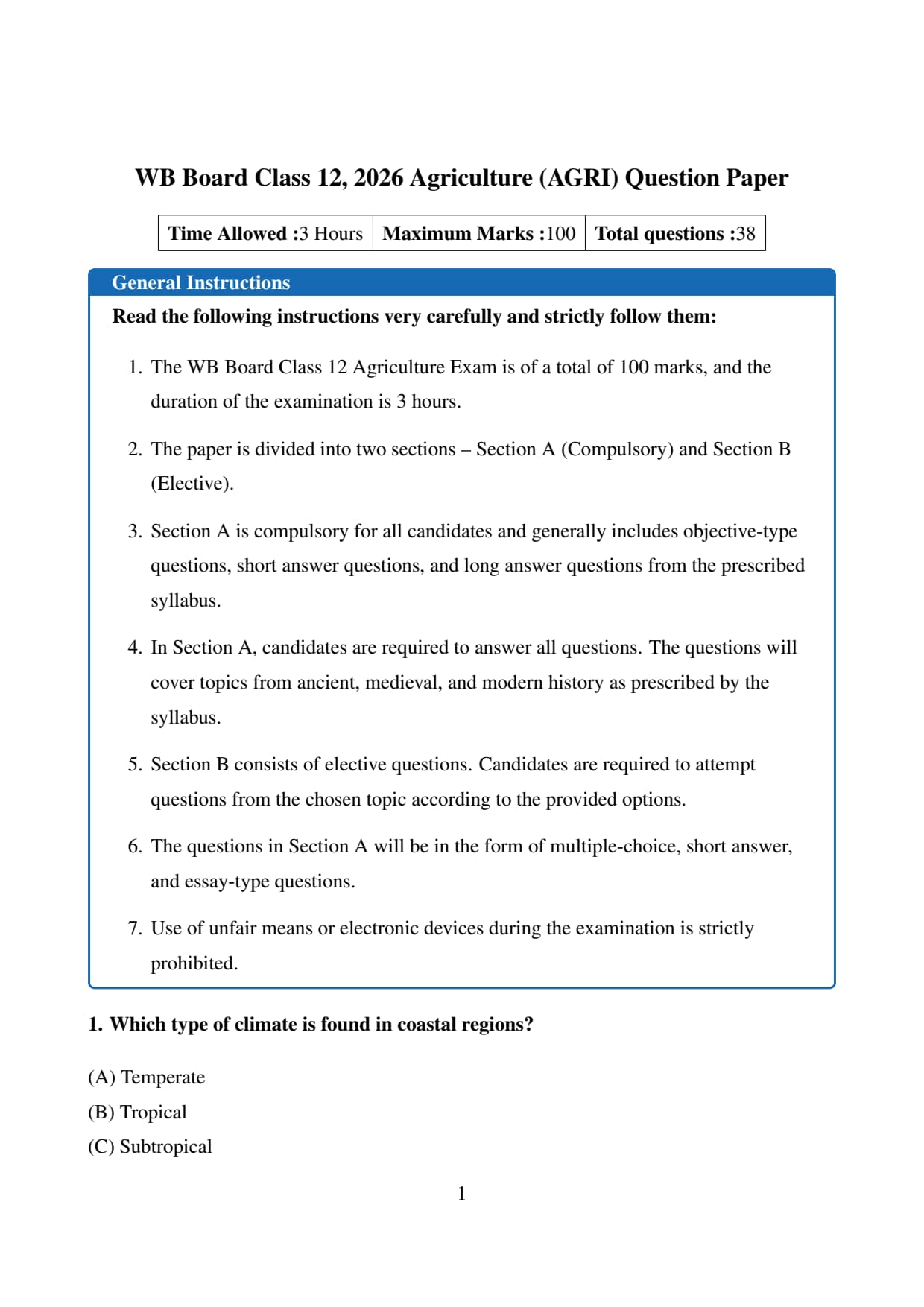
WB Board is conducting the Class 12 Agriculture (AGRI) Board Exam 2026 on February 19, 2026. Class 12 Agriculture (AGRI) Question Paper with Solution PDF is available here for download.
The official question paper of WB Board Class 12 Agriculture (AGRI) Board Exam 2026 is provided below. Students can download the official paper in PDF format for reference.
WB Board Class 12, 2026 Agriculture (AGRI) Question Paper with Solution PDF
| WB Board Class 12 Agriculture (AGRI) Question Paper 2026 |  Download Download |
Check Solutions |

Which type of climate is found in coastal regions?
View Solution
Coastal regions, especially those located in lower latitudes, often experience a Tropical climate. Due to the proximity to large water bodies, these areas maintain high humidity and relatively consistent temperatures throughout the year, as the ocean acts as a heat reservoir that moderates the climate.
Step 1: Analyze the options.
(A) Temperate: Found in mid-latitude regions with four distinct seasons; while some coasts are temperate, it is not the universal definition for "coastal regions" in this context.
(B) Tropical: Characterized by high temperatures and significant rainfall, this is the predominant climate for coastal belts in equatorial and near-equatorial zones.
(C) Subtropical: These regions are adjacent to the tropics but often have more seasonal temperature variation than true tropical coastal zones.
(D) Polar: Found at high latitudes (the Arctic and Antarctic), characterized by extreme cold; not a general characteristic of global coastal regions.
Step 2: Conclusion.
In the context of general geography and the provided options, Tropical is the most appropriate classification for the climate typically associated with these coastal zones. Hence, the correct answer is (B).
Final Answer: \[ \boxed{(B) \, Tropical} \] Quick Tip: Water has a higher specific heat capacity than land, meaning coastal regions stay warmer in winter and cooler in summer compared to inland areas, a phenomenon known as the "Maritime Effect."
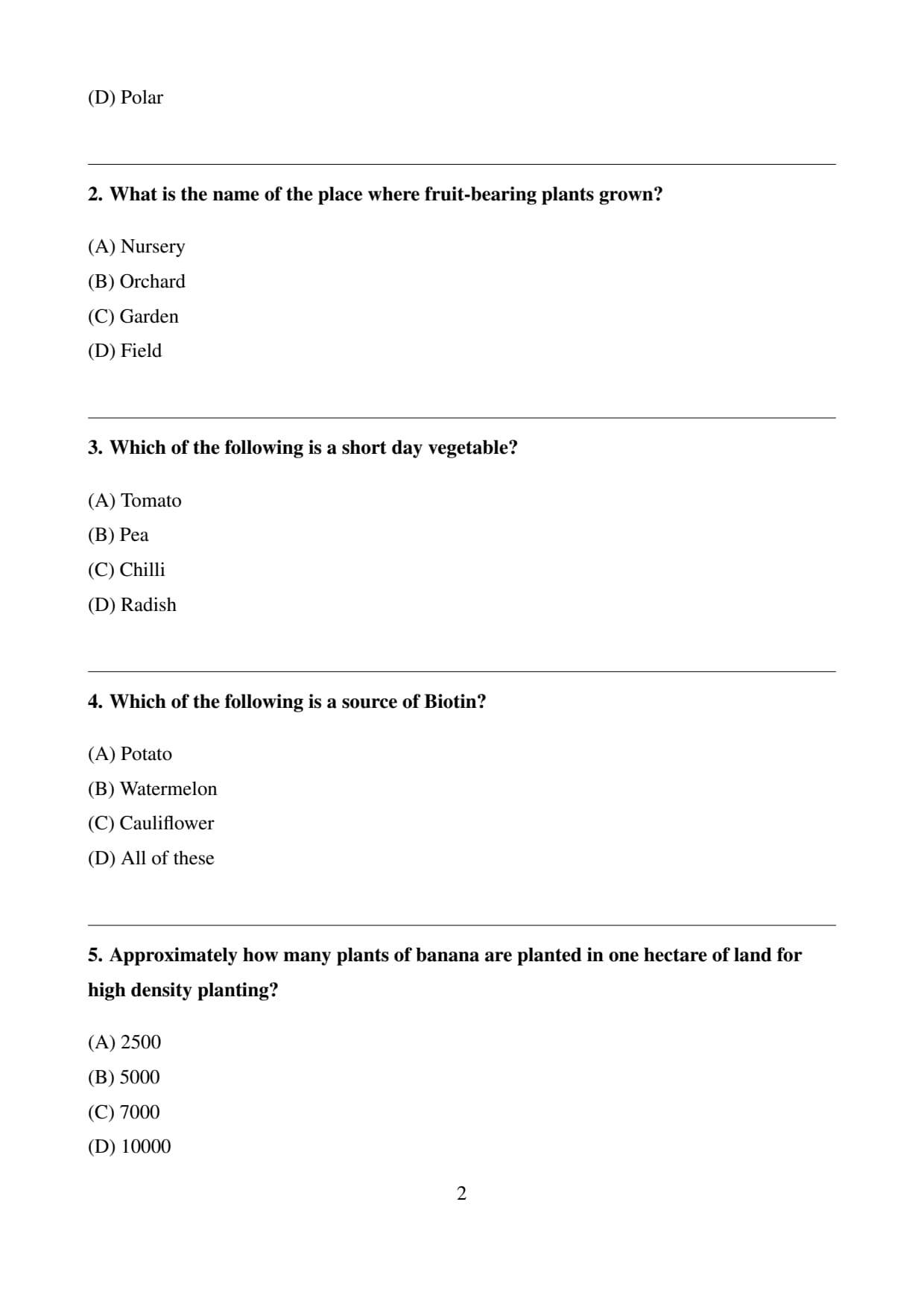
What is the name of the place where fruit-bearing plants grown?
View Solution
An Orchard is a specialized area of land dedicated to the intentional planting of trees or shrubs for food production, specifically fruit-bearing or nut-bearing plants. Unlike general farming, orchards focus on perennial woody plants.
Step 1: Analyze the options.
(A) Nursery: A place where young plants are propagated and grown to a usable size before being sold or transplanted.
(B) Orchard: A piece of land specifically planted with fruit trees.
(C) Garden: A piece of ground used for growing flowers, herbs, or vegetables; a garden can contain fruit, but it is not the technical term for a fruit-production site.
(D) Field: A large area of open land used for various agricultural purposes, typically for crops like grains.
Step 2: Conclusion.
The technical and specific term for a place where fruit trees are grown is an Orchard. Hence, the correct answer is (B).
Final Answer: \[ \boxed{(B) \, Orchard} \] Quick Tip: While a "Garden" is usually for domestic or decorative use, an "Orchard" is an agricultural term specifically for large-scale fruit production.
Which of the following is a short day vegetable?
View Solution
A short-day vegetable is one that requires a period of darkness longer than its critical photoperiod to initiate flowering. In agricultural classification, crops grown during the winter months (Rabi crops), like the Pea, are typically categorized as short-day or day-neutral plants depending on the specific cultivar.
Step 1: Analyze the options.
(A) Tomato: Generally classified as a day-neutral plant, as it flowers regardless of the length of the day.
(B) Pea: Often categorized as a short-day plant in several agricultural contexts because it thrives and flowers during the shorter days of winter.
(C) Chilli: Typically categorized as day-neutral.
(D) Radish: Generally a long-day plant, meaning it requires more than 12 hours of light to flower.
Step 2: Conclusion.
The Pea is the most suitable choice among the options for a vegetable that prefers or requires shorter daylight durations for its reproductive cycle. Hence, the correct answer is (B).
Final Answer: \[ \boxed{(B) \, Pea} \] Quick Tip: Photoperiodism is the physiological reaction of organisms to the length of night or a dark period; it is vital for determining the planting season of vegetables.
Which of the following is a source of Biotin?
View Solution
Biotin, also known as Vitamin B7, is a water-soluble vitamin that plays a vital role in metabolism. While it is found in various foods, Cauliflower is recognized as a significant plant-based source of this nutrient.
Step 1: Analyze the options.
(A) Potato: While potatoes contain various vitamins, they are not a primary or notable source of Biotin.
(B) Watermelon: This fruit is mostly water and contains Vitamin C and A, but negligible amounts of Biotin.
(C) Cauliflower: One of the best vegetable sources of Biotin; consuming it raw or lightly cooked preserves the vitamin content.
(D) All of these: Since options (A) and (B) are not significant sources, this option is incorrect.
Step 2: Conclusion.
Among the given choices, Cauliflower is the established source of Biotin. Hence, the correct answer is (C).
Final Answer: \[ \boxed{(C) \, Cauliflower} \] Quick Tip: Biotin is often called "Vitamin H" (from the German words Haar and Haut) because of its well-known benefits for hair and skin health.
Approximately how many plants of banana are planted in one hectare of land for high density planting?
View Solution
High Density Planting (HDP) is a modern farming technique where a higher number of plants are accommodated in a unit area compared to traditional methods. For banana cultivation, HDP usually involves closer spacing, such as \(1.2m \times 1.2m\) or \(1.5m \times 1.5m\), which significantly increases the plant population per hectare.
Step 1: Understand standard vs. high density.
Traditional banana planting usually accommodates about 1,500 to 2,500 plants per hectare. High density planting seeks to double or triple this number to maximize yield per unit area.
Step 2: Evaluate the numbers.
While the exact number can vary based on the specific spacing (e.g., triangular vs. rectangular), a common standard for "high density" in many commercial banana varieties is approximately 5,000 plants per hectare.
Step 3: Conclusion.
Option (B) represents the standard approximate value used in agricultural examinations for high density banana populations. Hence, the correct answer is (B).
Final Answer: \[ \boxed{(B) \, 5000} \] Quick Tip: High Density Planting not only increases yield but also helps in weed control due to the dense canopy, though it requires more intensive management of water and nutrients.
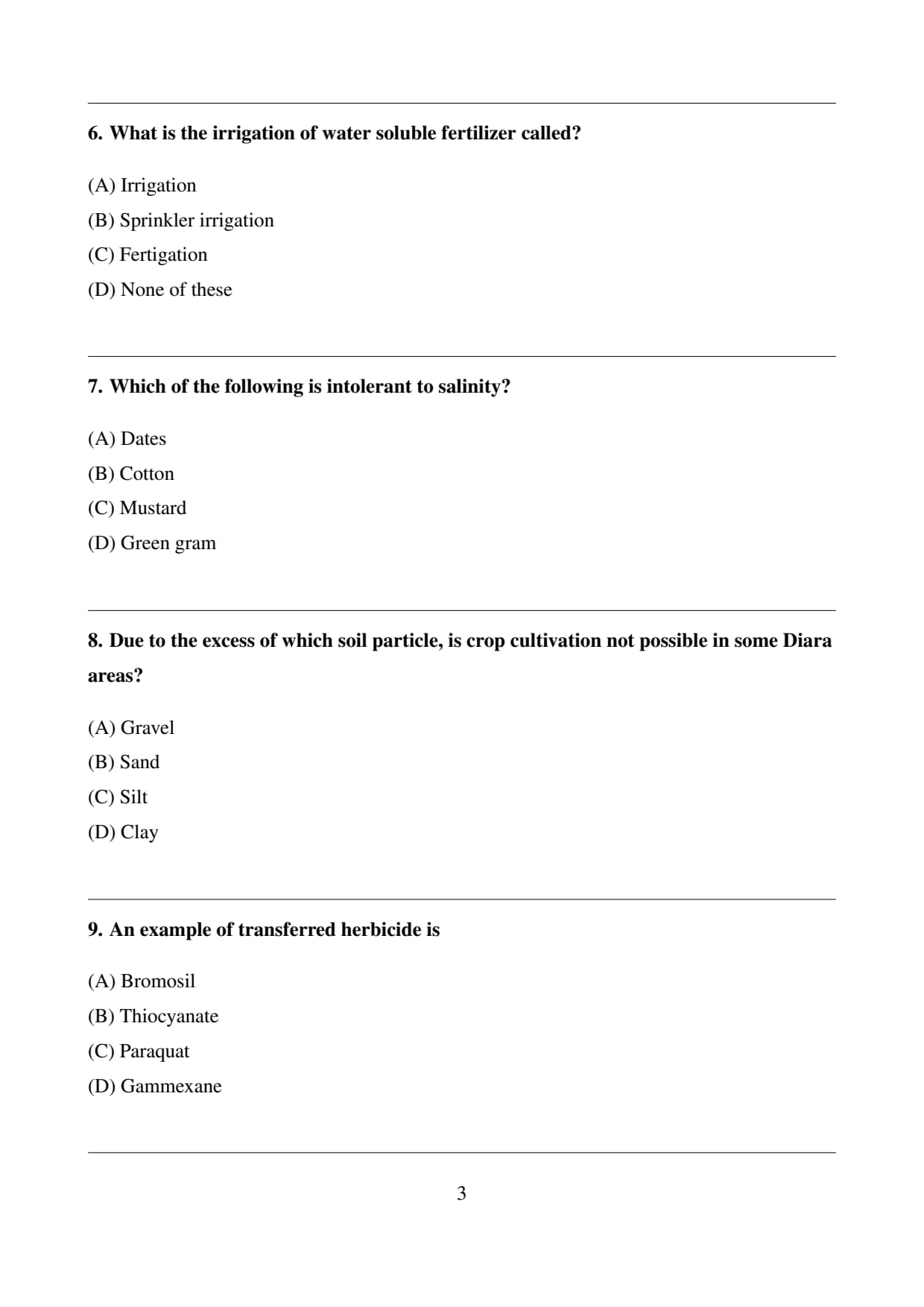
What is the irrigation of water soluble fertilizer called?
View Solution
The practice of applying water-soluble fertilizers, soil amendments, and other water-soluble products through an irrigation system is known as Fertigation. This method allows for the precise delivery of nutrients directly to the root zone of the plants.
Step 1: Analyze the options.
(A) Irrigation: This is the general term for the artificial application of water to land or soil; it does not specifically imply the addition of fertilizers.
(B) Sprinkler irrigation: This is a specific method of applying water that mimics natural rainfall; while fertilizers can be added, the method itself is defined by the water delivery mechanism, not the chemical addition.
(C) Fertigation: A portmanteau of "Fertilization" and "Irrigation." It specifically describes the simultaneous application of water and fertilizer.
(D) None of these: This is incorrect as option (C) is the accurate technical term.
Step 2: Conclusion.
The specific process of mixing fertilizer with irrigation water is called Fertigation. Hence, the correct answer is (C).
Final Answer: \[ \boxed{(C) \, Fertigation} \] Quick Tip: Fertigation is highly efficient as it reduces nutrient leaching and allows farmers to adjust nutrient delivery based on the specific growth stage of the crop.
Which of the following is intolerant to salinity?
View Solution
Salinity tolerance refers to the ability of a plant to grow and complete its life cycle on a substrate that contains high concentrations of soluble salts. Green gram (Vigna radiata) is highly sensitive to salt stress, which significantly affects its growth and grain yield.
Step 1: Analyze the options.
(A) Dates: Date palms are known for their high tolerance to salinity and can thrive in arid regions with salty soil.
(B) Cotton: Cotton is classified as a salt-tolerant crop, often grown in areas where other crops might fail due to soil salinity.
(C) Mustard: Mustard possesses a moderate level of tolerance to salinity compared to many pulse crops.
(D) Green gram: Pulses, in general, are sensitive to salinity. Green gram specifically is considered intolerant or highly sensitive, as even low levels of salinity can inhibit its nitrogen-fixing capabilities and overall development.
Step 2: Conclusion.
Among the given options, Green gram is the most intolerant to saline conditions. Hence, the correct answer is (D).
Final Answer: \[ \boxed{(D) \, Green gram} \] Quick Tip: Pulse crops like Green gram and Black gram are typically more sensitive to salinity than cereals or oilseeds because salinity interferes with the symbiotic relationship they have with Rhizobium bacteria.
Due to the excess of which soil particle, is crop cultivation not possible in some Diara areas?
View Solution
Diara lands are flood-prone areas located in the river basins. While these areas are often fertile due to annual silt deposition, some specific zones become unfit for cultivation due to an excess of sand particles. Large deposits of coarse sand reduce the soil's water-holding capacity and nutrient retention, making it difficult for most crops to survive.
Step 1: Analyze the options.
(A) Gravel: While present in some riverbeds, gravel is less common than sand in the vast stretches of Diara floodplains.
(B) Sand: High sand content (sandy diara) leads to poor soil structure and excessive drainage, which is the primary reason for cultivation failure in these specific riverine areas.
(C) Silt: Silt is actually beneficial for agriculture; Diara lands are famous for their high silt content which usually makes them very productive.
(D) Clay: Excessive clay can cause waterlogging, but in the context of Diara areas, the "wasteland" portions are typically dominated by sand deposits left after heavy floods.
Step 2: Conclusion.
The presence of excess sand is the limiting factor for agriculture in unproductive Diara patches. Hence, the correct answer is (B).
Final Answer: \[ \boxed{(B) \, Sand} \] Quick Tip: Diara land is also known as "Riverine land." Farmers in these areas often practice "Diara Cultivation" specifically for cucurbits (like watermelons and cucumbers) because their long taproots can reach the lower water table beneath the sandy surface.
An example of transferred herbicide is
View Solution
A transferred herbicide (also known as a systemic herbicide) is a chemical that is absorbed by the roots or foliage of a plant and then translocated (moved) through the vascular system to other parts of the plant, such as the roots or growing tips, to ensure a complete kill.
Step 1: Analyze the options.
(A) Bromosil: This is a substituted uracil herbicide that acts systemically. It is absorbed primarily through the roots and is translocated throughout the plant, inhibiting photosynthesis.
(B) Thiocyanate: Generally acts as a contact herbicide or a non-selective chemical, often used in industrial settings rather than as a standard systemic agricultural herbicide.
(C) Paraquat: A very famous "contact" herbicide. It only kills the green tissue it touches and does not move significantly through the plant's vascular system.
(D) Gammexane: This is actually an insecticide (Lindane), not a herbicide.
Step 2: Conclusion.
Bromosil is the correct example of a herbicide that utilizes translocation to be effective. Hence, the correct answer is (A).
Final Answer: \[ \boxed{(A) \, Bromosil} \] Quick Tip: Systemic (transferred) herbicides are particularly effective against perennial weeds because they travel down to the roots and underground tubers, preventing the plant from regrowing.
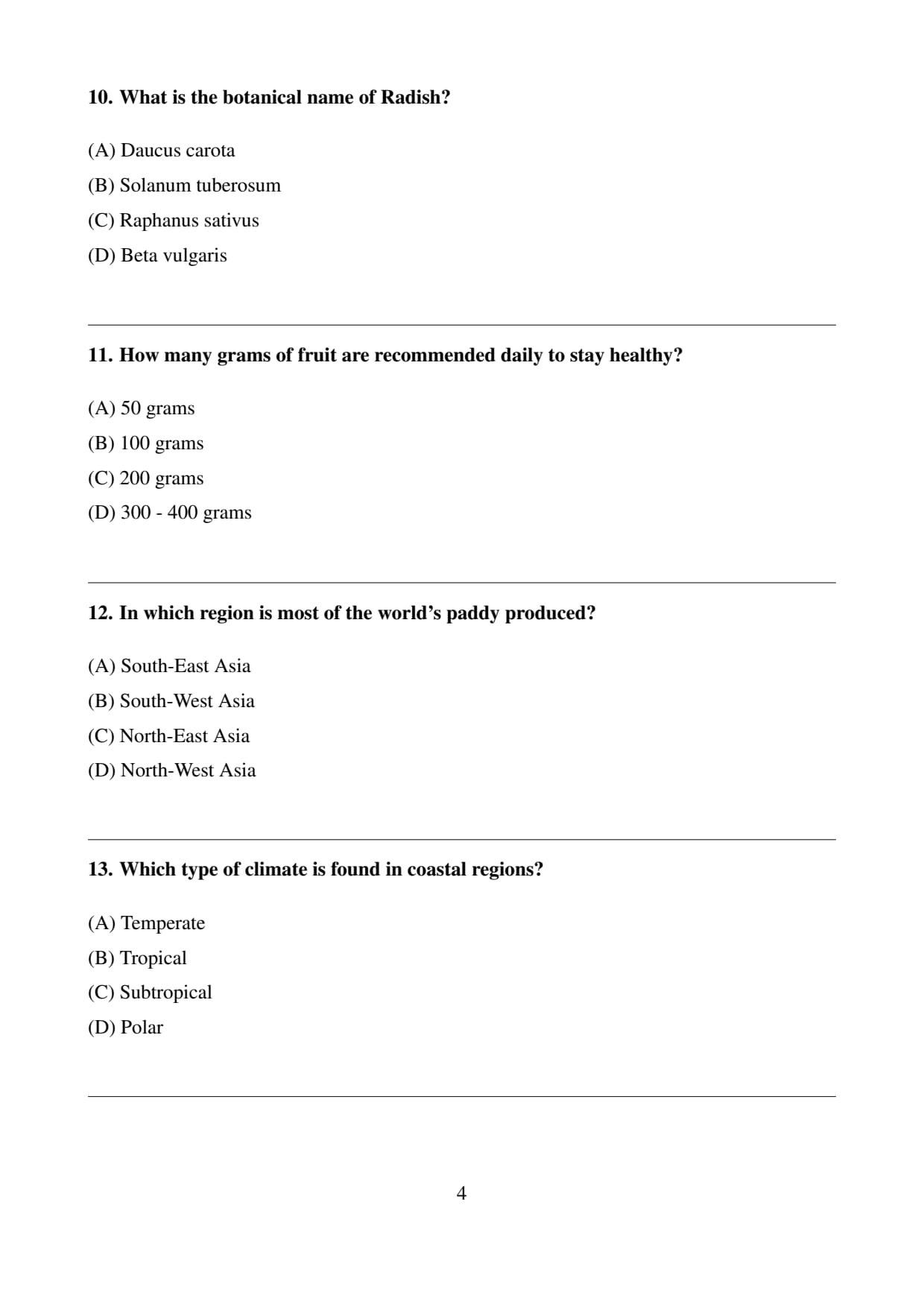
What is the botanical name of Radish?
View Solution
The botanical or scientific name of a plant is a formal system of naming using two parts (binomial nomenclature). For the Radish, which belongs to the Brassicaceae family, the correct botanical name is Raphanus sativus.
Step 1: Analyze the options.
(A) \textit{Daucus carota: This is the botanical name for the Carrot.
(B) \textit{Solanum tuberosum: This is the botanical name for the Potato.
(C) \textit{Raphanus sativus: This is the specific botanical name for the Radish. It is characterized by its edible root and pungent flavor.
(D) \textit{Beta vulgaris: This is the botanical name for Beetroot or Chard.
Step 2: Conclusion.
By identifying the specific names of common vegetables, we find that Radish corresponds to \textit{Raphanus sativus. Hence, the correct answer is (C).
Final Answer: \[ \boxed{(C) \, \textit{Raphanus sativus} \] Quick Tip: Botanical names are always written in italics (or underlined if handwritten). The first word (Genus) is capitalized, and the second word (species) starts with a lowercase letter.
How many grams of fruit are recommended daily to stay healthy?
View Solution
Nutritionists and global health organizations, such as the Indian Council of Medical Research (ICMR), provide specific dietary guidelines for maintaining optimal health. For an average adult, a daily intake of at least 100 grams of fruits is generally recommended to ensure a sufficient supply of vitamins, minerals, and antioxidants.
Step 1: Analyze the options.
(A) 50 grams: This amount is generally considered too low to meet the daily requirements for essential micronutrients found in fruit.
(B) 100 grams: This aligns with standard nutritional guidelines in many agricultural and health textbooks (particularly in the Indian context) as the minimum recommended daily serving.
(C) 200 grams: While consuming more fruit is often healthy, 100g is typically cited as the primary "stay healthy" benchmark in standard curricula.
(D) 300 - 400 grams: This range is more typical for total vegetable intake or combined fruit and vegetable targets, rather than fruit alone.
Step 2: Conclusion.
Based on standardized nutritional recommendations for dietary health, 100 grams is the recognized target for fruit consumption. Hence, the correct answer is (B).
Final Answer: \[ \boxed{(B) \, 100 grams} \] Quick Tip: Consuming fruits of different colors (the "rainbow diet") ensures that you get a diverse range of phytonutrients, as different colors often correspond to different types of antioxidants.
In which region is most of the world's paddy produced?
View Solution
Paddy (rice) is a staple crop that requires high temperatures, high humidity, and abundant rainfall or irrigation. South-East Asia, along with East and South Asia, constitutes the "rice bowl" of the world, producing more than 90% of the global rice supply due to its favorable monsoon climate and traditional farming practices.
Step 1: Analyze the options.
(A) South-East Asia: This region (including countries like Vietnam, Thailand, Indonesia, and Myanmar) is a global leader in paddy production due to the tropical monsoon climate.
(B) South-West Asia: This region is largely arid or semi-arid (Middle East), making it unsuitable for large-scale paddy cultivation which requires standing water.
(C) North-East Asia: While countries like China and Japan produce significant rice, the vast majority of global production is concentrated further south in the tropical and subtropical belts.
(D) North-West Asia: This area typically consists of colder or drier climates not conducive to the high-water requirements of paddy.
Step 2: Conclusion.
South-East Asia is the primary geographical region for the majority of the world's paddy production. Hence, the correct answer is (A).
Final Answer: \[ \boxed{(A) \, South-East Asia} \] Quick Tip: Rice is a "Kharif" crop in many regions, meaning it is sown at the beginning of the monsoon season to take advantage of the heavy rainfall necessary for its growth.
Which type of climate is found in coastal regions?
View Solution
Coastal regions, particularly those in lower latitudes, often exhibit a Tropical climate characterized by high humidity and moderate-to-high temperatures. The proximity to the ocean creates a maritime effect, which stabilizes temperatures compared to inland areas.
Step 1: Analyze the options.
(A) Temperate: Found in mid-latitude regions with distinct seasonal changes.
(B) Tropical: Characterized by consistent warmth and moisture, typical of many coastal belts.
(C) Subtropical: Zones bordering the tropics with more seasonal variation.
(D) Polar: Extreme cold regions near the Earth's poles.
Step 2: Conclusion.
Tropical is the most appropriate general classification for these regions. Hence, the correct answer is (B).
Final Answer: \[ \boxed{(B) \, Tropical} \] Quick Tip: Coastal climates are often moderated by "sea breezes," which keep the land cooler during the day and warmer at night.



Comments