




The Maharashtra Board 2026 Class 12 Physics (54) question paper and solution PDF are available here for download. The Class 12 exam was held in the morning session from 11:00 AM to 2:00 PM.
Based on the analysis of initial' board papers, the Maharashtra Board 2026 exam was generally moderate in difficulty, focusing on conceptual clarity and case studies. Students who practice Previous Year Question Papers (PYQs) and the official SCERT Maharashtra Question Bank score high easily. Aiming for 75+ marks in the written paper is an excellent achievement for MSBSHSE HSC Commerce students
Maharashtra Board 2026 Class 12 Physics(S) (54) Question Paper with Solution PDF – Memory Based
| Maharashtra Board 2026 Class 12 Physics(S) (54) Question Paper with Solution PDF | Download | Check Solutions |
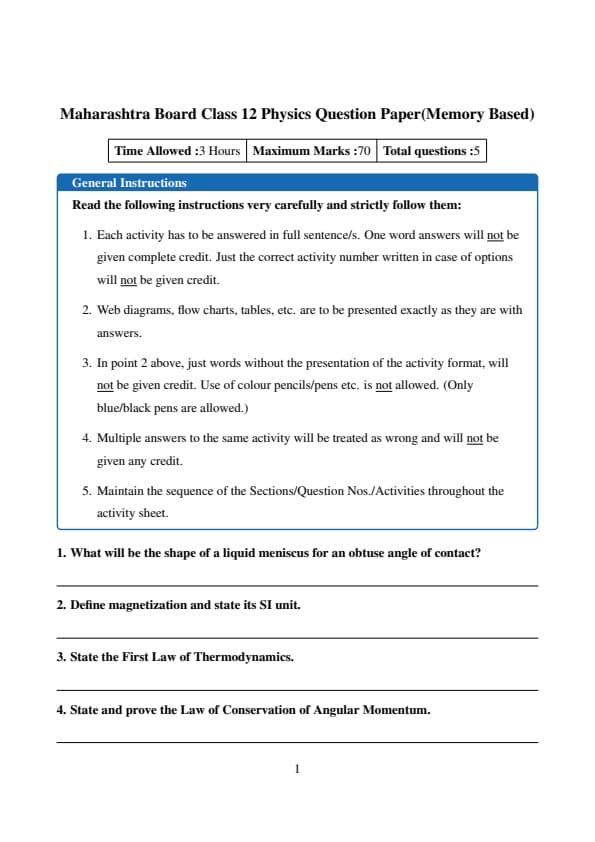
What will be the shape of a liquid meniscus for an obtuse angle of contact?
View Solution
Concept:
The shape of a liquid meniscus depends on the angle of contact (\(\theta\)) between the liquid and the container wall.
Step 1: Angle of contact definition
Angle of contact is the angle between the tangent to the liquid surface and the solid surface, measured inside the liquid.
Step 2: Cases based on angle
\(\theta < 90^\circ\) (acute angle):
Adhesive forces \(>\) cohesive forces → liquid wets the surface → concave meniscus.
Example: Water in glass.
\(\theta > 90^\circ\) (obtuse angle):
Cohesive forces \(>\) adhesive forces → liquid does not wet the surface → convex meniscus.
Example: Mercury in glass.
Step 3: Given condition
Since the angle of contact is obtuse (\(> 90^\circ\)):
\[ Meniscus shape = Convex \]
Final Answer:
\[ \boxed{Convex meniscus} \] Quick Tip: Angle of contact rule: Acute angle → Concave meniscus Obtuse angle → Convex meniscus Mercury in glass is the classic convex example.
Define magnetization and state its SI unit.
View Solution
Concept:
Magnetization describes how strongly a material becomes magnetized when placed in a magnetic field. It represents the alignment of magnetic dipoles within a substance.
Step 1: Definition
Magnetization (\(M\)) is defined as:
\[ M = \frac{Magnetic dipole moment}{Volume} \]
It indicates the net magnetic moment per unit volume of the material.
Step 2: Physical meaning
When a material is placed in an external magnetic field:
- Magnetic domains align
- Net magnetic dipole moment develops
This gives rise to magnetization.
Step 3: SI unit
Magnetic dipole moment has unit:
\[ A·m^2 \]
Dividing by volume (\(m^3\)):
\[ \frac{A·m^2}{m^3} = A/m \]
Final Answer:
\[ \boxed{Magnetization (M) = magnetic moment per unit volume, unit = A/m} \] Quick Tip: Magnetization = Magnetic moment density. Always remember unit: Ampere per metre (A/m).
State the First Law of Thermodynamics.
View Solution
Concept:
The First Law of Thermodynamics is based on the principle of conservation of energy applied to thermodynamic systems.
Step 1: Statement
It states that the total energy of an isolated system remains constant. Energy may change form (heat, work, internal energy) but cannot be created or destroyed.
Step 2: Mathematical expression
If heat \(Q\) is supplied to a system and work \(W\) is done by the system, then:
\[ Q = \Delta U + W \]
where: \(\Delta U\) = change in internal energy.
Step 3: Interpretation
- Part of heat increases internal energy.
- Remaining heat is used in doing external work.
Final Form:
\[ \boxed{Q = \Delta U + W} \] Quick Tip: First Law = Energy conservation in thermodynamics. Heat supplied = Increase in internal energy + Work done.
State and prove the Law of Conservation of Angular Momentum.
View Solution
Concept:
Angular momentum is the rotational analogue of linear momentum. It depends on the moment of inertia and angular velocity of a body.
Step 1: Definition of angular momentum
For a particle:
\[ \vec{L} = \vec{r} \times \vec{p} \]
For a rigid body rotating about a fixed axis:
\[ L = I\omega \]
where \(I\) = moment of inertia, \(\omega\) = angular velocity.
Step 2: Relation between torque and angular momentum
Torque is defined as:
\[ \vec{\tau} = \frac{d\vec{L}}{dt} \]
This is the rotational form of Newton’s second law.
Step 3: Condition for conservation
If the net external torque on the system is zero:
\[ \vec{\tau}_{ext} = 0 \]
Then:
\[ \frac{d\vec{L}}{dt} = 0 \]
Step 4: Integrating
\[ \frac{d\vec{L}}{dt} = 0 \Rightarrow \vec{L} = constant \]
Thus angular momentum remains conserved.
Step 5: Alternative form
For a rotating rigid body:
\[ I_1 \omega_1 = I_2 \omega_2 \]
This shows that if moment of inertia changes, angular velocity adjusts to keep angular momentum constant.
Conclusion:
In absence of external torque, angular momentum remains conserved in both magnitude and direction. Quick Tip: No external torque → Angular momentum conserved. Example: Figure skater spins faster when pulling arms inward.
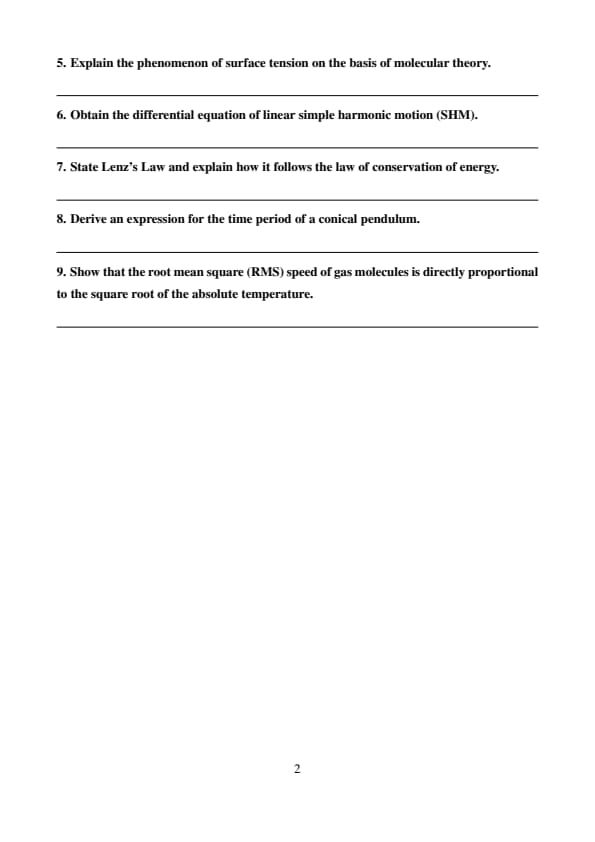
Explain the phenomenon of surface tension on the basis of molecular theory.
View Solution
Concept:
Surface tension is explained by intermolecular forces acting between liquid molecules, particularly cohesive forces.
Step 1: Molecules inside the liquid
A molecule deep inside a liquid is surrounded by other molecules on all sides.
Cohesive forces act equally in all directions, so the net force is zero.
Step 2: Molecules at the surface
A surface molecule has:
- Neighbouring molecules below and sideways
- Very few molecules above (air)
Thus, cohesive forces are unbalanced and act inward.
Step 3: Result of inward force
Due to this inward pull:
- Surface molecules are drawn closer together
- Surface area tends to decrease
This gives rise to surface tension.
Step 4: Surface behaves like a stretched membrane
The liquid surface acts like an elastic film trying to contract, similar to a stretched rubber sheet.
Step 5: Molecular energy explanation
Surface molecules possess higher potential energy than interior molecules.
To minimize energy, the liquid reduces surface area, producing surface tension effects.
Conclusion:
Surface tension is caused by unbalanced cohesive molecular forces at the liquid surface, making the surface contract and behave like a stretched membrane. Quick Tip: Inside liquid → Balanced forces Surface molecules → Inward pull → Surface tension That’s why drops become spherical.
Obtain the differential equation of linear simple harmonic motion (SHM).
View Solution
Concept:
Simple harmonic motion (SHM) is a type of oscillatory motion in which the restoring force is directly proportional to displacement and directed towards the mean position.
Step 1: Restoring force in SHM
In SHM, restoring force is proportional to displacement and opposite in direction:
\[ F \propto -x \]
\[ F = -kx \]
where \(k\) is a constant.
Step 2: Apply Newton’s second law
\[ F = ma \]
\[ m\frac{d^2x}{dt^2} = -kx \]
Step 3: Rearranging
\[ \frac{d^2x}{dt^2} + \frac{k}{m}x = 0 \]
Step 4: Define angular frequency
Let:
\[ \omega^2 = \frac{k}{m} \]
Substitute into the equation.
Final Differential Equation
\[ \boxed{\frac{d^2x}{dt^2} + \omega^2 x = 0} \]
Interpretation:
This equation shows that acceleration is always proportional to displacement and directed towards the equilibrium position, which is the defining property of SHM. Quick Tip: SHM key idea: Restoring force \(\propto\) displacement and opposite in direction. That always leads to: \[ \frac{d^2x}{dt^2} + \omega^2 x = 0 \]
State Lenz’s Law and explain how it follows the law of conservation of energy.
View Solution
Concept:
Lenz’s Law is a consequence of Faraday’s law of electromagnetic induction and determines the direction of induced current.
Step 1: Statement of Lenz’s Law
The induced emf or current is always in such a direction that the magnetic field produced by it opposes the change in magnetic flux causing it.
Mathematically included as the negative sign in Faraday’s law:
\[ \mathcal{E} = -\frac{d\Phi}{dt} \]
Step 2: Example of increasing flux
Consider a magnet moving towards a conducting loop.
- Magnetic flux through the loop increases.
- Induced current produces a magnetic field opposing the approaching magnet.
This creates a repulsive force.
Step 3: Energy consideration
To push the magnet towards the loop, external work must be done against this repulsive force.
This mechanical work is converted into electrical energy (induced current).
Step 4: If Lenz’s law were not true
If the induced current supported the change instead of opposing it:
- Magnet would accelerate without external work.
- Energy would be produced without input.
This would violate conservation of energy.
Step 5: Conclusion
Thus, Lenz’s Law ensures that:
- Induction always resists the cause producing it.
- Energy input is required for energy output.
Hence it is consistent with the law of conservation of energy. Quick Tip: Lenz’s Law = Nature resists change. Induced current always opposes flux change → Prevents free energy → Ensures energy conservation.
Derive an expression for the time period of a conical pendulum.
View Solution
Concept:
A conical pendulum consists of a mass tied to a string moving in a horizontal circular path such that the string makes a constant angle \(\theta\) with the vertical.
The motion is uniform circular motion with centripetal force provided by components of tension.
Step 1: Forces acting on the bob
Let tension in the string be \(T\).
Resolve tension into components:
Vertical component: \(T\cos\theta\) balances weight
Horizontal component: \(T\sin\theta\) provides centripetal force
Step 2: Vertical equilibrium
\[ T\cos\theta = mg \quad \cdots (1) \]
Step 3: Centripetal force
Radius of circular path:
\[ r = l\sin\theta \]
Centripetal force:
\[ T\sin\theta = \frac{mv^2}{r} \]
\[ T\sin\theta = \frac{mv^2}{l\sin\theta} \quad \cdots (2) \]
Step 4: Divide equations (2) by (1)
\[ \frac{T\sin\theta}{T\cos\theta} = \frac{mv^2/(l\sin\theta)}{mg} \]
\[ \tan\theta = \frac{v^2}{gl\sin\theta} \]
Step 5: Solve for velocity
\[ v^2 = gl\sin\theta \tan\theta = gl\frac{\sin^2\theta}{\cos\theta} \]
\[ v = \sqrt{\frac{gl\sin^2\theta}{\cos\theta}} \]
Step 6: Time period of circular motion
\[ T = \frac{2\pi r}{v} \]
\[ T = \frac{2\pi l\sin\theta}{\sqrt{\frac{gl\sin^2\theta}{\cos\theta}}} \]
Step 7: Simplify
\[ T = 2\pi \sqrt{\frac{l\cos\theta}{g}} \]
Final Expression:
\[ \boxed{T = 2\pi \sqrt{\frac{l\cos\theta}{g}}} \] Quick Tip: Conical pendulum shortcut: Replace effective length by \(l\cos\theta\) in simple pendulum formula. So: \[ T = 2\pi \sqrt{\frac{l\cos\theta}{g}} \]
Show that the root mean square (RMS) speed of gas molecules is directly proportional to the square root of the absolute temperature.
View Solution
Concept:
According to the kinetic theory of gases, the average kinetic energy of gas molecules is directly proportional to the absolute temperature.
Step 1: Kinetic energy of one molecule
The translational kinetic energy of a molecule is:
\[ KE = \frac{1}{2}mv^2 \]
For RMS speed:
\[ \frac{1}{2}m v_{rms}^2 \]
Step 2: Relation from kinetic theory
Average kinetic energy of a gas molecule:
\[ \frac{1}{2}m v_{rms}^2 = \frac{3}{2}kT \]
where \(k\) = Boltzmann constant \(T\) = absolute temperature
Step 3: Solve for RMS speed
\[ m v_{rms}^2 = 3kT \]
\[ v_{rms}^2 = \frac{3kT}{m} \]
\[ v_{rms} = \sqrt{\frac{3kT}{m}} \]
Step 4: Proportionality
Since \(k\) and \(m\) are constants for a given gas:
\[ v_{rms} \propto \sqrt{T} \]
Conclusion:
The RMS speed of gas molecules is directly proportional to the square root of the absolute temperature. Quick Tip: Temperature increases → molecular speed increases. Doubling temperature does NOT double speed — it increases by \(\sqrt{2}\).



Comments