




The Maharashtra Board 2026 Class 12 Secretarial Practice (Commerce) (52) Question Paper with Solution PDF is available here to download. The Secretarial Practice exam was conducted in the Morning Session from 11:00 AM to 2:00 PM as per the official MSBSHSE HSC timetable.
Students who regularly practice Previous Year Question Papers (PYQs), revise important definitions and provisions, and thoroughly prepare from the official Maharashtra State Board textbook and SCERT question bank have a strong chance of scoring high marks. Securing 70+ marks in the written paper is considered a very good performance, while scoring 80+ marks reflects excellent preparation and clarity in concepts for MSBSHSE HSC Commerce students.
Maharashtra Board 2026 Class 12 Secretarial Practice (Commerce) (52) of Question Paper with Solution PDF – Memory Based
| Maharashtra Board 2026 Class 12 Secretarial Practice (Commerce) (52) Question Paper with Solution PDF | Download | Check Solutions |

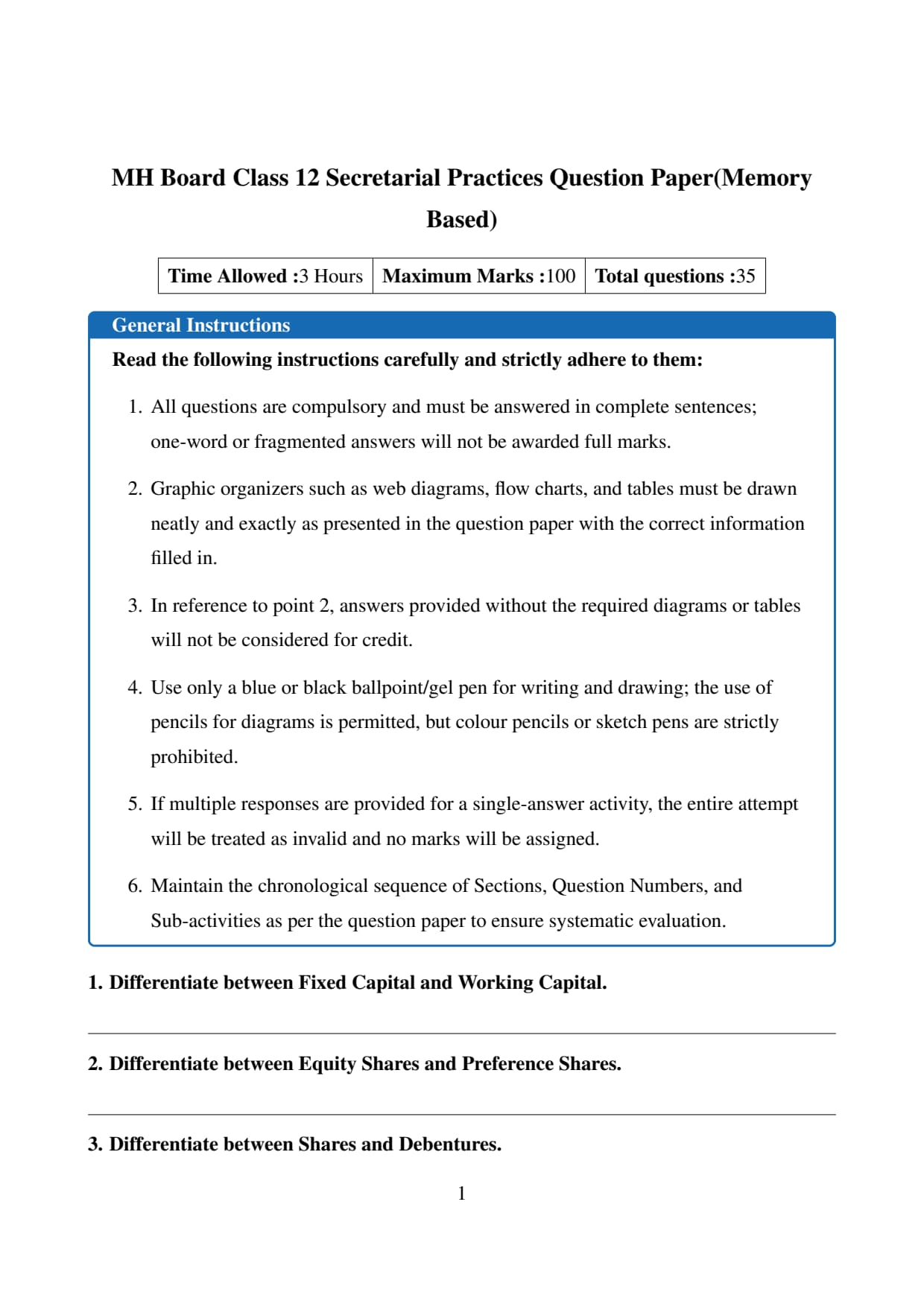
Differentiate between Fixed Capital and Working Capital.
View Solution
Concept:
Capital refers to the money or assets used in business operations.
It is broadly classified into:
Fixed Capital
Working Capital
Fixed Capital:
Fixed capital refers to the money invested in long-term assets that are used repeatedly in production.
Features:
Used for purchasing fixed assets
Long-term investment
Not consumed in a single production cycle
Examples:
Machinery
Buildings
Land
Tools and equipment
Working Capital:
Working capital refers to the money used for day-to-day business operations.
Features:
Short-term in nature
Used in daily production activities
Continuously converted into cash
Examples:
Raw materials
Wages and salaries
Electricity bills
Transport costs
Difference between Fixed Capital and Working Capital:
\begin{tabular{|c|c|c|
\hline
Basis & Fixed Capital & Working Capital
\hline
Nature & Long-term & Short-term
\hline
Use & Purchase of fixed assets & Daily operations
\hline
Consumption & Used repeatedly & Consumed quickly
\hline
Examples & Machinery, buildings & Raw materials, wages
\hline
\end{tabular
Conclusion:
Fixed capital supports production infrastructure, while working capital ensures smooth day-to-day functioning of a business. Quick Tip: Fixed capital = Long-term assets. Working capital = Daily business expenses.
Differentiate between Equity Shares and Preference Shares.
View Solution
Concept:
Shares represent ownership in a company. They are broadly classified into:
Equity Shares
Preference Shares
Equity Shares:
Equity shares are ordinary shares that represent ownership of the company.
Features:
Owners are called equity shareholders
Dividend is variable (depends on profit)
Voting rights are available
Higher risk but higher return potential
Preference Shares:
Preference shares are those shares which have preferential rights over equity shares in certain matters.
Features:
Fixed rate of dividend
Priority in dividend payment
Preference in repayment during liquidation
Usually no voting rights
Difference between Equity Shares and Preference Shares:
\begin{tabular{|c|c|c|
\hline
Basis & Equity Shares & Preference Shares
\hline
Ownership & Real owners of company & Limited ownership rights
\hline
Dividend & Variable & Fixed
\hline
Risk & High risk & Lower risk
\hline
Voting rights & Available & Generally not available
\hline
Priority in liquidation & Paid after preference shareholders & Paid before equity shareholders
\hline
\end{tabular
Conclusion:
Equity shares offer ownership and higher returns with risk, while preference shares provide stable returns with priority benefits. Quick Tip: Equity = Ownership + Voting + Variable returns. Preference = Fixed dividend + Priority benefits.
Differentiate between Shares and Debentures.
View Solution
Concept:
Companies raise long-term finance through shares and debentures.
Both are sources of capital but differ in ownership, risk, and return.
Shares:
Shares represent ownership in a company.
Features:
Shareholders are owners of the company
Return is in the form of dividend
Dividend depends on profits
Shareholders may have voting rights
Debentures:
Debentures are instruments of borrowing issued by a company.
Features:
Debenture holders are creditors
Fixed rate of interest is paid
Interest is paid whether profit or loss
No voting rights
Difference between Shares and Debentures:
\begin{tabular{|c|c|c|
\hline
Basis & Shares & Debentures
\hline
Status & Owners of company & Creditors of company
\hline
Return & Dividend & Interest
\hline
Nature of return & Variable & Fixed
\hline
Risk & Higher risk & Lower risk
\hline
Voting rights & Usually available & Not available
\hline
Repayment & Not repaid during life of company & Repaid after fixed period
\hline
Security & Not secured & Often secured against assets
\hline
\end{tabular
Conclusion:
Shares represent ownership with variable returns, whereas debentures represent loans with fixed interest and lower risk. Quick Tip: Shares = Ownership + Dividend. Debentures = Loan + Fixed Interest.
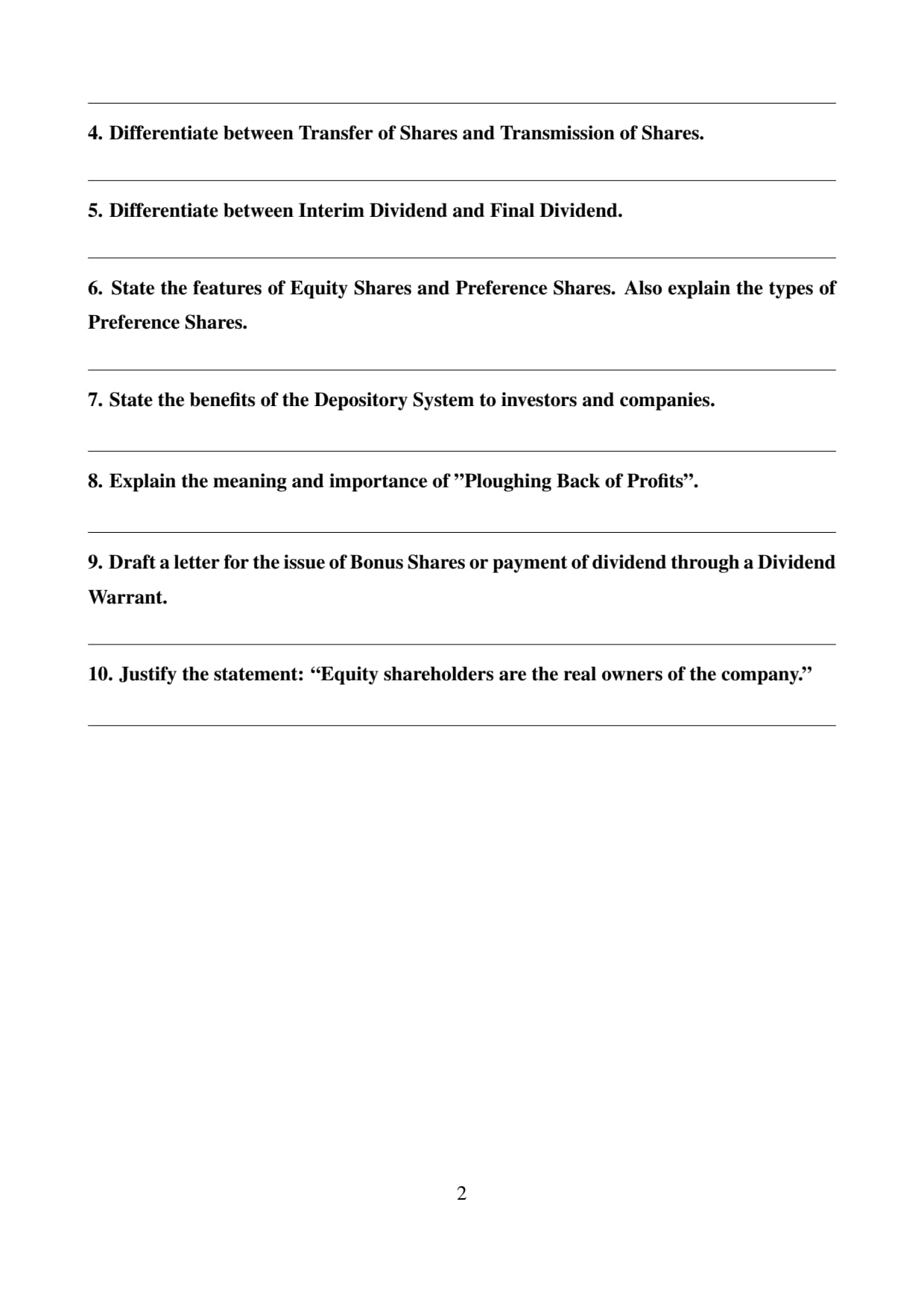
Differentiate between Transfer of Shares and Transmission of Shares.
View Solution
Concept:
Shares of a company may change ownership either voluntarily or due to operation of law.
This leads to two concepts:
Transfer of Shares
Transmission of Shares
Transfer of Shares:
Transfer of shares refers to the voluntary transfer of ownership of shares by a shareholder to another person.
Features:
Done by choice of the shareholder
Takes place through sale or gift
Requires execution of transfer deed
Consideration (price) is usually involved
Transmission of Shares:
Transmission of shares refers to the transfer of shares by operation of law.
Features:
Not voluntary
Occurs due to death, insolvency, or lunacy of shareholder
Legal heirs or nominees receive shares
No transfer deed required
Difference between Transfer and Transmission of Shares:
\begin{tabular{|c|c|c|
\hline
Basis & Transfer of Shares & Transmission of Shares
\hline
Nature & Voluntary & By operation of law
\hline
Initiated by & Shareholder & Legal circumstances
\hline
Consideration & Usually present & No consideration
\hline
Transfer deed & Required & Not required
\hline
Reason & Sale or gift & Death, insolvency, etc.
\hline
\end{tabular
Conclusion:
Transfer of shares is a voluntary act of the shareholder, while transmission occurs automatically due to legal reasons. Quick Tip: Transfer = Voluntary sale/gift. Transmission = Legal transfer after death or insolvency.
Differentiate between Interim Dividend and Final Dividend.
View Solution
Concept:
Dividend is the portion of profits distributed by a company to its shareholders.
It can be declared either during the financial year or after its completion.
Interim Dividend:
Interim dividend is the dividend declared by the Board of Directors during the financial year, before final accounts are prepared.
Features:
Declared during the accounting year
Announced by Board of Directors
Based on estimated profits
Does not require approval in AGM
Final Dividend:
Final dividend is declared after the end of the financial year, once final accounts are prepared.
Features:
Declared after financial year ends
Recommended by Board of Directors
Approved by shareholders in AGM
Based on actual profits
Difference between Interim and Final Dividend:
\begin{tabular{|c|c|c|
\hline
Basis & Interim Dividend & Final Dividend
\hline
Timing & During financial year & After financial year ends
\hline
Declared by & Board of Directors & Shareholders in AGM (on recommendation)
\hline
Profit basis & Estimated profits & Actual profits
\hline
Approval & No AGM approval needed & Requires AGM approval
\hline
Frequency & May be multiple times & Usually once a year
\hline
\end{tabular
Conclusion:
Interim dividend is an advance dividend declared during the year, while final dividend is declared after finalising annual profits. Quick Tip: Interim = During year, by directors. Final = After year-end, approved in AGM.
State the features of Equity Shares and Preference Shares. Also explain the types of Preference Shares.
View Solution
Concept:
Share capital of a company is broadly divided into:
Equity Shares
Preference Shares
Each has distinct features and rights.
Features of Equity Shares:
Equity shares represent the ownership of a company.
Equity shareholders are the real owners of the company.
They have voting rights in company decisions.
Dividend is variable and depends on profits.
They bear the highest risk.
Paid after preference shareholders during liquidation.
Possibility of higher returns in profitable years.
Features of Preference Shares:
Preference shares have preferential rights over equity shares.
Fixed rate of dividend.
Priority in payment of dividend.
Preference in repayment of capital during winding up.
Generally no voting rights (except in special cases).
Lower risk compared to equity shares.
Types of Preference Shares:
Preference shares can be classified on different bases.
1. On the basis of dividend accumulation
(a) Cumulative Preference Shares:
Unpaid dividends accumulate and are paid in future years.
(b) Non-cumulative Preference Shares:
Unpaid dividends do not accumulate.
2. On the basis of participation in profits
(a) Participating Preference Shares:
Shareholders receive additional dividend after equity shareholders.
(b) Non-participating Preference Shares:
No share in surplus profits.
3. On the basis of convertibility
(a) Convertible Preference Shares:
Can be converted into equity shares after a specified period.
(b) Non-convertible Preference Shares:
Cannot be converted into equity shares.
4. On the basis of redemption
(a) Redeemable Preference Shares:
Can be repaid after a fixed period.
(b) Irredeemable Preference Shares:
Not repayable during the lifetime of the company (rare in modern practice).
Conclusion:
Equity shares provide ownership and higher risk-return potential, while preference shares provide fixed returns and priority rights with different structural types. Quick Tip: Equity = Ownership + Voting + Variable returns. Preference = Fixed dividend + Priority rights + Multiple types.
State the benefits of the Depository System to investors and companies.
View Solution
Concept:
A depository system allows securities (shares, debentures, bonds) to be held in electronic form instead of physical certificates.
It works through depositories like NSDL and CDSL and depository participants (DPs).
Benefits to Investors:
Safety of securities: Eliminates risks of loss, theft, forgery, and damage of physical certificates.
Convenience: No need to handle paper certificates.
Easy transfer: Quick and hassle-free transfer of securities.
No stamp duty: Transfers in electronic mode do not require stamp duty.
Faster settlement: Reduced settlement time in stock market transactions.
Reduced paperwork: Less documentation and administrative work.
Automatic credit: Bonus shares, dividends, and rights shares are credited directly.
Nomination facility: Easy nomination and transmission process.
Benefits to Companies:
Reduced administrative cost: Less printing, storage, and handling of certificates.
Elimination of forgery: No fake or duplicate certificates.
Faster transfer of securities: Improves liquidity of shares.
Improved investor satisfaction: Efficient and transparent system.
Better record keeping: Electronic records are accurate and easy to maintain.
Quick corporate actions: Easy distribution of bonus shares, dividends, etc.
Reduced legal disputes: Less litigation related to loss or transfer of certificates.
Conclusion:
The depository system enhances efficiency, safety, and transparency in holding and transferring securities, benefiting both investors and companies. Quick Tip: Depository system = Paperless securities + Faster transfers + Greater safety.
Explain the meaning and importance of "Ploughing Back of Profits".
View Solution
Concept:
Ploughing back of profits refers to retaining a portion of a company's profits in the business instead of distributing them fully as dividends.
It is also known as retained earnings or self-financing.
Meaning:
Ploughing back of profits means:
\begin{quote
Reinvesting a part of the profits into the business for future growth and expansion.
\end{quote
Instead of distributing all profits to shareholders, the company keeps some funds for internal use.
Importance of Ploughing Back of Profits:
1. Source of Internal Finance:
Provides funds without borrowing from external sources.
2. Expansion and Growth:
Helps in business expansion, diversification, and modernization.
3. Reduces Dependence on Loans:
Less reliance on external borrowings reduces financial risk.
4. Improves Financial Stability:
Strengthens the company’s financial position and reserves.
5. Increases Shareholder Value:
Reinvestment may lead to higher future profits and capital appreciation.
6. No Interest Burden:
Unlike loans, retained profits do not require interest payments.
7. Helps in Emergencies:
Acts as a financial cushion during economic downturns.
Conclusion:
Ploughing back of profits is an important strategy for long-term growth, financial stability, and self-reliance of a company. Quick Tip: Ploughing back = Retained profits reinvested for growth and stability.
Draft a letter for the issue of Bonus Shares or payment of dividend through a Dividend Warrant.
View Solution
Concept:
A company communicates corporate actions like bonus shares or dividend payments through formal letters to shareholders.
Below are sample formats for both cases.
(A) Letter for Issue of Bonus Shares
\begin{flushleft
ABC Ltd.
Registered Office: 123, Business Street, Mumbai
Date: 10 April 2026
To,
All Shareholders of ABC Ltd.
Subject: Issue of Bonus Shares
Dear Shareholder,
We are pleased to inform you that the Board of Directors of ABC Ltd., in its meeting held on 8 April 2026, has approved the issue of bonus shares in the ratio of 1:2, i.e., one bonus share for every two equity shares held by you.
These bonus shares will be issued by capitalising the company’s free reserves and will be credited to your demat account on or before 30 April 2026. No action is required from your side in this regard.
We thank you for your continued trust and support.
Yours faithfully,
For ABC Ltd.
(Authorized Signatory)
\hrule
(B) Letter for Payment of Dividend through Dividend Warrant
\begin{flushleft
XYZ Ltd.
Corporate Office: 45, Industrial Area, Delhi
Date: 15 July 2026
To,
Mr./Ms. Shareholder Name
Address
Subject: Payment of Dividend
Dear Shareholder,
We are pleased to inform you that the shareholders of XYZ Ltd., at the Annual General Meeting held on 12 July 2026, have approved a final dividend of 15% for the financial year 2025–26.
Accordingly, a dividend warrant for the amount due to you is enclosed herewith. You are requested to deposit the warrant in your bank for encashment at the earliest.
In case of any discrepancy, please contact our Registrar and Transfer Agent.
We thank you for your continued support.
Yours faithfully,
For XYZ Ltd.
(Company Secretary) Quick Tip: Bonus shares = Issued from reserves, no cash outflow. Dividend warrant = Written instrument for dividend payment.
Justify the statement: “Equity shareholders are the real owners of the company.”
View Solution
Concept:
Equity shareholders are considered the real owners because they bear the ultimate risk and enjoy the residual benefits of the company.
Justification:
1. Ownership Rights:
Equity shareholders provide the risk capital and hold ownership of the company.
2. Voting Rights:
They have voting rights and can participate in important decisions like election of directors and approval of policies.
3. Control over Management:
Through voting power, they influence the management and governance of the company.
4. Residual Claim on Profits:
They receive dividends only after all expenses, taxes, and preference dividends are paid. Hence, they are residual claimants.
5. Residual Claim on Assets:
In case of liquidation, they are paid after all creditors and preference shareholders. This reflects ultimate ownership and risk.
6. Higher Risk–Higher Return:
They bear the maximum risk but also enjoy the possibility of higher returns.
7. Participation in Growth:
Equity shareholders benefit from capital appreciation and bonus issues as the company grows.
Conclusion:
Since equity shareholders bear maximum risk, enjoy voting rights, and have residual claims on profits and assets, they are rightly regarded as the real owners of the company. Quick Tip: Equity shareholders = Ownership + Voting rights + Residual claims.



Comments