




Maharashtra Board is conducting the Class 12 Chemistry Board Exam 2026 on February 18, 2026. Class 12 Chemistry Question Paper with Solution PDF is available here for download.
The official question paper of Maharashtra Board Class 12 Chemistry Board Exam 2026 is provided below. Students can download the official Class 12 HSC Chemistry in PDF format for reference.
Maharashtra Board Class 12 HSC Chemistry Question Paper 2026 with Solution PDF
| Maharashtra Board Class 12 2026 Chemistry Question Paper with Solution PDF | Download PDF | Check Solutions |
The electrolyte used in \(H_2 - O_2\) fuel cell is ________.
The oxidation state of bromine in \(HOBrO_2\) oxoacid is ________.
Acetonitrile may be prepared by heating the following reactants :
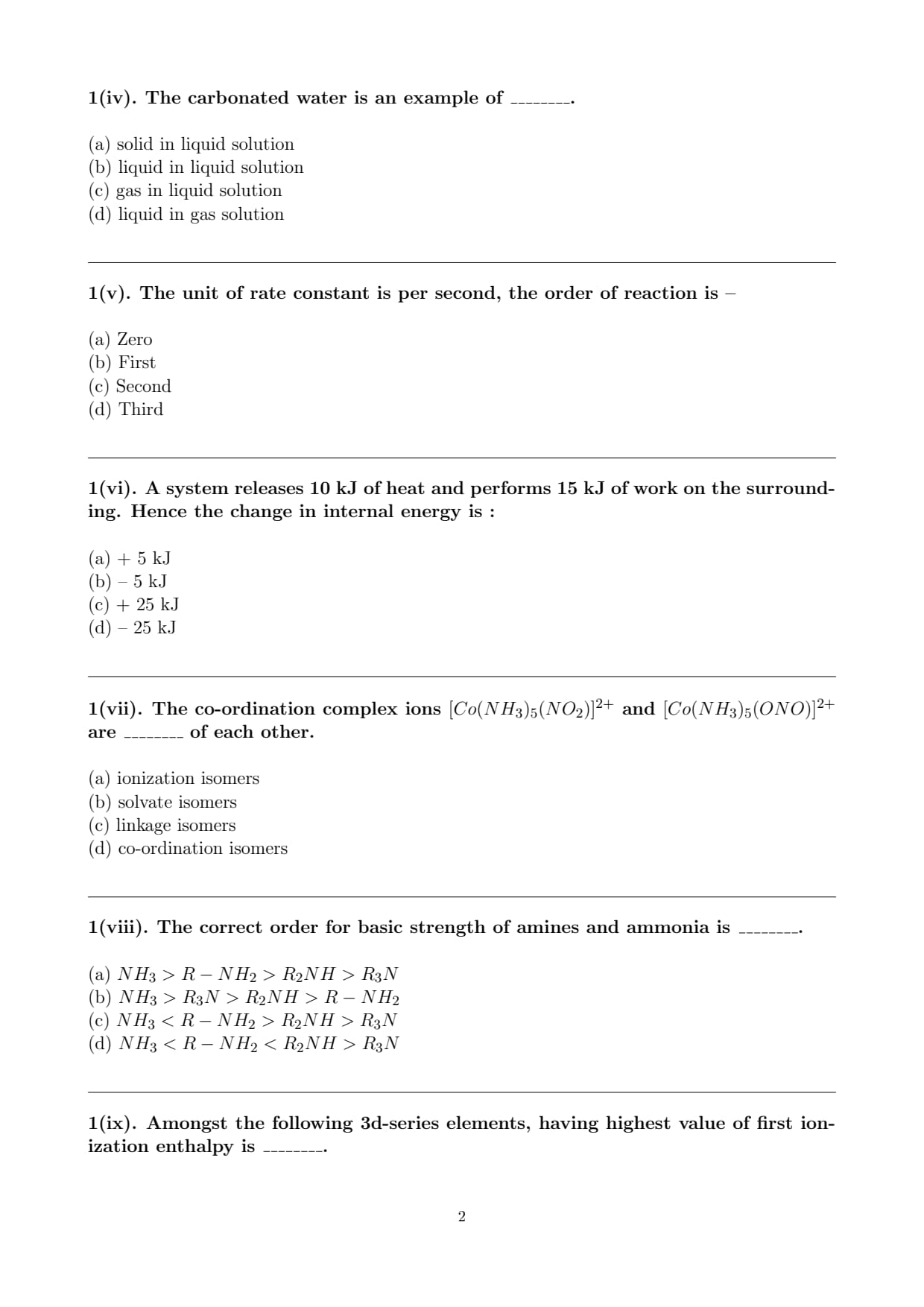
The carbonated water is an example of ________.
The unit of rate constant is per second, the order of reaction is --
A system releases 10 kJ of heat and performs 15 kJ of work on the surrounding. Hence the change in internal energy is :
The co-ordination complex ions \([Co(NH_3)_5(NO_2)]^{2+}\) and \([Co(NH_3)_5(ONO)]^{2+}\) are ________ of each other.
The correct order for basic strength of amines and ammonia is ________.
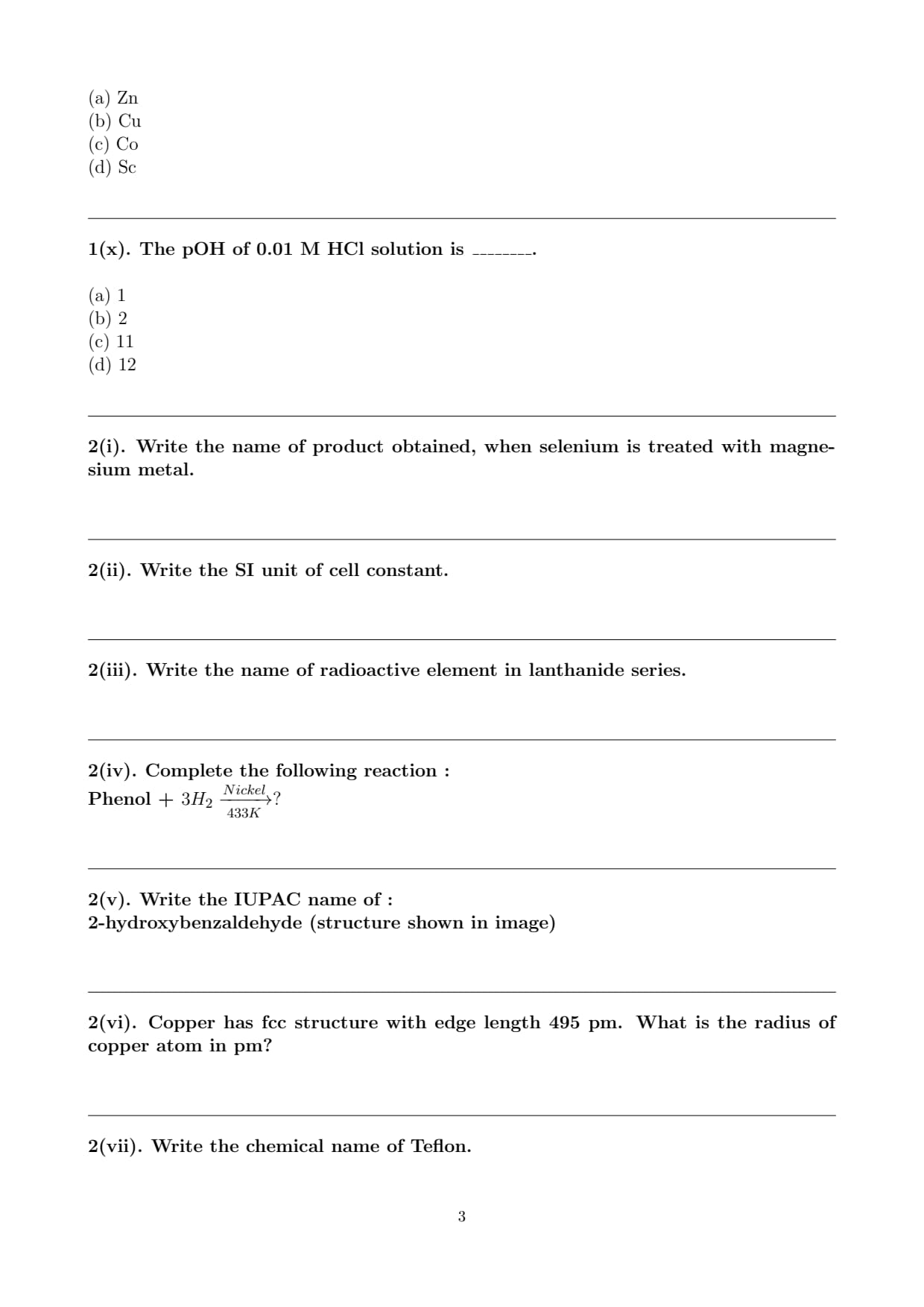
Amongst the following 3d-series elements, having highest value of first ionization enthalpy is ________.
The pOH of 0.01 M HCl solution is ________.
Write the name of product obtained, when selenium is treated with magnesium metal.
Write the SI unit of cell constant.
Write the name of radioactive element in lanthanide series.
Complete the following reaction :
Phenol + \(3H_2 \xrightarrow[433K]{Nickel} ?\)
Write the IUPAC name of :
2-hydroxybenzaldehyde (structure shown in image)
Copper has fcc structure with edge length 495 pm. What is the radius of copper atom in pm?
Write the chemical name of Teflon.
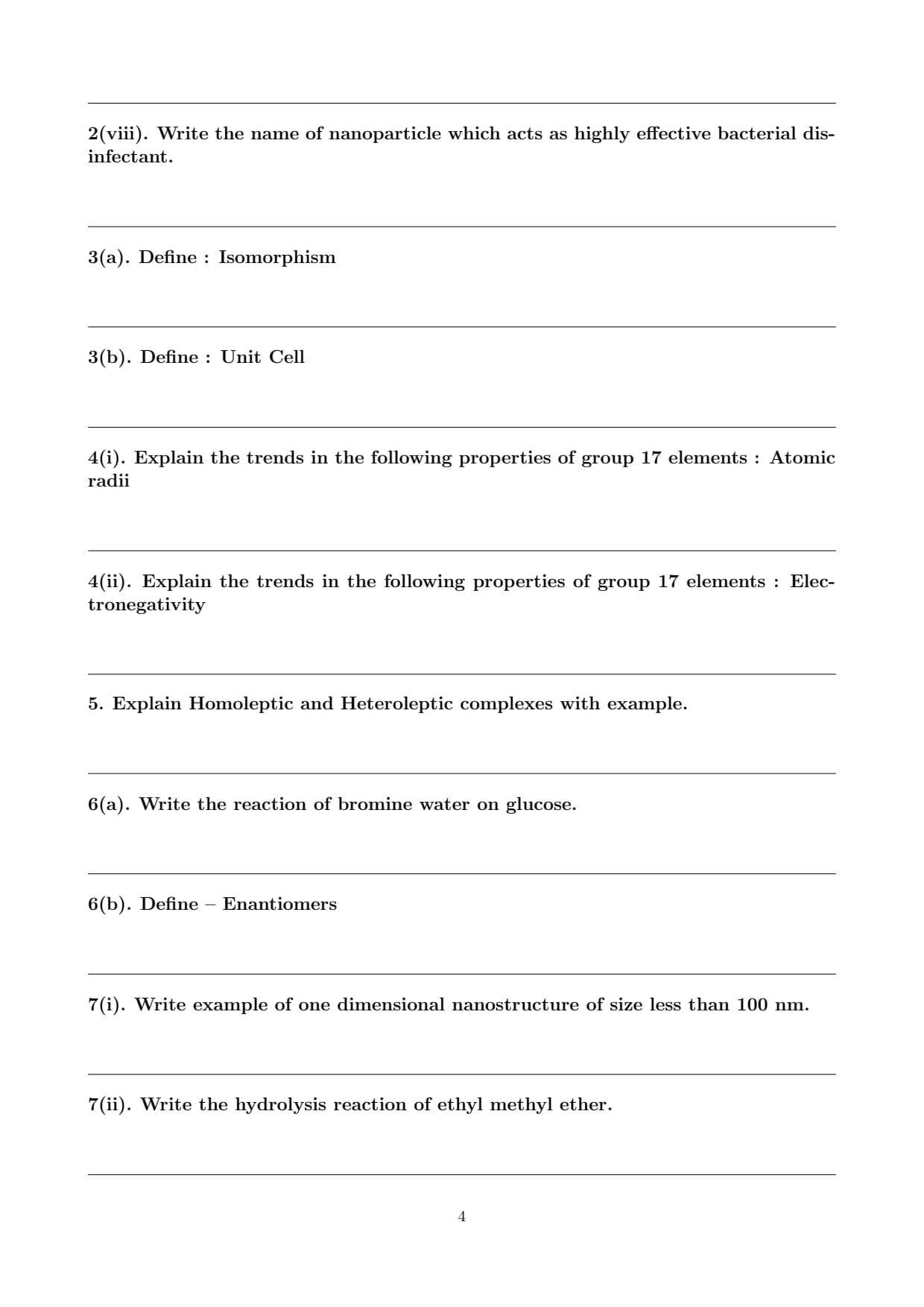
Write the name of nanoparticle which acts as highly effective bacterial disinfectant.
Define : Isomorphism
Define : Unit Cell
Explain the trends in the following properties of group 17 elements : Atomic radii
Explain the trends in the following properties of group 17 elements : Electronegativity
Explain Homoleptic and Heteroleptic complexes with example.
Write the reaction of bromine water on glucose.
Define -- Enantiomers
Write example of one dimensional nanostructure of size less than 100 nm.
Write the hydrolysis reaction of ethyl methyl ether.
Calculate the osmotic pressure of solution containing 0.822 gm of sucrose in 300 mL of water at 298 K. [ Given : Molar mass of sucrose 342 g/mol, R = 0.08205 \(dm^3\) atm \(K^{-1}\) \(mol^{-1}\) ]
Write the mathematical equation of first law of thermodynamics for following processes : (a) Isochoric process, (b) Adiabatic process
Write two similarities and two differences between lanthanoids and actinoids.
What is the action of following reagents on chlorobenzene? (i) conc. \(HNO_3\), (ii) fuming \(H_2SO_4\)
Explain Cannizzaro reaction with suitable example.
A chemical reaction occurs in two steps :
(i) \( NO_2Cl(g) \xrightarrow{slow} NO_2(g) + Cl(g) \)
(ii) \( NO_2Cl(g) + Cl(g) \xrightarrow{fast} NO_2(g) + Cl_2(g) \)
(a) Write down the rate law.
(b) Identify the reaction intermediate.
The standard potential of electrode \(Cu^{++} (0.02 M) | Cu_{(s)}\) is 0.337 volt. Calculate its potential in volt.
Derive relationship between relative lowering of vapour pressure and molar mass of non volatile solute.
Write statement of second law of thermodynamics.
Convert, acetamide into ethyl amine.
Explain amphoteric nature of water.
Convert Ethanol into sodium ethoxide.
Convert Phenol into o-phenol sulfonic acid.
Convert Bromomethane into methoxyethane.
What is peptide linkage?
Write general characteristics of interhalogen compounds.
Write observed electronic configuration of chromium (Z = 24).
Calculate magnetic moment of \(Ti^{3+}\) by using spin only formula. (Z of Ti = 22)
Define Green chemistry.
Write examples of coordination metal complexes in biology.
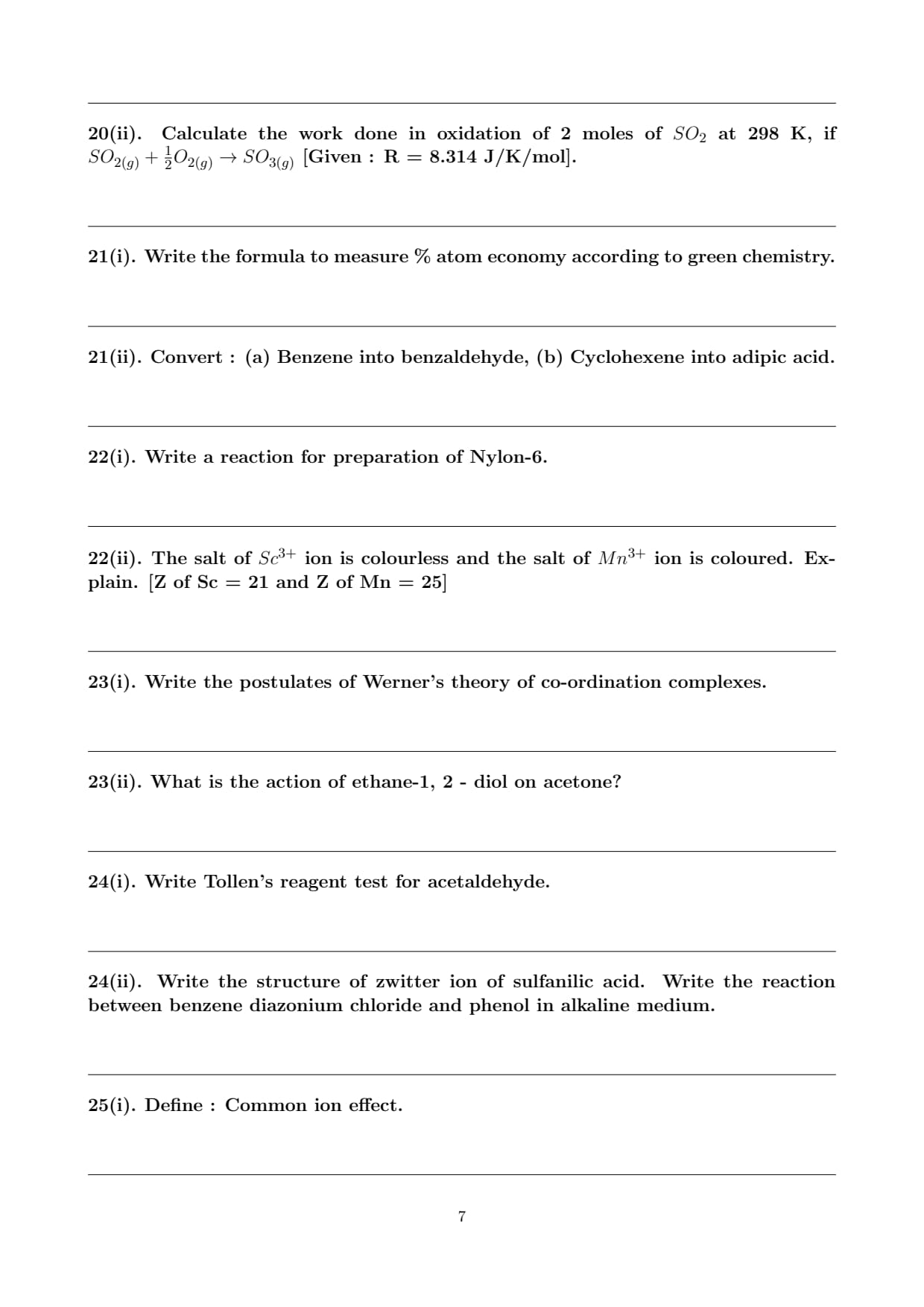
Calculate the work done in oxidation of 2 moles of \(SO_2\) at 298 K, if \(SO_{2(g)} + \frac{1}{2}O_{2(g)} \rightarrow SO_{3(g)}\) [Given : R = 8.314 J/K/mol].
Write the formula to measure % atom economy according to green chemistry.
Convert : (a) Benzene into benzaldehyde, (b) Cyclohexene into adipic acid.
Write a reaction for preparation of Nylon-6.
The salt of \(Sc^{3+}\) ion is colourless and the salt of \(Mn^{3+}\) ion is coloured. Explain. [Z of Sc = 21 and Z of Mn = 25]
Write the postulates of Werner's theory of co-ordination complexes.
What is the action of ethane-1, 2 - diol on acetone?
Write Tollen's reagent test for acetaldehyde.
Write the structure of zwitter ion of sulfanilic acid. Write the reaction between benzene diazonium chloride and phenol in alkaline medium.
Define : Common ion effect.
Write preparation of glucose from starch.
Draw the structure of 2, 4 - dinitrophenylhydrazone of acetaldehyde.
The rate of A + B \(\rightarrow\) P is \(3.6 \times 10^{-2}\) mol/\(dm^3\)/s. When [A] = 0.2 M and [B] = 0.1 M. Calculate the rate constant if reaction is first order in B and second order in A.
Define : Isotonic solution
Define : Molecularity of reaction
State and explain Hess's law of constant heat summation.
Define : Schottky defect
Define : Ferromagnetism
Write the name of catalyst used in preparation of HDP.
Draw structure of isoprene unit of natural rubber.
Calculate effective atomic number of \( Fe^{2+} \) in \( [Fe(CN)_6]^{4-} \) [ Given : (Z = 26) ]
Draw neat and labelled diagram of lead accumulator.
Write two advantages of hydrogen - oxygen fuel cell.
Convert, ethanoic acid to ethanol.
Explain the mechanism of alkaline hydrolysis of bromomethane.
Acetic acid is 5% ionised in its decimolar solution. Calculate the dissociation constant of acetic acid.








Comments