GMAT 2024 Verbal Sample Paper 2 Question Paper with Answer Key and Solutions PDF is available for download. GMAT lasts for a total of 2 hours and 15 minutes, with an optional 10-minute break. Throughout the test, candidates will be required to answer 64 questions, distributed as follows:
- Quantitative Reasoning: 21 questions, to be completed in 45 minutes.
- Verbal Reasoning: 23 questions, to be completed in 45 minutes.
- Data Insights: 20 questions, to be completed in 45 minutes.
GMAT 2024 Verbal Sample Paper 2 Question Paper with Solutions PDF
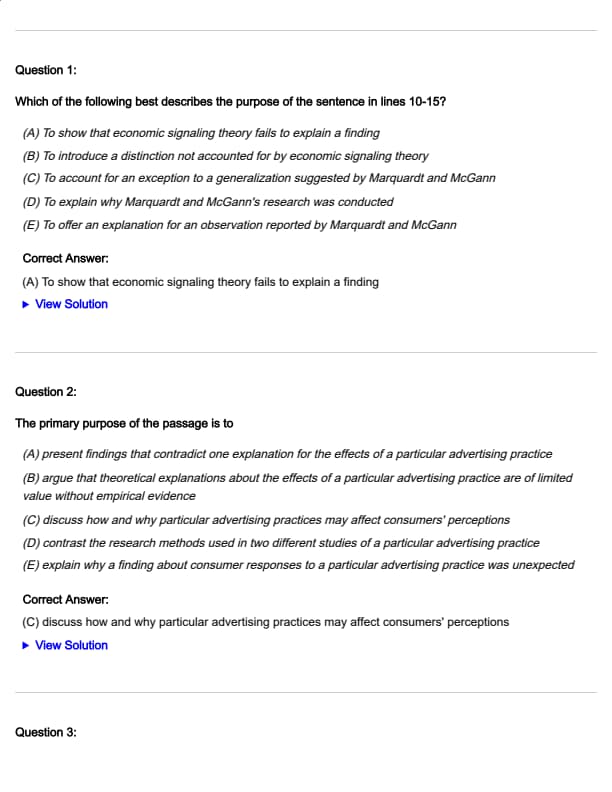
Question 1:
Which of the following best describes the purpose of the sentence in lines 10-15?
- (A) To show that economic signaling theory fails to explain a finding
- (B) To introduce a distinction not accounted for by economic signaling theory
- (C) To account for an exception to a generalization suggested by Marquardt and McGann
- (D) To explain why Marquardt and McGann's research was conducted
- (E) To offer an explanation for an observation reported by Marquardt and McGann
Question 2:
The primary purpose of the passage is to
- (A) present findings that contradict one explanation for the effects of a particular advertising practice
- (B) argue that theoretical explanations about the effects of a particular advertising practice are of limited value without empirical evidence
- (C) discuss how and why particular advertising practices may affect consumers' perceptions
- (D) contrast the research methods used in two different studies of a particular advertising practice
- (E) explain why a finding about consumer responses to a particular advertising practice was unexpected
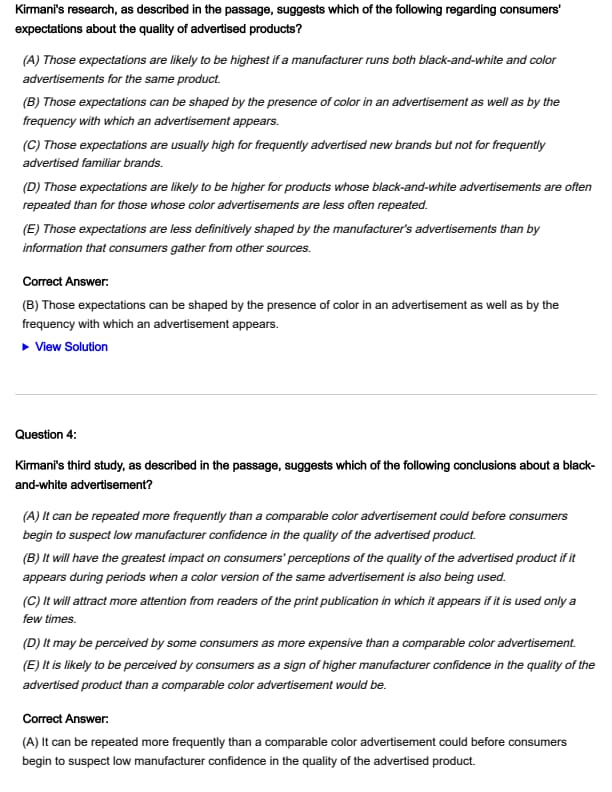
Question 3:
Kirmani's research, as described in the passage, suggests which of the following regarding consumers' expectations about the quality of advertised products?
- (A) Those expectations are likely to be highest if a manufacturer runs both black-and-white and color advertisements for the same product.
- (B) Those expectations can be shaped by the presence of color in an advertisement as well as by the frequency with which an advertisement appears.
- (C) Those expectations are usually high for frequently advertised new brands but not for frequently advertised familiar brands.
- (D) Those expectations are likely to be higher for products whose black-and-white advertisements are often repeated than for those whose color advertisements are less often repeated.
- (E) Those expectations are less definitively shaped by the manufacturer's advertisements than by information that consumers gather from other sources.
Question 4:
Kirmani's third study, as described in the passage, suggests which of the following conclusions about a black-and-white advertisement?
- (A) It can be repeated more frequently than a comparable color advertisement could before consumers begin to suspect low manufacturer confidence in the quality of the advertised product.
- (B) It will have the greatest impact on consumers' perceptions of the quality of the advertised product if it appears during periods when a color version of the same advertisement is also being used.
- (C) It will attract more attention from readers of the print publication in which it appears if it is used only a few times.
- (D) It may be perceived by some consumers as more expensive than a comparable color advertisement.
- (E) It is likely to be perceived by consumers as a sign of higher manufacturer confidence in the quality of the advertised product than a comparable color advertisement would be.
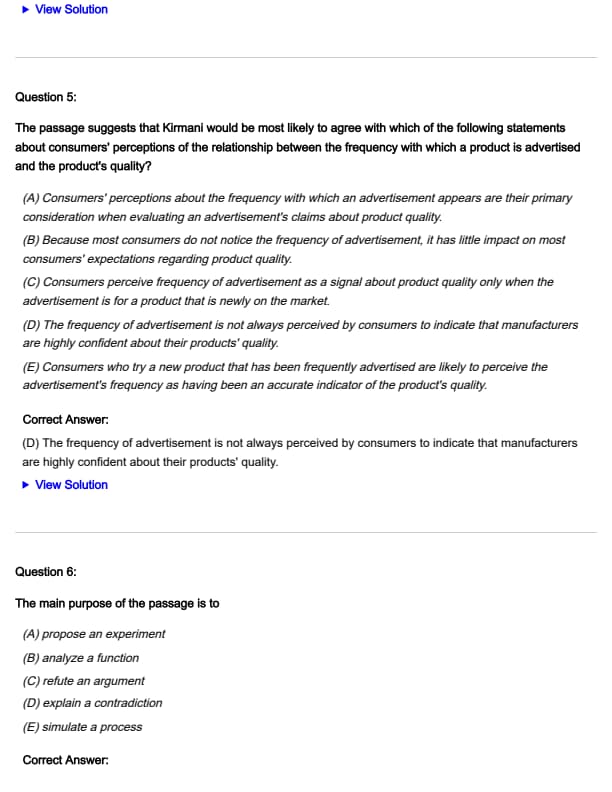
Question 5:
The passage suggests that Kirmani would be most likely to agree with which of the following statements about consumers' perceptions of the relationship between the frequency with which a product is advertised and the product's quality?
- (A) Consumers' perceptions about the frequency with which an advertisement appears are their primary consideration when evaluating an advertisement's claims about product quality.
- (B) Because most consumers do not notice the frequency of advertisement, it has little impact on most consumers' expectations regarding product quality.
- (C) Consumers perceive frequency of advertisement as a signal about product quality only when the advertisement is for a product that is newly on the market.
- (D) The frequency of advertisement is not always perceived by consumers to indicate that manufacturers are highly confident about their products' quality.
- (E) Consumers who try a new product that has been frequently advertised are likely to perceive the advertisement's frequency as having been an accurate indicator of the product's quality.
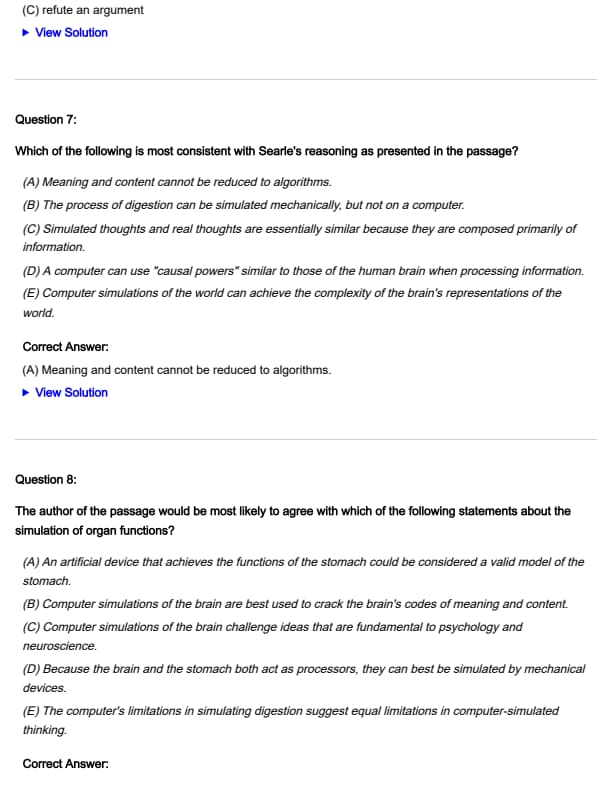
Question 6:
The main purpose of the passage is to
- (A) propose an experiment
- (B) analyze a function
- (C) refute an argument
- (D) explain a contradiction
- (E) simulate a process
Question 7:
Which of the following is most consistent with Searle's reasoning as presented in the passage?
- (A) Meaning and content cannot be reduced to algorithms.
- (B) The process of digestion can be simulated mechanically, but not on a computer.
- (C) Simulated thoughts and real thoughts are essentially similar because they are composed primarily of information.
- (D) A computer can use "causal powers" similar to those of the human brain when processing information.
- (E) Computer simulations of the world can achieve the complexity of the brain's representations of the world.
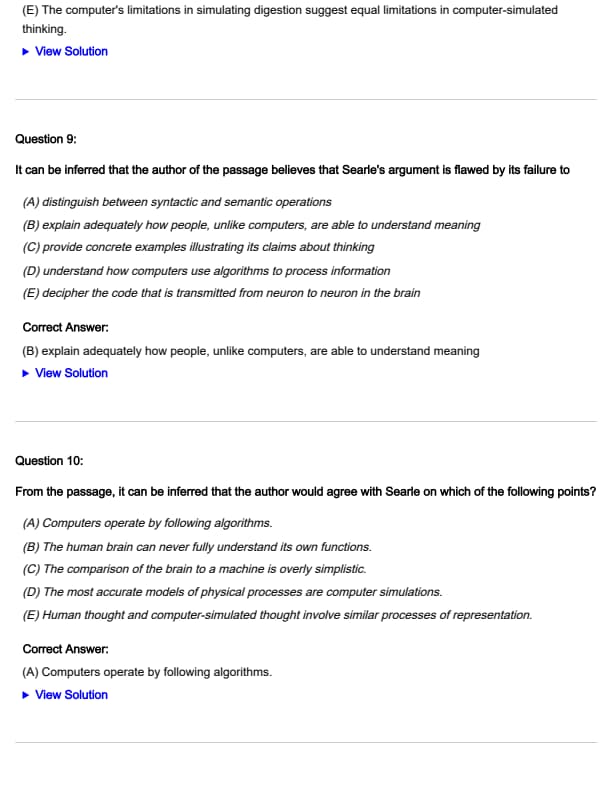
Question 8:
The author of the passage would be most likely to agree with which of the following statements about the simulation of organ functions?
- (A) An artificial device that achieves the functions of the stomach could be considered a valid model of the stomach.
- (B) Computer simulations of the brain are best used to crack the brain's codes of meaning and content.
- (C) Computer simulations of the brain challenge ideas that are fundamental to psychology and neuroscience.
- (D) Because the brain and the stomach both act as processors, they can best be simulated by mechanical devices.
- (E) The computer's limitations in simulating digestion suggest equal limitations in computer-simulated thinking.
Question 9:
It can be inferred that the author of the passage believes that Searle's argument is flawed by its failure to
- (A) distinguish between syntactic and semantic operations
- (B) explain adequately how people, unlike computers, are able to understand meaning
- (C) provide concrete examples illustrating its claims about thinking
- (D) understand how computers use algorithms to process information
- (E) decipher the code that is transmitted from neuron to neuron in the brain
Question 10:
From the passage, it can be inferred that the author would agree with Searle on which of the following points?
- (A) Computers operate by following algorithms.
- (B) The human brain can never fully understand its own functions.
- (C) The comparison of the brain to a machine is overly simplistic.
- (D) The most accurate models of physical processes are computer simulations.
- (E) Human thought and computer-simulated thought involve similar processes of representation.
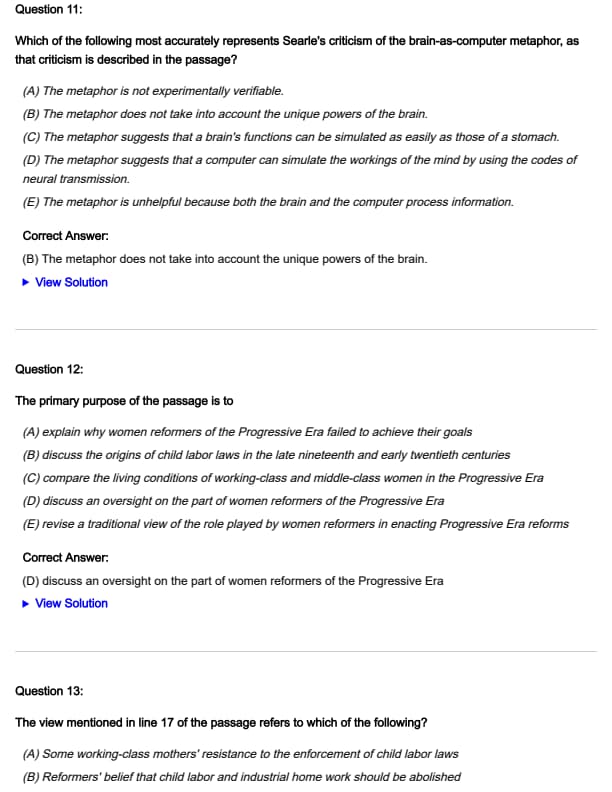
Question 11:
Which of the following most accurately represents Searle's criticism of the brain-as-computer metaphor, as that criticism is described in the passage?
- (A) The metaphor is not experimentally verifiable.
- (B) The metaphor does not take into account the unique powers of the brain.
- (C) The metaphor suggests that a brain's functions can be simulated as easily as those of a stomach.
- (D) The metaphor suggests that a computer can simulate the workings of the mind by using the codes of neural transmission.
- (E) The metaphor is unhelpful because both the brain and the computer process information.
Question 12:
The primary purpose of the passage is to
- (A) explain why women reformers of the Progressive Era failed to achieve their goals
- (B) discuss the origins of child labor laws in the late nineteenth and early twentieth centuries
- (C) compare the living conditions of working-class and middle-class women in the Progressive Era
- (D) discuss an oversight on the part of women reformers of the Progressive Era
- (E) revise a traditional view of the role played by women reformers in enacting Progressive Era reforms
Question 13:
The view mentioned in line 17 of the passage refers to which of the following?
- (A) Some working-class mothers' resistance to the enforcement of child labor laws
- (B) Reformers' belief that child labor and industrial home work should be abolished
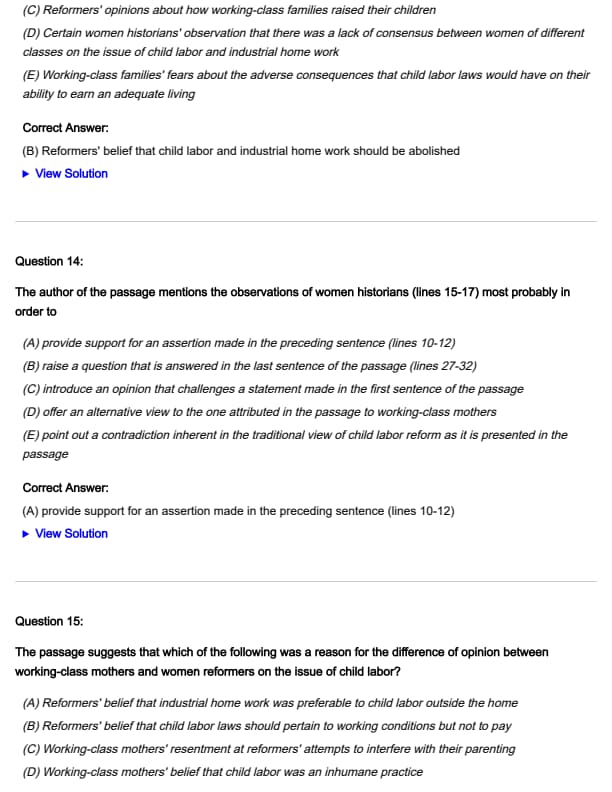
- (C) Reformers' opinions about how working-class families raised their children
- (D) Certain women historians' observation that there was a lack of consensus between women of different classes on the issue of child labor and industrial home work
- (E) Working-class families' fears about the adverse consequences that child labor laws would have on their ability to earn an adequate living
Question 14:
The author of the passage mentions the observations of women historians (lines 15-17) most probably in order to
- (A) provide support for an assertion made in the preceding sentence (lines 10-12)
- (B) raise a question that is answered in the last sentence of the passage (lines 27-32)
- (C) introduce an opinion that challenges a statement made in the first sentence of the passage
- (D) offer an alternative view to the one attributed in the passage to working-class mothers
- (E) point out a contradiction inherent in the traditional view of child labor reform as it is presented in the passage
Question 15:
The passage suggests that which of the following was a reason for the difference of opinion between working-class mothers and women reformers on the issue of child labor?
- (A) Reformers' belief that industrial home work was preferable to child labor outside the home
- (B) Reformers' belief that child labor laws should pertain to working conditions but not to pay
- (C) Working-class mothers' resentment at reformers' attempts to interfere with their parenting
- (D) Working-class mothers' belief that child labor was an inhumane practice
- (E) Working-class families' need for every employable member of their families to earn money
Question 16:
The author of the passage asserts which of the following about women reformers who tried to abolish child labor?
- (A) They alienated working-class mothers by attempting to enlist them in agitating for progressive causes.
- (B) They underestimated the prevalence of child labor among the working classes.
- (C) They were correct in their conviction that child labor was deplorable but shortsighted about the impact of child labor legislation on working-class families.
- (D) They were aggressive in their attempts to enforce child labor legislation, but were unable to prevent working-class families from circumventing them.
- (E) They were prevented by their nearly total disenfranchisement from making significant progress in child labor reform.
Question 17:
According to the passage, one of the most striking achievements of white middle-class women reformers during the Progressive Era was
- (A) gaining the right to vote in school elections
- (B) mobilizing working-class women in the fight against child labor
- (C) uniting women of different classes in grassroots activism
- (D) improving the economic conditions of working-class families
- (E) improving women's and children's working conditions


-modified.png?h=56&w=56&mode=stretch)


 Download




Comments