GMAT 2025 Practice Paper Set 2 Question Paper with Answer Key and Solutions PDF

GMAT 2025 Practice Paper Set 2 Question Paper with Answer Key and Solutions PDF is available for download. GMAT lasts for a total of 2 hours and 15 minutes, with an optional 10-minute break. Throughout the test, candidates will be required to answer 64 questions, distributed as follows:

  • Quantitative Reasoning: 21 questions, to be completed in 45 minutes.
  • Verbal Reasoning: 23 questions, to be completed in 45 minutes.
  • Data Insights: 20 questions, to be completed in 45 minutes.

GMAT 2025 Practice Paper Set 2 Question Paper with Solutions PDF

GMAT 2025 Practice Paper Set 2 Question Paper with Solutions PDF download iconDownload Check Solutions
GMAT 2025 Practice Paper Set 2


Question 1:

12 is 15 percent of what number?

  • (A) 1.8
  • (B) 8
  • (C) 19.5
  • (D) 80
  • (E) 180

Question 2:

If 3/4 of x is 9, what is the value of x?

  • (A) 4
  • (B) 6 3/4
  • (C) 12
  • (D) 12 1/4
  • (E) 13 1/3

Question 3:

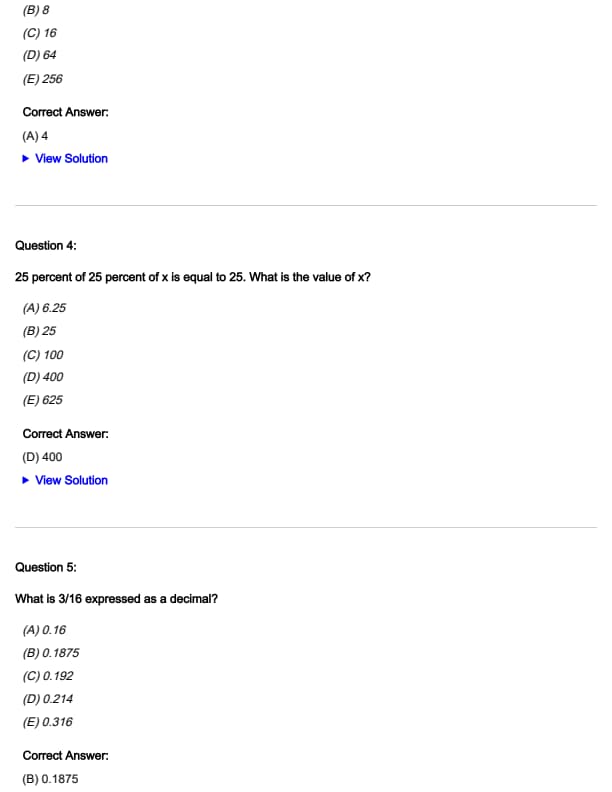
\(\sqrt{100} - \sqrt{36}\) =

  • (A) 4
  • (B) 8
  • (C) 16
  • (D) 64
  • (E) 256

Question 4:

25 percent of 25 percent of x is equal to 25. What is the value of x?

  • (A) 6.25
  • (B) 25
  • (C) 100
  • (D) 400
  • (E) 625

Question 5:

What is 3/16 expressed as a decimal?

  • (A) 0.16
  • (B) 0.1875
  • (C) 0.192
  • (D) 0.214
  • (E) 0.316

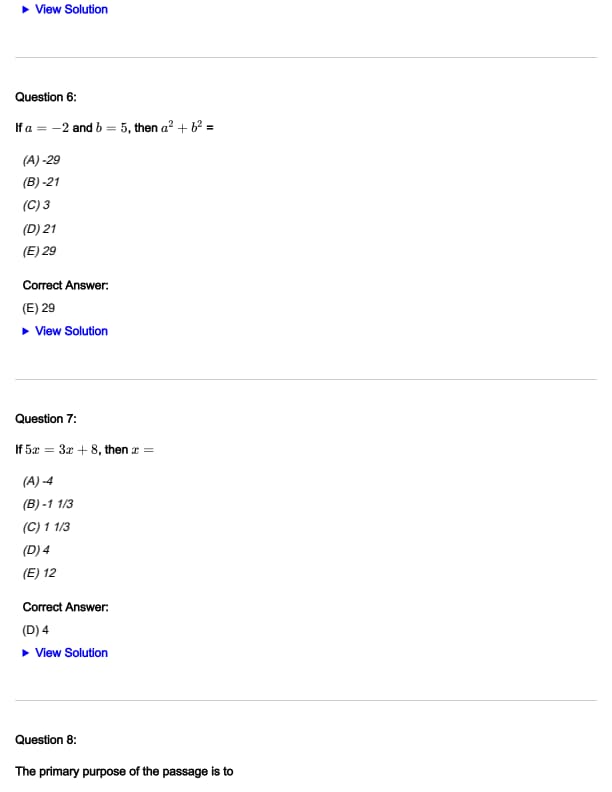
Question 6:

If \(a = -2\) and \(b = 5\), then \(a^2 + b^2\) =

  • (A) -29
  • (B) -21
  • (C) 3
  • (D) 21
  • (E) 29

Question 7:

If \(5x = 3x + 8\), then \(x =\)

  • (A) -4
  • (B) -1 1/3
  • (C) 1 1/3
  • (D) 4
  • (E) 12

Question 8:

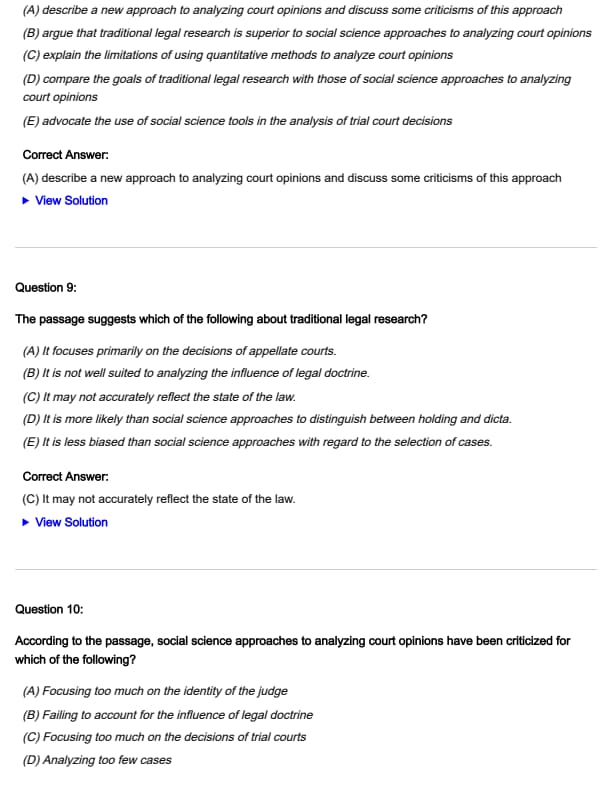
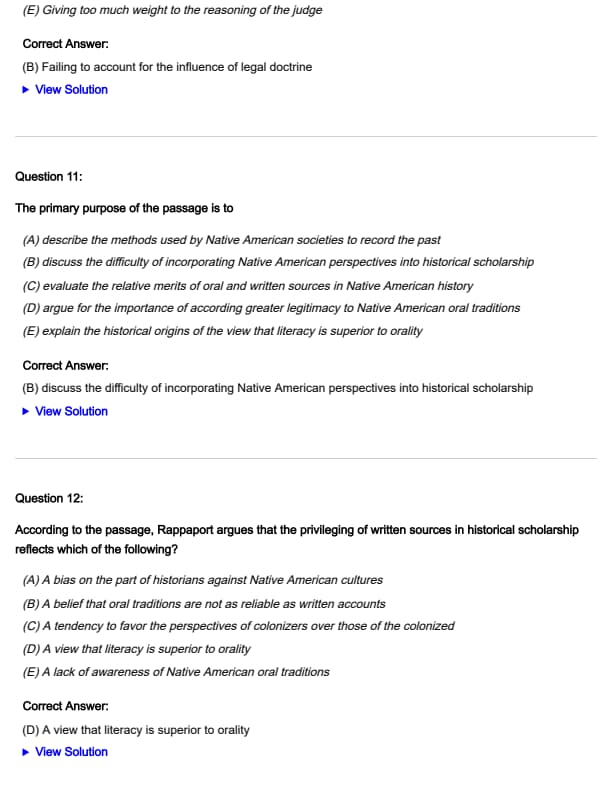
The primary purpose of the passage is to

  • (A) describe a new approach to analyzing court opinions and discuss some criticisms of this approach
  • (B) argue that traditional legal research is superior to social science approaches to analyzing court opinions
  • (C) explain the limitations of using quantitative methods to analyze court opinions
  • (D) compare the goals of traditional legal research with those of social science approaches to analyzing court opinions
  • (E) advocate the use of social science tools in the analysis of trial court decisions

Question 9:

The passage suggests which of the following about traditional legal research?

  • (A) It focuses primarily on the decisions of appellate courts.
  • (B) It is not well suited to analyzing the influence of legal doctrine.
  • (C) It may not accurately reflect the state of the law.
  • (D) It is more likely than social science approaches to distinguish between holding and dicta.
  • (E) It is less biased than social science approaches with regard to the selection of cases.

Question 10:

According to the passage, social science approaches to analyzing court opinions have been criticized for which of the following?

  • (A) Focusing too much on the identity of the judge
  • (B) Failing to account for the influence of legal doctrine
  • (C) Focusing too much on the decisions of trial courts
  • (D) Analyzing too few cases
  • (E) Giving too much weight to the reasoning of the judge

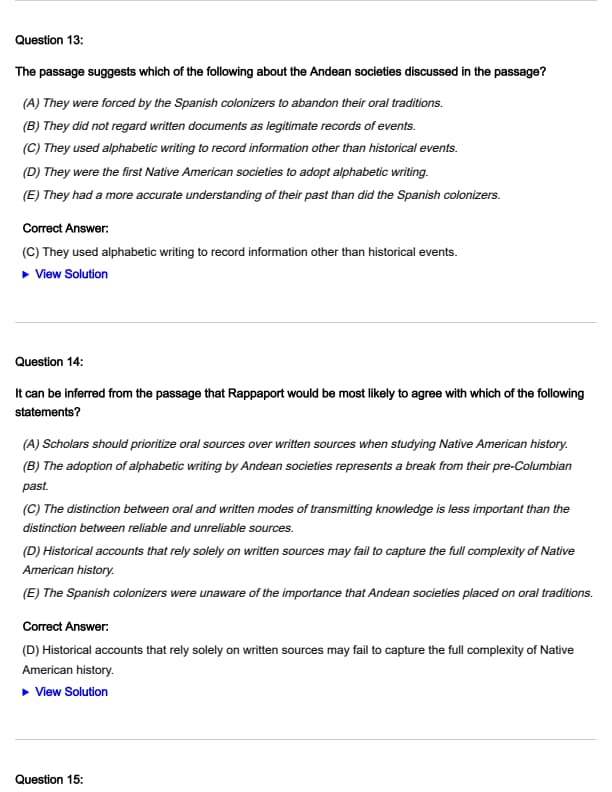
Question 11:

The primary purpose of the passage is to

  • (A) describe the methods used by Native American societies to record the past
  • (B) discuss the difficulty of incorporating Native American perspectives into historical scholarship
  • (C) evaluate the relative merits of oral and written sources in Native American history
  • (D) argue for the importance of according greater legitimacy to Native American oral traditions
  • (E) explain the historical origins of the view that literacy is superior to orality

Question 12:

According to the passage, Rappaport argues that the privileging of written sources in historical scholarship reflects which of the following?

  • (A) A bias on the part of historians against Native American cultures
  • (B) A belief that oral traditions are not as reliable as written accounts
  • (C) A tendency to favor the perspectives of colonizers over those of the colonized
  • (D) A view that literacy is superior to orality
  • (E) A lack of awareness of Native American oral traditions

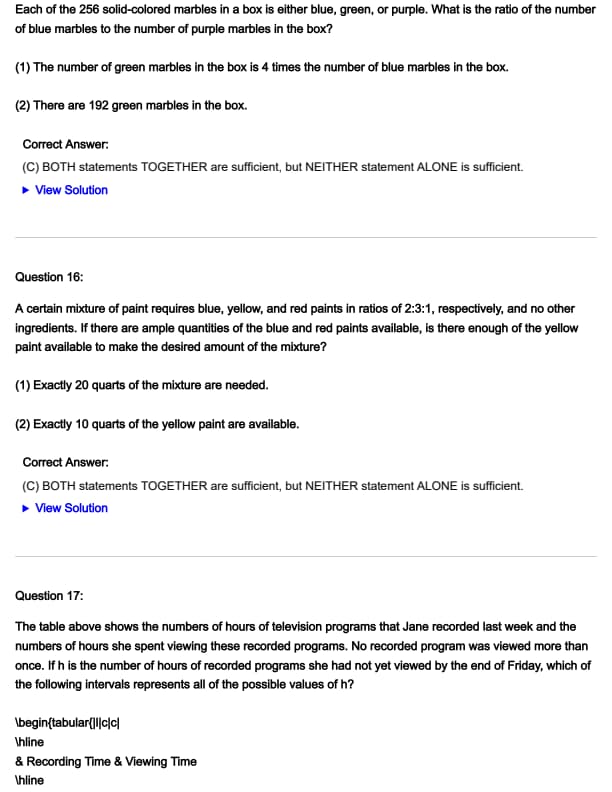
Question 13:

The passage suggests which of the following about the Andean societies discussed in the passage?

  • (A) They were forced by the Spanish colonizers to abandon their oral traditions.
  • (B) They did not regard written documents as legitimate records of events.
  • (C) They used alphabetic writing to record information other than historical events.
  • (D) They were the first Native American societies to adopt alphabetic writing.
  • (E) They had a more accurate understanding of their past than did the Spanish colonizers.

Question 14:

It can be inferred from the passage that Rappaport would be most likely to agree with which of the following statements?

  • (A) Scholars should prioritize oral sources over written sources when studying Native American history.
  • (B) The adoption of alphabetic writing by Andean societies represents a break from their pre-Columbian past.
  • (C) The distinction between oral and written modes of transmitting knowledge is less important than the distinction between reliable and unreliable sources.
  • (D) Historical accounts that rely solely on written sources may fail to capture the full complexity of Native American history.
  • (E) The Spanish colonizers were unaware of the importance that Andean societies placed on oral traditions.

Question 15:

Each of the 256 solid-colored marbles in a box is either blue, green, or purple. What is the ratio of the number of blue marbles to the number of purple marbles in the box?

(1) The number of green marbles in the box is 4 times the number of blue marbles in the box.

(2) There are 192 green marbles in the box.


Question 16:

A certain mixture of paint requires blue, yellow, and red paints in ratios of 2:3:1, respectively, and no other ingredients. If there are ample quantities of the blue and red paints available, is there enough of the yellow paint available to make the desired amount of the mixture?

(1) Exactly 20 quarts of the mixture are needed.

(2) Exactly 10 quarts of the yellow paint are available.


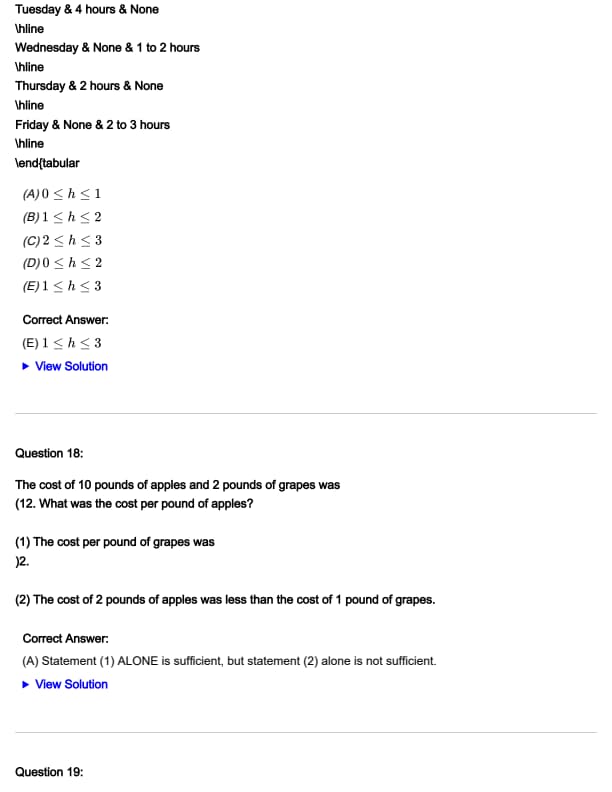
Question 17:

The table above shows the numbers of hours of television programs that Jane recorded last week and the numbers of hours she spent viewing these recorded programs. No recorded program was viewed more than once. If h is the number of hours of recorded programs she had not yet viewed by the end of Friday, which of the following intervals represents all of the possible values of h?

\begin{tabular{|l|c|c|
\hline
& Recording Time & Viewing Time
\hline
Tuesday & 4 hours & None
\hline
Wednesday & None & 1 to 2 hours
\hline
Thursday & 2 hours & None
\hline
Friday & None & 2 to 3 hours
\hline
\end{tabular

  • (A) \(0 \le h \le 1\)
  • (B) \(1 \le h \le 2\)
  • (C) \(2 \le h \le 3\)
  • (D) \(0 \le h \le 2\)
  • (E) \(1 \le h \le 3\)

Question 18:

The cost of 10 pounds of apples and 2 pounds of grapes was
(12. What was the cost per pound of apples?

(1) The cost per pound of grapes was
)2.

(2) The cost of 2 pounds of apples was less than the cost of 1 pound of grapes.


Question 19:

A company bought 3 printers and 1 scanner. What was the price of the scanner?

(1) The total price of the printers and the scanner was
(1,300.

(2) The price of each printer was
)300.


Question 20:

The table shows the amount budgeted and the amount spent for each of three accounts in a certain company. For which of these accounts did the amount spent differ from the amount budgeted by more than 6 percent of the amount budgeted?

\begin{tabular{|l|c|c|
\hline
Accounts & Amount Budgeted & Amount Spent
\hline
Payroll &
(110,000 &
)117,000
\hline
Taxes & 40,000 & 42,000
\hline
Insurance & 2,500 & 2,340
\hline
\end{tabular

  • (A) Payroll only
  • (B) Taxes only
  • (C) Insurance only
  • (D) Payroll and Insurance
  • (E) Taxes and Insurance

Question 21:

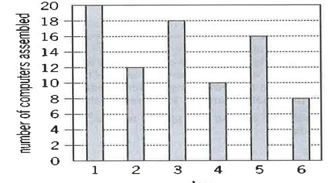
The graph shows the number of computers assembled during each of 6 consecutive days. From what day to the next day was the percent change in the number of computers assembled the greatest in magnitude?

  • (A) From Day 1 to Day 2
  • (B) From Day 2 to Day 3
  • (C) From Day 3 to Day 4
  • (D) From Day 4 to Day 5
  • (E) From Day 5 to Day 6

Question 22:

The following pie chart shows the market share distribution of five different smartphone brands in 2023.


Brand A: 30%
Brand B: 25%
Brand C: 20%
Brand D: 15%
Brand E: 10%


What is the combined market share of Brand A, Brand B, and Brand C?
Comments


No Comments To Show