

-modified.png?h=56&w=56&mode=stretch)


GMAT 2024 Quant Sample Paper 2 Question Paper with Answer Key and Solutions PDF is available for download. GMAT lasts for a total of 2 hours and 15 minutes, with an optional 10-minute break. Throughout the test, candidates will be required to answer 64 questions, distributed as follows:
- Quantitative Reasoning: 21 questions, to be completed in 45 minutes.
- Verbal Reasoning: 23 questions, to be completed in 45 minutes.
- Data Insights: 20 questions, to be completed in 45 minutes.
GMAT 2024 Quant Sample Paper 2 Question Paper with Solutions PDF
| GMAT 2024 Quant Sample Paper 2 Question Paper with Solutions PDF |  Download Download |
Check Solutions |
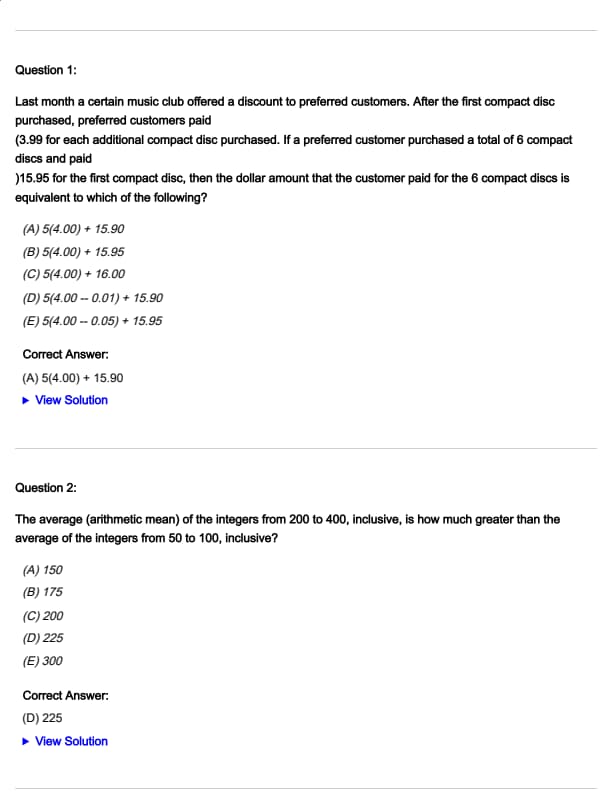
Last month a certain music club offered a discount to preferred customers. After the first compact disc purchased, preferred customers paid
(3.99 for each additional compact disc purchased. If a preferred customer purchased a total of 6 compact discs and paid
)15.95 for the first compact disc, then the dollar amount that the customer paid for the 6 compact discs is equivalent to which of the following?
The average (arithmetic mean) of the integers from 200 to 400, inclusive, is how much greater than the average of the integers from 50 to 100, inclusive?
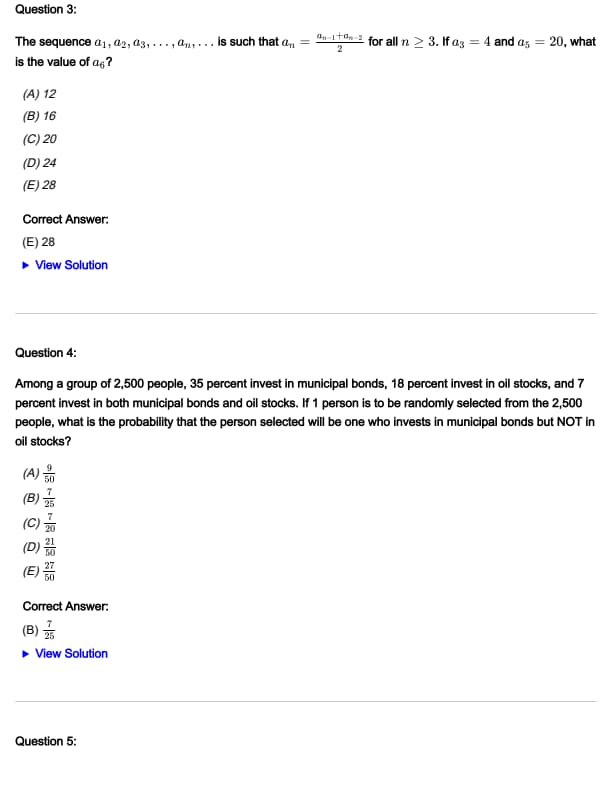
The sequence \(a_1, a_2, a_3, \dots, a_n, \dots\) is such that \(a_n = \frac{a_{n-1} + a_{n-2}}{2}\) for all \(n \geq 3\). If \(a_3 = 4\) and \(a_5 = 20\), what is the value of \(a_6\)?
Among a group of 2,500 people, 35 percent invest in municipal bonds, 18 percent invest in oil stocks, and 7 percent invest in both municipal bonds and oil stocks. If 1 person is to be randomly selected from the 2,500 people, what is the probability that the person selected will be one who invests in municipal bonds but NOT in oil stocks?
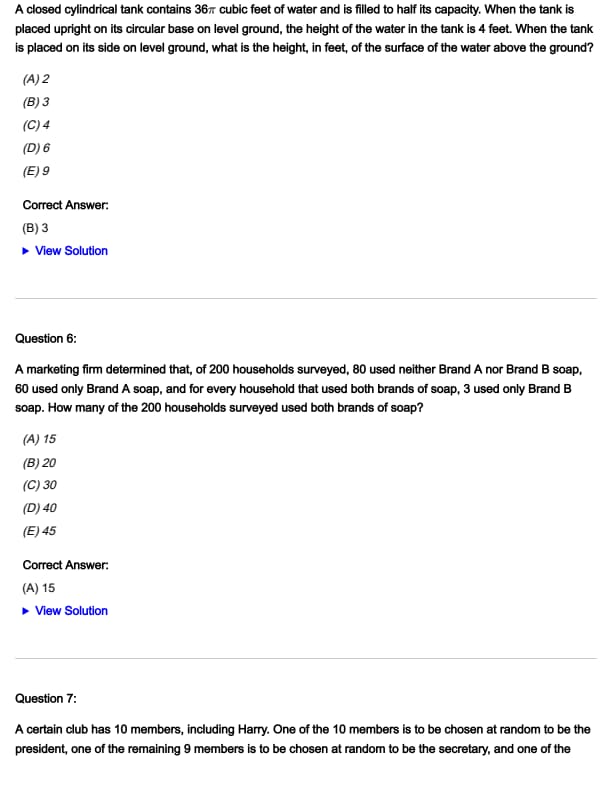
A closed cylindrical tank contains 36\(\pi\) cubic feet of water and is filled to half its capacity. When the tank is placed upright on its circular base on level ground, the height of the water in the tank is 4 feet. When the tank is placed on its side on level ground, what is the height, in feet, of the surface of the water above the ground?
A marketing firm determined that, of 200 households surveyed, 80 used neither Brand A nor Brand B soap, 60 used only Brand A soap, and for every household that used both brands of soap, 3 used only Brand B soap. How many of the 200 households surveyed used both brands of soap?
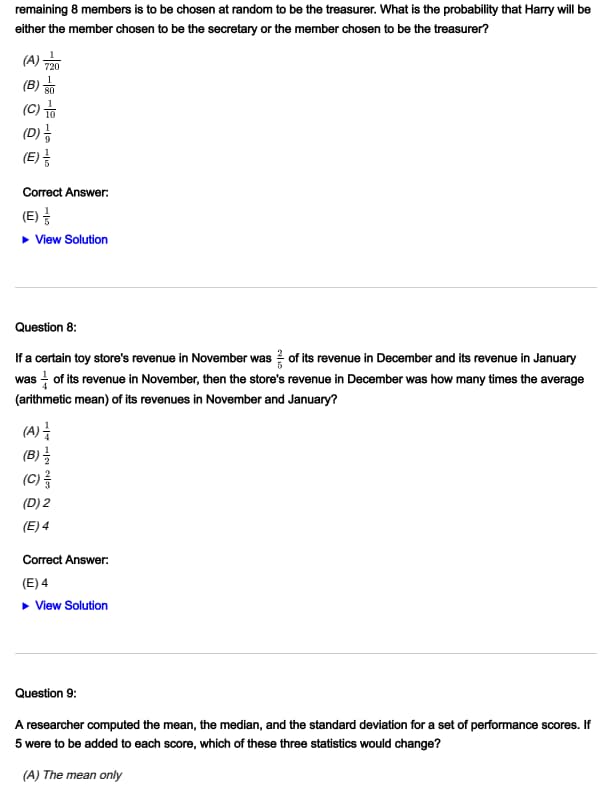
A certain club has 10 members, including Harry. One of the 10 members is to be chosen at random to be the president, one of the remaining 9 members is to be chosen at random to be the secretary, and one of the remaining 8 members is to be chosen at random to be the treasurer. What is the probability that Harry will be either the member chosen to be the secretary or the member chosen to be the treasurer?
If a certain toy store's revenue in November was \(\frac{2}{5}\) of its revenue in December and its revenue in January was \(\frac{1}{4}\) of its revenue in November, then the store's revenue in December was how many times the average (arithmetic mean) of its revenues in November and January?
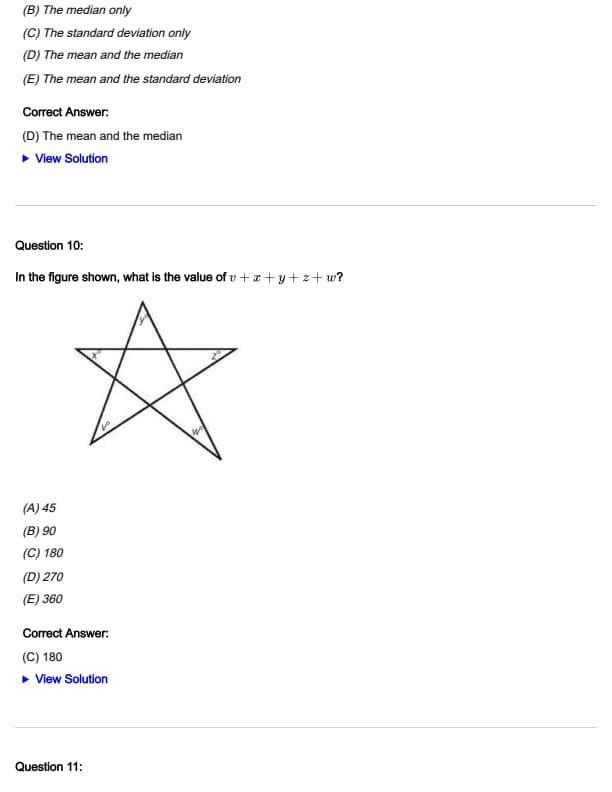
A researcher computed the mean, the median, and the standard deviation for a set of performance scores. If 5 were to be added to each score, which of these three statistics would change?
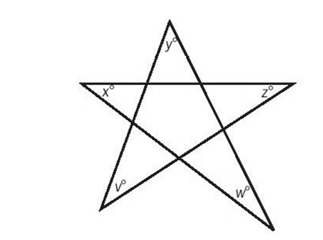
In the figure shown, what is the value of \(v+x+y+z+w\)?
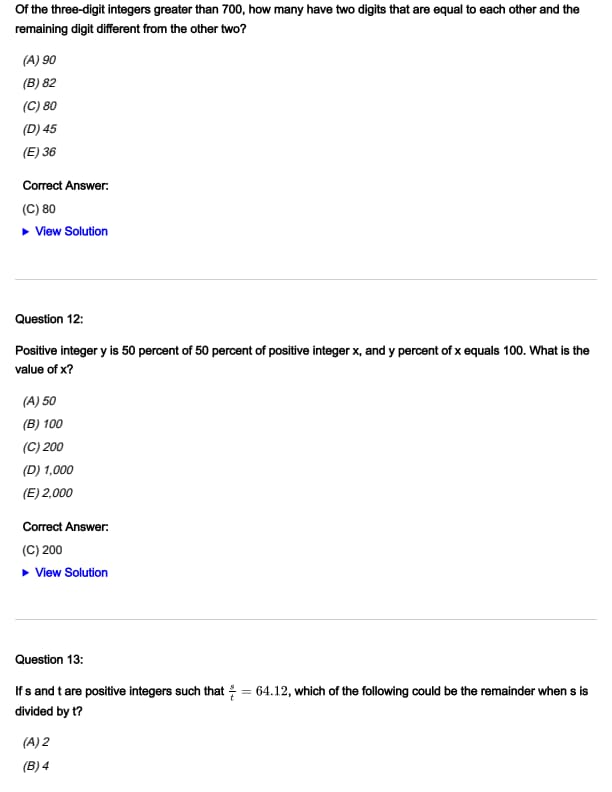
Of the three-digit integers greater than 700, how many have two digits that are equal to each other and the remaining digit different from the other two?
Positive integer y is 50 percent of 50 percent of positive integer x, and y percent of x equals 100. What is the value of x?
If s and t are positive integers such that \(\frac{s}{t} = 64.12\), which of the following could be the remainder when s is divided by t?
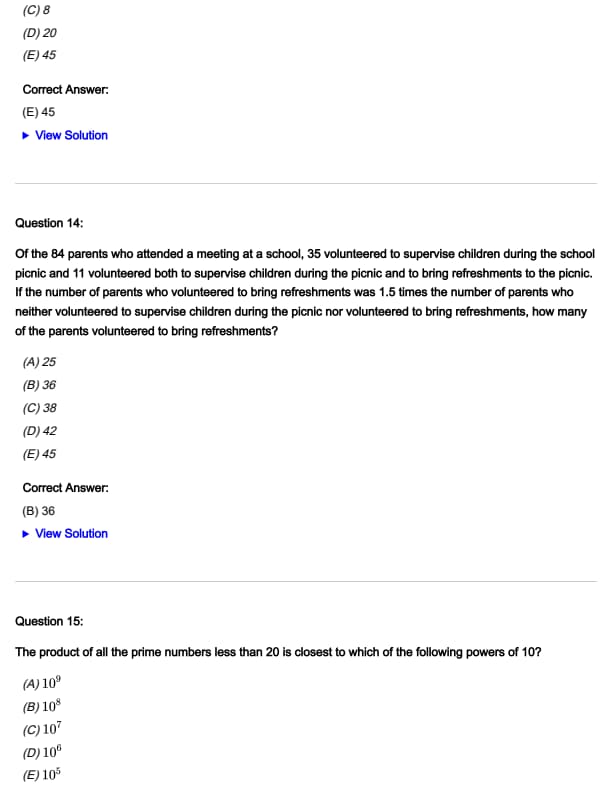
Of the 84 parents who attended a meeting at a school, 35 volunteered to supervise children during the school picnic and 11 volunteered both to supervise children during the picnic and to bring refreshments to the picnic. If the number of parents who volunteered to bring refreshments was 1.5 times the number of parents who neither volunteered to supervise children during the picnic nor volunteered to bring refreshments, how many of the parents volunteered to bring refreshments?
The product of all the prime numbers less than 20 is closest to which of the following powers of 10?
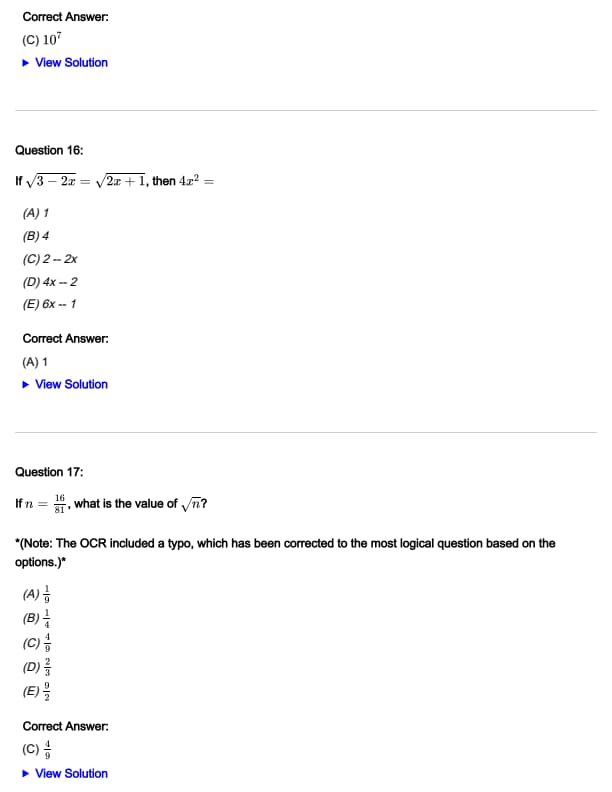
If \(\sqrt{3-2x} = \sqrt{2x + 1}\), then \(4x^2 =\)
If \(n = \frac{16}{81}\), what is the value of \(\sqrt{n}\)?
*(Note: The OCR included a typo, which has been corrected to the most logical question based on the options.)*
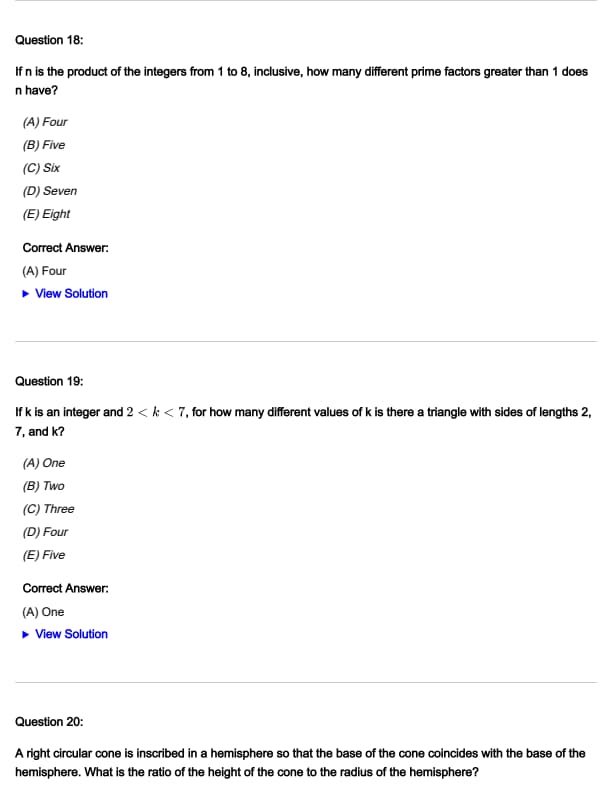
If n is the product of the integers from 1 to 8, inclusive, how many different prime factors greater than 1 does n have?
If k is an integer and \(2 < k < 7\), for how many different values of k is there a triangle with sides of lengths 2, 7, and k?
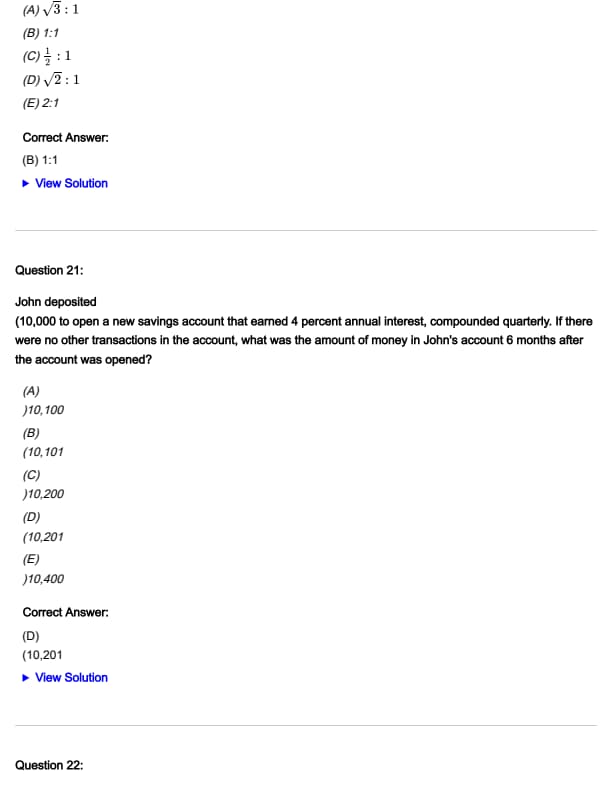
A right circular cone is inscribed in a hemisphere so that the base of the cone coincides with the base of the hemisphere. What is the ratio of the height of the cone to the radius of the hemisphere?
John deposited
(10,000 to open a new savings account that earned 4 percent annual interest, compounded quarterly. If there were no other transactions in the account, what was the amount of money in John's account 6 months after the account was opened?
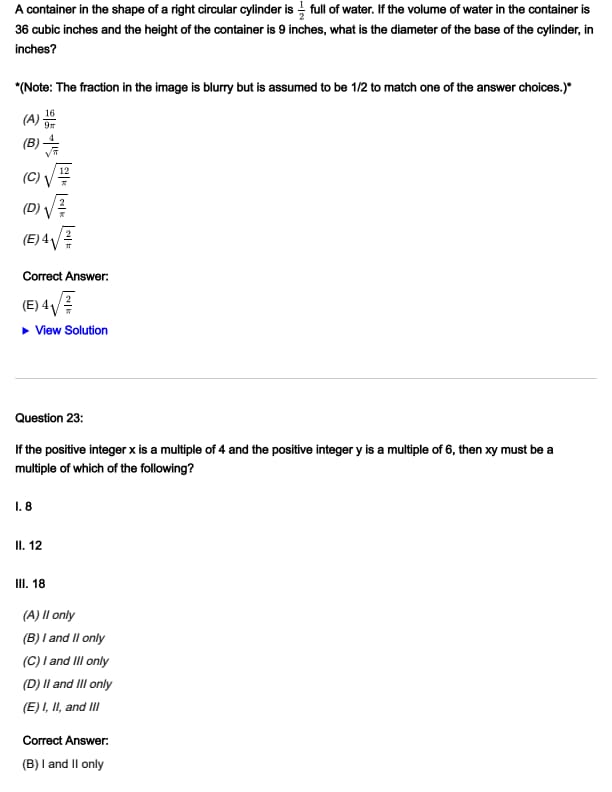
A container in the shape of a right circular cylinder is \(\frac{1}{2}\) full of water. If the volume of water in the container is 36 cubic inches and the height of the container is 9 inches, what is the diameter of the base of the cylinder, in inches?
*(Note: The fraction in the image is blurry but is assumed to be 1/2 to match one of the answer choices.)*
If the positive integer x is a multiple of 4 and the positive integer y is a multiple of 6, then xy must be a multiple of which of the following?
I. 8
II. 12
III. 18
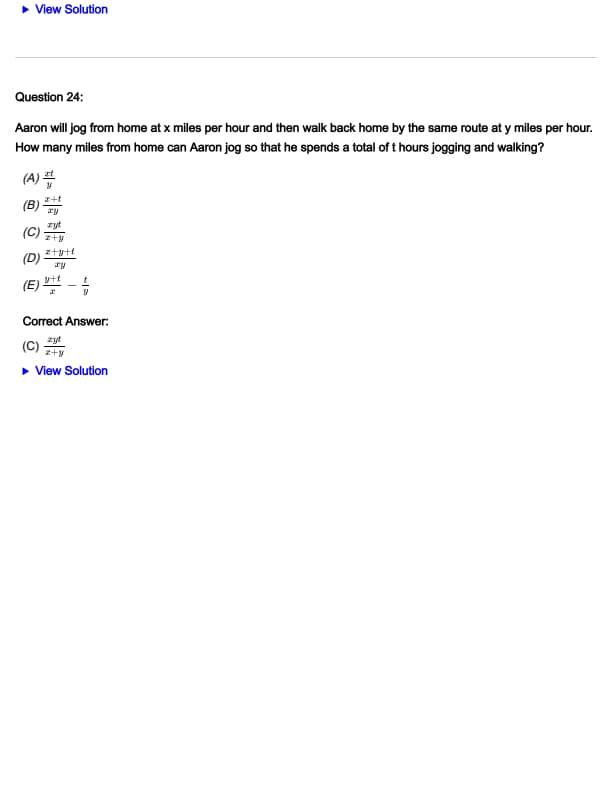
Aaron will jog from home at x miles per hour and then walk back home by the same route at y miles per hour. How many miles from home can Aaron jog so that he spends a total of t hours jogging and walking?



Comments