

-modified.png?h=56&w=56&mode=stretch)


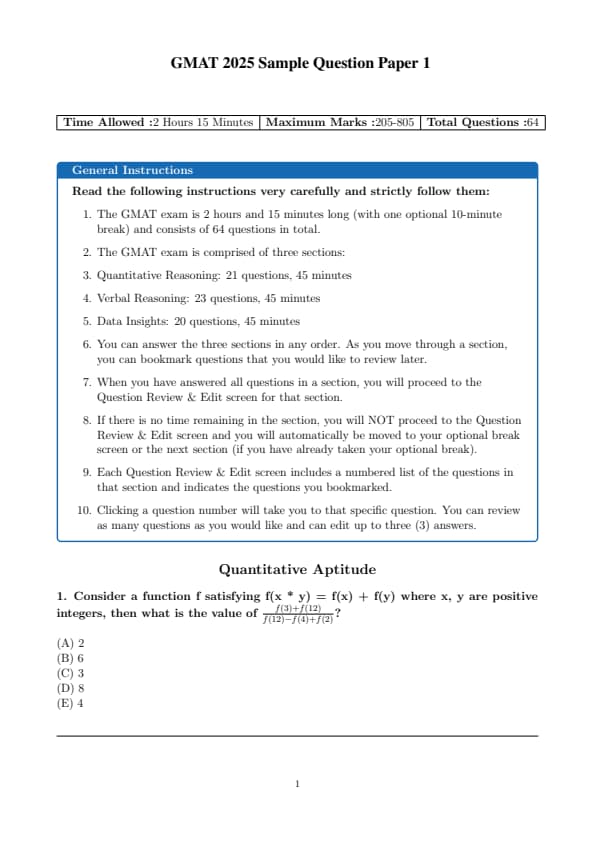
GMAT 2025 Sample Paper 1 Question Paper with Answer Key and Solutions PDF is available for download. GMAT lasts for a total of 2 hours and 15 minutes, with an optional 10-minute break. Throughout the test, candidates will be required to answer 64 questions, distributed as follows:
- Quantitative Reasoning: 21 questions, to be completed in 45 minutes.
- Verbal Reasoning: 23 questions, to be completed in 45 minutes.
- Data Insights: 20 questions, to be completed in 45 minutes.
GMAT 2025 Sample Paper 1 Question Paper with Solutions PDF
| GMAT 2025 Sample Paper 1 Question Paper with Solutions PDF |  Download Download |
Check Solutions |

Consider a function f satisfying f(x * y) = f(x) + f(y) where x, y are positive integers, then what is the value of \( \frac{f(3) + f(12)}{f(12) - f(4) + f(2)} \)?
A merchant sold a car at 60% of the marked price and obtained a loss of 20%. If the cost price of the car is three times the cost price of the bike, then what should be the selling price of the bike to make a profit of 20%?
Two trains, P and Q, pass a pole in 40 seconds and 2 minutes 20 seconds, respectively. If the length of train P is two-thirds that of train Q, what is the ratio of the speed of train P to that of train Q?
If a and b are positive integers satisfying \(4a + 3b = 17\) and \( \frac{(5ab)!}{3^p} \) is an integer, then the maximum value of p is
Alex has two children - Ben and Chloe. The current age of Alex is 4 times that of Ben. 4 years later, the age of Alex is 4 times that of Chloe. What is the age difference between Ben and Chloe?
In a college there are 150 students out of which 60% of the students play cricket, 30% of the students play football and 40% of the students play hockey. If it is know that no student plays all three sports and all the students play at least one sport, then what is the number of students that play exactly one sport?
A beaker contains a solution in which the concentration of milk is 80%. On the addition of some water, this ratio of milk to water becomes 8:5. On replacing 39 L of this solution with pure milk, the ratio of milk to water changes to 9:4. What is the volume of water added initially?
In a class of 150 students, the average weight is 42 kg. If the number of girls increases by 50% and the number of boys becomes two-thirds of its original value, while keeping the total number of students the same, the new average weight of the class becomes 43 kg. It is also observed that the average weight of boys and girls remains the same as before. Find the sum of the average weights of boys and girls.
An unfair dice consisted of two faces with 1 on them, two faces with 2 on them, and one face each of 3 and 5 on them. If the dice is rolled thrice, then what is the probability that the sum of the three rolls is greater than or equal to 11?
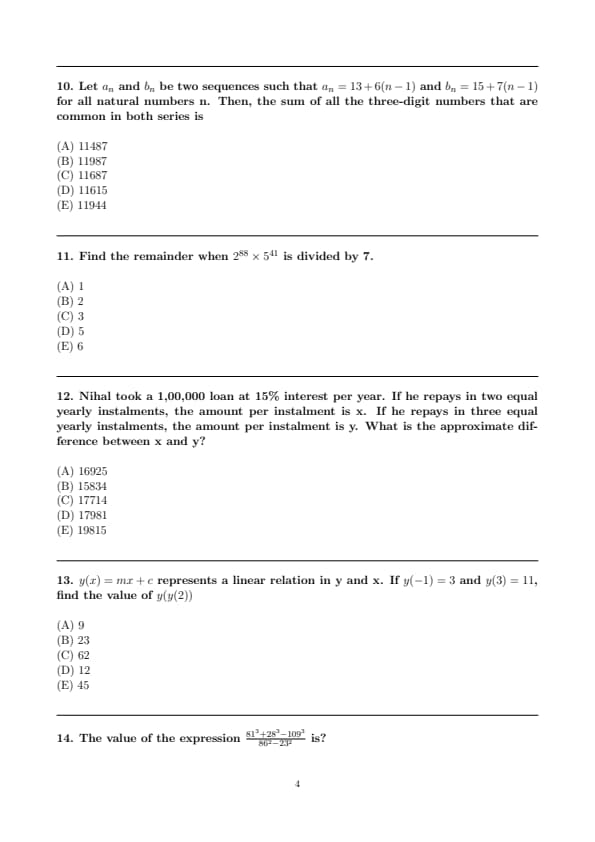
Let \(a_n\) and \(b_n\) be two sequences such that \(a_n = 13 + 6(n-1)\) and \(b_n = 15 + 7(n-1)\) for all natural numbers n. Then, the sum of all the three-digit numbers that are common in both series is
Find the remainder when \(2^{88} \times 5^{41}\) is divided by 7.
Nihal took a 1,00,000 loan at 15% interest per year. If he repays in two equal yearly instalments, the amount per instalment is x. If he repays in three equal yearly instalments, the amount per instalment is y. What is the approximate difference between x and y?
\(y(x) = mx + c\) represents a linear relation in y and x. If \(y(-1) = 3\) and \(y(3) = 11\), find the value of \(y(y(2))\)
The value of the expression \( \frac{81^3 + 28^3 - 109^3}{86^2 - 23^2} \) is?
What is the highest power of 12 in 99!?
Peter takes 4 hours longer than Samuel to prepare 30 sandwiches. Working together, they can make 50 sandwiches in 150 minutes. How long would it take Peter alone to make 40 sandwiches?
The sum of two numbers is 16. Thrice the smaller number is greater than twice the larger by 3. The product of the numbers is ?
What is the remainder when \(43^{380}\) is divided by 20?
If \(2x^2 + 10 = 7y - 5x\) and \(4y^2 - 5y = -(7x + 17)\), then find the value of \((x + y)\)?
Find the value of \( \sqrt{11 + \sqrt{72}} + \sqrt{11 - \sqrt{72}} \)
Find the possible number of integral values of \(x\) satisfying \(2x^2 + 11x - 138 < 0\)
Raju, a cake seller, mixes flour, cream, and sugar in a ratio of 5:3:2 and sells it at the cost price. Their prices are in the ratio 4:10:5. What ratio should the three be mixed in to get a 10% profit selling at the earlier proportions' price?
i) The proportion of sugar should remain the same.
ii) The price of sugar is Rs. 30 per kg
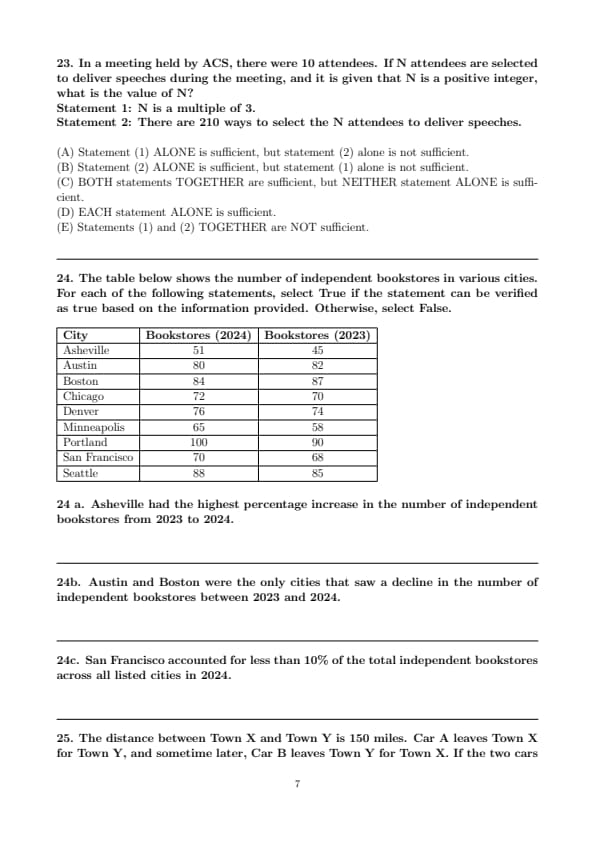
In a meeting held by ACS, there were 10 attendees. If N attendees are selected to deliver speeches during the meeting, and it is given that N is a positive integer, what is the value of N?
Statement 1: N is a multiple of 3.
Statement 2: There are 210 ways to select the N attendees to deliver speeches.
24 a. Asheville had the highest percentage increase in the number of independent bookstores from 2023 to 2024.
View Solution
Step 1: Understanding the Concept:
We need to calculate the percentage increase for each city that saw an increase in the number of bookstores and then compare these percentages to find the highest one.
Step 2: Key Formula or Approach:
\[ Percentage Increase = \frac{New Value - Old Value}{Old Value} \times 100% \]
Step 3: Detailed Explanation:
We only need to calculate the percentage increase for cities where the number of bookstores grew from 2023 to 2024.
Asheville: \( \frac{51 - 45}{45} \times 100% = \frac{6}{45} \times 100% = \frac{2}{15} \times 100% \approx 13.33% \)
Chicago: \( \frac{72 - 70}{70} \times 100% = \frac{2}{70} \times 100% = \frac{1}{35} \times 100% \approx 2.86% \)
Denver: \( \frac{76 - 74}{74} \times 100% = \frac{2}{74} \times 100% = \frac{1}{37} \times 100% \approx 2.70% \)
Minneapolis: \( \frac{65 - 58}{58} \times 100% = \frac{7}{58} \times 100% \approx 12.07% \)
Portland: \( \frac{100 - 90}{90} \times 100% = \frac{10}{90} \times 100% = \frac{1}{9} \times 100% \approx 11.11% \)
San Francisco: \( \frac{70 - 68}{68} \times 100% = \frac{2}{68} \times 100% = \frac{1}{34} \times 100% \approx 2.94% \)
Seattle: \( \frac{88 - 85}{85} \times 100% = \frac{3}{85} \times 100% \approx 3.53% \)
Step 4: Final Answer:
Comparing the calculated percentages, Asheville's increase of approximately 13.33% is the highest. Therefore, the statement is true.
Quick Tip: When comparing percentage changes, be mindful of the base value (the denominator). A smaller base can lead to a larger percentage change even for a small absolute increase.
24b. Austin and Boston were the only cities that saw a decline in the number of independent bookstores between 2023 and 2024.
View Solution
Step 1: Understanding the Concept:
We need to examine the data for each city and identify which ones experienced a decrease in the number of bookstores from 2023 to 2024.
Step 2: Detailed Explanation:
Let's check the change for each city by comparing the 2024 value to the 2023 value.
Asheville: 51 (2024) \(>\) 45 (2023) \(\implies\) Increase
Austin: 80 (2024) \(<\) 82 (2023) \(\implies\) Decline
Boston: 84 (2024) \(<\) 87 (2023) \(\implies\) Decline
Chicago: 72 (2024) \(>\) 70 (2023) \(\implies\) Increase
Denver: 76 (2024) \(>\) 74 (2023) \(\implies\) Increase
Minneapolis: 65 (2024) \(>\) 58 (2023) \(\implies\) Increase
Portland: 100 (2024) \(>\) 90 (2023) \(\implies\) Increase
San Francisco: 70 (2024) \(>\) 68 (2023) \(\implies\) Increase
Seattle: 88 (2024) \(>\) 85 (2023) \(\implies\) Increase
Step 3: Final Answer:
Only Austin and Boston saw a decline in the number of bookstores. Therefore, the statement is true.
Quick Tip: For questions asking for "only," "all," or "none," be sure to check every single data point to confirm the condition holds universally as stated. A single exception would make the statement false.
24c. San Francisco accounted for less than 10% of the total independent bookstores across all listed cities in 2024.
View Solution
Step 1: Understanding the Concept:
We need to calculate the total number of bookstores across all cities in 2024 and then find the percentage that San Francisco's bookstores represent out of this total.
Step 2: Detailed Explanation:
First, sum the number of bookstores for all cities in 2024: \[ Total_{2024} = 51 + 80 + 84 + 72 + 76 + 65 + 100 + 70 + 88 \] \[ Total_{2024} = 686 \]
The number of bookstores in San Francisco in 2024 is 70.
Now, calculate the percentage: \[ Percentage_{SF} = \frac{SF Bookstores}{Total Bookstores} \times 100% = \frac{70}{686} \times 100% \]
To check if this is less than 10%, we can compare 70 to 10% of 686.
\[ 10% of 686 = 0.10 \times 686 = 68.6 \]
Since 70 is greater than 68.6, San Francisco accounted for more than 10% of the total.
Step 3: Final Answer:
The statement that San Francisco accounted for less than 10% is false.
Quick Tip: For "percent of total" questions, you don't always need to calculate the exact percentage. You can often save time by calculating the threshold value (e.g., 10% of the total) and simply comparing it to the part.
The distance between Town X and Town Y is 150 miles. Car A leaves Town X for Town Y, and sometime later, Car B leaves Town Y for Town X. If the two cars meet exactly halfway between Town X and Town Y, what is the speed of Car B?
(1) Car B leaves Town Y exactly 45 minutes after Car A leaves Town X.
(2) Car B travels at a speed 10 mph faster than Car A.
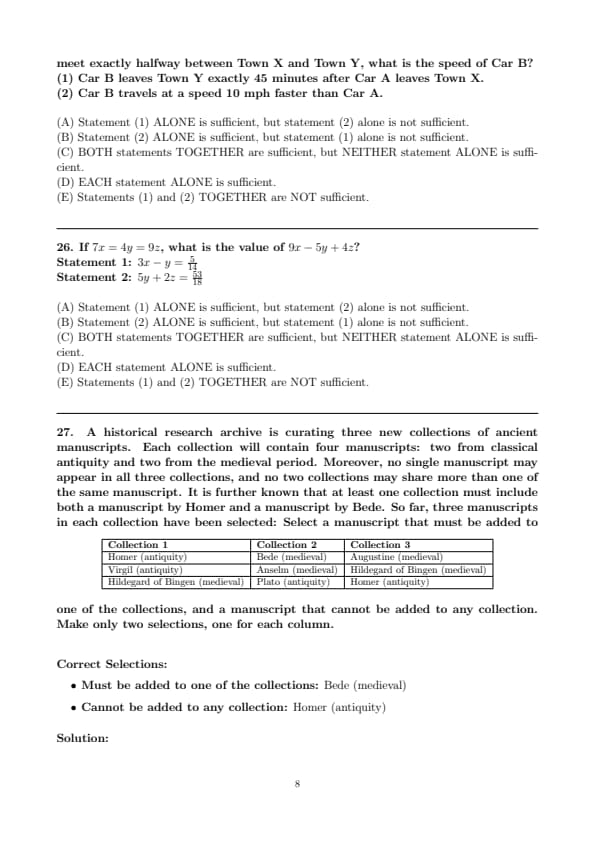
If \(7x = 4y = 9z\), what is the value of \(9x - 5y + 4z\)?
Statement 1: \(3x - y = \frac{5}{14}\)
Statement 2: \(5y + 2z = \frac{53}{18}\)
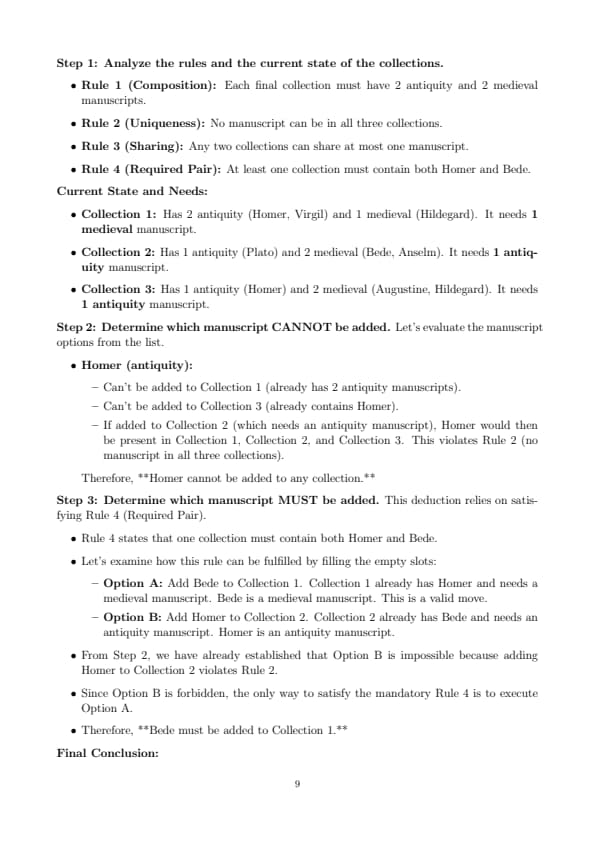
A historical research archive is curating three new collections of ancient manuscripts. Each collection will contain four manuscripts: two from classical antiquity and two from the medieval period. Moreover, no single manuscript may appear in all three collections, and no two collections may share more than one of the same manuscript. It is further known that at least one collection must include both a manuscript by Homer and a manuscript by Bede. So far, three manuscripts in each collection have been selected:

Select a manuscript that must be added to one of the collections, and a manuscript that cannot be added to any collection. Make only two selections, one for each column.
Correct Selections:
Must be added to one of the collections: Bede (medieval)
Cannot be added to any collection: Homer (antiquity)
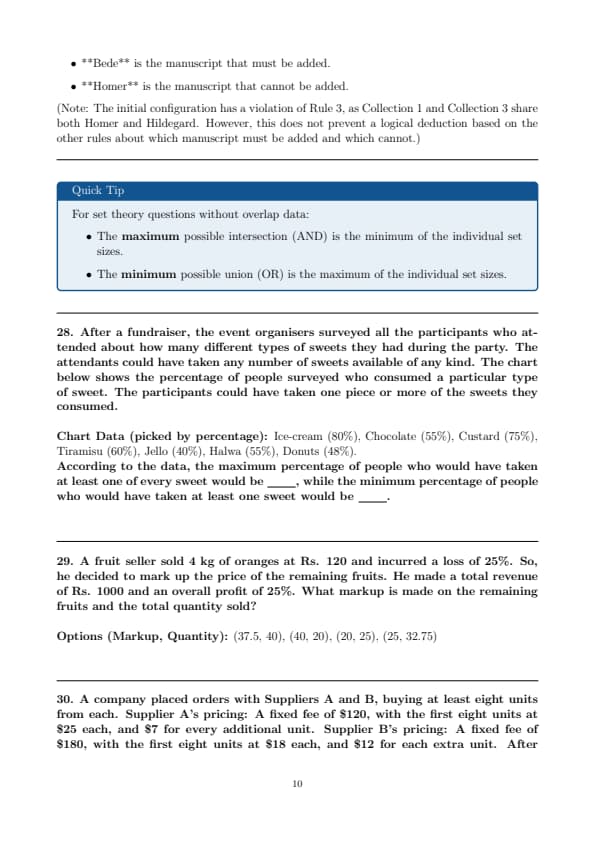
After a fundraiser, the event organisers surveyed all the participants who attended about how many different types of sweets they had during the party. The attendants could have taken any number of sweets available of any kind. The chart below shows the percentage of people surveyed who consumed a particular type of sweet. The participants could have taken one piece or more of the sweets they consumed.
Chart Data (picked by percentage): Ice-cream (80%), Chocolate (55%), Custard (75%), Tiramisu (60%), Jello (40%), Halwa (55%), Donuts (48%).
According to the data, the maximum percentage of people who would have taken at least one of every sweet would be \hspace{1cm}, while the minimum percentage of people who would have taken at least one sweet would be \hspace{1cm}.
A fruit seller sold 4 kg of oranges at Rs. 120 and incurred a loss of 25%. So, he decided to mark up the price of the remaining fruits. He made a total revenue of Rs. 1000 and an overall profit of 25%. What markup is made on the remaining fruits and the total quantity sold?
Options (Markup, Quantity): (37.5, 40), (40, 20), (20, 25), (25, 32.75)
A company placed orders with Suppliers A and B, buying at least eight units from each.
Supplier A's pricing: A fixed fee of
(120, with the first eight units at
)25 each, and
(7 for every additional unit.
Supplier B's pricing: A fixed fee of
)180, with the first eight units at
(18 each, and
)12 for each extra unit. After all purchases, including fixed costs, the average price per unit was
(23.
Select the number of units purchased from Supplier A and the number of units purchased from Supplier B that are jointly consistent with the given information. Make only two selections, one in each column.
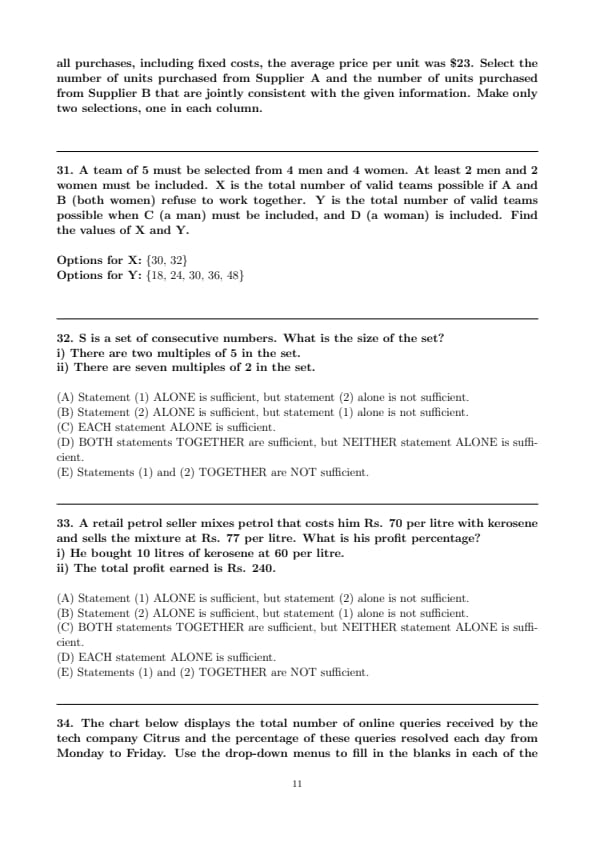
A team of 5 must be selected from 4 men and 4 women. At least 2 men and 2 women must be included. X is the total number of valid teams possible if A and B (both women) refuse to work together. Y is the total number of valid teams possible when C (a man) must be included, and D (a woman) is included. Find the values of X and Y.
Options for X: \{30, 32\
Options for Y: \{18, 24, 30, 36, 48\
S is a set of consecutive numbers. What is the size of the set?
i) There are two multiples of 5 in the set.
ii) There are seven multiples of 2 in the set.
A retail petrol seller mixes petrol that costs him Rs. 70 per litre with kerosene and sells the mixture at Rs. 77 per litre. What is his profit percentage?
i) He bought 10 litres of kerosene at 60 per litre.
ii) The total profit earned is Rs. 240.
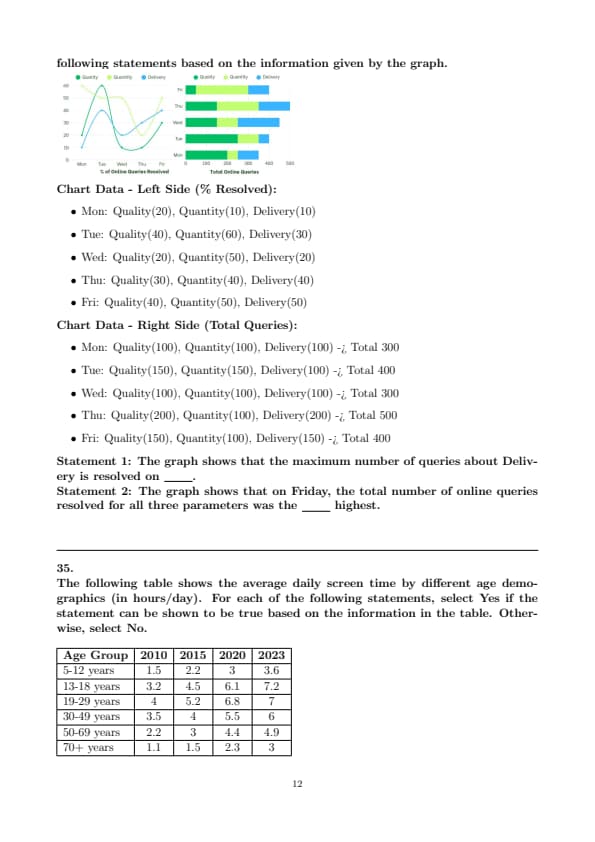
The chart below displays the total number of online queries received by the tech company Citrus and the percentage of these queries resolved each day from Monday to Friday.
Use the drop-down menus to fill in the blanks in each of the following statements based on the information given by the graph.
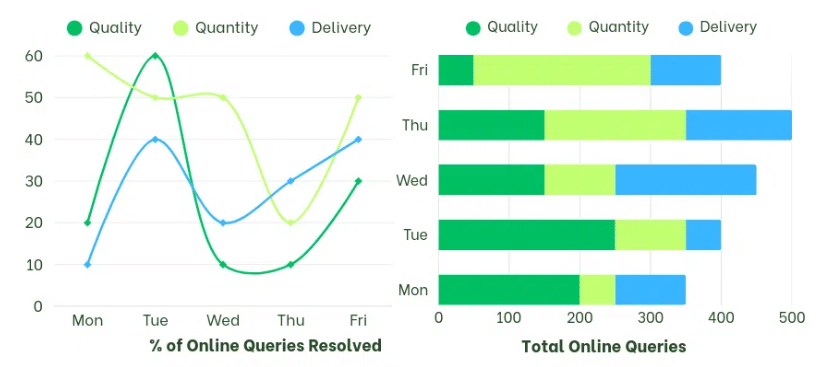
Chart Data - Left Side
Mon: Quality(20), Quantity(10), Delivery(10)
Tue: Quality(40), Quantity(60), Delivery(30)
Wed: Quality(20), Quantity(50), Delivery(20)
Thu: Quality(30), Quantity(40), Delivery(40)
Fri: Quality(40), Quantity(50), Delivery(50)
Chart Data - Right Side (Total Queries):
Mon: Quality(100), Quantity(100), Delivery(100) -> Total 300
Tue: Quality(150), Quantity(150), Delivery(100) -> Total 400
Wed: Quality(100), Quantity(100), Delivery(100) -> Total 300
Thu: Quality(200), Quantity(100), Delivery(200) -> Total 500
Fri: Quality(150), Quantity(100), Delivery(150) -> Total 400
Statement 1: The graph shows that the maximum number of queries about Delivery is resolved on \hspace{1cm}.
Statement 2: The graph shows that on Friday, the total number of online queries resolved for all three parameters was the \hspace{1cm} highest.
35a. The percentage increase in average screen time for the 13-18 age group from 2010 to 2023 is more than 115%.
View Solution
Step 1: Find the values for the 13-18 age group in 2010 and 2023.
2010 value = 3.2 hours
2023 value = 7.2 hours
Step 2: Calculate the percentage increase. \[ % Increase = \frac{New Value - Old Value}{Old Value} \times 100 = \frac{7.2 - 3.2}{3.2} \times 100 \] \[ % Increase = \frac{4.0}{3.2} \times 100 = \frac{40}{32} \times 100 = \frac{5}{4} \times 100 = 1.25 \times 100 = 125% \]
Step 3: Compare the result to 115%.
Since 125% is more than 115%, the statement is true. Select Yes.
Quick Tip: Read table-based questions very carefully to distinguish between requests for \textbf{absolute increase} (New - Old), \textbf{percentage increase} ((New - Old)/Old), and values like \textbf{median} (the middle value of a sorted set). Each requires a different calculation.
35b. If there are equal numbers of people in each age group, then the median average usage for all people in 2020 is more than 5 hours/day.
35c. The increase in the average screen time from 2010 to 2023 for the 30-49 age group is greater than the increase in average screen time for the 50-69 age group during the same period.
View Solution
Step 1: Calculate the absolute increase for the 30-49 age group from 2010 to 2023.
2023 value = 6 hours
2010 value = 3.5 hours
Increase = \(6 - 3.5 = 2.5\) hours.
Step 2: Calculate the absolute increase for the 50-69 age group from 2010 to 2023.
2023 value = 4.9 hours
2010 value = 2.2 hours
Increase = \(4.9 - 2.2 = 2.7\) hours.
Step 3: Compare the two increases.
The increase for the 30-49 group (2.5 hours) is not greater than the increase for the 50-69 group (2.7 hours). Therefore, the statement is false. Select No.
Quick Tip: Read table-based questions very carefully to distinguish between requests for \textbf{absolute increase} (New - Old), \textbf{percentage increase} ((New - Old)/Old), and values like \textbf{median} (the middle value of a sorted set). Each requires a different calculation.
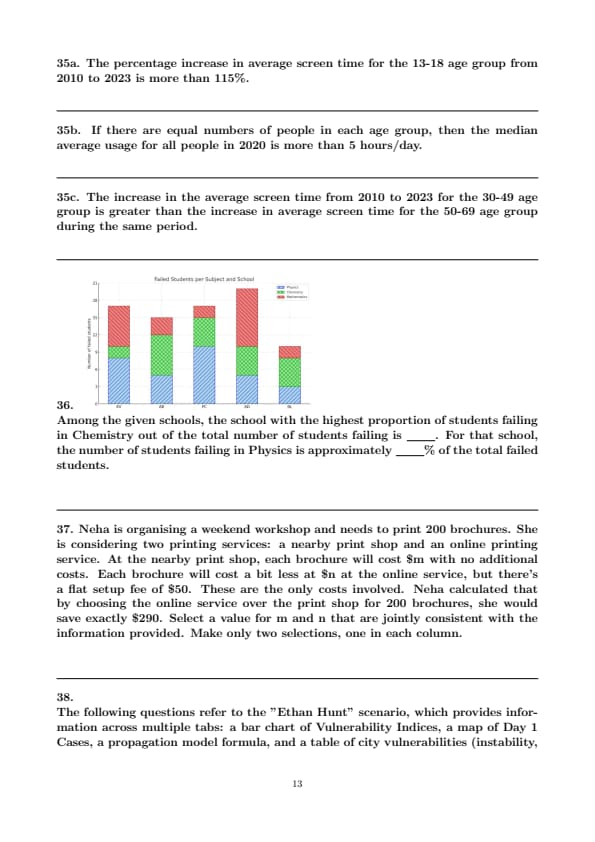
Among the given schools, the school with the highest proportion of students failing in Chemistry out of the total number of students failing is For that school, the number of students failing in Physics is approximately \hspace{1cm}% of the total failed students.
Neha is organising a weekend workshop and needs to print 200 brochures. She is considering two printing services: a nearby print shop and an online printing service. At the nearby print shop, each brochure will cost
(m with no additional costs. Each brochure will cost a bit less at
)n at the online service, but there's a flat setup fee of
(50. These are the only costs involved. Neha calculated that by choosing the online service over the print shop for 200 brochures, she would save exactly
)290.
Select a value for m and n that are jointly consistent with the information provided. Make only two selections, one in each column.
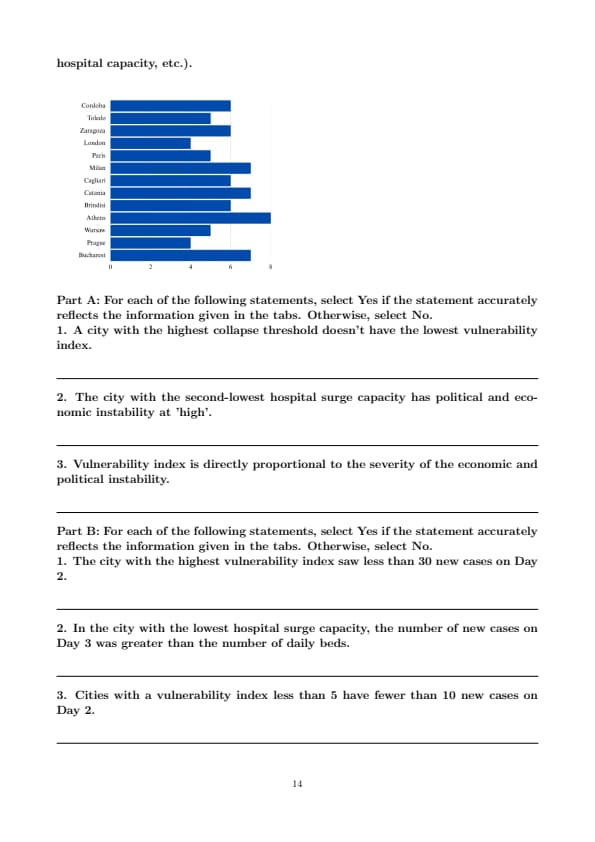
1. A city with the highest collapse threshold doesn't have the lowest vulnerability index.
View Solution
Step 1: Identify the city with the highest collapse threshold from the table. The highest value is 3000, which corresponds to London.
Step 2: Find the vulnerability index (VI) for London from the bar chart. London's VI is 4.5.
Step 3: Find the lowest vulnerability index among all cities. The lowest VI value on the chart is 4.5, shared by London and Prague.
Step 4: Evaluate the statement. The city with the highest collapse threshold (London) *does* have the lowest vulnerability index (4.5). The statement claims it "doesn't have" the lowest VI, which is false.
Quick Tip: When analyzing exponential growth over multiple periods, the growth rate (multiplier) is typically more influential on the final outcome than the initial starting value. A city with a significantly higher rate will likely overtake a city with a higher starting value but a lower rate.
2. The city with the second-lowest hospital surge capacity has political and economic instability at 'high'.
View Solution
Step 1: Identify the city with the second-lowest hospital surge capacity from the table. Sorting the capacities: Cagliari (40), Brindisi (45), Catania (50), etc. The second-lowest is Brindisi.
Step 2: Check the political and economic instability levels for Brindisi from the table. Political Instability is Medium and Economic Instability is High.
Step 3: Evaluate the statement. The city (Brindisi) does not have both instabilities at 'High'. Therefore, the statement is false.
Quick Tip: When analyzing exponential growth over multiple periods, the growth rate (multiplier) is typically more influential on the final outcome than the initial starting value. A city with a significantly higher rate will likely overtake a city with a higher starting value but a lower rate.
3. Vulnerability index is directly proportional to the severity of the economic and political instability.
View Solution
Step 1: To test for direct proportionality, the ratio of VI to a measure of instability must be constant. Let's assign numerical values: Low=1, Medium=2, High=3.
Step 2: Compare two cities with the same instability levels.
Cagliari: Political=High (3), Economic=High (3). Total instability score = 6. VI = 6. Ratio = 6/6 = 1.
Athens: Political=High (3), Economic=High (3). Total instability score = 6. VI = 8. Ratio = 8/6 \(\approx\) 1.33.
Step 3: Evaluate the statement. Since two cities with the same instability score have different VIs, the ratio is not constant. Therefore, the relationship is not a direct proportion. The statement is false.
Quick Tip: When analyzing exponential growth over multiple periods, the growth rate (multiplier) is typically more influential on the final outcome than the initial starting value. A city with a significantly higher rate will likely overtake a city with a higher starting value but a lower rate.
1. The city with the highest vulnerability index saw less than 30 new cases on Day 2.
View Solution
Step 1: Identify the city with the highest VI. This is Athens with VI = 8.
Step 2: Find the Day 1 cases for Athens from the map: Cases\(_{D1}\) = 36.
Step 3: Use the formula to calculate total cases on Day 2. Cases\(_{t+1}\) = Cases\(_t\) \(\times\) (1 + VI/10).
Cases\(_{D2}\) = floor(36 \(\times\) (1 + 8/10)) = floor(36 \(\times\) 1.8) = floor(64.8) = 64.
Step 4: Calculate the number of new cases on Day 2. New Cases = Cases\(_{D2}\) - Cases\(_{D1}\) = 64 - 36 = 28.
Step 5: Evaluate the statement. 28 is less than 30. The statement is true.
Quick Tip: When analyzing exponential growth over multiple periods, the growth rate (multiplier) is typically more influential on the final outcome than the initial starting value. A city with a significantly higher rate will likely overtake a city with a higher starting value but a lower rate.
2. In the city with the lowest hospital surge capacity, the number of new cases on Day 3 was greater than the number of daily beds.
3. Cities with a vulnerability index less than 5 have fewer than 10 new cases on Day 2.
1. Catania saw more new cases than the available daily beds for the first time on Day 4.
View Solution
Step 1: Get data for Catania: Daily beds = 50, VI = 7, Cases\(_{D1}\) = 39. Multiplier = 1.7.
Step 2: Project new cases day by day and compare to 50.
Day 2: Cases\(_{D2}\) = floor(39 \(\times\) 1.7) = 66. New cases = 66-39=27. (27 < 50)
Day 3: Cases\(_{D3}\) = floor(66 \(\times\) 1.7) = 112. New cases = 112-66=46. (46 < 50)
Day 4: Cases\(_{D4}\) = floor(112 \(\times\) 1.7) = 190. New cases = 190-112=78. (78 > 50)
Step 3: Evaluate the statement. Day 4 is the first day new cases (78) exceeded the daily beds (50). The statement is true.
Quick Tip: When analyzing exponential growth over multiple periods, the growth rate (multiplier) is typically more influential on the final outcome than the initial starting value. A city with a significantly higher rate will likely overtake a city with a higher starting value but a lower rate.
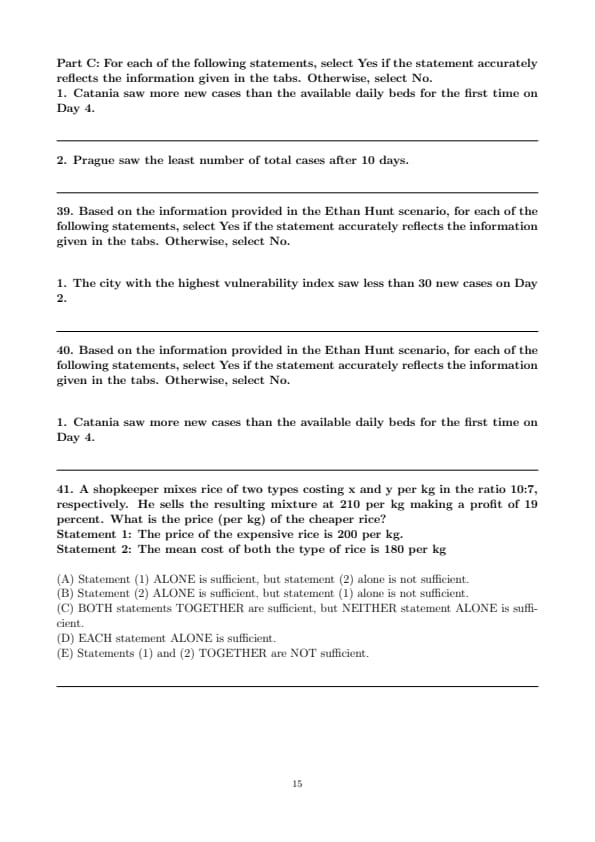
2. Prague saw the least number of total cases after 10 days.
View Solution
N/A
3. Athens saw the highest number of total cases after 10 days.
View Solution
Step 1: To find the city with the most cases, we should look for cities with high initial cases and high VI. The growth is dominated by the VI. Athens has the highest VI of 8.
Step 2: Let's project cases for Athens and another strong contender like Zaragoza (high initial cases).
Athens (VI=8, C1=36): Projection for 10 days gives a total of 7020 cases.
Zaragoza (VI=6.5, C1=43): Projection for 10 days gives a total of 3796 cases.
Step 3: The significantly higher VI of Athens leads to much faster exponential growth, resulting in the highest total number of cases. The statement is true.
Quick Tip: When analyzing exponential growth over multiple periods, the growth rate (multiplier) is typically more influential on the final outcome than the initial starting value. A city with a significantly higher rate will likely overtake a city with a higher starting value but a lower rate.
Based on the information provided in the Ethan Hunt scenario, for each of the following statements, select Yes if the statement accurately reflects the information given in the tabs. Otherwise, select No.
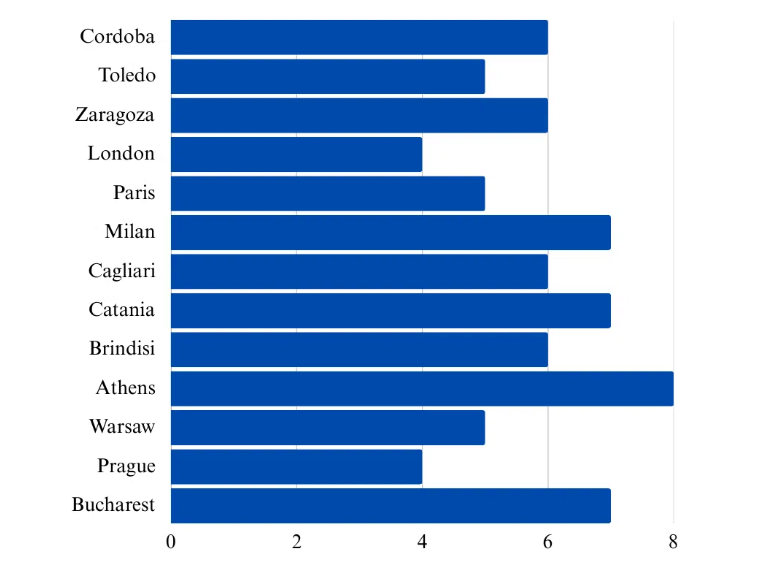
1. The city with the highest vulnerability index saw less than 30 new cases on Day 2.
Based on the information provided in the Ethan Hunt scenario, for each of the following statements, select Yes if the statement accurately reflects the information given in the tabs. Otherwise, select No.
1. Catania saw more new cases than the available daily beds for the first time on Day 4.
A shopkeeper mixes rice of two types costing x and y per kg in the ratio 10:7, respectively. He sells the resulting mixture at 210 per kg making a profit of 19 percent. What is the price (per kg) of the cheaper rice?
Statement 1: The price of the expensive rice is 200 per kg.
Statement 2: The mean cost of both the type of rice is 180 per kg
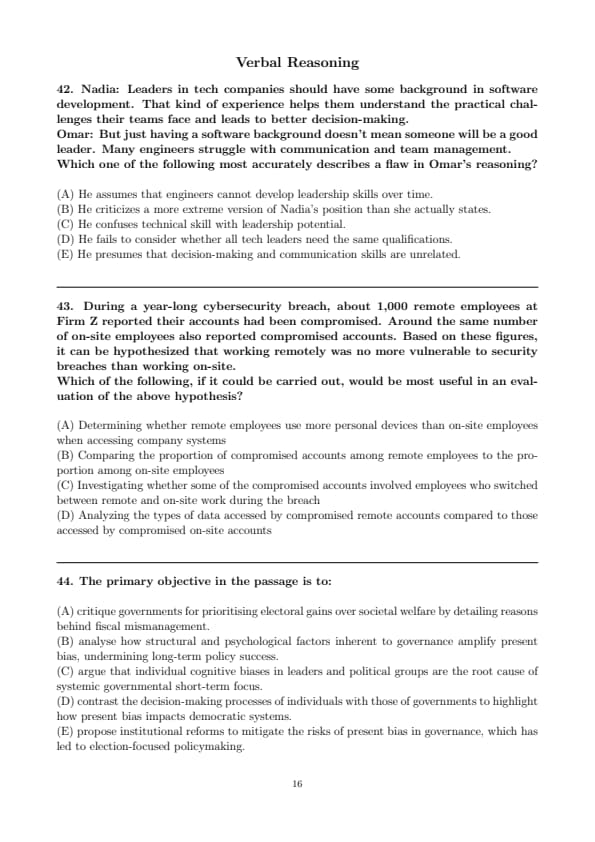
Nadia: Leaders in tech companies should have some background in software development. That kind of experience helps them understand the practical challenges their teams face and leads to better decision-making.
Omar: But just having a software background doesn't mean someone will be a good leader. Many engineers struggle with communication and team management.
Which one of the following most accurately describes a flaw in Omar's reasoning?
During a year-long cybersecurity breach, about 1,000 remote employees at Firm Z reported their accounts had been compromised. Around the same number of on-site employees also reported compromised accounts. Based on these figures, it can be hypothesized that working remotely was no more vulnerable to security breaches than working on-site.
Which of the following, if it could be carried out, would be most useful in an evaluation of the above hypothesis?
The primary objective in the passage is to:
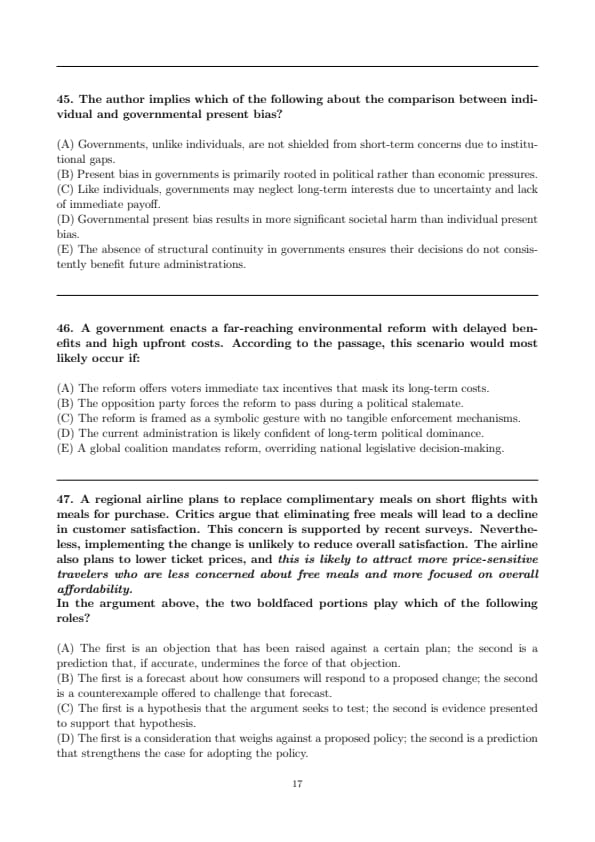
The author implies which of the following about the comparison between individual and governmental present bias?
A government enacts a far-reaching environmental reform with delayed benefits and high upfront costs. According to the passage, this scenario would most likely occur if:
A regional airline plans to replace complimentary meals on short flights with meals for purchase. Critics argue that eliminating free meals will lead to a decline in customer satisfaction. This concern is supported by recent surveys. Nevertheless, implementing the change is unlikely to reduce overall satisfaction. The airline also plans to lower ticket prices, and this is likely to attract more price-sensitive travelers who are less concerned about free meals and more focused on overall affordability.
In the argument above, the two boldfaced portions play which of the following roles?
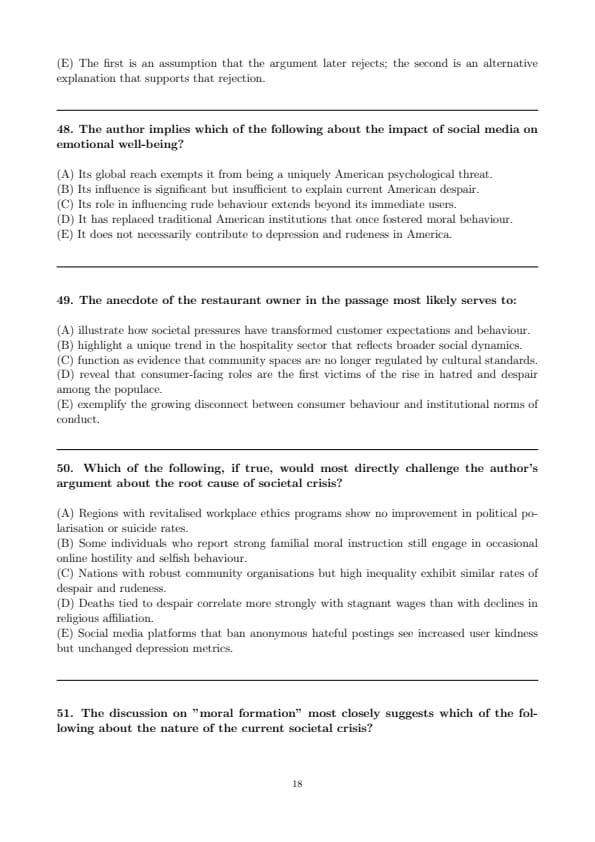
The author implies which of the following about the impact of social media on emotional well-being?
The anecdote of the restaurant owner in the passage most likely serves to:
Which of the following, if true, would most directly challenge the author's argument about the root cause of societal crisis?
The discussion on "moral formation" most closely suggests which of the following about the nature of the current societal crisis?
Which of the following is most strongly supported by the discovery of southwest British tin in shipwrecks near Israel (1300 BC) and France (600 BC)?
The argument that southwest Britain was a major contributor to Bronze Age tin supplies depends on which of the following assumptions?
The boldfaced sentence plays which of the following roles in the passage?
The core limitation with the last line of the passage is that it:
A study of professional chess players revealed that those who began formal coaching before the age of 10 were far more likely to become grandmasters than those who began coaching at an older age or not at all. Researchers concluded that early coaching significantly increases the likelihood of attaining elite status in chess. However, this conclusion is not entirely correct. Early achievers are typically individuals who show exceptional interest and aptitude for chess from a young age. It is this early talent and motivation-not the timing of coaching-that primarily accounts for their success.
Which one of the following, if true, most strengthens the objection to the researchers' conclusion?
For many years, biologists thought a certain frog species had gone extinct in a region because no individuals were found after a fungal outbreak. This belief was based on surveys conducted after the outbreak, which failed to detect any frogs. However, researchers recently found the species' remains buried in soil layers that appear to have been deposited after the time of the outbreak, suggesting the species might have survived longer than previously believed. This finding does not necessarily disprove the original belief, because \hspace{1cm}.
The prestigious Larchmont High School recently introduced a new magnet program for advanced STEM students. Over the past few months, the school has seen a sharp rise in enrollment, and several teachers have noted that classroom resources are becoming stretched. They argue that if the magnet program were relocated to a separate campus, both the STEM students and the general student body would have a better educational experience.
Which of the following is an assumption that supports drawing the conclusion above from the reasons given for that conclusion?
Principle: An investment strategy is prudent only if it does not expose the investor to an unacceptable level of financial risk.
Application: Noah has recently begun using a strategy that includes investing in early-stage tech startups. Although the strategy diversifies his portfolio, it increases his exposure to assets that are less stable than traditional blue-chip stocks. Therefore, his strategy is not prudent.
The application of the principle is most vulnerable to criticism on which one of the following grounds?
In 2018, a medium-sized company implemented a remote work policy allowing employees to work from home two days a week. A study before the policy was introduced showed average employee productivity scores. A follow-up study conducted two years later showed that productivity among employees had increased by 25%. The company concluded that remote work boosts employee productivity. Meanwhile, a separate study of two similar companies that had allowed remote work for over a decade showed no significant change in productivity during the same two-year period.
The results of the final study mentioned above:
Astronomer: In 2022, Observatory Z discovered 12 comets within a two-month span, an unusually high figure compared to their typical average of 3-4 comet discoveries per year. Strikingly, most of these 12 comets were discovered using a decade-old telescope, while a recently acquired state-of-the-art telescope, capable of scanning larger portions of the sky and detecting fainter objects, identified only one comet in the same period. This discrepancy is puzzling, given that the new telescope was designed to vastly outperform the older model.
Which of the following, if true, most helps to explain the discrepancy described by the astronomer?
According to the passage, which of the following would apply to a person who reads a novel and later watches its film adaptation?
Which of the following, if true, would most strengthen the argument that fictional memories can influence decision-making similarly to autobiographical memories?
If a person identifies strongly with a fictional character who overcomes social anxiety, what would the author likely argue about this identification?








Comments