GMAT 2025 Practice Paper Set 2 Question Paper with Answer Key and Solutions PDF is available for download. GMAT lasts for a total of 2 hours and 15 minutes, with an optional 10-minute break. Throughout the test, candidates will be required to answer 64 questions, distributed as follows:
- Quantitative Reasoning: 21 questions, to be completed in 45 minutes.
- Verbal Reasoning: 23 questions, to be completed in 45 minutes.
- Data Insights: 20 questions, to be completed in 45 minutes.
GMAT 2025 Sample Paper Set 2 Question Paper with Solutions PDF
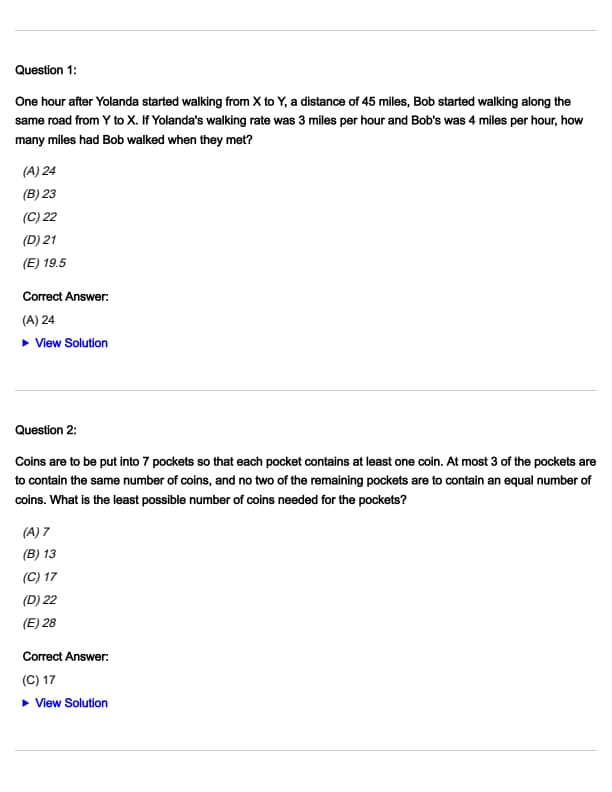
Question 1:
One hour after Yolanda started walking from X to Y, a distance of 45 miles, Bob started walking along the same road from Y to X. If Yolanda's walking rate was 3 miles per hour and Bob's was 4 miles per hour, how many miles had Bob walked when they met?
- (A) 24
- (B) 23
- (C) 22
- (D) 21
- (E) 19.5
Question 2:
Coins are to be put into 7 pockets so that each pocket contains at least one coin. At most 3 of the pockets are to contain the same number of coins, and no two of the remaining pockets are to contain an equal number of coins. What is the least possible number of coins needed for the pockets?
- (A) 7
- (B) 13
- (C) 17
- (D) 22
- (E) 28
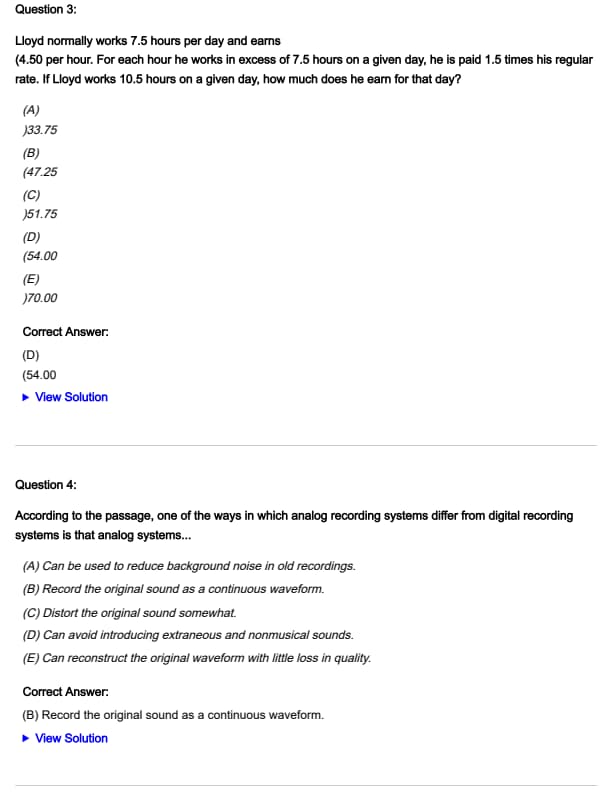
Question 3:
Lloyd normally works 7.5 hours per day and earns
(4.50 per hour. For each hour he works in excess of 7.5 hours on a given day, he is paid 1.5 times his regular rate. If Lloyd works 10.5 hours on a given day, how much does he earn for that day?
- (A)
)33.75
- (B)
(47.25
- (C)
)51.75
- (D)
(54.00
- (E)
)70.00
Question 4:
According to the passage, one of the ways in which analog recording systems differ from digital recording systems is that analog systems...
- (A) Can be used to reduce background noise in old recordings.
- (B) Record the original sound as a continuous waveform.
- (C) Distort the original sound somewhat.
- (D) Can avoid introducing extraneous and nonmusical sounds.
- (E) Can reconstruct the original waveform with little loss in quality.
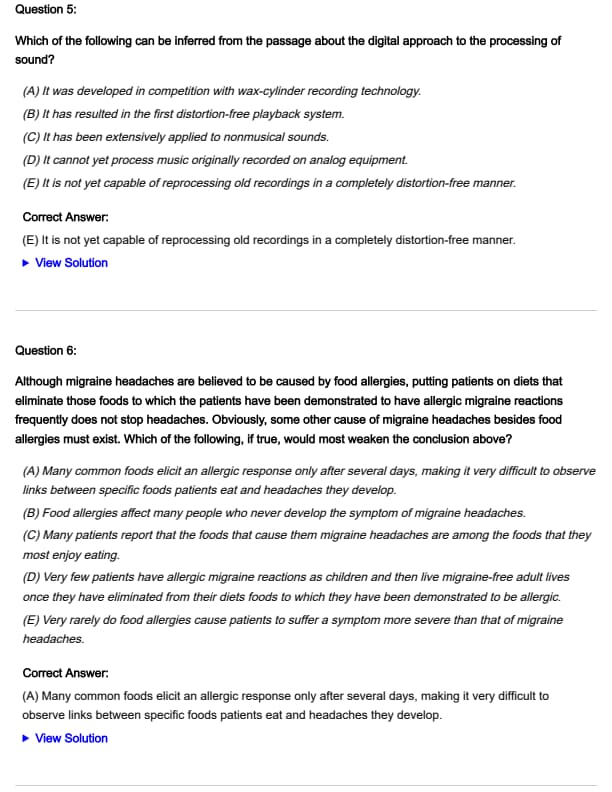
Question 5:
Which of the following can be inferred from the passage about the digital approach to the processing of sound?
- (A) It was developed in competition with wax-cylinder recording technology.
- (B) It has resulted in the first distortion-free playback system.
- (C) It has been extensively applied to nonmusical sounds.
- (D) It cannot yet process music originally recorded on analog equipment.
- (E) It is not yet capable of reprocessing old recordings in a completely distortion-free manner.
Question 6:
Although migraine headaches are believed to be caused by food allergies, putting patients on diets that eliminate those foods to which the patients have been demonstrated to have allergic migraine reactions frequently does not stop headaches. Obviously, some other cause of migraine headaches besides food allergies must exist. Which of the following, if true, would most weaken the conclusion above?
- (A) Many common foods elicit an allergic response only after several days, making it very difficult to observe links between specific foods patients eat and headaches they develop.
- (B) Food allergies affect many people who never develop the symptom of migraine headaches.
- (C) Many patients report that the foods that cause them migraine headaches are among the foods that they most enjoy eating.
- (D) Very few patients have allergic migraine reactions as children and then live migraine-free adult lives once they have eliminated from their diets foods to which they have been demonstrated to be allergic.
- (E) Very rarely do food allergies cause patients to suffer a symptom more severe than that of migraine headaches.
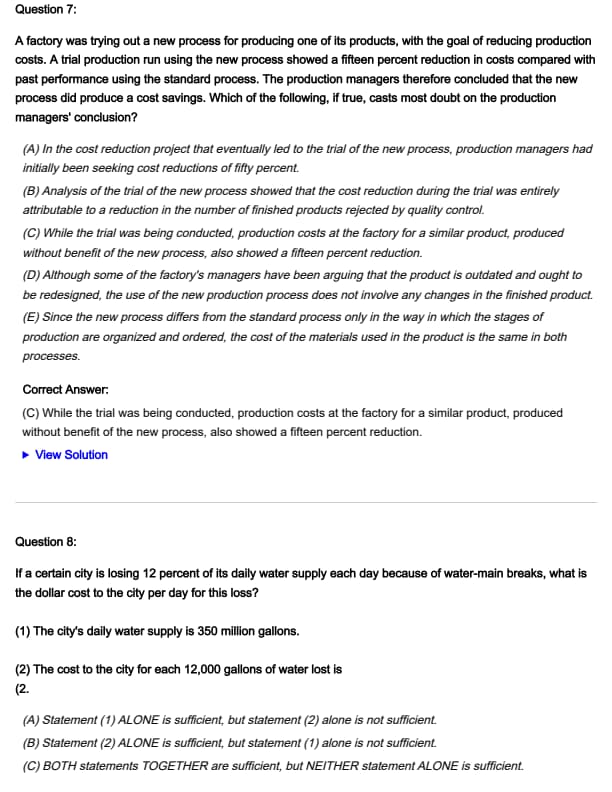
Question 7:
A factory was trying out a new process for producing one of its products, with the goal of reducing production costs. A trial production run using the new process showed a fifteen percent reduction in costs compared with past performance using the standard process. The production managers therefore concluded that the new process did produce a cost savings. Which of the following, if true, casts most doubt on the production managers' conclusion?
- (A) In the cost reduction project that eventually led to the trial of the new process, production managers had initially been seeking cost reductions of fifty percent.
- (B) Analysis of the trial of the new process showed that the cost reduction during the trial was entirely attributable to a reduction in the number of finished products rejected by quality control.
- (C) While the trial was being conducted, production costs at the factory for a similar product, produced without benefit of the new process, also showed a fifteen percent reduction.
- (D) Although some of the factory's managers have been arguing that the product is outdated and ought to be redesigned, the use of the new production process does not involve any changes in the finished product.
- (E) Since the new process differs from the standard process only in the way in which the stages of production are organized and ordered, the cost of the materials used in the product is the same in both processes.
Question 8:
If a certain city is losing 12 percent of its daily water supply each day because of water-main breaks, what is the dollar cost to the city per day for this loss?
(1) The city's daily water supply is 350 million gallons.
(2) The cost to the city for each 12,000 gallons of water lost is
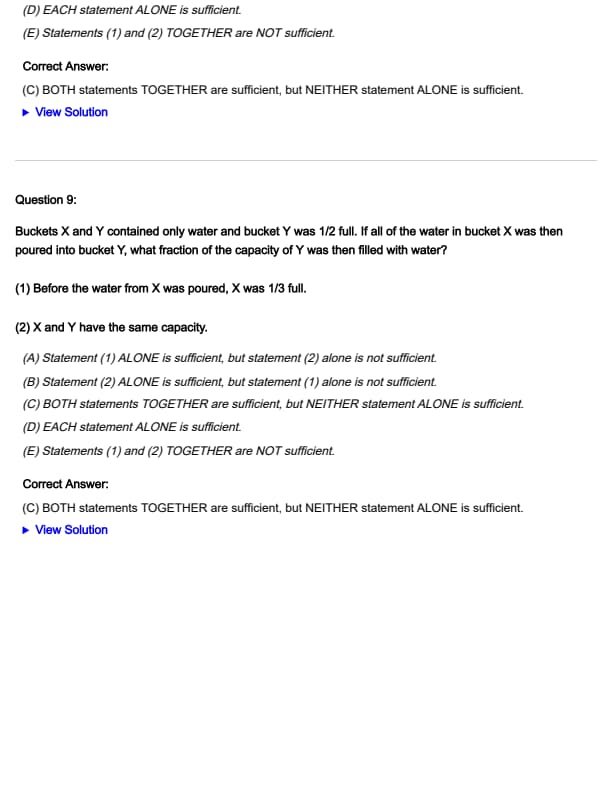
(2.
- (A) Statement (1) ALONE is sufficient, but statement (2) alone is not sufficient.
- (B) Statement (2) ALONE is sufficient, but statement (1) alone is not sufficient.
- (C) BOTH statements TOGETHER are sufficient, but NEITHER statement ALONE is sufficient.
- (D) EACH statement ALONE is sufficient.
- (E) Statements (1) and (2) TOGETHER are NOT sufficient.
Question 9:
Buckets X and Y contained only water and bucket Y was 1/2 full. If all of the water in bucket X was then poured into bucket Y, what fraction of the capacity of Y was then filled with water?
(1) Before the water from X was poured, X was 1/3 full.
(2) X and Y have the same capacity.
- (A) Statement (1) ALONE is sufficient, but statement (2) alone is not sufficient.
- (B) Statement (2) ALONE is sufficient, but statement (1) alone is not sufficient.
- (C) BOTH statements TOGETHER are sufficient, but NEITHER statement ALONE is sufficient.
- (D) EACH statement ALONE is sufficient.
- (E) Statements (1) and (2) TOGETHER are NOT sufficient.


-modified.png?h=56&w=56&mode=stretch)


 Download



Comments