GMAT 2025 Sample Paper 3 Question Paper with Answer Key and Solutions PDF

GMAT 2025 Sample Paper 3 Question Paper with Answer Key and Solutions PDF is available for download. GMAT lasts for a total of 2 hours and 15 minutes, with an optional 10-minute break. Throughout the test, candidates will be required to answer 64 questions, distributed as follows:

  • Quantitative Reasoning: 21 questions, to be completed in 45 minutes.
  • Verbal Reasoning: 23 questions, to be completed in 45 minutes.
  • Data Insights: 20 questions, to be completed in 45 minutes.

GMAT 2025 Sample Paper 3 Question Paper with Solutions PDF

GMAT 2025 Sample Paper 3 Question Paper with Solutions PDF download iconDownload Check Solutions

GMAT 2025 Sample Paper 3


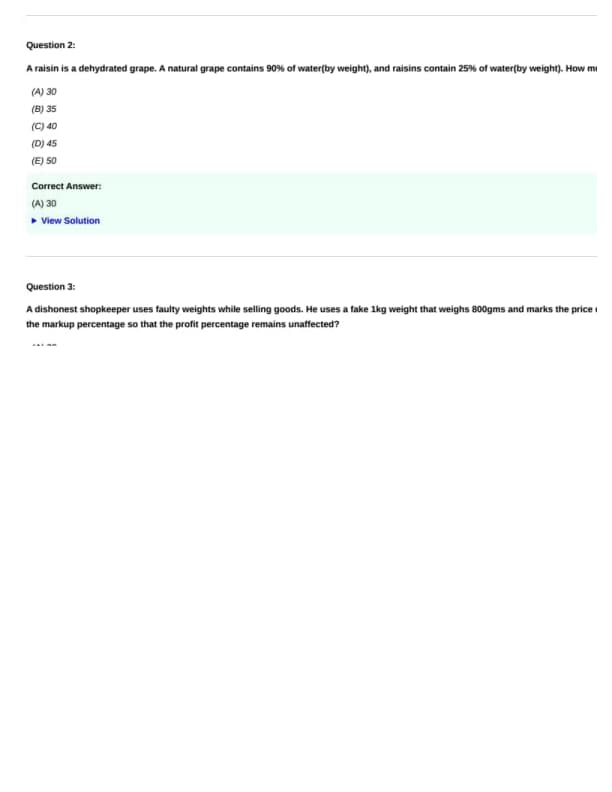
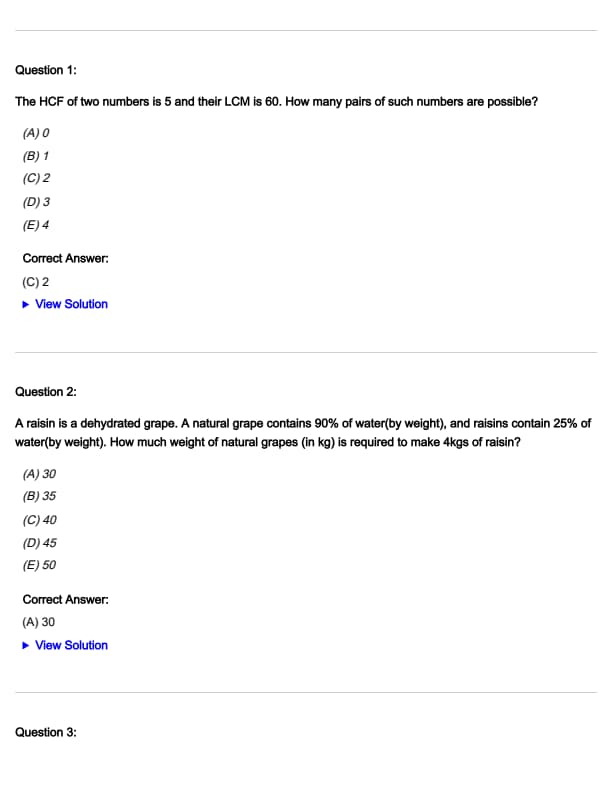
Question 1:

The HCF of two numbers is 5 and their LCM is 60. How many pairs of such numbers are possible?

  • (A) 0
  • (B) 1
  • (C) 2
  • (D) 3
  • (E) 4

Question 2:

A raisin is a dehydrated grape. A natural grape contains 90% of water(by weight), and raisins contain 25% of water(by weight). How much weight of natural grapes (in kg) is required to make 4kgs of raisin?

  • (A) 30
  • (B) 35
  • (C) 40
  • (D) 45
  • (E) 50

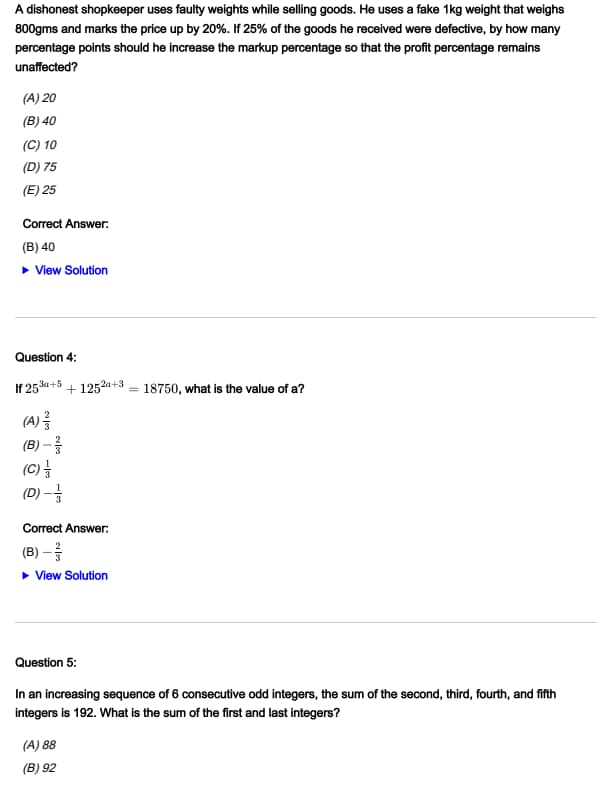
Question 3:

A dishonest shopkeeper uses faulty weights while selling goods. He uses a fake 1kg weight that weighs 800gms and marks the price up by 20%. If 25% of the goods he received were defective, by how many percentage points should he increase the markup percentage so that the profit percentage remains unaffected?

  • (A) 20
  • (B) 40
  • (C) 10
  • (D) 75
  • (E) 25

Question 4:

If \(25^{3a+5} + 125^{2a+3} = 18750\), what is the value of a?

  • (A) \( \frac{2}{3} \)
  • (B) \( -\frac{2}{3} \)
  • (C) \( \frac{1}{3} \)
  • (D) \( -\frac{1}{3} \)

Question 5:

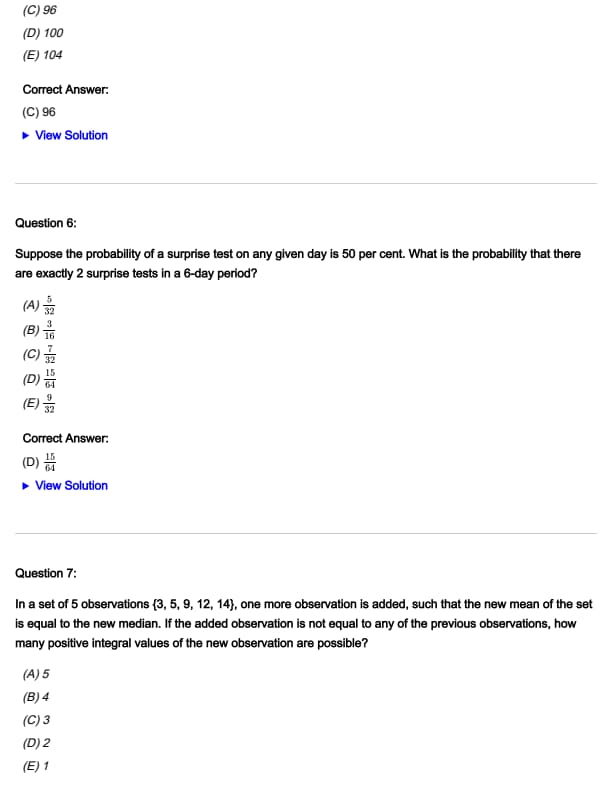
In an increasing sequence of 6 consecutive odd integers, the sum of the second, third, fourth, and fifth integers is 192. What is the sum of the first and last integers?

  • (A) 88
  • (B) 92
  • (C) 96
  • (D) 100
  • (E) 104

Question 6:

Suppose the probability of a surprise test on any given day is 50 per cent. What is the probability that there are exactly 2 surprise tests in a 6-day period?

  • (A) \( \frac{5}{32} \)
  • (B) \( \frac{3}{16} \)
  • (C) \( \frac{7}{32} \)
  • (D) \( \frac{15}{64} \)
  • (E) \( \frac{9}{32} \)

Question 7:

In a set of 5 observations {3, 5, 9, 12, 14}, one more observation is added, such that the new mean of the set is equal to the new median. If the added observation is not equal to any of the previous observations, how many positive integral values of the new observation are possible?

  • (A) 5
  • (B) 4
  • (C) 3
  • (D) 2
  • (E) 1

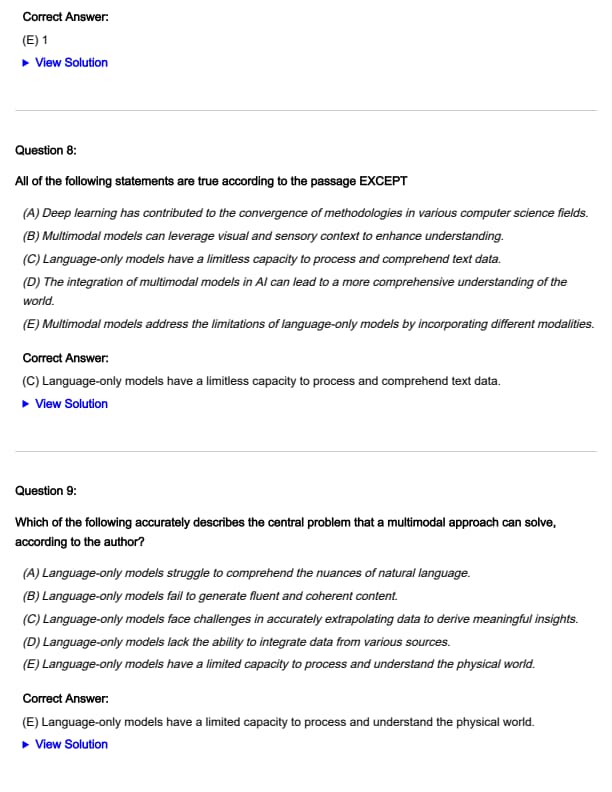
Question 8:

All of the following statements are true according to the passage EXCEPT

  • (A) Deep learning has contributed to the convergence of methodologies in various computer science fields.
  • (B) Multimodal models can leverage visual and sensory context to enhance understanding.
  • (C) Language-only models have a limitless capacity to process and comprehend text data.
  • (D) The integration of multimodal models in AI can lead to a more comprehensive understanding of the world.
  • (E) Multimodal models address the limitations of language-only models by incorporating different modalities.

Question 9:

Which of the following accurately describes the central problem that a multimodal approach can solve, according to the author?

  • (A) Language-only models struggle to comprehend the nuances of natural language.
  • (B) Language-only models fail to generate fluent and coherent content.
  • (C) Language-only models face challenges in accurately extrapolating data to derive meaningful insights.
  • (D) Language-only models lack the ability to integrate data from various sources.
  • (E) Language-only models have a limited capacity to process and understand the physical world.

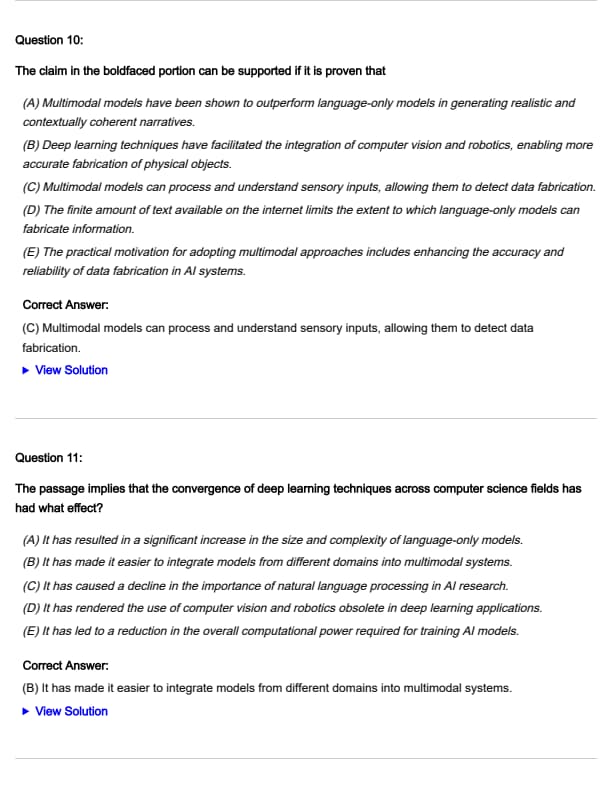
Question 10:

The claim in the boldfaced portion can be supported if it is proven that

  • (A) Multimodal models have been shown to outperform language-only models in generating realistic and contextually coherent narratives.
  • (B) Deep learning techniques have facilitated the integration of computer vision and robotics, enabling more accurate fabrication of physical objects.
  • (C) Multimodal models can process and understand sensory inputs, allowing them to detect data fabrication.
  • (D) The finite amount of text available on the internet limits the extent to which language-only models can fabricate information.
  • (E) The practical motivation for adopting multimodal approaches includes enhancing the accuracy and reliability of data fabrication in AI systems.

Question 11:

The passage implies that the convergence of deep learning techniques across computer science fields has had what effect?

  • (A) It has resulted in a significant increase in the size and complexity of language-only models.
  • (B) It has made it easier to integrate models from different domains into multimodal systems.
  • (C) It has caused a decline in the importance of natural language processing in AI research.
  • (D) It has rendered the use of computer vision and robotics obsolete in deep learning applications.
  • (E) It has led to a reduction in the overall computational power required for training AI models.

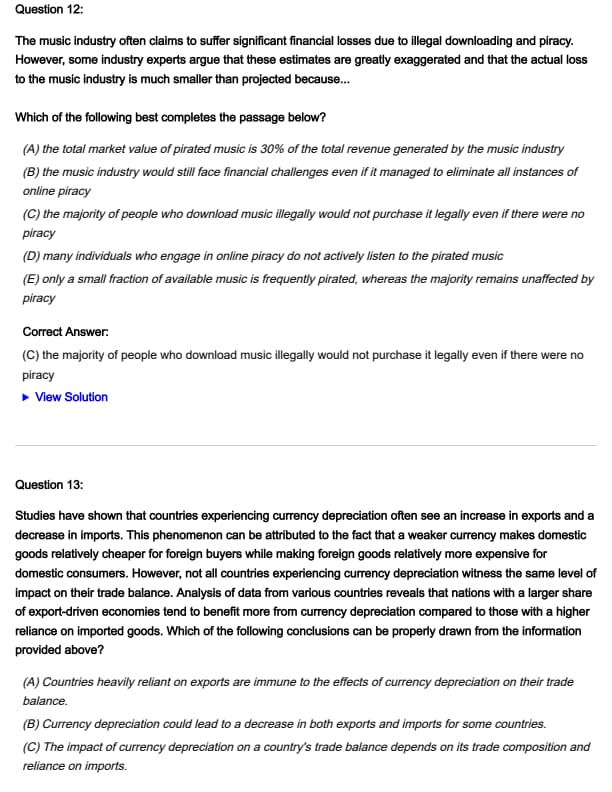
Question 12:

The music industry often claims to suffer significant financial losses due to illegal downloading and piracy. However, some industry experts argue that these estimates are greatly exaggerated and that the actual loss to the music industry is much smaller than projected because...

Which of the following best completes the passage below?

  • (A) the total market value of pirated music is 30% of the total revenue generated by the music industry
  • (B) the music industry would still face financial challenges even if it managed to eliminate all instances of online piracy
  • (C) the majority of people who download music illegally would not purchase it legally even if there were no piracy
  • (D) many individuals who engage in online piracy do not actively listen to the pirated music
  • (E) only a small fraction of available music is frequently pirated, whereas the majority remains unaffected by piracy

Question 13:

Studies have shown that countries experiencing currency depreciation often see an increase in exports and a decrease in imports. This phenomenon can be attributed to the fact that a weaker currency makes domestic goods relatively cheaper for foreign buyers while making foreign goods relatively more expensive for domestic consumers. However, not all countries experiencing currency depreciation witness the same level of impact on their trade balance. Analysis of data from various countries reveals that nations with a larger share of export-driven economies tend to benefit more from currency depreciation compared to those with a higher reliance on imported goods. Which of the following conclusions can be properly drawn from the information provided above?

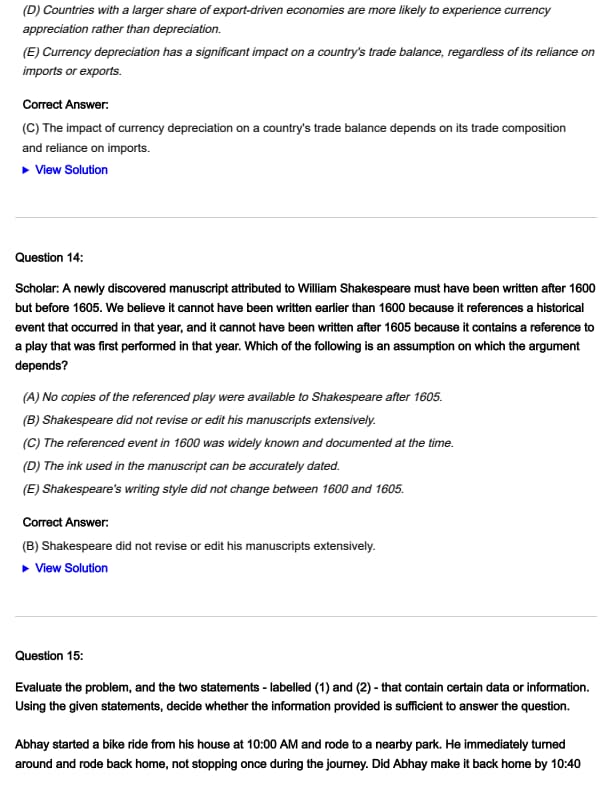
  • (A) Countries heavily reliant on exports are immune to the effects of currency depreciation on their trade balance.
  • (B) Currency depreciation could lead to a decrease in both exports and imports for some countries.
  • (C) The impact of currency depreciation on a country's trade balance depends on its trade composition and reliance on imports.
  • (D) Countries with a larger share of export-driven economies are more likely to experience currency appreciation rather than depreciation.
  • (E) Currency depreciation has a significant impact on a country's trade balance, regardless of its reliance on imports or exports.

Question 14:

Scholar: A newly discovered manuscript attributed to William Shakespeare must have been written after 1600 but before 1605. We believe it cannot have been written earlier than 1600 because it references a historical event that occurred in that year, and it cannot have been written after 1605 because it contains a reference to a play that was first performed in that year. Which of the following is an assumption on which the argument depends?

  • (A) No copies of the referenced play were available to Shakespeare after 1605.
  • (B) Shakespeare did not revise or edit his manuscripts extensively.
  • (C) The referenced event in 1600 was widely known and documented at the time.
  • (D) The ink used in the manuscript can be accurately dated.
  • (E) Shakespeare's writing style did not change between 1600 and 1605.

Question 15:

Evaluate the problem, and the two statements - labelled (1) and (2) - that contain certain data or information. Using the given statements, decide whether the information provided is sufficient to answer the question.

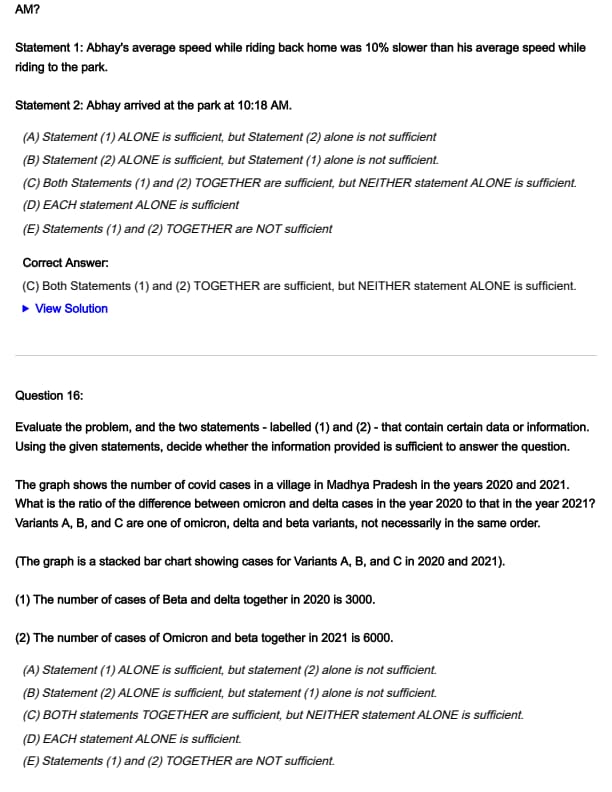
Abhay started a bike ride from his house at 10:00 AM and rode to a nearby park. He immediately turned around and rode back home, not stopping once during the journey. Did Abhay make it back home by 10:40 AM?

Statement 1: Abhay's average speed while riding back home was 10% slower than his average speed while riding to the park.

Statement 2: Abhay arrived at the park at 10:18 AM.

  • (A) Statement (1) ALONE is sufficient, but Statement (2) alone is not sufficient
  • (B) Statement (2) ALONE is sufficient, but Statement (1) alone is not sufficient.
  • (C) Both Statements (1) and (2) TOGETHER are sufficient, but NEITHER statement ALONE is sufficient.
  • (D) EACH statement ALONE is sufficient
  • (E) Statements (1) and (2) TOGETHER are NOT sufficient

Question 16:

Evaluate the problem, and the two statements - labelled (1) and (2) - that contain certain data or information. Using the given statements, decide whether the information provided is sufficient to answer the question.

The graph shows the number of covid cases in a village in Madhya Pradesh in the years 2020 and 2021. What is the ratio of the difference between omicron and delta cases in the year 2020 to that in the year 2021? Variants A, B, and C are one of omicron, delta and beta variants, not necessarily in the same order.

(The graph is a stacked bar chart showing cases for Variants A, B, and C in 2020 and 2021).

(1) The number of cases of Beta and delta together in 2020 is 3000.

(2) The number of cases of Omicron and beta together in 2021 is 6000.

  • (A) Statement (1) ALONE is sufficient, but statement (2) alone is not sufficient.
  • (B) Statement (2) ALONE is sufficient, but statement (1) alone is not sufficient.
  • (C) BOTH statements TOGETHER are sufficient, but NEITHER statement ALONE is sufficient.
  • (D) EACH statement ALONE is sufficient.
  • (E) Statements (1) and (2) TOGETHER are NOT sufficient.

Question 17:

Evaluate the problem, and the two statements - labelled (1) and (2) - that contain certain data or information. Using the given statements, decide whether the information provided is sufficient to answer the question.

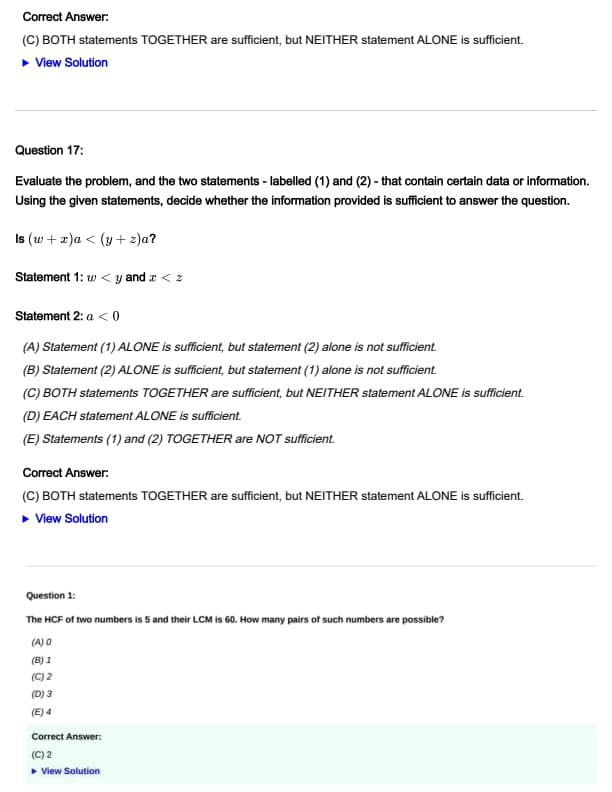
Is \( (w + x)a < (y + z)a \)?

Statement 1: \( w < y \) and \( x < z \)

Statement 2: \( a < 0 \)
  • (A) Statement (1) ALONE is sufficient, but statement (2) alone is not sufficient.
  • (B) Statement (2) ALONE is sufficient, but statement (1) alone is not sufficient.
  • (C) BOTH statements TOGETHER are sufficient, but NEITHER statement ALONE is sufficient.
  • (D) EACH statement ALONE is sufficient.
  • (E) Statements (1) and (2) TOGETHER are NOT sufficient.

Comments


No Comments To Show