GMAT 2025 Verbal Practice Paper Set 1 Question Paper with Answer Key and Solutions PDF is available for download. GMAT lasts for a total of 2 hours and 15 minutes, with an optional 10-minute break. Throughout the test, candidates will be required to answer 64 questions, distributed as follows:
- Quantitative Reasoning: 21 questions, to be completed in 45 minutes.
- Verbal Reasoning: 23 questions, to be completed in 45 minutes.
- Data Insights: 20 questions, to be completed in 45 minutes.
GMAT 2025 Verbal Practice Paper Set 1 Question Paper with Solutions PDF
![GMAT 2025 Verbal Practice Paper Set 1]()
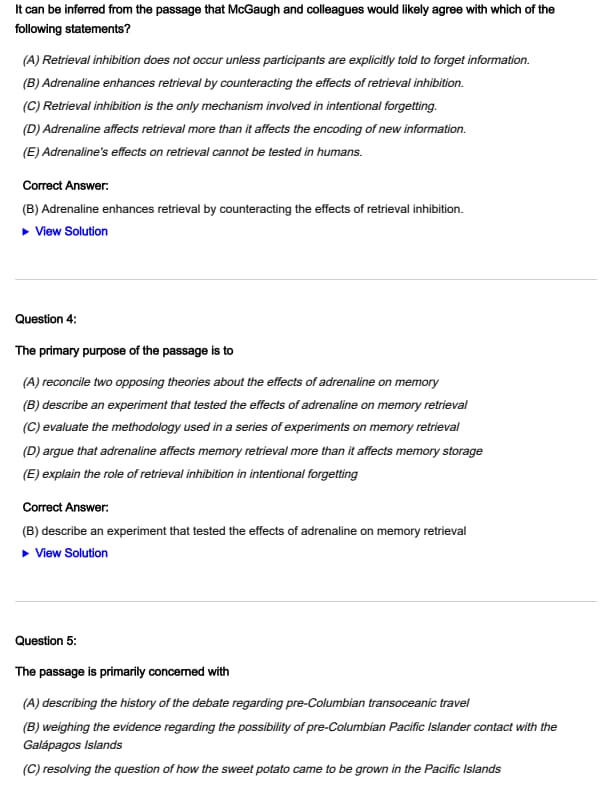
Question 1:
Passage 1
Although the hormone adrenaline is known to regulate memory storage, its effects on retrieval
are debated. Adrenaline’s modulation of retrieval is difficult to interpret because retrieval pro-
tocols usually involve new learning, which is known to be affected by adrenaline. Say, for
example, that researchers test the effect of adrenaline on participants’ ability to remember a
story. If participants are injected with adrenaline before being asked to recall the story, the
adrenaline might enhance or impair their recall performance not by affecting retrieval directly,
but rather by affecting their ability to learn the information presented in the retrieval protocol
(i.e., the researcher’s questions). To evaluate the hormone’s effect on retrieval without the
confounding effects of new learning, McGaugh and colleagues tested the effects of adrenaline
on memory for intentionally forgotten information. Research has shown that when participants
are asked to memorize two lists (list 1 and list 2) and are then instructed to forget list 1,
they exhibit poorer recall of list 1 than do participants who are not instructed to forget it-a
phenomenon known as intentional forgetting. This phenomenon is attributed to retrieval inhi-
bition, a mechanism that makes the unwanted information less likely to be retrieved, whether
intentionally or unintentionally. McGaugh and colleagues reasoned that if adrenaline enhances
retrieval, it should reduce intentional forgetting. They hypothesized that participants given
adrenaline after being instructed to forget list 1 would recall more words from that list than
participants given a placebo. After participants memorized list 1, they were told to forget it
and memorize list 2. Immediately afterwards, they received an injection of either adrenaline
or a placebo and then completed a distractor task. Finally, they were asked to recall as many
words as possible from list 1. Adrenaline-treated participants did indeed recall significantly
more words from list 1 than placebo-treated participants, suggesting that adrenaline enhances
the retrieval of intentionally forgotten memories.
According to the passage, which of the following is a reason that researchers have found it difficult to interpret the effects of adrenaline on memory retrieval?
- (A) Adrenaline affects how information is encoded in memory but not how it is retrieved.
- (B) Adrenaline facilitates retrieval in some situations but hinders it in others.
- (C) Retrieval protocols typically involve the learning of new information.
- (D) The effects of adrenaline on retrieval are temporary.
- (E) The effects of adrenaline on retrieval cannot be easily separated from the effects of other hormones.
Question 2:
Which of the following best describes the function of the highlighted sentence ("This phenomenon ... unintentionally.")?
- (A) It describes a phenomenon that adrenaline was expected to affect.
- (B) It describes a phenomenon that researchers had previously misinterpreted.
- (C) It explains why McGaugh and colleagues decided to study the effects of adrenaline on intentional forgetting.
(D) It explains why participants in the experiment were asked to memorize two different lists of words.
- (E) It explains a finding that appears to contradict the main conclusion of the passage.
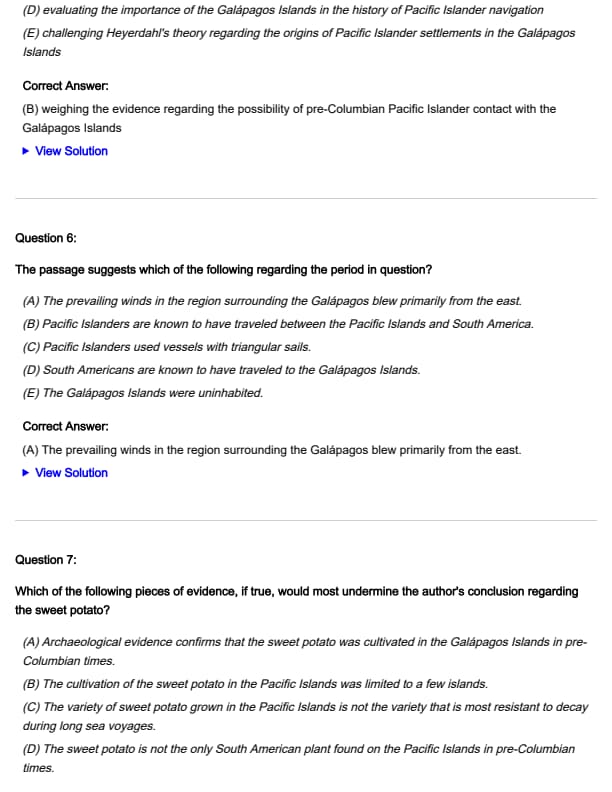
Question 3:
It can be inferred from the passage that McGaugh and colleagues would likely agree with which of the following statements?
- (A) Retrieval inhibition does not occur unless participants are explicitly told to forget information.
- (B) Adrenaline enhances retrieval by counteracting the effects of retrieval inhibition.
- (C) Retrieval inhibition is the only mechanism involved in intentional forgetting.
- (D) Adrenaline affects retrieval more than it affects the encoding of new information.
- (E) Adrenaline's effects on retrieval cannot be tested in humans.
Question 4:
The primary purpose of the passage is to
- (A) reconcile two opposing theories about the effects of adrenaline on memory
- (B) describe an experiment that tested the effects of adrenaline on memory retrieval
- (C) evaluate the methodology used in a series of experiments on memory retrieval
- (D) argue that adrenaline affects memory retrieval more than it affects memory storage
- (E) explain the role of retrieval inhibition in intentional forgetting
Question 5:
The passage is primarily concerned with
- (A) describing the history of the debate regarding pre-Columbian transoceanic travel
- (B) weighing the evidence regarding the possibility of pre-Columbian Pacific Islander contact with the Galápagos Islands
- (C) resolving the question of how the sweet potato came to be grown in the Pacific Islands
- (D) evaluating the importance of the Galápagos Islands in the history of Pacific Islander navigation
- (E) challenging Heyerdahl's theory regarding the origins of Pacific Islander settlements in the Galápagos Islands
Question 6:
The passage suggests which of the following regarding the period in question?
- (A) The prevailing winds in the region surrounding the Galápagos blew primarily from the east.
- (B) Pacific Islanders are known to have traveled between the Pacific Islands and South America.
- (C) Pacific Islanders used vessels with triangular sails.
- (D) South Americans are known to have traveled to the Galápagos Islands.
- (E) The Galápagos Islands were uninhabited.
Question 7:
Which of the following pieces of evidence, if true, would most undermine the author's conclusion regarding the sweet potato?
- (A) Archaeological evidence confirms that the sweet potato was cultivated in the Galápagos Islands in pre-Columbian times.
- (B) The cultivation of the sweet potato in the Pacific Islands was limited to a few islands.
- (C) The variety of sweet potato grown in the Pacific Islands is not the variety that is most resistant to decay during long sea voyages.
- (D) The sweet potato is not the only South American plant found on the Pacific Islands in pre-Columbian times.
- (E) The genetic variety of the sweet potatoes grown in the Pacific Islands suggests that the original sweet potatoes may have arrived at different times.
Question 8:
The passage is primarily concerned with
- (A) summarizing the history of a scientific debate
- (B) discussing two competing explanations for a natural phenomenon
- (C) describing the evidence in favor of a new scientific theory
- (D) casting doubt on the accuracy of a long-held scientific assumption
- (E) explaining the relationship between two types of natural phenomena
Question 9:
It can be inferred from the passage that the author would be most likely to agree with which of the following statements about the "new theory"?
- (A) It provides the best explanation for the observed chirality of molecules, crystals, and shells.
- (B) It correctly identifies the weak force as the single influence responsible for the chirality found in nature.
- (C) It provides a plausible explanation for the chirality found in nature.
- (D) It provides a useful model for understanding the relationship between elementary particles and macroscopic structures.
- (E) It requires further testing before it can be accepted by the scientific community.
Question 10:
According to the "new theory" described in the passage, the handedness of the weak force normally affects the material world in which of the following ways?
- (A) It influences the configuration of elementary particles at the subatomic level.
- (B) It determines the direction in which molecules twist.
- (C) It affects the formation of crystals.
- (D) It is responsible for the structure of snail shells.
- (E) It is the single most important factor determining the structure of DNA molecules.


-modified.png?h=56&w=56&mode=stretch)


 Download



Comments