GMAT Quant Practice Paper 1 Question Paper with Answer Key and Solutions PDF is available for download. GMAT lasts for a total of 2 hours and 15 minutes, with an optional 10-minute break. Throughout the test, candidates will be required to answer 64 questions, distributed as follows:
- Quantitative Reasoning: 21 questions, to be completed in 45 minutes.
- Verbal Reasoning: 23 questions, to be completed in 45 minutes.
- Data Insights: 20 questions, to be completed in 45 minutes.
GMAT Quant Practice Paper 1 Question Paper with Solutions PDF
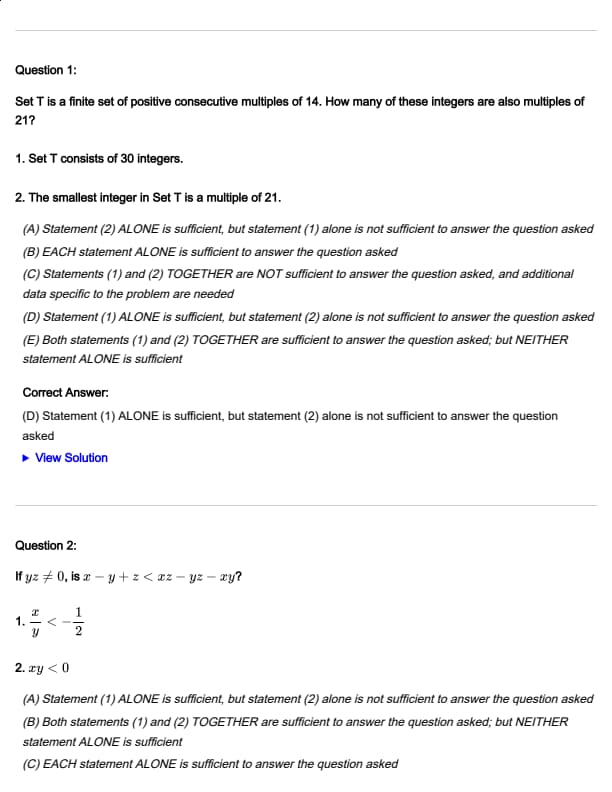
Question 1:
Set T is a finite set of positive consecutive multiples of 14. How many of these integers are also multiples of 21?
1. Set T consists of 30 integers.
2. The smallest integer in Set T is a multiple of 21.
- (A) Statement (2) ALONE is sufficient, but statement (1) alone is not sufficient to answer the question asked
- (B) EACH statement ALONE is sufficient to answer the question asked
- (C) Statements (1) and (2) TOGETHER are NOT sufficient to answer the question asked, and additional data specific to the problem are needed
- (D) Statement (1) ALONE is sufficient, but statement (2) alone is not sufficient to answer the question asked
- (E) Both statements (1) and (2) TOGETHER are sufficient to answer the question asked; but NEITHER statement ALONE is sufficient
Question 2:
If \(yz \neq 0\), is \(x-y+z < xz-yz-xy\)?
1. \(\displaystyle \frac{x}{y}<-\frac{1}{2}\)
2. \(\displaystyle xy< 0\)
- (A) Statement (1) ALONE is sufficient, but statement (2) alone is not sufficient to answer the question asked
- (B) Both statements (1) and (2) TOGETHER are sufficient to answer the question asked; but NEITHER statement ALONE is sufficient
- (C) EACH statement ALONE is sufficient to answer the question asked
- (D) Statement (2) ALONE is sufficient, but statement (1) alone is not sufficient to answer the question asked
- (E) Statements (1) and (2) TOGETHER are NOT sufficient to answer the question asked, and additional data specific to the problem are needed
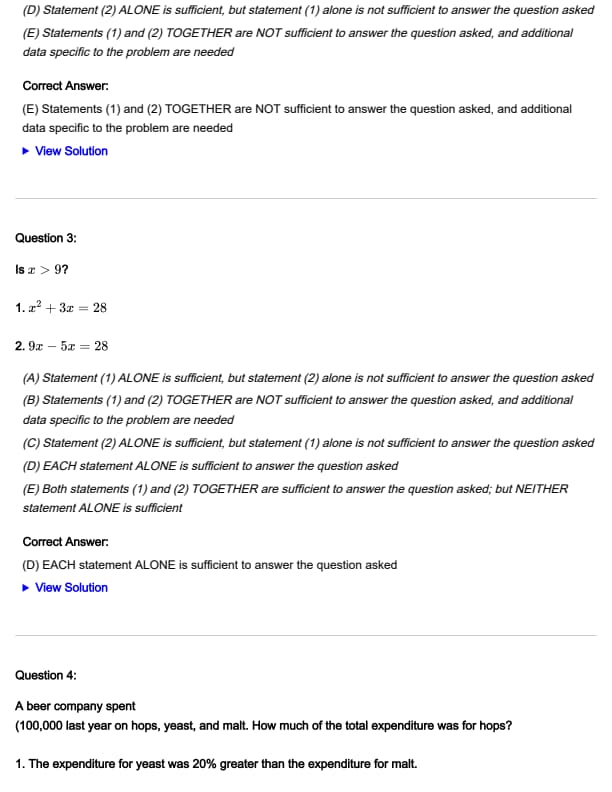
Question 3:
Is \(x>9\)?
1. \(x^2+3x=28\)
2. \(9x-5x=28\)
- (A) Statement (1) ALONE is sufficient, but statement (2) alone is not sufficient to answer the question asked
- (B) Statements (1) and (2) TOGETHER are NOT sufficient to answer the question asked, and additional data specific to the problem are needed
- (C) Statement (2) ALONE is sufficient, but statement (1) alone is not sufficient to answer the question asked
- (D) EACH statement ALONE is sufficient to answer the question asked
- (E) Both statements (1) and (2) TOGETHER are sufficient to answer the question asked; but NEITHER statement ALONE is sufficient
Question 4:
A beer company spent
(100,000 last year on hops, yeast, and malt. How much of the total expenditure was for hops?
1. The expenditure for yeast was 20% greater than the expenditure for malt.
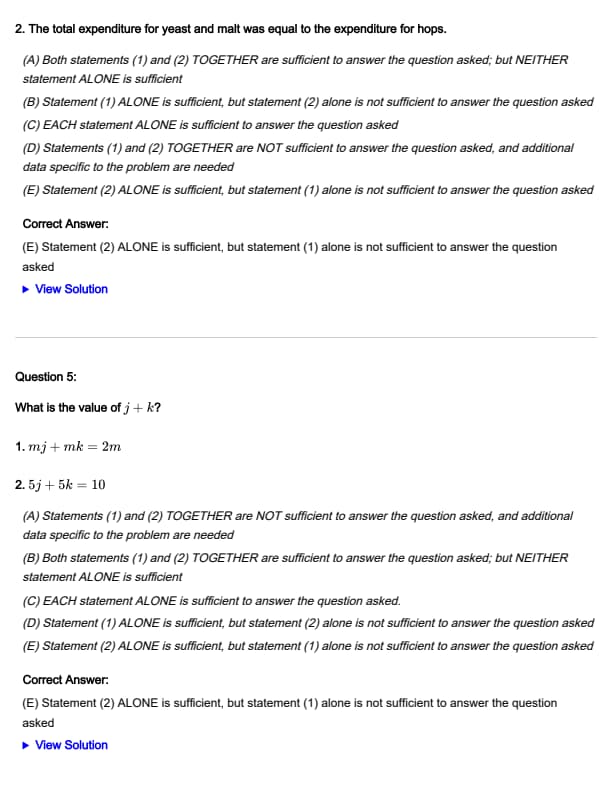
2. The total expenditure for yeast and malt was equal to the expenditure for hops.
- (A) Both statements (1) and (2) TOGETHER are sufficient to answer the question asked; but NEITHER statement ALONE is sufficient
- (B) Statement (1) ALONE is sufficient, but statement (2) alone is not sufficient to answer the question asked
- (C) EACH statement ALONE is sufficient to answer the question asked
- (D) Statements (1) and (2) TOGETHER are NOT sufficient to answer the question asked, and additional data specific to the problem are needed
- (E) Statement (2) ALONE is sufficient, but statement (1) alone is not sufficient to answer the question asked
Question 5:
What is the value of \(j+k\)?
1. \(mj+mk = 2m\)
2. \(5j + 5k = 10\)
- (A) Statements (1) and (2) TOGETHER are NOT sufficient to answer the question asked, and additional data specific to the problem are needed
- (B) Both statements (1) and (2) TOGETHER are sufficient to answer the question asked; but NEITHER statement ALONE is sufficient
- (C) EACH statement ALONE is sufficient to answer the question asked.
- (D) Statement (1) ALONE is sufficient, but statement (2) alone is not sufficient to answer the question asked
- (E) Statement (2) ALONE is sufficient, but statement (1) alone is not sufficient to answer the question asked
Question 6:
x is a positive integer less than 20. What is the value of x?
1. x is the sum of two consecutive integers.
2. x is the sum of five consecutive integers.
- (A) Statement (2) ALONE is sufficient, but statement (1) alone is not sufficient to answer the question asked
- (B) EACH statement ALONE is sufficient to answer the question asked
- (C) Statements (1) and (2) TOGETHER are NOT sufficient to answer the question asked, and additional data specific to the problem are needed
- (D) Both statements (1) and (2) TOGETHER are sufficient to answer the question asked; but NEITHER statement ALONE is sufficient
- (E) Statement (1) ALONE is sufficient, but statement (2) alone is not sufficient to answer the question asked
Question 7:
If arc XYZ above is a semicircle, what is its length?
1. q = 2
2. r = 8
- (A) Both statements (1) and (2) TOGETHER are sufficient to answer the question asked; but NEITHER statement ALONE is sufficient
- (B) EACH statement ALONE is sufficient to answer the question asked
- (C) Statements (1) and (2) TOGETHER are NOT sufficient to answer the question asked, and additional data specific to the problem are needed
- (D) Statement (2) ALONE is sufficient, but statement (1) alone is not sufficient to answer the question asked
- (E) Statement (1) ALONE is sufficient, but statement (2) alone is not sufficient to answer the question asked
Question 8:
What is the value of x?
(1) \((x)(x + 1) = (2013)(2014)\)
(2) x is odd
- (A) Both statements (1) and (2) TOGETHER are sufficient to answer the question asked; but NEITHER statement ALONE is sufficient
- (B) EACH statement ALONE is sufficient to answer the question asked
- (C) Statement (1) ALONE is sufficient, but statement (2) alone is not sufficient to answer the question asked
- (D) Statements (1) and (2) TOGETHER are NOT sufficient to answer the question asked, and additional data specific to the problem are needed
- (E) Statement (2) ALONE is sufficient, but statement (1) alone is not sufficient to answer the question asked
Question 9:
If Alyssa is twice as old as Brandon, by how many years is Brandon older than Clara?
(1) Four years ago, Alyssa was twice as old as Clara is now.
(2) Alyssa is 8 years older than Clara.
- (A) EACH statement ALONE is sufficient to answer the question asked
- (B) Statement (1) ALONE is sufficient, but statement (2) alone is not sufficient to answer the question asked
- (C) Statement (2) ALONE is sufficient, but statement (1) alone is not sufficient to answer the question asked
- (D) Statements (1) and (2) TOGETHER are NOT sufficient to answer the question asked, and additional data specific to the problem are needed
- (E) Both statements (1) and (2) TOGETHER are sufficient to answer the question asked; but NEITHER statement ALONE is sufficient
Question 10:
In the first hour of a bake sale, students sold either chocolate chip cookies, which sold for
(1.30, or brownies, which sold for
)1.50. What was the ratio of chocolate chip cookies sold to brownies sold during that hour?
1. The average price for the items sold during that hour was
(1.42
2. The total price for all items sold during that hour was
)14.20
- (A) Statement (1) ALONE is sufficient, but statement (2) alone is not sufficient to answer the question asked
- (B) EACH statement ALONE is sufficient to answer the question asked
- (C) Both statements (1) and (2) TOGETHER are sufficient to answer the question asked; but NEITHER statement ALONE is sufficient
- (D) Statements (1) and (2) TOGETHER are NOT sufficient to answer the question asked, and additional data specific to the problem are needed
- (E) Statement (2) ALONE is sufficient, but statement (1) alone is not sufficient to answer the question asked


-modified.png?h=56&w=56&mode=stretch)


 Download



Comments