

-modified.png?h=56&w=56&mode=stretch)


GMAT Quant Practice Paper 3 Question Paper with Answer Key and Solutions PDF is available for download. GMAT lasts for a total of 2 hours and 15 minutes, with an optional 10-minute break. Throughout the test, candidates will be required to answer 64 questions, distributed as follows:
- Quantitative Reasoning: 21 questions, to be completed in 45 minutes.
- Verbal Reasoning: 23 questions, to be completed in 45 minutes.
- Data Insights: 20 questions, to be completed in 45 minutes.
GMAT Quant Practice Paper 3 Question Paper with Solutions PDF
| GMAT Quant Practice Paper 3 Question Paper with Solutions PDF |  Download Download |
Check Solutions |
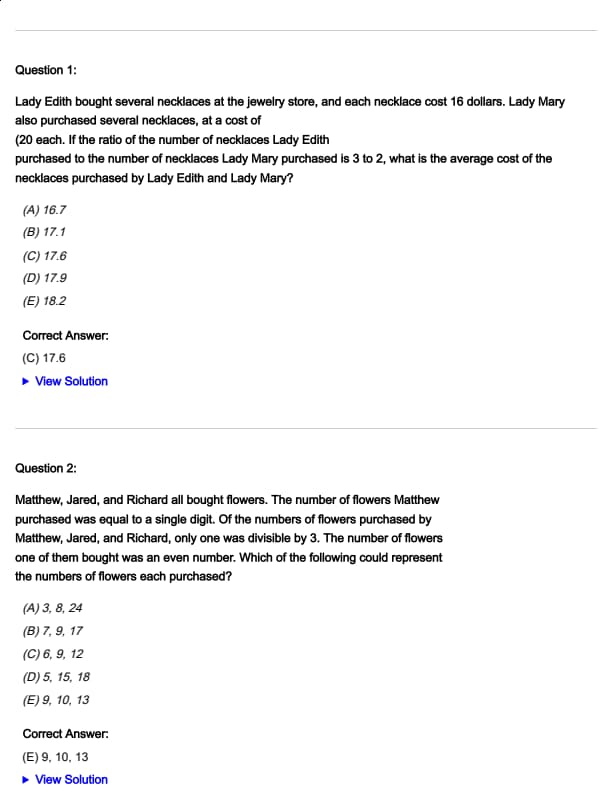
Lady Edith bought several necklaces at the jewelry store, and each necklace cost 16 dollars. Lady Mary
also purchased several necklaces, at a cost of
(20 each. If the ratio of the number of necklaces Lady Edith
purchased to the number of necklaces Lady Mary purchased is 3 to 2, what is the average cost of the
necklaces purchased by Lady Edith and Lady Mary?
Matthew, Jared, and Richard all bought flowers. The number of flowers Matthew
purchased was equal to a single digit. Of the numbers of flowers purchased by
Matthew, Jared, and Richard, only one was divisible by 3. The number of flowers
one of them bought was an even number. Which of the following could represent
the numbers of flowers each purchased?
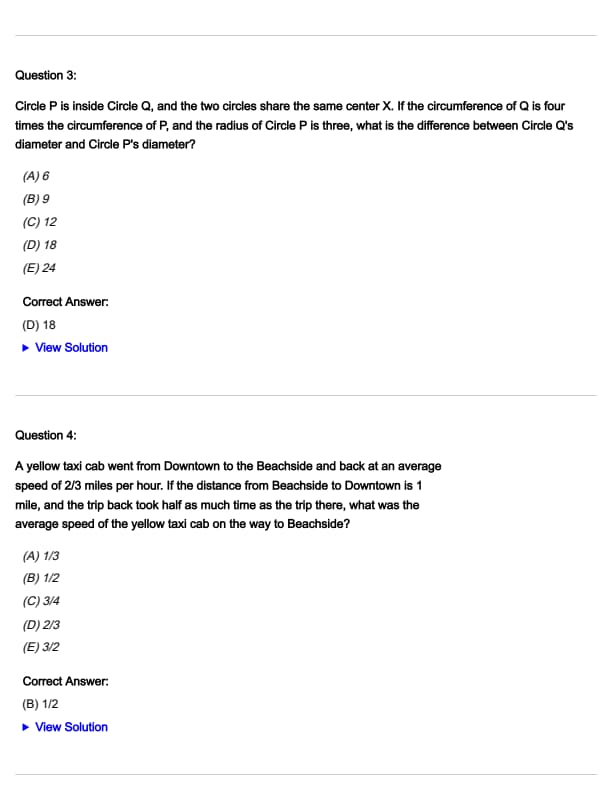
Circle P is inside Circle Q, and the two circles share the same center X. If the circumference of Q is four
times the circumference of P, and the radius of Circle P is three, what is the difference between Circle Q's
diameter and Circle P's diameter?
A yellow taxi cab went from Downtown to the Beachside and back at an average
speed of 2/3 miles per hour. If the distance from Beachside to Downtown is 1
mile, and the trip back took half as much time as the trip there, what was the
average speed of the yellow taxi cab on the way to Beachside?
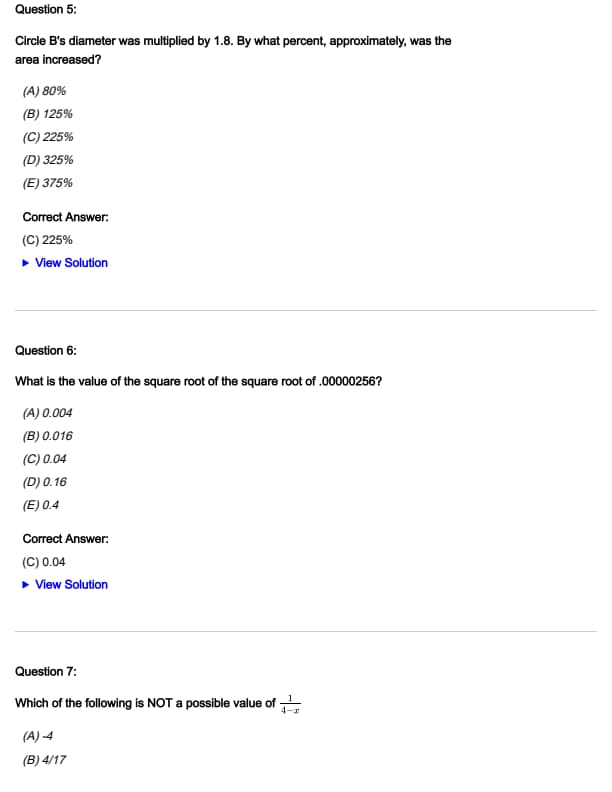
Circle B's diameter was multiplied by 1.8. By what percent, approximately, was the
area increased?
What is the value of the square root of the square root of .00000256?
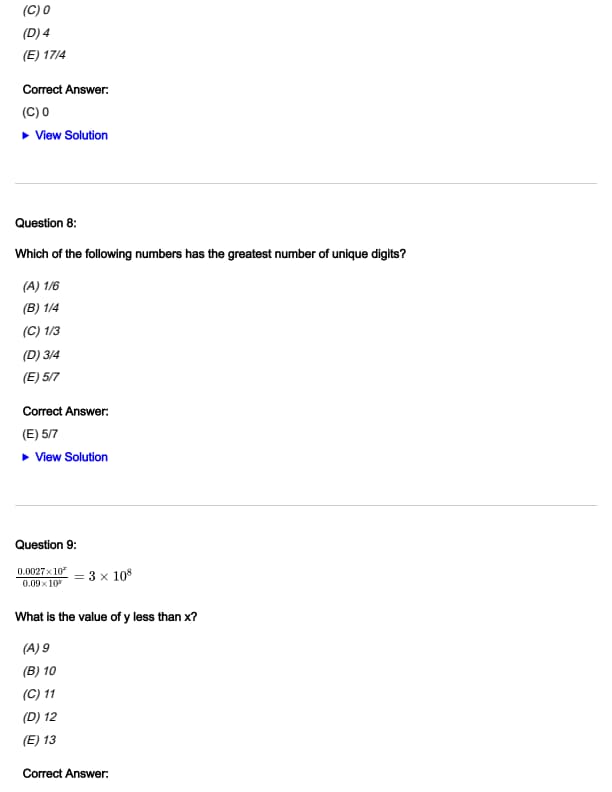
Which of the following is NOT a possible value of \( \frac{1}{4 - x} \)
Which of the following numbers has the greatest number of unique digits?
\( \frac{0.0027 \times 10^x}{0.09 \times 10^y} = 3 \times 10^8 \)
What is the value of y less than x?
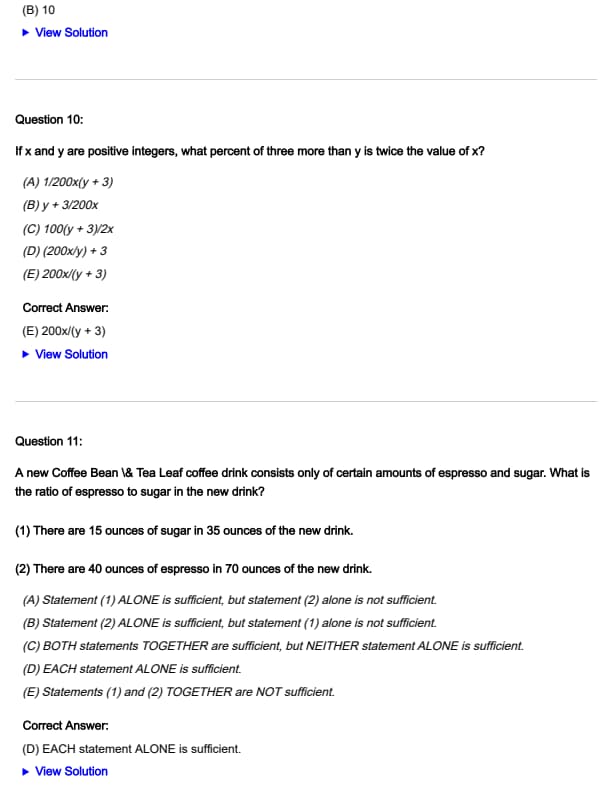
If x and y are positive integers, what percent of three more than y is twice the value of x?
A new Coffee Bean \& Tea Leaf coffee drink consists only of certain amounts of espresso and sugar. What is the ratio of espresso to sugar in the new drink?
(1) There are 15 ounces of sugar in 35 ounces of the new drink.
(2) There are 40 ounces of espresso in 70 ounces of the new drink.
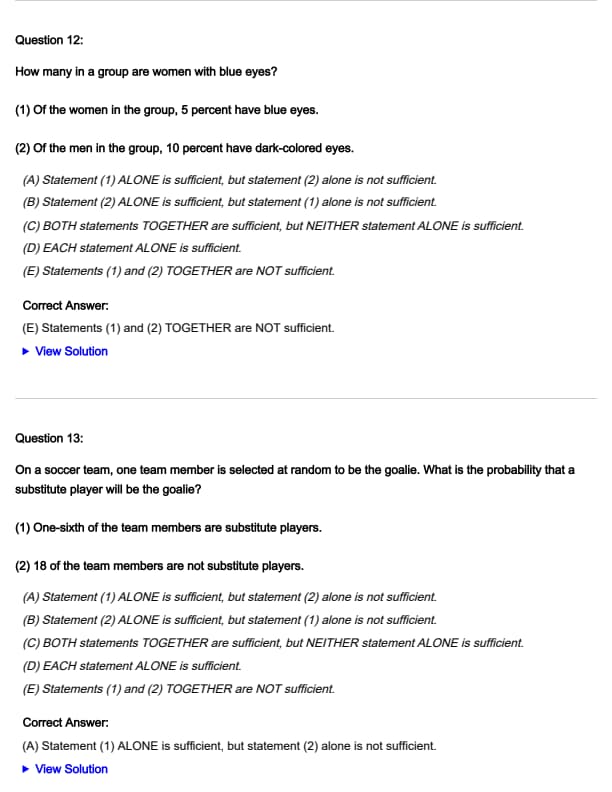
How many in a group are women with blue eyes?
(1) Of the women in the group, 5 percent have blue eyes.
(2) Of the men in the group, 10 percent have dark-colored eyes.
On a soccer team, one team member is selected at random to be the goalie. What is the probability that a substitute player will be the goalie?
(1) One-sixth of the team members are substitute players.
(2) 18 of the team members are not substitute players.
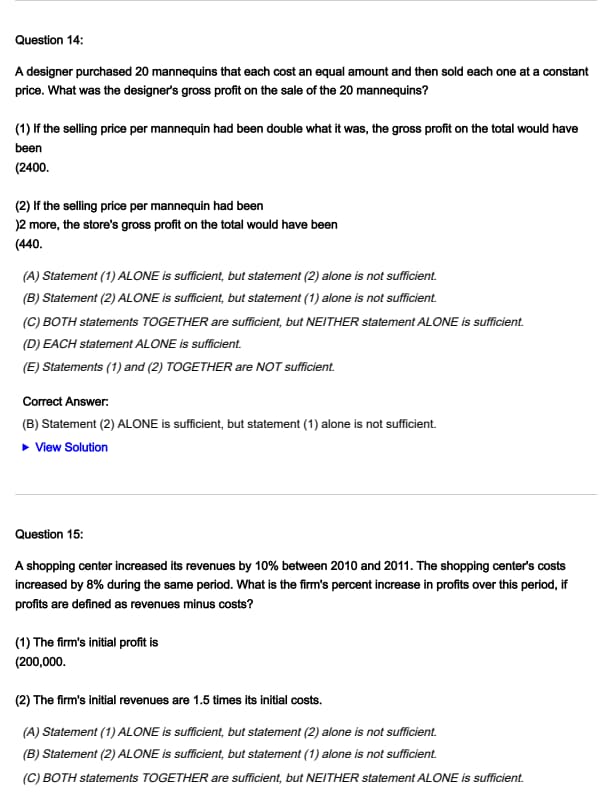
A designer purchased 20 mannequins that each cost an equal amount and then sold each one at a constant price. What was the designer's gross profit on the sale of the 20 mannequins?
(1) If the selling price per mannequin had been double what it was, the gross profit on the total would have been
(2400.
(2) If the selling price per mannequin had been
)2 more, the store's gross profit on the total would have been
(440.
A shopping center increased its revenues by 10% between 2010 and 2011. The shopping center's costs increased by 8% during the same period. What is the firm's percent increase in profits over this period, if profits are defined as revenues minus costs?
(1) The firm's initial profit is
(200,000.
(2) The firm's initial revenues are 1.5 times its initial costs.
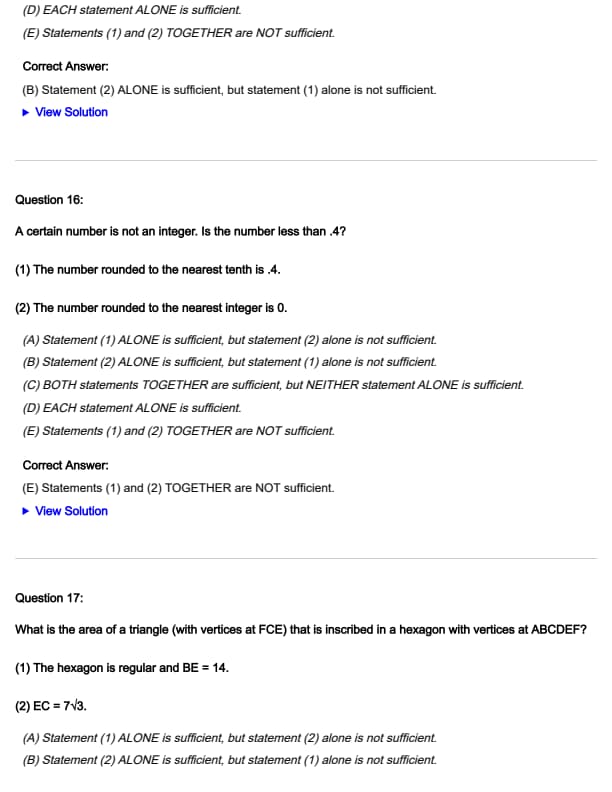
A certain number is not an integer. Is the number less than .4?
(1) The number rounded to the nearest tenth is .4.
(2) The number rounded to the nearest integer is 0.
What is the area of a triangle (with vertices at FCE) that is inscribed in a hexagon with vertices at ABCDEF?
(1) The hexagon is regular and BE = 14.
(2) EC = 7√3.
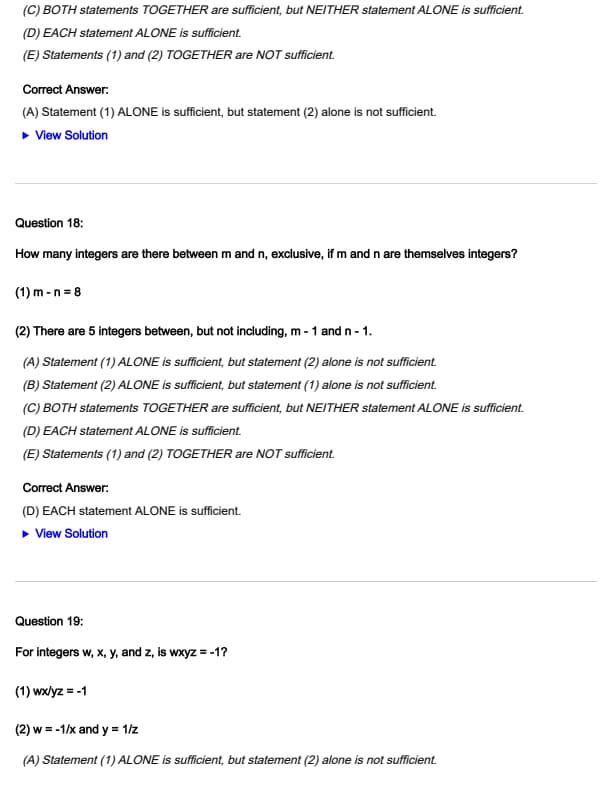
How many integers are there between m and n, exclusive, if m and n are themselves integers?
(1) m - n = 8
(2) There are 5 integers between, but not including, m - 1 and n - 1.
For integers w, x, y, and z, is wxyz = -1?
(1) wx/yz = -1
(2) w = -1/x and y = 1/z
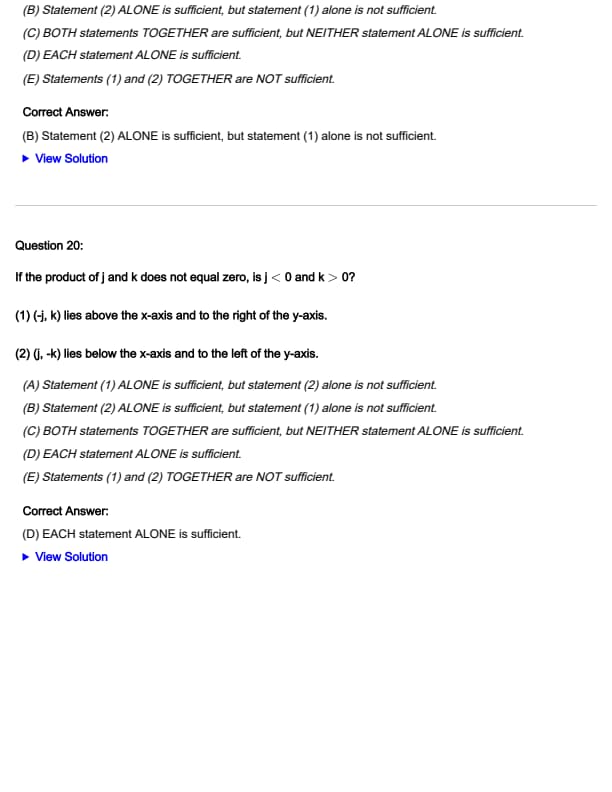
If the product of j and k does not equal zero, is j \(<\) 0 and k \(>\) 0?
(1) (-j, k) lies above the x-axis and to the right of the y-axis.
(2) (j, -k) lies below the x-axis and to the left of the y-axis.



Comments