GMAT Quant Practice Paper 6 Question Paper with Answer Key and Solutions PDF is available for download. GMAT lasts for a total of 2 hours and 15 minutes, with an optional 10-minute break. Throughout the test, candidates will be required to answer 64 questions, distributed as follows:
- Quantitative Reasoning: 21 questions, to be completed in 45 minutes.
- Verbal Reasoning: 23 questions, to be completed in 45 minutes.
- Data Insights: 20 questions, to be completed in 45 minutes.
GMAT Quant Practice Paper 6 Question Paper with Solutions PDF
Question 1:
Find the area of a right angle triangle whose base is 12 inches.
1. The hypotenuse is 13 inches.
2. The perpendicular height of the triangle is one less than half its base.
- (A) Statement (1) ALONE is sufficient, but statement (2) alone is not sufficient to answer the question asked.
- (B) Statement (2) ALONE is sufficient, but statement (1) alone is not sufficient to answer the question asked.
- (C) BOTH statements (1) and (2) TOGETHER are sufficient to answer the question asked, but NEITHER statement ALONE is sufficient to answer the question ask
- (D) EACH statement ALONE is sufficient to answer the question asked.
- (E) Statements (1) and (2) TOGETHER are NOT sufficient to answer the question asked, and additional data specific to the problem are needed.
Question 2:
Is the number a prime number?
1. The number is divisible by a prime factor.
2. The number is positive.
- (A) Statement (1) ALONE is sufficient, but statement (2) alone is not sufficient to answer the question asked.
- (B) Statement (2) ALONE is sufficient, but statement (1) alone is not sufficient to answer the question asked.
- (C) BOTH statements (1) and (2) TOGETHER are sufficient to answer the question asked, but NEITHER statement ALONE is sufficient to answer the question ask
- (D) EACH statement ALONE is sufficient to answer the question asked.
- (E) Statements (1) and (2) TOGETHER are NOT sufficient to answer the question asked, and additional data specific to the problem are needed.
Question 3:
Find the direction in which the parabola \( y = ax^2 + bx - 2 \) is facing.
1. a = b
2. a \(<\) 0
- (A) Statement (1) ALONE is sufficient, but statement (2) alone is not sufficient to answer the question asked.
- (B) Statement (2) ALONE is sufficient, but statement (1) alone is not sufficient to answer the question asked.
- (C) BOTH statements (1) and (2) TOGETHER are sufficient to answer the question asked, but NEITHER statement ALONE is sufficient to answer the question ask
- (D) EACH statement ALONE is sufficient to answer the question asked.
- (E) Statements (1) and (2) TOGETHER are NOT sufficient to answer the question asked, and additional data specific to the problem are needed.
Question 4:
Find the equation of a line.
1. Its x and y intercept is 2 and -2 respectively.
2. The slope of the line is 1.
- (A) Statement (1) ALONE is sufficient, but statement (2) alone is not sufficient to answer the question asked.
- (B) Statement (2) ALONE is sufficient, but statement (1) alone is not sufficient to answer the question asked.
- (C) BOTH statements (1) and (2) TOGETHER are sufficient to answer the question asked, but NEITHER statement ALONE is sufficient to answer the question ask
- (D) EACH statement ALONE is sufficient to answer the question asked.
- (E) Statements (1) and (2) TOGETHER are NOT sufficient to answer the question asked, and additional data specific to the problem are needed.
Question 5:
Determine the size of an interior angle of the polygon.
1. The ratio of its interior angle to the exterior angle is 2:1.
2. The polygon is a regular hexagon.
- (A) Statement (1) ALONE is sufficient, but statement (2) alone is not sufficient to answer the question asked.
- (B) Statement (2) ALONE is sufficient, but statement (1) alone is not sufficient to answer the question asked.
- (C) BOTH statements (1) and (2) TOGETHER are sufficient to answer the question asked, but NEITHER statement ALONE is sufficient to answer the question ask
- (D) EACH statement ALONE is sufficient to answer the question asked.
- (E) Statements (1) and (2) TOGETHER are NOT sufficient to answer the question asked, and additional data specific to the problem are needed.
Question 6:
Find out if t \(<\) 0.
1. \(|t| > t\)
2. \(t^2 > 0\)
- (A) Statement (1) ALONE is sufficient, but statement (2) alone is not sufficient to answer the question asked.
- (B) Statement (2) ALONE is sufficient, but statement (1) alone is not sufficient to answer the question asked.
- (C) BOTH statements (1) and (2) TOGETHER are sufficient to answer the question asked, but NEITHER statement ALONE is sufficient to answer the question ask
- (D) EACH statement ALONE is sufficient to answer the question asked.
- (E) Statements (1) and (2) TOGETHER are NOT sufficient to answer the question asked, and additional data specific to the problem are needed.
Question 7:
Determine the value of t.
1. \(2t + 6s = 8\)
2. \(t/2 - 2 = -3s/4\)
- (A) Statement (1) ALONE is sufficient, but statement (2) alone is not sufficient to answer the question asked.
- (B) Statement (2) ALONE is sufficient, but statement (1) alone is not sufficient to answer the question asked.
- (C) BOTH statements (1) and (2) TOGETHER are sufficient to answer the question asked, but NEITHER statement ALONE is sufficient to answer the question ask
- (D) EACH statement ALONE is sufficient to answer the question asked.
- (E) Statements (1) and (2) TOGETHER are NOT sufficient to answer the question asked, and additional data specific to the problem are needed.
Question 8:
Find the percentage change in the volume of a cylinder.
1. The diameter is increased by 20%.
2. The height is increased by 21%.
- (A) Statement (1) ALONE is sufficient, but statement (2) alone is not sufficient to answer the question asked.
- (B) Statement (2) ALONE is sufficient, but statement (1) alone is not sufficient to answer the question asked.
- (C) BOTH statements (1) and (2) TOGETHER are sufficient to answer the question asked, but NEITHER statement ALONE is sufficient to answer the question ask
- (D) EACH statement ALONE is sufficient to answer the question asked.
- (E) Statements (1) and (2) TOGETHER are NOT sufficient to answer the question asked, and additional data specific to the problem are needed.
Question 9:
a \(<\) b. Is a positive?
1. b = 0.
2. \( \sqrt{a} < a \)
- (A) Statement (1) ALONE is sufficient, but statement (2) alone is not sufficient to answer the question asked.
- (B) Statement (2) ALONE is sufficient, but statement (1) alone is not sufficient to answer the question asked.
- (C) BOTH statements (1) and (2) TOGETHER are sufficient to answer the question asked, but NEITHER statement ALONE is sufficient to answer the question ask
- (D) EACH statement ALONE is sufficient to answer the question asked.
- (E) Statements (1) and (2) TOGETHER are NOT sufficient to answer the question asked, and additional data specific to the problem are needed.
Question 10:
Determine the equation of the circle passing through (-4,-2).
1. (1,-1) lies in the circle.
2. The center of the circle is the origin.
- (A) Statement (1) ALONE is sufficient, but statement (2) alone is not sufficient to answer the question asked.
- (B) Statement (2) ALONE is sufficient, but statement (1) alone is not sufficient to answer the question asked.
- (C) BOTH statements (1) and (2) TOGETHER are sufficient to answer the question asked, but NEITHER statement ALONE is sufficient to answer the question ask
- (D) EACH statement ALONE is sufficient to answer the question asked.
- (E) Statements (1) and (2) TOGETHER are NOT sufficient to answer the question asked, and additional data specific to the problem are needed.
Question 11:
A racecar driver has completed 12 1/2 laps of a 50 lap race. What fractional part of the race remains?
- (A) 1/4
- (B) 1/5
- (C) 3/4
- (D) 4/5
- (E) 75/2
Question 12:
If M is the set of positive multiples of 2 less than 150 and N is the set of positive multiples of 9 less than 150, how many members are there in M \(\cap\) N?
- (A) 0
- (B) 8
- (C) 9
- (D) 18
- (E) 74
Question 13:
At Bruno's Video World, the regular price for a DVD is d dollars. How many DVDs can be purchased for x dollars when the DVDs are on sale at 20% off the regular price?
- (A) 4/5x
- (B) 5/4x
- (C) 4/5d
- (D) 4x/5d
- (E) 5x/4d
Question 14:
If \(x \neq 2y\), then \( \frac{x-2y}{2y-x} + \frac{2y-x}{x-2y} = \)
- (A) 2(x-2y)
- (B) 2y-x
- (C) 1
- (D) 0
- (E) -2
Question 15:
If Dave drove one-third of the distance of his trip on the first day, and 60 miles on the second day, he figured out that he still had 1/2 of the trip to drive. What was the total length, in miles, of his trip?
- (A) 360
- (B) 180
- (C) 120
- (D) 60
- (E) 90
Question 16:
If \(x^2 - y^2 = 48\), then \( \frac{2}{3}(x+y)(x-y) = \)
- (A) 16
- (B) 72
- (C) 96
- (D) 32
- (E) 64
Question 17:
Eddie is 7 years older than Brian. If Brian is x years old, then how old was Eddie 11 years ago?
- (A) x - 18
- (B) x - 4
- (C) x - 7
- (D) 7x - 11
- (E) x + 18
Question 18:
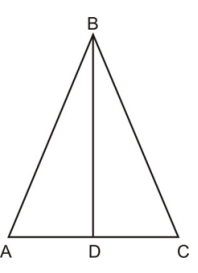
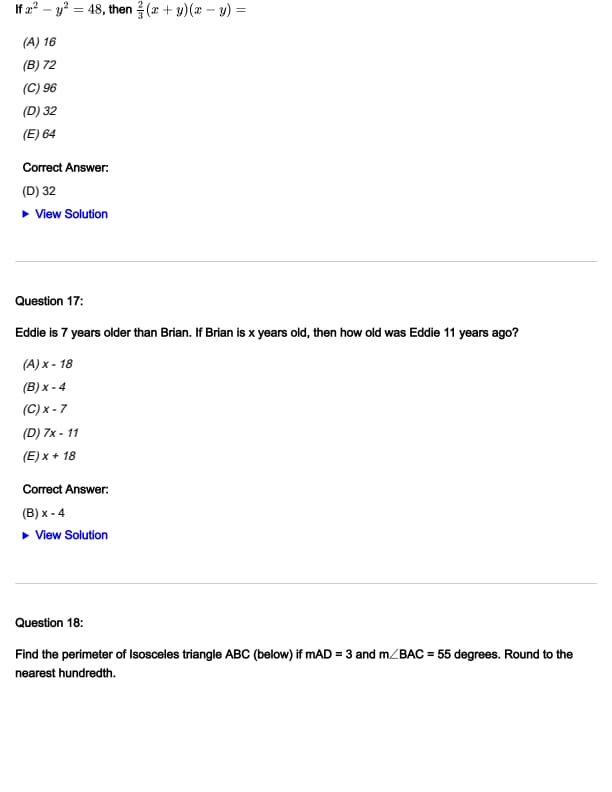
Find the perimeter of Isosceles triangle ABC (below) if mAD = 3 and m\(\angle\)BAC = 55 degrees. Round to the nearest hundredth.
![]()
- (A) 5.21
- (B) 10.42
- (C) 13.48
- (D) 16.46
- (E) 13.39
Question 19:
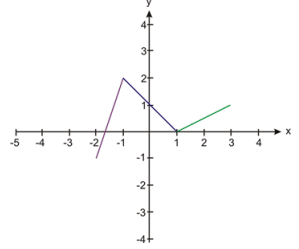
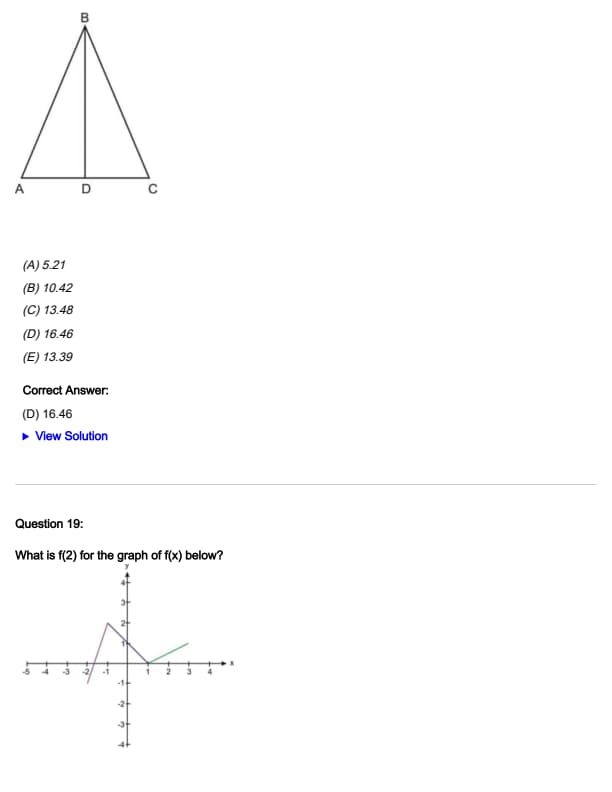
What is f(2) for the graph of f(x) below?
![]()
- (A) 1
- (B) 1/2
- (C) 0
- (D) 2
- (E) -1
Question 20:
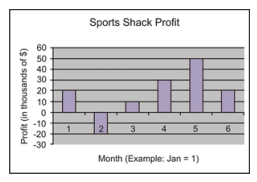
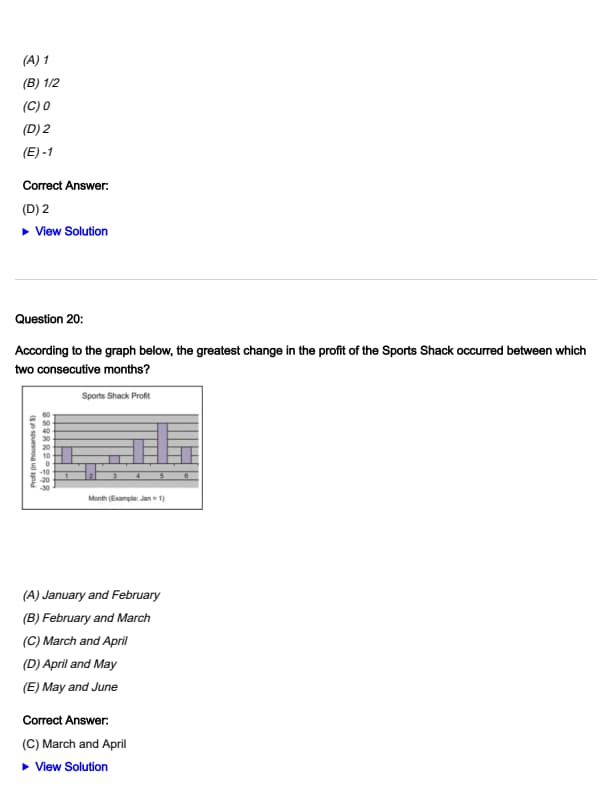
According to the graph below, the greatest change in the profit of the Sports Shack occurred between which two consecutive months?
![]()
- (A) January and February
- (B) February and March
- (C) March and April
- (D) April and May
- (E) May and June


-modified.png?h=56&w=56&mode=stretch)


 Download




Comments