GMAT Verbal Sample Paper Set 4 Question Paper with Answer Key and Solutions PDF is available for download. GMAT lasts for a total of 2 hours and 15 minutes, with an optional 10-minute break. Throughout the test, candidates will be required to answer 64 questions, distributed as follows:
- Quantitative Reasoning: 21 questions, to be completed in 45 minutes.
- Verbal Reasoning: 23 questions, to be completed in 45 minutes.
- Data Insights: 20 questions, to be completed in 45 minutes.
GMAT Verbal Sample Paper Set 4 Question Paper with Solutions PDF
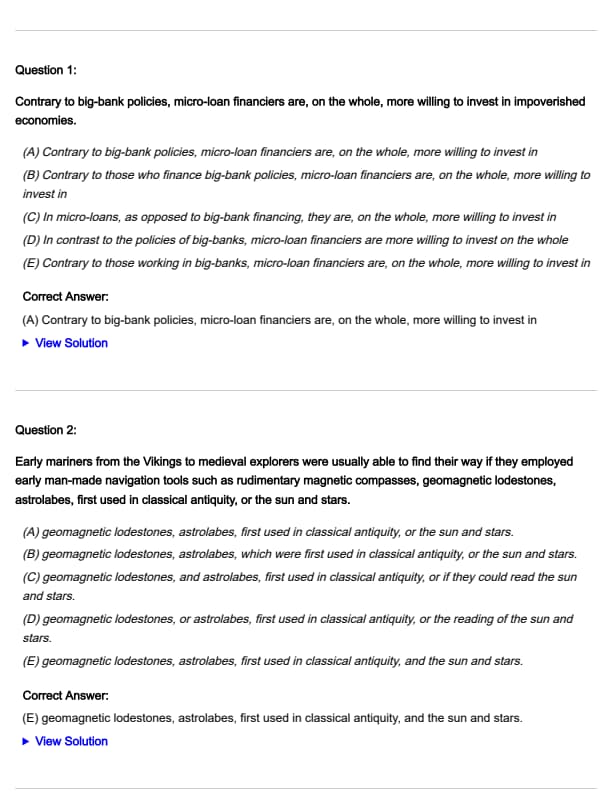
Question 1:
Contrary to big-bank policies, micro-loan financiers are, on the whole, more willing to invest in impoverished economies.
- (A) Contrary to big-bank policies, micro-loan financiers are, on the whole, more willing to invest in
- (B) Contrary to those who finance big-bank policies, micro-loan financiers are, on the whole, more willing to invest in
- (C) In micro-loans, as opposed to big-bank financing, they are, on the whole, more willing to invest in
- (D) In contrast to the policies of big-banks, micro-loan financiers are more willing to invest on the whole
- (E) Contrary to those working in big-banks, micro-loan financiers are, on the whole, more willing to invest in
Question 2:
Early mariners from the Vikings to medieval explorers were usually able to find their way if they employed early man-made navigation tools such as rudimentary magnetic compasses, geomagnetic lodestones, astrolabes, first used in classical antiquity, or the sun and stars.
- (A) geomagnetic lodestones, astrolabes, first used in classical antiquity, or the sun and stars.
- (B) geomagnetic lodestones, astrolabes, which were first used in classical antiquity, or the sun and stars.
- (C) geomagnetic lodestones, and astrolabes, first used in classical antiquity, or if they could read the sun and stars.
- (D) geomagnetic lodestones, or astrolabes, first used in classical antiquity, or the reading of the sun and stars.
- (E) geomagnetic lodestones, astrolabes, first used in classical antiquity, and the sun and stars.
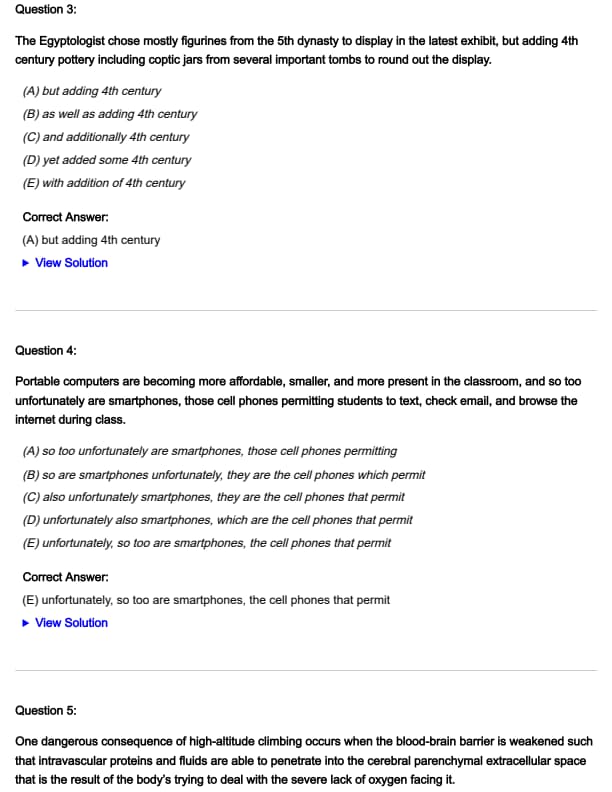
Question 3:
The Egyptologist chose mostly figurines from the 5th dynasty to display in the latest exhibit, but adding 4th century pottery including coptic jars from several important tombs to round out the display.
- (A) but adding 4th century
- (B) as well as adding 4th century
- (C) and additionally 4th century
- (D) yet added some 4th century
- (E) with addition of 4th century
Question 4:
Portable computers are becoming more affordable, smaller, and more present in the classroom, and so too unfortunately are smartphones, those cell phones permitting students to text, check email, and browse the internet during class.
- (A) so too unfortunately are smartphones, those cell phones permitting
- (B) so are smartphones unfortunately, they are the cell phones which permit
- (C) also unfortunately smartphones, they are the cell phones that permit
- (D) unfortunately also smartphones, which are the cell phones that permit
- (E) unfortunately, so too are smartphones, the cell phones that permit
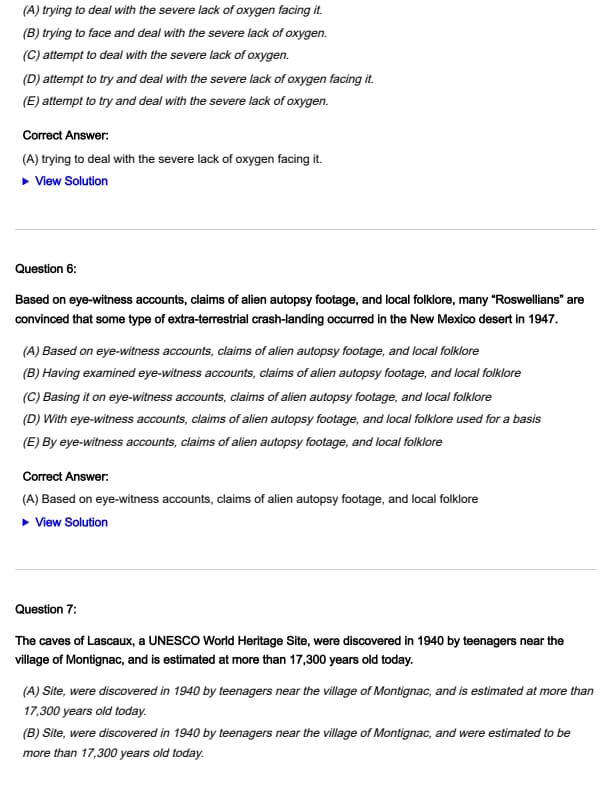
Question 5:
One dangerous consequence of high-altitude climbing occurs when the blood-brain barrier is weakened such that intravascular proteins and fluids are able to penetrate into the cerebral parenchymal extracellular space that is the result of the body’s trying to deal with the severe lack of oxygen facing it.
- (A) trying to deal with the severe lack of oxygen facing it.
- (B) trying to face and deal with the severe lack of oxygen.
- (C) attempt to deal with the severe lack of oxygen.
- (D) attempt to try and deal with the severe lack of oxygen facing it.
- (E) attempt to try and deal with the severe lack of oxygen.
Question 6:
Based on eye-witness accounts, claims of alien autopsy footage, and local folklore, many “Roswellians” are convinced that some type of extra-terrestrial crash-landing occurred in the New Mexico desert in 1947.
- (A) Based on eye-witness accounts, claims of alien autopsy footage, and local folklore
- (B) Having examined eye-witness accounts, claims of alien autopsy footage, and local folklore
- (C) Basing it on eye-witness accounts, claims of alien autopsy footage, and local folklore
- (D) With eye-witness accounts, claims of alien autopsy footage, and local folklore used for a basis
- (E) By eye-witness accounts, claims of alien autopsy footage, and local folklore
Question 7:
The caves of Lascaux, a UNESCO World Heritage Site, were discovered in 1940 by teenagers near the village of Montignac, and is estimated at more than 17,300 years old today.
- (A) Site, were discovered in 1940 by teenagers near the village of Montignac, and is estimated at more than 17,300 years old today.
- (B) Site, were discovered in 1940 by teenagers near the village of Montignac, and were estimated to be more than 17,300 years old today.
- (C) Site, were discovered in 1940 by teenagers near the village of Montignac, and was estimated to be more than 17,300 years old today.
- (D) Site, were discovered in 1940 by teenagers near the village of Montignac, and are estimated to be more than 17,300 years old today.
- (E) Site, was discovered in 1940 by teenagers near the village of Montignac, and are estimated as being more than 17,300 years old today.
Question 8:
Of the over 1000 species of rhododendron, the Rhododendron ponticum, native to southern Europe and southwest Asia, is probably the more dangerous as it’s proven the honey which is produced from its pollen can be poisonous.
- (A) is probably the more dangerous as it’s proven the honey which is produced from its pollen can be poisonous.
- (B) is probably the most dangerous as it’s proven the honey produced from its pollen can be poisonous.
- (C) is possibly the more dangerous of them as it’s proven the honey produced from its pollen can be poisonous.
- (D) is most likely the more dangerous as it’s proven the honey produced from its pollen can be poisonous.
- (E) is possibly the most dangerous since it’s proven the honey produced from its pollen could be poisonous.
Question 9:
The Adirondack mountains, unlike other mountain ranges that lie on fault lines, are in the shape of a dome, largely in due course from a deep uplift under the Earth’s crust about a billion years ago.
- (A) in due course from a deep uplift under the Earth’s crust
- (B) because of a deep uplift of the crust of the Earth, which occurred
- (C) due to the course from a deep uplift under the Earth’s crust
- (D) being caused by a deep uplift under the crust of the Earth, occurring
- (E) because of a deep uplift, which occurred under the crust of the Earth
Question 10:
Although it was known that inductive action traveled with finite velocity in space, and that an electro-magnet would affect the space about it practically inversely as the square of the distance, nearly all the physicists failed to form the only conception of it that was possible.
- (A) and that an electro-magnet would affect the space about it practically inversely as the square of the distance
- (B) and an electro-magnet would affect the space about it practically inversely as the square of the distance
- (C) and also that an electro-magnet would affect the space about it practically inversely like the square of the distance
- (D) and that an electro-magnet would affect the space about them practically inversely as the square of the distance
- (E) and also known that an electro-magnet would affect the space about it practically inversely as the square of the distance
Question 11:
Which of the following findings, if true, would add further evidence to support the hyper-disease theory of giant ground sloth extinction?
- (A) evidence to support the idea that giant ground sloths became entirely extinct when humans and dogs first migrated together to the area
- (B) evidence to support the idea that the radiocarbon dating on the Cuba and Hispaniola fossils was incorrect
- (C) evidence to support the idea that giant ground sloths survived the last Ice Age
- (D) evidence to support the idea that giant ground sloths survived long after humans and dogs migrated into their habitats
- (E) evidence to support the idea that the giant ground sloth’s body size and population numbers did not make it vulnerable to disease
Question 12:
According to passage, the best evidence supporting the human hunting hypothesis is that:
- (A) humans used giant ground sloth skins for clothing
- (B) humans relied on a diet of giant ground sloth meat
- (C) giant ground sloth bones have been found near human cooking utensils
- (D) the last giant ground sloth fossils found coincide with the arrival of humans
- (E) humans and dogs hunted together when they migrated into ground sloth habitats
Question 13:
The author of this passage is primarily concerned with:
- (A) arguing that theories about why the giant ground sloth went extinct all lack solid scientific evidence
- (B) comparing and contrasting the extinction of the giant ground sloth to the extinction of other animals
- (C) providing examples of the ways in which human populations contributed to the extinction of many different types of prehistoric animals
- (D) suggesting that the giant ground sloth was hunted to its extinction
- (E) summarizing several different theories about the reason for the giant ground sloth’s extinction
Question 14:
The overall tone of this passage can best be described as:
- (A) highly critical and unwilling to acknowledge alternate views
- (B) informative and research-based
- (C) amusing and slightly humorous
- (D) skeptical but willing to compromise
- (E) shocking and disturbing
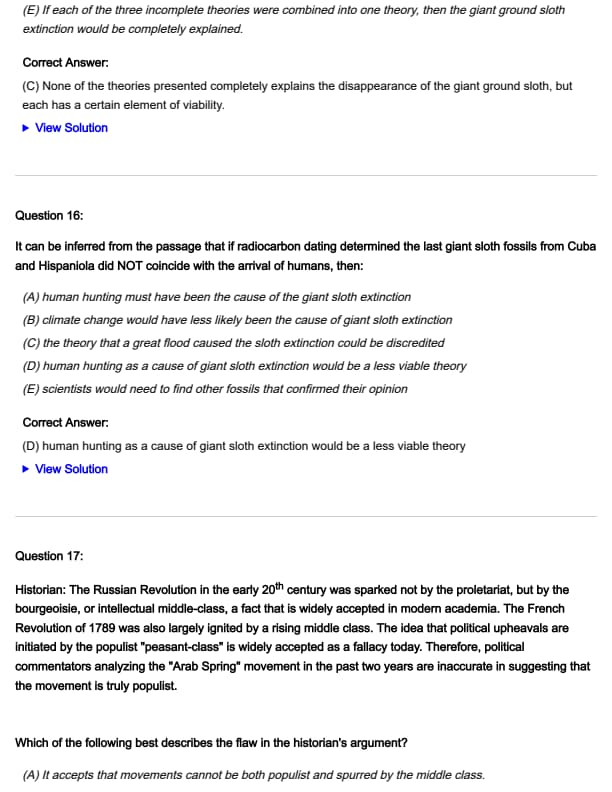
Question 15:
Which of the following statements would best conclude the ideas presented in this passage?
- (A) Scientists will never be able to know for sure what happened to the giant ground sloth, so they should focus their efforts elsewhere.
- (B) It is certain that humans contributed to giant ground sloth extinction, but scientists do not yet know in what way.
- (C) None of the theories presented completely explains the disappearance of the giant ground sloth, but each has a certain element of viability.
- (D) Humans will one day be in danger of extinction, so they should learn what they can from the case of the giant ground sloth.
- (E) If each of the three incomplete theories were combined into one theory, then the giant ground sloth extinction would be completely explained.
Question 16:
It can be inferred from the passage that if radiocarbon dating determined the last giant sloth fossils from Cuba and Hispaniola did NOT coincide with the arrival of humans, then:
- (A) human hunting must have been the cause of the giant sloth extinction
- (B) climate change would have less likely been the cause of giant sloth extinction
- (C) the theory that a great flood caused the sloth extinction could be discredited
- (D) human hunting as a cause of giant sloth extinction would be a less viable theory
- (E) scientists would need to find other fossils that confirmed their opinion
Question 17:
Historian: The Russian Revolution in the early 20th century was sparked not by the proletariat, but by the bourgeoisie, or intellectual middle-class, a fact that is widely accepted in modern academia. The French Revolution of 1789 was also largely ignited by a rising middle class. The idea that political upheavals are initiated by the populist "peasant-class" is widely accepted as a fallacy today. Therefore, political commentators analyzing the "Arab Spring" movement in the past two years are inaccurate in suggesting that the movement is truly populist.
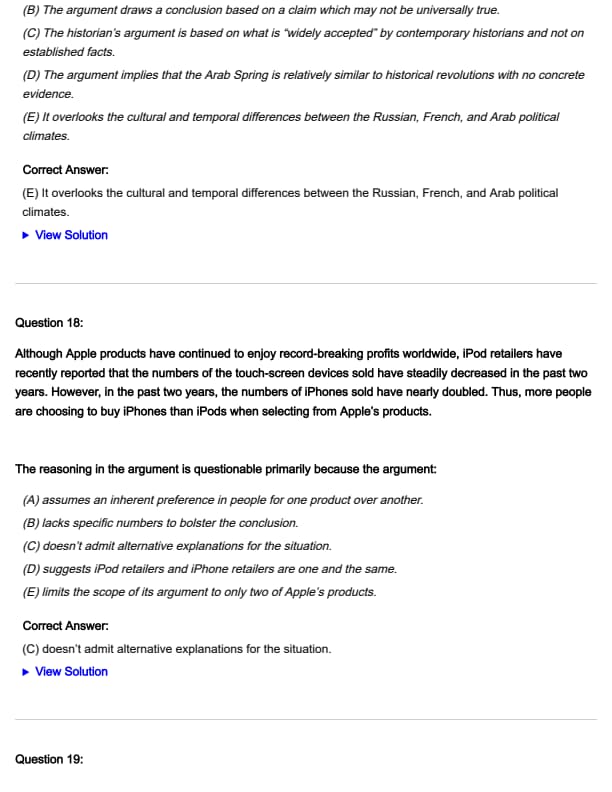
Which of the following best describes the flaw in the historian's argument?
- (A) It accepts that movements cannot be both populist and spurred by the middle class.
- (B) The argument draws a conclusion based on a claim which may not be universally true.
- (C) The historian’s argument is based on what is “widely accepted” by contemporary historians and not on established facts.
- (D) The argument implies that the Arab Spring is relatively similar to historical revolutions with no concrete evidence.
- (E) It overlooks the cultural and temporal differences between the Russian, French, and Arab political climates.
Question 18:
Although Apple products have continued to enjoy record-breaking profits worldwide, iPod retailers have recently reported that the numbers of the touch-screen devices sold have steadily decreased in the past two years. However, in the past two years, the numbers of iPhones sold have nearly doubled. Thus, more people are choosing to buy iPhones than iPods when selecting from Apple’s products.
The reasoning in the argument is questionable primarily because the argument:
- (A) assumes an inherent preference in people for one product over another.
- (B) lacks specific numbers to bolster the conclusion.
- (C) doesn’t admit alternative explanations for the situation.
- (D) suggests iPod retailers and iPhone retailers are one and the same.
- (E) limits the scope of its argument to only two of Apple’s products.
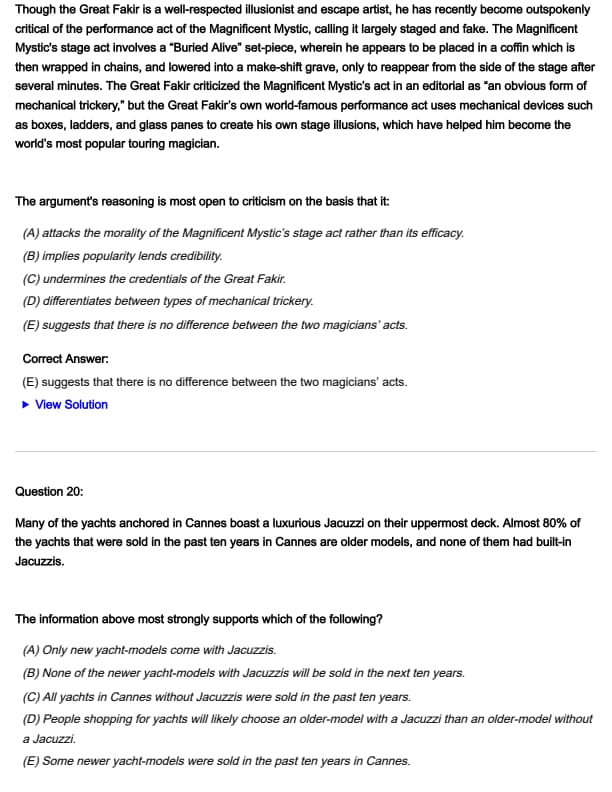
Question 19:
Though the Great Fakir is a well-respected illusionist and escape artist, he has recently become outspokenly critical of the performance act of the Magnificent Mystic, calling it largely staged and fake. The Magnificent Mystic's stage act involves a “Buried Alive” set-piece, wherein he appears to be placed in a coffin which is then wrapped in chains, and lowered into a make-shift grave, only to reappear from the side of the stage after several minutes. The Great Fakir criticized the Magnificent Mystic’s act in an editorial as “an obvious form of mechanical trickery,” but the Great Fakir’s own world-famous performance act uses mechanical devices such as boxes, ladders, and glass panes to create his own stage illusions, which have helped him become the world’s most popular touring magician.
The argument's reasoning is most open to criticism on the basis that it:
- (A) attacks the morality of the Magnificent Mystic’s stage act rather than its efficacy.
- (B) implies popularity lends credibility.
- (C) undermines the credentials of the Great Fakir.
- (D) differentiates between types of mechanical trickery.
- (E) suggests that there is no difference between the two magicians’ acts.
Question 20:
Many of the yachts anchored in Cannes boast a luxurious Jacuzzi on their uppermost deck. Almost 80% of the yachts that were sold in the past ten years in Cannes are older models, and none of them had built-in Jacuzzis.
The information above most strongly supports which of the following?
- (A) Only new yacht-models come with Jacuzzis.
- (B) None of the newer yacht-models with Jacuzzis will be sold in the next ten years.
- (C) All yachts in Cannes without Jacuzzis were sold in the past ten years.
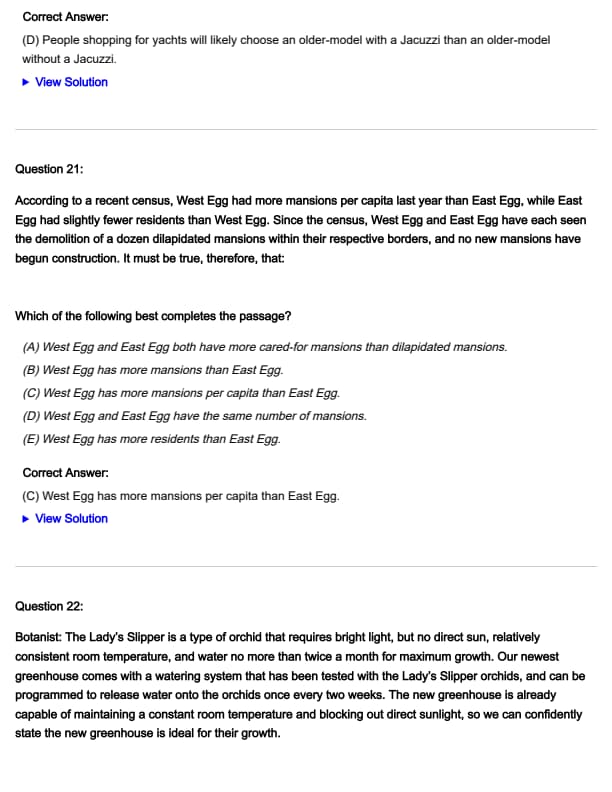
- (D) People shopping for yachts will likely choose an older-model with a Jacuzzi than an older-model without a Jacuzzi.
- (E) Some newer yacht-models were sold in the past ten years in Cannes.
Question 21:
According to a recent census, West Egg had more mansions per capita last year than East Egg, while East Egg had slightly fewer residents than West Egg. Since the census, West Egg and East Egg have each seen the demolition of a dozen dilapidated mansions within their respective borders, and no new mansions have begun construction. It must be true, therefore, that:
Which of the following best completes the passage?
- (A) West Egg and East Egg both have more cared-for mansions than dilapidated mansions.
- (B) West Egg has more mansions than East Egg.
- (C) West Egg has more mansions per capita than East Egg.
- (D) West Egg and East Egg have the same number of mansions.
- (E) West Egg has more residents than East Egg.
Question 22:
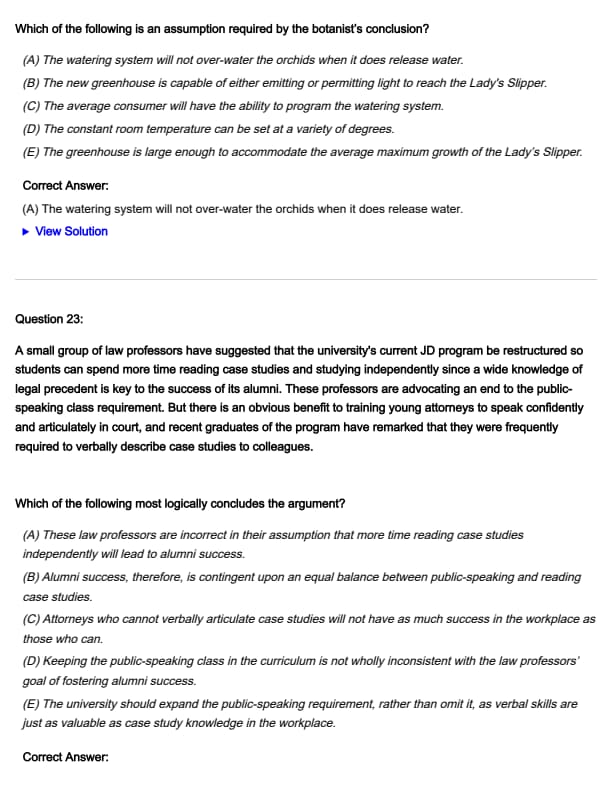
Botanist: The Lady’s Slipper is a type of orchid that requires bright light, but no direct sun, relatively consistent room temperature, and water no more than twice a month for maximum growth. Our newest greenhouse comes with a watering system that has been tested with the Lady’s Slipper orchids, and can be programmed to release water onto the orchids once every two weeks. The new greenhouse is already capable of maintaining a constant room temperature and blocking out direct sunlight, so we can confidently state the new greenhouse is ideal for their growth.
Which of the following is an assumption required by the botanist’s conclusion?
- (A) The watering system will not over-water the orchids when it does release water.
- (B) The new greenhouse is capable of either emitting or permitting light to reach the Lady's Slipper.
- (C) The average consumer will have the ability to program the watering system.
- (D) The constant room temperature can be set at a variety of degrees.
- (E) The greenhouse is large enough to accommodate the average maximum growth of the Lady’s Slipper.
Question 23:
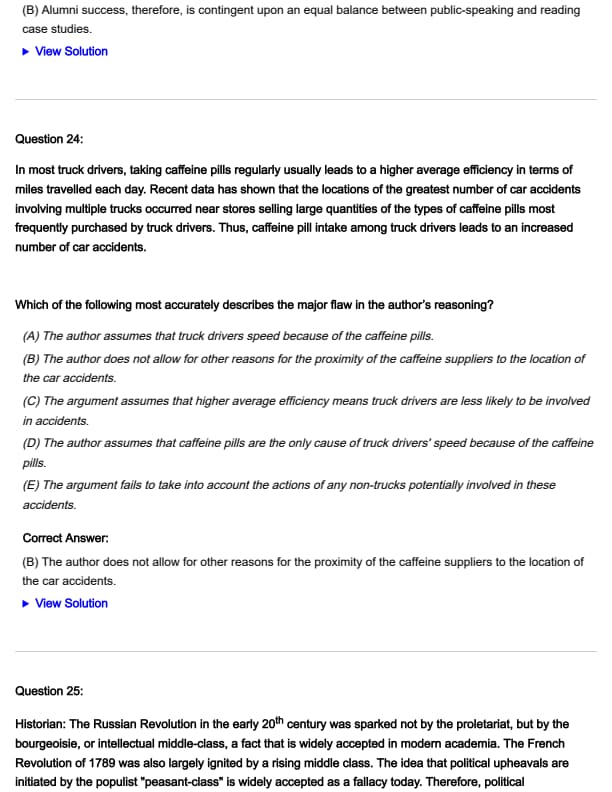
A small group of law professors have suggested that the university's current JD program be restructured so students can spend more time reading case studies and studying independently since a wide knowledge of legal precedent is key to the success of its alumni. These professors are advocating an end to the public-speaking class requirement. But there is an obvious benefit to training young attorneys to speak confidently and articulately in court, and recent graduates of the program have remarked that they were frequently required to verbally describe case studies to colleagues.
Which of the following most logically concludes the argument?
- (A) These law professors are incorrect in their assumption that more time reading case studies independently will lead to alumni success.
- (B) Alumni success, therefore, is contingent upon an equal balance between public-speaking and reading case studies.
- (C) Attorneys who cannot verbally articulate case studies will not have as much success in the workplace as those who can.
- (D) Keeping the public-speaking class in the curriculum is not wholly inconsistent with the law professors’ goal of fostering alumni success.
- (E) The university should expand the public-speaking requirement, rather than omit it, as verbal skills are just as valuable as case study knowledge in the workplace.
Question 24:
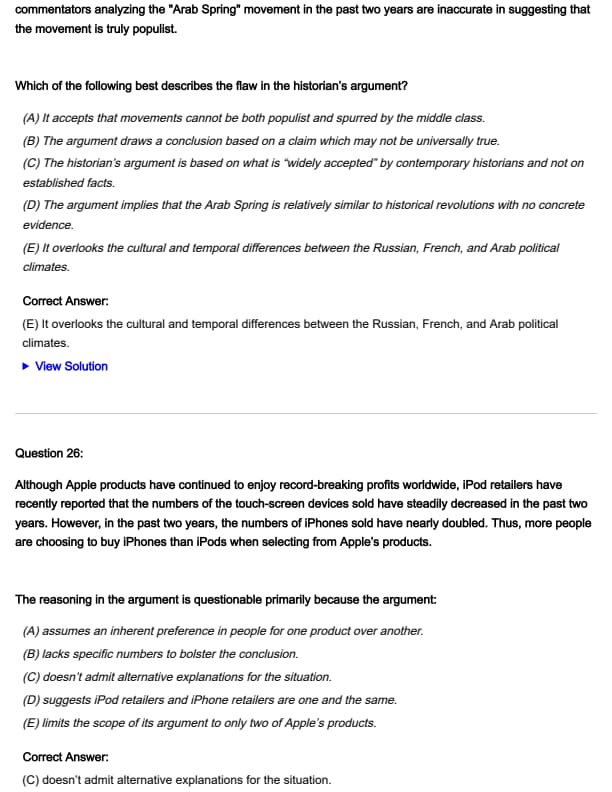
In most truck drivers, taking caffeine pills regularly usually leads to a higher average efficiency in terms of miles travelled each day. Recent data has shown that the locations of the greatest number of car accidents involving multiple trucks occurred near stores selling large quantities of the types of caffeine pills most frequently purchased by truck drivers. Thus, caffeine pill intake among truck drivers leads to an increased number of car accidents.
Which of the following most accurately describes the major flaw in the author’s reasoning?
- (A) The author assumes that truck drivers speed because of the caffeine pills.
- (B) The author does not allow for other reasons for the proximity of the caffeine suppliers to the location of the car accidents.
- (C) The argument assumes that higher average efficiency means truck drivers are less likely to be involved in accidents.
- (D) The author assumes that caffeine pills are the only cause of truck drivers' speed because of the caffeine pills.
- (E) The argument fails to take into account the actions of any non-trucks potentially involved in these accidents.
Question 25:
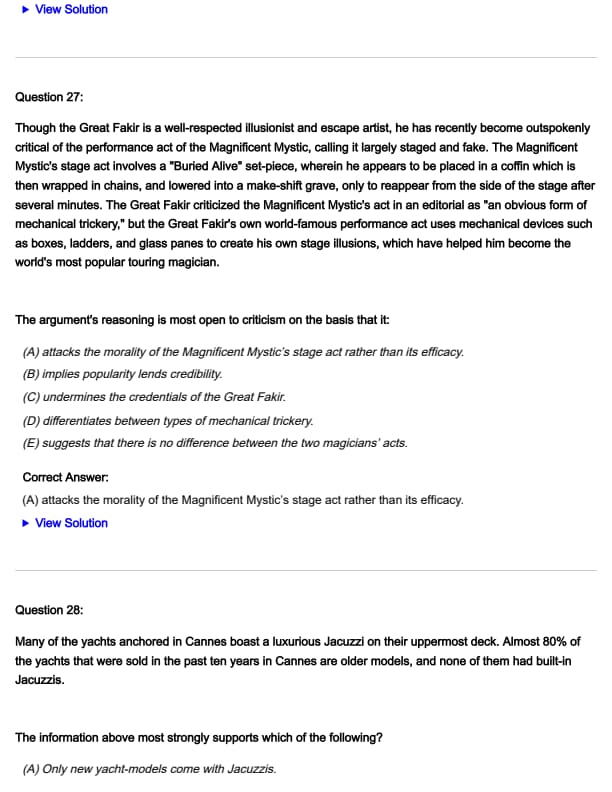
Historian: The Russian Revolution in the early 20th century was sparked not by the proletariat, but by the bourgeoisie, or intellectual middle-class, a fact that is widely accepted in modern academia. The French Revolution of 1789 was also largely ignited by a rising middle class. The idea that political upheavals are initiated by the populist "peasant-class" is widely accepted as a fallacy today. Therefore, political commentators analyzing the "Arab Spring" movement in the past two years are inaccurate in suggesting that the movement is truly populist.
Which of the following best describes the flaw in the historian’s argument?
- (A) It accepts that movements cannot be both populist and spurred by the middle class.
- (B) The argument draws a conclusion based on a claim which may not be universally true.
- (C) The historian’s argument is based on what is “widely accepted” by contemporary historians and not on established facts.
- (D) The argument implies that the Arab Spring is relatively similar to historical revolutions with no concrete evidence.
- (E) It overlooks the cultural and temporal differences between the Russian, French, and Arab political climates.
Question 26:
Although Apple products have continued to enjoy record-breaking profits worldwide, iPod retailers have recently reported that the numbers of the touch-screen devices sold have steadily decreased in the past two years. However, in the past two years, the numbers of iPhones sold have nearly doubled. Thus, more people are choosing to buy iPhones than iPods when selecting from Apple’s products.
The reasoning in the argument is questionable primarily because the argument:
- (A) assumes an inherent preference in people for one product over another.
- (B) lacks specific numbers to bolster the conclusion.
- (C) doesn’t admit alternative explanations for the situation.
- (D) suggests iPod retailers and iPhone retailers are one and the same.
- (E) limits the scope of its argument to only two of Apple’s products.
Question 27:
Though the Great Fakir is a well-respected illusionist and escape artist, he has recently become outspokenly critical of the performance act of the Magnificent Mystic, calling it largely staged and fake. The Magnificent Mystic's stage act involves a "Buried Alive" set-piece, wherein he appears to be placed in a coffin which is then wrapped in chains, and lowered into a make-shift grave, only to reappear from the side of the stage after several minutes. The Great Fakir criticized the Magnificent Mystic's act in an editorial as "an obvious form of mechanical trickery," but the Great Fakir's own world-famous performance act uses mechanical devices such as boxes, ladders, and glass panes to create his own stage illusions, which have helped him become the world's most popular touring magician.
The argument's reasoning is most open to criticism on the basis that it:
- (A) attacks the morality of the Magnificent Mystic’s stage act rather than its efficacy.
- (B) implies popularity lends credibility.
- (C) undermines the credentials of the Great Fakir.
- (D) differentiates between types of mechanical trickery.
- (E) suggests that there is no difference between the two magicians’ acts.
Question 28:
Many of the yachts anchored in Cannes boast a luxurious Jacuzzi on their uppermost deck. Almost 80% of the yachts that were sold in the past ten years in Cannes are older models, and none of them had built-in Jacuzzis.
The information above most strongly supports which of the following?
- (A) Only new yacht-models come with Jacuzzis.
- (B) None of the newer yacht-models with Jacuzzis will be sold in the next ten years.
- (C) All yachts in Cannes without Jacuzzis were sold in the past ten years.
- (D) People shopping for yachts will likely choose an older-model with a Jacuzzi than an older-model without a Jacuzzi.
- (E) Some newer yacht-models were sold in the past ten years in Cannes.
Question 29:
According to a recent census, West Egg had more mansions per capita last year than East Egg, while East Egg had slightly fewer residents than West Egg. Since the census, West Egg and East Egg have each seen the demolition of a dozen dilapidated mansions within their respective borders, and no new mansions have begun construction. It must be true, therefore, that:
Which of the following best completes the passage?
- (A) West Egg and East Egg both have more cared-for mansions than dilapidated mansions.
- (B) West Egg has more mansions than East Egg.
- (C) West Egg has more mansions per capita than East Egg.
- (D) West Egg and East Egg have the same number of mansions.
- (E) West Egg has more residents than East Egg.
Question 30:
Botanist: The Lady’s Slipper is a type of orchid that requires bright light, but no direct sun, relatively consistent room temperature, and water no more than twice a month for maximum growth. Our newest greenhouse comes with a watering system that has been tested with the Lady’s Slipper orchids, and can be programmed to release water onto the orchids once every two weeks. The new greenhouse is already capable of maintaining a constant room temperature and blocking out direct sunlight, so we can confidently state the new greenhouse is ideal for their growth.
Which of the following is an assumption required by the botanist’s conclusion?
- (A) The watering system will not over-water the orchids when it does release water.
- (B) The new greenhouse is capable of either emitting or permitting light to reach the Lady's Slipper.
- (C) The average consumer will have the ability to program the watering system.
- (D) The constant room temperature can be set at a variety of degrees.
- (E) The greenhouse is large enough to accommodate the average maximum growth of the Lady’s Slipper.
Question 31:
A small group of law professors have suggested that the university’s current JD program be restructured so students can spend more time reading case studies and studying independently since a wide knowledge of legal precedent is key to the success of its alumni. These professors are advocating an end to the public-speaking class requirement. But there is an obvious benefit to training young attorneys to speak confidently and articulately in court, and recent graduates of the program have remarked that they were frequently required to verbally describe case studies to colleagues.
Which of the following most logically concludes the argument?
- (A) These law professors are incorrect in their assumption that more time reading case studies independently will lead to alumni success.
- (B) Alumni success, therefore, is contingent upon an equal balance between public-speaking and reading case studies.
- (C) Attorneys who cannot verbally articulate case studies will not have as much success in the workplace as those who can.
- (D) Keeping the public-speaking class in the curriculum is not wholly inconsistent with the law professors’ goal of fostering alumni success.
- (E) The university should expand the public-speaking requirement, rather than omit it, as verbal skills are just as valuable as case study knowledge in the workplace.
Question 32:
In most truck drivers, taking caffeine pills regularly usually leads to a higher average efficiency in terms of miles travelled each day. Recent data has shown that the locations of the greatest number of car accidents involving multiple trucks occurred near stores selling large quantities of the types of caffeine pills most frequently purchased by truck drivers. Thus, caffeine pill intake among truck drivers leads to an increased number of car accidents.
Which of the following most accurately describes the major flaw in the author’s reasoning?
- (A) The author assumes that truck drivers speed because of the caffeine pills.
- (B) The author does not allow for other reasons for the proximity of the caffeine suppliers to the location of the car accidents.
- (C) The argument assumes that higher average efficiency means truck drivers are less likely to be involved in accidents.
- (D) The author assumes that caffeine pills are the only cause of truck drivers' speed because of the caffeine pills.
- (E) The argument fails to take into account the actions of any non-trucks potentially involved in these accidents.
Question 33:
An ancient palace in Mesopotamia was recently uncovered, revealing three antechambers relatively undamaged. The heights of the doorways between the chambers were measured, and found to be on average no greater than 4.5 feet tall. Therefore, it is reasonable to conclude that the chambers found were intended for children and young adults, and could very well have been used as a nursery.
Which of the following is NOT an assumption upon which the argument is based?
- (A) The height of the doorways did not shrink significantly over time prior to the palace’s discovery.
- (B) Ancient Mesopotamians were not a lot shorter, on average, than modern humans.
- (C) The ancient Mesopotamians built doors to accommodate the people who would primarily occupy the rooms behind them.
- (D) Ancient Mesopotamians were not generally taller than 5 feet at adult height.
- (E) Human height in ancient times is comparable to modern human height.
Question 34:
The city council of Town X has very little effective power. It has been primarily a deliberative body, with real decisions coming down from the mayor’s office. No city can claim to have effective leadership without a strong city council, and Town X is widely praised for its effective leadership. It follows, then, that the city council of Town X ..........
Which of the following best completes the argument?
- (A) could not be considered effective unless it’s false that Town X has strong leadership.
- (B) actually wields the true power within Town X’s leadership branch.
- (C) supports unilaterally the decisions from the mayor’s office.
- (D) is representative of most deliberative bodies.
- (E) is able to bolster Town X’s leadership through deliberation.


-modified.png?h=56&w=56&mode=stretch)


 Download




Comments