GMAT Verbal Sample Paper Set 7 Question Paper with Answer Key and Solutions PDF is available for download. GMAT lasts for a total of 2 hours and 15 minutes, with an optional 10-minute break. Throughout the test, candidates will be required to answer 64 questions, distributed as follows:
- Quantitative Reasoning: 21 questions, to be completed in 45 minutes.
- Verbal Reasoning: 23 questions, to be completed in 45 minutes.
- Data Insights: 20 questions, to be completed in 45 minutes.
GMAT Verbal Sample Paper Set 7 Question Paper with Solutions PDF
![GMAT Verbal Paper Set 7]()
While hotels have traditionally held a firm grip on the market of vacation-goers, the emer-
gence of companies fostering short-term rentals are dramatically changing the landscape of the
travel industry. Before the advent of the modern online forum, short-term rentals were an
arrangement limited by sheer logistics. Information about the availability of (and desire for) a
short-term rental was difficult to transmit and share. However, with the current explosion of
social media and cyber enterprise, the business model of short-term rentals has blossomed.
In 2011, 40% of travelers reported that they would be staying in a short-term rental during
the year, as opposed to a traditional hotel. By 2013, this figure had jumped up to a staggering
49%. The short-term rental business is a $24 billion market, holding 8% of the total market
of U.S. travel. Rapidly expanding and growing with the innovations of creative renters, the
question that hangs in the air is what this means for communities. Short-term rentals have had
a polarizing effect in many ways, becoming a source of joy for venturists and cause of dismay
for many homeowners.
In recent news, there have been incredible scandals in which short-term renters have abused
the property loaned to them, causing thousands of dollars’ worth of property damage. Other
accusations include disturbing the peace and the commission of criminal acts. Homeowners’
Associations (HOAs) have been up in arms, and the legal backlash has been significant. New
York enacted firm restrictions on short-term renters, and many HOAs now embed limits on the
purposes that a space may be used for, barring short-term rentals.
However, this reaction is an over-reaction, and a detrimental one at that. Cities and towns that
set hard limits against short-term rentals are halting the economic growth that would otherwise
accompany them. Vacationers are likely to be deterred from venturing out to towns that have
banned more affordable short-term rentals. While some vacationers might opt to stay at a hotel
in desirable locations, as the short-term rental industry continues to grow, it will become more
and more likely that vacation-goers will simply choose alternative destinations that actually
allow for short-term rentals.
This is not to say, however, that short-term rentals should be completely unregulated. The
key is imposing useful regulations that are mutually beneficial to both communities and to
the proprietors of short-term rentals. One potential solution would be to impose reasonable
taxes on visitors that use short-term rentals; having requirements for minimum stays could also
ensure more consistency for the communities. This also has the added benefit of generating
income for towns and cities. There is no reason why communities should see the short-term
rental industry as an adversary, when it can just as easily be made into an ally.
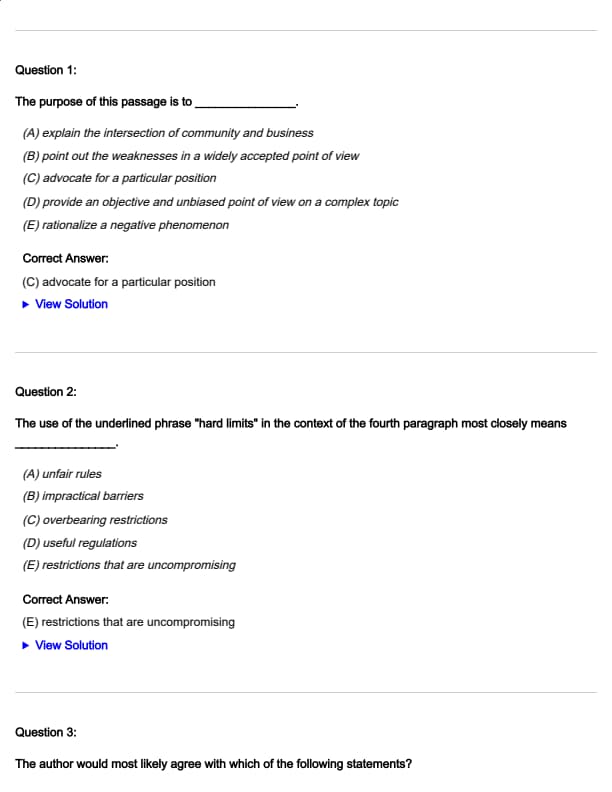
Question 1:
The purpose of this passage is to _______________.
- (A) explain the intersection of community and business
- (B) point out the weaknesses in a widely accepted point of view
- (C) advocate for a particular position
- (D) provide an objective and unbiased point of view on a complex topic
- (E) rationalize a negative phenomenon
Question 2:
The use of the underlined phrase "hard limits" in the context of the fourth paragraph most closely means _______________.
- (A) unfair rules
- (B) impractical barriers
- (C) overbearing restrictions
- (D) useful regulations
- (E) restrictions that are uncompromising
Question 3:
The author would most likely agree with which of the following statements?
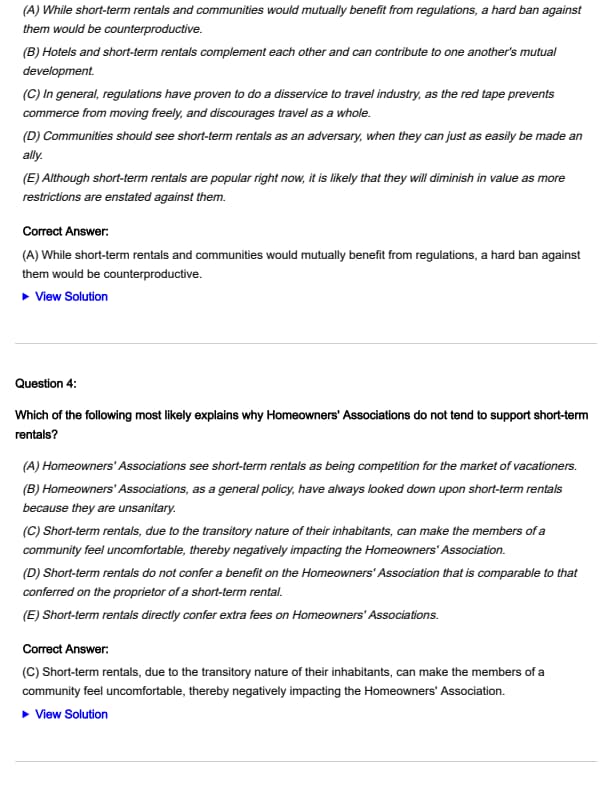
- (A) While short-term rentals and communities would mutually benefit from regulations, a hard ban against them would be counterproductive.
- (B) Hotels and short-term rentals complement each other and can contribute to one another's mutual development.
- (C) In general, regulations have proven to do a disservice to travel industry, as the red tape prevents commerce from moving freely, and discourages travel as a whole.
- (D) Communities should see short-term rentals as an adversary, when they can just as easily be made an ally.
- (E) Although short-term rentals are popular right now, it is likely that they will diminish in value as more restrictions are enstated against them.
Question 4:
Which of the following most likely explains why Homeowners' Associations do not tend to support short-term rentals?
- (A) Homeowners' Associations see short-term rentals as being competition for the market of vacationers.
- (B) Homeowners' Associations, as a general policy, have always looked down upon short-term rentals because they are unsanitary.
- (C) Short-term rentals, due to the transitory nature of their inhabitants, can make the members of a community feel uncomfortable, thereby negatively impacting the Homeowners' Association.
- (D) Short-term rentals do not confer a benefit on the Homeowners' Association that is comparable to that conferred on the proprietor of a short-term rental.
- (E) Short-term rentals directly confer extra fees on Homeowners' Associations.
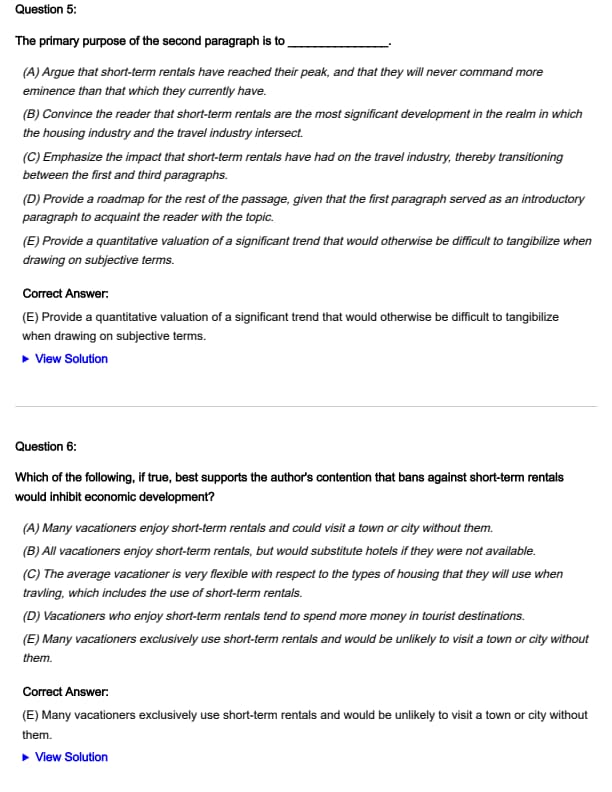
Question 5:
The primary purpose of the second paragraph is to _______________.
- (A) Argue that short-term rentals have reached their peak, and that they will never command more eminence than that which they currently have.
- (B) Convince the reader that short-term rentals are the most significant development in the realm in which the housing industry and the travel industry intersect.
- (C) Emphasize the impact that short-term rentals have had on the travel industry, thereby transitioning between the first and third paragraphs.
- (D) Provide a roadmap for the rest of the passage, given that the first paragraph served as an introductory paragraph to acquaint the reader with the topic.
- (E) Provide a quantitative valuation of a significant trend that would otherwise be difficult to tangibilize when drawing on subjective terms.
Question 6:
Which of the following, if true, best supports the author's contention that bans against short-term rentals would inhibit economic development?
- (A) Many vacationers enjoy short-term rentals and could visit a town or city without them.
- (B) All vacationers enjoy short-term rentals, but would substitute hotels if they were not available.
- (C) The average vacationer is very flexible with respect to the types of housing that they will use when travling, which includes the use of short-term rentals.
- (D) Vacationers who enjoy short-term rentals tend to spend more money in tourist destinations.
- (E) Many vacationers exclusively use short-term rentals and would be unlikely to visit a town or city without them.
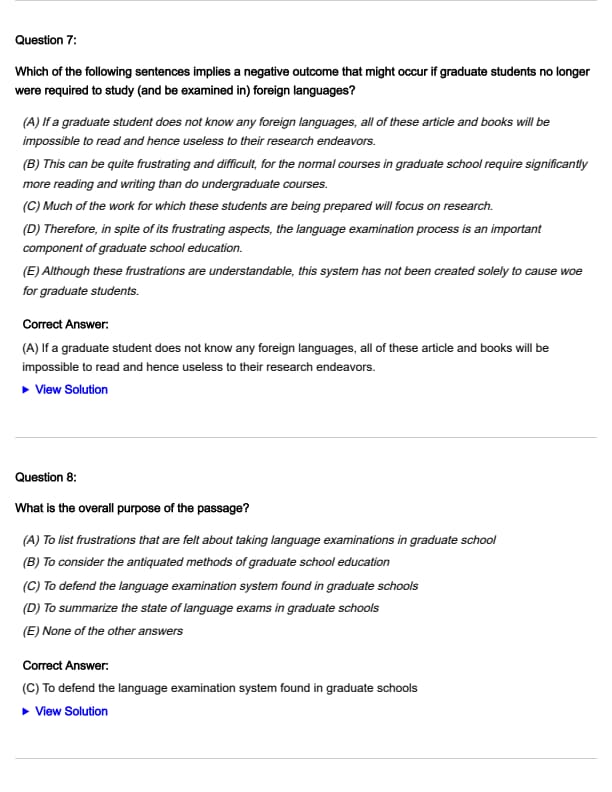
Question 7:
Which of the following sentences implies a negative outcome that might occur if graduate students no longer were required to study (and be examined in) foreign languages?
- (A) If a graduate student does not know any foreign languages, all of these article and books will be impossible to read and hence useless to their research endeavors.
- (B) This can be quite frustrating and difficult, for the normal courses in graduate school require significantly more reading and writing than do undergraduate courses.
- (C) Much of the work for which these students are being prepared will focus on research.
- (D) Therefore, in spite of its frustrating aspects, the language examination process is an important component of graduate school education.
- (E) Although these frustrations are understandable, this system has not been created solely to cause woe for graduate students.
Question 8:
What is the overall purpose of the passage?
- (A) To list frustrations that are felt about taking language examinations in graduate school
- (B) To consider the antiquated methods of graduate school education
- (C) To defend the language examination system found in graduate schools
- (D) To summarize the state of language exams in graduate schools
- (E) None of the other answers
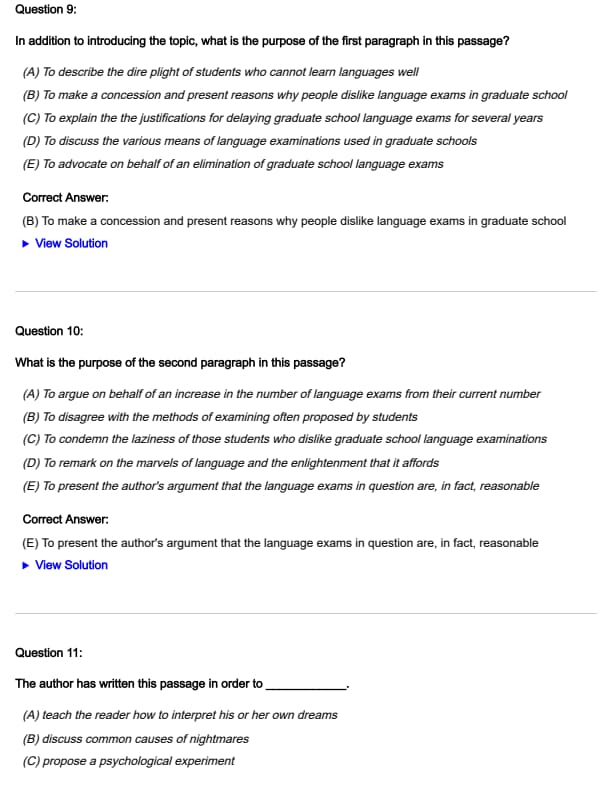
Question 9:
In addition to introducing the topic, what is the purpose of the first paragraph in this passage?
- (A) To describe the dire plight of students who cannot learn languages well
- (B) To make a concession and present reasons why people dislike language exams in graduate school
- (C) To explain the the justifications for delaying graduate school language exams for several years
- (D) To discuss the various means of language examinations used in graduate schools
- (E) To advocate on behalf of an elimination of graduate school language exams
Question 10:
What is the purpose of the second paragraph in this passage?
- (A) To argue on behalf of an increase in the number of language exams from their current number
- (B) To disagree with the methods of examining often proposed by students
- (C) To condemn the laziness of those students who dislike graduate school language examinations
- (D) To remark on the marvels of language and the enlightenment that it affords
- (E) To present the author's argument that the language exams in question are, in fact, reasonable
Question 11:
The author has written this passage in order to ____________.
- (A) teach the reader how to interpret his or her own dreams
- (B) discuss common causes of nightmares
- (C) propose a psychological experiment
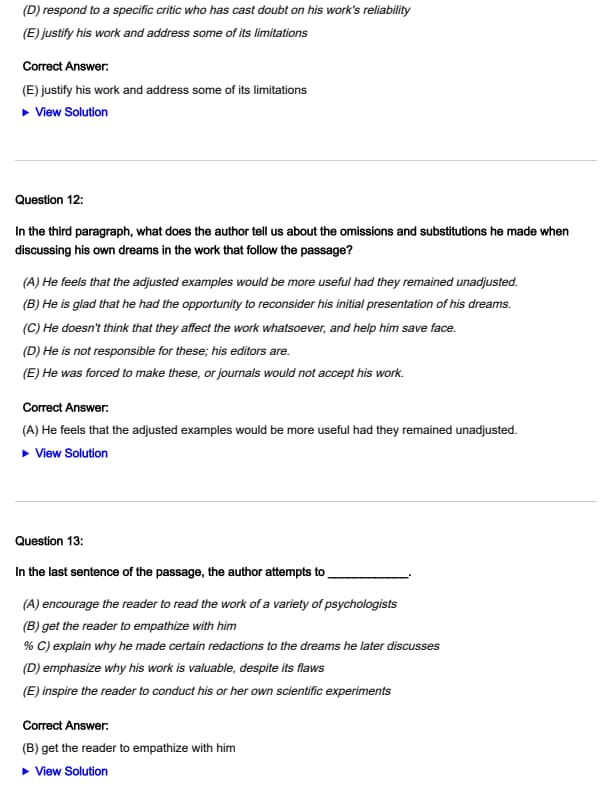
- (D) respond to a specific critic who has cast doubt on his work's reliability
- (E) justify his work and address some of its limitations
Question 12:
In the third paragraph, what does the author tell us about the omissions and substitutions he made when discussing his own dreams in the work that follow the passage?
- (A) He feels that the adjusted examples would be more useful had they remained unadjusted.
- (B) He is glad that he had the opportunity to reconsider his initial presentation of his dreams.
- (C) He doesn't think that they affect the work whatsoever, and help him save face.
- (D) He is not responsible for these; his editors are.
- (E) He was forced to make these, or journals would not accept his work.
Question 13:
In the last sentence of the passage, the author attempts to ____________.
- (A) encourage the reader to read the work of a variety of psychologists
- (B) get the reader to empathize with him
% C) explain why he made certain redactions to the dreams he later discusses
- (D) emphasize why his work is valuable, despite its flaws
- (E) inspire the reader to conduct his or her own scientific experiments
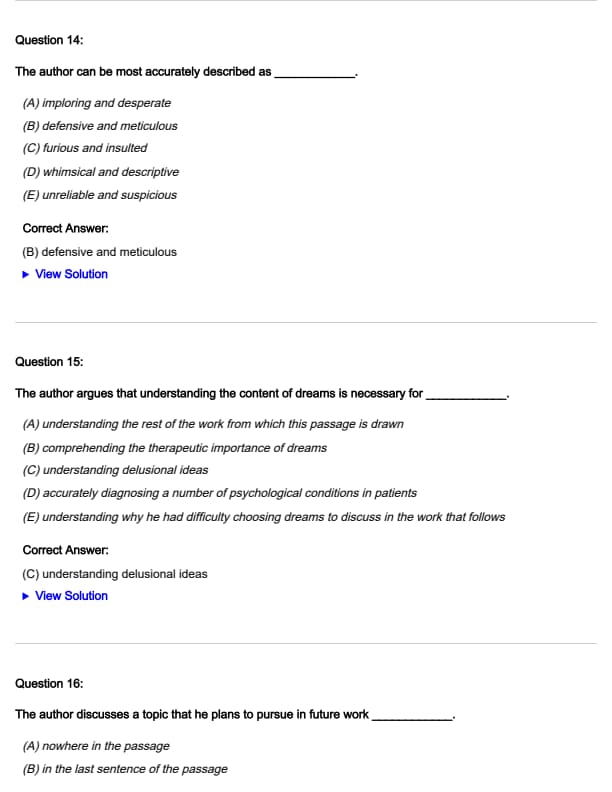
Question 14:
The author can be most accurately described as ____________.
- (A) imploring and desperate
- (B) defensive and meticulous
- (C) furious and insulted
- (D) whimsical and descriptive
- (E) unreliable and suspicious
Question 15:
The author argues that understanding the content of dreams is necessary for ____________.
- (A) understanding the rest of the work from which this passage is drawn
- (B) comprehending the therapeutic importance of dreams
- (C) understanding delusional ideas
- (D) accurately diagnosing a number of psychological conditions in patients
- (E) understanding why he had difficulty choosing dreams to discuss in the work that follows
Question 16:
The author discusses a topic that he plans to pursue in future work ____________.
- (A) nowhere in the passage
- (B) in the last sentence of the passage
- (C) in the second paragraph of the passage
- (D) in the first and last paragraphs of the passage
- (E) in the first sentence of the passage
Question 17:
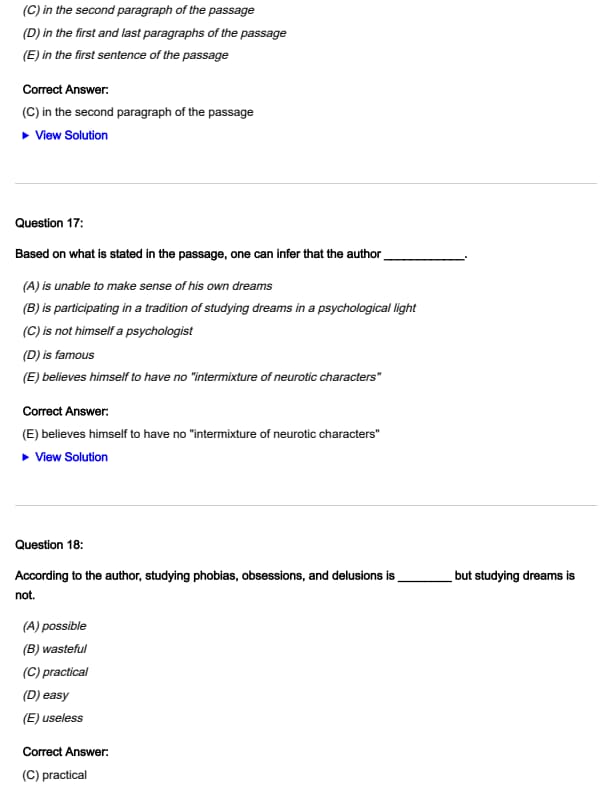
Based on what is stated in the passage, one can infer that the author ____________.
- (A) is unable to make sense of his own dreams
- (B) is participating in a tradition of studying dreams in a psychological light
- (C) is not himself a psychologist
- (D) is famous
- (E) believes himself to have no "intermixture of neurotic characters"
Question 18:
According to the author, studying phobias, obsessions, and delusions is ________ but studying dreams is not.
- (A) possible
- (B) wasteful
- (C) practical
- (D) easy
- (E) useless
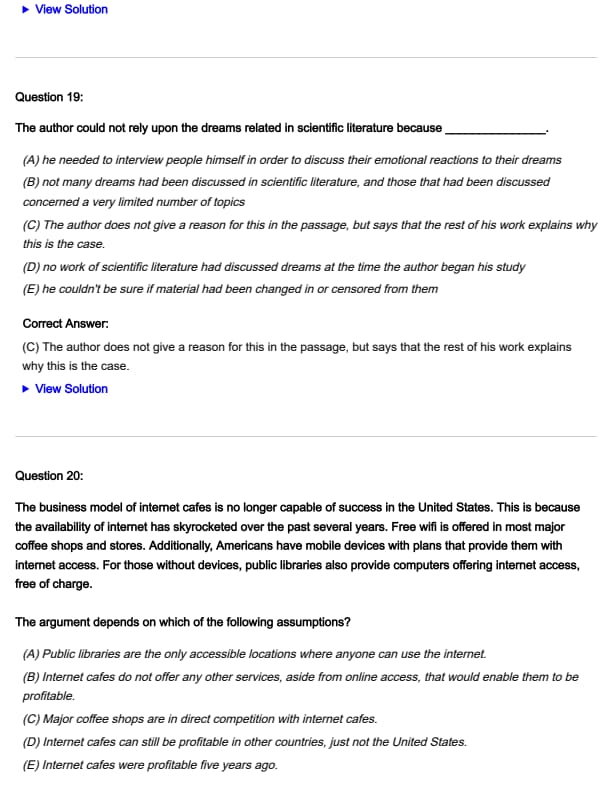
Question 19:
The author could not rely upon the dreams related in scientific literature because _______________.
- (A) he needed to interview people himself in order to discuss their emotional reactions to their dreams
- (B) not many dreams had been discussed in scientific literature, and those that had been discussed concerned a very limited number of topics
- (C) The author does not give a reason for this in the passage, but says that the rest of his work explains why this is the case.
- (D) no work of scientific literature had discussed dreams at the time the author began his study
- (E) he couldn't be sure if material had been changed in or censored from them
Question 20:
The business model of internet cafes is no longer capable of success in the United States. This is because the availability of internet has skyrocketed over the past several years. Free wifi is offered in most major coffee shops and stores. Additionally, Americans have mobile devices with plans that provide them with internet access. For those without devices, public libraries also provide computers offering internet access, free of charge.
The argument depends on which of the following assumptions?
- (A) Public libraries are the only accessible locations where anyone can use the internet.
- (B) Internet cafes do not offer any other services, aside from online access, that would enable them to be profitable.
- (C) Major coffee shops are in direct competition with internet cafes.
- (D) Internet cafes can still be profitable in other countries, just not the United States.
- (E) Internet cafes were profitable five years ago.
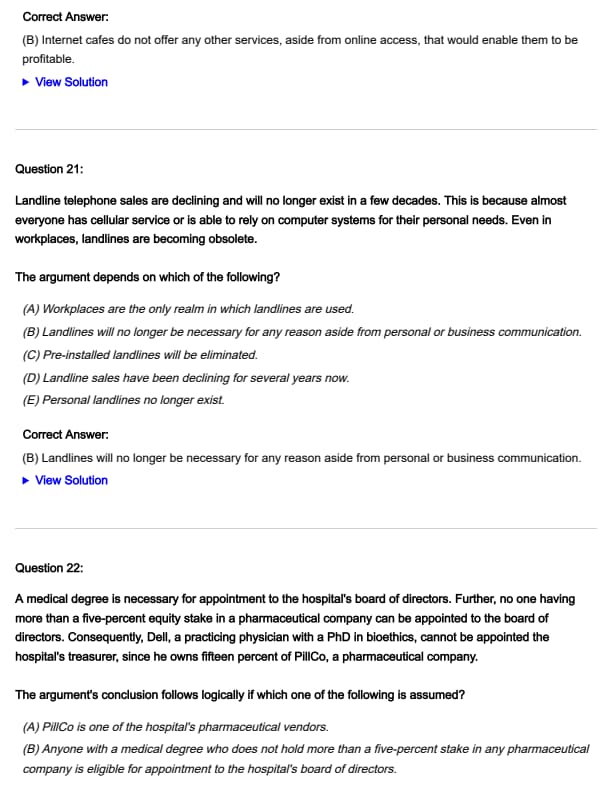
Question 21:
Landline telephone sales are declining and will no longer exist in a few decades. This is because almost everyone has cellular service or is able to rely on computer systems for their personal needs. Even in workplaces, landlines are becoming obsolete.
The argument depends on which of the following?
- (A) Workplaces are the only realm in which landlines are used.
- (B) Landlines will no longer be necessary for any reason aside from personal or business communication.
- (C) Pre-installed landlines will be eliminated.
- (D) Landline sales have been declining for several years now.
- (E) Personal landlines no longer exist.
Question 22:
A medical degree is necessary for appointment to the hospital's board of directors. Further, no one having more than a five-percent equity stake in a pharmaceutical company can be appointed to the board of directors. Consequently, Dell, a practicing physician with a PhD in bioethics, cannot be appointed the hospital's treasurer, since he owns fifteen percent of PillCo, a pharmaceutical company.
The argument's conclusion follows logically if which one of the following is assumed?
- (A) PillCo is one of the hospital's pharmaceutical vendors.
- (B) Anyone with a medical degree who does not hold more than a five-percent stake in any pharmaceutical company is eligible for appointment to the hospital's board of directors.
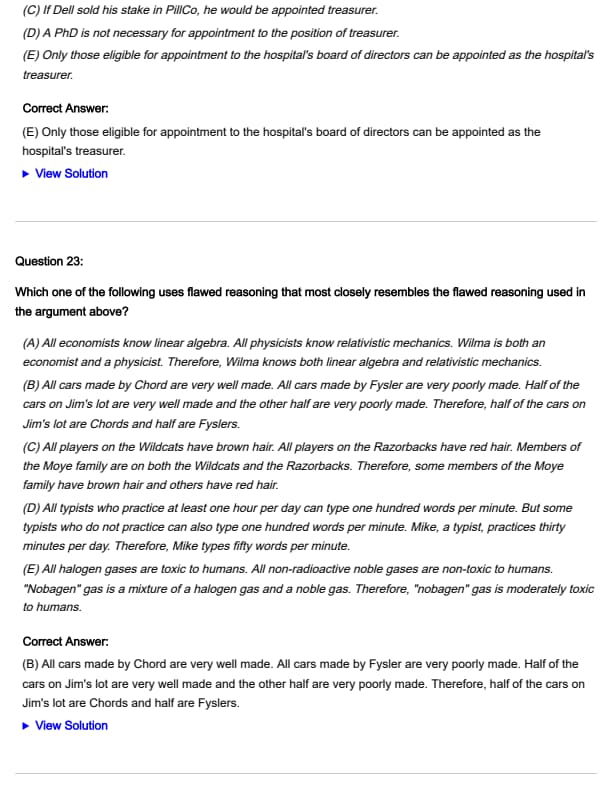
- (C) If Dell sold his stake in PillCo, he would be appointed treasurer.
- (D) A PhD is not necessary for appointment to the position of treasurer.
- (E) Only those eligible for appointment to the hospital's board of directors can be appointed as the hospital's treasurer.
Question 23:
Which one of the following uses flawed reasoning that most closely resembles the flawed reasoning used in the argument above?
- (A) All economists know linear algebra. All physicists know relativistic mechanics. Wilma is both an economist and a physicist. Therefore, Wilma knows both linear algebra and relativistic mechanics.
- (B) All cars made by Chord are very well made. All cars made by Fysler are very poorly made. Half of the cars on Jim's lot are very well made and the other half are very poorly made. Therefore, half of the cars on Jim's lot are Chords and half are Fyslers.
- (C) All players on the Wildcats have brown hair. All players on the Razorbacks have red hair. Members of the Moye family are on both the Wildcats and the Razorbacks. Therefore, some members of the Moye family have brown hair and others have red hair.
- (D) All typists who practice at least one hour per day can type one hundred words per minute. But some typists who do not practice can also type one hundred words per minute. Mike, a typist, practices thirty minutes per day. Therefore, Mike types fifty words per minute.
- (E) All halogen gases are toxic to humans. All non-radioactive noble gases are non-toxic to humans. "Nobagen" gas is a mixture of a halogen gas and a noble gas. Therefore, "nobagen" gas is moderately toxic to humans.
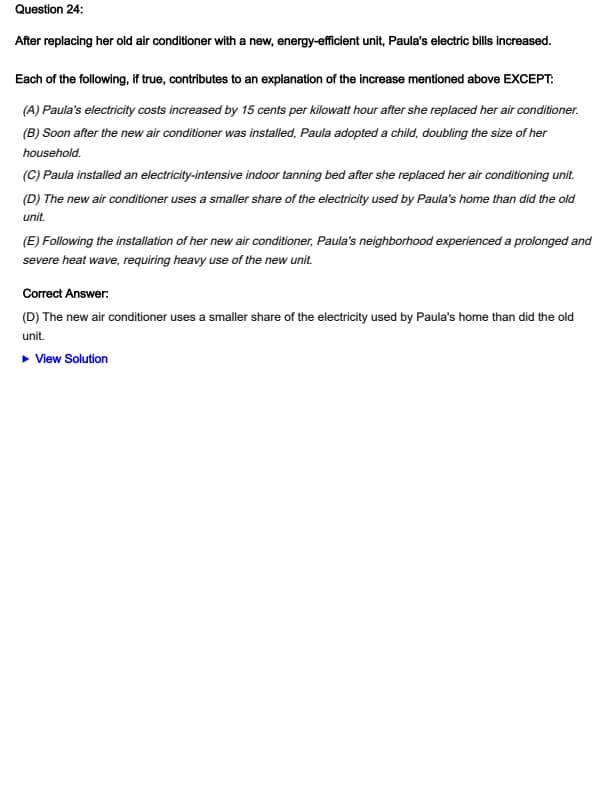
Question 24:
After replacing her old air conditioner with a new, energy-efficient unit, Paula's electric bills increased.
Each of the following, if true, contributes to an explanation of the increase mentioned above EXCEPT:
- (A) Paula's electricity costs increased by 15 cents per kilowatt hour after she replaced her air conditioner.
- (B) Soon after the new air conditioner was installed, Paula adopted a child, doubling the size of her household.
- (C) Paula installed an electricity-intensive indoor tanning bed after she replaced her air conditioning unit.
- (D) The new air conditioner uses a smaller share of the electricity used by Paula's home than did the old unit.
- (E) Following the installation of her new air conditioner, Paula's neighborhood experienced a prolonged and severe heat wave, requiring heavy use of the new unit.


-modified.png?h=56&w=56&mode=stretch)


 Download



Comments