

-modified.png?h=56&w=56&mode=stretch)


GMAT Verbal Sample Paper Set 8 Question Paper with Answer Key and Solutions PDF is available for download. GMAT lasts for a total of 2 hours and 15 minutes, with an optional 10-minute break. Throughout the test, candidates will be required to answer 64 questions, distributed as follows:
- Quantitative Reasoning: 21 questions, to be completed in 45 minutes.
- Verbal Reasoning: 23 questions, to be completed in 45 minutes.
- Data Insights: 20 questions, to be completed in 45 minutes.
GMAT Verbal Sample Paper Set 8 Question Paper with Solutions PDF
| GMAT Verbal Sample Paper Set 8 Question Paper with Solutions PDF |  Download Download |
Check Solutions |

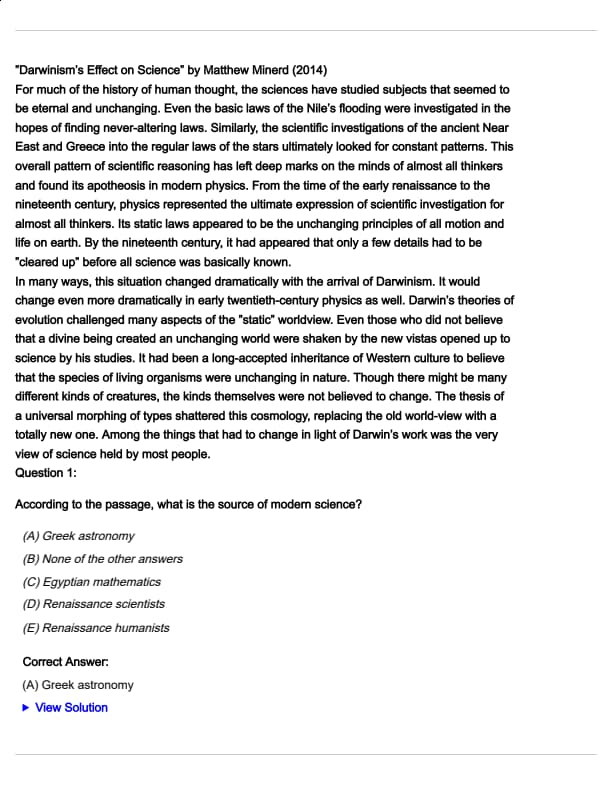
For much of the history of human thought, the sciences have studied subjects that seemed to
be eternal and unchanging. Even the basic laws of the Nile’s flooding were investigated in the
hopes of finding never-altering laws. Similarly, the scientific investigations of the ancient Near
East and Greece into the regular laws of the stars ultimately looked for constant patterns. This
overall pattern of scientific reasoning has left deep marks on the minds of almost all thinkers
and found its apotheosis in modern physics. From the time of the early renaissance to the
nineteenth century, physics represented the ultimate expression of scientific investigation for
almost all thinkers. Its static laws appeared to be the unchanging principles of all motion and
life on earth. By the nineteenth century, it had appeared that only a few details had to be
”cleared up” before all science was basically known.
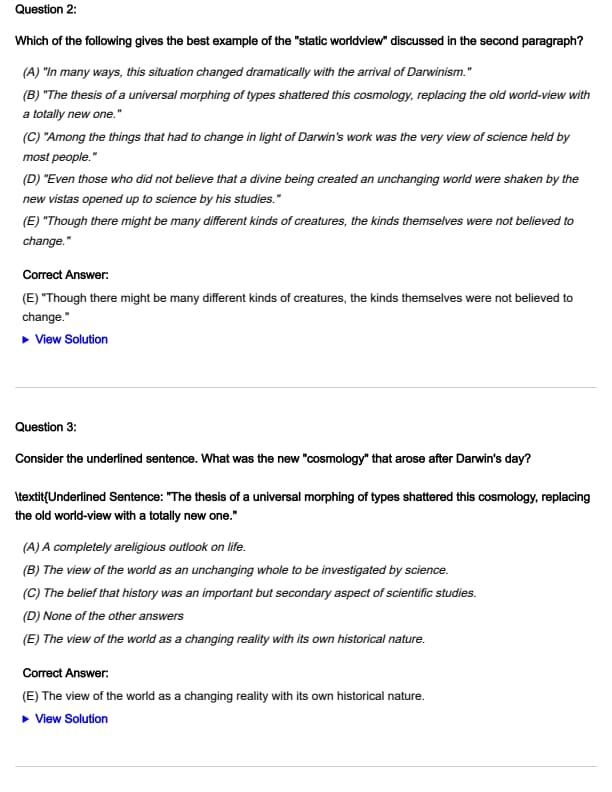
In many ways, this situation changed dramatically with the arrival of Darwinism. It would
change even more dramatically in early twentieth-century physics as well. Darwin’s theories of
evolution challenged many aspects of the ”static” worldview. Even those who did not believe
that a divine being created an unchanging world were shaken by the new vistas opened up to
science by his studies. It had been a long-accepted inheritance of Western culture to believe
that the species of living organisms were unchanging in nature. Though there might be many
different kinds of creatures, the kinds themselves were not believed to change. The thesis of
a universal morphing of types shattered this cosmology, replacing the old world-view with a
totally new one. Among the things that had to change in light of Darwin’s work was the very
view of science held by most people.
Question 1:
According to the passage, what is the source of modern science?
Which of the following gives the best example of the "static worldview" discussed in the second paragraph?
Consider the underlined sentence. What was the new "cosmology" that arose after Darwin's day?
\textit{Underlined Sentence: "The thesis of a universal morphing of types shattered this cosmology, replacing the old world-view with a totally new one."
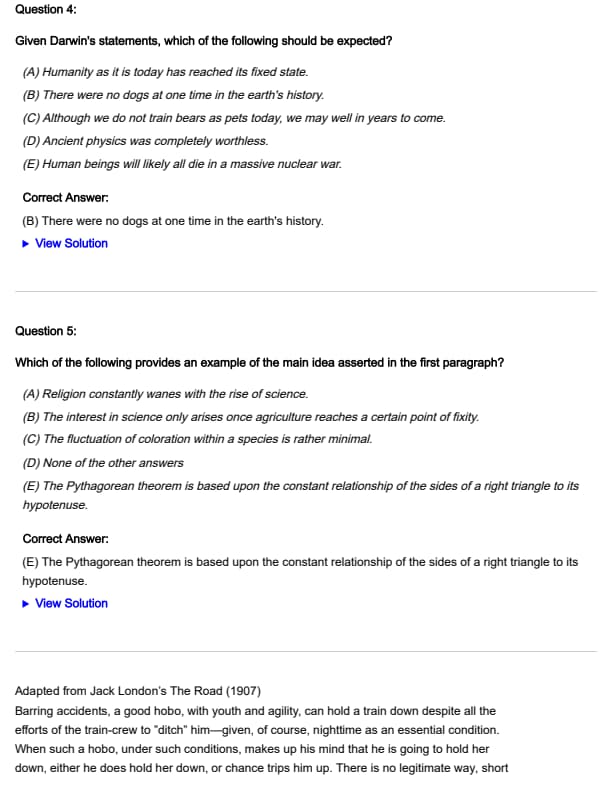
Given Darwin's statements, which of the following should be expected?
Which of the following provides an example of the main idea asserted in the first paragraph?
Adapted from Jack London’s The Road (1907)
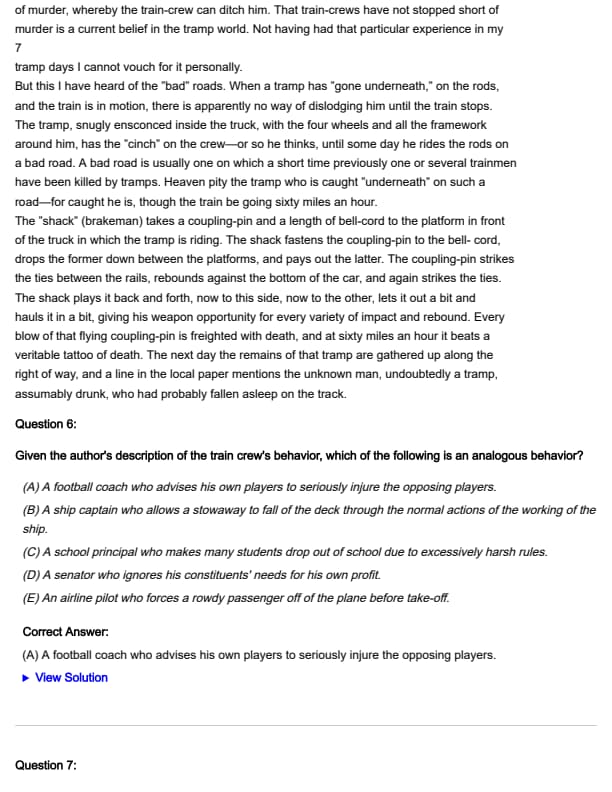
Barring accidents, a good hobo, with youth and agility, can hold a train down despite all the
efforts of the train-crew to ”ditch” him—given, of course, nighttime as an essential condition.
When such a hobo, under such conditions, makes up his mind that he is going to hold her
down, either he does hold her down, or chance trips him up. There is no legitimate way, short
of murder, whereby the train-crew can ditch him. That train-crews have not stopped short of
murder is a current belief in the tramp world. Not having had that particular experience in my
7
tramp days I cannot vouch for it personally.
But this I have heard of the ”bad” roads. When a tramp has ”gone underneath,” on the rods,
and the train is in motion, there is apparently no way of dislodging him until the train stops.
The tramp, snugly ensconced inside the truck, with the four wheels and all the framework
around him, has the ”cinch” on the crew—or so he thinks, until some day he rides the rods on
a bad road. A bad road is usually one on which a short time previously one or several trainmen
have been killed by tramps. Heaven pity the tramp who is caught ”underneath” on such a
road—for caught he is, though the train be going sixty miles an hour.
The ”shack” (brakeman) takes a coupling-pin and a length of bell-cord to the platform in front
of the truck in which the tramp is riding. The shack fastens the coupling-pin to the bell- cord,
drops the former down between the platforms, and pays out the latter. The coupling-pin strikes
the ties between the rails, rebounds against the bottom of the car, and again strikes the ties.
The shack plays it back and forth, now to this side, now to the other, lets it out a bit and
hauls it in a bit, giving his weapon opportunity for every variety of impact and rebound. Every
blow of that flying coupling-pin is freighted with death, and at sixty miles an hour it beats a
veritable tattoo of death. The next day the remains of that tramp are gathered up along the
right of way, and a line in the local paper mentions the unknown man, undoubtedly a tramp,
assumably drunk, who had probably fallen asleep on the track.
Question 6:
Given the author's description of the train crew's behavior, which of the following is an analogous behavior?
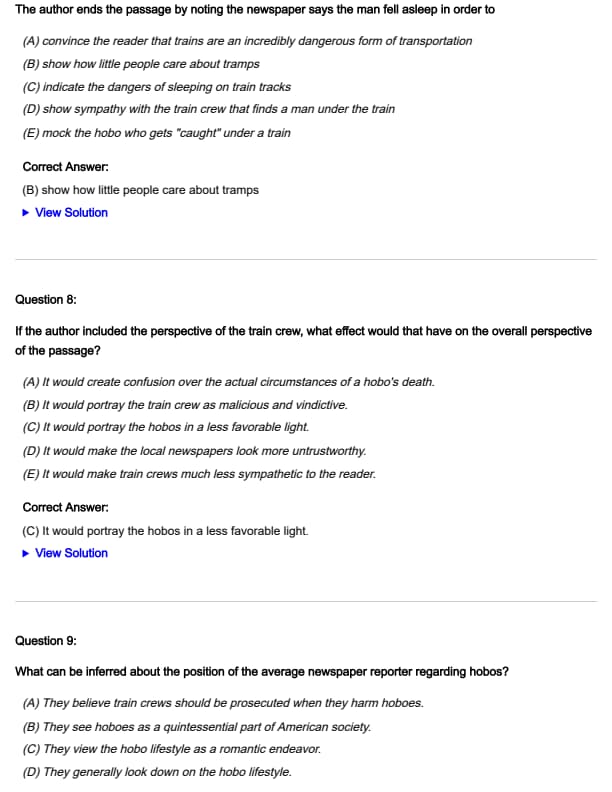
The author ends the passage by noting the newspaper says the man fell asleep in order to
If the author included the perspective of the train crew, what effect would that have on the overall perspective of the passage?
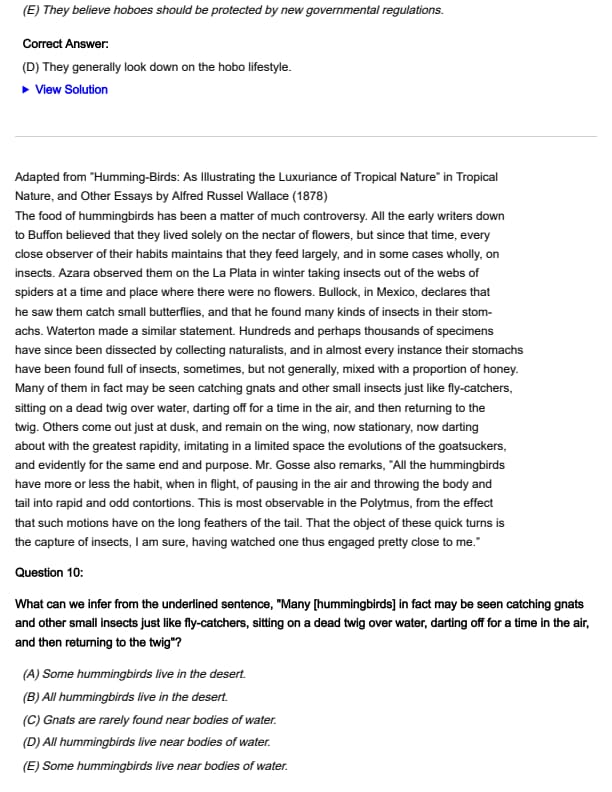
What can be inferred about the position of the average newspaper reporter regarding hobos?
Adapted from ”Humming-Birds: As Illustrating the Luxuriance of Tropical Nature” in Tropical
Nature, and Other Essays by Alfred Russel Wallace (1878)
The food of hummingbirds has been a matter of much controversy. All the early writers down
to Buffon believed that they lived solely on the nectar of flowers, but since that time, every
close observer of their habits maintains that they feed largely, and in some cases wholly, on
insects. Azara observed them on the La Plata in winter taking insects out of the webs of
spiders at a time and place where there were no flowers. Bullock, in Mexico, declares that
he saw them catch small butterflies, and that he found many kinds of insects in their stom-
achs. Waterton made a similar statement. Hundreds and perhaps thousands of specimens
have since been dissected by collecting naturalists, and in almost every instance their stomachs
have been found full of insects, sometimes, but not generally, mixed with a proportion of honey.
Many of them in fact may be seen catching gnats and other small insects just like fly-catchers,
sitting on a dead twig over water, darting off for a time in the air, and then returning to the
twig. Others come out just at dusk, and remain on the wing, now stationary, now darting
about with the greatest rapidity, imitating in a limited space the evolutions of the goatsuckers,
and evidently for the same end and purpose. Mr. Gosse also remarks, ”All the hummingbirds
have more or less the habit, when in flight, of pausing in the air and throwing the body and
tail into rapid and odd contortions. This is most observable in the Polytmus, from the effect
that such motions have on the long feathers of the tail. That the object of these quick turns is
the capture of insects, I am sure, having watched one thus engaged pretty close to me.”
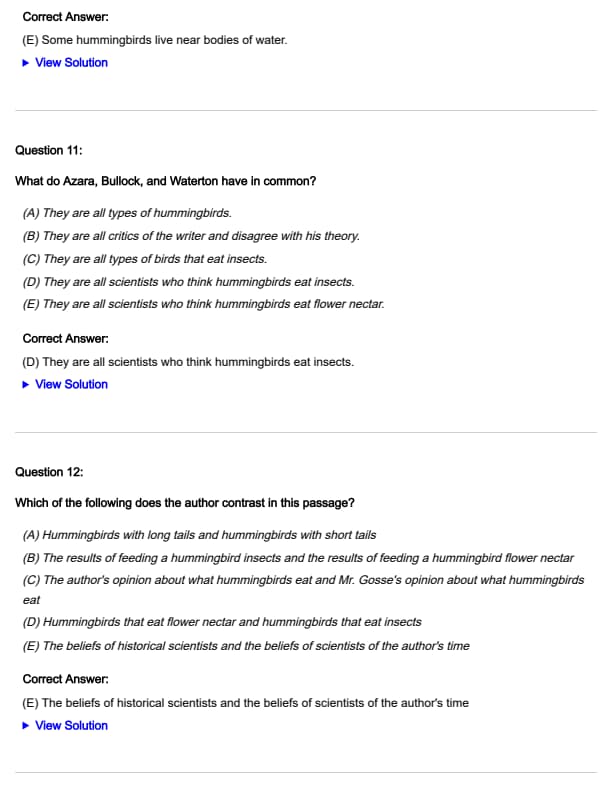
Question 10:
What can we infer from the underlined sentence, "Many [hummingbirds] in fact may be seen catching gnats and other small insects just like fly-catchers, sitting on a dead twig over water, darting off for a time in the air, and then returning to the twig"?
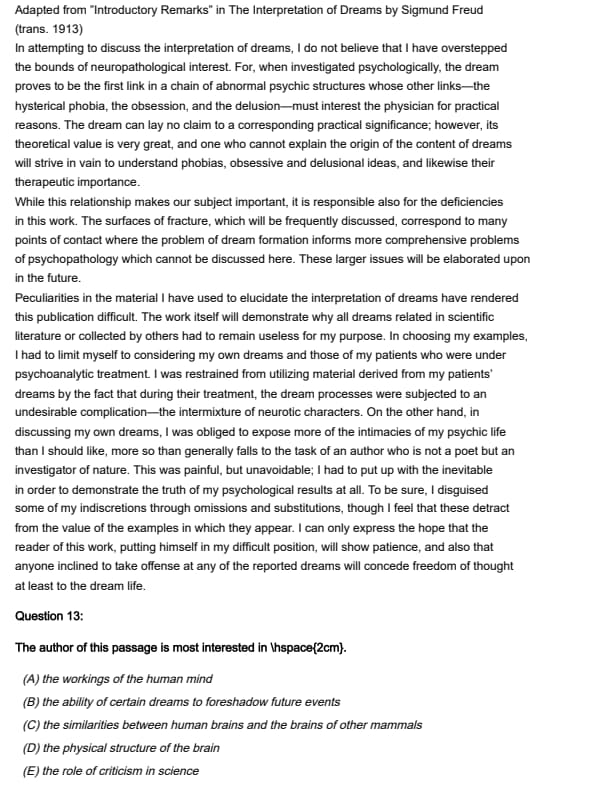
What do Azara, Bullock, and Waterton have in common?
Which of the following does the author contrast in this passage?
Adapted from ”Introductory Remarks” in The Interpretation of Dreams by Sigmund Freud
(trans. 1913)
In attempting to discuss the interpretation of dreams, I do not believe that I have overstepped
the bounds of neuropathological interest. For, when investigated psychologically, the dream
proves to be the first link in a chain of abnormal psychic structures whose other links—the
hysterical phobia, the obsession, and the delusion—must interest the physician for practical
reasons. The dream can lay no claim to a corresponding practical significance; however, its
theoretical value is very great, and one who cannot explain the origin of the content of dreams
will strive in vain to understand phobias, obsessive and delusional ideas, and likewise their
therapeutic importance.
While this relationship makes our subject important, it is responsible also for the deficiencies
in this work. The surfaces of fracture, which will be frequently discussed, correspond to many
points of contact where the problem of dream formation informs more comprehensive problems
of psychopathology which cannot be discussed here. These larger issues will be elaborated upon
in the future.
Peculiarities in the material I have used to elucidate the interpretation of dreams have rendered
this publication difficult. The work itself will demonstrate why all dreams related in scientific
literature or collected by others had to remain useless for my purpose. In choosing my examples,
I had to limit myself to considering my own dreams and those of my patients who were under
psychoanalytic treatment. I was restrained from utilizing material derived from my patients’
dreams by the fact that during their treatment, the dream processes were subjected to an
undesirable complication—the intermixture of neurotic characters. On the other hand, in
discussing my own dreams, I was obliged to expose more of the intimacies of my psychic life
than I should like, more so than generally falls to the task of an author who is not a poet but an
investigator of nature. This was painful, but unavoidable; I had to put up with the inevitable
in order to demonstrate the truth of my psychological results at all. To be sure, I disguised
some of my indiscretions through omissions and substitutions, though I feel that these detract
from the value of the examples in which they appear. I can only express the hope that the
reader of this work, putting himself in my difficult position, will show patience, and also that
anyone inclined to take offense at any of the reported dreams will concede freedom of thought
at least to the dream life.
Question 13:
The author of this passage is most interested in \hspace{2cm}.
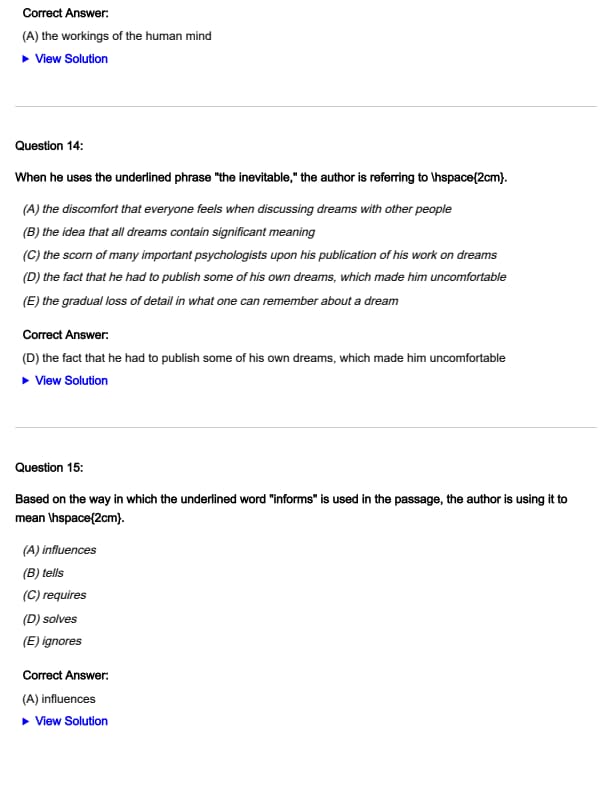
When he uses the underlined phrase "the inevitable," the author is referring to \hspace{2cm}.
Based on the way in which the underlined word "informs" is used in the passage, the author is using it to mean \hspace{2cm}.



Comments