

-modified.png?h=56&w=56&mode=stretch)


GMAT Verbal Sample Paper Set 9 Question Paper with Answer Key and Solutions PDF is available for download. GMAT lasts for a total of 2 hours and 15 minutes, with an optional 10-minute break. Throughout the test, candidates will be required to answer 64 questions, distributed as follows:
- Quantitative Reasoning: 21 questions, to be completed in 45 minutes.
- Verbal Reasoning: 23 questions, to be completed in 45 minutes.
- Data Insights: 20 questions, to be completed in 45 minutes.
GMAT Verbal Sample Paper Set 9 Question Paper with Solutions PDF
| GMAT Verbal Sample Paper Set 9 Question Paper with Solutions PDF |  Download Download |
Check Solutions |
Section: Verbal Reasoning - Reading Comprehension
To believe a proposition, say corn flakes have health benefits, is to accept it to be true. How-
ever, the question of belief is valid only for those propositions that are understandable. An
understandable proposition is one that is expressed using correct grammar and known words.
The dominant view in the scientific community on how human mind believes or disbelieves an
understandable proposition is the Cartesian hypothesis, propounded by the seventeenth-century
philosopher Ren´e Descartes. He said that when an understandable proposition is presented to a
human mind, the comprehension of its content happens automatically and passively; however,
the assessment of the truth-value of that proposition is a later and deliberate act, the result
of which is either belief or disbelief. Thus, this view holds that belief or disbelief in a com-
prehended proposition is created by rational assessment, and till such an assessment is made,
the intellect neither affirms nor denies a comprehended proposition. It also suggests that the
mental effort required to create belief and disbelief is the same: the effort required to assess
the comprehended proposition.
In contrast, Descartes’s near-contemporary Baruch Spinoza suggested that comprehension of
and belief in an understandable proposition happen together, automatically and passively; he
said that it is not possible to understand a proposition without, at least temporarily, accepting
it to be true. On later, willful assessment, if one judges the believed proposition to be false,
it may be unaccepted (disbelieved), and if judged to be true, one may continue to believe in
it. Thus, as per the Spinozan hypothesis, the default setting of the human mind is to believe
every understandable proposition that is presented to it; disbelief is possible but it comes if
it comes at all - from effortful, deliberate assessment done after the initial comprehension-belief.
Both hypotheses continue to have their proponents and opponents. It is, however, a common
observation that doubt, suspension of judgment and disbelief are mentally taxing tasks while
we naturally - effortlessly - accept and believe most of what we see, hear and read. Research
has proved that we systematically err on the side of believing too much, as opposed to rejecting
too much. This inherent credulity of the human mind is, in fact, the founding axiom of the
fields of advertising and propaganda.
Adapted from a research paper by Professor Daniel Gilbert
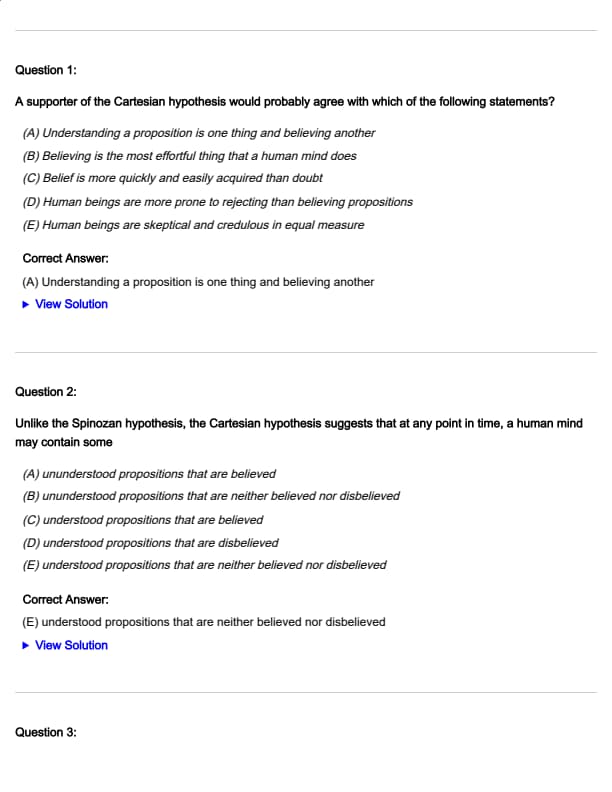
Question 1:
A supporter of the Cartesian hypothesis would probably agree with which of the following statements?
Unlike the Spinozan hypothesis, the Cartesian hypothesis suggests that at any point in time, a human mind may contain some
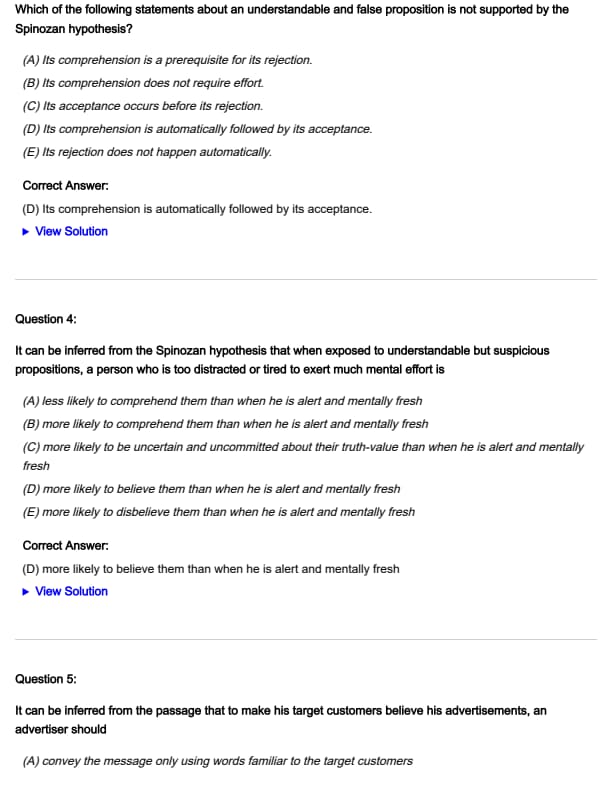
Which of the following statements about an understandable and false proposition is not supported by the Spinozan hypothesis?
It can be inferred from the Spinozan hypothesis that when exposed to understandable but suspicious propositions, a person who is too distracted or tired to exert much mental effort is
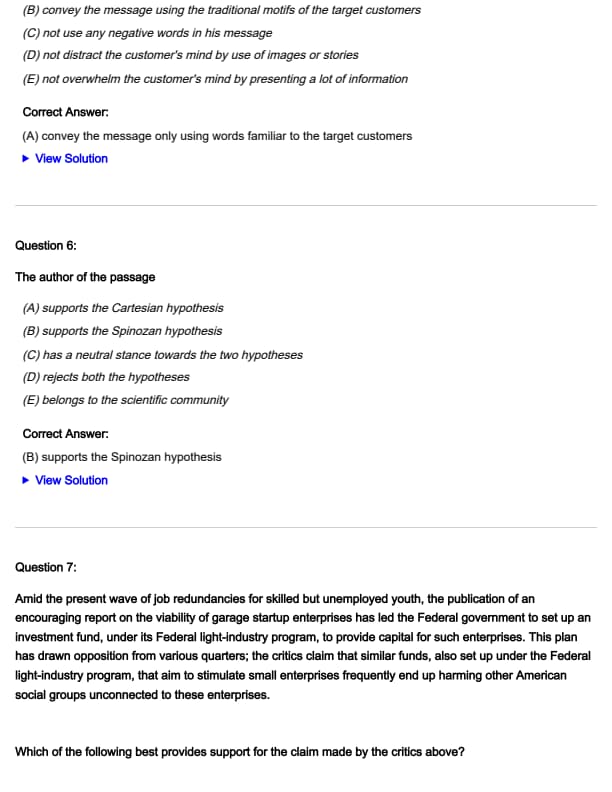
It can be inferred from the passage that to make his target customers believe his advertisements, an advertiser should
The author of the passage
Amid the present wave of job redundancies for skilled but unemployed youth, the publication of an encouraging report on the viability of garage startup enterprises has led the Federal government to set up an investment fund, under its Federal light-industry program, to provide capital for such enterprises. This plan has drawn opposition from various quarters; the critics claim that similar funds, also set up under the Federal light-industry program, that aim to stimulate small enterprises frequently end up harming other American social groups unconnected to these enterprises.
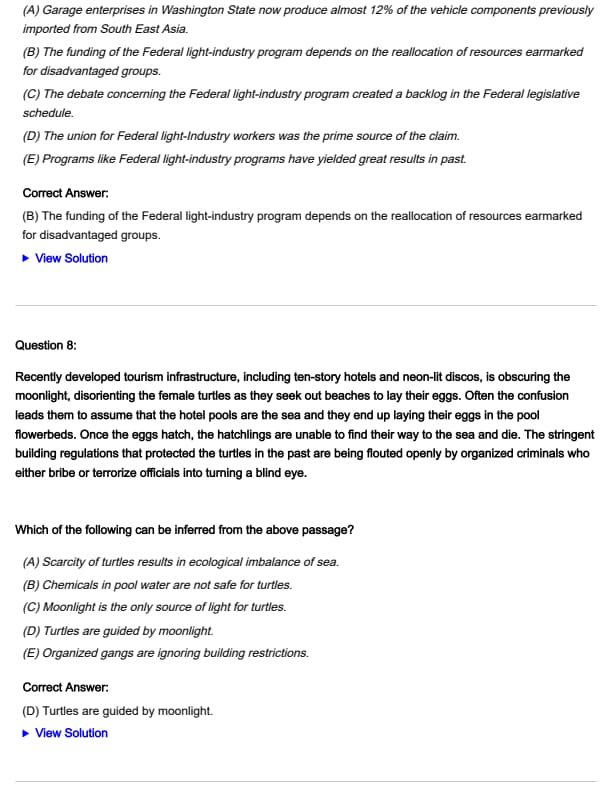
Which of the following best provides support for the claim made by the critics above?
Recently developed tourism infrastructure, including ten-story hotels and neon-lit discos, is obscuring the moonlight, disorienting the female turtles as they seek out beaches to lay their eggs. Often the confusion leads them to assume that the hotel pools are the sea and they end up laying their eggs in the pool flowerbeds. Once the eggs hatch, the hatchlings are unable to find their way to the sea and die. The stringent building regulations that protected the turtles in the past are being flouted openly by organized criminals who either bribe or terrorize officials into turning a blind eye.
Which of the following can be inferred from the above passage?
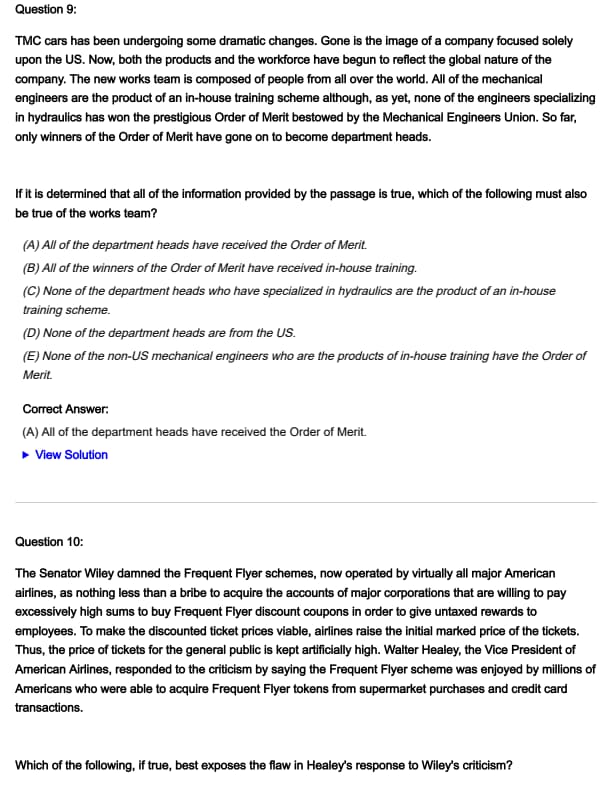
TMC cars has been undergoing some dramatic changes. Gone is the image of a company focused solely upon the US. Now, both the products and the workforce have begun to reflect the global nature of the company. The new works team is composed of people from all over the world. All of the mechanical engineers are the product of an in-house training scheme although, as yet, none of the engineers specializing in hydraulics has won the prestigious Order of Merit bestowed by the Mechanical Engineers Union. So far, only winners of the Order of Merit have gone on to become department heads.
If it is determined that all of the information provided by the passage is true, which of the following must also be true of the works team?
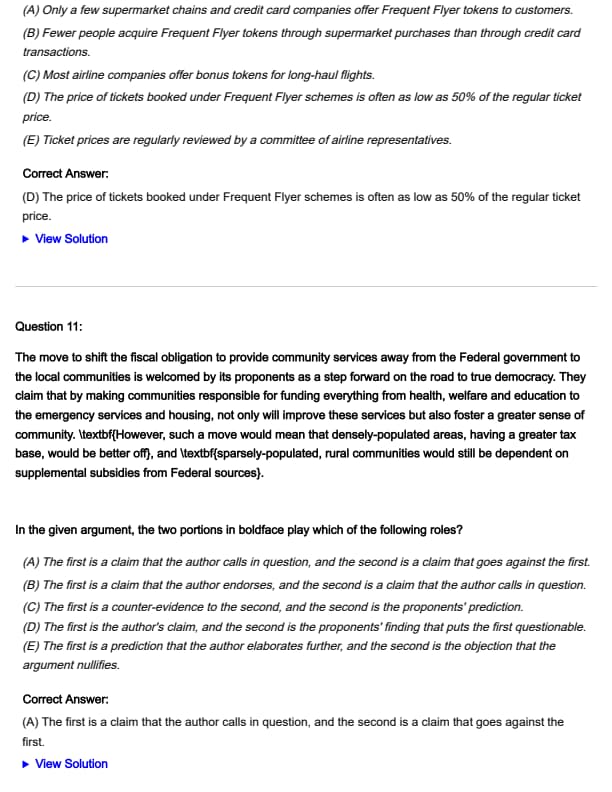
The Senator Wiley damned the Frequent Flyer schemes, now operated by virtually all major American airlines, as nothing less than a bribe to acquire the accounts of major corporations that are willing to pay excessively high sums to buy Frequent Flyer discount coupons in order to give untaxed rewards to employees. To make the discounted ticket prices viable, airlines raise the initial marked price of the tickets. Thus, the price of tickets for the general public is kept artificially high. Walter Healey, the Vice President of American Airlines, responded to the criticism by saying the Frequent Flyer scheme was enjoyed by millions of Americans who were able to acquire Frequent Flyer tokens from supermarket purchases and credit card transactions.
Which of the following, if true, best exposes the flaw in Healey's response to Wiley's criticism?
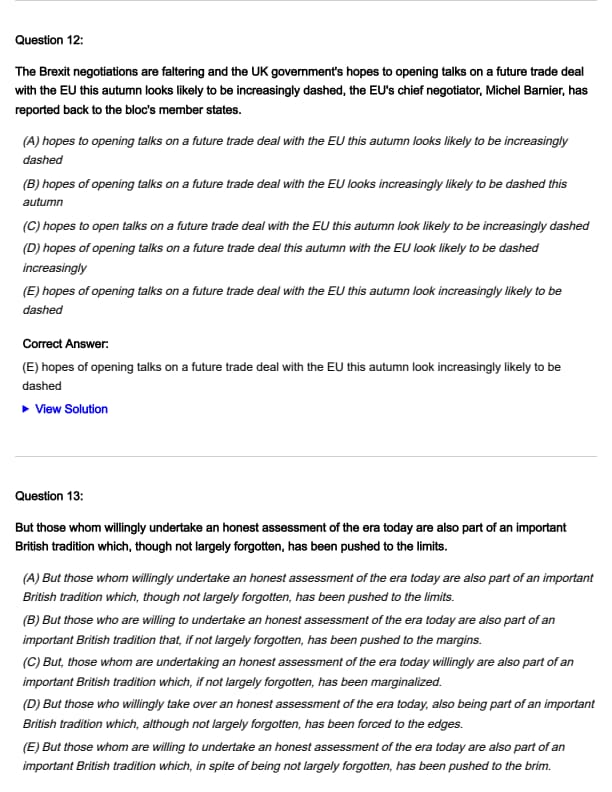
The move to shift the fiscal obligation to provide community services away from the Federal government to the local communities is welcomed by its proponents as a step forward on the road to true democracy. They claim that by making communities responsible for funding everything from health, welfare and education to the emergency services and housing, not only will improve these services but also foster a greater sense of community. \textbf{However, such a move would mean that densely-populated areas, having a greater tax base, would be better off}, and \textbf{sparsely-populated, rural communities would still be dependent on supplemental subsidies from Federal sources}.
In the given argument, the two portions in boldface play which of the following roles?
The Brexit negotiations are faltering and the UK government's hopes to opening talks on a future trade deal with the EU this autumn looks likely to be increasingly dashed, the EU's chief negotiator, Michel Barnier, has reported back to the bloc's member states.
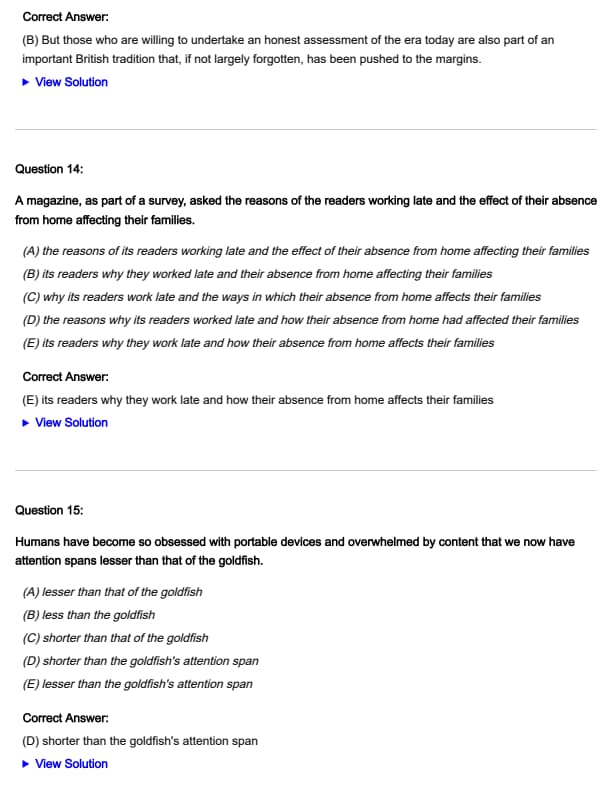
But those whom willingly undertake an honest assessment of the era today are also part of an important British tradition which, though not largely forgotten, has been pushed to the limits.
A magazine, as part of a survey, asked the reasons of the readers working late and the effect of their absence from home affecting their families.
Humans have become so obsessed with portable devices and overwhelmed by content that we now have attention spans lesser than that of the goldfish.
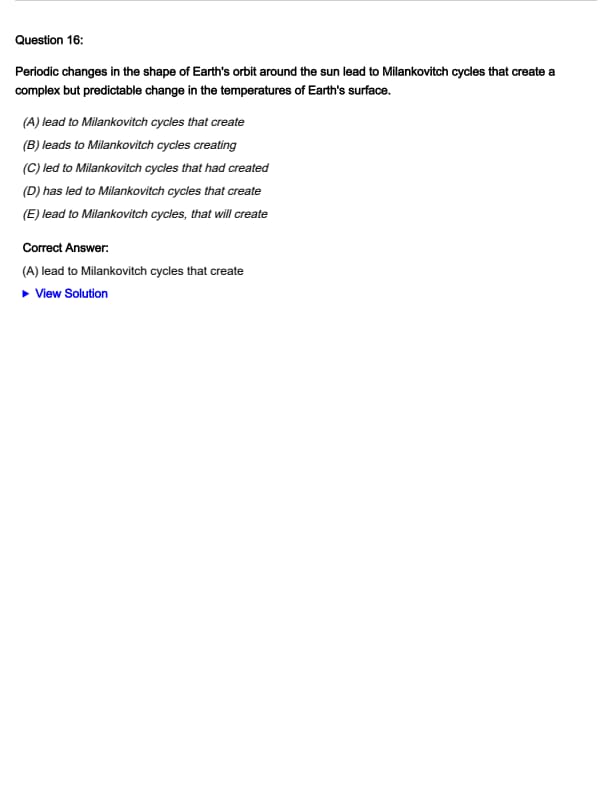
Periodic changes in the shape of Earth's orbit around the sun lead to Milankovitch cycles that create a complex but predictable change in the temperatures of Earth's surface.



Comments