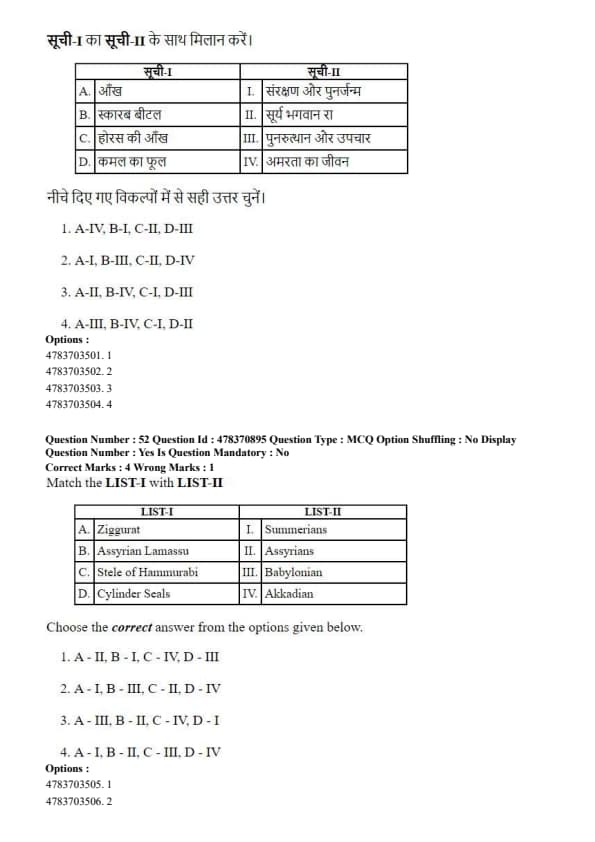
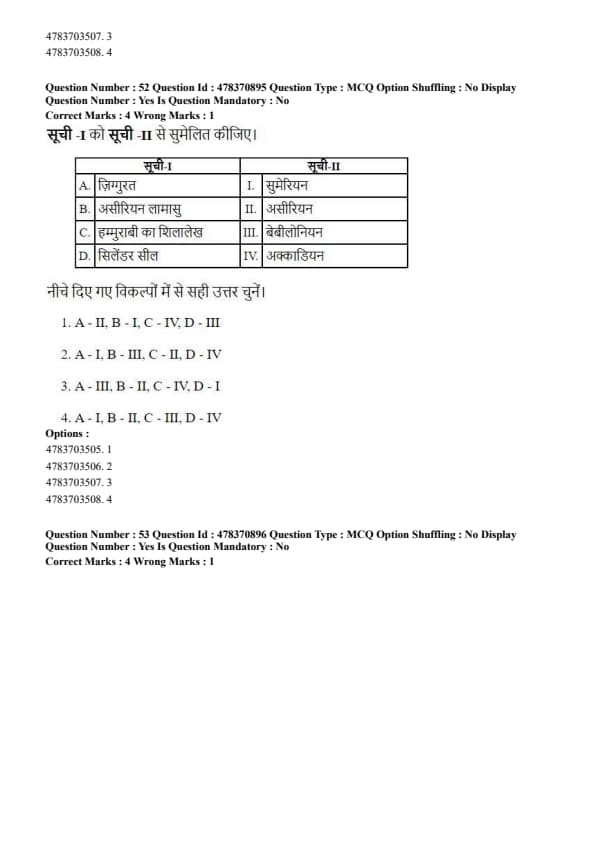
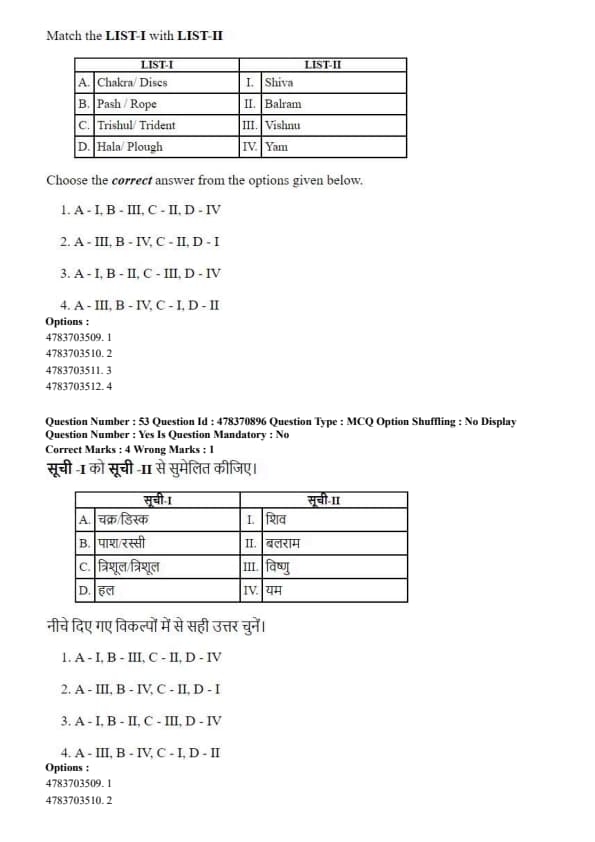
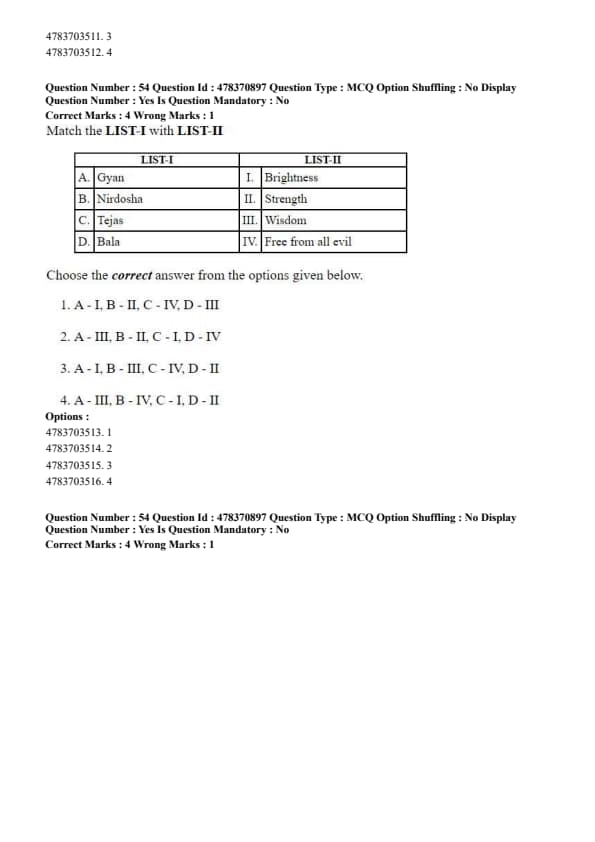
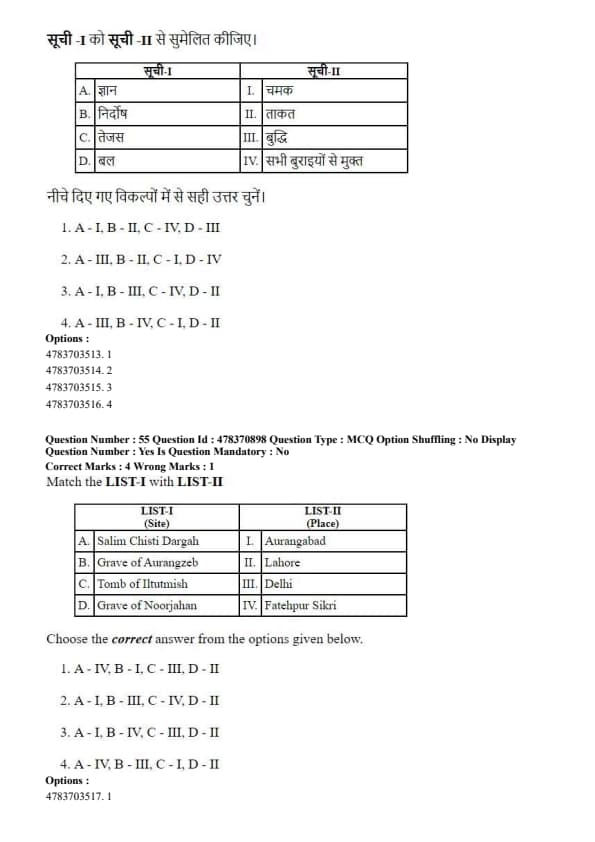
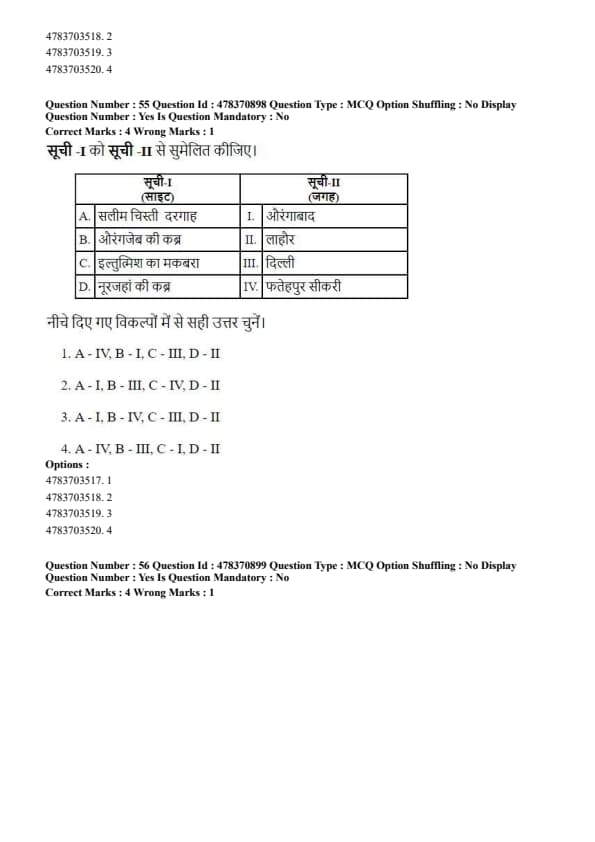
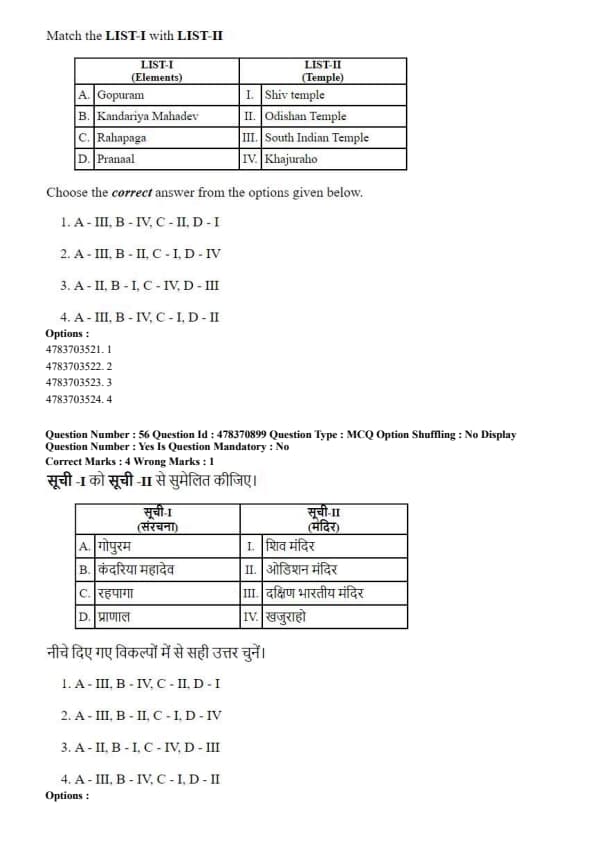
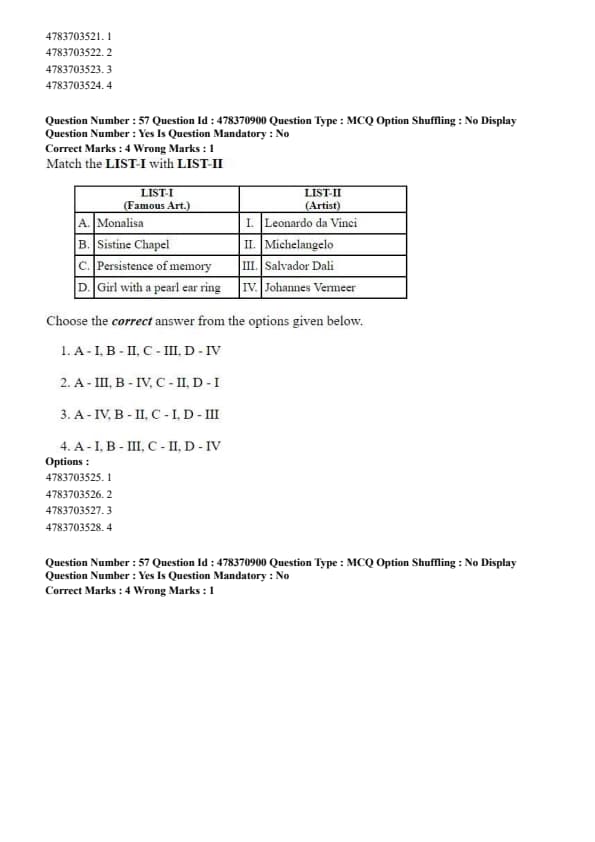
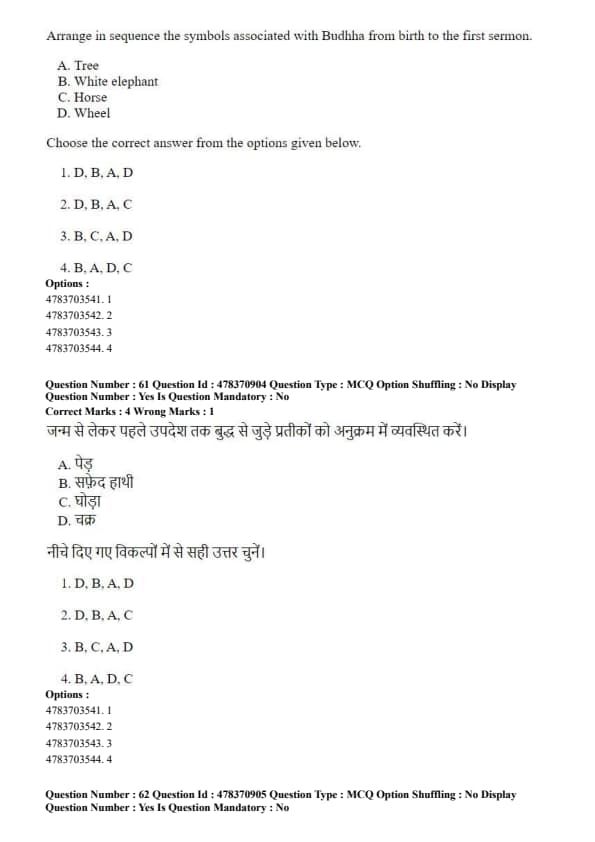
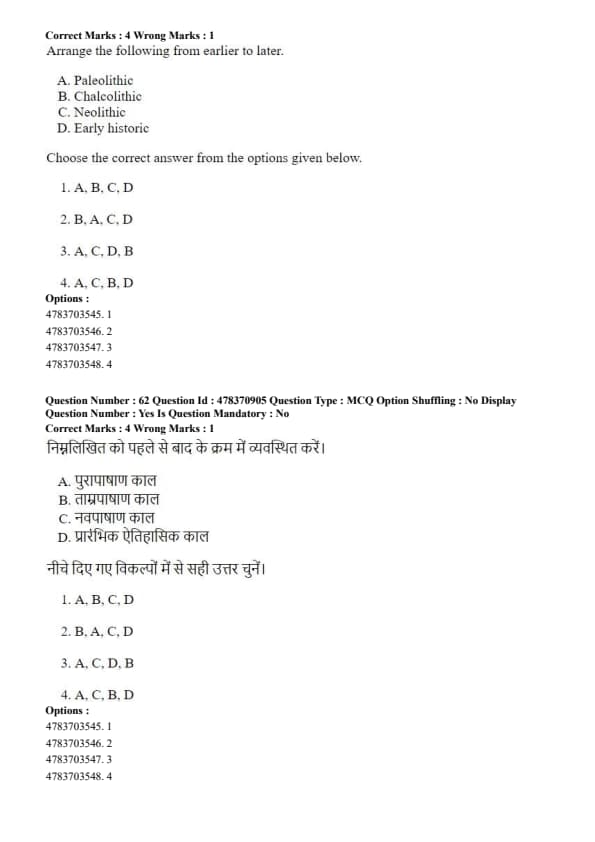
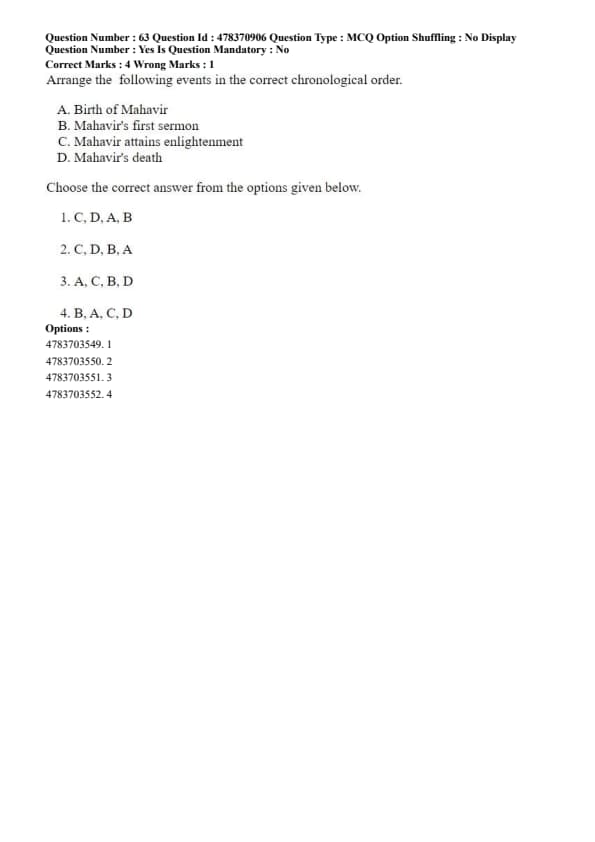
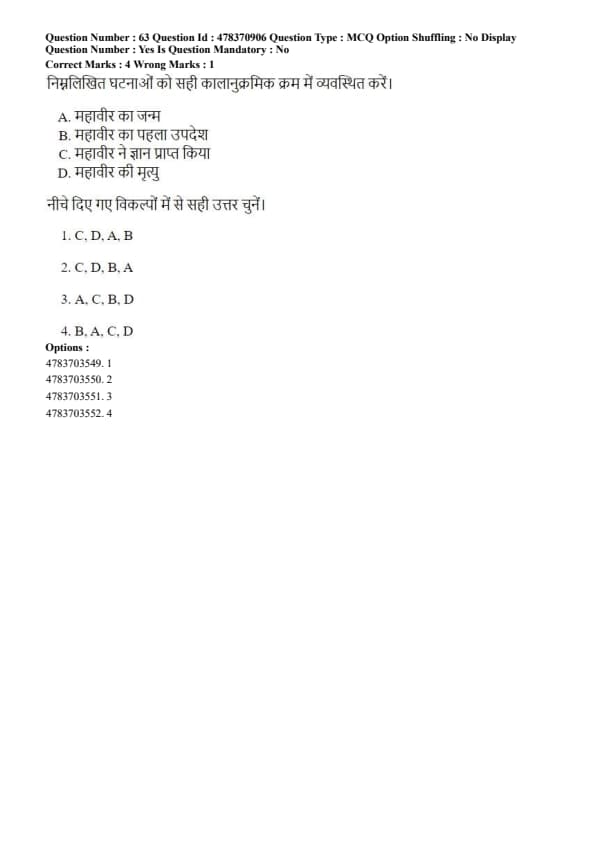
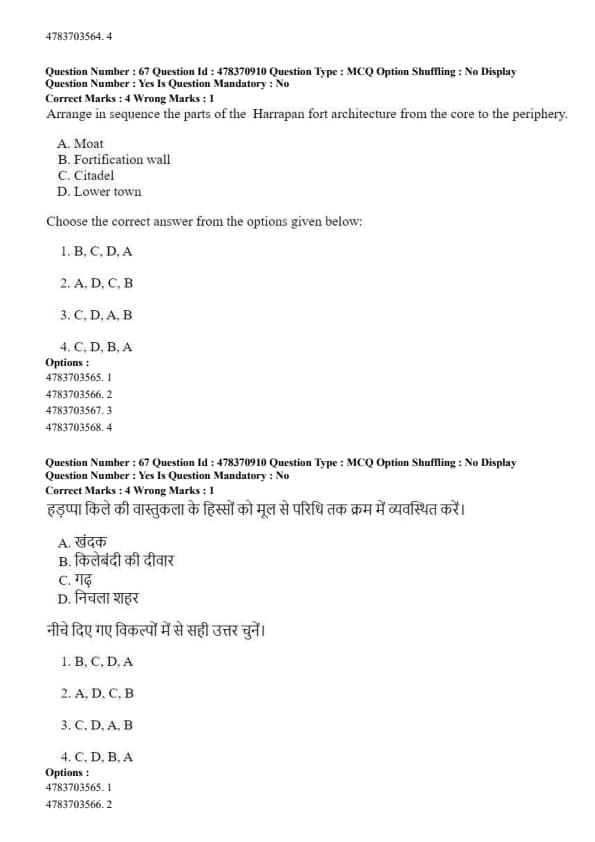
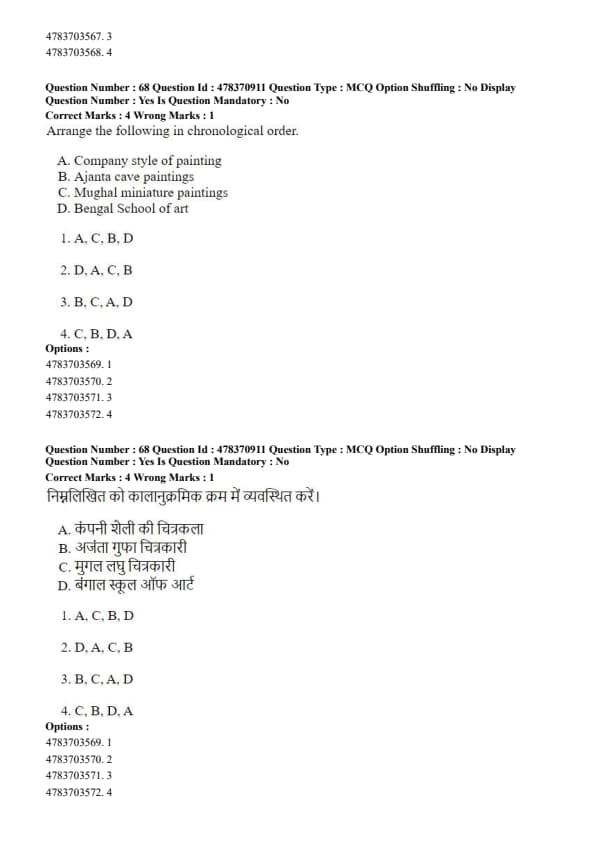
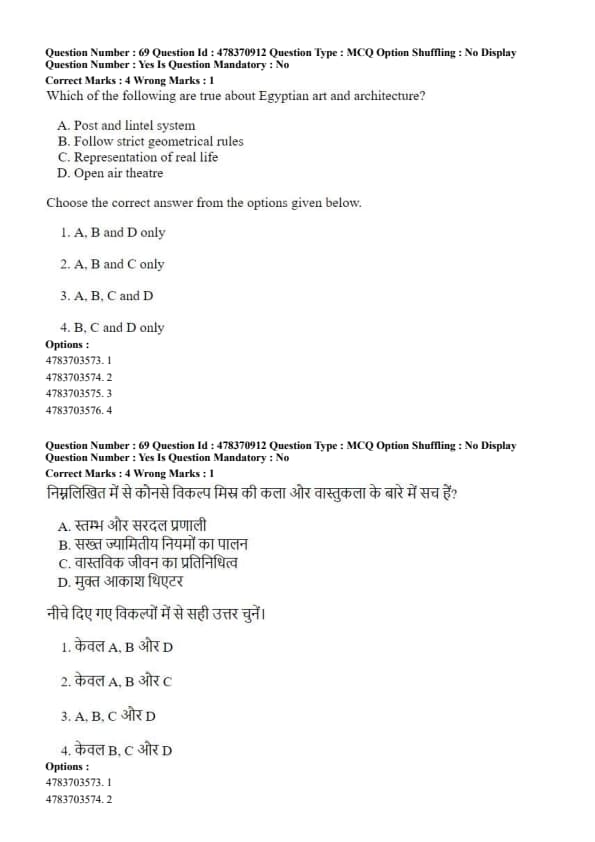
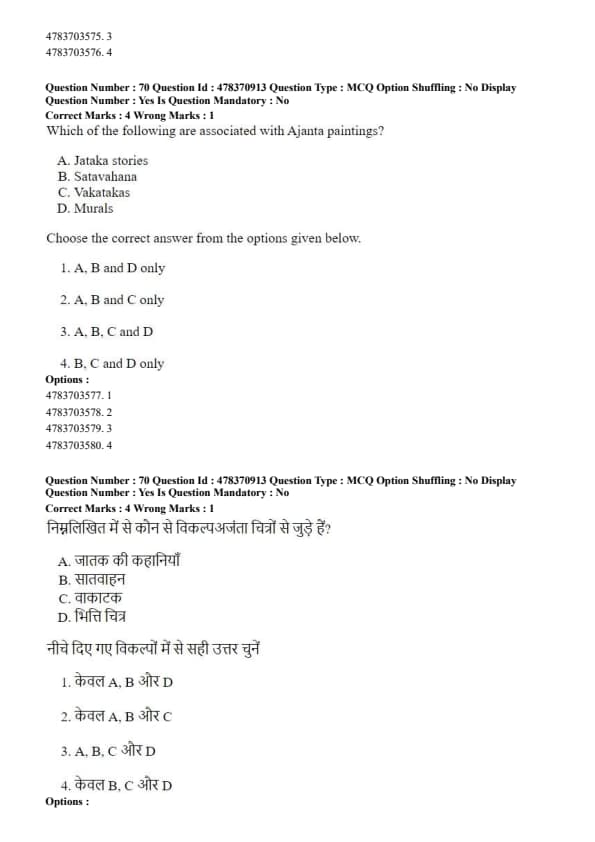
The CUET PG Museology exam was held on 30th March 2025 in Shift 2. After the exam, students can download the question paper, official answer key, and solution PDFs to analyze their performance. The exam focuses on museum management, conservation techniques, heritage studies, museum education, exhibition design, and the role of museums in cultural preservation.

The paper has 75 questions, each carrying 4 marks, with 1 mark penalty for each wrong answer. The exam duration is 60 minutes.

CUET PG Museology 2025 Question Paper with Solutions PDF

CUET PG Museology Question Paper with Solutions PDF Download PDF Check Solutions


Question 1:

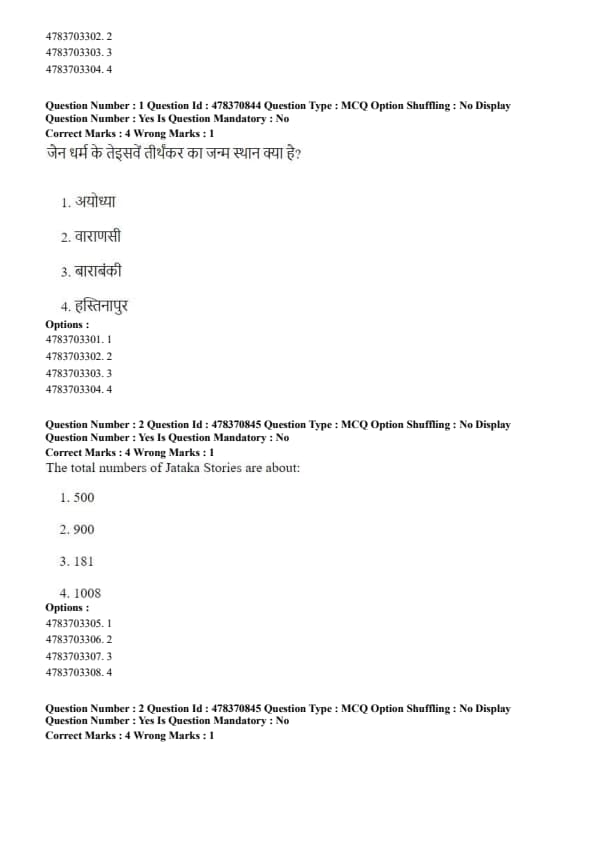
What is the birth place of the twenty third Tirthankar of Jainism?

  • (A) Ayodhya
  • (B) Varanasi
  • (C) Barabanki
  • (D) Hastinapur

Question 2:

The total numbers of Jataka Stories are about:

  • (A) 500
  • (B) 900
  • (C) 181
  • (D) 1008

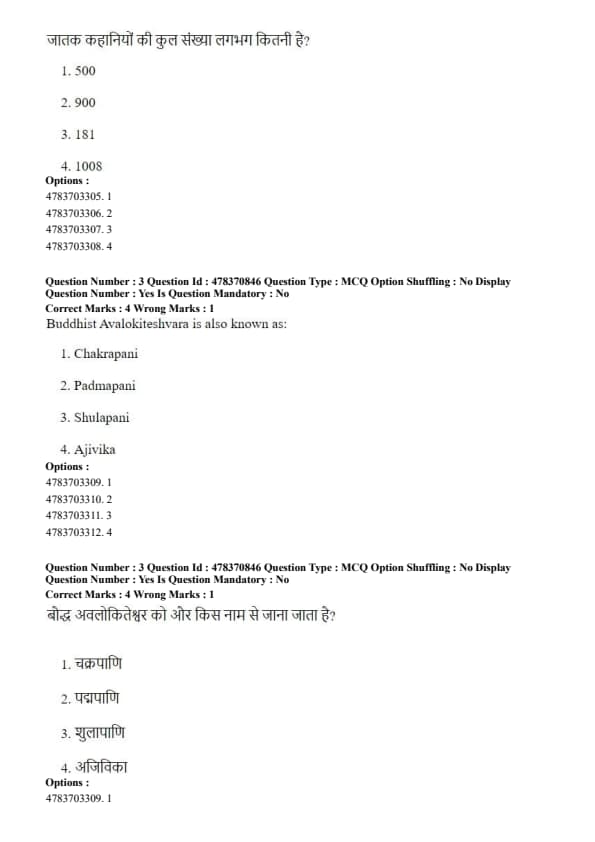
Question 3:

Buddhist Avalokiteshvara is also known as:

  • (A) Chakrapani
  • (B) Padmapani
  • (C) Shulapani
  • (D) Ajivika

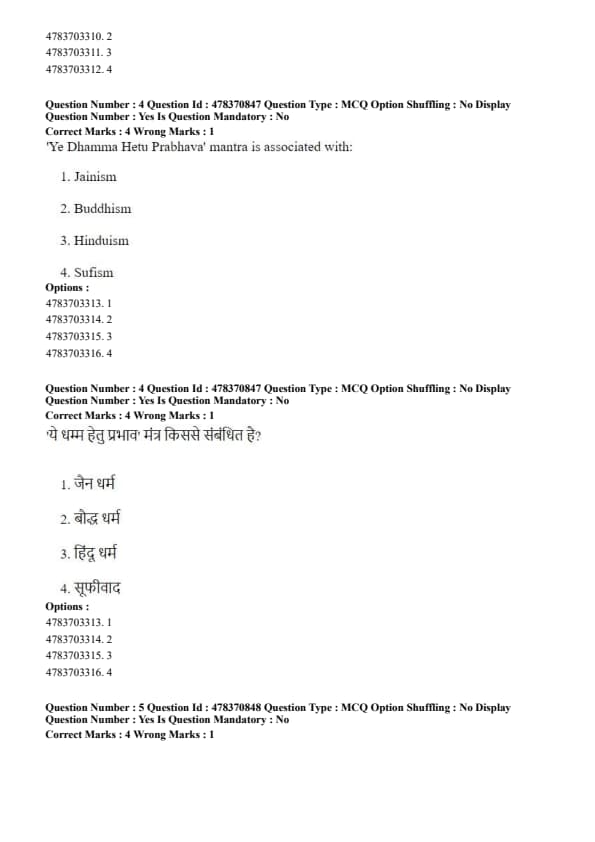
Question 4:

‘Ye Dhamma Hetu Prabhava’ mantra is associated with:

  • (A) Jainism
  • (B) Buddhism
  • (C) Hinduism
  • (D) Sufism

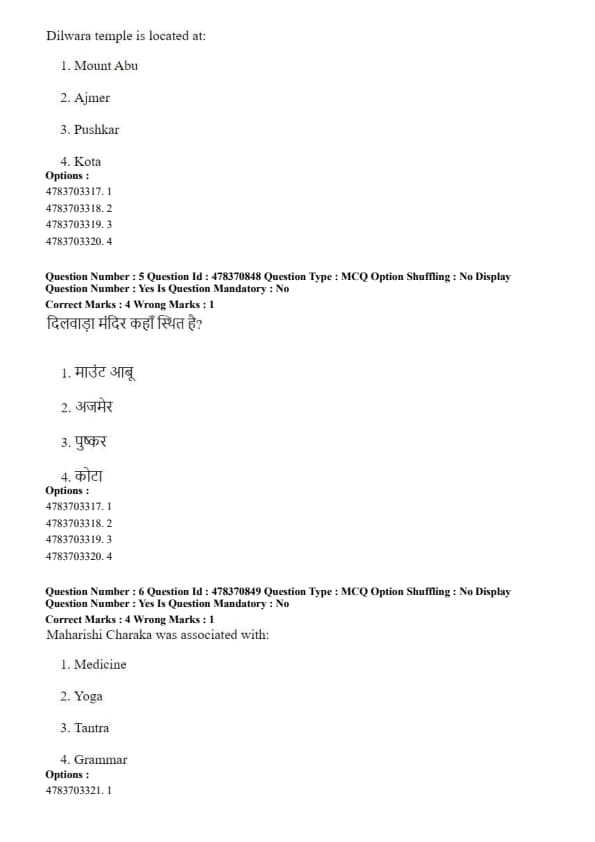
Question 5:

Dilwara temple is located at:

  • (A) Mount Abu
  • (B) Ajmer
  • (C) Pushkar
  • (D) Kota

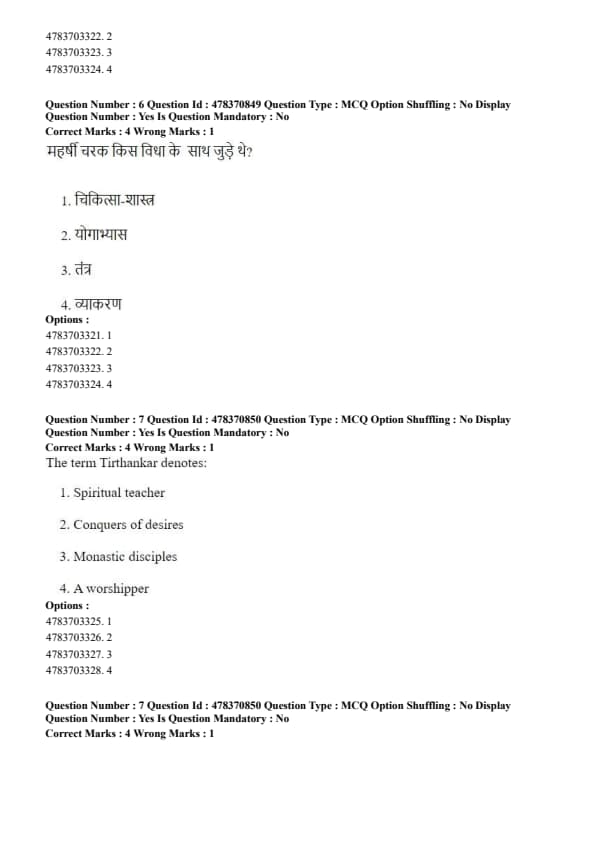
Question 6:

Maharishi Charaka was associated with:

  • (A) Medicine
  • (B) Yoga
  • (C) Tantra
  • (D) Grammar

Question 7:

The term Tirthankar denotes:

  • (A) Spiritual teacher
  • (B) Conquers of desires
  • (C) Monastic disciples
  • (D) A worshipper

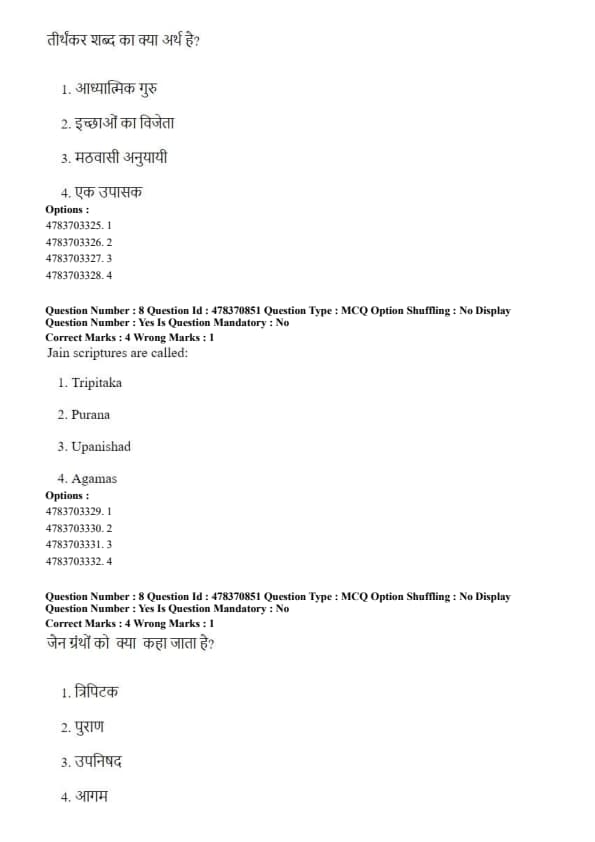
Question 8:

Jain scriptures are called:

  • (A) Tripitaka
  • (B) Purana
  • (C) Upanishad
  • (D) Agamas

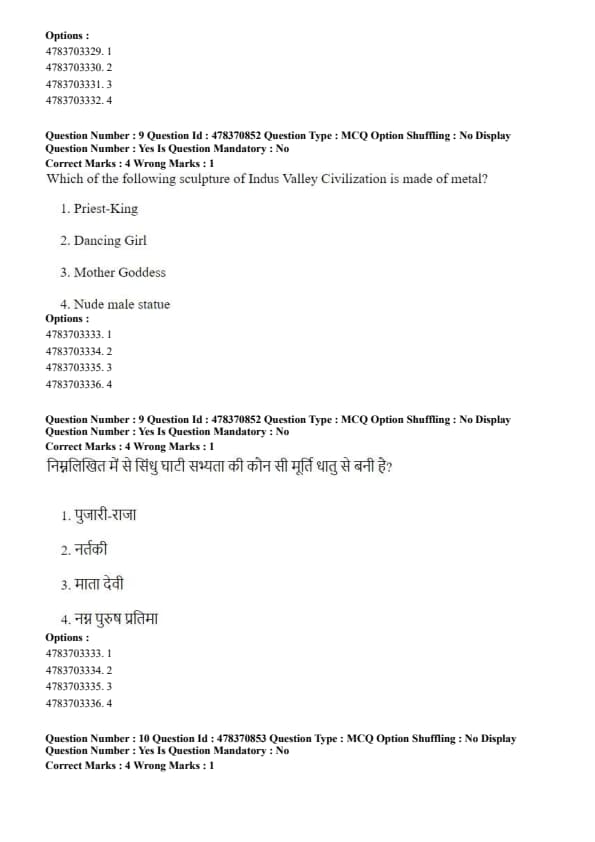
Question 9:

Which of the following sculpture of Indus Valley Civilization is made of metal?

  • (A) Priest-King
  • (B) Dancing Girl
  • (C) Mother Goddess
  • (D) Nude male statue

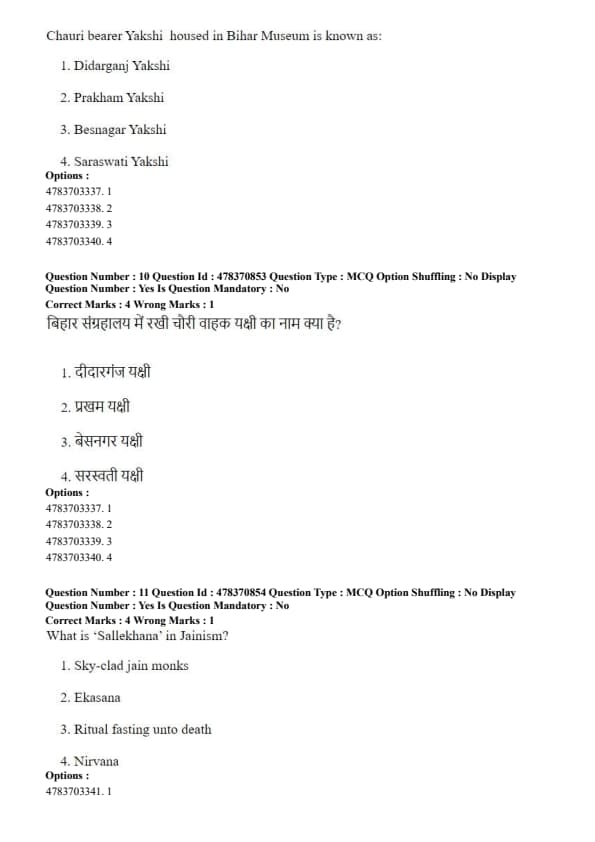
Question 10:

Chauri bearer Yakshi housed in Bihar Museum is known as:

  • (A) Didarganj Yakshi
  • (B) Prakham Yakshi
  • (C) Besnagar Yakshi
  • (D) Saraswati Yakshi

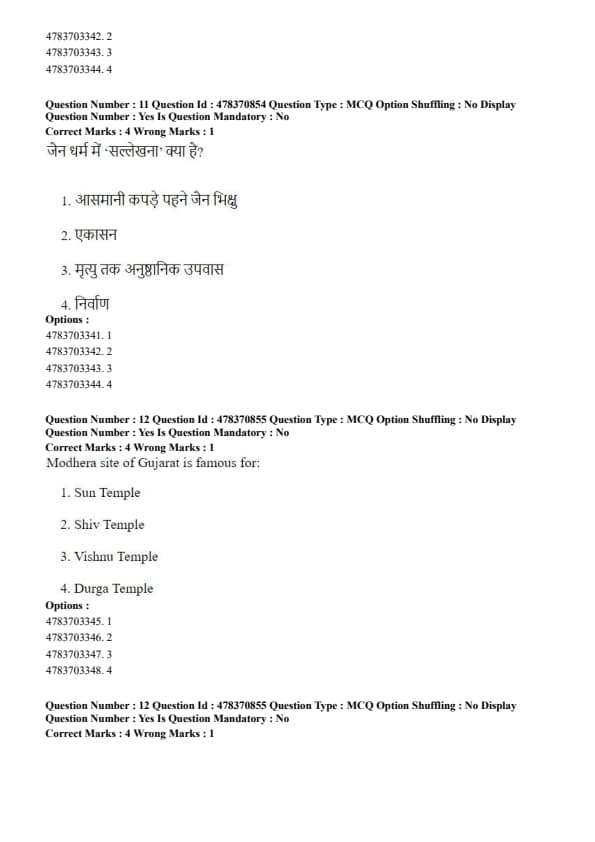
Question 11:

What is ‘Sallekhana’ in Jainism?

  • (A) Sky-clad Jain monks
  • (B) Ekasana
  • (C) Ritual fasting unto death
  • (D) Nirvana

Question 12:

Modhera site of Gujarat is famous for:

  • (A) Sun Temple
  • (B) Shiv Temple
  • (C) Vishnu Temple
  • (D) Durga Temple

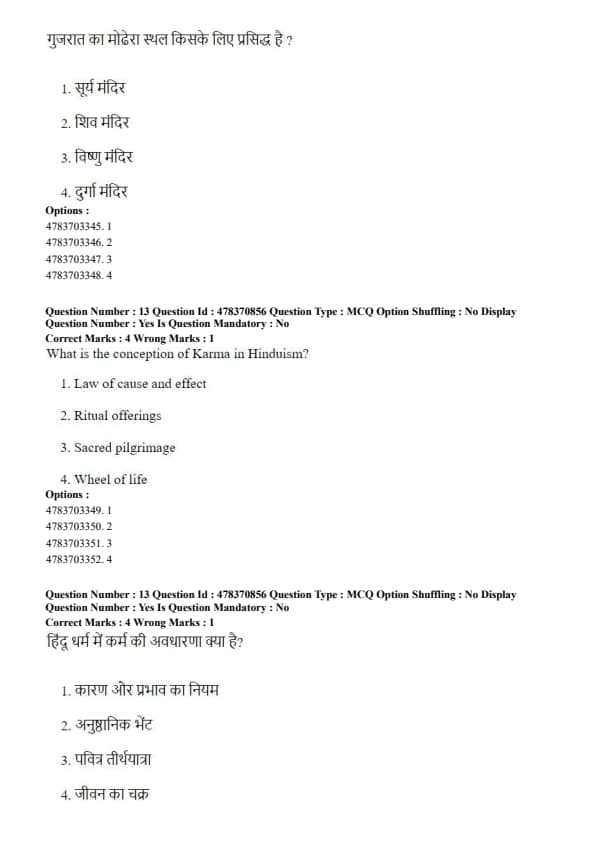
Question 13:

What is the conception of Karma in Hinduism?

  • (A) Law of cause and effect
  • (B) Ritual offerings
  • (C) Sacred pilgrimage
  • (D) Wheel of life

Question 14:

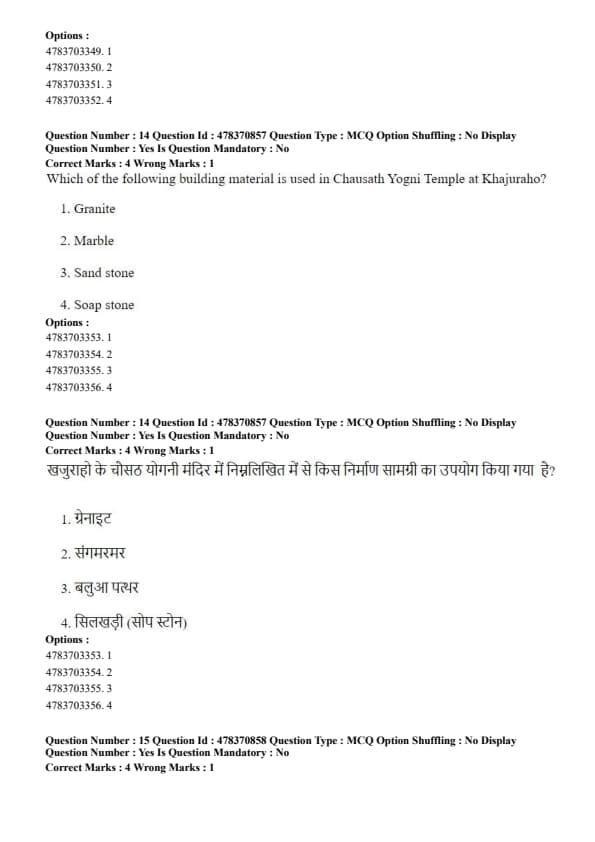
Which of the following building material is used in Chausath Yogini Temple at Khajuraho?

  • (A) Granite
  • (B) Marble
  • (C) Sand stone
  • (D) Soap stone

Question 15:

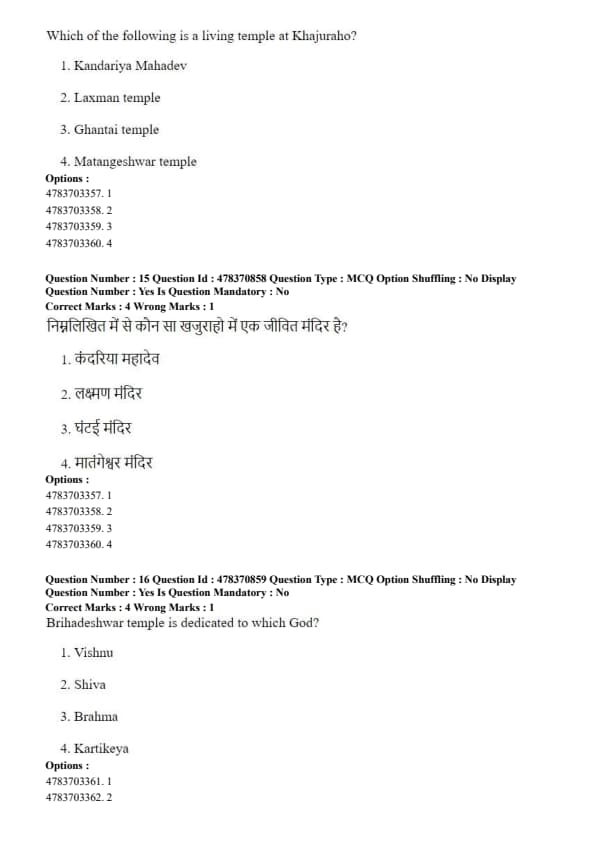
Which of the following is a living temple at Khajuraho?

  • (A) Kandariya Mahadev
  • (B) Laxman temple
  • (C) Ghantai temple
  • (D) Matangeshwar temple

Question 16:

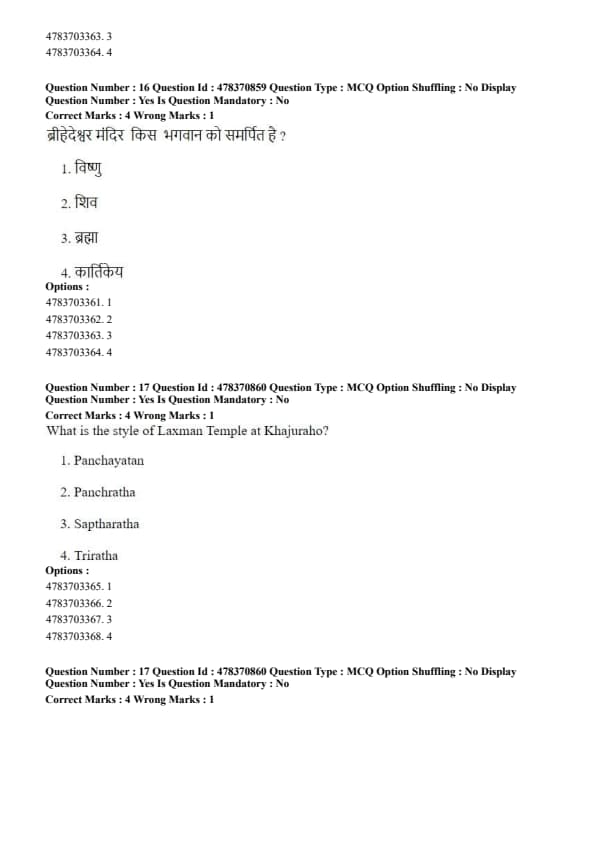
Brihadeshwar temple is dedicated to which God?

  • (A) Vishnu
  • (B) Shiva
  • (C) Brahma
  • (D) Kartikeya

Question 17:

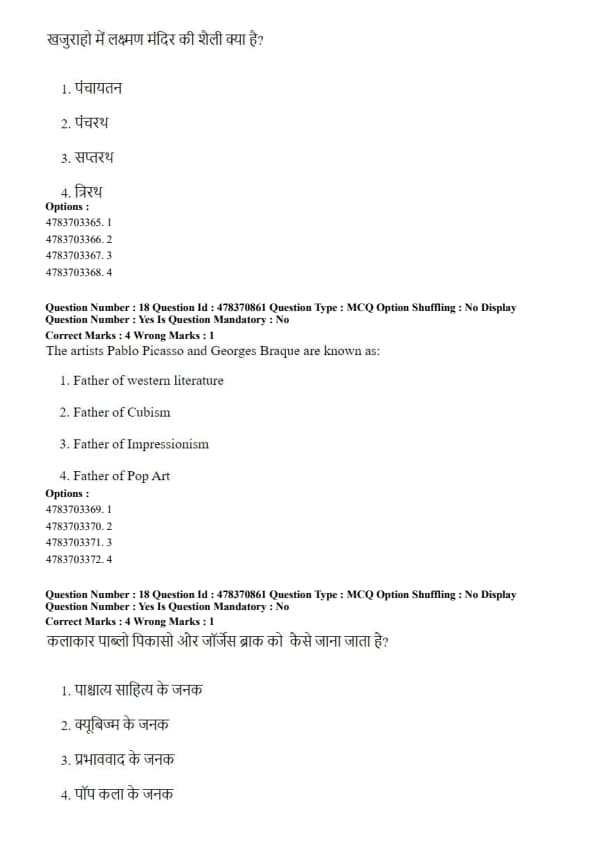
What is the style of Laxman Temple at Khajuraho?

  • (A) Panchayatan
  • (B) Panchratha
  • (C) Saptharatha
  • (D) Triratha

Question 18:

The artists Pablo Picasso and Georges Braque are known as:

  • (A) Father of western literature
  • (B) Father of Cubism
  • (C) Father of Impressionism
  • (D) Father of Pop Art

Question 19:

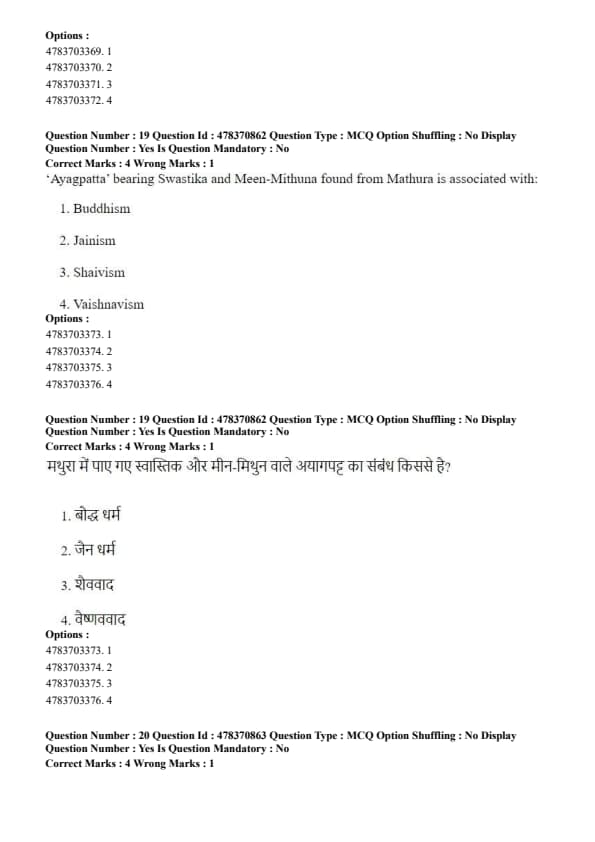
‘Ayagpatta’ bearing Swastika and Meen-Mithuna found from Mathura is associated with:

  • (A) Buddhism
  • (B) Jainism
  • (C) Shaivism
  • (D) Vaishnavism

Question 20:

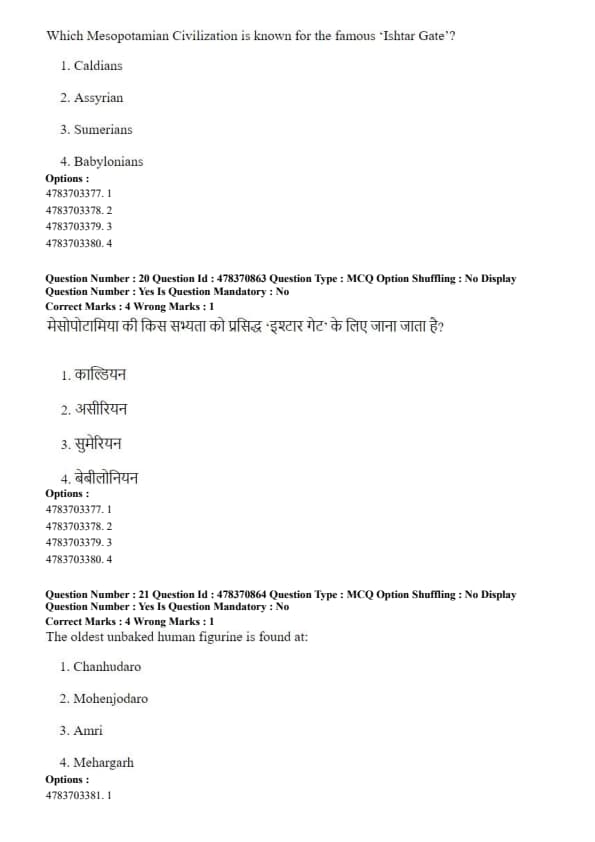
Which Mesopotamian Civilization is known for the famous ‘Ishtar Gate’?

  • (A) Caldians
  • (B) Assyrian
  • (C) Sumerians
  • (D) Babylonians

Question 21:

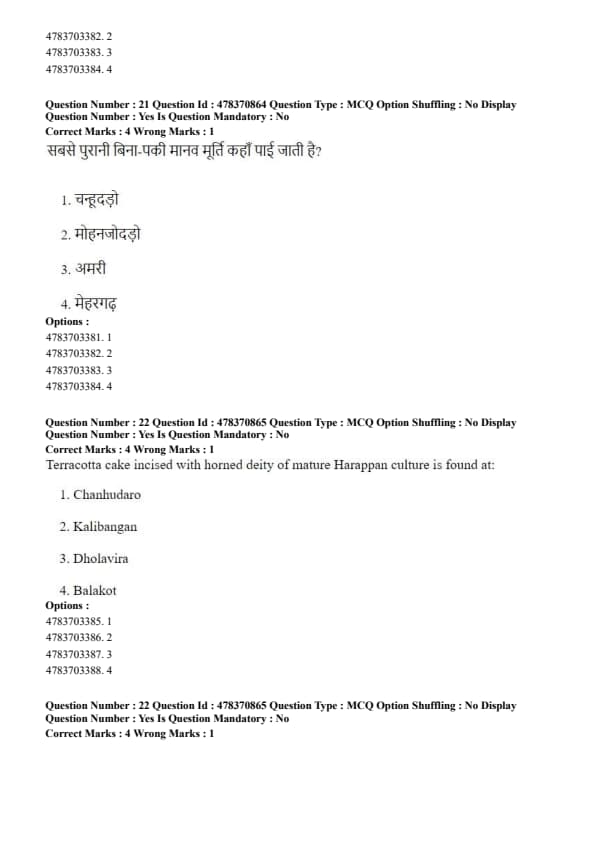
The oldest unbaked human figurine is found at:

  • (A) Chanhudaro
  • (B) Mohenjodaro
  • (C) Amri
  • (D) Mehargarh

Question 22:

Terracotta cake incised with horned deity of mature Harappan culture is found at:

  • (A) Chanhudaro
  • (B) Kalibangan
  • (C) Dholavira
  • (D) Balakot

Question 23:

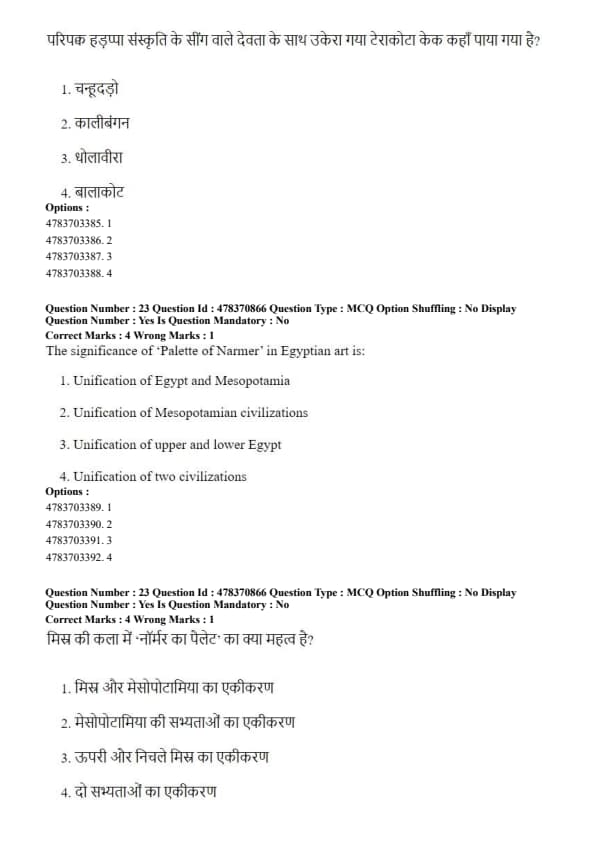
The significance of ‘Palette of Narmer’ in Egyptian art is:

  • (A) Unification of Egypt and Mesopotamia
  • (B) Unification of Mesopotamian civilizations
  • (C) Unification of upper and lower Egypt
  • (D) Unification of two civilizations

Question 24:

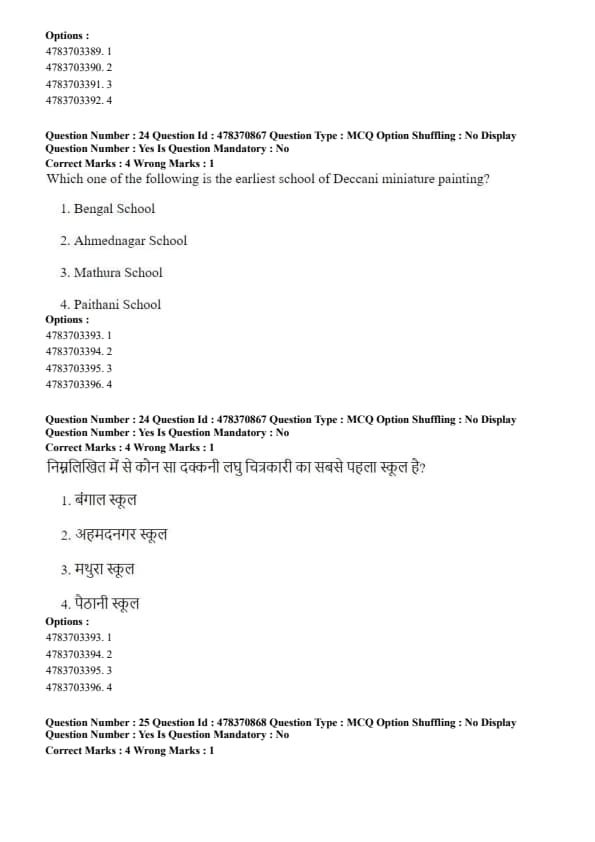
Which one of the following is the earliest school of Deccani miniature painting?

  • (A) Bengal School
  • (B) Ahmednagar School
  • (C) Mathura School
  • (D) Paithani School

Question 25:

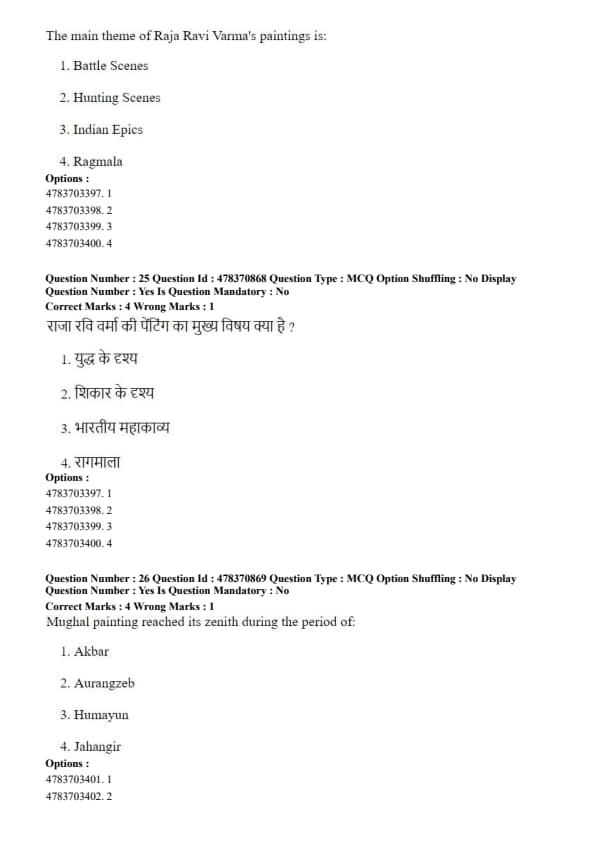
The main theme of Raja Ravi Varma's paintings is:

  • (A) Battle Scenes
  • (B) Hunting Scenes
  • (C) Indian Epics
  • (D) Ragmala

Question 26:

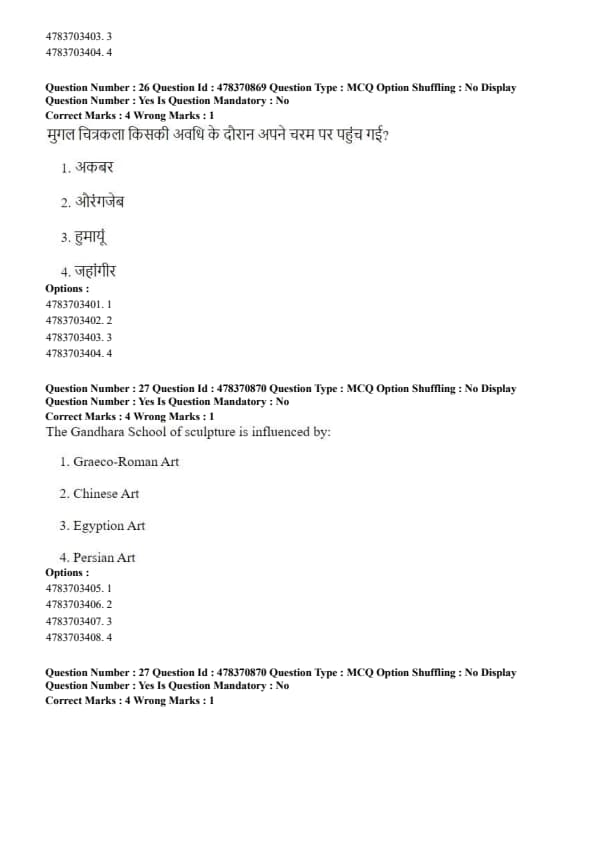
Mughal painting reached its zenith during the period of:

  • (A) Akbar
  • (B) Aurangzeb
  • (C) Humayun
  • (D) Jahangir

Question 27:

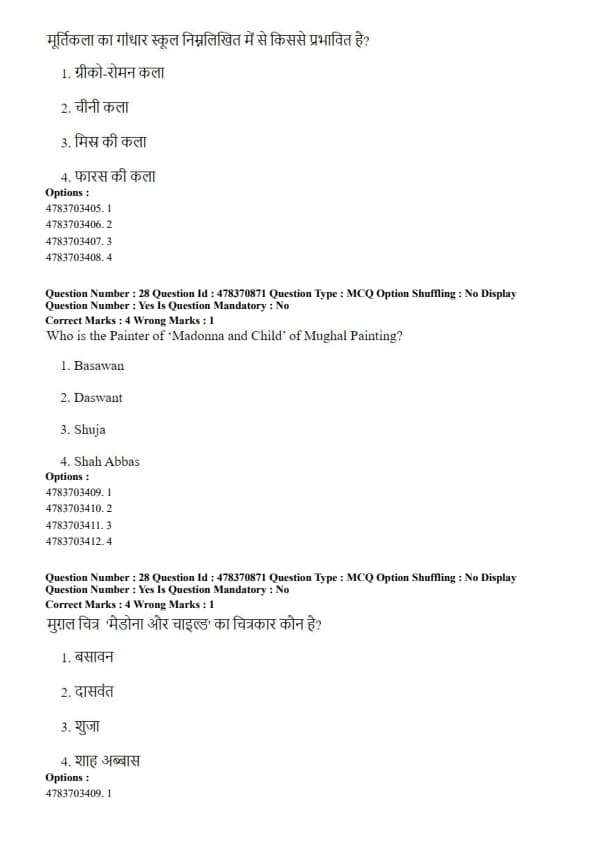
The Gandhara School of sculpture is influenced by:

  • (A) Graeco-Roman Art
  • (B) Chinese Art
  • (C) Egyptian Art
  • (D) Persian Art

Question 28:

Who is the Painter of ‘Madonna and Child’ of Mughal Painting?

  • (A) Basawan
  • (B) Daswant
  • (C) Shuja
  • (D) Shah Abbas

Question 29:

Which Purana refers to the origin of Vighneshwara?

  • (A) Linga Purana
  • (B) Skanda Purana
  • (C) Shiva Purana
  • (D) Vayu Purana

Question 30:

Where is the unique honeycomb structure known as ‘Hawa Mahal’ situated?

  • (A) Jaipur
  • (B) Jodhpur
  • (C) Udaipur
  • (D) Jaunpur

Question 31:

Goddess Laxmi is also known as:

  • (A) Shree Devi
  • (B) Maya Devi
  • (C) Bhoo Devi
  • (D) Vidya Devi

Question 32:

The gigantic statues of Buddha, destroyed in 2001 by Taliban, were located in:

  • (A) Afghanistan
  • (B) Pakistan
  • (C) Kazakhstan
  • (D) Uzbekistan

Question 33:

The name of the charioteer of Sun God is:

  • (A) Garuda
  • (B) Arun
  • (C) Skanda
  • (D) Prakash

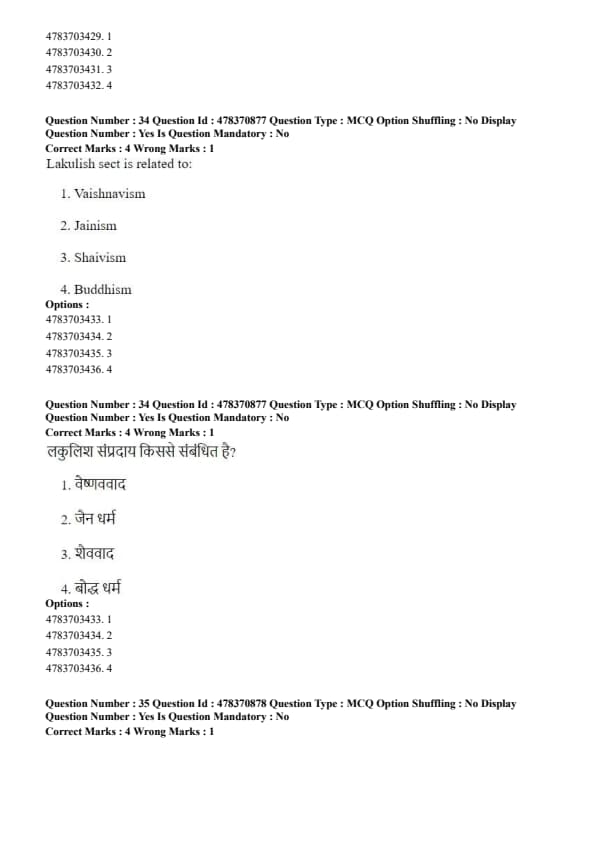
Question 34:

Lakulish sect is related to:

  • (A) Vaishnavism
  • (B) Jainism
  • (C) Shaivism
  • (D) Buddhism

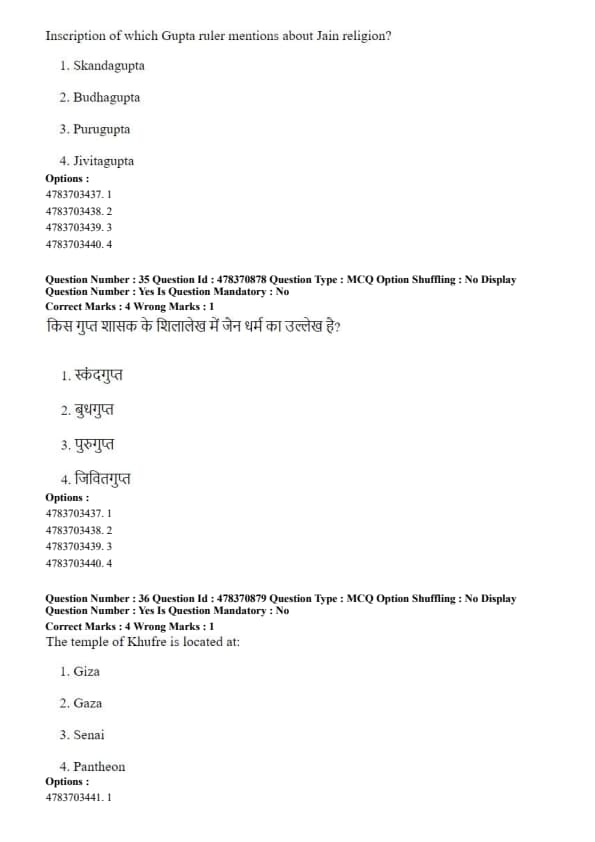
Question 35:

Inscription of which Gupta ruler mentions about Jain religion?

  • (A) Skandagupta
  • (B) Budhagupta
  • (C) Purugupta
  • (D) Jivitagupta

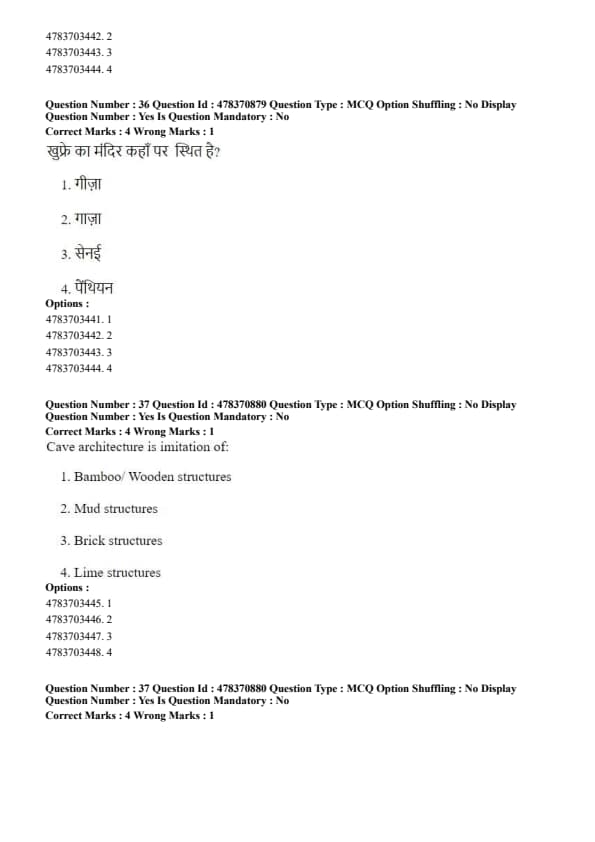
Question 36:

The temple of Khufre is located at:

  • (A) Giza
  • (B) Gaza
  • (C) Senai
  • (D) Pantheon

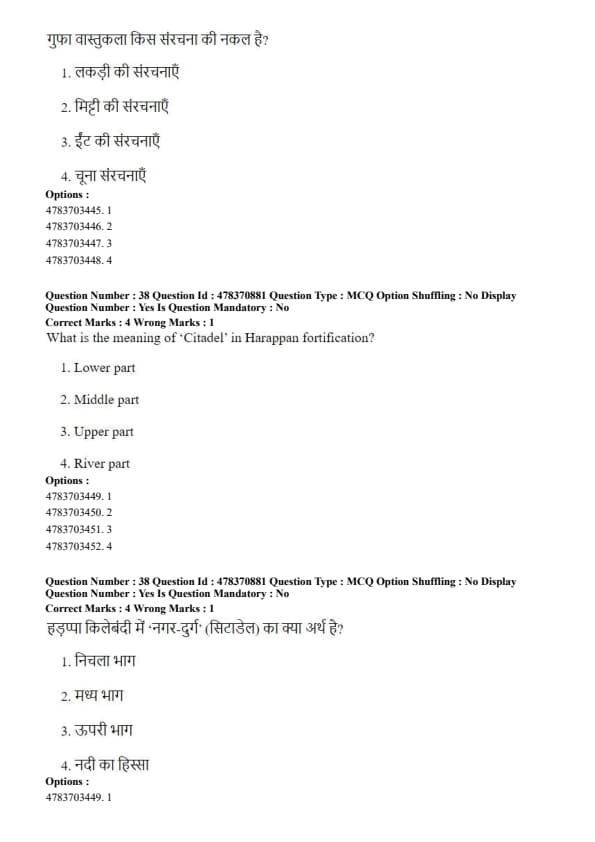
Question 37:

Cave architecture is imitation of:

  • (A) Bamboo/ Wooden structures
  • (B) Mud structures
  • (C) Brick structures
  • (D) Lime structures

Question 38:

What is the meaning of ‘Citadel’ in Harappan fortification?

  • (A) Lower part
  • (B) Middle part
  • (C) Upper part
  • (D) River part

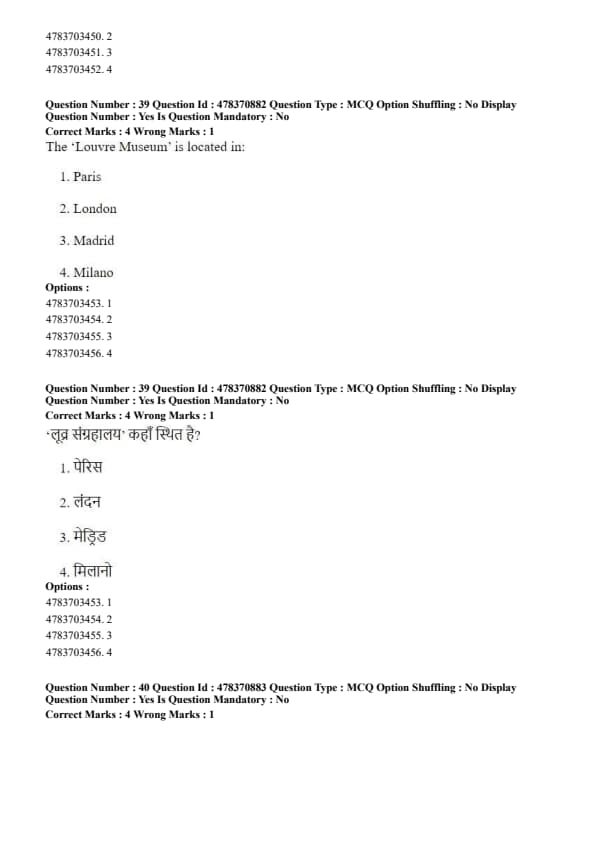
Question 39:

The ‘Louvre Museum’ is located in:

  • (A) Paris
  • (B) London
  • (C) Madrid
  • (D) Milano

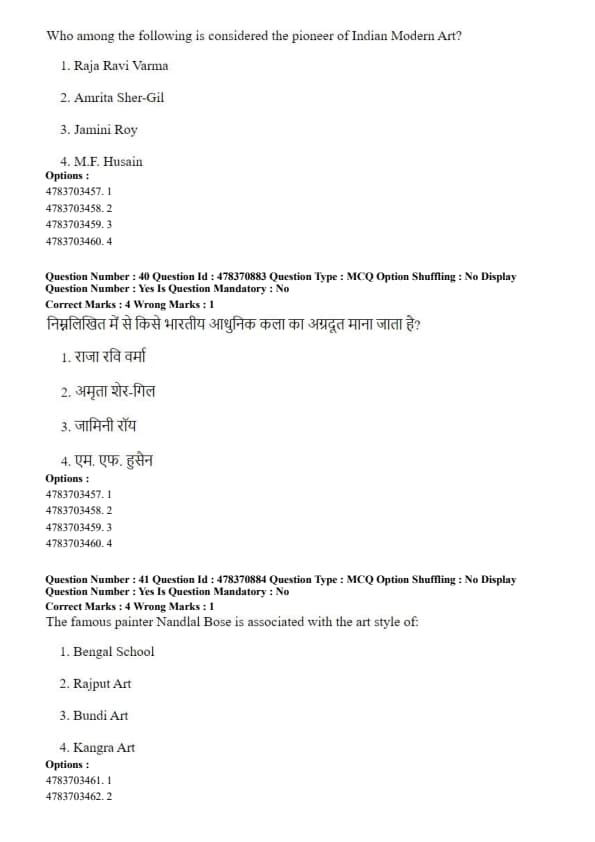
Question 40:

Who among the following is considered the pioneer of Indian Modern Art?

  • (A) Raja Ravi Varma
  • (B) Amrita Sher-Gil
  • (C) Jamini Roy
  • (D) M.F. Husain

Question 41:

The famous painter Nandalal Bose is associated with the art style of:

  • (A) Bengal School
  • (B) Rajput Art
  • (C) Bundi Art
  • (D) Kangra Art

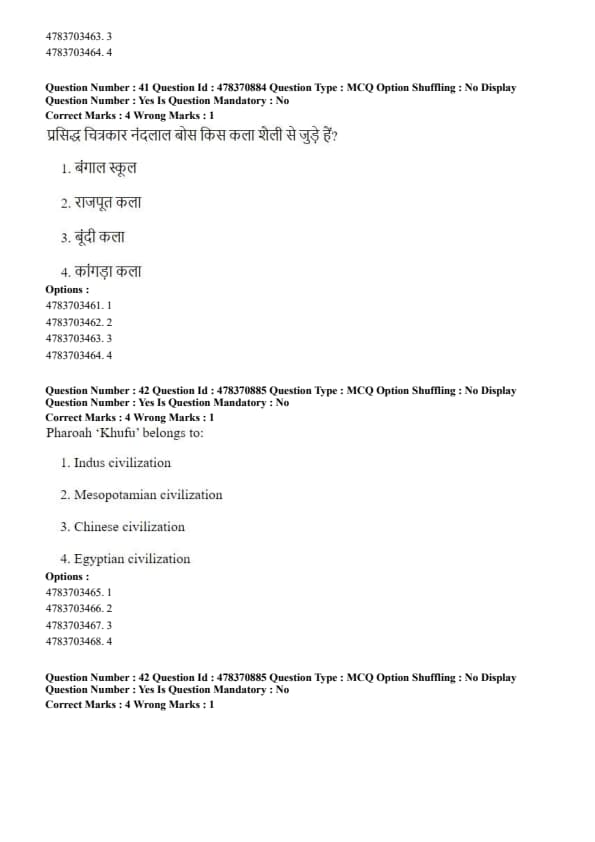
Question 42:

Pharaoh ‘Khufu’ belongs to:

  • (A) Indus civilization
  • (B) Mesopotamian civilization
  • (C) Chinese civilization
  • (D) Egyptian civilization

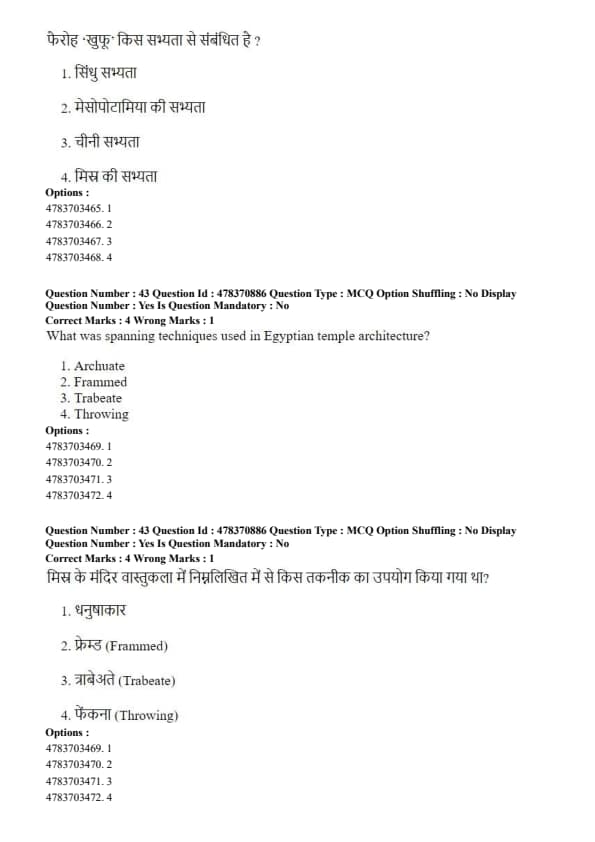
Question 43:

What was spanning techniques used in Egyptian temple architecture?

  • (A) Arcuate
  • (B) Frammed
  • (C) Trabeate
  • (D) Throwing

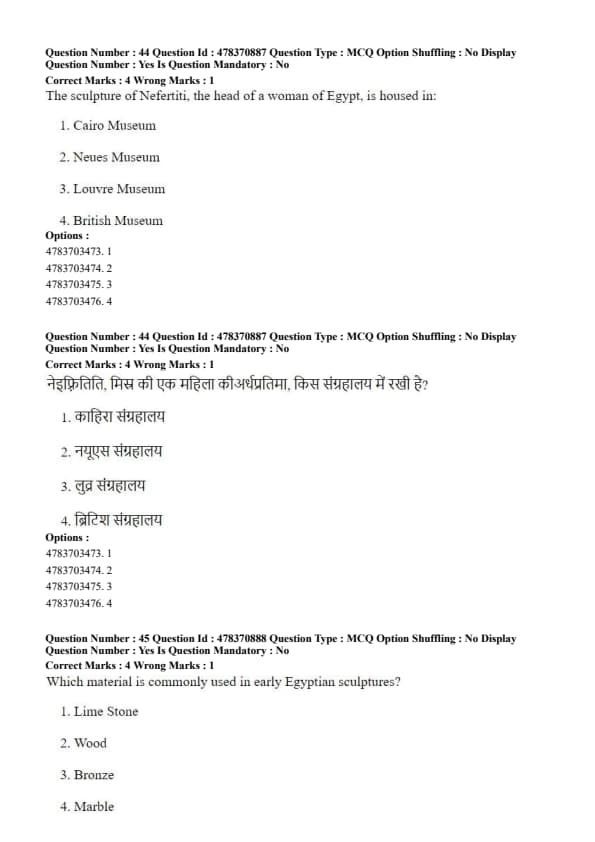
Question 44:

The sculpture of Nefertiti, the head of a woman of Egypt, is housed in:

  • (A) Cairo Museum
  • (B) Neues Museum
  • (C) Louvre Museum
  • (D) British Museum

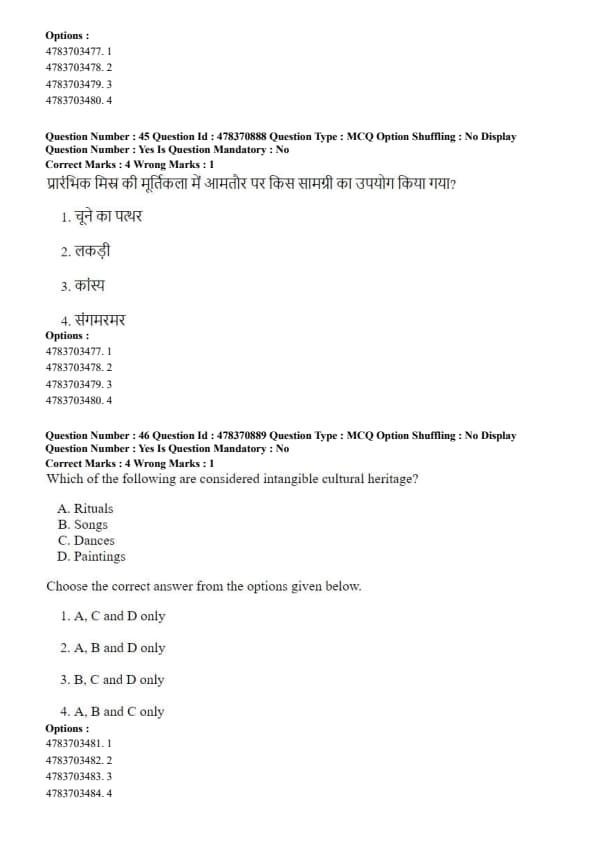
Question 45:

Which material is commonly used in early Egyptian sculptures?

  • (A) Lime Stone
  • (B) Wood
  • (C) Bronze
  • (D) Marble

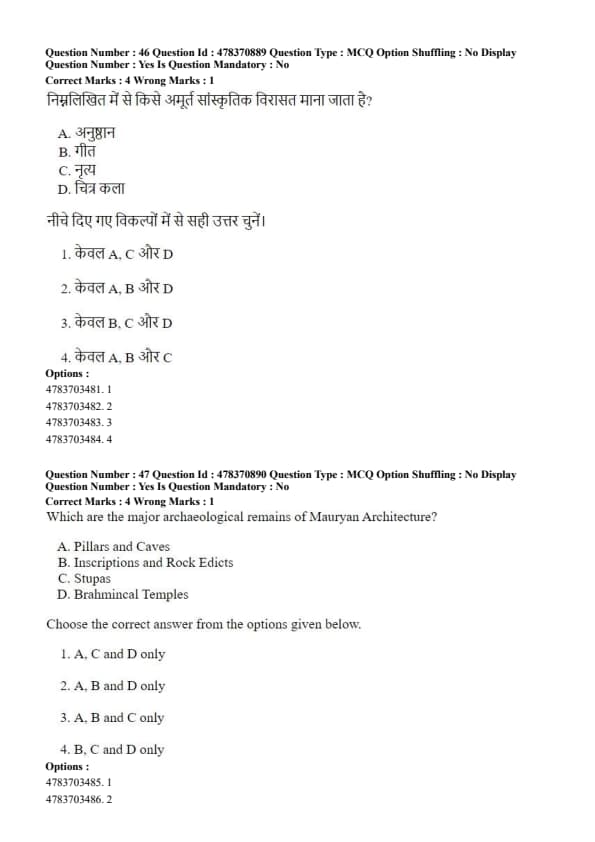
Question 46:

Which of the following are considered intangible cultural heritage?

(A) Rituals
(B) Songs
(C) Dances
(D) Paintings

  • (A) A, C and D only
  • (B) A, B and D only
  • (C) B, C and D only
  • (D) A, B and C only

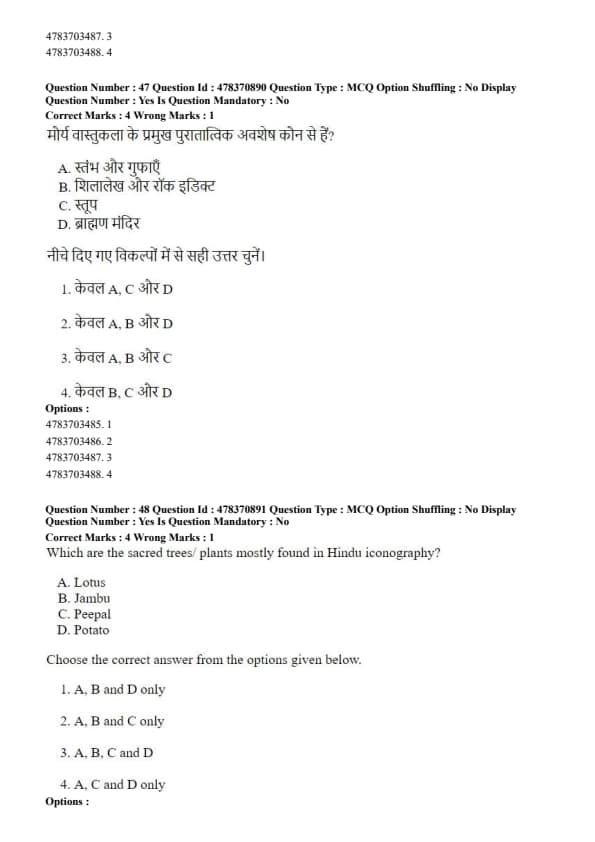
Question 47:

Which are the major archaeological remains of Mauryan Architecture?

(A) Pillars and Caves
(B) Inscriptions and Rock Edicts
(C) Stupas
(D) Brahminical Temples

  • (A) A, C and D only
  • (B) A, B and D only
  • (C) A, B and C only
  • (D) B, C and D only

Question 48:

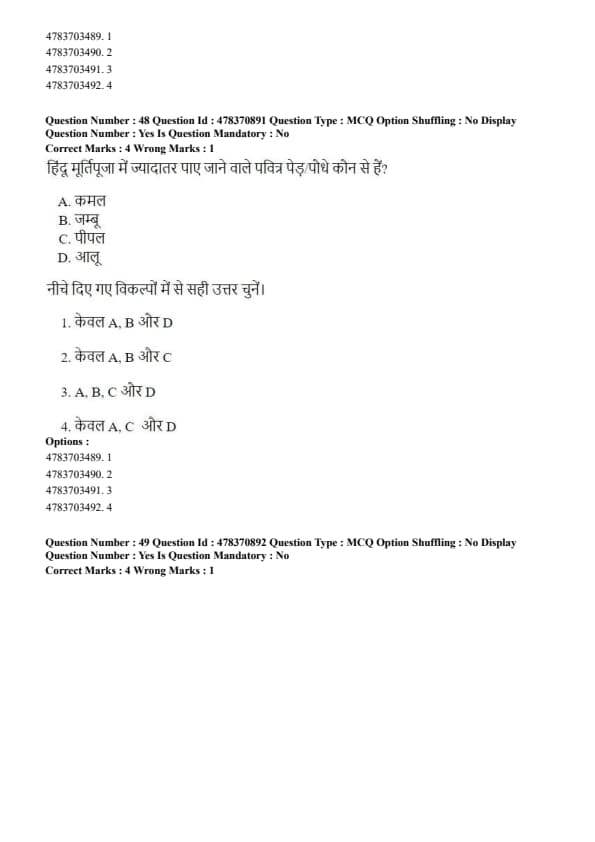
Which are the sacred trees/plants mostly found in Hindu iconography?

(A) Lotus
(B) Jambu
(C) Peepal
(D) Potato

  • (A) A, B and D only
  • (B) A, B and C only
  • (C) A, B, C and D
  • (D) A, C and D only

Question 49:

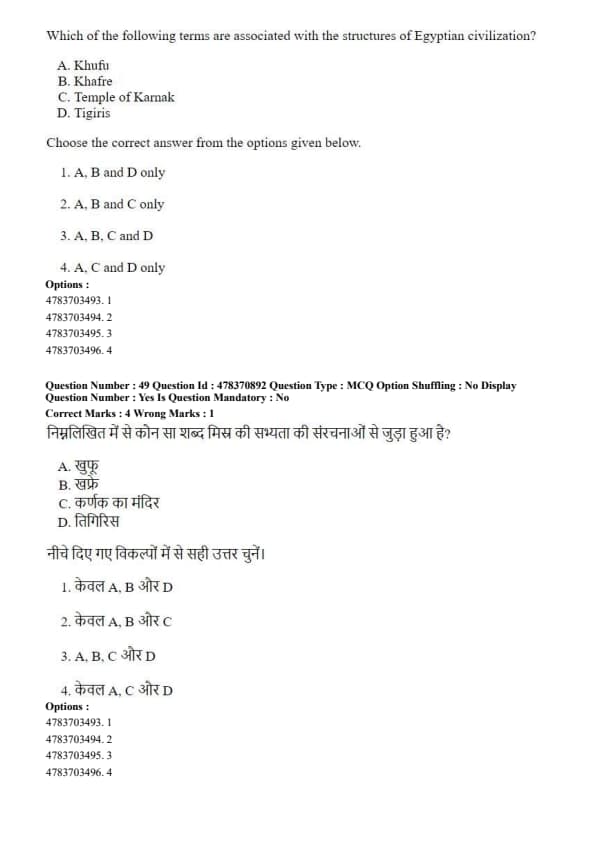
Which of the following terms are associated with the structures of Egyptian civilization?

(A) Khufu
(B) Khafre
(C) Temple of Karnak
(D) Tigris

  • (A) A, B and D only
  • (B) A, B and C only
  • (C) A, B, C and D
  • (D) A, C and D only

Question 50:

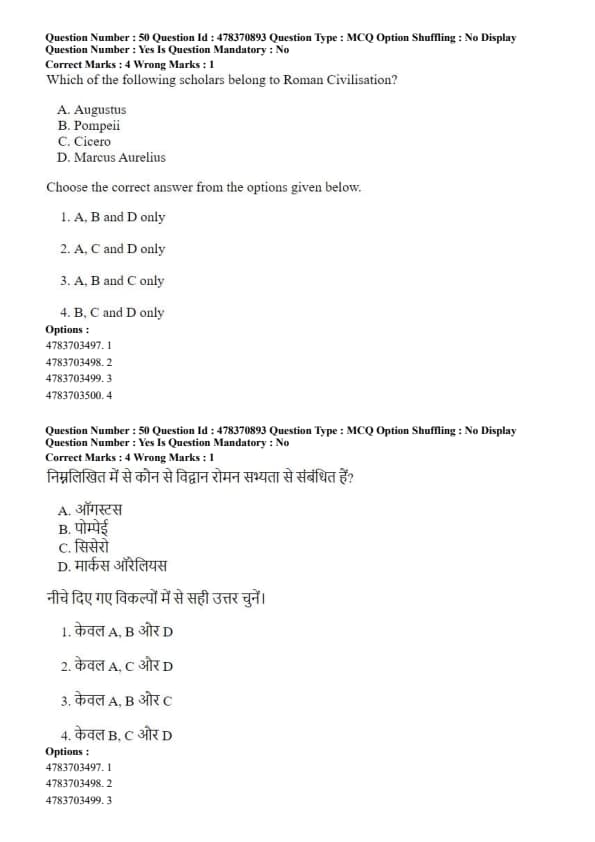
Which of the following scholars belong to Roman Civilization?

(A) Augustus
(B) Pompeii
(C) Cicero
(D) Marcus Aurelius

  • (A) A, B and D only
  • (B) A, C and D only
  • (C) A, B and C only
  • (D) B, C and D only

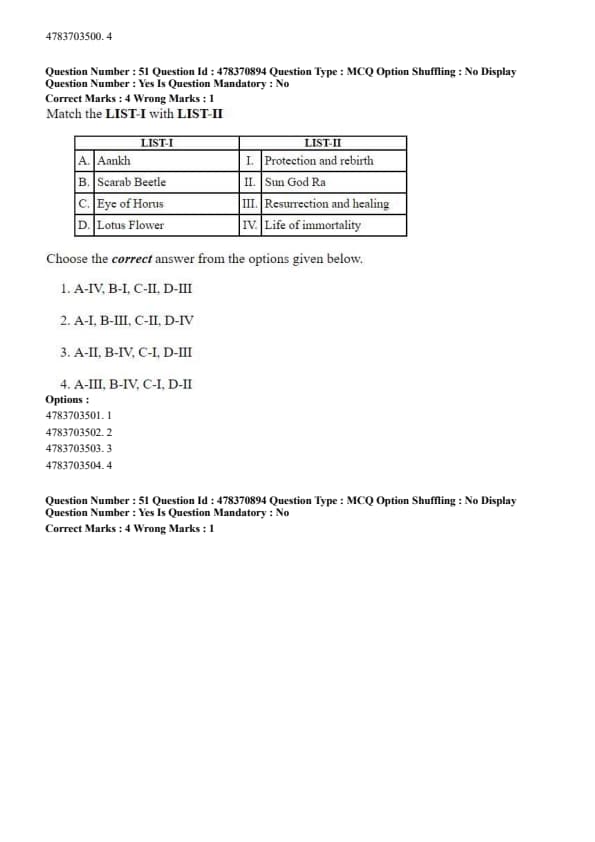
Question 51:

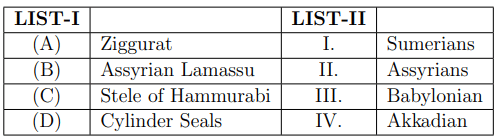
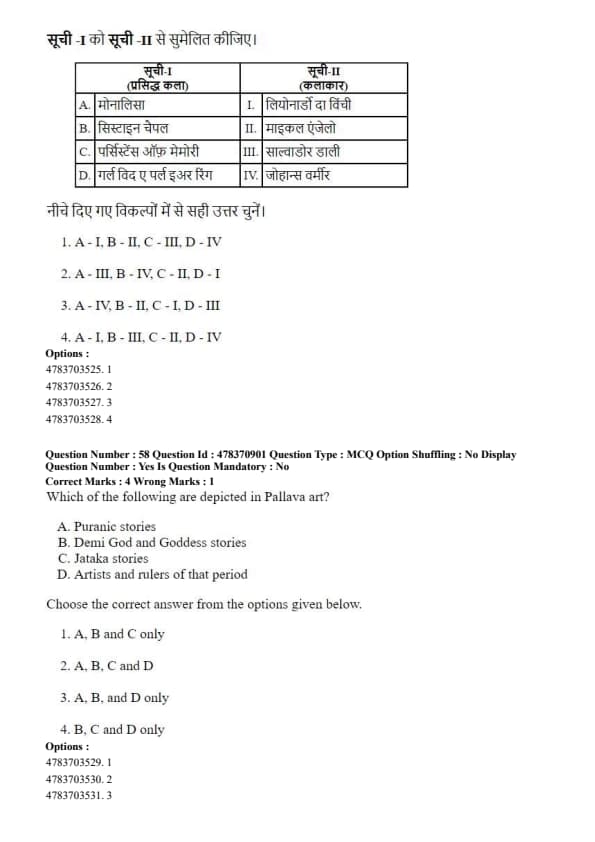
Match the LIST-I with LIST-II

Choose the appropriate answer:

  • (A) A-IV, B-I, C-II, D-III
  • (B) A-I, B-III, C-II, D-IV
  • (C) A-II, B-IV, C-I, D-III
  • (D) A-III, B-IV, C-I, D-II

Question 52:

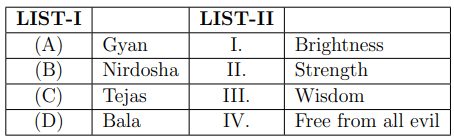
Match the LIST-I with LIST-II

Choose the appropriate answer:

  • (A) A-II, B-I, C-IV, D-III
  • (B) A-I, B-III, C-II, D-IV
  • (C) A-III, B-II, C-IV, D-I
  • (D) A-I, B-II, C-III, D-IV

Question 53:

Match the LIST-I with LIST-II

Choose the appropriate answer:

  • (A) A-I, B-III, C-II, D-IV
  • (B) A-III, B-IV, C-II, D-I
  • (C) A-I, B-II, C-III, D-IV
  • (D) A-III, B-IV, C-I, D-II

Question 54:

Match the LIST-I with LIST-II

Choose the appropriate answer:

  • (A) A-I, B-II, C-IV, D-III
  • (B) A-III, B-II, C-I, D-IV
  • (C) A-I, B-III, C-IV, D-II
  • (D) A-III, B-IV, C-I, D-II

Question 55:

Match the LIST-I with LIST-II

Choose the appropriate answer:

  • (A) A-IV, B-I, C-III, D-II
  • (B) A-I, B-III, C-IV, D-II
  • (C) A-I, B-IV, C-III, D-II
  • (D) A-IV, B-III, C-I, D-II

Question 56:

Match the LIST-I with LIST-II

Choose the appropriate answer:

  • (A) A-III, B-IV, C-II, D-I
  • (B) A-III, B-II, C-I, D-IV
  • (C) A-II, B-I, C-IV, D-III
  • (D) A-III, B-IV, C-I, D-II

Question 57:

Match the LIST-I with LIST-II

Choose the appropriate answer:

  • (A) A-I, B-II, C-III, D-IV
  • (B) A-III, B-IV, C-II, D-I
  • (C) A-IV, B-II, C-I, D-III
  • (D) A-I, B-III, C-II, D-IV

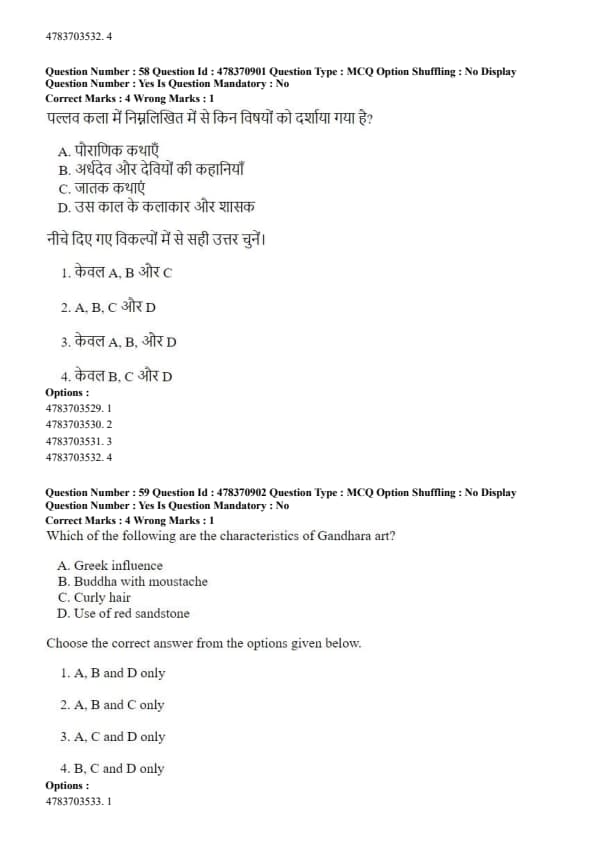
Question 58:

Which of the following are depicted in Pallava art?

(A) Puranic stories
(B) Demi God and Goddess stories
(C) Jataka stories
(D) Artists and rulers of that period

  • (A) A, B and C only
  • (B) A, B, C and D
  • (C) A, B and D only
  • (D) B, C and D only

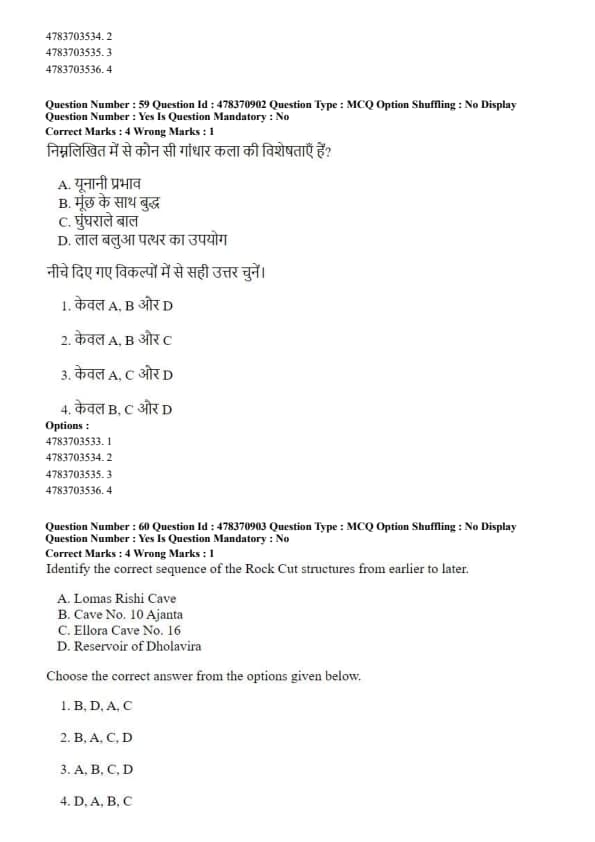
Question 59:

Which of the following are the characteristics of Gandhara art?

(A) Greek influence
(B) Buddha with moustache
(C) Curly hair
(D) Use of red sandstone

  • (A) A, B and D only
  • (B) A, B and C only
  • (C) A, C and D only
  • (D) B, C and D only

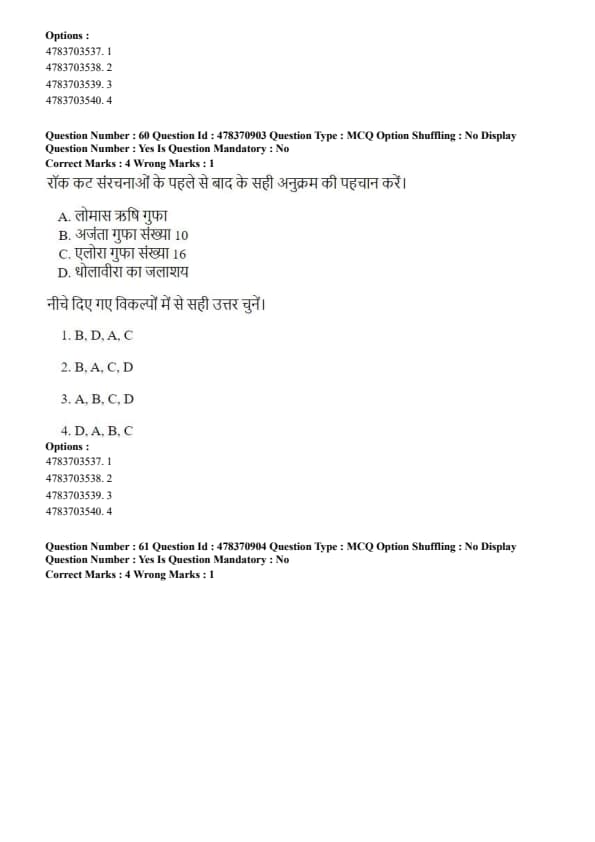
Question 60:

Identify the correct sequence of the Rock Cut structures from earlier to later.

(A) Lomas Rishi Cave
(B) Cave No. 10 Ajanta
(C) Ellora Cave No. 16
(D) Reservoir of Dholavira

  • (A) B, D, A, C
  • (B) B, A, C, D
  • (C) A, B, C, D
  • (D) D, A, B, C

Question 61:

Arrange in sequence the symbols associated with Buddha from birth to the first sermon.

(A) Tree
(B) White elephant
(C) Horse
(D) Wheel

  • (A) D, B, A, C
  • (B) D, B, A, C
  • (C) B, C, A, D
  • (D) B, A, D, C

Question 62:

Arrange the following from earlier to later.

(A) Paleolithic
(B) Chalcolithic
(C) Neolithic
(D) Early historic

  • (A) A, B, C, D
  • (B) B, A, C, D
  • (C) A, C, D, B
  • (D) A, C, B, D

Question 63:

Arrange the following events in the correct chronological order.

(A) Birth of Mahavir
(B) Mahavir's first sermon
(C) Mahavir attains enlightenment
(D) Mahavir's death

  • (A) C, D, A, B
  • (B) C, D, B, A
  • (C) A, C, B, D
  • (D) B, A, C, D

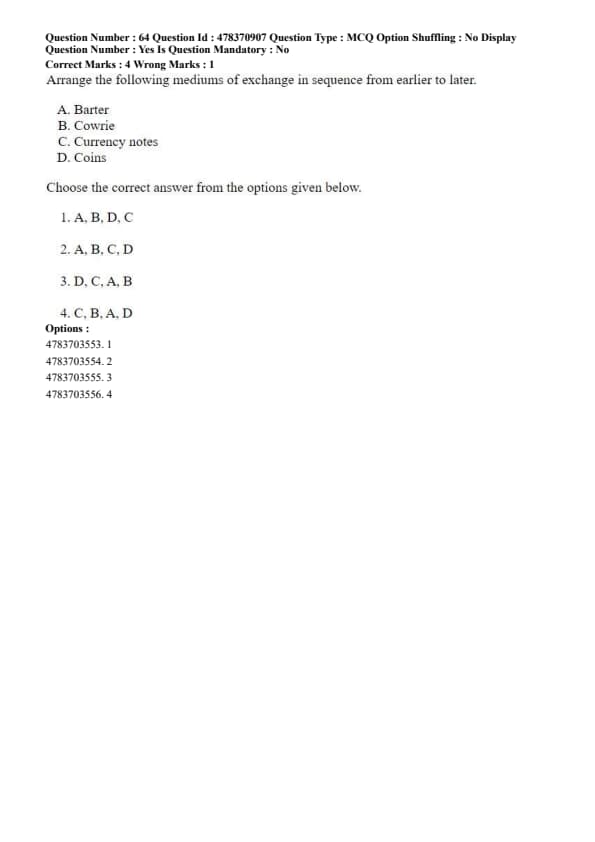
Question 64:

Arrange the following mediums of exchange in sequence from earlier to later.

(A) Barter
(B) Cowrie
(C) Currency notes
(D) Coins

  • (A) A, B, D, C
  • (B) A, B, C, D
  • (C) D, C, A, B
  • (D) C, B, A, D

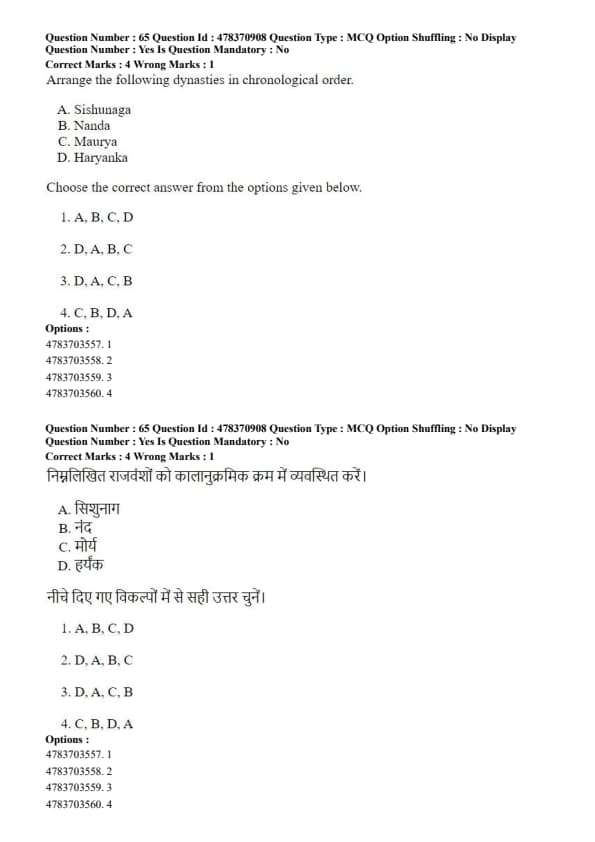
Question 65:

Arrange the following dynasties in chronological order.

(A) Sishunaga
(B) Nanda
(C) Maurya
(D) Haryanka

  • (A) A, B, C, D
  • (B) D, A, B, C
  • (C) D, A, C, B
  • (D) C, B, D, A

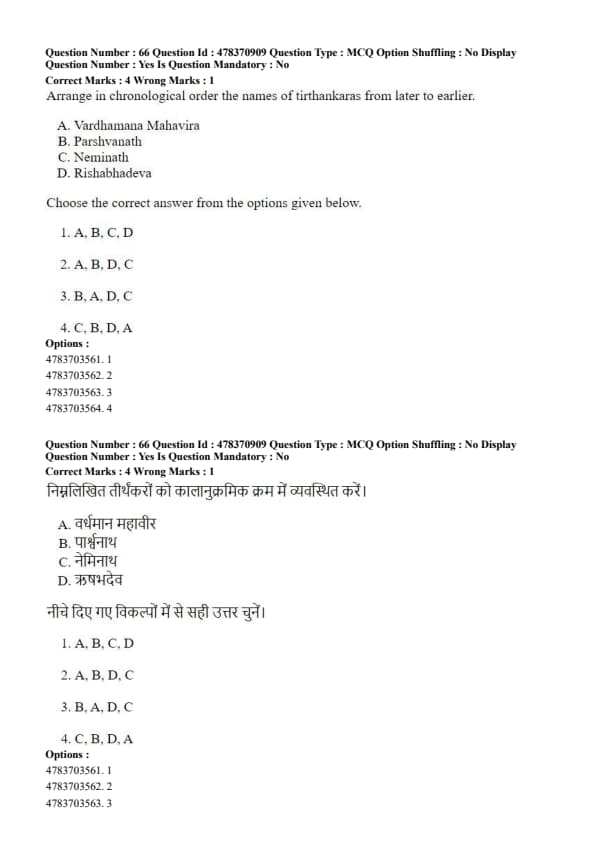
Question 66:

Arrange in chronological order the names of Tirthankaras from later to earlier.

(A) Vardhamana Mahavira
(B) Parshvanath
(C) Neminath
(D) Rishabhadeva

  • (A) A, B, C, D
  • (B) A, B, D, C
  • (C) B, A, D, C
  • (D) C, B, D, A

Question 67:

Arrange in sequence the parts of the Harappan fort architecture from the core to the periphery.

(A) Moat
(B) Fortification wall
(C) Citadel
(D) Lower town

  • (A) B, C, D, A
  • (B) A, D, C, B
  • (C) C, D, A, B
  • (D) C, D, B, A

Question 68:

Arrange the following in chronological order.

(A) Company style of painting
(B) Ajanta cave paintings
(C) Mughal miniature paintings
(D) Bengal School of art

  • (A) A, C, B, D
  • (B) D, A, C, B
  • (C) B, C, A, D
  • (D) C, B, D, A

Question 69:

Which of the following are true about Egyptian art and architecture?

(A) Post and lintel system
(B) Follow strict geometrical rules
(C) Representation of real life
(D) Open air theatre

  • (A) A, B and D only
  • (B) A, B and C only
  • (C) A, B, C and D
  • (D) B, C and D only

Question 70:

Which of the following are associated with Ajanta paintings?
A. Jataka stories
B. Satavahana
C. Vakatakas
D. Murals

  • (A) A, B and D only
  • (B) A, B and C only
  • (C) A, B, C and D
  • (D) B, C and D only

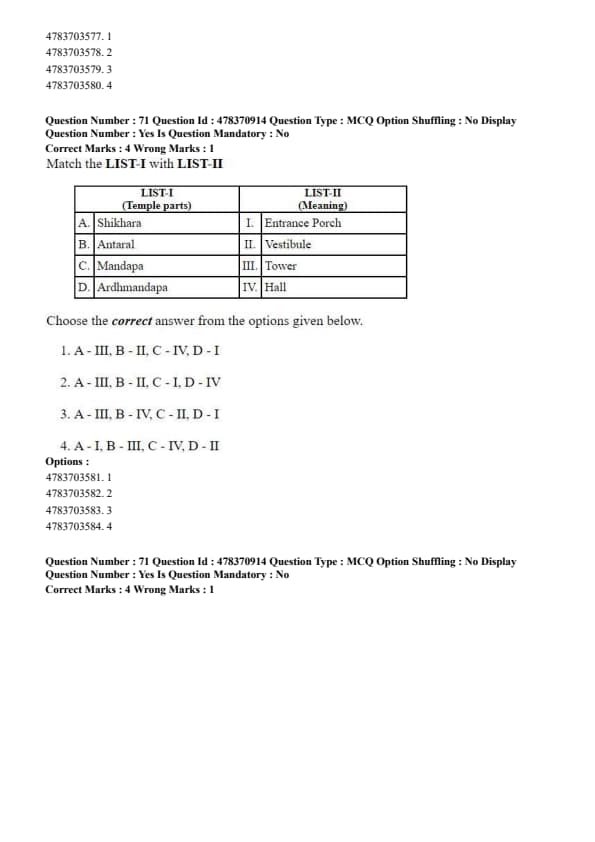
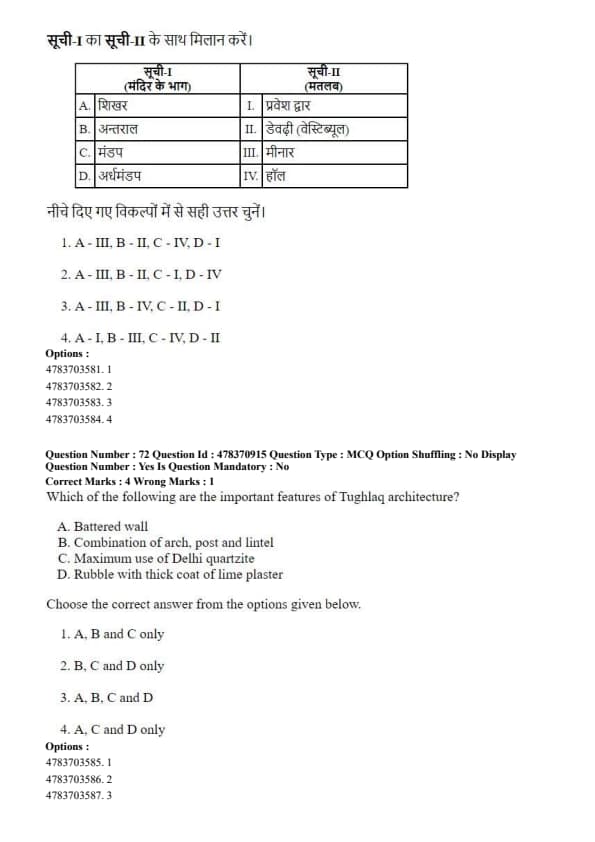
Question 71:

Match the LIST-I with LIST-II.

Choose the appropriate answer:

  • (A) A-III, B-II, C-IV, D-I
  • (B) A-III, B-I, C-II, D-IV
  • (C) A-III, B-IV, C-II, D-I
  • (D) A-I, B-III, C-IV, D-II

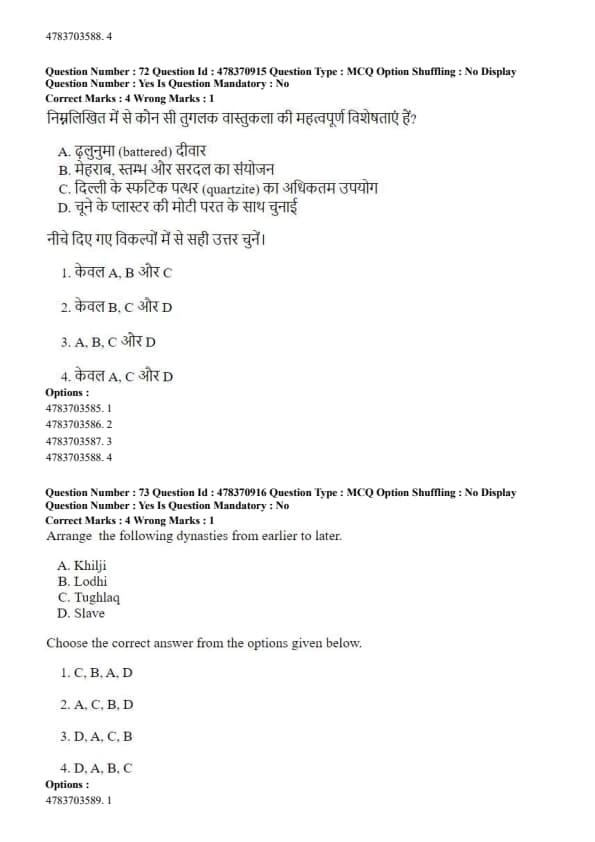
Question 72:

Which of the following are the important features of Tughlaq architecture?

A. Battered wall
B. Combination of arch, post and lintel
C. Maximum use of Delhi quartzite
D. Rubble with thick coat of lime plaster

  • (A) A, B and C only
  • (B) B, C and D only
  • (C) A, B, C and D
  • (D) A, C and D only

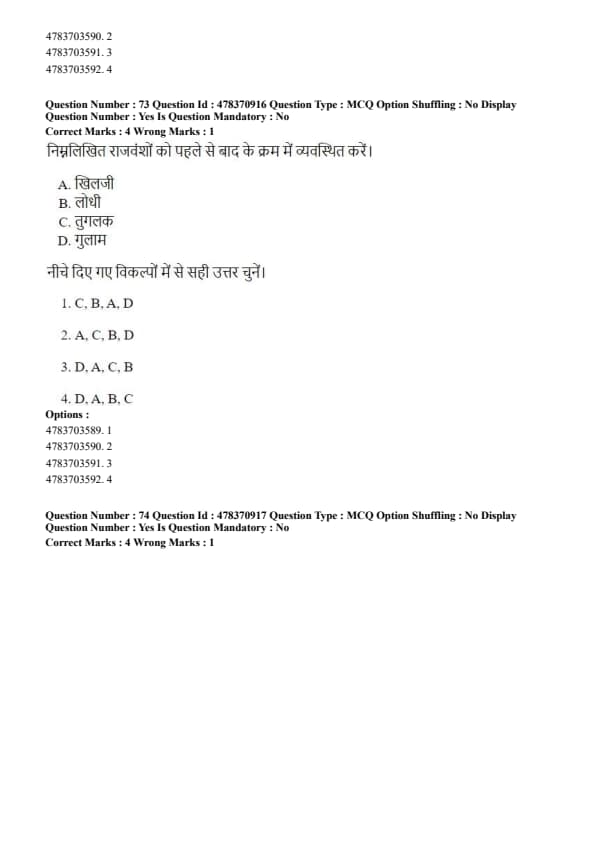
Question 73:

Arrange the following dynasties from earlier to later.

A. Khilji
B. Lodhi
C. Tughlaq
D. Slave

  • (A) C, B, A, D
  • (B) A, C, B, D
  • (C) D, A, C, B
  • (D) D, A, B, C

Question 74:

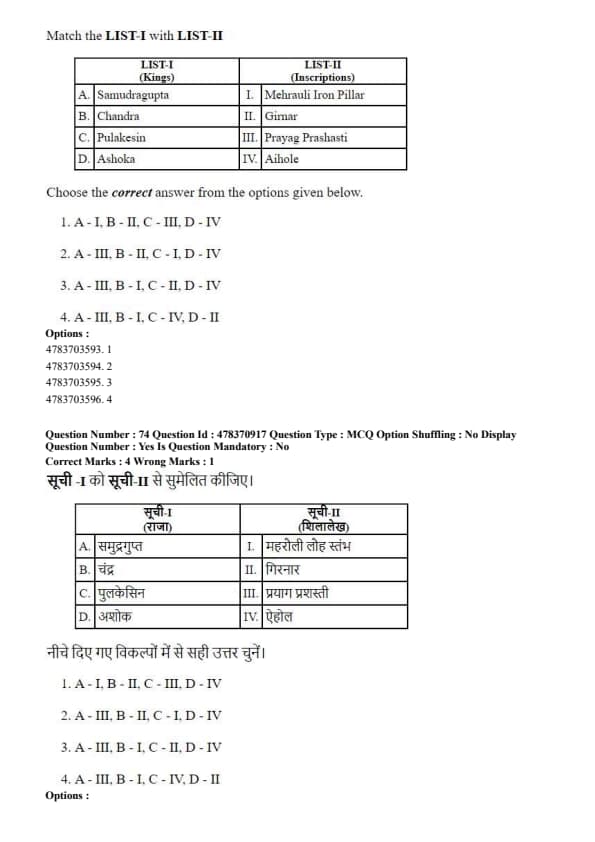
Match the LIST-I (Kings) with LIST-II (Inscriptions).

Choose the appropriate answer:

  • (A) A-I, B-II, C-III, D-IV
  • (B) A-III, B-II, C-I, D-IV
  • (C) A-III, B-I, C-II, D-IV
  • (D) A-III, B-I, C-IV, D-II

Question 75:

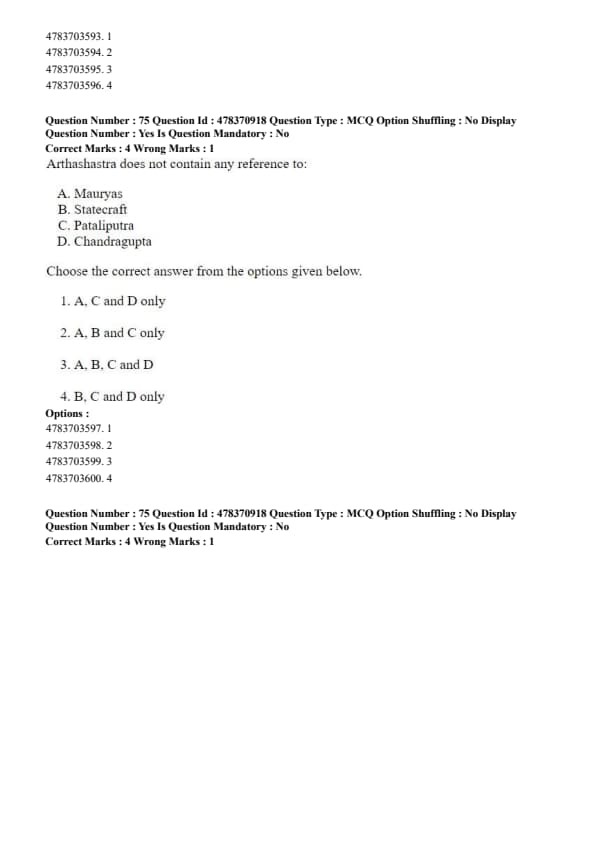
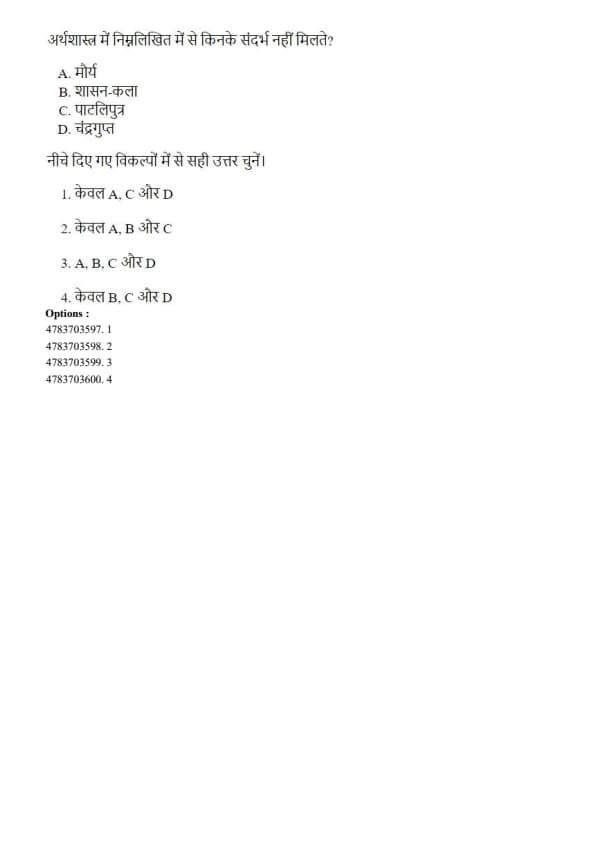
Arthashastra does not contain any reference to:

A. Mauryas
B. Statecraft
C. Pataliputra
D. Chandragupta
  • (A) A, C and D only
  • (B) A, B and C only
  • (C) A, B, C and D
  • (D) B, C and D only