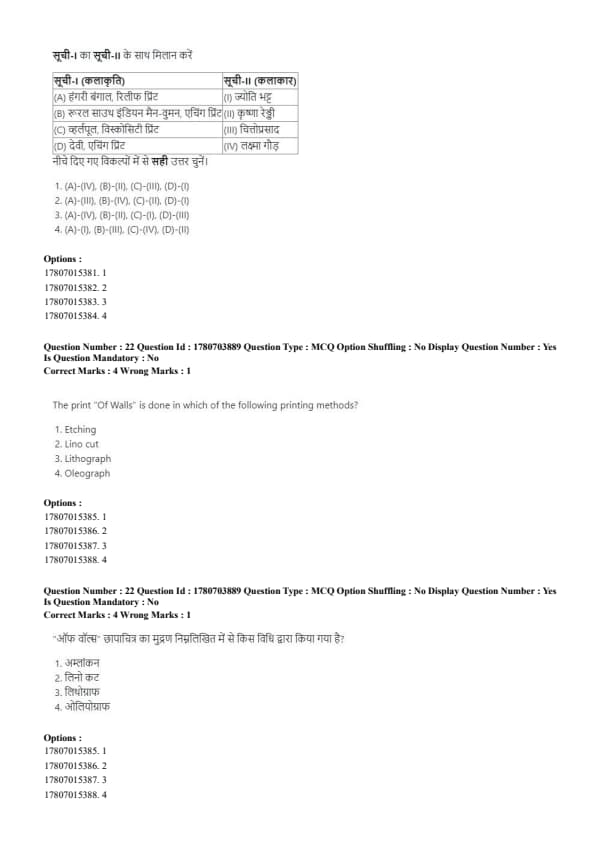
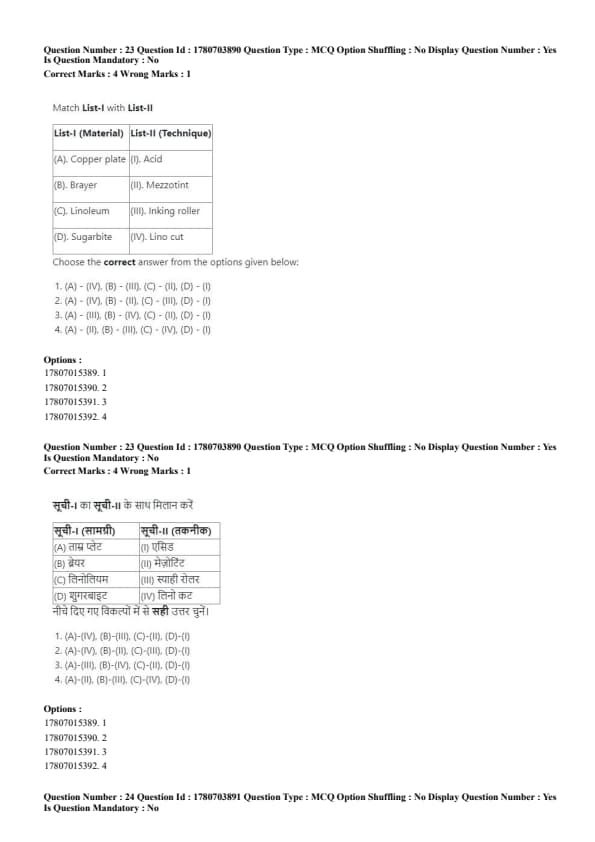
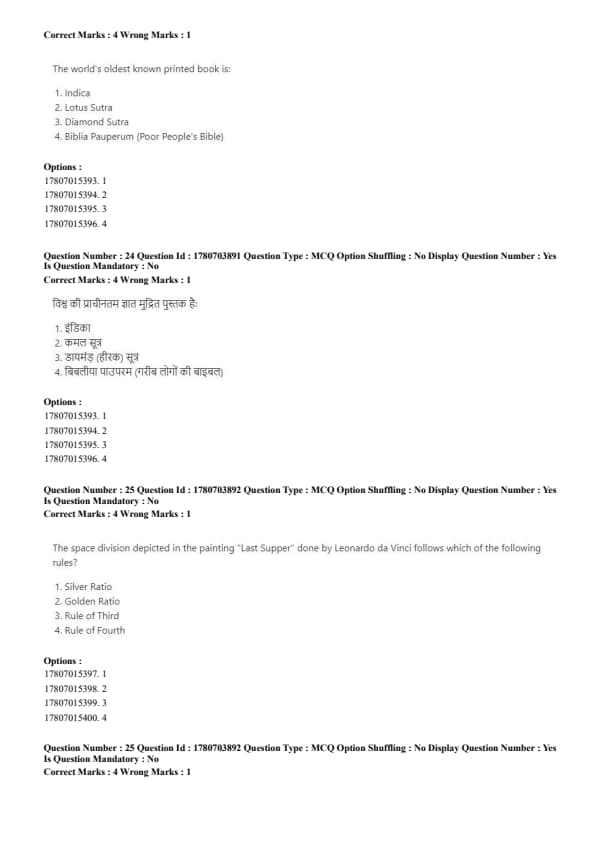
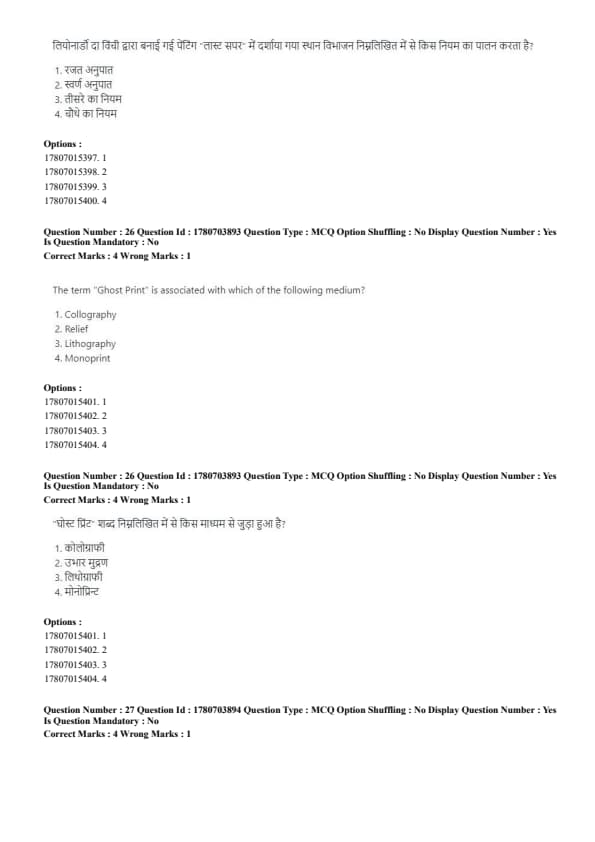
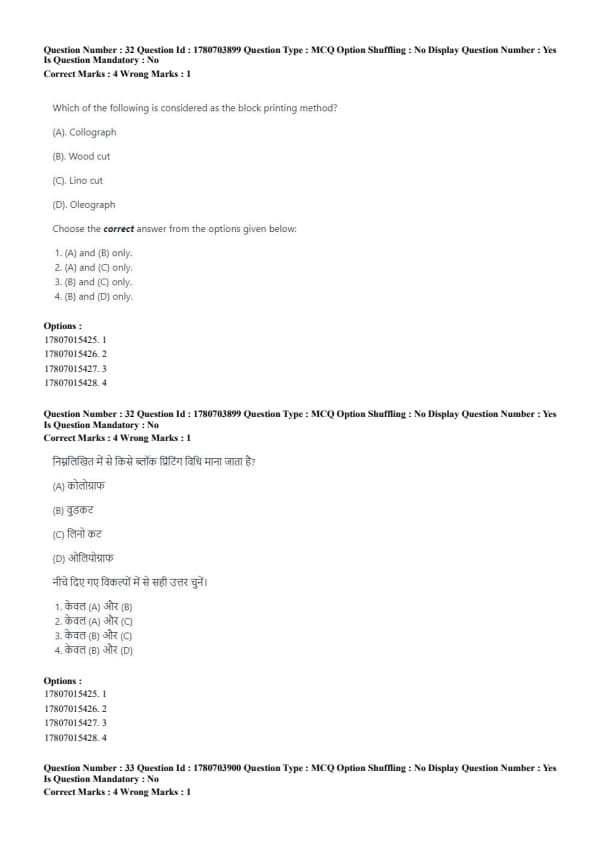
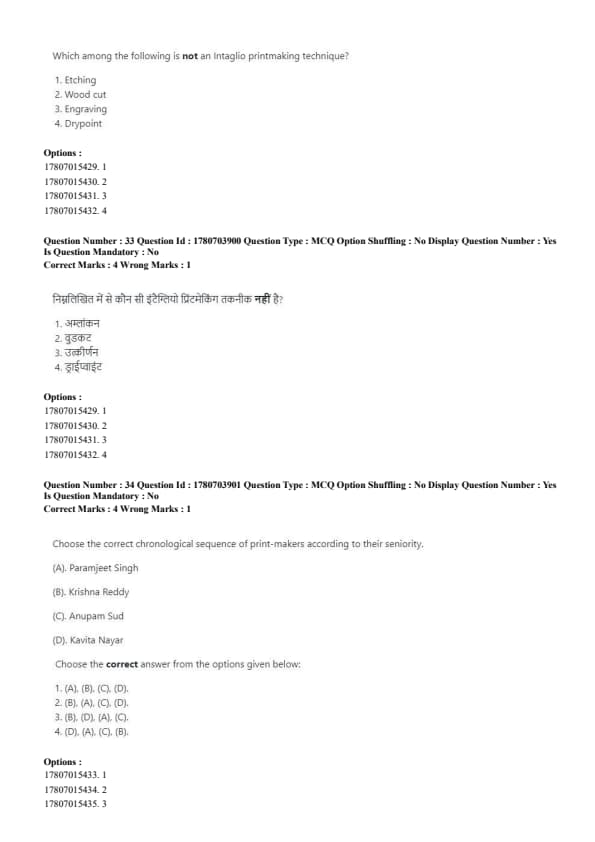
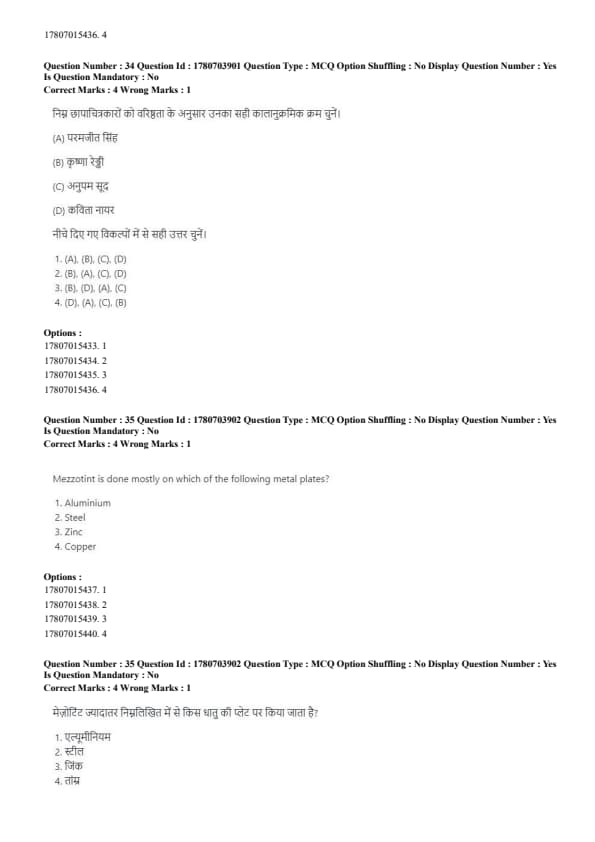
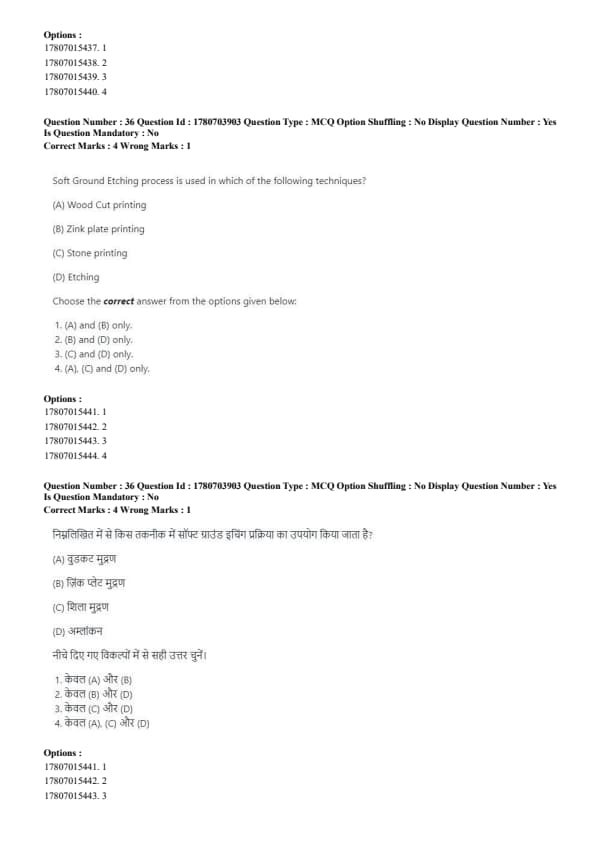
The CUET PG Painting exam in 2025 is scheduled for 26th March during Shift 2. After the exam, candidates can access the question paper, answer key, and detailed solution PDF. The test evaluates knowledge in art history, techniques of painting, aesthetics, Indian and Western art forms, and creative expression.

Candidates must attempt 75 questions within 60 minutes, totaling 300 marks. Each correct answer awards 4 marks, while 1 mark is deducted for every incorrect response.

CUET PG Painting 2025 Question Paper with Solutions PDF

CUET PG Painting Question Paper with Solutions PDF Download PDF Check Solutions


Question 1:

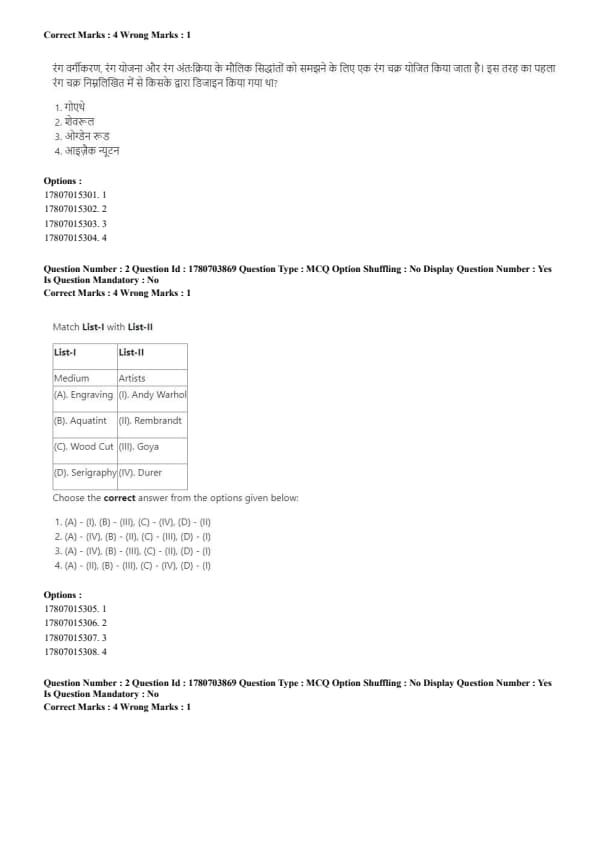
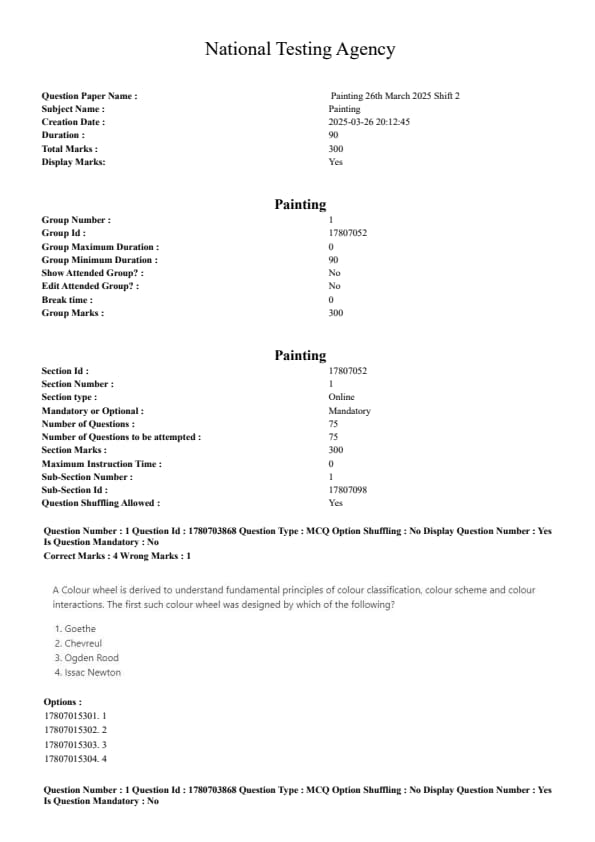
A Colour wheel is derived to understand fundamental principles of colour classification, colour scheme and colour interactions. The first such colour wheel was designed by which of the following?

  • (1) Goethe
  • (2) Chevreul
  • (3) Ogden Rood
  • (4) Issac Newton

Question 2:

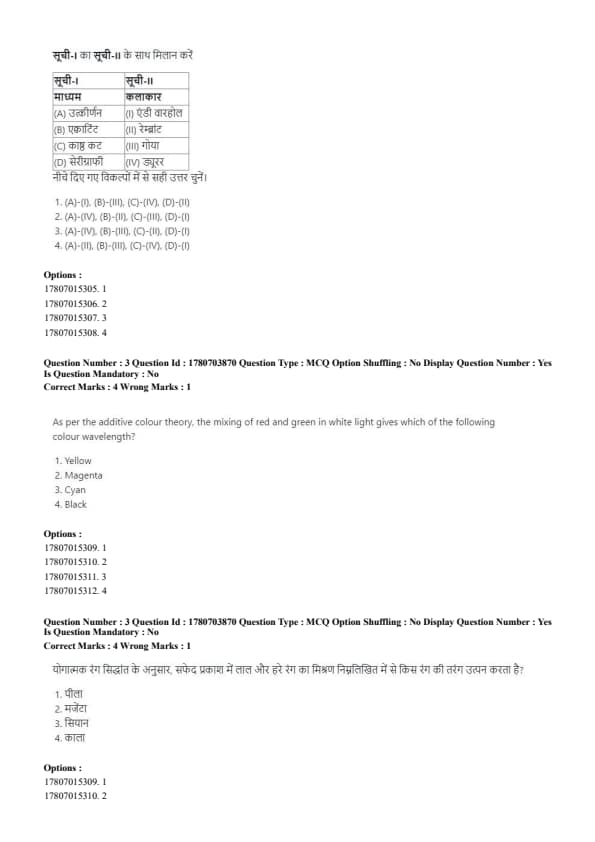
Match List-I with List-II

Choose the correct answer from the options given below:

  • (1) (A) - (I), (B) - (III), (C) - (IV), (D) - (II)
  • (2) (A) - (IV), (B) - (II), (C) - (III), (D) - (I)
  • (3) (A) - (IV), (B) - (III), (C) - (II), (D) - (I)
  • (4) (A) - (II), (B) - (III), (C) - (IV), (D) - (I)

Question 3:

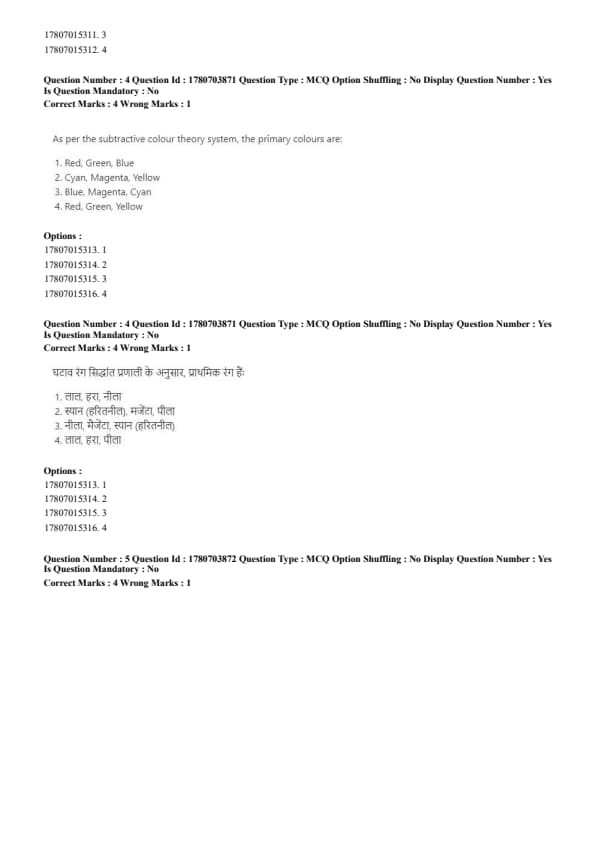
As per the additive colour theory, the mixing of red and green in white light gives which of the following colour wavelength?

  • (1) Yellow
  • (2) Magenta
  • (3) Cyan
  • (4) Black

Question 4:

As per the subtractive colour theory system, the primary colours are:

  • (1) Red, Green, Blue
  • (2) Cyan, Magenta, Yellow
  • (3) Blue, Magenta, Cyan
  • (4) Red, Green, Yellow

Question 5:

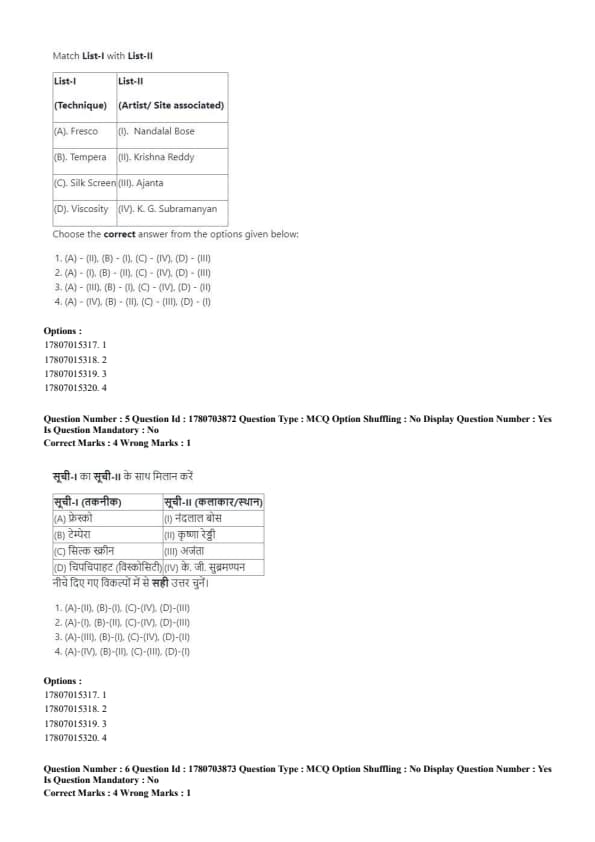
Match List-I with List-II

Choose the correct answer from the options given below:

  • (1) (A) - (III), (B) - (I), (C) - (IV), (D) - (II)
    (2) (A) - (I), (B) - (III), (C) - (IV), (D) - (II)
  • (3) (A) - (III), (B) - (II), (C) - (IV), (D) - (I)
  • (4) (A) - (IV), (B) - (III), (C) - (II), (D) - (I)

Question 6:

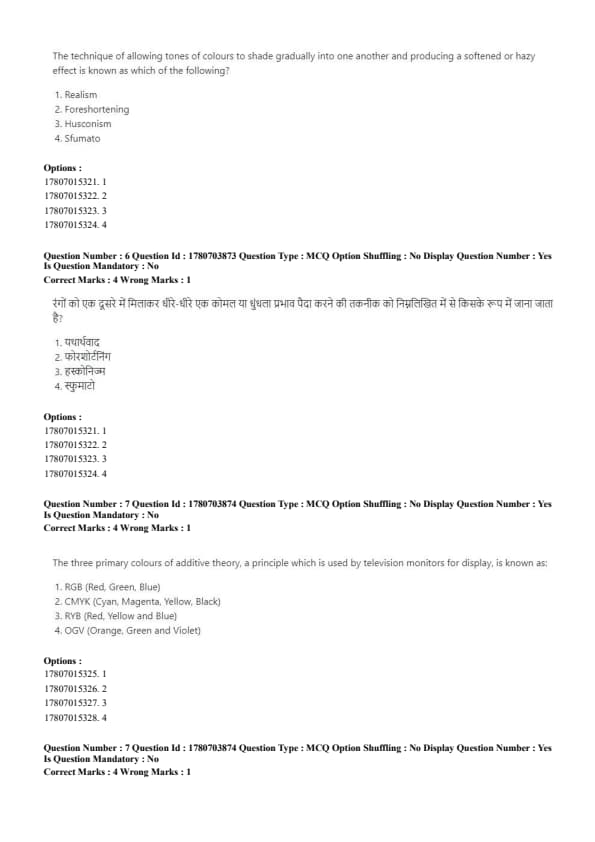
The technique of allowing tones of colours to shade gradually into one another and producing a softened or hazy effect is known as which of the following?

  • (1) Realism
  • (2) Foreshortening
  • (3) Husconism
  • (4) Sfumato

Question 7:

The three primary colours of additive theory, a principle which is used by television monitors for display, is known as:

  • (1) RGB (Red, Green, Blue)
  • (2) CMYK (Cyan, Magenta, Yellow, Black)
  • (3) RYB (Red, Yellow and Blue)
  • (4) OGV (Orange, Green and Violet)

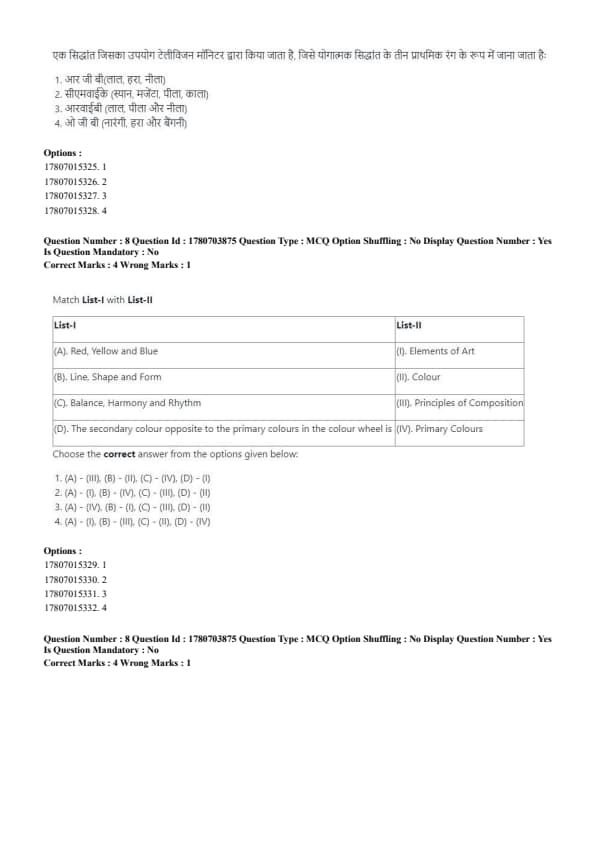
Question 8:

Match List-I with List-II

  • Choose the correct answer from the options given below:
  • (1) (A) - (III), (B) - (II), (C) - (IV), (D) - (I)
  • (2) (A) - (I), (B) - (IV), (C) - (III), (D) - (II)
  • (3) (A) - (IV), (B) - (I), (C) - (III), (D) - (II)
  • (4) (A) - (I), (B) - (III), (C) - (II), (D) - (IV)

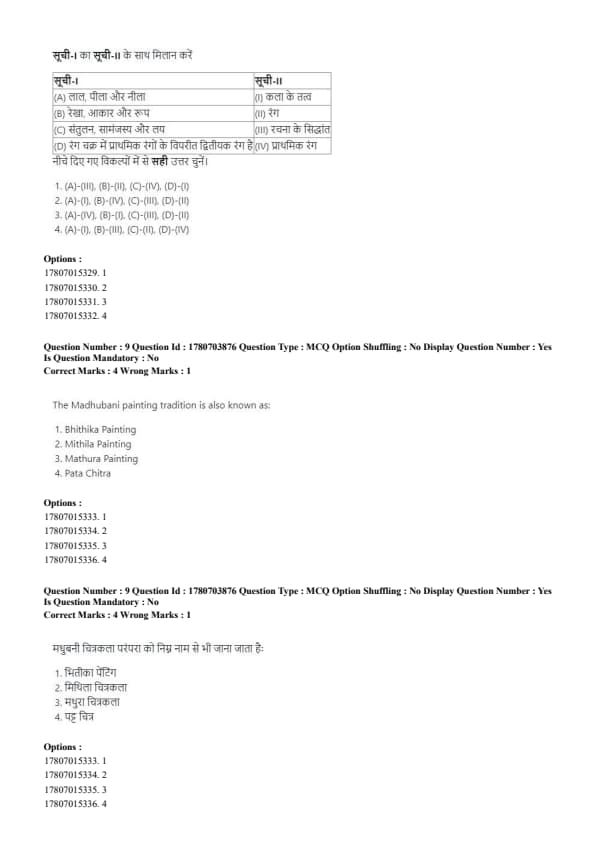
Question 9:

The Madhubani painting tradition is also known as:

  • (1) Bhithika Painting
  • (2) Mithila Painting
  • (3) Mathura Painting
  • (4) Pata Chitra

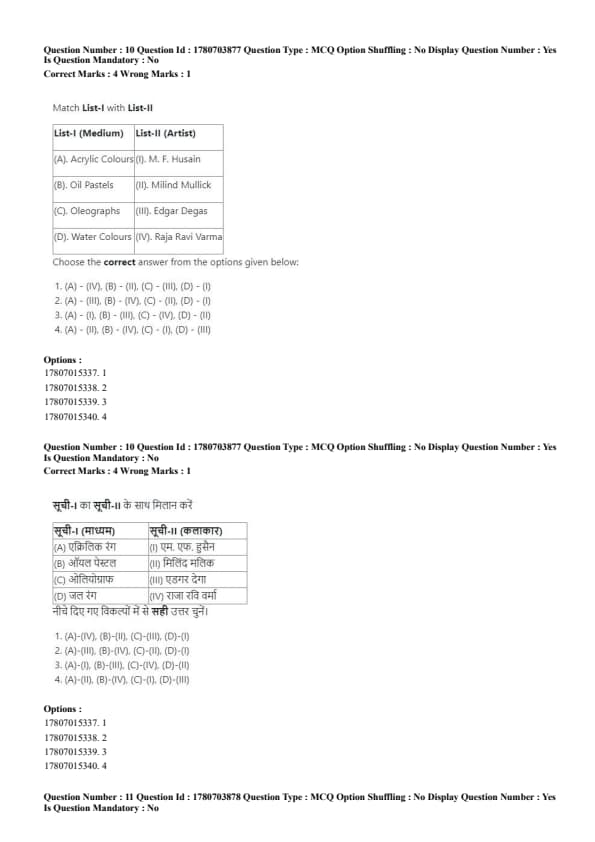
Question 10:

Match List-I with List-II

  • Choose the correct answer from the options given below:
  • (1) (A) - (IV), (B) - (II), (C) - (III), (D) - (I)
  • (2) (A) - (III), (B) - (IV), (C) - (II), (D) - (I)
  • (3) (A) - (I), (B) - (III), (C) - (IV), (D) - (II)
  • (4) (A) - (II), (B) - (IV), (C) - (I), (D) - (III)

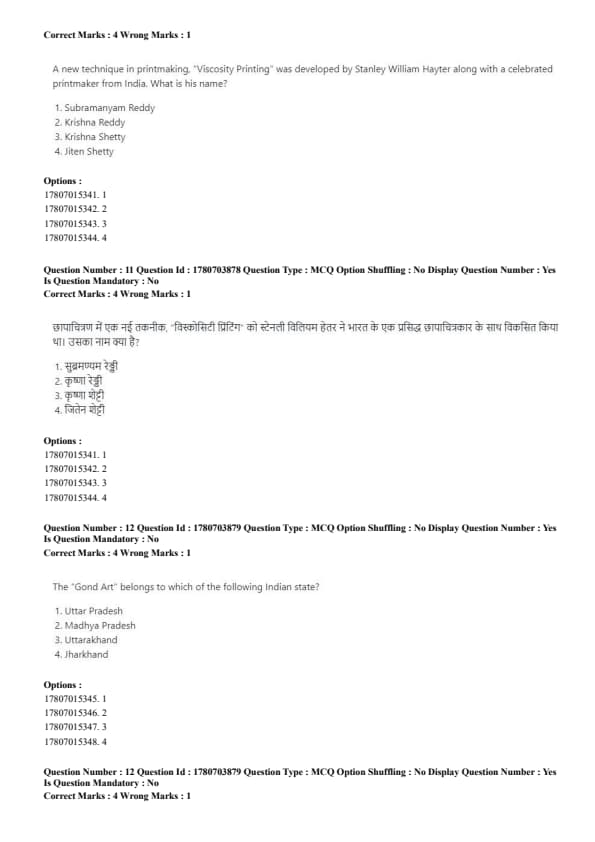
Question 11:

A new technique in printmaking, "Viscosity Printing" was developed by Stanley William Hayter along with a celebrated printmaker from India. What is his name?

  • (1) Subramanyam Reddy
  • (2) Krishna Reddy
  • (3) Krishna Shetty
  • (4) Jiten Shetty

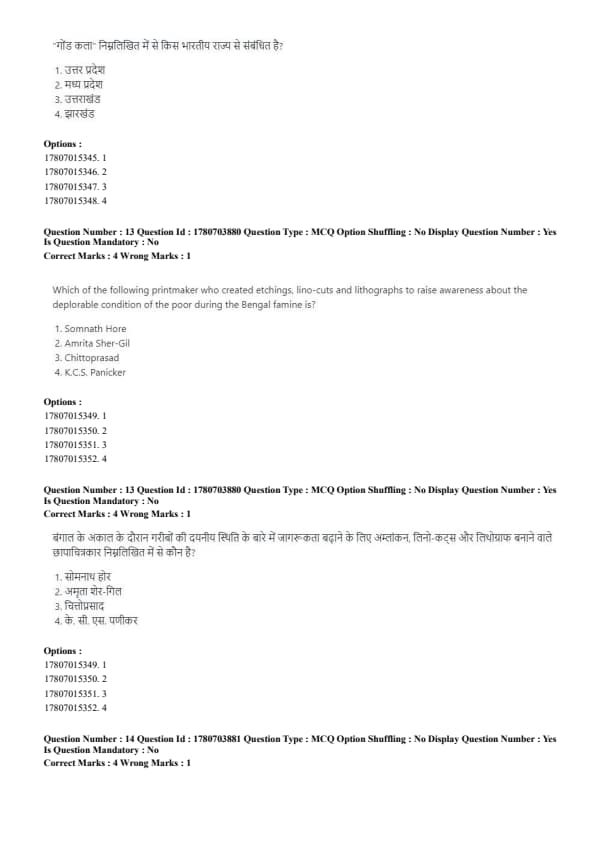
Question 12:

The "Gond Art" belongs to which of the following Indian state?

  • (1) Uttar Pradesh
  • (2) Madhya Pradesh
  • (3) Uttarakhand
  • (4) Jharkhand

Question 13:

Which of the following printmaker who created etchings, lino-cuts and lithographs to raise awareness about the deplorable condition of the poor during the Bengal famine is?

  • (1) Somnath Hore
  • (2) Amrita Sher-Gil
  • (3) Chittoprasad
  • (4) K.C.S. Panicker

Question 14:

The mural "The Lives of Medieval Saint" created by Benode Behari Mukherjee is done in which of the following medium?

  • (1) Fresco buono
  • (2) Fresco secco
  • (3) Cement
  • (4) Terracotta

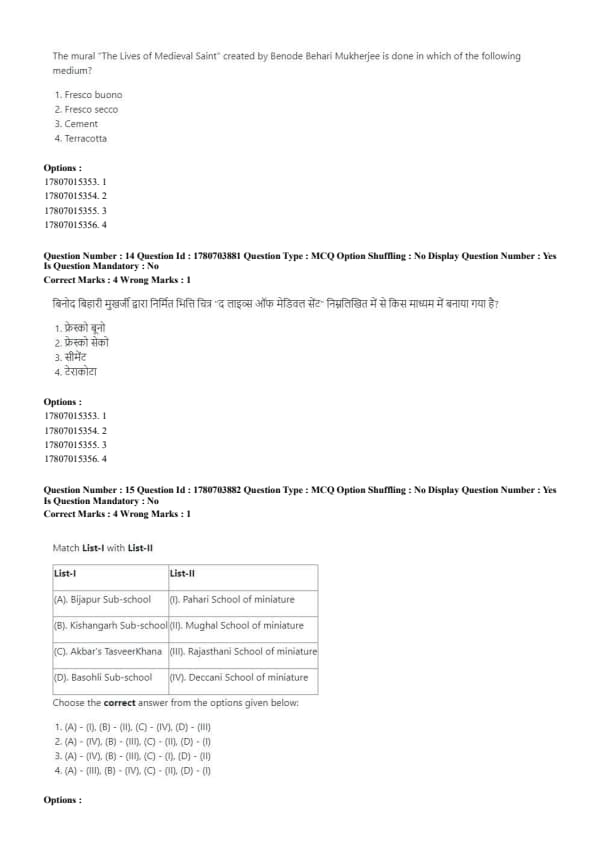
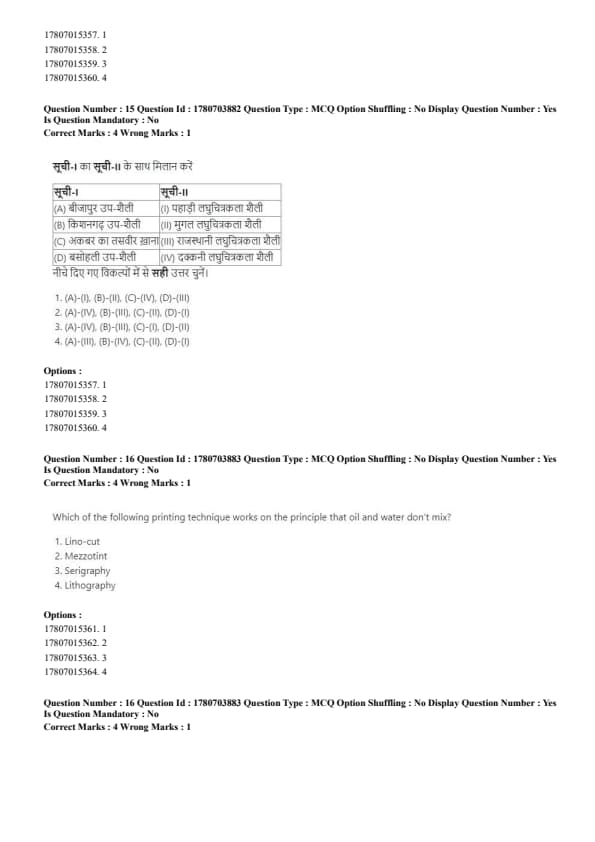
Question 15:

Match List-I with List-II

  • Choose the correct answer from the options given below:
  • (1) (A) - (I), (B) - (III), (C) - (IV), (D) - (II)
  • (2) (A) - (IV), (B) - (III), (C) - (II), (D) - (I)
  • (3) (A) - (IV), (B) - (II), (C) - (I), (D) - (III)
  • (4) (A) - (III), (B) - (IV), (C) - (II), (D) - (I)

Question 16:

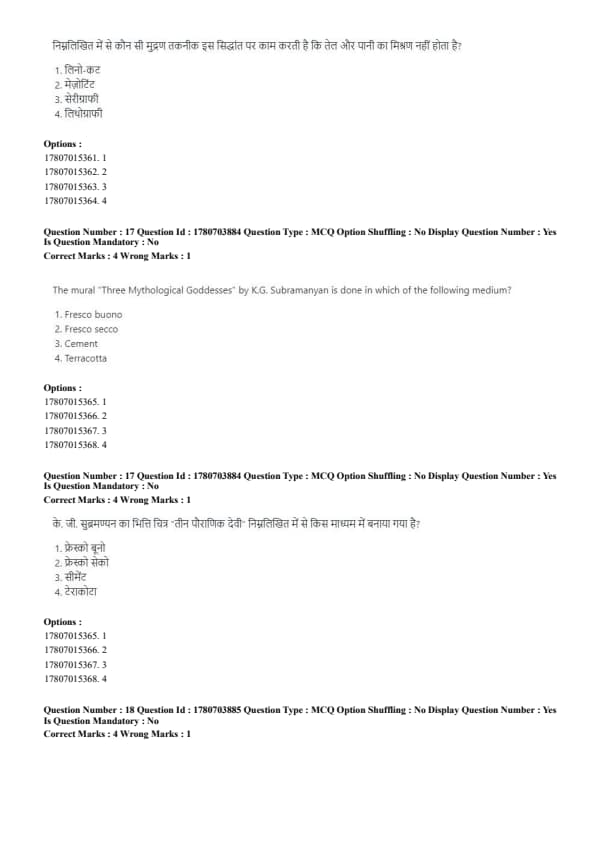
Which of the following printing technique works on the principle that oil and water don't mix?

  • (1) Lino-cut
  • (2) Mezzotint
  • (3) Serigraphy
  • (4) Lithography

Question 17:

The mural "Three Mythological Goddesses" by K.G. Subramanyan is done in which of the following medium?

  • (1) Fresco buono
  • (2) Fresco secco
  • (3) Cement
  • (4) Terracotta

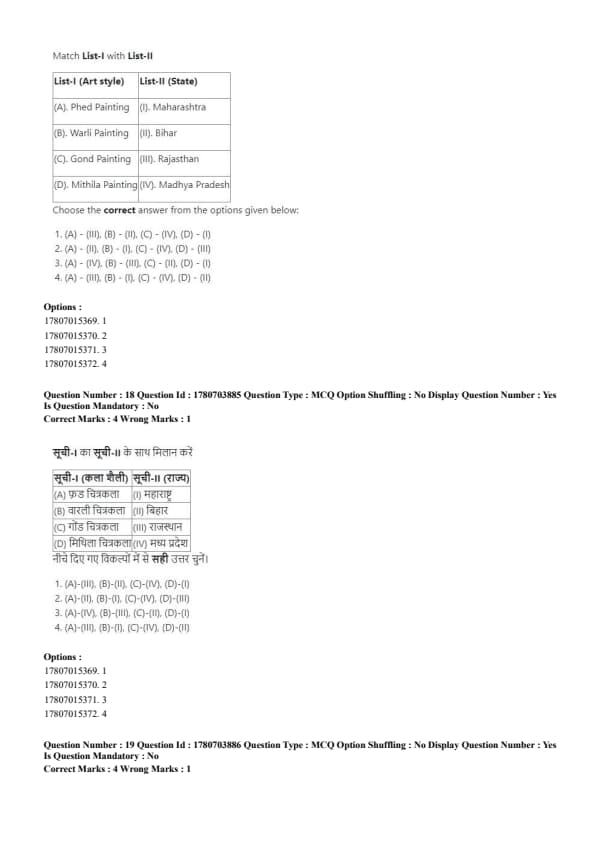
Question 18:

Match List-I with List-II

  • Choose the correct answer from the options given below:
  • (1) (A) - (III), (B) - (I), (C) - (IV), (D) - (II)
  • (2) (A) - (II), (B) - (I), (C) - (IV), (D) - (III)
  • (3) (A) - (IV), (B) - (III), (C) - (II), (D) - (I)
  • (4) (A) - (III), (B) - (I), (C) - (IV), (D) - (II)

Question 19:

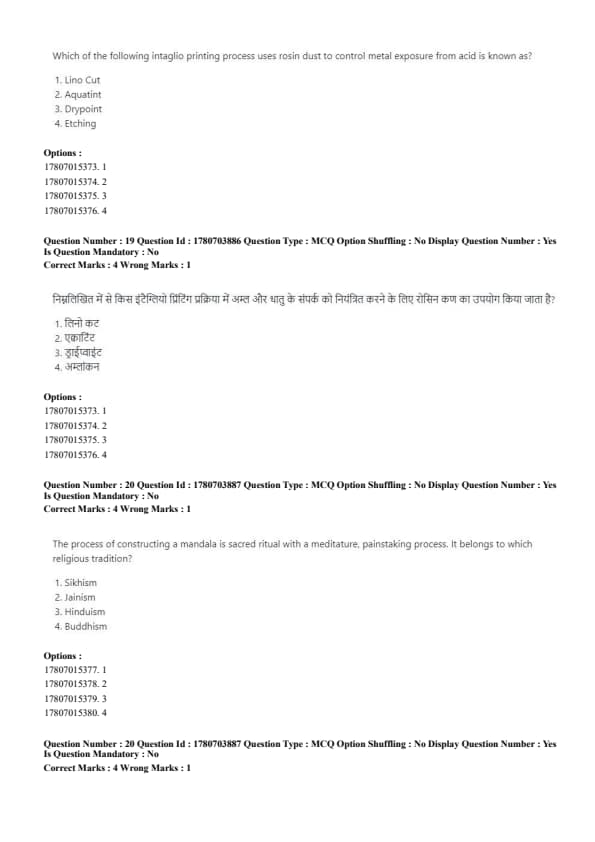
In which of the following intaglio printing processes are rosin particles used to control the contact between acid and metal?

  • (1) Lino cut
  • (2) Aquatint
  • (3) Drypoint
  • (4) Mezzotint

Question 20:

The process of constructing a mandala is a sacred ritual with a meditative, painstaking process. It belongs to which religious tradition?

  • (1) Sikhism
  • (2) Jainism
  • (3) Hinduism
  • (4) Buddhism

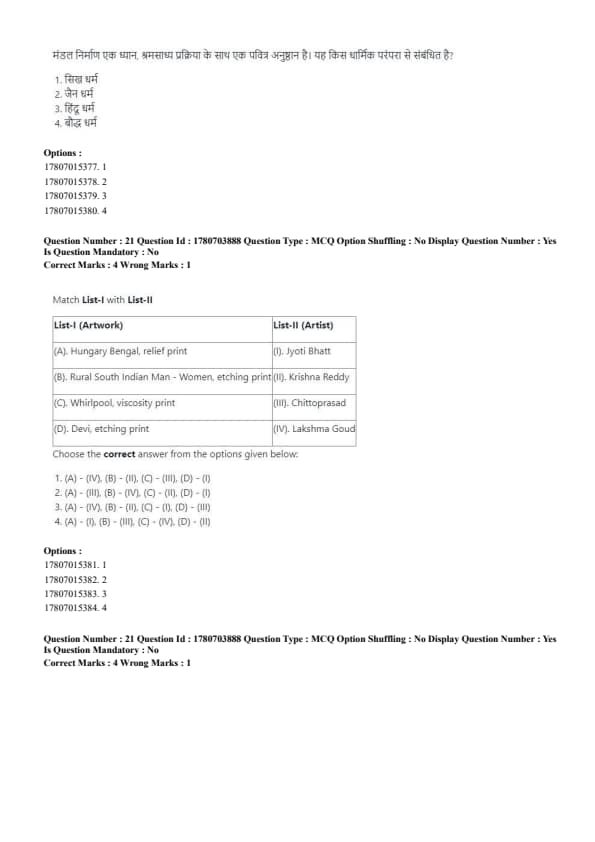
Question 21:

Match List-I with List-II

  • Choose the correct answer from the options given below:
  • (1) (A) - (IV), (B) - (II), (C) - (III), (D) - (I)
  • (2) (A) - (III), (B) - (IV), (C) - (II), (D) - (I)
  • (3) (A) - (IV), (B) - (II), (C) - (I), (D) - (III)
  • (4) (A) - (I), (B) - (III), (C) - (IV), (D) - (II)

Question 22:

The print "Of Walls" is done in which of the following printing methods?

  • (1) Etching
  • (2) Lino cut
  • (3) Lithograph
  • (4) Oleograph

Question 23:

Match List-I with List-II

  • Choose the correct answer from the options given below:
  • (1) (A) - (IV), (B) - (III), (C) - (II), (D) - (I)
  • (2) (A) - (IV), (B) - (II), (C) - (III), (D) - (I)
  • (3) (A) - (II), (B) - (IV), (C) - (II), (D) - (I)
  • (4) (A) - (II), (B) - (III), (C) - (IV), (D) - (I)

Question 24:

The world's oldest known printed book is:

  • (1) Indica
  • (2) Lotus Sutra
  • (3) Diamond Sutra
  • (4) Biblia Pauperum (Poor People's Bible)

Question 25:

The space division depicted in the painting "Last Supper" done by Leonardo da Vinci follows which of the following rules?

  • (1) Silver Ratio
  • (2) Golden Ratio
  • (3) Rule of Thirds
  • (4) Rule of Fourth

Question 26:

The term "Ghost Print" is associated with which of the following medium?

  • (1) Collography
  • (2) Relief
  • (3) Lithography
  • (4) Monoprint

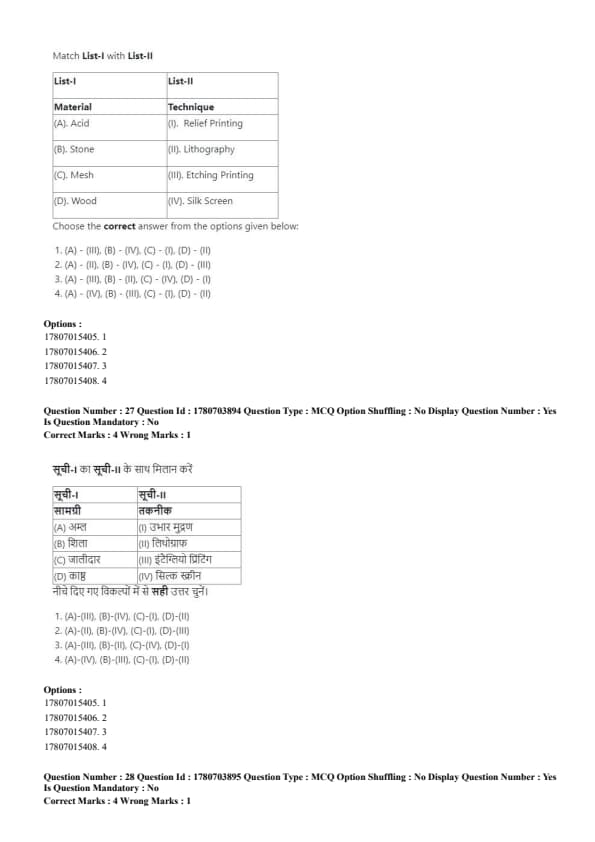
Question 27:

Match List-I with List-II

  • Choose the correct answer from the options given below:
  • (1) (A) - (III), (B) - (IV), (C) - (I), (D) - (II)
  • (2) (A) - (II), (B) - (IV), (C) - (I), (D) - (III)
  • (3) (A) - (III), (B) - (II), (C) - (IV), (D) - (I)
  • (4) (A) - (IV), (B) - (III), (C) - (I), (D) - (II)

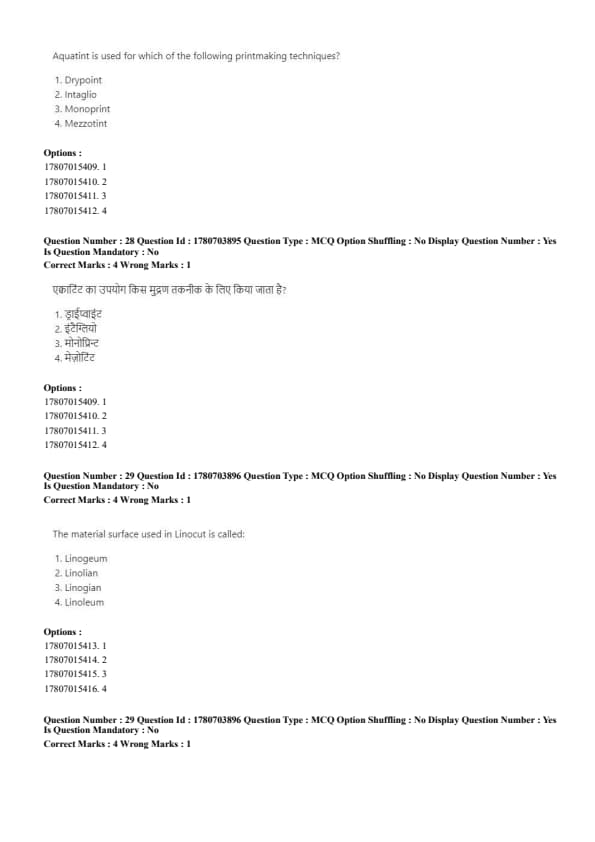
Question 28:

Aquatint is used for which printing technique?

  • (1) Drypoint
  • (2) Intaglio
  • (3) Monoprint
  • (4) Mezzotint

Question 29:

The material surface used in Linocut is called:

  • (1) Linogeum
  • (2) Linolian
  • (3) Linogian
  • (4) Linoleum

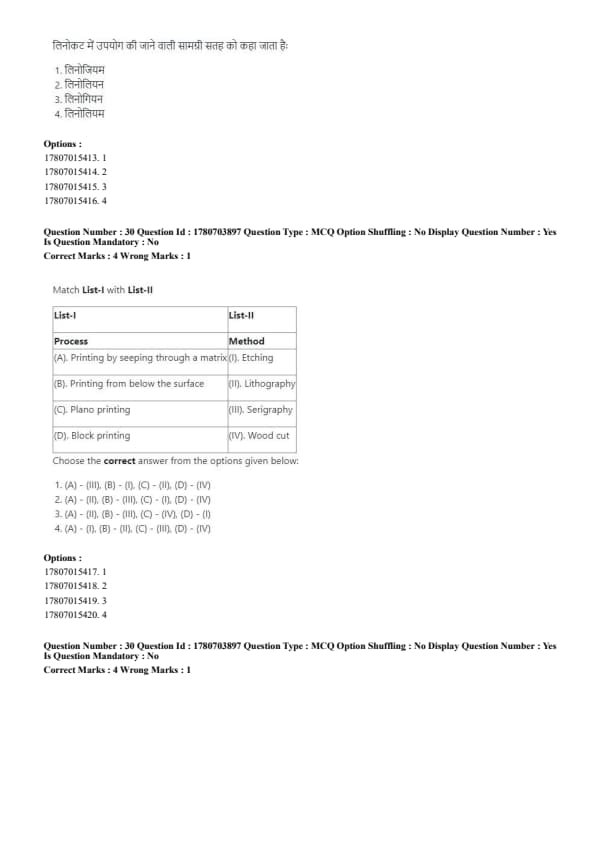
Question 30:

Match List-I with List-II

  • Choose the correct answer from the options given below:
  • (1) (A) - (III), (B) - (I), (C), (D) - (IV)
  • (2) (A) - (II), (B) - (III), (C) - (I), (D) - (IV)
  • (3) (A) - (II), (B) - (III), (C) - (IV), (D) - (I)
  • (4) (A) - (III), (B) - (I), (C) - (II), (D) - (IV)

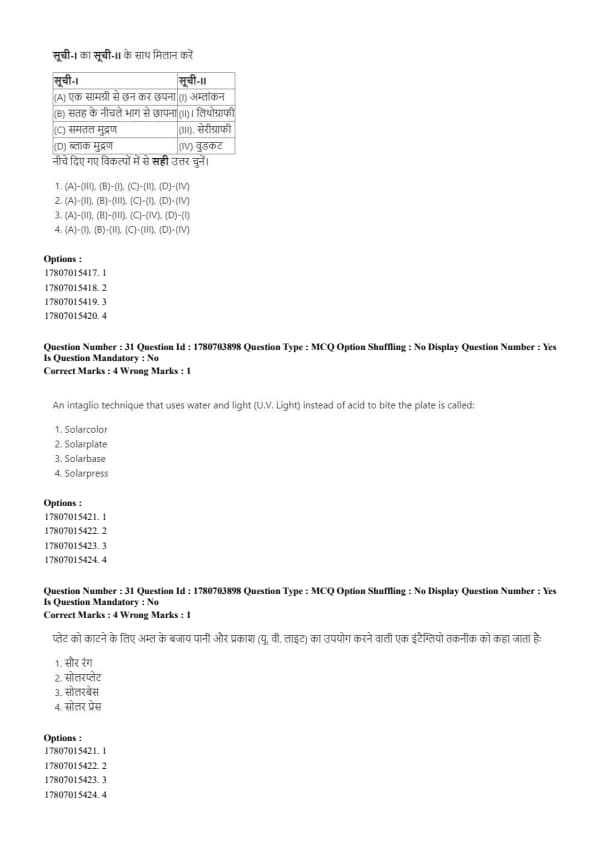
Question 31:

An intaglio technique that uses water and light (U.V. Light) instead of acid to bite the plate is called:

  • (1) Solarcolor
  • (2) Solarplate
  • (3) Solarbase
  • (4) Solarpress

Question 32:

Which of the following is considered as the block printing method?

(A) . Collograph
(B) . Wood cut
(C) . Lino cut
(D) . Oleograph

Choose the correct answer from the options given below:

  • (1) (A) and (B) only
  • (2) (A) and (C) only
  • (3) (B) and (C) only
  • (4) (B) and (D) only

Question 33:

Which among the following is not an Intaglio printmaking technique?

  • (1) Etching
  • (2) Wood cut
  • (3) Engraving
  • (4) Drypoint

Question 34:

Choose the correct chronological sequence of print-makers according to their seniority.

(A) . Paramjeet Singh
(B) . Krishna Reddy
(C) . Anupam Sud
(D) . Kavita Nayar

Choose the correct answer from the options given below:

  • (1) (A), (B), (C), (D)
  • (2) (B), (A), (C), (D)
  • (3) (B), (D), (A), (C)
  • (4) (D), (A), (C), (B)

Question 35:

Mezzotint is done mostly on which of the following metal plates?

  • (1) Aluminium
  • (2) Steel
  • (3) Zinc
  • (4) Copper

Question 36:

Soft Ground Etching process is used in which of the following techniques?

(A) Wood Cut printing
(B) Zink plate printing
(C) Stone printing
(D) Etching

Choose the correct answer from the options given below:

  • (1) (A) and (B) only.
  • (2) (B) and (D) only.
  • (3) (C) and (D) only.
  • (4) (A), (C) and (D) only.

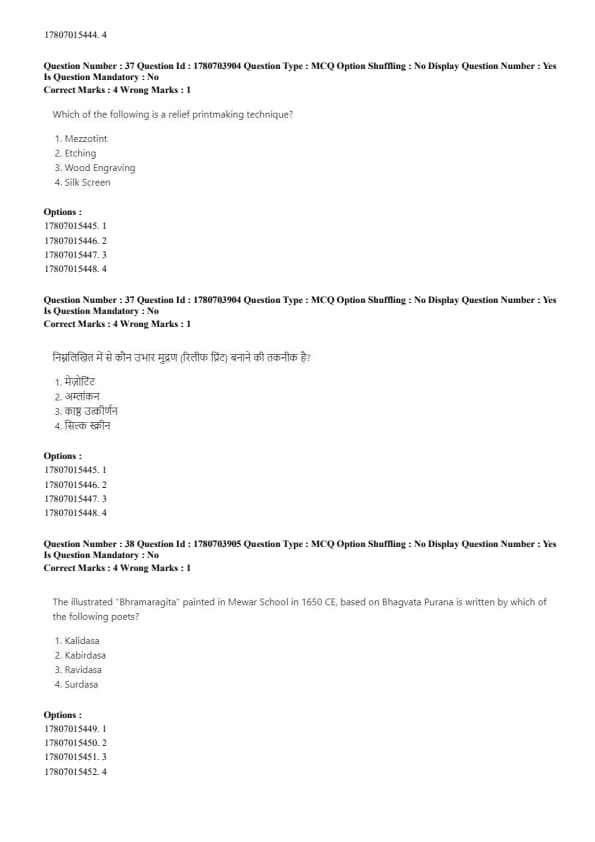
Question 37:

Which of the following is a relief printmaking technique?

  • (1) Mezzotint
  • (2) Etching
  • (3) Wood Engraving
  • (4) Silk Screen

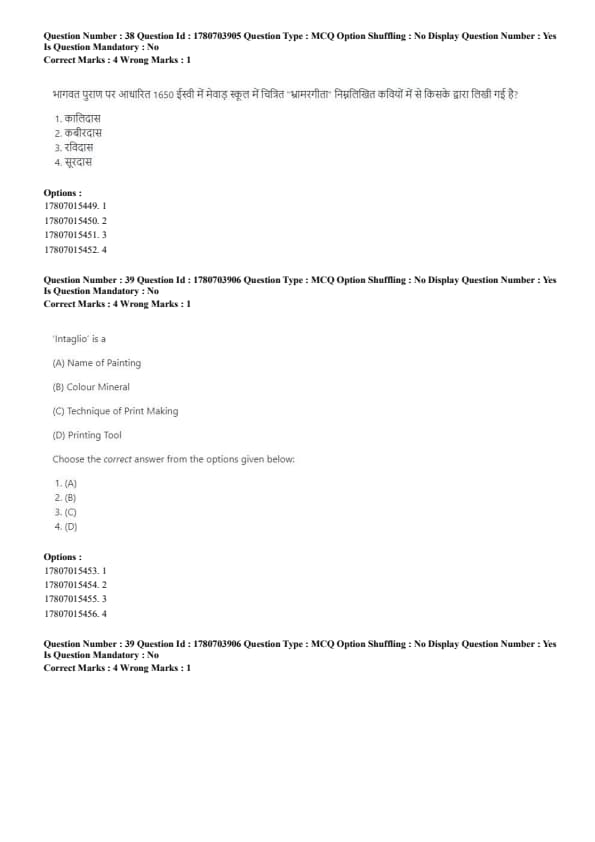
Question 38:

The illustrated "Bhramaragita" painted in Mewar School in 1650 CE, based on Bhagavata Purana is written by which of the following poets?

  • (1) Kalidasa
  • (2) Kabirdasa
  • (3) Ravidas
  • (4) Surdasa

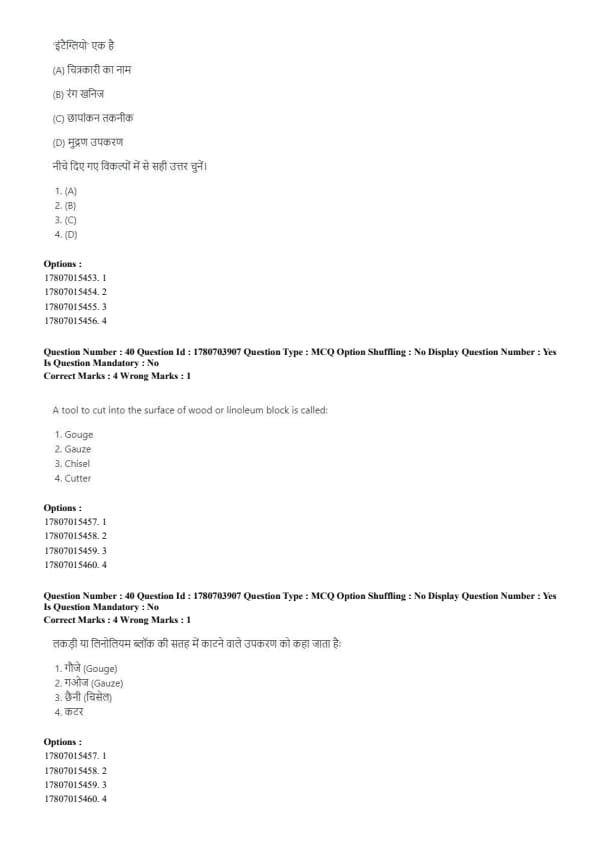
Question 39:

'Intaglio' is a

(A) Name of Painting
(B) Colour Mineral
(C) Technique of Print Making
(D) Printing Tool

Choose the correct answer from the options given below:

  • (1) (A)
  • (2) (B)
  • (3) (C)
  • (4) (D)

Question 40:

A tool to cut into the surface of wood or linoleum block is called:

  • (1) Gouge
  • (2) Gauze
  • (3) Chisel
  • (4) Cutter

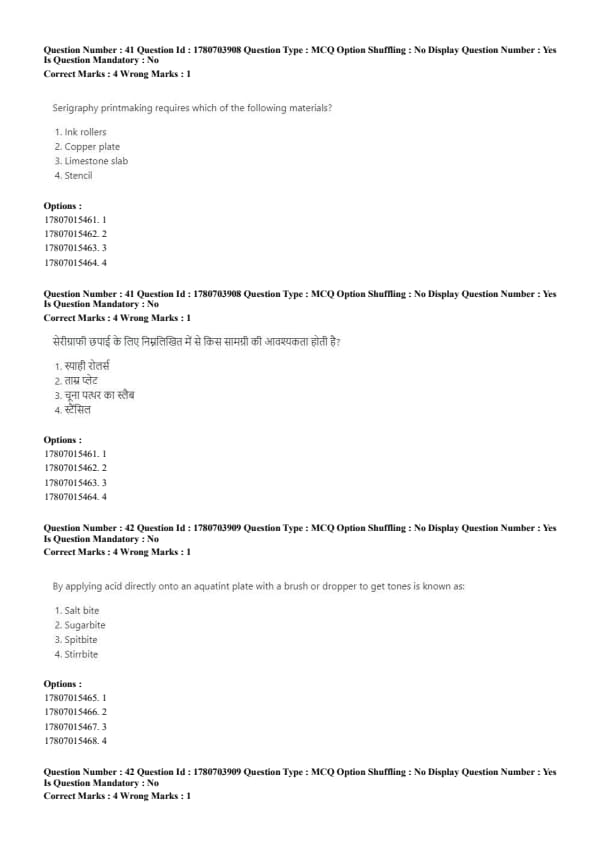
Question 41:

Serigraphy printmaking requires which of the following materials?

  • (1) Ink rollers
  • (2) Copper plate
  • (3) Limestone slab
  • (4) Stencil

Question 42:

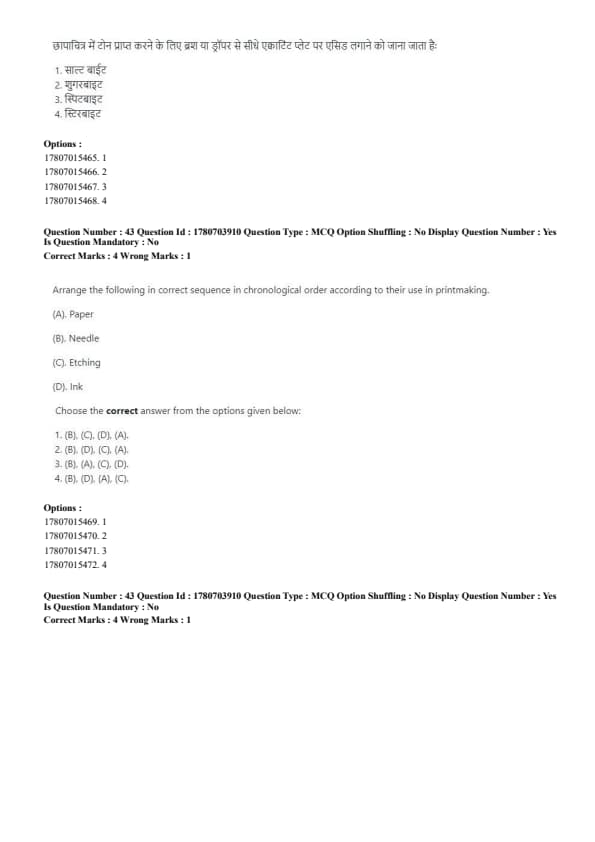
By applying acid directly onto an aquatint plate with a brush or dropper to get tones is known as:

  • (1) Salt bite
  • (2) Sugarbite
  • (3) Spitbite
  • (4) Stirrbite

Question 43:

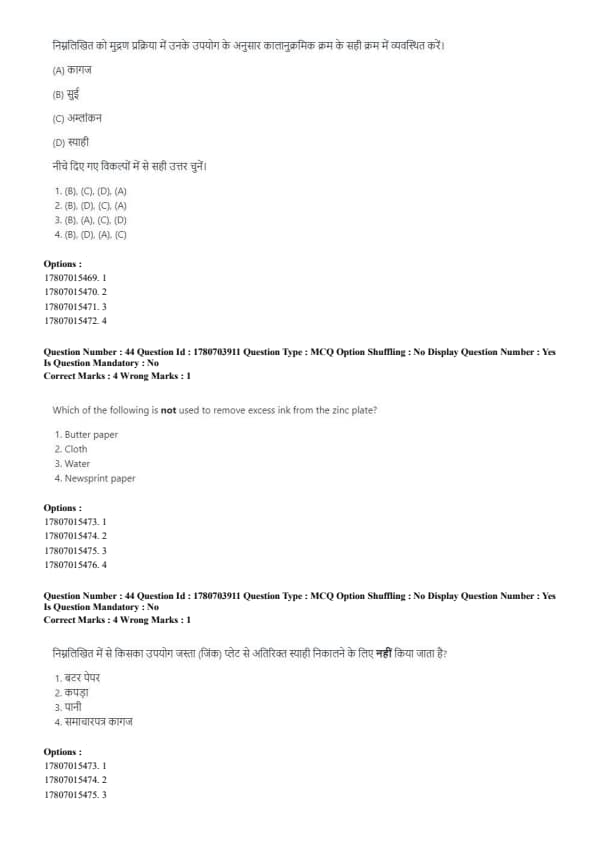
Arrange the following in correct sequence in chronological order according to their use in printmaking.

(A) Paper
(B) Needle
(C) Etching
(D) Ink

Choose the correct answer from the options given below:

  • (1) (B), (C), (D), (A).
  • (2) (B), (D), (C), (A).
  • (3) (B), (A), (C), (D).
  • (4) (B), (D), (A), (C).

Question 44:

Which of the following is not used to remove excess ink from the zinc plate?

  • (1) Butter paper
  • (2) Cloth
  • (3) Water
  • (4) Newsprint paper

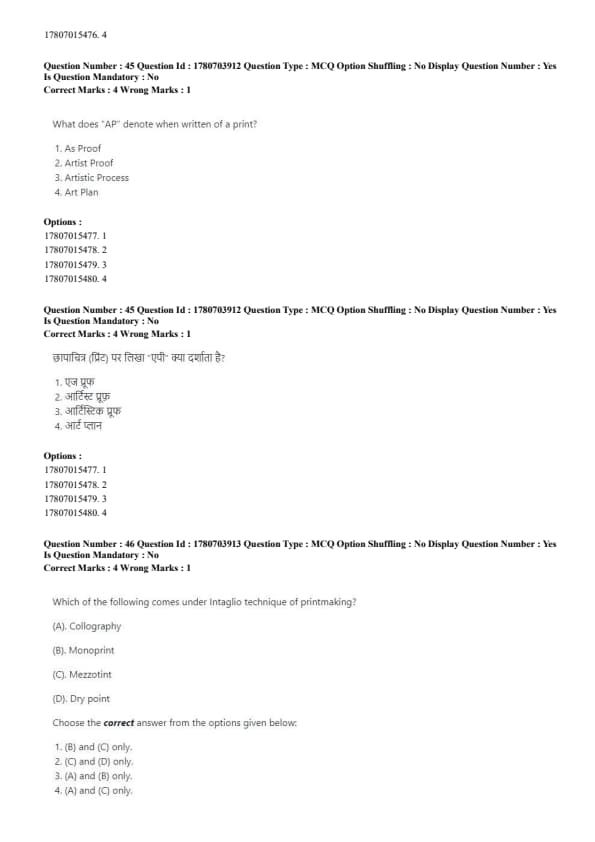
Question 45:

What does "AP" denote when written of a print?

  • (1) As Proof
  • (2) Artist Proof
  • (3) Artistic Process
  • (4) Art Plan

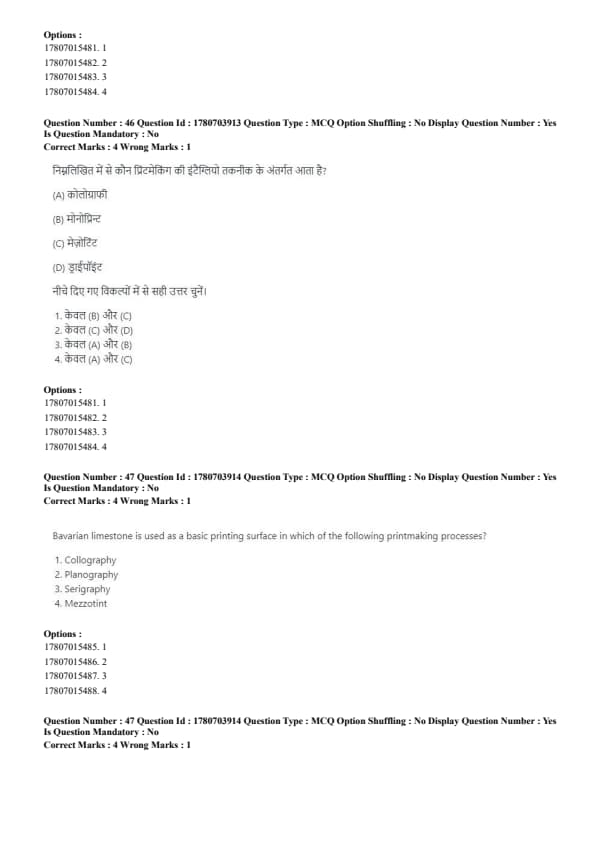
Question 46:

Which of the following comes under Intaglio technique of printmaking?

(A) . Collography
(B) . Monoprint
(C) . Mezzotint
(D) . Dry point

Choose the correct answer from the options given below:

  • (1) (B) and (C) only.
  • (2) (C) and (D) only.
  • (3) (A) and (B) only.
  • (4) (A) and (C) only.

Question 47:

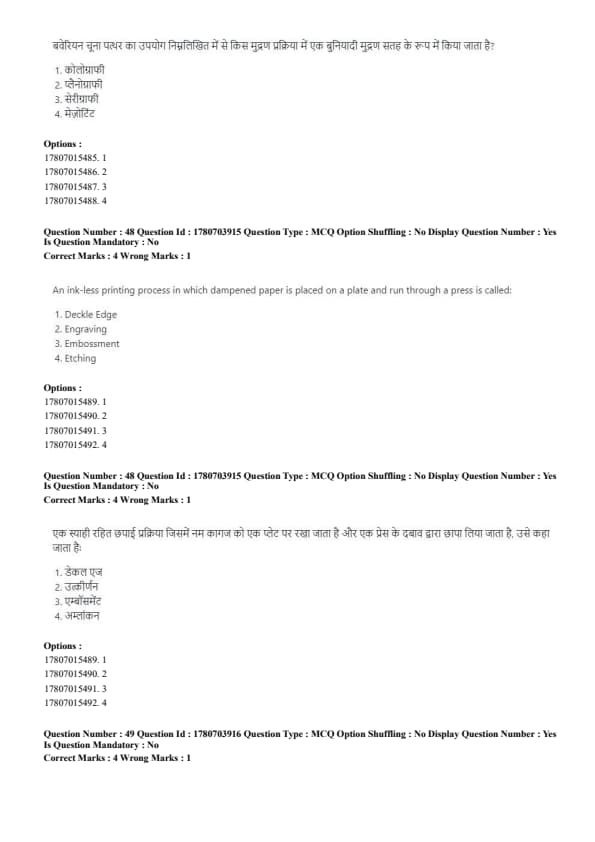
Bavarian limestone is used as a basic printing surface in which of the following printmaking processes?

  • (1) Collography
  • (2) Planography
  • (3) Serigraphy
  • (4) Mezzotint

Question 48:

An ink-less printing process in which dampened paper is placed on a plate and run through a press is called:

  • (1) Deckle Edge
  • (2) Engraving
  • (3) Embossment
  • (4) Etching

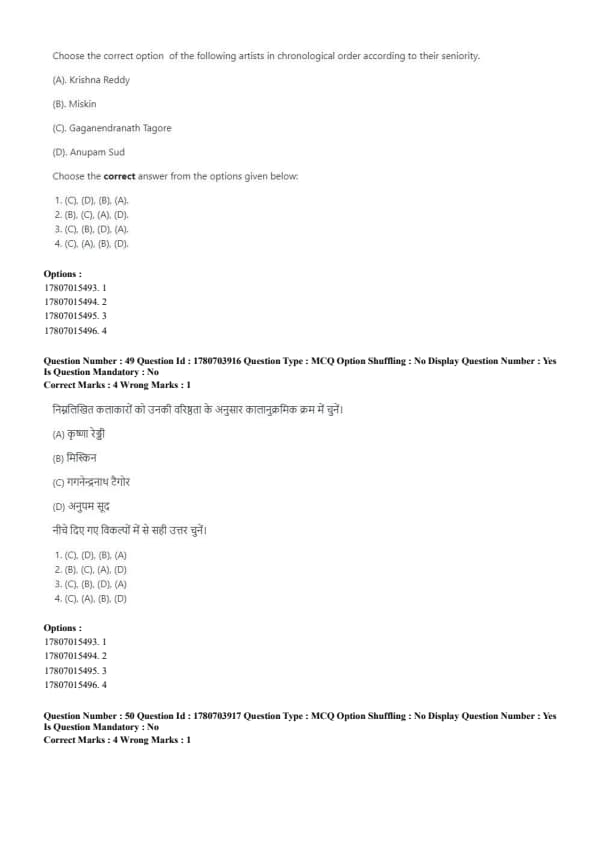
Question 49:

Choose the correct option of the following artists in chronological order according to their seniority.

(A) . Krishna Reddy
(B) . Miskin
(C) . Gaganendranath Tagore
(D) . Anupam Sud

Choose the correct answer from the options given below:

  • (1) (C), (D), (B), (A).
  • (2) (B), (C), (A), (D).
  • (3) (C), (B), (D), (A).
  • (4) (C), (A), (B), (D).

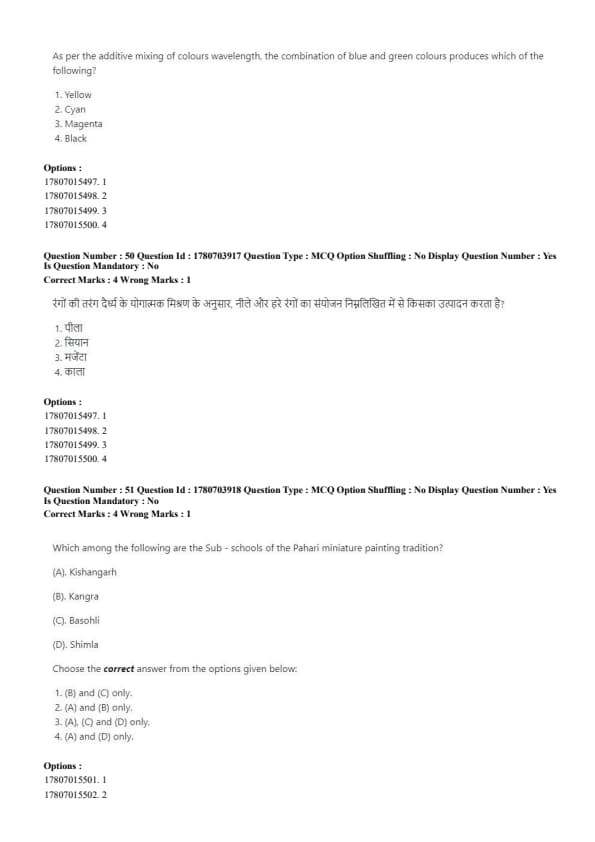
Question 50:

As per the additive mixing of colours wavelength, the combination of blue and green colours produces which of the following?

  • (1) Yellow
  • (2) Cyan
  • (3) Magenta
  • (4) Black

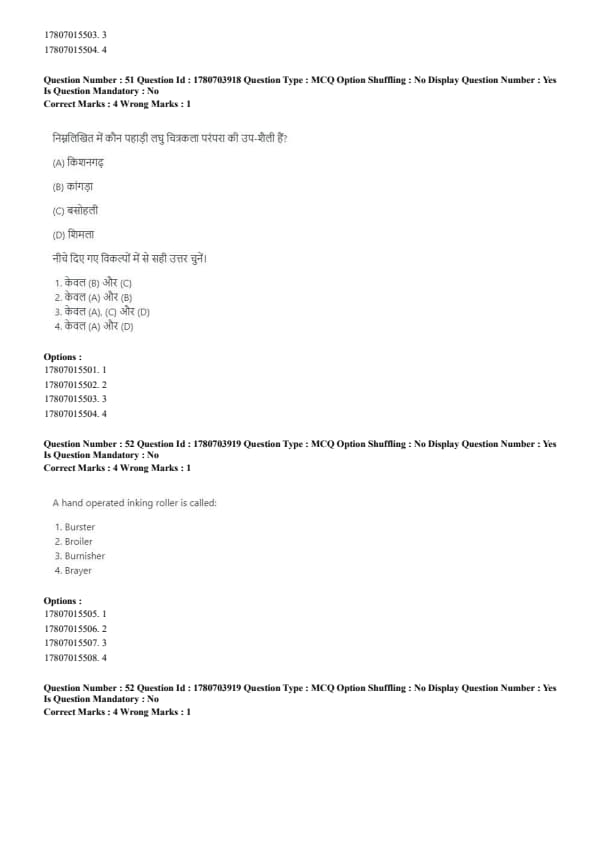
Question 51:

Which among the following are the Sub - schools of the Pahari miniature painting tradition?

(A) . Kishangarh
(B) . Kangra
(C) . Basohli
(D) . Shimla

Choose the correct answer from the options given below:

  • (1) (B) and (C) only.
  • (2) (A) and (B) only.
  • (3) (A), (C) and (D) only.
  • (4) (A) and (D) only.

Question 52:

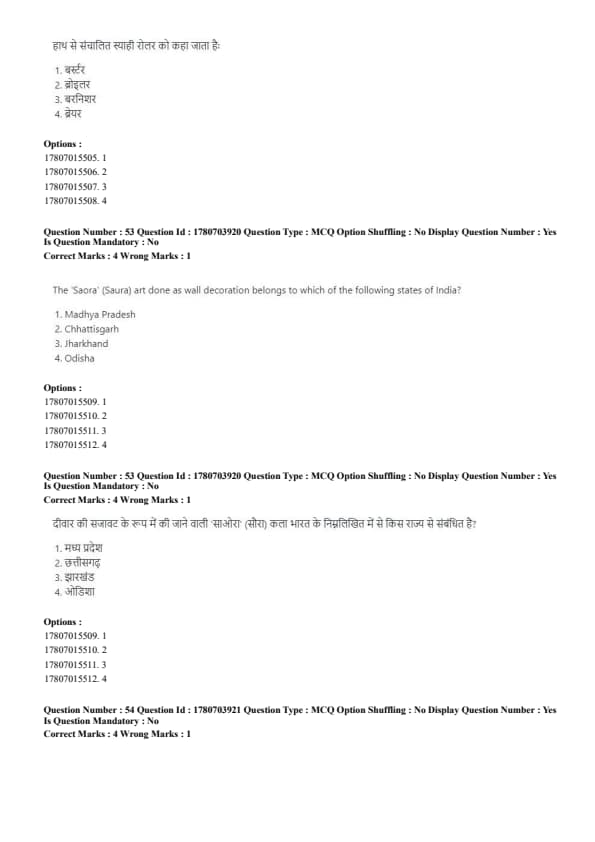
A hand operated inking roller is called:

  • (1) Burster
  • (2) Broiler
  • (3) Burnisher
  • (4) Brayer

Question 53:

The 'Saora' (Saura) art done as wall decoration belongs to which of the following states of India?

  • (1) Madhya Pradesh
  • (2) Chhattisgarh
  • (3) Jharkhand
  • (4) Odisha

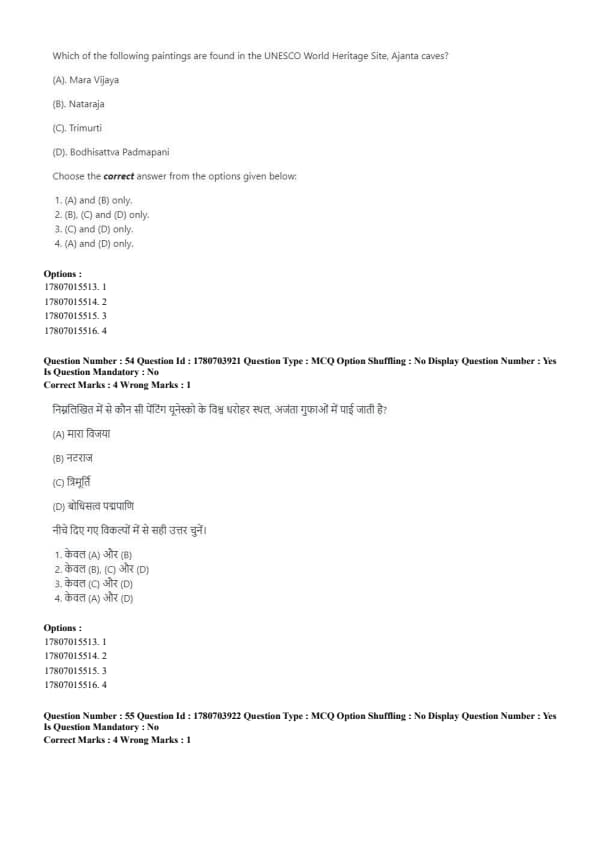
Question 54:

Which of the following paintings are found in the UNESCO World Heritage Site, Ajanta caves?

(A) . Mara Vijaya
(B) . Nataraja
(C) . Trimurti
(D) . Bodhisattva Padmapani

Choose the correct answer from the options given below:

  • (1) (A) and (B) only.
  • (2) (B), (C) and (D) only.
  • (3) (C) and (D) only.
  • (4) (A) and (D) only.

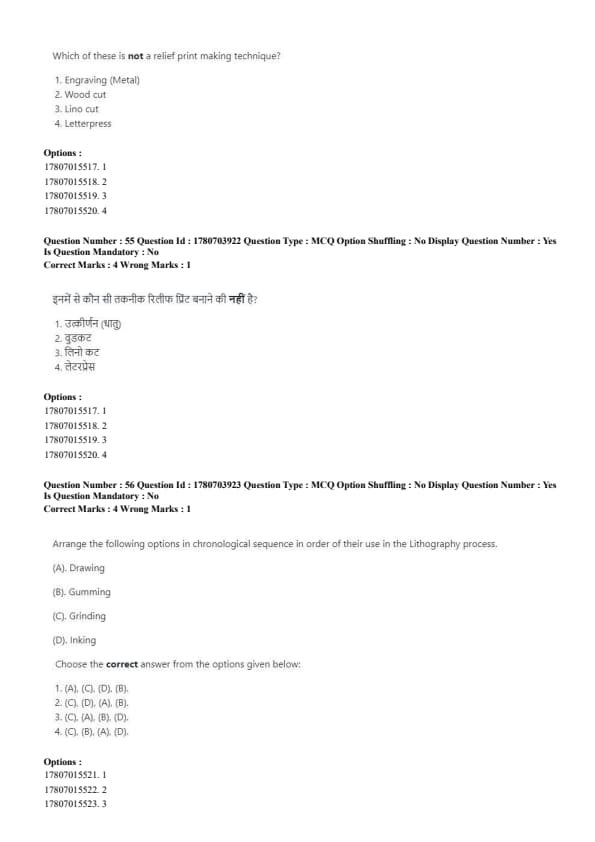
Question 55:

Which of these is not a relief print making technique?

  • (1) Engraving (Metal)
  • (2) Wood cut
  • (3) Lino cut
  • (4) Letterpress

Question 56:

Arrange the following options in chronological sequence in order of their use in the Lithography process.

(A) . Drawing
(B) . Gumming
(C) . Grinding
(D) . Inking

Choose the correct answer from the options given below:

  • (1) (A), (C), (D), (B).
  • (2) (C), (D), (A), (B).
  • (3) (C), (A), (B), (D).
  • (4) (C), (B), (A), (D).

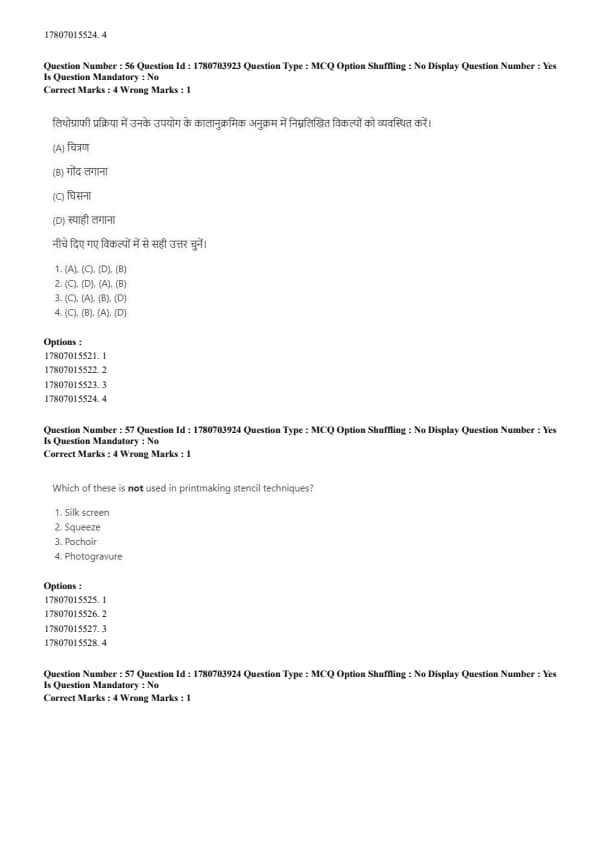
Question 57:

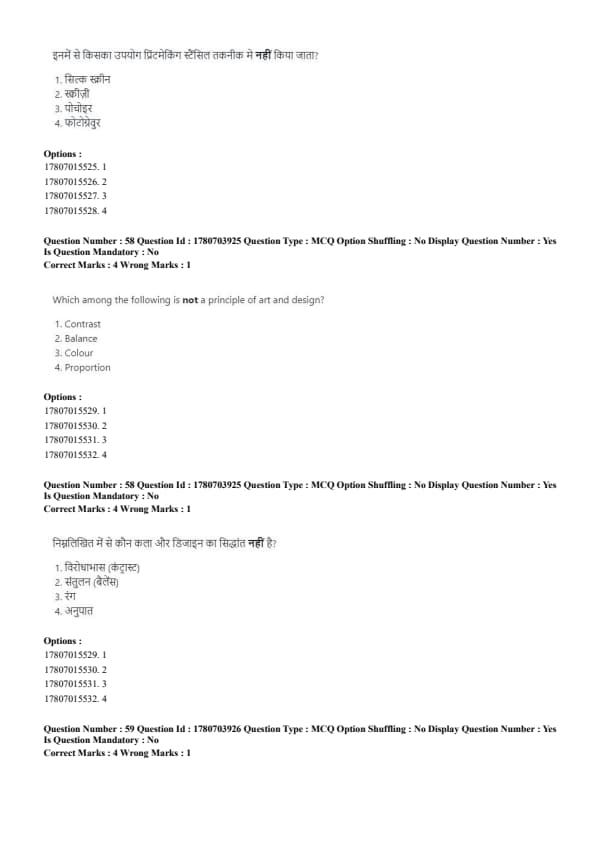
Which of these is not used in printmaking stencil techniques?

  • (1) Silk screen
  • (2) Squeeze
  • (3) Pochoir
  • (4) Photogravure

Question 58:

Which among the following is not a principle of art and design?

  • (1) Contrast
  • (2) Balance
  • (3) Colour
  • (4) Proportion

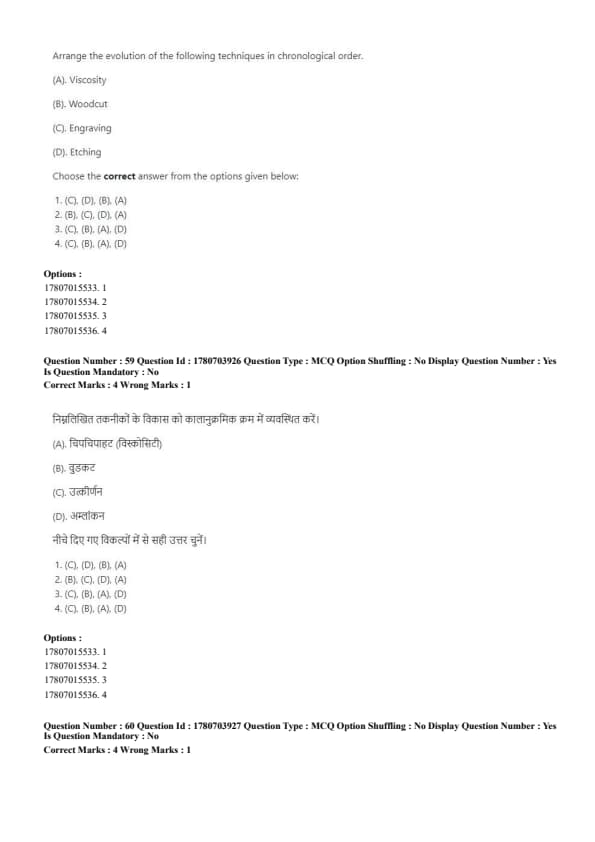
Question 59:

Arrange the evolution of the following techniques in chronological order.

(A) . Viscosity
(B) . Woodcut
(C) . Engraving
(D) . Etching

Choose the correct answer from the options given below:

  • (1) (C), (D), (B), (A)
  • (2) (B), (C), (D), (A)
  • (3) (C), (B), (A), (D)
  • (4) (C), (B), (A), (D)

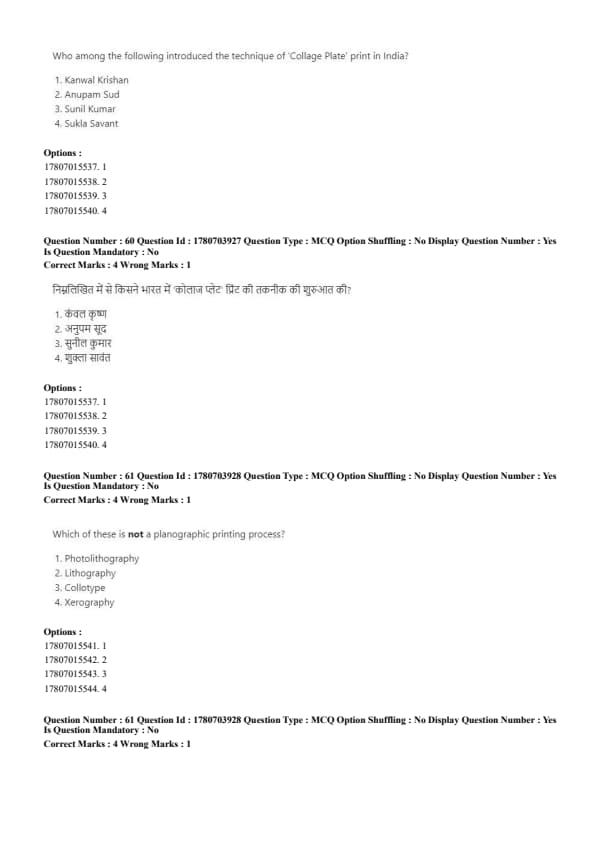
Question 60:

Who among the following introduced the technique of 'Collage Plate' print in India?

  • (1) Kanwal Krishan
  • (2) Anupam Sud
  • (3) Sunil Kumar
  • (4) Sukla Savant

Question 61:

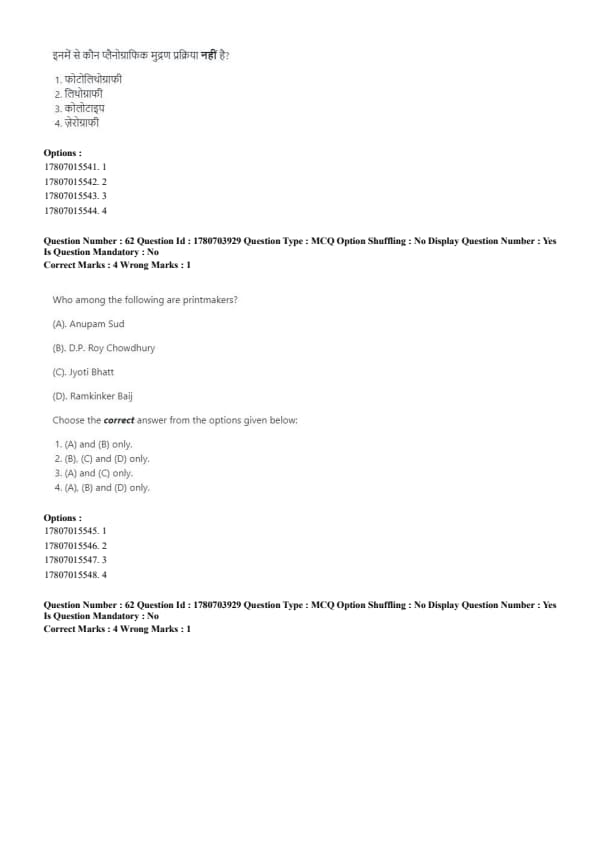
Which of these is not a planographic printing process?

  • (1) Photolithography
  • (2) Lithography
  • (3) Collotype
  • (4) Xerography

Question 62:

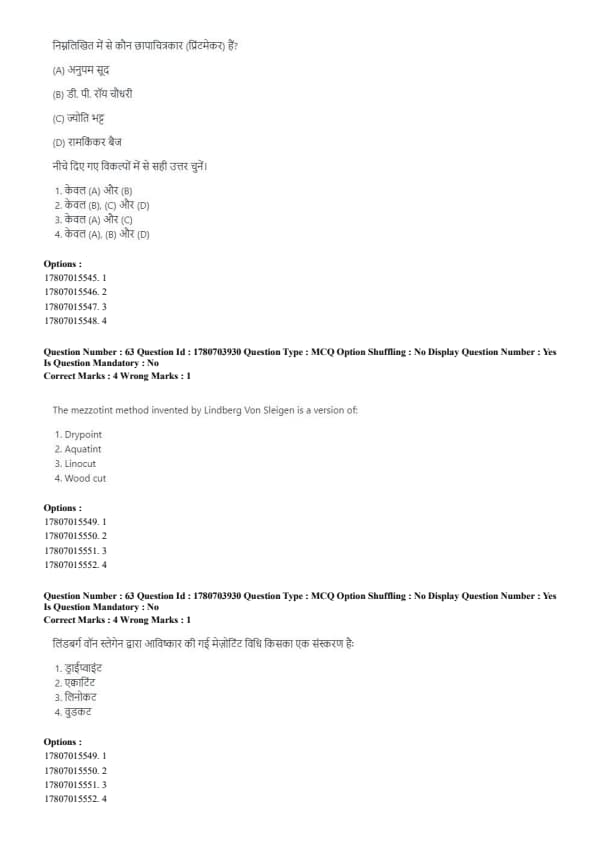
Who among the following are printmakers?

(A) . Anupam Sud
(B) . D.P. Roy Chowdhury
(C) . Jyoti Bhatt
(D) . Ramkinker Baij

Choose the correct answer from the options given below:

  • (1) (A) and (B) only.
  • (2) (B), (C) and (D) only.
  • (3) (A) and (C) only.
  • (4) (A), (B) and (D) only.

Question 63:

The mezzotint method invented by Lindberg Von Sleigen is a version of:

  • (1) Drypoint
  • (2) Aquatint
  • (3) Linocut
  • (4) Wood cut

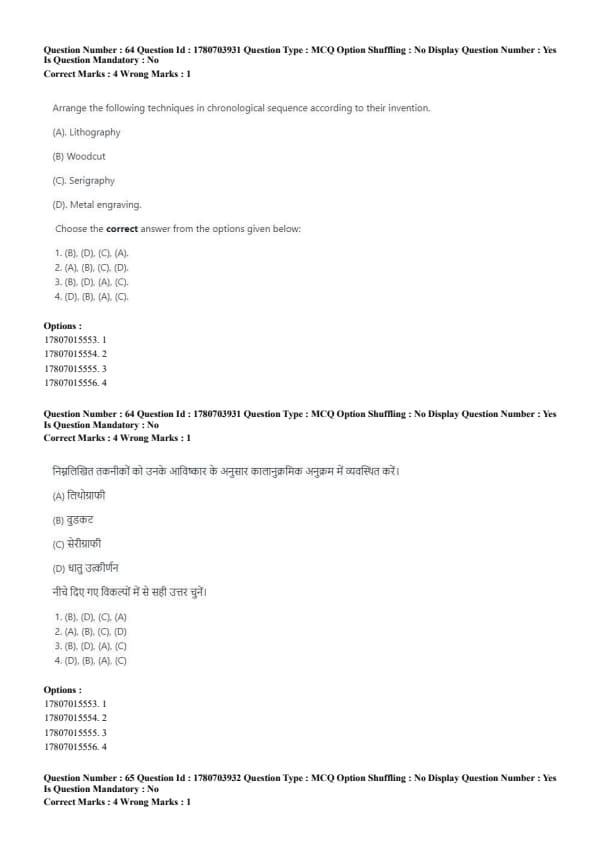
Question 64:

Arrange the following techniques in chronological sequence according to their invention.

(A) . Lithography
(B) . Woodcut
(C) . Serigraphy
(D) . Metal engraving

Choose the correct answer from the options given below:

  • (1) (B), (D), (C), (A).
  • (2) (A), (B), (C), (D).
  • (3) (B), (D), (A), (C).
  • (4) (D), (B), (A), (C).

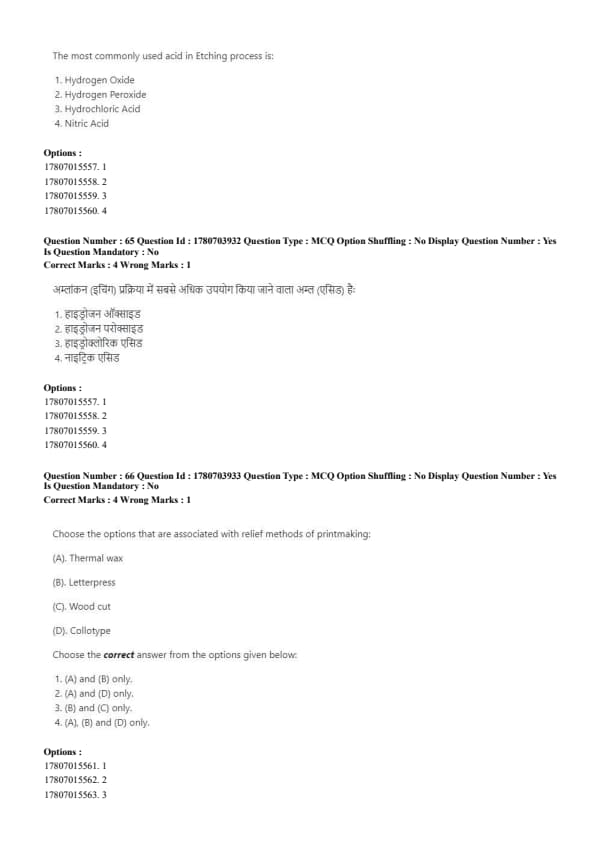
Question 65:

The most commonly used acid in Etching process is:

  • (1) Hydrogen Oxide
  • (2) Hydrogen Peroxide
  • (3) Hydrochloric Acid
  • (4) Nitric Acid

Question 66:

Choose the options that are associated with relief methods of printmaking:

(A) . Thermal wax
(B) . Letterpress
(C) . Wood cut
(D) . Collotype

Choose the correct answer from the options given below:

  • (1) (A) and (B) only.
  • (2) (A) and (D) only.
  • (3) (B) and (C) only.
  • (4) (A), (B) and (D) only.

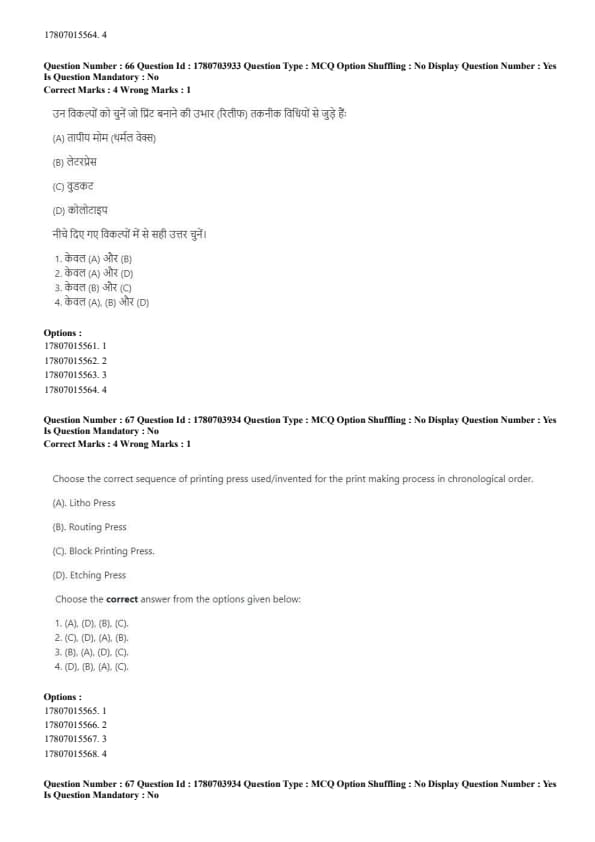
Question 67:

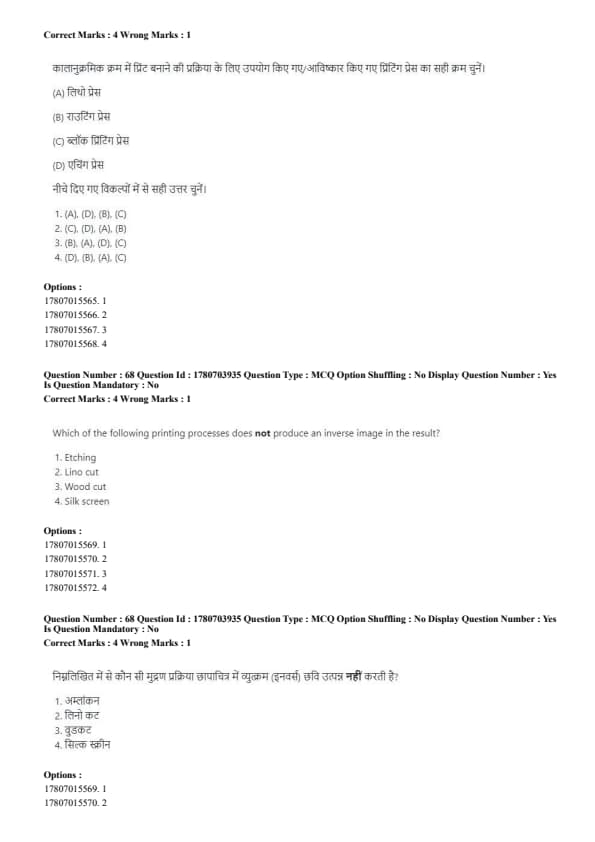
Choose the correct sequence of printing press used/invented for the print making process in chronological order.

(A) . Litho Press
(B) . Routing Press
(C) . Block Printing Press
(D) . Etching Press

Choose the correct answer from the options given below:

  • (1) (A), (D), (B), (C).
  • (2) (C), (D), (A), (B).
  • (3) (B), (A), (D), (C).
  • (4) (D), (B), (A), (C).

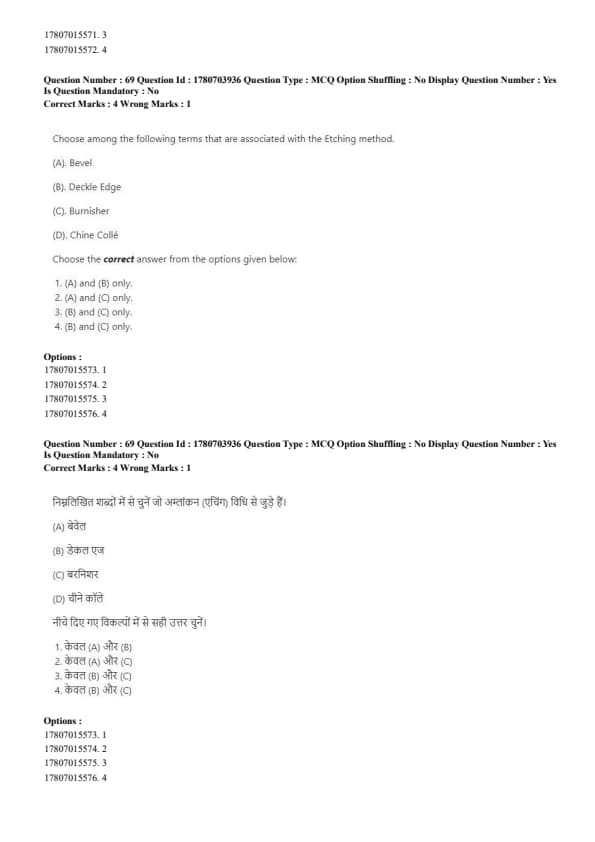
Question 68:

Which of the following printing processes does not produce an inverse image in the result?

  • (1) Etching
  • (2) Lino cut
  • (3) Wood cut
  • (4) Silk screen

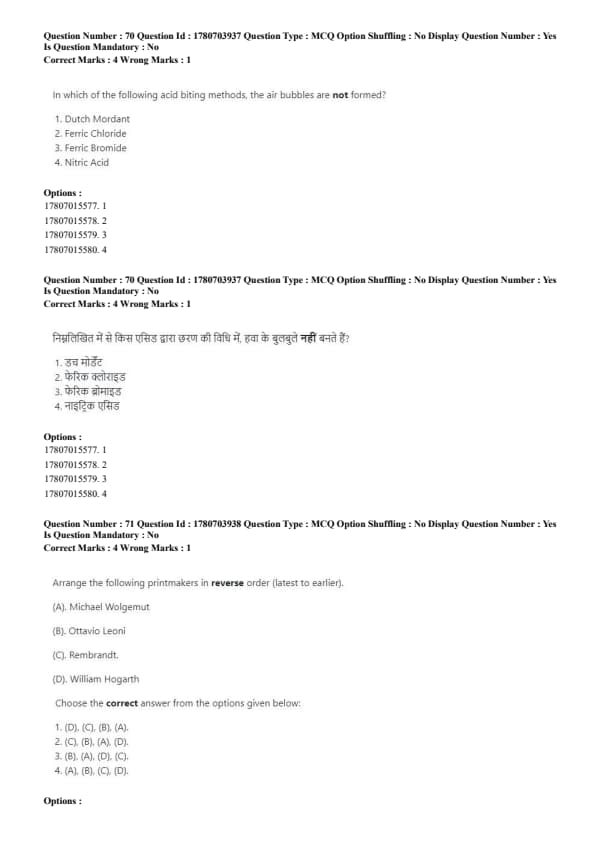
Question 69:

Choose among the following terms that are associated with the Etching method.

(A) . Bevel
(B) . Deckle Edge
(C) . Burnisher
(D) . Chine Collé

Choose the correct answer from the options given below:

  • (1) (A) and (B) only.
  • (2) (A) and (C) only.
  • (3) (B) and (C) only.
  • (4) (B) and (D) only.

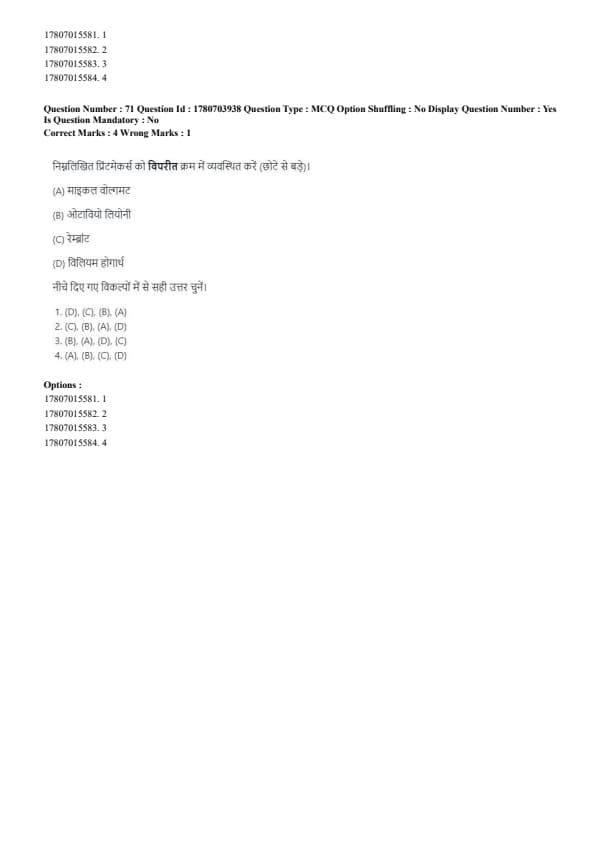
Question 70:

In which of the following acid biting methods, the air bubbles are not formed?

  • (1) Dutch Mordant
  • (2) Ferric Chloride
  • (3) Ferric Bromide
  • (4) Nitric Acid

Question 71:

Arrange the following printmakers in reverse order (latest to earlier).

(A) . Michael Wolgemut
(B) . Ottavio Leoni
(C) . Rembrandt
(D) . William Hogarth

Choose the correct answer from the options given below:

  • (1) (D), (C), (B), (A).
  • (2) (C), (B), (A), (D).
  • (3) (B), (A), (D), (C).
  • (4) (A), (B), (C), (D).

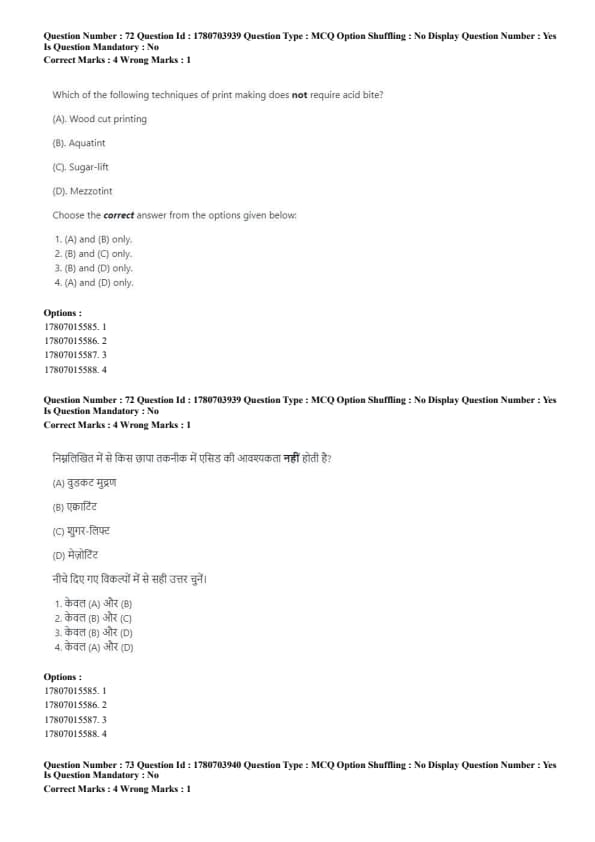
Question 72:

Which of the following techniques of print making does not require acid bite?

(A) . Wood cut printing
(B) . Aquatint
(C) . Sugar-lift
(D) . Mezzotint

Choose the correct answer from the options given below:

  • (1) (A) and (B) only.
  • (2) (B) and (C) only.
  • (3) (B) and (D) only.
  • (4) (A) and (D) only.

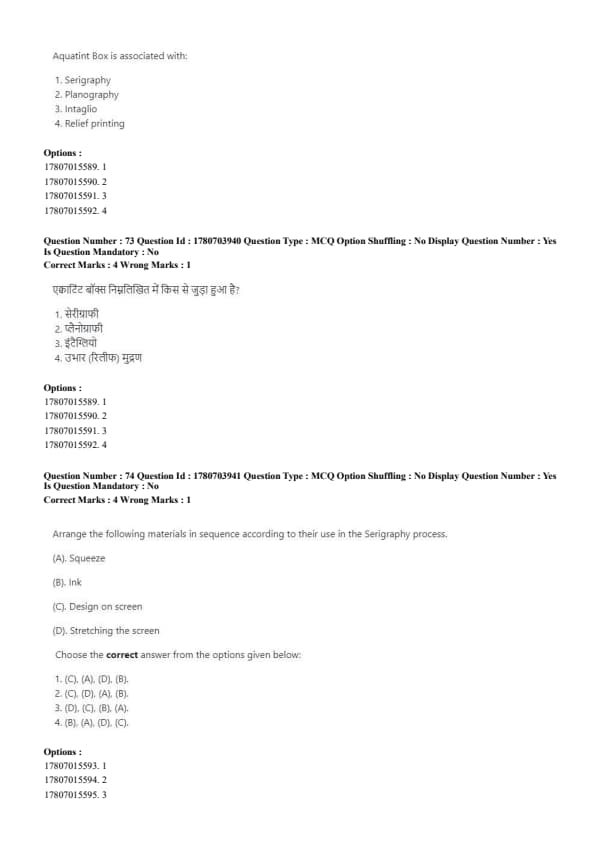
Question 73:

Aquatint Box is associated with:

  • (1) Serigraphy
  • (2) Planography
  • (3) Intaglio
  • (4) Relief printing

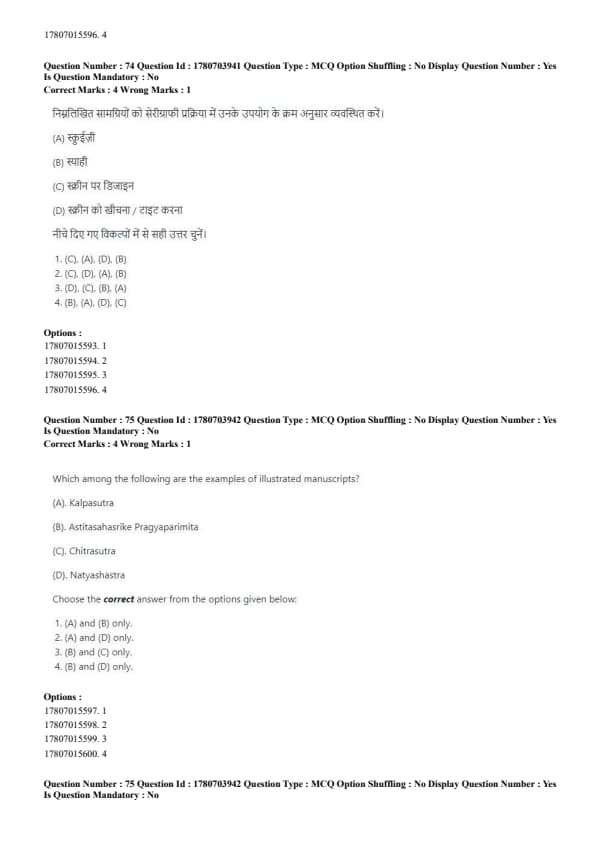
Question 74:

Arrange the following materials in sequence according to their use in the Serigraphy process.

(A) . Squeeze
(B) . Ink
(C) . Design on screen
(D) . Stretching the screen

Choose the correct answer from the options given below:

  • (1) (C), (A), (D), (B).
  • (2) (C), (D), (A), (B).
  • (3) (D), (C), (B), (A).
  • (4) (B), (A), (D), (C).

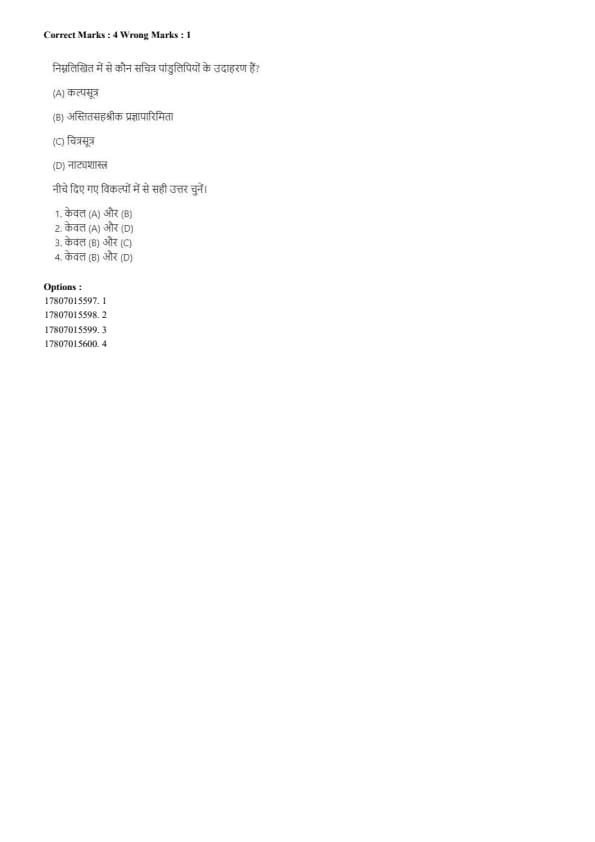
Question 75:

Which among the following are the examples of illustrated manuscripts?

(A) . Kalpasutra
(B) . Astasahasrika Prajnaparamita
(C) . Chitrasutra
(D) . Natyashastra

Choose the correct answer from the options given below:
  • (1) (A) and (B) only.
  • (2) (A) and (D) only.
  • (3) (B) and (C) only.
  • (4) (B) and (D) only.