




The CUET PG Plant Biotechnology exam for 2025 will be conducted between 13th May and 3rd June, as part of the CUET PG exam window. Candidates can download the official question paper, answer key, and complete solution PDF after the exam concludes. The exam assesses topics such as plant tissue culture, genetic engineering in plants, molecular markers, transgenic crops, genomics, and bioinformatics applications in plant research.
The format includes 75 objective questions to be attempted in 60 minutes, with +4 for correct answers and -1 for incorrect answers.
CUET PG Plant Biotechnology 2025 Question Paper with Solutions PDF
| CUET PG Plant Biotechnology Question Paper with Solutions PDF | Download PDF | Check Solutions |
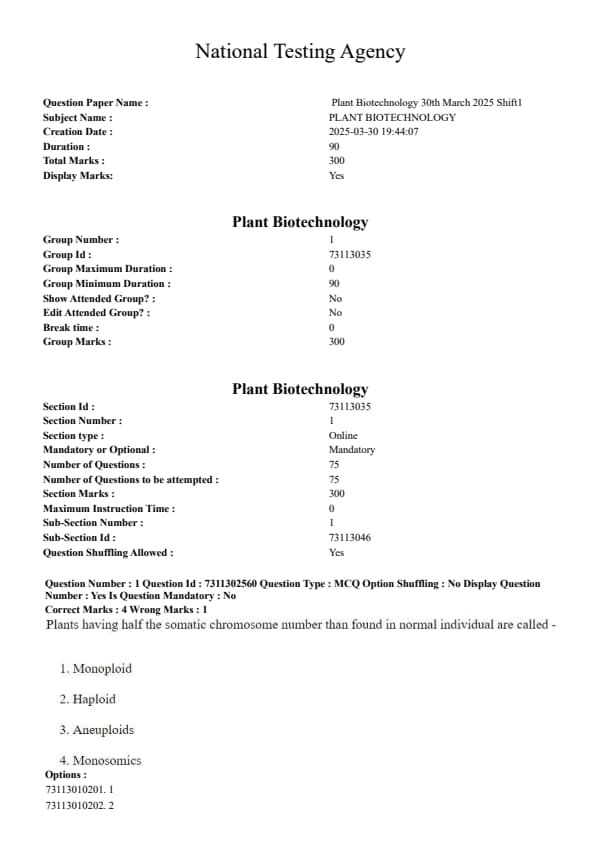
Plants having half the somatic chromosome number than found in normal individual are called -
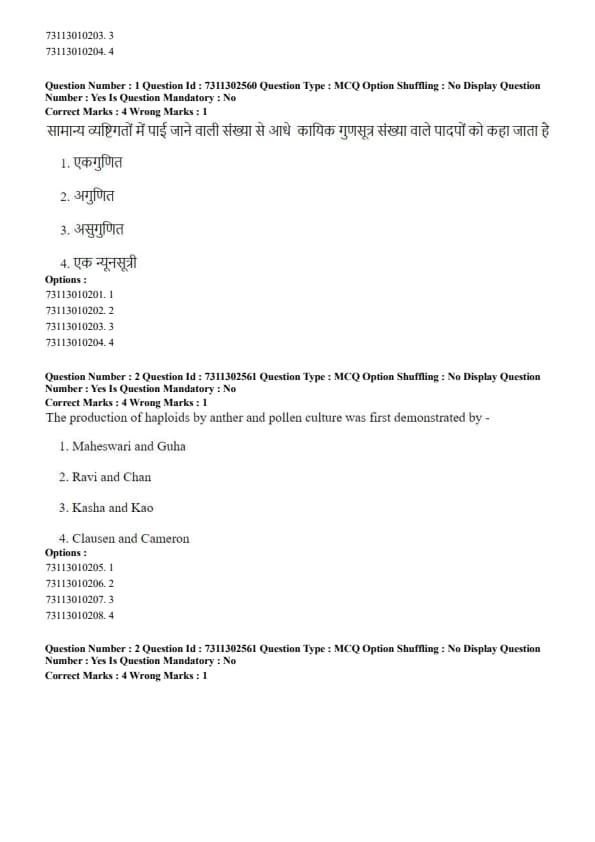
The production of haploids by anther and pollen culture was first demonstrated by -
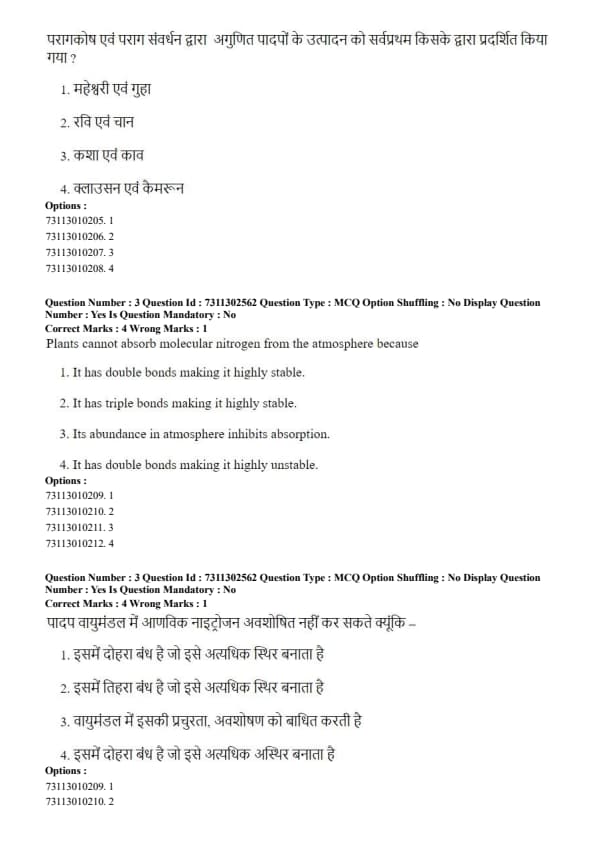
Plants cannot absorb molecular nitrogen from the atmosphere because
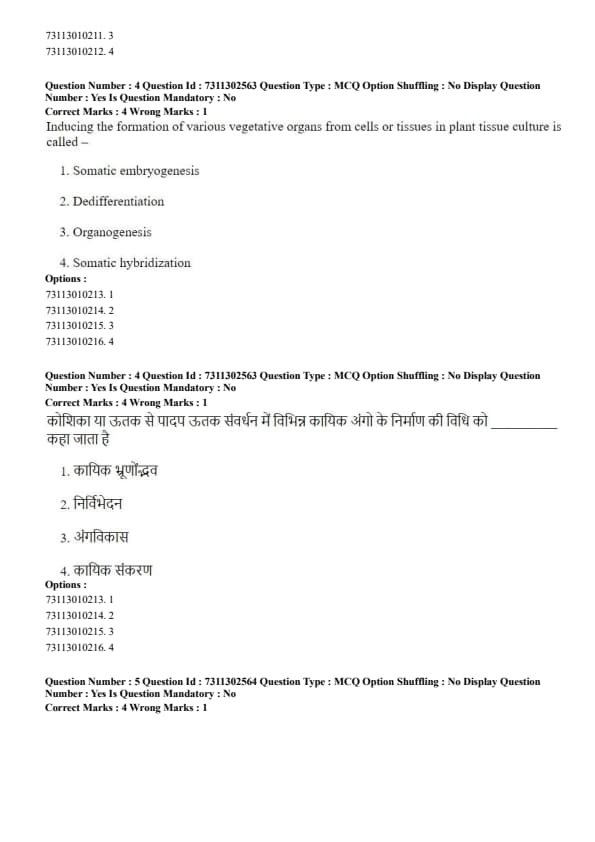
Inducing the formation of various vegetative organs from cells or tissues in plant tissue culture is called -
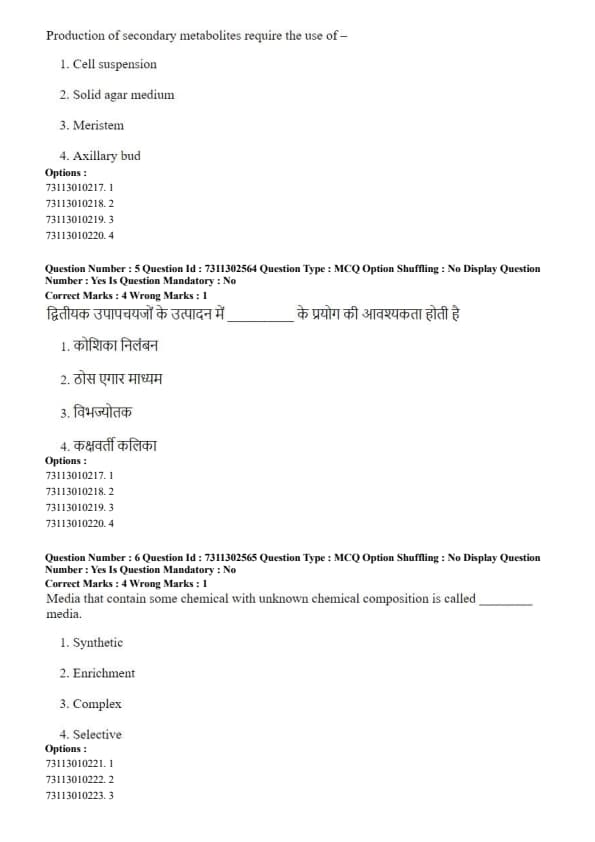
Production of secondary metabolites require the use of -
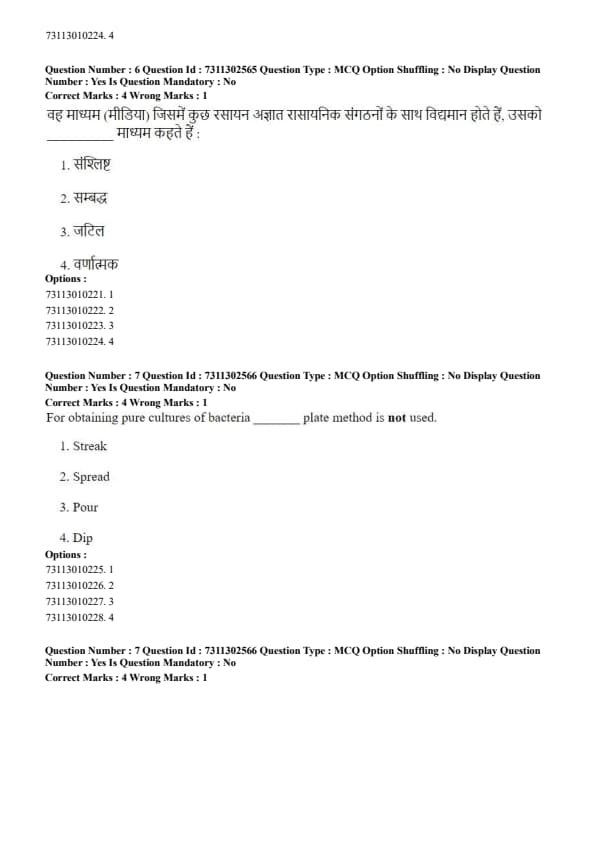
Media that contain some chemical with unknown chemical composition is called ____________ media.
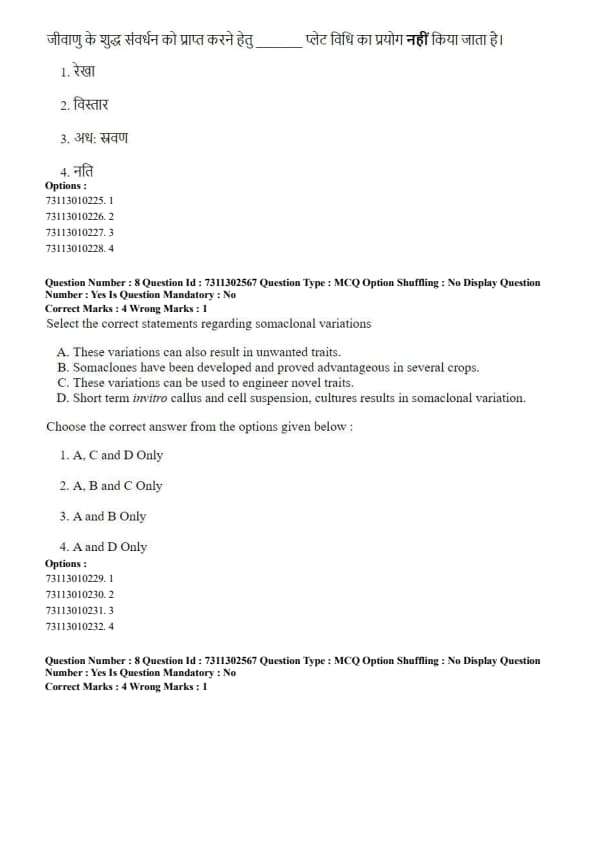
For obtaining pure cultures of bacteria ____________ plate method is not used.
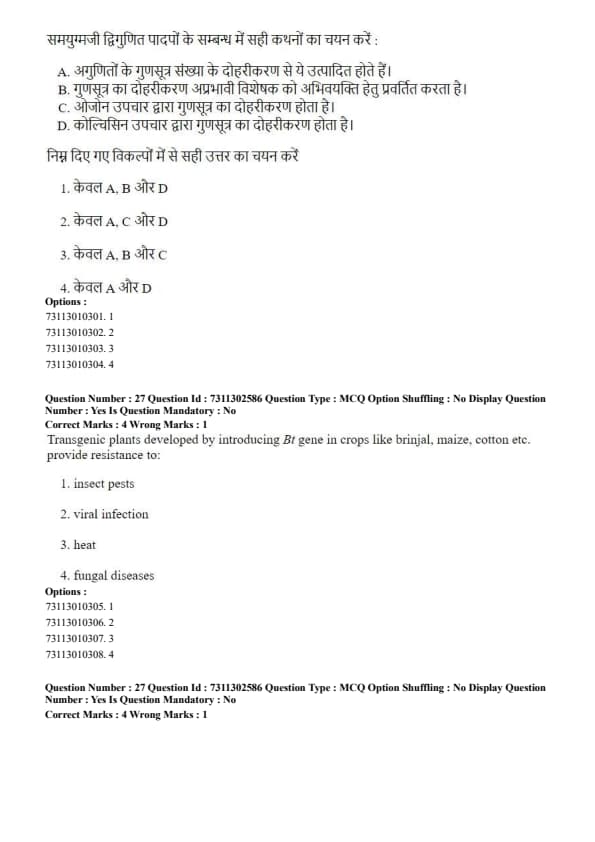
Select the correct statements regarding somaclonal variations
A. These variations can also result in unwanted traits.
B. Somaclones have been developed and proved advantageous in several crops.
C. These variations can be used to engineer novel traits.
D. Short term invitro callus and cell suspension, cultures results in somaclonal variation.
Choose the correct answer from the options given below :
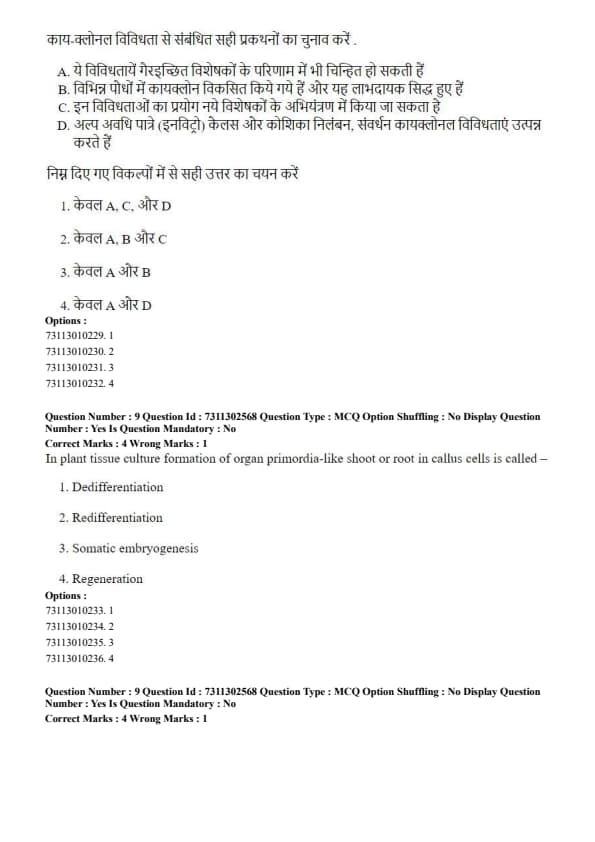
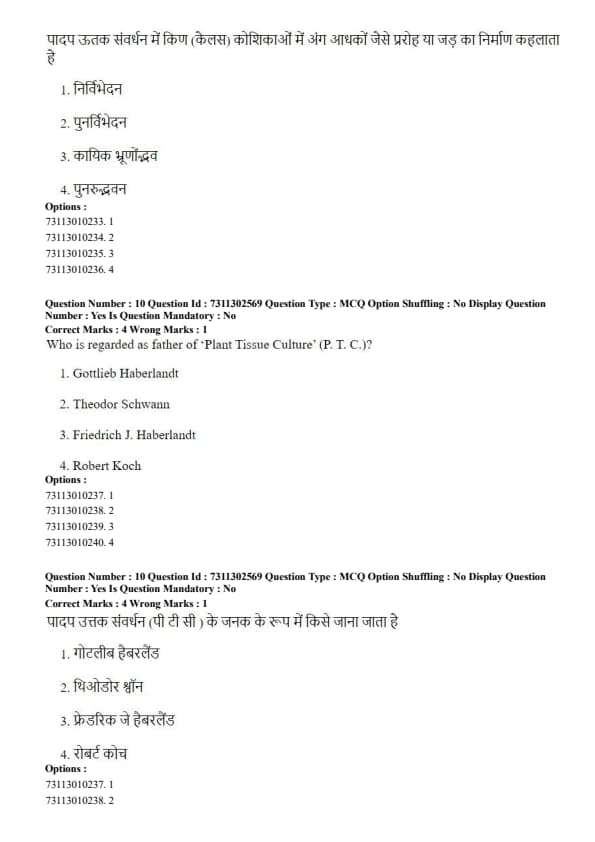
In plant tissue culture formation of organ primordia-like shoot or root in callus cells is called -
Who is regarded as father of 'Plant Tissue Culture' (P. T. C.)?
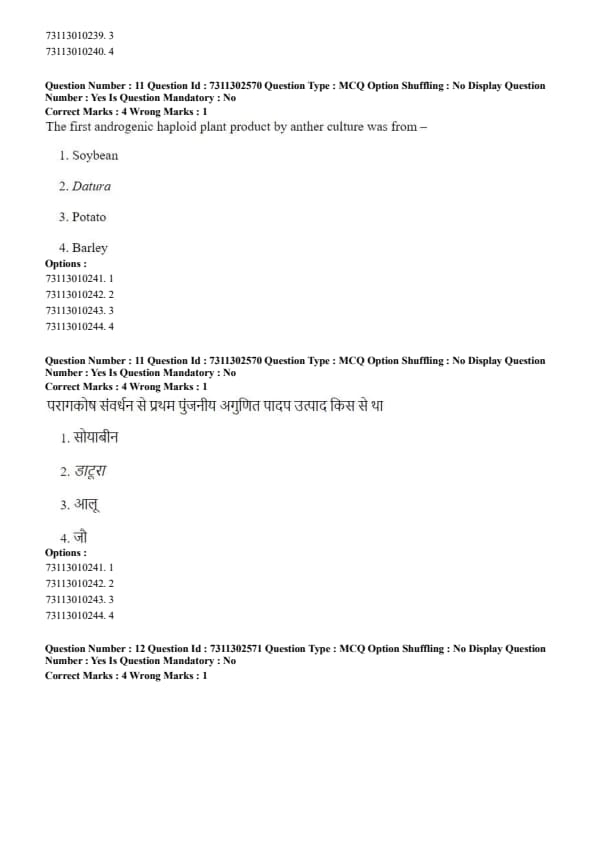
The first androgenic haploid plant product by anther culture was from -
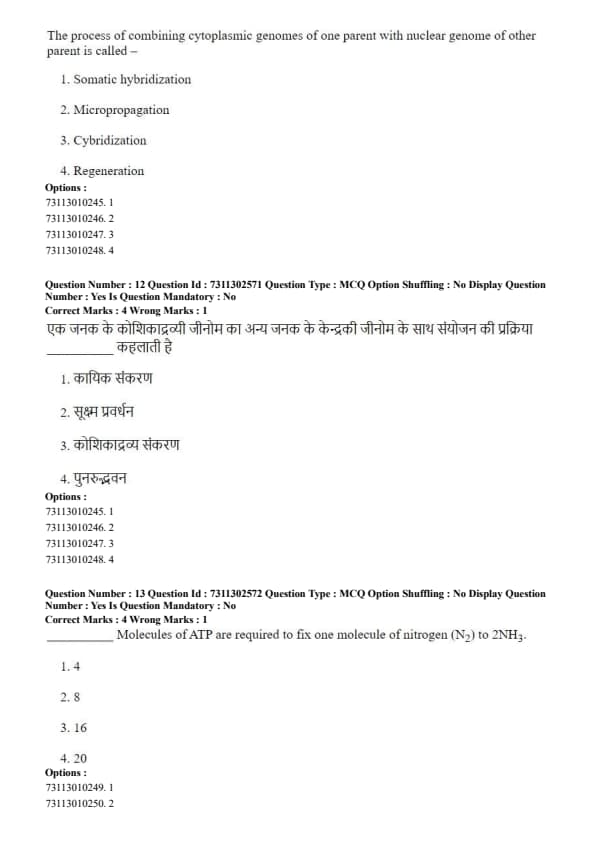
The process of combining cytoplasmic genomes of one parent with nuclear genome of other parent is called -
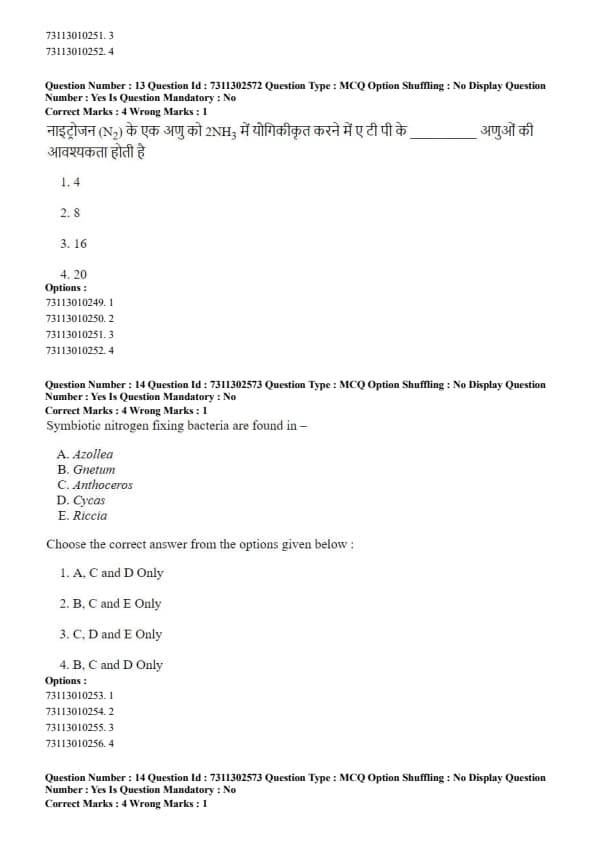
____________ Molecules of ATP are required to fix one molecule of nitrogen (N2) to 2NH3.
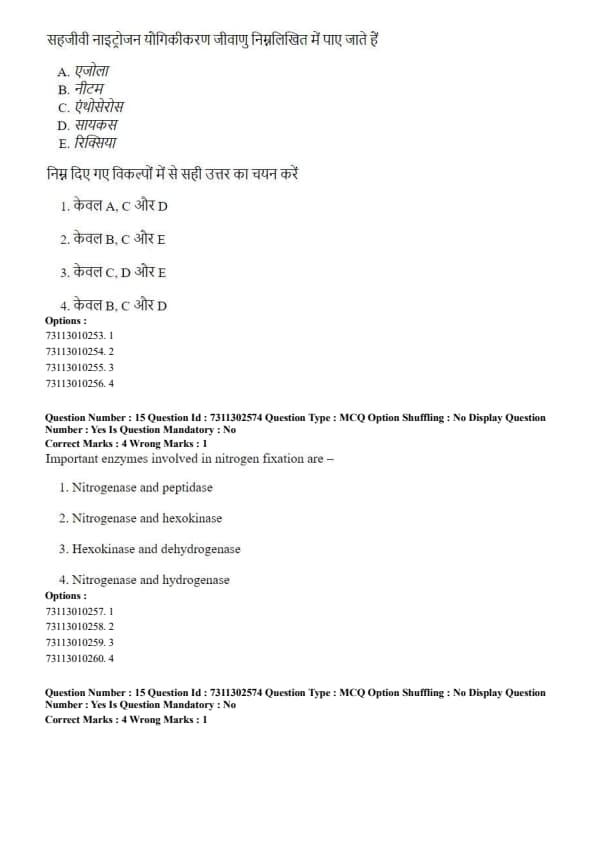
Symbiotic nitrogen fixing bacteria are found in -
A. Azolla
B. Gnetum
C. Anthoceros
D. Cycas
E. Riccia
Choose the correct answer from the options given below :
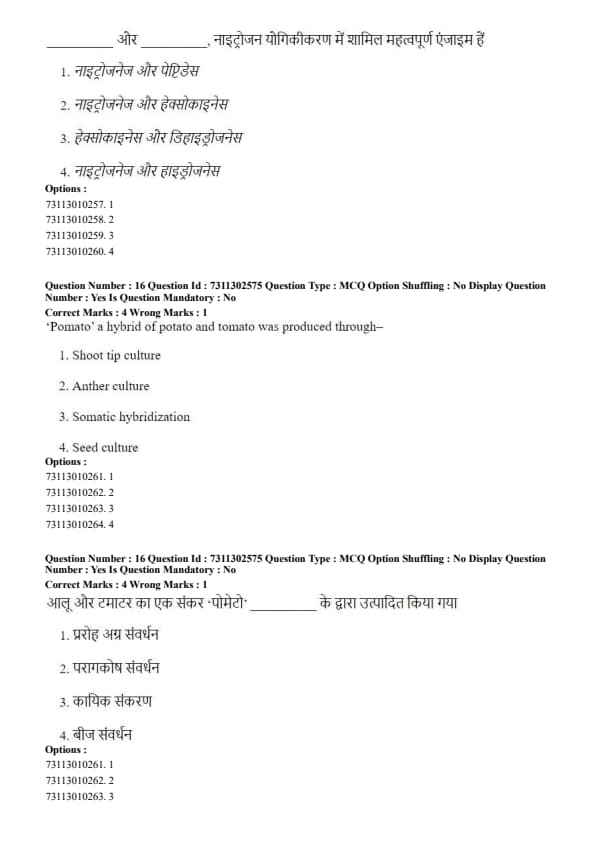
Important enzymes involved in nitrogen fixation are -
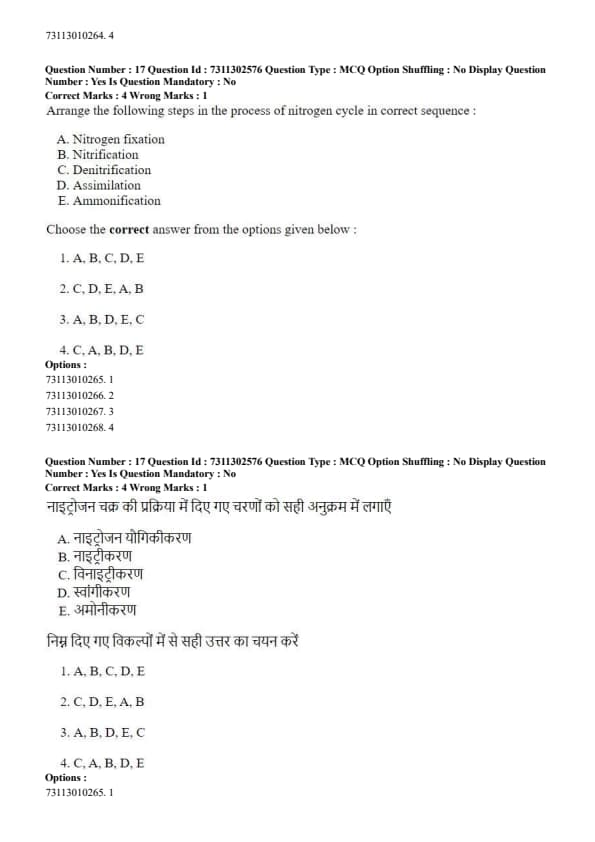
'Pomato' a hybrid of potato and tomato was produced through-
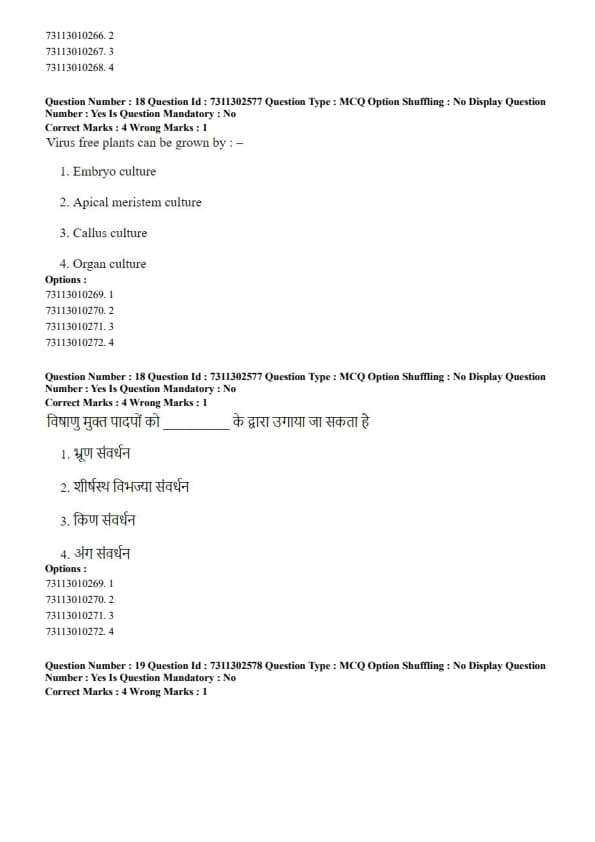
Arrange the following steps in the process of nitrogen cycle in correct sequence:
A. Nitrogen fixation
B. Nitrification
C. Denitrification
D. Assimilation
E. Ammonification
Choose the correct answer from the options given below :
Virus free plants can be grown by : -
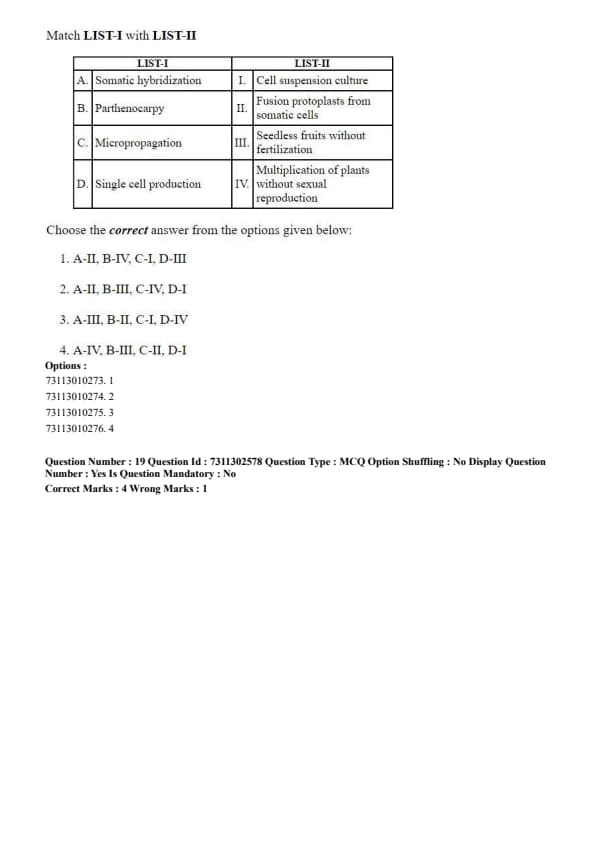
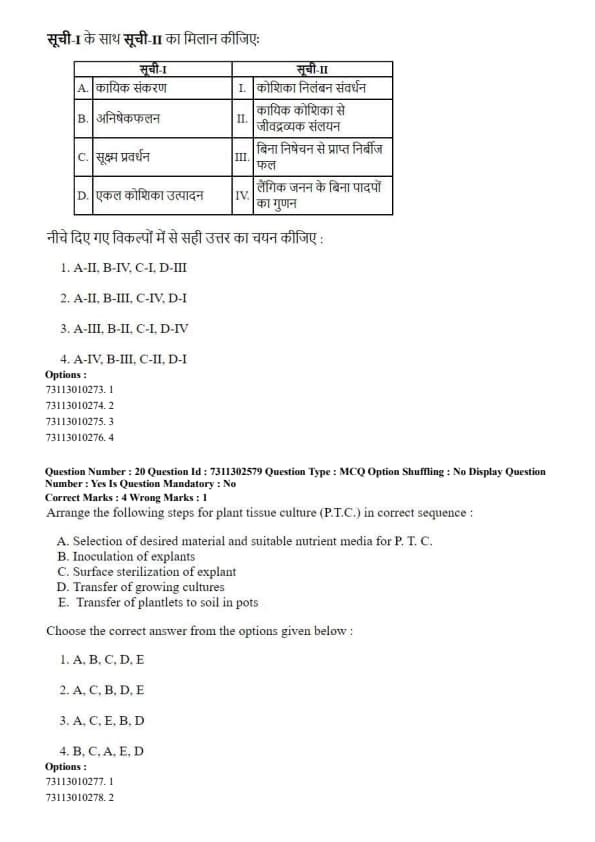
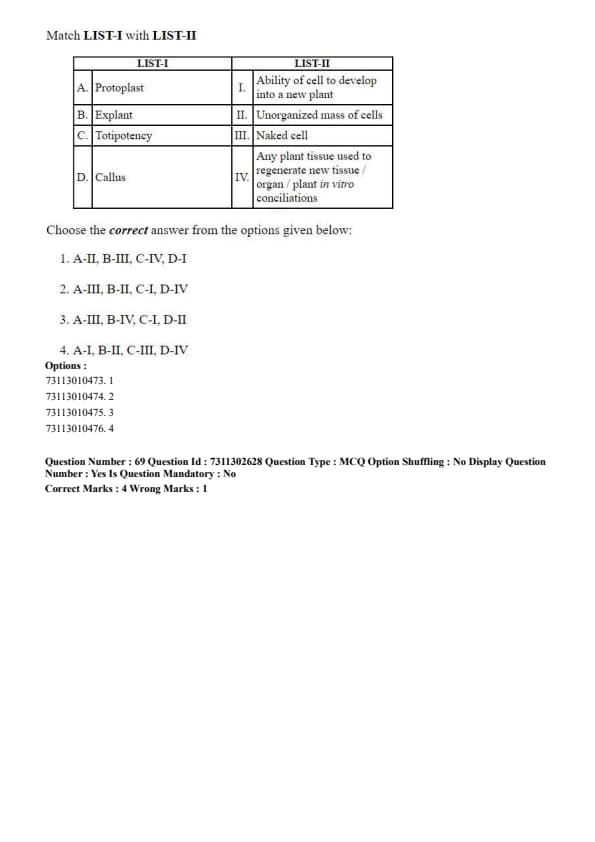
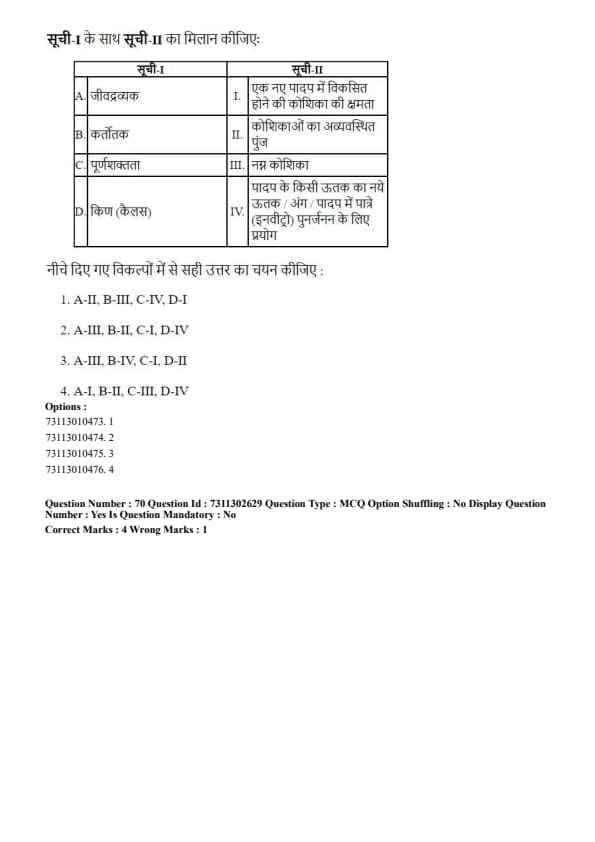
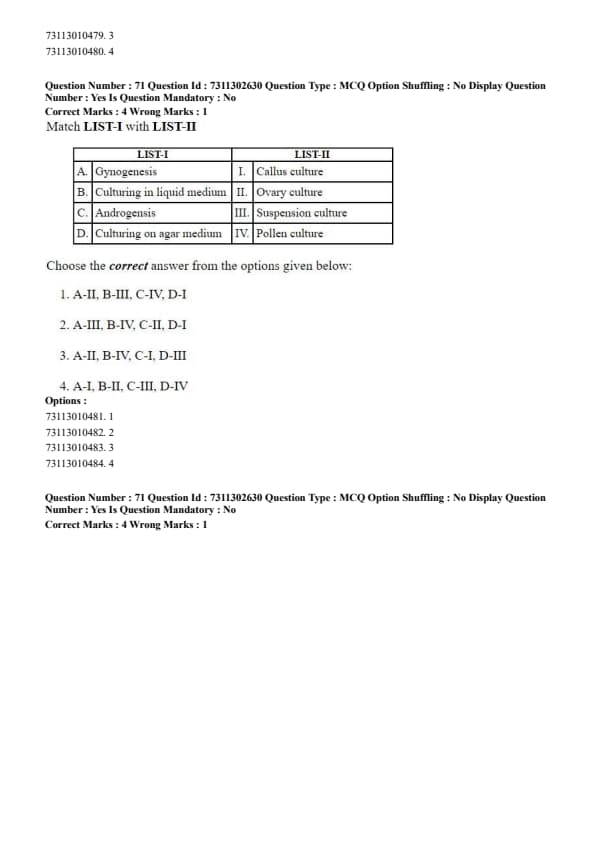
Match LIST-I with LIST-II

Choose the correct answer from the options given below:
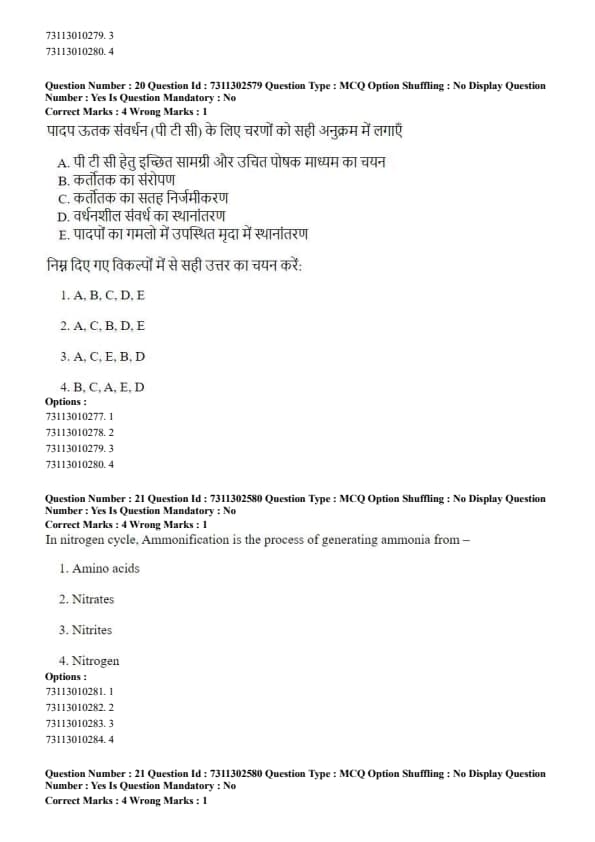
Arrange the following steps for plant tissue culture (P.T.C.) in correct sequence:
A. Selection of desired material and suitable nutrient media for P. T. C.
B. Inoculation of explants
C. Surface sterilization of explant
D. Transfer of growing cultures
E. Transfer of plantlets to soil in pots
Choose the correct answer from the options given below :
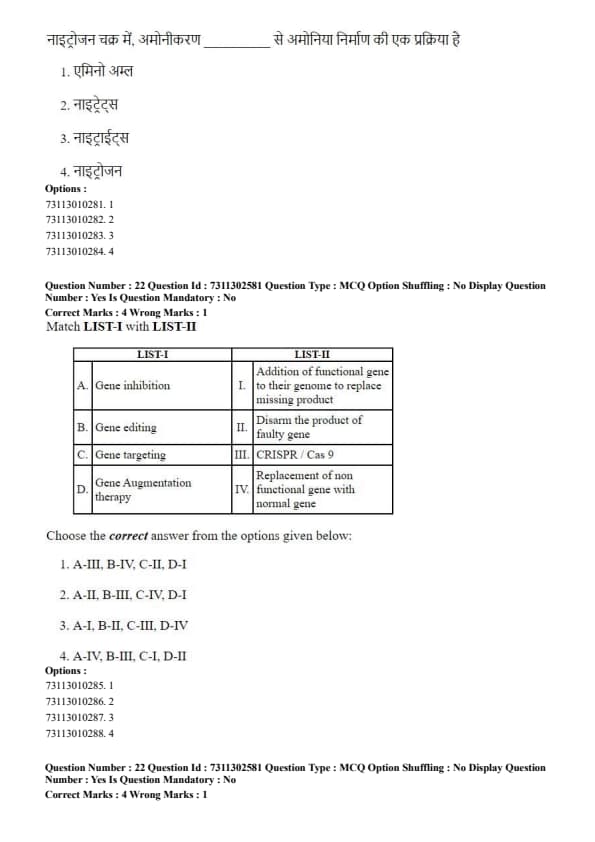
In nitrogen cycle, Ammonification is the process of generating ammonia from-
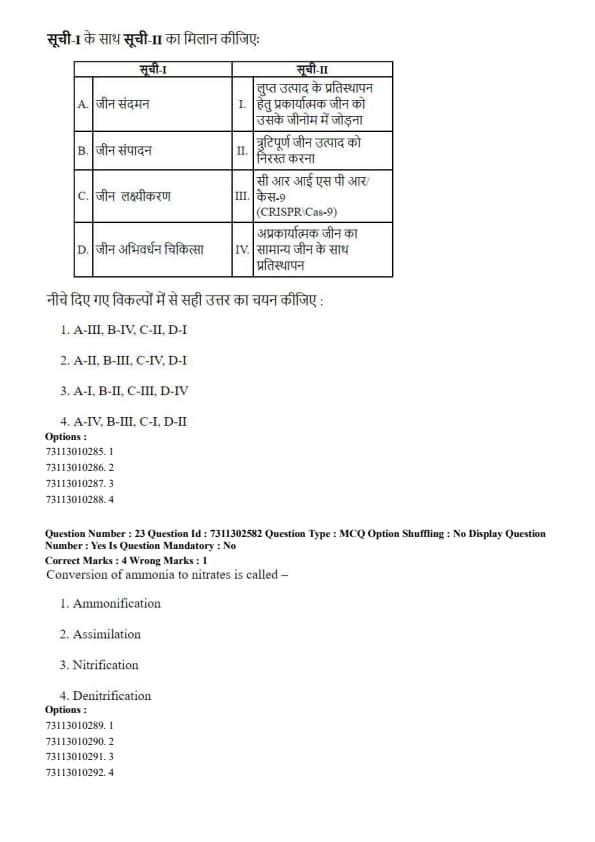
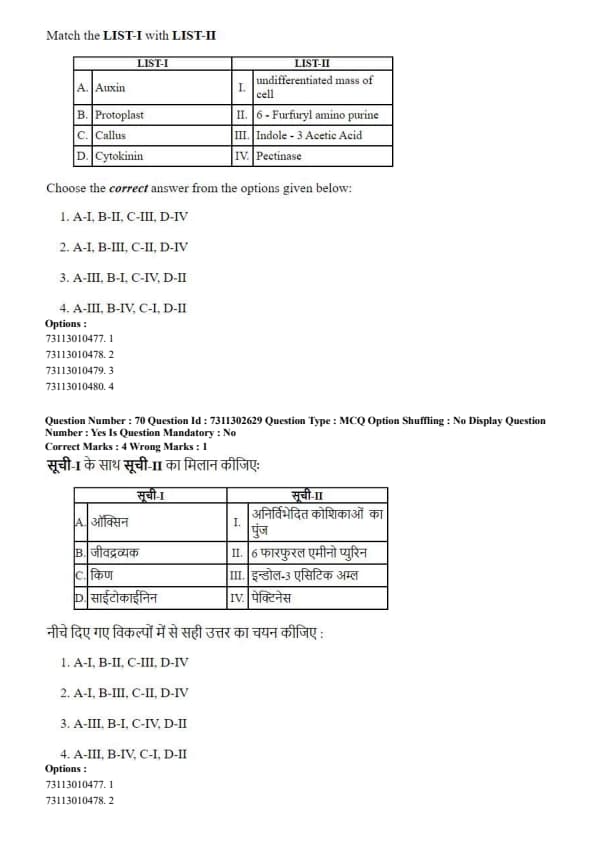
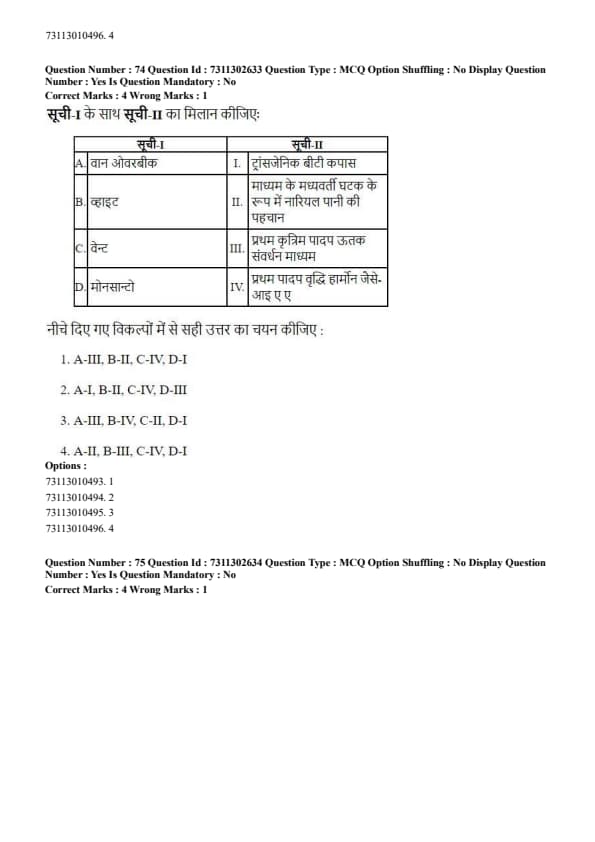
Match LIST-I with LIST-II
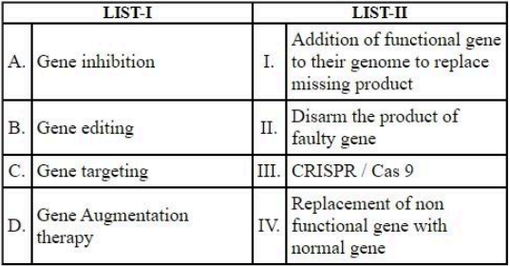
Choose the correct answer from the options given below:
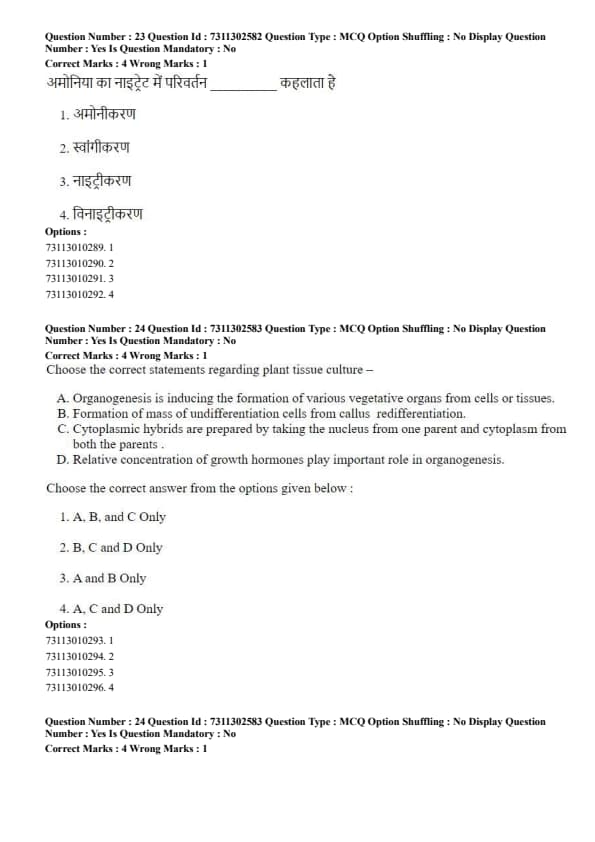
Conversion of ammonia to nitrates is called -
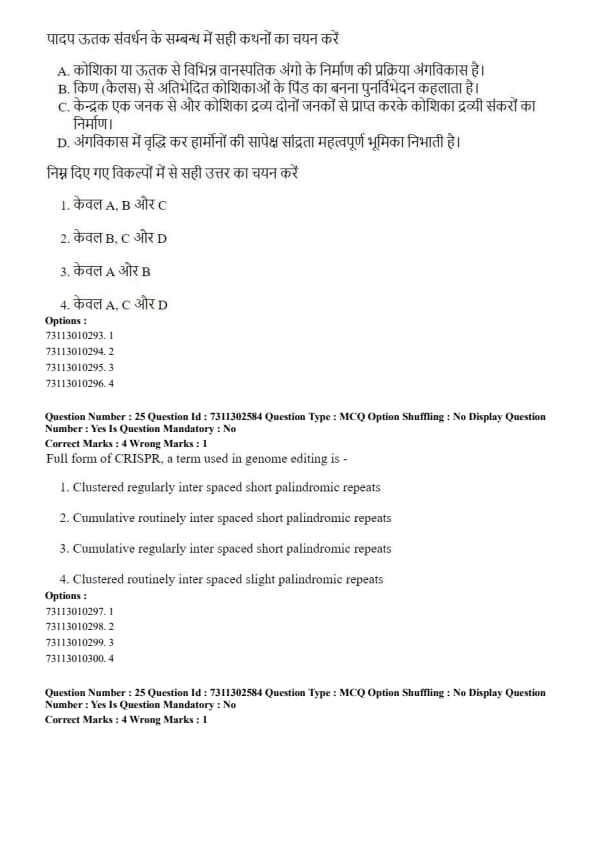
Choose the correct statements regarding plant tissue culture -
A. Organogenesis is inducing the formation of various vegetative organs from cells or tissues.
B. Formation of mass of undifferentiation cells from callus redifferentiation.
C. Cytoplasmic hybrids are prepared by taking the nucleus from one parent and cytoplasm from both the parents.
D. Relative concentration of growth hormones play important role in organogenesis.
Choose the correct answer from the options given below :
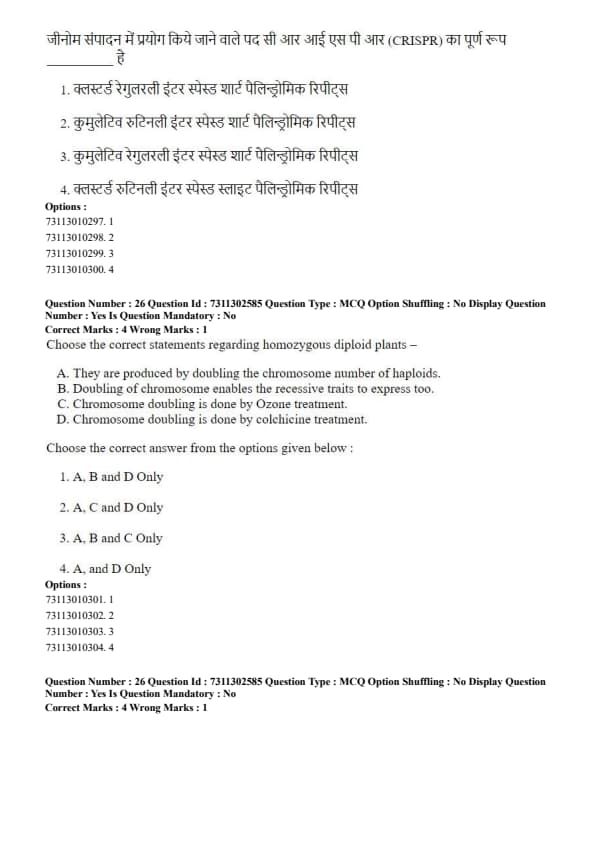
Full form of CRISPR, a term used in genome editing is -
Choose the correct statements regarding homozygous diploid plants -
A. They are produced by doubling the chromosome number of haploids.
B. Doubling of chromosome enables the recessive traits to express too.
C. Chromosome doubling is done by Ozone treatment.
D. Chromosome doubling is done by colchicine treatment.
Choose the correct answer from the options given below:
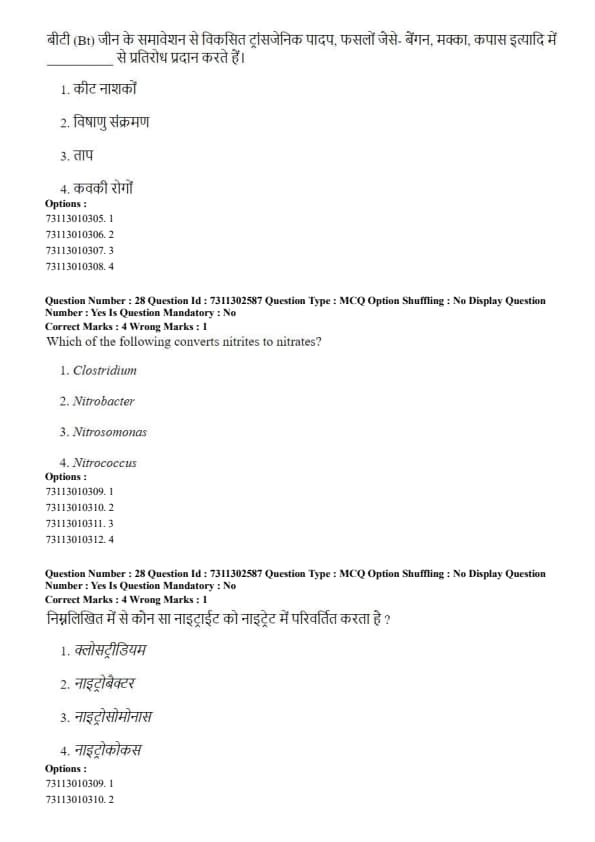
Transgenic plants developed by introducing Bt gene in crops like brinjal, maize, cotton etc. provide resistance to:
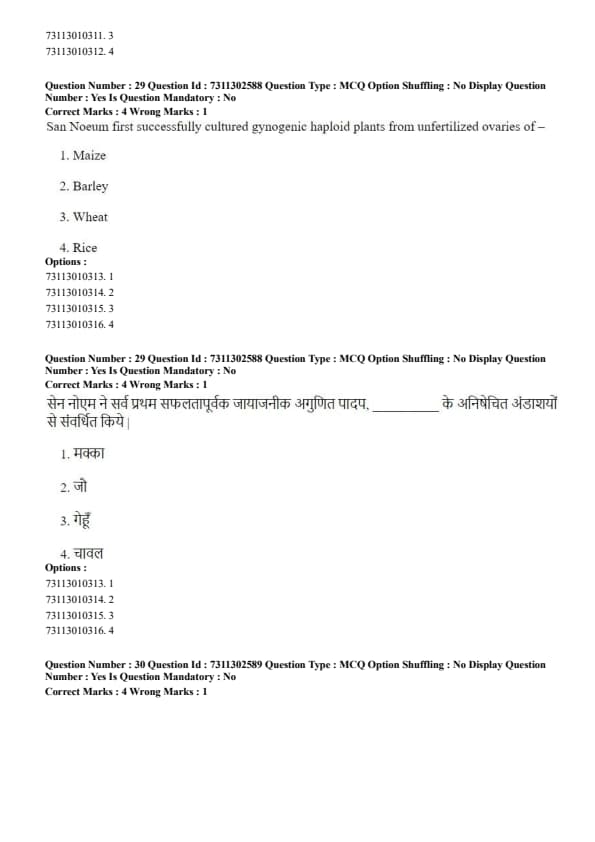
Which of the following converts nitrites to nitrates?
San Noeum first successfully cultured gynogenic haploid plants from unfertilized ovaries of -
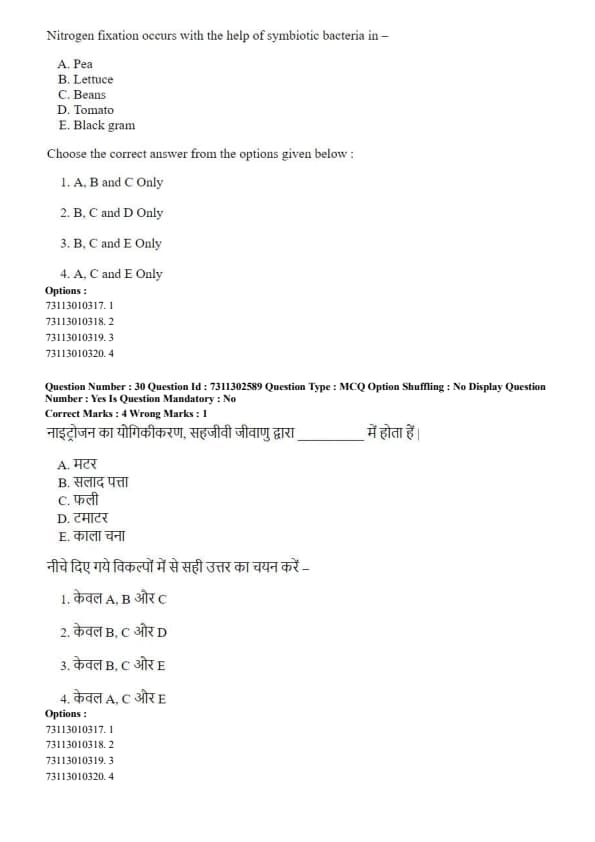
Nitrogen fixation occurs with the help of symbiotic bacteria in -
A. Pea
B. Lettuce
C. Beans
D. Tomato
E. Black gram
Choose the correct answer from the options given below :
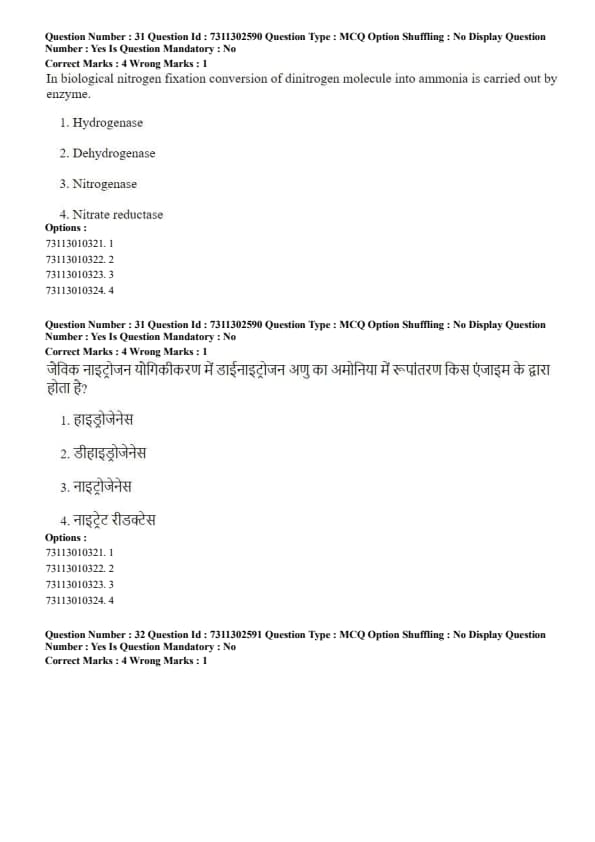
In biological nitrogen fixation conversion of dinitrogen molecule into ammonia is carried out by enzyme.
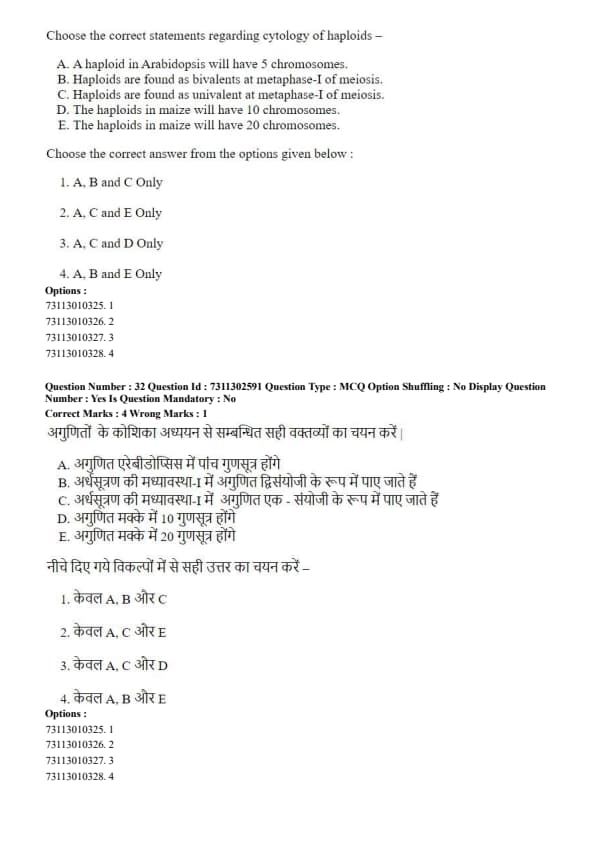
Choose the correct statements regarding cytology of haploids -
A. A haploid in Arabidopsis will have 5 chromosomes.
B. Haploids are found as bivalents at metaphase-I of meiosis.
C. Haploids are found as univalent at metaphase-I of meiosis.
D. The haploids in maize will have 10 chromosomes.
E. The haploids in maize will have 20 chromosomes.
Choose the correct answer from the options given below :
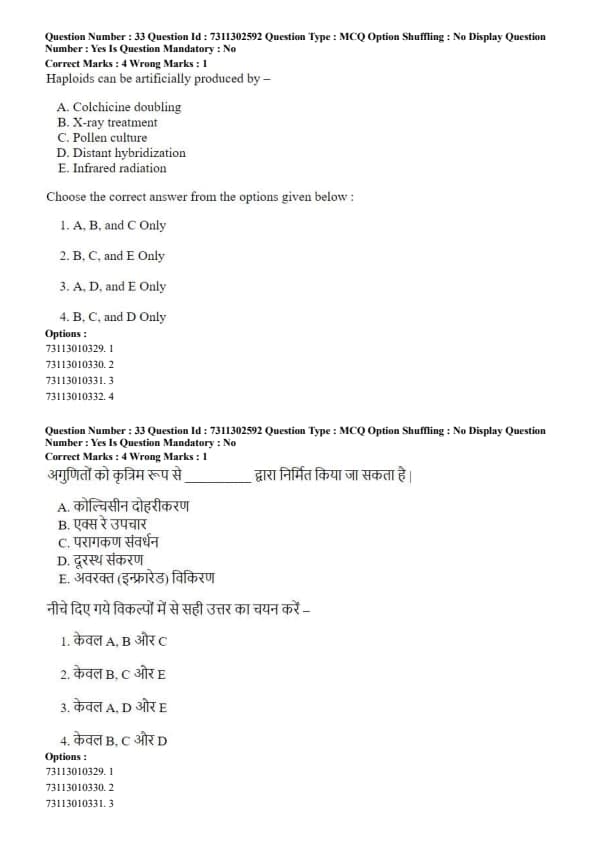
Haploids can be artificially produced by -
A. Colchicine doubling
B. X-ray treatment
C. Pollen culture
D. Distant hybridization
E. Infrared radiation
Choose the correct answer from the options given below :
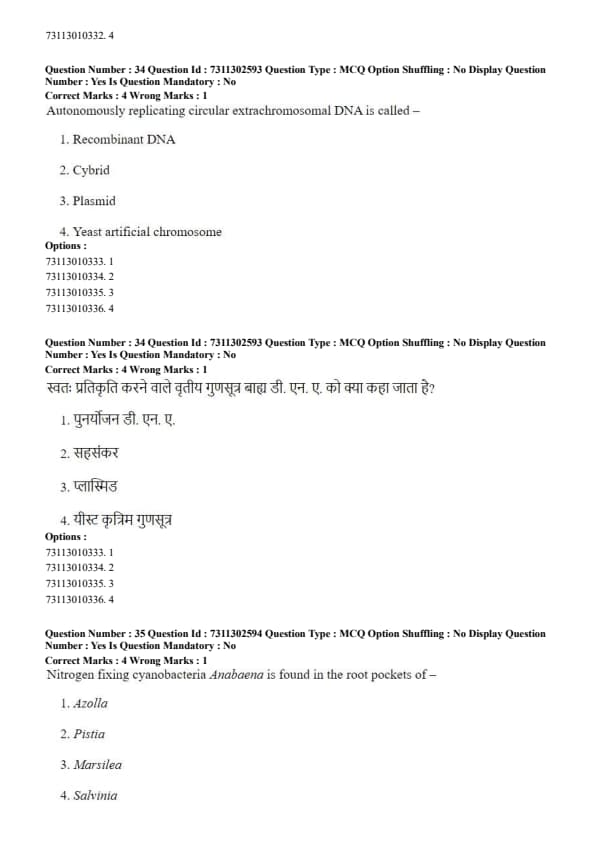
Autonomously replicating circular extrachromosomal DNA is called -
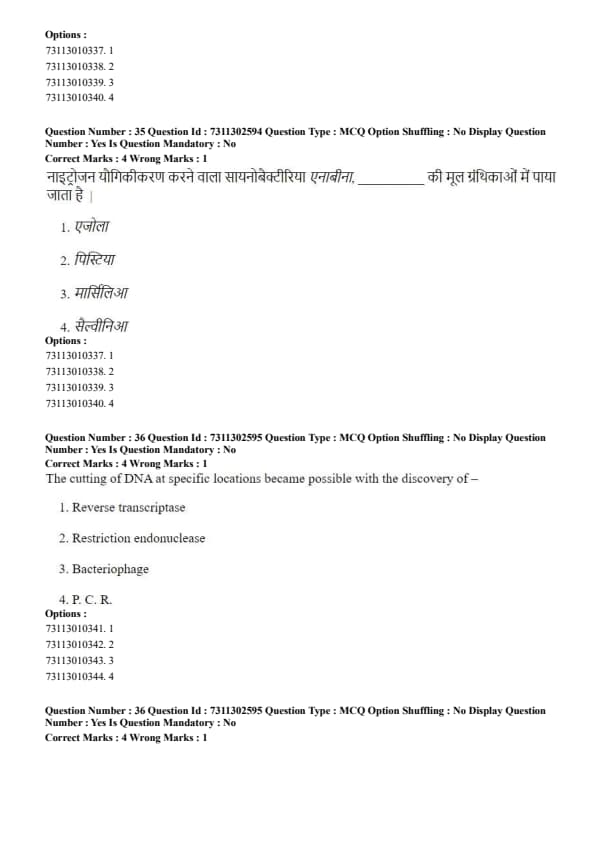
Nitrogen fixing cyanobacteria Anabaena is found in the root pockets of -
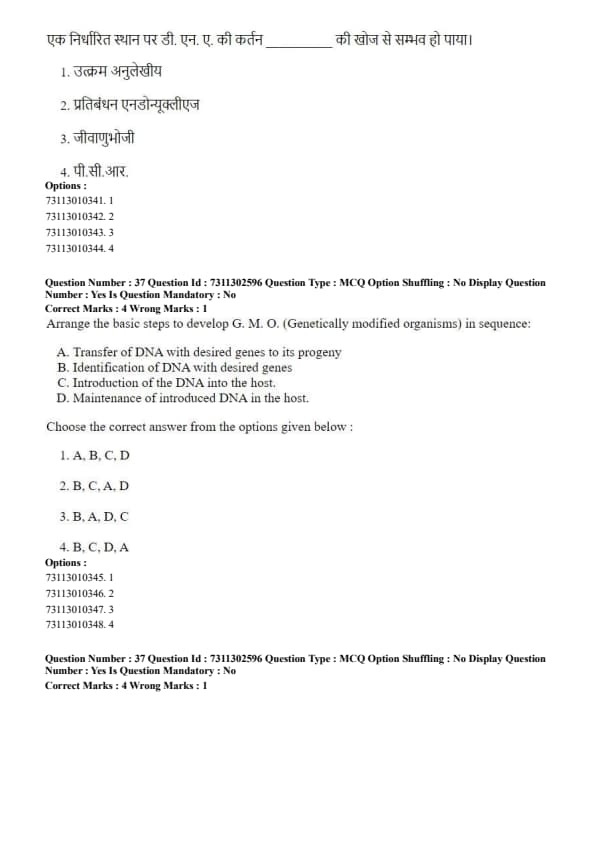
The cutting of DNA at specific locations became possible with the discovery of -
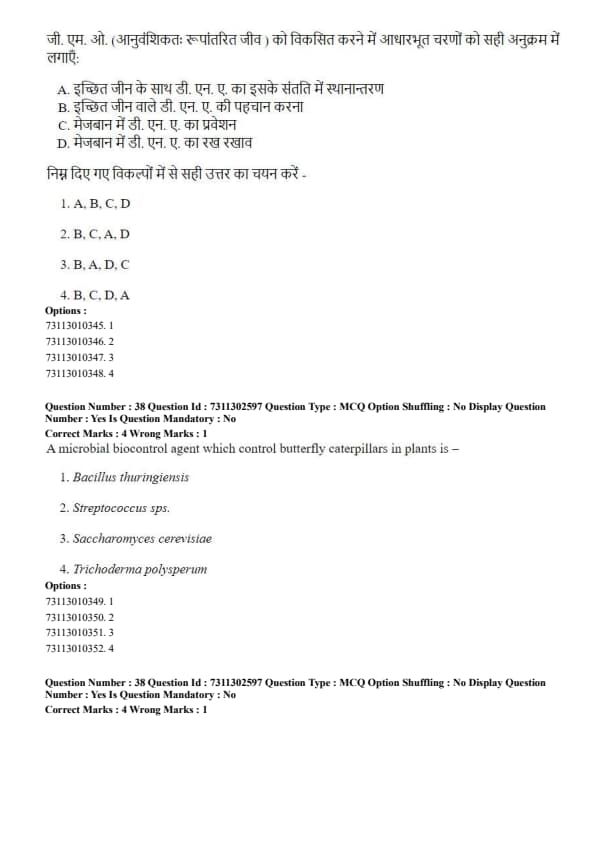
Arrange the basic steps to develop G. M. O. (Genetically modified organisms) in sequence:
A. Transfer of DNA with desired genes to its progeny
B. Identification of DNA with desired genes
C. Introduction of the DNA into the host.
D. Maintenance of introduced DNA in the host.
Choose the correct answer from the options given below :
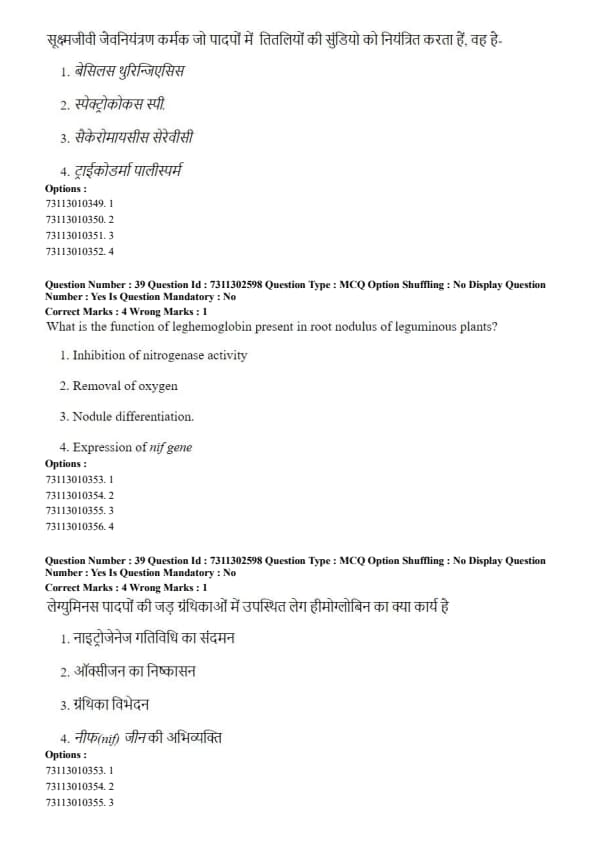
A microbial biocontrol agent which control butterfly caterpillars in plants is -
What is the function of leghemoglobin present in root nodulus of leguminous plants?
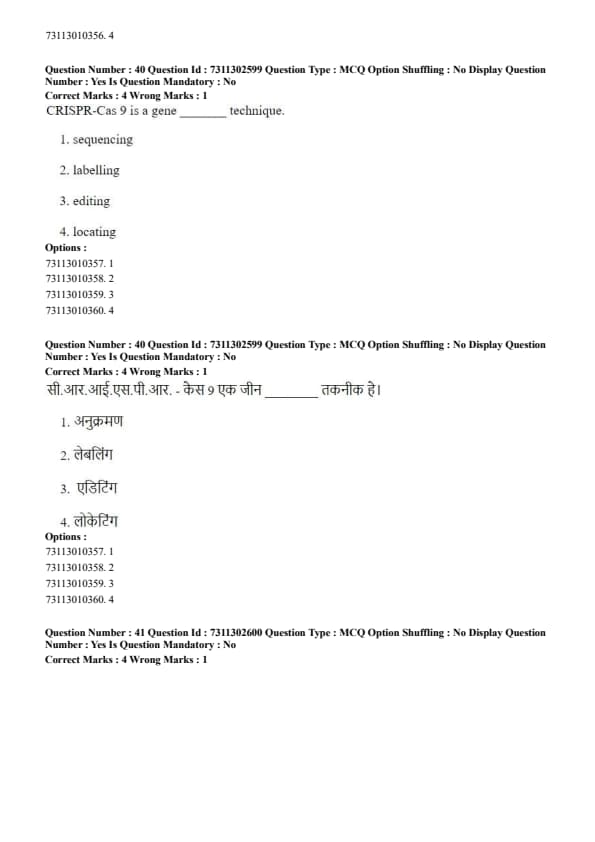
CRISPR-Cas 9 is a gene ____________ technique.
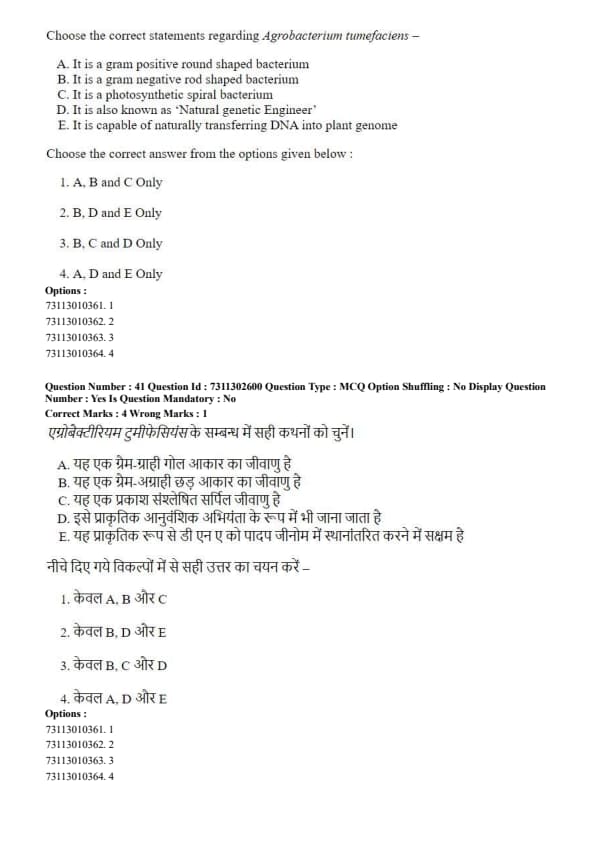
Choose the correct statements regarding Agrobacterium tumefaciens -
A. It is a gram positive round shaped bacterium
B. It is a gram negative rod shaped bacterium
C. It is a photosynthetic spiral bacterium
D. It is also known as 'Natural genetic Engineer'
E. It is capable of naturally transferring DNA into plant genome
Choose the correct answer from the options given below :
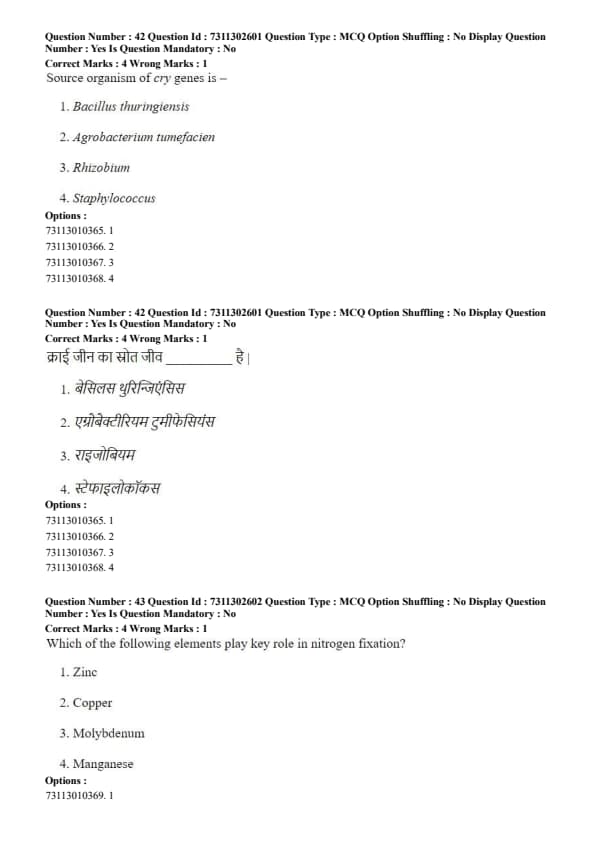
Source organism of cry genes is -
Which of the following elements play key role in nitrogen fixation?
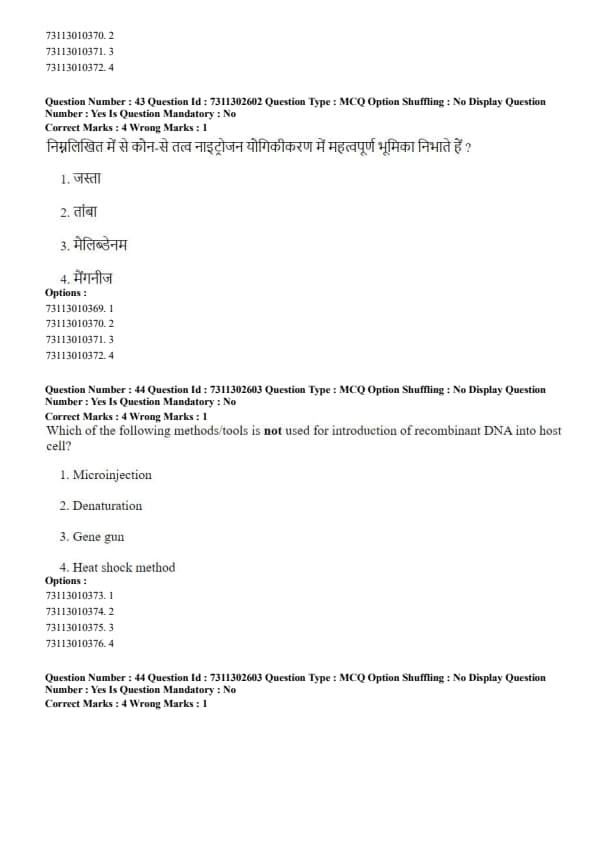
Which of the following methods/tools is not used for introduction of recombinant DNA into host cell?
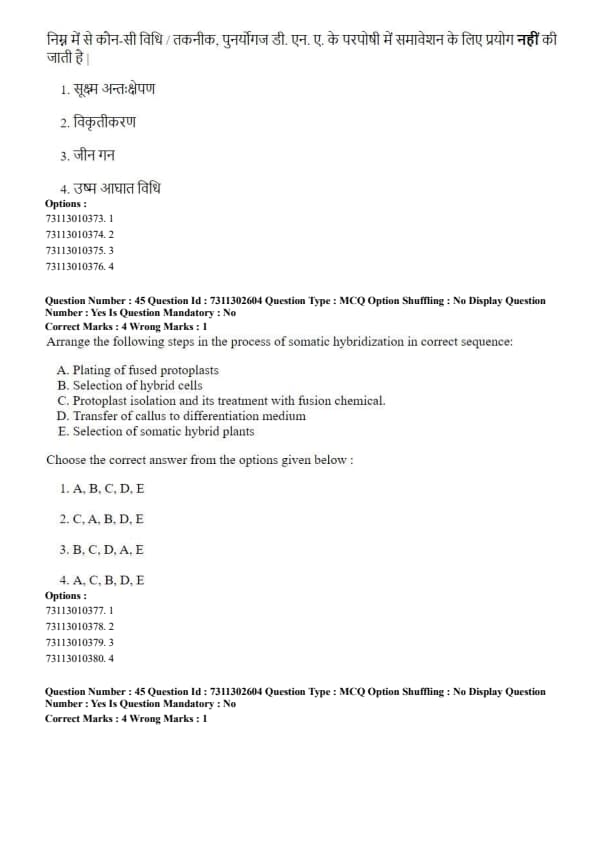
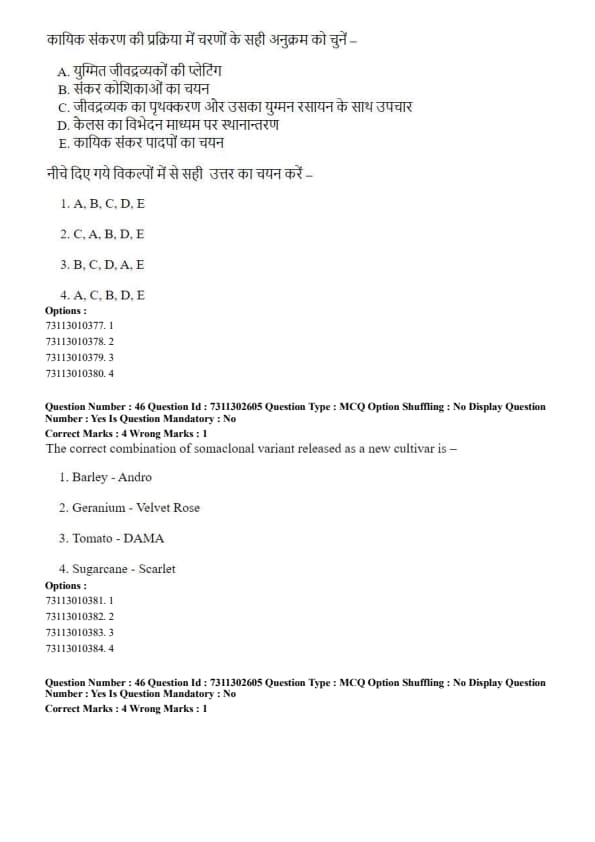
Arrange the following steps in the process of somatic hybridization in correct sequence:
A. Plating of fused protoplasts
B. Selection of hybrid cells
C. Protoplast isolation and its treatment with fusion chemical.
D. Transfer of callus to differentiation medium
E. Selection of somatic hybrid plants
Choose the correct answer from the options given below :
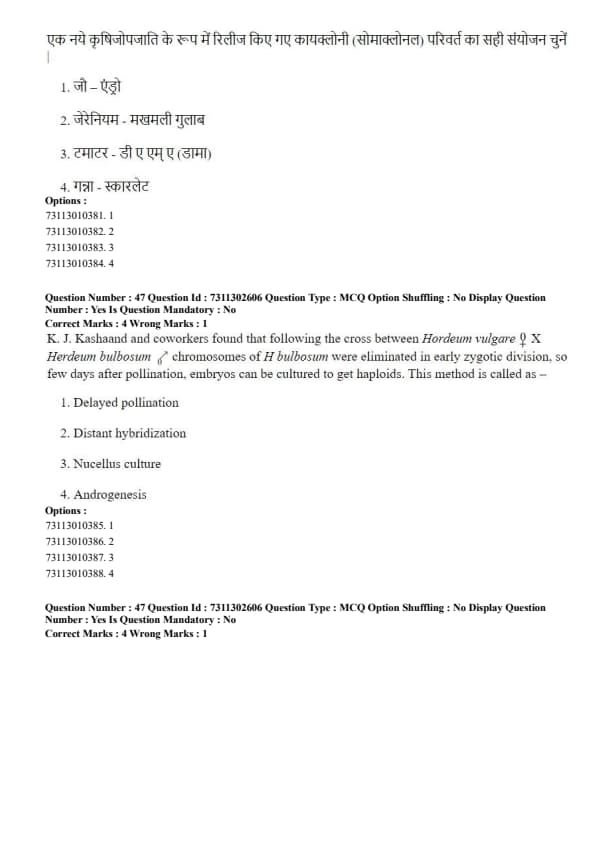
The correct combination of somaclonal variant released as a new cultivar is -
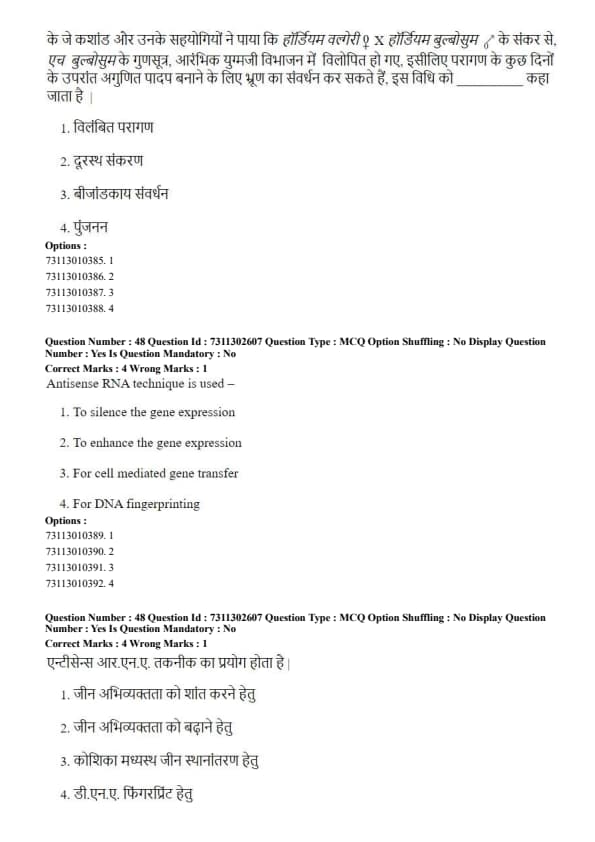
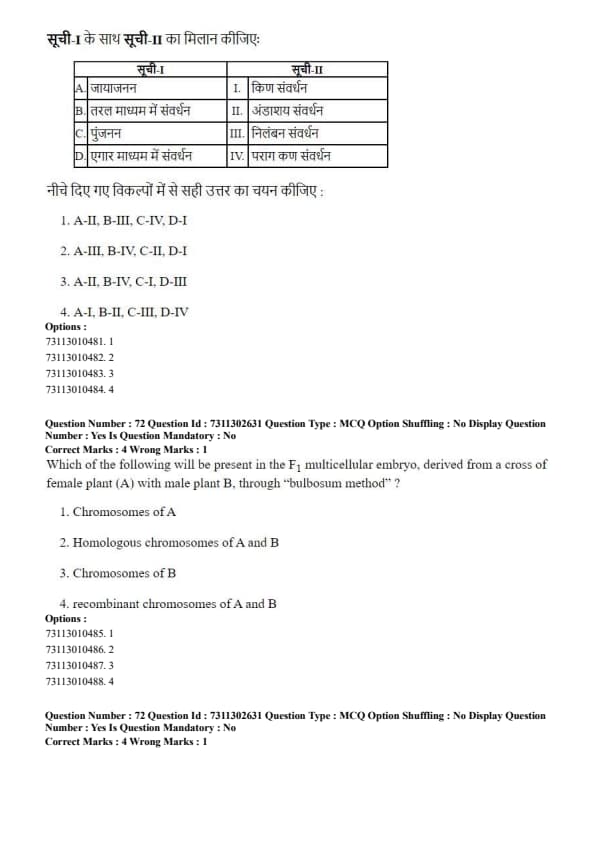
K. J. Kasha and coworkers found that following the cross between Hordeum vulgare \(\times\) Hordeum bulbosum, chromosomes of H. bulbosum were eliminated in early zygotic division, so few days after pollination, embryos can be cultured to get haploids. This method is called as -
Antisense RNA technique is used -
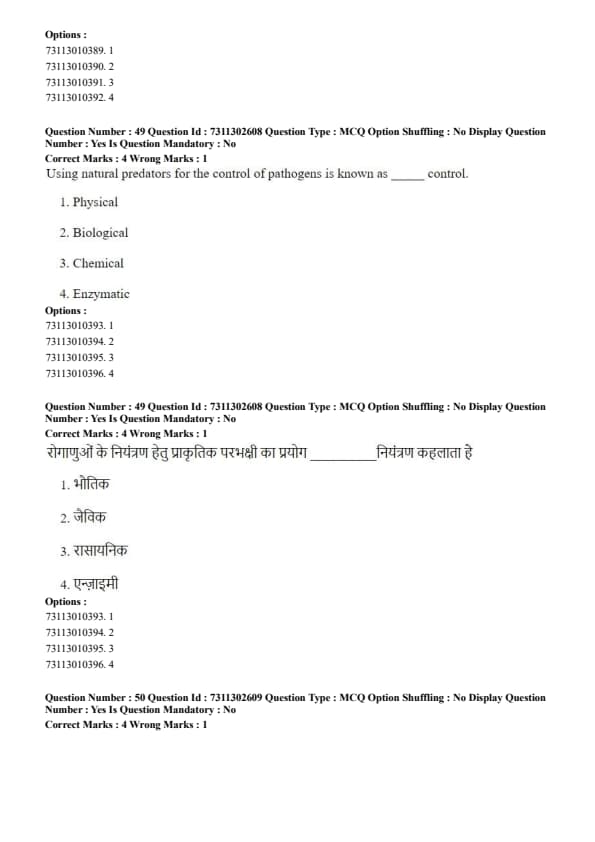
Using natural predators for the control of pathogens is known as ____________ control.
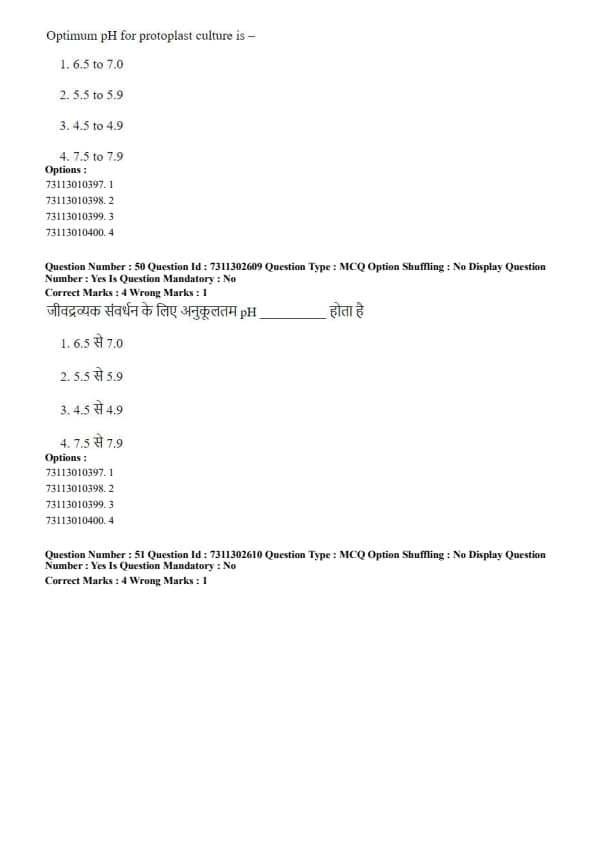
Optimum pH for protoplast culture is -
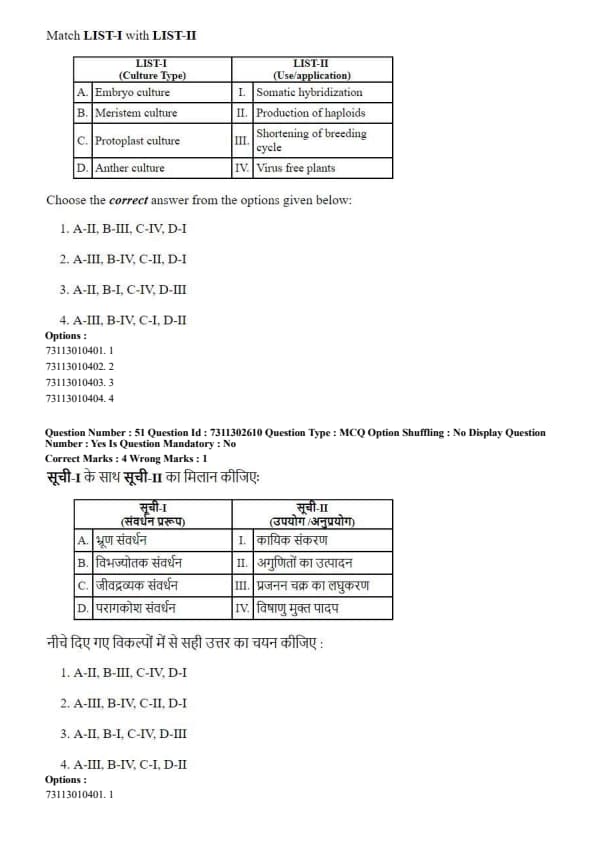
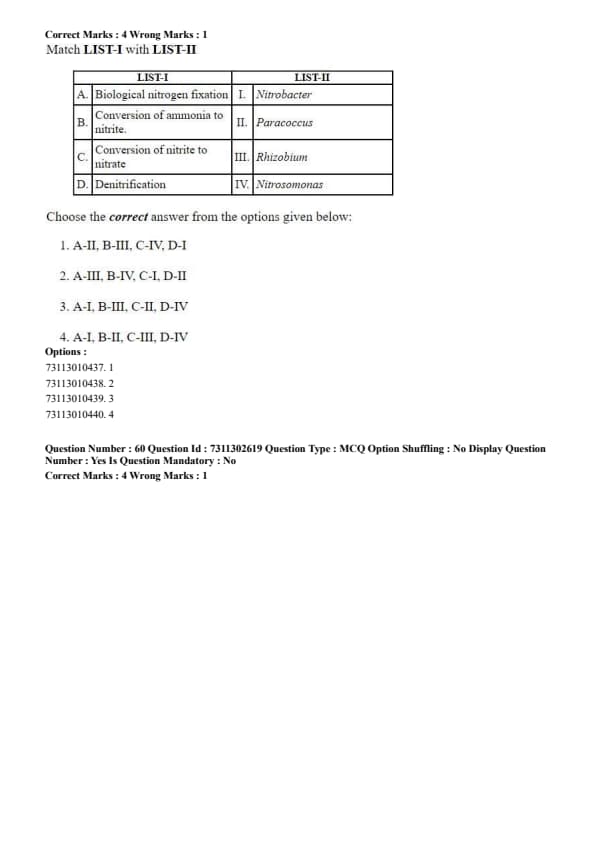
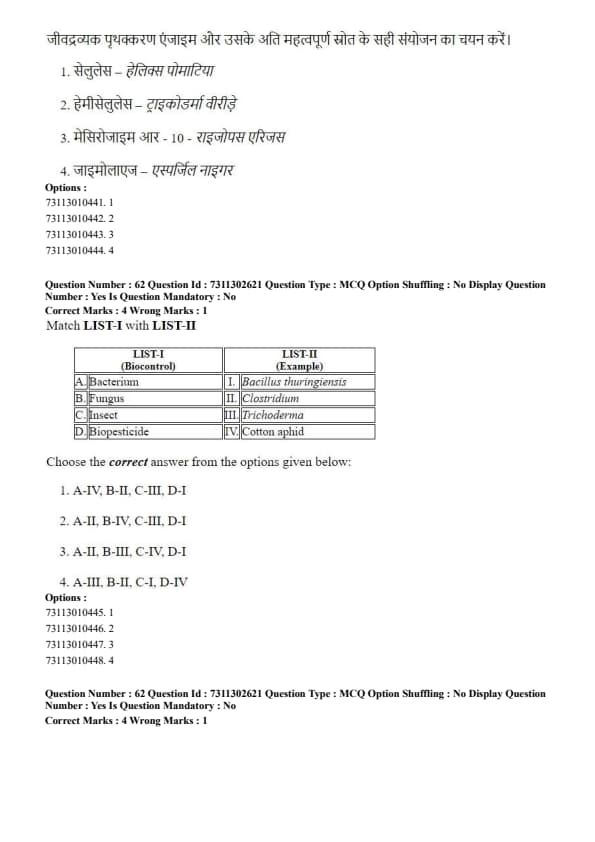
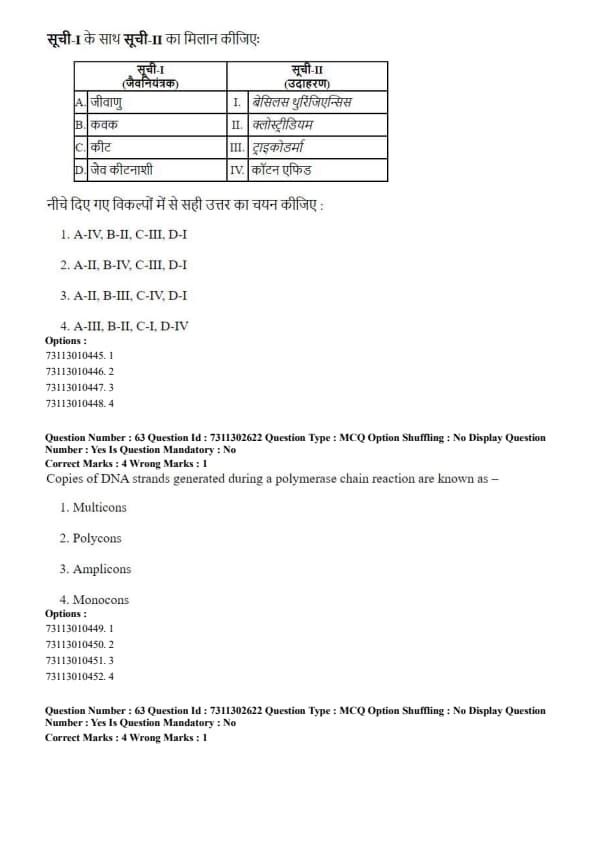
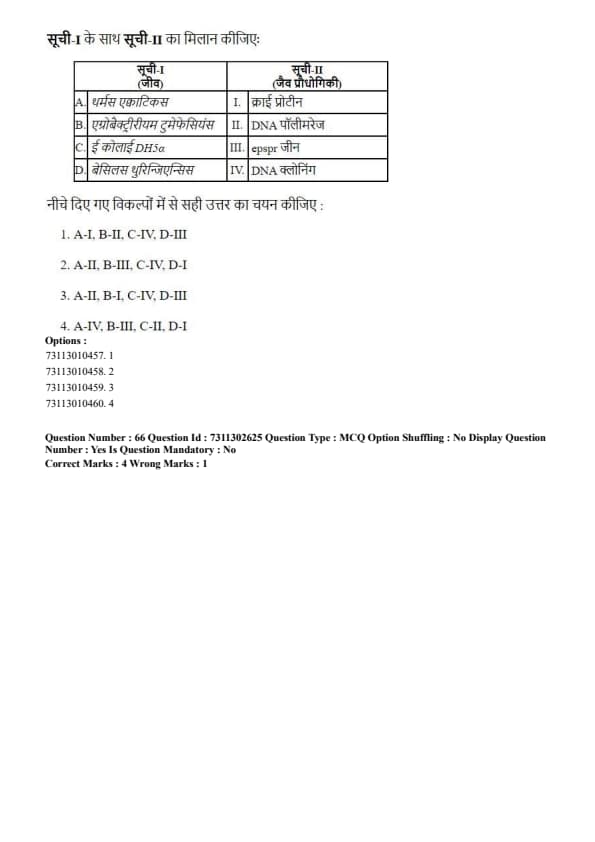
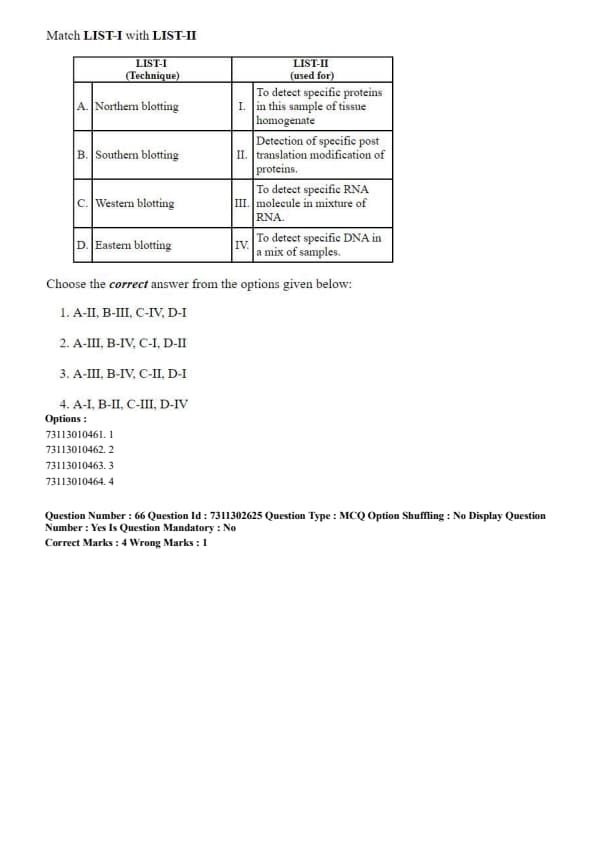
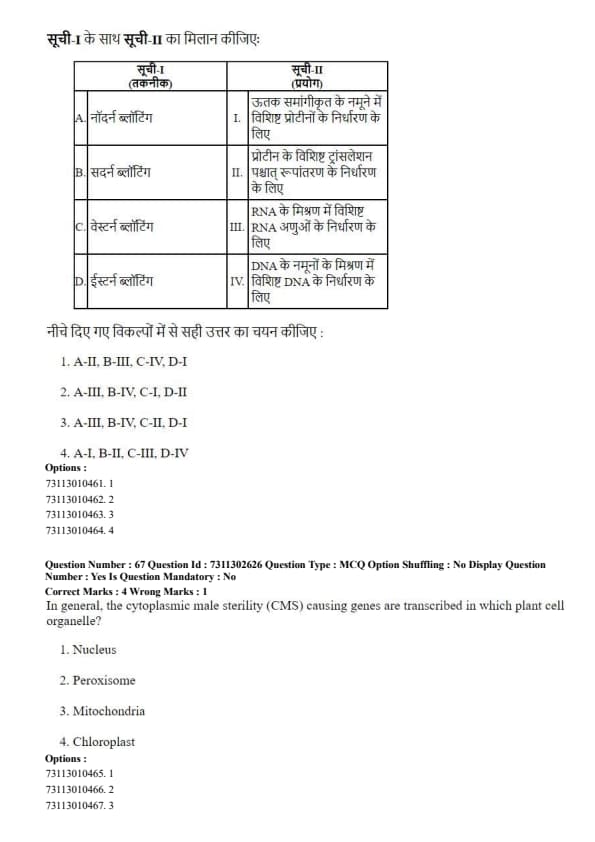
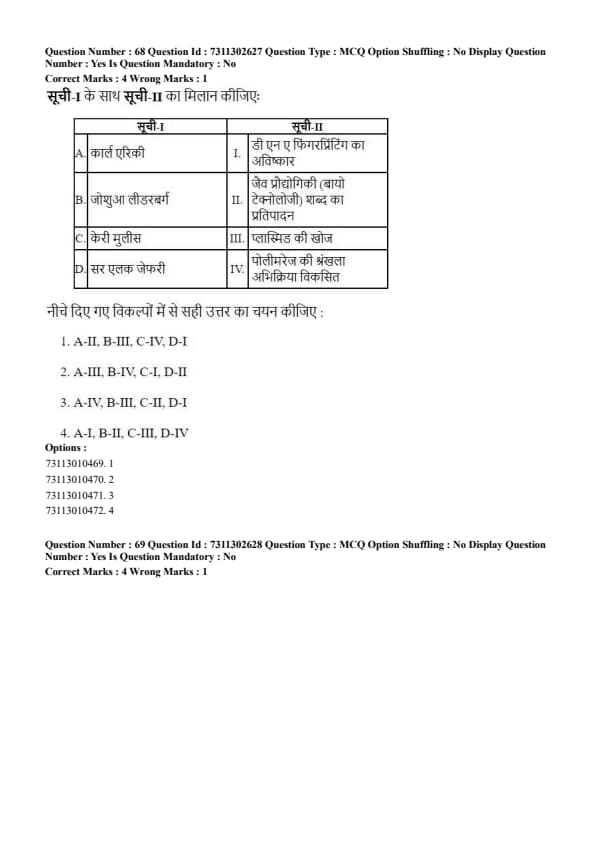
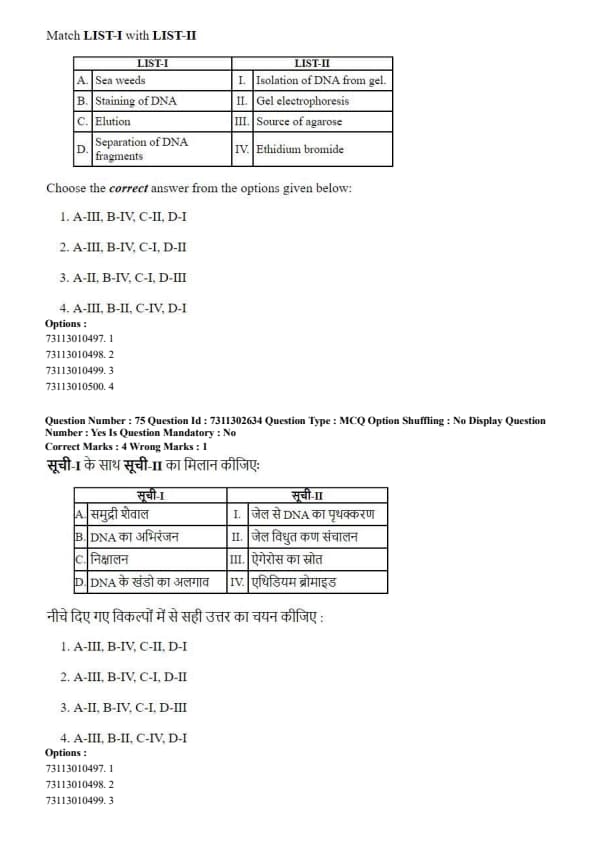
Match LIST-I with LIST-II
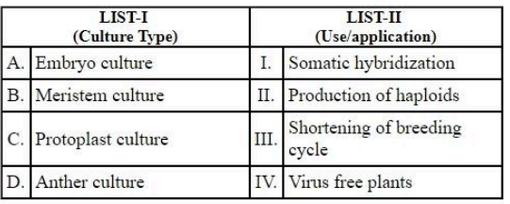
Choose the correct answer from the options given below:
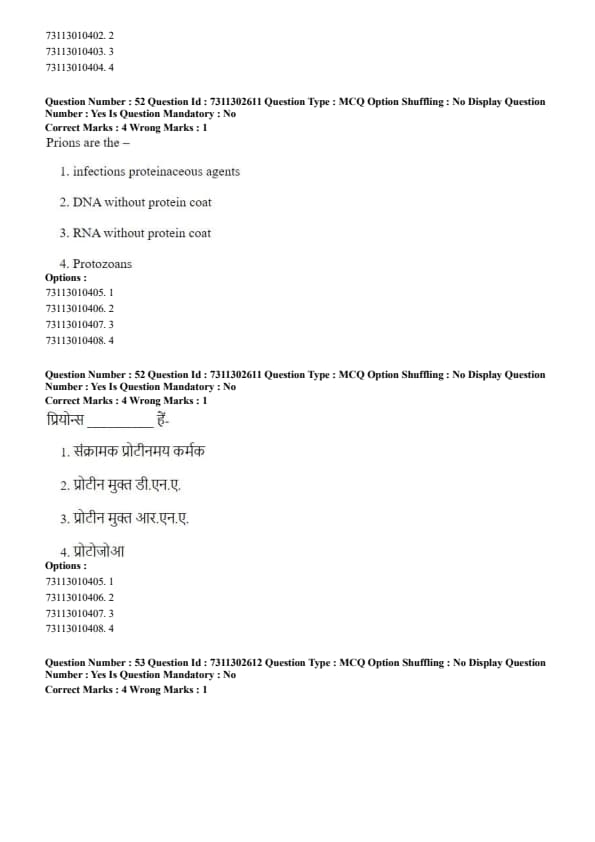
Prions are the -
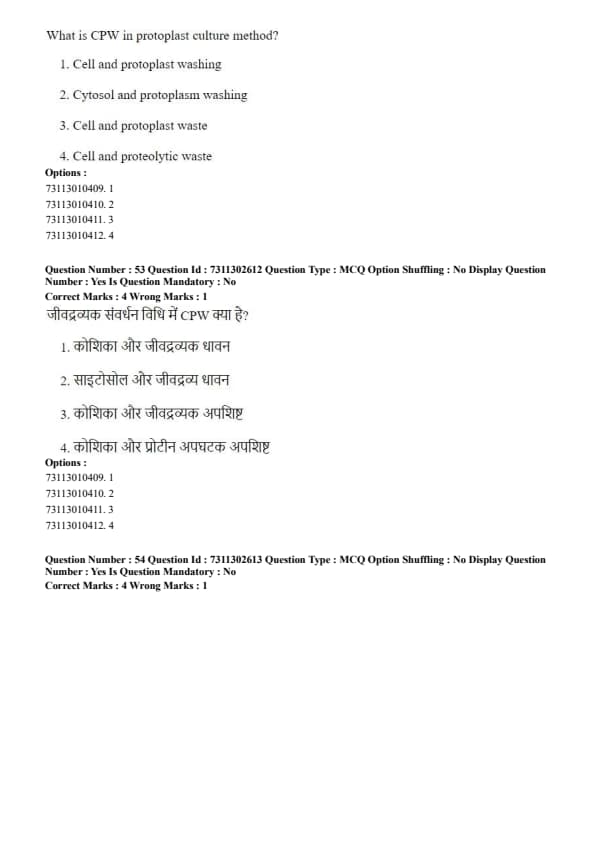
What is CPW in protoplast culture method?
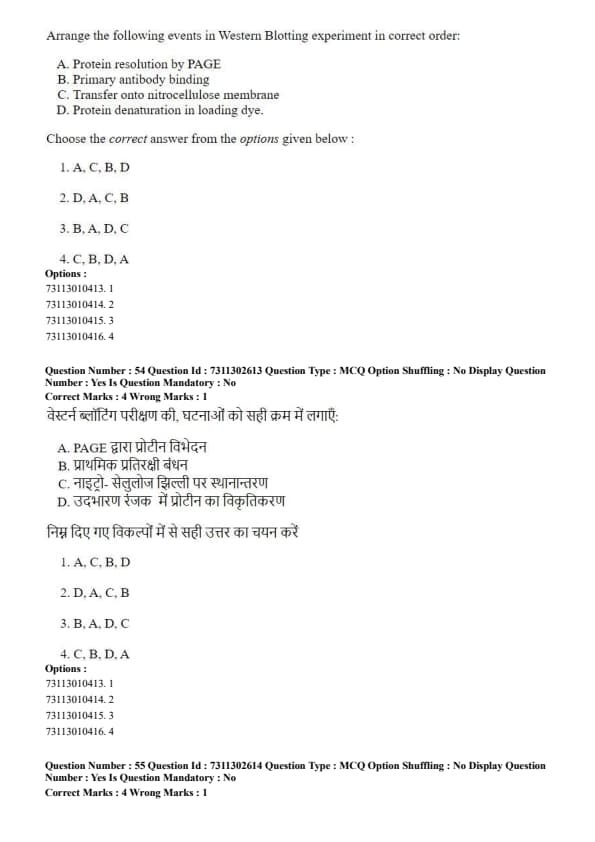
Arrange the following events in Western Blotting experiment in correct order:
A. Protein resolution by PAGE
B. Primary antibody binding
C. Transfer onto nitrocellulose membrane
D. Protein denaturation in loading dye.
Choose the correct answer from the options given below :
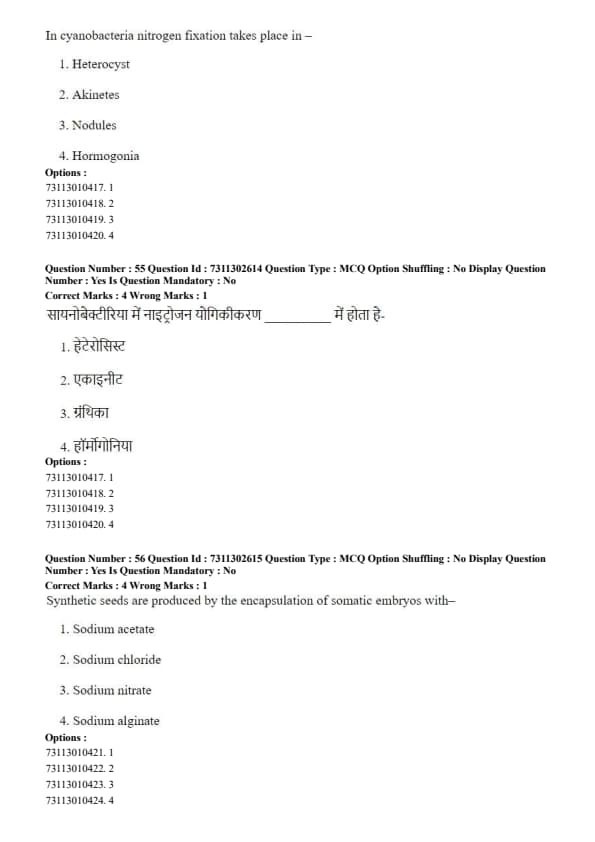
In cyanobacteria nitrogen fixation takes place in -
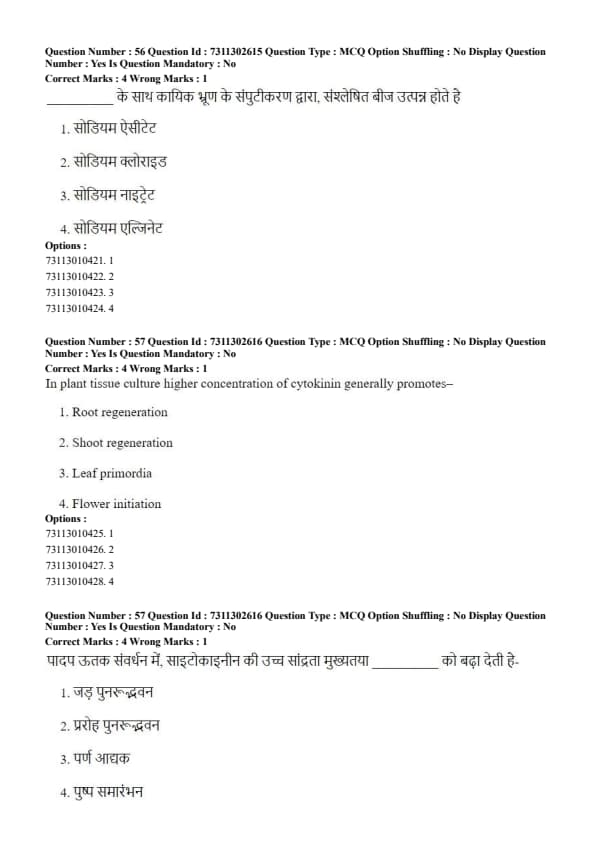
Synthetic seeds are produced by the encapsulation of somatic embryos with-
In plant tissue culture higher concentration of cytokinin generally promotes-
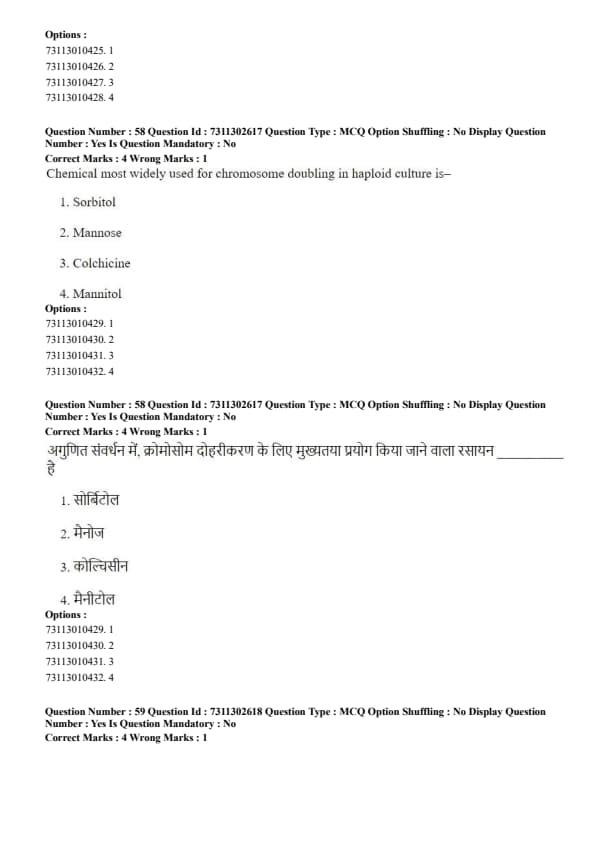
Chemical most widely used for chromosome doubling in haploid culture is-
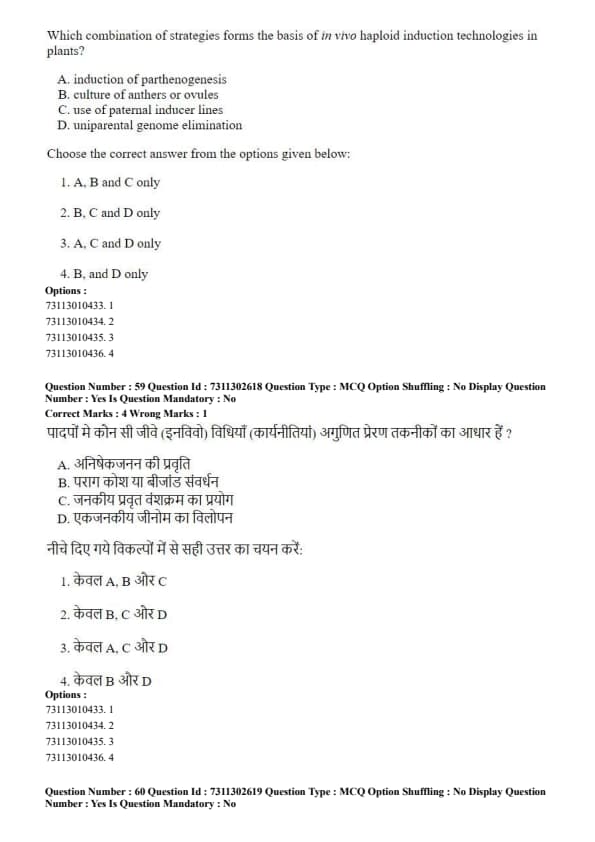
Which combination of strategies forms the basis of in vivo haploid induction technologies in plants?
A. induction of parthenogenesis
B. culture of anthers or ovules
C. use of paternal inducer lines
D. uniparental genome elimination
Choose the correct answer from the options given below:
Match LIST-I with LIST-II

Choose the correct answer from the options given below:
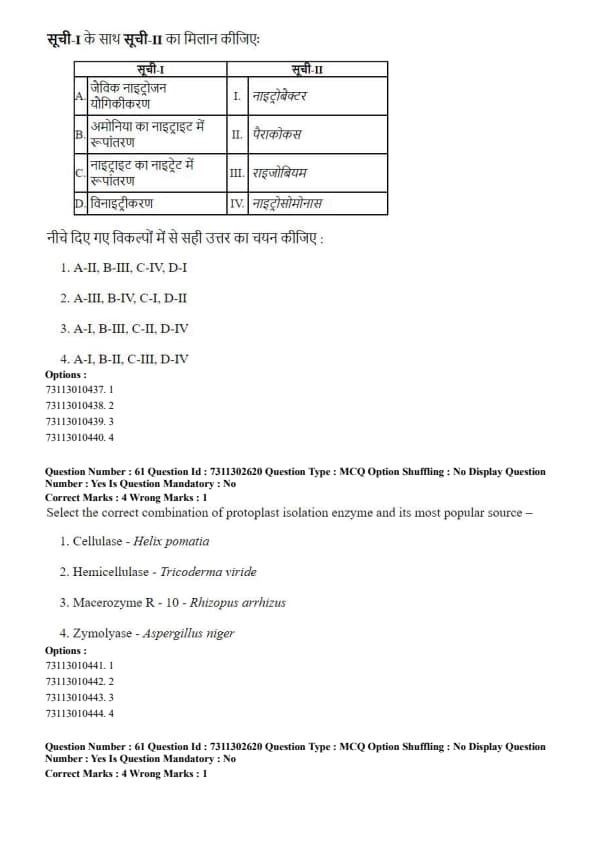
Select the correct combination of protoplast isolation enzyme and its most popular source -
Match LIST-I with LIST-II

Choose the correct answer from the options given below:
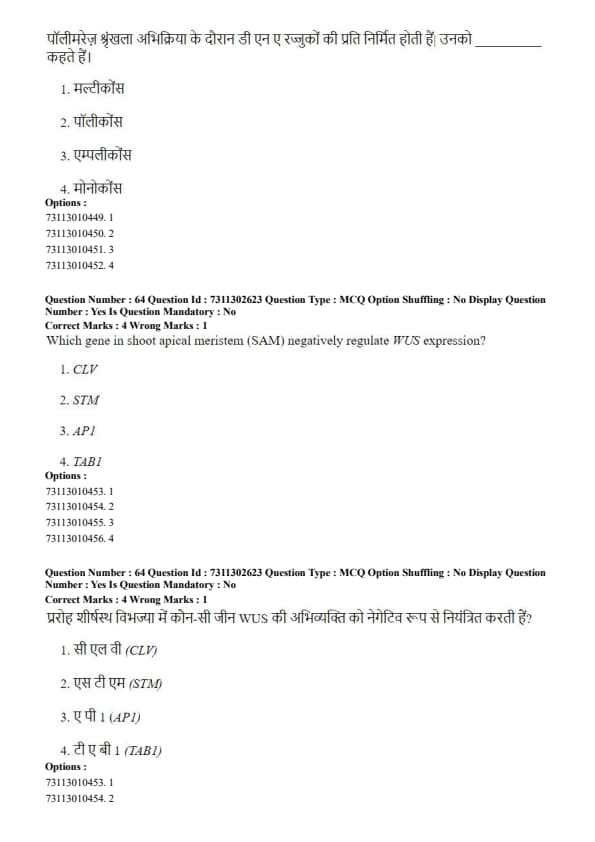
Copies of DNA strands generated during a polymerase chain reaction are known as -
Which gene in shoot apical meristem (SAM) negatively regulate WUS expression?
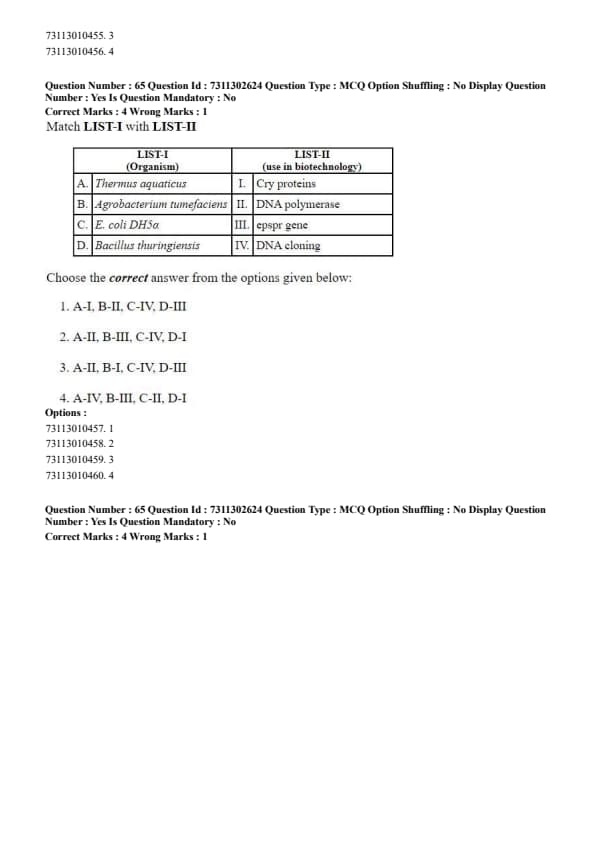
Match LIST-I with LIST-II

Choose the correct answer from the options given below:
Match LIST-I with LIST-II

Choose the correct answer from the options given below:
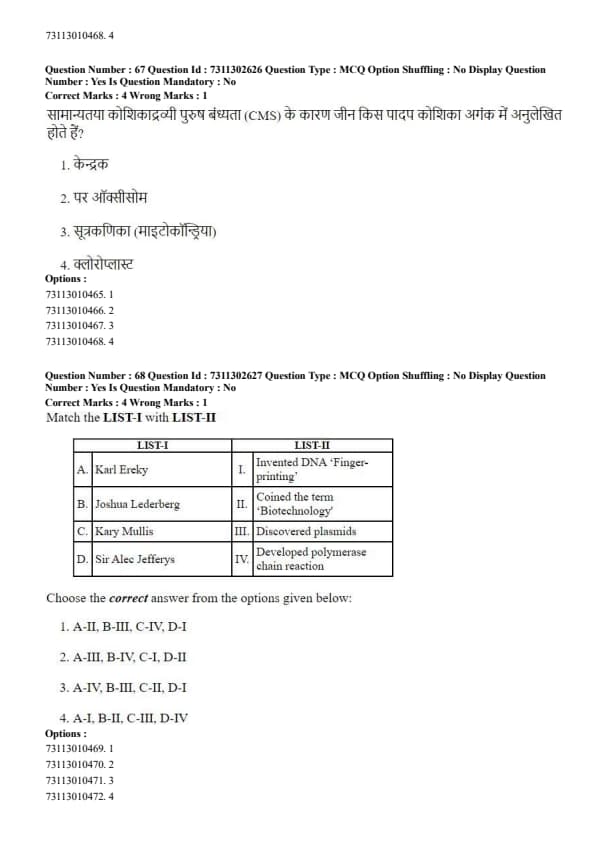
In general, the cytoplasmic male sterility (CMS) causing genes are transcribed in which plant cell organelle?
Match the LIST-I with LIST-II
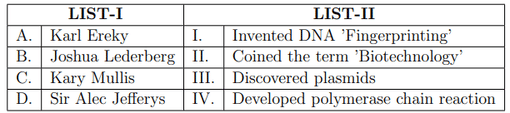
Choose the correct answer from the options given below:
Match LIST-I with LIST-II

Choose the correct answer from the options given below:
Match the LIST-I with LIST-II

Choose the correct answer from the options given below:
Match LIST-I with LIST-II
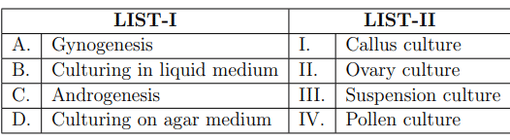
Choose the correct answer from the options given below:
Which of the following will be present in the F1 multicellular embryo, derived from a cross of female plant (A) with male plant B, through "bulbosum method"?
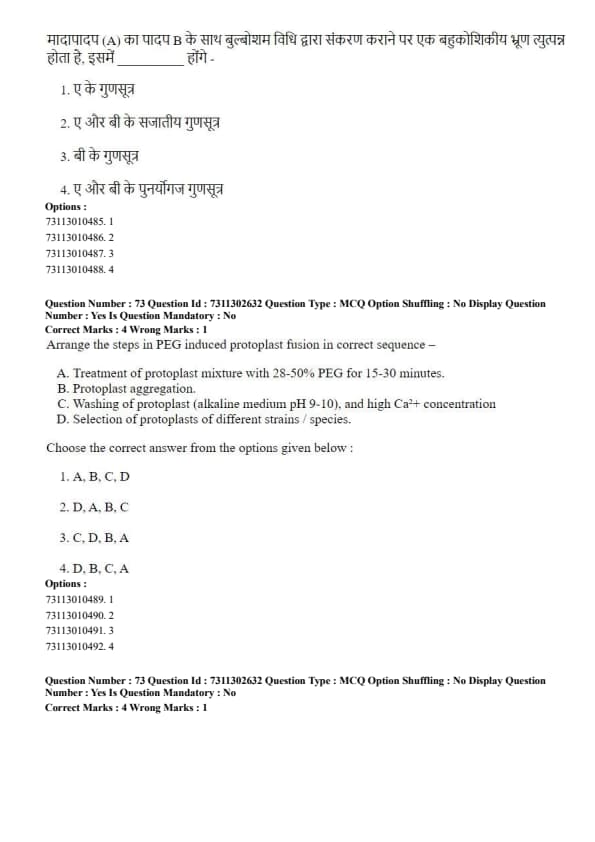
Arrange the steps in PEG induced protoplast fusion in correct sequence -
A. Treatment of protoplast mixture with 28-50% PEG for 15-30 minutes.
B. Protoplast aggregation.
C. Washing of protoplast (alkaline medium pH 9-10), and high Ca2+ concentration
D. Selection of protoplasts of different strains / species.
Choose the correct answer from the options given below :
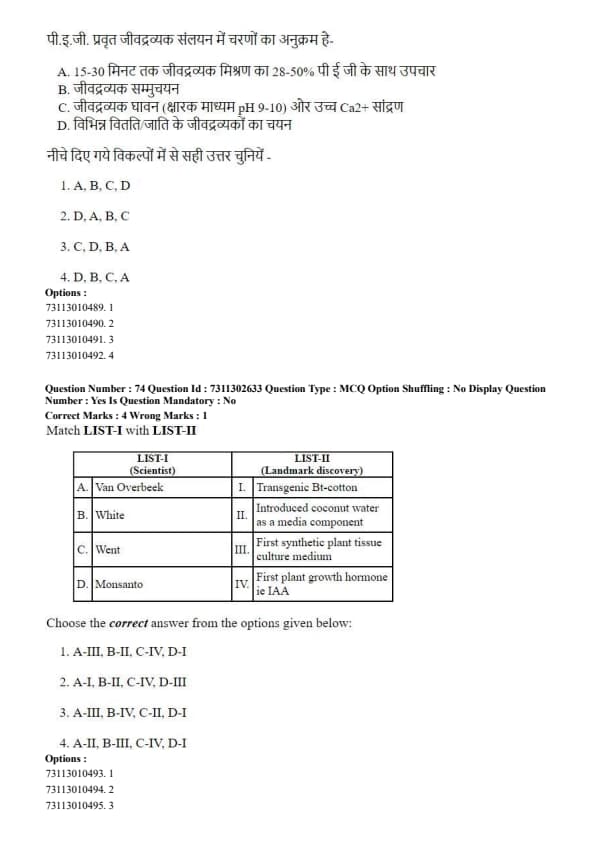
Match LIST-I with LIST-II

Choose the correct answer from the options given below:
Match LIST-I with LIST-II

Choose the correct answer from the options given below:




Comments