




CUET PG 2026 Chemistry Question Paper is available for download here. The National Testing Agency (NTA) conducted the CUET PG 2026 Chemistry (SCQP08) examination on March 11, 2026, during Shift 3 from 04:00 PM to 05:30 PM.
CUET PG 2026 Chemistry Question Paper with Solutions PDF
| CUET PG 2026 Chemistry Question Paper with Answer Key | Download PDF | Check Solutions |
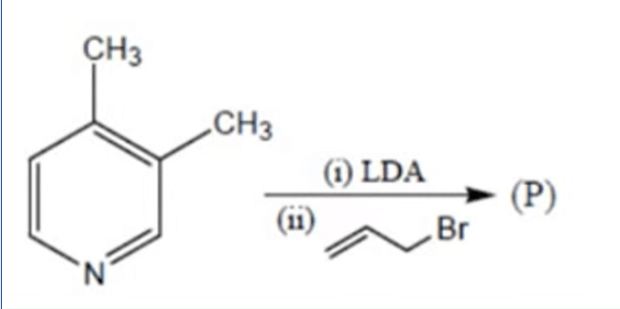
The major product formed in the following reaction is p

The major product P is
Match the appropriate geometry on the right with each of the species on the left:
The correct polarity order among the following is?
The total number of lone pairs in \(XeOF_4\) is
In the above compound, the number of \(^1H\) NMR signals is
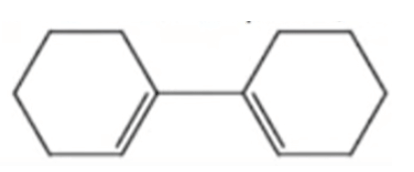
Consider the following reaction
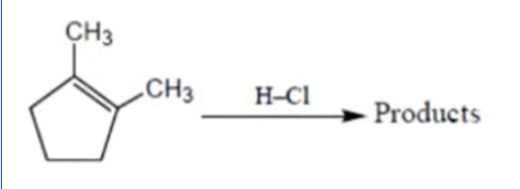
The number of stereoisomer(s) formed during this reaction will be
The number of total valence electrons in the following complex is \([Os(N)Br_2(PMe_3)(NMe_2)]^-\)
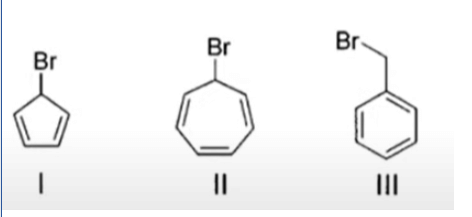
The correct order of rate of solvolysis for the following compounds is
The following borate \([B_5O_6(OH)_4]^-\) belongs to which of the following class of borates?
Hybridizations of the atoms indicated with the asterisk (*) in the following compounds sequentially are
The light pink colour of \([Co(H_2O)_6]^{2+}\) and the deep blue colour of \([CoCl_4]^{2-}\) are due to:
The number of isomers having non-zero dipole moment for \(PCl_2F_3\) in the trigonal bipyramidal geometry is



Comments