CUET PG 2026 Data Science Question Paper is available for download here. The National Testing Agency (NTA) Conducted the CUET PG 2026 Data Science (MTQP04) examination on March 10, 2026, during Shift 1 from 9:00 AM to 10:30 AM.

CUET PG 2026 Data Science Question Paper with Solutions PDF

CUET PG 2026 Data Science Question Paper with Answer key Download PDF Check Solutions
CUET PG 2026 Data Science Question Paper

Question 1:

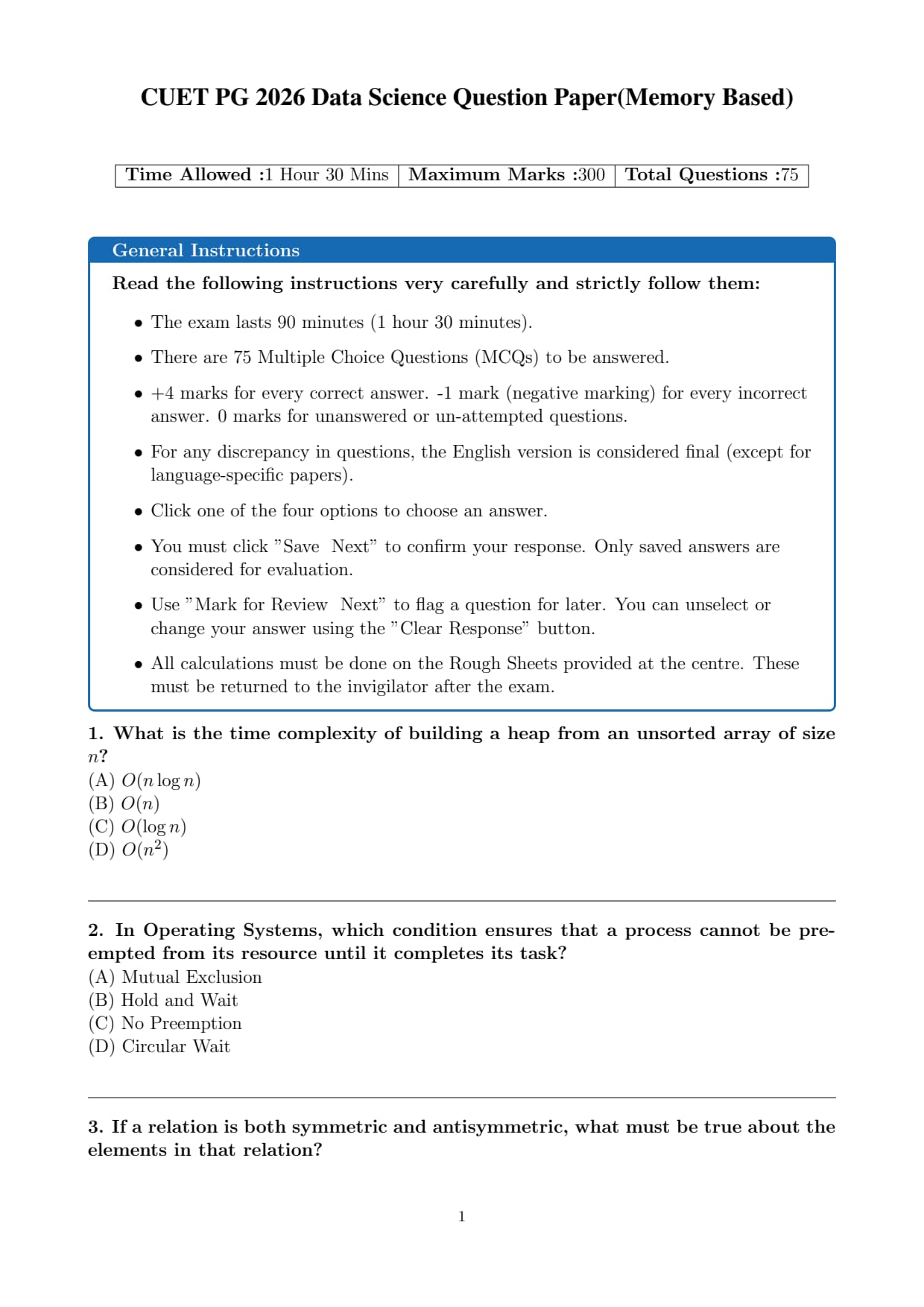
What is the time complexity of building a heap from an unsorted array of size \(n\)?

  • (A) \(O(n \log n)\)
  • (B) \(O(n)\)
  • (C) \(O(\log n)\)
  • (D) \(O(n^2)\)

Question 2:

In Operating Systems, which condition ensures that a process cannot be preempted from its resource until it completes its task?

  • (A) Mutual Exclusion
  • (B) Hold and Wait
  • (C) No Preemption
  • (D) Circular Wait

Question 3:

If a relation is both symmetric and antisymmetric, what must be true about the elements in that relation?

  • (A) All elements must be comparable
  • (B) The relation must be transitive
  • (C) Only pairs of the form \( (a,a) \) can exist
  • (D) The relation must contain all ordered pairs

Question 4:

Which activation function is zero-centered and ranges between \(-1\) and \(1\)?

  • (A) Sigmoid
  • (B) ReLU
  • (C) Tanh
  • (D) Softmax

Question 5:

What is the determinant of an identity matrix of any order \(n\)?

  • (A) \(0\)
  • (B) \(1\)
  • (C) \(n\)
  • (D) \(-1\)

Question 6:

In Linear Regression, what is the primary goal of the Ordinary Least Squares (OLS) method?

  • (A) Maximize the variance of predictions
  • (B) Minimize the sum of squared residuals
  • (C) Maximize the correlation between variables
  • (D) Minimize the number of features

Question 7:

Which data structure is used by the system to implement recursion?

  • (A) Queue
  • (B) Stack
  • (C) Linked List
  • (D) Heap

Question 8:

A high variance in a machine learning model is a primary indicator of which problem?

  • (A) Underfitting
  • (B) Overfitting
  • (C) High bias
  • (D) Data normalization

Question 9:

In a Binary Search Tree, which traversal method produces the elements in non-decreasing order?

  • (A) Preorder Traversal
  • (B) Inorder Traversal
  • (C) Postorder Traversal
  • (D) Level Order Traversal

Question 10:

What is the probability of getting a sum of \(9\) when two fair dice are rolled simultaneously?

  • (A) \( \frac{1}{12} \)
  • (B) \( \frac{1}{9} \)
  • (C) \( \frac{1}{8} \)
  • (D) \( \frac{1}{6} \)

Question 11:

Which layer of the OSI model is responsible for IP addressing and routing?

  • (A) Data Link Layer
  • (B) Network Layer
  • (C) Transport Layer
  • (D) Session Layer

Question 12:

How many edges are there in a complete graph with \(n\) vertices?

  • (A) \(n(n-1)\)
  • (B) \( \frac{n(n-1)}{2} \)
  • (C) \(n^2\)
  • (D) \( \frac{n(n+1)}{2} \)

Question 13:

In SQL, which clause is used to filter the results of an aggregate function?

  • (A) WHERE
  • (B) GROUP BY
  • (C) HAVING
  • (D) ORDER BY

Question 14:

What is the value of \((AB)^T\) in matrix algebra?

  • (A) \(A^T B^T\)
  • (B) \(B^T A^T\)
  • (C) \(AB\)
  • (D) \(A^T B\)

Question 15:

Which ensemble technique reduces variance by training multiple trees on different subsets of data?
  • (A) Boosting
  • (B) Bagging
  • (C) Stacking
  • (D) Gradient Descent

CUET PG 2026 M.Tech Syllabus