The National Testing Agency (NTA) conducted the CUET PG 2026 Economics (COQP19) examination on March 12, 2026, during Shift 2 from 12:30 PM to 02:00 PM. Students who appeared for the exam reported that the overall difficulty level of the paper was moderate. CUET PG 2026 Economics Question Paper with Solutions PDF is available here for Download
Based on candidate feedback, the question paper focused on domain knowledge, including Microeconomics, Macroeconomics, Mathematical Economics, Statistics, and Indian Economy. The marking scheme is +4 for correct answers and -1 for wrong answers, totaling 300 marks.
CUET PG 2026 Economics Question Paper with Solutions PDF
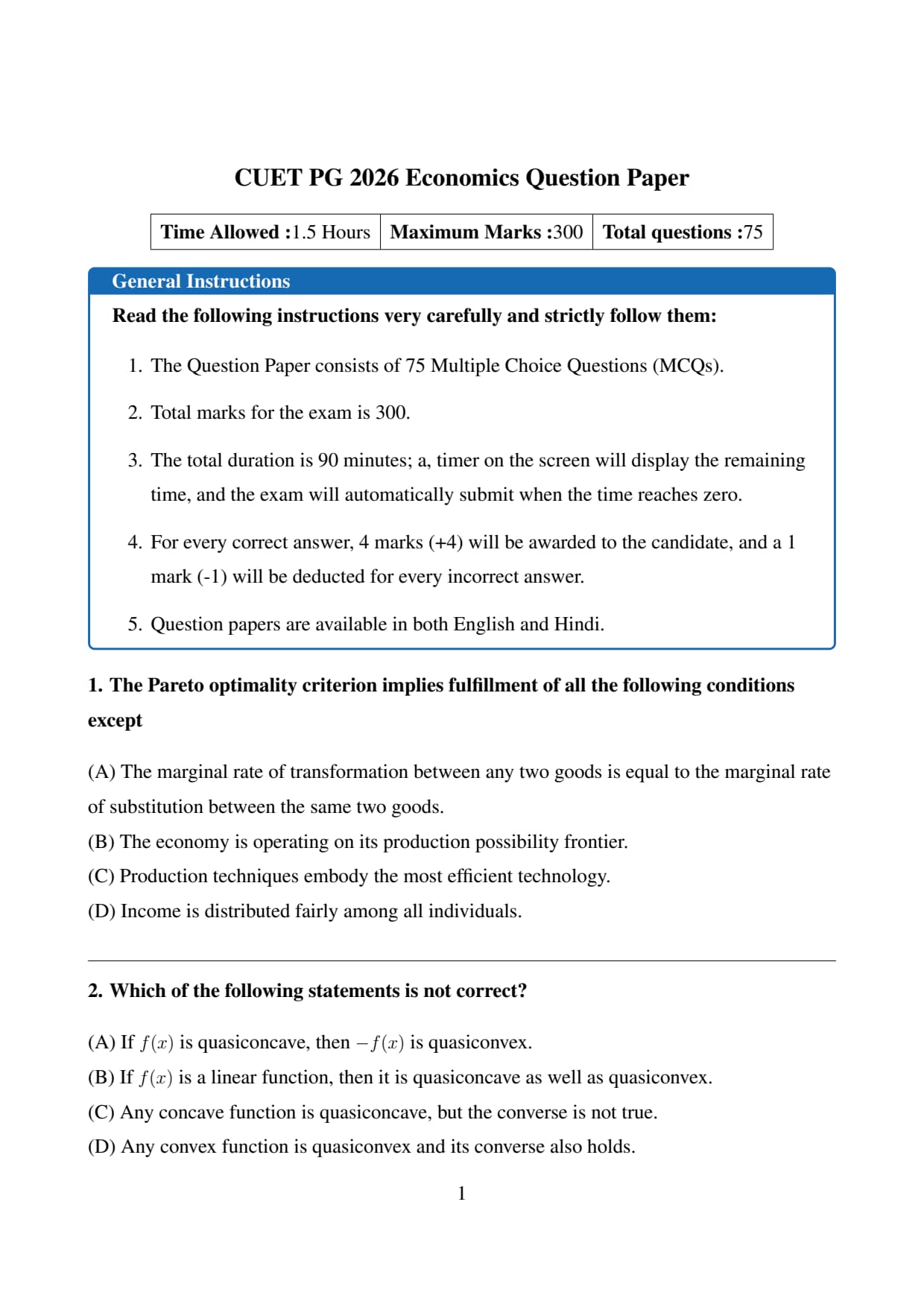
Question 1:
The Pareto optimality criterion implies fulfillment of all the following conditions except
- (A) The marginal rate of transformation between any two goods is equal to the marginal rate of substitution between the same two goods.
- (B) The economy is operating on its production possibility frontier.
- (C) Production techniques embody the most efficient technology.
- (D) Income is distributed fairly among all individuals.
Question 2:
Which of the following statements is not correct?
- (A) If \( f(x) \) is quasiconcave, then \( -f(x) \) is quasiconvex.
- (B) If \( f(x) \) is a linear function, then it is quasiconcave as well as quasiconvex.
- (C) Any concave function is quasiconcave, but the converse is not true.
- (D) Any convex function is quasiconvex and its converse also holds.
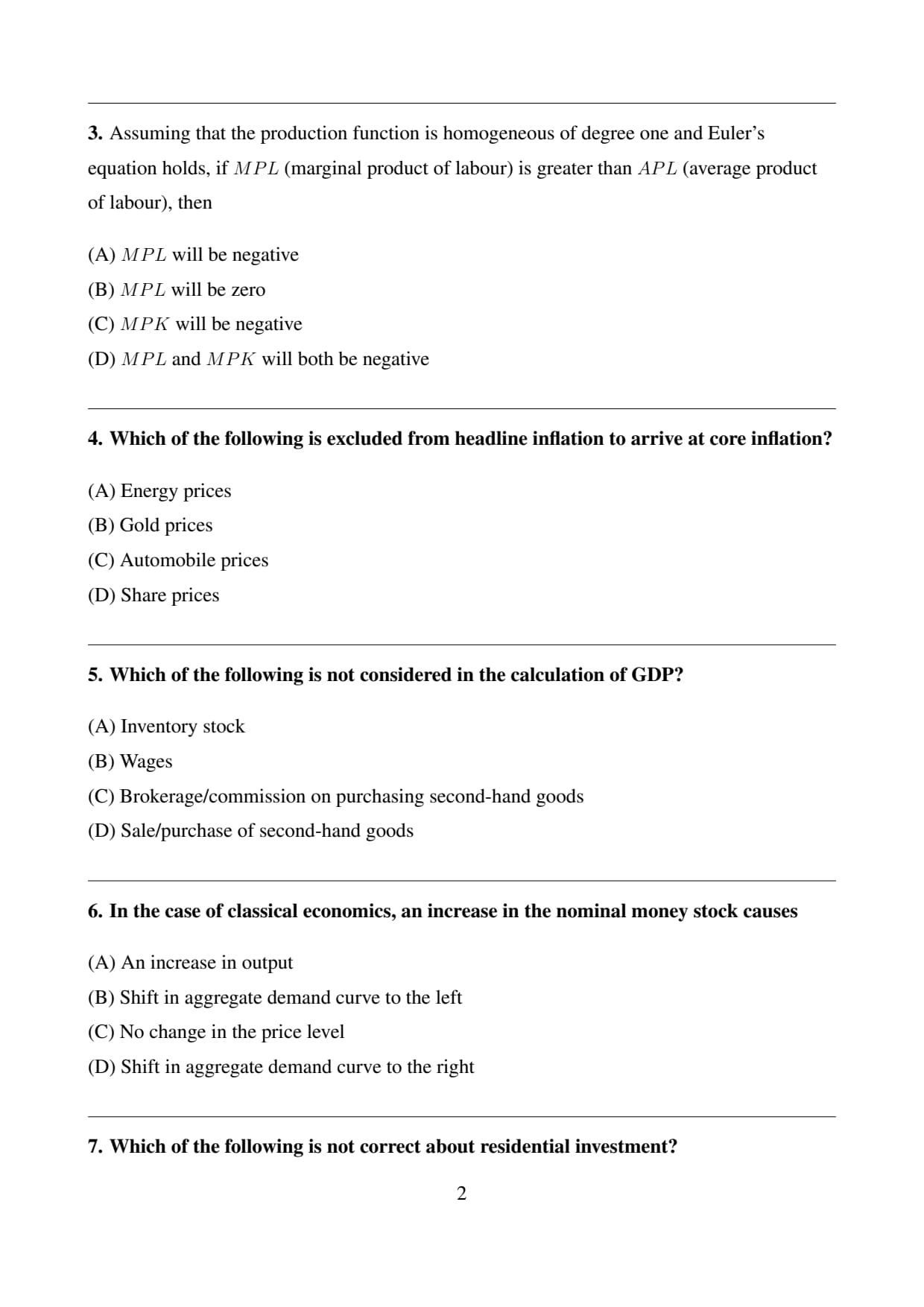
Question 3:
Assuming that the production function is homogeneous of degree one and Euler’s equation holds, if \(MPL\) (marginal product of labour) is greater than \(APL\) (average product of labour), then
- (A) \(MPL\) will be negative
- (B) \(MPL\) will be zero
- (C) \(MPK\) will be negative
- (D) \(MPL\) and \(MPK\) will both be negative
Question 4:
Which of the following is excluded from headline inflation to arrive at core inflation?
- (A) Energy prices
- (B) Gold prices
- (C) Automobile prices
- (D) Share prices
Question 5:
Which of the following is not considered in the calculation of GDP?
- (A) Inventory stock
- (B) Wages
- (C) Brokerage/commission on purchasing second-hand goods
- (D) Sale/purchase of second-hand goods
Question 6:
In the case of classical economics, an increase in the nominal money stock causes
- (A) An increase in output
- (B) Shift in aggregate demand curve to the left
- (C) No change in the price level
- (D) Shift in aggregate demand curve to the right
Question 7:
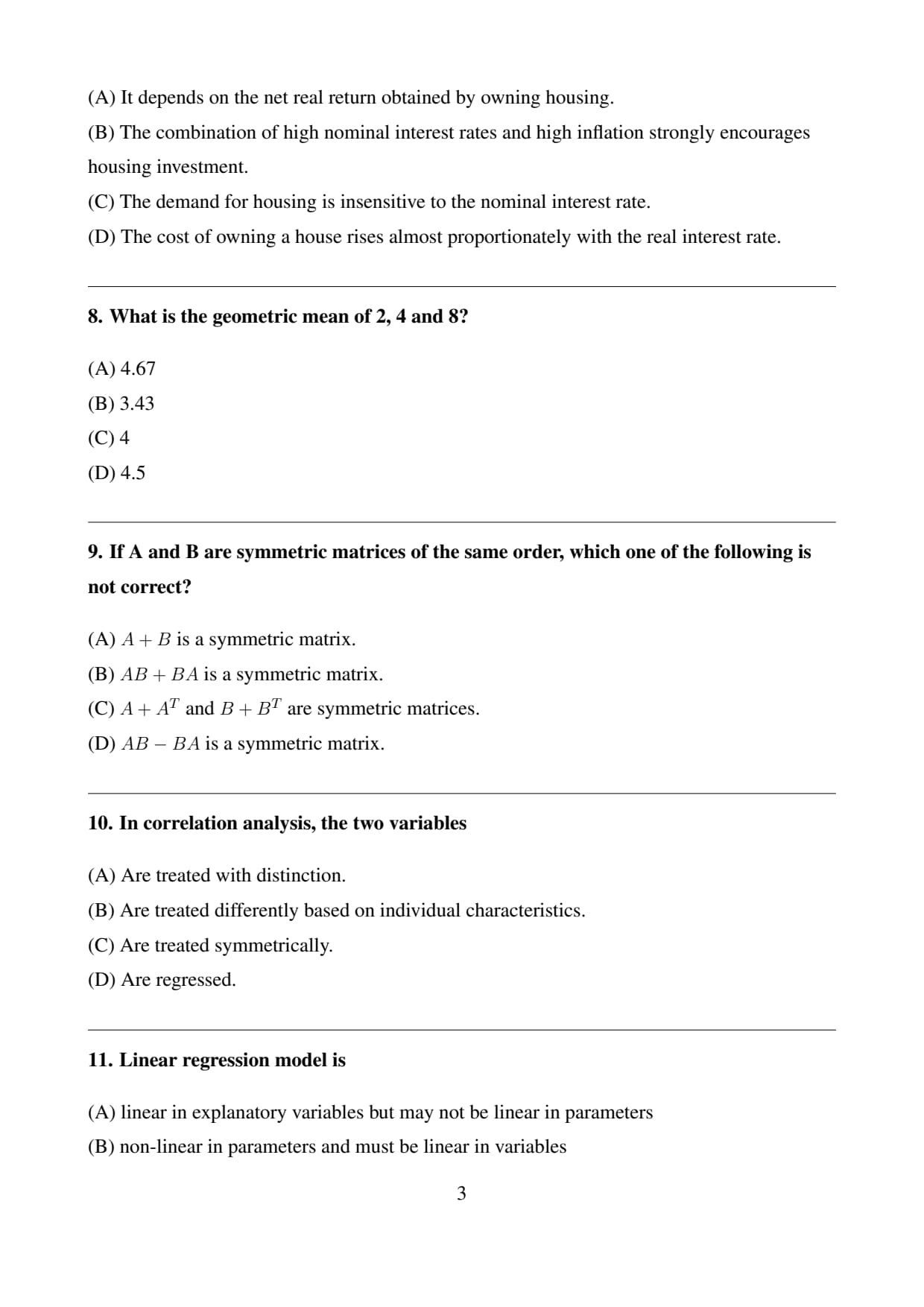
Which of the following is not correct about residential investment?
- (A) It depends on the net real return obtained by owning housing.
- (B) The combination of high nominal interest rates and high inflation strongly encourages housing investment.
- (C) The demand for housing is insensitive to the nominal interest rate.
- (D) The cost of owning a house rises almost proportionately with the real interest rate.
Question 8:
What is the geometric mean of 2, 4 and 8?
- (A) 4.67
- (B) 3.43
- (C) 4
- (D) 4.5
Question 9:
If A and B are symmetric matrices of the same order, which one of the following is not correct?
- (A) \( A + B \) is a symmetric matrix.
- (B) \( AB + BA \) is a symmetric matrix.
- (C) \( A + A^T \) and \( B + B^T \) are symmetric matrices.
- (D) \( AB - BA \) is a symmetric matrix.
Question 10:
In correlation analysis, the two variables
- (A) Are treated with distinction.
- (B) Are treated differently based on individual characteristics.
- (C) Are treated symmetrically.
- (D) Are regressed.
Question 11:
Linear regression model is
- (A) linear in explanatory variables but may not be linear in parameters
- (B) non-linear in parameters and must be linear in variables
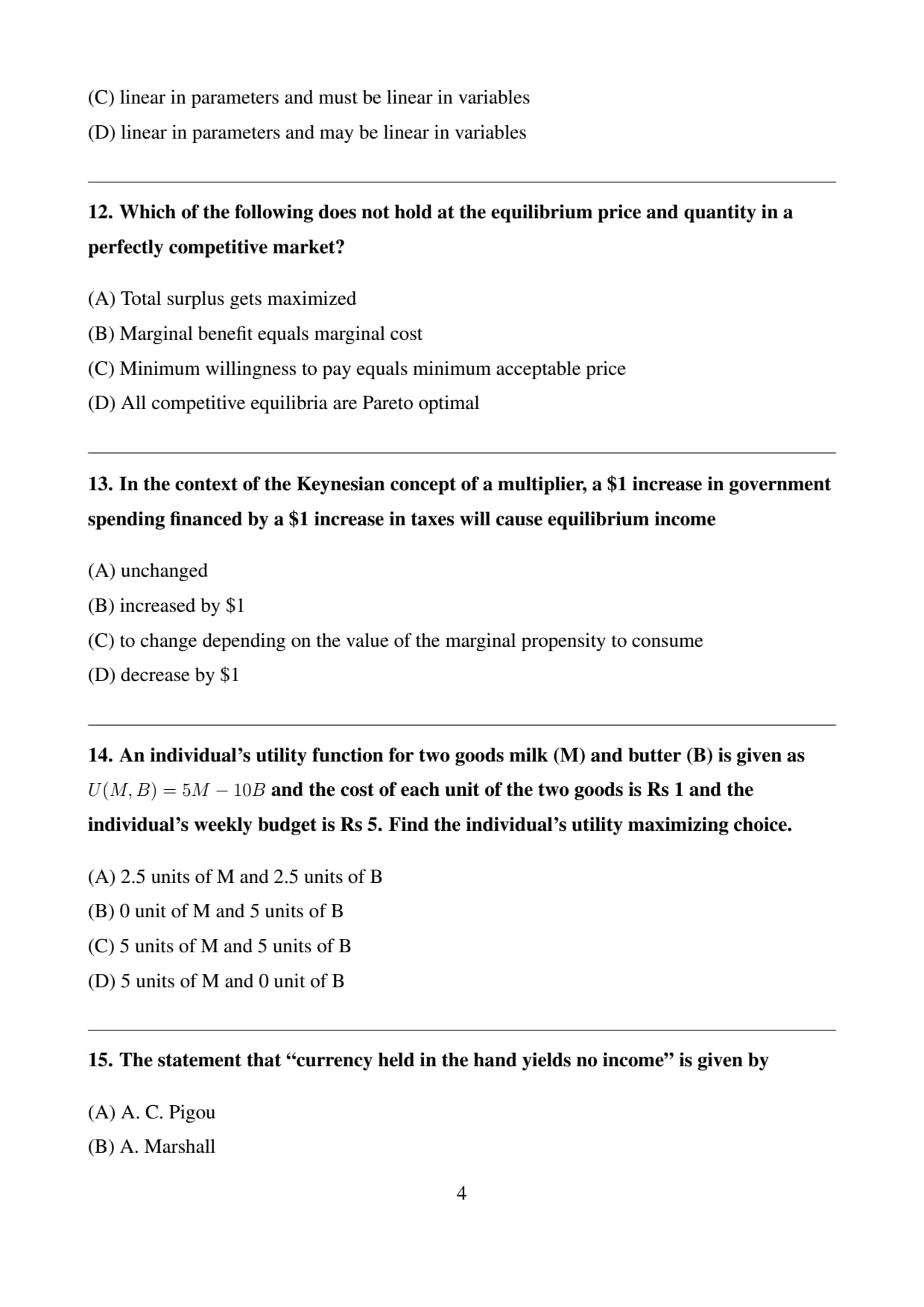
- (C) linear in parameters and must be linear in variables
- (D) linear in parameters and may be linear in variables
Question 12:
Which of the following does not hold at the equilibrium price and quantity in a perfectly competitive market?
- (A) Total surplus gets maximized
- (B) Marginal benefit equals marginal cost
- (C) Minimum willingness to pay equals minimum acceptable price
- (D) All competitive equilibria are Pareto optimal
Question 13:
In the context of the Keynesian concept of a multiplier, a
(1 increase in government spending financed by a
)1 increase in taxes will cause equilibrium income
- (A) unchanged
- (B) increased by
(1
- (C) to change depending on the value of the marginal propensity to consume
- (D) decrease by
)1
Question 14:
An individual’s utility function for two goods milk (M) and butter (B) is given as \( U(M, B) = 5M - 10B \) and the cost of each unit of the two goods is Rs 1 and the individual’s weekly budget is Rs 5. Find the individual’s utility maximizing choice.
- (A) 2.5 units of M and 2.5 units of B
- (B) 0 unit of M and 5 units of B
- (C) 5 units of M and 5 units of B
- (D) 5 units of M and 0 unit of B
Question 15:
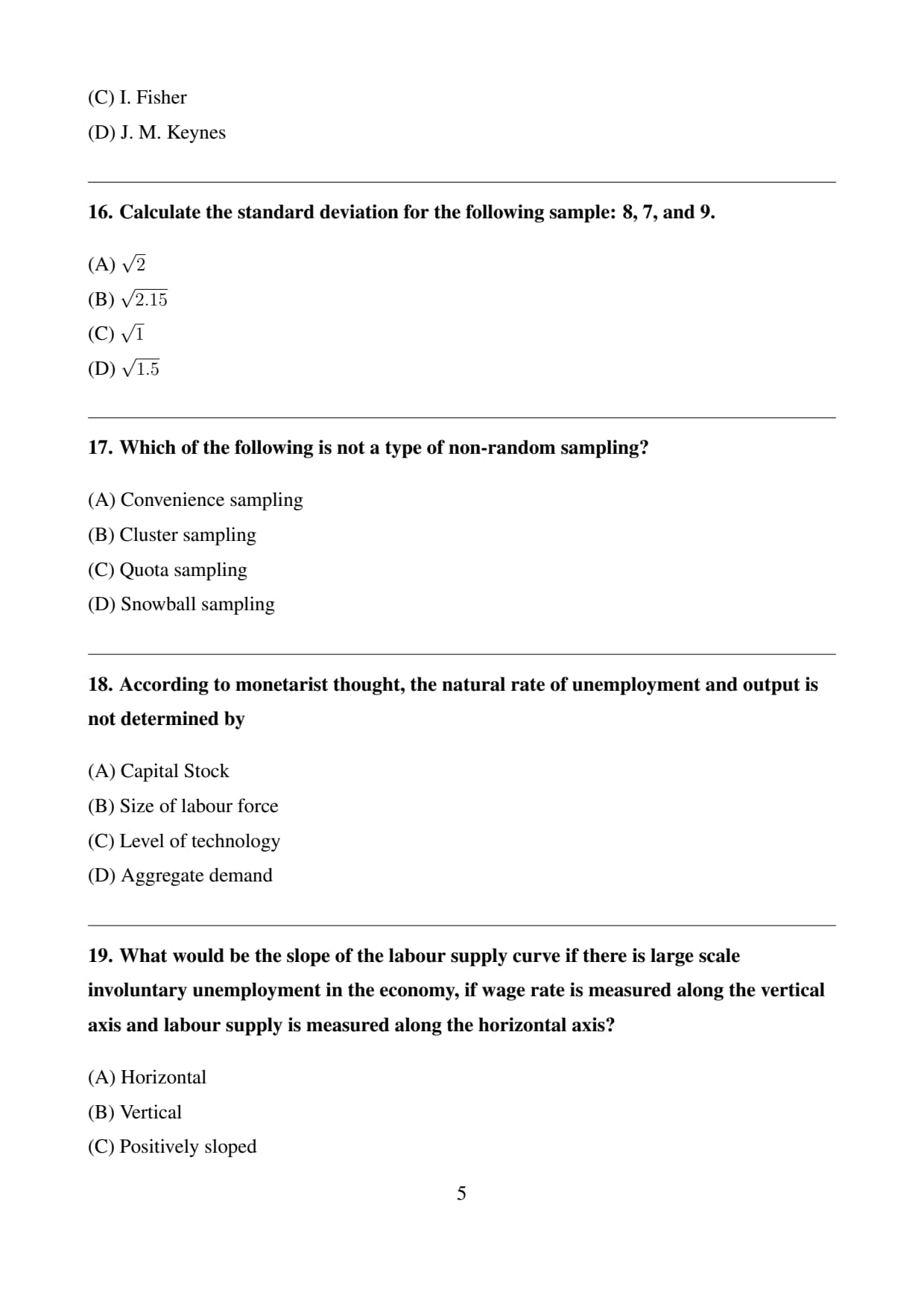
The statement that “currency held in the hand yields no income” is given by
- (A) A. C. Pigou
- (B) A. Marshall
- (C) I. Fisher
- (D) J. M. Keynes
Question 16:
Calculate the standard deviation for the following sample: 8, 7, and 9.
- (A) \( \sqrt{2} \)
- (B) \( \sqrt{2.15} \)
- (C) \( \sqrt{1} \)
- (D) \( \sqrt{1.5} \)
Question 17:
Which of the following is not a type of non-random sampling?
- (A) Convenience sampling
- (B) Cluster sampling
- (C) Quota sampling
- (D) Snowball sampling
Question 18:
According to monetarist thought, the natural rate of unemployment and output is not determined by
- (A) Capital Stock
- (B) Size of labour force
- (C) Level of technology
- (D) Aggregate demand
Question 19:
What would be the slope of the labour supply curve if there is large scale involuntary unemployment in the economy, if wage rate is measured along the vertical axis and labour supply is measured along the horizontal axis?
- (A) Horizontal
- (B) Vertical
- (C) Positively sloped
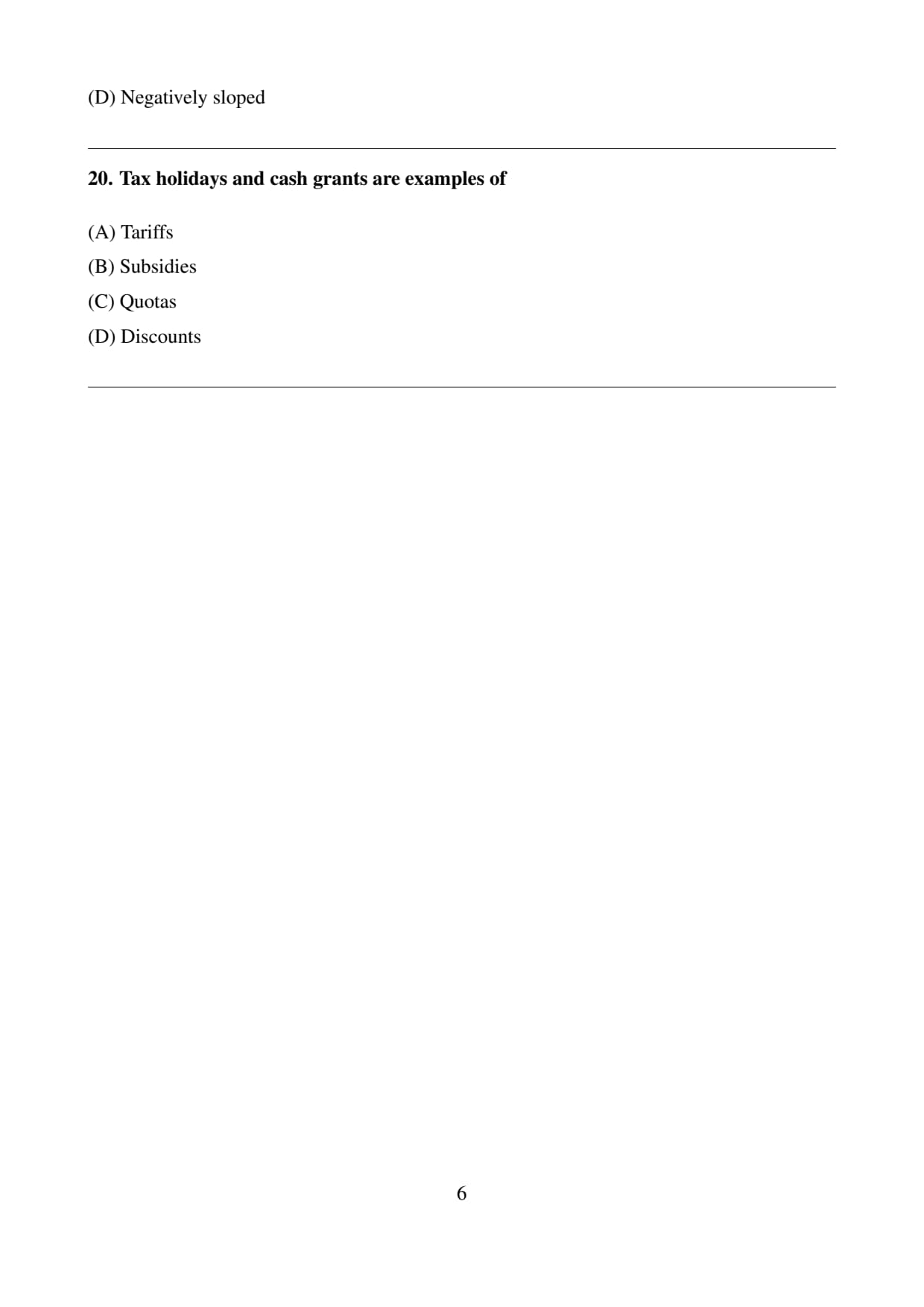
- (D) Negatively sloped
Question 20:
Tax holidays and cash grants are examples of
- (A) Tariffs
- (B) Subsidies
- (C) Quotas
- (D) Discounts
CUET PG 2026 Economics Preparation









Comments