



UK Board conducted the Class 10 English Board Exam 2026 on March 14, 2026. Class 10 English Question Paper with Solution PDF is available here for download.
The UK Board Class 10 English paper covered key topics from literature, grammar, writing skills, and comprehension. Students should focus on understanding literary texts, improving grammar and vocabulary, and practicing structured writing. The exam is marked out of 100, with 80 marks for the theory paper and 20 for internal assessment.
UK Board Class 10 2026 English Question Paper with Solution PDF
| UK Board Class 10 English Question Paper 2026 | Download PDF | Check Solution |

Read the passage given below and answer the questions that follow-
The Egyptian mummies have always remained a fascination for all. The method of embalming, or treating the dead body, that the ancient Egyptians used, is called mummification. Using special processes, they removed all moisture from the dead body, leaving only a dried form that would not easily decay. It was an important Egyptian religious belief to preserve the dead body in as lifelike a manner as possible.
Read More
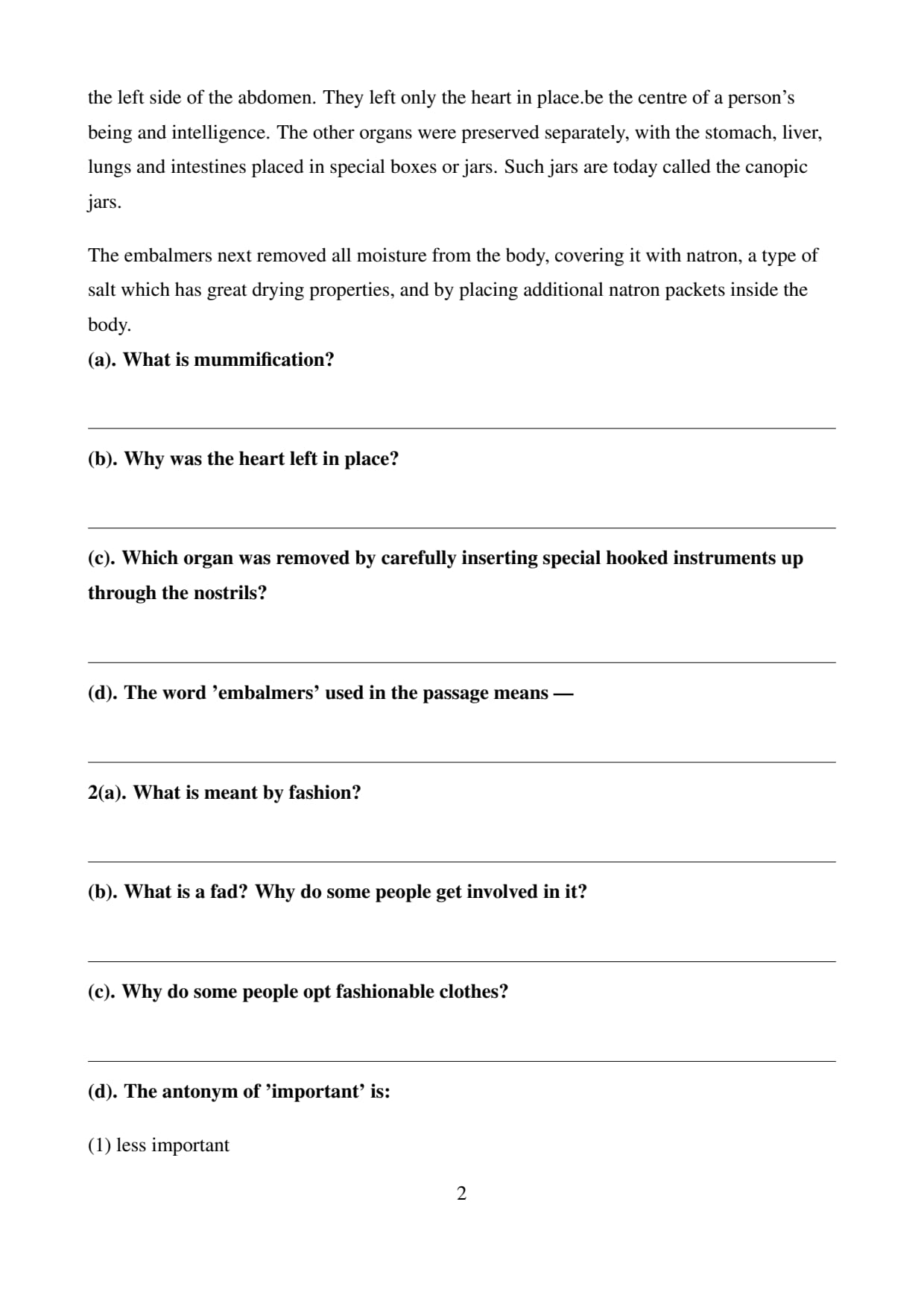
The first step in the process was the removal of all internal parts that might decay rapidly. The brain was removed by carefully inserting special hooked instruments up through the nostrils. It was a delicate operation, one which could easily disfigure the face. The embalmers then removed the organs of the abdomen and chest through a cut usually made on the left side of the abdomen. They left only the heart in place.be the centre of a person's being and intelligence. The other organs were preserved separately, with the stomach, liver, lungs and intestines placed in special boxes or jars. Such jars are today called the canopic jars.
The embalmers next removed all moisture from the body, covering it with natron, a type of salt which has great drying properties, and by placing additional natron packets inside the body.
What is mummification?
View Solution
Step 1: Meaning of mummification.
Mummification was an ancient Egyptian method used to preserve a dead body after death. The process involved removing internal organs and drying the body using substances such as natron.
Step 2: Method used.
After removing the organs, the body was dried, wrapped in linen cloth, and carefully preserved so that it would not decay.
Step 3: Purpose of mummification.
Ancient Egyptians believed in life after death, so they preserved the body so that the soul could return to it in the afterlife.
Step 4: Conclusion.
Thus, mummification is the ancient Egyptian process of preserving dead bodies to prevent decay and prepare them for the afterlife.
Quick Tip: Mummification preserved the body by removing organs and drying it with natron to prevent decay.
Why was the heart left in place?
View Solution
Step 1: Egyptian belief system.
Ancient Egyptians believed that the heart was the centre of a person's intelligence, emotions, and soul.
Step 2: Religious significance.
They believed the heart would be needed in the afterlife for judgement and spiritual existence.
Step 3: Practice in mummification.
Because of this belief, embalmers did not remove the heart during mummification, while other organs were taken out and preserved separately.
Step 4: Conclusion.
Therefore, the heart was left in place because Egyptians believed it was the centre of a person's being and intelligence.
Quick Tip: Ancient Egyptians considered the heart the centre of intelligence and the soul, so it was not removed during mummification.
Which organ was removed by carefully inserting special hooked instruments up through the nostrils?
View Solution
Step 1: Understanding the embalming process.
During the process of mummification in ancient Egypt, embalmers removed several internal organs to prevent the body from decaying. Special tools and techniques were used to remove these organs carefully.
Step 2: Removal through the nostrils.
One of the most delicate steps involved inserting special hooked instruments through the nostrils. This method was used to break up and extract the brain from the skull.
Step 3: Reason for removing the brain.
The ancient Egyptians believed that the brain had little importance, so it was removed and discarded during the embalming process.
Step 4: Conclusion.
Thus, the organ removed through the nostrils using special hooked instruments was the brain.
Quick Tip: In ancient Egyptian mummification, the brain was removed through the nostrils, while the heart was usually left inside the body.
The word 'embalmers' used in the passage means —
View Solution
Step 1: Understanding the context.
In the passage, the word embalmers refers to people involved in the process of preparing and preserving dead bodies during mummification.
Step 2: Meaning of the word.
Embalmers are individuals who treat and preserve a dead body by removing organs, drying it with substances such as natron, and wrapping it carefully so that it does not decay.
Step 3: Conclusion.
Therefore, the word embalmers means people who preserve dead bodies (especially during mummification).
Quick Tip: Embalmers were specialists in ancient Egypt who preserved bodies through the process of mummification.
What is meant by fashion?
View Solution
Step 1: Meaning of fashion.
Fashion refers to the popular style or trend of clothing, accessories, hairstyle or behaviour that is accepted and followed by people during a particular period of time.
Step 2: Nature of fashion.
Fashion changes from time to time according to people's preferences, culture, social influences and technological developments.
Step 3: Conclusion.
Thus, fashion is the style that becomes widely accepted and followed by people for a certain period.
Quick Tip: Fashion is temporary and keeps changing with time, culture and trends.
What is a fad? Why do some people get involved in it?
View Solution
Step 1: Meaning of fad.
A fad is a style, trend or activity that becomes extremely popular for a very short period of time and then quickly disappears.
Step 2: Reason people follow fads.
People get involved in fads because they want to look modern, attract attention, feel accepted in a social group or imitate celebrities and media influences.
Step 3: Conclusion.
Therefore, a fad is a short-lived fashion trend followed mainly because of social influence and the desire to be part of the latest trend.
Quick Tip: A fad spreads very quickly but also disappears quickly compared to long-lasting fashion trends.
Why do some people opt fashionable clothes?
View Solution
Step 1: Personal appearance.
Some people choose fashionable clothes to improve their appearance and to look attractive and stylish.
Step 2: Social influence.
Fashionable clothing helps individuals feel confident and accepted in society, especially among friends, colleagues and social groups.
Step 3: Expression of personality.
Fashion is also a way for people to express their personality, creativity and personal preferences.
Step 4: Conclusion.
Therefore, people choose fashionable clothes to look attractive, gain confidence and express their identity.
Quick Tip: Fashion is often used as a way to express personality and social identity.
The antonym of 'important' is:
View Solution
Step 1: Understanding antonyms.
An antonym is a word that has the opposite meaning of another word.
Step 2: Meaning of important.
The word “important” means something that has great value, significance or priority.
Step 3: Identifying the opposite meaning.
The opposite meaning of important is something that does not have significance or value, which is expressed by the word “non-important”.
Step 4: Conclusion.
Hence, the correct antonym of “important” is “non-important”.
Quick Tip: Antonyms are words with opposite meanings such as important – unimportant.
You are Avni/Anand studying at DAV Intermediate School, Dehradun. Write a letter to your father asking for five hundred rupees for a school pleasure trip.
View Solution
Step 1: Sender's address and date.
DAV Intermediate School Hostel
Dehradun
10 March 2024
Step 2: Salutation and introduction.
Dear Father,
I hope you are in good health and spirits. I am also fine here and concentrating well on my studies.
Step 3: Purpose of writing the letter.
I am writing this letter to inform you that our school is organizing a pleasure trip to Mussoorie next week. Our class teacher has encouraged all the students to participate as it will be both educational and enjoyable.
Step 4: Request for money.
For this trip, each student has to contribute five hundred rupees to cover travel and other arrangements. I request you kindly to send me Rs. 500 so that I may join my classmates on this trip.
Step 5: Closing the letter.
I assure you that I will take good care of myself and make good use of this opportunity. Please convey my regards to mother and love to younger siblings.
Your loving son/daughter,
Avni / Anand
Quick Tip: While writing an informal letter, maintain a friendly tone, clearly mention the purpose, and end the letter politely.
Write a paragraph on 'Importance of mental health' in about 60 words.
View Solution
Step 1: Understanding mental health.
Mental health refers to a person's emotional, psychological, and social well-being. It affects how we think, feel, and behave in daily life.
Step 2: Importance in daily life.
Good mental health helps individuals handle stress, make proper decisions, and maintain healthy relationships with others. It also improves concentration and productivity.
Step 3: Conclusion.
Therefore, maintaining mental health through positive thinking, regular exercise, and proper rest is very important for living a balanced and happy life.
Quick Tip: Mental health is as important as physical health. A healthy mind helps us face challenges and live a positive life.
Complete the story: A house catches fire...
View Solution
Step 1: Beginning of the story.
One evening, a small house in a quiet neighborhood suddenly caught fire. Thick smoke began to rise from the roof, and flames quickly spread through the rooms. The neighbors noticed the fire and immediately called the fire brigade.
Step 2: Development of the incident.
People gathered around the house and tried to help the family come out safely. Fortunately, all the members of the family managed to escape from the house in time. The fire brigade soon arrived and worked hard to control the flames.
Step 3: Resolution of the story.
After some time, the fire was finally brought under control. Although the house suffered heavy damage, everyone was safe. The incident taught everyone an important lesson about fire safety and the need to stay calm during emergencies.
Step 4: Moral of the story.
This incident showed that quick thinking, cooperation, and timely help can prevent a disaster from becoming worse.
Quick Tip: When writing a story, include a clear beginning, a problem or event, a resolution, and a moral to make the story meaningful.
Fill in the blanks with correct form of verbs.
View Solution
(a) Some boys are making a noise in the class.
Correct verb form: are making (Present Continuous Tense)
(b) Raju goes to bed at 10 p.m.
Correct verb form: goes (Simple Present Tense)
(c) Shyam has bought a cooler.
Correct verb form: has bought (Present Perfect Tense)
(d) I have been working on this problem since morning.
Correct verb form: have been working (Present Perfect Continuous Tense)
Quick Tip: Different verb tenses show different times of action. Present Continuous shows ongoing action, Simple Present shows routine, Present Perfect shows completed action with present effect, and Present Perfect Continuous shows action continuing from the past until now.
Combine using clauses.
View Solution
(a) I do not believe in what you say.
Step 1: Understanding the clause.
The sentence combines two ideas: "I do not believe" and "you say something".
Step 2: Using a noun clause.
The word what is used to connect the ideas and form a noun clause.
Step 3: Final sentence.
Thus, the combined sentence becomes: I do not believe in what you say.
(b) This is the place where she was born.
Step 1: Understanding the clause.
The sentence combines the ideas "This is the place" and "She was born there".
Step 2: Using an adverb clause of place.
The word where is used to connect the sentences and indicate the place.
Step 3: Final sentence.
Thus, the combined sentence becomes: This is the place where she was born.
Quick Tip: Clauses help combine sentences smoothly. Words like \textbf{what, where, who, which, and that} are commonly used to connect ideas.
Fill in the blanks with non-finites.
View Solution
(a) I know how to drive a car.
Step 1: Understanding the non-finite verb.
The phrase to drive is an infinitive, which is a type of non-finite verb. It does not change according to the subject or tense.
Step 2: Final sentence.
Thus, the correct sentence is: I know how to drive a car.
(b) He was glad to see me.
Step 1: Identifying the infinitive.
The word to see is an infinitive and acts as a non-finite verb expressing purpose or feeling.
Step 2: Final sentence.
Thus, the correct sentence is: He was glad to see me.
(c) Walking is a good exercise.
Step 1: Identifying the gerund.
The word Walking is a gerund. It is formed from a verb but functions as a noun in the sentence.
Step 2: Final sentence.
Thus, the correct sentence is: Walking is a good exercise.
(d) He kept me waiting.
Step 1: Identifying the participle.
The word waiting is a present participle, which is another form of non-finite verb.
Step 2: Final sentence.
Thus, the correct sentence is: He kept me waiting.
Quick Tip: Non-finite verbs include infinitives (to + verb), gerunds (verb + ing used as a noun), and participles (verb forms used as adjectives).
Change into passive voice.
View Solution
(a) Fruits are being eaten by me.
Step 1: Identify the tense.
The sentence is in Present Continuous Tense.
Step 2: Passive structure.
Passive voice for present continuous follows the pattern:
Object + is/are being + past participle + by + subject.
Step 3: Final sentence.
Thus, the passive form is: Fruits are being eaten by me.
(b) Let the book be opened.
Step 1: Understanding the imperative sentence.
The original sentence is an imperative form giving an order or request.
Step 2: Passive formation.
Imperative sentences in passive voice usually begin with Let.
Step 3: Final sentence.
Thus, the passive form is: Let the book be opened.
(c) What has been done by you today?
Step 1: Identify the tense.
The sentence is in Present Perfect Tense.
Step 2: Passive structure.
Passive voice for present perfect follows the pattern:
Object + has/have been + past participle + by + subject.
Step 3: Final sentence.
Thus, the passive form is: What has been done by you today?
Quick Tip: To convert active voice into passive voice, make the object of the active sentence the subject of the passive sentence and use the appropriate form of \textbf{be + past participle}.
Complete the following sentences using suitable modals.
(a) We ______ climb up this high tree.
(b) ______ he return home safe!
(c) Take a taxi. You ______ catch the train.
(d) She wondered whether it ______ be true.
View Solution
(a) We can climb up this high tree.
Step 1: Understanding the sentence.
The sentence expresses ability to do something.
Step 2: Suitable modal.
The modal verb can is used to show ability.
Step 3: Final sentence.
Thus, the correct sentence is: We can climb up this high tree.
(b) May he return home safe!
Step 1: Understanding the sentence.
This sentence expresses a wish or prayer.
Step 2: Suitable modal.
The modal verb may is used to express wish or hope.
Step 3: Final sentence.
Thus, the correct sentence is: May he return home safe!
(c) Take a taxi. You may catch the train.
Step 1: Understanding the sentence.
The sentence expresses possibility.
Step 2: Suitable modal.
The modal verb may shows possibility.
Step 3: Final sentence.
Thus, the correct sentence is: Take a taxi. You may catch the train.
(d) She wondered whether it might be true.
Step 1: Understanding the sentence.
The sentence expresses doubtful possibility in the past.
Step 2: Suitable modal.
The modal verb might is used for uncertain possibility.
Step 3: Final sentence.
Thus, the correct sentence is: She wondered whether it might be true.
Quick Tip: Modal verbs such as can, may, might, must and should express ability, permission, possibility, obligation and advice.
Rearrange the following words and phrases to form meaningful sentences.
(i) famous / is / teacher / a / he
(ii) us / together / let / dance
View Solution
(i) He is a famous teacher.
Step 1: Identify the subject.
The word he is the subject of the sentence.
Step 2: Place the verb correctly.
The verb is follows the subject.
Step 3: Arrange the remaining words.
The words a famous teacher act as the complement describing the subject.
Step 4: Final sentence.
Thus, the correct sentence is: He is a famous teacher.
(ii) Let us dance together.
Step 1: Identify the imperative structure.
The sentence begins with the word let to form a suggestion.
Step 2: Arrange the pronoun and verb.
The pronoun us comes after let, followed by the verb dance.
Step 3: Place the remaining word.
The word together is placed at the end to complete the meaning.
Step 4: Final sentence.
Thus, the correct sentence is: Let us dance together.
Quick Tip: To rearrange words into a meaningful sentence, first identify the subject, then place the verb, and finally add the remaining words in logical order.
Question 18:
Read the extract given below and answer the questions that follow:
The young seagull was alone on his ledge. His two brothers and his sister had already flown away the day before. He had been afraid to fly with them. Somehow when he had taken a little run forward to the brink of the ledge and attempted to flap his wings he became afraid. The great expanse of sea stretched down beneath, and it was such a long way down—miles down. He felt certain that his wings would never support him; so he bent his head and ran away back to the little hole under the ledge where he slept at night.
Who had flown away the day before?
View Solution
Step 1: Understanding the passage.
The passage describes a young seagull who was afraid to fly. It states that the other members of his family had already flown away the previous day.
Step 2: Identifying who flew away.
The passage refers to the young seagull’s family members such as his parents, brothers and sisters. They had learned to fly and had already flown away the day before.
Step 3: Conclusion.
Therefore, the young seagull’s family had flown away the day before.
Quick Tip: This passage is taken from the story "His First Flight", which describes the young seagull learning to overcome fear and fly.
What did the young seagull feel when he thought of flying?
View Solution
Step 1: Situation described in the passage.
The young seagull stood at the edge of the ledge and looked at the vast sea below. The height and distance frightened him.
Step 2: His feelings about flying.
He felt afraid that his wings would not support him if he tried to fly. Because of this fear, he lost confidence and ran back to his shelter.
Step 3: Conclusion.
Thus, when the young seagull thought of flying, he felt frightened and lacked confidence.
Quick Tip: Fear of failure prevented the young seagull from flying until he finally gained confidence.
Where did he sleep last night?
View Solution
Step 1: Location mentioned in the passage.
The passage explains that the young seagull ran back to a small hole under the ledge where he usually stayed.
Step 2: Identifying the sleeping place.
This small hole under the ledge served as his resting place during the night.
Step 3: Conclusion.
Therefore, the young seagull slept in a little hole under the ledge.
Quick Tip: The young seagull stayed in a small hole under the ledge because he was too afraid to fly like the others.
Find a word from the passage which means the same as 'below'.
View Solution
Step 1: Understanding the meaning.
The word “below” refers to something that is under or at a lower position.
Step 2: Checking the options.
Among the given options, the word “beneath” means under or below something.
Step 3: Conclusion.
Hence, the correct word from the passage that means “below” is beneath.
Quick Tip: Synonyms help identify words with similar meanings within a passage.
How can the spirit of Mandela's long walk to freedom inspire you to contribute positively to your society, even in small ways, to fight injustice or inequality?
View Solution
Step 1: Understanding Mandela's struggle.
Nelson Mandela spent many years fighting against racial discrimination and injustice in South Africa. His courage, patience and determination helped bring freedom and equality to his people.
Step 2: Inspiration for individuals.
Mandela’s life inspires us to stand against injustice and treat everyone equally. Even small actions such as helping the needy, speaking against unfair behaviour and promoting equality can make a difference.
Step 3: Contribution to society.
By showing kindness, respecting others and supporting justice in our daily life, we can help build a better and fairer society. Mandela’s spirit teaches us that every small effort for justice is valuable.
Quick Tip: Nelson Mandela’s life teaches us that courage, patience and determination can bring social change and equality.
How does Anne feel about her father, her grandmother, Mrs. Kuperus and Mr. Keesing? What do these tell you about her?
View Solution
Step 1: Anne's feelings about her father.
Anne Frank loves and respects her father deeply. She considers him kind, understanding and supportive, and she shares her thoughts freely with him.
Step 2: Feelings about her grandmother and Mrs. Kuperus.
Anne remembers her grandmother with affection and respect. She also speaks fondly about Mrs. Kuperus, her headmistress, who cared for her and encouraged her during her early school days.
Step 3: Feelings about Mr. Keesing.
Mr. Keesing was her strict mathematics teacher who often punished her for talking in class. However, Anne handled the situation with humour and cleverness.
Step 4: What this shows about Anne.
These feelings show that Anne was intelligent, affectionate, humorous and thoughtful. She valued relationships and had a positive attitude towards the people in her life.
Quick Tip: Anne Frank's diary shows her intelligence, humour and deep affection for the people around her.
Describe the personalities of Lomov, Natalya and Chubukov.
View Solution
Step 1: Lomov's personality.
Lomov is a nervous, short-tempered and hypochondriac man who worries excessively about his health. He is quick to argue and becomes irritated easily.
Step 2: Natalya's personality.
Natalya is stubborn, argumentative and strong-willed. She is very concerned about property and often quarrels over small issues.
Step 3: Chubukov's personality.
Chubukov is a loud and emotional man. Although he initially welcomes Lomov, he quickly joins the arguments and behaves aggressively during disputes.
Quick Tip: In the play "The Proposal", the characters are humorous because they argue constantly over trivial matters instead of focusing on the marriage proposal.
What does the play 'The Proposal' say about property in relationships?
View Solution
Step 1: Understanding the theme.
The play humorously shows how people give more importance to property and land than to relationships.
Step 2: Example from the play.
Lomov and Natalya argue bitterly about the ownership of Oxen Meadows and their dogs even though Lomov has come to propose marriage.
Step 3: Conclusion.
Thus, the play suggests that greed and pride over property can create unnecessary conflicts and weaken human relationships.
Quick Tip: "The Proposal" is a comic play that shows how trivial disputes and pride can disturb relationships.
Read the following extract and answer the questions that follow:
But if it had to perish twice,
I think I know enough of hate
To say that for destruction ice
Is also great
And would suffice.
What does 'it' refer to here?
View Solution
Step 1: Understanding the extract.
The given lines are taken from the poem where the poet discusses the possible destruction of the world. He suggests that the world may end either because of fire or ice.
Step 2: Meaning of 'it'.
In the line “But if it had to perish twice,” the word ‘it’ refers to the world. The poet is talking about the destruction or end of the world.
Step 3: Conclusion.
Thus, the word ‘it’ in the extract refers to the world.
Quick Tip: In Robert Frost’s poem, the destruction of the world is symbolically linked to human emotions like desire and hatred.
What is 'ice' a symbol of?
View Solution
Step 1: Symbolic meaning in the poem.
In the poem, the poet uses natural elements like fire and ice as symbols to represent human emotions.
Step 2: Meaning of ice.
The word ‘ice’ symbolises emotions such as hatred, coldness and indifference. These feelings can destroy relationships and society just like fire.
Step 3: Conclusion.
Therefore, in the poem, ice is a symbol of hatred and cold-heartedness.
Quick Tip: In the poem “Fire and Ice,” fire symbolises desire while ice symbolises hatred.
Name the poem and the poet.
View Solution
Step 1: Identifying the poem.
The lines “But if it had to perish twice, I think I know enough of hate…” are taken from the poem “Fire and Ice.”
Step 2: Identifying the poet.
The poem “Fire and Ice” was written by the famous American poet Robert Frost.
Step 3: Conclusion.
Thus, the poem is “Fire and Ice” and the poet is Robert Frost.
Quick Tip: Robert Frost’s poem “Fire and Ice” explains how powerful emotions like desire and hatred can lead to destruction.
How does the poet suggest that you identify the lion and the tiger? When can you do so, according to him?
View Solution
Step 1: Poet's suggestion.
The poet suggests that one should observe the behaviour and appearance of the animals carefully in order to identify them. The lion and the tiger can be distinguished by their roar and by the stripes on the tiger’s body.
Step 2: When identification is possible.
According to the poet, this identification can be done when the animals are seen clearly and closely in their natural surroundings. Their movements, sounds and physical features help in recognizing them.
Step 3: Conclusion.
Thus, by observing their physical features and hearing their roar, one can identify the lion and the tiger.
Quick Tip: In poetry, poets often describe animals through their unique physical features and sounds to help readers imagine and identify them.
Why was the arrival of the stranger in a village an unusual event?
View Solution
Step 1: Understanding the village life.
The village mentioned in the story was a small and quiet place where everyone knew each other well. People rarely travelled there, and visitors were very uncommon.
Step 2: Reason for the unusual event.
Because of this isolated lifestyle, the arrival of a stranger attracted a lot of attention. The villagers were curious and surprised to see someone new among them.
Step 3: Conclusion.
Therefore, the arrival of the stranger was considered unusual because visitors seldom came to that village.
Quick Tip: In small or isolated villages, the arrival of an unknown person often becomes a notable and surprising event.
Compare and contrast Tricki in the beginning and in the end of the story.
View Solution
Step 1: Tricki in the beginning of the story.
At the beginning of the story, Tricki is a very fat and unhealthy dog. He is lazy, weak and does not have enough energy to move or play. His owner, Mrs. Pumphrey, feeds him too much rich food and does not allow him to exercise. As a result, he becomes ill and inactive.
Step 2: Tricki's condition after treatment.
When Tricki is taken to the veterinary surgeon, Dr. Herriot keeps him under simple treatment without giving him any special food. He is allowed to play with other dogs and gets proper exercise.
Step 3: Tricki at the end of the story.
By the end of the story, Tricki becomes active, healthy and energetic again. He runs, jumps and plays happily with the other dogs. His health improves greatly due to proper care and exercise.
Step 4: Conclusion.
Thus, Tricki changes from a weak and unhealthy dog in the beginning to a lively and healthy dog at the end of the story.
Quick Tip: The story "A Triumph of Surgery" shows that proper diet, exercise and care are essential for maintaining good health.
What different guesses were made by the Martians about what books are?
View Solution
Step 1: Martians observing the books.
When the Martians saw books for the first time, they could not understand their real purpose. Since they had never seen such objects before, they started making different guesses about them.
Step 2: Different guesses about books.
Some Martians thought that books were strange decorative objects used by humans. Others believed that they might be a kind of container or device used for communication. Some even guessed that books could be objects meant for entertainment or some unknown human activity.
Step 3: Conclusion.
Thus, the Martians made several imaginative guesses because they were unfamiliar with the concept of reading and books.
Quick Tip: When something completely new is observed, people often make guesses based on their own experiences and understanding.
Who was Horace Danby and what kind of a person was he?
View Solution
Step 1: Introduction of Horace Danby.
Horace Danby was about fifty years old and lived alone. He appeared to be a respectable and quiet person who made locks for a living.
Step 2: His secret habit.
Although he seemed honest and hardworking, he had a secret habit of stealing rare and expensive books from wealthy people’s houses. He committed one theft every year to satisfy his passion for collecting books.
Step 3: His personality.
Horace Danby was careful, intelligent and patient. He planned his robberies very cleverly and avoided unnecessary trouble. However, his love for rare books led him to become a thief.
Step 4: Conclusion.
Thus, Horace Danby was a respectable locksmith by profession but secretly a clever thief who stole rare books.
Quick Tip: Horace Danby is the central character in the story "A Question of Trust", which shows how even a careful criminal can be tricked.
What was Ebright's eighth grade project? Why did it win?
View Solution
Step 1: Ebright's eighth grade project.
Richard Ebright’s eighth grade science project was about studying the habits of monarch butterflies. He collected many butterflies and tried to understand their behaviour and migration patterns.
Step 2: What he discovered.
During his project, Ebright discovered that monarch butterflies migrate long distances and return to the same place every year. His careful observation and scientific method helped him gather important information about them.
Step 3: Reason for winning the prize.
His project won the prize because it was well researched, scientifically organized and showed original observation. The judges appreciated his curiosity, dedication and clear presentation.
Step 4: Conclusion.
Thus, Ebright’s project won because of his detailed research and genuine scientific interest in monarch butterflies.
Quick Tip: Richard Ebright’s success shows that curiosity, careful observation and hard work are essential qualities for a good scientist.
What was the cause of Matilda's ruin? How could she have avoided it?
View Solution
Step 1: Cause of Matilda's ruin.
Matilda's ruin was mainly caused by her pride, vanity and desire for a luxurious life. She borrowed a diamond necklace from her friend Mme. Forestier to attend a party. Unfortunately, she lost the necklace and, instead of admitting the truth, she and her husband replaced it with a very expensive one. To repay the debt, they had to work very hard and live in poverty for ten years.
Step 2: How she could have avoided it.
Matilda could have avoided this tragedy if she had been honest and informed Mme. Forestier about losing the necklace. The original necklace was actually artificial and not very valuable, so the problem could have been solved easily.
Step 3: Conclusion.
Thus, Matilda's ruin was the result of her pride and dishonesty, which could have been avoided through honesty and contentment.
Quick Tip: The story "The Necklace" teaches that pride, greed and dishonesty can lead to unnecessary suffering, while honesty and simplicity bring peace.






Comments