




The MAH MBA CET 2025 Question Paper and Answer Key for the 1st April session 2 is available here. The MAH MBA CET 2025 was moderate to difficult level of difficulty.The MAH CET Exam is an objective-type, multiple-choice test, including logical reasoning, quantitative aptitude, and verbal ability. The MAH CET exam typically consists of 200 multiple-choice questions, with a duration of 2.5 hours (150 minutes). Each correct answer is given as 1 mark, and there is no negative marking for incorrect answers. The total maximum score in the exam is 200 marks, Student can download MAHCET Question paper with Solution here.
Related Links:
MAH MBA CET 2025 April 1 Session 2 Question Paper with Solutions
| MAH MBA CET 2025 Question Paper April 1 Session 2 | Download PDF | Check Solution |
Identify the number that does not belong to the number series given below:
789, 645, 545, 481, 440, 429, 425
Anora sees the time on her perfectly working ordinary wrist watch at 10:20 AM on 8th of March, 2025 and the next occasion when she sees the time on her same watch is at 11:15 AM on 11th of March, 2025. Determine the number of times, the hour and minute hand of her watch would have been exactly over one another between the two times that Anora saw the time on her watch?
P, Q, R and S are four towns. One can travel between P and Q along 3 direct paths, between Q and S along 4 direct paths, and between P and R along 4 direct paths. There is no direct path between P and S, while there are a few direct paths between Q and R and also between R and S. One can travel from P to S either via Q, or via R, or via Q followed by R, respectively, in exactly 62 possible ways. One can also travel from Q to R either directly, or via P, or via S, in exactly 27 possible ways. Then, the number of direct paths between Q and R is:
A fruit seller has a stock of mangoes, bananas and apples with at least one fruit of each type. At the beginning of a day, the number of mangoes make up 40% of his stock. That day, he sells half of the mangoes, 96 bananas and 40% of the apples. At the end of the day, he ends up selling 50% of the fruits. The smallest possible total number of fruits in the stock at the beginning of the day is:
When Rajesh's age was same as the present age of Garima, the ratio of their ages was 3 : 2. When Garima's age becomes the same as the present age of Rajesh, the ratio of the ages of Rajesh and Garima will become :
In the following letter series, some of the letters are missing which are given in that order as one of the alternatives below it. Choose the correct alternative:

In the following question there is a certain relationship between two given numbers on one side of : and one number is given on another side of : while another number is to be found from the given alternatives, having the same relation with this number as the numbers of the given pair have.
Choose the correct alternative:
6 : 43 : : 4 : ?
If in a particular language ; DIAMOND is coded as VQYMKLV, then how is FEMALE coded in that language ?
Read the information given below carefully and answer the question that follows:
A, B, C, D, E, and F are six members of family.
One couple has parents and children in the family.
A is the son of C and E is the daughter of A.
D is the daughter of F who is the mother of E.
Which of the following pairs is the parents of the couple?
Read the information given below carefully and answer the question that follows:
A, B, C, D, E, and F are six members of family.
One couple has parents and children in the family.
A is the son of C and E is the daughter of A.
D is the daughter of F who is the mother of E.
How many female members are there in the family?
Read the information given below carefully and answer the question that follows:
A, B, C, D, E, and F are six members of family.
One couple has parents and children in the family.
A is the son of C and E is the daughter of A.
D is the daughter of F who is the mother of E.
What relationship do D and E bear to each other?
Read the information given below carefully and answer the question that follows:
A team of five is to be selected from amongst five boys A, B, C, D and E and four girls P, Q, R and S.
Criteria for selection are:
A and S have to be together.
P cannot be put with R.
D and Q cannot go together.
C and E have to be together.
R cannot be put with B.
If two of the members have to be boys, the composition of the team will be:
Read the information given below carefully and answer the question that follows:
A team of five is to be selected from amongst five boys A, B, C, D and E and four girls P, Q, R and S.
Criteria for selection are:
A and S have to be together.
P cannot be put with R.
D and Q cannot go together.
C and E have to be together.
R cannot be put with B.
If R has to be one of the members, the other members of the team shall be?
D is the mother of J and L. J is the brother of F. F is the son of K. K has only three children. Y is the son-in-law of D. M is the son of Y. M is the brother of S, how is D related to M?
Pointing to man in a photograph a lady said, "The father of his brother, is the only son of my grandfather." How is the lady related to the man in the photograph?
In the following series, find the correct options at the place of the question mark.
Q1F, S2E, U6D, W21C, ?
In the following series find correct options at the place of question mark.
2, 4, 12, 6, 12, 36, 18, 36, 108, ?
R walks 20 m North. Then he turns right and walks 30 m. Then he turns right and walks 35 m. Then he turns left and walks 15 m. Then he again turns left and walks 15 m. Determine that finally in which direction and how many metres away is he from his original position ?
P, Q, R, S, T, U, V, W are sitting around a round table in the same order, for group discussion at equal distances. Their positions are clockwise. If V sits in the North, then what will be the position of S?
Observe the series given below carefully and answer the question that follows:
ABCDEFGHIJKLMNOPQRSTUVWXYZ
If the series is written in the reverse order, which will be the eighth letter to the right of O?
Observe the series given below carefully and answer the question that follows:
ABCDEFGHIJKLMNOPQRSTUVWXYZ
If the series is written in the reverse order, then determine that which will be the fifth letter to the left of the ninth letter from the right?
Observe the series given below carefully and answer the question that follows:
ABCDEFGHIJKLMNOPQRSTUVWXYZ
If the last ten letters of the series are written in the reverse order, which of the following will be the sixth to the right of the thirteenth letter from the left end?
Abhini went to the movies nine days ago. She goes to the movies only on Thursday. What day of the week is it today?
A, B, C, D and E play a game of cards. A says to B, "If you give me 3 cards, you will have as many as I have at this moment, while if D takes 5 cards from you, he will have as many as E has." A and C together have twice as many cards as E has. B and D together also have the same number of cards as A and C taken together. If together they have 150 cards, how many cards has C got?
There are Three statements given below that are followed by Three conclusions numbered I, II, III. You have to take the given statements to be true even if they seem to be at variance with commonly known facts. Read all the conclusions and then decide which of the given conclusion/s logically follows from the given statements, disregarding commonly known facts.
Statements: Some hills are rivers. Some rivers are deserts. All deserts are roads.
Conclusions: I. Some roads are rivers.
II. Some roads are hills.
III. Some deserts are hills.
There are Three statements given below that are followed by Three conclusions numbered I, II, III. You have to take the given statements to be true even if they seem to be at variance with commonly known facts. Read all the conclusions and then decide which of the given conclusion/s logically follows from the given statements, disregarding commonly known facts.
Statements: All tigers are jungles. No jungle is bird. Some birds are rains.
Conclusions: I. No rain is jungle.
II. Some rains are jungles.
III. No bird is tiger.
The difference between the local value and the face value of 7 in 32675149 is:
If a seven-digit number 876p37q is divisible by 225, then the values of p and q respectively are:
The average weight of 16 boys in a class is 50.25 kgs and that of the remaining 8 boys is 45.15 kgs. Find the average weight of all the boys in the class?
If the sum and difference of two numbers is 20 and 8 respectively, then the difference between their squares shall be:
Read the information given carefully and answer the question that follows:
Automobiles are the most preferred mode of transport because they allow us to cover large distance quickly, resultantly, vehicles have been developed that run on diesel, petrol and even on electricity, which is a remarkable innovative development during a survey about the percentage wise distribution of cars in four different states, the information regarding ratio between the diesel engine cars, petrol engine cars and electric cars was collected. total number of cars for which data was collected was 8000. Of these, State 1 had 15% of the total cars in the ratio of 3:4:1 (diesel, petrol and electri(C); State 2 had 20% of the total cars in the ratio of 5:3:2 (diesel, petrol and electri(C); State 3 had 30% of the total cars in the ratio of 4:5:3 (diesel, petrol and electri(C), and; State 4 had 35% of the total cars in the ratio of 7:5:2 (diesel, petrol and electri(C).
What is the ratio of diesel cars in State 4 to electric cars in State 3?
Read the information given carefully and answer the question that follows:
Automobiles are the most preferred mode of transport because they allow us to cover large distance quickly. resultantly, vehicles have been developed that run on diesel, petrol and even on electricity, which is a remarkable innovative development during a survey about the percentage wise distribution of cars in four different states, the information regarding ratio between the diesel engine cars, petrol engine cars and electric cars was collected. total number of cars for which data was collected was 8000. Of these, State 1 had 15% of the total cars in the ratio of 3:4:1 (diesel, petrol and electri(C); State 2 had 20% of the total cars in the ratio of 5:3:2 (diesel, petrol and electri(C); State 3 had 30% of the total cars in the ratio of 4:5:3 (diesel, petrol and electri(C), and; State 4 had 35% of the total cars in the ratio of 7:5:2 (diesel, petrol and electri(C).
What is the difference between number of petrol cars in State 3 and diesel cars in State 1?
Read the information given carefully and answer the question that follows:
Automobiles are the most preferred mode of transport because they allow us to cover large distance quickly. resultantly, vehicles have been developed that run on diesel, petrol and even on electricity, which is a remarkable innovative development during a survey about the percentage wise distribution of cars in four different states, the information regarding ratio between the diesel engine cars, petrol engine cars and electric cars was collected. total number of cars for which data was collected was 8000. Of these, State 1 had 15% of the total cars in the ratio of 3:4:1 (diesel, petrol and electri(C); State 2 had 20% of the total cars in the ratio of 5:3:2 (diesel, petrol and electri(C); State 3 had 30% of the total cars in the ratio of 4:5:3 (diesel, petrol and electri(C), and; State 4 had 35% of the total cars in the ratio of 7:5:2 (diesel, petrol and electri(C).
If 45% of the electric cars in State 4 are air conditioned (A(C) and remaining are non-AC, what is the number of non-AC cars in the State?
Read the passage given below carefully and answer the question that follows:
A survey was conducted about the population of a particular region having working population of Three Lakhs and information was collected about self-employed persons, casual wage workers, regular salaries employees of both urban and rural areas of the region.
Self-employment is a key source of income in both rural and urban areas but it is more prevalent in rural areas (56% of the rural population) than in urban areas (40% of the urban population). The rural population was 48% of the total population. regular salaried workers in urban areas were 48% of the urban population whereas in rural areas, regular salaried workers constituted 12% of the rural population. During the survey, the casual wage workers were found to be more common in rural areas than in urban areas. Casual wage workers in rural areas were 32% of the rural population whereas it was 12% of the urban population in urban areas.
What is the total number of regular salaried employees of the region?
Read the passage given below carefully and answer the question that follows:
A survey was conducted about the population of a particular region having working population of Three Lakhs and information was collected about self-employed persons, casual wage workers, regular salaries employees of both urban and rural areas of the region.
Self-employment is a key source of income in both rural and urban areas but it is more prevalent in rural areas (56% of the rural population) than in urban areas (40% of the urban population). The rural population was 48% of the total population. regular salaried workers in urban areas were 48% of the urban population whereas in rural areas, regular salaried workers constituted 12% of the rural population. During the survey, the casual wage workers were found to be more common in rural areas than in urban areas. Casual wage workers in rural areas were 32% of the rural population whereas it was 12% of the urban population in urban areas.
What is the ratio of urban and rural working population?
Read the passage given below carefully and answer the question that follows:
A survey was conducted about the population of a particular region having working population of Three Lakhs and information was collected about self-employed persons, casual wage workers, regular salaries employees of both urban and rural areas of the region.
Self-employment is a key source of income in both rural and urban areas but it is more prevalent in rural areas (56% of the rural population) than in urban areas (40% of the urban population). The rural population was 48% of the total population. regular salaried workers in urban areas were 48% of the urban population whereas in rural areas, regular salaried workers constituted 12% of the rural population. During the survey, the casual wage workers were found to be more common in rural areas than in urban areas. Casual wage workers in rural areas were 32% of the rural population whereas it was 12% of the urban population in urban areas.
What is the percentage of regular salaried employees in rural areas corresponding to the number of casual wage workers in urban areas?
Rs. 8400 are divided among A, B, C and D in such a way that the shares of A and B, B and C as well as C and D are in the ratios of 2 : 3, 4 : 5 and 6 : 7 respectively.
Determine the share of A?
A motorist covers a distance of 39 km in 45 minutes by moving at a speed of x kmph for the first 15 minutes, then moving at a double the speed for the next 20 minutes and then again moving at his original speed for the rest of the journey. Then, x is equal to:
A can contains a mixture of two liquids, A and B in the ratio 7 : 5. When 9 litres of mixture is drawn off and the can is filled with B, the ratio of A and B becomes 7 : 9. How many litres of liquid A was contained by the can initially ?
At what time between 9 and 10 O'Clock are the hands of an ordinary clock 23 minute spaces apart?
In how many ways can the letters of the word MATHEMATICS be arranged so that all the vowels always come together?
Ajoy stood faciong towrds the east, he then started waling towards the left direction of his original position. He walked 10m then turned left and walked 5m. Then he turned right and walked 2m. What is the distance between the starting and the point at which Ajoy is finally at. Also determine the direction that Ajoy finally facing?
There are 25 rooms in a hotel. Each room can accommodate at most three people. For each room, the single occupancy charge is Rs. 2000 per day, the double occupancy charge is Rs. 3000 per day, and the triple occupancy charge is Rs. 3500 per day.
If there are 55 people staying in the hotel today, what is the maximum possible revenue from room occupancy charges today?
In a computer game, each move requires pressing a button. When the button is pressed for the first time, as a move, the computer randomly chooses a cell from a 4x4 grid of Sixteen cells and puts an "X" mark on that cell. When the button is pressed subsequently, the computer randomly chooses a cell from the remaining unmarked cells and puts an "X" mark on that cell. This goes on till the end of the game. The game ends when either all the cells in any one row, or all the cells in any one column, are marked with "X". What is the maximum possible number of times a player has to press the button to finish the game?
Read the information given below carefully and answer the question that follows:
In an 8-week course, Professor Bala G. administered a test at the end of each week. Each of the 8 tests taken by Bala G. were scored out of 4 marks, and a student could only receive a non-negative integer score.
Two students, namely, Puneet and Urvisha, took the 8 tests.
In the first test, Puneet and Urvisha scored the same marks. From the second to 8 tests, Puneet scored the exact same non-zero marks.
Urvisha scored the same marks as Puneet from the 5th test onwards.
Puneet's total marks in the first three tests was the same as Urvisha's total marks in the first 2 tests. Also, Urvisha's marks in the first test, total marks of the first 2 tests, and total marks of the 8 tests were found to be in a geometric progression.
Which of the following may be true?
Read the information given below carefully and answer the question that follows:
In an 8-week course, Professor Bala G. administered a test at the end of each week. Each of the 8 tests taken by Bala G. were scored out of 4 marks, and a student could only receive a non-negative integer score.
Two students, namely, Puneet and Urvisha, took the 8 tests.
In the first test, Puneet and Urvisha scored the same marks. From the second to 8 tests, Puneet scored the exact same non-zero marks.
Urvisha scored the same marks as Puneet from the 5th test onwards.
Puneet's total marks in the first three tests was the same as Urvisha's total marks in the first 2 tests. Also, Urvisha's marks in the first test, total marks of the first 2 tests, and total marks of the 8 tests were found to be in a geometric progression.
If Puneet scored 4 marks in the first test, how many marks did Urvisha score in the third test?
Read the information given below carefully and answer the question that follows:
Eight friends: Ajit, Boymkesh, Gargi, Jayanta, Kikira, Manik, Prodosh and Tapesh are going to Delhi from Kolkata by a flight that operated by Khanaa Air. In the flight, sitting is arranged in 30 rows, numbered 1 to 30, each consisting of 6 seats, marked by letters A to F from left to right, respectively. Seats A to C are to the left of the aisle passage running from the front of the aircraft to the back, and seats D to F are to the right of the aisle. Seats A and F are the windows and referred to as Window seats. C and D are by the aisle and are referred to as Aisle seats while B and E are referred to as Middle seats. Seats marked by consecutive letters are called consecutive seats (or seats next to each other). A seat number is a combination of the row number, followed by the letter indicating the position in the row; e.g., 1A is the left window seat in the first row, while 12E is the right middle seat in the 12th row.
Khanaa Air charges Rs. 100 extra for any seats in Rows 1, 12 and 13. For A seats, they charge extra Rs. 210, extra for B seats Rs. 300 extra for Window seats and Rs. 50 extra for Aisle seats. For Rows 11 and 14 to 20, it charges Rs. 200 extra for Window seats and Rs. 400 extra for Aisle seats. All other seats are available at no extra charge.
The following facts are known additionally:
The eight friends were seated in six different rows.
They occupied 3 Window seats, 4 Aisle seats and 1 Middle seat.
Seven of them had to pay extra amounts, totaling to Rs. 4600, for their choices of seat. One of them did not pay any additional amount for his/her choice of seat.
Jayanta, Ajit and Boymkesh were sitting in seats marked by the same letter, in consecutive rows in increasing order of row numbers; but all of them paid different amounts for their choices of seat. One of these amounts may be zero.
Gargi was sitting next to Kikira, and Manik was sitting next to Jayanta.
Prodosh and Tapesh were sitting in seats marked by the same letter, in consecutive rows in increasing order of row numbers; but they paid different amounts for their choices of seat. One of these amounts may be zero.
Question: What amount did Gargi pay extra for her choice of seat in the airline?
In how many ways can 8 identical pens be distributed among Aal, Bal, and Cal so that Aal gets at least 1 pen, Bal gets at least 2 pens, and Cal gets at least 3 pens?
Bottle 1 contains a mixture of milk and water in 7 : 2 ratio and Bottle 2 contains a mixture of milk and water in 9 : 4 ratio. In what ratio of volumes should the liquids in Bottle 1 and Bottle 2 be combined to obtain a mixture of milk and water in 3 : 1 ratio?
A motorbike leaves point A at 1 pm and moves towards point B at a uniform speed. A car leaves point B at 2 pm and moves towards point A at a uniform speed which is double that of the motorbike. They meet at 3:40 pm at a point which is 168 km away from A. What is the distance, in km, between A and B?
Read the passage given below carefully and answer the questions that follow:
Five friends, namely, Daljit, Mukesh, Sandeep, Ignesh and Bimal meet every morning at Ballee Restaurant for an Idli & Vada breakfast.
Each consumes a different number of Idlis and Vadas. The number of Idlis consumed are 1, 4, 5, 6, and 8, while the number of Vadas consumed are 0, 1, 2, 4, and 6.
Below are some more facts about who eats what and how much:
The number of Vadas eaten by Ignesh is three times the number of Vadas consumed by the person who eats 4 Idlis.
Three persons, including the one who eats four Vadas, eat without Chutney.
Sandeep does not take any Chutney.
The one who eats one Idli a day does not eat any Vadas or Chutney. Further, he is not Mukesh.
Daljit eats Idli with Chutney and also eats Vada.
Mukesh, who does not take Chutney, eats half as many Vadas as the person who eats twice as many Idlis as he does.
Bimal eats two more Idlis than Ignesh, but Ignesh eats two more Vadas than Bimal.
Question: Which one of the following statements is most definitely true?
Read the passage given below carefully and answer the questions that follow:
Five friends, namely, Daljit, Mukesh, Sandeep, Ignesh and Bimal meet every morning at Ballee Restaurant for an Idli & Vada breakfast.
Each consumes a different number of Idlis and Vadas. The number of Idlis consumed are 1, 4, 5, 6, and 8, while the number of Vadas consumed are 0, 1, 2, 4, and 6.
Below are some more facts about who eats what and how much:
The number of Vadas eaten by Ignesh is three times the number of Vadas consumed by the person who eats 4 Idlis.
Three persons, including the one who eats four Vadas, eat without Chutney.
Sandeep does not take any Chutney.
The one who eats one Idli a day does not eat any Vadas or Chutney. Further, he is not Mukesh.
Daljit eats Idli with Chutney and also eats Vada.
Mukesh, who does not take Chutney, eats half as many Vadas as the person who eats twice as many Idlis as he does.
Bimal eats two more Idlis than Ignesh, but Ignesh eats two more Vadas than Bimal.
Question: Which one of the following statements is most definitely true?
Read the passage given below carefully and answer the questions that follow:
Five friends, namely, Daljit, Mukesh, Sandeep, Ignesh and Bimal meet every morning at Ballee Restaurant for an Idli & Vada breakfast.
Each consumes a different number of Idlis and Vadas. The number of Idlis consumed are 1, 4, 5, 6, and 8, while the number of Vadas consumed are 0, 1, 2, 4, and 6.
Below are some more facts about who eats what and how much:
The number of Vadas eaten by Ignesh is three times the number of Vadas consumed by the person who eats 4 Idlis.
Three persons, including the one who eats four Vadas, eat without Chutney.
Sandeep does not take any Chutney.
The one who eats one Idli a day does not eat any Vadas or Chutney. Further, he is not Mukesh.
Daljit eats Idli with Chutney and also eats Vada.
Mukesh, who does not take Chutney, eats half as many Vadas as the person who eats twice as many Idlis as he does.
Bimal eats two more Idlis than Ignesh, but Ignesh eats two more Vadas than Bimal.
Question: Which one of the following statements is most definitely true?
Read the passage given below carefully and answer the questions that follow:
Five friends, namely, Daljit, Mukesh, Sandeep, Ignesh and Bimal meet every morning at Ballee Restaurant for an Idli & Vada breakfast.
Each consumes a different number of Idlis and Vadas. The number of Idlis consumed are 1, 4, 5, 6, and 8, while the number of Vadas consumed are 0, 1, 2, 4, and 6.
Below are some more facts about who eats what and how much:
The number of Vadas eaten by Ignesh is three times the number of Vadas consumed by the person who eats 4 Idlis.
Three persons, including the one who eats four Vadas, eat without Chutney.
Sandeep does not take any Chutney.
The one who eats one Idli a day does not eat any Vadas or Chutney. Further, he is not Mukesh.
Daljit eats Idli with Chutney and also eats Vada.
Mukesh, who does not take Chutney, eats half as many Vadas as the person who eats twice as many Idlis as he does.
Bimal eats two more Idlis than Ignesh, but Ignesh eats two more Vadas than Bimal.
Question: Which one of the following statements is most definitely true?
There are 6 boxes numbered 1, 2, 3, 4, 5, 6. Each box is to be filled up either with a red or a green ball in such a way that at least 1 box contains a green ball and the boxes containing green balls are consecutively numbered. The total number of ways in which this can be done is:
Determine the 288th term of the series a,b,b,c,c,c,d,d,d,d,e,e,e,e,e,f,f,f,f,f,f,f,f,f,f,f,f,f,f,f,f,f,f,f,f
A test has 50 questions. A student scores \textbf{1 mark} for a correct answer, \textbf{\(-1/3\) mark for a wrong answer, and \(-1/6\) mark for not attempting a question.
If the net score of Ananyaa who is a student who attempted the test is 32, then the number of questions answered wrongly by Ananyaa cannot be less than how much of the following?
Read the following passage carefully and answer the question that follows:
A leather factory produces two kinds of bags, standard and deluxe. The profit margin is Rs.\ 20 on a Standard bag and Rs.\ 30 on a deluxe bag. Every bag must be processed on machine A and on machine B. The processing times per bag on the two machines are as follows:

The total time available on machine A is 700 hours and on machine B is 1250 hours. Among the following production plans, which one meets the machine availability constraints and maximizes the profits for the factory?
Alifa scores an aggregate of 60% marks in the Five subjects in her Class 8 Year end Examination. Her marks are in the ratio 10:9:8:7:6. If the passing marks are 50% of the maximum marks and each subject has the same maximum marks, in how many subjects did Alifa pass the Examination?
P, Q and R are three consecutive odd numbers in ascending order. If the value of three times P is 3 less than two times R, find the value of R?
A thief, after committing the burglary, started fleeing at 12 noon, at a speed of 60 km/hr. He was then chased by a policeman X. X started the chase, 15 min after the thief had started, at a speed of 65 km/hr. If another policeman had started the same chase along with X, but at a speed of 60 km/hr, then how far behind was he when X caught the thief?
One third of the buses from City A to City B stop at City C, while the rest go non-stop to City B. One third of the passengers, in the buses stopping at City C, continue to City B, while the rest alight at City C. All the buses have equal capacity and always start full from City A. What proportion of the passengers going to City B from City A travel by a bus stopping at City C?
Deep inside a jungle, a deer and a tiger are joyfully playing with one another. The deer notices that it is 40 steps away from the tiger and starts running towards it. At the same time, the tiger starts running away from the deer. Both run on the same straight line. For every five steps the deer takes, the tiger takes six. However, the deer takes only two steps to cover the distance that the tiger covers in three. In how many steps can the deer catch the tiger?
Read the information give below carefully and answer the question that follows:
A quick survey at the end of a purchase of a online shopping mart asks the following three questions to each shopper:
Q1. Are you shopping at the website for the first time? (YES or NO)
Q2. Specify your gender: (MALE or FEMAL(E)
Q3. How satisfied are you? (HAPPY, NEUTRAL or UNHAPPY)
240 shoppers answer the survey, among whom 65 are first time shoppers.
Furthermore:
i. The ratio of the numbers of male to female shoppers is 1:2 while the ratio of the numbers of unhappy, happy and neutral shoppers is 3:4:5;
ii. The ratio of the numbers of happy first-time male shoppers, happy returning male shoppers, unhappy female shoppers, neutral male shoppers, neutral female shoppers and happy female shoppers is 1:1:4:4:6:6;
iii. Among the first-time shoppers, the ratio of the numbers of happy male, neutral male, unhappy female and the remaining female shoppers is 1:1:1:2, while the number of happy first-time female shoppers is equal to the number of unhappy first-time male shoppers.
What is the number of happy male shoppers?
Read the information give below carefully and answer the question that follows:
A quick survey at the end of a purchase of a online shopping mart asks the following three questions to each shopper:
Q1. Are you shopping at the website for the first time? (YES or NO)
Q2. Specify your gender: (MALE or FEMAL(E)
Q3. How satisfied are you? (HAPPY, NEUTRAL or UNHAPPY)
240 shoppers answer the survey, among whom 65 are first time shoppers.
Furthermore:
i. The ratio of the numbers of male to female shoppers is 1:2 while the ratio of the numbers of unhappy, happy and neutral shoppers is 3:4:5;
ii. The ratio of the numbers of happy first-time male shoppers, happy returning male shoppers, unhappy female shoppers, neutral male shoppers, neutral female shoppers and happy female shoppers is 1:1:4:4:6:6;
iii. Among the first-time shoppers, the ratio of the numbers of happy male, neutral male, unhappy female and the remaining female shoppers is 1:1:1:2, while the number of happy first-time female shoppers is equal to the number of unhappy first-time male shoppers.
Which among the following is the lowest in numbers?
Six male friends A, B, C, D, E and F are married to R, S, U, V, T and W and not necessarily is same order. Following facts are additionally known about them: -
R and S are A's sisters
Neither R nor T are wives of C
W is wife of E
V is wife of B
D is not married to R, S or T
Who is A's wife?
A, B, C and D are four medical representatives of a Company. Each of them must visit exactly two of the eight cities - Delhi, Chennai, Kolkata, Hyderabad, Bangalore, Mumbai, Lucknow and Patna and each city is visited by only one person. C does not visit Mumbai and Delhi, While D does not visit Kolkata and Hyderabad. B does not visit Lucknow and Patna. Whereas A does not visit Bangalore and Chennai. Patna and Bangalore are visited neither by B nor by C. If Delhi and Lucknow were visited by A, then which one of the following cities could B visit?
Which interchange of signs will make the following equation correct?
10 + 10 ÷ 10 - 10 × 10 = 10
There are three boxes of three different colours - Green, Blue and Red, and 6 toys of which 2 are of Green colour, 2 are of Blue colour and 2 are of Red colour. The toys are packed in the three boxes such that each box has 2 toys of different colours in it and also the colour of the box is different from the colour of the toys packed in it. Now, 10 chocolates are kept in these boxes in such a way that the Green box has the maximum possible chocolates in it whereas, the Red box has the least possible chocolates in it. Each box should have at least one chocolate and no two boxes have the same number of chocolates.
Determine which of the following is definitely true?
If one third of one-fourth of a number is 15, then three-tenth of that number will be which of the following?
A group of 200 people are chosen randomly at a conference. Later, it was found that 120 of them like blue pens and 140 like green pens while 70 like both green and blue pens. Determine the number of people thus chosen who like neither green nor blue pens?
Select a figure from the Answer Figures which will continue the same series as established by the Five Problem Figures.

Select a figure from amongst the four alternatives (A), (B), (C) and (D), which, when placed in the blank space of fig. (X) would complete the pattern. If the correct figure to complete the pattern of fig. (X) is not there in the given alternatives (A), (B), (C) and (D) then choose options (E) None of these.
Select the figure from amongst the four alternatives (A), (B), (C) and (D), which, when placed in the blank space of fig. (X) would complete the pattern. If the correct figure to complete the pattern of fig. (X) is not there in the given alternatives (A), (B), (C) and (D) then choose options (E) None of these.

Select the figure from amongst the four alternatives (A), (B), (C) and (D), which, when placed in the blank space of fig. (X) would complete the pattern. If the correct figure to complete the pattern of fig. (X) is not there in the given alternatives (A), (B), (C) and (D) then choose options (E) None of these.

Choose the correct water image of the Figure(X) from amongst the four alternatives a, b, c and d given along with it.

Choose the correct water-image of the Figure (X) from amongst the four alternatives (A), (B), (C) and (D) given along with it. If the correct water-image of the Figure (X) is not there in the given alternatives (A), (B), (C) and (D) then choose options (E) None of these.

Choose the correct water-image of the Figure (X) from amongst the four alternatives (A), (B), (C) and (D) given along with it. If the correct water-image of the Figure (X) is not there in the given alternatives (A), (B), (C) and (D) then choose options (E) None of these.

Choose the correct mirror-image of the Figure (X) from amongst the four alternatives (A), (B), (C) and (D) given along with it. If the correct water-image of the Figure (X) is not there in the given alternatives (A), (B), (C) and (D) then choose options (E) None of these.

Choose the option that will come in the place of ?

Out of the five figures marked four are similar in a certain manner,However, one figure isnot like the other four, Choose the figure which is different from the rest?

Out of the five figures marked (A), (B), (C), (D) and (E), four are similar in a certain manner. However, one figure is not like the other four. Choose the figure which is different from the rest.

In the following problem, out of the five figures marked (A), (B), (C), (D) and (E), four are similar in a certain manner. However, one figure is not like the other four. Choose the figure which is different from the rest.

In the following question, a related pair of figures (unnumbere(D) is followed by five other pairs of figures numbered as 1, 2, 3, 4 and 5. Out of the five numbered pairs, select the pair that has a relationship similar to that in the unnumbered pair.

In the following question, a related pair of figures (unnumbere(D) is followed by five other pairs of figures numbered as 1, 2, 3, 4 and 5. Out of the five numbered pairs, select the pair that has a relationship similar to that in the unnumbered pair.

Select a fiogure from the Answer Figures which will continue the same senes as established by the Five Problem Figures
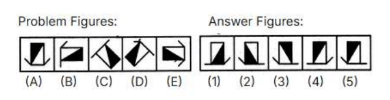
Following question consists of four problem figures marked A, B, C, d and five answer figures marked 1 2 3 4 and 5. Select a figure from amongst the answer figures which will conitnue the series established bu the four problem figures

Following question consists of four problem figures marked A, B, C, d and five answer figures marked 1 2 3 4 and 5. Select a figure from amongst the answer figures which will conitnue the series established bu the four problem figures

Identify the number of rhombus in the figure given below:

which otpion as given in the lower row shall come next in sequence in the upper row


Identify the Odd one out:

If a cube is to be constructed by folding the given figure along the lines shown, then in the cube so formed, what would the number be opposite to the number 4?

The numbers are arranged in a certain order, in one place a question mark '?' is given. Find out which one of the options numbers will replace '?'

Which options from the lower row shall complete the sequence of the upper in the best manner?

Find the number of triangles in the given figure:

when \(3^{333}\) is divided by 11, the remainder is :
ABCD is a trapezium in which AB is parallel to CD. The sides AD and BC when extended, intersect at point E. If AB = 2 cm, CD = 1 cm, and perimeter of ABCD is 6 cm, then the perimeter, in cm, of \(\triangle\)AEB is:
Amal and Vimal together can complete a task in 150 days, while Vimal and Sunil together can complete the same task in 100 days. Amal starts working on the task and works for 75 days, then Vimal takes over and works for 135 days. Finally, Sunil takes over and completes the remaining task in 45 days. If Amal had started the task alone and worked on all days, Vimal had worked on every second day, and Sunil had worked on every third day, then the number of days required to complete the task would have been how many?
A company has 40 employees whose names are listed in a certain order. In the year 1925, the average bonus of the first 30 employees was Rs. 40000, of the last 30 employees was Rs. 60000, and of the first 10 and last 10 employees together it was Rs. 50000. Next year, the average bonus of the first 10 employees increased by 100%, of the last 10 employees increased by 200% and of the remaining employees was unchanged. Then, the average bonus, in Rupees, of all the 40 employees together in the year 1926 would have been:
If \((x + 6\sqrt{2})^{1/2} - (x - 6\sqrt{2})^{1/2} = 2\sqrt{2}\), then \(x\) equals
A vessel contained a certain amount of a solution of acid and water. When 2 litres of water was added to it, the new solution had 50% acid concentration. When 15 litres of acid was further added to this new solution, the final solution had 80% acid concentration. The ratio of water and acid in the original solution would have been:
How many times will you write even numerals if you write all the numbers from 291 to 300?
Solve: \(8796 \times 223 + 8796 \times 77\)
Find the lowest of all the given numbers which when divided by 16, 18, 20 and 25 leaves 4 as remainder in each case, but when divided by 7 leaves no remainder?
A team of 8 shooters joins a shooting competition. The best marksman scored 85 points. If he had scored 92 points, the average score for the team would have been 84. Determine the number of points, the team scored in the given competition?
The cost price of an article is 64% of the marked price. Calculate the percent gain after allowing a discount of 12%?
Two friends P and Q started a business investing in the ratio of 5 : 6. R joined them after six months investing an amount equal to that of Q's. At the end of the year, 20% of profit was earned, which was equal to Rs. 98000. Determine the amount invested by R ?
A town is supplied with water from a big overhead tank which is fed with a constant volume of water regularly. When the tank is full, if 32000 gallons are used daily, the supply fails in 50 days. However, if 37000 gallons are used daily, the supply lasts for 40 days only. How much water can be used daily without the supply ever failing?
A boat takes 8 hours to cover a distance while traveling upstream, whereas while traveling downstream it takes 6 hours. If the speed of the current is 4 kmph, what is the speed of the boat in still water?
A train 400 m long overtook a man walking along the line in the same direction as the train, at the rate of 5 kmph and passed him in 40 seconds. The train reached the station in 20 minutes after passing the man. In what time did the man reach the station?
If \(9^{\frac{1}{2}} - 2^{2x - 2} = 4^{x} - 3^{2x - 3}\), then \(x\) is
How many four digit numbers, which are divisible by 6, can be formed using the digits 0, 2, 3, 4, 6, such that no digit is used more than once and 0 does not occur in the left-most position?
A tank has an inlet pipe and an outlet pipe. If the outlet pipe is closed then the inlet pipe fills the empty tank in 8 hours. If the outlet pipe is open then the inlet pipe fills the empty tank in 10 hours. If only the outlet pipe is open then in how many hours the full tank becomes half-full?
Amal can complete a job in 10 days and Bimal can complete it in 8 days. Amal, Bimal and Kamal together complete the job in 4 days and are paid a total amount of Rs 1000 as remuneration. If this amount is shared by them in proportion to their work, then Kamal's share, in Rupees will be how much?
The base of a vertical pillar with uniform cross section is a trapezium whose parallel sides are of lengths 10 cm and 20 cm while the other two sides are of equal lengths. The perpendicular distance between the parallel sides of the trapezium is 12 cm. If the height of the pillar is 20 cm, then determine the total area, in sq cm, of all six surfaces of the pillar?
Let T be the set of integers {3, 11, 19, 27, ... 451, 459, 467} and S be a subset of T such that the sum of no two elements of S is 470. In this case, the maximum possible number of elements in S will be how much?
There are 8436 steel balls, each with a radius of 1 centimeter, stacked in a pile, with 1 ball on top, 3 balls in the second layer, 6 in the third layer, 10 in the fourth, and so on. The number of horizontal layers in the pile in this case will be how many?
In a triangle ABC, If, AB = 6, BC = 8 and AC = 10. Further, if a perpendicular which is dropped from B, meets the side AC at D. A circle of radius BD (with center (B) is drawn. If the circle cuts AB and BC at P and Q respectively, the AP:QC will be equal to which of the following?
In a 4000 meter race around a circular stadium having a circumference of 1000 meters, the fastest runner and the slowest runner reach the same point at the end of the 5th minute, for the first time after the start of the race. All the runners have the same starting point and each runner maintains a uniform speed throughout the race. If the fastest runner runs at twice the speed of the slowest runner, then what shall be the time taken by the fastest runner to finish the said race?
How many even integers n, where 100 ≤ n ≤ 200, are divisible neither by seven nor by nine?
The number of non-negative real roots of \(2^x - x - 1 = 0\) equals to:
Amreeshdar instead of finding the value of 7/8th of a number, found the value of 7/18th of the number. If his answer differed from the actual answer by 770, determine the number that Amreeshdar wanted to find?
In a rectangle, the difference between the sum of the adjacent sides and the diagonal is half the length of the longer side. What is the ratio of the shorter to the longer side?
The value of each of a set of coins varies as the square of its diameter, if its thickness remains constant, and it varies as the thickness, if the diameter remains constant. If the diameter of two coins are in the ratio 4 : 3, what should be the ratio of their thickness if the value of the first is four times that of the second?
Qoban has some money (M) that he divides in the ratio of 1:2. He then deposits the smaller amount in a savings scheme that offers a certain rate of interest, and the larger amount in another savings scheme that offers half of that rate of interest. Both interests compound yearly. At the end of two years, the total interest earned from the two savings schemes is £ 830. It is known that one of the interest rates is 10% and that Qoban deposited more than £1000 in each saving scheme at the start. Find the value of M?
Ajosey buys some avocados. After bringing the avocados home, she finds two to be rotten and throws them away. Of the remaining avocados, she puts five-ninth in her fridge, and brings the rest to her hostel. She eats two avocados and puts the rest in her hostel's mess fridge. If her hostel mess fridge cannot hold more than five avocados, what is the maximum possible number of avocados bought by Ajosey?
A small store has five units of a new phone model in stock: two white, two black, and one red. Three customers arrive at the shop to buy a unit each. Each one has a pre-determined choice of the colour and will not buy a unit of any other colour. All the three customers are equally likely to have chosen any of the three colours. What is the probability that the store will be able to satisfy all the three customers?
Swati can row a boat on still water at a speed of 5 km/hr. However, on a given river, it takes her 1 hour more to row the boat 12 km upstream than downstream. One day, Swati rows the boat on this river from X to Y, which is N km upstream from X. Then she rows back to X immediately. If she takes at least 2 hours to complete this round trip, what is the minimum possible value of N?
Razaaq has created a 3x3 magic square, in which the sum of the cells along any row, column or diagonal, is the same number (N). The entries in the cells are given as expressions in x, y and z. Find N.
Aavesh, a courier delivery agent, starts at point A and makes a delivery each at points B, C and D, in that order. He travels in a straight line between any two consecutive points. The following are known:
(i) AB and CD intersect at a right angle at E, and;
(ii) BC, CE and ED are respectively 1.3 km, 0.5 km and 2.5 km long.
If AD is parallel to BC, then what is the total distance (in km) that Aavesh covers in travelling from A to D?
Four friends, A, B, C and D, decide to jog for 30 minutes inside a stadium with a circular running track that is 200 metres long. The friends run at different speeds. A completes a lap exactly every 60 seconds. Likewise, B, C and D complete a lap exactly every 1 minute 30 seconds, 40 seconds and 1 minute 20 seconds respectively. The friends begin together at the start line exactly at 4 p.m. What is the total of the numbers of laps the friends would have completed when they next cross the start line together?
The LCM and HCF of two numbers are 84 and 21 respectively. If the ratio of the two numbers is 1:4, what is the larger of the two numbers?
What shall be the arithmetic mean of all the distinct numbers that can be obtained by rearranging the digits in 1421 including itself?
Take 6 distinct natural numbers such that the average of the two smallest numbers is 14, and the average of the two largest numbers is 28. Then, the maximum possible value of the average of these six numbers can be how much?
Read the following question carefully:
Datta purchased two oranges, three bananas and four apples which cost him Rs.\ 15.
If Datta had purchased three oranges, two bananas and one apple, it would have cost him only Rs.\ 10.
If Datta bought 3 oranges, 3 bananas and 3 apples, determine as to how much did he have to pay?
A cricket umpire has to pick up certain artickles from amongst 6 caps and 4 sweaters before a match. She picks up 3 articles at rando. Determine the probability taht atleasdt one sweater was pickeup up by the u,mpire?
A drain pipe can drain a tank in 12 hours, and a fill pipe can fill the same tank in 6 hours. A total of n pipes, which include a few fill pipes and the remaining drain pipes can fill the entire tank in 2 hours. How many of the following values could n have in this case?
a. 24
b. 16
c. 33
d. 13
e. 9
f. 8
Read the following sentences carefully and choose the optionss that contain grammatically correct sentences.
A. There are less cars on the road today.
B. She is nicer than her sister.
C. I have been here from Monday.
D. I know how to swim.
E. She is the girl that won the case competition.
F. The media are divided on the issue.
Read the following sentences carefully and choose the optionss that contain grammatically correct sentences.
A. The dean asked for additional funding.
B. The boss discussed about the new project with his team.
C. Adhika is good in data interpretation.
D. Neil is transitioning into a new phase of life.
E. Ajat emphasized for the need for consistency in MH-CET preparation.
F. This car is superior to the previous one in terms of efficiency.
Read the following given five sentences, namely, A, B, C, D and E carefully and choose the optionss that shall form a coherent passage by using the five sentences.
A. Whatever that might be on Europa—far from the Sun, and beneath kilometres of ice—it will not be sunlight.
B. The final ingredient for a habitable world is a source of energy for life to exploit.
C. On Earth almost every living thing ultimately depends on photosynthesis for its energy, including the rich ecosystems in the ocean depths, discovered in the 1980s and which helped the idea of life on Europa gain a foothold.
D. Their inhabitants do not benefit from sunlight directly, but their metabolisms are powered by chemicals created in the photosynthesis, oxygen-rich surface oceans far above.
E. That is a bit of a problem.
Read the following and then from the options given, choose the one that meaningfully fills the blanks:
When each generation grows up, it looks down on the next as if we all forget what it feels like to be . When most think about their own youthful indiscretions they do so with a wink and a laugh. But when the same people think about those in today's generation doing something similar, they sound the alarm about a decline in morality in next generation.
Read the following statement and answer the question that follows:
Employees complaining about mundane tasks are often ignored. There is a listlessness that settles around them. A bored employee may continue to produce good results, but that can also be because the tasks are repetitive, and the outcomes are expected.
Which of the following optionss can be BEST inferred from the passage?
Which of the following best describes the purpose of the example of neuroscience?
On the basis of the passage, which of the following teams is likely to be most effective in solving the problem of rising obesity levels?
Read the following statement carefully and answer the question:
``An engagement with words is the most captivating, enchanting, and sometimes daunting encounter with the world.''
Which of the following conclusions can be drawn from the above statement?
In the context of the passage, what is the significance of the "world within the word"?
What is the central theme of the passage?
Fill in the blanks with the correct set of words given below:
I don't believe he \rule{1.5cm{0.4pt \rule{1.5cm{0.4pt from his current job despite the raise.
The truth is usually more \rule{1.5cm{0.4pt \rule{1.5cm{0.4pt than a lie.
We have finite amounts of willpower that become \rule{1.5cm{0.4pt \rule{1.5cm{0.4pt as we use them.
Read the following sentences carefully and determine that which of the following optionss contain grammatically CORRECT sentences?
A. There are less cars on the road today.
B. She is nicer than her sister.
C. I have been here from Monday.
D. I know how to swim.
E. She is the girl that won the case competition.
F. The media are divided on the issue.
Read the following Statements, numbered as A, B, C, D, E carefully and determine which options is most logically chronologically ordered?
A. The treaty tests of a budget deficit no bigger than 3% of the GDP and a public debt converging towards a ceiling of 60% of a GDP seemed impossible for Italy to pass by 1999.
B. That Belgium also had a public debt above 100 percent of GDP helped, as did a special euro tax Mr. Prodi introduced.
C. Into the uncompromising environment came the first of a series of external shocks. One of the earliest was entry into the European single currency, the euro, in 1999.
D. But when it became clear in 1997 that Spain was determined to join from the start, Romano Prodi, then Italian prime minister, decided that Italy, as a founder member of the bloc, must be there too.
E. Germany had more or less designed the 1992 Maastricht treaty's convergence criteria to keep out a profligate, chronically indebted Italy.
In the passage given below, there is an underlined word, choose an alternative from the optionss given that can most correctly be used in place of the underlined word?
It is *klang* to a sensitive traveler who walks through this great town, when he sees the streets, the roads and cabin doors crowded with beggars, mostly women, followed by three, four, or six children, all in rags and importuning every passenger for alms.
Read the passage given below carefully and answer the question that follows:
In a world where aspirations for upward mobility are fervent, the opportunities for achieving such dreams remain limited. When one generation falls short, the mantle of ambition passes to the next, embedding within it a heavy burden of responsibility. Failing to meet these expectations can lead to profound sorrow, and the direst cases, even to suicide. It is in this landscape that coaching institutes assume a significant role, cultivating an atmosphere of uncertainty among students and parents. A stark discrepancy emerges between preparation for board examinations and competitive tests, amplifying the inequalities that plague the education system. The coaching industry's massive marketing campaigns further exacerbate the situation, with some strategies veering into ethically grey areas. The tests themselves, designed to be more challenging than standardised exams, set the stage for feelings of inadequacy and self-doubt when not conquered.
Our educational system is tailored to gauge an individual's merit through examinations. Eminent thinker Michael Sandel dubs this system the ``tyranny of merit'', a sentiment echoed by the Supreme Court of India, when the Court called for a deeper evaluation of the idea of merit, highlighting its nuanced nature. Merit as a concept remains shrouded in misunderstanding and often goes unexamined within school curriculum. Adapting to new living arrangements, sourcing nourishing meals, battling isolation, and grappling with commutes form the backdrop against which education unfolds. For marginalised communities and gender minorities, these hurdles are often amplified. Social media algorithms exacerbate mental health concerns, sowing loneliness and impeding attention spans and creativity. Technology emerges as a potential equaliser in this landscape. Online platforms now offer preparation opportunities from the comfort of one's home. Government-curated or market-driven content could usher in a new era of accessibility.
Question: Which of the following is correct regarding the inequalities mentioned by the author?
Read the passage given below carefully and answer the question that follows:
In a world where aspirations for upward mobility are fervent, the opportunities for achieving such dreams remain limited. When one generation falls short, the mantle of ambition passes to the next, embedding within it a heavy burden of responsibility. Failing to meet these expectations can lead to profound sorrow, and the direst cases, even to suicide. It is in this landscape that coaching institutes assume a significant role, cultivating an atmosphere of uncertainty among students and parents. A stark discrepancy emerges between preparation for board examinations and competitive tests, amplifying the inequalities that plague the education system. The coaching industry's massive marketing campaigns further exacerbate the situation, with some strategies veering into ethically grey areas. The tests themselves, designed to be more challenging than standardised exams, set the stage for feelings of inadequacy and self-doubt when not conquered.
Our educational system is tailored to gauge an individual's merit through examinations. Eminent thinker Michael Sandel dubs this system the ``tyranny of merit'', a sentiment echoed by the Supreme Court of India, when the Court called for a deeper evaluation of the idea of merit, highlighting its nuanced nature. Merit as a concept remains shrouded in misunderstanding and often goes unexamined within school curriculum. Adapting to new living arrangements, sourcing nourishing meals, battling isolation, and grappling with commutes form the backdrop against which education unfolds. For marginalised communities and gender minorities, these hurdles are often amplified. Social media algorithms exacerbate mental health concerns, sowing loneliness and impeding attention spans and creativity. Technology emerges as a potential equaliser in this landscape. Online platforms now offer preparation opportunities from the comfort of one's home. Government-curated or market-driven content could usher in a new era of accessibility.
Question: Which of the following is correct regarding the inequalities mentioned by the author?
Read the passage given below carefully and answer the question that follows:
In a world where aspirations for upward mobility are fervent, the opportunities for achieving such dreams remain limited. When one generation falls short, the mantle of ambition passes to the next, embedding within it a heavy burden of responsibility. Failing to meet these expectations can lead to profound sorrow, and the direst cases, even to suicide. It is in this landscape that coaching institutes assume a significant role, cultivating an atmosphere of uncertainty among students and parents. A stark discrepancy emerges between preparation for board examinations and competitive tests, amplifying the inequalities that plague the education system. The coaching industry's massive marketing campaigns further exacerbate the situation, with some strategies veering into ethically grey areas. The tests themselves, designed to be more challenging than standardised exams, set the stage for feelings of inadequacy and self-doubt when not conquered.
Our educational system is tailored to gauge an individual's merit through examinations. Eminent thinker Michael Sandel dubs this system the ``tyranny of merit'', a sentiment echoed by the Supreme Court of India, when the Court called for a deeper evaluation of the idea of merit, highlighting its nuanced nature. Merit as a concept remains shrouded in misunderstanding and often goes unexamined within school curriculum. Adapting to new living arrangements, sourcing nourishing meals, battling isolation, and grappling with commutes form the backdrop against which education unfolds. For marginalised communities and gender minorities, these hurdles are often amplified. Social media algorithms exacerbate mental health concerns, sowing loneliness and impeding attention spans and creativity. Technology emerges as a potential equaliser in this landscape. Online platforms now offer preparation opportunities from the comfort of one's home. Government-curated or market-driven content could usher in a new era of accessibility.
Question: Which of the following is correct regarding the inequalities mentioned by the author?
Read the passage given below carefully and answer the question that follows:
In a world where aspirations for upward mobility are fervent, the opportunities for achieving such dreams remain limited. When one generation falls short, the mantle of ambition passes to the next, embedding within it a heavy burden of responsibility. Failing to meet these expectations can lead to profound sorrow, and the direst cases, even to suicide. It is in this landscape that coaching institutes assume a significant role, cultivating an atmosphere of uncertainty among students and parents. A stark discrepancy emerges between preparation for board examinations and competitive tests, amplifying the inequalities that plague the education system. The coaching industry's massive marketing campaigns further exacerbate the situation, with some strategies veering into ethically grey areas. The tests themselves, designed to be more challenging than standardised exams, set the stage for feelings of inadequacy and self-doubt when not conquered.
Our educational system is tailored to gauge an individual's merit through examinations. Eminent thinker Michael Sandel dubs this system the ``tyranny of merit'', a sentiment echoed by the Supreme Court of India, when the Court called for a deeper evaluation of the idea of merit, highlighting its nuanced nature. Merit as a concept remains shrouded in misunderstanding and often goes unexamined within school curriculum. Adapting to new living arrangements, sourcing nourishing meals, battling isolation, and grappling with commutes form the backdrop against which education unfolds. For marginalised communities and gender minorities, these hurdles are often amplified. Social media algorithms exacerbate mental health concerns, sowing loneliness and impeding attention spans and creativity. Technology emerges as a potential equaliser in this landscape. Online platforms now offer preparation opportunities from the comfort of one's home. Government-curated or market-driven content could usher in a new era of accessibility.
Question: Which of the following is correct regarding the inequalities mentioned by the author?
"What a *figummy* community is?", quipped Maajeeda.
What do you understand by the word figummy?
In the following question, out of the given alternatives, choose the one which best expresses the meaning of the given word.
ELEGIAC
Read the passage given below carefully and answer the question that follows:
No one argues that the rich should be rich because they were born to wealthy parents. Critics of inequality may complain that those who would abolish inheritance taxes say, are implicitly endorsing hereditary privilege. But no one defends hereditary privilege outright or disputes the principle that careers should be open to talents. Most of our debates about access to jobs, education, and public office proceed from the premise of equal opportunity. Our disagreements are less about the principle itself than about what it requires. For example, critics of affirmative action in hiring and college admissions argue that such policies are inconsistent with equality of opportunity, because they judge applicants on factors other than merit. Defenders of affirmative action reply that such policies are necessary to make equality of opportunity a reality for members of groups that have suffered discrimination or disadvantage. At the level of principle at least, and political rhetoric, meritocracy has won the day. In democracies throughout the world, politicians of the center-left and center-right claim that their policies are the ones that will enable citizens, whatever their race or ethnicity, gender or class, to compete on equal terms and to rise as far as their efforts and talents will take them. When people complain about meritocracy, the complaint is usually not about the ideal but about our failure to live up to it. The wealthy and powerful have rigged the system to perpetuate their privilege; the professional classes have figured out how to pass their advantages on to their children, converting the meritocracy into a hereditary aristocracy; colleges that claim to select students on merit give an edge to the sons and daughters of the wealthy and well-connected. According to this complaint, meritocracy is a myth, a distant promise yet to be redeemed.
Question: Based on the passage, which of the following inferences cannot be drawn?
Read the passage given below carefully and answer the question that follows:
No one argues that the rich should be rich because they were born to wealthy parents. Critics of inequality may complain that those who would abolish inheritance taxes say, are implicitly endorsing hereditary privilege. But no one defends hereditary privilege outright or disputes the principle that careers should be open to talents. Most of our debates about access to jobs, education, and public office proceed from the premise of equal opportunity. Our disagreements are less about the principle itself than about what it requires. For example, critics of affirmative action in hiring and college admissions argue that such policies are inconsistent with equality of opportunity, because they judge applicants on factors other than merit. Defenders of affirmative action reply that such policies are necessary to make equality of opportunity a reality for members of groups that have suffered discrimination or disadvantage. At the level of principle at least, and political rhetoric, meritocracy has won the day. In democracies throughout the world, politicians of the center-left and center-right claim that their policies are the ones that will enable citizens, whatever their race or ethnicity, gender or class, to compete on equal terms and to rise as far as their efforts and talents will take them. When people complain about meritocracy, the complaint is usually not about the ideal but about our failure to live up to it. The wealthy and powerful have rigged the system to perpetuate their privilege; the professional classes have figured out how to pass their advantages on to their children, converting the meritocracy into a hereditary aristocracy; colleges that claim to select students on merit give an edge to the sons and daughters of the wealthy and well-connected. According to this complaint, meritocracy is a myth, a distant promise yet to be redeemed.
Question: Based on the passage, which of the following inferences cannot be drawn?
Read the passage given below carefully and answer the question that follows:
No one argues that the rich should be rich because they were born to wealthy parents. Critics of inequality may complain that those who would abolish inheritance taxes say, are implicitly endorsing hereditary privilege. But no one defends hereditary privilege outright or disputes the principle that careers should be open to talents. Most of our debates about access to jobs, education, and public office proceed from the premise of equal opportunity. Our disagreements are less about the principle itself than about what it requires. For example, critics of affirmative action in hiring and college admissions argue that such policies are inconsistent with equality of opportunity, because they judge applicants on factors other than merit. Defenders of affirmative action reply that such policies are necessary to make equality of opportunity a reality for members of groups that have suffered discrimination or disadvantage. At the level of principle at least, and political rhetoric, meritocracy has won the day. In democracies throughout the world, politicians of the center-left and center-right claim that their policies are the ones that will enable citizens, whatever their race or ethnicity, gender or class, to compete on equal terms and to rise as far as their efforts and talents will take them. When people complain about meritocracy, the complaint is usually not about the ideal but about our failure to live up to it. The wealthy and powerful have rigged the system to perpetuate their privilege; the professional classes have figured out how to pass their advantages on to their children, converting the meritocracy into a hereditary aristocracy; colleges that claim to select students on merit give an edge to the sons and daughters of the wealthy and well-connected. According to this complaint, meritocracy is a myth, a distant promise yet to be redeemed.
Question: Based on the passage, which of the following inferences cannot be drawn?
No one argues that the rich should be rich because they were born to wealthy parents. Critics of inequality may complain that those who would abolish inheritance taxes say, are implicitly endorsing hereditary privilege. But no one defends hereditary privilege outright or disputes the principle that careers should be open to talents. Most of our debates about access to jobs, education, and public office proceed from the premise of equal opportunity. Our disagreements are less about the principle itself than about what it requires. For example, critics of affirmative action in hiring and college admissions argue that such policies are inconsistent with equality of opportunity, because they judge applicants on factors other than merit. Defenders of affirmative action reply that such policies are necessary to make equality of opportunity a reality for members of groups that have suffered discrimination or disadvantage. At the level of principle at least, and political rhetoric, meritocracy has won the day. In democracies throughout the world, politicians of the center-left and center-right claim that their policies are the ones that will enable citizens, whatever their race or ethnicity, gender or class, to compete on equal terms and to rise as far as their efforts and talents will take them. When people complain about meritocracy, the complaint is usually not about the ideal but about our failure to live up to it. The wealthy and powerful have rigged the system to perpetuate their privilege; the professional classes have figured out how to pass their advantages on to their children, converting the meritocracy into a hereditary aristocracy; colleges that claim to select students on merit give an edge to the sons and daughters of the wealthy and well-connected. According to this complaint, meritocracy is a myth, a distant promise yet to be redeemed.
Question: Based on the passage, which of the following inferences cannot be drawn?
The word VIOLACEOUS is most likely to be associated with which of the following?
The word OLIVACEOUS is most likely to be associated with which of the following?
Sheela suffers from Emetophobia. She is most likely to have the fear of which of the following?
Sheena suffers from Alektorophobia. She is most likely to have the fear of which of the following?
Sheeba suffers from Hypsophobia. She is most likely to have the fear of which of the following?
Which of the following is most likely to be the antonym of the word Attenuate?
Which of the following is most likely to be the antonym of the word Entente?
Which of the following is most likely to be the antonym of the word Martinet?
The given pair of words bear a certain relationship with one another. Choose the options which most closely resembles the same relationship as seen in the given pair of words?
Peel : Peal
The given pair of words bear a certain relationship with one another. Choose the options which most closely resembles the same relationship as seen in the given pair of words?
Doggerel : Poet
The given pair of words bear a certain relationship with one another. Choose the options which most closely resembles the same relationship as seen in the given pair of words?
Barge : Vessel
Fill in the blank with the most suitable alternative:
In India the talent is prodigious, and it increases ____.
Read the passage given below carefully and answer the question that follows:
(Passage about wealth, Puritan legacy, financial decadence, debt, polarization, investor class vs lottery class, payday lenders, credit cards, software stalwarts, and recommendations)
Why does the author of the given passage seem to be displeased with the software stalwarts?
Which of the following, according to the author, has/have been responsible for the encouragement of culture of debt in the society lately?
1. The changing lifestyle which makes it impossible for a common man to sustain himself without debts and loans.
2. Breaking down of moral institutions which supported economic prudence.
3. Provision for easy availability of loans to every section of the society regardless of their ability to repay these.
The given sentence has been broken up into four different parts A, B, C and D. The error, if any, will be in any one part of the sentence. Select the options which contains the part of the sentence which has an error (spelling, grammatical or contextual). If there is no error, choose options (E).
poorly regulated pharmaceutical (A) / industry mean that antibiotics (B) / are freely available to (C) / those who can afford them (D)
Arrange the sentences A, B, C and D in a proper sequence so as to make a coherent paragraph.
A. It begins with an ordinary fever and a moderate cough.
B. India could be under attack from a class of germs that cause what are called atypical pneumonias.
C. Slowly, a sore throat progresses to bronchitis and then pneumonia and respiratory complications.
D. It appears like the ordinary flu, but baffled doctors find that the usual drugs don't work.
Arrange the sentences A, B, C and D in a proper sequence so as to make a coherent paragraph.
A. Good advertising can make people buy your products even if it is ersatz.
B. A Paisa spent on brainwashing is more cost-effective than a Paisa spent on product improvement.
C. That's important because it takes pressure off you to make good products.
D. Obviously, there's a minimum quality that every product has to achieve: it should be able to withstand the shipping process without becoming unrecognizable.
Arrange the sentences A, B, C and D in a proper sequence so as to make a coherent paragraph.
A. I sat there frowning at the checkered tablecloth, chewing the bitter cud of insight.
B. That wintry afternoon in Manhattan, waiting in the little French restaurant, I was feeling frustrated and depressed.
C. Even the prospect of seeing a dear friend failed to cheer me as it usually did.
D. Because of certain miscalculations on my part, a project of considerable importance in my life had fallen through.
Read the passage given below carefully and answer the question that follows:
Most of recorded human history is one big data gap. Starting with the theory of Man the Hunter, the chroniclers of the past have left little space for women's role in the evolution of humanity, whether cultural or biological. Instead, the lives of men have been taken to represent those of humans overall. When it comes to the lives of the other half of humanity, there is often nothing but silence. And these silences are everywhere. Our entire culture is riddled with them. Films, news, literature, science, city planning, economics. The stories we tell ourselves about our past, present and future. They are all marked—disfigured—by a female-shaped absent presence'. This is the gender data gap.
The gender data gap isn't just about silence. These silences, these gaps, have consequences. They impact on women's lives every day. The impact can be relatively minor. Shivering in offices set to a male temperature norm, for example, or struggling to reach a top shelf set at a male height norm. Irritating, certainly. Unjust, undoubtedly. But not life-threatening. Not like crashing in a car whose safety measures don't account for women's measurements. Not like having a heart attack go undiagnosed because your symptoms are deemed 'atypical'. For these women, the consequences of living in a world built around male data can be deadly.
One of the most important things to say about the gender data gap is that it is not generally malicious, or even deliberate. Quite the opposite. It is simply the product of a way of thinking that has been around for millennia and is therefore a kind of not thinking. A double not thinking, even: men go without saying, and women don't get said at all. Because when we say human, on the whole, we mean man.
This is not a new observation. Simone de Beauvoir made it most famously in 1949 when she wrote, ``humanity is male and man defines woman not in herself, but as relative to him; she is not regarded as an autonomous being. [...] He is the Subject, he is the Absolute—she is the Other''. What is new is the context in which women continue to be the 'Other'. And that context is a world increasingly reliant on and in thrall to data. Big Data. Which in turn fed Big Truths by Big Algorithms, using Big Computers. But when your big data is corrupted by big silences, the truths you get are half-truths, at best. And often, for women, they aren't true at all. As computer scientists themselves say: `Garbage in, garbage out.'
Question: Based on the passage, which of the following statements best explains ``absent presence''?
Read the passage given below carefully and answer the question that follows:
Most of recorded human history is one big data gap. Starting with the theory of Man the Hunter, the chroniclers of the past have left little space for women's role in the evolution of humanity, whether cultural or biological. Instead, the lives of men have been taken to represent those of humans overall. When it comes to the lives of the other half of humanity, there is often nothing but silence. And these silences are everywhere. Our entire culture is riddled with them. Films, news, literature, science, city planning, economics. The stories we tell ourselves about our past, present and future. They are all marked—disfigured—by a female-shaped absent presence'. This is the gender data gap.
The gender data gap isn't just about silence. These silences, these gaps, have consequences. They impact on women's lives every day. The impact can be relatively minor. Shivering in offices set to a male temperature norm, for example, or struggling to reach a top shelf set at a male height norm. Irritating, certainly. Unjust, undoubtedly. But not life-threatening. Not like crashing in a car whose safety measures don't account for women's measurements. Not like having a heart attack go undiagnosed because your symptoms are deemed 'atypical'. For these women, the consequences of living in a world built around male data can be deadly.
One of the most important things to say about the gender data gap is that it is not generally malicious, or even deliberate. Quite the opposite. It is simply the product of a way of thinking that has been around for millennia and is therefore a kind of not thinking. A double not thinking, even: men go without saying, and women don't get said at all. Because when we say human, on the whole, we mean man.
This is not a new observation. Simone de Beauvoir made it most famously in 1949 when she wrote, ``humanity is male and man defines woman not in herself, but as relative to him; she is not regarded as an autonomous being. [...] He is the Subject, he is the Absolute—she is the Other''. What is new is the context in which women continue to be the 'Other'. And that context is a world increasingly reliant on and in thrall to data. Big Data. Which in turn fed Big Truths by Big Algorithms, using Big Computers. But when your big data is corrupted by big silences, the truths you get are half-truths, at best. And often, for women, they aren't true at all. As computer scientists themselves say: `Garbage in, garbage out.'
Question: Which of the following statements can be the best concluded from the passage?
Choose the alternative which can be best substituted for the given words.
Science of human beauty
Which of the following sentences have an incorrect usage of preposition as per the rules of English grammar?
1. The manager was sitting at the desk.
2. My work is superior to yours.
3. I prefer coffee than tea.
4. She was accused for stealing gold.
5. This is an exception to the rule.
6. They are leaving to England soon.
Read the sentence given below to find out whether there is any grammatical or idiomatic error in it. The error, if any, will be in one part of the sentence. That part of the sentence is the answer. If there is no error, the answer is 'No error'.
The angry boatman threw (A)/ the cracked oar (B)/ in the river (C)/ and returned home. (D)/ No error (E).
Choose the correctly spelt word:
Fill in the blanks with the most appropriate alternatives given below:
The manners and _____ of the \textit{nouveau riche is a recurrent _____ in the literature.


Section-wise Distribution of Questions and Marks
| Section | Number of Questions | Marks per Question | Total Marks |
| Logical Reasoning | 75 | 1 | 75 |
| Quantitative Aptitude | 50 | 1 | 50 |
| Verbal Ability / Reading Comprehension | 50 | 1 | 50 |
| Total | 200 | 1 | 200 |



Comments