




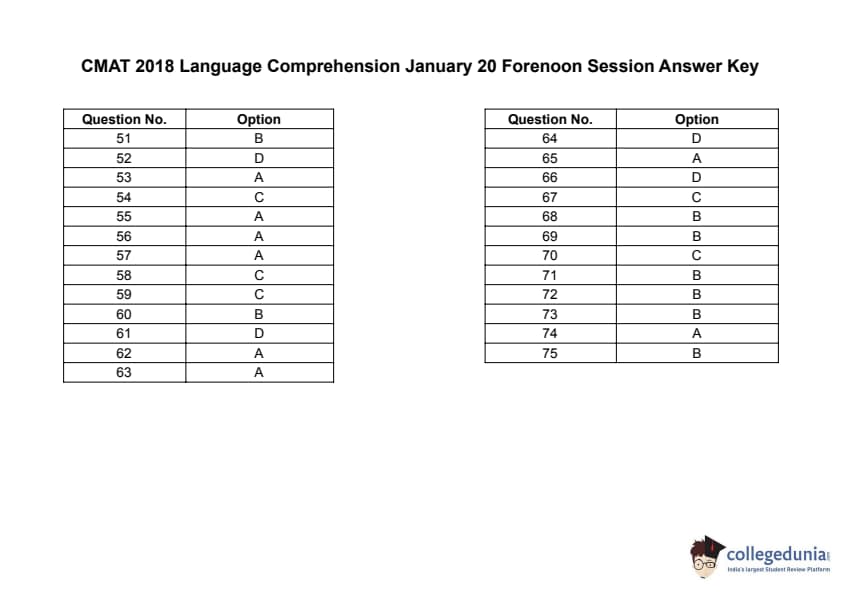
CMAT 2018 Language Comprehension Question paper with answer key pdf conducted on January 20 in Forenoon Session 9:30 AM to 12:30 PM is available for download. The exam was successfully organized by All India Council for Technical Education (AICTE). The question paper comprised a total of 25 questions. (PDF Source: cracku.in)
CMAT 2018 Language Comprehension Question Paper with Answer Key PDFs Forenoon Session
| CMAT 2018 Language Comprehension Question Paper with Solutions PDF | Download PDF | Check Solutions |
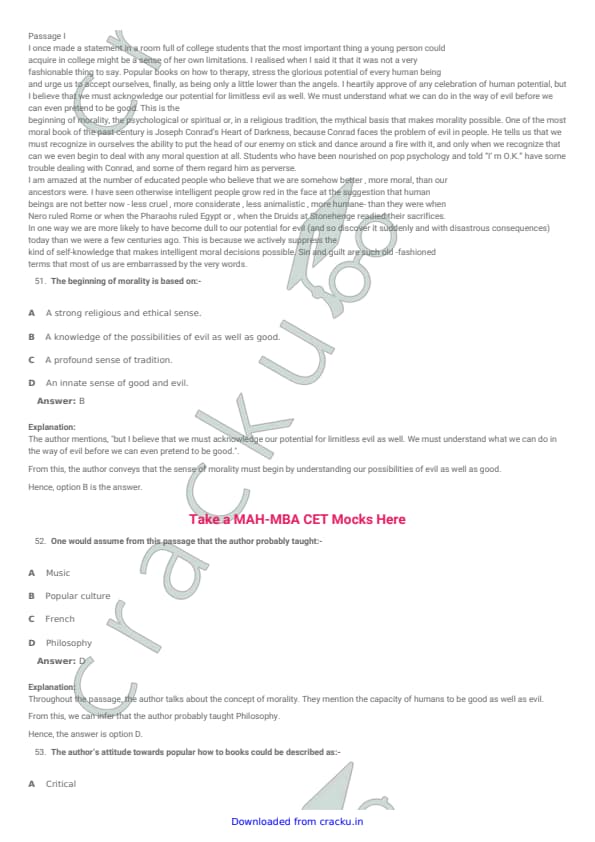
Passage I
I once made a statement in a room full of college students that the most important thing a young person could acquire in college might be a sense of her own limitations. I realised when I said it that it was not a very fashionable thing to say. Popular books on how to therapy, stress the glorious potential of every human being and urge us to accept ourselves, finally, as being only a little lower than the angels. I heartily approve of any celebration of human potential, but I believe that we must acknowledge our potential for limitless evil as well. We must understand what we can do in the way of evil before we can even pretend to be good. This is the beginning of morality; the psychological or spiritual or, in a religious tradition, the mythical basis that makes morality possible. One of the most moral book of the past century is Joseph Conrad's Heart of Darkness, because Conrad faces the problem of evil in people. He tells us that we must recognize in ourselves the ability to put the head of our enemy on stick and dance around a fire with it, and only when we recognize that can we even begin to deal with any moral question at all. Students who have been nourished on pop psychology and told "I'm O.K." have some trouble dealing with Conrad, and some of them regard him as perverse.
I am amazed at the number of educated people who believe that we are somehow better, more moral, than our ancestors were. I have seen otherwise intelligent people grow red in the face at the suggestion that human beings are not better now - less cruel, more considerate, less animalistic, more humane - than they were when Nero ruled Rome or when the Pharaohs ruled Egypt or, when the Druids at Stonehenge readied their sacrifices.
In one way we are more likely to have become dull to our potential for evil (and so discover it suddenly and with disastrous consequences) today than we were a few centuries ago. This is because we actively suppress the kind of self-knowledge that makes intelligent moral decisions possible. Sin and guilt are such old-fashioned terms that most of us are embarrassed by the very words.
Question 1:
The beginning of morality is based on:-
View Solution
Step 1: Identify the key line in the passage.
The author clearly says:
"We must acknowledge our potential for limitless evil as well. We must understand what we can do in the way of evil before we can even pretend to be good."
Step 2: Connect it with the phrase "beginning of morality".
Immediately after that, the author states:
"This is the beginning of morality."
So, morality begins when we understand our capacity for evil as well as good.
Step 3: Match with the correct option.
Option (2) exactly states:
A knowledge of the possibilities of evil as well as good.
Hence, option (2) is correct.
Quick Tip: In RC questions, locate the exact sentence where the author defines the concept and match it directly with the closest option.
One would assume from this passage that the author probably taught:-
View Solution
Step 1: Observe what the author discusses throughout the passage.
The passage is deeply focused on:
- morality
- human nature
- potential for evil
- ethical self-awareness
- moral decision-making
Step 2: Identify which subject aligns with these ideas.
Such discussion belongs to ethics and philosophy, since philosophy deals with moral reasoning, good vs evil, and human conduct.
Step 3: Match with the given options.
Among the options, only Philosophy aligns with morality and ethics discussion.
Hence, option (4) is correct.
Quick Tip: When asked what the author likely taught, focus on the dominant theme of the passage and select the subject that naturally covers it.
The author's attitude towards popular how to books could be described as:-
View Solution
Step 1: Find what the author says about popular how-to books.
The author says these books:
"stress the glorious potential of every human being and urge us to accept ourselves"
But the author immediately adds that such thinking is incomplete because it ignores human potential for evil.
Step 2: Identify the author's disagreement.
The author states:
"Students who have been nourished on pop psychology and told 'I'm O.K.' have some trouble dealing with Conrad."
This indicates that the author finds these books misleading or shallow.
Step 3: Determine attitude.
Since the author points out the limitation and danger of such books, the attitude is clearly critical.
Hence, option (1) is correct.
Quick Tip: For attitude questions, look for words showing disagreement, limitation, or negative judgment, as they reveal a critical tone.
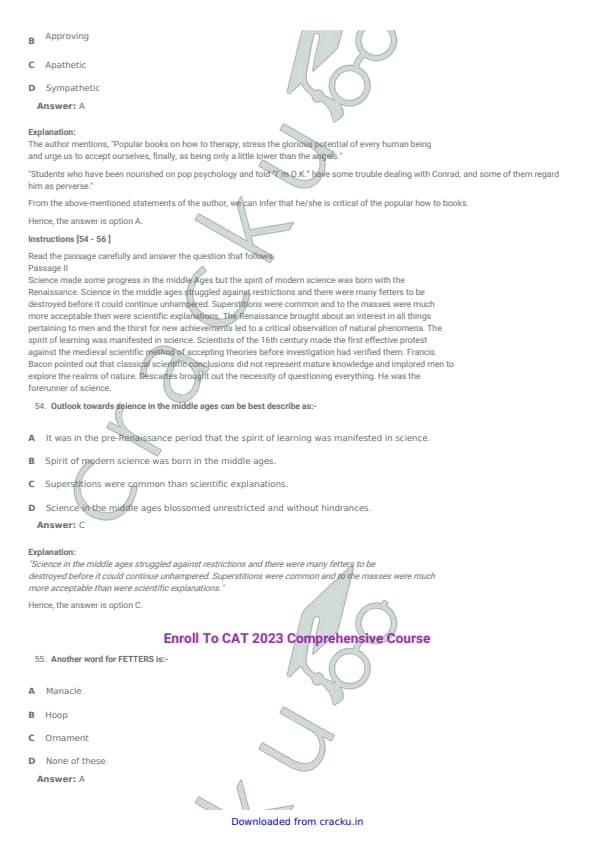
Passage II
Science made some progress in the middle Ages but the spirit of modern science was born with the Renaissance. Science in the middle ages struggled against restrictions and there were many fetters to be destroyed before it could continue unhampered. Superstitions were common and to the masses were much more acceptable than were scientific explanations. The Renaissance brought about an interest in all things pertaining to men and the thirst for new achievements led to a critical observation of natural phenomena. The spirit of learning was manifested in science. Scientists of the 16th century made the first effective protest against the medieval scientific method of accepting theories before investigation had verified them. Francis Bacon pointed out that classical scientific conclusions did not represent mature knowledge and implored men to explore the realms of nature. Descartes brought out the necessity of questioning everything. He was the forerunner of science.
Question 4:
Outlook towards science in the middle ages can be best describe as:-
View Solution
Step 1: Locate the relevant line from the passage.
The passage clearly states:
"Superstitions were common and to the masses were much more acceptable than were scientific explanations."
Step 2: Interpret what this implies about the outlook.
This means people in the middle ages preferred superstition over science.
So the overall outlook towards science was weak and limited by superstitions.
Step 3: Match with the correct option.
Option (3) directly matches the passage statement.
Hence, option (3) is correct.
Quick Tip: When a question asks about “outlook” or “attitude”, directly pick the option that repeats the author’s statement most closely.
Another word for FETTERS is:-
View Solution
Step 1: Understand the meaning of "fetters".
A fetter means a chain or restriction that prevents freedom of movement or action.
In context: science struggled against restrictions.
Step 2: Match the synonym with the options.
- Menace = threat / danger / restriction (closest meaning here)
- Hoop = a ring, unrelated
- Ornament = decoration, unrelated
Step 3: Conclusion.
Thus, the closest word among the options is Menace.
Hence, option (1) is correct.
Quick Tip: To find word meaning in RC, always use the context sentence; “fetters” in context means restrictions or chains.
How were the scientists of the 16th century different from those of the medieval times?
View Solution
Step 1: Identify the key contrast line.
The passage says:
"Scientists of the 16th century made the first effective protest against the medieval scientific method of accepting theories before investigation had verified them."
Step 2: Interpret the difference.
- Medieval times: theories were accepted before verification.
- 16th century: scientists protested this and insisted on verification first.
Step 3: Match with the correct option.
Option (1) correctly describes this difference.
Hence, option (1) is correct.
Quick Tip: If a question asks “how different”, find the sentence in the passage that directly compares the two time periods.
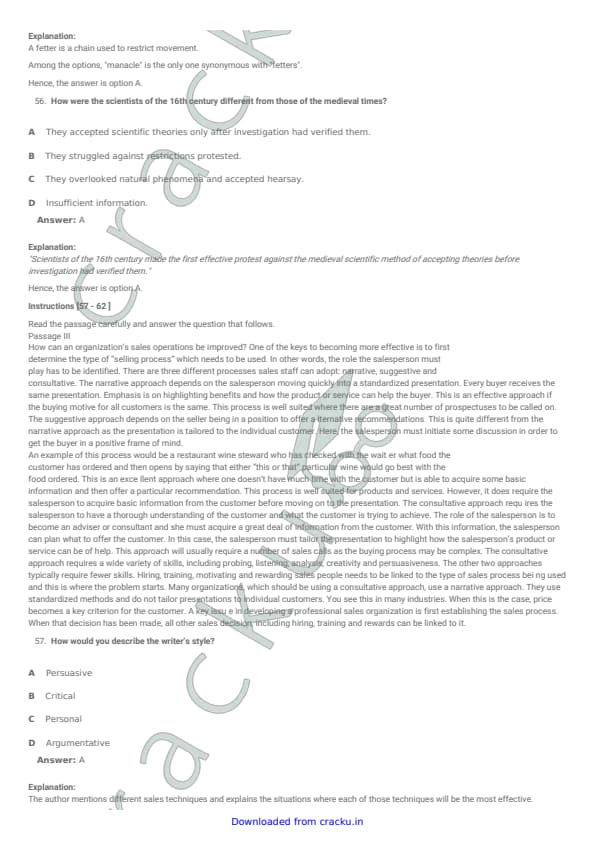
Passage III
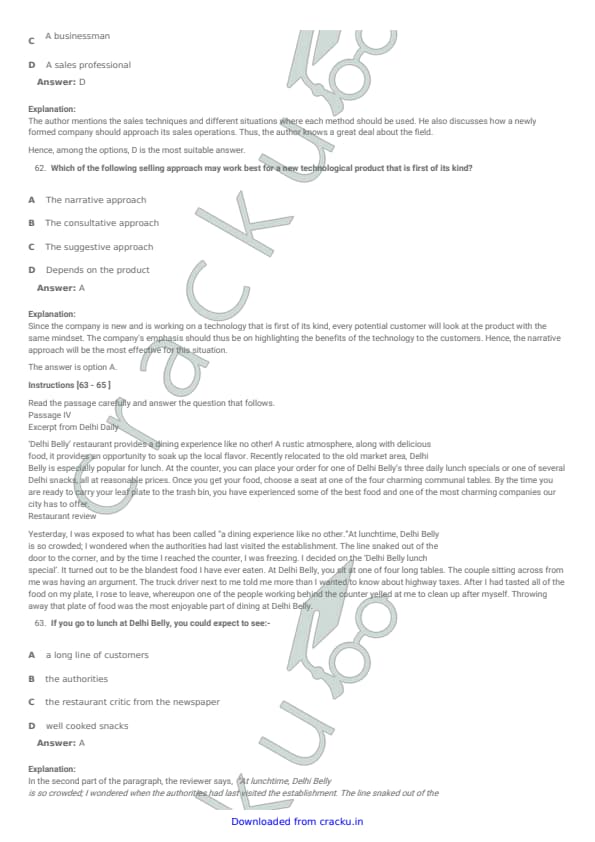
How can an organization's sales operations be improved? One of the keys to becoming more effective is first to determine the type of "selling process" which needs to be used. In other words, the role of the salesperson must be such as to identify a customer's needs and requirements. There are three different types of sales staff that can be categorized. There can be consultative, narrative approach depends on the salesperson having quickly hit a standardized presentation. Every buyer receives the same presentation. Emphasis is on highlighting benefits and how the product or service can help the buyer. This is an effective approach if the buying motive for all customers is the same. This process is well suited where there are a great number of prospects to be called on. The suggestive approach depends on the seller being in a position to offer alternative recommendations. This is quite different from the narrative approach as the presentation is tailored to the individual customer. Here, the salesperson must initiate some discussion in order to get the buyer in a positive frame of mind.
An example of this process would be a restaurant wine steward who has checked with the waiter what food the customer has ordered and then opens by saying that either "this or that particular wine would go best with the food ordered." This is an excellent approach where one doesn't have much time with the customer but is able to acquire some basic information and then offer a particular recommendation. This process is well suited for products and services. However, it does require the salesperson to acquire basic information from the customer before moving on to the presentation. The consultative approach requires the salesperson to have a thorough understanding of the customer and what the customer is trying to achieve. The role of the salesperson is to become an advisor or consultant and she must acquire a great deal of information from the customer. With this information, the salesperson can now offer the customer a more customized presentation and highlight how the salesperson's product or service can help. This approach will usually require a number of sales calls as the buying process may be complex.
This consultative approach requires a selling process including probing, listening, analyzing, creativity and persuasiveness. The other two approaches are typically require fewer sales calls. Finally, motivating and rewarding sales people needs to be linked to the type of sales being used and this is where the problem starts. Many organizations, which should be using a consultative approach, use a narrative approach. They use standardized methods and do not tailor presentations to individual customers. You see this in many industries. When this is the case, price becomes a key criterion for the customer. A key issue in developing a professional sales organization is first establishing the sales process. When that decision has been made, all other sales decisions, including hiring, training and rewards can be linked to it.
Question 7:
How would you describe the writer's style?
View Solution
Step 1: Observe what the writer is doing.
The writer explains different sales approaches and recommends which one should be used in which situation.
The intent is to guide and convince organizations to adopt suitable selling processes.
Step 2: Eliminate incorrect styles.
- Not personal: writer does not share personal experience.
- Not argumentative: writer is not debating, but explaining.
- Not critical: writer is not attacking, but advising.
Step 3: Conclusion.
Thus, the style is persuasive.
Hence, option (1) is correct.
Quick Tip: If a passage gives advice, recommendations, and guidance to influence the reader, the tone is usually persuasive.
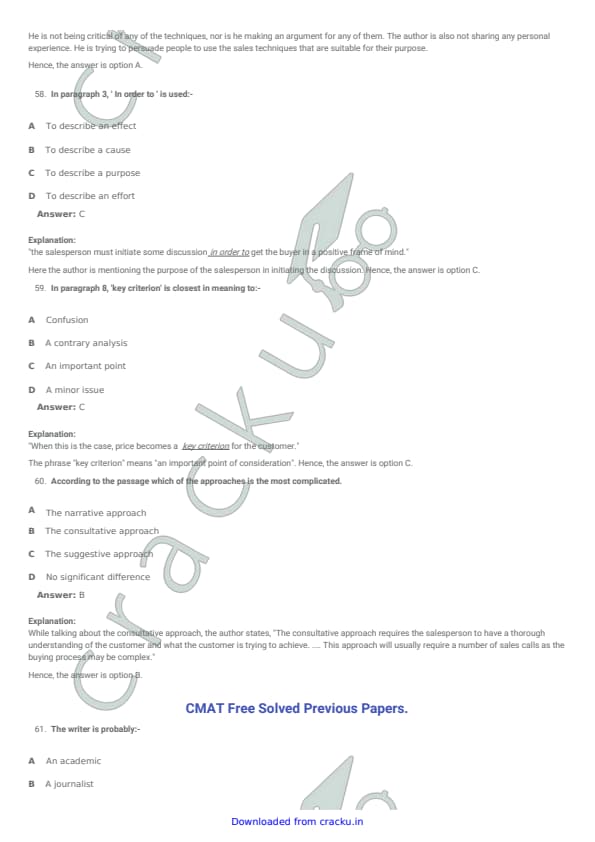
In paragraph 3, "in order to" is used:-
View Solution
Step 1: Find the sentence containing "in order to".
The passage says:
"the salesperson must initiate some discussion in order to get the buyer in a positive frame of mind."
Step 2: Understand what "in order to" indicates.
The phrase "in order to" always introduces the purpose or goal behind an action.
Step 3: Conclusion.
So it is used to describe purpose.
Hence, option (3) is correct.
Quick Tip: The phrase “in order to” almost always indicates PURPOSE, i.e., why something is done.
In paragraph 8, key criterion is closest in meaning to:-
View Solution
Step 1: Identify the sentence using "key criterion".
The passage says:
"price becomes a key criterion for the customer."
Step 2: Interpret the meaning in context.
Here, "key criterion" means the most important factor used for decision-making.
Step 3: Match with the options.
The closest meaning is an important point.
Hence, option (3) is correct.
Quick Tip: “Key” means most important and “criterion” means factor for judgment, so “key criterion” = most important factor.
According to the passage which of the approaches is the most complicated.
View Solution
Step 1: Identify which approach needs the most effort and steps.
The passage says consultative approach requires:
- thorough understanding of customer
- becoming an advisor
- acquiring a great deal of information
- customized presentation
- multiple sales calls
Step 2: Compare with other approaches.
Narrative approach: standardized, same presentation, less effort.
Suggestive approach: tailored but still less complex than consultative.
Step 3: Conclusion.
Consultative approach is described as requiring the maximum steps, hence most complicated.
So option (2) is correct.
Quick Tip: If an approach involves multiple steps, detailed customer understanding, and repeated interactions, it is the most complex.
The writer is probably:-
View Solution
Step 1: Analyze the writer's knowledge and focus.
The passage explains:
- sales processes
- sales staff roles
- consultative vs suggestive vs narrative selling
- hiring, training and reward systems linked to sales process
Step 2: Determine which profession fits best.
Such detailed operational discussion and expertise is most likely from a sales professional.
Step 3: Conclusion.
Hence, option (4) is the most suitable answer.
Quick Tip: When identifying the writer, look at the depth and technical nature of the topic; professional-level detail usually indicates domain expertise.
Which of the following selling approach may work best for a new technological product that is first of its kind?
View Solution
Step 1: Identify what narrative approach means.
Narrative approach: standardized presentation, highlights benefits, suits when many prospects exist and selling motive is similar.
Step 2: Apply this to a first-of-its-kind product.
A new technological product will require explaining benefits clearly to many prospects who all need basic understanding.
So giving a standard persuasive presentation works best initially.
Step 3: Conclusion.
Hence, narrative approach is most suitable.
So option (1) is correct.
Quick Tip: For new products, standardized storytelling and benefit-highlighting works best when most customers need the same initial explanation.
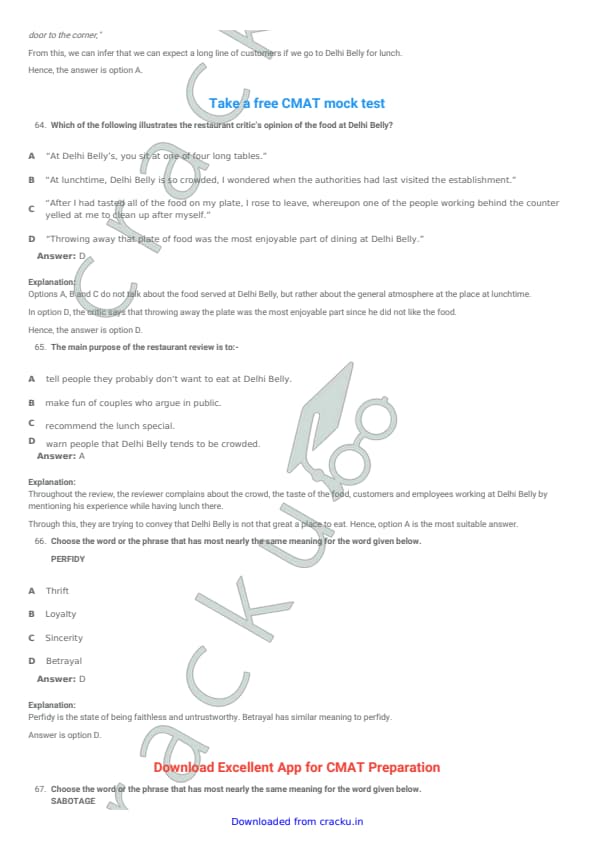
If you go to lunch at Delhi Belly, you could expect to see:-
View Solution
Step 1: Identify the relevant clue from the passage.
The reviewer clearly says:
"At lunchtime, Delhi Belly is so crowded... The line snaked out of the door to the corner."
Step 2: Convert that clue into what a visitor would expect.
If the line is snaking out of the door, it means there will be a long line of customers during lunch hours.
Step 3: Match with the options.
Option (1) directly matches the passage statement.
Hence, option (1) is correct.
Quick Tip: Whenever you see phrases like “so crowded” or “line snaked out”, the correct option usually relates to crowd or long queues.
Which of the following illustrates the restaurant critic's opinion of the food at Delhi Belly?
View Solution
Step 1: Understand what the question asks.
We must choose the line that best shows the critic’s opinion of the food.
Step 2: Evaluate each option.
- Option (1) talks about seating arrangement, not food.
- Option (2) talks about crowd and hygiene authorities, not food quality.
- Option (3) talks about staff behavior, not directly food.
- Option (4) directly shows the critic hated the food so much that throwing it away was the best part.
Step 3: Conclusion.
Thus, option (4) best reflects the critic’s negative opinion of the food.
Quick Tip: For opinion-based questions, always pick the sentence that clearly expresses judgment (like best/worst/enjoyable/disgusting).
The main purpose of the restaurant review is to:-
View Solution
Step 1: Observe the overall tone of the review.
The reviewer describes multiple negative experiences:
- overcrowding and long queues
- freezing while waiting
- bland meal
- unpleasant table companions
- rude staff
- finally, says throwing food away was the best part
Step 2: Identify the central message.
All these points strongly discourage the reader from dining there.
So the main purpose is to warn people not to eat at Delhi Belly.
Step 3: Match with the options.
Option (1) captures this purpose best.
Hence, option (1) is correct.
Quick Tip: To find “main purpose”, look at the overall tone: if it is mostly negative, the purpose is usually to discourage or criticize.
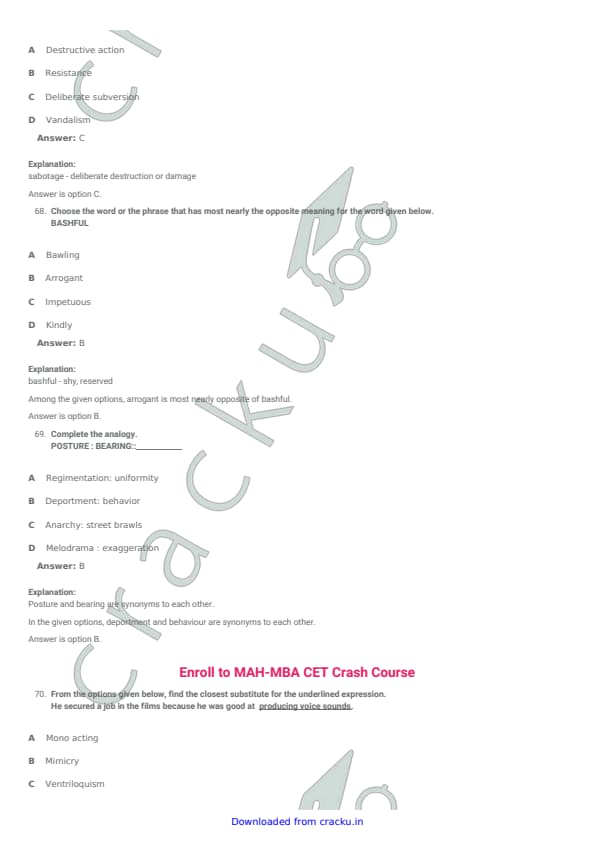
Choose the word or the phrase that has most nearly the same meaning for the word given below.
PERFIDY
View Solution
Step 1: Understand the meaning of the word “Perfid y”.
Perfid y means being faithless, disloyal, and untrustworthy.
It refers to cheating someone’s trust or acting in a treacherous manner.
Step 2: Compare with the given options.
(1) Thrift means saving money, not related.
(2) Loyalty means faithfulness, which is the opposite of perfidy.
(3) Sincerity means honesty, also the opposite.
(4) Betrayal means breaking trust, which matches perfidy.
Step 3: Conclusion.
Thus, the closest meaning of Perfid y is Betrayal.
Quick Tip: Perfid y always relates to disloyalty and treachery, so the best synonym is usually “betrayal”.
Choose the word or the phrase that has most nearly the same meaning for the word given below.
SABOTAGE
View Solution
Step 1: Understand the meaning of “Sabotage”.
Sabotage means deliberately damaging or destroying something to prevent success.
It is intentional disruption or subversion of a system.
Step 2: Compare with the options.
(1) Destructive action is close but not always intentional.
(2) Resistance means opposition, not necessarily damage.
(3) Deliberate subversion means intentional disruption, which perfectly matches sabotage.
(4) Vandalism is destruction, but not always with the motive of stopping success.
Step 3: Conclusion.
Thus, Deliberate subversion is the closest meaning.
Quick Tip: Sabotage always involves intentional harm with the goal of disrupting progress, so “deliberate subversion” is the best match.
Choose the word or the phrase that has most nearly the opposite meaning for the word given below.
BASHFUL
View Solution
Step 1: Understand the meaning of “Bashful”.
Bashful means shy, reserved, and easily embarrassed.
Step 2: Find the opposite meaning.
Opposite of shy is someone who is bold, proud, or overconfident.
Step 3: Check the options.
(1) Bawling means crying loudly, not opposite.
(2) Arrogant means overly proud and confident, which contrasts bashful.
(3) Impetuous means acting quickly, unrelated.
(4) Kindly means polite, unrelated.
Step 4: Conclusion.
Thus, the opposite of bashful is Arrogant.
Quick Tip: Bashful = shy, so the opposite will be bold or overly confident, like “arrogant”.
Complete the analogy.
POSTURE : BEARING :: ______________
View Solution
Step 1: Understand the relationship in the first pair.
Posture and bearing are synonyms.
Both refer to the way a person holds or carries themselves.
Step 2: Look for a similar synonym relationship in options.
(1) Regimentation and uniformity are related but not exact synonyms.
(2) Deportment and behavior are very close in meaning, both refer to conduct.
(3) Anarchy and street brawls are not synonyms.
(4) Melodrama and exaggeration are related but not direct synonyms.
Step 3: Conclusion.
Thus, the correct analogy is Deportment : behavior.
Quick Tip: If the first pair are synonyms, the second pair should also be synonyms to maintain the analogy.
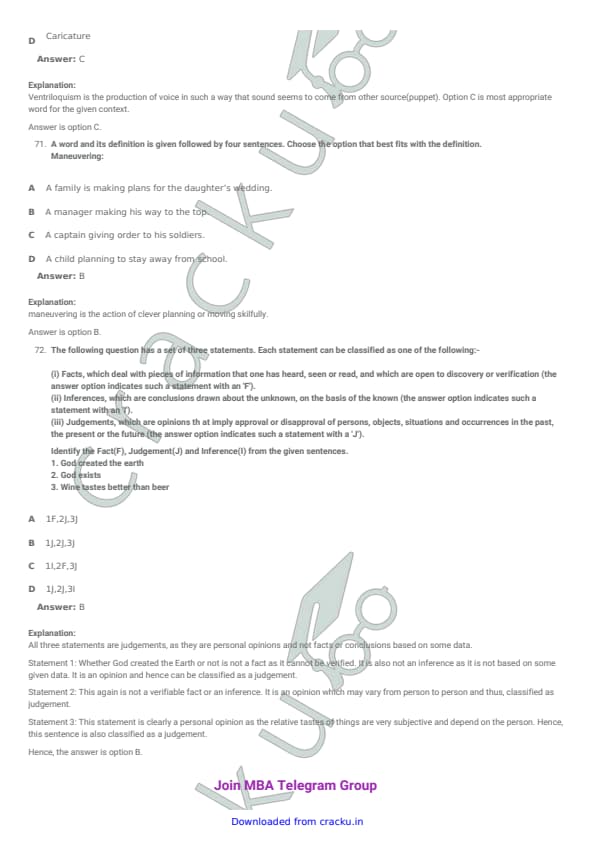
From the options given below, find the closest substitute for the underlined expression.
He secured a job in the films because he was good at producing voice sounds.
View Solution
Step 1: Understand the underlined phrase.
“Producing voice sounds” refers to creating voice effects or voices in a special way.
Step 2: Check which option best matches.
(1) Mono acting is acting alone, not about voice sounds.
(2) Mimicry is copying voices, but not producing voice sounds from another source.
(3) Ventriloquism is the art of producing voice so it seems to come from another source (like a puppet).
(4) Caricature is exaggerated drawing or imitation, not specifically voice production.
Step 3: Conclusion.
Thus, the closest substitute is Ventriloquism.
Quick Tip: Ventriloquism = voice projection that seems to come from another source, commonly used in films and stage acts.
A word and its definition is given followed by four sentences. Choose the option that best fits with the definition.
Maneuvering:
View Solution
Step 1: Understand the meaning of “Maneuvering”.
Maneuvering refers to moving skillfully or planning cleverly to achieve a goal.
It often implies strategic actions to gain advantage.
Step 2: Match with the best sentence.
(1) Wedding planning is normal planning, not strategic maneuvering.
(2) A manager making his way to the top implies strategic career moves, fits maneuvering.
(3) A captain giving orders is leadership, not maneuvering.
(4) A child avoiding school is not skillful strategic movement.
Step 3: Conclusion.
Thus, option (2) best matches maneuvering.
Quick Tip: Maneuvering involves strategy and clever movement toward a goal, often seen in career or competition contexts.
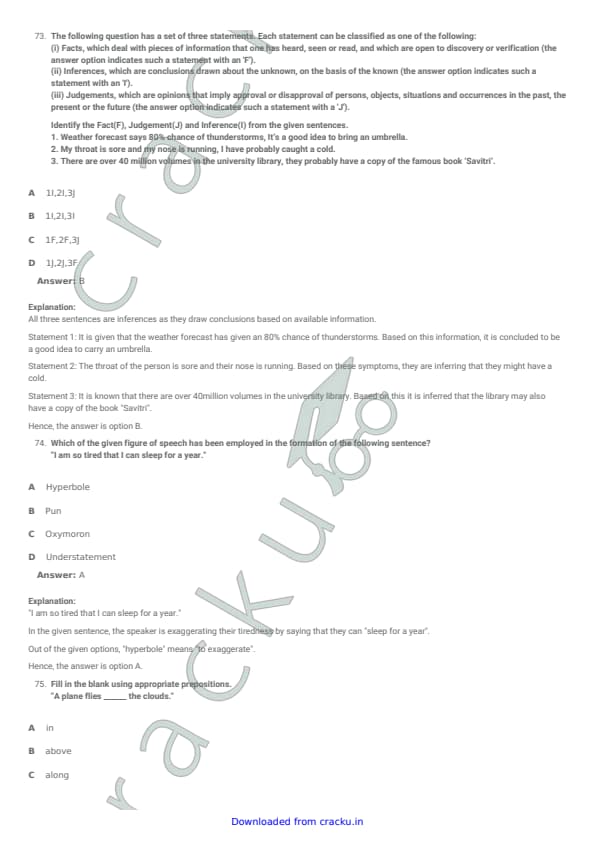
The following question has a set of three statements. Each statement can be classified as one of the following:
(i) Facts, which deal with pieces of information that one has heard, seen or read, and which are open to discovery or verification (the answer option indicates such a statement with an 'F').
(ii) Inferences, which are conclusions drawn about the unknown, on the basis of the known (the answer option indicates such a statement with a 'I').
(iii) Judgements, which are opinions that imply approval or disapproval of persons, objects, situations and occurrences in the past, the present or the future (the answer option indicates such a statement with a 'J').
Identify the Fact(F), Judgement(J) and Inference(I) from the given sentences.
1. God created the earth
2. God exists
3. Wine tastes better than beer
View Solution
Step 1: Classify Statement 1.
“God created the earth” is a belief-based statement and cannot be verified scientifically.
It is presented as a conclusion based on faith, so it is treated as an Inference.
Step 2: Classify Statement 2.
“God exists” is a personal belief and cannot be proven as a factual verification.
So it is treated as a Judgement or opinion-based belief.
Step 3: Classify Statement 3.
“Wine tastes better than beer” is purely subjective and depends on personal preference.
So it is a Judgement.
Step 4: Match with the option.
I[1] and J[2,3] matches option (2).
Quick Tip: Taste preferences and belief statements are usually Judgements, while conclusions drawn without direct verification are Inferences.
The following question has a set of three statements. Each statement can be classified as one of the following:
(i) Facts, which deal with pieces of information that one has heard, seen or read, and which are open to discovery or verification (the answer option indicates such a statement with an 'F').
(ii) Inferences, which are conclusions drawn about the unknown, on the basis of the known (the answer option indicates such a statement with a 'I').
(iii) Judgements, which are opinions that imply approval or disapproval of persons, objects, situations and occurrences in the past, the present or the future (the answer option indicates such a statement with a 'J').
Identify the Fact(F), Judgement(J) and Inference(I) from the given sentences.
1. Weather forecast says 80% chance of thunderstorms, It's a good idea to bring an umbrella.
2. My throat is sore and my nose is running, I have probably caught a cold.
3. There are over 40 million volumes in the university library, they probably have a copy of the famous book 'Savitri'.
View Solution
Step 1: Evaluate Statement 1.
The forecast gives information, and from it the speaker concludes it is a good idea to bring an umbrella.
That conclusion is an Inference.
Step 2: Evaluate Statement 2.
Symptoms are known facts, and the conclusion “probably caught a cold” is an Inference.
Step 3: Evaluate Statement 3.
Library size is known, and concluding they probably have a certain book is an Inference.
Step 4: Conclusion.
All three statements are Inferences.
Hence, option (2) is correct.
Quick Tip: If the statement contains words like “probably”, “good idea”, “may”, or “likely”, it is usually an inference.
Which of the given figure of speech has been employed in the formation of the following sentence?
"I am so tired that I can sleep for a year."
View Solution
Step 1: Understand what the sentence expresses.
The speaker is expressing extreme tiredness by exaggerating that they can sleep for a year.
Step 2: Identify the figure of speech.
Hyperbole means exaggeration for emphasis.
Here, sleeping for a year is not literal, but exaggeration.
Step 3: Conclusion.
Thus, the figure of speech used is Hyperbole.
Hence, option (1) is correct.
Quick Tip: If the sentence exaggerates beyond reality to emphasize emotion, it is Hyperbole.
Fill in the blank using appropriate prepositions.
"A plane flies _____ the clouds."
View Solution
Step 1: Understand the meaning of the sentence.
A plane generally flies at a higher altitude than clouds, so it flies above them.
Step 2: Evaluate the options.
(1) in the clouds means inside the clouds, which is not generally correct.
(2) above means higher than, correct.
(3) along means beside, incorrect.
(4) with means together, incorrect.
Step 3: Conclusion.
Thus, the best preposition is above.
Hence, option (2) is correct.
Quick Tip: Use “above” when something is at a higher level than another object, especially for altitude-related sentences.






Comments