




CMAT 2024 shift 1 question paper with solutions pdf is available for download here. NTA conducted CMAT 2024 exam on May 15 in Shift 1 from 9 AM to 12 PM. CMAT 2024 question paper consists of 100 multiple-choice questions to be attempted in 180 minutes. CMAT 2024 question paper PDF is divided into 5 sections carrying 20 questions each. Candidates can download the memory-based CMAT 2024 question paper with solutions pdf for May 15 shift 1 exam using the links given below.
CMAT 2024 Shift 1 Question Paper with Solutions PDF
| CMAT 2024 Shift 1 Question Paper with Answer Key |  Download Download |
Check Solutions |
CMAT Shift 1 Question Paper 2024 Solution
| Question | Answer | Detailed Solution | ||||||||||
|---|---|---|---|---|---|---|---|---|---|---|---|---|
|
Comprehension:
Following 3 questions are based on the information given below. There are 240 students in an engineering college. Each student opted for exactly one of three specialisations among Computer Science, Mechanical and Electronics. The total number of students who opted for Computer Science and Electronics is equal to the number of students who opted for Mechanical. 42.5% students who opted for Mechanical are girls. Read MoreThe number of girls who opted for Computer Science is one-third the number of boys who opted for Mechanical. The difference between the number of boys who opted for Electronics and the number of girls who opted for Computer Science is equal to the difference between the number of boys who opted for Computer Science and the number of girls who opted for Electronics. The number of girls who opted for Electronics is 28. |
||||||||||||
| 1. The total number of girls in the Engineering College is: (1) 138 (2) 112 (3) 102 (4) 116 |
(3) 102. | The total number of girls in the Engineering College is calculated as 102, considering the distribution across all specialisations and the given conditions. | ||||||||||
|
2. The number of girls who opted Mechanical is how much percent of number of students who opted Electronics? |
(3) 85%. | The percentage is calculated as frac51/60 * 100, resulting in 85%. | ||||||||||
| 3. By what percent is the number of boys who opted for Mechanical more than the total number of students who opted for Electronics? (1) 15% (2) 12% (3) 13.5% (4) 17.5% |
(1) 15%. | The number of boys in Mechanical exceeds the total number of Electronics students by 15%, calculated using the percentage increase formula. | ||||||||||
| 4. Given below are two statements: Statement I: In order to get a mixture worth Rs 16.5/kg, a grocer needs to mix two varieties of pulses costing Rs 15 and Rs 20 per kg respectively in the ratio 7 : 3. Statement II: A merchant has 1000 kg of rice, part of which he sells at 8% profit and the rest at 16% profit. He gains 14% on the whole. The quantity of rice sold at 16% profit is 750 kg. In the light of the above statements, choose the correct answer from the options given below: (1) Both Statement I and Statement II are true (2) Both Statement I and Statement II are false (3) Statement I is true but Statement II is false (4) Statement I is false but Statement II is true |
(1) Both Statement I and Statement II are true | Statement I: The weighted average price confirms the mixture price. The formula for the weighted average price is: Pmix = (7 × 15 + 3 × 20) / (7 + 3) Pmix = (105 + 60) / 10 = 165 / 10 = Rs 16.5/kg This matches the statement, so Statement I is true. Statement II: Let x be the quantity of rice sold at 8% profit. Then, the quantity sold at 16% profit is (1000 - x). The total profit is given by: 0.08x + 0.16(1000 - x) = 0.14 × 1000 Solving this: 0.08x + 160 - 0.16x = 140 -0.08x + 160 = 140 -0.08x = -20 x = 250 Thus, the rice sold at 16% profit is 1000 - 250 = 750 kg, confirming Statement II. Therefore, both statements are true. |
||||||||||
| 5. Ramesh invests Rs 1,200 at 5% simple interest. How much additional money must he invest at 8% simple interest so that his total annual income will be equal to 6% of his total investment during this year? (1) Rs 500 (2) Rs 600 (3) Rs 1,200 (4) Rs 1,500 |
(2) Rs 600 | Let x be the additional amount invested at 8%. The total investment is (1200 + x) and the total income is 6% of this amount. Income from Rs 1,200 at 5%: 0.05 × 1200 = Rs 60 Income from Rs x at 8%: 0.08 × x Total income = 6% of total investment: 60 + 0.08x = 0.06 × (1200 + x) Expanding and solving: 60 + 0.08x = 72 + 0.06x 0.08x - 0.06x = 72 - 60 0.02x = 12 x = 600 Therefore, Rs 600 must be invested at 8%. |
||||||||||
| 6. If the digit in the unit's place of a two-digit number is halved and the digit in the ten’s place is doubled, the number thus obtained is equal to the number obtained by interchanging the digits. Which of the following is definitely true? (1) Sum of the digits is a two-digit number (2) Digit in the unit's place is half of the digit in the ten’s place (3) Digit in the unit's place and the ten’s place are equal (4) Digit in the unit's place is twice the digit in ten’s place |
(4) Digit in the unit's place is twice the digit in ten’s place | Let the two-digit number be 10x + y, where x is the digit in the ten’s place and y is the digit in the unit's place. Halving the unit's digit and doubling the ten’s digit gives: 10(2x) + (y / 2) This equals the number obtained by interchanging the digits: 10y + x Forming the equation: 20x + (y / 2) = 10y + x Multiplying through by 2 to eliminate the fraction: 40x + y = 20y + 2x Rearranging terms: 40x - 2x = 20y - y 38x = 19y Dividing through by 19: 2x = y Hence, the digit in the unit's place is twice the digit in the ten’s place. |
||||||||||
| 7. A cylindrical vessel of radius 4 cm contains water. A solid sphere of 3 cm radius is lowered into the water until it is completely immersed. The water level in the vessel will rise by: (1) 2/9 cm (2) 4/9 cm (3) 9/4 cm (4) 9/2 cm |
(3) 9/4 cm | The volume of water displaced by the sphere will raise the water level in the vessel. Step 1: Volume of the sphere: The formula for the volume of a sphere is: Volume = (4/3) × π × r³ Substituting r = 3 cm: Volume = (4/3) × π × (3)³ = (4/3) × π × 27 = 36π cm³. Step 2: Area of the base of the cylinder: The area of the base is given by: Area = π × r² Substituting r = 4 cm: Area = π × (4)² = 16π cm². Step 3: Rise in water level: The rise in water level is calculated as: Rise = Volume displaced / Area of base Substituting the values: Rise = 36π / 16π = 36 / 16 = 9/4 cm. Therefore, the rise in water level is 9/4 cm. |
||||||||||
| 8. If abc > 0, such that a, b, c are integers, then which of the following must be true? (1) a/b < 0 (2) ab/c > 0 (3) bc < 0 (4) a > bc |
(2) ab/c > 0 | We are given abc > 0, meaning the product of a, b, and c is positive. Step 1: Analyze ab: For ab to be positive, a and b must either both be positive or both be negative. Thus, ab > 0. Step 2: Analyze ab/c: Since abc > 0, c must align with the sign of ab. If ab > 0 and c > 0, then ab/c > 0. Therefore, ab/c > 0 is the correct conclusion. |
||||||||||
| 9. Given below are two statements: Statement I: Ram and Shyam can finish a task by working together in 6 days. If Shyam can finish the task by working alone in 8 days, then Ram alone will take 24 days to finish it. Statement II: If 6 persons working 8 hours a day earn Rs 8,400 per week, then 9 persons working 6 hours a day will earn Rs 9,450 per week. In the light of the above statements, choose the correct answer from the options given below: (1) Both Statement I and Statement II are true (2) Both Statement I and Statement II are false (3) Statement I is true but Statement II is false (4) Statement I is false but Statement II is true |
(3) Statement I is true but Statement II is false | Statement I: Ram and Shyam's combined rate of work is 1/6. Shyam's rate is 1/8. Ram's rate is: Ram's rate = 1/6 - 1/8 = (4/24) - (3/24) = 1/24. Ram alone will take 24 days to finish the task. Thus, Statement I is true. Statement II: The total hours worked by 6 persons in 8 hours/day is 6 × 8 = 48 hours. Earnings should be proportional to work hours, but the calculation for 9 persons working 6 hours/day does not match Rs 9,450. Thus, Statement II is false. |
||||||||||
| 10. A (1/x : 1/y : 1/z = 2:3:5) then (x : y : z = 15:10:6). (A) If 4p = 6q = 9r, then p:q:r = 9:6:4. (B) If 2A = 3B = 4C, then A:B:C = 3:4:6. (C) P:Q:R = 2:3:4, then P/Q : Q/R = 9:8:24. Choose the correct answer from the options given below: (1) (C) only (2) (D) only (3) (A) and (B) only (4) (C) and (D) only |
(3) (A) and (B) only | Statement (A): We are given 1/x : 1/y : 1/z = 2:3:5, meaning x:y:z is the reciprocal of these ratios. Simplifying, x:y:z = 15:10:6. Statement (A) is correct. Statement (B): Given 4p = 6q = 9r, simplifying gives p:q:r = 9:6:4. Statement (B) is correct. Statement (C): Given 2A = 3B = 4C, simplifying gives A:B:C = 6:4:3, not 3:4:6. Statement (C) is incorrect. Statement (D): For P/Q : Q/R, the derived ratio does not match 9:8:24. Statement (D) is incorrect. Thus, the correct answer is (3) (A) and (B) only. |
||||||||||
| 11. Arrange the following in increasing order: (A) 4√3 (B) 9√2 (C) 6√5 (D) 6√7 Choose the correct answer from the options given below: (1) A < D < B < C (2) B < C < A < D (3) A < C < B < D (4) B < A < C < D |
(2) B < C < A < D | We are given four expressions involving square roots and asked to compare them. To make the comparison easier, we calculate the numerical values of each expression by approximating the square roots. 1. Expression A: 4√3 The value of √3 is approximately 1.732. So: 4√3 ≈ 4 × 1.732 = 6.928. 2. Expression B: 9√2 The value of √2 is approximately 1.414. So: 9√2 ≈ 9 × 1.414 = 12.727. 3. Expression C: 6√5 The value of √5 is approximately 2.236. So: 6√5 ≈ 6 × 2.236 = 13.416. 4. Expression D: 6√7 The value of √7 is approximately 2.646. So: 6√7 ≈ 6 × 2.646 = 15.874. Now that we have the numerical values: 4√3 ≈ 6.928, 9√2 ≈ 12.727, 6√5 ≈ 13.416, 6√7 ≈ 15.874. The increasing order is: B < C < A < D. |
||||||||||
| 12. A glass jar contains 1 red, 3 green, 2 blue, and 4 yellow marbles. If a single marble is chosen at random from the jar, choose the correct answer: (A) Probability of getting a yellow marble is 1/5 (B) Probability of getting a green marble is 3/10 (C) Probability of getting either a yellow or a green marble is 7/10 (D) Probability of getting either a red or a yellow marble is 3/10 (1) (A) and (D) only (2) (B) and (C) only (3) (A) and (C) only (4) (B) and (D) only |
(4) (B) and (D) only | The total number of marbles is 10. Statement A: Probability of a yellow marble is 4/10 = 2/5 (Incorrect as the statement says 1/5). Statement B: Probability of a green marble is 3/10 (Correct). Statement C: Probability of yellow or green marble is 4/10 + 3/10 = 7/10 (Correct). Statement D: Probability of red or yellow marble is 1/10 + 4/10 = 5/10 = 1/2 (Correct). Correct options are (B) and (D). |
||||||||||
| 13. Arrange the following in increasing order: (A) 16 2/3% (B) 2/15 (C) 0.17 (D) 0.25% of 64 (1) B < D < A < C (2) A < D < B < C (3) C < D < B < A (4) A < C < D < B |
(1) B < D < A < C | Convert values to decimals: (A) 16 2/3% = 0.166667. (B) 2/15 ≈ 0.1333. (C) 0.17. (D) 0.25% of 64 = 0.16. Increasing order is B < D < A < C. |
||||||||||
| 14. A dishonest dealer sells his goods at 10% loss on cost price and uses 30% less weight. What is his profit or loss percentage? (1) 28 4/7% loss (2) 28 3/7% profit (3) 28 3/7% loss (4) 28 4/7% profit |
(4) 28 4/7% profit | Assume 1 kg costs Rs. 100. Selling at 10% loss means Rs. 90 for 1 kg. With 30% less weight, the dealer sells 0.7 kg at Rs. 90. Cost for 0.7 kg is Rs. 70. Profit = Rs. 90 - Rs. 70 = Rs. 20. Profit percentage = (20/70) × 100 = 28 4/7% profit. |
||||||||||
| 15. If the roots of the equation px² + x + r = 0 are reciprocal to each other, then which one of the following is correct? (1) p = 2r (2) p = r (3) 2p = r (4) p = 4r |
(2) p = r | For reciprocal roots: Product of roots = 1. Given px² + x + r = 0, product of roots = r/p = 1. Hence, p = r. |
||||||||||
16. Match List-I with List-II:
(1) (A) - (I), (B) - (IV), (C) - (III), (D) - (II) (2) (A) - (I), (B) - (III), (C) - (IV), (D) - (II) (3) (A) - (II), (B) - (IV), (C) - (I), (D) - (III) (4) (A) - (II), (B) - (I), (C) - (IV), (D) - (III) |
(3) (A) - (II), (B) - (IV), (C) - (I), (D) - (III) | By solving the expressions step by step, we get the following results: (A) ≈ 0.99 (B) ≈ 6 (C) ≈ 0.024 (D) ≈ 50 The correct matching is: (A) - (II), (B) - (IV), (C) - (I), (D) - (III). |
||||||||||
| 17. Find the number of permutations that can be made from the letters of the word OMEGA, if the vowels occupy odd places: (1) 12 ways (2) 6 ways (3) 16 ways (4) 20 ways |
(1) 12 ways | The vowels O, E, A occupy the 1st, 3rd, and 5th positions, while M and G occupy the 2nd and 4th positions. Vowels can be arranged in 3! = 6 ways. Consonants can be arranged in 2! = 2 ways. Total arrangements = 3! × 2! = 6 × 2 = 12 ways. Thus, the total permutations are 12 ways. |
||||||||||
18. Match List-I with List-II:
(1) (A) - (III), (B) - (I), (C) - (IV), (D) - (II) (2) (A) - (II), (B) - (III), (C) - (IV), (D) - (I) (3) (A) - (IV), (B) - (I), (C) - (II), (D) - (III) (4) (A) - (I), (B) - (III), (C) - (IV), (D) - (II) |
(2) (A) - (II), (B) - (III), (C) - (IV), (D) - (I) | Matching the ratios step by step: (A) 4 : 14 = 2 : 7 → (II) (B) Compound ratio = 40 : 147 → (III) (C) 4 : 49 = 2 : 7 → (IV) (D) 25 : 30 = 5 : 6 → (I). Thus, the correct matching is: (A) - (II), (B) - (III), (C) - (IV), (D) - (I). |
||||||||||
| 19. A train traveling at 48 km/h completely crosses another train having half the length of the first train and traveling in the opposite direction at 42 km/h in 12 seconds. The train traveling at 48 km/h also passes a railway platform in 45 seconds. What is the length of the platform? (1) 600 m (2) 300 m (3) 400 m (4) 200 m |
(3) 400 m | Let the length of the first train be L = 200 m. Total time to cross the platform = 45 seconds. Speed = 48 km/h = 40/3 m/s. Total distance = Speed × Time = (40/3) × 45 = 600 m. Platform length = Total distance - Train length = 600 - 200 = 400 m. Thus, the length of the platform is 400 m. |
||||||||||
| 20. A certain amount of money at compound interest grows to ₹66,550 in 3 years and ₹73,205 in 4 years. The rate percent per annum is: (1) 10% (2) 9% (3) 5% (4) 11% |
(1) 10% | Using the compound interest formula: A4 = A3 × (1 + r/100). ₹73,205 = ₹66,550 × (1 + r/100). Solve for r: r = (73,205 / 66,550 - 1) × 100 = 10%. Thus, the rate of interest is 10%. |
||||||||||
| 21. Miss 'Lilly’ started her journey from her house and goes 2 km straight. Then, she turns towards her right and goes 1 km. She again turns towards her right and goes 1 km again. If finally she is in the north-west direction from her house, then in which direction did she go in the beginning? (1) North (2) South (3) East (4) West |
(4) West | Lilly goes 2 km straight, then turns right and goes 1 km, then turns right again and goes 1 km. After this, she is in the north-west direction from her house. The initial direction must be west to result in the described final direction. | ||||||||||
| 22. Take the given statements to be true even if they seem to be at variance from commonly known facts. Which conclusion would follow on the basis of given statements? Statement: ‘Some bags are purses’, ‘All purses are containers’ and ‘All containers are suitcases’. Conclusions: (A) Some suitcases are bags (B) All purses are bags (C) All purses are suitcases (D) Some containers are purses (1) (A), (B) and (C) only (2) (B) and (D) only (3) (A) and (C) only (4) (A), (C) and (D) only |
(4) (A), (C) and (D) only | Given the relationships, we can conclude that: - Some suitcases are bags because some purses are bags and all purses are containers, which are suitcases. - All purses are suitcases since all containers are suitcases. - Some containers are purses, as some bags are purses. |
||||||||||
| 23. Choose the correct word from the given alternatives which bears the same relationship to the third word as the first two. Vigilant : Alert : : Viable : ? (1) Active (2) Hopeless (3) Feasible (4) Useful |
(3) Feasible | Vigilant is synonymous with alert, and viable is synonymous with feasible, both implying something that is possible or workable. | ||||||||||
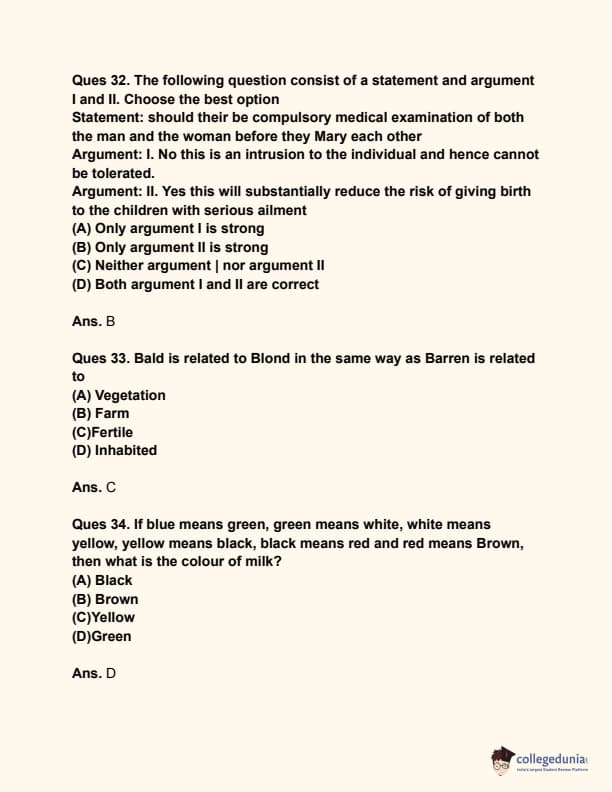
| 24. Bald is related to Blond in the same way as Barren is related to? (1) Vegetation (2) Farm (3) Fertile (4) Inhabited |
(3) Fertile | Bald is the opposite of blond in terms of hair, and barren is the opposite of fertile in terms of land or soil. | ||||||||||
| 25. Find the odd one out among the following: (1) Bajra (2) Barley (3) Mustard (4) Rice |
(3) Mustard | Bajra, barley, and rice are all grains, while mustard is a spice, making it the odd one out. | ||||||||||
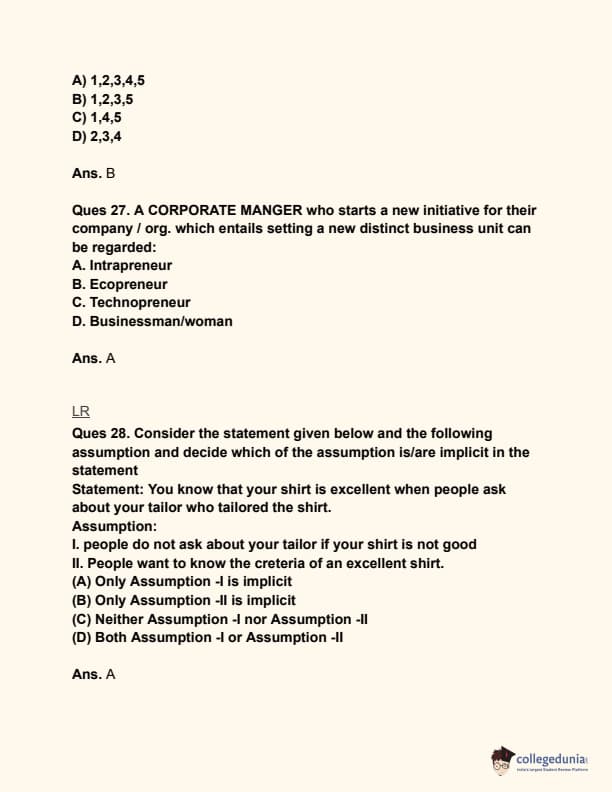
| 26. Given below are two statements: one is labelled as Assertion (A) and the other is labelled as Reason (R). Assertion (A): A person with blood group O is supposed to be a universal donor. Reason (R): Group O does not contain any antigens. (1) Both Assertion (A) and Reason (R) are true and Reason (R) is the correct explanation of Assertion (A). (2) Both Assertion (A) and Reason (R) are true, but Reason (R) is not the correct explanation of Assertion (A). (3) Assertion (A) is true, but Reason (R) is false. (4) Assertion (A) is false, but Reason (R) is true. |
(1) Both Assertion (A) and Reason (R) are true and Reason (R) is the correct explanation of Assertion (A). | Group O does not contain antigens, which is why it is the universal donor. This makes both statements true and Reason (R) correctly explains Assertion (A). | ||||||||||
| 27. Mr. X starts walking from his house towards west. After walking a distance of 30 metres, he turns towards right and walked 20 metres. He then turns left and moving a distance of 10 metres, turns to his left again and walked 40 metres. He now turns to the left and walks 5 metres. Finally he turns to his left. In which direction is he walking now? (1) North (2) South (3) South-East (4) East |
(1) North | After all the turns and movements, Mr. X is walking towards the north. | ||||||||||
| 28. If ‘blue means green’, ‘green means white’, ‘white means yellow’, ‘yellow means black’, ‘black means red’ and ‘red means brown’, then what is the colour of milk? (1) Black (2) Brown (3) Yellow (4) Green |
(4) Green | Milk is naturally white in color, but according to the given transformations, green is the color of milk. | ||||||||||
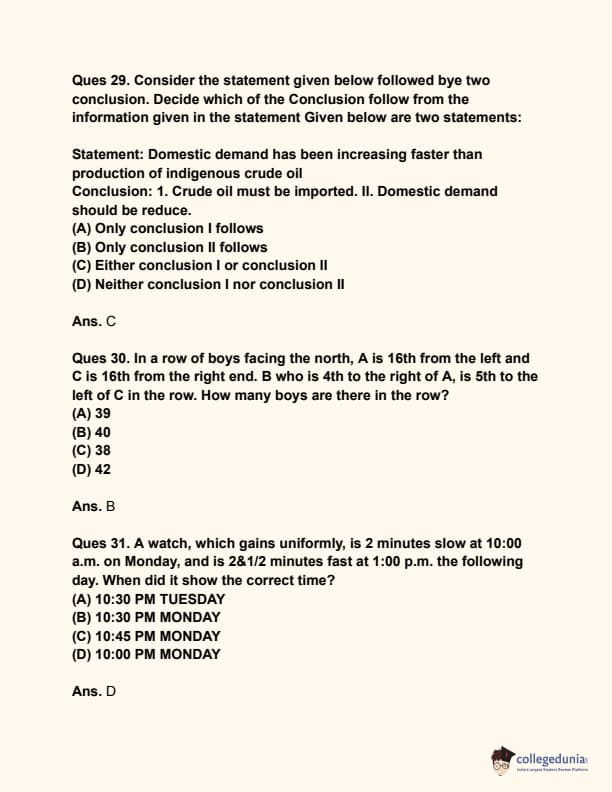
| 29. In a row of boys facing the north, A is 16th from the left and C is 16th from the right end. B who is 4th to the right of A, is 5th to the left of C in the row. How many boys are there in the row? (1) 39 (2) 40 (3) 38 (4) 42 |
(2) 40 | The total number of boys in the row is 40, based on the positions of A, B, and C. | ||||||||||
| 30. A watch which gains uniformly is 2 minutes slow at 10:00 AM on Monday and is 2 (1/2) minutes fast at 1:00 PM the following day. When did it show the correct time? (1) 10:30 PM Tuesday (2) 10:30 PM Monday (3) 10:45 PM Monday (4) 10:00 PM Monday |
(4) 10:00 PM Monday | The watch gains uniformly, and the correct time is shown at 10:00 PM Monday. | ||||||||||
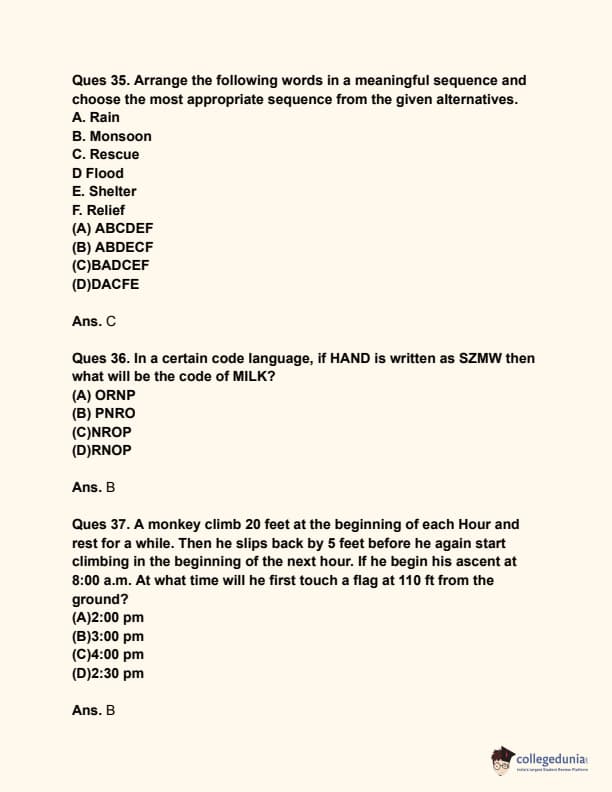
| 31. A monkey climbs 20 feet at the beginning of each hour and rests for a while when he slips back 5 feet before he again starts climbing in the beginning of the next hour. If he begins his ascent at 8:00 AM, at what time will he first touch a flag at 110 feet from the ground? (1) 2:00 PM (2) 3:00 PM (3) 4:00 PM (4) 2:30 PM |
(2) 3:00 PM | The monkey climbs 20 feet every hour but slips back 5 feet, making a net progress of 15 feet per hour. By 7 hours, he will reach 95 feet. In the next hour, he climbs 20 feet, reaching the flag at 110 feet at 3:00 PM. | ||||||||||
32. Find the missing term in the following figure: (1) 5 (1) 5(2) 6 (3) 11 (4) 7 |
(4) 7 | Analyzing the numerical relationships within the figure, the missing term is calculated to be 7 based on the pattern identified in the arrangement. | ||||||||||
| 33. The following question consists of a statement and arguments I and II. Choose the best option: Statement: Should there be a compulsory medical examination of both the man and the woman before they marry each other? Arguments: I. No, this is an intrusion into the privacy of an individual and hence cannot be tolerated. II. Yes, this will substantially reduce the risk of giving birth to children with serious ailments. (1) Only Argument I is strong (2) Only Argument II is strong (3) Neither Argument I nor Argument II is strong (4) Both Argument I and Argument II are strong |
(2) Only Argument II is strong | Argument II is strong as it provides a logical and practical benefit of reducing health risks for children. Argument I focuses on privacy but does not outweigh the potential health benefits. | ||||||||||
| 34. In a certain code language, if HAND is written as SZMW, then what will be the code of MILK? (1) ORNP (2) PNRO (3) NROP (4) RNOP |
(3) NROP | Applying the same shifts as in HAND → SZMW, MILK is coded as NROP. | ||||||||||
| 35. Consider the statement given below and the following assumptions and decide which of the assumptions is/are implicit in the statement: Statement: You know that your shirt is excellent when people ask about your tailor who tailored the shirt. Assumptions: I. People do not ask about your tailor if your shirt is not good. II. People want to know the criteria of an excellent shirt. (1) Only Assumption I is implicit (2) Only Assumption II is implicit (3) Neither Assumption I nor II is implicit (4) Both Assumptions I and II are implicit |
(1) Only Assumption I is implicit | Assumption I is implicit as the statement implies that the shirt's quality prompts people to ask about the tailor. Assumption II is not directly supported by the statement. | ||||||||||
| 36. Consider the statement given below followed by two conclusions. Decide which of the conclusions follows from the information given in the statement: Statement: Domestic demand has been increasing faster than production of indigenous crude oil. Conclusions: I. Crude oil must be imported. II. Domestic demand should be reduced. (1) Only Conclusion I follows (2) Only Conclusion II follows (3) Either Conclusion I or II follows (4) Neither Conclusion I nor II follows |
(3) Either Conclusion I or II follows | The statement indicates a mismatch between demand and production. Importing crude oil (Conclusion I) or reducing domestic demand (Conclusion II) are both valid solutions to the problem. Thus, either conclusion could follow. | ||||||||||
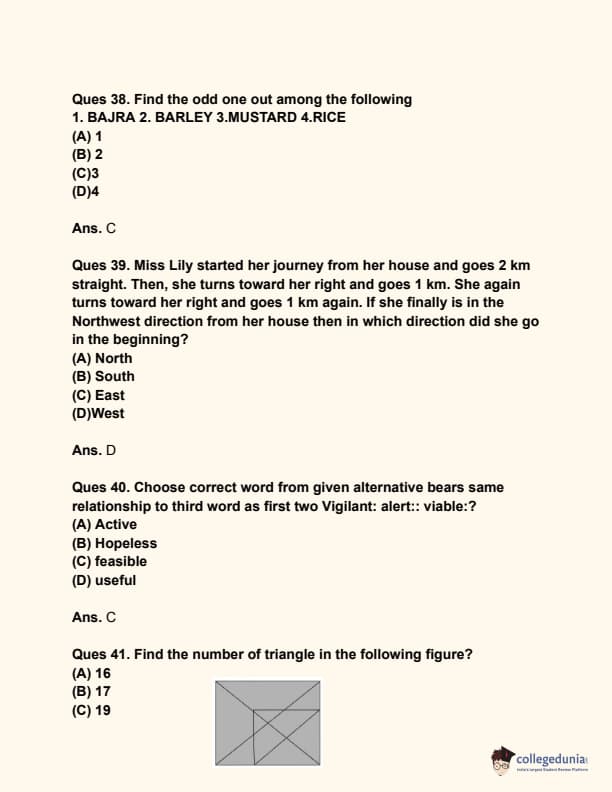
37. Find the number of triangles in the following figure: (1) 16 (1) 16(2) 17 (3) 19 (4) 21 |
(4) 21 | By counting all possible triangles formed by different combinations of the lines in the given figure, we find there are 21 triangles. | ||||||||||
38. A dice is thrown four times and its four different positions are shown below. Find the number on the face opposite the face showing 2: (1) 3 (1) 3(2) 4 (3) 5 (4) 6 |
(3) 5 | By analyzing the positions of the dice, we determine that the face opposite the one showing 2 is 5. | ||||||||||
39. A cylinder is painted in 6 colours - Green, Blue, Yellow, Violet, Red and Pink. Three positions are shown below. What is the colour in the empty space? (1) Blue (1) Blue(2) Green (3) Violet (4) Yellow |
(3) Violet | By observing the pattern of the cylinder’s painted colors, we deduce that the missing color in the empty space is Violet. | ||||||||||
| 40. Arrange the following words in a meaningful sequence and choose the most appropriate sequence from the given alternatives: (A) Rain (B) Monsoon (C) Rescue (D) Flood (E) Shelter (F) Relief (1) (A), (B), (C), (D), (E), (F) (2) (A), (B), (D), (E), (C), (F) (3) (B), (A), (D), (C), (E), (F) (4) (D), (A), (B), (C), (F), (E) |
(3) (B), (A), (D), (C), (E), (F) | The logical sequence of events is: - Monsoon (B) leads to Rain (A). - Rain leads to Floods (D). - Floods lead to the need for Shelter (E). - After Shelter is provided, Relief (F) is given. - Finally, Rescue (C) efforts are carried out. Thus, the correct sequence is: Monsoon, Rain, Flood, Shelter, Relief, Rescue. |
||||||||||
| 41. Pick the word opposite in meaning to the word “OBLIGATORY": (1) Compulsory (2) Exclusionary (3) Voluntary (4) Exemplary |
(3) Voluntary | "Obligatory" means something that is required, while "voluntary" refers to something done by choice, making it the opposite. | ||||||||||
| 42. Identify the usages of the word “PRINCIPAL" in the following sentence: “In the meeting, the principal stated the principal reasons for the suggested changes in the statute.” (1) As a noun and as an adverb (2) As a noun and as a verb (3) As a noun and as an adjective (4) As a noun and as a noun |
(3) As a noun and as an adjective | In this sentence, "principal" is used as a noun in "the principal" (referring to a person) and as an adjective in "the principal reasons" (modifying the noun "reasons"). | ||||||||||
| 43. Pick the correct answer from the options given below to replace the underlined words/phrase in the following sentence to make it grammatically correct: “He keeps getting for me and I really don't know what wrong have I done.” (1) gets at me (2) get off at me (3) getting at me (4) getting by me |
(3) getting at me | The correct expression here is "getting at me," which means bothering or criticizing someone. The phrase "getting for me" is incorrect, and the other options do not fit the context. | ||||||||||
| 44. Pick the odd one out from the following options: (1) hold back (2) hold high (3) hold on (4) hold up |
(2) hold high | "Hold back," "hold on," and "hold up" are all phrasal verbs, while "hold high" is not commonly used as a phrasal verb, making it the odd one out. | ||||||||||
| 45. Pick the correct option to complete the following sentence: “He often ___ cold in winter.” (1) catch (2) is catching (3) catches (4) have caught |
(3) catches | The correct answer is "catches" because the sentence is in the present tense and refers to a habitual action. | ||||||||||
| 46. “Speech without any preparation” is known as: (1) Ready-made (2) Natural (3) Present-minded (4) Extempore |
(4) Extempore | "Extempore" refers to speaking or performing without preparation, making it the correct choice. | ||||||||||
| 47. Pick the correct passive form of the following sentence: “One sees this sort of advertisement everywhere.” (1) This sort of advertisement is seen everywhere. (2) This sort of advertisement sees everywhere. (3) The advertisement are seen everywhere by one. (4) This sort of advertisement is shown everywhere. |
(1) This sort of advertisement is seen everywhere. | The passive form of "One sees this sort of advertisement everywhere" is "This sort of advertisement is seen everywhere." | ||||||||||
|
Comprehension:
To what extent reasoning can (I) ______ a reliable basis for a theory of justice is, of course, itself an issue that has been subject to controversy. (II) ______ first chapter of this book is (III) ______ with the role and reach of reasoning. I argue against the plausibility of seeing emotions or psychology or instincts as independent sources of valuation, without reasoned appraisal. Impulses and mental attitudes remain important, however, since we have good reasons to take note of them in our assessment of justice and injustice in the world. There is no irreducible conflict here, I argue, between reason and emotion, and there are very good reasons for making room for the relevance of emotions. Read MoreImpulses and mental attitudes remain important, however, since we have good reasons to take note of them in our assessment of justice and injustice in the world. There is no irreducible conflict here, I argue, between reason and emotion, and there are very good reasons for making room for the relevance of emotions. |
||||||||||||
| 48. Pick the appropriate replacement for (I): (1) provide (2) provides (3) provided (4) be provided |
(1) provide. | "Reasoning" is singular, and the correct form of the verb to match this subject is "provide." | ||||||||||
| 49. Pick the appropriate replacement for (II): (1) a (2) an (3) the (4) None of the above |
(3) the. | The correct article is "the" because we are referring to a specific concept ("a reliable basis for a theory of justice") which has already been introduced in the sentence. | ||||||||||
| 50. Pick the appropriate replacement for (III): (1) concern (2) concerns (3) concerned (4) concerning |
(3) concerned. | The word "concerned" is the correct form to indicate the issue is about something being debated or considered. | ||||||||||
| 51. Given below are two statements: one is labelled as Assertion (A) and the other is labelled as Reason (R). “The details of the incident was not known.” Assertion (A): The above sentence does not adhere to the requirement of subject-verb agreement and hence it is a grammatically incorrect sentence. Reason (R): In “Noun + Preposition + Noun" constructions, the verb agrees with the number and person of the noun preceding the preposition. (1) Both Assertion (A) and Reason (R) are true and Reason (R) is the correct explanation of Assertion (A). (2) Both Assertion (A) and Reason (R) are true and Reason (R) is not the correct explanation of Assertion (A). (3) (A) is true but (R) is false. (4) (A) is false but (R) is true. |
(1) Both Assertion (A) and Reason (R) are true and Reason (R) is the correct explanation of Assertion (A). | Assertion (A) is correct because "details" is plural and should take the verb "were." Reason (R) explains this by stating that the verb agrees with the noun before the preposition. | ||||||||||
| 52. Rearrange the following components to get a meaningful sentence: (A) balanced economic growth (B) had to plan for (C) the Indian Government (D) and development of a huge country (1) (A), (B), (C), (D) (2) (A), (D), (B), (C) (3) (C), (A), (B), (D) (4) (C), (B), (A), (D) |
(4) (C), (B), (A), (D) | The logical arrangement is: "The Indian Government had to plan for balanced economic growth and development of a huge country." | ||||||||||
| 53. Rearrange the following sentences to get a meaningful paragraph: (A) All Indian water bodies within and near population centres are now grossly polluted with organic and hazardous pollutants. (B) India is facing a water situation that is significantly worse than any that previous generations had faced. (C) That's why interstate disputes over river waters are becoming intense and widespread. (D) Not a single Indian city can provide clean water that can be consumed from a tap on a 24 x 7 basis. (1) (C), (A), (D), (B) (2) (C), (B), (A), (D) (3) (C), (D), (A), (B) (4) (B), (A), (D), (C) |
(4) (B), (A), (D), (C) | The logical order is: - (B) introduces the issue of India's worsening water situation. - (A) provides details of pollution in water bodies. - (D) highlights the lack of clean water in cities. - (C) explains the consequence of this situation—intense interstate disputes. |
||||||||||
| 54. Given below are two statements: Statement I: Modal verbs have only one form. They have no -ing or -ed forms and do not add -s to the 3rd person singular form. Statement II: Modal verbs are followed by past participle form of the other verbs. (1) Both Statement I and Statement II are true. (2) Both Statement I and Statement II are false. (3) Statement I is true but Statement II is false. (4) Statement I is false but Statement II is true. |
(3) Statement I is true but Statement II is false. | - Statement I is true because modal verbs do not have different forms. - Statement II is false because modal verbs are followed by the base form of verbs, not the past participle. |
||||||||||
| 55. Given below are two statements: Statement I: "DARE" usually forms negatives and questions like an ordinary verb and is followed by an infinitive with to. Statement II: It can also be used like a modal verb, especially in present tense negative forms, and is followed by an infinitive without to. (1) Both Statement I and Statement II are true. (2) Both Statement I and Statement II are false. (3) Statement I is true but Statement II is false. (4) Statement I is false but Statement II is true. |
(1) Both Statement I and Statement II are true. | - Statement I is true because "DARE" acts as an ordinary verb in certain contexts. - Statement II is also true because "DARE" can function as a modal verb in negative forms. |
||||||||||
| 56. Which of the following are synonyms of the word “CAJOLE”? (A) Coax (B) Entice (C) Bully (D) Disenchant (1) (A) and (B) only (2) (A) and (C) only (3) (B) and (C) only (4) (C) and (D) only |
(1) (A) and (B) only | "Cajole" means to persuade someone to do something through flattery or gentle urging, which is similar to "coax" and "entice." "Bully" and "disenchant" are not synonyms for "cajole." | ||||||||||
57. Match List-I with List-II:
(2) (A) - (I), (B) - (II), (C) - (III), (D) - (IV) (3) (A) - (II), (B) - (IV), (C) - (III), (D) - (I) (4) (A) - (IV), (B) - (III), (C) - (II), (D) - (I) |
(3) (A) - (II), (B) - (IV), (C) - (III), (D) - (I) | - "Alibi" refers to a defense showing one was elsewhere, matching with (II). - "Ex parte" refers to a legal proceeding from one side only, matching with (IV). - "Lex loci" refers to the law of the place, matching with (III). - "Quid pro quo" means mutual exchange, matching with (I). |
||||||||||
58. Match List-I with List-II:
(2) (A) - (II), (B) - (I), (C) - (III), (D) - (IV) (3) (A) - (II), (B) - (III), (C) - (IV), (D) - (I) (4) (A) - (IV), (B) - (III), (C) - (II), (D) - (I) |
(3) (A) - (II), (B) - (III), (C) - (IV), (D) - (I) | - "Win hands down" means to conquer easily, matching with (II). - "Learn the hard way" means to learn from bad experiences, matching with (III). - "To feel blue" means feeling miserable, matching with (IV). - "Take to one's heels" means to run away, matching with (I). |
||||||||||
|
Comprehension:
Education, taken in its most extensive sense, is properly that which makes the man. One method of education, therefore, would only produce one kind of man; but the greater excellence of human nature consists in the variety of which it is capable. Instead then, of endeavouring, by uniform and fixed systems of education, to keep mankind always the same, let us give free scope to everything which may bid fair for introducing more variety among us. The varied character of the Athenians was certainly preferable to the uniform character of the Spartans, or to any uniform national character whatever. Uniformity is the characteristic of the brute creation. Among them every species of bird builds its nest with the same materials and in same form; the genius and disposition of one individual is that of all and it is only the education which men give them that raises any of them much above others. But it is the glory of human nature that the operations of reason, through variable and by no means infallible, are capable of infinite improvement. We come into the world worse provided than any of the brutes; but when their faculties are at a full stand and their enjoyments incapable of variety or increase, our intellectual powers are growing apace; we are perpetually deriving happiness from new sources, and even before we leave this world, are capable of tasting the felicity of angels. Read MoreInstead then, of endeavouring, by uniform and fixed systems of education, to keep mankind always the same, let us give free scope to everything which may bid fair for introducing more variety among us. |
||||||||||||
| 59. Which of the following is true about the given passage? (1) It describes the state of education in our society. (2) It narrates the story of educational development in our society. (3) It reflects on the role and impact of education in life. (4) All of the above |
(3) It reflects on the role and impact of education in life. | The passage discusses the importance of education and the variety of human nature it fosters. It focuses on the role of education in shaping individuals and society rather than describing the current state of education or its development in society. | ||||||||||
| 60. Which of the following statements are true about the given passage? (A) The author creates a binary between uniformity and diversity in matters of education. (B) It upholds a uniform and stable system of education. (C) It holds uniformity as brutish but necessary for society. (D) It holds diversity in education as a key to human excellence and progress. (1) (A) and (B) only (2) (A) and (C) only (3) (A) and (D) only (4) (B) and (D) only |
(3) (A) and (D) only. | The passage emphasizes the importance of diversity in education (statement A) and its role in human progress and excellence (statement D). It does not uphold uniformity or describe it as necessary for society (statements B and C). | ||||||||||
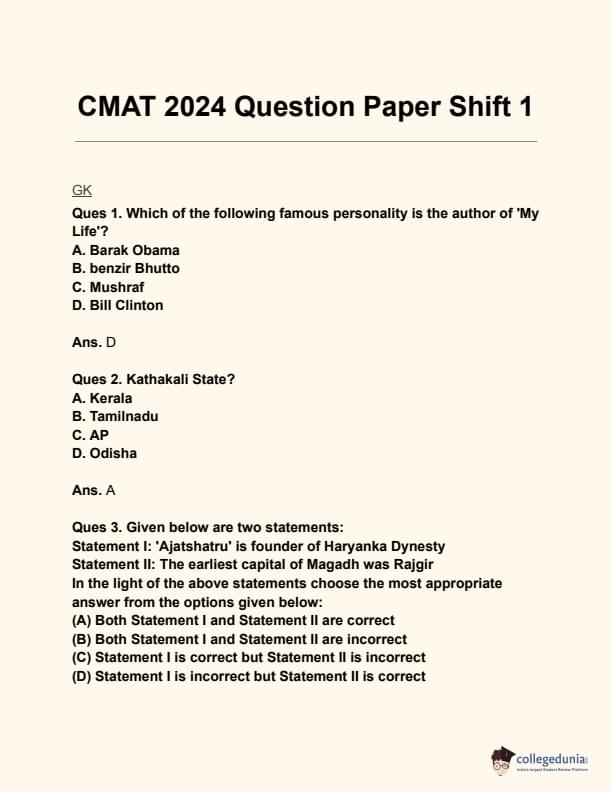
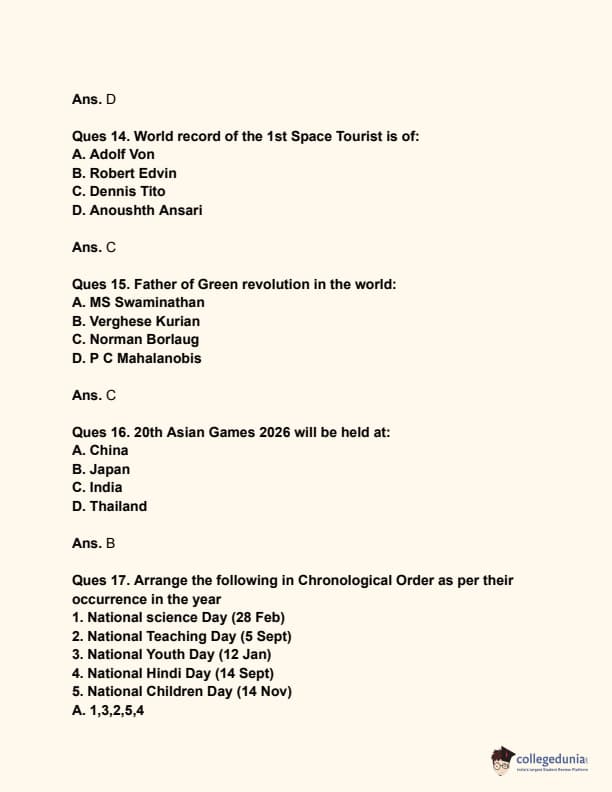
| 61. The famous football player Lionel Messi belongs to which country? (1) Jamaica (2) Portugal (3) Argentina (4) Spain |
(3) Argentina | Lionel Messi is an Argentine professional footballer, widely regarded as one of the greatest players of all time. He was born in Rosario, Argentina. | ||||||||||
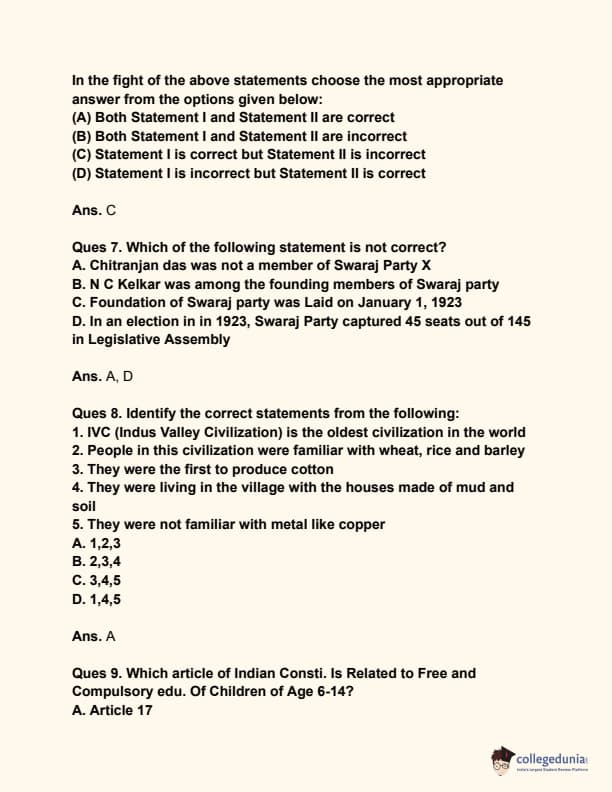
| 62. Which of the following statement is NOT correct? (1) Chitranjan Das was not a member of Swaraj Party. (2) N. C. Kelkar was among the founding members of Swaraj Party. (3) The foundation of Swaraj Party was laid on January 1, 1923. (4) In the election held in 1923, the Swaraj Party captured 45 out of 145 seats. |
(1) Chitranjan Das was not a member of Swaraj Party | Chitranjan Das was indeed one of the founding members of the Swaraj Party, making the first statement false. The other statements about the Swaraj Party’s formation and performance are correct. | ||||||||||
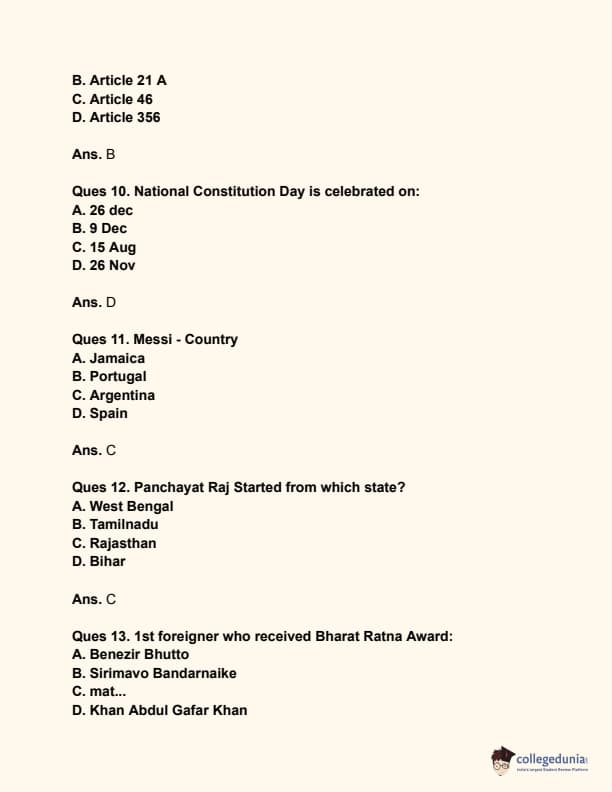
| 63. The 20th Asian Games - 2026 is scheduled to be held in which country? (1) China (2) Japan (3) India (4) Thailand |
(2) Japan | Japan has been selected to host the 20th edition of the Asian Games in 2026, marking an important milestone for the country's involvement in international sports. | ||||||||||
| 64. Which Article of the Indian Constitution is related to free and compulsory education for children of age 6 years to 14 years? (1) Article - 17 (2) Article - 21A (3) Article - 46 (4) Article - 356 |
(2) Article - 21A | Article 21A of the Indian Constitution guarantees the right to free and compulsory education for children aged 6 to 14 years, introduced by the 86th Amendment in 2002. | ||||||||||
| 65. We celebrate National Constitution Day on: (1) 26th December (2) 9th December (3) 15th August (4) 26th November |
(4) 26th November | National Constitution Day is celebrated on November 26th to commemorate the adoption of the Constitution of India in 1949. | ||||||||||
| 66. Kathakali is the famous dance of which state? (1) Tamil Nadu (2) Kerala (3) Andhra Pradesh (4) Odisha |
(2) Kerala | Kathakali is a classical dance-drama from Kerala, known for its intricate makeup, costumes, and storytelling. | ||||||||||
| 67. Who is known as “The Father of Green Revolution in the world”? (1) M.S. Swaminathan (2) Dr. Verghese Kurien (3) Norman E. Borlaug (4) P.C. Mahalanobis |
(3) Norman E. Borlaug | Norman E. Borlaug is known as the "Father of the Green Revolution" for his pioneering work in agriculture, especially in developing high-yielding crop varieties. | ||||||||||
| 68. The Author of the famous Book "My Life" is: (1) Barack Obama (2) Benazir Bhutto (3) Pervez Musharraf (4) Bill Clinton |
(4) Bill Clinton | "My Life" is the autobiography of Bill Clinton, the 42nd President of the United States. The book covers his early life, his career, and his presidency. | ||||||||||
| 69. The world record of the First Space Tourist is of: (1) Anousheh Ansari (2) Adolf Von (3) Dennis Tito (4) Robert Edwin |
(3) Dennis Tito | Dennis Tito was the first person to travel to space as a tourist, visiting the International Space Station in 2001. | ||||||||||
| 70. The Panchayat system first started in India from: (1) West Bengal (2) Tamil Nadu (3) Rajasthan (4) Bihar |
(3) Rajasthan | Rajasthan was the first state in India to introduce the Panchayat system under the Panchayat Act of 1953. | ||||||||||
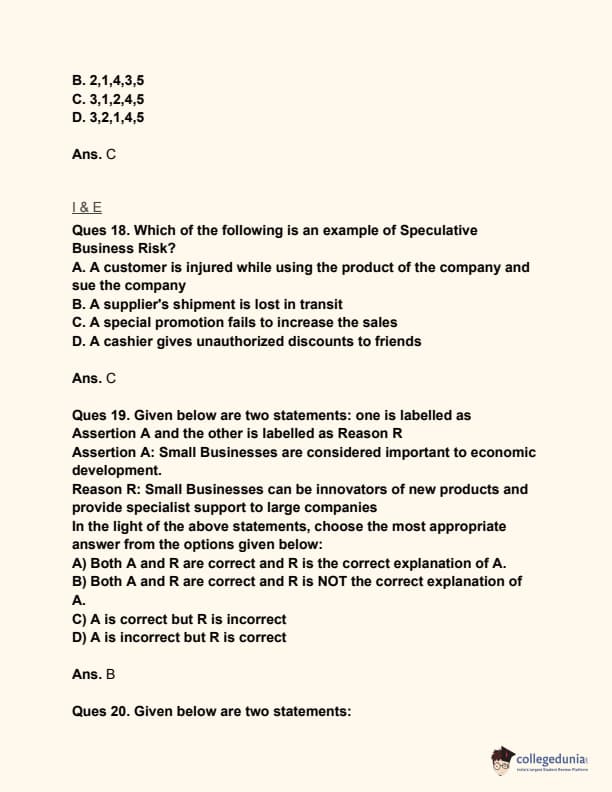
| 71. Arrange the following important National Days of India in chronological sequence. (A) National Science Day (B) National Teacher's Day (C) National Youth Day (D) National Hindi Day (E) National Children's Day (1) (A), (C), (B), (E), (D) (2) (B), (A), (D), (C), (E) (3) (C), (A), (B), (D), (E) (4) (C), (B), (A), (E), (D) |
(3) (C), (A), (B), (D), (E) | National Youth Day (January 12), National Science Day (February 28), National Teacher's Day (September 5), National Hindi Day (September 14), National Children's Day (November 14). | ||||||||||
| 72. Which of the following statements are correct? (A) Indus Valley Civilization is one of the oldest civilizations of the world. (B) People of this civilization were familiar with Wheat, Rice and Barley. (C) They were the first people to produce cotton. (D) They were living in villages with homes made with mud and soil. (E) They were not familiar with metals like copper. (1) (A), (B) and (C) only (2) (B), (C) and (D) only (3) (C), (D) and (E) only (4) (A), (D) and (E) only |
(1) (A), (B) and (C) only | Statements (A), (B), and (C) are correct. The Indus Valley Civilization knew about cotton and agriculture. Statement (D) is also true, but (E) is false as they knew about copper. | ||||||||||
| 73. Which of the following statements are correct? (A) Men in Paleolithic age, survived on hunting animals and birds, fishing, fruits and nuts. (B) Men in Mesolithic age, domesticated some animals and started to stay in one place. (C) Men in Mesolithic age invented the wheel for transportation. (D) Men in Chalcolithic age started the practice of agriculture. (1) (A), (B) and (C) only (2) (B) and (C) only (3) (A), (B) and (D) only (4) (B), (C) and (D) only |
(3) (A), (B) and (D) only | Statements (A), (B), and (D) are correct. The Paleolithic people were hunter-gatherers, the Mesolithic people started domesticating animals and settled in one place, and the Chalcolithic period saw the beginning of agriculture. Statement (C) is incorrect; the invention of the wheel is generally associated with later periods. | ||||||||||
74. Match List-I with List-II
(2) (A) - (III), (B) - (I), (C) - (II), (D) - (IV) (3) (A) - (II), (B) - (I), (C) - (III), (D) - (IV) (4) (A) - (IV), (B) - (III), (C) - (II), (D) - (I) |
(2) (A) - (III), (B) - (I), (C) - (II), (D) - (IV) | This matching is based on well-known characteristics of these planets, with Jupiter being the largest, Earth known as the blue planet, Neptune as the coldest, and Venus as the hottest. | ||||||||||
75. Match List-I with List-II
(1) (A) - (I), (B) - (IV), (C) - (III), (D) - (II) (2) (A) - (IV), (B) - (I), (C) - (II), (D) - (III) (3) (A) - (IV), (B) - (II), (C) - (III), (D) - (I) (4) (A) - (IV), (B) - (I), (C) - (III), (D) - (II) |
(2) (A) - (IV), (B) - (I), (C) - (II), (D) - (III) | The given matches are correct based on historical events. Each activity is correctly paired with the year it occurred. | ||||||||||
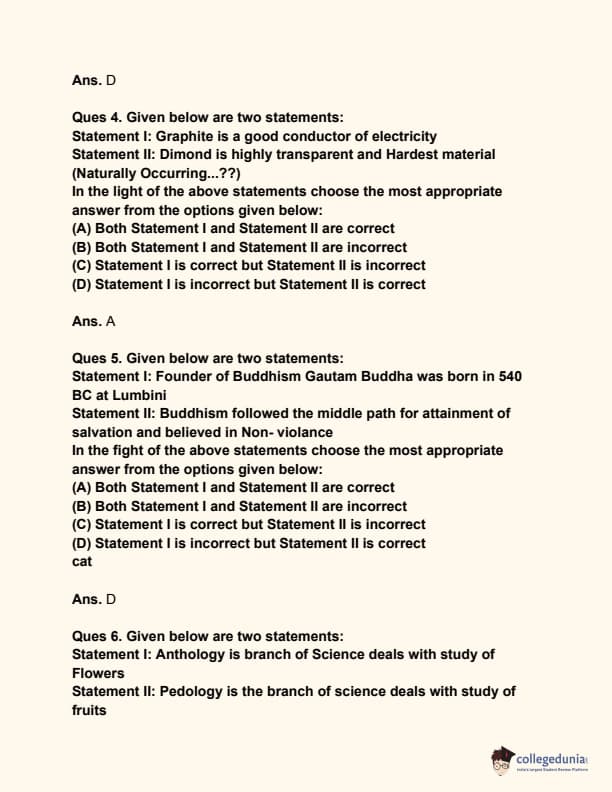
| 76. Given below are two statements: Statement I: Graphite is a good conductor of electricity. Statement II: Diamond is highly transparent and the hardest known material. Options: (1) Both Statement I and Statement II are true (2) Both Statement I and Statement II are false (3) Statement I is true but Statement II is false (4) Statement I is false but Statement II is true |
(1) Both Statement I and Statement II are true | Graphite, due to its structure, can conduct electricity. Diamond is highly transparent and is indeed the hardest naturally occurring material on Earth. | ||||||||||
| 77. Given below are two statements: Statement I: Anthology is the branch of science that deals with the study of flowers. Statement II: Pedology is the branch of science that deals with the study of fruits. Options: (1) Both Statement I and Statement II are true (2) Both Statement I and Statement II are false (3) Statement I is true but Statement II is false (4) Statement I is false but Statement II is true |
(2) Both Statement I and Statement II are false | Both statements are incorrect. Anthology refers to a collection of literary works, not the study of flowers. Pedology is the scientific study of soils in their natural environment, not fruits. | ||||||||||
| 78. Given below are two statements: Statement I: Ajatashatru was the founder of Haryanka Dynasty. Statement II: The earliest capital of Magadha was Rajgir. Options: (1) Both Statement I and Statement II are true (2) Both Statement I and Statement II are false (3) Statement I is true but Statement II is false (4) Statement I is false but Statement II is true |
(4) Statement I is false but Statement II is true | Ajatashatru was not the founder but a notable ruler of the Haryanka Dynasty; Bimbisara was the founder. Rajgir was indeed the first capital of Magadha. | ||||||||||
| 79. Given below are two statements: Statement I: The founder of Buddhism, Gautam Buddha was born in 540 BC at Lumbini. Statement II: Buddhism followed the middle path for attainment of salvation and believed in the concept of non-violence. Options: (1) Both Statement I and Statement II are true (2) Both Statement I and Statement II are false (3) Statement I is true but Statement II is false (4) Statement I is false but Statement II is true |
(4) Statement I is false but Statement II is true | Statement I is incorrect because Gautam Buddha was born in approximately 563 BC, not 540 BC, in Lumbini (modern-day Nepal). Statement II is correct as Buddhism emphasizes the middle path for salvation and strictly follows non-violence as a principle. | ||||||||||
| 80. The first foreigner honoured with the Bharat Ratna Award was: Options: (1) Muhammad Ali Jinnah (2) Benazir Bhutto (3) Sirimavo Bandarnaike (4) Khan Abdul Ghaffar Khan |
(4) Khan Abdul Ghaffar Khan | Khan Abdul Ghaffar Khan, also known as Frontier Gandhi, was the first foreigner to be honored with the Bharat Ratna, India's highest civilian award, in 1987. | ||||||||||
| 81. The entrepreneur: (1) is an aggressive catalyst for change in the world of business. (2) is an independent thinker who dares to be different amid a background of common events. (3) is a mere creator of business. (4) Both (1) and (2) |
(4) Both (1) and (2) | An entrepreneur is a dynamic individual who not only acts as a catalyst for change but also demonstrates independent thinking and a willingness to challenge conventional norms. Entrepreneurs identify opportunities, take calculated risks, and create innovative solutions that transform the market landscape. | ||||||||||
| 82. A corporate manager who starts a new initiative for their company/organization which entails setting up a new distinct business unit can be regarded as: (1) Ecopreneur (2) Technopreneur (3) Intrapreneur (4) Businessman/Businesswoman |
(3) Intrapreneur | An intrapreneur is an individual within an organization who takes the initiative to innovate, develop new ideas, or create new business units while leveraging the resources and support of the parent company. | ||||||||||
| 83. The primary function of a new age entrepreneur is innovation. This statement was/is proposed and propagated by: (1) Henri Fayol (2) Steve Jobs (3) Schumpeter (4) Elon Musk |
(3) Schumpeter | Joseph Schumpeter, an influential economist, emphasized the role of innovation in entrepreneurship. He described entrepreneurs as agents of "creative destruction," driving economic growth by introducing new products, services, or methods. | ||||||||||
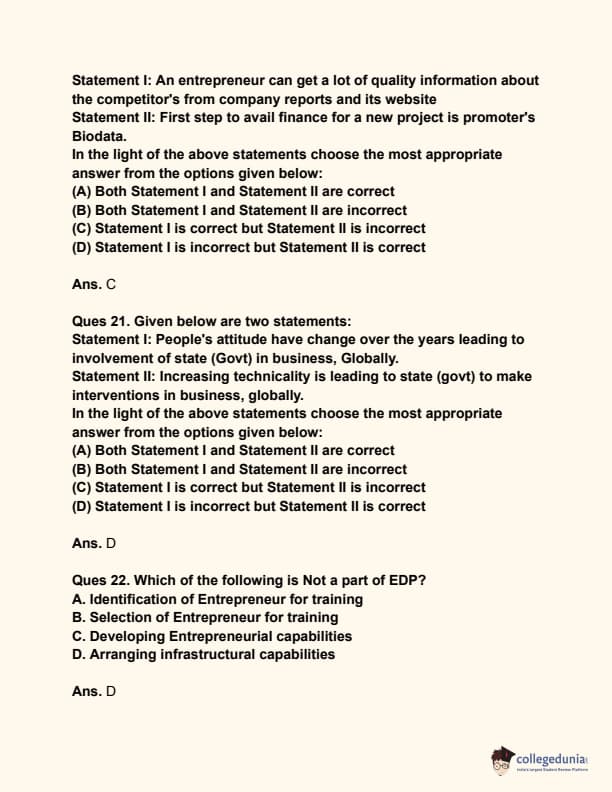
| 84. Given below are two statements: Statement I: People’s attitudes have changed over the years leading to involvement of State (Government) in businesses globally. Statement II: Increasing technicality is leading to State (Government) to make interventions in businesses globally. Options: (1) Both Statement I and Statement II are correct (2) Both Statement I and Statement II are incorrect (3) Statement I is correct but Statement II is incorrect (4) Statement I is incorrect but Statement II is correct |
(2) Both Statement I and Statement II are incorrect | Both statements are incorrect. Government involvement in business is primarily driven by socio-economic factors, market failures, and regulatory requirements rather than people's attitudes or technical advancements alone. | ||||||||||
| 85. Which of the following statements are correct? (A) MUDRA loans under PMMY include Shishu Category (B) MUDRA loans under PMMY include Kishore Category (C) MUDRA loans under PMMY include Shaishav Category (D) MUDRA loans under PMMY include Tarun Category (E) MUDRA loans under PMMY include Vyask Category Options: (1) (C), (B) and (E) only (2) (C), (B) and (D) only (3) (A), (B) and (E) only (4) (A), (B) and (D) only |
(4) (A), (B) and (D) only | MUDRA loans under the Pradhan Mantri Mudra Yojana (PMMY) consist of three categories: Shishu (loans up to ₹50,000), Kishore (₹50,001 to ₹5,00,000), and Tarun (₹5,00,001 to ₹10,00,000). These categories support micro and small enterprises at different growth stages. | ||||||||||
| 86. Which of the following is NOT a form of organization to initiate a business/enterprise? (1) Partner Organization (2) Sole Proprietorship (3) Private Limited Company (4) Live and License |
(4) Live and License | "Live and License" is not a recognized business organization form. Common forms include Sole Proprietorship, Partnership, and Private Limited Company, each with specific legal structures and implications. | ||||||||||
87. Match List-I with List-II:
|
(3) (A)-(II), (B)-(III), (C)-(I), (D)-(IV) | Correct matches: (A) Intrapreneur - Risk-taking in an organizational role; (B) Entrepreneur - Calculated Risk-taking; (C) Distributor - Value Addition; (D) Customer - Utility Maximization. | ||||||||||
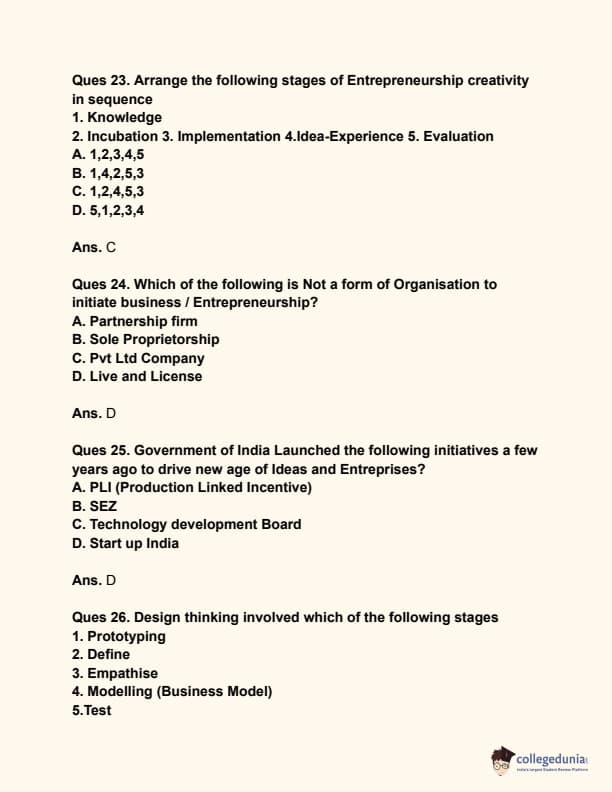
| 88. Arrange the following stages of Entrepreneurship Creativity in sequence: (A) Knowledge accumulation (B) Incubation (C) Implementation (D) Idea experience (E) Evaluation Options: (1) (A), (B), (C), (D), (E) (2) (A), (D), (B), (E), (C) (3) (A), (B), (D), (E), (C) (4) (E), (A), (B), (C), (D) |
(3) (A), (B), (D), (E), (C) | The sequence is: Knowledge accumulation → Incubation → Idea experience → Evaluation → Implementation. | ||||||||||
| 89. Design thinking involves which of the following stages? (A) Prototyping (B) Define (C) Empathize (D) Modeling (E) Test Options: (1) (A), (B), (C), (D), and (E) (2) (A), (B), (C), and (E) only (3) (A), (D), and (E) only (4) (B), (C), and (D) only |
(2) (A), (B), (C), and (E) only | Design thinking stages include Empathize, Define, Prototyping, and Test. Modeling is not a standard stage. | ||||||||||
| 90. Which of the following factors must you judge to estimate the market potential? (A) Present Market Demand (B) Export Market Demand (C) Future Market Demand (D) Labour Demand (E) Retailer’s Consumption Preferences Options: (1) (B), (C), and (D) only (2) (A), (B), and (D) only (3) (A), (B), and (C) only (4) (B), (D), and (E) only |
(3) (A), (B), and (C) only | Estimating market potential requires analysis of Present Market Demand, Export Market Demand, and Future Market Demand. | ||||||||||
| 91. Given below are two statements, one is labeled as Assertion (A) and the other is labeled as Reason (R): Assertion (A): Small businesses are considered important to economic development. Reason (R): Small businesses can be innovators of new products and provide specialist support to larger companies. Options: (1) Both Assertion (A) and Reason (R) are correct and Reason (R) is the correct explanation of Assertion (A). (2) Both Assertion (A) and Reason (R) are correct and Reason (R) is not the correct explanation of Assertion (A). (3) (A) is correct but (R) is not correct. (4) (A) is not correct but (R) is correct. |
(1) Both Assertion (A) and Reason (R) are correct and Reason (R) is the correct explanation of Assertion (A). | Small businesses foster innovation, create employment, and support larger corporations with specialized services, making them vital for economic growth. The Reason (R) accurately explains the Assertion (A). | ||||||||||
| 92. Given below are two statements: Statement I: An entrepreneur can get a lot of quality information about competitors from company reports and its website. Statement II: The first step to avail finance for a new project is Promoter’s Biodata. Options: (1) Both Statement I and Statement II are true (2) Both Statement I and Statement II are false (3) Statement I is true but Statement II is false (4) Statement I is false but Statement II is true |
(3) Statement I is true but Statement II is false | Entrepreneurs can analyze competitors through reports and websites. However, the first step to financing a new project is submitting a business plan, not the Promoter's Biodata. | ||||||||||
93. Match List-I with List-II:
|
(4) (A)-(III), (B)-(IV), (C)-(II), (D)-(I) | Feasibility types correspond with specific planning elements: (A) Financial, (B) Technical, (C) Market, and (D) Business Plan. | ||||||||||
| 94. Scaling up of a business requires a firm to take care of the following things: (A) Hiring, retaining, and motivating qualified employees (B) Finding investors who share the same goals (C) Time management and work assignment ability (D) Adequate market potential and opportune time (E) Business idea experiencing Options: (1) (A), (B), (D), and (E) (2) (B), (C), and (D) only (3) (A), (B), (C), and (D) only (4) (C), (D), and (E) only |
(3) (A), (B), (C), and (D) only | Scaling requires skilled employees, aligned investors, effective management, and market opportunities. Business idea experiencing is unrelated. | ||||||||||
| 95. Which of the following is an example of speculative business risk? (1) A customer is injured while using the product and sues the company (2) A supplier's shipment is lost in transit (3) A special promotion fails to increase the sales (4) A cashier gives unauthorized discounts to friends |
(3) A special promotion fails to increase the sales | Speculative risks involve potential gains or losses. A failed promotion is speculative, while other examples are operational or insurable risks. | ||||||||||
| 96. Which of the following can give an enterprise dealing in instant coffee a competitive edge? Options: (1) Quality, taste, and location (2) Population increase in the city (3) Ambience and customer relationship (4) (1) and (3) only |
(4) (1) and (3) only | Quality and taste ensure customer satisfaction, while ambience and strong customer relationships foster loyalty. Population growth, though beneficial, is not directly tied to competitiveness. | ||||||||||
| 97. Given below are two statements: Statement I: Yoga and focus on hobbies are good ways to deal with stress for an entrepreneur. Statement II: Having stress for an entrepreneur is welcoming as it helps in better performance and helps him/her lead a balanced life. Options: (1) Both Statement I and Statement II are correct (2) Both Statement I and Statement II are incorrect (3) Statement I is correct but Statement II is incorrect (4) Statement I is incorrect but Statement II is correct |
(3) Statement I is correct but Statement II is incorrect | Yoga and hobbies are proven stress management techniques. However, chronic stress negatively affects performance and health, making Statement II incorrect. | ||||||||||
| 98. Social Enterprise Obligation includes: (A) Environment (B) Fair Business Practices (C) Community Involvement (D) Energy (E) Shareholder’s Profit Options: (1) (A), (C), and (E) only (2) (A), (C), and (D) only (3) (B), (C), and (D) only (4) (D) and (E) only |
(1) (A), (C), and (E) only | Social enterprises focus on environmental sustainability, community development, and shareholder profits as key obligations. | ||||||||||
| 99. Which of the following is NOT part of the Entrepreneurship Development Programme? Options: (1) Identification of entrepreneurs for training (2) Selection of entrepreneurs for training (3) Developing entrepreneurial capabilities (4) Arranging infrastructural capabilities |
(4) Arranging infrastructural capabilities | EDPs focus on training and skill enhancement, not physical resource provisioning, which is beyond their direct scope. | ||||||||||
| 100. The Government of India has launched the following initiative a few years ago to drive the new-age ideas and enterprises: Options: (1) Production Linked Incentive (PLI) (2) Special Economic Zone (SEZ) (3) Technology Development Board (4) Start-Up India |
(4) Start-Up India | The Start-Up India initiative supports innovation and entrepreneurship with tax benefits, funding opportunities, and reduced compliance burdens. | ||||||||||
CMAT Previous Year Question Paper with Solution PDF
| CMAT 2023 Question Papers | CMAT 2022 Question Papers | CMAT 2021 Question Papers |
| CMAT 2020 Question Papers | CMAT 2019 Question Papers | CMAT 2018 Question Papers |




Comments