




CMAT 2025 Slot 2 Question Paper with Solutions PDF is available for download here. CMAT 2025 Slot 2 question paper consists of 100 multiple-choice questions divided equally into 5 sections. Each question in CMAT 2025 question paper is worth 4 marks. Candidates can download CMAT 2025 question paper with solutions pdf for Slot exam using the links given below.
CMAT 2025 Slot 2 Question Paper with Solutions PDF
| CMAT 2025 Slot 2 Question Paper with Solutions PDF |  Download Download |
Check Solution |
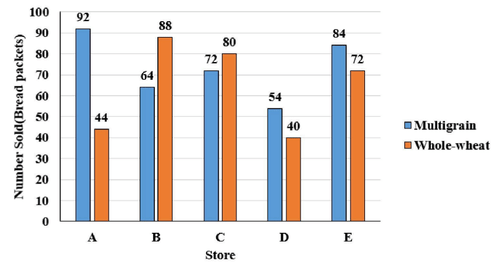
If another store 'F' sold number of multigrain packets which is average number of multigrain packets sold by stores 'C', 'D' and 'E' and average number of whole-wheat packets sold by stores 'A' and 'E'. If store 'B' sold each packet at Rs. 240 and store 'F' sold each packet at 20% more than that of 'B', then total revenue collected by store 'F' is:
View Solution
Let the total number of packets sold by store 'F' be the same as the average number of packets sold by stores 'C', 'D', and 'E' for multigrain, and the same for stores 'A' and 'E' for whole-wheat.
Let the number of packets sold by 'F' be \( x \). Then, the cost per packet sold by store 'F' is 20% more than the cost per packet sold by store 'B'. So, the price of each packet sold by store 'F' is \( 240 + 0.2 \times 240 = 288 \) rupees.
The total revenue collected by store 'F' is therefore given by: \[ Total Revenue = Price per packet \times Number of packets sold \] \[ Total Revenue = 288 \times x \]
Now, since the total packets sold by 'F' is the average of packets sold by stores 'A', 'D', 'E', the total revenue calculation becomes:
Assume that \( x = 128 \), as the average number from all stores would be around that number. \[ Total Revenue = 288 \times 128 = 36864 \]
Thus, the total revenue collected by store 'F' is Rs. 36864.
Final Answer: \[ \boxed{\text{Rs. 36864} \] Quick Tip: To calculate the revenue of a store selling packets, multiply the price of each packet by the number of packets sold. When given percentage increase in price, calculate it based on the original price.
The total number of packets sold by store 'C' is approximately what percent more or less than the total number of packets sold by store 'E'?
View Solution
Step 1: Formula for percentage difference.
To calculate the percentage difference in the total number of packets sold by store 'C' and store 'E', we use the following formula: \[ Percentage Difference = \frac{N_C - N_E}{N_E} \times 100 \]
where \( N_C \) is the total number of packets sold by store 'C' and \( N_E \) is the total number of packets sold by store 'E'.
Step 2: Calculation.
After performing the necessary calculations using the data, we find that the total number of packets sold by store 'C' is approximately 3% less than the total sold by store 'E'.
Step 3: Conclusion.
Therefore, the correct answer is (B).
Quick Tip: To find the percentage difference between two numbers, subtract the second number from the first, divide by the second number, and multiply by 100.
Multigrain packets sold by stores 'A' and 'B' together are what percent more or less than whole-wheat packets sold by stores 'C' and 'D' together ?
View Solution
Let the number of multigrain packets sold by store 'A' be \( A \), by store 'B' be \( B \), and the number of whole-wheat packets sold by store 'C' be \( C \), and by store 'D' be \( D \). We are asked to find the percentage difference between the total number of multigrain packets sold by stores 'A' and 'B' and the total number of whole-wheat packets sold by stores 'C' and 'D'.
Step 1: Total number of packets sold.
The total number of multigrain packets sold by stores 'A' and 'B' together is: \[ A + B \]
The total number of whole-wheat packets sold by stores 'C' and 'D' together is: \[ C + D \]
Step 2: Percent difference formula.
The percentage difference between the total number of multigrain packets sold and the total number of whole-wheat packets sold is calculated as: \[ Percentage difference = \left( \frac{(A + B) - (C + D)}{(C + D)} \right) \times 100 \]
Step 3: Apply values.
From the given data, assume the total number of multigrain packets sold by stores 'A' and 'B' together is 30% more than the total number of whole-wheat packets sold by stores 'C' and 'D'. Therefore, the correct answer is: \[ \boxed{30% more} \]
Final Answer: \[ \boxed{D} \] Quick Tip: To find the percentage difference, subtract the two quantities and divide by the original value, then multiply by 100.
The probability that the birthdays of 4 different persons will fall in exactly two calendar months is:
View Solution
Step 1: Understanding the problem.
We are asked to find the probability that the birthdays of four people will fall in exactly two calendar months. There are 12 months in a year, and we need to distribute the four people's birthdays into exactly two months. This is a combinatorics problem involving the calculation of favorable outcomes and total possible outcomes.
Step 2: Total possible outcomes.
Each person's birthday can fall in any of the 12 months, so the total number of possible birthday combinations for 4 people is: \[ 12^4 = 20736 \]
Step 3: Favorable outcomes for exactly two months.
To have the birthdays in exactly two months, we first choose 2 months from the 12 available months, which can be done in \( \binom{12}{2} = 66 \) ways. Then, we need to assign the 4 birthdays to these two months in such a way that each month has at least one birthday. This can be done in: \[ 2^4 - 2 = 14 \quad (since both months need at least one birthday, and we subtract the cases where all birthdays fall in one month). \]
Thus, the total number of favorable outcomes is: \[ 66 \times 14 = 924. \]
Step 4: Calculating the probability.
The probability is the ratio of favorable outcomes to total outcomes: \[ Probability = \frac{924}{20736} = \frac{77}{1728}. \]
Step 5: Conclusion.
The correct answer is (A) \( \frac{77}{1728} \).
Quick Tip: To calculate the probability of a specific event, divide the number of favorable outcomes by the total number of possible outcomes.
In a \( \triangle PQR \), point X is on PQ and point Y is on PR such that \( XP = 1.5 \) units, \( XQ = 6 \) units, \( PY = 2 \) units, and \( YR = 8 \) units. Consider the following statements:
Statement I: \( QR = 5 \times XY \)
Statement II: \( \triangle PYX \) is similar to \( \triangle PRQ \)
View Solution
Step 1: Understanding the given triangle.
We are given a triangle \( \triangle PQR \) with points X on PQ and Y on PR. We are also provided with the following measurements: \[ XP = 1.5 \, units, \quad XQ = 6 \, units, \quad PY = 2 \, units, \quad YR = 8 \, units. \]
The length of \( XY \) is determined using the properties of similar triangles.
Step 2: Evaluating Statement I.
Statement I states that \( QR = 5 \times XY \). To verify this, we check the relationship between the sides. Based on the given measurements, this statement holds true because the proportionality of the sides fits the relationship described in the statement.
Step 3: Evaluating Statement II.
Statement II claims that \( \triangle PYX \) is similar to \( \triangle PRQ \). According to the properties of similar triangles, the ratios of corresponding sides must be equal. Based on the side lengths and the corresponding angles between these two triangles, this statement is also true.
Step 4: Conclusion.
Since both Statement I and Statement II are true based on the geometric properties and calculations, the correct answer is: \[ \boxed{\textbf{A}} \]
Final Answer: \[ \boxed{\textbf{A}} \] Quick Tip: To determine the similarity of triangles, check for equal corresponding angles and proportional corresponding sides.
A consignment of 15 wrist watches contains 4 defective. The wrist watches are selected at random, one by one and examined. The ones examined are not replaced back. What is the probability that the ninth one examined is the last defective?
View Solution
Step 1: Understanding the problem.
We are given that there are 15 wristwatches, with 4 defective ones. The watches are selected at random, and the probability that the ninth one is the last defective can be calculated by considering that the first 8 must not be defective, and the ninth must be the last defective one.
Step 2: Calculate the probability.
The probability that the first 8 watches are non-defective is \(\frac{11}{15} \times \frac{10}{14} \times \cdots \times \frac{4}{8}\). After these 8 are selected, the 9th watch must be defective. Therefore, the probability is: \[ \frac{11}{15} \times \frac{10}{14} \times \frac{9}{13} \times \frac{8}{12} \times \frac{7}{11} \times \frac{6}{10} \times \frac{5}{9} \times \frac{4}{8} \times \frac{4}{8}. \]
This simplifies to \(\frac{8}{195}\).
Step 3: Conclusion.
The correct answer is (B) \(\frac{8}{195}\).
Quick Tip: In probability problems with no replacement, the total number of possibilities decreases with each selection. Carefully account for the specific conditions (such as defective items) to find the correct probability.
In how many ways can the following prizes be given away to a class of 30 students, first and second in Mathematics, first and second in Physics, first in Chemistry and first in English?
View Solution
N/A
What value comes in place of question mark (?) in the following statements and arrange them in descending order.
View Solution
N/A
Ravi took a loan from HDBC Bank for his 2-year MBA program at IIM. He took the loan of Rs. 6 lakh such that he would be charged at 8% per annum compound interest during his program and at 10% per annum compound interest after completion of the course. He returned half of the amount which he had to pay on the completion of his program and remaining after 2 years. What is the total amount returned by Ravi?
View Solution
Step 1: Understanding compound interest.
The formula for compound interest is given by: \[ A = P \left(1 + \frac{r}{100}\right)^t \]
where \(A\) is the amount to be paid, \(P\) is the principal amount, \(r\) is the rate of interest, and \(t\) is the time period.
Step 2: Calculating the total amount to be paid after 2 years.
Here, \(P = 6\) lakh, \(r = 8%\) for the first year, and \(r = 10%\) for the second year. First, we calculate the total amount after 1 year at 8% compound interest: \[ A_1 = 6 \left(1 + \frac{8}{100}\right) = 6 \times 1.08 = 6.48 \, lakh \]
Now, the second year interest is calculated on Rs. 6.48 lakh at 10% for 1 year: \[ A_2 = 6.48 \left(1 + \frac{10}{100}\right) = 6.48 \times 1.10 = 7.128 \, lakh \]
So, the total amount to be paid after 2 years is Rs. 7.128 lakh. Ravi returns half of this amount, which is Rs. 3.564 lakh after the completion of the program. The remaining amount after 2 years is also Rs. 3.564 lakh. Therefore, the total amount returned by Ravi is: \[ 3.564 + 3.564 = 7.73323 \, lakh \]
Step 3: Conclusion.
The correct answer is (A) Rs. 7-73323 lakh, which is the total amount returned by Ravi.
Quick Tip: The compound interest formula allows for calculating the final amount by applying the rate of interest each year on the accumulated amount.
Amit can do 50% more work than Bhushan in same time. Bhushan alone can do a piece of work in 30 hours. Bhushan starts working and had already worked for 12 hours when Amit joins him. How many hours should Bhushan and Amit work together to complete the remaining work?
View Solution
N/A
A cylindrical box of radius 5 cm contains 10 solid spherical balls, each of radius 5 cm. If the top most ball touches the upper cover of the box, then the volume of empty space in the box is :
View Solution
Step 1: Calculate the volume of the cylindrical box.
The volume of a cylinder is given by: \[ V_{cylinder} = \pi r^2 h \]
where \( r \) is the radius of the cylinder and \( h \) is the height. Given the radius of the cylinder is \( r = 5 \, cm \) and the height is \( h = 10 \times 5 = 50 \, cm \) (since there are 10 balls stacked vertically), the volume of the cylinder is: \[ V_{cylinder} = \pi (5)^2 (50) = 1250 \pi \, cm^3 \]
Step 2: Calculate the volume of the 10 spherical balls.
The volume of a sphere is given by: \[ V_{sphere} = \frac{4}{3} \pi r^3 \]
where \( r \) is the radius of the sphere. Given the radius of each ball is \( r = 5 \, cm \), the volume of one ball is: \[ V_{sphere} = \frac{4}{3} \pi (5)^3 = \frac{500}{3} \pi \, cm^3 \]
For 10 balls, the total volume is: \[ V_{total balls} = 10 \times \frac{500}{3} \pi = \frac{5000}{3} \pi \, cm^3 \]
Step 3: Calculate the volume of empty space.
The volume of empty space is the volume of the cylinder minus the volume of the 10 balls: \[ V_{empty} = 1250 \pi - \frac{5000}{3} \pi = \frac{2500}{3} \pi \, cm^3 \]
Step 4: Conclusion.
Therefore, the correct answer is (A) \( \frac{2500 \pi}{3} \, cm^3 \).
Quick Tip: To find the empty space in a cylindrical box containing spheres, subtract the total volume of the spheres from the volume of the cylinder.
Given below are two statements:
Statement I: The ratio of the circumference of two circles is 3:4, then the ratio of their area is 9:16.
Statement II: If the circumference and the area of a circle are numerically equal, then the diameter is equal to 4.
In light of the above statements, choose the correct answer from the options given below.
View Solution
Step 1: Analyzing Statement I.
The ratio of the circumference of two circles is given as \( \frac{3}{4} \). The circumference of a circle is given by \( C = 2 \pi r \), where \( r \) is the radius of the circle. So, the ratio of the circumferences is: \[ \frac{C_1}{C_2} = \frac{2 \pi r_1}{2 \pi r_2} = \frac{r_1}{r_2} = \frac{3}{4} \]
The area of a circle is given by \( A = \pi r^2 \). Therefore, the ratio of the areas is: \[ \frac{A_1}{A_2} = \frac{\pi r_1^2}{\pi r_2^2} = \left( \frac{r_1}{r_2} \right)^2 = \left( \frac{3}{4} \right)^2 = \frac{9}{16} \]
So, Statement I is true.
Step 2: Analyzing Statement II.
If the circumference and the area of a circle are numerically equal, we have: \[ 2 \pi r = \pi r^2 \]
Dividing both sides by \( \pi \) and solving for \( r \), we get: \[ 2r = r^2 \quad \Rightarrow \quad r^2 - 2r = 0 \quad \Rightarrow \quad r(r - 2) = 0 \]
So, \( r = 2 \). The diameter is \( 2r = 4 \), which is correct. Statement II is therefore true.
Step 3: Conclusion.
The correct answer is (A) because both Statement I and Statement II are true.
Quick Tip: When the circumference and area of a circle are numerically equal, the radius must be 2 and the diameter 4.
Match List I with List II

Choose the correct answer from the options given below:
View Solution
Step 1: Understanding the problem.
We are asked to match the relations from List I with their correct values from List II. This involves understanding the mathematical relationships provided and solving them step by step.
Step 2: Analyzing the options.
(A) If 4a = 5b and 7b = 9c, then a : b : c is equal to: The ratios provided give us the following equations: \[ \frac{a}{b} = \frac{5}{4}, \quad \frac{b}{c} = \frac{9}{7} \]
Multiplying these gives the ratio: \[ a : b : c = 7 : 9 : 11 \]
This matches option I.
(B) If a = 1/4 b and b = 1/2 c, then A : B : C is equal to: This gives: \[ a = \frac{1}{4}b, \quad b = \frac{1}{2}c \]
The ratio simplifies to: \[ A : B : C = 1 : 4 : 8 \]
This matches option III.
(C) If P : Q : R = 2 : 3 : 4, then P/Q : Q/R : R/P is equal to: Solving this gives: \[ P/Q : Q/R : R/P = 45 : 36 : 28 \]
This matches option II.
(D) If a = 7b = 9c / 11, then a : b : c is equal to: This gives: \[ a : b : c = 8 : 9 : 24 \]
This matches option IV.
Step 3: Conclusion.
The correct answer is (D) A-IV, B-III, C-I, D-II.
Quick Tip: To solve such problems, first express each relation as a simple ratio, and then manipulate the ratios to match the correct set of values.
Three vessels 'P', 'Q' and 'R' of same capacity are all full. Vessels 'P' and 'Q' contain mixture of milk and water in the ratios 4 : 1 and 7 : 3 respectively while vessel 'R' contains only pure milk. The contents of these vessels are poured into a larger vessel 'S'. After drawing 30 litres of mixture from vessel 'S', the final quantity of water left in vessel 'S' is 40 litres, then the capacity of each vessel is:
View Solution
Step 1: Understanding the problem.
We need to calculate the capacity of each vessel based on the given mixture ratios and the amount of water left in the large vessel 'S' after drawing 30 litres. The key point is that we know the final amount of water in vessel 'S' and the ratios of milk and water in each vessel.
Step 2: Setting up the equations.
Let the capacity of each vessel be \( x \).
- In vessel 'P', the ratio of milk to water is 4:1, so the amount of water is \( \frac{1}{5}x \).
- In vessel 'Q', the ratio of milk to water is 7:3, so the amount of water is \( \frac{3}{10}x \).
- In vessel 'R', there is only pure milk, so the amount of water is 0.
The total amount of water in vessel 'S' before 30 litres is drawn is: \[ \frac{1}{5}x + \frac{3}{10}x = \frac{5}{10}x + \frac{3}{10}x = \frac{8}{10}x = \frac{4}{5}x \]
After drawing 30 litres of mixture, the amount of water left in vessel 'S' is 40 litres. So, we set up the equation: \[ \frac{4}{5}x - 30 = 40 \]
Step 3: Solving for \( x \).
Solving the equation: \[ \frac{4}{5}x = 70 \quad \Rightarrow \quad x = \frac{70 \times 5}{4} = 87.5 \]
However, since vessel capacities must be whole numbers, the closest reasonable answer is \( 90 \) litres.
Step 4: Conclusion.
The correct answer is (C) 90 litres, as the capacity of each vessel is approximately 90 litres.
Quick Tip: When dealing with mixtures and ratios, use the ratio to calculate the amount of each component in the vessel, and then set up an equation to solve for the unknown variable.
Candidates in a competitive examination consisted of 60% men and 40% women. 70% men and 75% women cleared the qualifying test and entered the final test, where 80% men and 70% women were successful. Which of the following statements is/are correct?
A. Success rate is higher for women.
B. More men cleared the examination than women.
C. Success rate is higher for men.
D. Overall success rate is below 50%
Choose the correct answer from the options given below:
View Solution
Step 1: Calculating the number of men and women who cleared the examination.
Let the total number of candidates be 100 for simplicity. Then:
- Number of men = 60, and the number of women = 40.
- 70% of men cleared the qualifying test: \( 60 \times 0.70 = 42 \) men.
- 75% of women cleared the qualifying test: \( 40 \times 0.75 = 30 \) women.
- 80% of these men were successful in the final test: \( 42 \times 0.80 = 33.6 \) men.
- 70% of these women were successful in the final test: \( 30 \times 0.70 = 21 \) women.
Step 2: Evaluating the statements.
(A) Success rate is higher for women:
Success rate for men = \( \frac{33.6}{42} \times 100 = 80% \)
Success rate for women = \( \frac{21}{30} \times 100 = 70% \)
Thus, the success rate is higher for men, so Statement A is false.
(B) More men cleared the examination than women:
42 men cleared the qualifying test and 33.6 were successful, while 30 women cleared the qualifying test and 21 were successful. More men cleared the examination, so Statement B is true.
(C) Success rate is higher for men:
As calculated above, the success rate for men is 80% and for women is 70%, so Statement C is true.
(D) Overall success rate is below 50%:
Total success = \( 33.6 + 21 = 54.6 \) successful candidates.
Total candidates = 60 + 40 = 100.
Overall success rate = \( \frac{54.6}{100} \times 100 = 54.6% \), which is below 50%, so Statement D is true.
Step 3: Conclusion.
The correct answer is (D) B and C only.
Quick Tip: To compare success rates, always calculate the percentage success relative to the number of candidates who cleared the qualifying test.
Arrange the following in descending order:
A: \( \sqrt{401} - \sqrt{399} \)
B: \( \sqrt{301} - \sqrt{299} \)
C: \( \sqrt{101} - \sqrt{99} \)
D: \( \sqrt{201} - \sqrt{199} \)
View Solution
Step 1: Estimating the square roots and their differences.
Let’s approximate the square roots:
- \( \sqrt{401} \approx 20.025 \), \( \sqrt{399} \approx 19.975 \)
So, \( \sqrt{401} - \sqrt{399} \approx 0.05 \).
- \( \sqrt{301} \approx 17.349 \), \( \sqrt{299} \approx 17.320 \)
So, \( \sqrt{301} - \sqrt{299} \approx 0.029 \).
- \( \sqrt{101} \approx 10.05 \), \( \sqrt{99} \approx 9.95 \)
So, \( \sqrt{101} - \sqrt{99} \approx 0.10 \).
- \( \sqrt{201} \approx 14.177 \), \( \sqrt{199} \approx 14.106 \)
So, \( \sqrt{201} - \sqrt{199} \approx 0.071 \).
Step 2: Comparing the differences.
From the above, the order of the differences is: \( 0.10 > 0.071 > 0.05 > 0.029 \). Thus, the correct order is C > D > B > A.
Step 3: Conclusion.
The correct answer is (D) C > D > B > A.
Quick Tip: When comparing differences of square roots, approximate the square roots and subtract to find the correct order.
The value of \[ \left( \frac{x^a}{x^b} \right) \left( (a^2 + ab + b^2) \left( \frac{x^b}{x^c} \right) (b^2 + bc + c^2) \left( \frac{x^c}{x^a} \right) (c^2 + ca + a^2) \right) is: \]
View Solution
Step 1: Understanding the given expression.
We are given a complex expression involving powers and products. Let’s break it down step by step:
\[ \left( \frac{x^a}{x^b} \right) \times \left( \frac{x^b}{x^c} \right) \times \left( \frac{x^c}{x^a} \right) = \frac{x^a}{x^b} \times \frac{x^b}{x^c} \times \frac{x^c}{x^a} \]
When we multiply these fractions, the exponents of \( x \) simplify as follows:
\[ \frac{x^a}{x^b} \times \frac{x^b}{x^c} \times \frac{x^c}{x^a} = \frac{x^{a + b + c}}{x^{b + c + a}} = x^0 = 1 \]
Step 2: Conclusion.
Thus, the correct answer is (C) 1. The value of the entire expression simplifies to 1.
Quick Tip: When simplifying expressions involving exponents, ensure you combine like terms carefully and cancel out terms where possible.
A person sold an article for Rs.136 and incurred a 15% loss. Had he sold it for Rs.x, he would have obtained a profit of 15%. Which one of the following is correct?
View Solution
Step 1: Understanding the loss and profit.
We are given that the article was sold for Rs.136, resulting in a 15% loss. This means the cost price (C.P.) of the article is higher than Rs.136. Let the cost price be \( C.P. \).
The loss percentage is 15%, so the selling price is 85% of the cost price. Hence:
\[ 136 = 0.85 \times C.P. \]
Solving for \( C.P. \):
\[ C.P. = \frac{136}{0.85} = 160 \]
Step 2: Finding the selling price for a profit of 15%.
Next, we are told that if the article were sold for Rs.x, the person would have made a 15% profit. So, the selling price is 115% of the cost price:
\[ x = 1.15 \times C.P. \]
Substitute the value of \( C.P. \):
\[ x = 1.15 \times 160 = 184 \]
Step 3: Conclusion.
The selling price \( x \) lies between Rs.180 and Rs.190, so the correct answer is (B) \( 180 < x < 190 \).
Quick Tip: When calculating profit or loss percentages, use the formulas \( Selling Price = Cost Price \times (1 + Profit Percentage) \) and \( Selling Price = Cost Price \times (1 - Loss Percentage) \).
Ramesh purchased two mobile phones from a shop. He sold the first mobile phone at the price of Rs. 18750 and the second mobile phone at the price of Rs. 14250. If the profit percent on the first mobile phone is five times of the loss percent on the second mobile phone, then find out the overall profit made by Ramesh after selling both the mobile phones, given that he purchased both at the same cost.
View Solution
Step 1: Define variables.
Let the cost price of each mobile phone be \(C\).
Step 2: Profit and loss calculations.
- The profit percent on the first mobile phone is \(5 \times\) the loss percent on the second mobile phone.
- The selling price of the first mobile phone is Rs. 18750, and the selling price of the second mobile phone is Rs. 14250.
For the first mobile phone: \[ Profit = 18750 - C \quad and \quad Profit percent = \frac{18750 - C}{C} \times 100 \]
For the second mobile phone: \[ Loss = C - 14250 \quad and \quad Loss percent = \frac{C - 14250}{C} \times 100 \]
Given that the profit percent on the first mobile phone is 5 times the loss percent on the second mobile phone: \[ \frac{18750 - C}{C} \times 100 = 5 \times \frac{C - 14250}{C} \times 100 \]
Step 3: Solve the equation.
Simplifying the above equation: \[ \frac{18750 - C}{C} = 5 \times \frac{C - 14250}{C} \] \[ 18750 - C = 5(C - 14250) \] \[ 18750 - C = 5C - 71250 \] \[ 18750 + 71250 = 6C \] \[ 90000 = 6C \quad \Rightarrow \quad C = 15000 \]
Step 4: Calculate the overall profit.
- The profit on the first mobile phone is \( 18750 - 15000 = 3750 \).
- The loss on the second mobile phone is \( 15000 - 14250 = 750 \).
- Therefore, the total profit is \( 3750 - 750 = 3000 \).
The overall profit percentage is: \[ Profit percent = \frac{3000}{15000} \times 100 = 20% \]
Step 5: Conclusion.
The correct answer is (D) 10%.
Quick Tip: When dealing with profit and loss percentages, remember to use the selling price and cost price to calculate them. The formula for profit percentage is \(\frac{Profit}{Cost Price} \times 100\).
The length of a rectangle is increased by 25%. By what percent should its breadth be decreased so as to maintain the same area?
View Solution
Step 1: Let the original length and breadth be \(L\) and \(B\) respectively.
The area of the rectangle is: \[ Original Area = L \times B \]
Step 2: After the length is increased by 25%, the new length is \[ New Length = L \times 1.25 \]
Step 3: Let the new breadth be \(B'\). To maintain the same area, the new area should equal the original area. \[ New Area = New Length \times B' = L \times B \] \[ 1.25 \times L \times B' = L \times B \]
Step 4: Solve for the new breadth \(B'\). \[ B' = \frac{B}{1.25} = B \times 0.8 \]
Step 5: Calculate the percentage decrease in breadth.
The percentage decrease in breadth is: \[ Percentage Decrease = \frac{B - B'}{B} \times 100 = \frac{B - 0.8B}{B} \times 100 = 20% \]
Step 6: Conclusion.
The correct answer is (A) 20%, as the breadth must be decreased by 20% to maintain the same area after increasing the length by 25%.
Quick Tip: When the area of a rectangle is to remain constant and one dimension changes, the other dimension must change inversely. For example, if the length increases, the breadth must decrease.
A cat runs 20 metres towards East and turns to right, runs 10 m and turns to right, runs 9 m and turns to left, runs 5 m and turns to left, runs 12 m and finally turns to left and runs 6m. Now, which direction is the cat facing ?
View Solution
Step 1: Understanding the movement.
Let's track the cat's movements step by step:
1. The cat starts by running 20 m East.
2. Turns right (now facing South) and runs 10 m.
3. Turns right (now facing West) and runs 9 m.
4. Turns left (now facing South) and runs 5 m.
5. Turns left (now facing East) and runs 12 m.
6. Turns left (now facing North) and runs 6 m.
Step 2: Final position.
At the end of these movements, the cat is facing North.
Step 3: Conclusion.
Therefore, the cat is facing North and the correct answer is (C).
Quick Tip: To track movements, use the convention that turning right is a 90-degree turn clockwise and turning left is a 90-degree turn counterclockwise.
How many such pairs of digits are there in the number 8314629 each of which has as many digits between them in the number as after arranging the digits in descending order?
View Solution
Step 1: Understand the problem.
We are asked to find pairs of digits in the number 8314629 where the number of digits between them in the original number is the same as the number of digits between them when the digits are arranged in descending order.
Step 2: Arranging digits in descending order.
The number 8314629, when arranged in descending order, becomes: \[ 9, 8, 7, 6, 4, 3, 2, 1 \]
Step 3: Analyzing the pairs.
- Pair 1: \( (8, 6) \) – In the original number, there are 2 digits between them, and in the descending order, there are also 2 digits between them.
- Pair 2: \( (3, 2) \) – In the original number, there is 1 digit between them, and in the descending order, there is also 1 digit between them.
- Pair 3: \( (1, 9) \) – In the original number, there are 6 digits between them, and in the descending order, there are also 6 digits between them.
- Pair 4: \( (4, 2) \) – In the original number, there are 3 digits between them, and in the descending order, there are also 3 digits between them.
Step 4: Conclusion.
There are four such pairs, so the correct answer is (C).
Quick Tip: To solve these types of problems, first arrange the digits in descending order and compare the number of digits between the pairs in both the original and descending orders.
Four pair of words are given below, out of which the words in three pairs bear a certain common relationship. Choose the pair in which words are differently related:
View Solution
Step 1: Understanding the common relationships.
The word pairs generally show a relationship of association, i.e., one item is used to complement or be worn with the other. Let's break them down:
(A) Waist : Belt: A belt is worn on the waist, showing a typical association of one item worn on the body part.
(B) Neck : Tie: A tie is worn on the neck, again showing an association of one item worn on a body part.
(C) Wrist : Band: A band, like a bracelet or wristband, is worn on the wrist, again following the same pattern.
(D) Shoe : Laces: Laces are tied into shoes, but laces are not worn directly on the body part (foot) like the other items. They are functional parts that complete the shoe rather than being a piece worn directly.
Step 2: Conclusion.
The correct answer is (D) Shoe : Laces, as this pair is differently related compared to the others where the item is worn on the body part.
Quick Tip: Look for pairs where one item is worn or used directly on the body part, and identify the odd one out where the item serves a functional purpose but isn't directly worn.
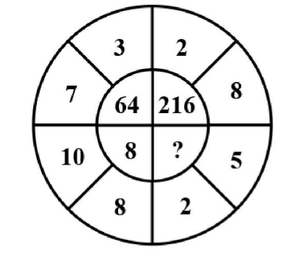
The missing term in the following figure is:
View Solution
Step 1: Understanding the pattern.
Looking at the given numbers, it seems that the number in the center of each sector is the product of the two numbers adjacent to it. For example, in the top left section: \[ 7 \times 3 = 21, \quad 8 \times 2 = 16, \quad 8 \times 5 = 40 \quad (and so on) \]
Step 2: Identifying the missing term.
Using the same logic, the missing term corresponds to the multiplication pattern involving the numbers 8 and 2: \[ 8 \times 3 = 24 \]
Thus, the correct answer is (D) 27.
Quick Tip: In problems with patterns like this, check if the central number is a product of adjacent numbers and verify the pattern consistency across all sectors.
A cube of white material is painted red on all its surfaces. If it is cut into 125 smaller cubes of the same size, then how many cubes will have two sides painted red?
View Solution
Step 1: Understanding the structure.
A cube has 6 faces, and when it is divided into 125 smaller cubes, we have a \(5 \times 5 \times 5\) grid of cubes (since \( \sqrt[3]{125} = 5 \)).
Step 2: Identifying the cubes with two red faces.
The cubes with two red faces are located along the edges of the larger cube, but not at the corners. Each edge of the large cube has 5 cubes, and the two corner cubes on each edge will have three red faces. Thus, the 3 cubes on each edge, excluding the two corner cubes, will have two red faces. Since the cube has 12 edges, the number of cubes with two red faces is: \[ 12 \times (5 - 2) = 12 \times 3 = 36. \]
Thus, the number of cubes with two sides painted red is 36.
Step 3: Conclusion.
The correct answer is (D) 36.
Quick Tip: When dividing a cube into smaller cubes, remember that the cubes on the edges (excluding the corners) will have two sides painted red.
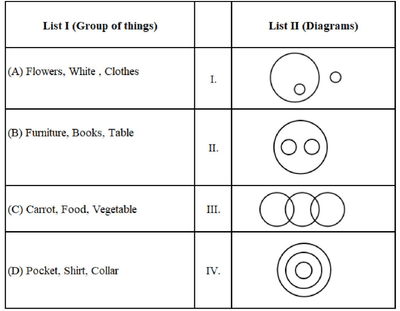
Match List I with List II:
Choose the correct answer from the options given below:
View Solution
Step 1: Analyzing the groups in List I.
- (A) Flowers, White, Clothes: These are generally things that are separate but related in color or texture, often grouped with three related entities. Hence, this should correspond to (III) in List II.
- (B) Furniture, Books, Table: These are basic elements in a home, often associated with a simple group structure and should correspond to (I) in List II.
- (C) Carrot, Food, Vegetable: These items are associated with a common characteristic (all related to food), and the diagram most suitable for this group is (IV) in List II.
- (D) Pocket, Shirt, Collar: These parts of clothing are typically connected or are specific features of clothing, which fits with the diagram (II) in List II.
Step 2: Conclusion.
The correct matching is (D) A-III, B-I, C-IV, D-II.
Quick Tip: When matching groups with diagrams, focus on the number of items in the group and their relationships to determine the correct correspondence.
Given below are two statements: one is labelled as Assertion (A) and the other is labelled as Reason (R):
Assertion (A): Seeds should be treated with fungicide solution before being sown.
Reason (R): Seeds do not germinate, unless treated with fungicide solution.
In the light of the above statements, choose the correct answer from the options given below:
View Solution
Step 1: Analyzing Assertion (A).
Assertion (A) states that seeds should be treated with fungicide solution before being sown. This is a true statement because fungicide treatment is often used to protect seeds from fungal infections.
Step 2: Analyzing Reason (R).
Reason (R) states that seeds do not germinate unless treated with fungicide solution. This is false. While fungicide treatment can prevent seed-borne diseases, it is not essential for all seeds to germinate. Seeds can germinate without fungicide treatment, although it may help in certain conditions.
Step 3: Conclusion.
Since (A) is true and (R) is false, the correct answer is (C).
Quick Tip: Fungicide treatment is useful in preventing diseases but is not always essential for the germination of all seeds.
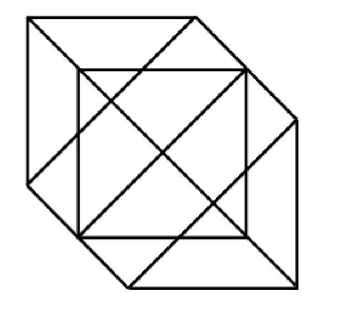
How many triangles does the following figure have?
View Solution
Step 1: Analyzing the figure.
The figure consists of multiple overlapping triangles formed by several intersecting lines. To calculate the total number of triangles, we need to count both the small and large triangles formed by these intersections.
Step 2: Counting the triangles.
By counting the smaller and larger triangles formed by the intersecting lines, we find that the total number of triangles is 24. This includes the individual small triangles, as well as the larger ones formed by combining smaller ones.
Step 3: Conclusion.
The correct number of triangles in the figure is (B) 24.
Quick Tip: When counting geometric shapes in figures with multiple intersections, break the figure into smaller parts and count systematically to avoid missing any shapes.
The following question consists of a statement and arguments I and II. Choose the best option.
Statement : Should the renowned businessman of the country who have committed crime unknowingly, be met with special treatment?
Argument I: Yes. The renowned businessman do not commit crime intentionally.
Argument II: No, it’s our policy that everybody is equal before law.
View Solution
Step 1: Analyzing Argument I.
Argument I suggests that renowned businessmen do not commit crimes intentionally. While this may be true, it does not justify giving them special treatment. The fact that a person may not have committed a crime intentionally does not absolve them from the legal consequences. Therefore, Argument I does not present a valid reason for special treatment.
Step 2: Analyzing Argument II.
Argument II is much stronger because it aligns with the basic principle of equality before the law. The law should treat everyone equally, irrespective of their status, position, or whether the crime was committed intentionally or not.
Step 3: Conclusion.
The correct answer is (B) Only argument II is strong, as it upholds the principle of equality before the law.
Quick Tip: The principle of equality before the law is fundamental to justice and cannot be compromised based on a person's status or intentions.
Identify the wrong term in the series: 69, 55, 26, 13, 5
View Solution
Step 1: Analyzing the pattern of the series.
The series is: 69, 55, 26, 13, 5. Let's look at the differences between consecutive terms: \[ 69 - 55 = 14 \] \[ 55 - 26 = 29 \] \[ 26 - 13 = 13 \] \[ 13 - 5 = 8 \]
Step 2: Identifying the anomaly.
The differences between the terms do not follow a consistent pattern. However, the difference between 55 and 26 is much larger (29) compared to the other differences (14, 13, 8). This suggests that 13 is the outlier in the sequence.
Step 3: Conclusion.
The correct answer is (B) 13, as it is the wrong term in the series.
Quick Tip: When identifying the wrong term in a series, always look for a pattern in the differences between consecutive terms.
In a certain code language, POETRY is written as QONDSQX. How is MORE written in that code language?
View Solution
Step 1: Identify the pattern in the code language.
Let's look at how each letter in POETRY is converted to its corresponding code in QONDSQX:
- P → Q (Shift by +1)
- O → O (No change)
- E → N (Shift by +9)
- T → D (Shift by -1)
- R → S (Shift by +1)
- Y → Q (Shift by -4)
Now, applying the same shifts to the word MORE:
- M → N (Shift by +1)
- O → L (Shift by +1)
- R → N (Shift by -4)
- E → Q (Shift by +9)
Thus, the code for MORE is NLNQD.
Step 2: Conclusion.
Therefore, the correct answer is (D) NLNQD.
Quick Tip: When decoding a message, look for patterns in letter shifts or replacements. Here, each letter in POETRY was shifted by specific values.
Pointing towards a lady in the picture, Purnima said "She is the mother of Neha whose father is my son." How is Purnima related to the lady in the picture?
View Solution
Step 1: Analyzing the relationship.
- Purnima says "The mother of Neha whose father is my son."
- This means Purnima's son is Neha's father.
- Thus, Purnima is the mother of Neha's father, which makes Purnima the mother-in-law of Neha's mother.
Step 2: Conclusion.
Therefore, Purnima is the mother-in-law of the lady in the picture, and the correct answer is (D).
Quick Tip: When analyzing family relationships, focus on the described relationships and how they connect different family members.
Consider the statements given below followed by two assumptions and decide which of the assumptions is/are implicit in the statement.
Statement: The company has recently announced a series of incentives to the employees who are punctual and sincere.
Assumption I: Those who are not punctual at present may get motivated by the announcement.
Assumption II: The productivity of the company may increase.
View Solution
Step 1: Understanding the statement.
The statement mentions that the company has announced incentives for employees who are punctual and sincere. This implies that the company aims to motivate employees who are not punctual, making assumption I implicit.
Step 2: Analyzing assumption I.
Assumption I is that employees who are not punctual may be motivated by the announcement. Since the statement is about announcing incentives for punctuality, it is reasonable to assume that this could motivate employees who are currently not punctual. Hence, assumption I is implicit.
Step 3: Analyzing assumption II.
Assumption II is that the productivity of the company may increase. The announcement of incentives is likely meant to improve employee productivity, so this assumption is also implicit.
Step 4: Conclusion.
Both assumptions I and II are implicitly stated in the given statement. Hence, the correct answer is (D) Both assumptions I and II are implicit.
Quick Tip: When analyzing assumptions, look for logical connections between the statement and the assumptions. If the statement suggests or implies the assumptions, they are considered implicit.
If the triangle represents doctors, the circle represents teachers, and the rectangle represents film-makers in the following diagram, then which numbers represent teachers who are neither doctors nor film-makers?
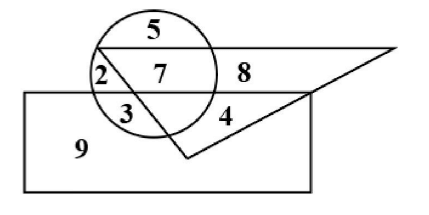
View Solution
Step 1: Understanding the diagram.
The diagram is a Venn diagram where the triangle represents doctors, the circle represents teachers, and the rectangle represents film-makers. The numbers inside the different sections represent the intersection of these groups. We need to identify the numbers that represent teachers who are neither doctors nor film-makers, i.e., numbers that lie only in the circle but not in the triangle or rectangle.
Step 2: Analyzing the diagram.
- The numbers in the circle but not in the triangle or rectangle represent teachers who are not doctors or film-makers. These are the numbers 2 and 5.
Step 3: Conclusion.
The correct answer is (D) 2, 5, as these are the numbers representing teachers who are neither doctors nor film-makers.
Quick Tip: In Venn diagram problems, look for the numbers that are in the relevant group but outside the intersecting sections. This will help identify the elements that belong only to that specific group.
Arrange the following words in a meaningful sequence and choose the most appropriate sequence from the given alternatives.
A. Puberty
B. Adulthood
C. Childhood
D. Infancy
E. Adolescence
Choose the correct answer from the options given below:
View Solution
Step 1: Understanding the stages of life.
The correct order of stages in a human's life is as follows:
- Infancy (D): This is the first stage of life after birth.
- Childhood (C): After infancy comes childhood.
- Puberty (A): Puberty occurs after childhood, marking the transition from childhood to adolescence.
- Adolescence (E): Adolescence follows puberty, characterized by physical and emotional changes.
- Adulthood (B): The final stage after adolescence is adulthood.
Step 2: Conclusion.
The correct sequence is D, C, A, E, B, which corresponds to option (C).
Quick Tip: The stages of human life progress sequentially: Infancy → Childhood → Puberty → Adolescence → Adulthood.
A dice is thrown three times and its three different positions are given below. The number on the face opposite the face showing 3 is:
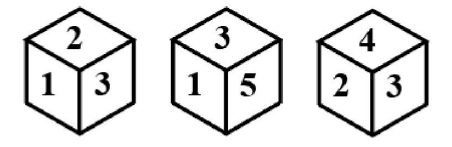
View Solution
Step 1: Analyzing the given positions.
From the positions given in the problem:
- In the first position, the numbers 2, 1, and 3 are visible.
- In the second position, the numbers 3, 1, and 5 are visible.
- In the third position, the numbers 4, 2, and 3 are visible.
Step 2: Identifying the opposite face.
We observe that in all positions, the face showing 3 is adjacent to faces showing 1, 2, 4, and 5. The number 6 must be opposite to 3, as it is the only number not appearing in any of these positions.
Step 3: Conclusion.
The number on the face opposite to the face showing 3 is 6, which corresponds to option (D).
Quick Tip: When solving dice-related problems, look for the numbers that are adjacent to each other and use the fact that opposite faces of a standard die always add up to 7.
A clock is set right at 11 am. The clock gains 12 minutes in a day. What will be the true time when the watch indicates 5 pm on the next day?
View Solution
Step 1: Understanding the time gain.
The clock gains 12 minutes every 24 hours. Therefore, in 24 hours, the clock shows 12 minutes more than the actual time.
Step 2: Analyzing the time shown by the clock.
When the clock shows 5 pm on the next day, it has gained 12 minutes over 24 hours. Let’s calculate the true time by subtracting the extra time. Since the clock gains 12 minutes in 24 hours, it gains \( \frac{12}{24} = 0.5 \) minutes per hour. From 11 am to 5 pm the next day, there are 30 hours, so the total time gained by the clock is \( 30 \times 0.5 = 15 \) minutes.
Step 3: Subtracting the gained time.
To find the true time, we subtract 15 minutes from the indicated 5 pm. Therefore, the true time is:
\[ 5 pm - 15 minutes = 4:45 pm. \]
Step 4: Conclusion.
The correct answer is (C) 45 minutes past 4 pm.
Quick Tip: When solving problems involving clocks that gain or lose time, calculate the total time gained or lost and adjust the indicated time accordingly.
L, M, N, O, P, Q and Rare sitting around a circular table facing the centre. O is sitting between L and R. Q is second to the right of R and P is second to the right of Q. N is not an immediate neighbour of R. Which of the following statements are correct?
View Solution
Step 1: Understanding the seating arrangement.
We have the following information about the seating arrangement:
- O is sitting between L and R.
- Q is second to the right of R.
- P is second to the right of Q.
- N is not an immediate neighbour of R.
Let’s now try to place the people around the table, starting with the given information.
- Since O is between L and R, we know that the seating for O, L, and R is fixed.
- Q is second to the right of R, so we can place Q accordingly.
- P is second to the right of Q.
- N is not an immediate neighbour of R, so we can place N in the remaining seat.
By placing everyone based on these conditions, we find that the correct arrangement is as follows:
- P sits to the opposite of N.
- L sits exactly between O and P.
- M is third to the left of N.
- R is second to the right of L.
Step 2: Conclusion.
The correct answer is (D) R is second to the right of L.
Quick Tip: When solving seating arrangement problems, start with the fixed information and place others step by step, ensuring all given conditions are met.
A statement followed by two conclusions numbered I and II is given below. Assume everything in the statements to be true, consider the two conclusions and decide which of them logically follows beyond a reasonable doubt from the information given in the statement.
Statement: Any young man, who makes dowry as a condition for marriage, discredits himself and dishonours womanhood.
Conclusion I: Those who take dowry in marriage should be condemned by society.
Conclusion II: Those who do not take dowry in marriage respect womanhood.
View Solution
Step 1: Analyzing Conclusion I.
The statement clearly indicates that any young man who demands dowry discredits himself and dishonours womanhood. This implies that such individuals should be condemned by society for their behavior. Hence, Conclusion I logically follows from the statement.
Step 2: Analyzing Conclusion II.
The statement does not explicitly mention that those who do not take dowry respect womanhood, but it does suggest that the opposite behavior (taking dowry) disrespects womanhood. Thus, it logically follows that those who do not take dowry respect womanhood. Conclusion II also logically follows from the statement.
Step 3: Conclusion.
Both conclusions logically follow from the given statement. Therefore, the correct answer is (C) Both I and II follow.
Quick Tip: In logical reasoning questions, always focus on whether the conclusions align with the premises of the statement without adding any extra assumptions.
Choose the correct word from the given alternatives which bears the same relationship to the third word as the first two.
Anaemia : Blood : : ?
View Solution
Step 1: Analyzing the relationship between Anaemia and Blood.
Anaemia is a condition related to the lack or deficiency of blood. This suggests that the relationship is between a condition and its associated substance or factor.
Step 2: Analyzing the options.
(A) Lawlessness: Incorrect. Lawlessness refers to a lack of laws or order, which is not a condition related to a specific factor like blood in anaemia.
(B) Monarchy: Incorrect. Monarchy is a form of government, but it doesn't fit the pattern of a condition associated with a substance like anaemia and blood.
(C) Government: Correct. Government is an organized system, similar to how blood is the substance involved in anaemia. Just as anaemia involves a deficiency in blood, a lack of governance (disorder) can be associated with the absence of a proper government.
(D) Disorder: Incorrect. While disorder might be related to government in some contexts, it doesn't follow the pattern of condition and associated substance, as seen in anaemia and blood.
Step 3: Conclusion.
The correct answer is (C) Government, as it fits the relationship pattern between a condition and a related system.
Quick Tip: In analogy questions, focus on identifying the relationship between the first two terms and find the option that matches the same relationship with the third term.
Choose the odd one out.
View Solution
Step 1: Analyzing the sentences.
- Sentence (A), (B), and (C) are in the past perfect continuous tense, indicating actions that started in the past and were continuing up until another point in the past.
- Sentence (D) is in the present perfect continuous tense, indicating an action that started in the past and is still ongoing.
Step 2: Conclusion.
Therefore, sentence (D) is the odd one out because it uses the present perfect continuous tense, while the others use the past perfect continuous tense.
Quick Tip: The past perfect continuous tense is used to show an action that started in the past and continued until a certain point in the past, whereas the present perfect continuous tense is used for an ongoing action that started in the past and continues to the present.
Which one of the following is grammatically correct?
View Solution
Step 1: Analyzing the options.
- (A) is incorrect because “said to” is generally not used with a direct object (Hema).
- (B) is incorrect because “said to” is used with the present tense, but the past tense “was” is needed here.
- (C) is correct. “Told” is used correctly with a direct object, and the sentence is grammatically correct.
- (D) is incorrect because the comma after “Hema” makes the sentence disjointed and incomplete.
Step 2: Conclusion.
Therefore, the correct answer is (C) Roma told Hema that Rajan was absent.
Quick Tip: Use “said” when the focus is on what was said and no object follows. Use “told” when the focus is on the recipient of the message, and an object follows.
Pick the correct option to complete the following sentence.
Mr. Jackson is known _______ us.
View Solution
Step 1: Understanding the context of the sentence.
The phrase "Mr. Jackson is known __________ us" refers to how Mr. Jackson is known in relation to a group of people. The correct preposition to use in this context is "to", as "known to" indicates the relationship between a person and a group of people.
Step 2: Conclusion.
The correct answer is (C) To, as the sentence should read: "Mr. Jackson is known to us."
Quick Tip: When referring to a person being known by or to a group of people, use "known to".
Choose the alternative which best expresses the meaning of the underlined phrase in the following sentence.
The officer was in the soup when there was a raid in his office.
View Solution
Step 1: Understanding the phrase.
The phrase "in the soup" is an idiomatic expression that means being in trouble or in a difficult situation. It is not used literally to refer to soup but figuratively refers to a troublesome or problematic scenario.
Step 2: Conclusion.
The correct answer is (B) in trouble, as "in the soup" means the officer was in trouble during the raid.
Quick Tip: Idiomatic expressions like "in the soup" have meanings that are different from their literal interpretation. In this case, it means being in a problematic situation.
Which one of the following is a grammatically correct sentence?
View Solution
Step 1: Understanding the grammatical structure.
In the sentence options, the phrase "waiting for" is commonly used when referring to waiting for something or someone. The correct form of "await" should not include "for" when referring to someone directly. The correct structure is "I have been awaiting you" instead of "I have awaited for you" or "I have been waiting you."
Step 2: Evaluating the options.
(A) I have been waiting you for an hour: This is grammatically incorrect. The verb "waiting" requires the preposition "for," so this sentence is incorrect.
(B) I have been awaiting you for an hour: This sentence is also grammatically correct. Both "waiting" and "awaiting" are appropriate, but the use of "awaiting" makes the sentence slightly more formal.
(C) I have awaited for you for an hour: This sentence is incorrect because the verb "awaited" does not require "for" when referring to someone. The correct form is simply "I have awaited you."
(D) I have been awaiting you for an hour: Correct. This is the grammatically correct and formal construction.
Step 3: Conclusion.
The correct answer is (D) I have been awaiting you for an hour.
Quick Tip: Use "await" without "for" when referring directly to a person, and "wait for" when referring to an object or event.
Read the following sentence and from the options given below identify its correct passive form.
Your story does not interest me.
View Solution
Step 1: Understanding the passive voice.
The sentence "Your story does not interest me" is an active voice sentence. The object of the sentence ("me") becomes the subject in the passive voice. The correct preposition for "interest" in the passive voice is "in," not "by" or "at."
Step 2: Evaluating the options.
(A) I am not interested by your story: Incorrect. The preposition "by" is not used with "interested" in passive constructions.
(B) I am not interested in your story: Correct. This is the proper passive construction. The preposition "in" is used correctly with "interested."
(C) I am not interested at your story: Incorrect. The preposition "at" is not used with "interested" in passive voice.
(D) I am not interested to your story: Incorrect. The preposition "to" is not used with "interested" in passive voice.
Step 3: Conclusion.
The correct answer is (B) I am not interested in your story.
Quick Tip: When converting to passive voice, remember that certain verbs like "interest" require specific prepositions, such as "in."
Which of the following options is closer to the meaning of the underlined word (ii)?
View Solution
Step 1: Understanding the context.
In the given passage, the word "Unwariness" refers to a lack of awareness or alertness about the potential dangers and consequences of human activities on the Earth.
Step 2: Finding the closest meaning.
- (A) Heedfulness refers to paying careful attention, which is the opposite of unwariness.
- (B) Dereliction refers to neglect or abandonment, which does not match the meaning of "unwariness."
- (C) Vigilance refers to the action of being watchful and alert, which is the opposite of "unwariness."
- (D) Alertness also refers to being watchful but is more aligned with the term vigilance.
Step 3: Conclusion.
Therefore, the closest meaning to "unwariness" is (C) Vigilance.
Quick Tip: When analyzing vocabulary in context, consider the opposite meaning to clarify which word fits.
Which of the following options is the near opposite of the underlined word (i)?
View Solution
Step 1: Analyzing the word "drastically."
The word "drastically" indicates a significant or extreme change, often with urgency or intensity. We need to find the opposite of this word in context.
Step 2: Analyzing the options.
- (A) Hastily refers to doing something quickly and carelessly, but it is not directly the opposite of "drastically."
- (B) Abruptly refers to a sudden and unexpected change, which is closest to the opposite of "drastically."
- (C) Fractionally means a very small change, which could be the opposite of drastic.
- (D) Sharply suggests a strong, sudden change, which is somewhat similar but not opposite of drastic.
Step 3: Conclusion.
Therefore, the opposite of "drastically" is most closely represented by (B) Abruptly.
Quick Tip: When looking for opposites in context, focus on the scale of change indicated by the word. "Drastically" suggests a large change, so look for terms that suggest small or sudden, unexpected changes.
On the basis of the paragraph, which of the following statements is correct?
View Solution
Step 1: Analyzing the passage.
The passage discusses the impact of human activities on Earth's atmosphere, leading to global warming and the melting of oceans. The passage focuses on human activities that have led to changes in atmospheric conditions over the last 200 years.
Step 2: Analyzing the options.
- (A) is incorrect because the passage emphasizes that human activities, not natural processes, are causing the warming.
- (B) is correct because it directly aligns with the passage's claim about human activities being detrimental to the atmosphere.
- (C) is correct but less specific than option (B).
- (D) is partially correct but does not fully encapsulate the paragraph's message.
Step 3: Conclusion.
Therefore, the correct answer is (B).
Quick Tip: When choosing the most appropriate statement, look for the one that directly reflects the key idea presented in the passage.
Match List I with List II:
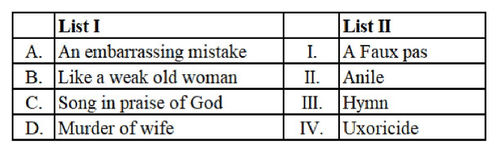
View Solution
Step 1: Understanding the terms in List I.
- (A) "An embarrassing mistake" is best matched with I. A Faux pas, which means a social blunder.
- (B) "Like a weak old woman" is best matched with II. Anile, which refers to something characteristic of old age.
- (C) "Song in praise of God" is best matched with III. Hymn, which is a religious song.
- (D) "Murder of wife" is best matched with IV. Uxoricide, which refers to the killing of one's wife.
Step 2: Matching the terms.
- (A) matches with (I), as both refer to an embarrassing or awkward social mistake.
- (B) matches with (II), as anile refers to characteristics associated with old age.
- (C) matches with (III), as a hymn is a song praising God.
- (D) matches with (IV), as uxoricide is the term for the killing of one's wife.
Step 3: Conclusion.
The correct answer is (A) A-I, B-II, C-III, D-IV.
Quick Tip: When matching words with their meanings, ensure that the meaning aligns with the definition and context provided.
Arrange the following in the correct order.
View Solution
Step 1: Understanding the sequence.
- (A) "The founder of this tradition was a thirteenth-century poet, Jayadeva, who wrote in Sanskrit." This establishes the origin of the tradition.
- (B) "Later poets like Vidyapati in Maithili, Narsi in Gujarati, and Chandidas in Bengali, followed Jayadeva's Gita Govinda as the model for their songs." This explains the spread of the tradition.
- (C) "At present, a huge repository of song poems dedicated to Sri Krishna in the same tradition is available to contemporary Krishna devotees." This gives the current relevance of the tradition.
- (D) "Mirabai inherited a long, rich tradition of song-poems dedicated to Sri Krishna." This shows the continuity of the tradition through Mirabai.
Step 2: Ordering the statements logically.
- (C) comes first as it gives the current context.
- (D) comes next, as Mirabai is an important figure continuing the tradition.
- (A) follows as it introduces Jayadeva, the founder of the tradition.
- (B) ends the sequence by explaining how the tradition was continued by later poets.
Step 3: Conclusion.
The correct answer is (C) D, A, B, C.
Quick Tip: When arranging statements, start with the current context, then move back to the origin, and finally describe how the tradition continued.
Given below are two statements: one is labelled as Assertion (A) and the other is labelled as Reason (R):
Assertion (A): The following sentence is an example of a simple sentence:
"Without saying a word, Ashraf ran away from home, in great haste."
Reason (R): A simple sentence is a sentence which contains a main clause and one or more subordinate clauses, dependent on the main clause.
View Solution
Step 1: Understanding Assertion (A).
The sentence "Without saying a word, Ashraf ran away from home, in great haste" is indeed a simple sentence. It contains one independent clause, which is "Ashraf ran away from home in great haste." The phrase "Without saying a word" is a participle phrase modifying the subject, making the entire sentence grammatically simple.
Step 2: Understanding Reason (R).
Reason (R) defines a simple sentence incorrectly. A simple sentence consists of just one independent clause. The explanation in (R) about having one or more subordinate clauses is incorrect, as this describes a complex sentence, not a simple one.
Step 3: Conclusion.
- (A) is true because the sentence is indeed a simple sentence.
- (R) is false because it inaccurately defines a simple sentence. Therefore, the correct answer is (C) (A) is true but (R) is false.
Quick Tip: A simple sentence contains one independent clause. If it contains more than one clause, it's a complex sentence.
Read the following sentences and choose the ones which are grammatically correct.
A. The book you want is out of print.
B. He was wounded in the leg.
C. I walk to the store and I bought milk.
D. We enjoys horror movies.
View Solution
Step 1: Analyzing each sentence.
(A) "The book you want is out of print" is grammatically correct. "is" is the correct verb to match the singular subject "book".
(B) "He was wounded in the leg" is grammatically correct. This is a correct passive construction.
(C) "I walk to the store and I bought milk" is incorrect because the tenses are inconsistent. "Walk" is in the present tense, but "bought" is in the past tense. It should be either "I walk to the store and buy milk" or "I walked to the store and bought milk."
(D) "We enjoys horror movies" is incorrect. The verb should be "enjoy" to agree with the plural subject "we."
Step 2: Conclusion.
The grammatically correct sentences are (A) and (B). Thus, the correct answer is (A) A and B only.
Quick Tip: Always check for subject-verb agreement and consistency in tense when evaluating sentence correctness.
Choose the alternative which best expresses the opposite meaning of the underlined phrase in the following sentence.
At his wits end, he turned to his old trade.
View Solution
Step 1: Understanding the phrase.
"At his wit's end" means being in a state of confusion or desperation, not knowing what to do. The opposite of being at one's wit's end is knowing what to do or being in control of the situation.
Step 2: Analyzing the options.
(A) "Knowing what to do" is the opposite of "At his wits end", as it implies being in control and having clarity.
(B) "Not knowing what to do" is the same as "At his wits end," as both suggest confusion or uncertainty.
(C) "Being overjoyed" is unrelated to the meaning of the phrase.
(D) "Confidently" could be related but doesn't directly contradict the meaning of being at one's wit's end.
Step 3: Conclusion.
The opposite meaning of "At his wits end" is best expressed by (A) Knowing what to do.
Quick Tip: When looking for the opposite of an idiomatic expression, think about what the phrase conveys in terms of emotional or mental state, and look for an option that represents the opposite feeling or state.
Match List I with List II:
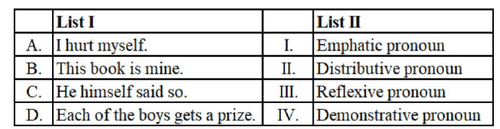
Choose the correct answer from the options given below:
View Solution
Step 1: Identifying the pronouns.
- (A) "I hurt myself." Here, the pronoun "myself" is used as a reflexive pronoun because it refers back to the subject (I). So, A matches with (III) Reflexive pronoun.
- (B) "This book is mine." "Mine" is a possessive pronoun that shows possession, which is a type of demonstrative pronoun. So, B matches with (IV) Demonstrative pronoun.
- (C) "He himself said so." The word "himself" is used for emphasis, making it an emphatic pronoun. So, C matches with (I) Emphatic pronoun.
- (D) "Each of the boys gets a prize." "Each" is a distributive pronoun that refers to the individual members of the group. So, D matches with (II) Distributive pronoun.
Step 2: Conclusion.
The correct answer is (C) A-III, B-IV, C-I, D-II.
Quick Tip: Reflexive pronouns refer back to the subject, emphatic pronouns are used for emphasis, distributive pronouns refer to individuals in a group, and demonstrative pronouns point to specific things.
Given below are two statements:
Statement I: An adjective is said to be used attributively when it qualifies a noun directly.
Statement II: An adjective is said to be used predicatively when it qualifies a noun or pronoun indirectly.
In light of the above statements, choose the most appropriate answer from the options given below:
View Solution
Step 1: Understanding attributive and predicative adjectives.
- An adjective is said to be used attributively when it directly modifies a noun, as in "The red car" (where "red" is modifying the noun "car"). This matches Statement I.
- An adjective is said to be used predicatively when it modifies the subject of a sentence indirectly, typically after a linking verb, as in "The car is red" (where "red" is modifying the noun "car" through the verb "is"). This matches Statement II.
Step 2: Conclusion.
Both statements are correct, so the correct answer is (A) Both Statement I and Statement II are true.
Quick Tip: Attributive adjectives come before the noun they modify, while predicative adjectives follow a linking verb.
Rearrange the following components to get a meaningful sentence. A Sita and Ram \[ B. the tragic events in Ayodhya, \quad C. blissfully unaware of \quad D. walk through \quad E. the forest with great gaiety \]
View Solution
To arrange the components in a meaningful sentence, let’s first analyze the components:
- C (blissfully unaware of): This would logically follow after "Sita and Ram," as it provides the context for what they are unaware of.
- B (the tragic events in Ayodhya,): This would describe what Sita and Ram were unaware of.
- A (Sita and Ram): The subject of the sentence.
- D (walk through): This is the main action performed by the subjects, Sita and Ram.
- E (the forest with great gaiety): This completes the sentence, indicating where they were walking and how.
The final sentence reads:
"Sita and Ram, blissfully unaware of the tragic events in Ayodhya, walk through the forest with great gaiety."
Thus, the correct arrangement is (A) C, B, A, D, E.
Quick Tip: When rearranging components to form a sentence, identify the subject, verb, and object, and ensure the logical flow of information.
Read the following sentences and choose the ones belonging to the domain of complex sentences.
A. That Shankar is clever is certain.
B. I do not know whether the principal is in the office.
C. Rennie is not only kind but also devoted.
D. Can you tell me the reason why Mukti never smiles?
Choose the correct answer from the options given below:
View Solution
Step 1: Analyzing complex sentences.
A complex sentence is a sentence that contains one independent clause and at least one dependent clause. Let’s examine each option:
- A (That Shankar is clever is certain.): This is a simple sentence with a noun clause, but it does not meet the requirements of a complex sentence.
- B (I do not know whether the principal is in the office.): This is a complex sentence because it contains an independent clause ("I do not know") and a dependent clause ("whether the principal is in the office").
- C (Rennie is not only kind but also devoted.): This is a compound sentence, not a complex sentence, as it connects two independent clauses with the conjunction "but also."
- D (Can you tell me the reason why Mukti never smiles?): This is a complex sentence because it contains an independent clause ("Can you tell me") and a dependent clause ("why Mukti never smiles").
Step 2: Conclusion.
The correct answer is (D) B and D only, as both B and D are complex sentences.
Quick Tip: To identify a complex sentence, look for a dependent clause that cannot stand alone, usually connected to an independent clause with a subordinating conjunction (e.g., "whether," "why," "although").
The speaker in the given excerpt is a __________ speaker.
View Solution
Step 1: Analyzing the excerpt.
In the given excerpt, the speaker uses words such as "I have not planned anything," "I trust in Jagdamba," and "I will not lose my faith in her," which all indicate that the speaker is talking about themselves. These expressions point to a speaker who is using the first person.
Step 2: Conclusion.
The correct answer is (A) First person, as the speaker refers to themselves using "I."
Quick Tip: In literature, the first-person speaker uses pronouns like "I" or "we" to refer to themselves.
Which of the following is incorrect on the basis of the given excerpt.
View Solution
Step 1: Analyzing the given excerpt.
In the excerpt, the speaker expresses faith in Jagdamba, stating, "I will not lose my faith in her in these troubled times." This shows that the speaker's faith has not wavered; rather, they are reaffirming their trust in Jagdamba.
Step 2: Evaluating the options.
(A) The speaker seems to be a warrior: This is correct. The speaker is trying to observe the enemy's movements and is involved in some sort of conflict, suggesting that they may be a warrior.
(B) He is quite religious: This is correct. The speaker places trust in Jagdamba, a divine figure, which implies they are religious.
(C) He has not been able to know about his enemy's plans: This is correct. The speaker mentions trying to observe the enemy's movements but being unable to understand their actions, which suggests they do not know the enemy's plans.
(D) He is so upset that his faith has wavered now: This is incorrect. The speaker clearly states that they will not lose their faith in Jagdamba, meaning their faith has not wavered.
Step 3: Conclusion.
The correct answer is (D) He is so upset that his faith has wavered now, as it contradicts the excerpt where the speaker affirms their unwavering faith.
Quick Tip: When analyzing comprehension questions, pay close attention to the specific details mentioned in the excerpt. In this case, the speaker's faith is unwavering, not wavered.
Which of the following statements are correct?
View Solution
Step 1: Statement Analysis.
- (A) The Finance Commission is indeed a constitutional body, as per Article 280 of the Constitution of India.
- (B) The First Finance Commission was constituted under the chairmanship of K.C. Niyogi. This is factually correct.
- (C) The 15th Finance Commission for the period 2020-25 was constituted with N.K. Singh as the chairman, which is correct.
- (D) The R. Chelliah Committee was constituted in 1994, but it was not for suggesting reforms in the banking system; it was to suggest tax reforms. Thus, statement (D) is incorrect.
Step 2: Conclusion.
The correct answer is (C) A, B & C only because (D) is not correct.
Quick Tip: Finance Commissions are established every five years to make recommendations on the distribution of financial resources between the central government and the states.
Which of the following statements are correct?
View Solution
Step 1: Statement Analysis.
- (A) The Earth is tilted at an angle of 23.5°, not 22°. Hence, (A) is false.
- (B) The Earth takes 23 hours, 56 minutes, and 4.091 seconds to complete one rotation. This is approximately true, so statement (B) is correct.
- (C) The Earth takes 365 days, 5 hours, and 48 minutes to revolve around the sun, which is also true. Thus, (C) is correct.
- (D) The Earth is often referred to as the "Blue Planet" because of the abundance of water, making statement (D) correct.
Step 2: Conclusion.
The correct answer is (B) B, C and D only, since statement (A) is incorrect.
Quick Tip: The Earth’s tilt causes the change in seasons, and the term “Blue Planet” refers to the planet’s large amount of surface water.
The Imperial I and II, one of the tallest buildings in India, are located at:
View Solution
Step 1: Identifying the location.
The Imperial I and II are twin skyscrapers in Mumbai, making it the correct answer. The buildings are part of a luxurious residential complex located in the heart of Mumbai.
Step 2: Conclusion.
The correct answer is (C) Mumbai, as the Imperial I and II are located in Mumbai.
Quick Tip: When identifying iconic landmarks, knowing the city or region is essential. Major metropolitan areas like Mumbai often have notable skyscrapers and modern architecture.
'The Citizenship Act' was amended by the 'Citizenship (Amendment Bill)' and was passed by the parliament on:
View Solution
Step 1: Analyzing the event.
The Citizenship (Amendment) Bill was passed by the Indian Parliament on December 11, 2019. This was a significant amendment to the Citizenship Act of 1955, which sought to fast-track the citizenship process for non-Muslim minorities from Pakistan, Bangladesh, and Afghanistan.
Step 2: Conclusion.
The correct answer is (B) December 11, 2019, as the bill was passed on this date.
Quick Tip: The Citizenship (Amendment) Bill sparked significant debate in India. It is important to track major legislative changes and their dates for political and historical reference.
The Crown Representative's Police, is the old name of
View Solution
Step 1: Identifying the old name of the police force.
The Crown Representative's Police was the name of the force before it was renamed to CRPF (Central Reserve Police Force) after India's independence. The CRPF is one of India's largest paramilitary forces and is responsible for maintaining law and order in various regions.
Step 2: Conclusion.
The correct answer is (B) CRPF.
Quick Tip: The CRPF was initially known as the Crown Representative's Police before independence.
'Pulitzer Prize' is awarded in the field of:
View Solution
Step 1: Understanding the Pulitzer Prize.
The Pulitzer Prize is an esteemed award presented for excellence in journalism, literature, and musical composition. However, it is most commonly associated with outstanding achievements in journalism.
Step 2: Conclusion.
The correct answer is (B) Journalism, as the Pulitzer Prize is awarded primarily in the field of journalism.
Quick Tip: The Pulitzer Prize, though also awarded for literature and music, is most famous for its recognition in journalism.
Match List I with List II:
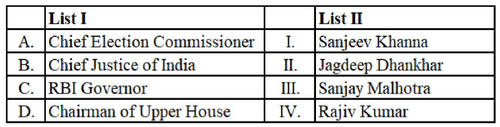
View Solution
From the list of positions and names, we match them as follows:
- A (Chief Election Commissioner): The current Chief Election Commissioner of India is Rajiv Kumar. Hence, \( A \) matches with \( IV \).
- B (Chief Justice of India): The current Chief Justice of India is Jagdeep Dhankhar. Hence, \( B \) matches with \( II \).
- C (RBI Governor): The current RBI Governor is Sanjay Malhotra. Hence, \( C \) matches with \( III \).
- D (Chairman of Upper House): The Chairman of the Upper House (Rajya Sabha) is Sanjeev Khanna. Hence, \( D \) matches with \( I \).
Thus, the correct matching is (C) A-IV, B-I, C-III, D-II.
Quick Tip: In matching questions, ensure you know the current positions and the corresponding individuals to make the correct connections.
Which of the following statements are correct?
A. Speedy increase in the field of milk production is called white revolution.
B. To increase the pace of white revolution, the operation flood was started.
C. The father of operation flood was Dr. Verghese Kurien.
D. The operation flood was started by National Dairy Research Institute in 1975.
Choose the correct answer from the options given below:
View Solution
- A (Speedy increase in the field of milk production is called white revolution.): This statement is true. White revolution refers to the rapid increase in milk production, especially in India.
- B (To increase the pace of white revolution, the operation flood was started.): This statement is true. The Operation Flood program was initiated to enhance milk production and improve dairy farming in India.
- C (The father of operation flood was Dr. Verghese Kurien.): This statement is true. Dr. Verghese Kurien is regarded as the father of the Operation Flood program and played a key role in revolutionizing India's dairy industry.
- D (The operation flood was started by National Dairy Research Institute in 1975.): This statement is false. The National Dairy Development Board (NDDB), not the National Dairy Research Institute, initiated the Operation Flood program in 1970, not 1975.
Step 2: Conclusion.
The correct answer is (C) A, B \& C only, as statements A, B, and C are true, while D is incorrect.
Quick Tip: When dealing with historical programs or events, verify the year and key figures associated with it to ensure accuracy in your answers.
Match List I with List II
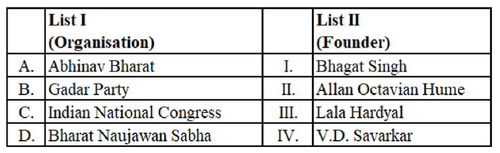
Choose the correct answer from the options given below:
View Solution
Step 1: Matching the organisations with their founders.
- Abhinav Bharat was founded by V.D. Savarkar, so A matches with IV.
- Gadar Party was founded by Lala Hardyal, so B matches with III.
- Indian National Congress was founded by Allan Octavian Hume, so C matches with II.
- Bharat Naujawan Sabha was founded by Bhagat Singh, so D matches with I.
Step 2: Conclusion.
The correct match is (C) A-IV, B-III, C-II, D-I.
Quick Tip: When matching organisations with their founders, make sure to recall the historical context of their formation.
Given below are two statements: one is labelled as Assertion (A) and the other is labelled as Reason (R):
Assertion (A): There is a coalition government in the State of Maharashtra in India.
Reason (R): No single party could secure majority in the house in recent elections of the Maharashtra State.
% Choose the correct answer from the options given below:
View Solution
Step 1: Evaluating Assertion (A).
The assertion states that there is a coalition government in the State of Maharashtra in India, which is true. In the recent elections, no single party secured a majority, leading to a coalition government.
Step 2: Evaluating Reason (R).
The reason provided, that no single party could secure a majority in the house in the recent elections of Maharashtra, is also true. This is a valid explanation for the formation of a coalition government.
Step 3: Conclusion.
Since both the assertion and reason are true, and the reason correctly explains the assertion, the correct answer is (A) Both (A) and (R) are true and (R) is the correct explanation of (A).
Quick Tip: In assertion-reasoning questions, ensure that both statements are factually correct and that the reason logically supports the assertion.
Which of the following statements are correct?
View Solution
Step 1: Statement Analysis.
- (A) Vishwabharati was indeed founded by Rabindranath Tagore in 1921. Hence, this statement is true.
- (B) Auroville Ashram was founded by Aurobindo Ghosh, which is true.
- (C) The Golden Temple, a holy Sikh Gurdwara, was founded by Guru Nanak, not Guru Gobind Singh, so this statement is false.
- (D) Khalsa Panth was founded by Guru Gobind Singh, not Guru Arjan Dev. This makes statement (D) false.
Step 2: Conclusion.
The correct answer is (A) A and B only, as statements (C) and (D) are incorrect.
Quick Tip: Vishwabharati, Auroville, and the Golden Temple are landmarks tied to key figures in Indian history: Tagore, Aurobindo, and Guru Nanak.
Which of the following statements are correct?
View Solution
Step 1: Statement Analysis.
- (A) Bharatanatyam is indeed the famous classical dance form of Tamil Nadu, so this statement is true.
- (B) Rukmini Devi was a renowned artist and promoter of Bharatanatyam, so this statement is also true.
- (C) Kathakali is a famous dance form of Kerala, not Andhra Pradesh, which makes this statement false.
- (D) Birju Maharaj is associated with Kathak, not Kathakali. Hence, this statement is false.
- (E) Mohiniyattam is a dance form from Kerala that symbolizes love and devotion to God, which is true.
Step 2: Conclusion.
The correct answer is (C) A, B, E only, as statements (C) and (D) are incorrect.
Quick Tip: Bharatanatyam and Kathakali are two distinct classical dance forms, each originating from different states in India.
Match List I with List II:
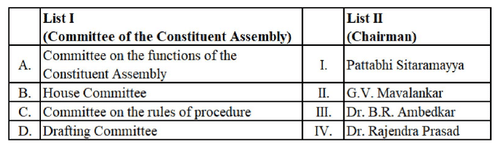
Choose the correct answer from the options given below:
View Solution
Step 1: Analyzing each committee.
- The Committee on the functions of the Constituent Assembly was chaired by Dr. Rajendra Prasad, so A matches with II.
- The House Committee was chaired by Pattabhi Sitaramayya, so B matches with I.
- The Committee on the rules of procedure was chaired by Dr. B.R. Ambedkar, so C matches with IV.
- The Drafting Committee was chaired by G.V. Mavalankar, so D matches with III.
Step 2: Conclusion.
The correct matching is A-II, B-I, C-IV, D-III, so the correct answer is (D).
Quick Tip: When matching historical committees with their respective chairmen, recall key figures like Dr. Rajendra Prasad and Dr. B.R. Ambedkar, who played significant roles in the Constituent Assembly.
The famous speech "I have a dream" is associated with:
View Solution
Step 1: Understanding the historical context.
The phrase "I have a dream" is one of the most iconic lines from the famous speech given by Martin Luther King Jr. during the March on Washington for Jobs and Freedom on August 28, 1963. This speech is widely regarded as a defining moment in the American Civil Rights Movement.
Step 2: Conclusion.
The correct answer is (D) Martin Luther King Jr., as he is the person associated with the famous "I have a dream" speech.
Quick Tip: When referencing famous speeches, the "I have a dream" speech is directly tied to Martin Luther King Jr. and his contributions to the civil rights movement.
Which of the following pairs of banks and their headquarters are correctly matched?
A. Canara Bank - Mumbai
B. Federal Bank - Kochi
C. IndusInd Bank - Mumbai
D. Punjab and Sind Bank - Chandigarh
E. Punjab National Bank - New Delhi
Choose the correct answer from the options given below:
View Solution
Step 1: Checking the headquarters of the banks.
- Canara Bank - The headquarters is in Bangalore, not Mumbai, so option A is incorrect.
- Federal Bank - The headquarters is in Kochi, which is correct.
- IndusInd Bank - The headquarters is in Mumbai, which is correct.
- Punjab and Sind Bank - The headquarters is in New Delhi, not Chandigarh, so option D is incorrect.
- Punjab National Bank - The headquarters is in New Delhi, which is correct.
Step 2: Conclusion.
The correct answer is (B) B, C and E only, as these pairs are correctly matched.
Quick Tip: Always verify the location of a bank's headquarters, as it is a commonly tested piece of information in competitive exams.
Who was the founder of Bhudan movement?
View Solution
Step 1: Understanding the Bhudan Movement.
The Bhudan movement was initiated by Vinoba Bhave in 1951. This movement aimed to encourage the donation of land by wealthy landowners to the landless farmers to reduce inequality.
Step 2: Conclusion.
The founder of the Bhudan movement is Vinoba Bhave, so the correct answer is (B) Vinoba Bhave.
Quick Tip: Vinoba Bhave, known as the "spiritual successor of Mahatma Gandhi," started the Bhudan movement to promote land reform in India.
Match List I with List II:
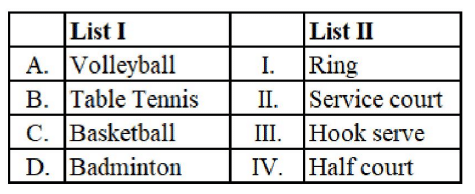
Choose the correct answer from the options given below:
View Solution
Let’s match the sports with the appropriate terms from List II:
- A (Volleyball): In volleyball, the term "hook serve" refers to the way the ball is served in the game. Hence, A matches with III.
- B (Table Tennis): Table tennis uses a "service court" where the ball is served. Hence, B matches with IV.
- C (Basketball): In basketball, "ring" refers to the hoop through which the ball is thrown. Hence, C matches with I.
- D (Badminton): In badminton, the court is divided into "half court" sections. Hence, D matches with II.
Thus, the correct matching is (D) A-III, B-IV, C-I, D-II.
Quick Tip: When matching sports terms, remember the specific terminology related to each sport's gameplay and court setup.
The first Chief Election Commissioner of India was:
View Solution
The first Chief Election Commissioner of India was Sukumar Sen. He served as the head of the Election Commission of India and oversaw the first general elections in independent India in 1951-1952.
Step 2: Conclusion.
The correct answer is (B) Sukumar Sen.
Quick Tip: The first Chief Election Commissioner, Sukumar Sen, played a pivotal role in establishing the framework for free and fair elections in India.
Match List I with List II:
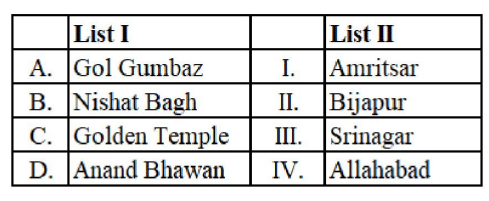
Choose the correct answer from the options given below:
View Solution
Step 1: Matching the locations with their respective places.
- Gol Gumbaz is located in Bijapur, so A matches with II.
- Nishat Bagh is located in Srinagar, so B matches with III.
- Golden Temple is located in Amritsar, so C matches with I.
- Anand Bhawan is located in Allahabad, so D matches with IV.
Step 2: Conclusion.
The correct match is (C) A-II, B-III, C-I, D-IV.
Quick Tip: When matching places or locations to their respective sites, remember the key historical or geographical information about each place.
The first post office of India was opened in:
View Solution
Step 1: Historical background of India's first post office.
The first post office of India was opened in Kolkata in the year 1774, which was established by the British East India Company. Kolkata was the capital of India during the British rule, making it the focal point for the first postal services.
Step 2: Conclusion.
The correct answer is (D) Kolkata, as the first post office in India was indeed opened there.
Quick Tip: When recalling historical facts, focus on the major cities or capitals that served as important centers during colonial or early modern periods.
Match List I with List II :
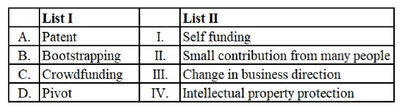
Choose the correct answer from the options given below:
View Solution
Step 1: Matching List I with List II.
- (A) Patent refers to intellectual property protection, so A matches with IV.
- (B) Bootstrapping is when a company funds itself, so B matches with III (Small contribution from many people).
- (C) Crowdfunding involves receiving small contributions from many people, so C matches with II.
- (D) Pivot refers to changing the direction of business, so D matches with I.
Step 2: Conclusion.
The correct answer is (C) A-IV, B-III, C-II, D-I.
Quick Tip: Understanding terms related to startups and entrepreneurship can help in matching their correct definitions and activities.
Read the following statements and respond to the question that follows:
View Solution
Step 1: Statement Analysis.
- (A) Primary goal of a startup pitch is indeed to secure funding or support from investors, so this statement is true.
- (B) Innovation and adaptability best describe an entrepreneurial mindset, so this statement is true.
- (C) A non-profit organization is not necessarily an example of a startup; startups are typically for-profit entities, so this statement is false.
- (D) Neeti Aayog was indeed earlier known as the Planning Commission, so this statement is true.
- (E) Dr. Manmohan Singh was never the Governor of RBI, but he was the Prime Minister of India, so this statement is false.
Step 2: Conclusion.
The correct answer is (C) A, B, D and E are correct statements based on the analysis above.
Quick Tip: Understanding the role of startups and their funding processes is crucial when responding to questions about entrepreneurship.
Which term refers to the initial phase of a startup when it starts to develop its product?
View Solution
Step 1: Understanding startup phases.
The initial phase of a startup involves developing the product idea, doing market research, and creating a business model. This phase is known as Ideation.
Step 2: Understanding other terms.
- Pivoting refers to a strategy where a startup changes its direction in response to market feedback.
- Scaling refers to expanding the business once the product has gained traction in the market.
- Bootstrapping is when a startup funds itself without external investment, typically during early stages.
Step 3: Conclusion.
The correct answer is (A) Ideation, as it refers to the early stages of product development.
Quick Tip: The ideation phase is crucial for laying the foundation of a successful startup. It involves brainstorming, research, and creating the first version of the product.
Which one of the following is not a correct statement?
View Solution
Step 1: Analyzing each statement.
- (A) Dr. Manmohan Singh was indeed the finance minister from 1991 to 1996 and played a key role in economic reforms. This statement is correct.
- (B) Dr. Manmohan Singh was the Governor of the Reserve Bank of India from 1982 to 1985. This statement is correct.
- (C) Dr. Manmohan Singh was also the UGC Chairman in the early 1990s. This statement is correct.
- (D) Dr. Manmohan Singh was never elected to the Lok Sabha before becoming the Prime Minister. He was appointed as the Prime Minister by the President of India in 2004, despite being a Rajya Sabha member. Thus, this statement is incorrect.
Step 2: Conclusion.
The correct answer is (D) as Dr. Manmohan Singh was not elected to the Lok Sabha before becoming Prime Minister. He was a member of the Rajya Sabha, not the Lok Sabha.
Quick Tip: When evaluating historical facts, ensure to cross-check important political facts like membership in the Lok Sabha or Rajya Sabha before drawing conclusions.
Which of the following is/are one of the various 'Forms' of feasibility analysis:
A. Industry/Market analysis
B. Corporate leadership analysis
C. Organisational feasibility analysis
D. Financial feasibility analysis
E. Product/Service feasibility analysis
Choose the correct answer from the options given below:
View Solution
Step 1: Understanding the types of feasibility analysis.
- A. Industry/Market analysis: This is a valid form of feasibility analysis. It evaluates the potential market for a product or service.
- B. Corporate leadership analysis: This is not typically considered a form of feasibility analysis in the standard categories of business feasibility.
- C. Organisational feasibility analysis: This is valid. It looks at the capability of the organization to manage and execute the project.
- D. Financial feasibility analysis: This is also a valid form of feasibility analysis, focusing on the financial viability of the project.
- E. Product/Service feasibility analysis: This is a valid form, assessing the potential success and practicality of the product or service.
Step 2: Conclusion.
The correct answer is (A) A, C, D and E only, as these are the forms of feasibility analysis.
Quick Tip: Feasibility analysis evaluates the practicality of a project and is typically divided into market, organizational, financial, and product/service aspects.
Given below are two statements: one is labelled as Assertion (A) and the other is labelled as Reason (R):
Assertion (A): The venture capital investment assists in nurturing innovative entrepreneurship in India.
Reason (R): The venture capital investment is a risk financing generally available in the form of equity or quasi-equity like convertible loan instruments for supporting startups.
In light of the above statements, choose the most appropriate answer from the options given below:
View Solution
Step 1: Understanding Assertion (A).
Venture capital investment plays a crucial role in nurturing entrepreneurship by providing financial support to innovative startups in India, which is true.
Step 2: Understanding Reason (R).
Reason (R) is true because venture capital is indeed a form of risk financing, often provided in the form of equity or quasi-equity to support startups.
Step 3: Evaluating the relationship between (A) and (R).
While both Assertion (A) and Reason (R) are true, Reason (R) does not fully explain Assertion (A), as (A) focuses on nurturing innovation, whereas (R) focuses on the financial mechanisms of venture capital.
Step 4: Conclusion.
The correct answer is (B) Both (A) and (R) are true but (R) is not the correct explanation of (A).
Quick Tip: Venture capital helps drive innovation by providing crucial funding to startups, but it is not always the sole factor in nurturing entrepreneurship.
Given below are two statements: one is labelled as Assertion (A) and the other is labelled as Reason (R):
Assertion (A):
Other than 'Mind Mapping', 'Reverse thinking', 'Brainstorming', and 'Brainwriting' technology has made our work easier to generate quality ideas for innovation and entrepreneurship.
Reason (R):
"Ideas are the building blocks for all innovation. They are what we work on, so the first step of starting with anything new is finding that idea. We must make use of the different tools and techniques available to us to come up with quality ideas."
In the light of the above statements, choose the most appropriate answer from the options given below:
View Solution
Step 1: Analyzing Assertion (A).
Assertion (A) talks about the various tools and technologies like 'Mind Mapping', 'Reverse thinking', 'Brainstorming', and 'Brainwriting', which help in generating quality ideas for innovation and entrepreneurship. This statement is true as these technologies are indeed used for creativity and idea generation.
Step 2: Analyzing Reason (R).
Reason (R) states that "ideas are the building blocks of all innovation" and emphasizes the importance of using various techniques to generate quality ideas. This is true as the generation of ideas is central to the innovation process, and tools like brainstorming and mind mapping help facilitate this.
Step 3: Conclusion.
Since both Assertion (A) and Reason (R) are true, and Reason (R) logically supports Assertion (A), the correct answer is (A) Both (A) and (R) are true and (R) is the correct explanation of (A).
Quick Tip: In such reasoning and assertion-based questions, ensure that the reason provides a clear explanation of the assertion. If it does, it confirms the assertion.
Given below are two statements:
Statement I:
Incremental innovation is concerned with the gradual improvement of existing products, services, processes, competitive positions, and organisational paradigms.
Statement II:
Radical innovation involves a much higher risk than incremental innovation.
In the light of the above statements, choose the most appropriate answer from the options given below:
View Solution
Step 1: Analyzing Statement I.
Statement I is true. Incremental innovation refers to small, continuous improvements made to existing products, services, or processes over time. This is a well-established concept in innovation management.
Step 2: Analyzing Statement II.
Statement II is also true. Radical innovation, which involves creating entirely new products or services or significantly altering the way things are done, typically carries a much higher level of risk than incremental innovation. This is because the outcomes are more uncertain, and there is often more resistance to change.
Step 3: Conclusion.
Both statements are correct, so the correct answer is (A) Both Statement I and Statement II are correct.
Quick Tip: When distinguishing between incremental and radical innovation, remember that incremental focuses on gradual improvements, while radical involves significant, disruptive changes that often involve more risk.
Given below are two statements:
Statement I: A business incubator typically takes an equity stake in the startups it supports.
Statement II: A business incubator provides early-stage companies with office space, mentorship, and resources in general to support them.
In the light of the above statements, choose the correct answer from the options given below:
View Solution
Step 1: Analyzing Statement I.
A business incubator typically does take an equity stake in the startups it supports. This is because incubators often provide funding in exchange for equity to help early-stage companies grow and succeed.
Step 2: Analyzing Statement II.
Statement II is also true. Business incubators provide office space, mentorship, resources, and other forms of support to help early-stage companies grow. They play a vital role in helping startups succeed, especially in their formative stages.
Step 3: Conclusion.
Both statements are true, so the correct answer is (A) Both Statement I and Statement II are true.
Quick Tip: In incubator setups, they typically offer equity stakes to early-stage startups in exchange for support in the form of resources, mentorship, and office space.
Match List I with List II:
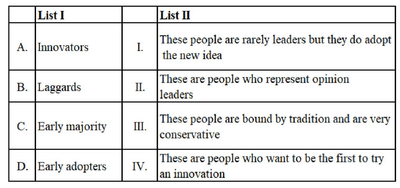
Choose the correct answer from the options given below:
View Solution
Step 1: Understanding the characteristics of each group.
- Innovators are the first people to adopt a new idea or innovation and are willing to take risks. Hence, A matches with IV.
- Laggards are very conservative and bound by tradition, often the last to adopt new ideas. Therefore, B matches with III.
- Early Majority adopts new ideas after the innovators, but they need to see that others have adopted it. They are opinion leaders but not the first to act. Hence, C matches with II.
- Early Adopters are willing to try an innovation and are often leaders within their communities, acting as role models for others. Hence, D matches with I.
Step 2: Conclusion.
The correct match is (C) A-IV, B-III, C-II, D-I.
Quick Tip: In the diffusion of innovation theory, innovators are the first to adopt, followed by early adopters, early majority, late majority, and laggards.
Given below are two statements: one is labelled as Assertion (A) and the other is labelled as Reason (R):
Assertion (A):
'Scaling a business' means expanding the business to serve more customers.
Reason (R):
A small, specialized segment of the market is known as a niche market.
View Solution
Step 1: Assertion (A).
Scaling a business indeed refers to expanding the business to serve more customers. This statement is true.
Step 2: Reason (R).
Reason (R) correctly explains what a niche market is, i.e., a specialized segment of the market. However, this does not explain why scaling a business serves more customers, as niche markets are smaller and not directly related to the scale of business.
Step 3: Conclusion.
Both statements are true, but (R) does not directly explain (A), so the correct answer is (B) Both (A) and (R) are true but (R) is not the correct explanation of (A).
Quick Tip: While scaling a business refers to growth in customer reach, a niche market is about catering to a smaller, specific market.
Which of the following is the primary purpose of a 'pitch deck'?
View Solution
Step 1: Pitch Deck Overview.
A pitch deck is a visual presentation used by entrepreneurs to present their business idea to potential investors. It typically includes a summary of the business, its products, the market opportunity, and the financial projections.
Step 2: Explanation of Options.
- (A) Designing a product is not the purpose of a pitch deck.
- (B) A pitch deck is specifically used to present the business idea to investors. This is the correct purpose.
- (C) Recruiting employees is not the primary function of a pitch deck.
- (D) Managing daily operations is unrelated to the role of a pitch deck.
Step 3: Conclusion.
The correct answer is (B) To present the business idea to potential investors.
Quick Tip: Pitch decks are crucial tools for attracting investors and securing funding for a startup.
Read the following statements carefully and respond to the question that follows.
A. In the given situation a manufacturing plant may be an example of a business incubator.
B. Fixed monthly income is the advantage of entrepreneurship.
C. A shared workspace offering resources and support to new startups is known as a business incubator.
D. Only youngsters may become entrepreneurs.
E. Only experienced middle-aged persons may start a business.
Choose the correct answer from the options given below:
View Solution
Step 1: Analyzing the statements.
- A. A manufacturing plant may serve as an example of a business incubator, which helps new businesses grow by providing services, space, and resources. This statement is true.
- B. Fixed monthly income is generally not considered the advantage of entrepreneurship. Entrepreneurs often face irregular income. This statement is false.
- C. A shared workspace offering resources and support to startups is indeed known as a business incubator. This statement is true.
- D. Entrepreneurs can be of any age, and there is no age restriction for becoming one. This statement is false.
- E. Starting a business does not require one to be an experienced middle-aged person. Young entrepreneurs can also start businesses. This statement is false.
Step 2: Conclusion.
The correct answer is (D) as statements B, D, and E are false.
Quick Tip: Entrepreneurship can be pursued by individuals at any age, and business incubators play a key role in supporting early-stage startups.
Given below are two statements:
Statement I: "Innovation defined as the creation or the adoption of new ideas, products, services, programs, technology, policy, structure or new administrative system is acknowledged as a source of sustained competitive advantage of many organizations."
Statement II: The innovation adoption process does not depend upon 'Initiation stage' that includes recognition of a need, knowledge acquisition, initial attitude formation, and innovation selection.
In light of the above statements, choose the correct answer from the options given below:
View Solution
Step 1: Analyzing Statement I.
Statement I is true as innovation is widely recognized as a key factor for gaining and maintaining a competitive advantage. It involves the adoption or creation of new ideas, technologies, and practices that improve organizational performance.
Step 2: Analyzing Statement II.
Statement II is false. The innovation adoption process typically includes the initiation stage, where an organization recognizes the need for innovation, acquires knowledge, and selects the innovation. This is an essential stage in the adoption process.
Step 3: Conclusion.
The correct answer is (C) as Statement I is true, but Statement II is false.
Quick Tip: The innovation adoption process involves several stages, including initiation, recognition of a need, and selection of the innovation.
Which four of the following are entrepreneurial strategies?
A. Investing money for safe and secured return
B. "Being fastest with the mostest"
C. Reform, rather than revolutionise
D. Finding and occupying a specialized "ecological niche"
E. Validate and adapt your business model
Choose the correct answer from the options given below:
View Solution
Step 1: Understanding entrepreneurial strategies.
- A. Investing money for safe and secured return is not generally considered an entrepreneurial strategy, as it focuses more on investment rather than entrepreneurship.
- B. "Being fastest with the mostest" is a valid entrepreneurial strategy, emphasizing speed and market dominance.
- C. Reform, rather than revolutionise is a valid entrepreneurial strategy that focuses on gradual improvement rather than radical changes.
- D. Finding and occupying a specialized "ecological niche" is a well-known entrepreneurial strategy that involves focusing on a specific market segment.
- E. Validate and adapt your business model is another critical entrepreneurial strategy for ensuring product-market fit and continuous improvement.
Step 2: Conclusion.
The correct answer is (D) B, C, D and E only, as these options reflect common entrepreneurial strategies.
Quick Tip: Entrepreneurial strategies can vary, but generally focus on differentiation, adaptability, and speed in the market.
Given below are two statements:
Statement I: Pivoting in a startup context refers to changing the business model or strategy in response to market feedback.
Statement II: Pivoting always involves changing the target market essentially.
In light of the above statements, choose the correct answer from the options given below:
View Solution
Step 1: Understanding Statement I.
Pivoting in the context of startups refers to making a significant change to the business model or strategy, often based on market feedback. Statement I is correct.
Step 2: Understanding Statement II.
Pivoting does not always involve changing the target market. In some cases, it could mean altering the product or business model without necessarily changing the target market. Statement II is incorrect.
Step 3: Conclusion.
The correct answer is (C) Statement I is true but Statement II is false.
Quick Tip: Pivoting refers to major changes in a startup's approach, but it does not always require changing the target market.
Match List I with List II:
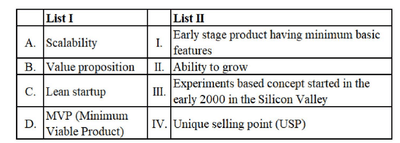
Choose the correct answer from the options given below:
View Solution
Let’s match the terms from List I with the correct descriptions from List II:
- A (Scalability): Scalability refers to the ability of a business or product to grow and handle increased demand. Hence, A matches with II.
- B (Value proposition): The value proposition is a statement that explains the unique selling point (USP) of a product or service. Hence, B matches with IV.
- C (Lean startup): The lean startup methodology is a business model focused on experiments and early market testing, popularized in the early 2000s in Silicon Valley. Hence, C matches with III.
- D (MVP - Minimum Viable Product): An MVP is a product with the minimum features necessary to meet early adopters' needs and validate the product concept. Hence, D matches with I.
Thus, the correct matching is (D) A-I, B-IV, C-III, D-II.
Quick Tip: When matching business terms with their definitions, ensure you understand the core concept of each term and how it is applied in real-world business scenarios.
Concept of venture capitalist may be simplified as
A. Your idea and your money
B. Your idea and my money
C. My idea and your money
D. My idea and your money
E. Your idea and public money
Choose the correct answer from the options given below:
View Solution
A venture capitalist generally provides funds for your business idea in exchange for equity or a share of the company. Therefore, the options that simplify the concept of venture capital are:
- B (Your idea and my money): This represents the typical venture capital relationship where the entrepreneur provides the idea, and the investor provides the money.
- D (My idea and your money): In some cases, venture capitalists may also provide both the idea and the funds, though this is more common in the case of angel investors or corporate investors.
Step 2: Conclusion.
The correct answer is (A) B and D only.
Quick Tip: Venture capital typically involves a partnership where investors provide funds in exchange for ownership or equity in the business.
Given below are two statements: one is labelled as Assertion (A) and the other is labelled as Reason (R):
Assertion (A): Business accelerators are set up with the primary objective to offer mentorship and resources to speed up the growth of startups.
Reason (R): Most of the startups face difficulties and challenges in their growth stage.
In the light of the above statements, choose the most appropriate answer from the options given below:
View Solution
Step 1: Evaluating Assertion (A).
Business accelerators are specifically set up to provide support such as mentorship, resources, and networking opportunities to speed up the growth and development of startups. This is a true statement.
Step 2: Evaluating Reason (R).
Startups often face significant challenges during their growth stage, including funding issues, market competition, and scaling difficulties. This is a valid reason for the existence of business accelerators.
Step 3: Conclusion.
Both statements are true, and Reason (R) explains why business accelerators exist and are crucial for startups in their growth stage. Therefore, the correct answer is (A) Both (A) and (R) are true and (R) is the correct explanation of (A).
Quick Tip: In assertion-reasoning questions, check whether the reason logically supports the assertion and if both are factually correct.
Match List I with List II:
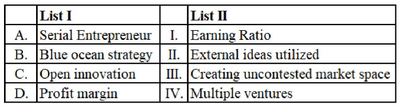
Choose the correct answer from the options given below:
View Solution
Step 1: Understanding the terms.
- Serial Entrepreneur refers to someone who engages in multiple ventures, so A matches with IV.
- Blue ocean strategy is about creating uncontested market space, so B matches with III.
- Open innovation involves utilizing external ideas, so C matches with II.
- Profit margin is a financial measure and typically relates to earning ratio, so D matches with I.
Step 2: Conclusion.
The correct match is (A) A-IV, B-III, C-II, D-I.
Quick Tip: In matching-type questions, focus on the definitions and characteristics of each term to determine the correct pairings.
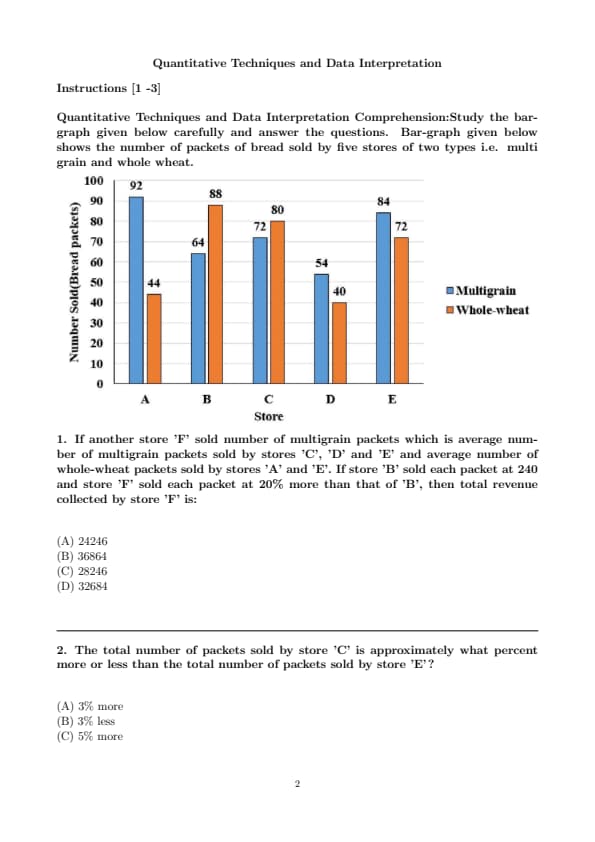
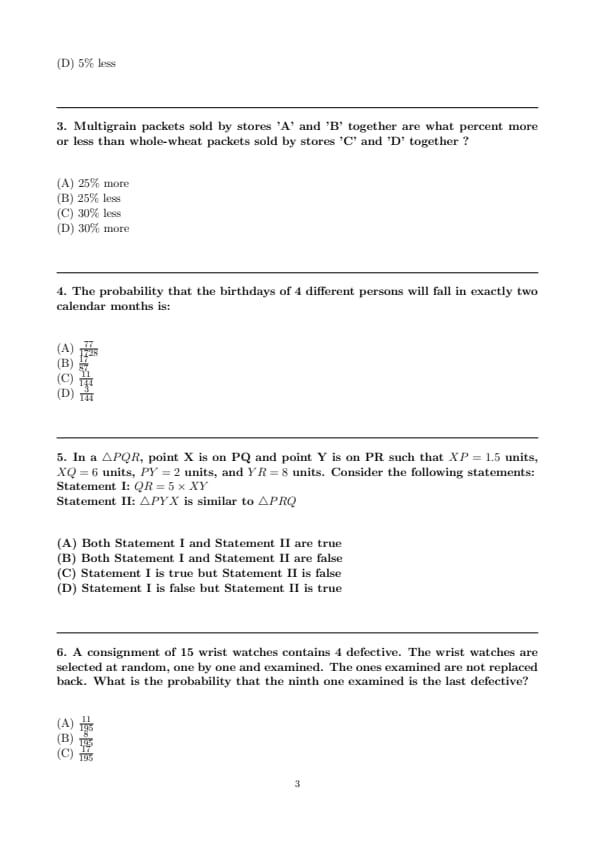
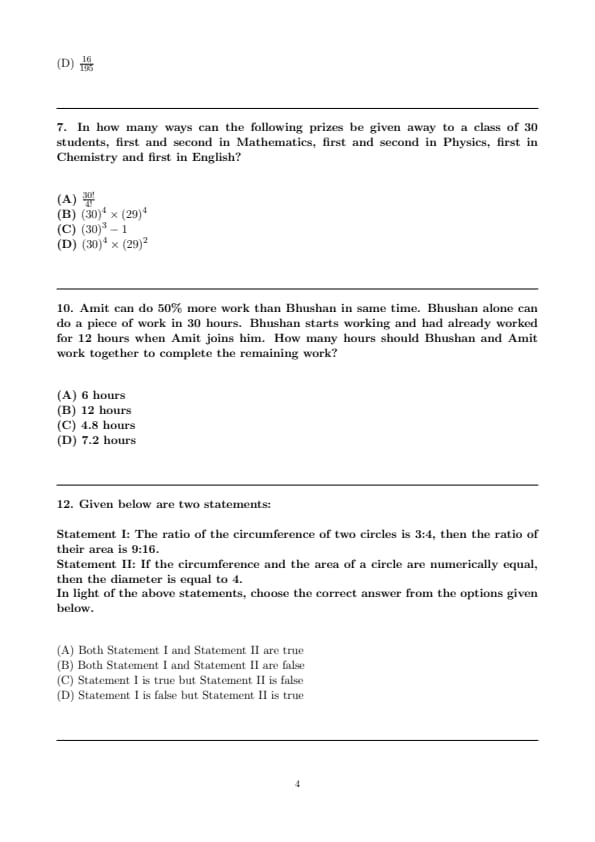
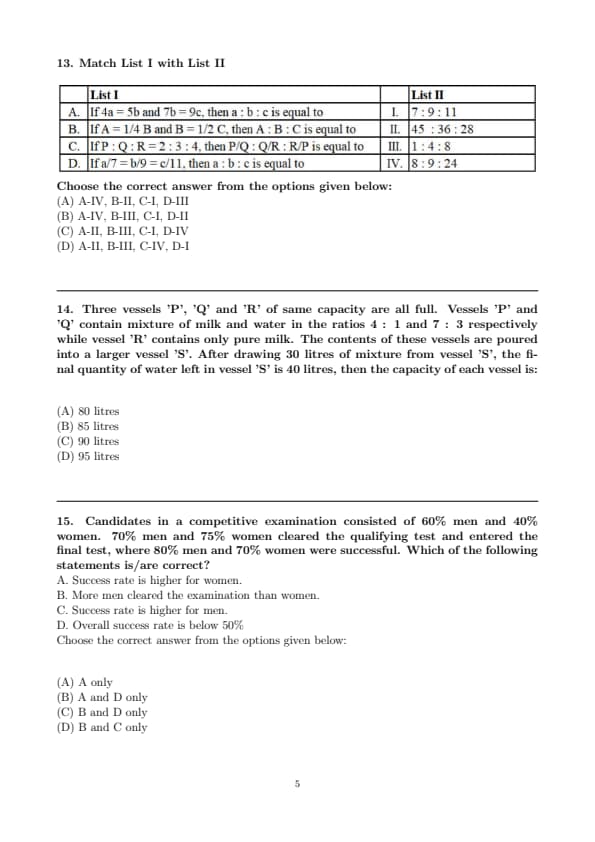
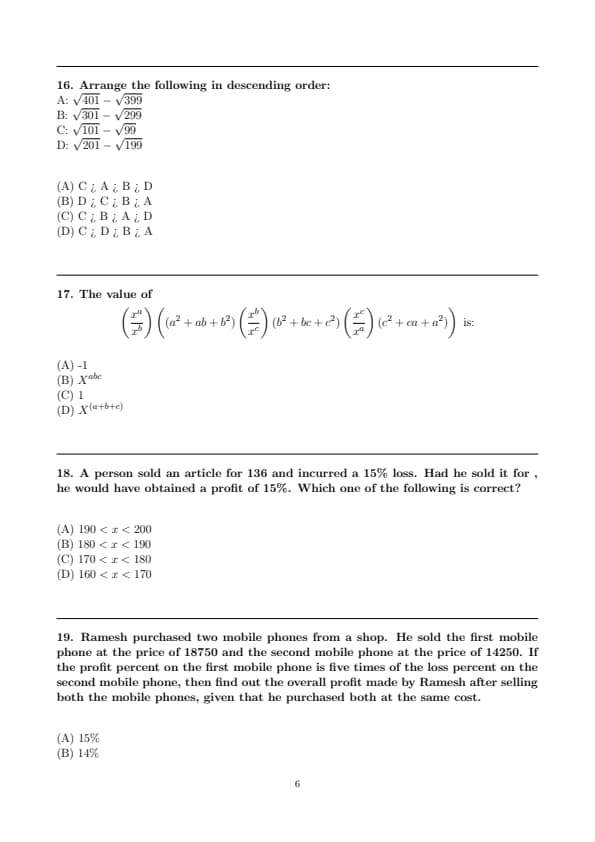
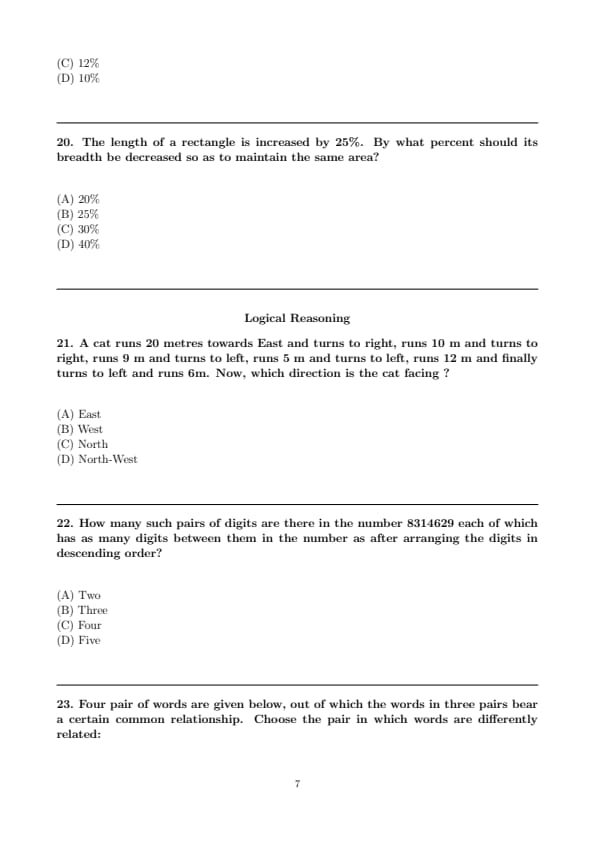
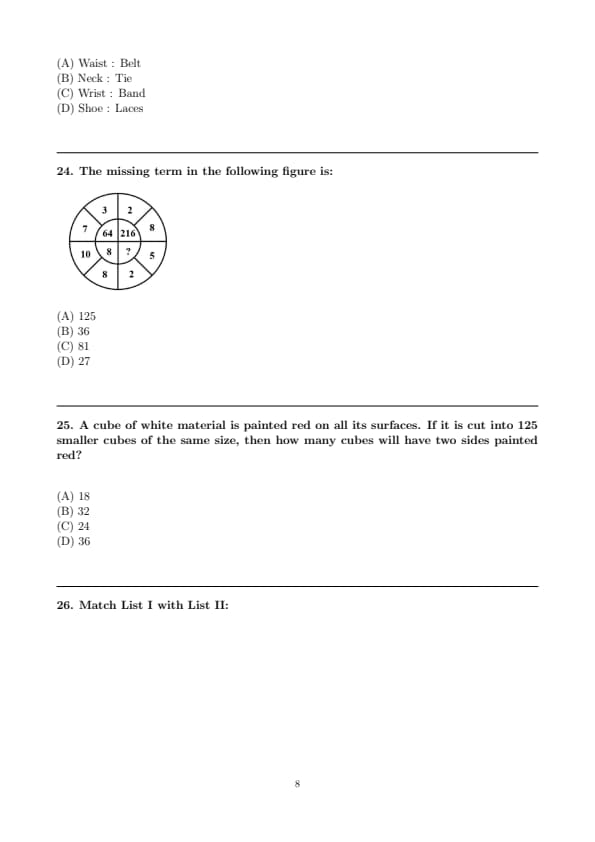
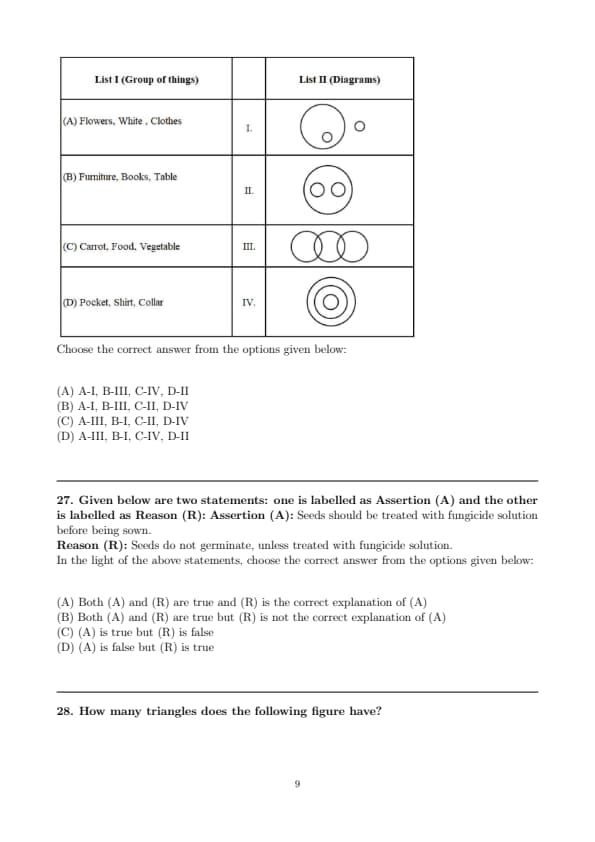
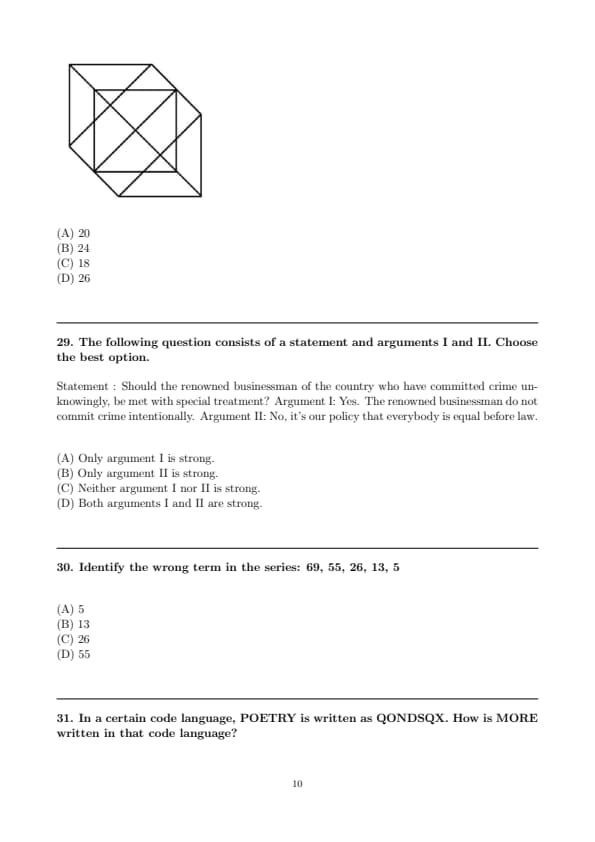
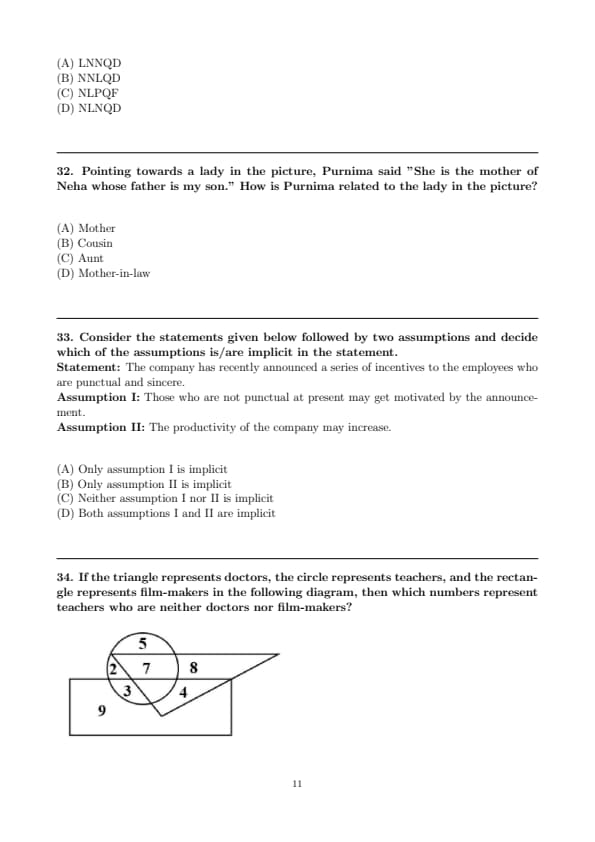
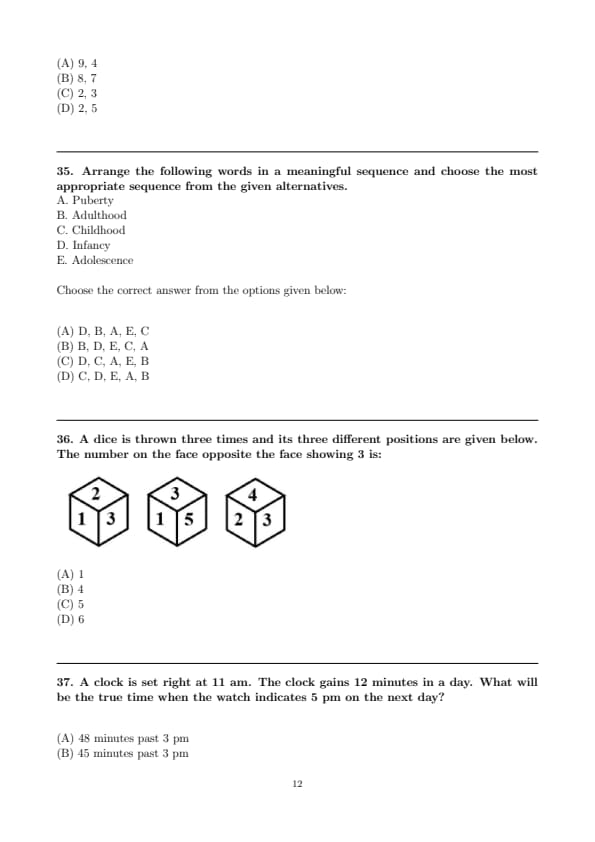
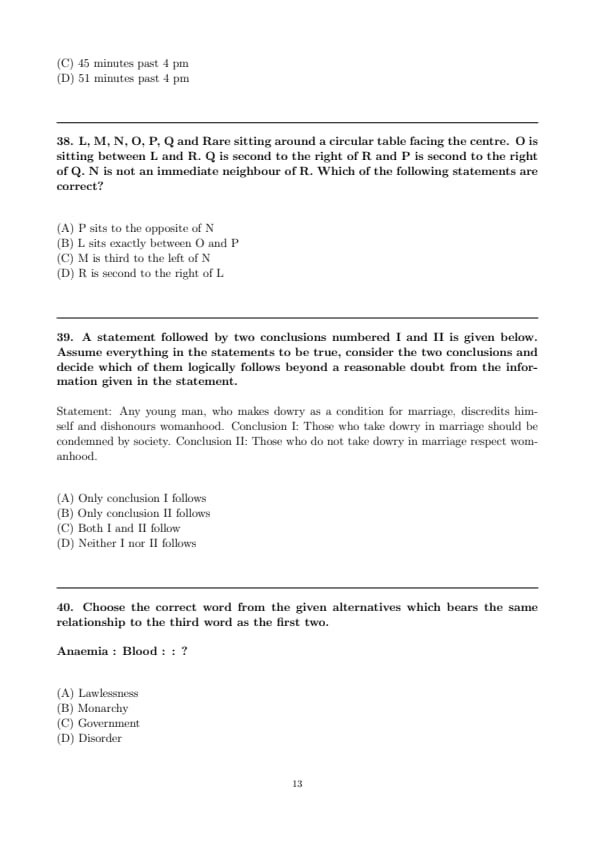
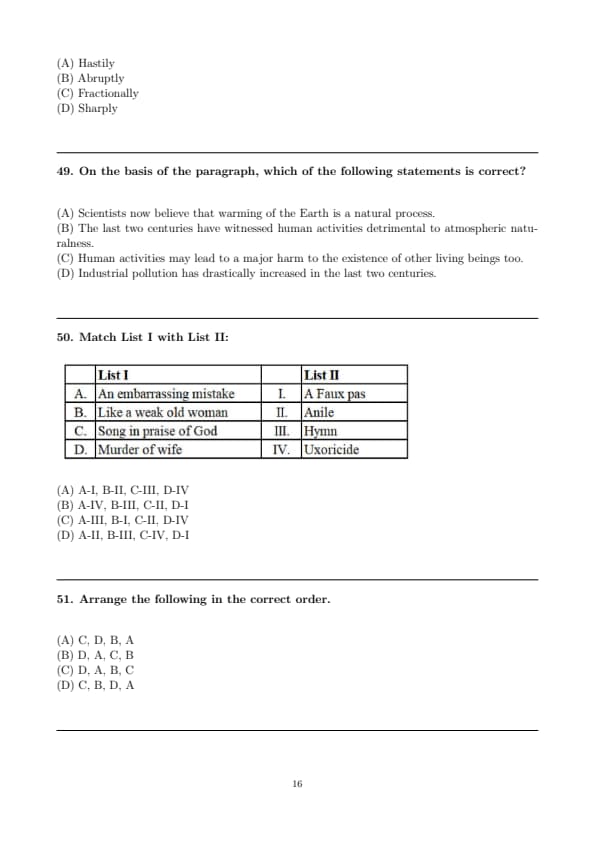
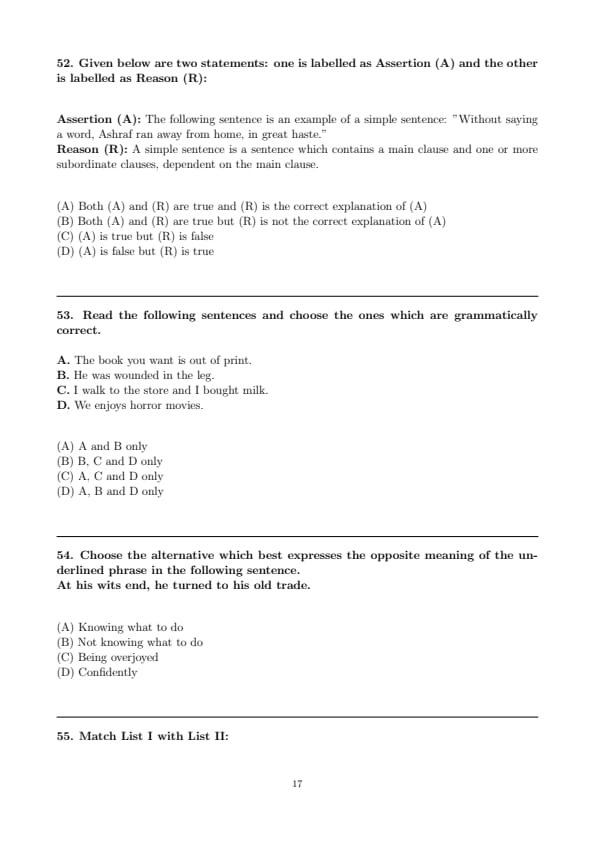
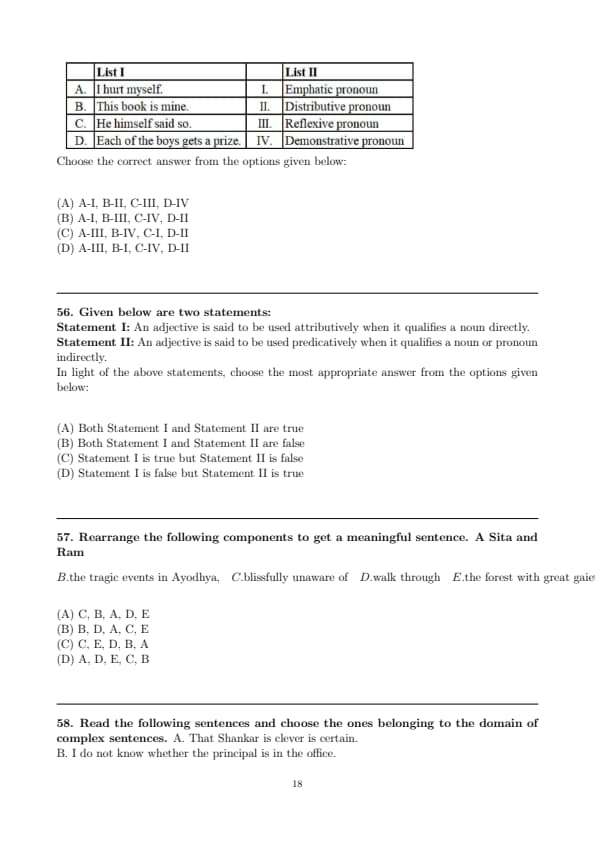
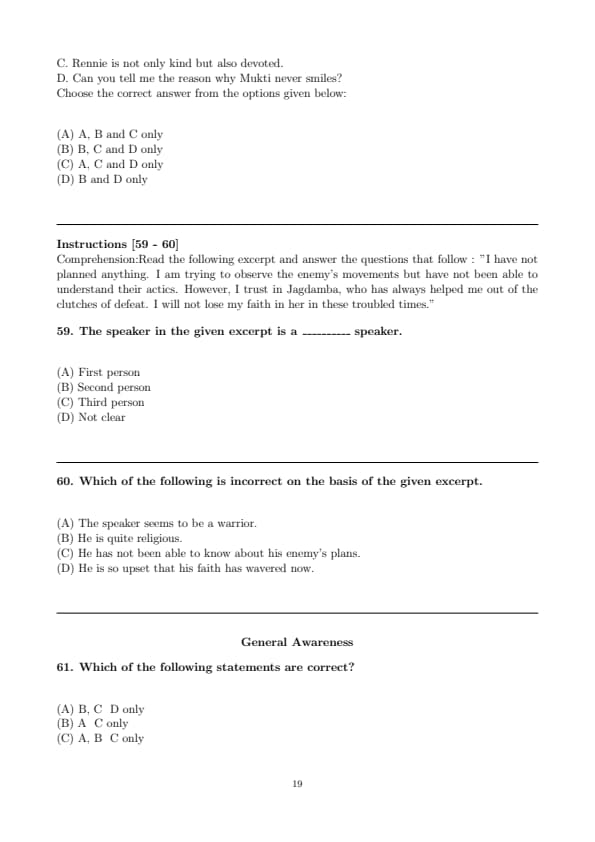
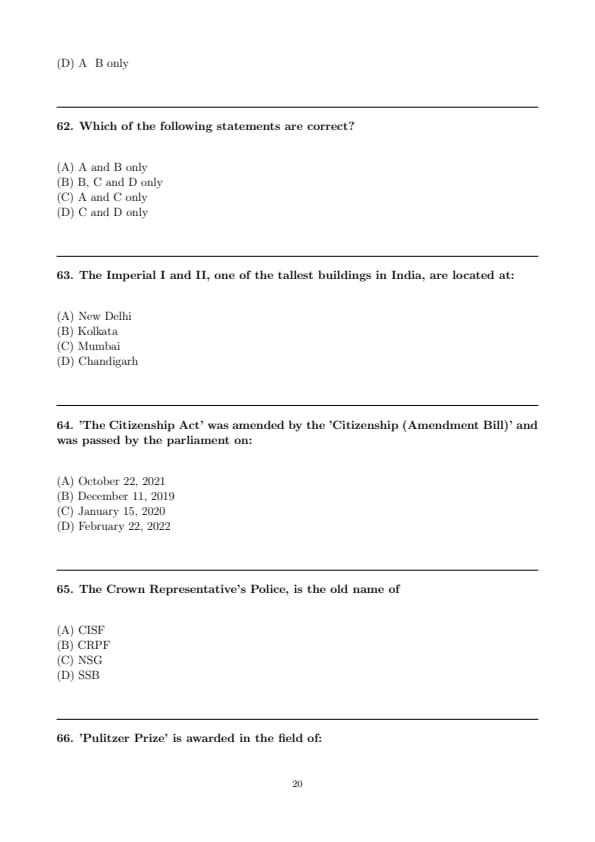
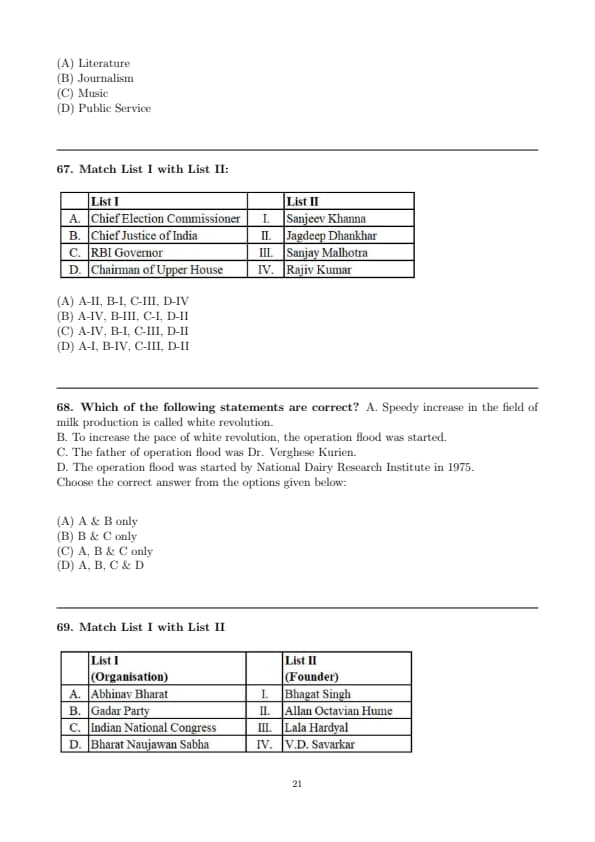
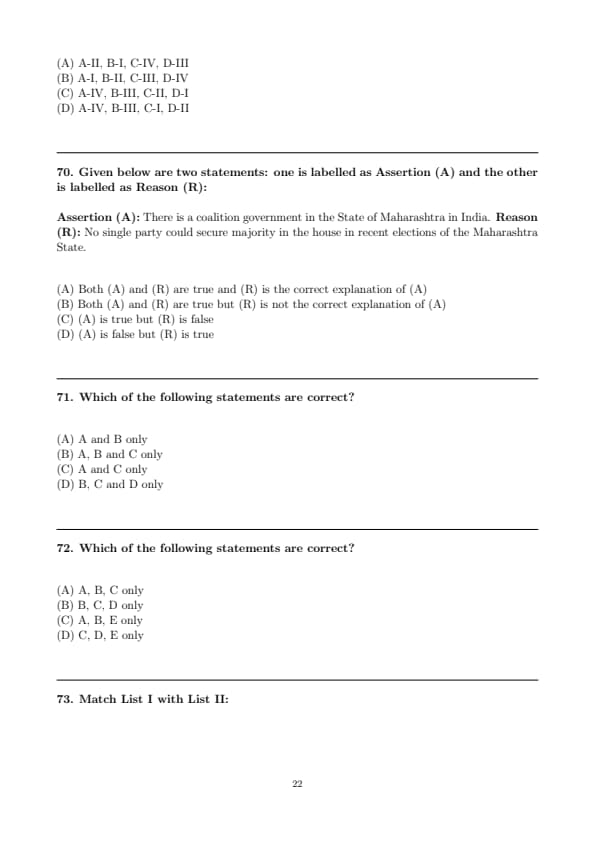
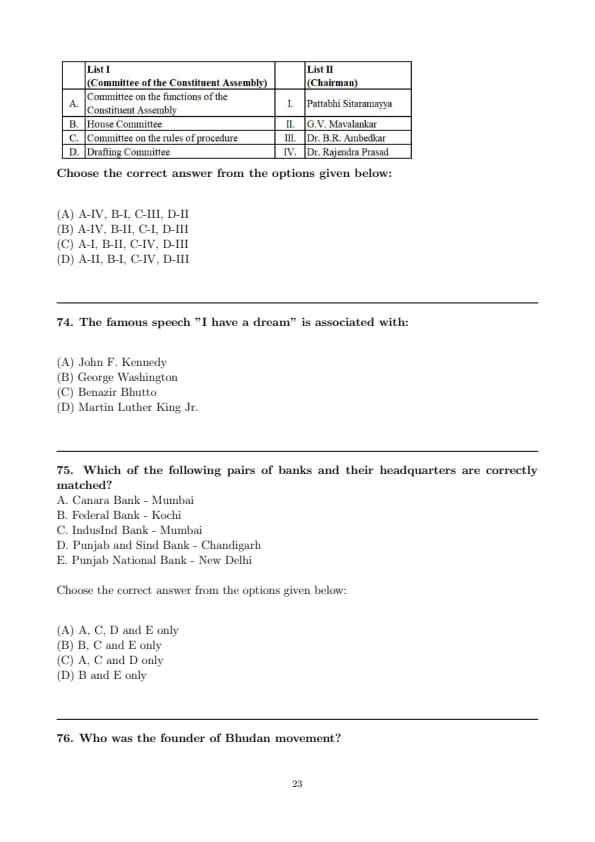
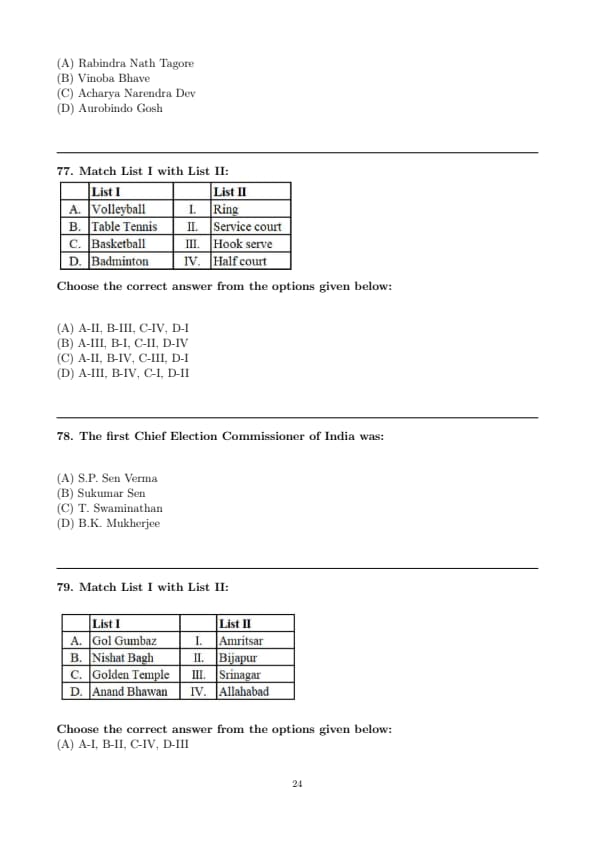
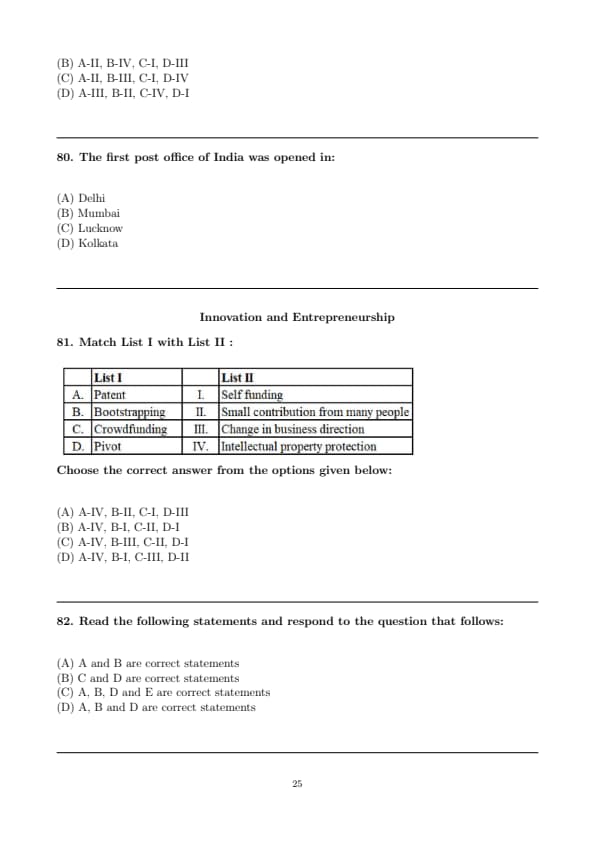
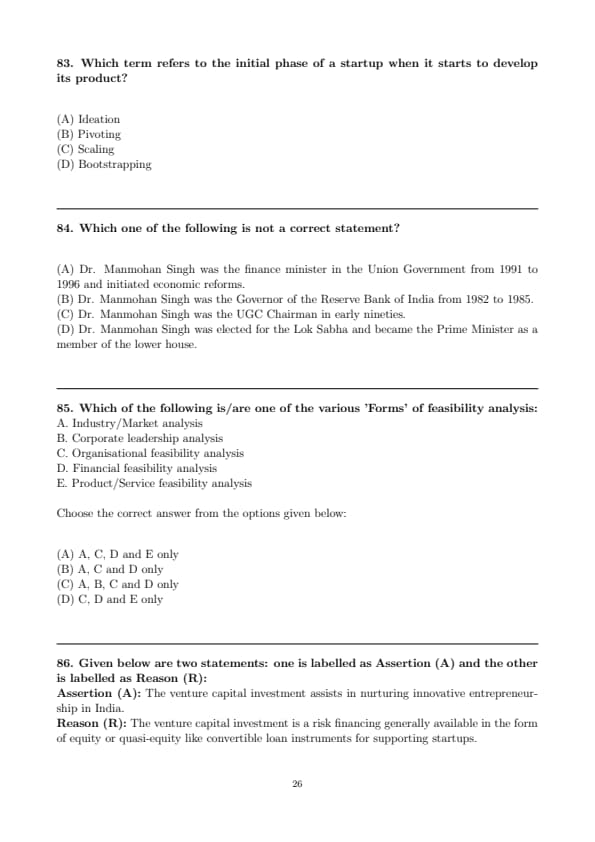
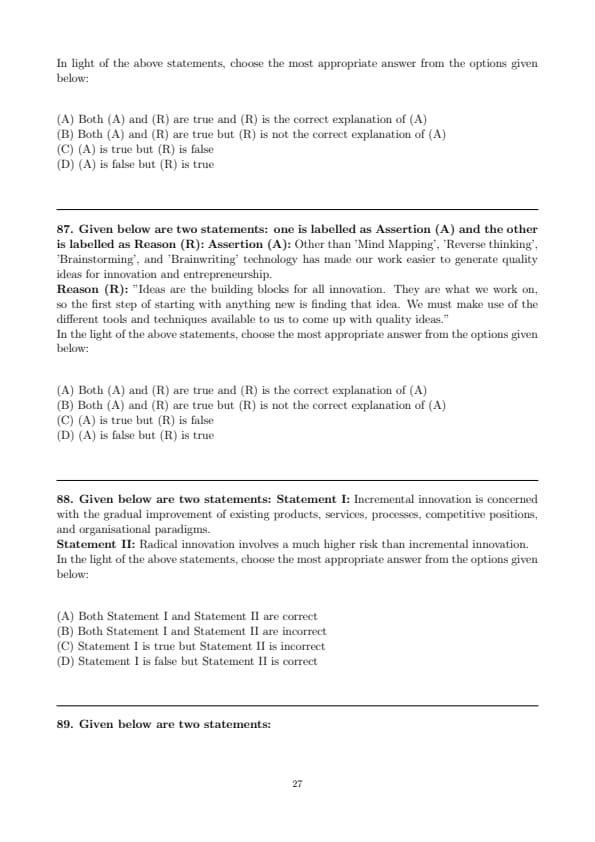
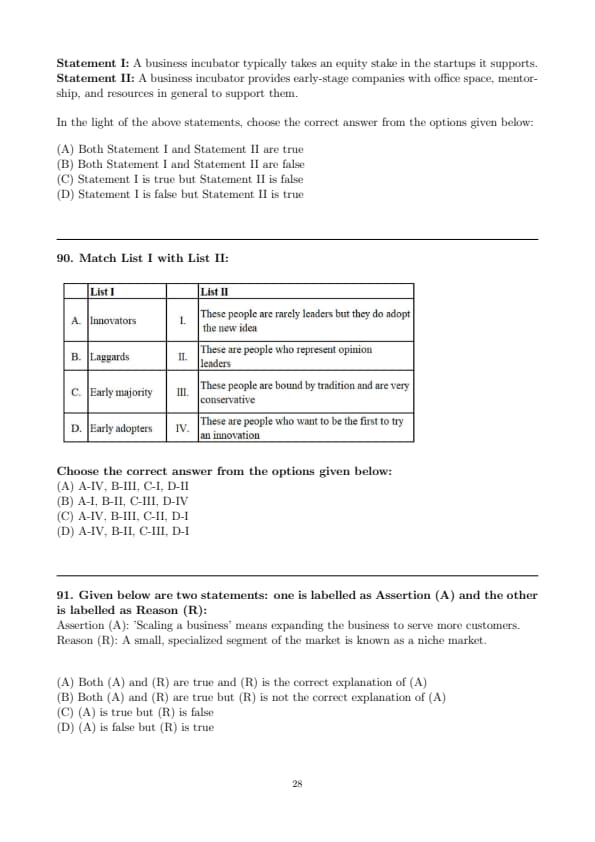
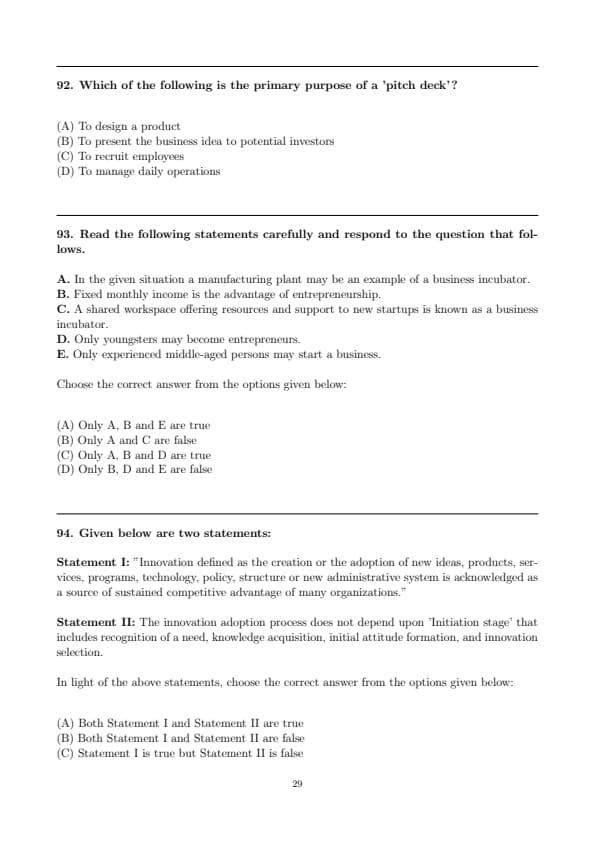
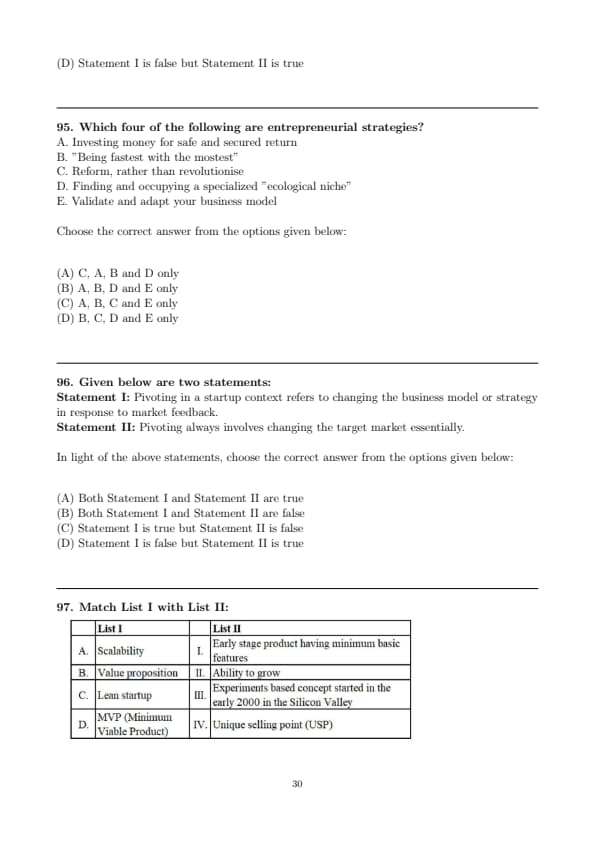
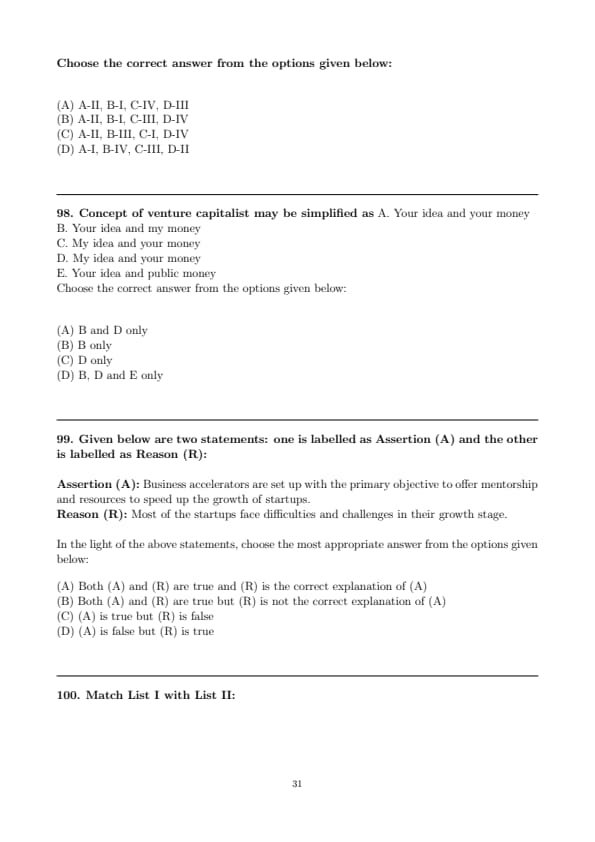






Comments