




TISSNET, was an entrance exam conducted by Tata Institute of Social Sciences (TISS) at the all-India level for admission to its various postgraduate programs. However, from the 2023-24 academic session, TISS has adopted the CUET-PG for Postgraduate programs and CAT scores for a few courses, where the TISSNET exam is no more applicable.
TISSNET (HUQP18 - Political Science, Public Administration, Human Rights, Politics and International Relation) Question Paper With Solution PDF is available here.
TISSNET Political Science Question Paper 2024 PDF Download
| TISSNET Political Science Question Paper 2024 with Answer Key |  Download Download |
Check Solutions |
TISSNET Political Science 2024 Questions with Solutions
Question 1:
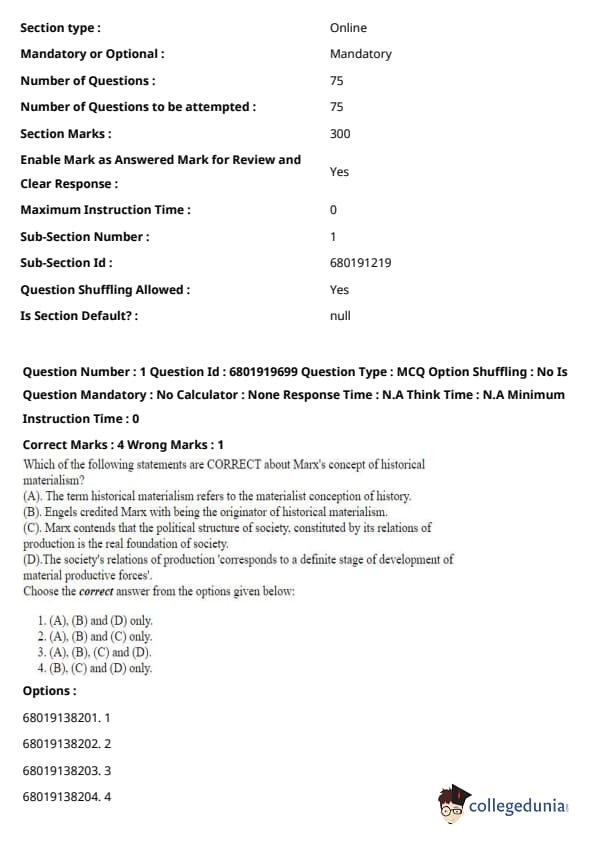
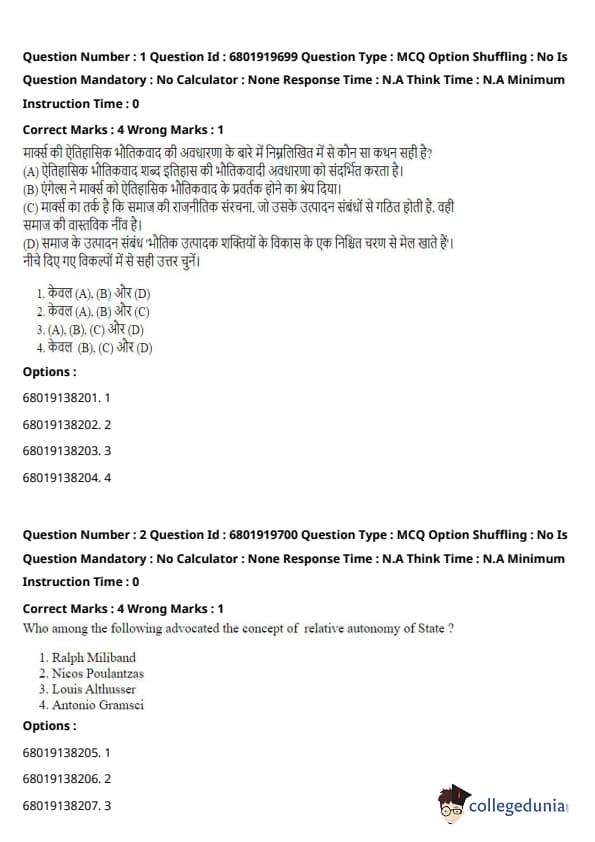
Which of the following statements are CORRECT about Marx's concept of historical materialism?
Choose the correct answer from the options given below:
View Solution
Solution: Marx's concept of historical materialism revolves around the materialist interpretation of history, focusing on how material conditions shape society. Here's the analysis of each statement:
1. Statement (A): Correct. The term historical materialism indeed refers to the materialist conception of history, which emphasizes economic structures and their impact on historical development.
2. Statement (B): Correct. Engels acknowledged Marx as the originator of historical materialism, as Marx developed it into a comprehensive framework for analyzing history and society.
3. Statement (C): Incorrect. While Marx emphasized the importance of relations of production, he argued that the economic base (relations and forces of production) shapes the superstructure (political, legal, and cultural systems), not that the political structure itself is the foundation.
4. Statement (D): Correct. Marx posited that the society's relations of production align with the development stage of material productive forces, demonstrating the dynamic relationship between the economy and society.
Thus, statements (A), (B), and (D) are correct, making option 1 the right choice.
Question 2:
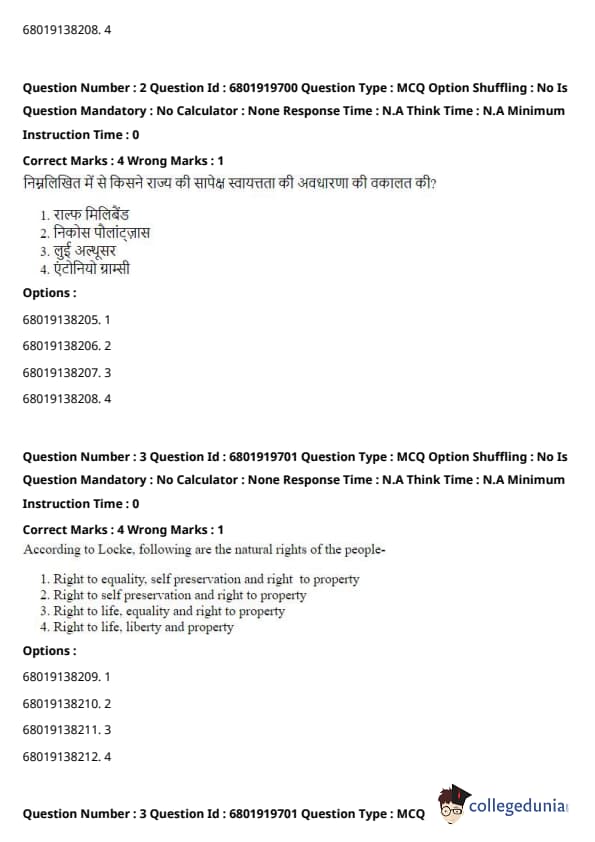
Who among the following advocated the concept of relative autonomy of State?
View Solution
Solution: Nicos Poulantzas, a Marxist political theorist, is known for advocating the concept of the relative autonomy of the state. This concept suggests that the state, while influenced by the economic base, possesses a degree of independence to act in the interests of the ruling class. Poulantzas emphasized that the state mediates conflicts between various fractions of the ruling class and implements policies to stabilize capitalism. His work contributed to neo-Marxist theories on the role of the state in society.
Question 3:
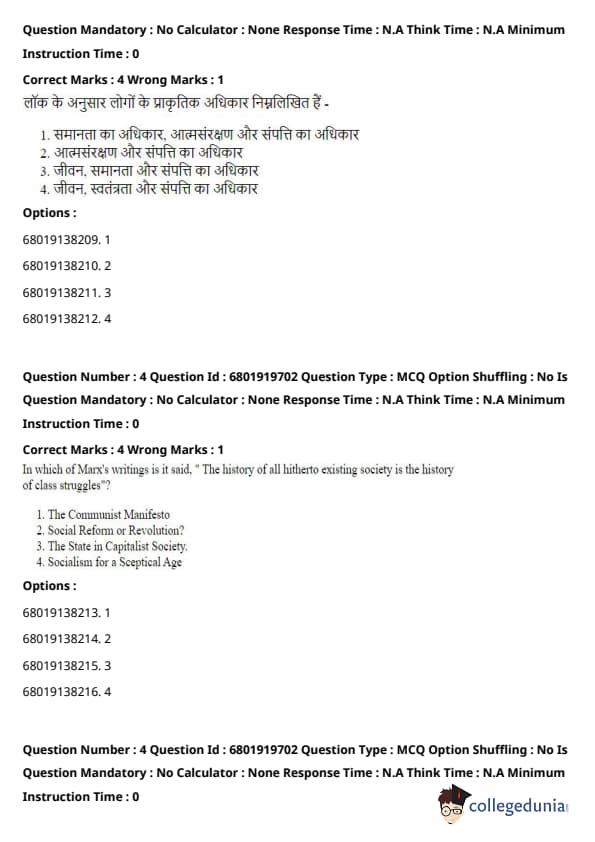
According to Locke, following are the natural rights of the people:
View Solution
Solution: John Locke, a prominent Enlightenment thinker, argued that natural rights are inherent to all individuals. These rights—life, liberty, and property—are fundamental and cannot be surrendered to any authority. Locke emphasized that governments are created to protect these rights, and any government that fails to do so loses its legitimacy. His ideas heavily influenced liberal political philosophy and the formation of constitutional democracies.
Question 4:
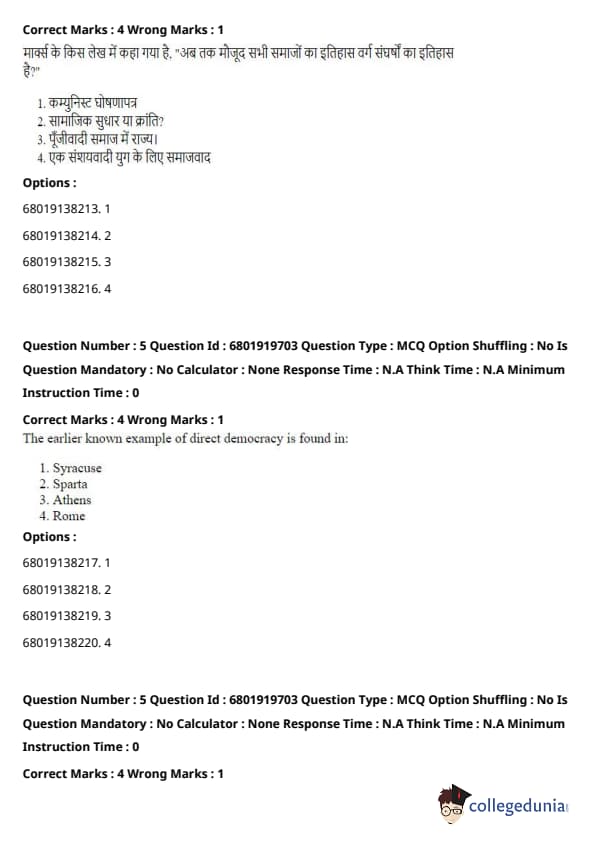
In which of Marx's writings is it said, "The history of all hitherto existing society is the history of class struggles"?
View Solution
Solution: Marx and Engels wrote "The Communist Manifesto” in 1848, highlighting the historical materialist view that societal progress occurs through class struggles. This statement underscores the conflict between oppressors and the oppressed as the driving force of history. The text calls for the proletariat (working class) to rise against the bourgeoisie (capitalist class) to establish a classless, communist society.
Question 5:
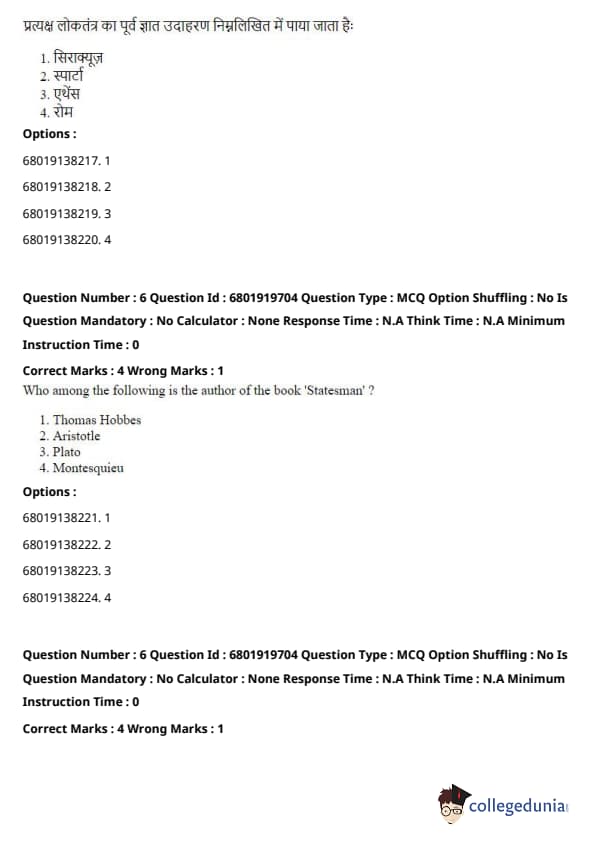
The earlier known example of direct democracy is found in:
View Solution
Solution: Athens is renowned for practicing direct democracy in the 5th century BCE. Citizens participated directly in decision-making by voting on laws and policies in assemblies. This system, though limited to free male citizens, laid the foundation for modern democratic practices. Institutions like the Ecclesia (assembly) and the Dikasteria (jury courts) played crucial roles in Athenian democracy.
Question 6:
Who among the following is the author of the book ‘Statesman’?
View Solution
Solution: Plato, one of the greatest ancient Greek philosophers, authored "Statesman” (also known as "Politikos"). This dialogue explores the nature of statesmanship, governance, and the ideal ruler. Plato distinguishes between true statesmanship and mere political manipulation, emphasizing the importance of wisdom and virtue in leadership.
Question 7:
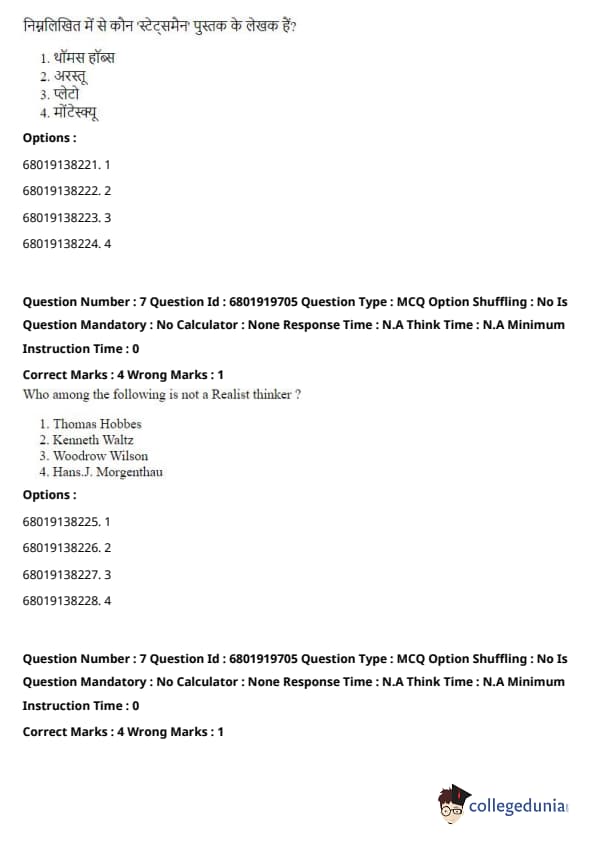
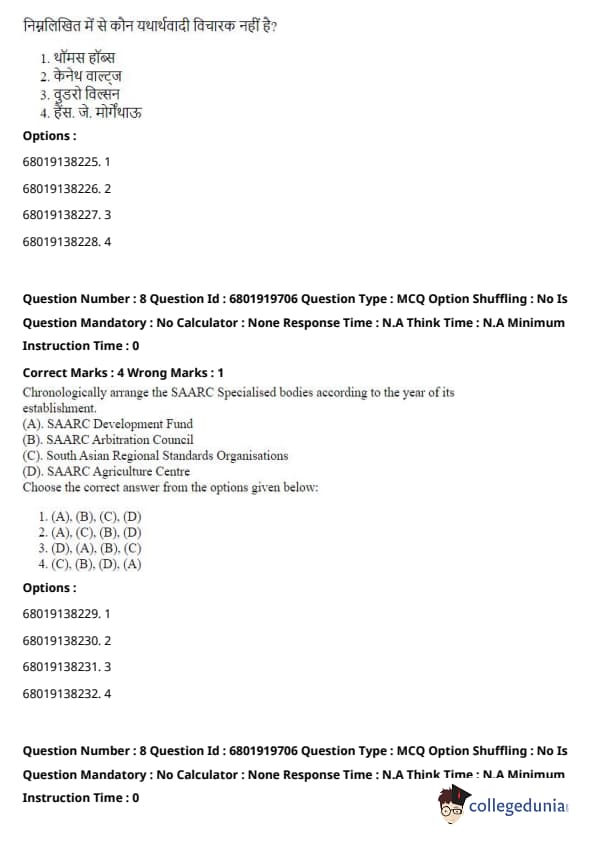
Who among the following is not a Realist thinker?
View Solution
Solution: Woodrow Wilson is not a Realist thinker; instead, he is associated with Idealism, emphasizing moral principles and international cooperation. In contrast, thinkers like Thomas Hobbes, Kenneth Waltz, and Hans J. Morgenthau are pivotal figures in Realism, which focuses on power, self-interest, and state-centric policies in international relations.
Question 8:
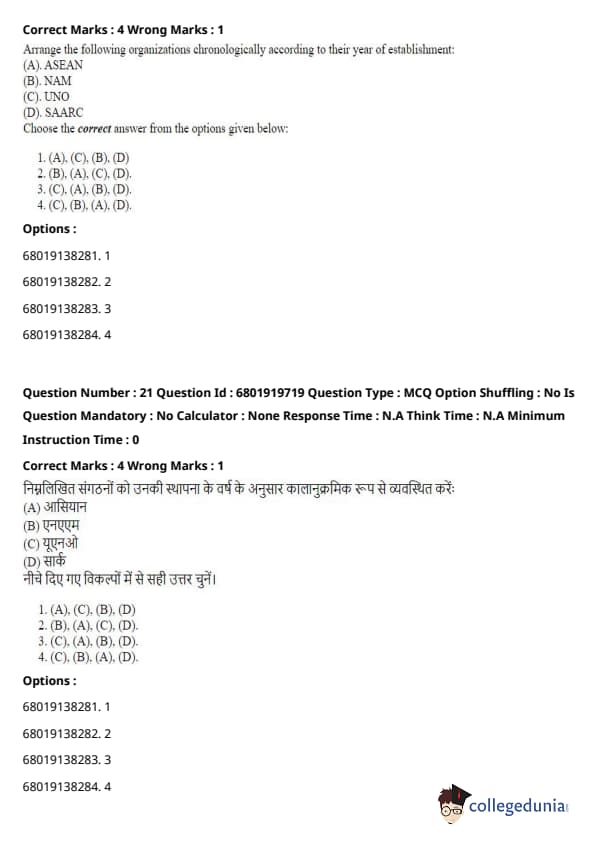
Chronologically arrange the SAARC Specialized bodies according to the year of their establishment.
(A) SAARC Development Fund
(B) SAARC Arbitration Council
(C) South Asian Regional Standards Organisations
(D) SAARC Agriculture Centre
Choose the correct answer from the options below:
View Solution
Solution: The chronological order of establishment is:
• SAARC Agriculture Centre (D): Established in 1988 as one of the oldest bodies under SAARC.
• SAARC Development Fund (A): Officially operational in 2010 to finance regional integration projects.
• SAARC Arbitration Council (B): Established in 2010 to settle disputes among member states.
• South Asian Regional Standards Organisations (C): Founded in 2011 to promote regional trade through uniform standards.
Question 9:
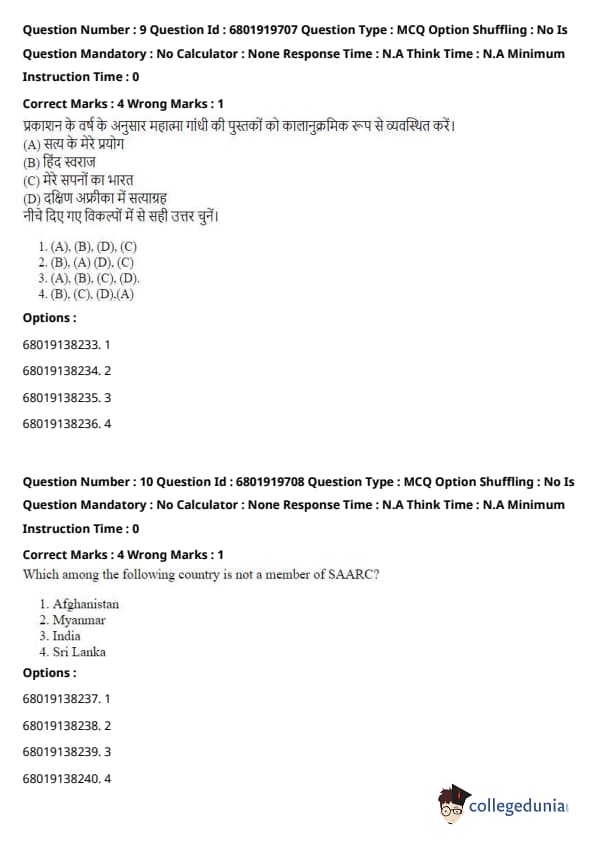
Chronologically arrange the books of Mahatma Gandhi according to their year of publication.
(A) The Story of My Experiments With Truth
(B) Hind Swaraj
(C) India of My Dreams
(D) Satyagraha in South Africa
Choose the correct answer from the options below:
View Solution
Solution: The chronological order of Gandhi's works is:
• Hind Swaraj (B): Published in 1909, it presents Gandhi's views on self-rule.
• The Story of My Experiments With Truth (A): Autobiography published in 1927.
• Satyagraha in South Africa (D): Written in 1928, recounting Gandhi's experiences in South Africa.
• India of My Dreams (C): Compilation of Gandhi's writings, published posthumously.
Question 10:
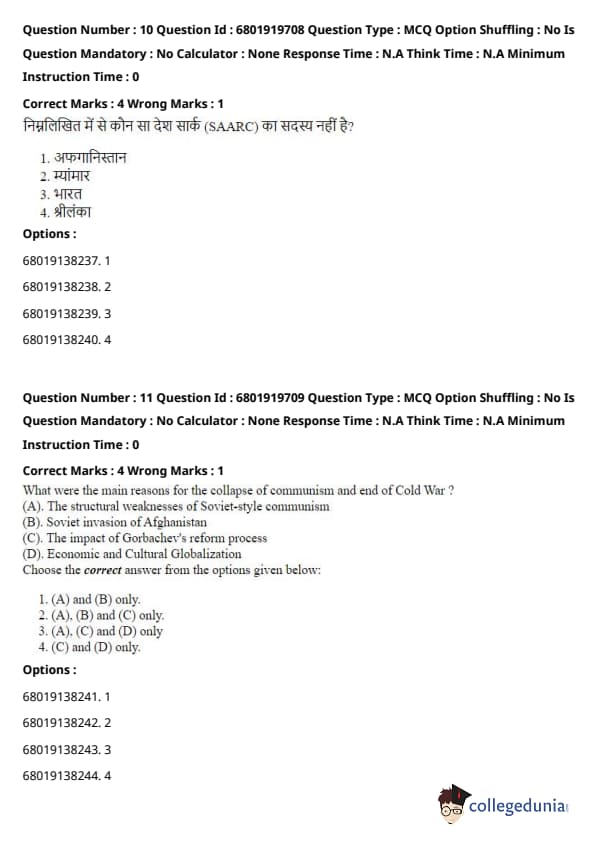
Which among the following countries is not a member of SAARC?
View Solution
Solution: Myanmar is not a member of SAARC. The South Asian Association for Regional Cooperation (SAARC) includes Afghanistan, Bangladesh, Bhutan, India, Maldives, Nepal, Pakistan, and Sri Lanka. Myanmar is a member of ASEAN but not SAARC.
Question 11:
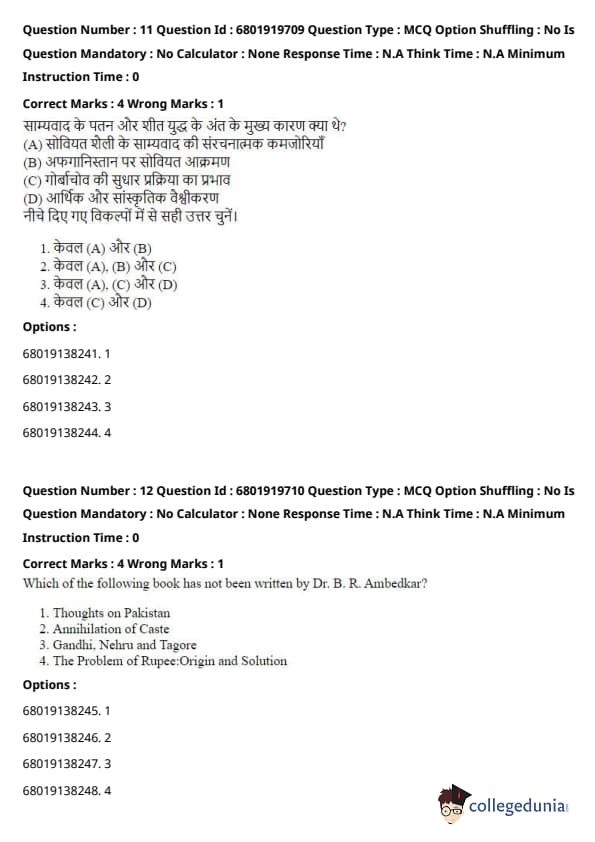
What were the main reasons for the collapse of communism and the end of the Cold War?
Choose the correct answer from the options below:
View Solution
Solution: The collapse of communism and the end of the Cold War resulted from:
• Structural Weaknesses (A): Soviet-style communism was inefficient and rigid, failing to adapt to modern economic challenges.
• Gorbachev's Reforms (C): Policies like Glasnost and Perestroika introduced political openness and economic restructuring, weakening the communist system.
• Globalization (D): Economic and cultural globalization exposed the Soviet Union's shortcomings and increased pressures for change.
The Soviet invasion of Afghanistan (B) contributed but was not a primary reason for communism's collapse.
Question 12:
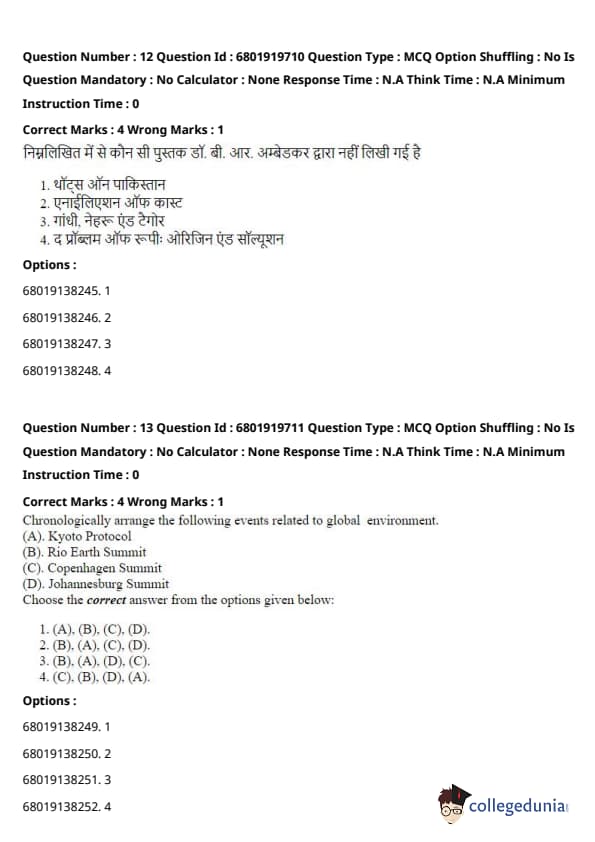
Which of the following books has not been written by Dr. B. R. Ambedkar?
View Solution
Solution: The book "Gandhi, Nehru and Tagore" was not authored by Dr. B. R. Ambedkar. Dr. Ambedkar was known for his scholarly works addressing caste, economics, and social reform, which include "Annihilation of Caste" and "The Problem of Rupee: Origin and Solution." This particular title relates to Indian history but does not fall under his authored works.
Question 13:
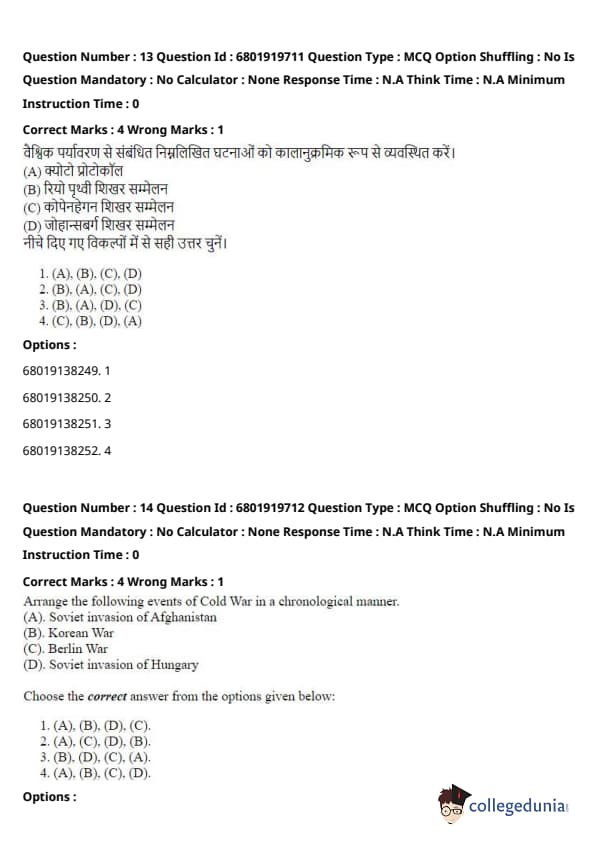
Chronologically arrange the following events related to the global environment.
(A) Kyoto Protocol
(B) Rio Earth Summit
(C) Copenhagen Summit
(D) Johannesburg Summit
View Solution
Solution: The chronological order is as follows:
1. The Rio Earth Summit (1992) laid the foundation for global environmental policies.
2. The Kyoto Protocol (1997) addressed greenhouse gas emissions.
3. The Johannesburg Summit (2002) expanded discussions on sustainable development.
4. The Copenhagen Summit (2009) revisited climate change with updated commitments.
Understanding these events helps in grasping the evolution of global environmental initiatives.
Question 14:
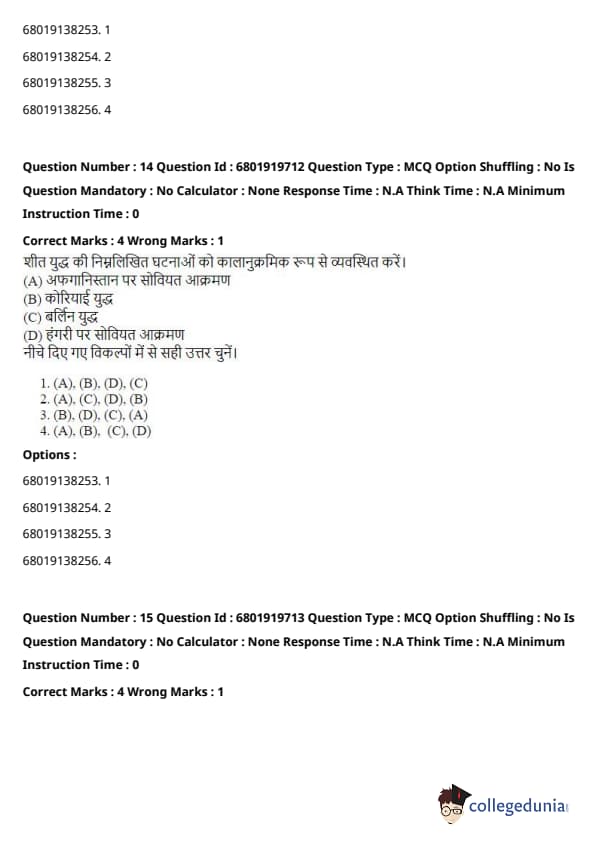
Arrange the following events of the Cold War in a chronological manner.
(A) Soviet invasion of Afghanistan
(B) Korean War
(C) Berlin War
(D) Soviet invasion of Hungary
View Solution
Solution:
1. The Korean War (1950–1953) marked one of the earliest conflicts of the Cold War.
2. The Soviet invasion of Hungary (1956) showcased the USSR's dominance over Eastern Europe.
3. The Berlin Wall (1961) symbolized Cold War tensions at their peak.
4. The Soviet invasion of Afghanistan (1979) highlighted the USSR's military engagements outside its territory.
This sequence reflects the Cold War's geopolitical and military developments.
Question 15:
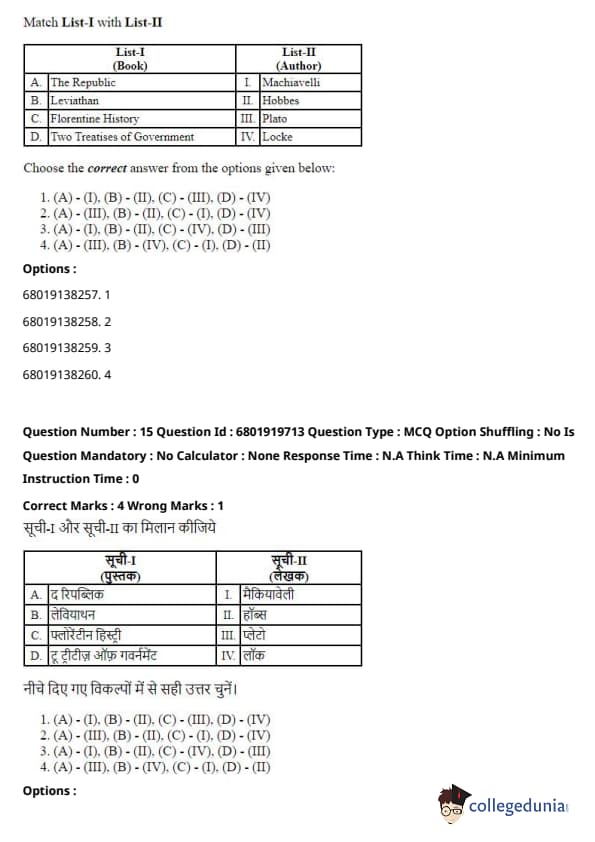
Match List-I with List-II.
| List-I (Book) | List-II (Author) |
|---|---|
| A. The Republic | I. Machiavelli |
| B. Leviathan | II. Hobbes |
| C. Florentine History | III. Plato |
| D. Two Treatises of Government | IV. Locke |
View Solution
Solution: The correct matching of books with their authors is as follows:
1. "The Republic" by Plato is a seminal work in political philosophy.
2. "Leviathan” by Hobbes discusses the social contract and the need for a sovereign authority.
3. "Florentine History” by Machiavelli explores the political history of Florence.
4. "Two Treatises of Government" by Locke is foundational for modern democracy.
This matching reflects the intersection of political theory and history.
Question 16:
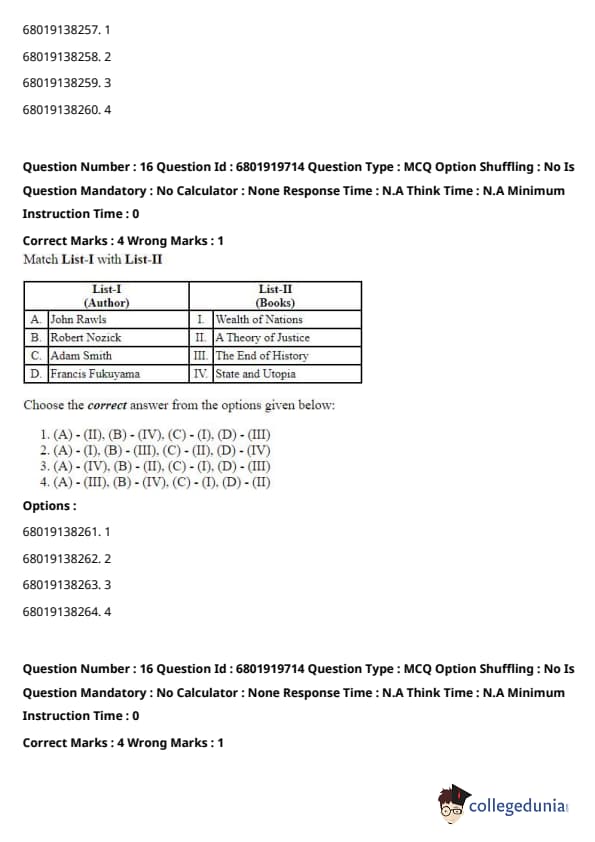
Match List-I with List-II.
| List-I (Author) | List-II (Books) |
|---|---|
| A. John Rawls | I. Wealth of Nations |
| B. Robert Nozick | II. A Theory of Justice |
| C. Adam Smith | III. The End of History |
| D. Francis Fukuyama | IV. State and Utopia |
View Solution
Solution:
1. John Rawls is known for "A Theory of Justice,” a foundational text in modern political philosophy.
2. Robert Nozick authored "State and Utopia," critiquing Rawls's ideas on distributive justice.
3. Adam Smith's "Wealth of Nations" is a cornerstone of classical economics.
4. Francis Fukuyama's "The End of History” argues the universalization of Western liberal democracy post-Cold War.
This matching integrates key political and economic philosophies.
Question 17:
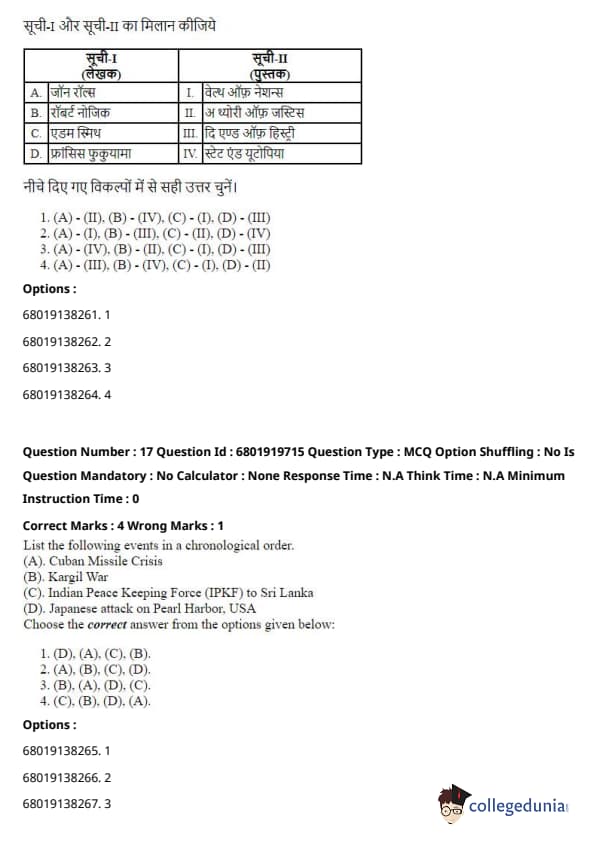
List the following events in chronological order.
(A) Cuban Missile Crisis
(B) Kargil War
(C) Indian Peace Keeping Force (IPKF) to Sri Lanka
(D) Japanese attack on Pearl Harbor, USA
View Solution
Solution: The correct chronological order is:
1. The Japanese attack on Pearl Harbor (1941) marked the US entry into World War II.
2. The Cuban Missile Crisis (1962) brought the world to the brink of nuclear war during the Cold War.
3. The Indian Peace Keeping Force (IPKF) deployment to Sri Lanka (1987) was aimed at resolving the Sri Lankan Civil War.
4. The Kargil War (1999) was a conflict between India and Pakistan in the Kargil sector.
Understanding the timeline of these events helps contextualize significant global conflicts and interventions.
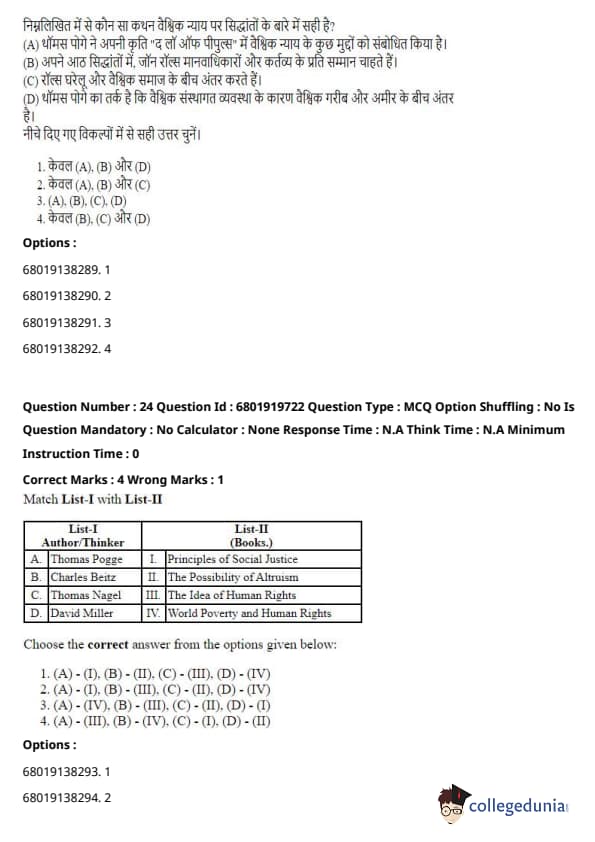
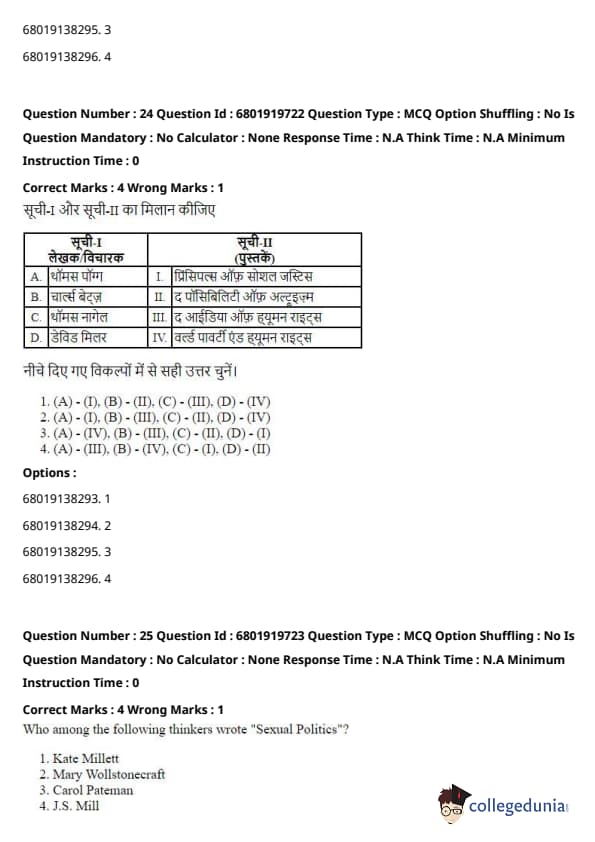
Question 24:
Match List-I with List-II:
| List-I (Author/Thinker) | List-II (Books) |
|---|---|
| A. Thomas Pogge | I. Principles of Social Justice |
| B. Charles Beitz | II. The Possibility of Altruism |
| C. Thomas Nagel | III. The Idea of Human Rights |
| D. David Miller | IV. World Poverty and Human Rights |
Choose the correct answer from the options given below:
View Solution
Solution:
Thomas Pogge's work relates to poverty and human rights, emphasizing global inequality. World Poverty and Human Rights
Charles Beitz explores the concept of altruism and how it shapes international justice. The Possibility of Altruism
Nagel's contributions focus on human rights philosophy. The Idea of Human Rights
while Miller addresses justice and social structures. Principles of Social Justice
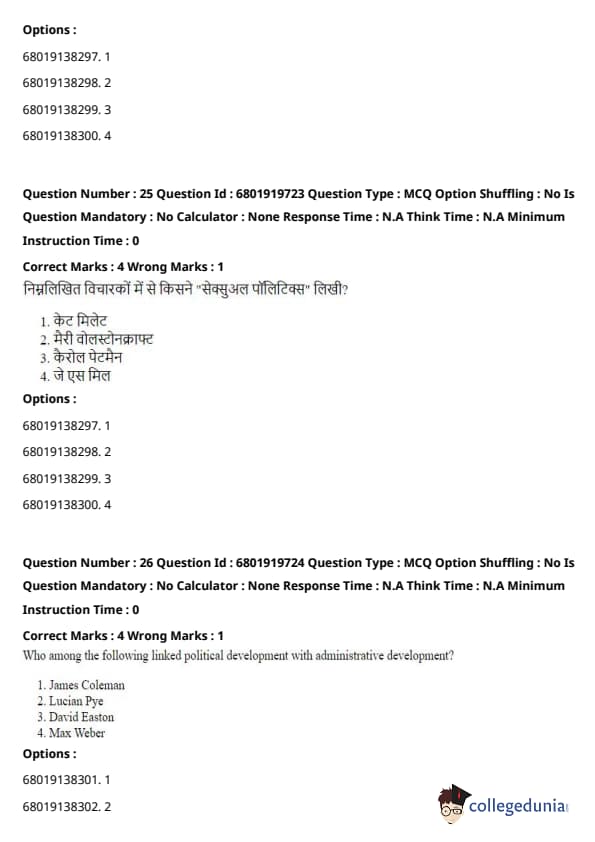
Question 25:
Who among the following thinkers wrote "Sexual Politics"?
View Solution
Solution: Kate Millett is a foundational thinker in feminist theory, and her book "Sexual Politics" critiques the patriarchal structures embedded in society, literature, and culture. The work revolutionized feminist criticism and introduced the concept of sexual politics as a way to analyze gender-based power dynamics.
Question 26:
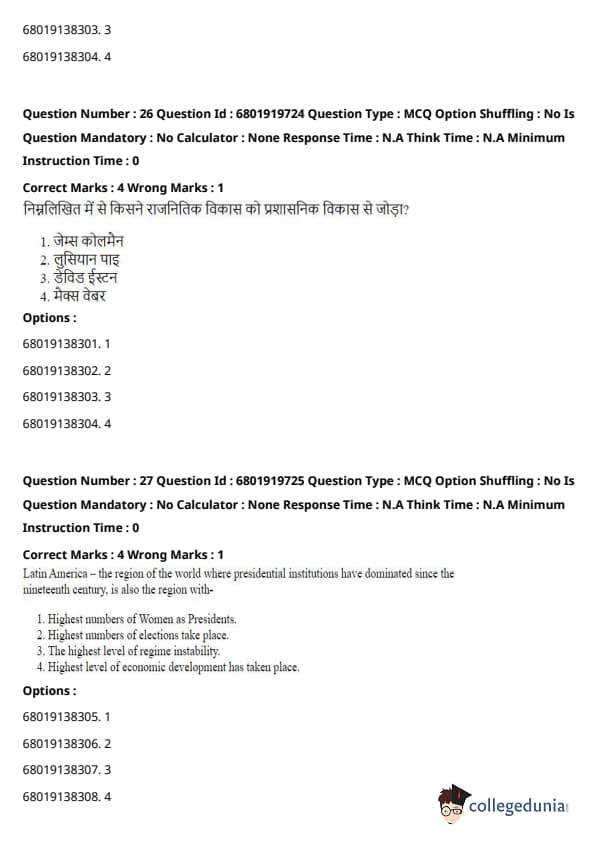
Who among the following linked political development with administrative development?
View Solution
Solution: Max Weber highlighted the interplay between political and administrative development, emphasizing that modernization processes require both political stability and efficient administrative systems. He argued that administrative capacity is central to achieving developmental goals in modern states.
Question 27:
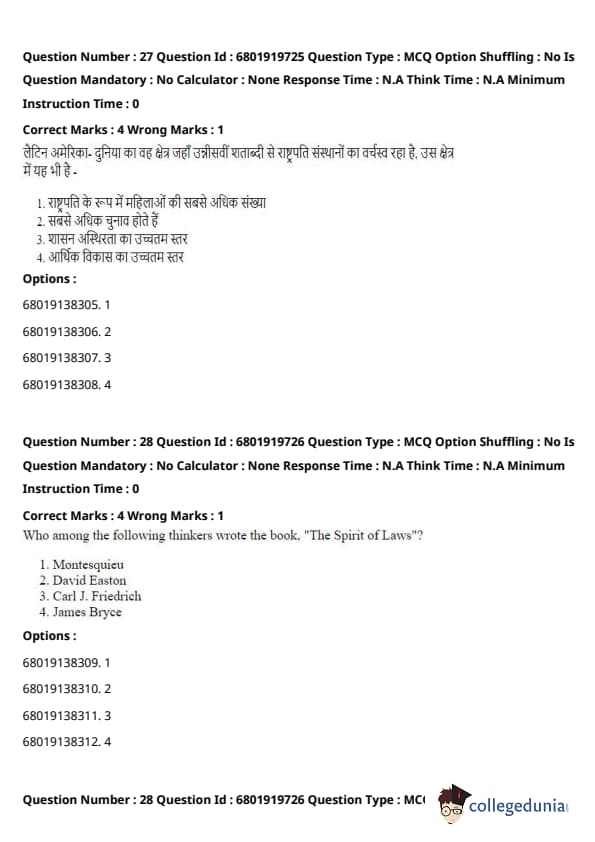
Latin America – the region of the world where presidential institutions have dominated since the nineteenth century, is also the region with-
View Solution
Solution: Latin America's political history is characterized by frequent changes in government and regime instability. Despite strong presidential institutions, the region has faced challenges such as coups, economic crises, and political corruption, which have contributed to this instability.
Question 28:
Who among the following thinkers wrote the book, "The Spirit of Laws"?
View Solution
Solution: Montesquieu, a French philosopher, is renowned for his seminal work, "The Spirit of Laws.” This book is a foundational text in political science, introducing the concept of the separation of powers among the legislative, executive, and judicial branches of government. His ideas influenced the framers of modern constitutions worldwide, including the U.S. Constitution.
Question 29:
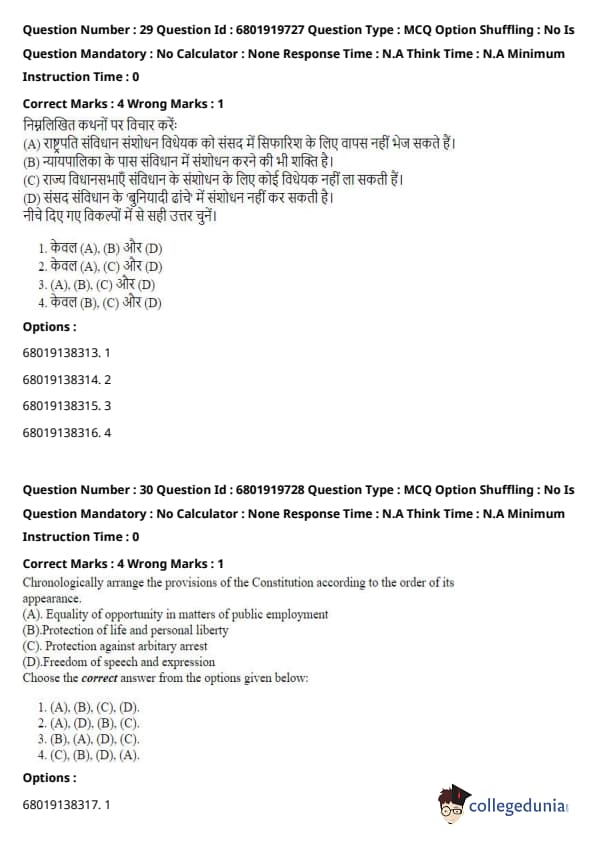
Consider the following statements:
(A). The President cannot send back a Constitutional amendment bill for recommendation to the Parliament.
(B). The Judiciary also have the power to amend the Constitution.
(C). The State legislatures cannot initiate any Bill for amendment of the Constitution.
(D). The Parliament cannot amend the 'basic features' of the Constitution.
Choose the correct answer from the options given below:
View Solution
Solution:
(A) is correct: The President has no authority to return a Constitutional amendment bill once passed by Parliament as per Article 368.
(B) is incorrect: The judiciary, through interpretations and judgments (e.g., Kesavananda Bharati case), can influence amendments indirectly.
(C) is correct: State legislatures do not have the power to initiate amendment Bills under Article 368.
(D) is correct: Parliament cannot alter the 'basic structure' of the Constitution as per the Basic Structure Doctrine established in the Kesavananda Bharati case.
Question 30:
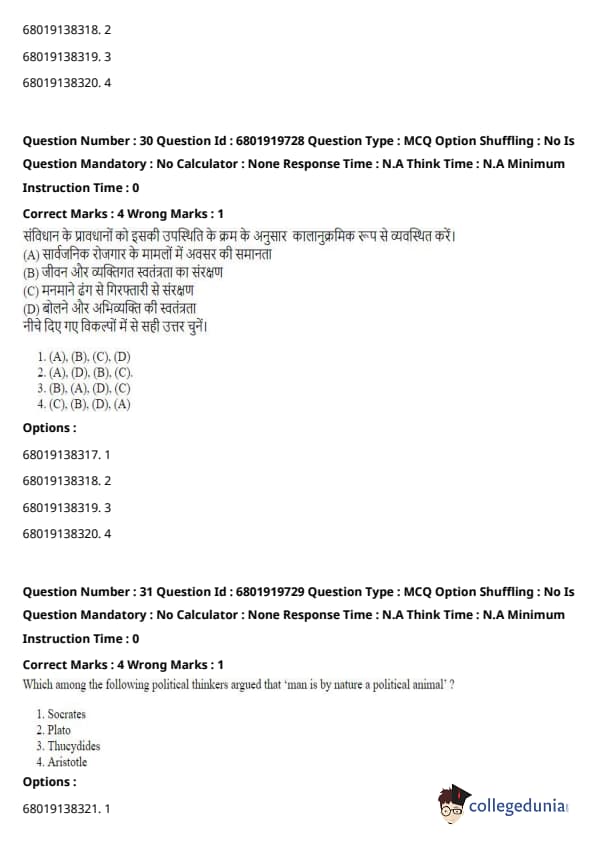
Chronologically arrange the provisions of the Constitution according to the order of its appearance:
(A). Equality of opportunity in matters of public employment
(B). Protection of life and personal liberty
(C). Protection against arbitrary arrest
(D). Freedom of speech and expression
Choose the correct answer from the options given below:
View Solution
Solution:
(A) Equality of opportunity in public employment is specified under Articles 15 and 16.
(D) Freedom of speech and expression comes under Article 19(1)(a).
(B) Protection of life and personal liberty appears in Article 21, a fundamental right enshrined in Part III.
(C) Protection against arbitrary arrest relates to Article 22, ensuring procedural safeguards.
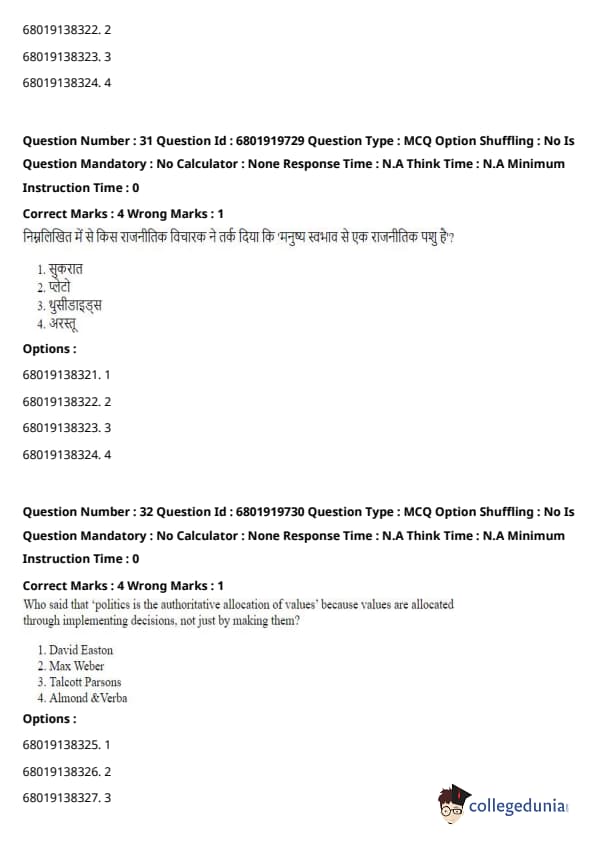
Question 31:
Which among the following political thinkers argued that ‘man is by nature a political animal’?
View Solution
Solution: Aristotle's famous assertion that "man is by nature a political animal” reflects his belief that human beings are naturally inclined to form communities and participate in governance. He viewed politics as essential for achieving the good life and believed that living in a polis (city-state) distinguished humans from other beings. Aristotle’s work "Politics" elaborates on this concept, emphasizing the role of humans in creating laws and institutions to achieve collective welfare.
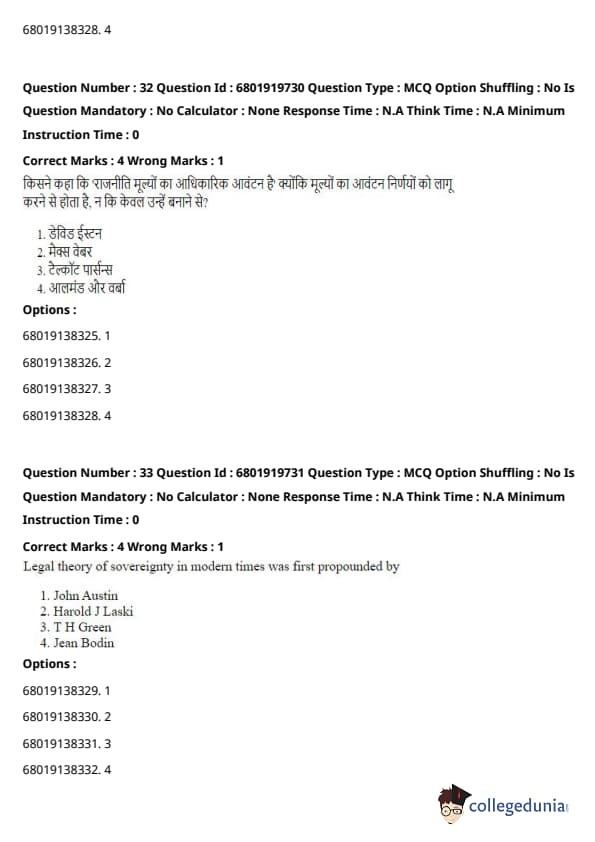
Question 32:
Who said that ‘politics is the authoritative allocation of values' because values are allocated through implementing decisions, not just by making them?
View Solution
Solution: David Easton defined politics as the "authoritative allocation of values" in his systems theory of politics. According to him, politics is about how values are prioritized and distributed within society through decision-making and policy implementation. His approach emphasized the inputs (demands and supports) and outputs (decisions and actions) of a political system and its feedback mechanisms.
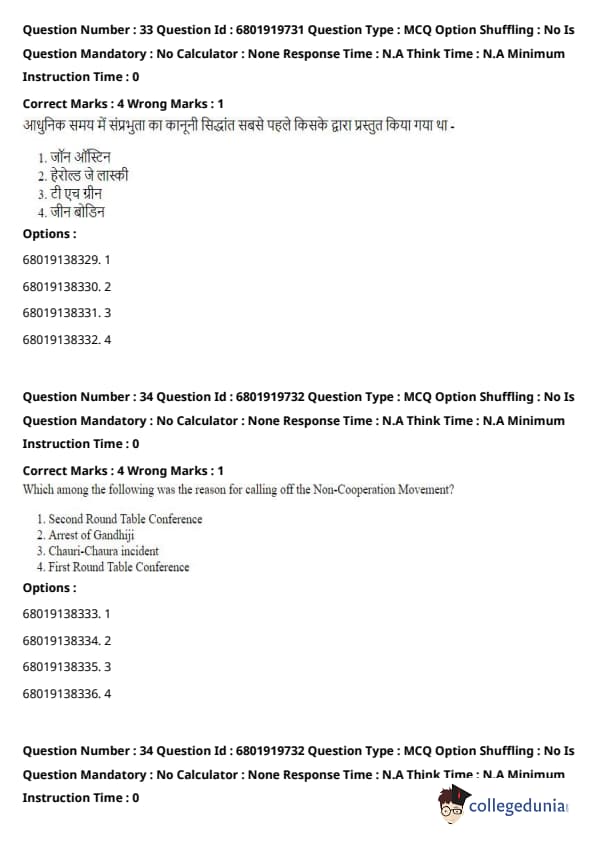
Question 33:
Legal theory of sovereignty in modern times was first propounded by
View Solution
Solution: John Austin is credited with the first systematic theory of sovereignty in his work "Six Books of the Republic" (1576). He described sovereignty as the absolute and perpetual power of a state. Bodin’s concept was rooted in the context of centralized monarchies, emphasizing that sovereign authority must be indivisible and supreme within its territory. This laid the foundation for modern legal and political theories of state sovereignty.
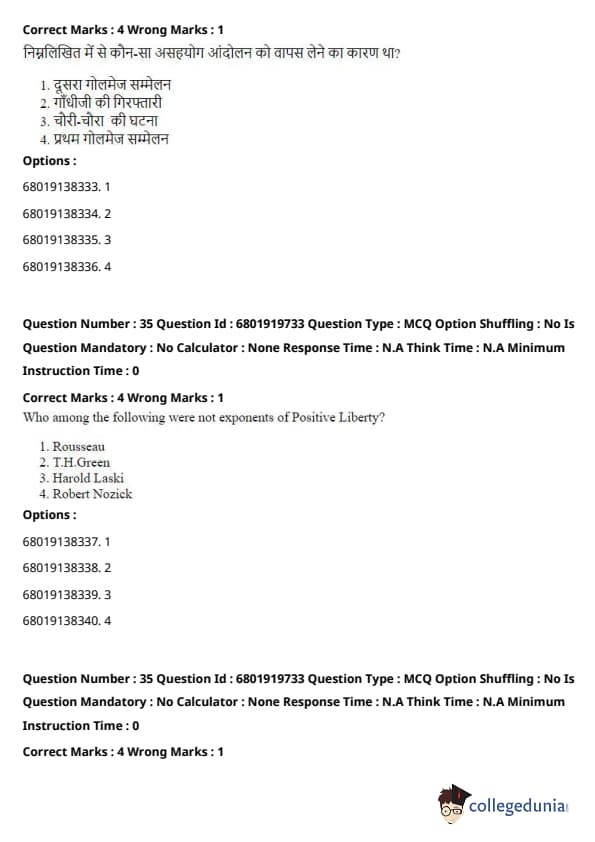
Question 34:
Which among the following was the reason for calling off the Non-Cooperation Movement?
View Solution
Solution: The Non-Cooperation Movement was called off by Mahatma Gandhi in 1922 following the Chauri-Chaura incident, where a violent clash between protestors and police resulted in the burning of a police station and the death of 22 policemen. Gandhi believed that the movement’s objectives could not be achieved through violence and insisted on maintaining the principle of non-violence, which was central to his philosophy of Satyagraha.
Question 35:
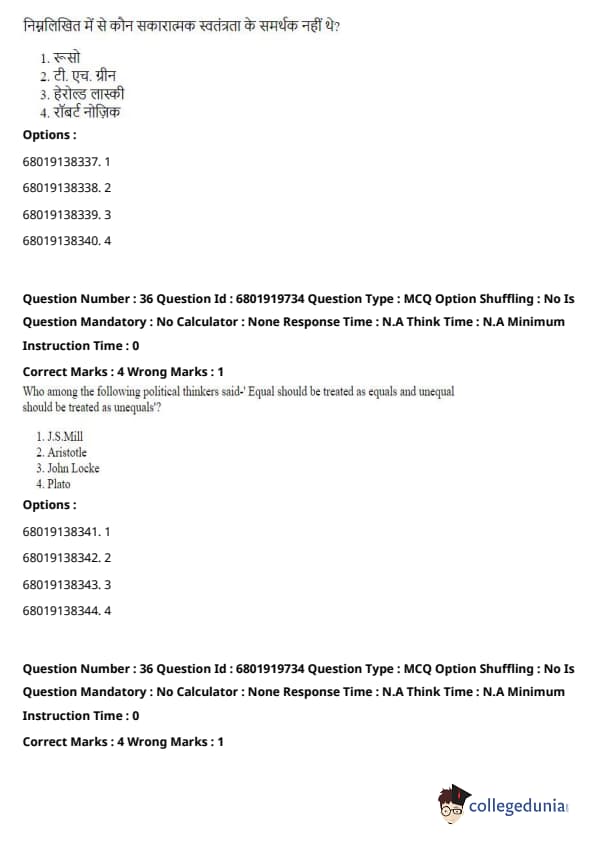
Who among the following were not exponents of Positive Liberty?
View Solution
Solution: Robert Nozick was a proponent of negative liberty, emphasizing minimal state intervention and individual freedom from coercion. Positive liberty, on the other hand, focuses on the ability of individuals to act on their free will, often requiring enabling conditions provided by the state or society. Thinkers like Rousseau, T. H. Green, and Harold Laski advocated positive liberty, emphasizing self-realization and collective welfare.
Question 36:
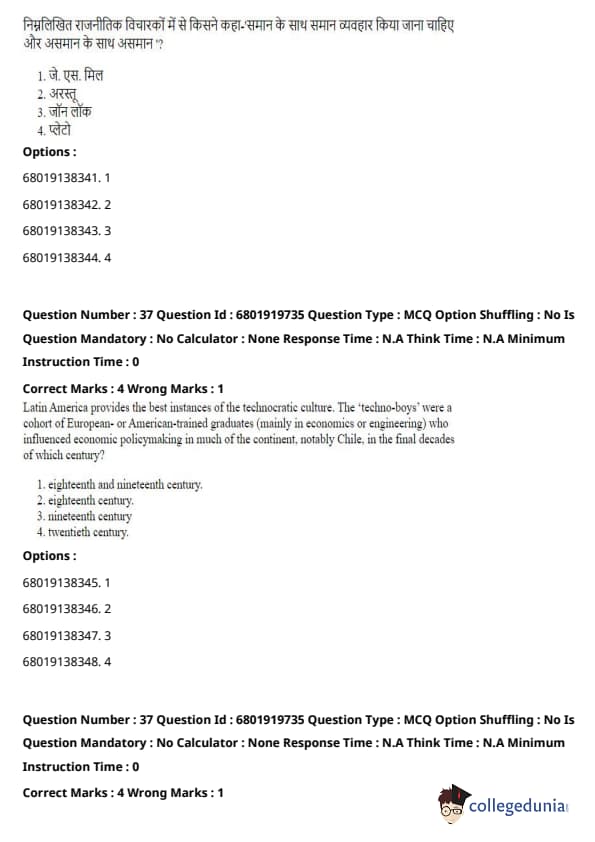
Who among the following political thinkers said: "Equal should be treated as equals and unequal should be treated as unequals"?
View Solution
Solution: Aristotle emphasized the idea of distributive justice, where individuals should receive what is due to them based on their merit. Equality should be provided to those who are equal, and inequality must be acknowledged among unequals to maintain fairness.
Question 37:
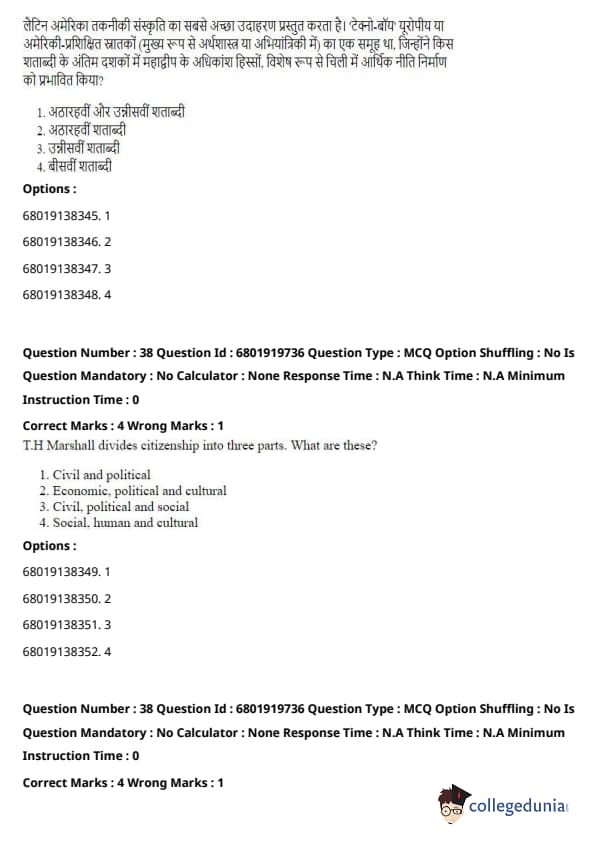
Latin America provides the best instances of the technocratic culture. The 'techno-boys' were a cohort of European- or American-trained graduates (mainly in economics or engineering) who influenced economic policymaking in much of the continent, notably Chile, in the final decades of which century?
View Solution
Solution: During the 20th century, many Latin American countries experienced a shift towards technocratic governance. Economists and engineers trained abroad played a crucial role in policy reforms, particularly in countries like Chile during the 1970s economic restructuring.
Question 38:
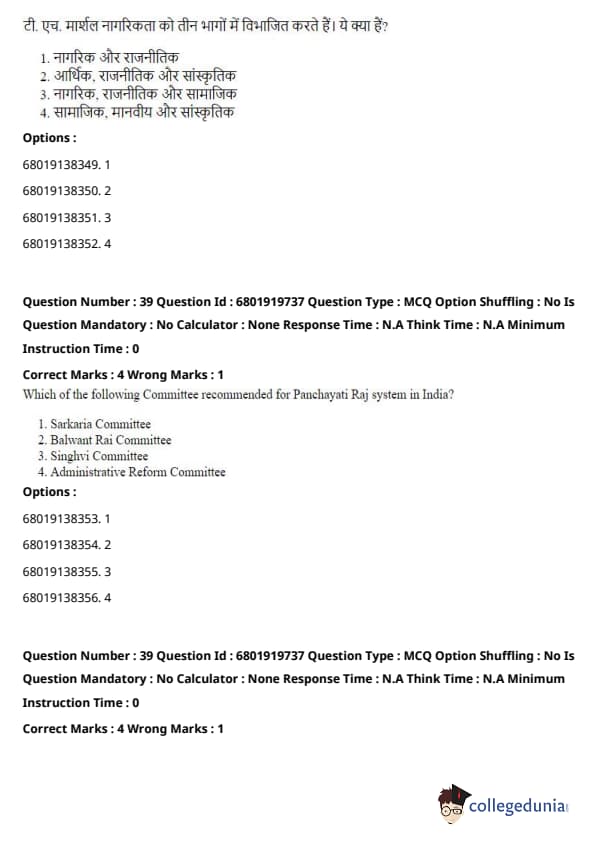
T.H. Marshall divides citizenship into three parts. What are these?
View Solution
Solution: T.H. Marshall outlined citizenship as encompassing three dimensions: civil (rights like freedom and property), political (participation in governance), and social (access to welfare and education). This holistic view integrates individuals into society effectively.
Question 39:
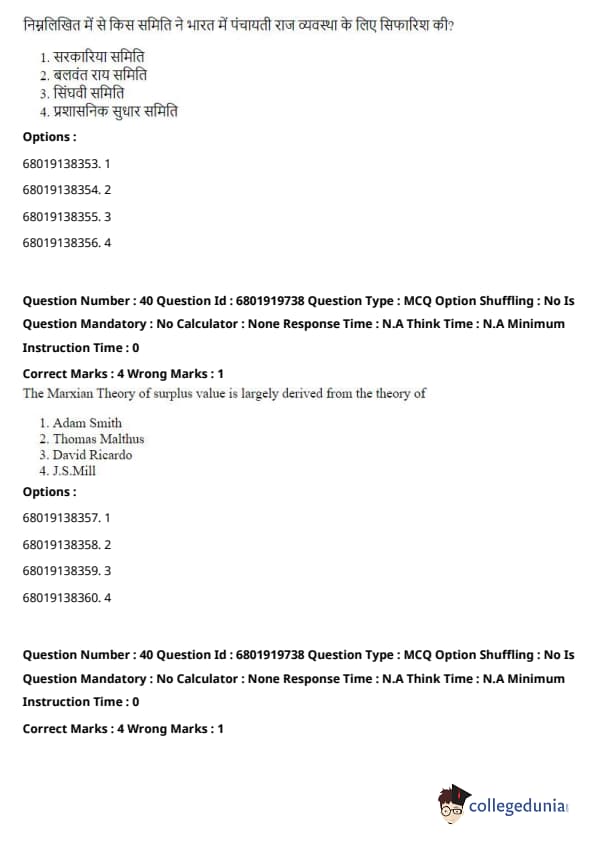
Which of the following Committee recommended for Panchayati Raj system in India?
View Solution
Solution: The Balwant Rai Mehta Committee, formed in 1957, recommended the establishment of a three-tier Panchayati Raj system for decentralized governance. This was implemented to enhance grassroots democracy and local self-governance.
Question 40:
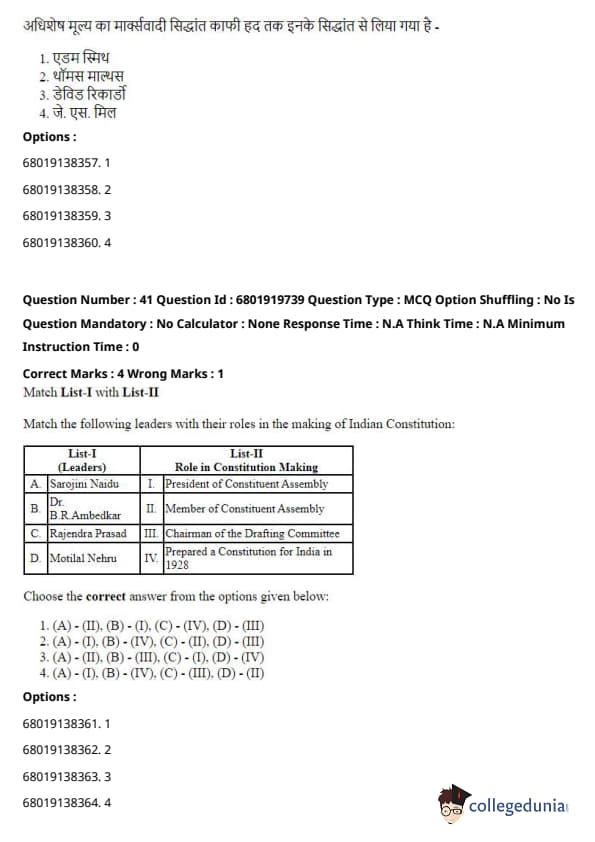
The Marxian Theory of surplus value is largely derived from the theory of
View Solution
Solution: Marx’s theory of surplus value builds on David Ricardo’s labor theory of value. Marx extended this to argue that capitalists exploit workers by extracting surplus value—the difference between a worker’s production and their wage.
Question 41:
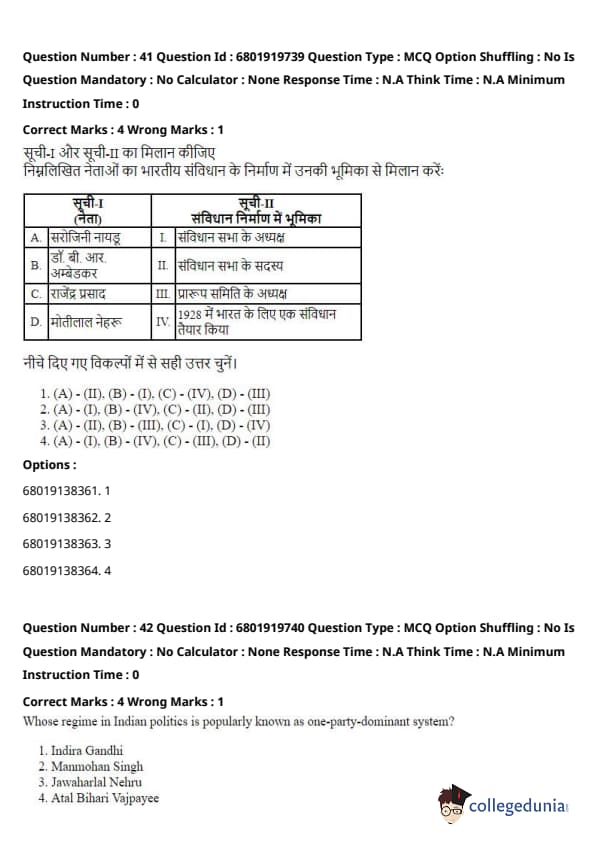
Match the following leaders with their roles in the making of Indian Constitution:
| List-I Leaders | List-II Role in Constitution Making |
|---|---|
| A. Sarojini Naidu | I. President of Constituent Assembly |
| B. Dr. B.R. Ambedkar | II. Member of Constituent Assembly |
| C. Rajendra Prasad | III. Chairman of the Drafting Committee |
| D. Motilal Nehru | IV. Prepared a Constitution for India in 1928 |
Table 1: Match the Leaders with their Roles in Constitution Making
Choose the correct answer from the options given below:
View Solution
Solution:
-Sarojini Naidu was a Member of the Constituent Assembly.
-Dr. B.R. Ambedkar was the Chairman of the Drafting Committee, responsible for drafting the Constitution.
-Rajendra Prasad was the President of the Constituent Assembly.
-Motilal Nehru prepared a draft constitution in 1928 as part of the Nehru Report.
Question 42:
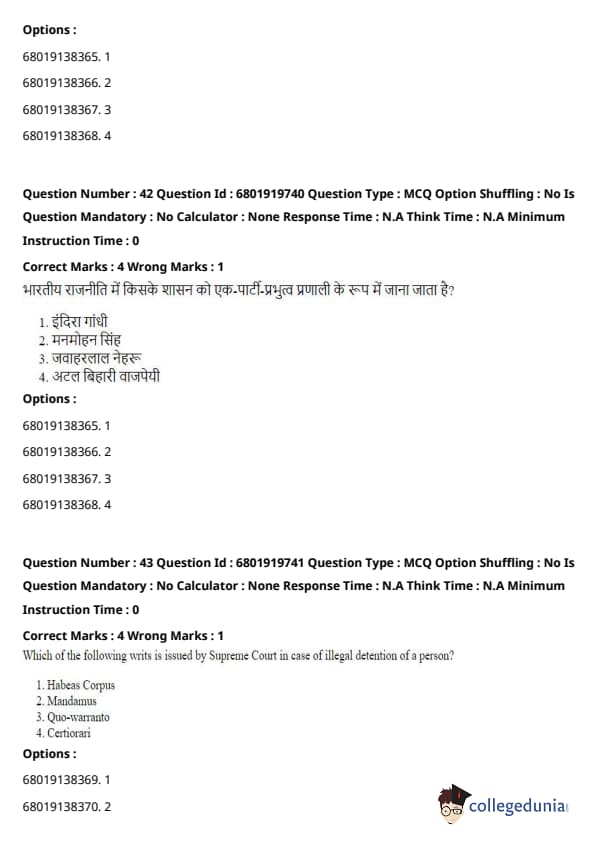
Whose regime in Indian politics is popularly known as one-party-dominant system?
View Solution
Solution: The one-party dominant system in Indian politics refers to the era under Jawaharlal Nehru’s leadership. The Indian National Congress maintained political dominance during the early years of independent India, controlling most legislative bodies.
Question 43:
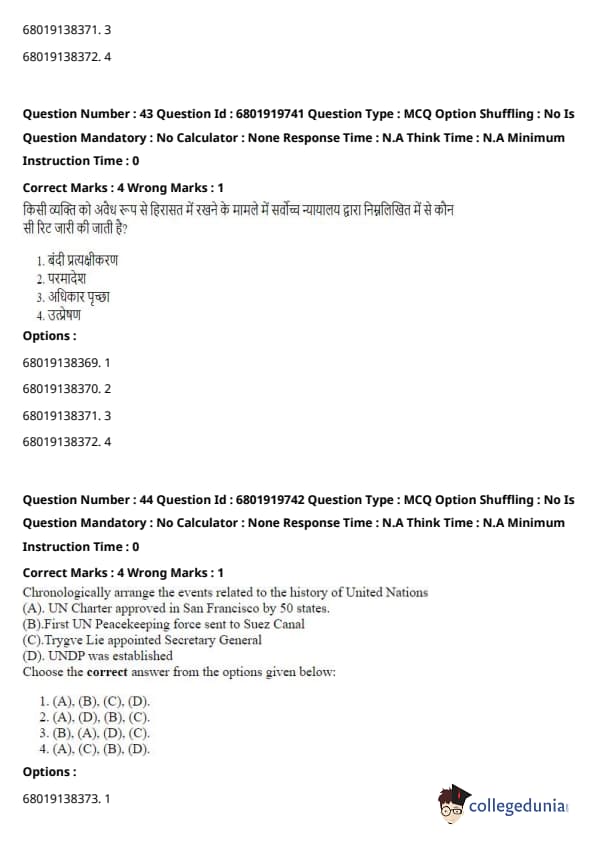
Which of the following writs is issued by Supreme Court in case of illegal detention of a person?
View Solution
Solution: The writ of Habeas Corpus is used to safeguard individual freedom against unlawful detention. It ensures that a person detained is brought before the court to determine the legality of their detention.
Question 44:
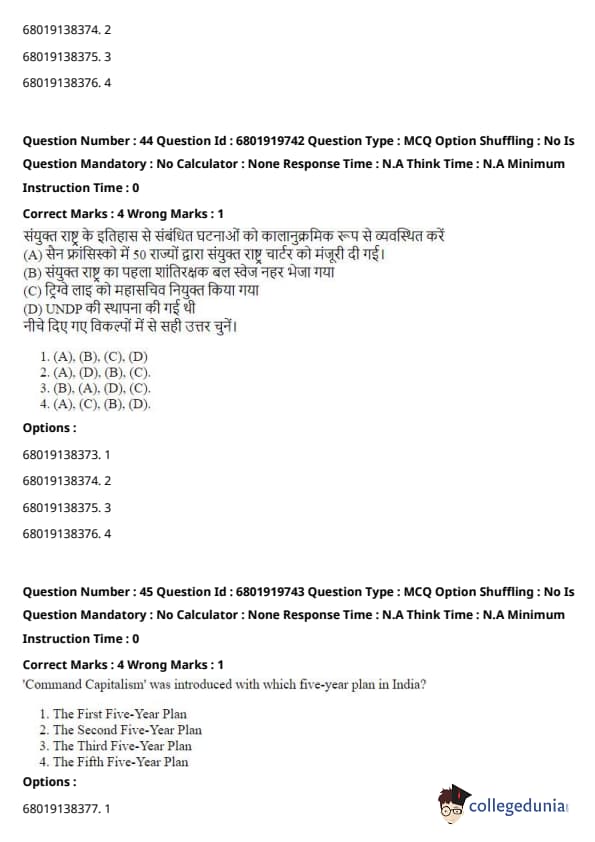
Chronologically arrange the events related to the history of United Nations:
(A) UN Charter approved in San Francisco by 50 states
(B) First UN Peacekeeping force sent to Suez Canal
(C) Trygve Lie appointed Secretary General
(D) UNDP was established
Choose the correct answer from the options given below:
View Solution
Solution:
The UN Charter was approved in 1945.
Trygve Lie was appointed the first Secretary-General in 1946.
The Suez Canal Crisis led to the first Peacekeeping Force in 1956.
UNDP was established in 1965.
Question 45:
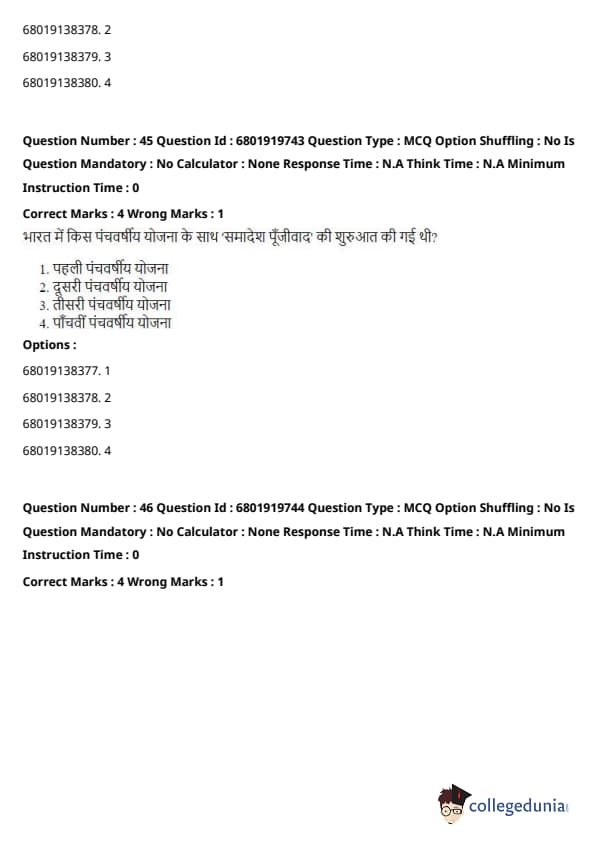
‘Command Capitalism’ was introduced with which five-year plan in India?
View Solution
Solution: The Second Five-Year Plan (1956-1961), also known as the Mahalanobis Plan, emphasized industrialization under state control, marking the era of Command Capitalism in India.
Question 46:
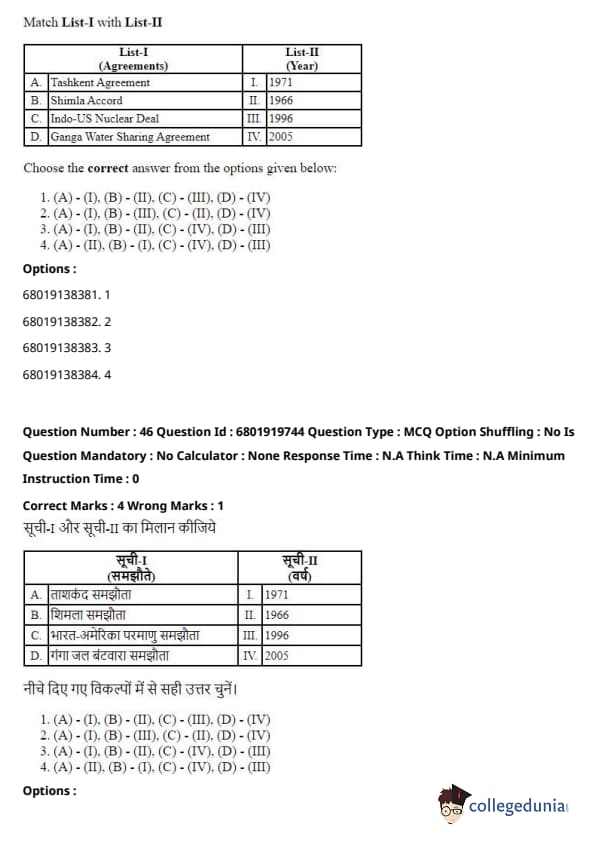
Match List-I with List-II
| List-I (Agreements) | List-II (Year) |
|---|---|
| A. Tashkent Agreement | I. 1971 |
| B. Shimla Accord | II. 1966 |
| C. Indo-US Nuclear Deal | III. 1996 |
| D. Ganga Water Sharing Agreement | IV. 2005 |
Options:
View Solution
Solution:
1. The Tashkent Agreement was signed in 1966 following the Indo-Pak war.
2. The Shimla Accord was signed in 1971 after the Bangladesh Liberation War.
3. The Indo-US Nuclear Deal occurred in 2005, marking a milestone in bilateral relations.
4. The Ganga Water Sharing Agreement was established in 1996 to share river waters between India and Bangladesh.
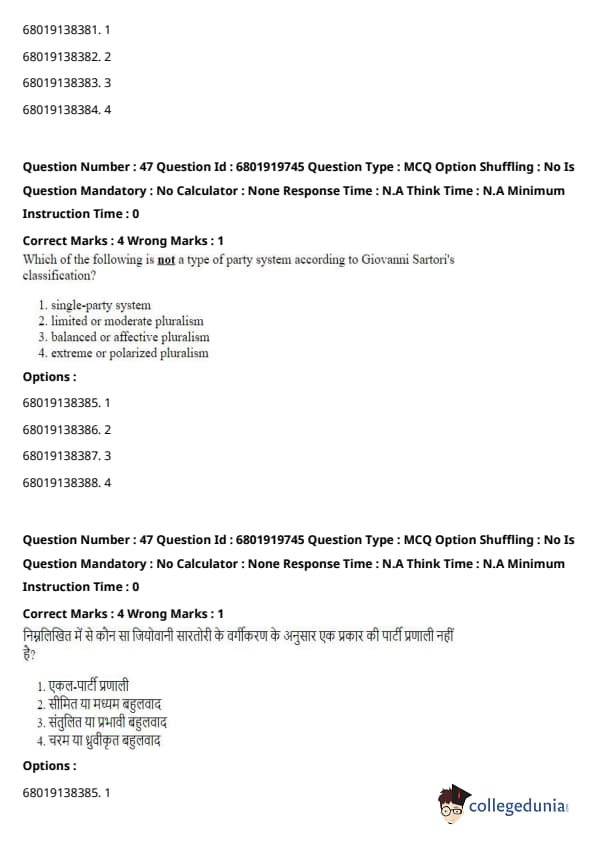
Question 47:
Which of the following is not a type of party system according to Giovanni Sartori's classification?
Options:
View Solution
Solution: Balanced or affective pluralism is not part of Sartori’s classification. Sartori classifies party systems into categories like single-party systems, moderate pluralism, and polarized pluralism based on the number and interaction of political parties.
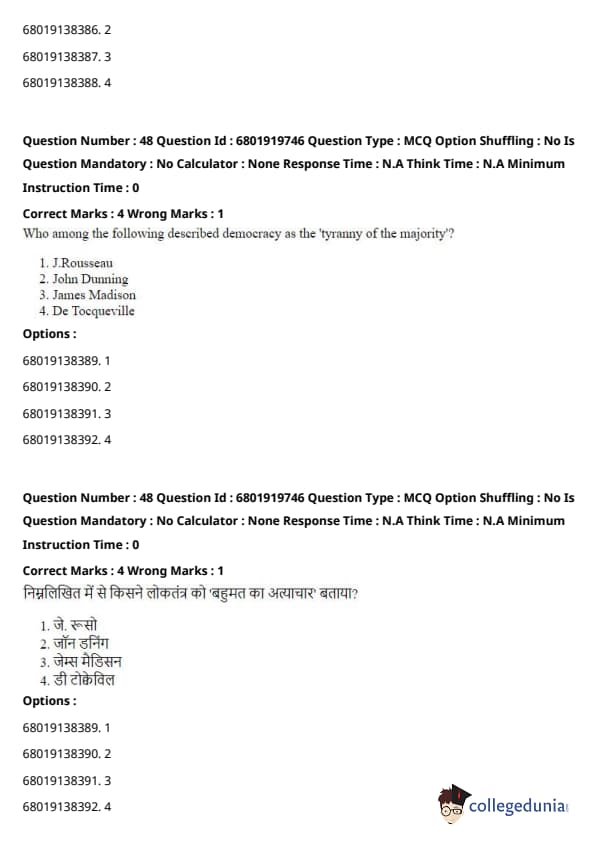
Question 48:
Who among the following described democracy as the 'tyranny of the majority'?
Options:
View Solution
Solution: De Tocqueville described democracy as the tyranny of the majority, emphasizing the potential for majority rule to oppress minority views within a democratic system.
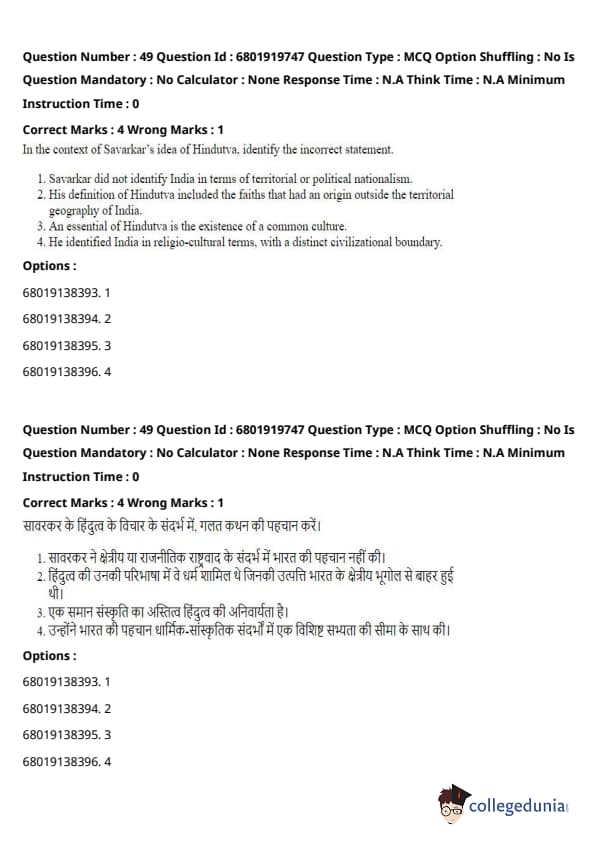
Question 49:
In the context of Savarkar’s idea of Hindutva, identify the incorrect statement.
Options:
View Solution
Solution: Savarkar’s idea of Hindutva was territorially and culturally rooted in the subcontinent. Faiths originating outside India were not included in his definition.
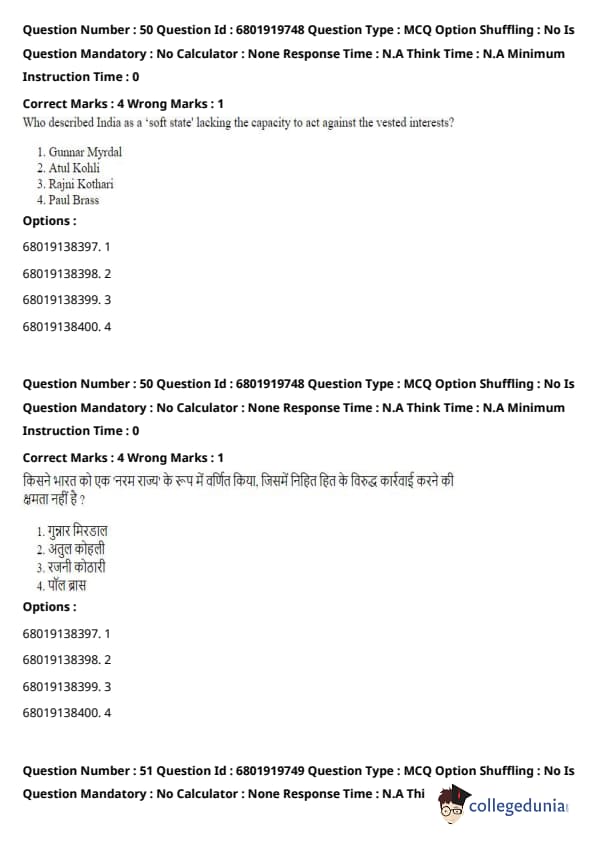
Question 50:
Who described India as a 'soft state' lacking the capacity to act against the vested interests?
Options:
View Solution
Solution: Gunnar Myrdal coined the term 'soft state' to describe India, highlighting its difficulty in implementing policies due to corruption, inefficiency, and resistance from vested interests.
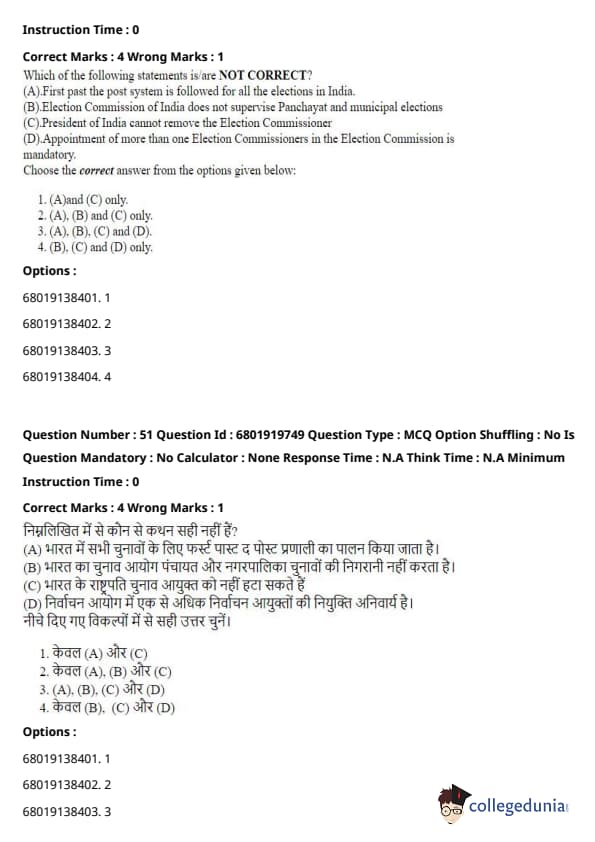
Question 51:
Which of the following statements is/are NOT CORRECT?
(A) First past the post system is followed for all the elections in India.
(B) Election Commission of India does not supervise Panchayat and municipal elections.
(C) President of India cannot remove the Election Commissioner.
(D) Appointment of more than one Election Commissioners in the Election Commission is mandatory.
Options:
View Solution
Solution:
(A) Correct: The first-past-the-post system is not followed for Presidential and Vice-Presidential elections.
(B) Incorrect: The Election Commission of India does not supervise Panchayat and Municipal elections as they are managed by the State Election Commissions.
(C) Correct: The President can remove the Election Commissioner based on the recommendation of the Chief Election Commissioner.
(D) Incorrect: Appointment of additional Election Commissioners is not mandatory; it is left to the President’s discretion.
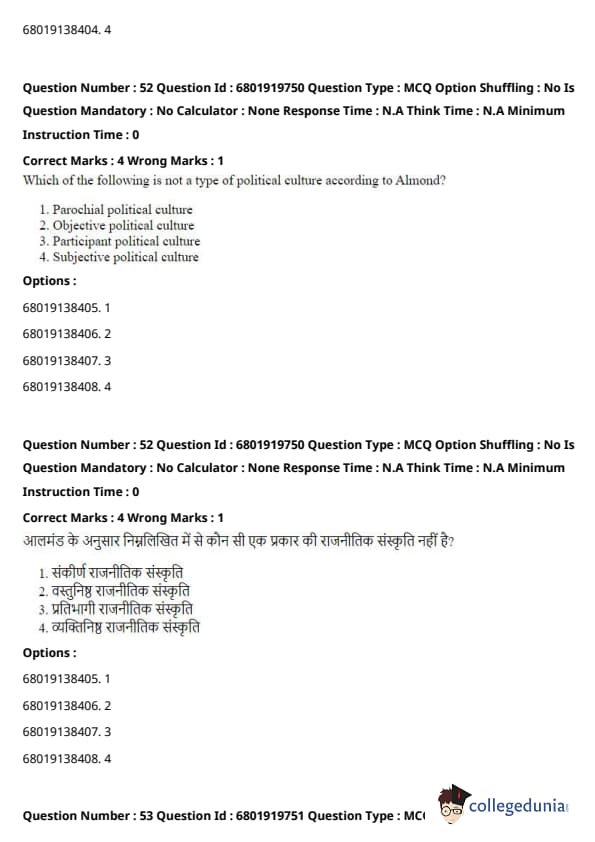
Question 52:
Which of the following is not a type of political culture according to Almond?
View Solution
Solution: Almond and Verba identified three types of political cultures: Parochial, Participant, and Subjective. Objective political culture is not part of their classification.
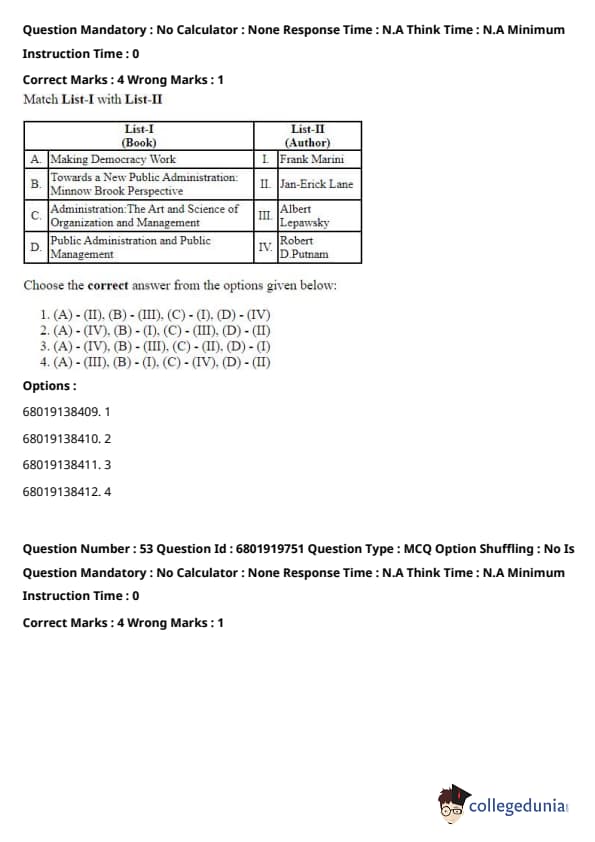
Question 53:
Match List-I with List-II:
| List-I (Books) | List-II (Authors) |
|---|---|
| A. Making Democracy Work | I. Frank Marini |
| B. Towards a New Public Administration | II. Jan-Erick Lane |
| C. Administration: The Art and Science of Organization and Management | III. Albert Lepawsky |
| D. Public Administration and Public Management | IV. Robert D. Putnam |
Options:
View Solution
Solution:
(A) "Making Democracy Work” was authored by Robert D. Putnam.
(B) "Towards a New Public Administration" was authored by Frank Marini.
(C) "Administration: The Art and Science of Organization and Management” was authored by Albert Lepawsky.
(D) "Public Administration and Public Management” was authored by Jan-Erick Lane.
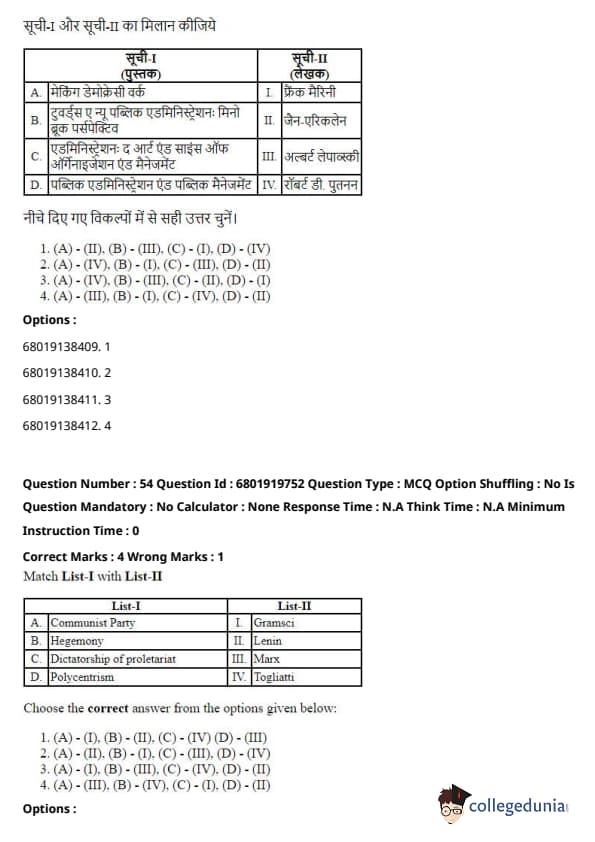
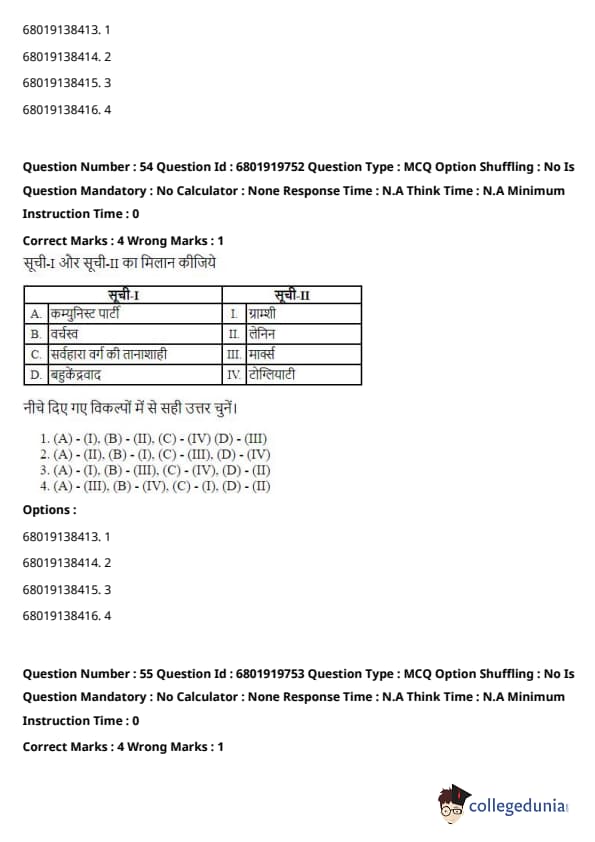
Question 54:
Match List-I with List-II:
| List-I | List-II |
|---|---|
| A. Communist Party | I. Gramsci |
| B. Hegemony | II. Lenin |
| C. Dictatorship of Proletariat | III. Marx |
| D. Polycentrism | IV. Togliatti |
Options:
View Solution
Solution:
(A) The Communist Party is associated with Lenin.
(B) The concept of Hegemony is attributed to Gramsci.
(C) The Dictatorship of the proletariat was proposed by Marx.
(D) Polycentrism is linked to Togliatti.
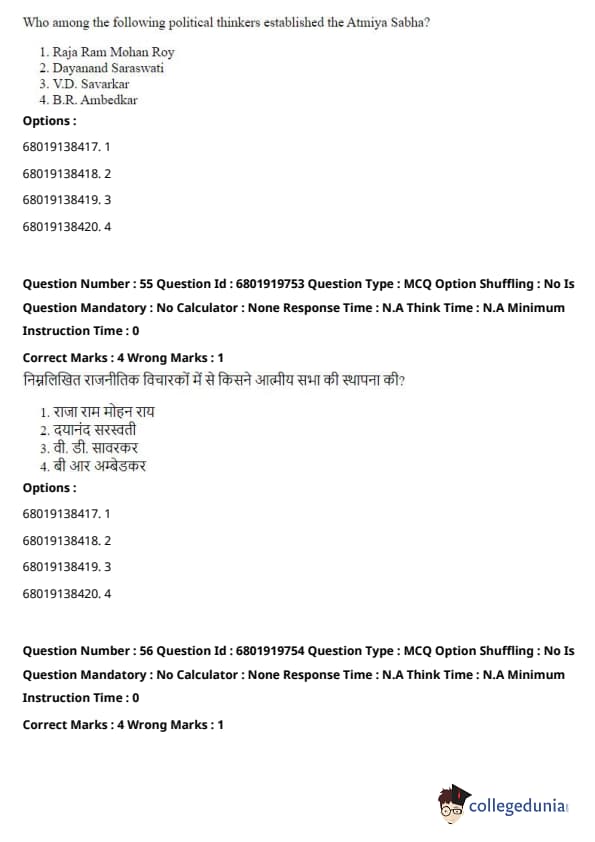
Question 55:
Who among the following political thinkers established the Atmiya Sabha?
View Solution
Solution: The Atmiya Sabha was established in 1815 by Raja Ram Mohan Roy. It aimed at propagating religious and social reforms, including the abolition of practices like sati and promoting education.
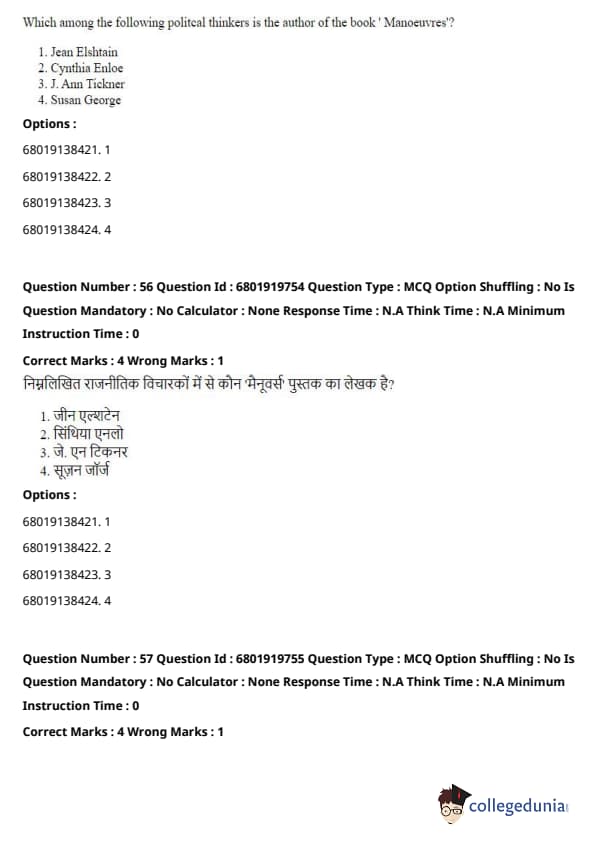
Question 56:
Which among the following political thinkers is the author of the book 'Manoeuvres'?
View Solution
Solution: Cynthia Enloe is a prominent feminist political thinker known for her work on militarism and feminism. The book "Manoeuvres” critically examines the roles of women in the military and how militarism affects gender roles.
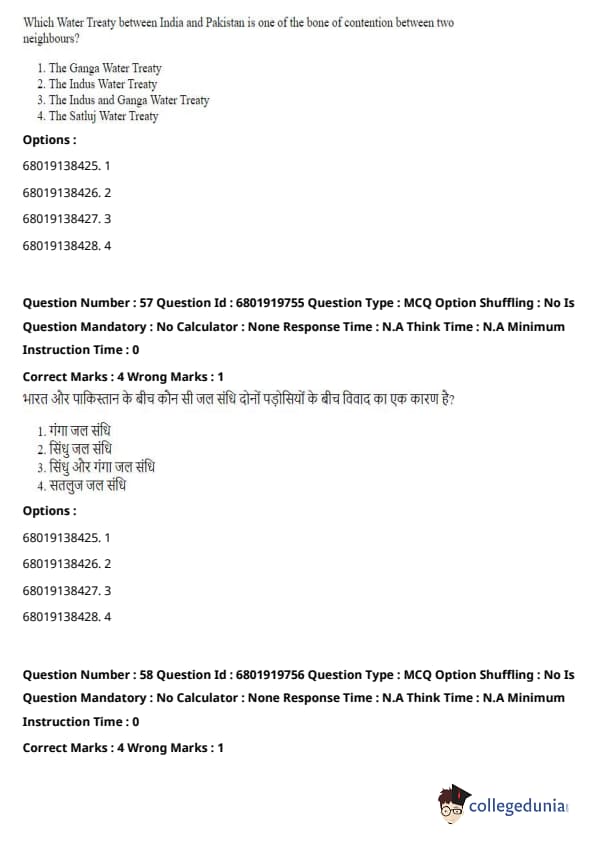
Question 57:
Which Water Treaty between India and Pakistan is one of the bone of contention between two neighbours?
View Solution
Solution: The Indus Water Treaty, signed in 1960, is an agreement between India and Pakistan to share the water of the Indus River system. It often causes disputes due to concerns over water distribution and usage.
Question 58:
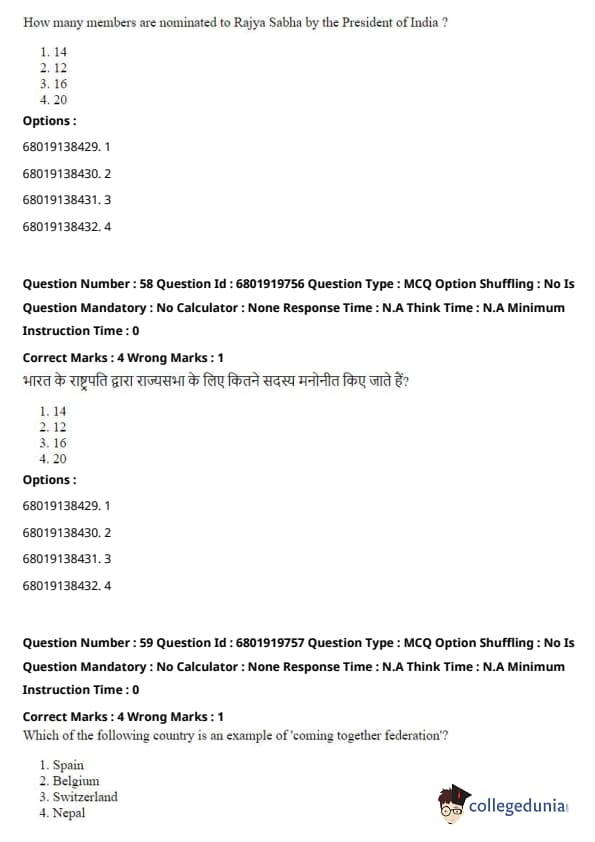
How many members are nominated to Rajya Sabha by the President of India?
View Solution
Solution: The President of India nominates 12 members to the Rajya Sabha. These members are chosen for their expertise in fields like literature, science, art, and social services as per Article 80 of the Constitution.
Question 59:
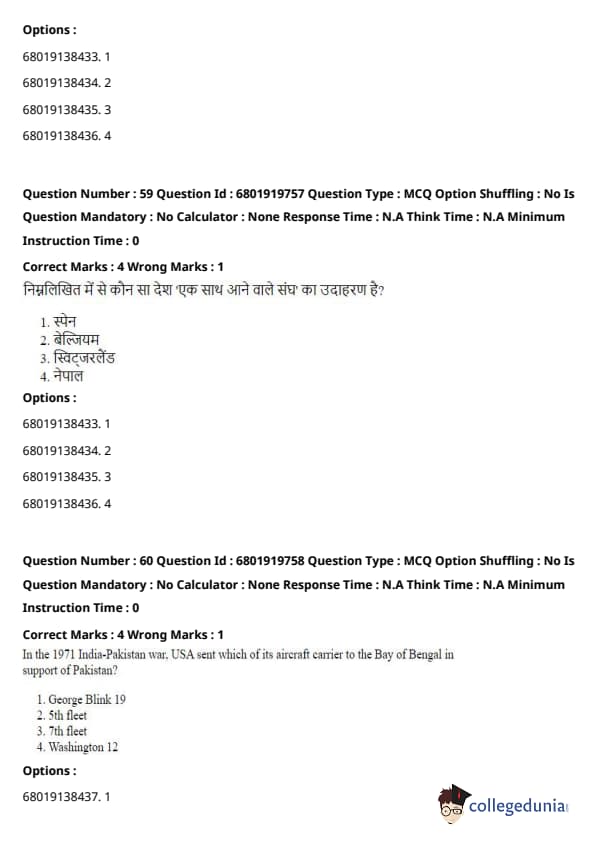
Which of the following country is an example of 'coming together federation'?
View Solution
Solution: A ‘coming together federation’ occurs when independent states voluntarily unite to form a larger political entity. Switzerland is a prime example, where various cantons came together to form the Swiss Confederation.
Question 60:
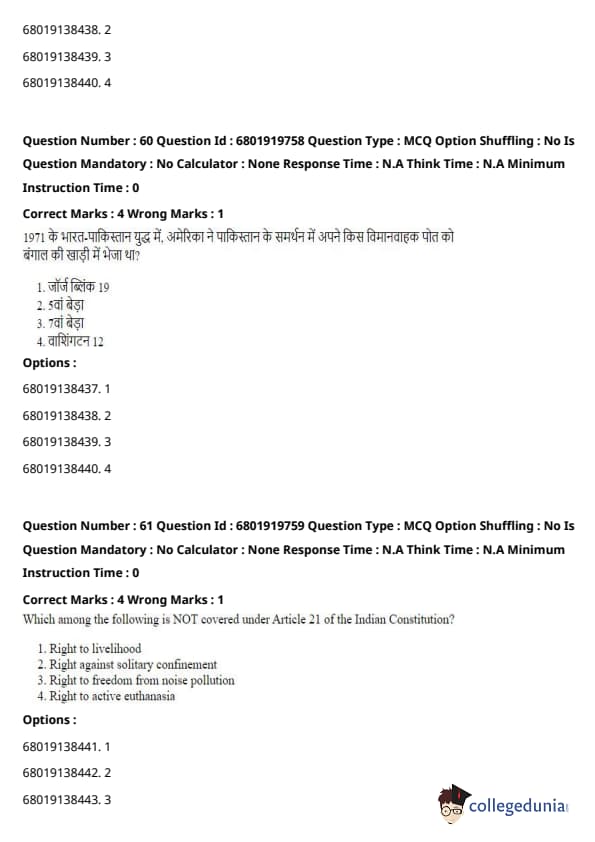
In the 1971 India-Pakistan war, USA sent which of its aircraft carrier to the Bay of Bengal in support of Pakistan?
View Solution
Solution: During the 1971 war between India and Pakistan, the USA sent the 7th fleet to the Bay of Bengal. This move was seen as a demonstration of support for Pakistan amidst growing tensions in the region.
Question 61:
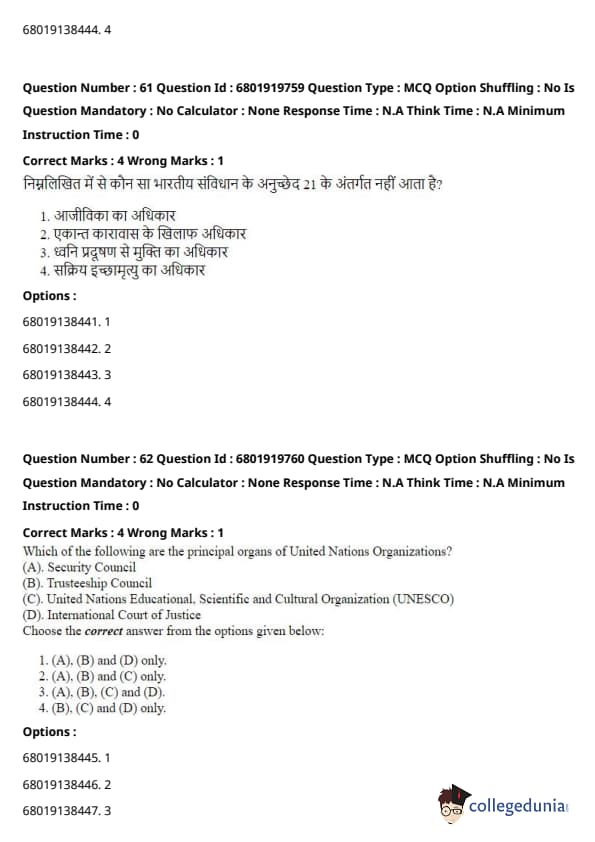
Which among the following is NOT covered under Article 21 of the Indian Constitution?
View Solution
Solution: Article 21 of the Indian Constitution guarantees the right to life and personal liberty. This includes rights such as livelihood, protection against solitary confinement, and freedom from noise pollution. However, active euthanasia is not covered under this Article.
Question 62:
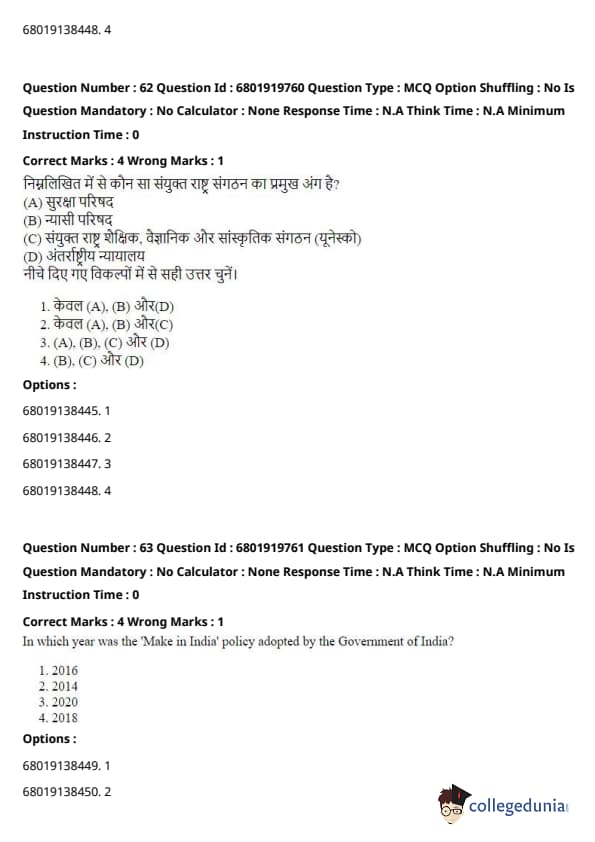
Which of the following are the principal organs of the United Nations Organizations?
(A) Security Council
(B) Trusteeship Council
(C) United Nations Educational, Scientific and Cultural Organization (UNESCO)
(D) International Court of Justice
Options:
View Solution
Solution: The principal organs of the United Nations include:
(A) Security Council
(B) Trusteeship Council (inactive since 1994 but remains part of the structure)
(D) International Court of Justice.
UNESCO (C) is a specialized agency, not a principal organ.
Question 63:
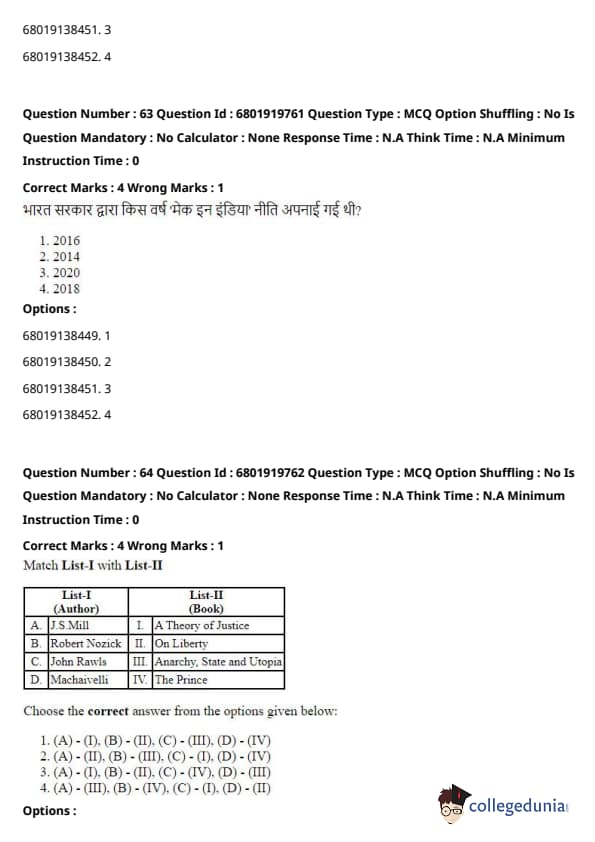
In which year was the 'Make in India' policy adopted by the Government of India?
View Solution
Solution: The ‘Make in India’ initiative was launched in 2014 by the Government of India to encourage companies to manufacture and invest in India. It aimed at boosting employment and economic growth by promoting domestic production.
Question 64:
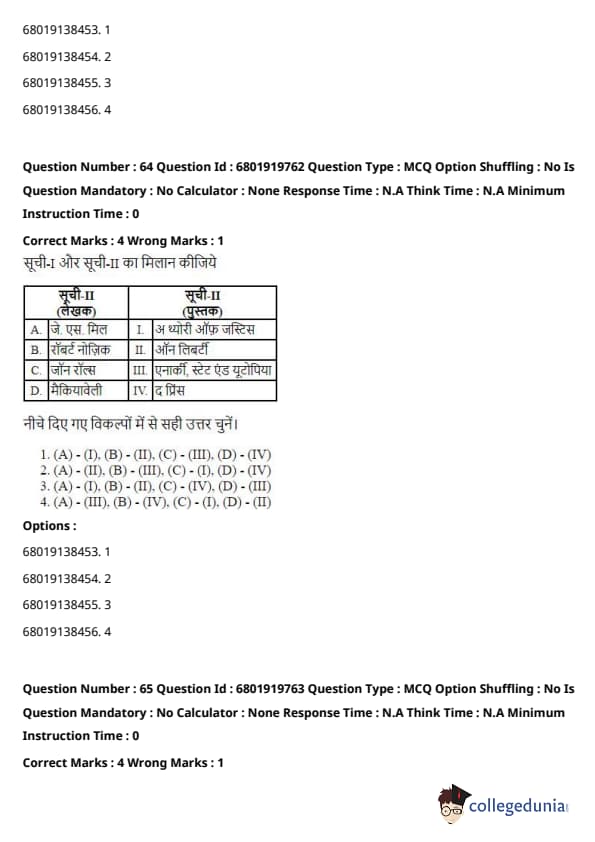
Match List-I with List-II:
| List-I (Author) | List-II (Book) |
|---|---|
| A. J.S. Mill | I. A Theory of Justice |
| B. Robert Nozick | II. On Liberty |
| C. John Rawls | III. Anarchy, State and Utopia |
| D. Machiavelli | IV. The Prince |
Options:
View Solution
Solution:
(A) J.S. Mill authored "On Liberty".
(B) Robert Nozick authored "Anarchy, State and Utopia".
(C) John Rawls authored "A Theory of Justice".
(D) Machiavelli authored "The Prince”.
Question 65:
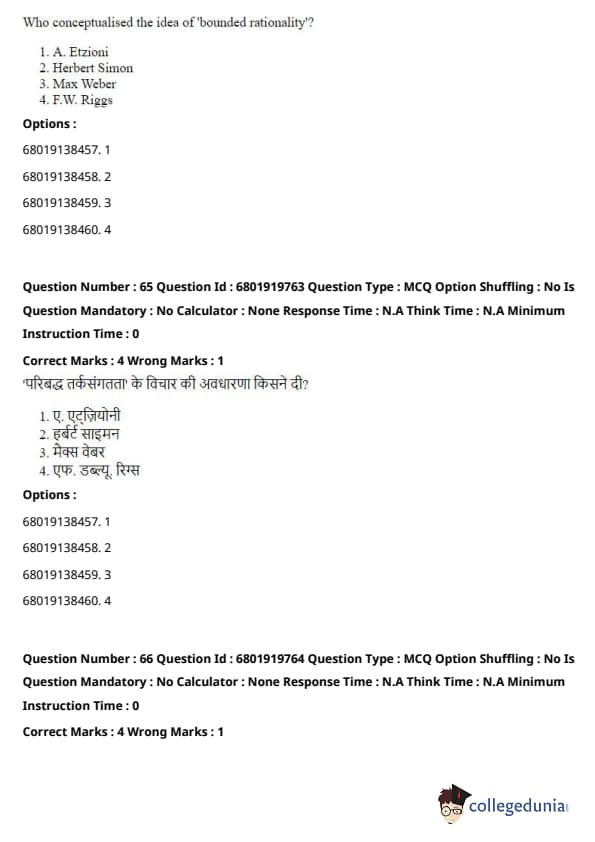
Who conceptualised the idea of 'bounded rationality'?
View Solution
Solution: Herbert Simon introduced the concept of ‘bounded rationality’, which suggests that individuals make decisions within the constraints of limited information, cognitive limitations, and time.
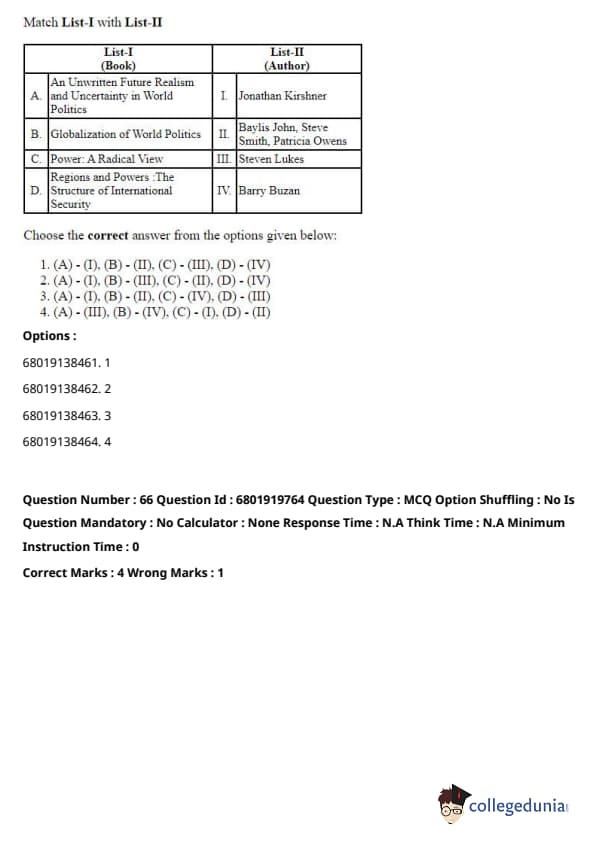
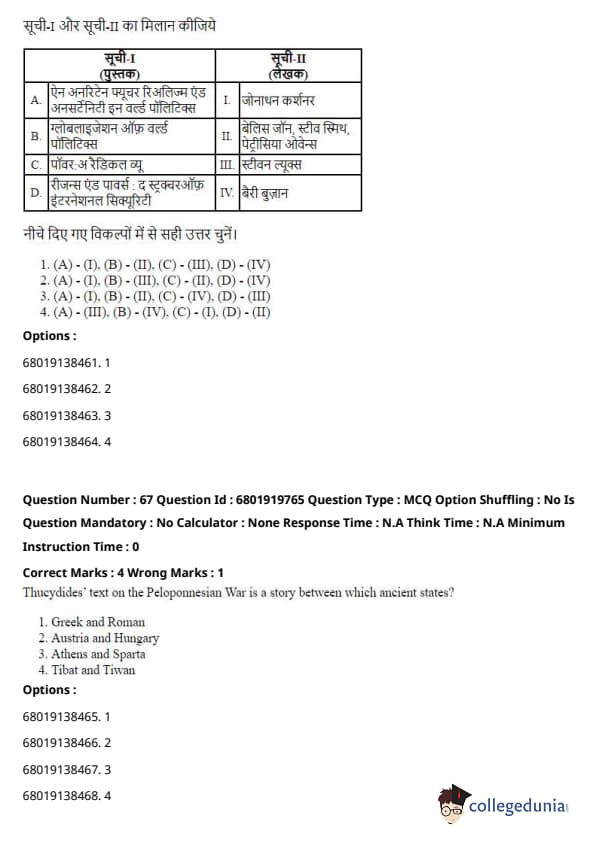
Question 66:
Match List-I with List-II:
| List-I (Book) | List-II (Author) |
|---|---|
| A. An Unwritten Future: Realism and Uncertainty in World Politics | I. Jonathan Kirshner |
| B. Globalization of World Politics | II. Baylis John, Steve Smith, Patricia Owens |
| C. Power: A Radical View | III. Steven Lukes |
| D. Regions and Powers: The Structure of International Security | IV. Barry Buzan |
Options:
View Solution
Solution:
(A) "An Unwritten Future: Realism and Uncertainty in World Politics” was authored by Jonathan Kirshner.
(B) "Globalization of World Politics” was authored by Baylis John, Steve Smith, and Patricia Owens.
(C) "Power: A Radical View” was authored by Steven Lukes.
(D) "Regions and Powers: The Structure of International Security" was authored by Barry Buzan.
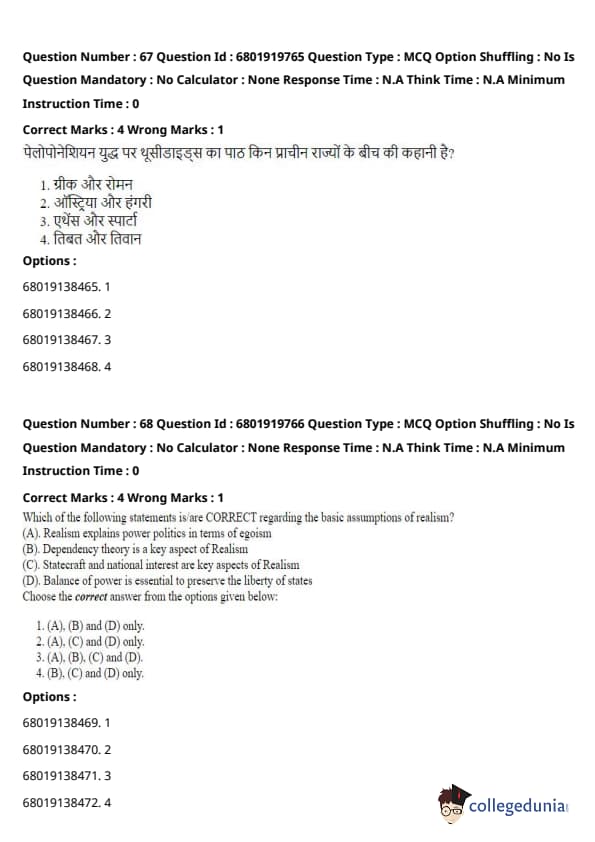
Question 67:
Thucydides' text on the Peloponnesian War is a story between which ancient states?
View Solution
Solution: The Peloponnesian War, as detailed by Thucydides, was a conflict between the Greek city-states of Athens and Sparta. It highlights the dynamics of power and war strategies in ancient Greece.
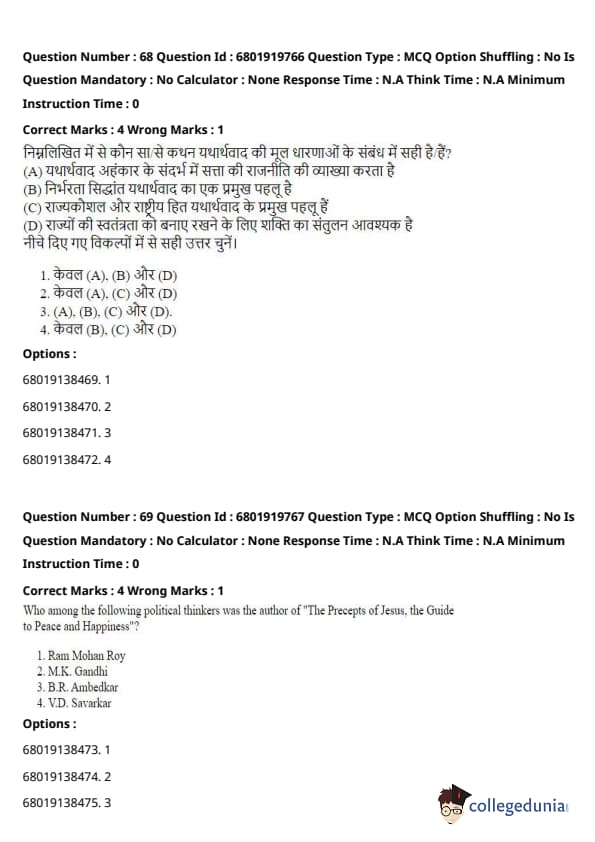
Question 68:
Which of the following statements is/are CORRECT regarding the basic assumptions of realism?
(A) Realism explains power politics in terms of egoism.
(B) Dependency theory is a key aspect of Realism.
(C) Statecraft and national interest are key aspects of Realism.
(D) Balance of power is essential to preserve the liberty of states.
Options:
View Solution
Solution:
(A) Correct: Realism emphasizes the role of egoism in power politics.
(B) Incorrect: Dependency theory is not associated with Realism; it belongs to critical theories.
(C) Correct: Statecraft and national interest are fundamental to Realism.
(D) Correct: The balance of power is a central concept in maintaining liberty and avoiding dominance.
Question 69:
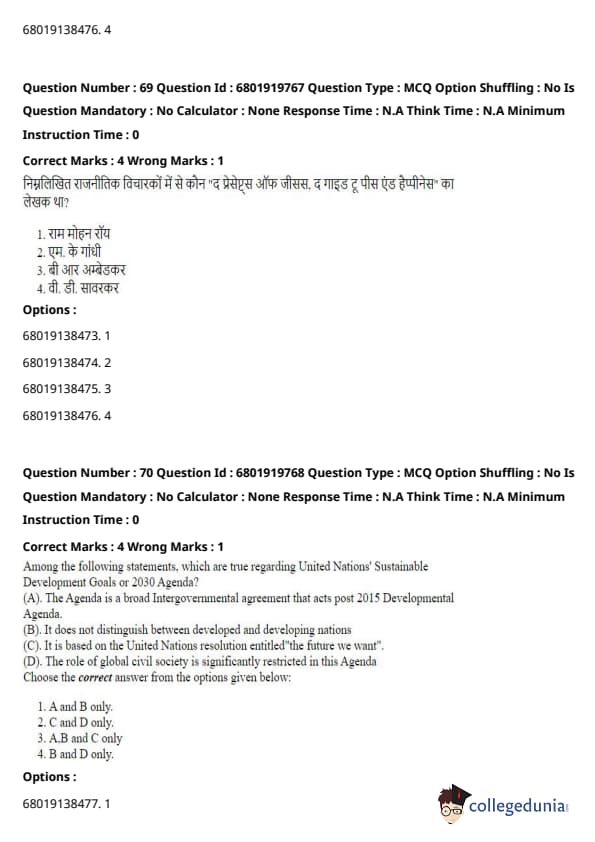
Who among the following political thinkers was the author of "The Precepts of Jesus, the Guide to Peace and Happiness"?
View Solution
Solution: "The Precepts of Jesus, the Guide to Peace and Happiness” was authored by Raja Ram Mohan Roy in 1820. It aimed to emphasize the moral teachings of Jesus while challenging orthodox Hinduism.
Question 70:
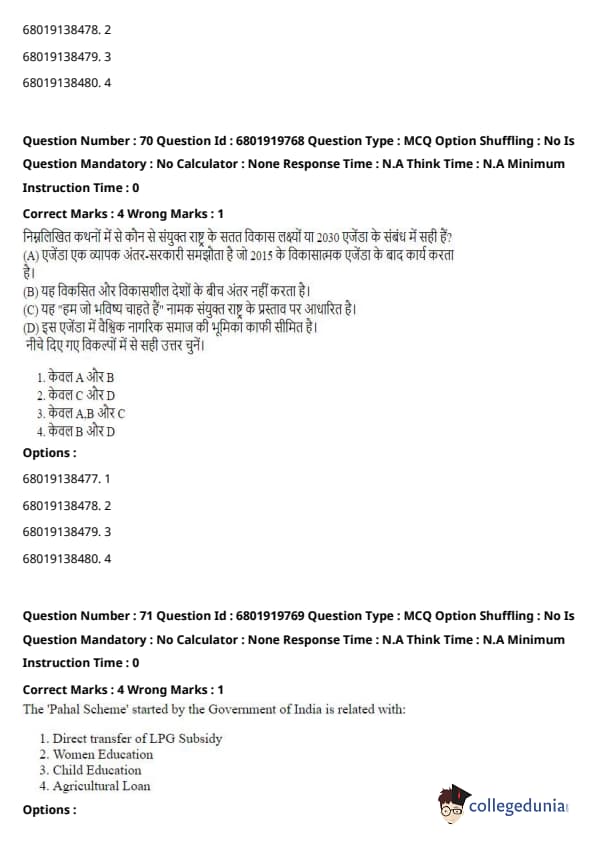
Among the following statements, which are true regarding United Nations' Sustainable Development Goals or 2030 Agenda?
Options:
View Solution
Solution:
A) True: The 2030 Agenda was adopted post-2015 as a global developmental framework.
B) True: The SDGs are universal and apply equally to all nations.
C) True: It was based on the resolution titled "the future we want”.
D) False: The role of civil society is crucial and emphasized in the Agenda.
Question 71:
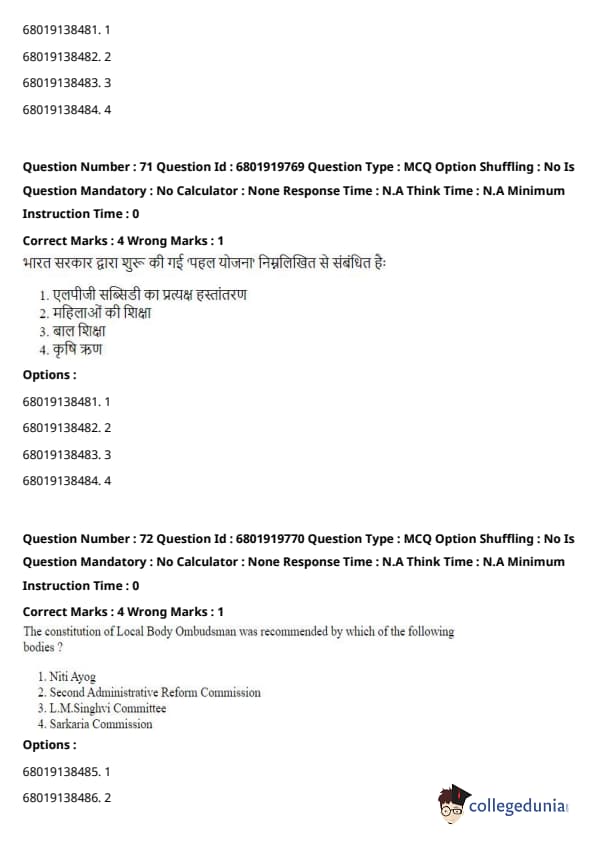
The 'Pahal Scheme' started by the Government of India is related with:
View Solution
Solution: The ‘Pahal Scheme’ (Pratyaksh Hanstantrit Labh) was launched to ensure the direct transfer of LPG subsidies to consumers' bank accounts. This initiative promotes efficiency, reduces leakages, and ensures transparency.
Question 72:
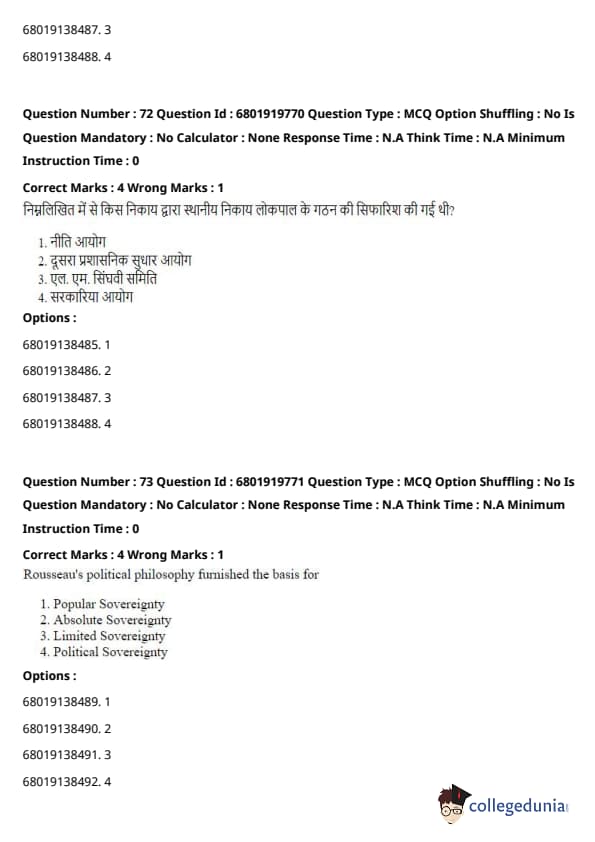
The constitution of Local Body Ombudsman was recommended by which of the following bodies?
View Solution
Solution: The Second Administrative Reform Commission recommended the establishment of a Local Body Ombudsman to enhance accountability, transparency, and address grievances related to the functioning of local self-government institutions. This was part of its broader agenda for administrative reforms in India.
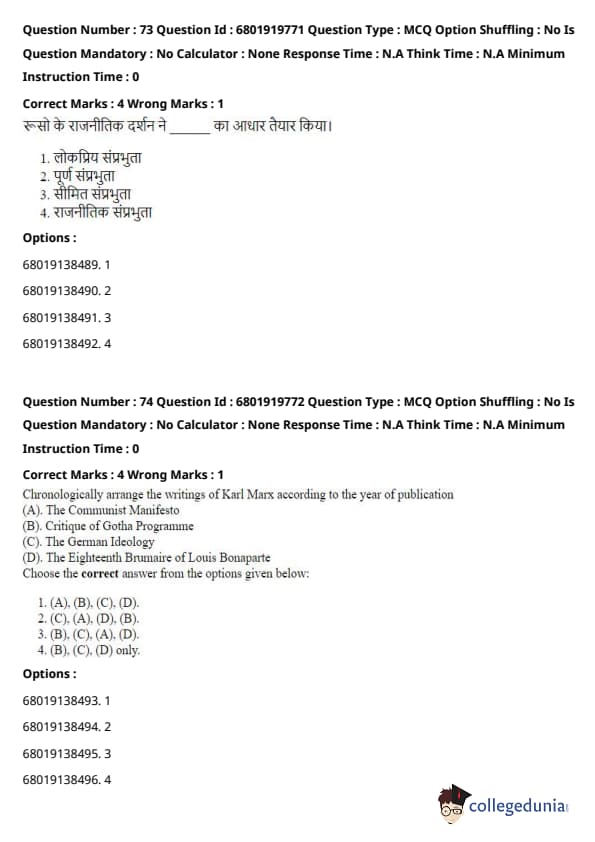
Question 73:
Rousseau’s political philosophy furnished the basis for:
View Solution
Solution: Rousseau’s philosophy emphasized that sovereignty resides with the people, forming the basis of the concept of popular sovereignty. His ideas inspired democratic ideals and social contract theories.
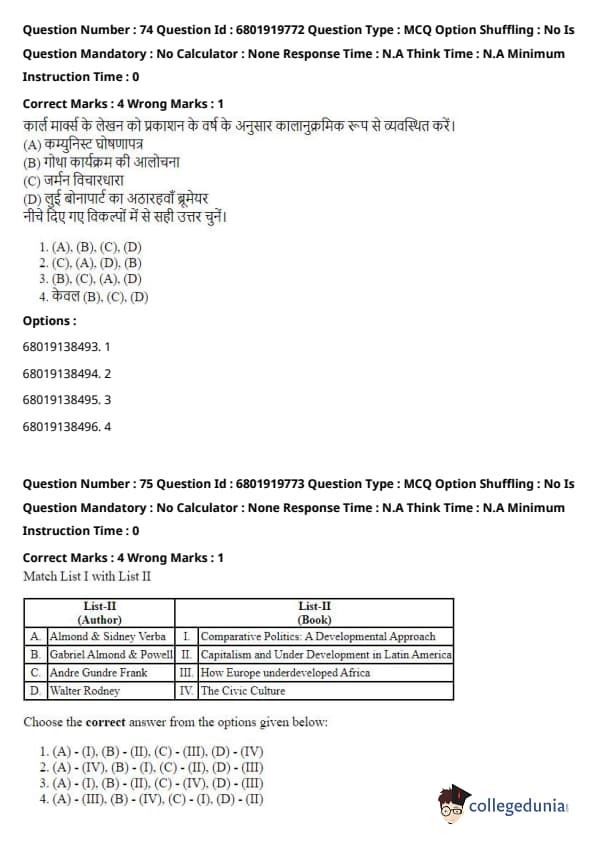
Question 74:
Chronologically arrange the writings of Karl Marx according to the year of publication:
(A) The Communist Manifesto
(B) Critique of Gotha Programme
(C) The German Ideology
(D) The Eighteenth Brumaire of Louis Bonaparte
Options:
View Solution
Solution:
(C) "The German Ideology” (1846)
(A) "The Communist Manifesto” (1848)
(D) "The Eighteenth Brumaire of Louis Bonaparte" (1852)
(B) "Critique of Gotha Programme” (1875)
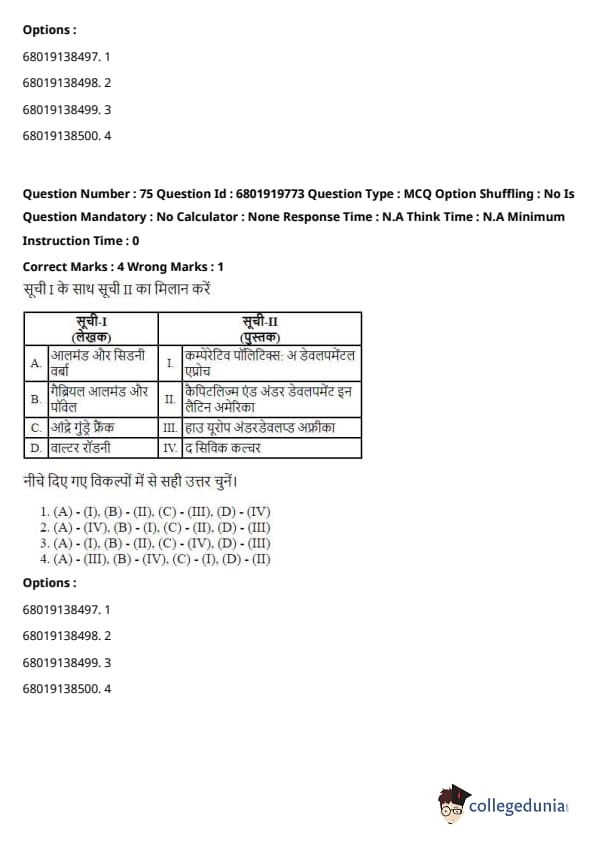
Question 75:
Match List-I with List-II:
| List-I (Author) | List-II (Book) |
|---|---|
| A. Almond & Sidney Verba | I. Comparative Politics: A Developmental Approach |
| B. Gabriel Almond & Powell | II. Capitalism and Underdevelopment in Latin America |
| C. Andre Gunder Frank | III. How Europe underdeveloped Africa |
| D. Walter Rodney | IV. The Civic Culture |
Options:
View Solution
Solution:
(A) "The Civic Culture” was authored by Almond Sidney Verba.
(B) "Comparative Politics: A Developmental Approach" was authored by Gabriel Almond Powell.
(C) "Capitalism and Underdevelopment in Latin America” was authored by Andre Gunder Frank.
(D) "How Europe Underdeveloped Africa” was authored by Walter Rodney.





Comments