




XAT 2016 Question paper with answer key pdf conducted on January 3, 2016 in Forenoon Session is available for download. The exam was successfully organized by XLRI Jamshedpur. The question paper comprised a total of 103.0 questions divided among four sections.
XAT 2016 Question Paper with Answer Key PDFs in English -(Forenoon Session)
| XAT 2016 Question Paper with Solutions PDF | Download PDF | Check Solutions |
XAT 2016 Questions with Solutions
Which of the following Options best captures the relationship similar to INSPECT : VIVISECT?
Read the following poem and answer the question that follows:
I sought a soul in the sea
And found a coral there
Beneath the foam for me
An ocean was all laid bare.
Into my heart’s night
Along a narrow way
I groped; and lo! The light,
An infinite land of day.
Which of the following would best capture the ESSENCE of the poem above?
“Assumptions are analogous to the basic ingredients in a gourmet recipe. Only the final product of the recipe dictates whether the ingredients suffice………”
Which of the following is ANALOGOUS to the statement above?
The FIRST and the LAST sentences of the paragraph are numbered 1 & 6. The others, labelled as P, Q, R and S are given below. Arrange them to form the MOST LOGICALLY ORDERED paragraph.
1. Suppose I know someone, Smith.
P. One day you come to me and say: “Smith is in Cambridge.”
Q. I inquire, and find you stood at Guildhall and saw at the other end a man and said: “That was Smith.”
R. I’d say: “Listen. This isn’t sufficient evidence.”
S. I’ve heard that he has been killed in a battle in this war.
6. If we had a fair amount of evidence he was killed I would try to make you say that you’re being credulous.
Which of the following combinations is the MOST LOGICALLY ORDERED?
The FIRST and the LAST sentences of the paragraph are numbered 1 & 6. The others, labelled as P, Q, R and S, are given below. Arrange them to form the MOST LOGICALLY ORDERED paragraph.
1. The word “symmetry” is used here with a special meaning, and therefore needs to be defined.
P. For instance, if we look at a vase that is left-and-right symmetrical, then turn it \(180^\circ\) around the vertical axis, it looks the same.
Q. When we have a picture symmetrical, one side is somehow the same as the other side.
R. When is a thing symmetrical — how can we define it?
S. Professor Hermann Weyl has given this definition of symmetry: a thing is symmetrical if one can subject it to a certain operation and it appears exactly the same after operation.
6. We shall adopt the definition of symmetry in Weyl’s more general form, and in that form we shall discuss symmetry of physical laws.
Which of the following combinations is the MOST LOGICALLY ORDERED?
In recent past, Indian football team has lost most of the matches in international football tournaments. The most successful coaches in Indian club football tournaments are from Latin American countries. In most of the Latin American countries, football is more popular sport than cricket.
From the passage above, choose the correct option:
Choose the best pronunciation of the word, Sobriquet, from the following options:
Consider the two related statements below:
Statement I: Offices and positions for the marginalized sections should be open to those with greater savings among them.
Statement II: Offices and positions must be open to everyone based on the principle of fair opportunity.
This season will pass. The Prime Minister may not win Lok Sabha elections, or she may; she may not continue as Prime Minister, or she may. The country will survive whatever the texture of politics in this decade or the next.
Which of the following, IF TRUE, will BEST reinforce the author's view?
The subject of this book is knavery, skullduggery, cheating, betrayal, unfairness, crime, sneakiness, malingering, cutting corner, immorality, dishonesty, betrayal, graft, wickedness, and sin.
Which of the following options best captures ALL the italicized words above?
Read the following conversation:
OINOS: I can comprehend you thus far—that certain operations of what we term Nature, or the natural laws, will, under certain conditions, give rise to that which has all the appearance of creation. Shortly before the final overthrow of the earth, there were, I well remember, many very successful experiments in what some philosophers were weak enough to denominate the creation of animalculae.
AGATHOS: The cases of which you speak were, in fact, instances of the secondary creation—and of the only species of creation which has ever been, since the first word spoke into existence the first law.
Which of the following options CANNOT be DEFINITELY inferred based on the above conversation?
... there is a degree of convergence in the definition of trust which can be summarized as follows: Trust is a particular level of the subjective probability with which an agent assesses that another agent or group of agents will perform a particular action. When we say we trust someone or that someone is trustworthy, we implicitly mean that the probability that he will perform an action that is beneficial to us….
Which of the following statement BEST COMPLETES the passage above?
Analyse the following passage and provide appropriate answers for the questions that follow: An effective way of describing what interpersonal communication is or is not, is perhaps to capture the underlying beliefs using specific game analogies.
Communication as Bowling: The bowling model of message delivery is probably the most widely held view of communication. I think that’s unfortunate. This model sees the bowler as the sender, who delivers the ball which is the message. As it rolls down the lane (the channel), clutter on the boards (noise) may deflect the ball (the message). Yet if it is aimed well, the ball strikes the passive pins (the target audience) with a predictable effect. In this one-way model of communication, the speaker (bowler) must take care to select a precisely crafted message (ball) and practice diligently to deliver it the same way every time. Of course, that makes sense only if target listeners are interchangeable, static pins waiting to be bowled over by our words — which they aren’t. This has led some observers to propose an interactive model of interpersonal communication.
Communication as Ping-Pong: Unlike bowling, Ping-Pong is not a solo game. This fact alone makes it a better analogy for interpersonal communication. One party puts the conversational ball in play, and the other gets into position to receive. It takes more concentration and skill to receive than to serve because while the speaker (server) knows where the message is going, the listener (receiver) doesn’t. Like a verbal or nonverbal message, the ball may appear straightforward yet have a deceptive spin. Ping-Pong is a back-and-forth game; players switch roles continuously. One moment the person holding the paddle is an initiator; the next second the same player is a responder, gauging the effectiveness of his or her shot by the way the ball comes back. The repeated adjustment essential for good play) closely parallels the feedback process described in a number of interpersonal communication theories.
Communication as Dumb Charades: The game of charades best captures the simultaneous and collaborative nature of interpersonal communication. A charade is neither an action, like bowling a strike, nor an interaction, like a rally in Ping-Pong. It’s a transaction. Charades is a mutual game; the actual play is cooperative. One member draws a title or slogan from a batch of possibilities and then tries to act it out visually for teammates in a silent mini drama. The goal is to get at least one partner to say the exact words that are on the slip of paper. Of course, the actor is prohibited from talking out loud. Suppose you drew the saying “God helps those who help themselves.” For God you might try folding your hands and gazing upward. For helps you could act out offering a helping hand or giving a leg-up boost over a fence. By pointing at a number of real or imaginary people you may elicit a response of them, and by this point a partner may shout out, “God helps those who help themselves.” Success.
Like charades, interpersonal communication is a mutual, ongoing process of sending, receiving, and adapting verbal and nonverbal messages with another person to create and alter images in both of our minds. Communication between us begins when there is some overlap between two images, and is effective to the extent that overlap increases. But even if our mental pictures are congruent, communication will be partial as long as we interpret them differently. The idea that “God helps those who help themselves” could strike one person as a hollow promise, while the other might interpret it as a statement of approval for hard work. Dumb Charade goes beyond the simplistic model of bowling and Ping-Pong. It views interpersonal communication as a complex transaction in which overlapping images form and change continuously in response to various personal and relational factors.
Question 13:
The meaning CLOSEST to ‘interchangeable’ in the ‘Communication as Bowling’ paragraph is:
Which of the following options is the CLOSEST to the necessary condition of communication:
The two inherent LIMITATIONS of Ping-Pong as a metaphor for communication are:
Action, interaction and transaction is CLOSEST to:
Analyse the following passage and provide appropriate answers for the questions that follow:
Advances in economic theory in the 1970s and 1980s illuminated the limits of markets; they showed that unfettered markets do not lead to economic efficiency whenever information is imperfect or markets are missing (for instance, good insurance markets to cover the key risks confronting individuals). And information is always imperfect and markets are always incomplete. Nor do markets, by themselves, necessarily lead to economic efficiency when the task of a country is to absorb new technology, to close the “knowledge gap”: a central feature of development. Today, most academic economists agree that markets, by themselves, do not lead to efficiency; the question is whether government can improve matters.
While it is difficult for economics to perform experiments to test their theories, as a chemist or a physicist might, the world provides a vast array of natural experiments as dozens of countries try different strategies. Unfortunately, because each country differs in its history and circumstances and in the myriad of details in the policies — and details do matter — it is often difficult to get a clear interpretation.
What is clear, however, is that there have been marked differences in performance, that the most successful countries have been those in Asia, and that in most of the Asian countries, government played a very active role. As we look more carefully at the effects of particular policies, these conclusions are reinforced: there is a remarkable congruence between what economic theory says government should do and what the East Asian governments actually did. By the same token, the economic theories based on imperfect information and incomplete risk markets that predicted that the free flow of short-term capital — a key feature of market fundamentalist policies — would produce not growth but instability have also been borne out.
Question 17:
“… whether government can improve matters”. Here ‘matters’ indicates
Which of the following options CANNOT be inferred from the above passage?
Which of the following statements BEST captures the ESSENCE of the two paragraphs in the above passage?
Analyse the following passage and provide appropriate answers for the questions that follow:
The base of Objectivism according to Ayan Rand is explicit: “Existence exists — and the act of grasping that statement implies two corollary axioms: that something exists which one perceives and that one exists processing consciousness, consciousness being the faculty of perceiving that which exists.”
Existence and consciousness are facts implicit in every perception. They are the base of all knowledge (and the precondition of proof): knowledge presupposes something to know and someone to know it. They are absolutes which cannot be questioned or escaped: every human utterance, including the denial of these axioms, implies their use and acceptance. The third axiom at the base of knowledge — an axioms true, in Aristotle’s words, of “being qua being” — is the Law of Identity. This law defines the essence of existence: to be is to be something, a thing is what it is; and leads to the fundamental principle of all action, the law of causality. The law of causality states that a thing’s actions are determined not by chance, but by its nature, i.e. by what it is. It is important to observe the interrelation of these three axioms. Existence is the first axiom. The universe exists independent of consciousness. Man is able to adapt his background to his own requirements, but “Nature, to be commanded, must be obeyed” (Francis Bacon). There is no mental process that can change the laws of nature or erase facts. The function of consciousness is not to create reality, but to apprehend it. “Existence is Identity, Consciousness is Identification.”
Question 20:
Which of the following is DEFINITELY CORRECT according to the passage:
Which of the following is the ESSENCE of ‘The law of Causality’?
Which of the following can be best captured as ‘Identity’ and ‘Identification’?
The author would interpret Francis Bacon’s “Nature, to be commanded, must be obeyed” as:
Analyse the following passage and provide appropriate answers for the questions that follow:
Each piece, or part, of the whole of nature is always merely an approximation to the complete truth, or the complete truth so far as we know it. In fact, everything we know is only some kind of approximation, because we know that we do not know all the laws as yet. Therefore, things must be learned only to be unlearned again or, more likely, to be corrected. The principal of science, the definition, almost, is the following: The test of all knowledge is experiment. Experiment is the sole judge of scientific “truth.” But what is the source of knowledge? Where do the laws that are to be tested come from? Experiment, itself, helps to produce these laws, in the sense that it gives us hints. But also needed is imagination to create from these hints the great generalizations — to guess at the wonderful, simple, but very strange patterns beneath them all, and then to experiment to check again whether we have made the right guess. This imagining process is so difficult that there is a division of labour in physics: there are the theoretical physicists who imagine, deduce, and guess at new laws, but do not experiment; and then there are experimental physicists who experiment, imagine, deduce, and guess.
We said that the laws of nature are approximate: that we first find the “wrong” ones, and then we find the “right” ones. Now, how can an experiment be “wrong”? First, in a trivial way: the apparatus can be faulty and you did not notice. But these things are easily fixed and checked back and forth. So without snatching at such minor things, how can the results of an experiment be wrong? Only by being inaccurate. For example, the mass of an object never seems to change; a spinning top has the same weight as a still one. So a “law” was invented: mass is constant, independent of speed. That “law” is now found to be incorrect. Mass is found to increase with velocity, but appreciable increase requires velocities near that of light. A true law is: if an object moves with a speed of less than one hundred miles a second the mass is constant to within one part in a million. In some such approximate form this is a correct law. So in practice one might think that the new law makes no significant difference. Well, yes and no. For ordinary speeds we can certainly forget it and use the simple constant mass law as a good approximation. But for high speeds we are wrong, and the higher the speed, the wronger we are.
Finally, and most interesting, philosophically we are completely wrong with the approximate law. Our entire picture of the world has to be altered even though the mass changes only by a little bit. This is a very peculiar thing about the philosophy, or the ideas, behind the laws. Even a very small effect sometimes requires profound changes to our ideas.
Question 24:
Which of the following options is DEFINITELY NOT an approximation to the complete truth?
Consider the two statements from the passage:
Statement I: The mass of an object never seems to change.
Statement II: Mass is found to increase with velocity.
Which of the following options CANNOT be concluded from the above passage?
‘Big Bang’ is a popular theory related to the origin of the universe. It states that the universe was the outcome of a big bang that released enormous energy.
Which of the following is the MOST PROBABLE inference about the big bang theory?
Analyse the following caselet and answer the questions that follow:
Indian Institute of Research is a Government-established body to promote research. In addition to helping in policy making, it also provides free online access to all the articles to the public. It has a mission of publishing high quality research articles. Till 2010, the publication of articles was very slow because there was no incentive for researchers to publish. Researchers stuck to the mandatory one article a year. Most of the researchers engaged in offering consultancy and earned extra income. Since its inception, the institute was considered the best place for cutting edge research.
The new director of the institute was not happy with the work done by researchers in silo and came out with a new research policy in 2013 to increase research output and improve collaboration among researchers. It was decided that extra benefits would be offered to researchers with new publications. As a result, the number of research articles increased fourfold in 2014.
At the 2015 annual audit, an objection was raised against increased expenses towards remuneration for researchers. Further, the Government opined that the publication was itself a reward and hence researchers need be paid nothing extra. The director tried to defend his policy but the response from the government was not encouraging. Note: Auditor’s role is to verify accounts.
Question 27:
The following facts were observed by an analytics team hired by the government to study the extant situation.
1. There was a four-fold increase in the number of researchers leaving the organization in 2014.
2. A researcher died while on duty.
3. The quality of articles published declined substantially.
4. The average number of people accessing an article decreased by 2%.
Which of the following options would justify the government’s intention to DISCONTINUE the scheme?
The director still wanted to persuade the government to review its stand. He had framed the following arguments:
1. Most famous researchers in the world are also the highest paid.
2. American institute of research gives extra benefits to its scientists.
3. This year’s highest paid researcher had won the Nobel Prize last year.
Considering the Government to be reasonable which of the following options is UNLIKELY to convince the Government?
The director wanted to promote good decision making at Indian Institute of Research. A few trusted colleagues offered the following suggestions:
1. Auditors need not be allowed to object to extra benefits schemes.
2. Auditors need not pin-point sudden increase in expenditure.
3. Auditors need not be consulted before taking any policy level decision.
Which of the following combination of options should the director agree THE MOST with?
Analyse the following caselet and answer the questions that follow:
Kamal Chinnappa, Vimal Rao, Ganesh Krishnan and Dinesh Kumar own a saloon each on the Barbil street. They are the only hairdressers on that street. Each of them offered three services viz. haircut, shaving and hair-dye. One evening, all four of them met in a nearby tea-stall and agreed to charge Rs. 100 for any of the three services (haircut, shave and hair-dye) on weekdays. They also agreed to increase this rate to Rs. 115 on weekends and holidays. All verbally decided to implement the agreement.
Question 30:
The following day Kamal, being the most competent hairdresser on the street, was contemplating charging higher than agreed upon price.
Which of the following would enable him to charge more with minimal violation of the agreement?
Vimal relies heavily on a bunch of loyal customers. He is concerned about retaining them.
Which of the following options should he choose if he does not want to violate the agreement?
Analyse the following caselet and answer the questions that follow:
The City of Yashmund is served by licensed taxis operating on officially sanctioned metered rates and driven by licensed drivers who do not own the taxis but pay a monthly rent to the taxi-owners. Shailesh Nair, the mayor of Yashmund, perceived that most of these taxis do not offer sufficient comfort and safety to passengers.
Question 32:
The Mayor wants the owners and drivers to care about comfort.
Which of the following decisions, IF TAKEN, is MOST LIKELY to increase the comfort levels of passengers?
The mayor wants to involve the car owners in finding a solution to the problem of comfort and safety. He is concerned that the customers may not be willing to pay more for safety. Which of the options below is MOST LIKELY to convince the owners?
Analyse the following caselet and answer the question that follow:
Chatterjee, the MLA of Trikathapur, owes his election success to his close friend and businessman Ghosh. The victory had appeared unlikely for Chatterjee after the arrival of Bhowmick, a budding politician with hordes of money. However, his clean image along with Ghosh’s money ensured Chatterjee’s resounding victory.
Question 34:
After the elections, Ghosh requested Chatterjee to sanction the land adjoining his factory, for expansion. However, the requested government land was a green belt reducing harmful pollution from the factory.
Which of the following is the BEST option for Chatterjee in these circumstances?
Inspired by Bhowmick’s manifesto, Chatterjee is contemplating a green policy which can adversely affect Ghosh’s business interest. Which of the following actions from Ghosh is likely to convince Chatterjee NOT to pursue this policy?
Amelia is disappointed with the performance of Nicky, Manoj and Benita. She came to know that ABC was not their first choice and they had spent the first ten months applying to other organizations. However, they have now started liking ABC and promised to do their best henceforth. Amelia has to rate their annual performance and decide about their future. She has the following choices:
1. Fire them from ABC for insincerity and save the organization’s time and money.
2. Give them average ratings with a year to prove their worth and fire them from ABC if they fail to show significant progress.
3. Impose a pay-cut of 15% since they have not delivered on the promise, but give them relatively high ratings.
4. Give them relatively poor ratings with one year time to improve and fire them from ABC if they fail to show significant progress.
5. Give them high ratings and give them a second chance to prove their worth.
Which of the following options rank the above choices in the order of MOST APPROPRIATE to LEAST APPROPRIATE?
Analyse the following caselet and answer the question that follow:
Nicky, Manoj and Benita are graduates from a top ranked B-school. They joined ABC corporation a year ago. ABC is known for its performance oriented culture. This is the first time the organization recruited from a top ranked B-school. They are part of a five member team with two others from lower ranked B-schools. Nicky, Manoj and Benita draw 40 percent higher salaries than other team members. This team reports to Amelia Ganeshmurthi, a senior Executive.
Question 37:
Recruiting Nicky, Manoj and Benita was part of a larger initiative to make the organization attractive to prospective employees. Recently Amelia’s boss informally told her that the trio’s perception of the organization might influence future recruitment from top B-schools. However, the trio had already expressed their unhappiness about the organization to Amelia. She suspected that her promotion due next year might depend on the trio!
Which of the following is the BEST way for Amelia to deal with this situation?
Nicky’s performance on the job is disappointing though she is considered a very helpful person outside the workplace helping her teammates and others in the organization with their personal needs (e.g. finding a place to rent, a good place to get homely food etc.). On the other hand, Manoj and Benita are performing well in their respective jobs and are perceived by their teammates as important to the team. But they are not interested in helping outside the workplace. Amelia has to decide the future of the trio. She has the following options:
1. Inform the higher authorities about Nicky’s poor performance and ask them to take a call.
2. Send Nicky for a one month training earmarked for top performing employees.
3. Serve Nicky an ultimatum to improve within the next six months or get fired.
4. Even though they performed well, give Manoj and Benita average ratings because of their disinterest in helping outside workplace.
5. Give Manoj and Benita high ratings based on their performance.
Rajan Shekhawat, the CEO of the company, feared this incident might affect the company’s image among consumers. Rajan had the following options:
1. Apologizing publicly for this inconvenience and immediately withdrawing the products from all stores.
2. Communicate ‘the correct findings’ to the public.
3. Hire a reputed independent testing agency to verify the claims of the report.
4. Establish internal mechanisms to prevent repetition of such incidences in future.
5. Give higher incentives to distributors and retailers for selling the company brands.
Which of the following would be the MOST APPROPRIATE ORDER of options for Rajan, starting from the immediate?
Mukesh Routray, a shopkeeper in a remote village, read in the newspaper (his only source) about harmful chemicals in Crunchy Chips. He had stocked a large quantity for the festive season and realized people in his village are unaware of the controversy. He has the following options:
1. Sell the entire stock at a discount before the news spreads.
2. Destroy the entire stock and advise customers not to buy this product from other shops as well.
3. Donate the entire stock of Crunchy Chips to a local orphanage.
4. Inform customers about the controversy but understate its seriousness.
5. Ignore the news and sell the stock at the forthcoming festive season as planned.
6. Explore the veracity of the report and then take a decision.
If arranged from ethical to unethical, which of the following is DEFINITELY the WRONG order?
An independent and trustworthy confidante of Rajan Shekhawat, the CEO of the company, informed him that one of their main competitors had bribed the food testing agency to manipulate the report.
Which of the following actions will BEST help Crunchy Chips to bounce back?
Analyse the following caselet and answer the question that follow:
Purushottam Bhatnagar own and operates a sweetshop Puru and Sons. He is about 60 years old is eager to hand over the business to his sons Ratan and Pramod. He however, fears that his sons, fresh from college may not understand the tricks of the trade.
Question 42:
Purushottam sends a batch of sweets to the police station across the street every day. Ratan construed it as a bribe and wanted to stop this practice. Which of the following arguments, IF TRUE, would BEST convince Ratan NOT to give up this practice?
Purushottam’s eldest son discovered that the shop repackaged sweets that were close to expiry and sold them at a discount under different names. These sweets usually get sold very fast. But his son was concerned about the possible consequences of this practice.
Purushottam was thinking of the following arguments to convince his son:
1. These sweets are consumed the same day and therefore there is no cause for worry.
2. Reduced prices give enough indication about the sweets to the customers.
3. These products are preferred by those who cannot afford full price and in a way, this is a service done to them.
4. In the past 30 years not a single person has reported ill because of consumption of these sweets.
5. Repacking and selling sweets is a common practice.
Which combination of arguments below is MOST LIKELY to convince Ratan?
Purushottam’s younger son Pramod discovered that 10% of their customers—whom Purushottam called “privileged customers”—purchased sweets at prices fixed 10 years ago (significantly lower than current prices). Purushottam said, “This 10% are my core and loyal customers with whom I have a personal connect; therefore they deserve this privilege.” Pramod refuted his father’s argument citing the following information:
1. These customers are from the top 20% income bracket of the city.
2. These customers frequently purchase from other sweetshops at market prices.
3. None of them recognises or greets Purushottam at the shop or elsewhere.
4. None of them was present at Pramod’s marriage.
5. These customers actually buy sweets at Puru & Sons for others not part of the core and loyal group.
Which combination is MOST LIKELY to convince Purushottam to charge market price to all?
Analyse the following caselet and answer the questions that follow: Six people working at the Bengaluru office of Simsys are planning to buy flats at a real estate project at Whitefield. Their preferences are listed below:
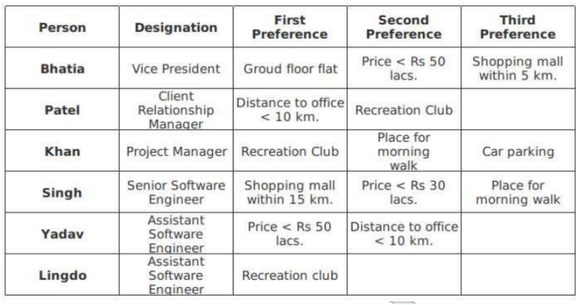
They have identified 7 real estate projects with following facilities available (marked with ):
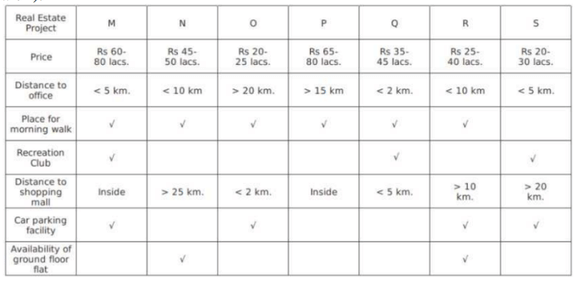
A person is ‘satisfied’ if a project meets all three preferences.
Question 45:
Identify the project(s) where NONE of the 6 persons will be ‘satisfied’.
Identify the project(s), where \(\textbf{AT LEAST 3}\) of the persons will be ‘satisfied’.
The marketing managers of all the six projects have agreed to add a recreation club and a car parking facility to the projects. In this changed scenario, identify projects where \(\textbf{AT MOST 2 of the 6 persons will NOT be ‘satisfied’}\).
Analyse the following caselet and answer the questions that follow: Geetha Gawde can cultivate up to 6 crops a year. Crop A and B are ready for harvest in 2 months; crop C and D in 3 months, and crop E and F in 4 months. Crop A can be cultivated from January to June; crop B can be cultivated from April to September; crop C can be cultivated from May to December; crops D as well as E can be cultivated from August to December, and crop F from November to May.
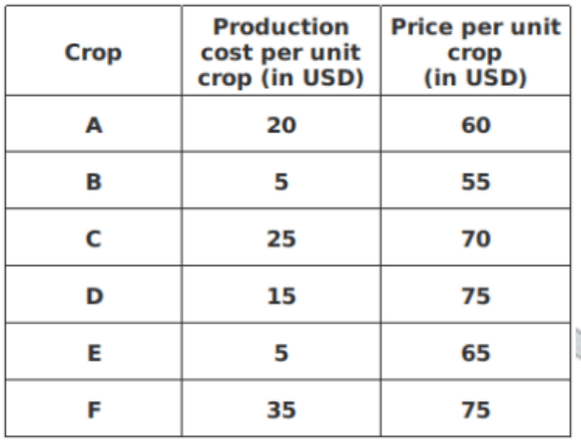
If Geetha plans a change of crop the soil should be left fallow for one month; however, if the same crop is sown no fallow time is needed. Sowing takes place only at the beginning of a month. Geetha can only harvest a maximum of 1000 units of any crop at any point in time. The production cost per unit (incurred at the time of sowing) and price per unit of crop are as follows:
Question 48:
Which of the following would DEFINITELY be a part of the ideal schedule?
Which of the following schedules would maximize her annual profit while minimizing the costs, if Geetha decides NOT to repeat a crop in a calendar year?
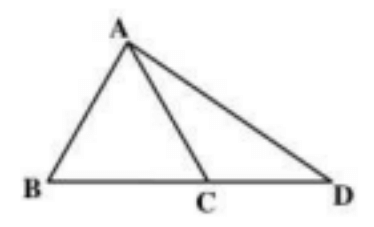
In the figure below, \(AB = AC = CD\). If \(\angle ADB = 20^\circ\), what is the value of \(\angle BAD\)?
In an amusement park, a visitor gets to ride on three different rides (A, B and C) for free. On a particular day 77 opted for ride A, 55 opted for B and 50 opted for C; 25 visitors opted for both A and C, 22 opted for both A and B, while no visitor opted for both B and C. 40 visitors did not opt for ride A or B (i.e., they were outside \(A \cup B\)). How many visited the amusement park on that day?
\(\triangle ABC\) and \(\triangle XYZ\) are equilateral triangles of side \(54 cm\). All smaller triangles like \(\triangle ANM,\ \triangle OCP,\ \triangle QPX\) etc. are also equilateral. Find the area of the shape \(MNOPQRM\).
Akhtar plans to cover a rectangular floor of dimensions \(9.5\) m and \(11.5\) m using tiles. Two types of square tiles are available: side \(1\) m costs Rs. 100, and side \(0.5\) m costs Rs. 30. Tiles can be cut if required. What is the minimum cost to cover the entire floor?
Anita, Biplove, Cheryl, Danish, Emily and Feroze compared their marks among themselves. Anita scored the highest marks, Biplove scored more than Danish, Cheryl scored more than at least two others and Emily had not scored the lowest.
Statement I: Exactly two members scored less than Cheryl.
Statement II: Emily and Feroze scored the same marks.
Which of the following statements would be sufficient to identify the one with the lowest marks?
Rani bought more apples than oranges. She sells apples at Rs. 23 apiece and makes 15% profit. She sells oranges at Rs. 10 apiece and marks 25% profit. If she gets Rs. 653 after selling all the apples and oranges, find her profit percentage.
Consider the set of numbers \(\{1,\,3,\,3^{2},\,3^{3},\,\ldots,\,3^{100}\}\). The ratio of the last number and the sum of the remaining numbers is closest to:
\(f\) is a function for which \(f(1)=1\) and \(f(x) = 2x + f(x-1)\) for each natural number \(x \geq 2\). Find \(f(31)\).
Two numbers in the base system \(B\) are \(2061_B\) and \(601_B\). The sum of these two numbers in decimal system is 432. Find the value of \(1010_B\) in decimal system.
A water tank has \(M\) inlet pipes and \(N\) outlet pipes. An inlet pipe can fill the tank in \(8\) hours while an outlet pipe can empty the full tank in \(12\) hours. If all pipes are left open simultaneously, it takes \(6\) hours to fill the empty tank. What is the relationship between \(M\) and \(N\)?
Company ABC starts an educational program in collaboration with Institute XYZ. As per the agreement, ABC and XYZ will share profit in \(60:40\) ratio. The initial investment of Rs. 100,000 on infrastructure is borne entirely by ABC whereas the running cost of Rs. 400 per student is borne by XYZ. If each student pays Rs. 2000 for the program, find the minimum number of students required to make the program profitable, assuming ABC wants to recover its investment in the very first year and the program has no seat limits.
Four persons walk from Point A to Point D following different routes.
The one following ABCD takes 70 minutes. Another person takes 45 minutes following ABD.
The third person takes 30 minutes following ACD. The last person takes 65 minutes following ACBD.
If all walk at the same speed, how long will it take to go from point B to point C?
Each day on Planet M is 10 hours, each hour 60 minutes and each minute 40 seconds. The inhabitants use a 10-hour analog clock. If such a clock shows \(\,3\) hours \(42\) minutes \(20\) seconds in a mirror, what will be the time on Planet M exactly after \(5\) minutes?
\(a, b, c\) are integers, \(|a| \ne |b| \ne |c|\) and \(-10 \le a,b,c \le 10\). What will be the maximum possible value of \([\,abc - (a+b+c)\,]\)?
A square piece of paper is folded three times along its diagonal to get an isosceles triangle whose equal sides are \(10\) cm. What is the area of the unfolded original piece of paper?
The difference between the area of the circumcircle and the area of the incircle of an equilateral triangle is \(2156\ cm^2\). What is the area of the equilateral triangle?
A person standing at point \(A\) on the ground saw an object at point \(B\) on the ground \(600\) m away. The object started flying towards him at an angle of \(30^\circ\) with the ground. The person saw it the second time at point \(C\) when the angle of elevation was \(30^\circ\). At \(C\), the object changed direction and continued flying upwards. The person saw it the third time when it was directly above him. The object flew at a constant speed of \(10\) kmph. Find the angle (with the ground) at which it flew after the second sighting. You may use additional statement(s) if required.
Statement I: After changing direction the object took \(3\) more minutes than it had taken before.
Statement II: After changing direction the object travelled an additional \(200\sqrt{3}\) metres.
Which of the following is correct?
For two positive integers \(a\) and \(b\), if \((a+b)^{(a+b)}\) is divisible by \(500\), then the least possible value of \(a\times b\) is:
Pradeep could either walk or drive to office. The time taken to walk to the office is \(8\) times the driving time. One day, his wife took the car making him walk to office. After walking \(1\) km, he reached a temple when his wife called to say that he can now take the car. Pradeep figures that continuing to walk to the office will take as long as walking back home and then driving to the office. Calculate the distance between the temple and the office.
If \(a,b,c\) are three consecutive integers between \(-10\) and \(+10\) (both inclusive), how many integer values are possible for \[ \frac{a^3+b^3+c^3+3abc}{(a+b+c)^2}\,? \]
In the figure, two circular arcs subtend \(60^\circ\) and \(90^\circ\) at their respective centres. If the length of the bottom arc \(Y\) is \(10\pi\), find the length of the other arc \(X\).
\(ABCD\) is a quadrilateral such that \(AD=9\ cm\), \(BC=13\ cm\) and \(\angle DAB=\angle BCD=90^\circ\). \(P\) and \(Q\) are two points on \(AB\) and \(CD\) respectively, such that \(DQ:BP=1:2\) and \(DQ\) is an integer. How many values can \(DQ\) take, for which the maximum possible area of the quadrilateral \(PBQD\) is \(150\ cm^2\)?
Instructions: Study the data given in the table below and answer the question that follow:
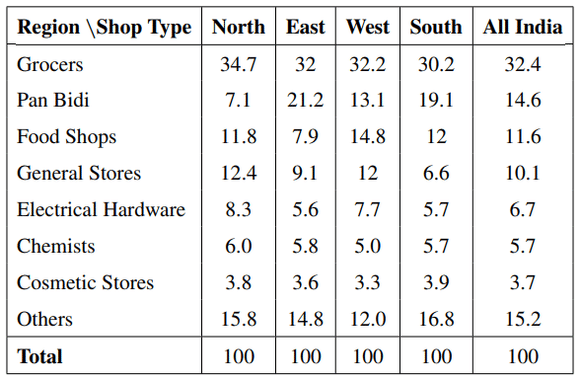
All figures are in percentage.
Based on survey of ‘shop types’ Kamath categorized Indian states into four geographical regions as shown in the table above. His boss felt that the categorization was inadequate since important labels were missing. Kamath argued that no further labels are required to interpret the data.
Question 72:
A consultant observing the data made the following two inferences:
Inference I: The number of Grocers per-thousand-population is the highest in North India.
Inference II: The number of Cosmetic per-thousand-population is the highest in South India.
Which of following options is DEFINITELY correct?
The average size of Food Shops in East India was twice that of Food Shops in West India. Which of the following cannot be inferred from the above data?
Bala collected the same data five years after Kamath, using the same categorization. His data is presented below (graph). Which of the following statements can definitely be concluded?
Instructions Study the graph below and answer the questions that follow:
This graph depicts the last eight years’ annual salaries (in Rs. lacs.) offered to student during campus placement. Every year 100 students go through placement process. However, at least one of them fails to get placed. The salaries of all unplaced students are marked zero and represented in the graph.
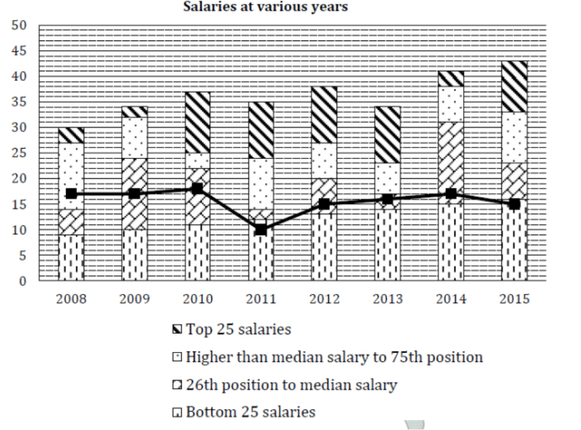
The bold line in the graph presents Mean salaries at various years.
Question 75:
In which year were a maximum number of students offered salaries between Rs. 20 to Rs. 30 lacs (both inclusive)?
Identify the years in which the annual median salary is higher by at least \(60%\) than the average salary of the preceding year.
Identify the number of years in which the difference between the average salaries of the top \(25%\) and the bottom \(25%\) is more than Rs. 20 lacs:
If the average salary is computed excluding students with no offers, in how many years will the new average salary be greater than the existing median salary? (Table gives the number of students without offers for each year.)
Elon Musk is closely associated with:
Raspberry Pi is a:
Which of the following films is not associated with Christopher Nolan?
Timbuktu is:
RuPay is related to:
Which Sea lies to the west of Yemen and Saudi Arabia?
In the budget Estimates of 2015-2016:
Consider the following statements:
1. Sinai is a part of Egypt.
2. Sinai is in Asia.
3. Sinai is in Africa.
4. Russian plane was downed in Sinai in November 2015.
Which of the above statements are true?
In 2015, which country was ranked number one as “best place to do business in”?
Perumal Murugan is a(n):
In percentage terms, which Indian state has the highest forest cover?
Meghnad Saha was a famous:
Read the following statements:
1. Russia supports President Assad of Syria.
2. Saudi Arabia opposes President Assad of Syria.
3. Iran supports President Assad.
4. The United President Assad.
Which of the above statements are true?
Angus Deaton is a famous:
Which of the following is not a conglomerate?
Plasmodium Vivax causes:
Pilatus PC-7 is a(n):
Which of the following commodity is not rightly matched with its country, if ‘right match’ is considered as one of the top five producers of that commodity?
Which of the following countries has the lowest External Debt?
Which of the following city is not related to the automobile industry?
Which of the following is the closest country to Antarctica?
The “New Horizon” was in news in 2015. It refers to:
The islands that are under dispute of ownership between Japan and China are:
The Inuit Paradox:
Takata Corporation was in the news recently because it:





Comments