




XAT 2022 Question paper with answer key pdf for the exam conducted on January 2, 2022 is available for download. The exam was conducted by XLRI Jamshedpur in online CBT mode. XAT 2022 was of moderate to high difficulty and the question paper comprised 100 MCQs from the 4 sections.
Also Check : XAT 2026 Question Paper with Solutions PDF
XAT 2022 Question Paper with Solutions PDF
| XAT 2022 Question Paper with Solutions PDF | Download PDF | Check Solutions |

XAT 2022 Question Paper Solutions
Read the poem carefully, and answer the following question.
Poem: I smiled at you because I thought that you
Were someone else; you smiled back; and there
Grew between two strangers in a library
Something that seems like love; but you loved me
(If that’s the word) because you thought that I
Was other than I was. And by and by
We found we’d been mistaken all the while
From that first glance, that first mistaken smile.
Question 1:
Which of the following CANNOT be inferred from the poem?
Which of the following sentences are grammatically CORRECT?
1. Have you any clothes to dispose of?
2. I saw a pleasant dream last night.
3. I have done it many a times safely.
4. Students struggle to cope up with academic pressure.
5. You need not give negative feedback to your employees.
6. My friend is good at playing football.
Carefully read the following statement:
When I ask people to name three recently implemented technologies that most impact our world today, they usually propose the computers, the Internet and the laser. All three were unplanned, _____, and _____ upon their discovery and remained _____ well after their initial use.
Which of the following options will BEST fill up the above blanks meaningfully?
Carefully read the following statement:
The moment we no longer have a free press, anything can happen. What makes it _____ for a totalitarian or any other dictatorship to rule is that _____ are not informed; how can you have an opinion if you are not informed? If everybody always lies to you, the _____ is not that you believe the lies, but rather that nobody believes anything any longer. This is because lies, by their very nature, have to be changed, and a lying government has _____ to rewrite its own history.
Which of the following options will BEST fill up the above blanks meaningfully?
Read the passage carefully and answer the following question:
Geologists have been investigating a potential cycle in geological events for a long time. Back in the 1920s and 30s, scientists of the era had suggested that the geological record had a 30-million-year cycle, while in the 1980s and 90s researchers used the best-dated geological events at the time to give them a range of the length between 'pulses' of 26.2 to 30.6 million years. Now, everything seems to be in order – 27.5 million years is right about where we'd expect. A study late last year suggested that this 27.5-million-year mark is when mass extinctions happen, too.
Which of the following statements can be BEST concluded from the passage?

Which of the following sentences have INCORRECT usage of preposition?
1. The manager was sitting at the desk.
2. My work is superior to yours.
3. I prefer coffee than tea.
4. She was accused for stealing gold.
5. This is an exception to the rule.
6. They are leaving to England soon.
Which of the following statements BEST reflects the theme of the poem?
\(\textit{Poem Excerpt: }\)
It hurts to walk on new legs:
The curse of consonants. The wobble of vowels.
And you for whom I gave up a kingdom
Can never love that thing I was.
When you look into my past
You see only weeds and scales.
Once I had a voice.
Now I have legs.
Sometimes I wonder
Was it a fair trade?
What does the author BEST mean by “Once I had a voice. / Now I have legs?”
Arrange the following sentences in a LOGICAL sequence:
1. In America, primary-age pupils are on average five months behind where they would usually be in maths, and four months in reading, according to McKinsey, a consultancy.
2. As a new school year gets under way in many countries, the harm caused by months of closure is becoming ever clearer.
3. The crisis will accelerate that trend.
4. The damage is almost certainly worse in places such as India and Mexico, where the disruption to schooling has been greater.
5. Even before pandemic, parents around the world were growing more willing to pay for extra lessons in the hope of boosting their children’s education.
Comprehension: Read the passage carefully and answer the THREE questions that follow.
What does a good life look like to you? For some, the phrase may conjure up images of a close-knit family, a steady job, and a Victorian house at the end of a street arched with oak trees. Others may focus on the goal of making a difference in the world, whether by working as a nurse or teacher, volunteering, or pouring their energy into environmental activism. According to Aristotlean theory, the first kind of life would be classified as “hedonic”—one based on pleasure, comfort, stability, and strong social relationships. The second is “eudaimonic,” primarily concerned with the sense of purpose and fulfilment one gets by contributing to the greater good. The ancient Greek philosopher outlined these ideas in his treatise Nicomachean Ethics, and the psychological sciences have pretty much stuck them ever since when discussing the possibilities of what people might want out of their time on Earth. But a new paper, published in the American Psychological Association’s Psychological Review, suggests there’s another way to live a good life. It isn’t focused on happiness or purpose, but rather it’s a life that’s “psychologically rich.”
What is a psychologically rich life? According to authors Shige Oishi, a professor of psychology at the University of Virginia, and Erin Westgate, an assistant professor of psychology at the University of Florida, it’s one characterized by “interesting experiences in which novelty and/or complexity are accompanied by profound changes in perspective. Studying abroad, for example, is one way that college students often introduce psychological richness into their lives. As they learn more about a new country’s customs and history, they’re often prompted to reconsider the social mores of their own cultures. Deciding to embark on a difficult new career path or immersing one’s self in avant-garde art (the paper gives a specific shout-out to James Joyce’s Ulysses) also could make a person feel as if their life is more psychologically rich.
Crucially, an experience doesn’t have to be fun in order to qualify as psychologically enriching. It might even be a hardship. Living through war or a natural disaster might make it hard to feel as though you’re living a particularly happy or purposeful life, but you can still come out of the experience with psychological richness. Or you might encounter less dramatic but nonetheless painful events: infertility, chronic illness, unemployment. Regardless of the specifics, you may experience suffering but still find value in how your experience shapes your understanding of yourself and the world around you.
Question 10:
Which of the following statements BEST contrasts Hedonic from Eudaimonic?
Which of the following statements BEST defines a “psychologically rich life”?
Which of the following statements can be BEST concluded from the passage?
Read the excerpt carefully and answer the following question. The over-whelming preponderance of people have not freely decided what to believe, but, rather, have been socially conditioned (indoctrinated) into their beliefs. They are unreflective thinkers.
Read the passage carefully and answer the following question.
One theory of accidents is what experts call the Swiss Cheese model. A slab of Swiss cheese has several holes, randomly and unevenly distributed over its surface. If several slabs are stacked together, it would be impossible for something to slip through unless all the holes happen to line up.
If even one slab doesn’t align, the impending catastrophe will meet a layer of resistance, and the worst is averted. Aviation professionals will tell you that plane crashes never happen for a single reason. There may be an identifiable primary factor, but it’s usually a chain of events, an array of circumstances neatly piling up.
Which of the following statements can be BEST concluded from the passage?
Comprehension: Read the passage carefully and answer the THREE questions that follow.
What bullshit essentially misrepresents is neither the state of affairs to which it refers nor the beliefs of the speaker concerning that state of affairs. Those are what lies misrepresent, by virtue of being false. Since bullshit need not be false, it differs from lies in its misrepresentational intent. The bullshitter may not deceive us, or even intend to do so, either about the facts or about what he takes the facts to be. What he does necessarily attempt to deceive us about is his enterprise. His only indispensably distinctive characteristic is that in a certain way he misrepresents what he is up to. This is the crux of the distinction between him and the liar. Both he and the liar represent themselves falsely as endeavoring to communicate the truth. The success of each depends upon deceiving us about that. But the fact about himself that the liar hides is that he is attempting to lead us away from a correct apprehension of reality; we are not to know that he wants us to believe something he supposes to be false. The fact about himself that the bullshitter hides, on the other hand, is that the truth-values of his statements are of no central interest to him; what we are not to understand is that his intention is neither to report the truth nor to conceal it. This does not mean that his speech is anarchically impulsive, but that the motive guiding and controlling it is unconcerned with how the things about which he speaks truly are. It is impossible for someone to lie unless he thinks he knows the truth. Producing bullshit requires no such conviction. A person who lies is thereby responding to the truth, and he is to that extent respectful of it. When an honest man speaks, he says only what he believes to be true; and for the liar, it is correspondingly indispensable that he considers his statements to be false.
Question 15:
Which of the following statements can be BEST inferred from the passage?
Why does the author say that the bullshitter’s intention “is neither to report the truth nor to conceal it”?
What is the most important task of a bullshitter?
Which of the following conditional sentences are grammatically INCORRECT?
1. If Sandhya had started from the hotel on time, she would have not missed the flight.
2. The students wouldn’t have completed their assignment even if the professor would have been there.
3. I had travelled across Europe if I weren’t afraid of airplane crashes.
4. Saurav won’t join music classes unless his father will ask him.
5. Should you wish to join the party, you must let me know by this evening.
6. We would be stupid if we shared our strategy with her.
Comprehension: Read the passage carefully and answer the THREE questions that follow.
What Arendt does for us is to remind us that our “publicness” is as important to our flourishing as our sociability and our privacy. She draws a distinction between what it means to act “socially” and what is means to act “politically.” The social realm for Arendt is both the context where all our basic survival needs “are permitted to appear in public” and also the realm of “behaviour.” One of the things she fears about modern societies is that society – focused on how we behave and what we will permit for ourselves and others – becomes the realm of conformism. This is worrying not just because we don’t really get vibrant societies out of conformism and sameness, but also, Arendt says because there is a risk that we think this is all there is to our living together. We lose ourselves in the tasks of managing behaviour and forget that our true public task is to act, and to distinguish ourselves in doing so. The risk, says Arendt, is therefore that we confuse behaviour with action, that in modern liberal societies “behaviour replaces action as the foremost mode of human relationship.” This confusion can happen in any area of our modern lives and institutions, secular or faith-based. None is immune.
Arendt wants to drive home the point that the healthy public life requires that we do not just see ourselves as social actors but also as fully public persons, committed to judging and acting as members of a common world we want to inhabit and pass on. Arendt tells us that public action is action in which we stand out, are individuated, become in some way excellent in a manner that is of service to others and a greater good. This is the space where we take risks, subject our common life to scrutiny, seek justice (that sometimes requires us to transgress what seem like accepted laws) in order to be increasingly open to the claims and needs of other humans – ones who are not our household and our kin.
Question 19:
According to the passage, who can be BEST categorised as a “public person”?
Based on the passage, which of the following options BEST describes “public action”?
Which of the following is the BEST reason for focusing on behaviour instead of acting in public?
Comprehension: Read the passage carefully and answer the THREE questions that follow.
Stupidity is a very specific cognitive failing. Crudely put, it occurs when you don’t have the right conceptual tools for the job. The result is an inability to make sense of what is happening and a resulting tendency to force phenomena into crude, distorting pigeonholes. This is easiest to introduce with a tragic case. British high command during the First World War frequently understood trench warfare using concepts and strategies from the cavalry battles of their youth. As one of Field Marshal Douglas Haig’s subordinates later remarked, they thought of the trenches as ‘mobile operations at the halt’: i.e., as fluid battle lines with the simple caveat that nothing in fact budged for years. Unsurprisingly, this did not serve them well in formulating a strategy: they were hampered, beyond the shortage of material resources, by a kind of ‘conceptual obsolescence’, a failure to update their cognitive tools to fit the task in hand. In at least some cases, intelligence actively abets stupidity by allowing pernicious rationalisation.
Stupidity will often arise in cases like this, when an outdated conceptual framework is forced into service, mangling the user’s grip on some new phenomenon. It is important to distinguish this from mere error. We make mistakes for all kinds of reasons. Stupidity is rather one specific and stubborn cause of error. Historically, philosophers have worried a great deal about the irrationality of not taking the available means to achieve goals: Tom wants to get fit, yet his running shoes are quietly gathering dust. The stock solution to Tom’s quandary is simple willpower. Stupidity is very different from this. It is rather a lack of the necessary means, a lack of the necessary intellectual equipment. Combatting it will typically require not brute willpower but the construction of a new way of seeing our self and our world. Such stupidity is perfectly compatible with intelligence: Haig was by any standard a smart man.
Question 22:
Which of the following statements BEST summarizes the author's view on stupidity?
Which of the following statements BEST explains why stupidity for a smart person is “perfectly compatible with intelligence”?
Based on the passage, which of the following can BEST help a leader avoid stupidity?
Read the passage carefully and answer the following question.
Labouring is simply what we do to survive. We labour to eat. To keep our bodies healthy. To keep roof over our heads, and to keep life reproducing. All animals labour, with or without coaxing…. There’s nothing special about labour, save for the fact that without it we would die.
Work, on the other hand, gives collective meaning to what we do. When we work to produce something we both put something into and leave something lasting in the world: a table, a house, a book, a car, a rug, a high precision piece of engineering with which we can order the days into time, or keep a body breathing.
Which of the following statements can be BEST concluded from the passage?
Arrange the following sentences in a LOGICAL sequence:
1. But when it comes to companies that lack computer programmers, the government is far more sympathetic.
2. As a result, limited access to foreign talent is a common gripe of tech founders and venture capitalists.
3. And, demand for the latter has soared among British startups.
4. This is less inconsistent than it may seem.
5. An HGV driver takes between six and ten weeks to train; a competent coder several years.
Comprehension: Read the following scenario and answer the THREE questions that follow
Dileep Dosan sells dosas in front of an upscale hospital at a city in Punjab. He only sells two varieties of dosas: plain for 25 and masala for 40. His dosa stall is popular amongst the hospital staff members, who mostly hail from South India and form his core clientele. They frequent his stall during office hours as they find his dosas to be reasonably priced. Though the hospital staff members can visit the upscale food court on the top floor of the hospital, they prefer his stall for breakfast and lunch, and even for occasional evening snacks. His daily sale volume varies between 300 and 400 dosas, in which the demand for masala dosas is around 50-60%.
Question 27:
Which of the following information will dissuade him the MOST from shifting his stall to the food court?
Dileep shifts his stall to the hospital food court. He prices his plain dosa at Rs. 40 and masala dosa at Rs. 60. However, two months on, he is serving only about 150 dosas per day. The clientele is mostly the same hospital staff members who had been his core customers earlier.
Which of the following actions will BEST help Dileep in increasing his sales?
On the first anniversary of his stall at the food court, Dileep realizes his customers are almost exclusively hospital staff. General visitors avoid his stall because it is frequented mostly by staff, giving it the feel of a staff canteen. Though he wishes to attract general visitors, his efforts have failed.
Which of the following options can BEST help Dileep in discouraging hospital staff members from crowding his stall while increasing overall revenue?
Comprehension: Read the following scenario and answer the THREE questions that follow.
Korkai is a serene village, nestled in a small island, separated from the mainland by a strait — the world forgot to name. Its inhabitants are mostly fishermen; a few are cattle-grazers too. A boat ride across the strait is the only mode of transport to the mainland. Budugu, the boatman, ferries people, cattle, and bicycles across the strait in his boat for a living. The remoteness and the lack of connection to the mainland has served him well. He has a family of five. His two daughters are away studying in a city college and dream of corporate jobs in the cities. His ailing mother and wife complete his family. Budugu sent his daughters to study in the city as there is only one school in Korkai, run by an NGO. The NGO prepares the village kids for higher studies. For those who cannot go to cities, the NGO teaches them about the virtues of the local way of life. Budugu is a member of the village Panchayat that runs the village administration. At Korkai, hardly anyone remembers the local MLA or MP. Interestingly, the local MLA visited last week, and informed the islanders of major changes planned for the region: urgent construction of a bridge connecting the island to the mainland, and real estate development. She announced that the island will become a well-known eco-tourism destination in the state. She stressed that the local livelihood, dependent on fortunes at the sea, might enjoy the certainty in minimum wages, meted out by the eco-resort owners. Nevertheless, some villagers fear that the bridge will irreversibly change their lives and livelihoods.
Question 30:
Budugu fears that the proposed bridge will leave him jobless, and is determined to do something about it. He wants to gather effective support in order to get the construction of the proposed bridge delayed.
Which of the following will be the MOST feasible option for Budugu to gather effective support?
The local MLA is worried about the resistance to the project. This project, like her previous projects in nearby villages, was supposed to generate significant employment opportunities, investments, and tourism. The project has already been announced by the state government and a ministerial berth. However, Budugu wants the project stopped, and the villagers are divided.
Which of the following actions will BEST help the MLA protect her political capital?
As the project gets delayed, Budugu becomes a well-known social activist with a lot of followers. However, his elder daughter, finishing her education, starts looking for jobs. A few known corporates refuse her a job because of her father’s “anti-development” activism.
Which of the following actions BEST communicates the concerns that Pragati has against the corporates?
Comprehension: Read the following scenario and answer the THREE questions that follow.
Fundamental Research in Science for Corporate Applications (FuRSCA) is an R&D unit of a Public Sector Undertaking (PSU). FuRSCA’s employees are research scientists who assist the Public Sector Undertaking through their R&D. Given the far-reaching implications of its research, FuRSCA was established as a separate entity near the factory of the PSU. FuRSCA has three levels of hierarchy viz.: junior, senior and chief scientists and all of them reside on the campus. Hence, every scientist, regardless of hierarchy, resides in a house that is similar in all aspects. Though the scientists are entitled to a house rent allowance (HRA), given the distance of FuRSCA from the city, housing them on the campus makes sense. The new recruits are provided a transit accommodation in the institute’s studio apartments, until vacant houses are available. For these recruits, a queue has been created on the basis of their date of joining and not on hierarchy, with the most recent recruit going to the last in the queue. Execution of this policy is the responsibility of the FuRSCA Chief Administrative Officer (CAO), who reports to the Director of FuRSCA.
Question 33:
Harsh Kohli resides in house no. 324. Since long, Harsh wants to move from a 3 series house to a 2 series house because his mother-in-law, a chief scientist, lives alone in house no. 225. A few years back, Harsh formally requested the CAO to allow him to move to a 2 series house whenever available. Recently, when house no. 224 becomes vacant, Harsh appeals to the CAO for that house, citing his earlier request. Currently, there are five scientists waiting in the queue and Sauf Tangud is on the top of the queue.
From the following options, choose the BEST action to be taken by the CAO without violating the existing housing policy.
Rawng Regrud joins FuRSCA recently and is placed third in the housing queue. He has been temporarily housed in a studio apartment. Given that the studio apartment is too small, he requests his sister to take care of their ailing parents while he awaits a regular house allotment. As months pass, his sister finds it difficult to accommodate her parents along with her in-laws. She requests Rawng to accommodate them with his family. Since he is third in the queue, he may not get a house allotted in the near future. He approaches the CAO with a request to be moved up the queue on humanitarian grounds.
Which of the following responses by the CAO shall be perceived as the MOST appropriate by all the stakeholders?
Of late, the CAO has received several requests from the residents of 3 series houses to move to other series houses. The CAO is aware that this is largely because of their own noisy factory nearby. Due to limited housing available on the campus, he must do something before the problem worsens. He wants to find a solution that makes the lives of 3 series residents more comfortable.
Which of the following actions can BEST help the CAO in achieving his goal?
Comprehension: Read the following scenario and answer the THREE questions that follow.
A2Z is a state-funded leading engineering college in the country, renowned for its teaching and placements. Now, A2Z aspires to be a global leader in research as well. A2Z has, therefore, decided to push for better quality research from its newly recruited faculty members. In the past, a few faculty members were confirmed because of their exceptional teaching feedback even though their research output was below par. Currently, the Dean, in consultation with the academic council, has included the quality of research as a mandatory requirement along with teaching excellence for the confirmation of the newly recruited faculty members. (The academic council comprises of the senior faculty members from different departments.) Initially, newly recruited faculty members are put on a probation for three years. Either they are confirmed or their probation is extended or their services are terminated, based on teaching and research contributions. Once confirmed, their job is secure along with other additional perquisites. Aparna joined the social sciences department of A2Z two years back. She is amongst the many faculty members, recruited after the new norms for confirmation were introduced. She completed her doctorate from a reputed university in the USA, with a significant research contribution. However, after joining A2Z, Aparna got deeply involved in social outreach as COVID-19 was spreading. Though her social outreach has given her immense satisfaction, she has nothing to show against research contributions; further, it has impacted her teaching effectiveness. Her confirmation is due in a year.
Question 36:
The Dean, during the annual appraisal of Aparna, realizes that her research contribution needs considerable investment of time and efforts. He is concerned that her performance could set a wrong precedent for the new faculty recruits. The dean wants to communicate to the new faculty recruits that research contribution is critical.
Which of the following actions will BEST help the Dean in achieving the objective, while being fair to Aparna?
One year on, Aparna continues with her social work. Gradually, she gets closer to the end of her probation and she has not much to show against her teaching and research contributions. However, her social work has been widely appreciated by the local media. The Chief Minister of the state wants Aparna to take a larger role in social outreach and assist the government.
The Dean is afraid that not confirming Aparna might prompt her to leave the institution, sending a wrong signal to the outside world. However, he also wants to send a message to the newly joined faculty members that teaching and research contributions are essential for confirmation.
Which of the following actions by the Dean is the MOST sustainable given the circumstances?
A few months later, Aparna, during an interview with the local media, inadvertently expresses her fear that she might be let go by A2Z because she has not met its teaching and research requirements. Consequently, the academic council urges the Dean to review the faculty confirmation policy. The Dean, however, believes that any change in the policy will be a setback to the institute’s aspirations of becoming a global leader in research.
Which of the following actions by the Dean will be the MOST appropriate, given the circumstances?
Comprehension: Read the following scenario and answer the THREE questions that follow.
Raghubir, a reputed doctor, practices medicine in a tier-three city. He owns an imported SUV which he bought 10 years ago, using his hard- earned savings of nearly 5 years. Initially, he used to take it for long rides, but for the last 6-7 years, he only commutes to his clinic, a 10- minute drive from his home. The SUV has been his proud possession but it demands high maintenance. Also, the dieselguzzling SUV does not comply with the new emission norms being introduced in the tier-one and tier-two cities. Of late, a few newspapers reported that the new emission norms may be introduced in tier-three cities as well. This news has worried Raghubir.
Question 39:
Raghubir is afraid that once the new emission norms are rolled out, he might not be able to use his SUV anymore.
Which of the following options will BEST put Raghubir at ease with using his SUV for some more time?
Anya, Raghubir’s daughter, works in a metro city. She is concerned about private transport emissions and is unhappy with her father’s diesel-guzzling SUV. Though she wants her father to be more environmentally responsible, she is aware that any drastic suggestion might attract strong resistance. Hence, she wants a solution, acceptable to Raghubir, that gently dissuades him from using his SUV on a daily basis.
Which of the following actions by Anya will BEST dissuade Raghubir from using his SUV on a daily basis?
The new emission norms are about to get implemented in tier-three cities, and Raghubir’s city will follow suit shortly. Hence, Raghubir starts exploring options of buying an electric vehicle (EV). He lists the following factors that will guide him on buying an electric car:
P. EVs within Raghubir’s budget can cover his daily commute, but not the long rides.
Q. A new electric SUV in the market, within his budget, nearly has the same look and feel of his present SUV.
R. EVs cannot be driven beyond a speed of 70 kmph.
S. New charging stations on the main highway, connecting his city to the closest metro city, may come up in another year.
T. The only shop, selling EVs in his city, is ready to trade in Raghubir’s SUV at a reasonable price.
The above listed factors have been arranged in a DECREASING order of influence in the options given below.
Which of the following options will BEST help Raghubir buy an electric vehicle immediately?
Comprehension: Read the following scenario and answer the THREE questions that follow.
Future Leaders is one of the most prestigious private schools in a small town, next to an industrial hub. Most of its students come from affluent families, but there are some who belong to middle-income and lower middle-income families as well. The school charges an annual fee of 2 lakhs, inclusive of all charges, payable at the beginning of the academic year. Roughly 20% of the fees collected goes into paying the salaries of the teachers, another 30% for the upkeep of the school, and roughly 20day-to-day businesses like supply, cleaning etc. The remaining goes into an exigency corpus. This year, like the rest of the country, the town has been hit by the coronavirus pandemic. The classes have been shifted online. The local authorities have mandated that all schools have to reduce their fees by 20%. Further, parents should be given extended time to pay the fees if they are in financial distress. Six months into the academic year, only 40% of the parents have paid even the reduced annual fees.
Question 42:
Ajay Biswas, the rector of the school, is alarmed by the shortfall in fee payments and wants to find the best solution to manage the situation. He does not want to trouble parents who might be genuinely in financial distress, but feels that there may be a possibility that many parents are taking advantage of the situation.
Which of the following actions by the school will BEST make financially capable parents pay the fees?
The board of trustees of the school is concerned about the current financial situation and has called Biswas for a meeting. The trustees have thought of the following actions, as listed below, to improve the school finances immediately:
P. Appeal to the local industrialists to donate to the school
Q. Withhold 20% of teachers' salary till the situation improves
R. Ask parents to pay up within a week or show a proof of financial distress
S. Stop online classes for a week to signal the desperate financial crunch
T. Start an extra section in every class and offer admission to whoever is willing to pay fees
Biswas is tasked to find the most feasible way of alleviating the financial crunch immediately.
Which combination of the above actions, in a DECREASING order of preference, will BEST help Biswas in achieving his goal?
Teachers of Future Leaders contribute to its stellar reputation. Moreover, they assist the school in arriving at several critical decisions. Biswas resents their involvement in school matters as he has to listen to their collective voice rather than the other way around. Biswas feels that the current situation offers him an opportunity to get back at the teachers. He wants to discuss the possibility of reducing teachers’ salaries by 20% with the board of trustees.
Which of the following, if true, will BEST enable Biswas to present his case for reducing teachers’ salaries?
Comprehension: Read the following scenario and answer the THREE questions that follow.
Sundaresan was a professor of Corporate Responsibility at a premium management institution. As a requirement of his course, students had to synthesize sustainability challenges, faced by thermal power companies and submit an assignment on them. Though it was an individual assignment, some students sought permission from Sundaresan to work on the assignment as a team. Sundaresan knew that collaboration fosters peer learning, and therefore, allowed them to work in teams. However, he mandated that a team should not exceed three members. While 15 students elected to work individually, other 15 formed teams of three each, and another 10 formed teams of two members each.
Question 45:
As assignment deadline came closer, Sundaresan was approached by Abbas Warram, who chose to work in a team of three members. He informed Sundaresan that Venkamma, his team member, distressed by the death of her grandmother, could not work on her bit of the assignment. Abbas requested for a deadline extension so that she could finish her part of the assignment. By then, many students who were working alone had already submitted their assignments.
Which of the following actions by Sundaresan is the MOST appropriate, given the circumstances?
When Sundaresan was about to grade the assignments, he received a request from the class representative regarding the students who worked individually. The request was to give those students additional marks because they handled the entire workload. This would improve their course grade significantly.
Which of the following is the MOST appropriate action by Sundaresan to mark the assignments?
Sundaresan was going through the submitted assignments. Team 9, with three members, had impressive exhibits and charts. Later, he discovered that Team 13, with three members, also had the same exhibits and charts. He realized that one of the teams had copied from the other. Hence, he informed both the teams that he would award an F-grade (fail grade) to both the teams for copying.
Later that evening, Aashi from Team 9 called and admitted to sharing exhibits and charts with Aanvi of Team 13. Further, she mentioned that Aanvi could not put enough efforts since she lost significant amount of time due to COVID-19. Therefore, Aanvi requested for help. However, Aanvi assured Aashi that she would not reproduce the shared content. Aashi requested Sundaresan to punish her and Aanvi and spare others as they were not involved.
Which of the following actions by Sundaresan is the MOST appropriate?
A marble is dropped from a height of 3 metres onto the ground. After hitting the ground, it bounces and reaches 80% of the height from which it was dropped. This repeats multiple times. Each time it bounces, the marble reaches 80% of the height previously reached. Eventually, the marble comes to rest on the ground.
What is the maximum distance that the marble travels from the time it was dropped until it comes to rest?
Some members of a social service organization in Kolkata decide to prepare 2400 laddoos to gift to children in various orphanages and slums in the city, during Durga Puja. The plan is that each of them makes the same number of laddoos. However, on laddoo-making day, ten members are absent, thus each remaining member makes 12 laddoos more than earlier decided.
How many members actually make the laddoos?
A supplier receives orders from 5 different buyers. Each buyer places their order only on a Monday. The first buyer places the order after every 2 weeks, the second buyer, after every 6 weeks, the third buyer, after every 8 weeks, the fourth buyer, every 4 weeks, and the fifth buyer, after every 3 weeks. It is known that on January 1st, which was a Monday, each of these five buyers placed an order with the supplier.
On how many occasions, in the same year, will these buyers place their orders together excluding the order placed on January 1st?
The sum of the cubes of two numbers is 128, while the sum of the reciprocals of their cubes is 2.
What is the product of the squares of the numbers?
Ramesh and Reena are playing with triangle \(ABC\). \(AD\) bisects \(\angle BAC\) and meets \(BC\) at \(D\). Reena extends \(AD\) to a point \(P\). In \(\triangle PBA\), \(BD\) bisects \(\angle PBA\). Given \(BD=6 cm\), \(AC=9 cm\), \(DC=5 cm\), \(BP=8 cm\), and \(DP=5 cm\).
How long is \(AP\)?
Sheela purchases two varieties of apples—A and B—for a total of Rs. 2800. The weights (in kg) of A and B purchased by Sheela are in the ratio \(5:8\), but the cost per kg of A is 20% more than that of B. Sheela sells A and B with profits of 15% and 10% respectively.
What is the overall profit in Rupees?
Comprehension: Read the following scenario and answer the THREE questions that follow.
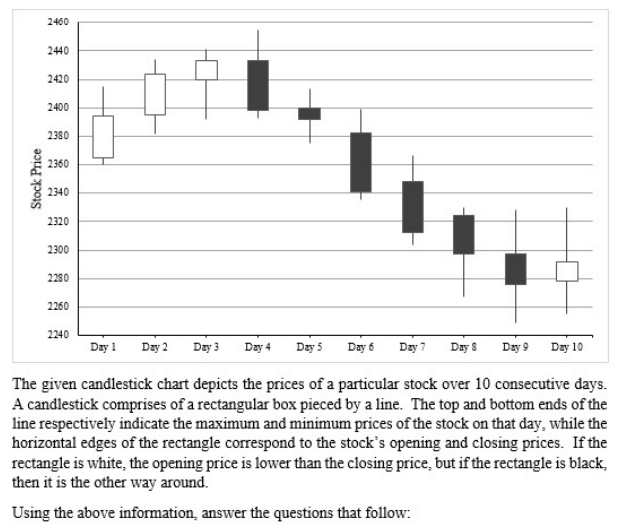
Question 54:
Which day saw the maximum percentage increase in the stock price at closing from the opening?
What is the highest magnitude of change over two consecutive days (for example, Day 1 \(\rightarrow\) Day 3 or Day 5 \(\rightarrow\) Day 7), in the maximum price touched by the stock during the 10-day period (choose the closest amongst the options given)?
On which day is the ratio of the maximum price to the opening price, the highest across the ten days?
Wilma, Xavier, Yaska and Zakir are four young friends, who have a passion for integers. One day, each of them selects one integer and writes it on a wall. The writing on the wall shows that Xavier and Zakir picked positive integers, Yaska picked a negative one, while Wilma’s integer is either negative, zero or positive. If their integers are denoted by the first letters of their respective names, the following is true: \[ W^4 + X^3 + Y^2 + Z \le 4,\qquad X^3 + Z \ge 2,\qquad W^4 + Y^2 \le 2,\qquad Y^2 + Z \ge 3. \]
Given the above, which of these can \(W^2 + X^2 + Y^2 + Z^2\) possibly evaluate to?
Shireen draws a circle in her courtyard. She then measures the circle’s circumference and its diameter with her measuring tape and records them as two integers, A and B respectively. She finds that A and B are coprimes (their greatest common divisor is 1). She also finds their ratio, A:B, to be: \(3.141614161416\ldots\) (repeating endlessly).
What is \(A - B\)?
Comprehension: Read the following scenario and answer the THREE questions that follow.
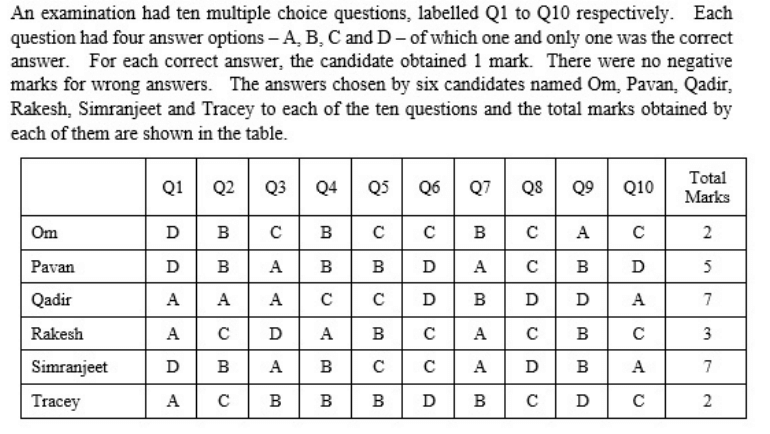
Question 59:
What is the correct answer for Q5?
For which of these questions is D the correct answer?
Fatima found that the profit earned by the Bala dosa stall today is a three-digit number. She also noticed that the middle digit is half of the leftmost digit, while the rightmost digit is three times the middle digit. She then randomly interchanged the digits and obtained a different number. This number was more than the original number by 198.
What was the middle digit of the profit amount?
If both the sequences \(x, a_1, a_2, y\) and \(x, b_1, b_2, z\) are in A.P. and it is given that \(y>x\) and \(z
which of the following values can \(\{(a_1-a_2)/(b_1-b_2)\}\) possibly take?
A tall tower has its base at point \(K\). Three points \(A, B, C\) are located at distances of \(4\) metres, \(8\) metres and \(16\) metres respectively from \(K\). The angles of elevation of the top of the tower from \(A\) and \(C\) are complementary.
What is the angle of elevation (in degrees) of the tower’s top from \(B\)?
Comprehension: Read the following scenario and answer the THREE questions that follow.
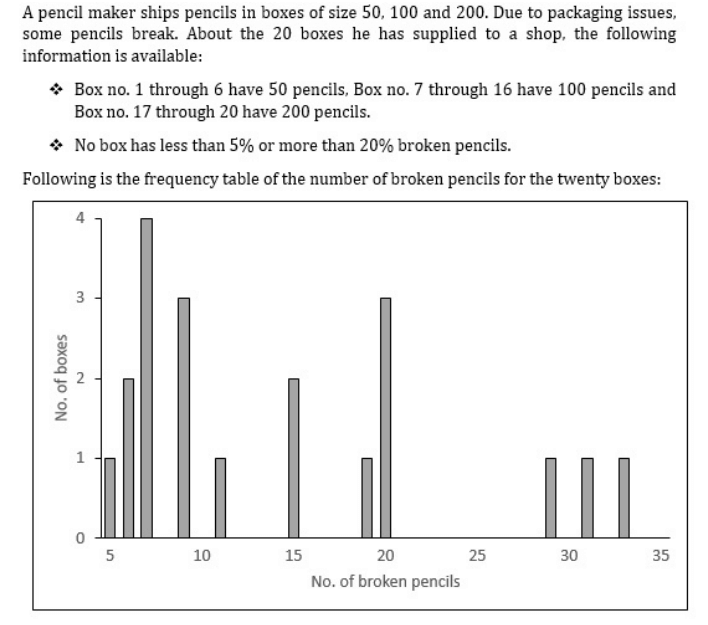
Question 64:
Which of the following can possibly be the sequence of the number of broken pencils in Boxes 7–16?
Which of the following cannot be inferred conclusively from the given information?
Suppose that additionally it is known that the number of broken pencils in Boxes 17-20 are in an increasing order. Which among the following additional information, if true, is not sufficient to uniquely know the number of defective pencils in each of the boxes numbered 17-20?
Kim’s wristwatch always shows the correct time, including ‘am’ and ‘pm’. Jim’s watch is identical to Kim’s watch in all aspects except its pace, which is slower than the pace of Kim’s watch. At 12 noon on January 1st, Jim sets his watch to the correct time, but an hour later, it shows 12:57 pm. At 12 noon on the next June 1st, Jim resets his watch to the correct time.
On how many instances between, and including 12 noon on the two dates mentioned, do Jim’s and Kim’s watches show the exact same time, including the ‘am’ and the ‘pm’?
Consider the real-valued function \[ f(x) = \frac{\log(3x-7)}{\sqrt{2x^2 - 7x + 6}}. \]
Find the domain of \(f(x)\).
I have five 10-rupee notes, three 20-rupee notes and two 50-rupee notes in my wallet.
If three notes were taken out randomly and simultaneously, what is the probability that at least 90 rupees were taken out?
The Madhura Fruits Company is packing four types of fruits into boxes. There are 126 oranges, 162 apples, 198 guavas and 306 pears. The fruits must be packed in such a way that a given box must have only one type of fruit and must contain the same number of fruit units as any other box.
What is the minimum number of boxes that must be used?
Comprehension: Read the following scenario and answer the THREE questions that follow.
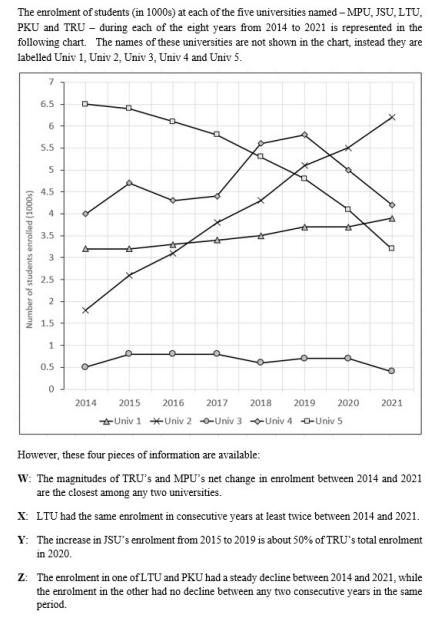
Question 71:
Which of the five universities can Univ 4 possibly be?
Which Univ’s enrolment was around twice that of LTU in 2014?
Which amongst the pieces of information mentioned below, if removed, will not prevent us from uniquely identifying the five universities?
Nadeem’s age is a two-digit number \(X\), squaring which yields a three-digit number, whose last digit is \(Y\). Consider the statements below:
Statement I: \(Y\) is a prime number.
Statement II: \(Y\) is one-third of \(X\).
To determine Nadeem’s age uniquely:
Match the following books with their authors.
What is a grey market?
From which location, India test-fired the new generation Agni Prime missile in 2021?
Identify the XLRI alumnus, who has recently been appointed as the Deputy National Security Advisor?
Match the following literary works with their authors.
Match the following classic movies with their directors.
Match the following districts with the states to which they belong.
Which of the following 2018 Commonwealth Games Gold medalists has successfully contested the 2020 Bihar Legislative Assembly elections?
Which of the following politicians has served for the longest years consecutively, or otherwise, as the Chief Minister of any Indian state or Union Territory?
Maitri and Bharati are the names of:
Which of the following footballing legends had never won the prestigious Ballon d'Or Award?
From the following options, choose the one which arranges the given Queens’ ascension to the throne in a chronological order.
Match the following UNESCO world heritage sites with the states to which they belong.
According to the venture capital industry, what is a unicorn?
What is OSIRIS-REx?
Which of the following Indian states does not have an “Indian Institute of Technology (IIT)”?
Match the animals listed below with the most common collective noun used to represent a group of them (e.g. wolves – Pack).
Who is the first Field Marshal of independent India?
What is the full form of NFT in the context of blockchain?
Which of the following spacecrafts by NASA entered the Sun’s upper atmosphere – the Corona?
What is the Large Hadron Collider (LHC)?
Which of the following wild animals has the sub-species as Sri Lankan, Indian, Sumatran, and Bornean?
Monosodium glutamate is:
Which of the following companies has acquired 100% stake in Air India?
What is Zoonosis?
Capitalism and democracy follow different paths: Unequally distributed property rights on the one hand, equal civic and political rights on the other; hierarchical decision making by managers and capital owners versus debate, compromise and majority decision-making within democratic politics. Therefore, they cannot co-exist.
View Solution
Essay:
Capitalism and democracy are two foundational concepts that have shaped political and economic landscapes across the globe. However, as highlighted in the given statement, these two systems follow divergent paths, and their co-existence is a matter of significant debate. While capitalism is characterized by unequal distribution of property and hierarchical structures, democracy is rooted in the principles of equality, fairness, and majority rule. These differences, when examined in-depth, suggest that capitalism and democracy might struggle to coexist harmoniously.
Capitalism and Its Inequalities
Capitalism thrives on the private ownership of property and the free market. In this system, resources and wealth are distributed unequally, with a significant concentration of wealth and power in the hands of a few individuals or corporations. The focus is on maximizing profits, and capital owners and managers have significant decision-making power over the workforce. In a capitalist society, economic hierarchies are deeply embedded, and social mobility is often limited to those with the means to accumulate capital. The capitalist model also supports competition, often at the expense of collaboration, with market forces determining the allocation of resources and opportunities.
Democracy and Its Egalitarian Principles
On the other hand, democracy is a political system based on the principles of equality, civic and political rights, and majority decision-making. In a democracy, every individual is granted equal rights, including the right to vote, express opinions, and participate in decision-making processes. Democratic governance relies on public debate, compromise, and collective decision-making, where power is vested in elected representatives chosen by the people. The democratic system seeks to minimize inequalities, offering citizens a sense of equality before the law and promoting individual freedoms. It ensures that each person's voice counts, and political decisions are made by the majority.
Contradictions Between Capitalism and Democracy
The fundamental contradiction between capitalism and democracy lies in their respective treatment of equality and power. While democracy aims for equal political and civic rights for all citizens, capitalism allows for the unequal distribution of wealth and power. In a capitalist system, decision-making is highly concentrated in the hands of a few, typically capital owners and corporate managers, who have the ability to influence political processes through lobbying and financial influence. This concentration of power contradicts the democratic ideal of collective decision-making, where power is meant to be distributed and exercised by the people.
Capitalism’s Influence on Democracy
In many capitalist societies, the influence of money in politics becomes a critical issue. Wealthy individuals and corporations often use their economic power to shape political agendas, fund election campaigns, and sway public opinion. This creates a situation where the interests of the wealthy few outweigh the concerns of the general population. As a result, political decisions may prioritize the interests of capital owners, further deepening social and economic inequalities. This undermines the democratic principle of one person, one vote, as the political system becomes more susceptible to the influence of
Conclusion:
While capitalism and democracy both offer valuable systems for organizing society, their co-existence remains problematic. The inherent contradictions between the unequal distribution of wealth and power in capitalism, and the emphasis on equality and majority rule in democracy, make it difficult for both systems to function in harmony. It is clear that the pursuit of economic growth and profit maximization, central to capitalism, often conflicts with the principles of democratic governance, where equality and collective decision-making are paramount. Thus, while they can coexist in certain forms, their full realization in tandem is an ideal that remains difficult to achieve. Quick Tip: To understand the tension between capitalism and democracy, it's helpful to focus on how economic power influences political processes. Capitalism's inherent inequalities challenge the democratic ideal of political equality.
In management, we do not need people who never experienced a setback; such people are highly averse to taking risks. Because, business schools majorly focus on stellar academic achievements during admissions, the selected students often turn into average managers.
View Solution
Essay:
Management is often seen as a field that demands quick decision-making, the ability to navigate through challenges, and the flexibility to adapt to new situations. Yet, the selection criteria in most business schools often prioritize academic excellence, such as high GPAs and test scores, over practical experience or resilience in the face of adversity. This focus on academic prowess can be problematic, as it selects individuals who may not have developed the resilience and risk-taking abilities that are essential for good management.
The Need for Resilience in Management:
In any management role, setbacks and challenges are inevitable. Whether it's managing a team, handling a business failure, or making a tough decision under pressure, managers will inevitably face difficulties that require them to adapt and find solutions. However, individuals who have never experienced significant setbacks may struggle in these high-pressure situations. Their lack of experience with failure makes them risk-averse, as they have not learned how to bounce back from mistakes or setbacks. This aversion to risk is problematic in a managerial context, where risk-taking is often required to make bold, innovative decisions that drive progress.
The Focus of Business Schools:
Most business schools place a strong emphasis on stellar academic performance during the admissions process. High GPAs, standardized test scores, and prestigious academic achievements often become the key criteria for acceptance into top programs. While these accomplishments reflect intellectual aptitude and academic discipline, they fail to account for qualities such as resilience, perseverance, and the ability to manage failure. Students who are selected based solely on their academic records might have excelled in structured environments but might not possess the skills needed to thrive in real-world, unpredictable situations.
The Effect on Managers:
Once admitted to business school, students who have never faced significant setbacks are often shielded from the real-world challenges of management. These students may excel in theoretical subjects and case studies but may lack the experience needed to handle high-pressure situations or failures in their careers. They may lack the practical skills and mental toughness required to navigate setbacks, making them prone to making cautious, conservative decisions in their professional roles. Over time, this can turn them into average managers who play it safe, avoiding risks rather than embracing them.
A Shift in Selection Criteria:
To produce better managers, business schools need to reconsider their selection criteria. In addition to academic achievements, schools should focus on a candidate's resilience, emotional intelligence, and experience with adversity. Selecting students who have faced challenges and setbacks, and who have demonstrated the ability to overcome them, can ensure that the future leaders of organizations are equipped to handle uncertainty and take calculated risks when necessary. Business schools should aim to identify individuals who can not only excel in a classroom environment but who can also thrive in the dynamic, unpredictable world of management.
Conclusion:
In conclusion, the current focus on academic achievement during business school admissions may inadvertently lead to the selection of individuals who are highly risk-averse and ill-equipped to handle the challenges of management. To produce effective and dynamic leaders, business schools must focus on selecting students with resilience, adaptability, and a proven ability to overcome setbacks. These qualities are essential for success in management, where the ability to take risks and learn from failure is paramount. Quick Tip: In business management, failure is often the best teacher. Resilience and the ability to learn from mistakes are critical skills for successful leadership.




Comments