




The XAT total marks for the four sections (Verbal Ability and Logical Reasoning, Decision-Making, Quantitative Aptitude and Data Interpretation, and GK) will be 95. The exam time will be 180 minutes, in which 170 minutes will be given for the first three sections, and the remaining 10 minutes will be given to solve GK questions in the XAT 2026 exam.
Also Check : XAT 2026 Question Paper with Solutions PDF
Related Links:
- Check XAT 2026 Exam Format
- Score Maximum Marks in the XAT Decision-making Section
- How to Boost Your XAT Total Marks in QA?

XAT 2026 Total Marks: Marking Scheme
The XAT 2026 marking scheme will help you understand the XAT exam pattern and penalty marks for unattempted questions. According to the XAT 2026 marking scheme, you will get +1 mark for each correct answer, and 0.25 mark will be deducted for each incorrect answer. While this marking scheme may seem similar to most students, the real twist of the XAT marking scheme is yet to be understood. The penalty marks applied after the first 8 unattempted questions are 0.10 marks.
In this regard, a Quora user who appeared in the XAT 2024 shared his own rollercoaster experience: "I aimed for a 90+ percentile, but ended up with just 31.25 raw marks, 85, due to a -0.25 penalty for miscalculation in decision-making—lesson learned: try smartly, skip wisely after eight, and treat GK as bonus points!"
| Particulars | Details |
|---|---|
| Total Questions | 95 (75 in Part 1+ 20 in Part 2) |
| GK Section Special |
|
This scheme rewards precision while discouraging baseless guessing, making mock tests essential for calibration.
XAT 2026 Total Marks: Section-Wise Weightage
XAT 2026 total marks in Part 1 (75 questions) influence your percentile, while GK (Part 2) marks will be counted in the Personal Interview round. Section-wise weightage will help students know the topics that should be given the most importance. In VALR, Reading Comprehensions and para jumbles are the important areas that together contribute around 13–15 marks out of the total 26 marks.
| Section | Questions | % Weightage | Difficulty Level (2025) | XAT Good Attempts (For 90+%ile) |
|---|---|---|---|---|
| Verbal Ability & Logical Reasoning (VALR) | 26 | 26 | Easy to Moderate | 16–18 |
| Decision Making (DM) | 21 | 21 | Moderate to Tough | 13–15 |
| Quantitative Ability &Data Interpretation (QA &DI) | 28 | 28 | Tough | 14–16 |
| General Knowledge (GK) | 20 | 20 | Moderate | 12–14 |
| XAT Total Marks | 95 | 95 | — | —- |
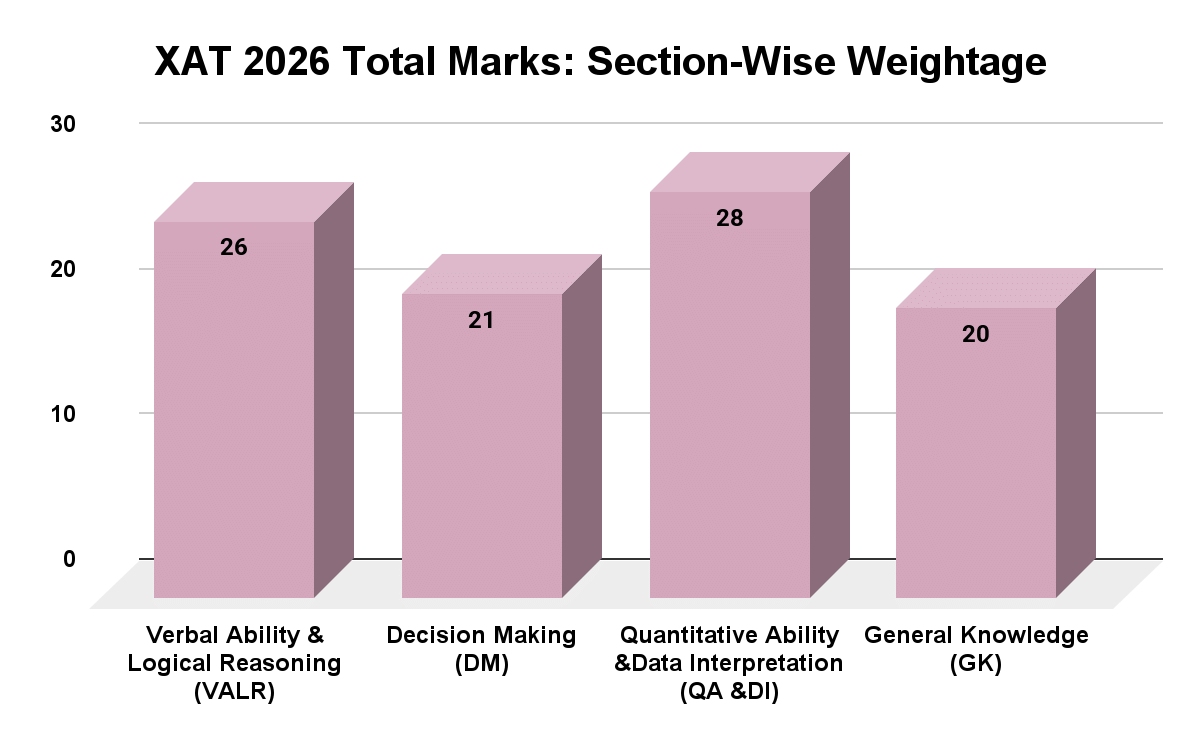
XAT 2026 Total Marks: Number of Questions & Difficulty Level
The XAT exam pattern has remained similar to recent years, focusing more on conceptual depth than speed. In previous years, the section-wise difficulty level has ranged from medium to high. However, according to student experience, questions in DM, QA, and DI tend to be lengthy and mostly calculation-based.
| Section | Questions | Difficulty Level | Question Types |
|---|---|---|---|
| VALR | 26 | Moderate-High | MCQs(RC, vocab, logic) |
| DM | 21 | High | Case-based MCQs (ethical issues) |
| QA & DI | 28 | High | MCQs (math, data analysis) |
| GK | 20 | Moderate | MCQs (facts, news) |
| Total | 95 | – | All MCQs (no descriptive) |
Note: No sectional time limits in Part 1 allow flexibility, but the overall clock demands smart navigation.
How XAT Calculates Total Marks?
XAT total marks are calculated from a raw score formula, after adjusting penalties (if any). The step-wise XAT total marks calculation is explained below in detail:
- Raw Score Calculation: Add + 1 for each correct answer in all sections.
- Calculate & Deduct Negatives: Subtract - 0.25 for each incorrect answer in VALR, DM, and QA &DI (GK exempt).
- Unattempted Penalty: No deduction for the first 8 unattempted across Part 1; -0.10 per additional unattempted question thereafter.
- Final Score: Raw score after penalties. GK is scored separately and not factored into the overall raw score or percentile – it’s evaluated during GD/PI for XLRI and select institutes.
- Normalisation: Depending on the phases and number of students appearing in the exam, a normalisation score is calculated to ensure fairness in the XAT exam. For the calculation of normalised marks, XAT's total raw marks are considered as a base.
Example: If you answer 70 questions correctly, 10 incorrectly, and leave 5 unattempted in Part 1 (75 questions), then your Part 1 score will be calculated as:
| XAT Total Marks 70-(10 x 0.25) = 67.5 |
Note: There will be no unattempted penalty as your number of unattempted questions is less than 8.
XAT 2026 Total Marks vs Raw Score vs Percentile
Percentiles are calculated from raw scores in Part 1 (max 75), normalised against the cohort. Based on trends, here’s the expected mapping for 2026 (assuming moderately difficult):
| Raw Score (Part 1, out of 75) | Estimated Percentile |
|---|---|
| 40+ | 97-99+ |
| 35-39 | 95-96 |
| 30-34 | 93-94 |
| 25-29 | 90-92 |
| 20-24 | 85-89 |
Note: GK adds to the total raw but not the percentile. Actuals may vary by exam difficulty.
Are there any Changes in XAT 2026 Total Marks?
As of now, there are no major changes in the XAT 2026 total marks notified by the examination authority yet. In
| Year | Total Questions | Total Marks | Key Changes |
|---|---|---|---|
| 2024 | 99 (incl. essay) | 99 | Essay added; 105 min duration |
| 2025 | 95 | 95 | Essay removed (to GD/PI); GK to 20 Qs; 180 min |
| 2020 | 95 | 95 | No changes; consistent with 2025 |
The removal of the essay streamlines the CBT, shifting the writing assessment to interviews. Total marks remain capped at 95, prioritising efficiency.
How to Maximise Your Total Marks in XAT 2026?
Boosting scores requires targeted prep. Here’s a roadmap:
| Strategy | Action Steps | Expected Impact |
| Master Accuracy | Solve 80%+ in mocks; review errors weekly | +5–7 marks (reduces negatives) |
| Section Priorization | Allocate time by strength; attempt 70-80% confidently | +8-10 marks overall |
| Mock Analysis | Take 20+ full mocks; simulate penalties | Improves percentile by 5-10% |
| GK Build-Up | Read daily (The Hindu, GK Today); aim 14/20 | +10-12 safe marks |
| Unattempted Control | Limit skips to <8; use elimination in MCQs | Avoids -2 to -5 penalties |
| Conceptual Depth | Focus on DM ethics, QA formulas; revise weak areas | +4-6 in tricky sections |



Comments