




XAT 2026 Question paper with Answer Key and Solution PDF for the exam conducted on January 4, 2026 is available here. The exam is conducted by XLRI Jamshedpur in one shift from 2:00 PM to 5:00 PM. XAT question paper 2026 comprises a total of 95 MCQs (28 in QADI, 26 in VALR, 21 in DM, and 25 in GK) and 1 essay.
XAT 2026 Question Paper with Solution PDF
| XAT 2026 Question Paper with Solution PDF | Download PDF | Check Solutions |

In a business school, only three specializations are offered: marketing, finance, and operations. A student can opt for either one, or two, or no specializations. In the current batch of 120 students, 60 are specializing in marketing, 50 are specializing in finance and 30 are specializing in operations. During the placement process, all students specializing either in marketing or in finance are shortlisted for consulting job interviews.
Two buses travel between Jamshedpur and Kolkata in the opposite directions, on the same road. On that road, the maximum allowed speeds are different (but constant) for
Read More
the opposite directions. Usually, both buses travel at the respective maximum allowed speeds to their respective destinations: the bus from Jamshedpur to Kolkata takes 4 hours, while the bus from Kolkata to Jamshedpur takes 3 hours.One day, the two buses start at the same time. However, one hour after starting, the bus from Jamshedpur to Kolkata reduces its speed to half of its maximum allowed speed due to congestion on the road.
If both buses do not stop anywhere in between, how many hours after starting do they meet?
Read the following scenario and answer the THREE questions that follow.
Read More
Brijbhushan, a microfinancier, lends money at the rate of Rs.10 per square meter to small farmers at a village. He charges an annual interest rate of 10%. All the farming plots in that village are rectangular, with areas varying between a minimum of 1000 square meters and a maximum of 10,000 square meters.This year, Brijbhushan has lent money only to five farmers: Aditya, Binod, Chhuttan, Dabloo and Govind. The perimeter of Chhuttan’s plot is 250 meters, with the length and width being at a ratio of 4:1. Aditya’s plot has an area three times the area of Govind’s plot. The area of Aditya’s plot is also the average of the areas of Govind’s plot and Dabloo’s plot. The plots belonging to Aditya, Binod and Dabloo are of the same width, but of different lengths. Moreover, the length of Binod’s plot is the sum of the lengths of Aditya’s plot and Dabloo’s plot.
What is the interest owed by Chhuttan to Brijbhushan at the end of the year?
What is the MAXIMUM possible value of the total loan Brijbhushan has given to these five farmers?
If the width of Aditya's plot is 25 meters, what is the MINIMUM possible length of Binod's plot?
In a battle, the commander-in-chief arranges his soldiers in a formation of three concentric circles. The radii of the circles are in an arithmetic progression: the smallest radius is 70m (meters) and the largest is 140m.
If each soldier is to be separated from the adjacent soldiers standing on the same circle by 1m, how many soldiers are required to complete the formation? (Consider \(\pi = \frac{22}{7}\) .)
An archer, from the point A, is aiming at a target, placed on the top of a 56 feet tall tree. The base of the tree is at the point C. From the archer's position, the angle of elevation to the target is 45° from his eye level. The archer, facing the tree, moves backwards on the straight line joining the points A and C, to a new position at the point B. From the point B, the angle of elevation from his eye level to the target becomes 30°.
How far did the archer move from A to B (in feet) if his eye level is at a height of 6 feet from the ground?
Let \( a_1 < a_2 < \dots < a_n \) be the list of all prime numbers less than 25. Define \( X_i = \frac{b_i}{a_i} \), where \( b_i \) is the sum of all \( a_k \) where \( k \) ranges from 1 to \( n \), \( k \neq i \). Let \( B \) be the set of all integer-valued \( X_i \).
What is the SMALLEST element of \( B \)?
A triangular plot is such that two of its sides, of lengths 90m (meter) and 60m, are perpendicular to each other. There is a housing complex in a rectangular region within the plot. The area of the rectangular region is 4/9th of the area of the triangular plot. Additionally, two sides of the rectangular region lie on the two perpendicular sides of the triangle, and one vertex is on the hypotenuse. The members of the housing complex want to construct a wall along the perimeter of the rectangular region.
If the cost of construction is Rs. 5000/m, what is the MINIMUM possible cost of building the wall?
In a multiple-choice examination, there are 20 questions. Each correct answer is worth 4 marks, while 2 marks are to be deducted for every unattempted question. One student receives a total of 46 marks in the examination. However, before releasing the marks, the professor realizes that she has, by mistake, deducted 2 marks for every unattempted question and 1 mark for every wrong answer.
After correction, how many marks will the student get?
The swimming pool in an exclusive club is a circular strip. A water flow is artificially maintained in the strip, along a clockwise direction, at a constant speed of 3km/h (kilometers/hour). One morning, Ayub and Rana start swimming at the same time from two diametrically opposite points on the strip. Ayub swims in a counterclockwise direction, while Rana swims in a clockwise direction. They swim at constant, but different, speeds. When they meet again after Rana has covered 60m (meters), they meet again after Rana has covered 180m from the first meeting point.
If Rana swims at the speed of 3 km/h in still water, how long does Ayub take to complete one round of the circular strip, if he swims in the clockwise direction?
Rajan is a fruit seller. On any day, he sells only one kind of fruit. On the first day, he buys 9 kg of blueberries. On the second day, he buys 22 kg of kiwis. On the third day, he buys mangoes at Rs. 35/kg and spends Rs. 15 less than any of the previous three days.
If he then sells all the mangoes at Rs. 50/kg, what is his MINIMUM possible profit on the fourth day?
A park has two gates, Gate 1 and Gate 2. These two gates are connected via two alternate paths. If one takes the first path from Gate 1, they need to walk 80m towards east, then 80m towards south, and finally 20m towards west to arrive at Gate 2.
Read More
The second path is a semi-circle connecting the two gates, where the diameter of the semi-circle is the straight-line distance between the two gates.A person walking at a constant speed of 5 kilometers/hour enters the park through Gate 1, walks along the first path to reach Gate 2 and then takes the second path to come back to Gate 1.
Three categories of candidates appear for an admission test: diligent (10%), lazy (30%) and confused (60%). A diligent candidate is 10 times more likely to clear the admission test compared to a lazy candidate.
If 40% of the candidates clearing the admission test are confused, what is the MAXIMUM possible value of the probability of a confused candidate clearing the test?
Consider a seven-digit number 735x6y4, divisible by 44, where the two digits \( x \) and \( y \) are unknown.
Consider the following two additional pieces of information:
I. \( x \) and \( y \) are even numbers.
II. \( x \) and \( y \) are equal.
To determine the values of \( x \) and \( y \) UNIQUELY, which of the above pieces of information is/are MINIMALLY SUFFICIENT?
Let \( f : \mathbb{R}^2 \to \mathbb{R} \) be a real-valued function defined as \( f(0, y) = y + 1 \) and \( f(x + 1, y) = f(x, f(x, y)) + x \).
What is the value of \( f(2, 2) \)?
How many solutions \( (x, y, z) \) of the equation \( x + y^2 + z^3 = 50 \) exist, where \( x, y \) and \( z \) are positive integers?
125 is multiplied by either 10 or 15. The resultant number is again multiplied by either 10 or 15. This process continues.
Which of the following CANNOT be a resultant number at any point in time?
Ronny uses a 5-digit key for a combination lock, where 5 digits need to be entered in a fixed sequence. While he remembers that the 5 digits are 9, 8, 7, 5, and 4, he has forgotten the sequence he uses. He also remembers that the sum of the first three digits is a multiple of 3, and so is the sum of the last three digits. Further, the sum of the last four digits is a multiple of 4.
Which of the following is DEFINITELY FALSE?
During Durga Puja, for the purpose of lighting, one puja pandal in Kolkata used many identical structures made of wooden sticks. The design of the structures was as follows: each structure
Read More
was constructed with the help of six wooden sticks by combining an isosceles triangular structure, and a square structure, with the bases of both structures being the same. Let us take one such structure. Call the triangle PAB, with PA = PB, and the square ABCD, with AB being the same wooden stick as a common base for the triangle and the square. To make the structure strong, the two equal sides of the triangular structure were tied with the opposite side of square’s base, i.e., CD, at points E and F, in such a way that CE = EF = FD. The structure was hung from P.Consider two circles, each having radius 5 cm, touching each other at a point P. A direct tangent QR is drawn touching one circle at a point Q and the other circle at R. Inside the region PQR inscribed by the two circles and the tangent, a square ABCD is inscribed with its base AB on the tangent and the other side touching the two circles at points D and C, respectively.
Find the area of the square ABCD.
There are three rectangular tanks in a building. The length, width and height of the first tank are \( m \) meters each, and the length, width and height of the second tank are \( n \) meters each. However, the length, width and height of the third tank are \( m \) meters, \( n \) meters and 1 meter, respectively. Initially, the first tank is full of water, while the second and the third are empty. When the second and the third tanks are completely filled with water transferred from the first tank, 85,000 liters of water is still left in the first tank.
If both \( m \) and \( n \) are positive integers, what is the value of \( m \)? (1 meter\(^3\) = 1000 liters)
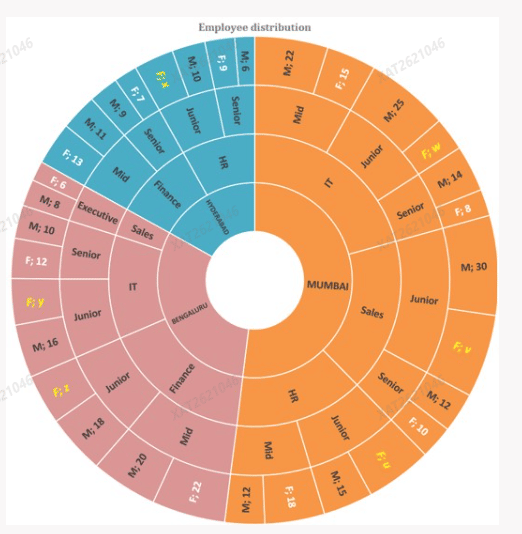
Based on the given information and the sunburst chart, the MOST LIKELY values of \( u \), \( v \) and \( w \), respectively, are:
Based on the given information and the sunburst chart, which of the following has the HIGHEST number of employees?
Based on the given information and the sunburst chart, which of the following statements CANNOT BE TRUE?
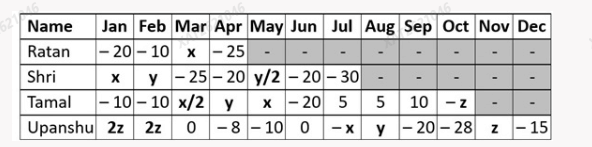
What BEST can be said about the value of \( y \)?
What BEST can be said about the profit generated by Upanshu at the end of his probation period?
The first step that Abirami wants to take is to join a group, having members with extensive work experience. Meanwhile, students with prior work experience have come together and formed groups. She reaches out to one such group. However, the group members are not interested since she is a fresher. They are unsure whether she can bring any value to case competitions that involve understanding, recommending and presenting solutions to organizational problems.
Which of the following reasons, IF TRUE, will BEST convince the group members that Abirami will be a valuable member of the group for case competitions?
Abirami cannot join groups having members with work experience; they reject her for being a fresher. Meanwhile, three of her batchmates, all freshers, are interested in forming a group with her. Abirami likes being with them as two of them are from her undergraduate college; however, Abirami fears that they may all come up with similar ideas during case discussions.
Which of the following reasons, IF TRUE, will BEST persuade Abirami to join them?
Abirami eventually joins a group, largely comprised of students with work experience. Whenever competition calls are announced, the group meets to discuss the competition. As competitions go by, Abirami observes that her views are hardly heard in meetings, though the other group members make it a point to invite her to every meeting. Since Abirami doesn’t get acknowledged for her ideas in group discussions, she starts reflecting on what she has gained so far by being a part of the group.
Which of the following pieces of information will BEST convince Abirami that being in the group is beneficial to her?
Soon after Kanmani takes over, she discovers that every instructor is paid differently even though they teach for the same number of hours. Moreover, these instructors have been recruited locally, having similar educational background. As she is introducing modern HR practices, she wants to equalize the salaries of all the instructors.
Which of the following is definitely NOT an option for Kanmani?
Kanmani cannot join groups having members with work experience; they reject her for being a fresher. Meanwhile, three of her batchmates, all freshers, are interested in forming a group with her.
Read More
Abirami likes being with them as two of them are from her undergraduate college; however, Abirami fears that they may all come up with similar ideas during case discussions.Kanmani is contemplating the following contingency arrangements for the classes that may not be conducted due to faculty leave.
Kanmani meets Selvam and requests his permission to recruit three extra instructors, who would be on the regular payroll. They will only chip in whenever the regular instructors go on leave. Selvam, having been running the tutorial for quite some time, believes this would not be the right way to solve the problem of managing classes when instructors go on leave. He shares the following data with Kanmani to help her understand that this problem cannot be solved by recruiting more people:
a) The number of days that instructors go on leave of absence is usually two days a month on average.
b) Each instructor has a unique style of teaching that cannot be replicated by part-timers.
c) Classes are held for 5 days a week, allowing enough rest for the instructors.
d) Selvam tried with part-time instructors as backups previously but they were often unavailable when needed.
e) The extra instructors must be paid a monthly salary, even when they might not be teaching the entire month.
Which of the following combinations of data will BEST convince Kanmani not to recruit extra instructors on the regular payroll?
Joginder wants to recommend Animisha for selection despite her not fulfilling the experience criterion.
Which of the following reasons, IF TRUE, will BEST convince Joginder to recommend Animisha?
Joginder shares his preference for Animisha with Premnarayan, the talent acquisition head. However, while rolling out the offer, Premnarayan realizes that Animisha does not meet the eligibility criteria. Though the recommendation has come from Joginder, who is a senior, he wants to reject Animisha for the role.
Which of the following reasons, IF TRUE, will BEST help him in rejecting Animisha’s candidature?
Joginder recommends Animisha’s candidature only to be turned down by Premnarayan. However, he wants Premnarayan to reconsider his decision.
Hence, Joginder has compiled a list of reasons to persuade Premnarayan to reconsider Animisha’s selection:
A. Animisha is academically strong and a gold medalist during her graduation.
B. Animisha’s experience is falling short only by a few months for the role she has applied for.
C. The number of applicants applying for the role she has applied for is very small.
D. Animisha’s college is known for producing the best business leaders for past many years.
E. Before he retired, Animisha’s maternal uncle was associated with Fine Elements Inc. for over 10 years.
F. Average industry experience for the role she has applied for is much lower than what Fine Elements Inc. has advertised.
Which of the following combination of reasons will BEST convince Premnarayan to reconsider his decision regarding Animisha’s selection for the role?
Abhishek is not happy with Mukesh’s decision. Abhishek is aware that he needs to be in the good books of Mukesh for his performance rating. However, he is passionate about cryptocurrency; hence, he considers approaching Neha directly to discuss a possible move. Neha can take such decisions independently, but Neha and Mukesh usually see eye to eye on most issues.
Which of the following reasons, IF TRUE, will BEST encourage Abhishek to reach out to Neha regarding his desired change to a different vertical?
Dissatisfied with Mukesh’s response, Abhishek reaches out to Neha for a vertical change. Though she listens to Abhishek, she shares her displeasure with the request. In fact, she brushes his request off, telling him to resign from Payseasy if it does not charm him anymore. Abhishek gets worried as he has a huge educational loan to pay, and such a departure will put him in a fix.
Read More
Later that day, in one of the team meetings, Abhishek is ignored as he is cut twice while he tries to share his project progress. Thereafter, he starts believing that Mukesh is not happy with him. This fear appears to get substantiated when Mukesh assigns an important project to another team member, which Abhishek wants to work on. His fear keeps growing regarding Neha and Mukesh not being happy with him. However, when he receives his annual rating, he finds out that Mukesh has rated him as the “best performer” of the year, based on his previous year’s performance.Abhishek wants his relationship with Mukesh to be back on track, as it was, before he reached out to Neha.
After two years at Payseasy, Abhishek applies to a competing firm and is called for an interview. The hiring manager, Amit, is impressed with Abhishek and tells him that he will take the final
Read More
decision to select Abhishek in a day or two. After the interview, Amit wants to know more about Abhishek since Abhishek will be leading a team of 15 people and his people management skills are very important for the team’s success. He calls Mukesh, Abhishek’s superior. Mukesh is Amit’s classmate who Amit trusts immensely. Mukesh informs Amit that though Abhishek is a good talent, he questions his superiors too often. Mukesh further shares that such a behavior makes it difficult for the superiors to manage the team.Amit needs a good talent, but is confused if he should recruit Abhishek, given Mukesh’s assessment of Abhishek.
MultiKrack, one of the oldest FMCG companies in Eastern India, was run by the Malhotras, a traditional business family, for generations. The organization believed that key positions should be held only by family members and close friends.
Read More
But, as the organization grew in size, the top management decided to bring in fresh thinking and fill key positions from premier management institutions. The need for such a decision was also brought upon by changes in consumer preferences, which the top management felt could be best handled by recruiting premier talent from the younger generation (Gen Z).MultiKrack drew the best talent, from premier management institutions, by offering highly attractive salaries. The first batch of Gen Z management trainees joined MultiKrack. Anindita was one of the seven management trainees recruited. She reported to Uday, a senior manager, who directly reported to the top management.
In one of the meetings, Uday was making a presentation on positioning their most popular product to make it more appealing to Gen Z. Unhappy with the discussion, Anindita candidly shared her concern regarding the assumptions Uday made about Gen Z. Uday immediately retorted: “Anindita, this is a discussion for adults. Kids, like you, should listen for a few months before sharing their opinion.” Further, he remarked, “you Gen Z have opinions about everything regardless of the subject.” Thereafter, he brushed aside any views Anindita attempted to share during the discussion. After the meeting, Anindita felt offended. However, when she discussed it with other management trainees, they did not find anything wrong with what Uday said. Even then, she decided to do something about such a treatment, since it would be seen as an approved behaviour.
Anindita was passionate about bringing a change in her organization. Thus, she went thoroughly prepared for every meeting. However, she soon realized that her ideas were not taken up for
Read More
discussions during meetings. She often felt looked down upon by Uday who dismissed her suggestions without even hearing them out. When she discussed her experience with other management trainees from other departments, she came to know that this was a common practice across MultiKrack. They wanted to do something about it; however, they were clueless about the course of action, since their seniors did not seem to be interested in listening to them.A few months passed. Anindita was a valuable member of her team and the top management was impressed with her. However, the other management trainees left the organization.
Read More
In their exit interviews, they shared the condescending behavior of senior management as the reason for their departure. Some even left MultiKrack to join organizations that paid lesser than what MultiKrack paid. The top management understood that the seniors belonged to a different generation; they found it difficult to appreciate the intergenerational differences. The top management felt it was high time to do something about the senior management’s behavior towards the juniors.Mr. Screwwala, a highly successful investment banker, had a career of nearly 25 years. In his circle, he was respected for his straight-shooter image and industrious behaviour. Screwwala loved travelling; he travelled extensively, both for his job and personal interests. He always wanted to share his life experiences with people at large.
Read More
He chanced upon such an opportunity when his old friend, Mr. Patel, a well-known publisher, offered Screwwala to publish a book based on his life experiences. Screwwala grabbed the opportunity; however, given his thorough nature, he took a three-year long sabbatical to finish the book.During that period, Patel guided Screwwala at every step, reviewing every chapter personally. At the end, the book turned out to be a bestseller, and Screwwala became famous.
Patel had a new proposal for Screwwala: he wanted Screwwala to work on a detective novel. Patel promised him good money but proposed that Screwwala would only write the final chapter of the novel, after his co-authors had completed the first nine chapters. Screwwala was surprised at the offer; since he never tried writing anything creative, and definitely not fiction. He wanted to be sure whether he could actually measure up with the co-authors who were established creative writers.
Patel had a new proposal for Screwwala: he wanted Screwwala to work on a detective novel. Patel proposed that Screwwala would only write the final chapter of the detective novel, after his co-authors. Screwwala accepted the offer.
Read More
Though the project started on time, a few of the authors could not manage to submit their chapters within the given timeline. Hence, it created a delay for the authors to follow.Having to wait endlessly for the other authors to finish their chapters, with no end in sight, Screwwala started getting impatient. In the meantime, he was offered another proposal from a rival publisher to write a travelogue on a country of his choice, which would involve all-expenses-paid trips. Because of his love for travel, Screwwala felt inclined to accept the offer. However, this would mean getting out of the contract of the detective novel, which could cause a serious friction with Patel.
While waiting for his turn to come to write his chapter for the detective novel, Screwwala started writing a travel blog. Because of his radiant style, the blog became popular. Hence, he started mulling over converting the blog articles into a book.
Read More
When Screwwala shared this idea, Patel sprung a surprise by pointing out to a clause in their contract. The clause forbade Screwwala from publishing anything else until the detective novel got published. Screwwala signed the contract without reading it as he trusted Patel as a good friend. Further, Patel offered Screwwala an extra sum of money if he would delay the publication of his travel blog articles as a book.Screwwala felt betrayed.
Vidya, a Bachelor of Commerce graduate, secured admission to one of India’s premier business schools (B schools) called Best-Known School of Management (BKSM). Not long after her joining BKSM, she was struck by the calibre of her experienced peers. This, in turn, made her anxious about her placement. Hence, she reached out to one of her seniors, who had also joined BKSM as a fresher, for advice.
Read More
In conversations with the senior, Vidya learned that fresher were often advised to join student committees to strengthen their curriculum vitae (CVs) for placements. Confident of making it to one, she started preparing. Despite her confidence, she could not secure a spot in the prominent committees she aspired to join.Frustrated and angry, Vidya began believing that committee selections were biased. Since the processes were entirely student-run, with minimal administrative oversight, she felt that she had no avenue to raise her concerns. Anjali, Vidya’s roommate in BKSM, told her about Why MBA, a social media platform where students often voiced their grievances anonymously.
Impulsively, Vidya secretly recorded her next committee interview. The interview turned out to be particularly harsh. Now, she was even more determined to post the transcript of the interview on Why MBA to teach a lesson to her seniors.
Vidya secretly recorded her next committee interview. The very next day, Vidya was selected for the same committee for which she had recorded the interview. However, a few days later, a post went viral on Why MBA about BKSM, accusing the student committees of unfair practices, claiming that seniors selected juniors based on personal preferences rather than objective criteria. The post created a stir in BKSM, making Vidya anxious.
Read More
Vidya’s anxiety stemmed from the fact that Anjali, her confidant, knew about Vidya’s intent to publish her interview transcript on Why MBA. Hence, Vidya feared that if Anjali shared Vidya’s earlier intent with anyone at BKSM, her reputation and relationships could be damaged.A few committee secretaries complained to the dean of BKSM about some anonymous posts on Why MBA that they felt were unfairly targeting them. Upon visiting the forums on Why MBA, the dean felt that while most of the posts were innocuous, some indeed crossed the line. Further, she felt that such posts tarnished the image of BKSM. Conversely, she observed that such posts led those targeted to reflect, mend their ways, and become more accountable. She wondered what she could do to save the reputation of BKSM being assailed in public forums through anonymous posts; however, she did not want to do anything disproportionately harsh.
What BEST can the dean do to take a sustainable decision to dissuade students from posting their grievances in public forums, presenting the college in a bad light?
Read the following excerpt carefully.
When we encounter new situations, concepts, or problems, we make ____________ of them by ___________ them onto older experience and structures. Far from being a ___________ mental shortcut, analogy is a process by which humans generalize, adapt, and grow in ___________.
Which of the following options BEST fills up the blanks in the above excerpt?
Read the following sentences carefully.
1. Everybody were late.
2. I will ask you if I need help.
3. Please revert to me at the earliest possible.
4. The report that the committee submitted was well received.
5. She is accustomed to work late.
Which of the following options consists of only grammatically CORRECT sentences?
Read the following sentences carefully.
1. She described about the journey.
2. We are awaiting her reply.
3. She is superior to us.
4. She requested for more time.
5. She is sharing with her friend.
6. She insisted for an apology.
Which of the following options contains only grammatically INCORRECT sentences?
Read the following sentences carefully.
1. The hybrid workplace is failing to live up to expectations in a number of ways.
2. By one estimate, spending an average of three days each week in the office can limit encounters between any two workers by 64% compared with pre-pandemic norms.
3. Many people hanker after the socializing, camaraderie and shared experience, even if getting used to it may take time.
4. For one thing, it is no substitute for the buzz and the chatter of the pre-pandemic office.
5. Even small amount of remote work can have a big impact on the frequency of face-to-face interactions in the office.
Which of the following options BEST arranges the above sentences in a logical sequence?
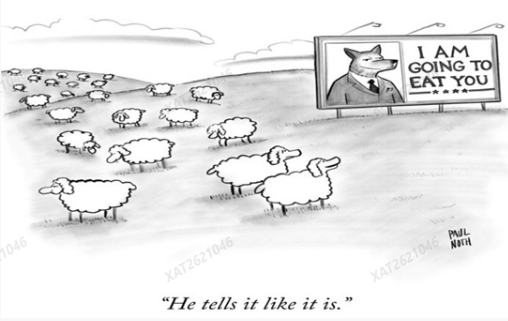
Which of the following options BEST explains the underlying message of the cartoon?
Which of the following options, IF TRUE, will BEST CONTRADICT the idea of the excerpt?
Read the following sentences carefully.
1. Any viewer of crime dramas might think, though, that there is a better way.
2. What would really speed things up would be a method of sampling an entire habitat at one go.
3. But, these, too must first be detected and collected—and they will identify only the animal that dropped them.
4. Ecologists have thought of this, and it certainly works for things like animal droppings.
5. Just as DNA traces on an unwashed glass can place a suspect as having been in a particular place, so can DNA shed by a creature as it goes about its business.
Which of the following options BEST arranges the above sentences in a logical sequence?
Which of the following can be BEST concluded from the above passage?
Which of the following can be BEST concluded from the passage?
Based on the passage, which of the following options will the author BEST agree with regarding the differences between temporal and social comparison?
Based on the passage, which of the following will the author MOST agree with?
Based on the passage, which of the following is NOT true about comparison?
Based on the passage, which of the following reasons BEST explains why metaphorical imagination is a crucial skill?
Which of the following statements BEST conveys the premise of the passage?
Based on the passage, which of the following statements BEST explains the limitations of “CONDUIT metaphors” in communication?
Based on the passage, which of the following would the author BEST agree with?
Based on the passage, which of the following statements is DEFINITELY NOT true?
Based on the passage, which of the following statements can be BEST concluded?
According to the passage, which of the following BEST explains why liberal democracy needs patience?
According to the passage, how does the second problem of liberal democracy lead to the third problem?
According to the passage, which of the following reasons BEST explains why “necessity of compromise” is a difficulty for liberal democracy?
What does the poet BEST convey about old newspapers when he says “that snakes have spawned in between these sheets?”
Which of the following BEST captures what the poet communicates when he says, “Keep your eyes closed. / Get rid of the whole goddamn pile if you want to / in the morning?”
Based on the passage, which of the following can be BEST inferred about the behaviour of trolls?
Based on the passage, which of the following statements BEST conveys why trolls prefer anonymity?
Based on the passage, what does the author BEST convey by the statement, “trolls are — at least in their own minds — doing their targets a favor?”
Which of the following GST slabs was abolished, during GST rationalization, in September 2025?
What is the primary objective of "Project Suncatcher" that Google CEO Sundar Pichai announced recently?
India recently launched its first indigenous 64-bit dual-core microprocessor. What is it named?
Who won the 2025 Pulitzer Prize for Fiction for the novel "James", a reimagining of "The Adventures of Huckleberry Finn"?
Which of the following is a comet that flew very close to the Earth in December, 2025?
Which of the following BEST describes a startup that is resilient, built for long-term survival, and is not focused on hyped-up valuation?
Who was the RUNNER-UP in the 2025 Wimbledon Gentlemen's Singles Championship?
India recently achieved a milestone by placing its heaviest payload ever into orbit using the LVM3-M6 rocket. Which of the following is a satellite, launched as a part of this mission?
Which major Indian infrastructure project, featuring the world's highest railway arch bridge over the Chenab River, was fully integrated into the national network in 2025?
Which of the following is the Oxford Word of the Year 2025?
Who is credited for popularizing the telephone greeting "Hello"?
Which of the following is the first Asian country to host the Commonwealth Games?
Who, among the following, is credited for designing the following ad campaigns: "Kuch khaas hai...zindagi mein" (Cadbury's), "Fevicol ka mazboot jod hai, tooteega nahin" (Fevicol), and "Har ghar kuch kehta hai" (Asian Paints)?
Arrange the following generations from the oldest to the youngest:
1. Generation X
2. Silent Generation
3. Generation Alpha
4. Baby Boomers
5. Millennials
Who was the player of the tournament in the ICC Women's World Cup 2025?
Which of the following is NOT true about octopuses?
Match the legendary Indian musicians in Column A with the musical instruments they are famously associated with in Column B.

Match the temple architectural terms in Column A with their descriptions in Column B.

What is common among the following celebrities: Val Kilmer, Diane Keaton, Robert Redford, Dharmendra Deol and B. Saroja Devi?
Which Indian city has become home to the country’s first Semiconductor Innovation Museum?
XAT 2026 Exam Pattern
| Part | Sections | Questions to Attempt | Time Limit |
|---|---|---|---|
| Part 1 | Decision Making | 21 | 170 minutes |
| Verbal & Logical Ability | 26 | ||
| Quantitative Ability & Data Interpretation | 28 | ||
| Part 2 | General Knowledge | 25 | 10 minutes |
| Keyboard Check | - | - | 5 minutes |
| Total | - | 95 | 185 minutes |




Comments