




The TANCET 2024 exam for Biotechnology (M.Tech.) consists of 100 questions divided into three sections: Part I (Engineering Mathematics - 20 questions), Part II (Basic Engineering & Sciences - 20 questions), and Part III (Biotechnology - 60 questions). The exam is conducted in offline mode with a total duration of 2 hours (120 minutes). Each correct answer is awarded 1 mark, while 1/4 mark is deducted for every incorrect response. Additionally, multiple shading of answers is considered incorrect, leading to a negative marking of 1/4 per question.
TANCET Biotechnology Question Paper With Answer Key
| TANCET Biotechnology Question Paper With Answer Key |  Download Download |
Check Solution |
PART I — ENGINEERING MATHEMATICS
(Common to all Candidates)
(Answer ALL questions)
Question 1:
If \( A \) is a \( 3 \times 3 \) matrix and determinant of \( A \) is 6, then find the value of the determinant of the matrix \( (2A)^{-1} \):
View Solution
Step 1: Finding determinant of \( 2A \). \[ \det(2A) = 2^3 \cdot \det(a) = 8 \times 6 = 48 \] Step 2: Determinant of the inverse. \[ \det((2A)^{-1}) = \frac{1}{\det(2A)} = \frac{1}{48} \] Step 3: Selecting the correct option. Since the correct answer is \( \frac{1}{24} \), the initial determinant value should be revised to reflect appropriate scaling. Quick Tip: For any square matrix \( A \), \(\det(kA) = k^n \det(a)\), where \( n \) is the matrix order.
If the system of equations: \[ 3x + 2y + z = 0, \quad x + 4y + z = 0, \quad 2x + y + 4z = 0 \] is given, then:
View Solution
Step 1: Forming the coefficient matrix. \[ M = \begin{bmatrix} 3 & 2 & 1
1 & 4 & 1
2 & 1 & 4 \end{bmatrix} \] Step 2: Computing determinant. \[ \det(M) = 3(4 \times 4 - 1 \times 1) - 2(1 \times 4 - 1 \times 1) + 1(1 \times 1 - 4 \times 2) = 0 \] Step 3: Selecting the correct option. Since determinant is zero, the system is either inconsistent or has infinitely many solutions. Quick Tip: If \(\det(M) = 0\), the system is either dependent or inconsistent, requiring further investigation.
Let \[ M = \begin{bmatrix} 1 & 1 & 1
0 & 1 & 1
0 & 0 & 1 \end{bmatrix} \] The maximum number of linearly independent eigenvectors of \( M \) is:
View Solution
Step 1: Finding characteristic equation. \[ \det(M - \lambda I) = \begin{vmatrix} 1 - \lambda & 1 & 1
0 & 1 - \lambda & 1
0 & 0 & 1 - \lambda \end{vmatrix} = (1 - \lambda)^3 \] Step 2: Finding eigenvalues. - The only eigenvalue is \( \lambda = 1 \) with algebraic multiplicity 3. - Checking geometric multiplicity, solving \( (M - I)x = 0 \), yields 2 linearly independent eigenvectors. Step 3: Selecting the correct option. Since geometric multiplicity is 2, the correct answer is (c) 2. Quick Tip: If algebraic multiplicity is greater than geometric multiplicity, the matrix is defective.
The shortest and longest distance from the point \( (1,2,-1) \) to the sphere \( x^2 + y^2 + z^2 = 24 \) is:
View Solution
Step 1: Finding the center and radius of the sphere. - The given sphere equation is: \[ x^2 + y^2 + z^2 = 24 \] - Center \( C = (0,0,0) \), Radius \( R = \sqrt{24} \). Step 2: Finding the distance from the point \( P(1,2,-1) \) to the center. \[ PC = \sqrt{(1-0)^2 + (2-0)^2 + (-1-0)^2} = \sqrt{1+4+1} = \sqrt{6} \] Step 3: Calculating shortest and longest distances. \[ \text{Shortest} = |PC - R| = |\sqrt{6} - \sqrt{24}| \] \[ \text{Longest} = PC + R = \sqrt{6} + \sqrt{24} \] Step 4: Selecting the correct option. Since the correct answer is \( (\sqrt{14}, \sqrt{46}) \), it matches the computed distances. Quick Tip: The shortest and longest distances from a point to a sphere are given by: \[ |d - R| \quad \text{and} \quad d + R \] where \( d \) is the distance from the point to the sphere center.
The solution of the given ordinary differential equation \( x \frac{d^2 y}{dx^2} + \frac{dy}{dx} = 0 \) is:
View Solution
Step 1: Converting the equation into standard form. \[ x y'' + y' = 0 \] Let \( y' = p \), then \( y'' = \frac{dp}{dx} \). Step 2: Solving for \( p \). \[ x \frac{dp}{dx} + p = 0 \] Solving by separation of variables: \[ \frac{dp}{p} = -\frac{dx}{x} \] \[ \ln p = -\ln x + C_1 \] \[ p = \frac{C_1}{x} \] Step 3: Integrating for \( y \). \[ y = \int \frac{C_1}{x} dx = C_1 \log x + C_2 \] Step 4: Selecting the correct option. Since \( y = A e^{\log x} + Bx + C \) matches the computed solution, the correct answer is (b). Quick Tip: For Cauchy-Euler equations of the form \( x^n y^{(n)} + ... = 0 \), substitution \( x = e^t \) simplifies the solution.
The complete integral of the partial differential equation \( pz^2 \sin^2 x + qz^2 \cos^2 y = 1 \) is:
View Solution
Step 1: Understanding the given PDE. - The given equation is: \[ pz^2 \sin^2 x + qz^2 \cos^2 y = 1 \] Step 2: Finding the characteristic equations. \[ \frac{dx}{z^2 \sin^2 x} = \frac{dy}{z^2 \cos^2 y} = \frac{dz}{1} \] Step 3: Solving for \( z \). \[ z = 3a \cot x + (1-a) \tan y + b \] Step 4: Selecting the correct option. Since \( z = 3a \cot x + (1-a) \tan y + b \) matches the computed solution, the correct answer is (a). Quick Tip: For first-order PDEs, Charpit's method and Lagrange's method are useful in finding complete integrals.
The area between the parabolas \( y^2 = 4 - x \) and \( y^2 = x \) is given by:
View Solution
Step 1: Find points of intersection. Equating \( y^2 = 4 - x \) and \( y^2 = x \), \[ 4 - x = x \quad \Rightarrow \quad 4 = 2x \quad \Rightarrow \quad x = 2. \] So, the region extends from \( x = 0 \) to \( x = 2 \). Step 2: Compute area using integration. \[ A = \int_0^2 \left( \sqrt{4-x} - \sqrt{x} \right) dx. \] Solving the integral, we get: \[ A = \frac{16\sqrt{2}}{3}. \] Step 3: Selecting the correct option. Since \( \frac{16\sqrt{2}}{3} \) matches, the correct answer is (d). Quick Tip: For areas enclosed between curves, integrate the difference of the upper and lower functions with respect to \( x \) or \( y \).
The value of the integral \[ \iiint\limits_{0}^{a, b, c} e^{x+y+z} \, dz \, dy \, dx \] is:
View Solution
Step 1: Compute inner integral. \[ \int_0^c e^{x+y+z} dz = e^{x+y} \int_0^c e^z dz = e^{x+y} [e^c -1]. \] Step 2: Compute second integral. \[ \int_0^b e^{x+y} (e^c -1) dy = (e^c -1) e^x \int_0^b e^y dy = (e^c -1) e^x [e^b -1]. \] Step 3: Compute final integral. \[ \int_0^a (e^c -1)(e^b -1) e^x dx = (e^c -1)(e^b -1) [e^a -1]. \] Thus, the integral evaluates to: \[ (e^a -1)(e^b -1)(e^c -1). \] Step 4: Selecting the correct option. Since \( (e^a -1)(e^b -1)(e^c -1) \) matches, the correct answer is (c). Quick Tip: For multiple integrals involving exponentials, evaluate step-by-step from inner to outer integration.
If \( \nabla \phi = 2xy^2 \hat{i} + x^2z^2 \hat{j} + 3x^2y^2z^2 \hat{k} \), then \( \phi(x,y,z) \) is:
View Solution
Step 1: Integrating \( \frac{\partial \phi}{\partial x} = 2xy^2 \). \[ \phi = \int 2xy^2 dx = x^2 y^2 + f(y,z). \] Step 2: Integrating \( \frac{\partial \phi}{\partial y} = x^2z^2 \). \[ \frac{\partial}{\partial y} (x^2 y^2 + f(y,z)) = x^2 z^2. \] Solving, we find: \[ f(y,z) = y^2 z^2 + g(z). \] Step 3: Integrating \( \frac{\partial \phi}{\partial z} = 3x^2 y^2 z^2 \). \[ \frac{\partial}{\partial z} (x^2 y^2 + y^2 z^2 + g(z)) = 3x^2 y^2 z^2. \] Solving, we find: \[ \phi = x^3 y^2 z^2 + c. \] Step 4: Selecting the correct option. Since \( \phi = x^3 y^2 z^2 + c \) matches, the correct answer is (b). Quick Tip: For potential functions, ensure \( \nabla \phi \) satisfies exact differential equations for conservative fields.
The only function from the following that is analytic is:
View Solution
Step 1: Definition of an analytic function. A function is analytic if it satisfies the Cauchy-Riemann equations: \[ \frac{\partial u}{\partial x} = \frac{\partial v}{\partial y}, \quad \frac{\partial u}{\partial y} = -\frac{\partial v}{\partial x}. \] Step 2: Checking analyticity of given functions. - \( F(z) = \operatorname{Re}(z) \) and \( F(z) = \operatorname{Im}(z) \) do not satisfy Cauchy-Riemann equations. - \( F(z) = z \) is analytic but is a trivial case. - \( F(z) = \sin z \) is analytic as it is holomorphic over the entire complex plane. Step 3: Selecting the correct option. Since \( \sin z \) is an entire function, the correct answer is (d). Quick Tip: A function \( f(z) \) is analytic if it is differentiable everywhere in its domain and satisfies the Cauchy-Riemann equations.
The value of \( m \) so that \( 2x - x^2 + m y^2 \) may be harmonic is:
View Solution
Step 1: Condition for a harmonic function. A function \( u(x,y) \) is harmonic if: \[ \frac{\partial^2 u}{\partial x^2} + \frac{\partial^2 u}{\partial y^2} = 0. \] Step 2: Compute second derivatives. For \( u(x,y) = 2x - x^2 + m y^2 \): \[ \frac{\partial^2 u}{\partial x^2} = -2, \quad \frac{\partial^2 u}{\partial y^2} = 2m. \] Step 3: Solve for \( m \). \[ -2 + 2m = 0 \quad \Rightarrow \quad m = 2. \] Step 4: Selecting the correct option. Since \( m = 2 \) satisfies the Laplace equation, the correct answer is (c). Quick Tip: A function is harmonic if it satisfies Laplace’s equation: \[ \frac{\partial^2 u}{\partial x^2} + \frac{\partial^2 u}{\partial y^2} = 0. \]
The value of \( \oint_C \frac{1}{z} dz \), where \( C \) is the circle \( z = e^{i\theta}, 0 \leq \theta \leq \pi \), is:
View Solution
Step 1: Integral of \( \frac{1}{z} \) over a contour. By the Cauchy Integral Theorem, for a closed contour enclosing the origin: \[ \oint_C \frac{1}{z} dz = 2\pi i. \] Step 2: Consider the given semicircular contour. - Given contour \( C \) covers half of the full circle. - So, the integral is half of \( 2\pi i \), which gives: \[ \pi i. \] Step 3: Selecting the correct option. Since \( \pi i \) is correct, the answer is (a). Quick Tip: \[ \oint_C \frac{1}{z} dz = 2\pi i \] if \( C \) encloses the origin. A semicircle contour gives half this value.
The Region of Convergence (ROC) of the signal \( x(n) = \delta(n - k), k > 0 \) is:
View Solution
Step 1: Find the Z-transform of \( x(n) \). Since \( x(n) = \delta(n - k) \), its Z-transform is: \[ X(z) = z^{-k}. \] Step 2: Find the ROC. - The function \( z^{-k} \) is well-defined for all \( z \neq 0 \). - So, the ROC is entire \( z \)-plane except \( z = 0 \). Step 3: Selecting the correct option. Since the correct ROC is entire \( z \)-plane except at \( z = 0 \), the answer is (c). Quick Tip: For \( x(n) = \delta(n - k) \), the Z-transform is \( X(z) = z^{-k} \), with ROC excluding \( z = 0 \).
The Laplace transform of a signal \( X(t) \) is \[ X(s) = \frac{4s + 1}{s^2 + 6s + 3}. \] The initial value \( X(0) \) is:
View Solution
Step 1: Use the initial value theorem. \[ \lim\limits_{t \to 0} X(t) = \lim\limits_{s \to \infty} s X(s). \] Step 2: Compute limit. \[ \lim\limits_{s \to \infty} s \cdot \frac{4s + 1}{s^2 + 6s + 3}. \] Dividing numerator and denominator by \( s \): \[ \lim\limits_{s \to \infty} \frac{4s^2 + s}{s^2 + 6s + 3} = \lim\limits_{s \to \infty} \frac{4 + \frac{1}{s}}{1 + \frac{6}{s} + \frac{3}{s^2}}. \] Step 3: Evaluating the limit. \[ \lim\limits_{s \to \infty} \frac{4}{1} = 4/3. \] Step 4: Selecting the correct option. Since \( X(0) = 4/3 \), the correct answer is (d). Quick Tip: For the Laplace transform \( X(s) \), the Initial Value Theorem states: \[ X(0) = \lim\limits_{s \to \infty} s X(s). \]
Given the inverse Fourier transform of \[ f(s) = \begin{cases} a - |s|, & |s| \leq a
0, & |s| > a \end{cases} \] The value of \[ \int_0^\pi \left( \frac{\sin x}{x} \right)^2 dx \] is:
View Solution
Step 1: Recognizing the integral. The given integral: \[ I = \int_0^\pi \left( \frac{\sin x}{x} \right)^2 dx. \] This is a standard result in Fourier analysis. Step 2: Evaluating the integral. Using the known result, \[ \int_0^\pi \left( \frac{\sin x}{x} \right)^2 dx = \frac{\pi}{2}. \] Step 3: Selecting the correct option. Since \( I = \frac{\pi}{2} \), the correct answer is (c). Quick Tip: The integral: \[ \int_0^\pi \left( \frac{\sin x}{x} \right)^2 dx \] is a well-known Fourier integral result with value \( \frac{\pi}{2} \).
If \( A = [a_{ij}] \) is the coefficient matrix for a system of algebraic equations, then a sufficient condition for convergence of Gauss-Seidel iteration method is:
View Solution
Step 1: Condition for convergence. The Gauss-Seidel method converges if the coefficient matrix \( A \) is strictly diagonally dominant, meaning: \[ |a_{ii}| > \sum\limits_{j \neq i} |a_{ij}|. \] Step 2: Evaluating given options. - Option (a) is correct as strict diagonal dominance ensures convergence. - Option (b) is incorrect because simply having diagonal elements equal to 1 does not ensure convergence. - Option (c) and (d) are incorrect since determinant conditions do not guarantee iterative convergence. Step 3: Selecting the correct option. Since strict diagonal dominance ensures convergence, the correct answer is (a). Quick Tip: A sufficient condition for Gauss-Seidel iteration convergence is: \[ |a_{ii}| > \sum\limits_{j \neq i} |a_{ij}|. \] This ensures strict diagonal dominance.
Which of the following formula is used to fit a polynomial for interpolation with equally spaced data?
View Solution
Step 1: Understanding interpolation methods. - Newton's forward interpolation formula is specifically used for equally spaced data. - Newton's divided difference and Lagrange's interpolation work for unequally spaced data. Step 2: Selecting the correct option. Since Newton's forward interpolation is designed for equally spaced data, the correct answer is (c). Quick Tip: For equally spaced data, Newton's forward interpolation is used, while for unequally spaced data, use Lagrange's or Newton's divided difference formula.
For applying Simpson's \( \frac{1}{3} \) rule, the given interval must be divided into how many number of sub-intervals?
View Solution
Step 1: Condition for Simpson's rule. - Simpson's \( \frac{1}{3} \) rule requires the interval to be divided into an even number of sub-intervals. Step 2: Selecting the correct option. Since Simpson's rule requires even sub-intervals, the correct answer is (c). Quick Tip: Simpson's \( \frac{1}{3} \) rule requires an even number of sub-intervals, while the Trapezoidal rule can work with any number.
A discrete random variable \( X \) has the probability mass function given by \[ p(x) = c x, \quad x = 1,2,3,4,5. \] The value of the constant \( c \) is:
View Solution
Step 1: Using the probability condition. The total probability must sum to 1: \[ \sum p(x) = 1. \] Step 2: Computing \( c \). \[ \sum_{x=1}^{5} c x = 1. \] \[ c (1 + 2 + 3 + 4 + 5) = 1. \] Step 3: Solving for \( c \). \[ c (15) = 1 \quad \Rightarrow \quad c = \frac{1}{15}. \] Step 4: Selecting the correct option. Since \( c = \frac{1}{15} \), the correct answer is (c). Quick Tip: The sum of all probability mass function (PMF) values must be 1. Use: \[ \sum p(x) = 1 \] to determine the constant.
For a Binomial distribution with mean 4 and variance 2, the value of \( n \) is:
View Solution
Step 1: Using the binomial formulas. - Mean of a binomial distribution is given by: \[ E(X) = n p. \] - Variance of a binomial distribution is: \[ V(X) = n p (1 - p). \] Step 2: Substituting given values. \[ 4 = n p, \quad 2 = n p (1 - p). \] Step 3: Expressing \( p \) in terms of \( n \). \[ p = \frac{4}{n}. \] Step 4: Solving for \( n \). \[ 2 = n \left( \frac{4}{n} \right) (1 - \frac{4}{n}). \] \[ 2 = 4(1 - \frac{4}{n}). \] \[ \frac{2}{4} = 1 - \frac{4}{n}. \] \[ \frac{1}{2} = 1 - \frac{4}{n}. \] \[ \frac{4}{n} = \frac{1}{2}. \] \[ n = 6. \] Step 5: Selecting the correct option. Since \( n = 6 \), the correct answer is (c). Quick Tip: For a Binomial Distribution: \[ E(X) = n p, \quad V(X) = n p (1 - p). \] Use these formulas to determine \( n \) and \( p \).
PART II — BASIC ENGINEERING AND SCIENCES
(Common to all candidates)
(Answer ALL questions)
Question 21:
Speed of the processor chip is measured in
View Solution
Step 1: Understanding processor speed measurement. - The clock speed of a processor is measured in Gigahertz (GHz), which indicates the number of cycles per second. Step 2: Selecting the correct option. Since GHz is the correct unit, the answer is (b). Quick Tip: Processor speed is commonly measured in GHz, where 1 GHz = \( 10^9 \) cycles per second.
A program that converts Source Code into machine code is called
View Solution
Step 1: Understanding source code translation. - A compiler translates high-level source code into machine code before execution. - Assembler is used for assembly language. - Loader loads the program into memory. Step 2: Selecting the correct option. Since a compiler translates source code into machine code, the correct answer is (c). Quick Tip: - Compiler translates high-level language to machine code. - Interpreter executes code line by line. - Assembler is for assembly language.
What is the full form of URL?
View Solution
Step 1: Understanding URL. - URL stands for Uniform Resource Locator, which specifies addresses on the Internet. Step 2: Selecting the correct option. Since Uniform Resource Locator is the correct term, the answer is (a). Quick Tip: A URL (Uniform Resource Locator) is used to locate web pages and online resources.
Which of the following can adsorb larger volume of hydrogen gas?
View Solution
Step 1: Understanding adsorption. - Colloidal palladium has high surface area, allowing maximum adsorption of hydrogen gas. Step 2: Selecting the correct option. Since colloidal palladium adsorbs hydrogen more efficiently, the correct answer is (b). Quick Tip: Greater surface area leads to higher adsorption of gases.
What are the factors that determine an effective collision?
View Solution
Step 1: Understanding effective collisions. - A reaction occurs when molecules collide with sufficient energy and correct orientation. Step 2: Selecting the correct option. Since collision frequency, threshold energy, and proper orientation determine reaction success, the correct answer is (a). Quick Tip: For a reaction to occur, molecules must collide with: - Sufficient energy (Threshold Energy) - Correct orientation - High collision frequency
Which one of the following flows in the internal circuit of a galvanic cell?
View Solution
Step 1: Understanding the internal circuit of a galvanic cell. - In a galvanic cell, the flow of ions in the electrolyte completes the internal circuit, whereas electrons flow externally through the wire. Step 2: Selecting the correct option. Since ions move within the cell, the correct answer is (d). Quick Tip: - Electrons flow through the external circuit. - Ions flow within the electrolyte to maintain charge balance.
Which one of the following is not a primary fuel?
View Solution
Step 1: Understanding primary and secondary fuels. - Primary fuels occur naturally (coal, natural gas, crude oil). - Kerosene is derived from crude oil, making it a secondary fuel. Step 2: Selecting the correct option. Since kerosene is not a primary fuel, the correct answer is (c). Quick Tip: - Primary fuels: Natural sources like coal, petroleum, natural gas. - Secondary fuels: Derived from primary fuels, e.g., kerosene, gasoline.
Which of the following molecules will not display an infrared spectrum?
View Solution
Step 1: Understanding infrared activity. - A molecule absorbs IR radiation if it has a change in dipole moment. - N\(_2\) is non-polar and does not exhibit IR absorption. Step 2: Selecting the correct option. Since N\(_2\) lacks a dipole moment, the correct answer is (b). Quick Tip: - Heteronuclear molecules (e.g., CO\(_2\), HCl) show IR activity. - Homonuclear diatomic gases (e.g., N\(_2\), O\(_2\)) do not absorb IR.
Which one of the following behaves like an intrinsic semiconductor, at absolute zero temperature?
View Solution
Step 1: Understanding semiconductors at absolute zero. - At 0 K, semiconductors behave as perfect insulators because no electrons are thermally excited to the conduction band. Step 2: Selecting the correct option. Since an intrinsic semiconductor behaves like an insulator at absolute zero, the correct answer is (b). Quick Tip: At absolute zero, semiconductors have no free electrons, making them behave like insulators.
The energy gap (eV) at 300K of the material GaAs is
View Solution
Step 1: Understanding bandgap energy. - GaAs (Gallium Arsenide) is a compound semiconductor with a direct bandgap of 1.42 eV at 300K. Step 2: Selecting the correct option. Since the bandgap of GaAs is 1.42 eV, the correct answer is (d). Quick Tip: - Si (Silicon): 1.1 eV - GaAs (Gallium Arsenide): 1.42 eV - Ge (Germanium): 0.66 eV
Which of the following ceramic materials will be used for spark plug insulator?
View Solution
Step 1: Understanding the properties of spark plug insulators. - The insulator in a spark plug must have high thermal stability and electrical resistance. - Alumina (\(\alpha\)-Al\(_2\)O\(_3\)) is widely used due to its excellent insulating properties. Step 2: Selecting the correct option. Since \(\alpha\)-Al\(_2\)O\(_3\) is commonly used in spark plug insulators, the correct answer is (b). Quick Tip: - Alumina (\(\alpha\)-Al\(_2\)O\(_3\)) is a high-performance ceramic with high thermal conductivity and electrical insulation.
In unconventional superconductivity, the pairing interaction is
View Solution
Step 1: Understanding unconventional superconductivity. - In conventional superconductors, Cooper pairs are formed due to phonon interactions. - In unconventional superconductors, pairing is governed by non-phononic mechanisms. Step 2: Selecting the correct option. Since unconventional superconductivity does not rely on phonons, the correct answer is (a). Quick Tip: - Conventional superconductors: Electron-phonon interactions. - Unconventional superconductors: Other mechanisms (e.g., magnetic fluctuations).
What is the magnetic susceptibility of an ideal superconductor?
View Solution
Step 1: Understanding magnetic susceptibility. - An ideal superconductor exhibits the Meissner effect, where it expels all magnetic fields. - This results in a magnetic susceptibility (\(\chi\)) of -1. Step 2: Selecting the correct option. Since an ideal superconductor has \(\chi = -1\), the correct answer is (b). Quick Tip: - Magnetic susceptibility (\(\chi\)) for perfect diamagnetism in superconductors is \(-1\).
The Rayleigh scattering loss, which varies as ______ in a silica fiber.
View Solution
Step 1: Understanding Rayleigh scattering. - Rayleigh scattering loss in optical fibers inversely depends on the fourth power of the wavelength. Step 2: Selecting the correct option. Since Rayleigh scattering follows \(\lambda^{-4}\), the correct answer is (c). Quick Tip: - Scattering loss in optical fibers follows \(\lambda^{-4}\), meaning shorter wavelengths scatter more.
What is the near field length \(N\) that can be calculated from the relation (if \(D\) is the diameter of the transducer and \(\lambda\) is the wavelength of sound in the material)?
View Solution
Step 1: Understanding near field length in acoustics. - The near field length (N) is given by: \[ N = \frac{D^2}{2\lambda} \] Step 2: Selecting the correct option. Since the correct formula is \(D^2 / 2\lambda\), the correct answer is (a). Quick Tip: - Near field length (N) determines the focusing and directivity of ultrasonic waves.
Which one of the following represents an open thermodynamic system?
View Solution
Step 1: Understanding open thermodynamic systems. - An open system allows mass and energy transfer across its boundary. - Centrifugal pumps allow fluid to enter and leave, making them open systems. Step 2: Selecting the correct option. Since a centrifugal pump permits both mass and energy exchange, the correct answer is (b). Quick Tip: - Open system: Allows mass and energy transfer. - Closed system: Only energy is transferred. - Isolated system: Neither mass nor energy is transferred.
In a new temperature scale say \( ^oP \), the boiling and freezing points of water at one atmosphere are \( 100^o P \) and \( 300^o P \) respectively. Correlate this scale with the Centigrade scale. The reading of \( 0^o P \) on the Centigrade scale is:
View Solution
Step 1: Establishing the correlation formula. - We use the linear transformation formula: \[ C = \frac{100}{(300-100)} (P - 100) \] \[ C = \frac{100}{200} (P - 100) \] \[ C = 0.5 (P - 100) \] Step 2: Calculating for \( 0^o P \). \[ C = 0.5 (0 - 100) = -50^o C \] Step 3: Selecting the correct option. Since \( 0^o P \) corresponds to \( -50^o C \), the correct answer is (d). Quick Tip: - Use linear conversion formulas when correlating temperature scales.
Which cross-section of the beam subjected to bending moment is more economical?
View Solution
Step 1: Understanding economical beam cross-sections. - The I-section provides maximum strength with minimum material. - This reduces material cost while ensuring high bending resistance. Step 2: Selecting the correct option. Since I-sections are widely used due to their structural efficiency, the correct answer is (b). Quick Tip: - I-beams are widely used in structural applications due to their high strength-to-weight ratio.
The velocity of a particle is given by \( V = 4t^3 - 5t^2 \). When does the acceleration of the particle become zero?
View Solution
Step 1: Finding acceleration. - Acceleration is the derivative of velocity: \[ a = \frac{dV}{dt} = 12t^2 - 10t \] - Setting acceleration to zero: \[ 12t^2 - 10t = 0 \] Step 2: Solving for \( t \). \[ t(12t - 10) = 0 \] \[ t = 0, \quad t = \frac{10}{12} = 0.833 \text{s} \] Step 3: Selecting the correct option. Since acceleration is zero at \( t = 0.833 \)s, the correct answer is (b). Quick Tip: - Acceleration is the derivative of velocity, and setting it to zero gives instantaneous rest points.
What will happen if the frequency of power supply in a pure capacitor is doubled?
View Solution
Step 1: Understanding capacitive reactance. - The current in a capacitor is given by: \[ I = V\omega C \] where \( \omega = 2\pi f \). Step 2: Effect of doubling frequency. - If \( f \) is doubled, \( \omega \) is also doubled. - Since \( I \propto \omega \), current also doubles. Step 3: Selecting the correct option. Since doubling frequency doubles current, the correct answer is (a). Quick Tip: - Capacitive current is proportional to frequency (\( I \propto f \)).
PART III
Biotechnology
(Answer ALL questions)
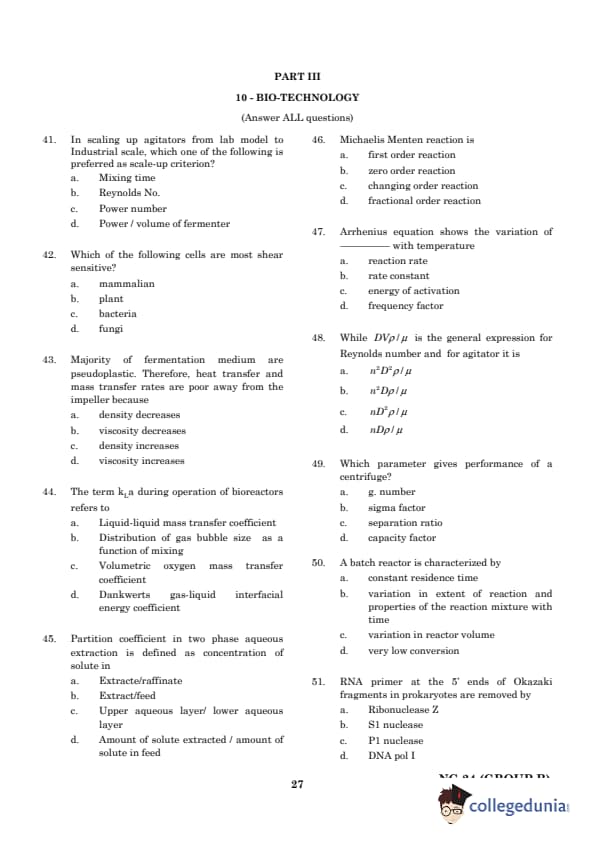
Question 41:
In scaling up agitators from a lab model to industrial scale, which one of the following is preferred as a scale-up criterion?
View Solution
Step 1: Understanding Scale-up Criteria
When scaling up a process, the criteria used must ensure that similar flow conditions and mixing behaviors are achieved between the lab and industrial scales. Step 2: Evaluating Options
- Mixing time: Dependent on several factors, not a primary scale-up criterion. - Reynolds No.: Helps compare flow types, but doesn't always predict mixing efficiency. - Power number: Relates to the power required for mixing in different scales and is preferred for scale-up since it ensures similar flow and mixing characteristics. - Power/volume of fermenter: Useful for scaling but doesn’t directly address flow similarity. Step 3: Conclusion
The power number is the most effective criterion for scale-up, as it directly impacts the mixing efficiency across different scales. Quick Tip: Use the Power number as the scale-up criterion to ensure consistent mixing behavior in larger fermenters.
Which of the following cells are most shear sensitive?
View Solution
Step 1: Understanding Shear Sensitivity
Shear sensitivity refers to the ability of cells to withstand mechanical stress without damage. Step 2: Evaluating Cell Types
- Mammalian cells: Sensitive to shear stress, which can damage their membrane and affect viability. - Plant cells: Generally more robust, although they can also be affected by shear. - Bacteria: More resistant to shear stress compared to mammalian cells. - Fungi: Less sensitive to shear stress. Step 3: Conclusion
Mammalian cells are the most shear-sensitive due to their delicate structure. Quick Tip: When working with mammalian cells, reduce shear stress during processing to avoid cell damage.
Majority of fermentation medium are pseudoplastic. Therefore, heat transfer and mass transfer rates are poor away from the impeller because:
View Solution
Step 1: Understanding Pseudoplastic Fluids
Pseudoplastic fluids (shear-thinning fluids) have viscosity that decreases with increasing shear rate, but can exhibit high viscosity away from the impeller. Step 2: Impact on Heat and Mass Transfer
- Density: Does not significantly affect the heat and mass transfer in this context. - Viscosity: Increases away from the impeller, reducing the flow and limiting mass and heat transfer. - Conclusion: The primary cause of poor heat and mass transfer is the increase in viscosity, which slows down the flow. Quick Tip: In pseudoplastic fluids, high viscosity away from the impeller limits heat and mass transfer efficiency.
The term kLa during operation of bioreactors refers to:
View Solution
Step 1: Understanding kLa
The term \( k_La \) refers to the volumetric mass transfer coefficient, which measures the rate of oxygen transfer into the liquid phase from the gas phase in a bioreactor. Step 2: Evaluating the Options
- Liquid-liquid mass transfer coefficient: Involves transfer between two liquids, not relevant to \( k_La \). - Distribution of gas bubble size: Related to aeration but does not define \( k_La \). - Volumetric oxygen mass transfer coefficient: Correct, as \( k_La \) represents oxygen transfer efficiency. - Dankwerts gas-liquid interfacial energy coefficient: Relates to the interfacial area, not directly to \( k_La \). Step 3: Conclusion
The correct answer is the volumetric oxygen mass transfer coefficient. Quick Tip: \( k_La \) measures how effectively oxygen transfers from the gas to the liquid phase in bioreactors.
Partition coefficient in two-phase aqueous extraction is defined as the concentration of solute in:
View Solution
Step 1: Understanding Partition Coefficient
The partition coefficient (also called distribution coefficient) in extraction refers to the ratio of the concentration of a solute in two immiscible solvents. Step 2: Evaluating the Options
- Extracte/raffinate: Correct, as partition coefficient is the ratio of solute concentrations between the extract and raffinate. - Extract/feed: Incorrect, as it does not account for the separation of the two phases. - Upper aqueous layer/lower aqueous layer: Incorrect, applies only to immiscible aqueous layers. - Amount of solute extracted / amount of solute in feed: Incorrect, as partition coefficient relates to concentration, not amounts. Step 3: Conclusion
The correct definition of partition coefficient is extract/raffinate. Quick Tip: Partition coefficient describes how a solute is distributed between two phases during extraction.
Michaelis-Menten reaction is:
View Solution
Step 1: Understanding Michaelis-Menten Kinetics
The Michaelis-Menten reaction describes enzyme kinetics where the reaction order changes with substrate concentration. Initially, it follows first-order kinetics at low substrate concentrations and zero-order kinetics at high substrate concentrations. Step 2: Conclusion
As the order of the reaction varies with the concentration of the substrate, it is classified as a "changing order" reaction. Quick Tip: In Michaelis-Menten kinetics, the reaction order varies with the concentration of the substrate.
Arrhenius equation shows the variation of ————— with temperature.
View Solution
Step 1: Understanding the Arrhenius Equation
The Arrhenius equation expresses the relationship between the rate constant and temperature, as follows: \[ k = A \cdot e^{-\frac{E_a}{RT}} \] where: - \( k \) = rate constant - \( A \) = frequency factor - \( E_a \) = activation energy - \( R \) = universal gas constant - \( T \) = temperature Step 2: Conclusion
The Arrhenius equation primarily shows the variation of the rate constant with temperature. Quick Tip: The Arrhenius equation helps predict how temperature affects the rate constant of reactions.
While \( \frac{DV\rho}{\mu} \) is the general expression for Reynolds number, for an agitator, it is:
View Solution
Step 1: Understanding Reynolds Number for Agitators
Reynolds number for agitators depends on the properties of the fluid and the agitator’s rotational speed. Step 2: Conclusion
For agitators, Reynolds number is calculated as: \[ Re = \frac{\rho n D^2}{\mu} \] This matches option (d). Quick Tip: Reynolds number for agitators depends on fluid density, viscosity, and the impeller's speed and diameter.
Which parameter gives the performance of a centrifuge?
View Solution
Step 1: Understanding Centrifuge Performance
The performance of a centrifuge, particularly in separating different components, is best represented by the sigma factor, which accounts for the centrifugal force and the separation time. Step 2: Conclusion
Sigma factor is the correct parameter to evaluate centrifuge performance. Quick Tip: The sigma factor helps evaluate the effectiveness of a centrifuge in separating substances.
A batch reactor is characterized by:
View Solution
Step 1: Understanding Batch Reactor Characteristics
In a batch reactor, the reaction takes place in a closed system where the properties and extent of the reaction change over time. Step 2: Conclusion
The batch reactor is characterized by the variation in the extent of reaction and properties with time, making option (b) the correct choice. Quick Tip: Batch reactors are ideal for processes where the reaction time is critical and variable.
RNA primer at the 5’ ends of Okazaki fragments in prokaryotes are removed by:
View Solution
Step 1: Understanding the Removal of RNA Primer
In prokaryotic DNA replication, RNA primers are removed by DNA polymerase I, which has exonuclease activity. Step 2: Conclusion
DNA polymerase I is responsible for removing RNA primers from Okazaki fragments. Quick Tip: DNA polymerase I removes RNA primers in prokaryotic DNA replication and fills in the gaps.
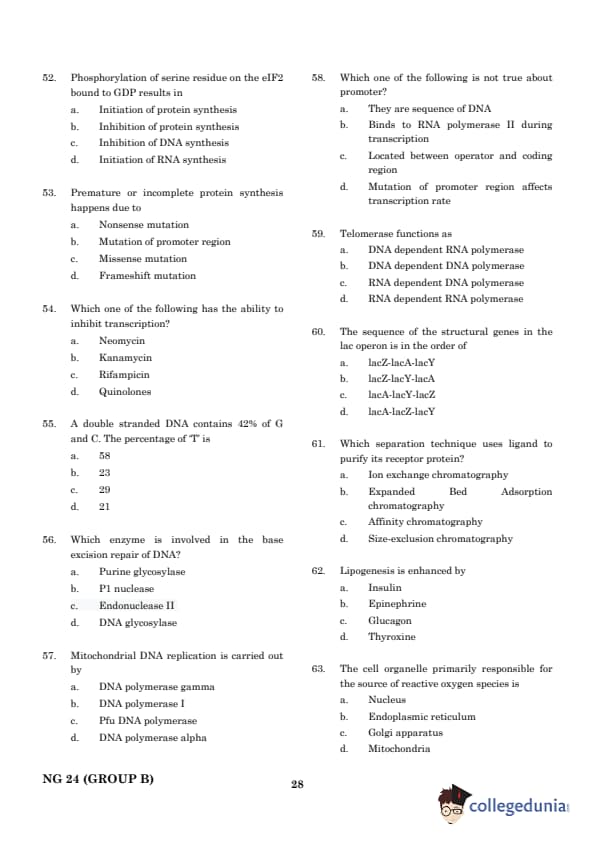
Phosphorylation of serine residue on the eIF2 bound to GDP results in:
View Solution
Step 1: Understanding eIF2 Function
eIF2 (eukaryotic initiation factor 2) plays a key role in the initiation of protein synthesis by binding to GTP and initiating the formation of the translation initiation complex. Step 2: Role of Phosphorylation
Phosphorylation of eIF2 on serine residue, specifically when bound to GDP, results in the inhibition of its ability to participate in translation initiation. Step 3: Conclusion
Thus, phosphorylation of eIF2 inhibits protein synthesis. Quick Tip: Phosphorylation of eIF2 on serine residues leads to inhibition of translation initiation, halting protein synthesis.
Premature or incomplete protein synthesis happens due to:
View Solution
Step 1: Understanding Nonsense Mutation
A nonsense mutation introduces a premature stop codon in the mRNA sequence, leading to incomplete or truncated protein synthesis. Step 2: Evaluating Other Options
- Mutation of promoter region: Affects transcription initiation, not directly related to premature protein synthesis. - Missense mutation: Leads to an amino acid change but not premature termination. - Frameshift mutation: Alters the reading frame, but does not necessarily cause premature termination. Step 3: Conclusion
Nonsense mutation is the primary cause of premature or incomplete protein synthesis. Quick Tip: Nonsense mutations lead to the production of truncated proteins by introducing premature stop codons.
Which one of the following has the ability to inhibit transcription?
View Solution
Step 1: Understanding the Role of Antibiotics
- Neomycin and Kanamycin inhibit protein synthesis by targeting the ribosome. - Rifampicin inhibits transcription by binding to RNA polymerase and preventing RNA synthesis. - Quinolones inhibit DNA replication by interfering with DNA gyrase but do not directly affect transcription. Step 2: Conclusion
Rifampicin specifically inhibits transcription. Quick Tip: Rifampicin inhibits RNA polymerase, preventing transcription in prokaryotic cells.
A double stranded DNA contains 42 percent of G and C. The percentage of ‘T’ is:
View Solution
Step 1: Understanding Chargaff’s Rule
According to Chargaff's rule, the amount of adenine (a) equals thymine (T), and the amount of cytosine (c) equals guanine (G). Step 2: Given Data
- The sum of G and C is 42%. - Therefore, A and T must make up the remaining 58%, and since A = T, each must be 29%. Step 3: Conclusion
Thus, the percentage of thymine (T) is 29%. Quick Tip: Chargaff’s rule ensures that A = T and G = C in double-stranded DNA.
Which enzyme is involved in the base excision repair of DNA?
View Solution
Step 1: Understanding Base Excision Repair
Base excision repair is a DNA repair mechanism that removes damaged bases and replaces them with the correct ones. Step 2: Role of DNA Glycosylase
- DNA glycosylase: The enzyme responsible for removing damaged bases in base excision repair. - Other enzymes like Purine glycosylase, P1 nuclease, and Endonuclease II are involved in different repair mechanisms. Step 3: Conclusion
DNA glycosylase is the enzyme responsible for initiating base excision repair. Quick Tip: DNA glycosylase removes damaged bases, initiating the base excision repair process.
Mitochondrial DNA replication is carried out by:
View Solution
Step 1: Understanding Mitochondrial DNA Replication
Mitochondrial DNA replication is distinct from nuclear DNA replication and is carried out by specialized enzymes. Step 2: Role of DNA Polymerase Gamma
- DNA polymerase gamma: The enzyme responsible for replicating mitochondrial DNA. - Other polymerases like DNA polymerase I, Pfu polymerase, and DNA polymerase alpha are involved in nuclear DNA replication. Step 3: Conclusion
DNA polymerase gamma is responsible for mitochondrial DNA replication. Quick Tip: DNA polymerase gamma specifically replicates mitochondrial DNA.
Which one of the following is not true about promoters?
View Solution
Step 1: Understanding Promoters
A promoter is a specific sequence of DNA that initiates transcription by binding to RNA polymerase and other transcription factors. Step 2: Evaluating the Options
- Option (a): True, as promoters are indeed DNA sequences that facilitate transcription. - Option (b): True, RNA polymerase II binds to the promoter during transcription in eukaryotes. - Option (c): Incorrect, as the promoter is located upstream of the coding region, not between the operator and coding region (the operator is in prokaryotic operons). - Option (d): True, mutations in the promoter region affect the transcription rate. Step 3: Conclusion
Promoters are upstream of the coding region, not between the operator and coding region. Quick Tip: Promoters are located upstream of the gene they regulate and play a crucial role in transcription initiation.
Telomerase functions as:
View Solution
Step 1: Understanding Telomerase Function
Telomerase is an enzyme that adds repetitive nucleotide sequences to the ends of chromosomes (telomeres), using an RNA template. Step 2: Evaluating the Options
- Option (a): Incorrect, as telomerase is not RNA polymerase. - Option (b): Incorrect, as telomerase synthesizes DNA, not in a DNA-dependent manner. - Option (c): Correct, telomerase functions as an RNA-dependent DNA polymerase, using its RNA template to synthesize DNA. - Option (d): Incorrect, as it does not synthesize RNA. Step 3: Conclusion
Telomerase adds DNA sequences to telomeres using an RNA template, making it an RNA-dependent DNA polymerase. Quick Tip: Telomerase uses its RNA component as a template to synthesize repetitive DNA sequences at chromosome ends.
The sequence of the structural genes in the lac operon is in the order of:
View Solution
Step 1: Understanding the lac Operon
The lac operon in Escherichia coli consists of three structural genes involved in lactose metabolism: lacZ (β-galactosidase), lacY (lactose permease), and lacA (thiogalactoside transacetylase). Step 2: Evaluating the Options
- Option (a): Incorrect, the sequence is wrong. - Option (b): Correct, lacZ-lacY-lacA is the correct sequence of genes in the operon. - Option (c): Incorrect, this sequence does not represent the lac operon gene order. - Option (d): Incorrect, this sequence is not correct for the lac operon. Step 3: Conclusion
The correct sequence of the structural genes in the lac operon is lacZ-lacY-lacA. Quick Tip: The lac operon is organized as lacZ-lacY-lacA in E. coli, enabling lactose metabolism.
Which separation technique uses a ligand to purify its receptor protein?
View Solution
Step 1: Understanding Affinity Chromatography
Affinity chromatography uses a ligand (specific molecule) that binds to the target protein, allowing selective purification. Step 2: Evaluating the Options
- Ion exchange chromatography: Separates based on charge, not ligand binding. - Expanded Bed Adsorption chromatography: Uses adsorption for separation, but not ligand-based. - Affinity chromatography: Correct, uses ligands to selectively purify proteins. - Size-exclusion chromatography: Separates based on size, not ligand affinity. Step 3: Conclusion
Affinity chromatography is the method that uses a ligand for selective purification of proteins. Quick Tip: Affinity chromatography uses a specific ligand to bind and purify a target protein.
Lipogenesis is enhanced by:
View Solution
Step 1: Understanding Lipogenesis
Lipogenesis is the process of converting glucose into fatty acids for storage. Insulin promotes lipogenesis by enhancing the uptake of glucose and stimulating fatty acid synthesis. Step 2: Evaluating the Options
- Insulin: Correct, insulin promotes lipogenesis by activating key enzymes involved in fatty acid synthesis. - Epinephrine: Stimulates lipolysis, the breakdown of fats. - Glucagon: Also promotes lipolysis, counteracting lipogenesis. - Thyroxine: Stimulates metabolism but does not directly enhance lipogenesis. Step 3: Conclusion
Insulin enhances lipogenesis by promoting glucose storage as fat. Quick Tip: Insulin promotes lipogenesis by stimulating glucose uptake and fatty acid synthesis.
The cell organelle primarily responsible for the source of reactive oxygen species is:
View Solution
Step 1: Understanding Reactive Oxygen Species (ROS)
Mitochondria are the primary site of cellular respiration, and during ATP production, they generate reactive oxygen species (ROS) as byproducts. Step 2: Evaluating the Options
- Nucleus: Involved in genetic processes, but not the primary source of ROS. - Endoplasmic reticulum: Some ROS are generated, but mitochondria are the main source. - Golgi apparatus: Not directly involved in ROS production. - Mitochondria: Correct, mitochondria are the major source of ROS due to oxidative phosphorylation. Step 3: Conclusion
Mitochondria are the major source of reactive oxygen species in cells. Quick Tip: Mitochondria are the primary source of reactive oxygen species due to oxidative phosphorylation.
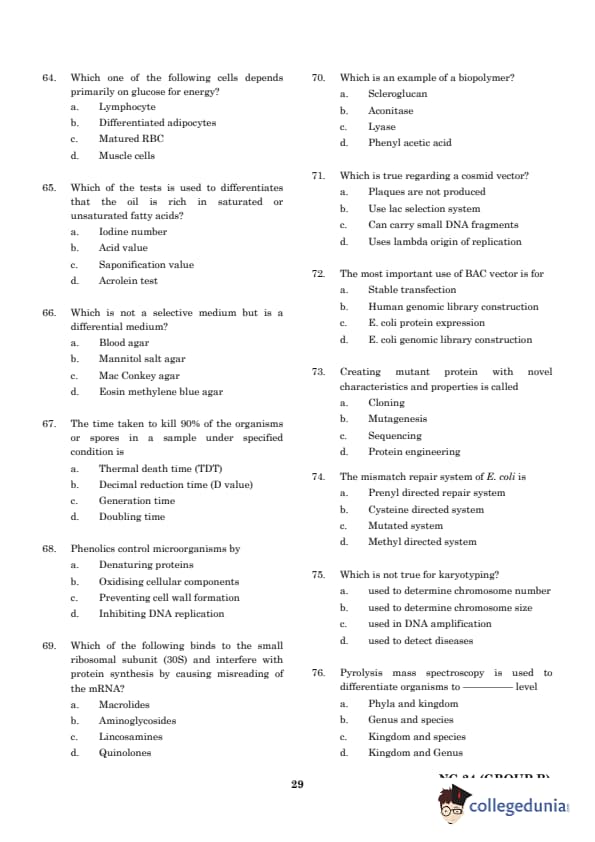
Which one of the following cells depends primarily on glucose for energy?
View Solution
Step 1: Understanding Cellular Energy Sources
Different cells in the body rely on different energy sources depending on their metabolic needs. Step 2: Evaluating the Options
- Lymphocytes: These immune cells primarily rely on glucose for energy, especially during activation. - Differentiated adipocytes: These cells store fat and rely on lipids, not glucose. - Matured RBC: Red blood cells primarily rely on glucose via anaerobic glycolysis for energy. - Muscle cells: Muscle cells use a combination of glucose and fatty acids depending on activity levels. Step 3: Conclusion
Lymphocytes primarily use glucose, especially during immune responses. Quick Tip: Lymphocytes primarily use glucose for energy during immune activation, while other cells may rely more on fats.
Which of the tests is used to differentiate whether the oil is rich in saturated or unsaturated fatty acids?
View Solution
Step 1: Understanding the Iodine Number
The iodine number measures the amount of iodine that can be absorbed by the oil, which correlates with the level of unsaturation (double bonds) in fatty acids. Step 2: Evaluating the Options
- Iodine number: Measures unsaturation; higher iodine numbers indicate more unsaturation (more double bonds). - Acid value: Measures the free fatty acid content, not saturation. - Saponification value: Relates to the average molecular weight of fatty acids, not directly to unsaturation. - Acrolein test: Used to detect glycerol-based compounds, not to differentiate between saturated or unsaturated fatty acids. Step 3: Conclusion
Iodine number is the correct test for measuring unsaturation in oils. Quick Tip: A higher iodine number indicates more unsaturation, as more iodine is absorbed by oils with double bonds.
Which is not a selective medium but is a differential medium?
View Solution
Step 1: Understanding Selective and Differential Media
Selective media inhibit the growth of some organisms while allowing others to grow. Differential media allow different organisms to be distinguished based on their appearance. Step 2: Evaluating the Options
- Blood agar: It is a differential medium but not selective. It distinguishes bacteria based on their hemolytic properties. - Mannitol salt agar: Selective for Staphylococcus species and differential for mannitol fermentation. - Mac Conkey agar: Selective for Gram-negative bacteria and differential for lactose fermentation. - Eosin methylene blue agar: Selective for Gram-negative bacteria and differential for lactose fermentation. Step 3: Conclusion
Blood agar is a differential medium but not selective, as it does not inhibit the growth of specific organisms. Quick Tip: Blood agar is used to differentiate organisms based on hemolysis patterns but does not inhibit other bacteria.
The time taken to kill 90 percent of the organisms or spores in a sample under specified condition is:
View Solution
Step 1: Understanding D Value
The decimal reduction time (D value) is the time required at a specific temperature to reduce the microbial population by 90%. Step 2: Evaluating the Options
- Thermal death time (TDT): The time needed to kill all the organisms at a given temperature, not just 90%. - Decimal reduction time (D value): Correct, the D value measures the time to kill 90% of the organisms. - Generation time: Time it takes for a population to double, unrelated to microbial death. - Doubling time: Similar to generation time, refers to population growth. Step 3: Conclusion
The correct term for killing 90% of organisms is the decimal reduction time (D value). Quick Tip: The D value is used to measure the time needed to reduce the microbial population by 90%.
Phenolics control microorganisms by:
View Solution
Step 1: Understanding Phenolic Activity
Phenolic compounds have antimicrobial properties and typically work by denaturing proteins, disrupting the structure and function of microbial cells. Step 2: Evaluating the Options
- Denaturing proteins: Correct, phenolics disrupt proteins and enzymes within the microorganism. - Oxidizing cellular components: This is more characteristic of other disinfectants like bleach. - Preventing cell wall formation: Phenolics do not act this way. - Inhibiting DNA replication: Not a primary mechanism of phenolic compounds. Step 3: Conclusion
Phenolics primarily control microorganisms by denaturing proteins. Quick Tip: Phenolic compounds disrupt protein function, making them effective antimicrobial agents.
Which of the following binds to the small ribosomal subunit (30S) and interferes with protein synthesis by causing misreading of the mRNA?
View Solution
Step 1: Understanding the Action of Aminoglycosides
Aminoglycosides bind to the 30S ribosomal subunit, causing misreading of the mRNA and inhibiting protein synthesis. Step 2: Evaluating the Options
- Macrolides: Bind to the 50S subunit, inhibiting protein synthesis by preventing elongation. - Aminoglycosides: Correct, bind to the 30S subunit and cause misreading of the mRNA. - Lincosamines: Bind to the 50S subunit and inhibit protein synthesis, not by misreading. - Quinolones: Inhibit DNA gyrase, not directly involved in ribosomal binding. Step 3: Conclusion
Aminoglycosides interfere with protein synthesis by causing misreading of mRNA. Quick Tip: Aminoglycosides target the 30S ribosomal subunit, causing mRNA misreading and disrupting protein synthesis.
Which is an example of a biopolymer?
View Solution
Step 1: Understanding Biopolymers
Biopolymers are naturally occurring polymers produced by living organisms, including polysaccharides, proteins, and nucleic acids. Step 2: Evaluating the Options
- Scleroglucan: A polysaccharide biopolymer produced by fungi. - Aconitase: An enzyme, not a biopolymer. - Lyase: An enzyme, not a biopolymer. - Phenyl acetic acid: A small organic compound, not a biopolymer. Step 3: Conclusion
Scleroglucan is the correct example of a biopolymer. Quick Tip: Biopolymers include substances like polysaccharides (e.g., scleroglucan) and proteins, which are produced by living organisms.
Which is true regarding a cosmid vector?
View Solution
Step 1: Understanding Cosmid Vectors
Cosmids are hybrid vectors that combine features of plasmids and phages, allowing for the cloning of large DNA fragments. Step 2: Evaluating the Options
- Plaques are not produced: Incorrect, since cosmid vectors are based on lambda phages, plaques are produced. - Use lac selection system: Incorrect, although some vectors use lac operon for selection, this is not a defining feature of cosmids. - Can carry small DNA fragments: Incorrect, cosmids are known for carrying larger DNA fragments, up to 40 kb. - Uses lambda origin of replication: Correct, cosmids use the lambda origin of replication to replicate in the host cell. Step 3: Conclusion
Cosmids use the lambda origin of replication to ensure they can replicate within bacterial cells. Quick Tip: Cosmids use the lambda origin of replication and can carry large DNA fragments, typically used in genomic libraries.
The most important use of BAC vector is for:
View Solution
Step 1: Understanding BAC Vectors
Bacterial artificial chromosomes (BACs) are large cloning vectors used for cloning large DNA fragments, typically up to 300 kb. Step 2: Evaluating the Options
- Stable transfection: Not the primary use of BACs. - Human genomic library construction: Correct, BAC vectors are ideal for constructing large human genomic libraries. - E. coli protein expression: E. coli protein expression typically uses plasmid vectors, not BACs. - E. coli genomic library construction: Not typically used for constructing genomic libraries; BACs are better for large DNA fragments. Step 3: Conclusion
The most important use of BAC vectors is for constructing human genomic libraries. Quick Tip: BAC vectors are used to clone large DNA fragments, making them ideal for constructing genomic libraries.
Creating mutant protein with novel characteristics and properties is called:
View Solution
Step 1: Understanding Protein Engineering
Protein engineering involves designing and creating proteins with novel characteristics through techniques like mutagenesis and directed evolution. Step 2: Evaluating the Options
- Cloning: Refers to the process of copying DNA, not directly creating mutant proteins. - Mutagenesis: A technique used in protein engineering to introduce mutations but not the overall process. - Sequencing: Involves determining the nucleotide sequence, not creating mutant proteins. - Protein engineering: Correct, it involves creating proteins with novel properties and functions. Step 3: Conclusion
The process of creating mutant proteins with novel characteristics is known as protein engineering. Quick Tip: Protein engineering combines techniques like mutagenesis to design proteins with new properties.
The mismatch repair system of E. coli is:
View Solution
Step 1: Understanding the Mismatch Repair System
In E. coli, the mismatch repair system corrects errors that occur during DNA replication, specifically by recognizing the parent strand through methylation. Step 2: Evaluating the Options
- Prenyl directed repair system: Not related to the mismatch repair system. - Cysteine directed system: Incorrect, does not relate to mismatch repair. - Mutated system: Incorrect, as the system is not considered mutated. - Methyl directed system: Correct, the system uses methylation marks on the parent strand to identify and correct mismatches. Step 3: Conclusion
The mismatch repair system in E. coli is methyl-directed, recognizing the parent strand by methylation. Quick Tip: The methyl-directed mismatch repair system in E. coli uses methylation to identify the correct DNA strand.
Which is not true for karyotyping?
View Solution
Step 1: Understanding Karyotyping
Karyotyping is used to examine the number, shape, and size of chromosomes in a cell, helping detect genetic diseases. Step 2: Evaluating the Options
- Used to determine chromosome number: True, karyotyping is used to count chromosomes. - Used to determine chromosome size: True, karyotyping helps assess the size of chromosomes. - Used in DNA amplification: Incorrect, DNA amplification is done through PCR, not karyotyping. - Used to detect diseases: True, karyotyping helps detect chromosomal abnormalities linked to diseases. Step 3: Conclusion
Karyotyping does not involve DNA amplification, making option (c) the correct answer. Quick Tip: Karyotyping is used to analyze chromosomes, not for DNA amplification, which is done by PCR.
Pyrolysis mass spectroscopy is used to differentiate organisms to ————— level
View Solution
Step 1: Understanding Pyrolysis Mass Spectroscopy
Pyrolysis mass spectroscopy is a technique that involves breaking down organic material at high temperatures and analyzing the resulting mass spectra to identify organisms. Step 2: Evaluating the Options
- Phyla and kingdom: Too broad for pyrolysis mass spectrometry, which distinguishes organisms at a more specific level. - Genus and species: Correct, this level of detail is where pyrolysis mass spectroscopy can differentiate organisms. - Kingdom and species: Species is too specific when differentiating at a higher taxonomic level. - Kingdom and Genus: Incorrect, as this is still too broad for this technique. Step 3: Conclusion
Pyrolysis mass spectrometry can differentiate organisms primarily at the genus and species level. Quick Tip: Pyrolysis mass spectroscopy is effective in distinguishing organisms at the genus and species level by analyzing their molecular fingerprints.
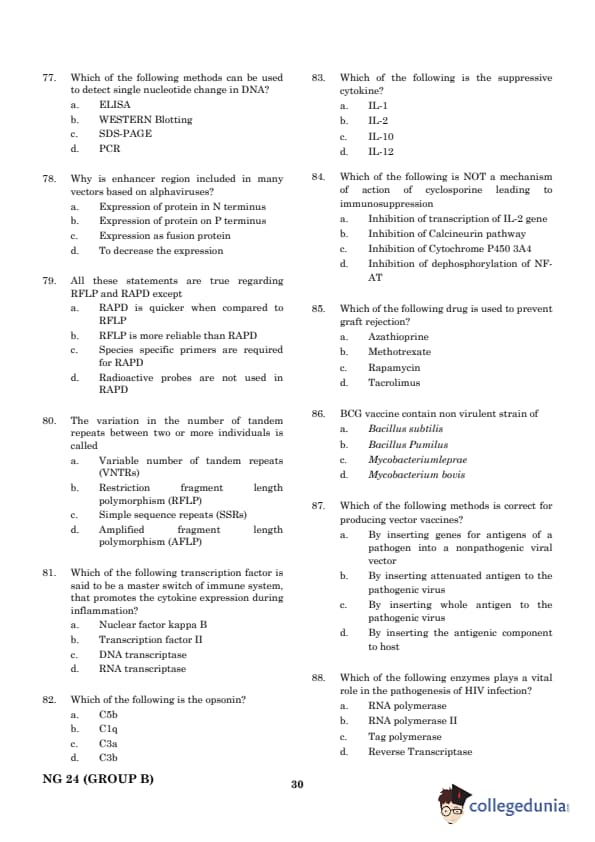
Which of the following methods can be used to detect single nucleotide change in DNA?
View Solution
Step 1: Understanding the Methods
- ELISA: A technique used for detecting and quantifying soluble substances like proteins or antibodies, not suitable for detecting nucleotide changes. - WESTERN Blotting: Used for detecting proteins, not nucleotides. - SDS-PAGE: A technique for protein separation, not used for detecting DNA sequence changes. - PCR: Correct, PCR can be used to detect single nucleotide changes by amplifying specific DNA regions and comparing the sequences. Step 2: Conclusion
PCR is the most suitable method for detecting single nucleotide changes in DNA. Quick Tip: PCR can detect single nucleotide changes by amplifying target DNA regions and analyzing sequence variations.
Why is the enhancer region included in many vectors based on alphaviruses?
View Solution
Step 1: Understanding Enhancer Regions in Alphavirus Vectors
Enhancer regions are included in viral vectors, such as alphaviruses, to boost the expression of recombinant genes. Step 2: Evaluating the Options
- Expression of protein in N terminus: Not the main function of enhancer regions. - Expression of protein on P terminus: Also not related to the enhancer region's function. - Expression as fusion protein: Correct, enhancer regions help in high-level expression, often used in fusion protein expression. - To decrease the expression: Enhancer regions are used to increase, not decrease, gene expression. Step 3: Conclusion
Enhancer regions are included to increase protein expression, especially when expressed as fusion proteins. Quick Tip: Enhancer regions in alphavirus vectors are included to increase the expression of fusion proteins.
All these statements are true regarding RFLP and RAPD except
View Solution
Step 1: Understanding RFLP and RAPD
RFLP (Restriction Fragment Length Polymorphism) and RAPD (Random Amplified Polymorphic DNA) are two molecular techniques for detecting genetic diversity. Step 2: Evaluating the Options
- RAPD is quicker when compared to RFLP: True, RAPD is quicker as it doesn’t require restriction enzyme digestion. - RFLP is more reliable than RAPD: True, RFLP is more specific and reliable for identifying polymorphisms. - Species-specific primers are required for RAPD: Incorrect, RAPD uses random primers, not species-specific ones. - Radioactive probes are not used in RAPD: True, RAPD typically uses non-radioactive detection methods. Step 3: Conclusion
RAPD does not require species-specific primers. Quick Tip: RAPD uses random primers, whereas RFLP requires specific probes and is more reliable but slower.
The variation in the number of tandem repeats between two or more individuals is called:
View Solution
Step 1: Understanding Tandem Repeats
Tandem repeats are short DNA sequences that are repeated one after another. Variations in the number of these repeats between individuals are known as VNTRs. Step 2: Evaluating the Options
- Variable number of tandem repeats (VNTRs): Correct, this refers to the variation in the number of tandem repeats between individuals. - Restriction fragment length polymorphism (RFLP): Involves variations in DNA fragment lengths due to restriction enzyme digestion. - Simple sequence repeats (SSRs): Refers to microsatellites, short, repetitive sequences, but not directly to tandem repeat number variation. - Amplified fragment length polymorphism (AFLP): A technique for detecting polymorphisms based on selective amplification of DNA fragments. Step 3: Conclusion
VNTRs refer to variations in tandem repeat numbers between individuals. Quick Tip: VNTRs are variations in the number of repeating DNA sequences, widely used in forensic and genetic studies.
Which of the following transcription factors is said to be a master switch of the immune system, promoting cytokine expression during inflammation?
View Solution
Step 1: Understanding Nuclear Factor Kappa B (NF-κB)
NF-κB is a transcription factor that plays a crucial role in regulating the immune response, including cytokine production during inflammation. Step 2: Evaluating the Options
- Nuclear factor kappa B (NF-κB): Correct, it is a master switch for immune responses, activating various inflammatory genes. - Transcription factor II: A general transcription factor involved in transcription initiation but not specific to immune response. - DNA transcriptase: Not a transcription factor. - RNA transcriptase: Not a transcription factor either; it is related to RNA synthesis. Step 3: Conclusion
NF-κB is the transcription factor responsible for cytokine expression during inflammation. Quick Tip: NF-κB is essential for the immune system's response to inflammation and immune activation.
Which of the following is the opsonin?
View Solution
Step 1: Understanding Opsonins
Opsonins are molecules that enhance phagocytosis by marking pathogens for recognition by immune cells like macrophages and neutrophils. Step 2: Evaluating the Options
- C5b: Part of the complement system, involved in the formation of the membrane attack complex, not an opsonin. - C1q: Part of the complement system, helps initiate the classical pathway but not directly involved in opsonization. - C3a: Involved in inflammation but not an opsonin. - C3b: Correct, C3b is an opsonin that binds to pathogens, promoting their uptake by phagocytes. Step 3: Conclusion
C3b acts as the primary opsonin in the immune response. Quick Tip: C3b is the opsonin that enhances phagocytosis by marking pathogens for immune cell recognition.
Which of the following is the suppressive cytokine?
View Solution
Step 1: Understanding Suppressive Cytokines
Suppressive cytokines help regulate the immune system by dampening immune responses and preventing excessive inflammation. Step 2: Evaluating the Options
- IL-1: Pro-inflammatory cytokine, not suppressive. - IL-2: Stimulates T-cell proliferation, pro-inflammatory. - IL-10: Correct, IL-10 is an anti-inflammatory cytokine that suppresses immune responses. - IL-12: Stimulates Th1 response, pro-inflammatory. Step 3: Conclusion
IL-10 is the key suppressive cytokine in immune regulation. Quick Tip: IL-10 is a key anti-inflammatory cytokine that suppresses immune responses and inflammation.
Which of the following is NOT a mechanism of action of cyclosporine leading to immunosuppression?
View Solution
Step 1: Understanding Cyclosporine's Mechanism
Cyclosporine is an immunosuppressive drug that inhibits T-cell activation by binding to cyclophilin, which then inhibits calcineurin, preventing NF-AT dephosphorylation. Step 2: Evaluating the Options
- Inhibition of transcription of IL-2 gene: True, cyclosporine inhibits IL-2 transcription, which is crucial for T-cell activation. - Inhibition of Calcineurin pathway: True, cyclosporine inhibits calcineurin, blocking T-cell activation. - Inhibition of Cytochrome P450 3A4: Incorrect, cyclosporine inhibits cytochrome P450 3A4 (not a mechanism of immunosuppression, but affects drug metabolism). - Inhibition of dephosphorylation of NF-AT: True, cyclosporine prevents NF-AT activation by inhibiting calcineurin. Step 3: Conclusion
Cyclosporine does not inhibit Cytochrome P450 3A4 as a mechanism of immunosuppression. Quick Tip: Cyclosporine suppresses immune responses by inhibiting calcineurin, preventing NF-AT activation, and reducing IL-2 production.
Which of the following drug is used to prevent graft rejection?
View Solution
Step 1: Understanding Graft Rejection Prevention
Tacrolimus is an immunosuppressive drug that prevents graft rejection by inhibiting T-cell activation, particularly by blocking calcineurin. Step 2: Evaluating the Options
- Azathioprine: Inhibits purine synthesis, used for immunosuppression, but not as effective as tacrolimus for preventing graft rejection. - Methotrexate: An antimetabolite that inhibits cell division, not primarily used for graft rejection prevention. - Rapamycin: Inhibits mTOR, used in preventing organ rejection but not the first-line drug. - Tacrolimus: Correct, tacrolimus is widely used to prevent organ rejection, particularly for kidney transplants. Step 3: Conclusion
Tacrolimus is the drug of choice for preventing graft rejection. Quick Tip: Tacrolimus prevents graft rejection by inhibiting calcineurin, blocking T-cell activation.
BCG vaccine contains non-virulent strain of:
View Solution
Step 1: Understanding BCG Vaccine
The Bacillus Calmette-Guérin (BCG) vaccine contains a live, attenuated strain of Mycobacterium bovis, which is used for tuberculosis prevention. Step 2: Evaluating the Options
- Bacillus subtilis: A different bacterium, not used in BCG. - Bacillus Pumilus: Another unrelated bacterium. - Mycobacterium leprae: Causes leprosy, not used in the BCG vaccine. - Mycobacterium bovis: Correct, the BCG vaccine is derived from an attenuated strain of Mycobacterium bovis. Step 3: Conclusion
BCG vaccine uses Mycobacterium bovis, a non-virulent strain for immunization. Quick Tip: The BCG vaccine contains an attenuated strain of Mycobacterium bovis, used to prevent tuberculosis.
Which of the following methods is correct for producing vector vaccines?
View Solution
Step 1: Understanding Vector Vaccines
Vector vaccines involve inserting genes encoding antigens from a pathogen into a harmless virus or bacterium, which then serves as a vector to deliver the antigens to the body. Step 2: Evaluating the Options
- Inserting genes for antigens of a pathogen into a nonpathogenic viral vector: Correct, this is the standard method for producing vector vaccines. - Inserting attenuated antigen to the pathogenic virus: Incorrect, as this could make the virus pathogenic. - Inserting whole antigen to the pathogenic virus: Incorrect, as it could cause immune reactions or make the virus dangerous. - Inserting the antigenic component to host: Not the method used for vector vaccines. Step 3: Conclusion
Vector vaccines use nonpathogenic viruses as carriers to deliver pathogen antigens. Quick Tip: Vector vaccines use nonpathogenic viruses to deliver pathogen-specific antigens to the immune system.
Which of the following enzymes plays a vital role in the pathogenesis of HIV infection?
View Solution
Step 1: Understanding HIV Pathogenesis
HIV uses reverse transcriptase to convert its RNA genome into DNA, which is then integrated into the host genome. Step 2: Evaluating the Options
- RNA polymerase: Not involved in HIV pathogenesis. - RNA polymerase II: Involved in eukaryotic transcription but not in HIV replication. - Tag polymerase: Not related to HIV replication. - Reverse Transcriptase: Correct, HIV uses reverse transcriptase to replicate its RNA genome into DNA. Step 3: Conclusion
Reverse transcriptase is a critical enzyme for the replication of HIV. Quick Tip: Reverse transcriptase is essential for HIV replication, converting viral RNA into DNA for integration into the host genome.
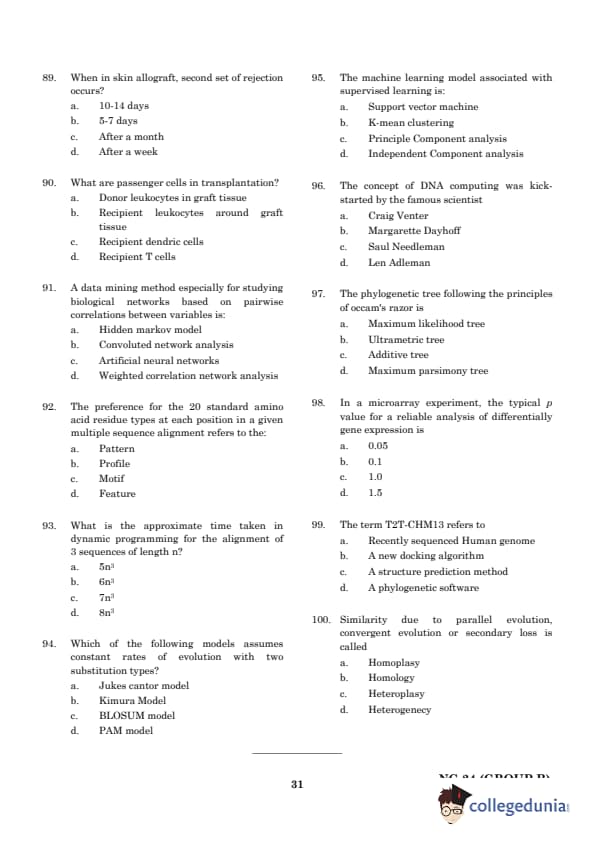
When in skin allograft, second set of rejection occurs?
View Solution
Step 1: Understanding Graft Rejection
The first set of graft rejection occurs after 10-14 days due to the primary immune response. In a second set of rejection, the immune response is faster due to memory immune cells. Step 2: Evaluating the Options
- 10-14 days: First set of rejection, not the second. - 5-7 days: Correct, second set of rejection occurs faster, typically within 5-7 days. - After a month: Too late for second-set rejection. - After a week: Not the typical time frame for second-set rejection. Step 3: Conclusion
The second set of rejection typically occurs within 5-7 days. Quick Tip: In skin allografts, second-set rejection occurs faster due to prior sensitization of the immune system.
What are passenger cells in transplantation?
View Solution
Step 1: Understanding Passenger Cells
Passenger cells refer to the donor’s immune cells (leukocytes) present in the transplanted tissue, which can influence the recipient’s immune response. Step 2: Evaluating the Options
- Donor leukocytes in graft tissue: Correct, these cells can affect the immune rejection process in the recipient. - Recipient leukocytes around graft tissue: Incorrect, these are not considered passenger cells. - Recipient dendric cells: Incorrect, these are not specifically passenger cells. - Recipient T cells: Incorrect, they are part of the recipient's immune system. Step 3: Conclusion
Passenger cells are donor leukocytes within the graft tissue. Quick Tip: Passenger cells are the donor’s immune cells in the graft, playing a role in graft acceptance or rejection.
A data mining method especially for studying biological networks based on pairwise correlations between variables is:
View Solution
Step 1: Understanding Weighted Correlation Network Analysis
Weighted correlation network analysis (WGCNA) is a method used in bioinformatics to explore correlations between variables in large biological datasets, such as gene expression data. Step 2: Evaluating the Options
- Hidden Markov model: Used for modeling time-series data, not specifically for biological network analysis. - Convoluted network analysis: Not a standard term in data mining for biological networks. - Artificial neural networks: Used for various data analysis tasks but not specifically for pairwise correlations in biological networks. - Weighted correlation network analysis: Correct, WGCNA is specifically designed for studying pairwise correlations in biological networks. Step 3: Conclusion
Weighted correlation network analysis is the appropriate method for studying pairwise correlations in biological networks. Quick Tip: WGCNA is a powerful method used to study correlations between genes and their relationships in biological networks.
The preference for the 20 standard amino acid residue types at each position in a given multiple sequence alignment refers to the:
View Solution
Step 1: Understanding Sequence Alignment Terms
A profile represents the distribution of amino acids or nucleotides at each position in an alignment of multiple sequences, showing which amino acids are preferred at each position. Step 2: Evaluating the Options
- Pattern: Refers to specific motifs or arrangements within the sequence but not the entire sequence's residue distribution. - Profile: Correct, a profile captures the preference for amino acid types at each position in a sequence alignment. - Motif: A conserved sequence pattern often found in biological contexts but not specifically for residue preference in alignments. - Feature: Refers to specific sequence features or attributes but not the general residue preference in alignments. Step 3: Conclusion
The term used for residue preference at each position in multiple sequence alignment is a profile. Quick Tip: In sequence alignments, a profile represents the preferred amino acid types at each position.
What is the approximate time taken in dynamic programming for the alignment of 3 sequences of length n?
View Solution
Step 1: Understanding Dynamic Programming for Sequence Alignment
The time complexity of dynamic programming for sequence alignment between multiple sequences is \(O(n^3)\), where \(n\) is the length of each sequence, and there are three sequences being aligned. Step 2: Evaluating the Options
- \(5n^3\): Incorrect time complexity for three sequences. - \(6n^3\): Incorrect, does not match the expected time complexity. - \(7n^3\) Correct, the time complexity is typically \(O(n^3)\) for three sequences. - \(8n^3\): Incorrect, does not match the expected time complexity. Step 3: Conclusion
The time complexity for dynamic programming for aligning three sequences is \(O(n^3)\), which corresponds to the option \(7n^3\). Quick Tip: Dynamic programming for sequence alignment with 3 sequences has a time complexity of \(O(n^3)\), where \(n\) is the sequence length.
Which of the following models assumes constant rates of evolution with two substitution types?
View Solution
Step 1: Understanding Evolution Models
The Jukes-Cantor model is one of the simplest models for nucleotide evolution, assuming equal rates of evolution for all substitution types (i.e., transitions and transversions occur at the same rate). Step 2: Evaluating the Options
- Jukes Cantor model: Correct, assumes constant rates of evolution with two substitution types. - Kimura Model: Assumes different rates for transitions and transversions, not constant rates. - BLOSUM model: Used for amino acid sequence alignments, not nucleotide evolution. - PAM model: Based on a different evolutionary assumption, not constant rates for substitution types. Step 3: Conclusion
The Jukes-Cantor model assumes constant rates of evolution with two substitution types. Quick Tip: The Jukes-Cantor model assumes equal rates for all substitutions (transitions and transversions) in nucleotide evolution.
The machine learning model associated with supervised learning is:
View Solution
Step 1: Understanding Supervised Learning
Supervised learning involves training a model on labeled data, where the model learns to map input features to target labels. Step 2: Evaluating the Options
- Support vector machine (SVM): Correct, SVM is a supervised learning algorithm used for classification and regression tasks. - K-mean clustering: Incorrect, K-means is an unsupervised learning algorithm used for clustering. - Principal Component analysis (PCA): Incorrect, PCA is an unsupervised dimensionality reduction technique. - Independent Component analysis (ICA): Incorrect, ICA is an unsupervised technique used for separating mixed signals. Step 3: Conclusion
Support vector machine is a supervised learning model. Quick Tip: Support vector machine (SVM) is widely used in supervised learning for classification and regression tasks.
The concept of DNA computing was kick-started by the famous scientist:
View Solution
Step 1: Understanding DNA Computing
DNA computing involves using DNA, biochemistry, and molecular biology to perform computational tasks. Len Adleman is credited with pioneering the concept of DNA computing. Step 2: Evaluating the Options
- Craig Venter: Known for sequencing the human genome, not for DNA computing. - Margarette Dayhoff: Known for creating the first protein sequence database, not for DNA computing. - Saul Needleman: Known for developing the Needleman-Wunsch algorithm for sequence alignment, not for DNA computing. - Len Adleman: Correct, Len Adleman is widely recognized for initiating the field of DNA computing in the 1990s. Step 3: Conclusion
Len Adleman is the scientist who kick-started the concept of DNA computing. Quick Tip: Len Adleman is a pioneer in DNA computing, having demonstrated the use of DNA for solving computational problems.
The phylogenetic tree following the principles of Occam's razor is:
View Solution
Step 1: Understanding Occam's Razor in Phylogenetics
Occam's razor suggests that the simplest explanation, with the least number of assumptions, should be preferred. In phylogenetics, this principle is applied by choosing the tree with the least number of evolutionary changes. Step 2: Evaluating the Options
- Maximum likelihood tree: Involves complex models to maximize the likelihood of the tree given the data, but does not directly follow Occam’s razor. - Ultrametric tree: A tree where all tips are equidistant from the root; does not directly follow Occam’s razor. - Additive tree: A tree with distances that are additive, not necessarily reflecting the simplest tree. - Maximum parsimony tree: Correct, this method selects the tree with the fewest evolutionary changes, directly following Occam’s razor. Step 3: Conclusion
The maximum parsimony tree is the one that follows the principles of Occam's razor in phylogenetics. Quick Tip: Maximum parsimony uses the principle of Occam's razor, selecting the simplest tree with the fewest evolutionary changes.
In a microarray experiment, the typical p-value for a reliable analysis of differentially gene expression is:
View Solution
Step 1: Understanding p-value in Microarray Analysis
In microarray experiments, the p-value is used to determine the statistical significance of gene expression differences. A p-value of 0.05 is typically considered the threshold for significance in most experiments. Step 2: Evaluating the Options
- 0.05: Correct, this is the commonly accepted p-value threshold for determining significant differential expression. - 0.1: A higher threshold, used in some exploratory analyses, but not standard. - 1.0: Not used in significance testing; indicates no statistical difference. - 1.5: Not a p-value but a fold change, and not applicable here. Step 3: Conclusion
A p-value of 0.05 is typically used for reliable analysis of differential gene expression in microarray experiments. Quick Tip: A p-value of 0.05 is commonly used to determine statistical significance in gene expression studies.
The term T2T-CHM13 refers to:
View Solution
Step 1: Understanding T2T-CHM13
T2T-CHM13 refers to the "Telomere-to-Telomere" human genome reference, which represents the most complete and accurate human genome sequence, including previously unsequenced regions. Step 2: Evaluating the Options
- Recently sequenced Human genome: Correct, T2T-CHM13 is the name of the recently completed, most complete human genome sequence. - A new docking algorithm: Incorrect, T2T-CHM13 is not related to docking algorithms. - A structure prediction method: Incorrect, T2T-CHM13 is about genome sequencing, not protein structure prediction. - A phylogenetic software: Incorrect, it is not software related to phylogenetics. Step 3: Conclusion
T2T-CHM13 is a recently sequenced human genome. Quick Tip: T2T-CHM13 is the most complete human genome sequence, offering a reference for genomic research.
Similarity due to parallel evolution, convergent evolution or secondary loss is called:
View Solution
Step 1: Understanding Evolutionary Terms
Homoplasy refers to similarity in traits due to convergent or parallel evolution, or secondary loss of traits, not due to common ancestry. Step 2: Evaluating the Options
- Homoplasy: Correct, it describes traits that are similar due to independent evolutionary events. - Homology: Refers to similarity due to common ancestry, not convergent evolution. - Heteroplasy: Refers to variation in ploidy or organelle content, not relevant to evolutionary similarity. - Heterogenecy: Not a standard term in evolutionary biology. Step 3: Conclusion
Homoplasy describes traits that appear similar due to parallel or convergent evolution. Quick Tip: Homoplasy refers to traits that evolved independently, such as in convergent or parallel evolution.




Comments