




The MICAT 2003 Question Paper is now available for download with answer key and detailed solutions PDF. MICAT Exam assesses candidates on General Knowledge, Verbal Ability, Quantitative Ability, Logical Reasoning, and the Psychometric Test. Solving MICAT question paper will help you get acquainted with the exam structure, the kinds of questions being asked, and optimize your preparation for better performance.
MICAT Question Paper 2003 with Solution PDF
| MICAT Question Paper 2003 with Solutions PDF | Download PDF | Check Solutions |

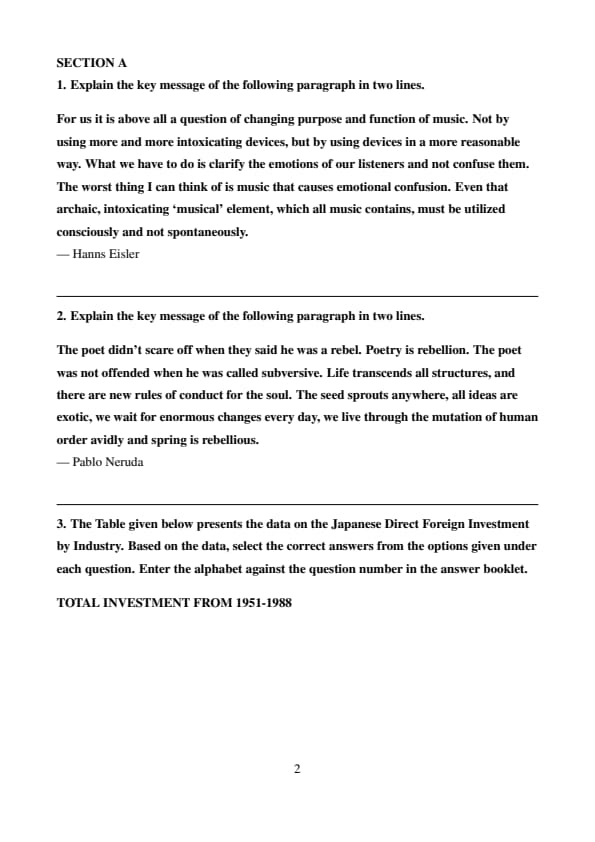
Explain the key message of the following paragraph in two lines.
For us it is above all a question of changing purpose and function of music. Not by using more and more intoxicating devices, but by using devices in a more reasonable way. What we have to do is clarify the emotions of our listeners and not confuse them. The worst thing I can think of is music that causes emotional confusion. Even that archaic, intoxicating ‘musical’ element, which all music contains, must be utilized consciously and not spontaneously.
— Hanns Eisler
View Solution
Step 1: Understanding the key message.
The passage stresses the importance of changing the purpose and function of music. It argues against using more intoxicating elements in music and instead advocates for using musical devices consciously to evoke clear emotions. The author also warns against creating confusion through music.
Step 2: Analyzing the options.
The key message revolves around the careful and reasoned use of music, emphasizing the need to avoid overwhelming or confusing listeners with excessive or distracting elements. The focus is on clarity and intentional use of the musical elements.
Step 3: Conclusion.
The correct answer encapsulates the main idea of the passage: music must be used consciously to communicate emotions clearly, avoiding confusion.
Quick Tip: When analyzing the purpose of art or music, focus on the intention behind its use and how it aims to influence the emotions of its audience.
Explain the key message of the following paragraph in two lines.
The poet didn’t scare off when they said he was a rebel. Poetry is rebellion. The poet was not offended when he was called subversive. Life transcends all structures, and there are new rules of conduct for the soul. The seed sprouts anywhere, all ideas are exotic, we wait for enormous changes every day, we live through the mutation of human order avidly and spring is rebellious.
— Pablo Neruda
View Solution
Step 1: Understanding the key message.
The passage conveys that poetry represents rebellion against the established norms. The poet accepts being called a rebel and embraces the idea that life, ideas, and change are not bound by traditional structures.
Step 2: Analyzing the options.
The message encourages viewing poetry and life through the lens of rebellion and constant transformation. The poet’s perspective embraces subversive ideas and sees every change as part of a larger, necessary process.
Step 3: Conclusion.
The correct answer emphasizes that the poet's approach to life and poetry is rooted in rebellion, embracing transformation and the challenge of established norms.
Quick Tip: In literature, rebellious themes often challenge social norms and invite readers to reflect on the need for change and progress in society.
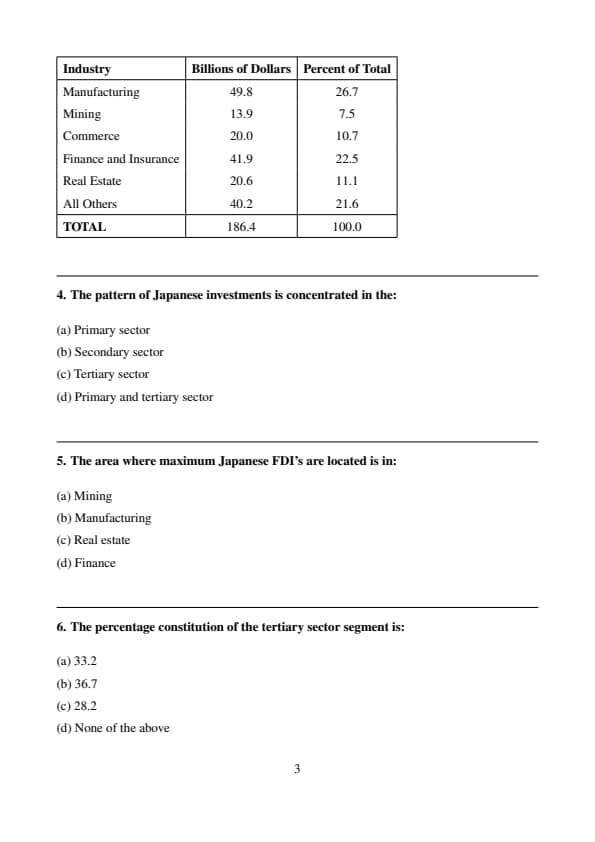
The Table given below presents the data on the Japanese Direct Foreign Investment by Industry. Based on the data, select the correct answers from the options given under each question. Enter the alphabet against the question number in the answer booklet.
TOTAL INVESTMENT FROM 1951-1988
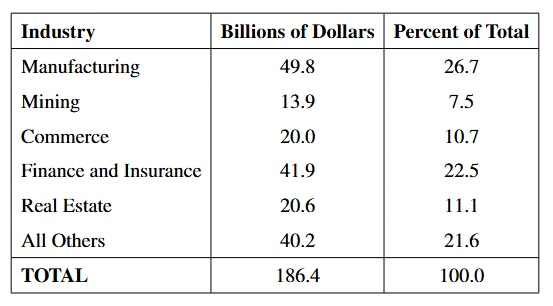
View Solution
Step 1: Analyzing the table.
The table provides the data for Japanese Direct Foreign Investment from 1951-1988, broken down by industry. It includes the total investment in billions of dollars and the corresponding percentage of the total investment for each industry.
Step 2: Understanding the industries.
- Manufacturing: The largest share with
(49.8 billion, representing 26.7% of the total investment.
- Mining: Represents a smaller portion, with
)13.9 billion, which is 7.5% of the total investment.
- Commerce: Contributes
(20.0 billion, which accounts for 10.7% of the total.
- Finance and Insurance:
)41.9 billion, making up 22.5%.
- Real Estate:
(20.6 billion, representing 11.1%.
- All Others:
)40.2 billion, or 21.6%.
Step 3: Conclusion.
The data shows that the largest investments were in Manufacturing and Finance & Insurance, while Mining had the smallest share. The total amount invested was
(186.4 billion, distributed across various industries.
Quick Tip: Always look for the industry with the largest and smallest investments in such tables. It provides a clear view of the priorities or trends in foreign investments.
The pattern of Japanese investments is concentrated in the:
View Solution
Step 1: Understanding the pattern of investment.
The table indicates that the majority of Japanese investments are concentrated in the manufacturing and finance sectors, which are part of the secondary sector. Manufacturing alone holds a significant portion of the total investment. Therefore, the investment pattern is more concentrated in the secondary sector, which includes manufacturing.
Step 2: Analyzing the options.
- (a) Primary sector: This sector includes industries like mining, which has a relatively small share of investment.
- (b) Secondary sector: Correct, as manufacturing and finance, which belong to the secondary sector, receive the largest share of investments.
- (c) Tertiary sector: This sector, which includes services, has a smaller proportion of investment compared to the secondary sector.
- (d) Primary and tertiary sector: The concentration is more on the secondary sector, not a combination of primary and tertiary.
Step 3: Conclusion.
The correct answer is (b) Secondary sector, as it accounts for the majority of investments, particularly in manufacturing.
Quick Tip: When analyzing investment patterns, focus on sectors with the highest investments, such as manufacturing in this case, which falls under the secondary sector.
The area where maximum Japanese FDI’s are located is in:
View Solution
Step 1: Identifying the sector with maximum investment.
According to the table, the largest portion of Japanese FDI is in manufacturing, with
(49.8 billion, which makes up 26.7% of the total investment.
Step 2: Analyzing the options.
- (a) Mining: Mining has a relatively small share of investment.
- (b) Manufacturing: Correct, this sector has the largest amount of Japanese FDI investment.
- (c) Real estate: This sector also has a significant investment, but it is smaller than manufacturing.
- (d) Finance: Finance also has a large share, but manufacturing is still the leader.
Step 3: Conclusion.
The correct answer is (b) Manufacturing, as it attracts the largest amount of Japanese FDI.
Quick Tip: When identifying the sector with maximum investment, focus on the industries that have the highest dollar amounts in the given data.
The percentage constitution of the tertiary sector segment is:
View Solution
Step 1: Calculating the percentage of the tertiary sector.
The tertiary sector includes real estate and finance, which together make up 11.1% and 22.5% of the total investment, respectively. Adding these gives: \[ Tertiary Sector = 11.1% + 22.5% = 33.6%. \]
This percentage is not listed in the options.
Step 2: Conclusion.
The correct answer is (d) None of the above, as the actual percentage of the tertiary sector is 33.6%, which is not among the given options.
Quick Tip: When calculating sector percentages, ensure to add up all relevant sectors before comparing the sum to the options.
The Accident Scene
A truck has collided with a car. The car happens to belong to a local politician who is injured along with his driver. There is commotion all around. People are asking about the identity of the truck driver – who was he, which company did he work for, where was he going, what was he carrying, is this his normal route, what clothes was he wearing, what religion did he belong to, was he carrying any weapon, where did he live, how serious is his condition, will he be able to talk etc. People are also talking about the politician, his life, his work, his friends, his party politics, his enemies, his family and so on. Party workers have arrived on the scene and some are rushing towards the hospital.
Question 7:
Imagine yourself as a TV reporter – You have to report this accident live on air for viewers: Write a short paragraph on the scene and what you would say to maintain the interest of the viewers.
View Solution
Step 1: Describing the scene.
"Good evening, viewers. We are live at the scene of a tragic accident. A truck has collided with a car, which belongs to a local politician, who is reportedly injured along with his driver. There is a lot of commotion here, and the crowd is gathering, trying to figure out who the truck driver is and why this accident happened. Authorities are on their way, and party workers have started rushing to the hospital where the injured politician is being taken. This incident is sparking a lot of questions among the public, including about the politician’s life and work. Stay tuned as we bring you more updates on this situation."
Step 2: Maintaining viewer interest.
To keep viewers engaged, I would focus on the drama of the situation, highlighting the confusion and the rush to identify key details like the politician’s condition, and the identity of the truck driver. Additionally, I would introduce interviews with witnesses or on-the-spot analysis from experts. This creates an immersive experience for the audience.
Quick Tip: Always keep the viewers engaged by focusing on the drama of the situation, involving live reactions and making them feel as though they are part of the unfolding story.
Imagine you were telecasting the news from New Delhi, and talking on phone to your reporter who is present at the scene of the accident. List three questions that you would ask the reporter.
View Solution
Step 1: Identifying key aspects of the situation.
1. What is the condition of the politician and the driver? Are they being transported to the hospital?
2. Can you tell us if there are any other vehicles or people involved in the accident?
3. What is the current reaction from the crowd? Are party workers present at the scene, and what is their role?
Step 2: Focusing on relevant details.
These questions aim to gather the most important and immediate information about the accident, which would be critical to updating viewers.
Quick Tip: Ask focused questions that address the health and well-being of those involved, the scope of the incident, and any political or public reactions that are relevant.
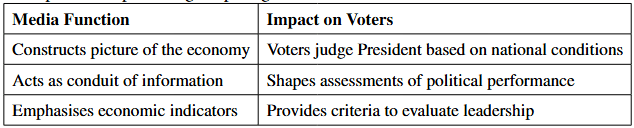
In particular, economic news coverage - specially, emphasis upon favourable or unfavourable developments or indicators - may help shape evaluations of presidential job performance because it provides citizens with socio-tropic criteria on which to judge the president. Scholars repeatedly have found that voters do not evaluate economic conditions through their own pocketbooks, focusing instead on national economic conditions. Although the informational demands of monitoring the state of economy seem great, Kinder and Kiewit (1981) suggest, "Voters must only develop rough evaluations of national economic condition". Thus, news media may either help "construct" a picture of the national economy through their reporting or function as a "conduit" through which economic information reaches citizens. Regardless, coverage linking the President to economic conditions may be a predominant influence on citizens' assessments of political performance.
Question 9:
The criteria to evaluate the performance of the nations’ top executive is usually:
View Solution
Step 1: Understanding the criteria for evaluating performance.
The passage discusses how economic news coverage influences voters' assessments of presidential job performance. It highlights the importance of both micro-economic (personal) and macro-economic (national) conditions. Both types of economic conditions are used by voters to evaluate the performance of the President.
Step 2: Analyzing the options.
- (a) Coverage of micro-economic condition: While personal economic conditions may influence individual assessments, this is only part of the picture.
- (b) Coverage of macro-economic condition: National economic conditions are a key factor in how voters evaluate the President.
- (c) None of the above: Incorrect, as both micro and macro-economic conditions are important.
- (d) Both a) and b): Correct, as the passage suggests that both types of economic coverage are relevant for voter evaluation of presidential performance.
Step 3: Conclusion.
The correct answer is (d) Both a) and b), as voters use both personal and national economic conditions to assess presidential performance.
Quick Tip: When evaluating political performance, consider both personal economic conditions (micro) and national economic conditions (macro), as both influence public opinion.
In terms of economic news the media helps:
View Solution
Step 1: Understanding the passage.
The passage states that media coverage constructs a picture of the economy and also acts as a conduit through which economic information reaches the public. This means media not only presents the economic situation but also filters and interprets information.
Step 2: Analyzing the options.
% Option
(a) Correct — The media provides citizens with a broad picture of the economy.
% Option
(b) Correct — The media functions as a filter through which economic information is conveyed.
% Option
(c) Incorrect — Both statements (a) and (b) are supported by the passage.
% Option
(d) Correct — Since both (a) and (b) are true.
Step 3: Conclusion.
Thus, the media helps both by providing a representative picture of the economy and filtering information for voters.
Quick Tip: When a passage explains two or more functions clearly, prefer the option that includes both.
The essence of the above paragraph is:
View Solution
Step 1: Identifying the central idea.
The passage focuses on how citizens form opinions about the President’s performance based on media coverage of national economic conditions. It deals mainly with how voters interpret economic information.
Step 2: Option analysis.
% Option
(a) Incorrect — Media reportage is discussed, but it is not the main focus.
% Option
(b) Correct — The paragraph is centered on how voters evaluate leaders based on economic news.
% Option
(c) Incorrect — The role of the executive is not the key theme.
% Option
(d) Incorrect — Because option (b) is correct.
Step 3: Conclusion.
The passage primarily explains voter behaviour shaped by media coverage of the economy.
Quick Tip: Look for words like “voters evaluate”, “citizens’ assessments”, which often indicate the core theme.
Explain the key message of the above paragraph in a visual form (drawing, table, chart, graph). As a second choice, suggest a headline that captures the essence of the paragraph.
View Solution
Step 1: Visual explanation (Text-based representation).
A simple table representing the passage:
Step 2: Suggested headline.
“How Economic News Shapes Public Evaluation of Leaders”
Quick Tip: When asked for a visual form, convert key ideas into tables or diagrams summarizing relationships.
"Things are getting tough today and I have problems from all corners. Customers are complaining, my own people are leaving and there are several legal suits pending. I am not able to pay attention to my family and my son is very unhappy about everything. I do not know what to do and I cannot even sleep well."
View Solution
Step 1: Identifying the main issues.
This person is overwhelmed with work-related problems such as customer complaints, internal staff departures, and pending legal issues. Additionally, family concerns are affecting them, and the lack of sleep suggests high stress levels.
Step 2: Suggested response.
I would suggest that the person take some time off to regain focus and rest. It might also help to delegate tasks or seek professional help to handle the legal and personnel matters. Counseling could also be beneficial for managing personal stress. I would advise discussing the issues with a mentor or someone they trust to gain perspective and emotional support.
Quick Tip: When dealing with stress, try to break down the problems into manageable parts and seek support, both professionally and personally.
"I am now losing interest in what I am doing. I do not find it challenging at all. In fact, I find it disgusting even to go to office. I am always late to office and there is a clear fall in my performance at the job and I have already been warned by my boss."
View Solution
Step 1: Identifying the underlying problem.
This person seems to be experiencing a lack of motivation, leading to decreased performance and tardiness. The feeling of disgust towards work may indicate burnout or a lack of engagement with the tasks at hand.
Step 2: Suggested response.
I would recommend that this person reflect on what aspects of their job have caused the loss of interest. It could be beneficial to discuss their feelings with their manager to explore if there are any changes that can be made to their role. Taking time to reassess career goals and seeking new challenges could reignite motivation. In some cases, counseling or therapy may help address underlying emotional concerns.
Quick Tip: Burnout can often be mitigated by reassessing work-life balance and seeking new challenges or tasks that align better with personal goals.
"I actually want to do something significant at the job. But I just cannot get any ideas. I am working hard but even then my colleagues often misunderstand me. I sometimes lack confidence and cannot assert myself with other people. They sometimes take undue advantage of me. Quality of my life has not changed much for the past ten years. In fact, it is getting worse day by day as my expenses at home are on the increase and there is no improvement in my income."
View Solution
Step 1: Identifying the key challenges.
This person feels stagnant in their career and is struggling with communication issues and lack of assertiveness. Financial stress and an inability to break out of this cycle are also major concerns.
Step 2: Suggested response.
I would recommend that the person work on building confidence through small, achievable tasks at work and seek opportunities to develop new skills. It could be helpful to have a direct conversation with their manager to discuss career growth and expectations. They might also benefit from assertiveness training or workshops. Financial planning and finding ways to reduce personal expenses could alleviate some of the financial pressure.
Quick Tip: Improving assertiveness and seeking professional growth opportunities can create positive changes in both career and personal life.
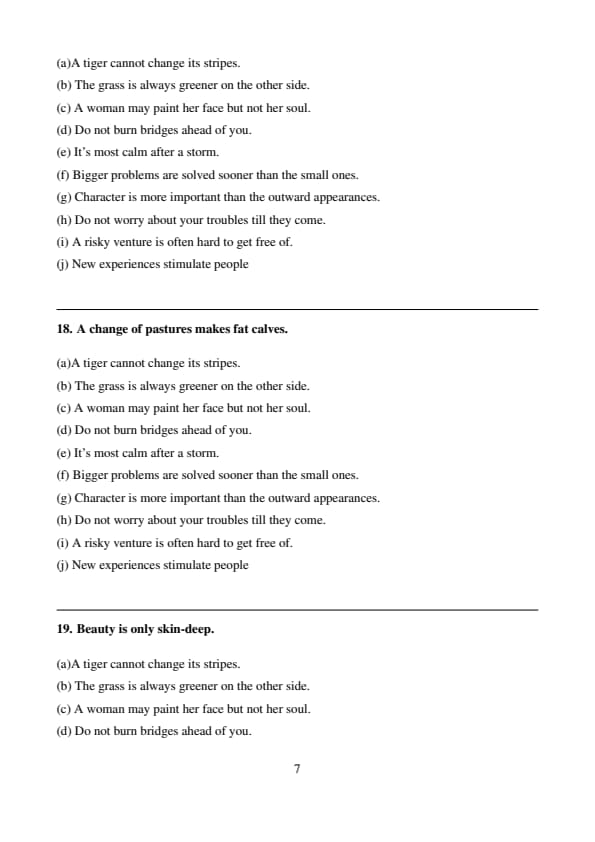
Do not cross bridges until you get to them.
View Solution
Step 1: Understanding the meaning.
The proverb suggests that one should not worry or make plans about future problems before they arise. You should face challenges when they come, not anticipate them prematurely.
Step 2: Analyzing the options.
- (a) Incorrect — This suggests that a person cannot change their inherent nature.
- (b) Incorrect — This is about the perception of better opportunities elsewhere.
- (c) Incorrect — This focuses on external beauty, not worry about the future.
- (d) Correct — This is a reminder not to worry about future problems.
Step 3: Conclusion.
The proverb advises against worrying too much about future issues. The correct match is option (h).
Quick Tip: When dealing with challenges, focus on solving them when they appear, not before.
He who rides the tiger cannot dismount.
View Solution
Step 1: Understanding the meaning.
This proverb suggests that once you are involved in something difficult or risky, you cannot easily back out of it. It implies that dealing with risky situations requires commitment and responsibility.
Step 2: Analyzing the options.
- (a) Correct — A tiger cannot change its stripes. Once involved, you cannot alter the situation.
- (b) Incorrect — Refers to the illusion of better options elsewhere.
- (c) Incorrect — This refers to superficial appearances, not risk-taking.
- (d) Incorrect — This refers to not worrying about future issues.
Step 3: Conclusion.
The proverb highlights the irreversible nature of engaging in risky situations. The correct answer is (a).
Quick Tip: When making a decision, understand the commitment involved, as backing out may not always be an option.
A change of pastures makes fat calves.
View Solution
Step 1: Understanding the meaning.
This proverb suggests that changing your situation or environment can lead to improvement, just like cows thrive when moved to a better pasture. It implies the potential for growth or better conditions in a new setting.
Step 2: Analyzing the options.
- (a) Incorrect — Refers to inherent traits that cannot be changed.
- (b) Correct — This describes the belief that better opportunities may exist elsewhere.
- (c) Incorrect — Focuses on external appearance, not change.
- (d) Incorrect — Talks about avoiding future problems, not change.
Step 3: Conclusion.
The proverb highlights the benefits of change and new opportunities, which aligns with option (b).
Quick Tip: Sometimes, change can bring new opportunities for growth or improvement, but evaluate all options carefully before making a move.
Beauty is only skin-deep.
View Solution
Step 1: Understanding the meaning.
This proverb implies that outer beauty is superficial and does not reflect a person's true character or qualities. It suggests that inner qualities are more important than physical appearance.
Step 2: Analyzing the options.
- (a) Incorrect — This is about the impossibility of changing inherent traits.
- (b) Incorrect — Talks about the illusion of better options, not beauty.
- (c) Correct — This speaks to the idea that outward beauty is superficial, and true beauty comes from within.
- (d) Incorrect — Talks about future concerns, not beauty.
Step 3: Conclusion.
The correct answer is (c), which refers to the idea that external appearances are not as important as inner qualities.
Quick Tip: Focus on developing inner qualities and character, as these are more important than superficial beauty.
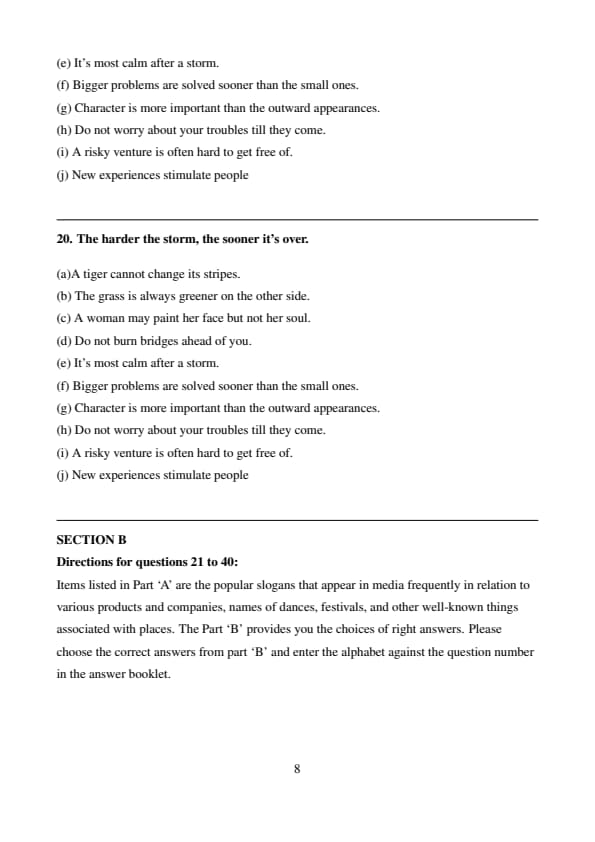
The harder the storm, the sooner it’s over.
View Solution
Step 1: Understanding the meaning.
This proverb suggests that difficult situations are often temporary, and after going through challenges, things will settle down and calm will prevail.
Step 2: Analyzing the options.
- (e) Correct — The storm will pass, and calm follows after difficult times.
Step 3: Conclusion.
The correct answer reflects the idea that difficult moments in life are often followed by peace or calm.
Quick Tip: Difficult situations often come to an end, and you will find peace after facing challenges.
Directions for questions 21 to 40:
Items listed in Part ‘A’ are the popular slogans that appear in media frequently in relation to various products and companies, names of dances, festivals, and other well-known things associated with places. The Part ‘B’ provides you the choices of right answers. Please choose the correct answers from part ‘B’ and enter the alphabet against the question number in the answer booklet.
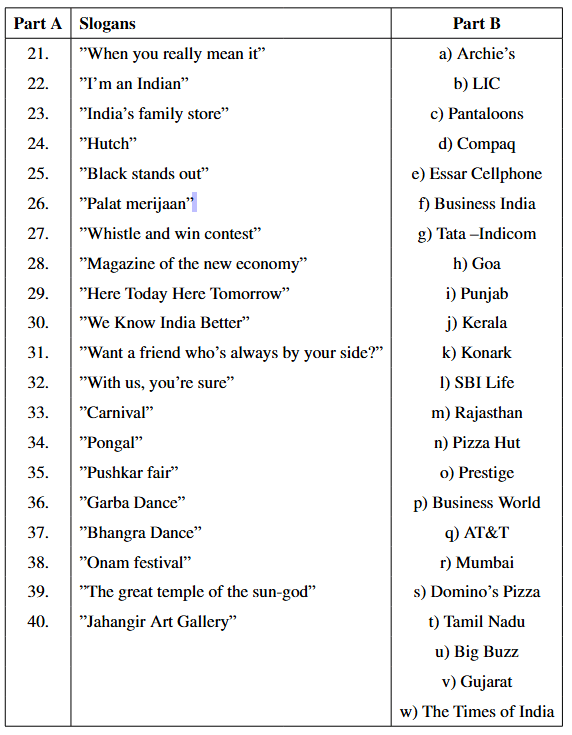
"When you really mean it"
View Solution
This slogan is associated with Pantaloons, a well-known retail chain in India, emphasizing authenticity and commitment to quality.
Quick Tip: Pantaloons uses slogans that emphasize authenticity and trust, appealing to the value-conscious consumer.
"I'm an Indian"
View Solution
The slogan is from LIC (Life Insurance Corporation of India), reflecting national pride and belonging.
Quick Tip: Insurance slogans like LIC's often focus on national identity and trust, appealing to a sense of social responsibility.
"India’s family store"
View Solution
Pantaloons used this slogan to appeal to family-oriented customers, emphasizing that it caters to all family needs.
Quick Tip: Slogans like "India’s family store" highlight the inclusive nature of the brand, which resonates with family-centered values.
"Hutch"
View Solution
"Hutch" was the slogan for Essar Cellphone, which later became Vodafone, focusing on simplicity and reliability in telecom services.
Quick Tip: The "Hutch" slogan reflects the idea of a simple, reliable service, which Vodafone successfully carried forward after the rebrand.
"Black stands out"
View Solution
This slogan was used by Prestige, a leading kitchen appliance brand, highlighting its sophisticated and stylish products.
Quick Tip: Prestige’s use of the color black emphasizes elegance and quality, aligning with their brand as a premium kitchenware brand.
"Palat merijaan"
View Solution
This is a slogan from Tata-Indicom, a telecommunications company, inviting customers to "turn" to their service for better connectivity.
Quick Tip: "Palat merijaan" captures the spirit of change and progress, appealing to customers seeking better services and experiences.
"Whistle and win contest"
View Solution
"Whistle and win" was part of a campaign by Pizza Hut, creating a fun and engaging experience for customers.
Quick Tip: Interactive campaigns like "Whistle and win" aim to create excitement and increase customer engagement with the brand.
"Magazine of the new economy"
View Solution
This slogan is used by Business India, a well-known business magazine that covers economic and corporate news.
Quick Tip: Business India’s slogan reflects its positioning as a thought leader in the business and economic space in India.
"Here Today Here Tomorrow"
View Solution
The Times of India uses this slogan to emphasize its timely and relevant news coverage.
Quick Tip: This slogan highlights the consistency and reliability of The Times of India, reinforcing the idea of constant, up-to-date news coverage.
"We Know India Better"
View Solution
This is a slogan by The Times of India, which highlights the newspaper's deep understanding and comprehensive coverage of India.
Quick Tip: Slogans like "We Know India Better" build the brand's authority, suggesting expertise in delivering insightful and accurate news about the country.
"Want a friend who’s always by your side?"
View Solution
This slogan is from SBI Life Insurance, promoting their insurance services as a dependable companion for customers' financial needs.
Quick Tip: Slogans from insurance companies often emphasize trust and reliability, appealing to customers' need for financial security.
"With us, you’re sure"
View Solution
Another slogan from SBI Life Insurance, emphasizing trust and certainty in their offerings, ensuring customers' peace of mind.
Quick Tip: Insurance slogans typically build customer confidence by focusing on security and certainty in financial services.
"Carnival"
View Solution
The slogan "Carnival" is associated with Rajasthan, which is famous for its vibrant festivals and cultural events.
Quick Tip: Rajasthan is known for its rich cultural heritage, especially its festivals and celebrations that attract tourists from around the world.
"Pongal"
View Solution
Pongal is a major festival in Tamil Nadu, celebrating the harvest season and giving thanks for a successful farming year.
Quick Tip: Pongal is one of the most significant festivals in South India, particularly celebrated in Tamil Nadu to mark the harvest.
"Pushkar fair"
View Solution
Pushkar Fair is a famous cultural and religious fair held in Pushkar, Rajasthan, drawing millions of visitors every year.
Quick Tip: Pushkar Fair is one of India's most famous events, showcasing Rajasthan's culture, religion, and traditional arts.
"Garba Dance"
View Solution
Garba Dance is a traditional dance form from Gujarat, especially popular during the Navratri festival.
Quick Tip: Garba is a vibrant and energetic dance form that is a central part of Gujarat's cultural heritage, especially during the Navratri festival.
"Bhangra Dance"
View Solution
Bhangra is a lively folk dance from Punjab, often performed during harvest festivals and celebrations.
Quick Tip: Bhangra is a high-energy dance that represents the lively and festive spirit of Punjab, especially during harvest celebrations.
"Onam festival"
View Solution
Onam is the most important festival in Kerala, celebrating the homecoming of the mythical King Mahabali.
Quick Tip: Onam is a cultural festival that reflects Kerala's rich tradition, marked by elaborate feasts, decorations, and a grand procession.
"The great temple of the sun-god"
View Solution
The Sun Temple at Konark, Odisha, is one of India's most famous heritage sites, dedicated to the Sun God.
Quick Tip: Konark Temple is renowned for its unique architectural design and its historical significance as a UNESCO World Heritage site.
"Jahangir Art Gallery"
View Solution
Jahangir Art Gallery is located in Mumbai, Maharashtra, and it is one of the most well-known art galleries in India.
Quick Tip: Jahangir Art Gallery is a hub for contemporary art in India, showcasing works from artists across the country.

View Solution
The square symbol typically represents stability, structure, and reliability. It is often associated with trustworthiness and dependability.
Quick Tip: When interpreting shapes, squares generally symbolize stability and reliability in design and branding.

View Solution
The circle is often seen as a symbol of eternity, completeness, and wholeness. It signifies infinity and continuity, hence "endless" is the best option.
Quick Tip: The circle symbolizes continuity, unity, and wholeness, commonly representing eternal or endless concepts.

View Solution
The black dot symbolizes focus or concentration. It is a small yet intense symbol often used to signify attention or clarity.
Quick Tip: A dot in design is commonly used to indicate focus, attention, or a point of interest.

View Solution
The triangle is often seen as a symbol of spirituality, balance, and harmony. It is associated with the idea of higher consciousness or the connection between the mind, body, and spirit.
Quick Tip: The triangle symbol is commonly used to represent spiritual growth, balance, or enlightenment.

View Solution
The right-angle triangle is often seen as a symbol for a messenger or a communicator. Its sharp angle represents direction or the delivery of a message from one point to another.
Quick Tip: Right-angle triangles are often associated with communication and direction due to their pointed shape.
Dharamchakra
View Solution
The Dharma Chakra represents the eight-fold path in Buddhism, symbolizing the eight rules of living that lead to enlightenment and wisdom.
Quick Tip: Dharamchakra is a symbol of righteousness, representing the path to enlightenment and the core principles of Buddhism.
Ek Onkar
View Solution
"Ek Onkar" is a significant symbol in Sikhism, representing the concept that there is one God and everything in the universe is a part of that divine entity.
Quick Tip: "Ek Onkar" is the foundation of Sikhism, signifying unity and the belief in one omnipresent God.
Full Moon
View Solution
The Full Moon symbolizes completion, wholeness, and the cosmic creation in many cultures and religions, representing the balance and cyclical nature of life.
Quick Tip: In many spiritual and cultural beliefs, the Full Moon symbolizes cosmic completeness and harmony in the universe.
Peepal
View Solution
The Peepal tree is highly revered in Hinduism, Buddhism, and Jainism and is considered a symbol of eternal life due to its long lifespan and its association with various deities.
Quick Tip: The Peepal tree is associated with the concept of immortality and divine presence in many cultures.
Snakes
View Solution
Snakes are often symbolic of energy, transformation, and renewal. In many cultures, they represent the flow of life energy, as well as knowledge and wisdom.
Quick Tip: Snakes are frequently associated with energy, transformation, and healing in spiritual symbolism.
"The Indian Administrative Services take in bright and idealistic young people but within ten years they are left with nothing but cynicism and conformity."
View Solution
Step 1: Acknowledge the problem.
The issue at hand is that the Indian Administrative Service (IAS) initially attracts young and idealistic individuals, but over time, they lose their enthusiasm due to the pressures of the job and institutional norms. The work environment becomes draining, leading to burnout, disillusionment, and conformity. This results in a loss of passion for public service.
Step 2: Suggest solutions.
- Mentorship Programs: Introduce regular mentorship and career counseling sessions for civil servants. Senior officials who still retain their passion for public service can guide the younger officers, ensuring they don’t lose their idealism and commitment.
- Job Rotation: Allow young officers to rotate across different sectors and departments. A variety of tasks and responsibilities will not only enhance their skill sets but also help them maintain their passion by reducing monotony.
- Support Systems: Providing emotional and psychological support through workshops, peer group discussions, and stress management programs would help maintain morale.
- Incentivizing Innovation: Encouraging officers to work on innovative projects that align with their values and passions would help sustain their initial drive for public service.
Step 3: Conclusion.
By implementing mentorship, job rotations, and stress management programs, we can help maintain the idealistic values of young IAS officers, ensuring they remain motivated and innovative in their careers. Quick Tip: Regular engagement, continuous learning, and emotional support can help retain passion and idealism in high-pressure careers.
"Our cycle has always enjoyed a reputation for a quality born out of sophisticated manufacturing technology that was imported. Over the course of years, bicycle technology in the country has become indigenised and cheaper with attendant loss of quality and reliability to a certain degree. Our main competitors are using indigenised technology and are selling their cycles at a much cheaper price. The consumers acknowledge our higher quality level but refuse to accept the extra price that it implies. In other words, the extra quality that our sophisticated technology gives is, in their views, not worth the extra price."
View Solution
Step 1: Identify the problem.
The company faces a situation where its bicycles are priced higher due to superior manufacturing technology, but consumers are unwilling to pay the extra cost, even though they acknowledge the higher quality. Competitors using more cost-effective, indigenised technology are offering cheaper alternatives, which makes the company's premium price unjustifiable in the eyes of the consumers.
Step 2: Suggest solutions.
- Product Line Diversification: The company could introduce a budget line of cycles with indigenised technology. This would appeal to the price-sensitive segment while maintaining the premium line for customers who value quality. This approach would allow the company to cater to both markets.
- Value Addition: The company could offer value-added services such as extended warranties, free servicing, or bike accessories with the premium cycle models. This would justify the higher price and create added value for customers.
- Consumer Education: Through advertising campaigns, the company can educate consumers about the long-term cost-effectiveness of quality products. Emphasizing durability, lower maintenance costs, and better overall value in the long run could help consumers see the worth of the extra price.
- Focus on Customer Loyalty: The company could also consider loyalty programs where customers receive discounts or special offers when they purchase additional cycles or services, which would help retain loyal customers despite the higher cost.
Step 3: Conclusion.
By offering tiered pricing, value-added services, and educating consumers about long-term benefits, the company can make its premium bicycles more attractive and justify their price. Quick Tip: Value addition, customer education, and offering tiered pricing can help differentiate products while maintaining competitive edge.
"Cricket as a game has now increasingly become dull. More and more people watch the cricket game casually. Something needs to be done to make the game more exciting and interesting."
View Solution
Step 1: Identify the issue.
The issue is that cricket is losing its appeal and excitement among viewers, leading to a drop in engagement and popularity. With more people watching casually, the game’s traditional formats are seen as less entertaining, especially in the fast-paced modern era.
Step 2: Suggest solutions.
- Introduce Shorter Formats: The game could adopt shorter formats like T20 even further or introduce new, innovative formats that are faster-paced and more entertaining. Consider introducing powerplays or a 'super over' at critical moments to add more excitement.
- Interactive Fan Engagement: Through fan voting, interactive apps, or social media participation, fans can influence certain aspects of the game (like choosing strategies or players). This would increase viewer involvement and excitement.
- Live Statistics and Augmented Reality: Integrate augmented reality to show more live stats, interactive graphics, and replays, making the viewing experience more immersive.
- Celebrity and Entertainment Integration: Integrating celebrity appearances or mini-games during intervals could provide entertainment and make the game more fun for the audience.
- Esports Collaboration: Collaborating with esports to create digital or VR cricket could also attract a younger audience and make the game more futuristic and entertaining.
Step 3: Conclusion.
By incorporating faster formats, interactive fan experiences, and more engaging visuals, cricket can be made more exciting and appealing to modern audiences. Quick Tip: Innovating the format, engaging fans interactively, and introducing new technologies can make traditional sports more exciting.
"Most universities in our country are increasingly becoming irrelevant in the current context of revolution in information and communication technology. Most teachers in universities have no concern about the deteriorating educational standards."
View Solution
Step 1: Identify the problem.
The issue is that universities are becoming outdated due to their lack of adaptation to modern technologies, particularly information and communication technology (ICT). The outdated methods being used by professors and the lack of attention to educational standards are contributing to the decline in quality education.
Step 2: Suggest solutions.
- Embrace Digital Learning: Universities should integrate digital platforms for teaching, offering online resources, video lectures, and interactive tools. This will help bridge the gap between traditional and modern education.
- Faculty Training: Professors should undergo regular training programs to update their teaching methods, integrate digital tools into their teaching, and stay updated with new technology trends.
- Modernize Curriculum: Revamping the curriculum to include courses on information technology, data science, and artificial intelligence would ensure students are future-ready. Practical, hands-on experience with modern tools should also be a part of the curriculum.
- Collaboration with Industry: Universities should collaborate with tech companies to create industry-oriented programs and internships. This will provide students with skills relevant to the modern job market.
- Focus on Research and Innovation: Increasing funding and support for research programs, especially in the tech and innovation sectors, can help universities stay at the forefront of new discoveries and technological developments.
Step 3: Conclusion.
By modernizing the curriculum, training faculty, and integrating technology, universities can remain relevant and provide quality education in line with global standards. Quick Tip: Embracing technology and updating curricula can enhance relevance and improve educational standards in the digital age.
Rose
View Solution
Here are a few different uses for a rose:
1. Decoration: Roses are widely used for decorating homes, events, and weddings.
2. Gift: A rose is a symbol of love and affection, often given as a gift.
3. Fragrance: Rose petals are used to make rosewater or essential oils.
4. Health: Rose petals have medicinal properties and can be used in herbal teas.
5. Symbolism: The rose is used as a symbol of beauty, love, and passion.
6. Cooking: Rose petals can be used to make rose jam or flavor dishes.
7. Art: Artists use roses in their work as symbols or as physical objects for painting or photography. Quick Tip: Roses are versatile in nature, offering a variety of uses beyond just being a symbol of love. Consider using them for crafts or even culinary purposes!
Old clothes
View Solution
Here are a few different uses for old clothes:
1. Repurpose into Rags: Old clothes can be cut into pieces and used as cleaning rags.
2. Upcycling: They can be upcycled into new garments or accessories, like quilts, bags, or scarves.
3. Donation: Donate old clothes to charity or thrift shops for reuse by others.
4. Crafts: Old clothes can be used for DIY projects like making dolls, cushions, or even wall art.
5. Composting: Clothes made from natural fibers like cotton or wool can be composted after being shredded.
6. Pet Bedding: Use old clothes as bedding for pets, especially for pets that need extra warmth. Quick Tip: Old clothes can be repurposed or recycled in countless ways, helping both the environment and those in need. Consider donating or upcycling instead of discarding them!
Stapler
View Solution
Here are a few different uses for a stapler:
1. Organizing Documents: Staplers are commonly used to bind together multiple sheets of paper for easier handling.
2. Craft Projects: Use a stapler to attach materials like fabric or cardboard in arts and crafts.
3. Binding Books: In offices, staplers are used for temporary bookbinding and pamphlet creation.
4. Labeling: Staple tags or labels onto products for quick identification.
5. Temporary Repairs: Use a stapler to temporarily fix items like posters, charts, or sheets to surfaces.
6. Securing Bags: Staplers can be used to close bags, especially for food or materials in a home or workshop setting. Quick Tip: Staplers are not just for office use. They are great for crafting, organizing, and even doing temporary repairs.
Spoon
View Solution
Here are a few different uses for a spoon:
1. Eating: The most obvious use, for consuming food like soup, cereals, and desserts.
2. Measuring: Spoons are often used for measuring ingredients while cooking or baking.
3. Serving: Use a spoon for serving food from a dish to a plate.
4. Crafts: Old spoons can be used for DIY projects like jewelry, sculptures, or even wind chimes.
5. Gardening: A spoon can be used for planting small seeds in soil or digging small holes.
6. Hair Styling: The back of a spoon can help with certain hair styling techniques, like smoothing or creating texture. Quick Tip: A spoon is a multifunctional tool, not just for eating! From crafts to gardening, it’s an incredibly versatile item around the house.
Indian Telephone Services
View Solution
Here are some ideas to improve Indian Telephone Services:
1. Improved Connectivity in Rural Areas: Ensure better network coverage in remote and rural areas to bridge the connectivity gap. This can be achieved by investing in rural infrastructure and building more towers.
2. Affordable Data Plans: Introduce more affordable data and voice plans to make telecommunication services accessible to a larger section of society.
3. Customer Service Improvement: Improve the quality of customer support by providing better training for service staff, offering faster response times, and utilizing AI for faster issue resolution.
4. Faster Internet Speeds: Upgrade the existing telecom infrastructure to provide faster 4G/5G internet speeds and improve reliability, especially in urban areas.
5. Transparent Billing System: Simplify the billing system to eliminate hidden charges and ensure transparency in pricing to improve customer trust.
6. Innovative Service Bundles: Offer bundled services like mobile data, broadband, and entertainment at discounted prices to increase customer satisfaction. Quick Tip: Better rural connectivity and transparent billing are key to improving the reach and customer satisfaction of telecom services in India.
Traffic System
View Solution
Here are some ideas to improve the Traffic System in India:
1. Enhanced Traffic Management: Use AI-powered systems to control and optimize traffic signals in real-time, based on traffic flow data. This can reduce congestion and improve efficiency.
2. Public Transportation: Improve the quality and coverage of public transport systems to encourage more people to use buses and trains, reducing the number of vehicles on the road.
3. Lane Discipline and Awareness: Conduct awareness campaigns and enforce strict penalties to ensure lane discipline and reduce violations such as lane cutting, speeding, and unauthorized parking.
4. Pedestrian Infrastructure: Create more pedestrian-friendly infrastructure, such as footpaths, pedestrian crossings, and overpasses, to ensure safe movement for pedestrians.
5. Smart Parking Solutions: Introduce smart parking systems that allow users to find parking spaces through apps, reducing the time spent searching for a spot and minimizing traffic congestion.
6. Integrated City Planning: Develop multi-modal transport systems by integrating buses, metro, and bicycles, making it easier for people to switch between different modes of transport. Quick Tip: AI-powered traffic systems and better public transport integration can drastically reduce traffic congestion and improve overall road safety.
Caste System
View Solution
Here are some ideas to improve the Caste System:
1. Education and Awareness: Implement nationwide awareness campaigns to educate people about the harmful effects of the caste system, focusing on equality, justice, and social harmony.
2. Legal Enforcement: Strengthen enforcement of anti-discrimination laws and ensure that caste-based discrimination is prosecuted, with harsher penalties for those involved in caste-based violence or prejudice.
3. Inclusive Policies: Promote policies that ensure equal opportunities for everyone, regardless of caste, in education, employment, and social services.
4. Empowerment Programs: Develop programs aimed at empowering individuals from marginalized castes through skill-building workshops, scholarships, and leadership training.
5. Media and Cultural Influence: Encourage movies, TV shows, and social media platforms to showcase stories and narratives that challenge caste-based stereotypes and promote social equality. Quick Tip: The solution lies in a combination of legal, social, and educational reforms to eliminate caste-based discrimination from society.
Marriage System in India
View Solution
Here are some ideas to improve the Marriage System in India:
1. Encourage Choice-Based Marriages: Promote the idea of love marriages, where individuals can choose their partners based on compatibility, rather than family or caste considerations.
2. Legal Reforms for Women’s Rights: Strengthen laws related to marriage, especially those protecting women’s rights in marriage, including inheritance rights, domestic violence protection, and marital rape.
3. Pre-Marriage Counseling: Introduce pre-marriage counseling and awareness programs to prepare couples for married life, helping them understand each other's expectations, responsibilities, and emotional needs.
4. Foster Gender Equality: Encourage the idea of equal roles in marriage, where both partners contribute equally to decision-making, household responsibilities, and finances.
5. End Dowry Practices: Make stricter laws to end the dowry system, along with rigorous enforcement of these laws, to prevent dowry-related violence.
6. Marriage Registration: Make it mandatory to register all marriages to provide legal protection to both spouses, particularly in case of disputes or separation. Quick Tip: Promoting equality, awareness, and legal rights can help modernize the marriage system and eliminate outdated practices like dowry.
Deteriorating standards of education in schools in India
View Solution
The consequences of deteriorating educational standards in India include:
1. Lower Skill Levels: Students graduate with insufficient knowledge and skills, which affects their employability and performance in the job market.
2. Increase in Unemployment: Poor education standards lead to a mismatch between the skills of graduates and the demands of the labor market, increasing the unemployment rate.
3. Social Inequality: The quality of education tends to vary based on location, income, and caste, leading to deeper social inequalities.
4. Brain Drain: Students with higher aspirations may seek education abroad, resulting in a brain drain where the country loses its educated talent.
5. Reduced Innovation: A lack of quality education limits creativity and innovation, which is essential for economic growth and global competitiveness.
6. Rural-Urban Divide: Schools in rural areas face more severe quality issues, leading to a widening gap between urban and rural education. Quick Tip: Improving the quality of education can help bridge skill gaps, reduce unemployment, and foster a more innovative and equal society.
War on Iraq
View Solution
The consequences of the War on Iraq include:
1. Humanitarian Crisis: The war resulted in thousands of deaths and displaced millions of civilians, leading to a humanitarian crisis in the region.
2. Economic Impact: Iraq's economy was severely damaged, with its infrastructure and oil production facilities destroyed, leading to long-term economic instability.
3. Regional Instability: The war destabilized the Middle East, contributing to the rise of extremist groups like ISIS and exacerbating sectarian conflicts.
4. Global Tensions: The war led to strained relations between the U.S. and other nations, particularly those who opposed the invasion.
5. Environmental Damage: The war caused environmental damage, including oil spills and destruction of land and water resources.
6. Refugee Crisis: Millions of Iraqis fled their homes, leading to a global refugee crisis and further strain on neighboring countries. Quick Tip: Wars have far-reaching consequences beyond the battlefield, affecting economies, humanitarian conditions, and international relations.
Disinvestment policy of the Government of India
View Solution
The consequences of the disinvestment policy of the Government of India include:
1. Increased Private Sector Participation: Disinvestment allows private players to invest in previously government-owned industries, boosting efficiency and profitability.
2. Improved Public Finances: The government generates revenue through disinvestment, which can be used to address fiscal deficits or invest in public welfare schemes.
3. Loss of Government Control: While privatization boosts efficiency, it may also lead to the loss of government control over strategic sectors and national interests.
4. Job Losses: Privatization often leads to downsizing or restructuring, resulting in job losses in government-owned enterprises.
5. Impact on Public Services: Essential services may be affected if privatization leads to cost-cutting measures or profit-driven strategies at the expense of quality.
6. Market Competition: Disinvestment can foster increased competition in the market, which may benefit consumers through lower prices and better products. Quick Tip: Disinvestment can lead to economic efficiency and improved public finances, but it also has social implications like job losses and reduced government control.
Child Labour in Indian Industry
View Solution










Comments