




MHT CET 2026 April 16 Shift 1 PCM Question Paper is available for download here. Maharashtra State CET Cell conducted the MHT CET 2026 PCM Exam on April 16 in Shift 1 from 9 AM to 12 PM in CBT mode.
- The MHT CET 2026 PCM Question Paper consists of 150 multiple-choice questions (MCQs) totalling 200 marks divided into 3 sections: Physics, Chemistry, and Mathematics, with 50 questions in each subject.
- Physics and Chemistry questions carry 1 mark each while Mathematics questions carry 2 marks each.
- There is no negative marking for incorrect answers.
Also Check: Expected Percentile for MHT CET 2026 April 16 Shift 1
Download MHT CET 2026 April 16 Shift 1 PCM Question Paper with Solutions PDF from the links provided below.
MHT CET 2026 April 16 Shift 1 PCM Question Paper PDF (Memory-Based)
| MHT CET 2026 April 16 Shift 1 Question Paper | Download PDF | Check Solution |
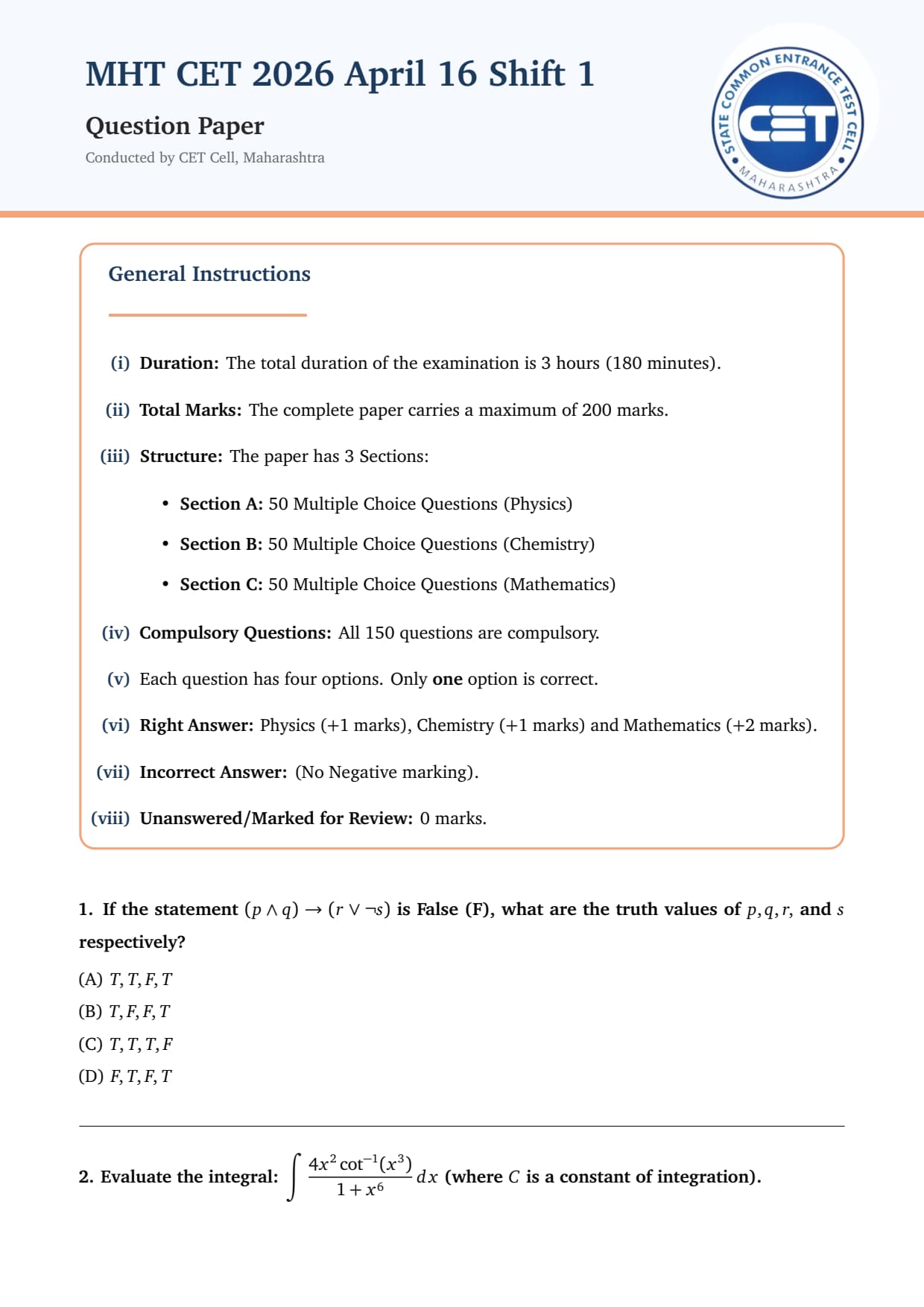
If the statement \( (p \land q) \rightarrow (r \lor \neg s) \) is False (F), what are the truth values of \(p, q, r,\) and \(s\) respectively?
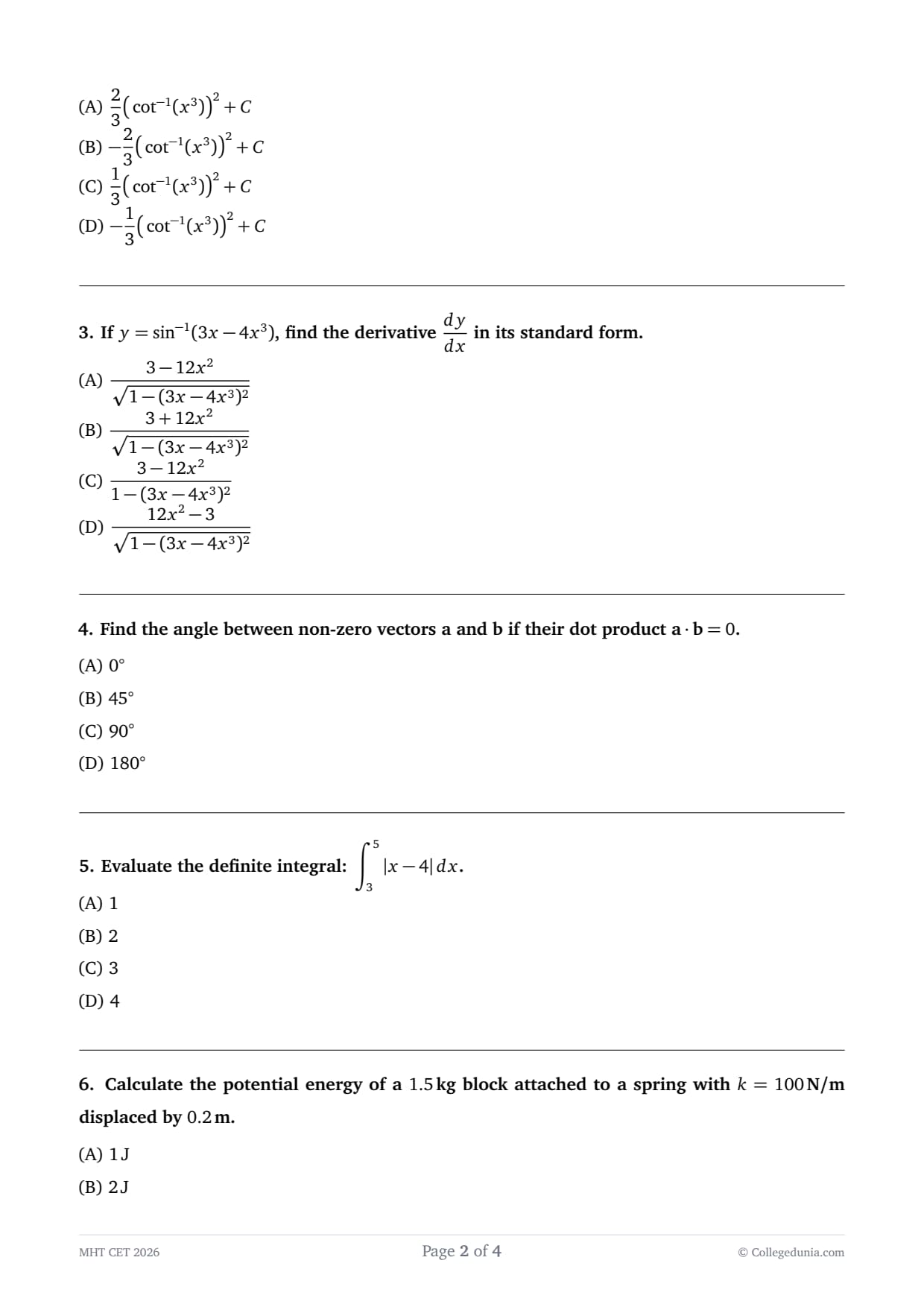
Evaluate the integral: \( \displaystyle \int \frac{4x^2\cot^{-1}(x^3)}{1+x^6}\,dx \) (where \(C\) is a constant of integration).
If \( y = \sin^{-1}(3x - 4x^3) \), find the derivative \( \dfrac{dy}{dx} \) in its standard form.
Find the angle between non-zero vectors \( \mathbf{a} \) and \( \mathbf{b} \) if their dot product \( \mathbf{a}\cdot\mathbf{b} = 0 \).
Evaluate the definite integral: \( \displaystyle \int_{3}^{5} |x-4|\,dx \).
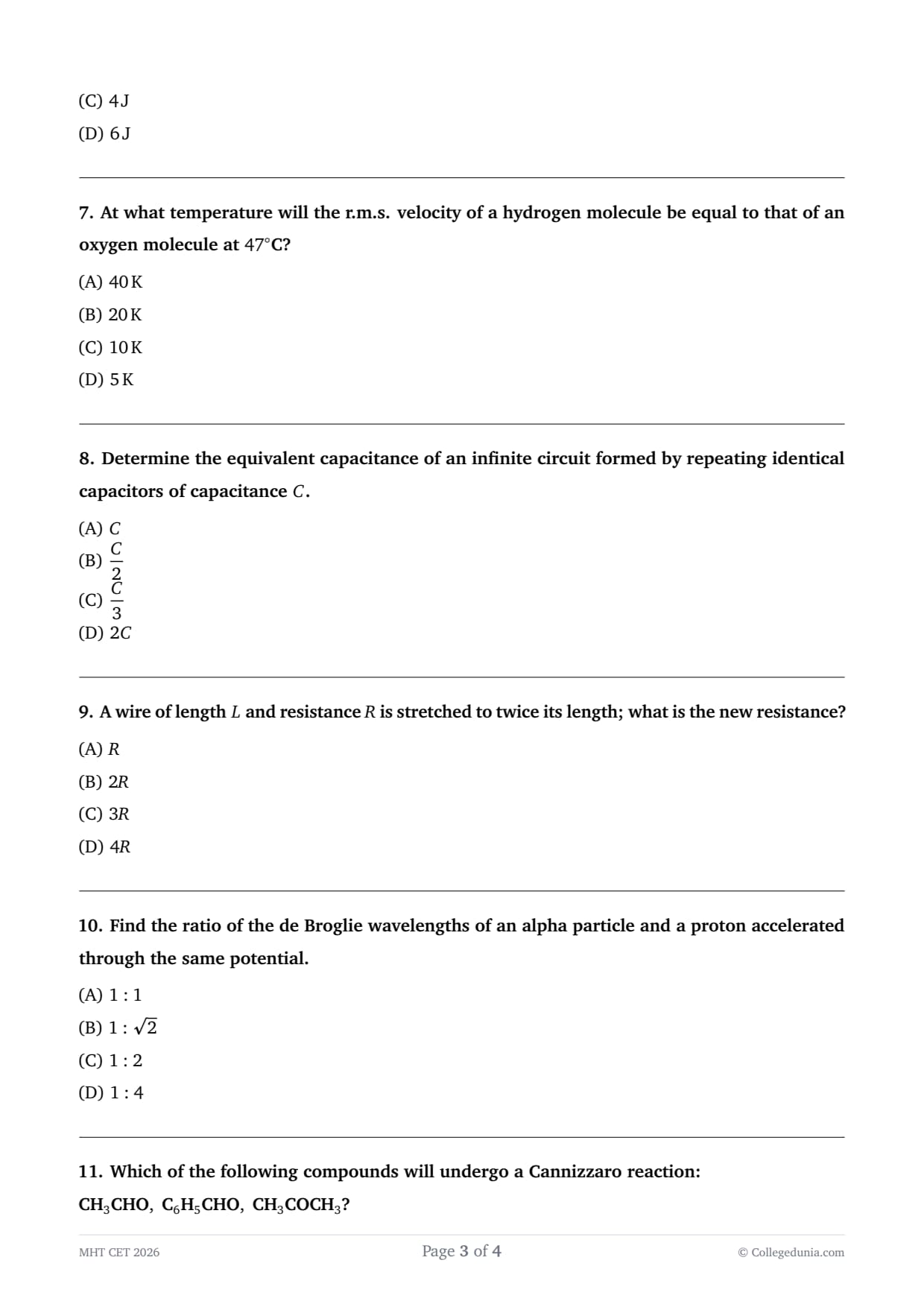
Calculate the potential energy of a \(1.5\,kg\) block attached to a spring with \(k = 100\,N/m\) displaced by \(0.2\,m\).
At what temperature will the r.m.s. velocity of a hydrogen molecule be equal to that of an oxygen molecule at \(47°\)?
Determine the equivalent capacitance of an infinite circuit formed by repeating identical capacitors of capacitance \(C\).
A wire of length \(L\) and resistance \(R\) is stretched to twice its length; what is the new resistance?
Find the ratio of the de Broglie wavelengths of an alpha particle and a proton accelerated through the same potential.
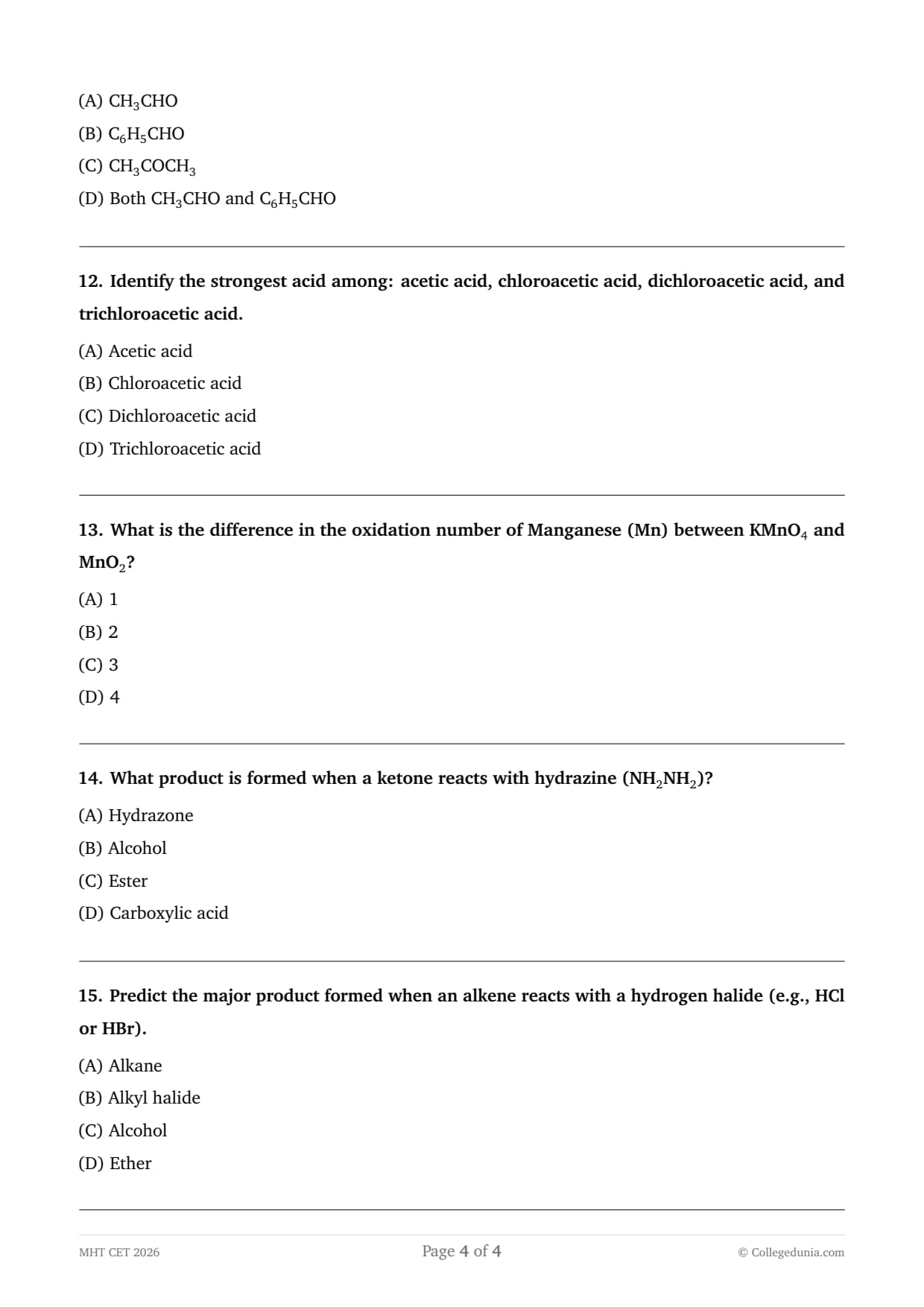
Which of the following compounds will undergo a Cannizzaro reaction: \( CH_3CHO,\ C_6H_5CHO,\ CH_3COCH_3 \)?
Identify the strongest acid among: acetic acid, chloroacetic acid, dichloroacetic acid, and trichloroacetic acid.
What is the difference in the oxidation number of Manganese (Mn) between \( KMnO_4 \) and \( MnO_2 \)?
What product is formed when a ketone reacts with hydrazine (\( NH_2NH_2 \))?
Predict the major product formed when an alkene reacts with a hydrogen halide (e.g., HCl or HBr).
MHT CET PCM Exam Pattern 2026
| Parameter | Details |
|---|---|
| Conducting Body | Maharashtra Common Entrance Test Cell (Maharashtra CET Cell) |
| Exam Mode | Online (Computer-Based Test) |
| Duration | 180 minutes (3 hours) |
| Groups / Subjects | PCM (Physics, Chemistry, Mathematics) for Engineering |
| Total Questions |
150 |
| Total Marks | 200 |
| Question Type | Multiple Choice Questions (MCQs) |
| Marks Distribution |
|
| Negative Marking | No |
| Syllabus Weightage |
|



Comments