




MHT CET 2026 April 17 Shift 2 PCM Question Paper is available for download here. Maharashtra State CET Cell conducted MHT CET 2026 PCM Exam on April 17 in Shift 2 from 2 AM to 5 PM in CBT mode.
- The MHT CET 2026 PCM Question Paper consists of 150 multiple-choice questions (MCQs) totalling 200 marks divided into 3 sections: Physics, Chemistry, and Mathematics, with 50 questions in each subject.
- Physics and Chemistry questions carry 1 mark each while Mathematics questions carry 2 marks each.
- There is no negative marking for incorrect answers.
Also Check: MHT CET 2026 April 17 Shift 1 PCM Question Paper
Download MHT CET 2026 April 17 Shift 2 PCM Question Paper with Solutions PDF from the links provided below. Based on initial student reaction, MHT CET 2026 April 17 Shift 2 PCM Paper was easy to moderate level.
MHT CET 2026 April 17 Shift 2 PCM Question Paper PDF Download
| MHT CET 2026 April 17 Shift 2 Question Paper | Download PDF | Check Solution |
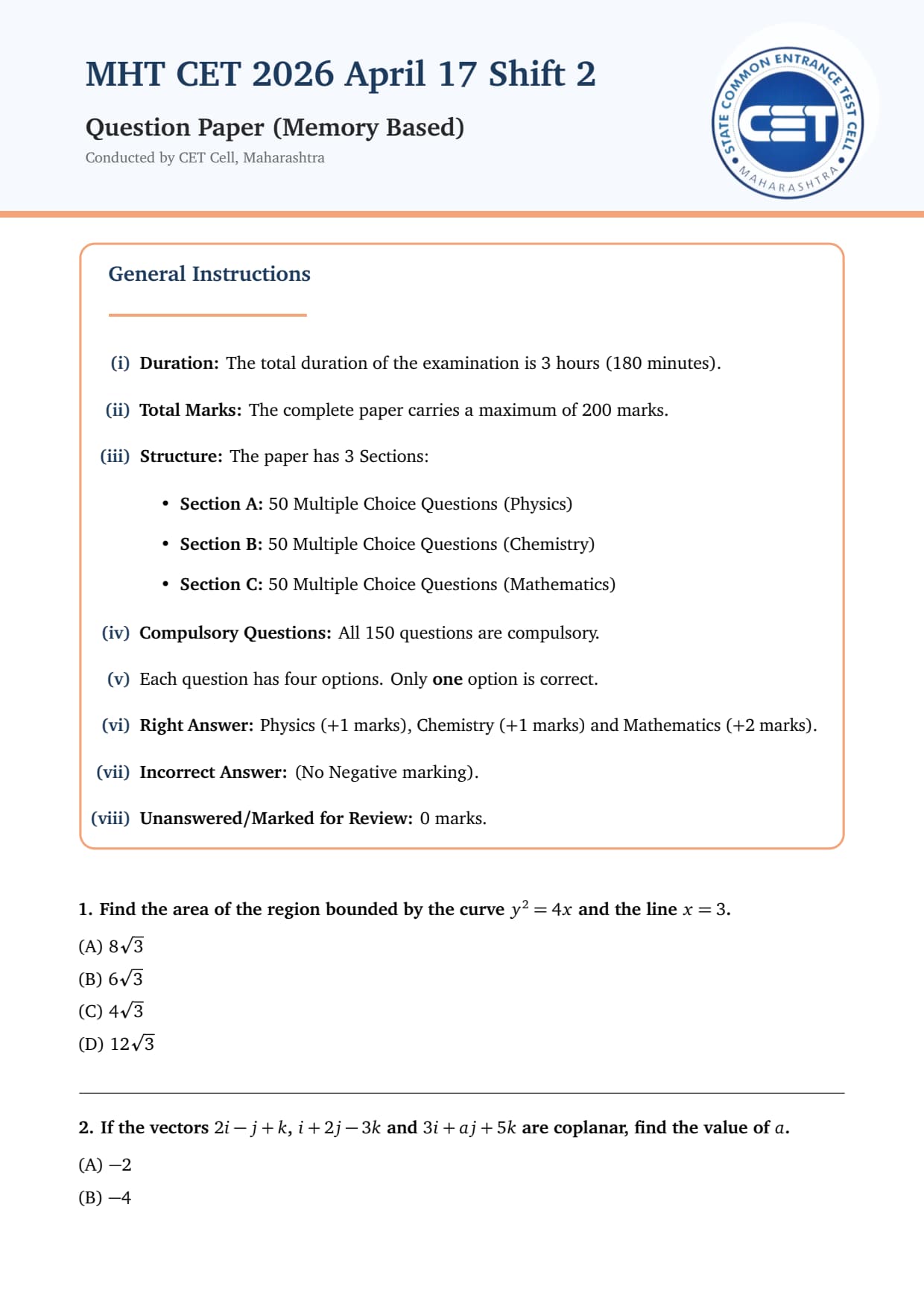
Find the area of the region bounded by the curve \(y^2 = 4x\) and the line \(x = 3\).
If the vectors \(2i - j + k\), \(i + 2j - 3k\) and \(3i + aj + 5k\) are coplanar, find the value of \(a\).
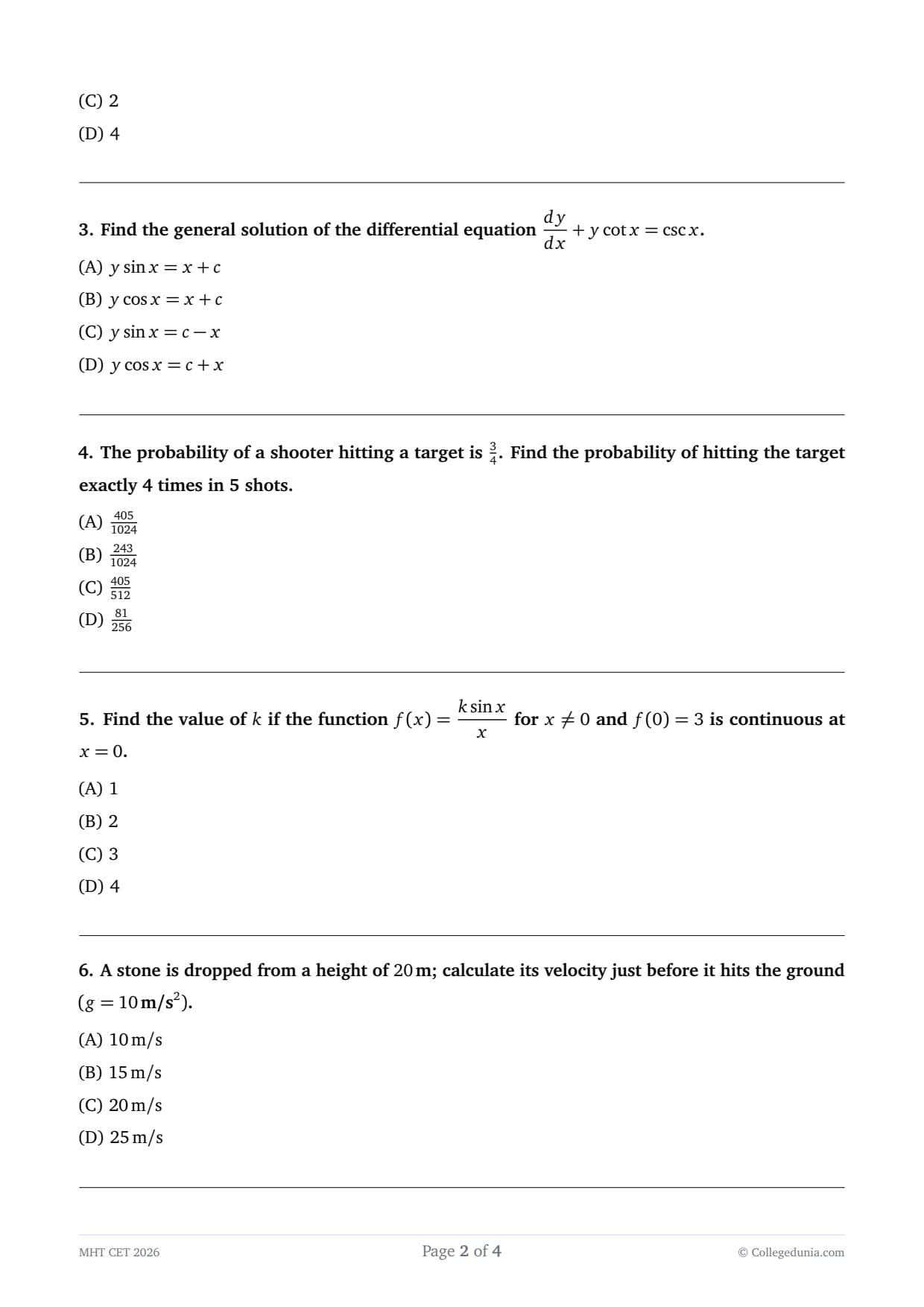
Find the general solution of the differential equation \(\dfrac{dy}{dx} + y\cot x = \csc x\).
The probability of a shooter hitting a target is \( \frac{3}{4} \). Find the probability of hitting the target exactly 4 times in 5 shots.
Find the value of \(k\) if the function \(f(x)=\dfrac{k\sin x}{x}\) for \(x\neq0\) and \(f(0)=3\) is continuous at \(x=0\).
View Solution
Concept:
A function is continuous at \(x=a\) if
\[ \lim_{x\to a} f(x) = f(a) \]
Thus for continuity at \(x=0\),
\[ \lim_{x\to0} f(x) = f(0) \]
We also use the standard limit
\[ \lim_{x\to0}\frac{\sin x}{x} = 1 \]
Step 1: {\color{redFind the limit of the function as \(x \to 0\).
\[ \lim_{x\to0} \frac{k\sin x}{x} \]
\[ = k \lim_{x\to0}\frac{\sin x}{x} \]
\[ = k(1) \]
\[ = k \]
Step 2: {\color{redApply the continuity condition.
Given:
\[ f(0)=3 \]
For continuity,
\[ \lim_{x\to0} f(x) = f(0) \]
\[ k = 3 \]
Therefore,
\[ \boxed{k = 3} \] Quick Tip: Whenever expressions involve \(\dfrac{\sin x}{x}\) near \(x=0\), remember the important limit: \[ \lim_{x\to0}\frac{\sin x}{x}=1 \] This identity is frequently used in continuity and limit problems.
A stone is dropped from a height of \(20\,m\); calculate its velocity just before it hits the ground \((g = 10\,m/s^2)\).
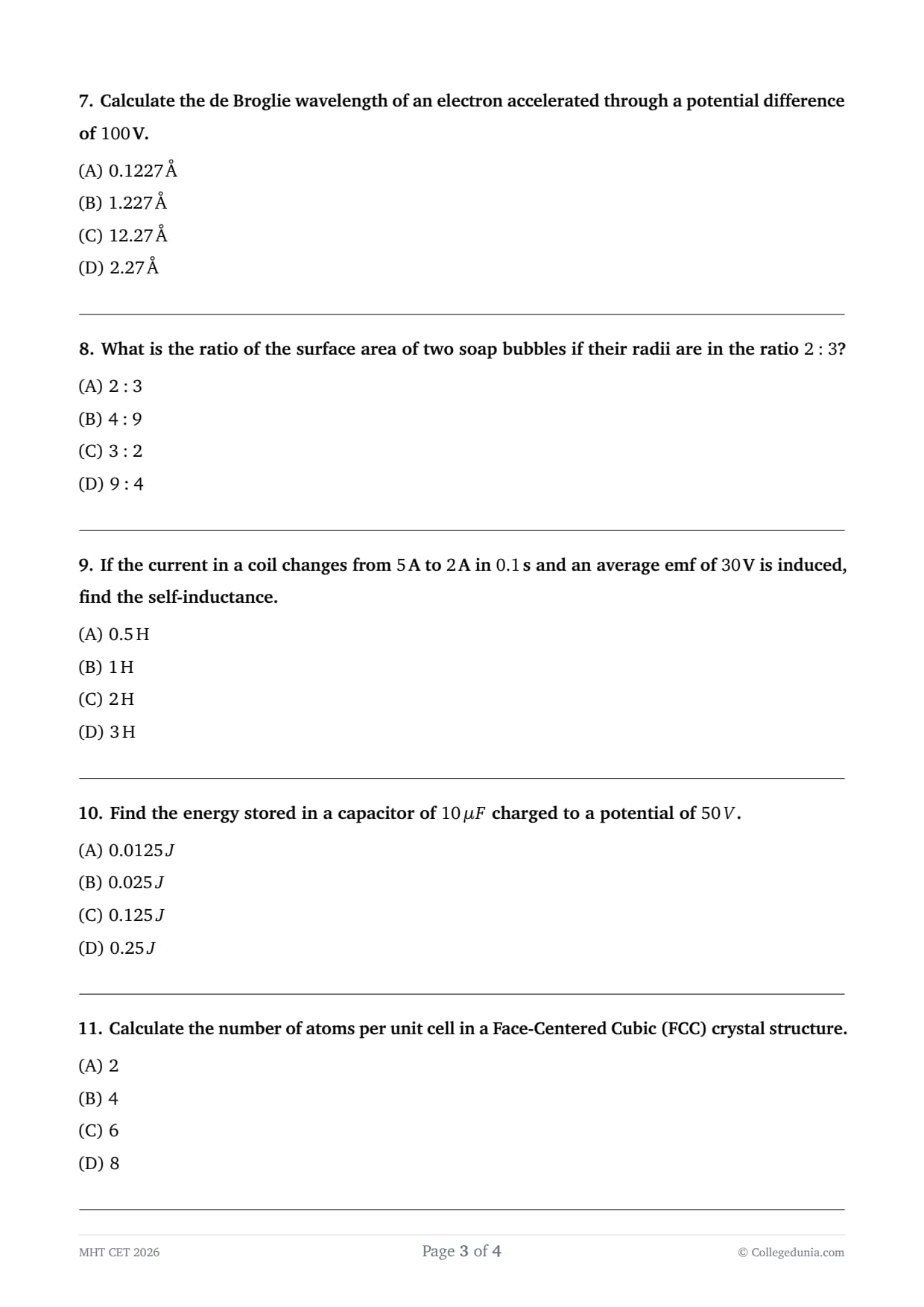
Calculate the de Broglie wavelength of an electron accelerated through a potential difference of \(100\,V\).
What is the ratio of the surface area of two soap bubbles if their radii are in the ratio \(2:3\)?
If the current in a coil changes from \(5\,A\) to \(2\,A\) in \(0.1\,s\) and an average emf of \(30\,V\) is induced, find the self-inductance.
Find the energy stored in a capacitor of \(10\,\mu F\) charged to a potential of \(50\,V\).
Calculate the number of atoms per unit cell in a Face-Centered Cubic (FCC) crystal structure.
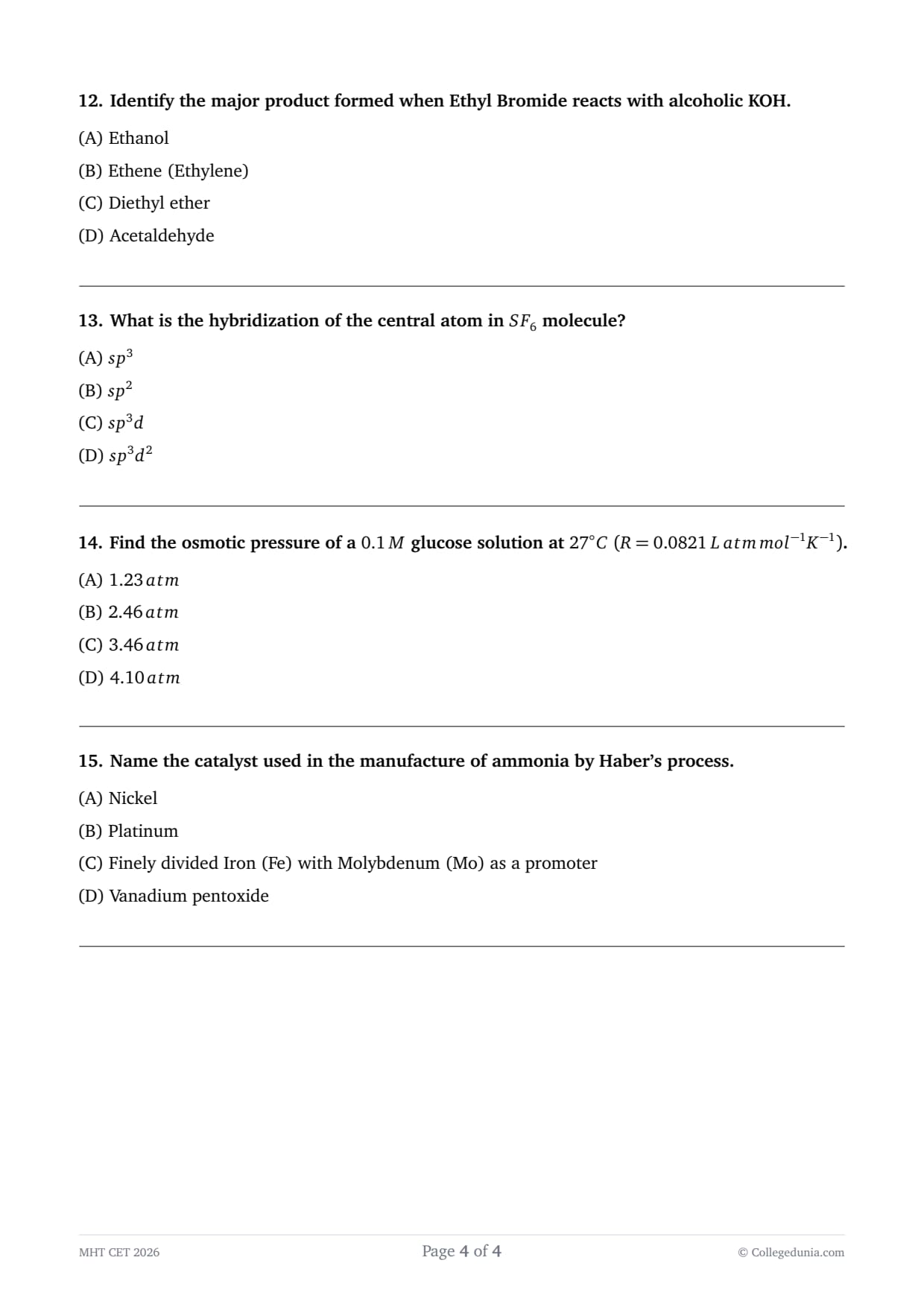
Identify the major product formed when Ethyl Bromide reacts with alcoholic KOH.
What is the hybridization of the central atom in \(SF_6\) molecule?
Find the osmotic pressure of a \(0.1\,M\) glucose solution at \(27^\circ C\) \((R = 0.0821\,L\,atm\,mol^{-1}K^{-1})\).
Name the catalyst used in the manufacture of ammonia by Haber’s process.
Related Links: Expected Percentile for MHT CET 2026 April 17 Shift 2
MHT CET PCM Exam Pattern 2026
| Parameter | Details |
|---|---|
| Conducting Body | Maharashtra Common Entrance Test Cell (Maharashtra CET Cell) |
| Exam Mode | Online (Computer-Based Test) |
| Duration | 180 minutes (3 hours) |
| Groups / Subjects | PCM (Physics, Chemistry, Mathematics) for Engineering |
| Total Questions |
150 |
| Total Marks | 200 |
| Question Type | Multiple Choice Questions (MCQs) |
| Marks Distribution |
|
| Negative Marking | No |
| Syllabus Weightage |
|



Comments