




On the basis of the previous year's analysis of MHT CET, some topics like Integration, Thermodynamics, Oscillations, Probability are the most repeated topics with high weightage. MHT CET 2026 follows 20% weightage for Class 11 and 80% for Class 12 topics.
- Mathematics: Integration (9%), Trigonometric Functions (8%), Probability (8%) are high-weightage topics
- Chemistry: Chemical Thermodynamics (15%), Coordination Compounds (9%), Organic reactions (20-25% combined) carry major weightage
- Physics: Kinetic Theory (12%), Oscillations (8%), Electrostatics (7%) are frequently asked topics
- These topics together contribute around 40-60% of total questions, making them crucial for scoring high
Studying with the chapter-wise trends can help students in better performance in exam along with the revision time, mock test, and managed study hours.
Also Read:
- MHT CET Exam Pattern 2026:Check Section-wise Exam Pattern, Marking Scheme
- How to attempt MHT CET 150 question with Accuracy
- Check Why MHT CET 2026 Cutoff Likely to Increase
Key Summary
- Previous MHT CET question trends show that concept-based chapters appear repeatedly.
- Balanced preparation for Mathematics, Physics, and Chemistry is important, as every subject has 50 questions.
- Candidates who focus on high-frequency chapters first can cover a large portion of the paper efficiently.
- Concept clarity combined with fast problem-solving ability is essential because most questions are short and require quick calculations.
MHT CET 2026 Important Chapters: Mathematics
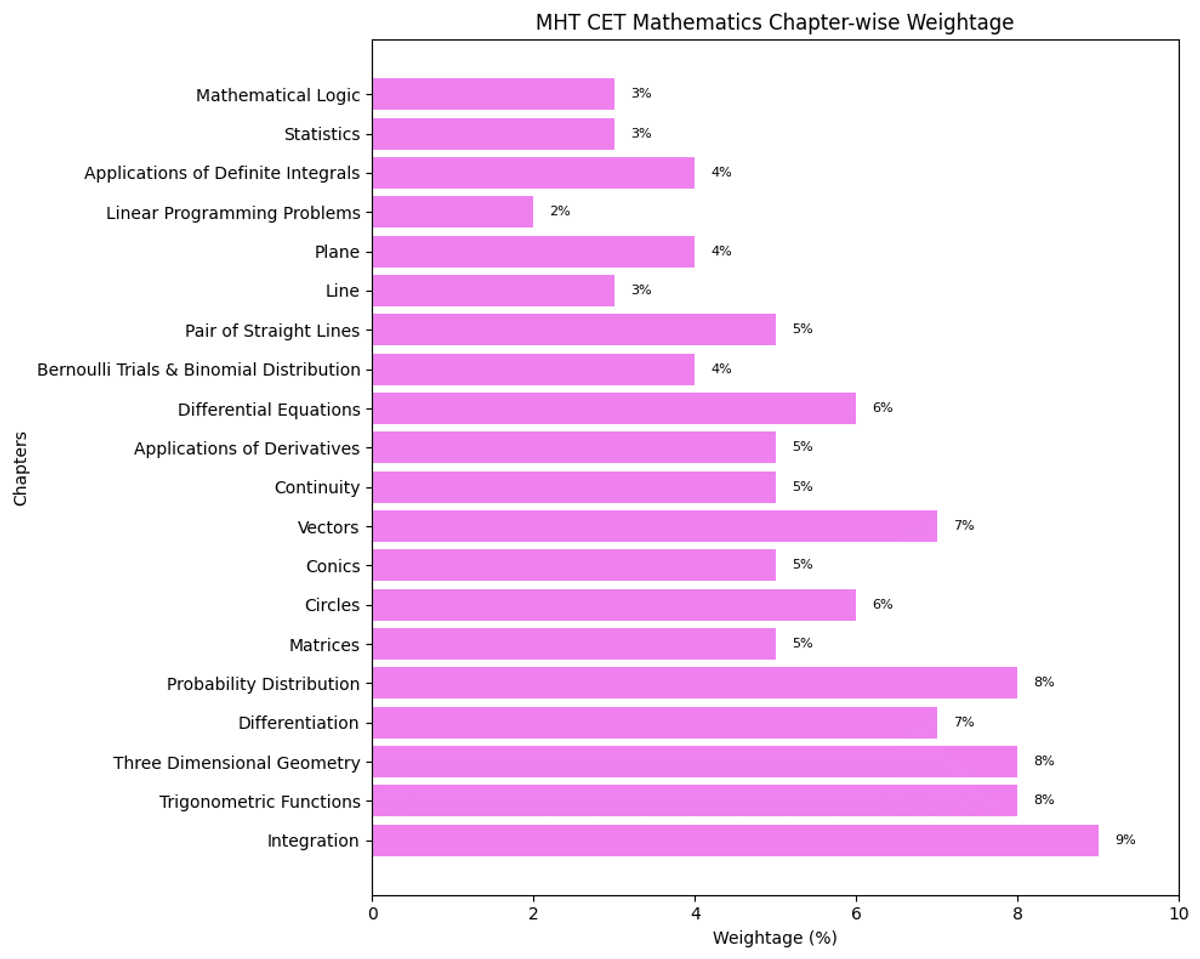
As there are 50 MCQs in MHT CET Mathematics, here are the expected number of questions and weightage in the question paper.
- Practice definite and indefinite integrals, substitution methods, and standard integral formulas regularly to solve 4-5 questions of integrals.
- Trigonometric Functions, Three-Dimensional Geometry, and Probability Distribution are high-weightage chapters with around 12 questions.
- Differentiation and Vectors are concept-heavy topics with 3-4 expected questions.
| MHT CET Chapter for Mathematics | Weightage of Marks | Expected Number of Questions | Preparation Strategy |
|---|---|---|---|
| Integration | 9% | 4-5 | Practice standard integration formulas, substitution, and definite integrals. Focus on quick solving techniques. |
| Trigonometric Functions | 8% | 4 | Revise identities, inverse trigonometric functions, and transformations. Practice simplification-based questions. |
| Three Dimensional Geometry | 8% | 4 | Focus on direction ratios, direction cosines, and equations of lines and planes. Practice vector-based problems. |
| Differentiation | 7% | 3-4 | Master derivative rules, chain rule, product rule, and implicit differentiation. Solve application-based problems. |
| Probability Distribution | 8% | 4 | Practice binomial distribution formulas, mean and variance, and probability calculations. |
| Matrices | 5% | 2-3 | Focus on matrix operations, determinant properties, and solving systems of equations quickly. |
| Circles | 6% | 3 | Practice standard equation of circle, tangent, and chord-related problems. |
| Conics | 5% | 2-3 | Revise properties and equations of parabola, ellipse, and hyperbola. Focus on direct formula-based questions. |
| Vectors | 7% | 3-4 | Practice vector algebra, dot product, cross product, and geometric interpretation of vectors. |
| Continuity | 5% | 2-3 | Focus on limits, continuity conditions, and solving limit-based questions quickly. |
| Applications of Derivatives | 5% | 2-3 | Practice increasing-decreasing functions, maxima-minima, and tangent/normal problems. |
| Differential Equations | 6% | 3 | Focus on standard forms and simple first-order differential equation solutions. |
| Bernoulli Trials And Binomial Distribution | 4% | 2 | Revise binomial expansion and probability-based questions. Practice formula-based problems. |
| Pair Of Straight Lines | 5% | 2-3 | Focus on combined equations, angle between lines, and condition for perpendicular lines. |
| Line | 3% | 1-2 | Practice slope form, intercept form, and angle between two lines. |
| Plane | 4% | 2 | Revise equation of plane, distance from point to plane, and normal form. |
| Linear Programming Problems | 2% | 1 | Practice graphical method and identifying feasible region. |
| Applications of Definite Integrals | 4% | 2 | Focus on area under curves and properties of definite integrals. |
| Statistics | 3% | 1-2 | Revise formulas for mean, variance, and standard deviation. |
| Mathematical Logic | 3% | 1-2 | Practice truth tables, logical statements, and implication-based questions. |
Ques. Which chapters are most important for MHT CET 2026 preparation?
Ans. Chapters such as Integration, Trigonometric Functions, Probability, Chemical Thermodynamics, Coordination Compounds, Kinetic Theory, Oscillations, and Electrostatics are among the most important topics based on previous exam trends.
Also Read: MHT CET 2026 Maths Strategy: High-Scoring Topics You Shouldn’t Skip
MHT CET 2026 Important Chapters: Chemistry
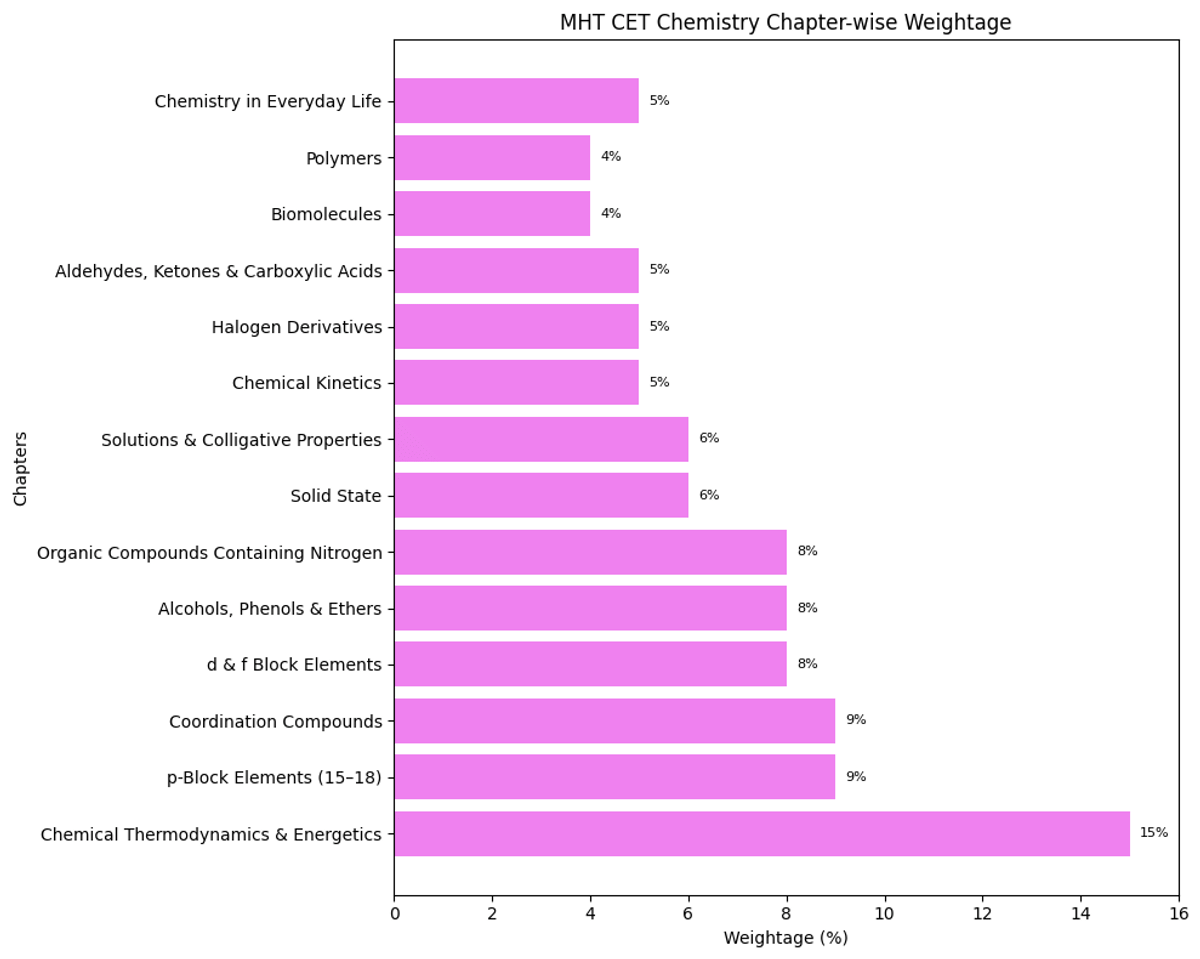
There are a total of 50 questions in MHT CET 2026 Chemistry which are divided between Physical, Inorganic, and Organic Chemistry. According to the previous years’ trends, here are the expected number of questions and weightage for each chapter.
- Chemical Thermodynamics and Energetics (15% weightage) is the most important chapter. Candidates should focus on numerical problems related to enthalpy change, Hess’s law, and bond energy calculations.
- p-Block Elements (Group 15-18), Coordination Compounds, and d & f Block from Inorganic Chemistry together can have 12-14 expected questions.
- Organic Chemistry chapters with topics like Alcohols, Phenols and Ethers; Organic Compounds Containing Nitrogen; and Aldehydes, Ketones can have a total of 12-14 questions.
| MHT CET Chapter for Chemistry | Chemistry Type | Weightage of Marks | Expected Number of Questions | Preparation Strategy |
|---|---|---|---|---|
| Chemical Thermodynamics And Energetics | Physical Chemistry | 15% | 7-8 | Focus on numerical problems related to enthalpy change, Hess’s law, bond energy, and thermodynamic formulas. Practice calculation-based questions regularly. |
| p-Block Elements - Group 15 To 18 | Inorganic Chemistry | 9% | 4-5 | Revise trends, oxidation states, important compounds, and reactions. Memorise properties and exceptions from NCERT. |
| Coordination Compounds | Inorganic Chemistry | 9% | 4-5 | Focus on ligands, coordination number, hybridisation, crystal field theory basics, and IUPAC naming of complexes. |
| d And f Block Elements | Inorganic Chemistry | 8% | 4 | Study electronic configuration, oxidation states, color, magnetic properties, and important compounds. |
| Alcohols, Phenols, And Ethers | Organic Chemistry | 8% | 4 | Practice reaction mechanisms, preparation methods, and important reactions of alcohols and phenols. |
| Organic Compounds Containing Nitrogen | Organic Chemistry | 8% | 4 | Focus on preparation, properties, and reactions of amines, diazonium salts, and related mechanisms. |
| Solid State | Physical Chemistry | 6% | 3 | Revise crystal structures, packing efficiency, density formulas, and defects in solids. |
| Solutions And Colligative Properties | Physical Chemistry | 6% | 3 | Practice numerical problems on molarity, molality, and colligative property formulas. |
| Chemical Kinetics | Physical Chemistry | 5% | 2-3 | Focus on rate law, order of reaction, half-life formulas, and graphical interpretation of reaction rates. |
| Halogen Derivatives Of Alkanes And Arenes | Organic Chemistry | 5% | 2-3 | Study preparation methods, nucleophilic substitution reactions, and important mechanisms. |
| Aldehydes, Ketones And Carboxylic Acids | Organic Chemistry | 5% | 2-3 | Practice reaction mechanisms, named reactions, and identification of functional groups. |
| Biomolecules | Organic Chemistry | 4% | 2 | Revise structures and functions of carbohydrates, proteins, and nucleic acids. |
| Polymers | Organic Chemistry | 4% | 2 | Memorise types of polymers, polymerisation reactions, and important examples. |
| Chemistry In Everyday Life | Organic Chemistry | 5% | 2-3 | Focus on drugs, detergents, antiseptics, and their applications. Mostly theory-based questions. |
Ques. How many questions are asked in MHT CET 2026 from each subject?
Ans. The exam usually contains 50 questions each from Physics, Chemistry, and Mathematics, making a total of 150 questions in the PCM group.
Related Articles:
MHT CET 2026 Important Chapters: Physics
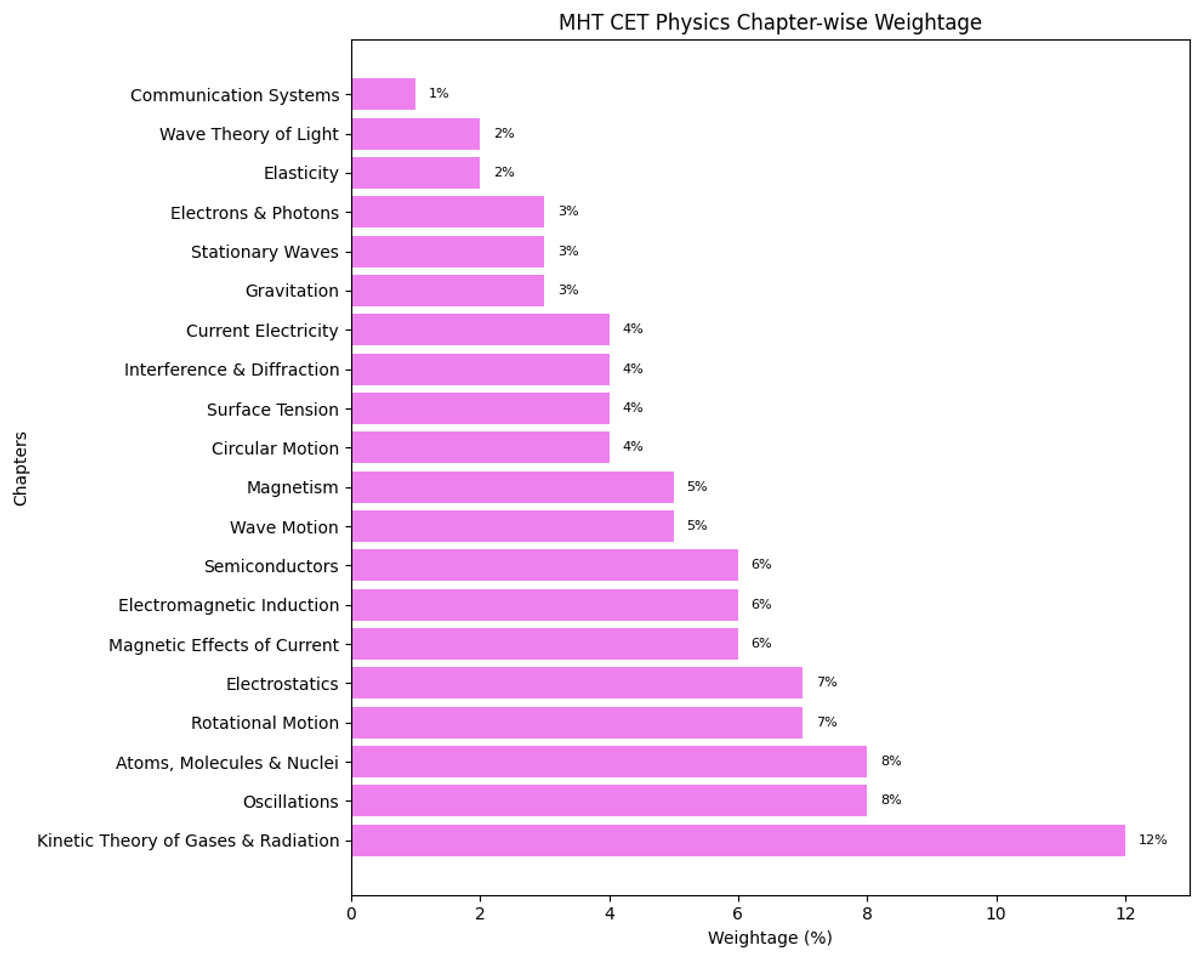
There are a total of 50 questions in MHT CET Physics. The questions are expected to be divided into this weightage as per previous year analysis.
- Kinetic Theory of Gases and Radiation is the most important chapter with around 6 expected questions and 12%weightage.
- Oscillations and Atoms, Molecules, and Nuclei are high-scoring topics contributes around 8 formula based and direct questions.
- Rotational Motion and Electrostatics with 3-4 expected questions needs strong clarity in concept to solve.
| MHT CET Chapter for Physics | Weightage of Marks | Expected Number of Questions | Preparation Strategy |
|---|---|---|---|
| Kinetic Theory Of Gases And Radiation | 12% | 6 | Focus on formulas related to RMS velocity, degrees of freedom, and radiation laws. Practice direct formula-based MCQs as most questions are numerical. |
| Oscillations | 8% | 4 | Revise SHM equations, time period formulas, and energy concepts. Practice graphical questions and small numerical problems. |
| Atoms, Molecules, And Nuclei | 8% | 4 | Memorize key formulas of Bohr model, binding energy, and radioactive decay. Solve previous-year numerical questions. |
| Rotational Motion | 7% | 3-4 | Focus on moment of inertia formulas and rotational dynamics relations. Practice conceptual questions involving torque and angular momentum. |
| Electrostatics | 7% | 3-4 | Strengthen Coulomb’s law, electric field, and potential formulas. Practice numericals involving charge distribution and capacitors. |
| Magnetic Effects Of Electric Current | 6% | 3 | Learn formulas related to Biot-Savart law, Ampere’s law, and force on current-carrying conductor. Solve application-based MCQs. |
| Electromagnetic Induction | 6% | 3 | Focus on Faraday’s law, Lenz’s law, and induced EMF formulas. Practice conceptual as well as numerical problems. |
| Semiconductors | 6% | 3 | Revise logic gates, p-n junction concepts, and diode characteristics. These are theory-based questions, so focus on concepts. |
| Wave Motion | 5% | 2-3 | Understand wave speed, phase difference, and superposition principle. Practice standard MCQs. |
| Magnetism | 5% | 2-3 | Focus on magnetic field lines, magnetic dipole moment, and torque formulas. Revise key theoretical concepts. |
| Circular Motion | 4% | 2 | Practice centripetal force formulas and motion in vertical circles. Solve conceptual numerical questions. |
| Surface Tension | 4% | 2 | Learn formulas related to capillary rise and surface energy. These questions are mostly direct formula-based. |
| Interference And Diffraction | 4% | 2 | Focus on Young’s double slit experiment formulas and fringe width concepts. Practice diagram-based questions. |
| Current Electricity | 4% | 2 | Revise Ohm’s law, resistivity formulas, and Kirchhoff’s laws. Practice circuit-based MCQs. |
| Gravitation | 3% | 1-2 | Focus on gravitational potential, escape velocity, and orbital velocity formulas. Practice quick numerical problems. |
| Stationary Waves | 3% | 1-2 | Revise node-antinode concepts and resonance conditions. Practice conceptual MCQs. |
| Electrons And Photons | 3% | 1-2 | Focus on photoelectric effect equations and related numerical problems. |
| Elasticity | 2% | 1 | Learn stress-strain relationships and modulus formulas. Practice basic numerical questions. |
| Wave Theory Of Light | 2% | 1 | Revise Huygens principle and related theory questions. Mostly concept-based. |
| Communication Systems | 1% | 0-1 | Read the basic theory and key definitions. Questions are usually direct and easy to score. |
Also Check:
Ques. Which subject has the most scoring topics in MHT CET?
Ans. Mathematics usually contains several formula-based and practice-oriented questions, while Chemistry often includes direct theory and reaction-based questions, making both subjects relatively scoring with proper preparation.
How to Use Previous Year Papers for MHT CET 2026 Preparation
Previous year question paper plays an important role to crack MHT CET exam. Candidates must try to analyze them properly to increase their chances of scoring better.
| Step | What to Do | How It Helps in Preparation |
|---|---|---|
| Analyse the Exam Pattern | Start by reviewing the last 8-10 years of MHT CET question papers to understand the distribution of questions across Physics, Chemistry, and Mathematics. | Helps identify the most frequently asked chapters and weightage trends in the exam. |
| Identify Repeated Topics | Mark chapters and concepts that appear repeatedly in multiple years such as Integration, Trigonometry, Thermodynamics, and Electrostatics. | Allows students to prioritise high-frequency topics that are more likely to appear again. |
| Practice Topic-Wise Questions | After revising a chapter, solve questions from previous papers related to that specific topic. | Strengthens concept clarity and application skills before attempting full papers. |
| Attempt Full-Length Papers | Once major chapters are completed, attempt previous year papers in a timed exam environment (90 minutes per paper). | Improves speed, accuracy, and time management for the actual exam. |
| Analyse Mistakes Carefully | After solving each paper, review incorrect answers and understand the concepts behind them. | Helps identify weak areas and avoid repeating similar mistakes. |
| Track Your Progress | Maintain a record of scores from each solved paper and monitor improvement over time. | Helps students measure preparation level and readiness for the exam. |
| Revise Important Concepts | Revisit formulas, reactions, and concepts from questions that appeared frequently in previous papers. | Ensures better retention of key concepts that are likely to be tested again. |
Ques. How important are previous year question papers for MHT CET preparation?
Ans. Previous year papers help students understand question patterns, frequently asked chapters, and difficulty level, making them one of the most effective tools for exam preparation.
Ques. How many questions can come from high-weightage chapters in MHT CET 2026?
Ans. High-weightage chapters across the three subjects can contribute around 40-60% of the total questions, which makes them crucial for scoring higher marks.
Ques. What is the best strategy to prepare for high-weightage chapters?
Ans. Students should first revise concepts from textbooks, practice MCQs topic-wise, and then attempt full-length mock tests to improve both accuracy and speed.
Related News:



Comments