AP PGECET 2024 Chemical Engineering Question Paper is available for download here. Sri Venkateswara University, Tirupati on behalf of APSCHE conducted AP PGECET 2024 Chemical Engineering on May 31 in Shift 1 from 9 AM to 11 AM. AP PGECET Question Paper 2024 consists of 120 MCQ-based questions in total carrying 1 mark each to be attempted in the duration of 2 hours.
AP PGECET 2024 Chemical Engineering Question Paper with Answer Key PDF
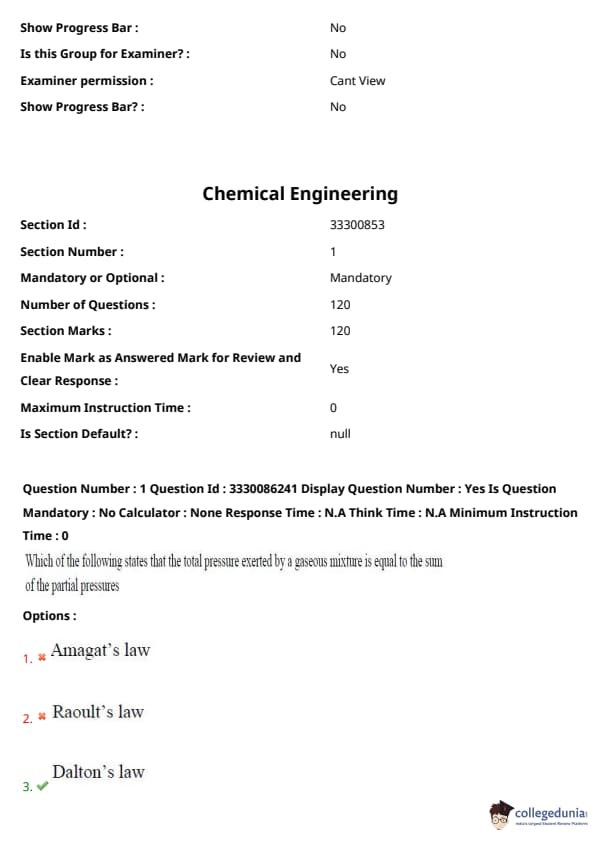
Question 1:
Which of the following states that the total pressure exerted by a gaseous mixture is equal to the sum of the partial pressures?
- (1) Amagat’s law
- (2) Raoult’s law
- (3) Dalton’s law
- (4) Avogadro’s law
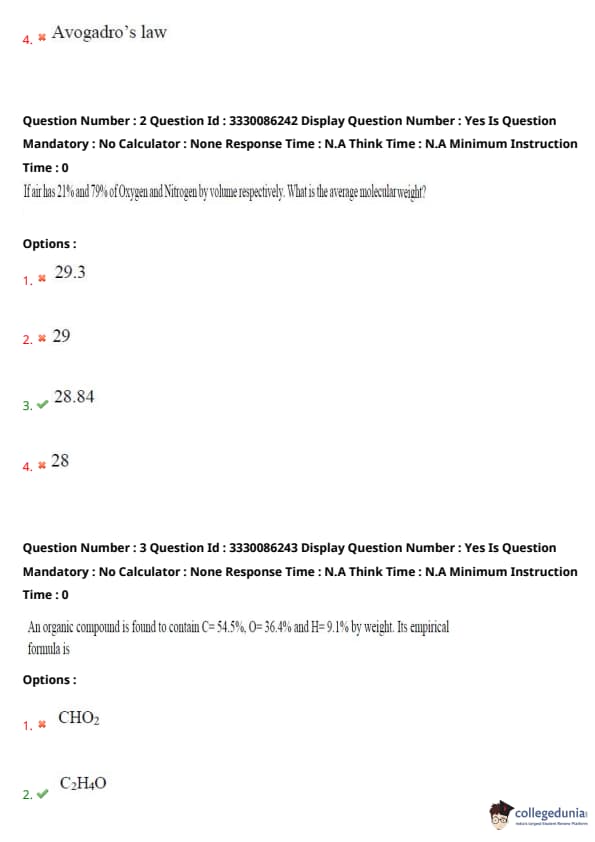
Question 2:
If air has 21% and 79% of Oxygen and Nitrogen by volume respectively. What is the average molecular weight?
- (A) \( 29.3 \)
- (B) \( 29 \)
- (C) \( 28.84 \)
- (D) \( 28 \)
Question 3:
An organic compound is found to contain \( \mathrm{C} = 54.5% \), \( \mathrm{O} = 36.4% \), and \( \mathrm{H} = 9.1% \) by weight. Its empirical formula is:
- (1) \(\mathrm{CHO}_2\)
- (2) \(\mathrm{C_2H_4O}\)
- (3) \(\mathrm{C_2H_6O}\)
- (4) \(\mathrm{C_3H_4O}\)
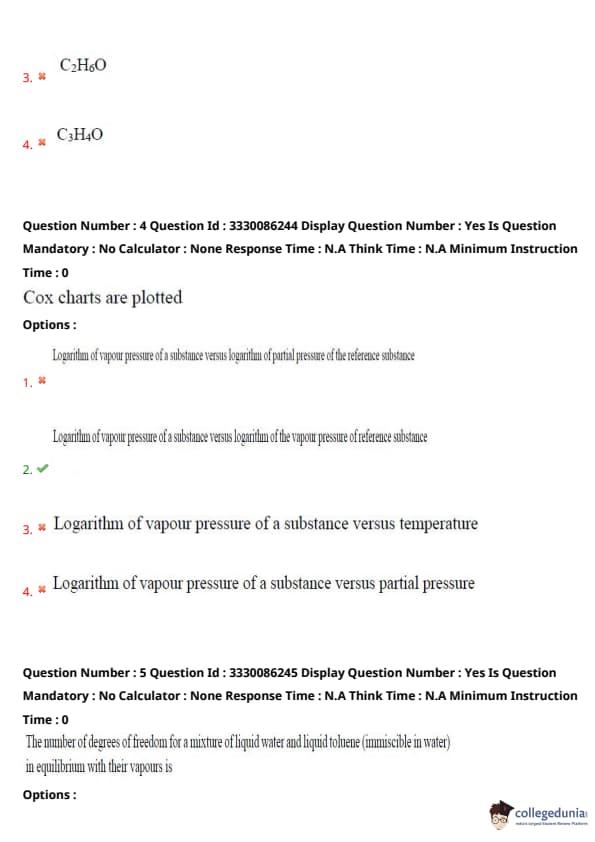
Question 4:
Cox charts are plotted
- (A) Logarithm of vapour pressure of a substance versus logarithm of partial pressure of the reference substance
- (B) Logarithm of vapour pressure of a substance versus logarithm of the vapour pressure of reference substance
- (C) Logarithm of vapour pressure of a substance versus temperature
- (D) Logarithm of vapour pressure of a substance versus partial pressure
Question 5:
The number of degrees of freedom for a mixture of liquid water and liquid toluene (immiscible in water) in equilibrium with their vapours is:
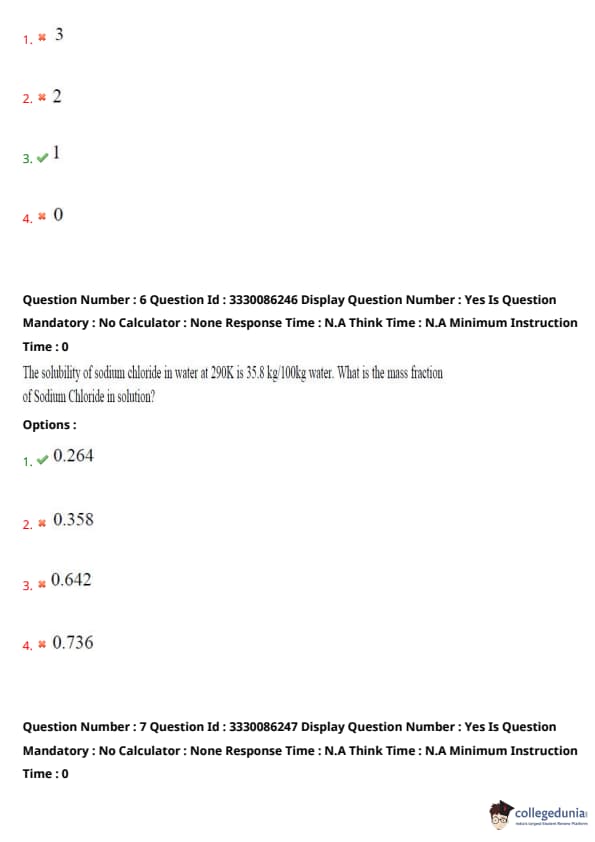
Question 6:
The solubility of sodium chloride in water at 290K is 35.8 kg/100 kg water. What is the mass fraction of sodium chloride in the solution?
- (1) 0.264
- (2) 0.358
- (3) 0.642
- (4) 0.736
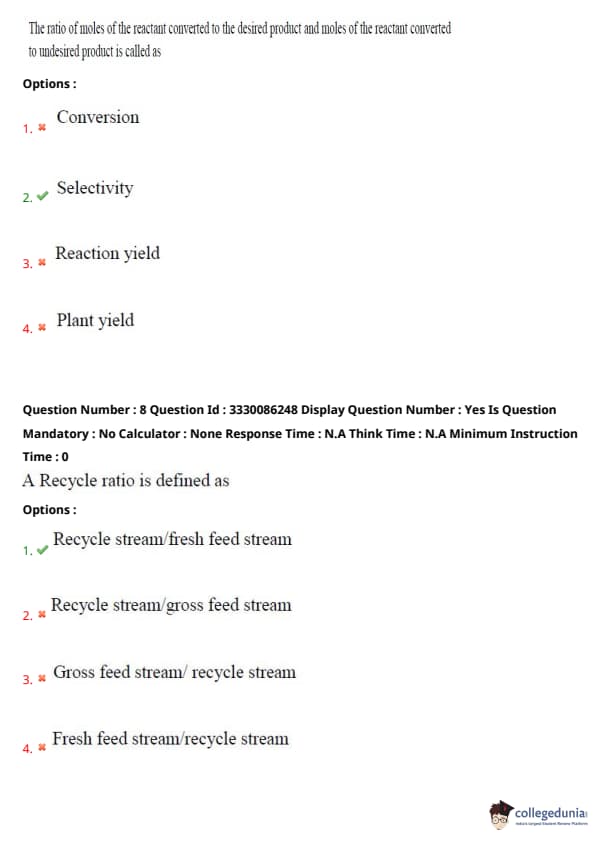
Question 7:
The ratio of moles of the reactant converted to the desired product and moles of the reactant converted to undesired product is called as:
- (1) Conversion
- (2) Selectivity
- (3) Reaction yield
- (4) Plant yield
Question 8:
A recycle ratio is defined as:
- (1) Recycle stream/fresh feed stream
- (2) Recycle stream/gross feed stream
- (3) Gross feed stream/recycle stream
- (4) Fresh feed stream/recycle stream
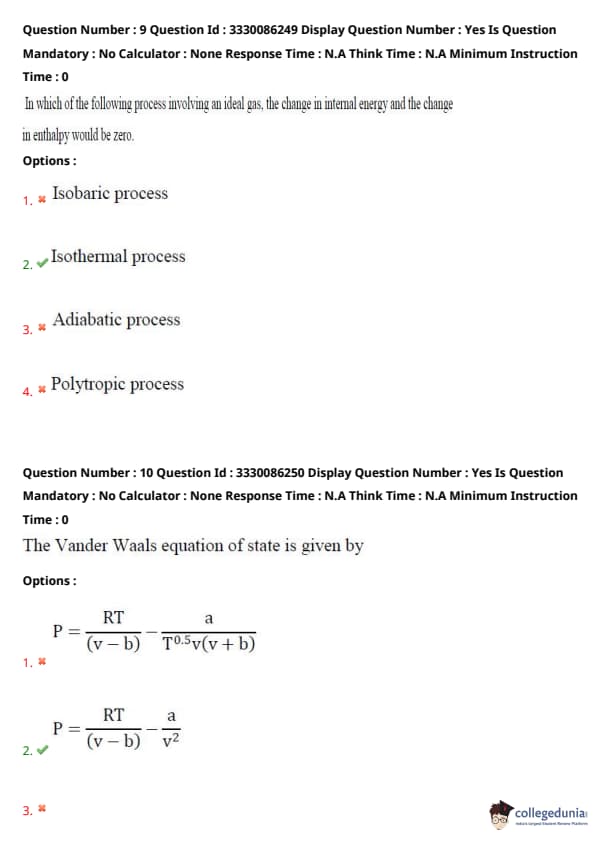
Question 9:
In which of the following process involving an ideal gas, the change in internal energy and the change in enthalpy would be zero?
- (1) Isobaric process
- (2) Isothermal process
- (3) Adiabatic process
- (4) Polytropic process
Question 10:
The Vander Waals equation of state is given by:
- (1) \( P = \frac{RT}{(v - b)} - \frac{a}{T^{0.5} v (v + b)} \)
- (2) \( P = \frac{RT}{(v - b)} - \frac{a}{v^2} \)
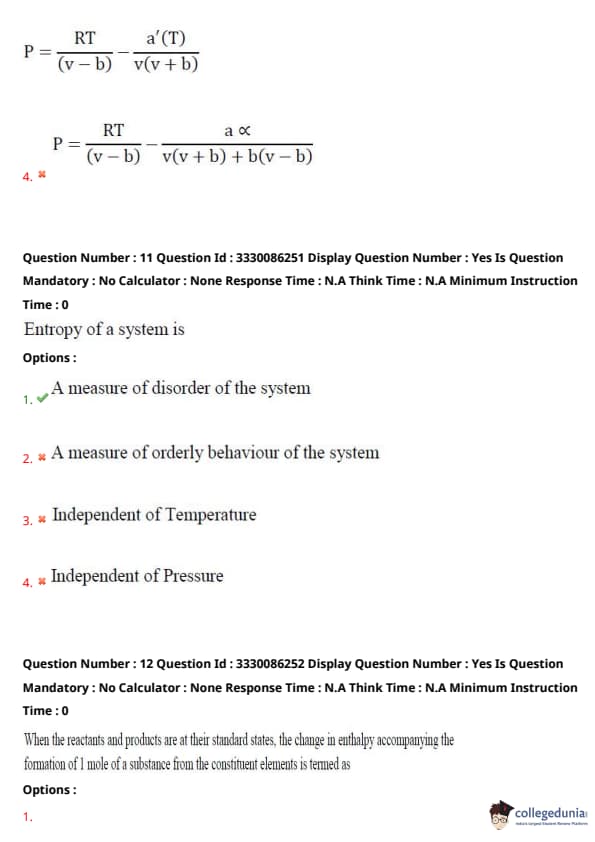
- (3) \( P = \frac{RT}{(v - b)} - \frac{{a'}{T}}{v(v + b)} \)
- (4) \( P = \frac{RT}{(v - b)} - \frac{a \alpha}{v(v + b) + b(v - b)} \)
Question 11:
Entropy of a system is:
- (1) A measure of disorder of the system
- (2) A measure of orderly behaviour of the system
- (3) Independent of Temperature
- (4) Independent of Pressure
Question 12:
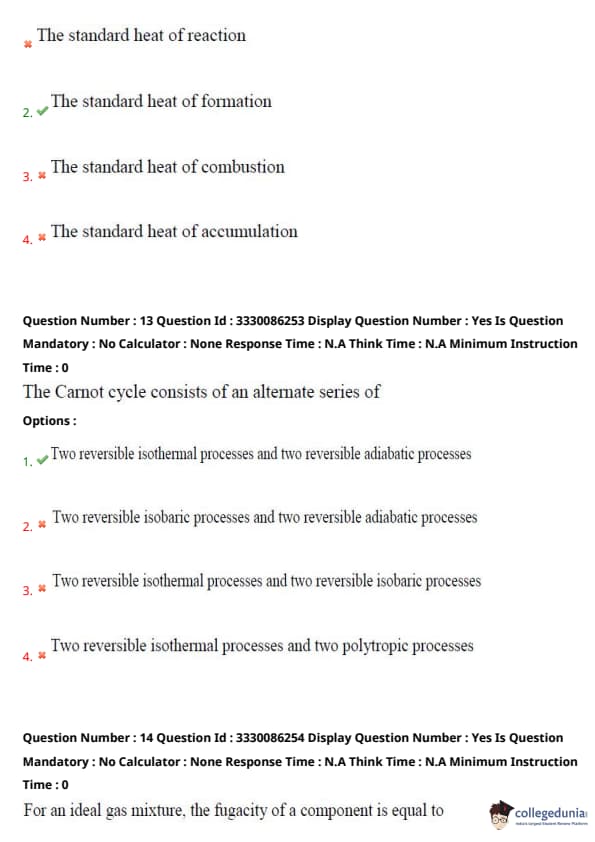
When the reactants and products are at their standard states, the change in enthalpy accompanying the formation of 1 mole of a substance from the constituent elements is termed as:
- (1) The standard heat of reaction
- (2) The standard heat of formation
- (3) The standard heat of combustion
- (4) The standard heat of accumulation
Question 13:
The Carnot cycle consists of an alternate series of
- (1) Two reversible isothermal processes and two reversible adiabatic processes
- (2) Two reversible isobaric processes and two reversible adiabatic processes
- (3) Two reversible isothermal processes and two reversible isobaric processes
- (4) Two reversible isothermal processes and two polytropic processes
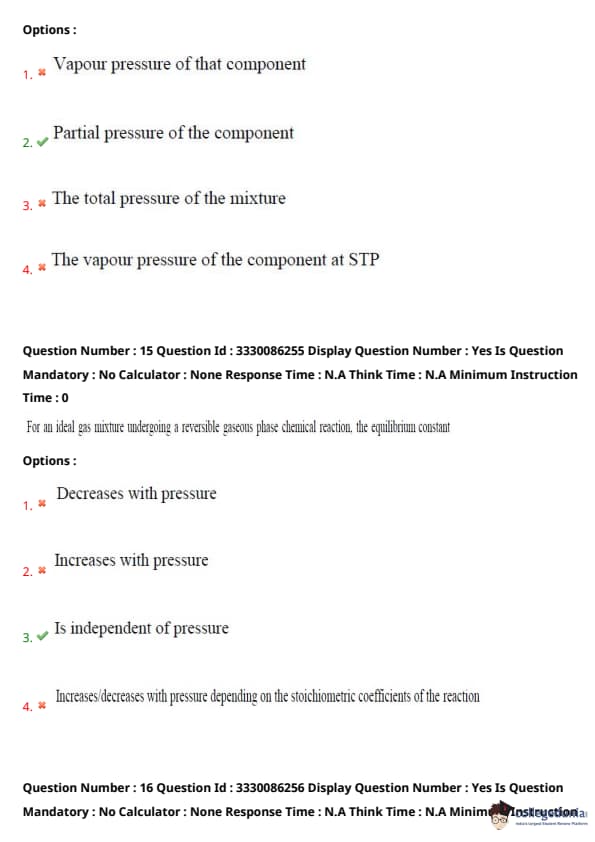
Question 14:
For an ideal gas mixture, the fugacity of a component is equal to
- (1) Vapour pressure of that component
- (2) Partial pressure of the component
- (3) The total pressure of the mixture
- (4) The vapour pressure of the component at STP
Question 15:
For an ideal gas mixture undergoing a reversible gaseous phase chemical reaction, the equilibrium constant:
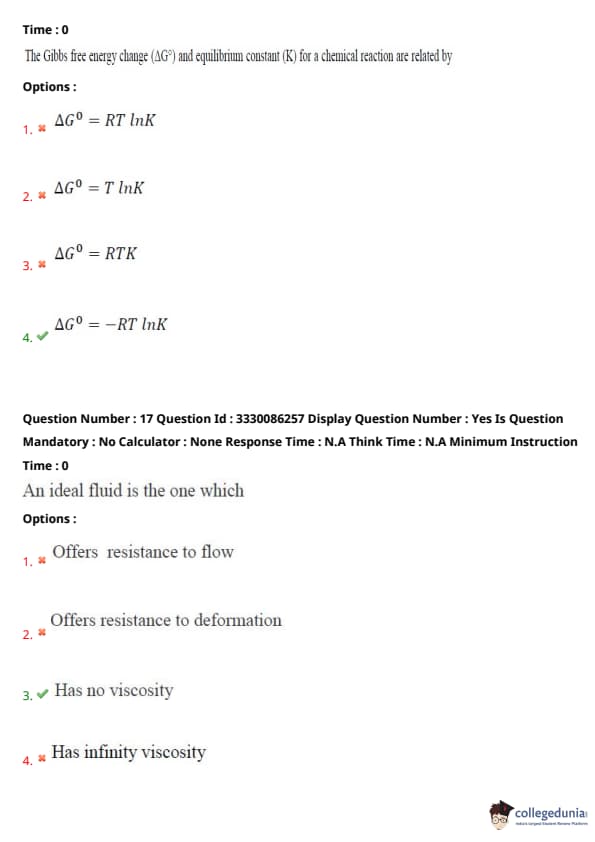
Question 16:
The Gibbs free energy change (\(\Delta G^\circ\)) and equilibrium constant (K) for a chemical reaction are related by
- (1) \(\Delta G^\circ = RT \ln K\)
- (2) \(\Delta G^\circ = T \ln K\)
- (3) \(\Delta G^\circ = RTK\)
- (4) \(\Delta G^\circ = -RT \ln K\)
Question 17:
An ideal fluid is the one which:
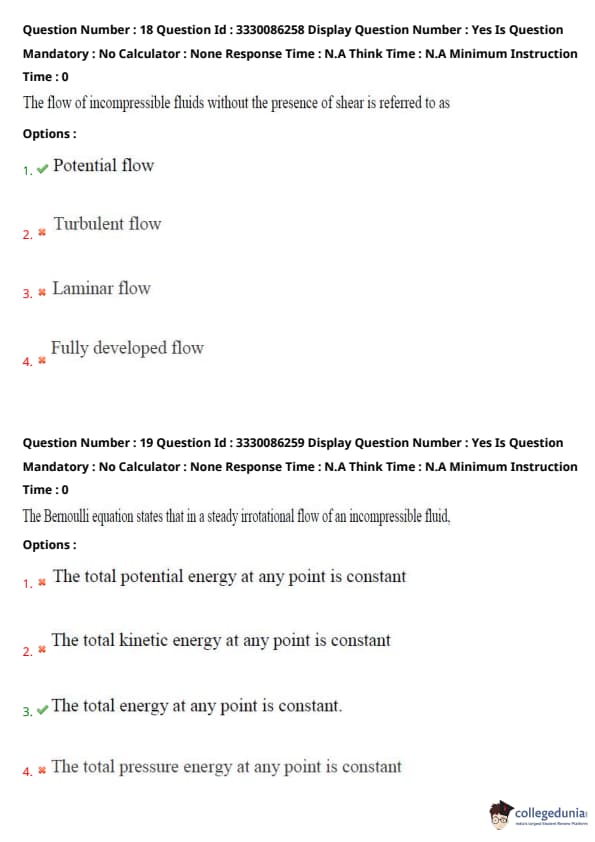
Question 18:
The flow of incompressible fluids without the presence of shear is referred to as
- (1) Potential flow
- (2) Turbulent flow
- (3) Laminar flow
- (4) Fully developed flow
Question 19:
The Bernoulli equation states that in a steady irrotational flow of an incompressible fluid,
- (1) The total potential energy at any point is constant
- (2) The total kinetic energy at any point is constant
- (3) The total energy at any point is constant
- (4) The total pressure energy at any point is constant
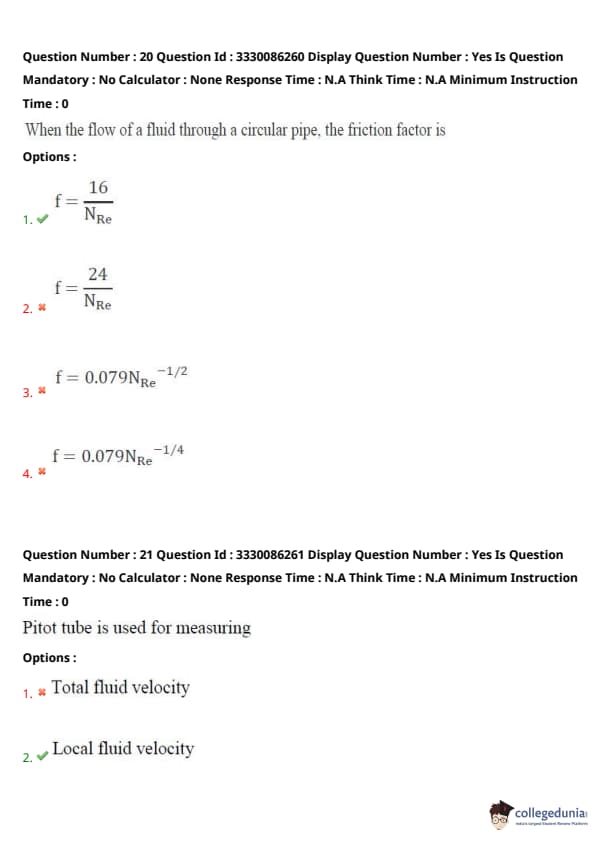
Question 20:
When the flow of a fluid through a circular pipe, the friction factor is
- (1) \( f = \frac{16}{N_{Re}} \)
- (2) \( f = \frac{24}{N_{Re}} \)
- (3) \( f = 0.079 N_{Re}^{-1/2} \)
- (4) \( f = 0.079 N_{Re}^{-1/4} \)
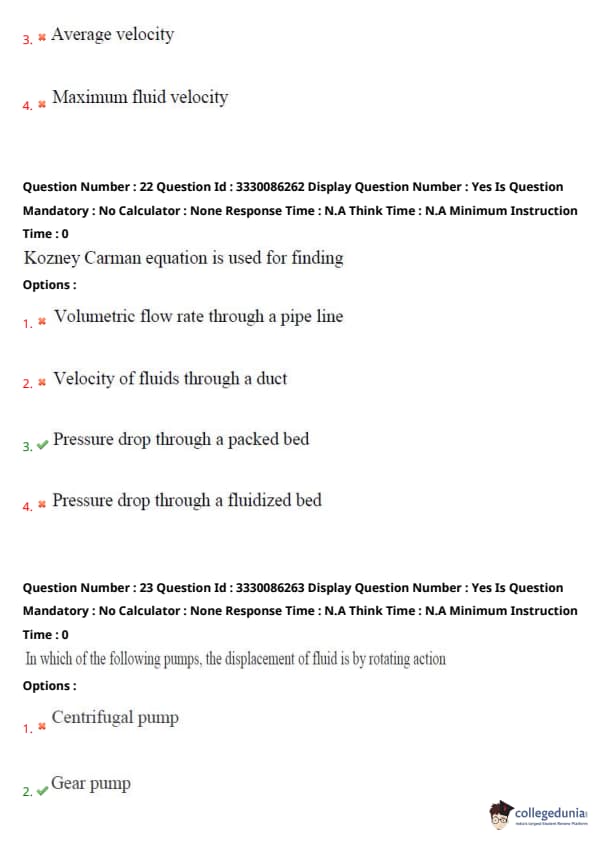
Question 21:
Pitot tube is used for measuring:
Question 22:
Kozney Carman equation is used for finding
- (1) Volumetric flow rate through a pipe line
- (2) Velocity of fluids through a duct
- (3) Pressure drop through a packed bed
- (4) Pressure drop through a fluidized bed
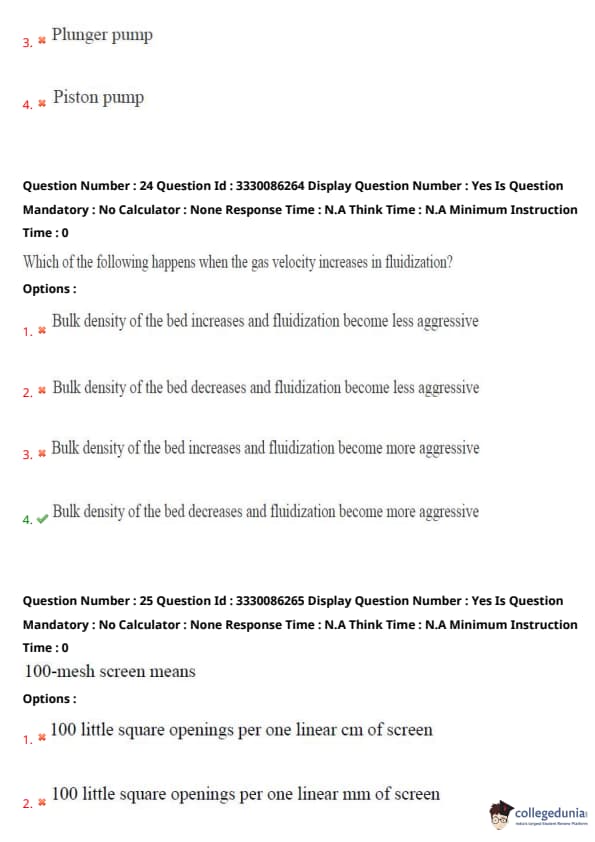
Question 23:
In which of the following pumps, the displacement of fluid is by rotating action
- (1) Centrifugal pump
- (2) Gear pump
- (3) Plunger pump
- (4) Piston pump
Question 24:
Which of the following happens when the gas velocity increases in fluidization?
- (1) Bulk density of the bed increases and fluidization become less aggressive
- (2) Bulk density of the bed decreases and fluidization become less aggressive
- (3) Bulk density of the bed increases and fluidization become more aggressive
- (4) Bulk density of the bed decreases and fluidization become more aggressive
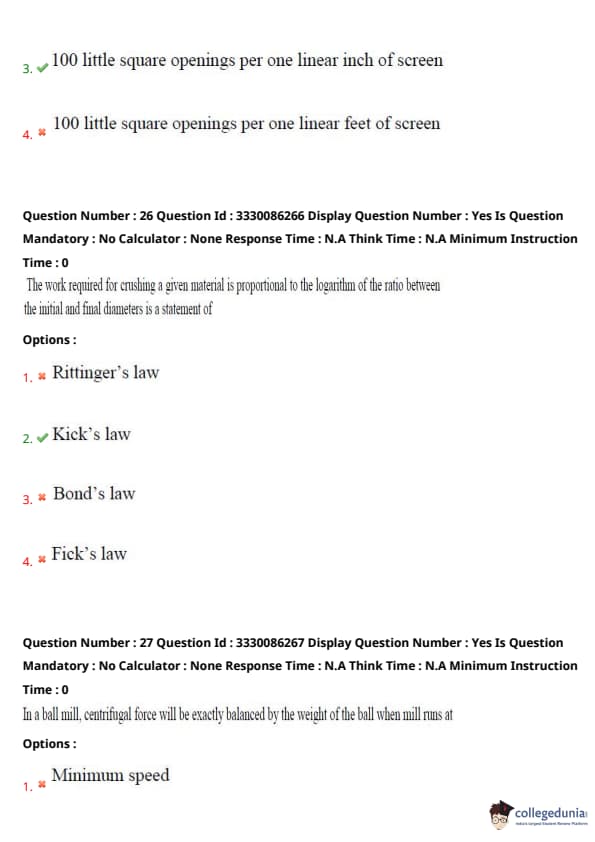
Question 25:
100-mesh screen means
- (1) 100 little square openings per one linear cm of screen
- (2) 100 little square openings per one linear mm of screen
- (3) 100 little square openings per one linear inch of screen
- (4) 100 little square openings per one linear feet of screen
Question 26:
The work required for crushing a given material is proportional to the logarithm of the ratio between the initial and final diameters is a statement of:
Question 27:
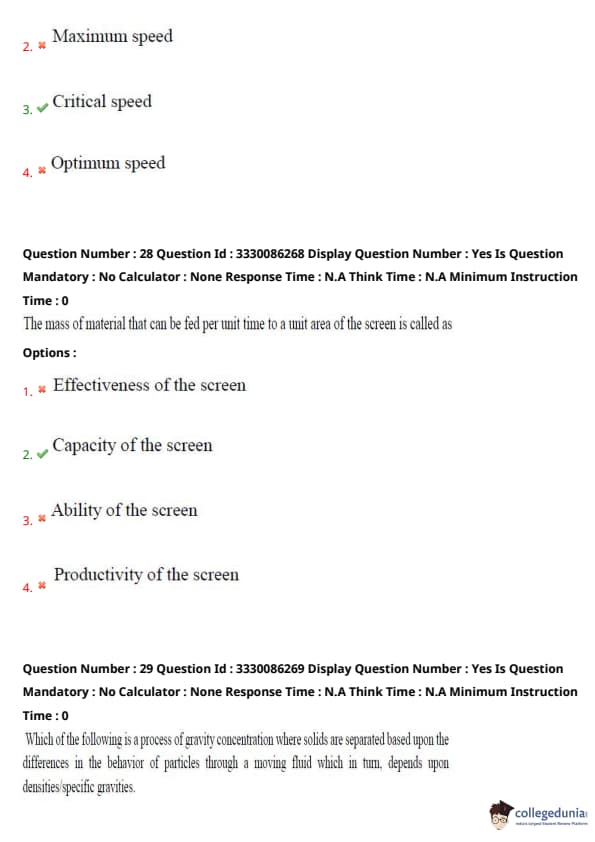
In a ball mill, centrifugal force will be exactly balanced by the weight of the ball when mill runs at
- (1) Minimum speed
- (2) Maximum speed
- (3) Critical speed
- (4) Optimum speed
Question 28:
The mass of material that can be fed per unit time to a unit area of the screen is called as
- (1) Effectiveness of the screen
- (2) Capacity of the screen
- (3) Ability of the screen
- (4) Productivity of the screen
Question 29:
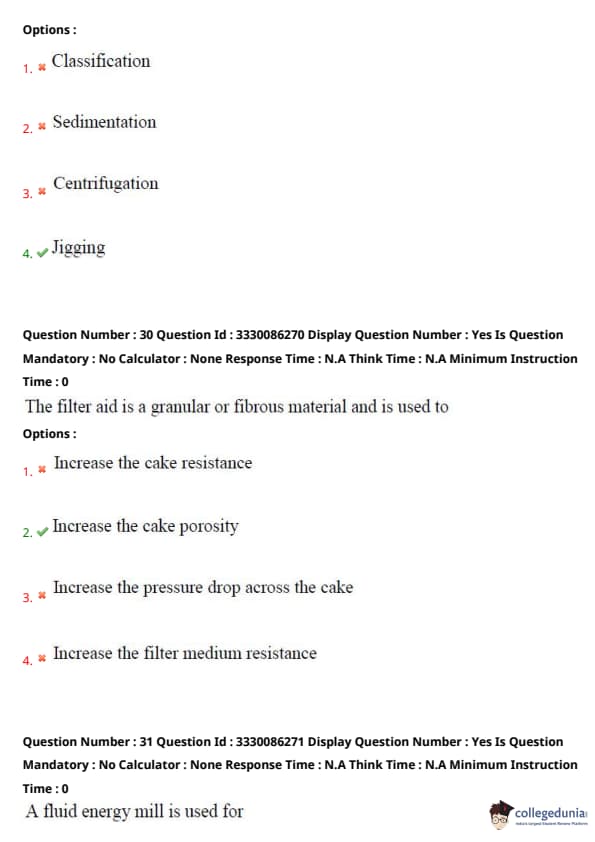
Which of the following is a process of gravity concentration where solids are separated based upon the differences in the behavior of particles through a moving fluid which in turn, depends upon densities/specific gravities.
- (1) Classification
- (2) Sedimentation
- (3) Centrifugation
- (4) Jigging
Question 30:
The filter aid is a granular or fibrous material and is used to
- (1) Increase the cake resistance
- (2) Increase the cake porosity
- (3) Increase the pressure drop across the cake
- (4) Increase the filter medium resistance
Question 31:
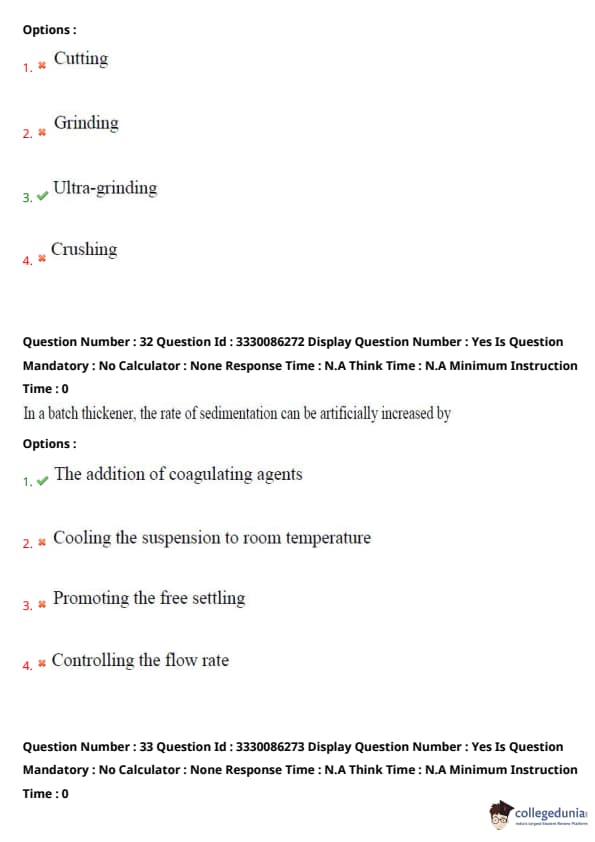
A fluid energy mill is used for:
Question 32:
In a batch thickener, the rate of sedimentation can be artificially increased by
- (1) The addition of coagulating agents
- (2) Cooling the suspension to room temperature
- (3) Promoting the free settling
- (4) Controlling the flow rate
Question 33:
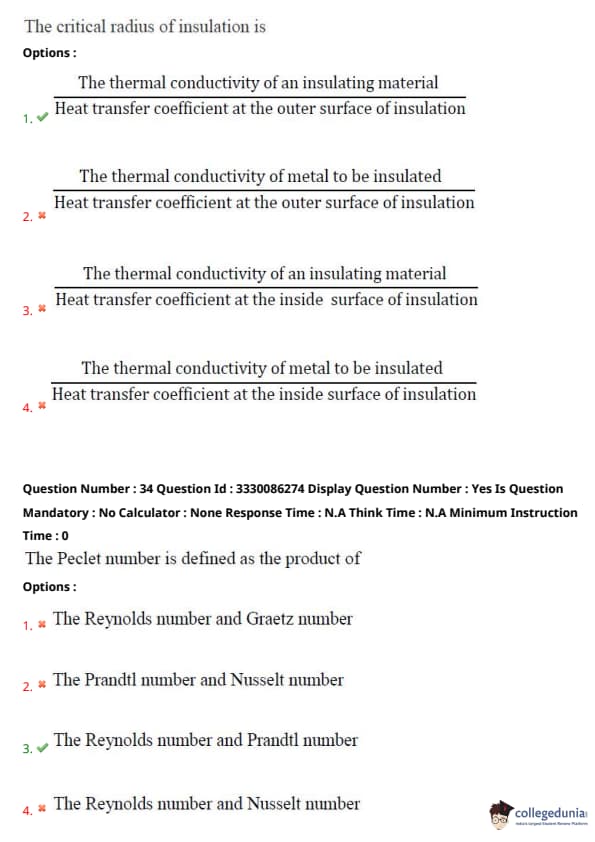
The critical radius of insulation is
- (1) \( \frac{The thermal conductivity of an insulating material}{Heat transfer coefficient at the outer surface of insulation} \)
- (2) \( \frac{The thermal conductivity of metal to be insulated}{Heat transfer coefficient at the outer surface of insulation} \)
- (3) \( \frac{The thermal conductivity of an insulating material}{Heat transfer coefficient at the inside surface of insulation} \)
- (4) \( \frac{The thermal conductivity of metal to be insulated}{Heat transfer coefficient at the inside surface of insulation} \)
Question 34:
The Peclet number is defined as the product of
- (1) The Reynolds number and Graetz number
- (2) The Prandtl number and Nusselt number
- (3) The Reynolds number and Prandtl number
- (4) The Reynolds number and Nusselt number
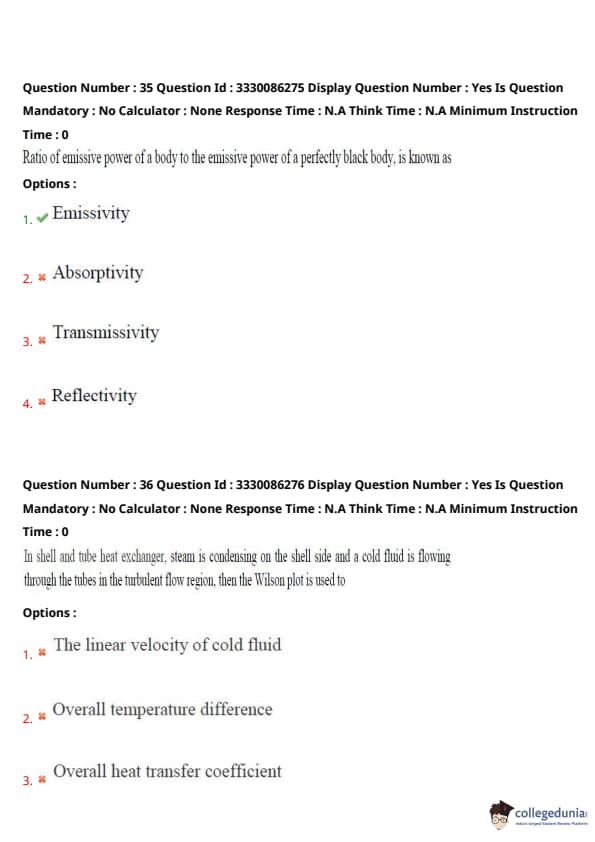
Question 35:
Ratio of emissive power of a body to the emissive power of a perfectly black body, is known
- (1) Emissivity
- (2) Absorptivity
- (3) Transmissivity
- (4) Reflectivity
Question 36:
In a shell and tube heat exchanger, steam is condensing on the shell side and a cold fluid is flowing through the tubes in the turbulent flow region, then the Wilson plot is used to:
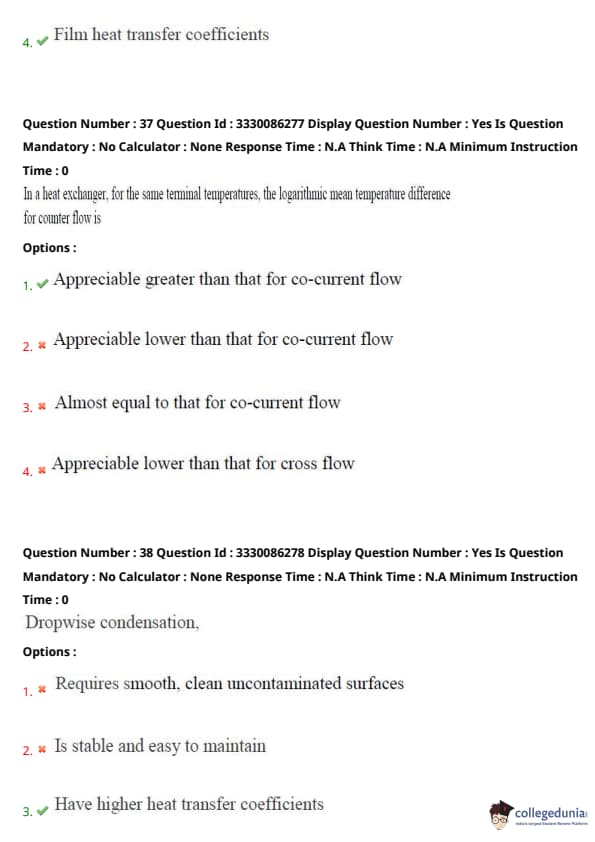
Question 37:
In a heat exchanger, for the same terminal temperatures, the logarithmic mean temperature difference for counter flow is
- (1) Appreciable greater than that for co-current flow
- (2) Appreciable lower than that for co-current flow
- (3) Almost equal to that for co-current flow
- (4) Appreciable lower than that for cross flow
Question 38:
Dropwise condensation,
- (1) Requires smooth, clean uncontaminated surfaces
- (2) Is stable and easy to maintain
- (3) Have higher heat transfer coefficients
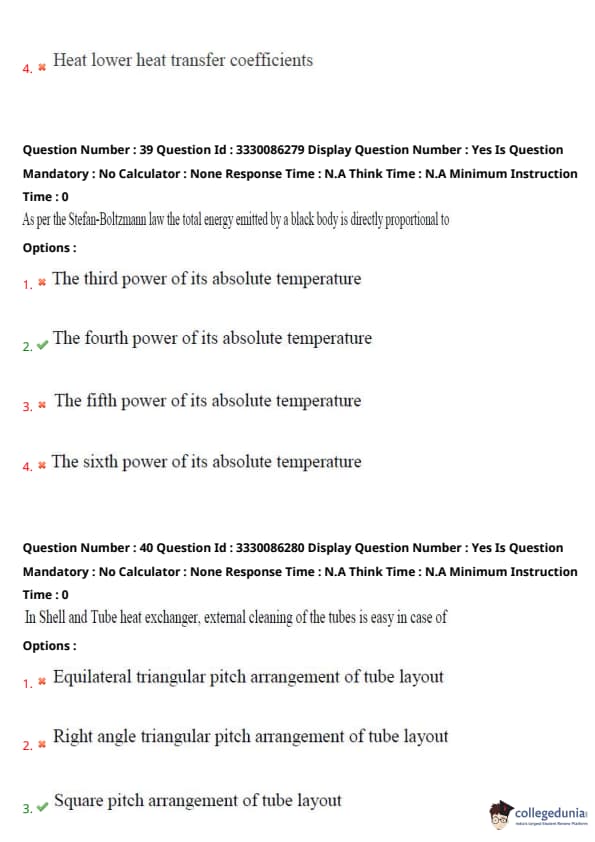
- (4) Have lower heat transfer coefficients
Question 39:
As per the Stefan-Boltzmann law the total energy emitted by a black body is directly proportional to
- (1) The third power of its absolute temperature
- (2) The fourth power of its absolute temperature
- (3) The fifth power of its absolute temperature
- (4) The sixth power of its absolute temperature
Question 40:
In shell and tube heat exchanger, external cleaning of the tubes is easy in case of
- (1) Equilateral triangular pitch arrangement of tube layout
- (2) Right angle triangular pitch arrangement of tube layout
- (3) Square pitch arrangement of tube layout
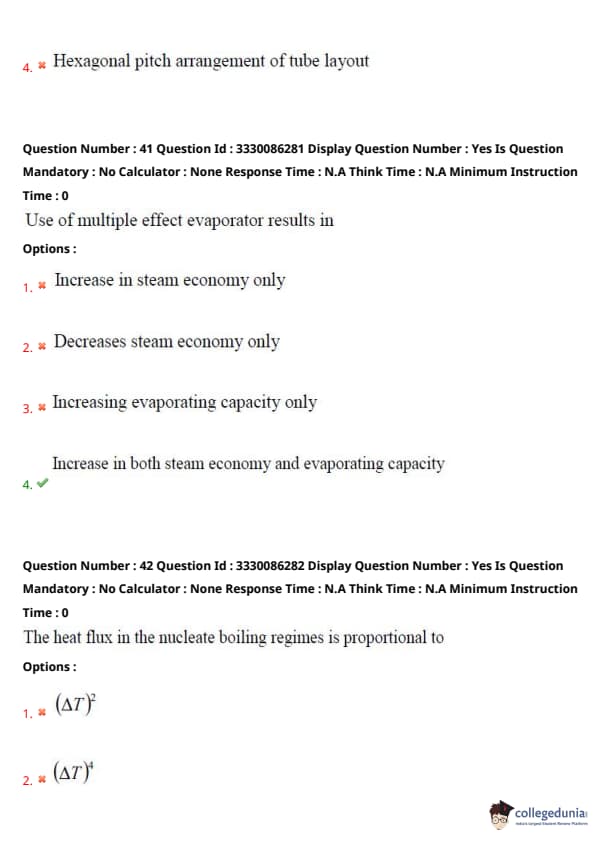
- (4) Hexagonal pitch arrangement of tube layout
Question 41:
Use of multiple effect evaporator results in:
Question 42:
The heat flux in the nucleate boiling regime is proportional to
- (1) \((\Delta T)^2\)
- (2) \((\Delta T)^4\)
- (3) \((\Delta T)^3\)
- (4) \(\sqrt{\Delta T}\)
Question 43:
The steady state gas phase reaction 3A + B \(\rightarrow\) C + 2D takes place on a catalyst surface. What will be the value of the flux ratio \( N_A / N_D \)?
- (1) -2
- (2) -0.5
- (3) -1.5
- (4) 2
Question 44:
Lewis number is the ratio of
- (1) Thermal diffusivity to mass diffusivity
- (2) Mass diffusivity to momentum diffusivity
- (3) Mass diffusivity to thermal diffusivity
- (4) Momentum diffusivity to thermal diffusivity
Question 45:
The penetration theory relates average mass transfer coefficient (\( k \)) with diffusivity (\( D \))
- (1) \( k \propto D \)
- (2) \( k \propto \sqrt{D} \)
- (3) \( k \propto D^{1.5} \)
- (4) \( k \propto D^2 \)
Question 46:
The absorption factor can be increased by:
Question 47:
A plate is called a theoretical plate when
- (1) The vapour and liquid leaving the plate are in equilibrium
- (2) The vapour and liquid entering the plate are in equilibrium
- (3) The vapour leaving the plate is in equilibrium with the liquid entering the plate
- (4) The liquid leaving the plate is in equilibrium with the vapour entering the plate
Question 48:
If reflux in a distillation column is 100 mol/hr and the overhead product rate is 50 mol/hr, the reflux ratio is
- (1) 0.5
- (2) 2
- (3) 50
- (4) 150
Question 49:
At a given temperature, the humid volume is
- (1) Linear function of humidity
- (2) Inverse function of humidity
- (3) Square function of humidity
- (4) No specific function of humidity
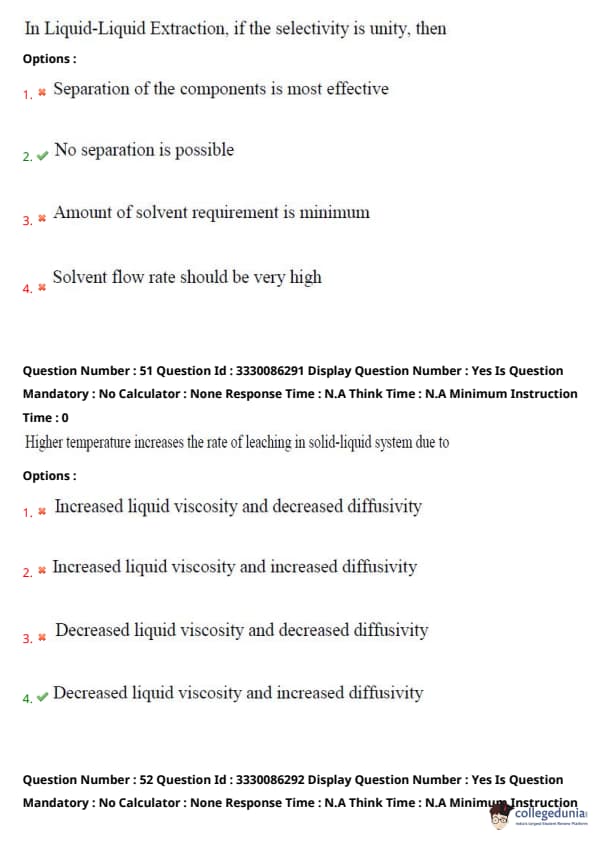
Question 50:
In liquid-liquid extraction, if the selectivity is unity, then
- (1) Separation of the components is most effective
- (2) No separation is possible
- (3) Amount of solvent required is minimum
- (4) Solvent flow rate should be very high
Question 51:
Higher temperature increases the rate of leaching in a solid-liquid system due to:
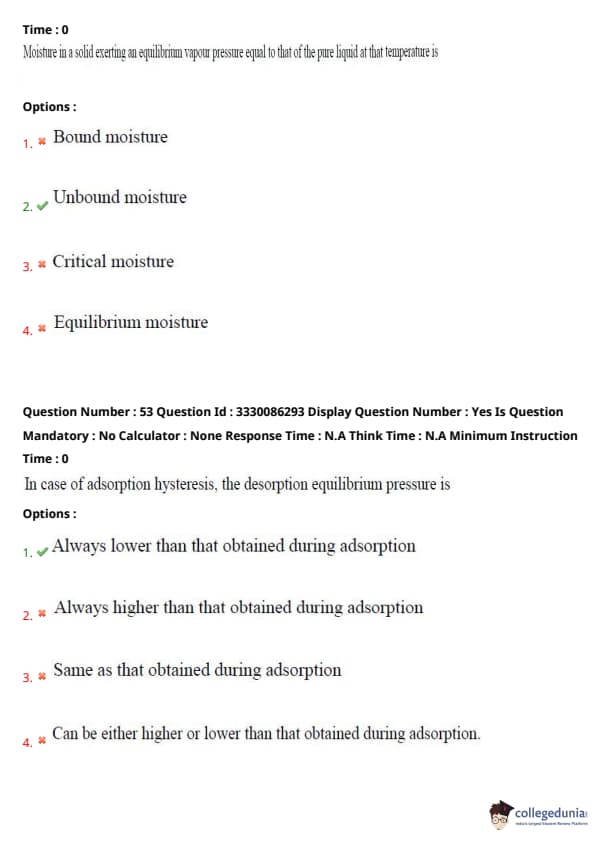
Question 52:
Moisture in a solid exerting an equilibrium vapour pressure equal to that of the pure liquid at that temperature is
- (1) Bound moisture
- (2) Unbound moisture
- (3) Critical moisture
- (4) Equilibrium moisture
Question 53:
In case of adsorption hysteresis, the desorption equilibrium pressure is
- (1) Always lower than that obtained during adsorption
- (2) Always higher than that obtained during adsorption
- (3) Same as that obtained during adsorption
- (4) Can be either higher or lower than that obtained during adsorption
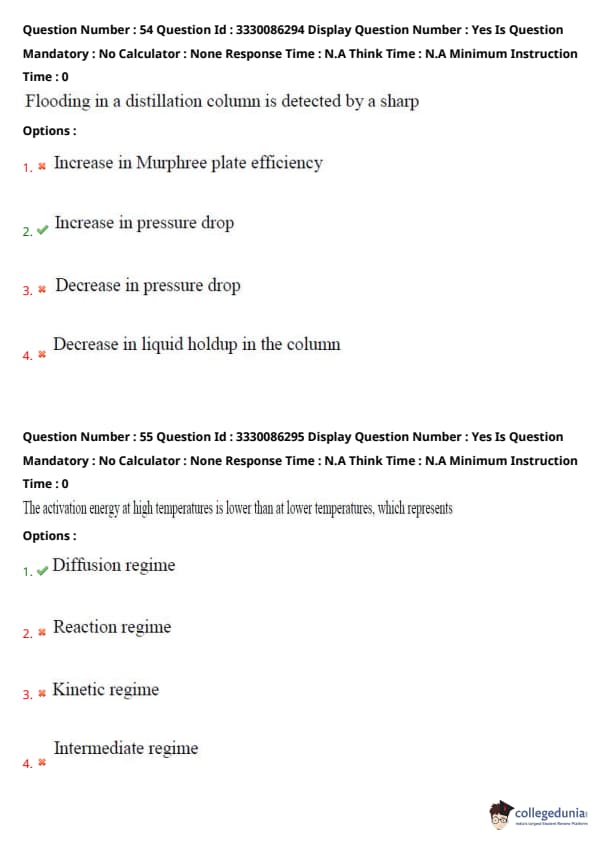
Question 54:
Flooding in a distillation column is detected by a sharp
- (1) Increase in Murphree plate efficiency
- (2) Increase in pressure drop
- (3) Decrease in pressure drop
- (4) Decrease in liquid holdup in the column
Question 55:
The activation energy at high temperatures is lower than at lower temperatures, which represents
- (1) Diffusion regime
- (2) Reaction regime
- (3) Kinetic regime
- (4) Intermediate regime
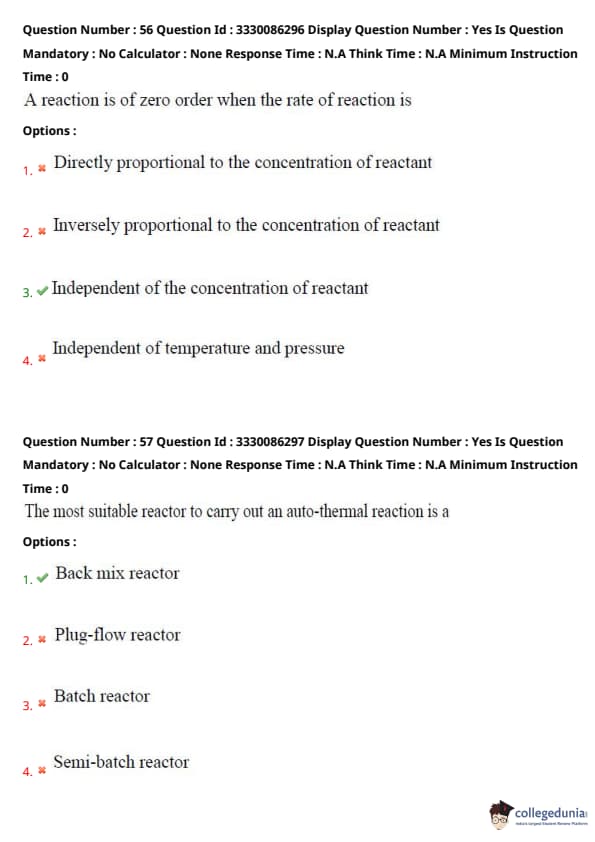
Question 56:
A reaction is of zero order when the rate of reaction is
- (1) Directly proportional to the concentration of reactant
- (2) Inversely proportional to the concentration of reactant
- (3) Independent of the concentration of reactant
- (4) Independent of temperature and pressure
Question 57:
The most suitable reactor to carry out an auto-thermal reaction is a:
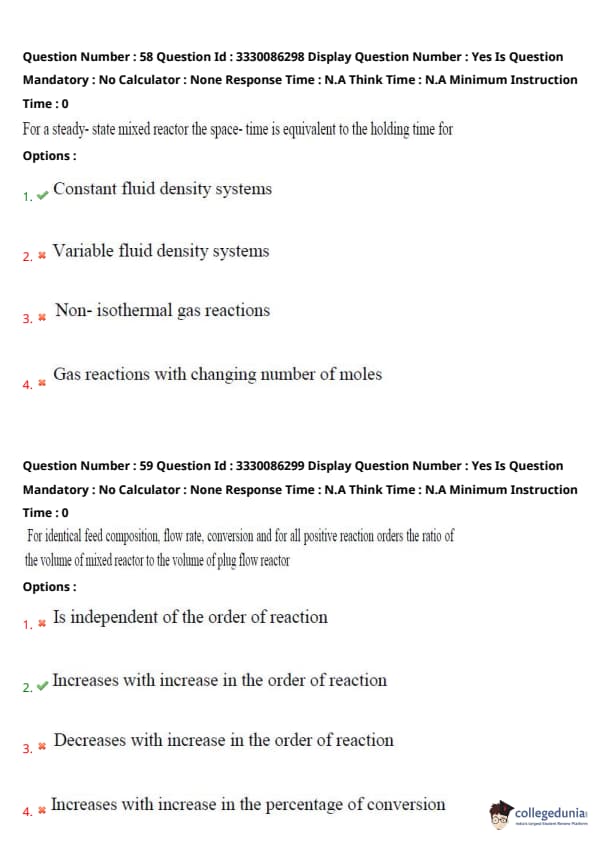
Question 58:
For a steady-state mixed reactor the space-time is equivalent to the holding time for
- (1) Constant fluid density systems
- (2) Variable fluid density systems
- (3) Non-isothermal gas reactions
- (4) Gas reactions with changing number of moles
Question 59:
For identical feed comp., flow rate, conversion and for all positive reaction orders the ratio of the volume of mixed reactor to the volume of plug flow reactor
- (1) Is independent of the order of reaction
- (2) Increases with increase in the order of reaction
- (3) Decreases with increase in the order of reaction
- (4) Increases with increase in the percentage of conversion
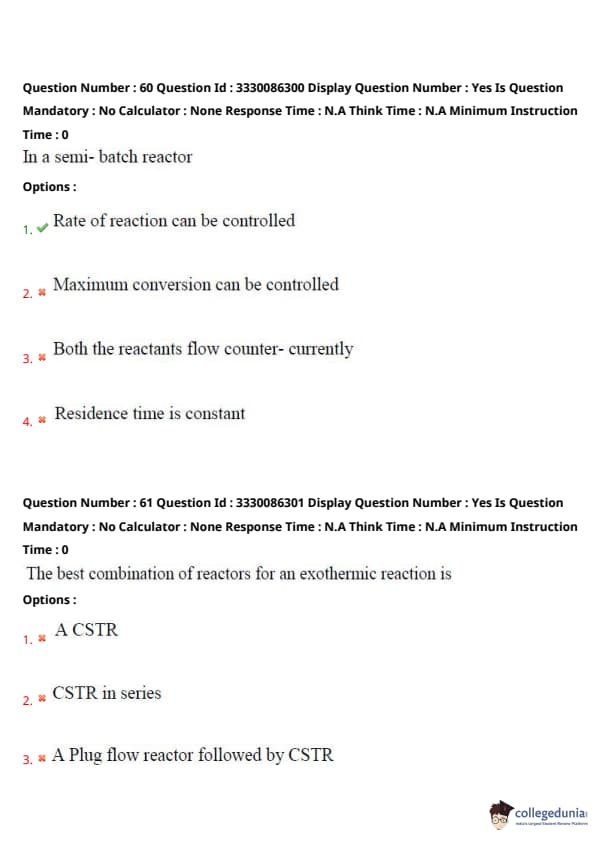
Question 60:
In a semi-batch reactor
- (1) Rate of reaction can be controlled
- (2) Maximum conversion can be controlled
- (3) Both the reactants flow counter-currently
- (4) Residence time is constant
Question 61:
The best combination of reactors for an exothermic reaction is:
Question 62:
If the conversion of a first-order liquid phase reaction occurring in a CSTR is 75%, molar feed rate is 5 mol/min, the rate of the reaction is 5 \(\frac{mol}{litre \cdot min}\) then the volume of the reactor (in litre) is?
- (1) 0.33
- (2) 0.4
- (3) 0.75
- (4) 0.5
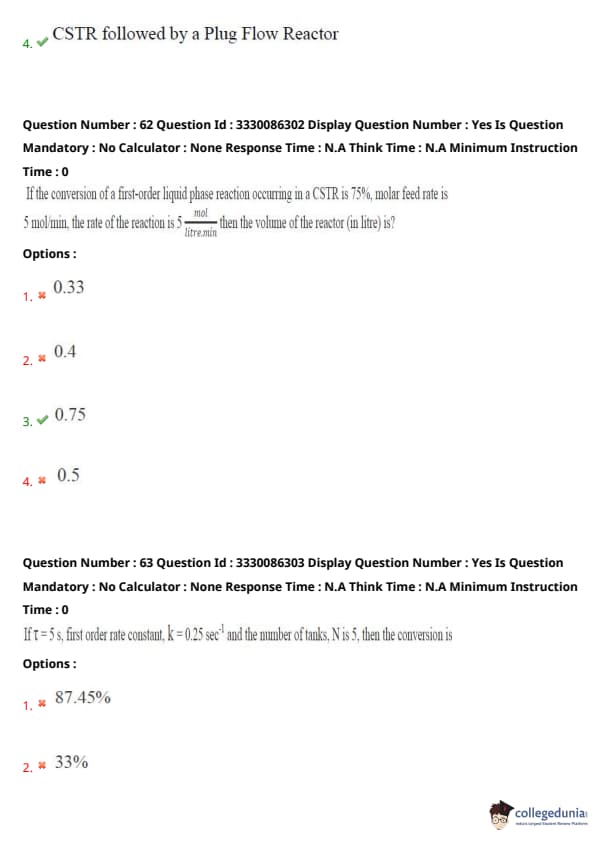
Question 63:
If \( \tau = 5 \) s, first order rate constant, \( k = 0.25 \) sec\(^{-1}\) and the number of tanks, \( N \) is 5, then the conversion is
- (1) 87.45%
- (2) 33%
- (3) 75%
- (4) 67.2%
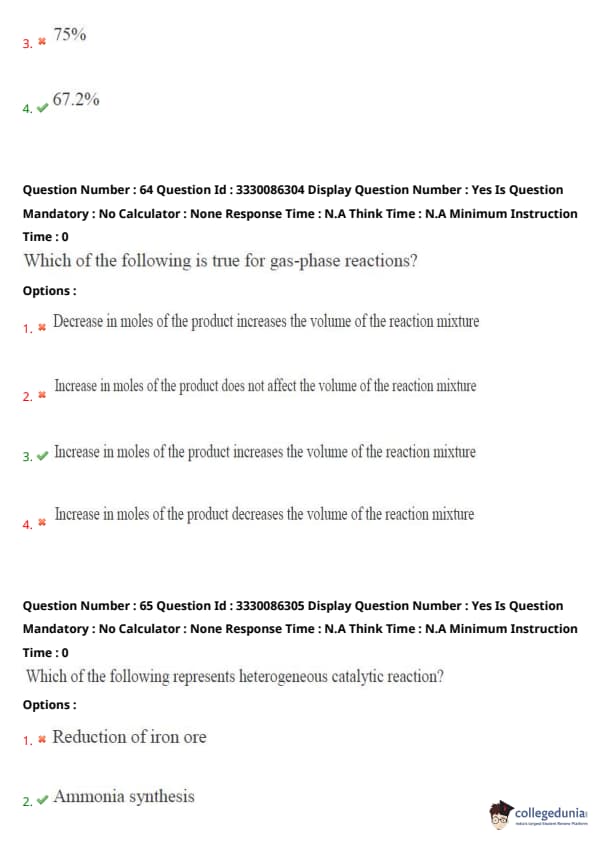
Question 64:
Which of the following is true for gas-phase reactions?
- (1) Decrease in moles of the product increases the volume of the reaction mixture
- (2) Increase in moles of the product does not affect the volume of the reaction mixture
- (3) Increase in moles of the product increases the volume of the reaction mixture
- (4) Increase in moles of the product decreases the volume of the reaction mixture
Question 65:
Which of the following represents heterogeneous catalytic reaction?
- (1) Reduction of iron ore
- (2) Ammonia synthesis
- (3) Burning of coal
- (4) Roasting of ores
Question 66:
What is the activity of a catalyst when a time \( t = 0 \)?
Question 67:
If an instrument produces the same reading at different times for the same variation in the measured variable, then it is said to
- (1) Have no hysteresis
- (2) Have no accuracy
- (3) Have no dead zone
- (4) Have no drift
Question 68:
Which of the following pressure gauge operation depends on the variation of the thermal conductivity of a gas at low pressure,
- (1) Bourdon tube gauge
- (2) Hydrostatic gauge
- (3) Pirani gauge
- (4) McLeod gauge
Question 69:
Which of the following measuring device is not suitable for the measurement of the rate of flow of liquids
- (1) Nutating-Disc Meter
- (2) Hot-Wire Anemometer
- (3) Laser-Doppler Anemometer
- (4) Venturi Meter
Question 70:
Bourdon gauges are used for measurement of pressures
- (1) Local atmospheric pressures
- (2) Local absolute pressures
- (3) Low range vacuum pressures
- (4) Large range gauge pressures
Question 71:
If initial conditions for a system are inherently zero, what does it physically mean?
Question 72:
If the system is stable, the response is smooth and non-oscillatory (damping coefficient, \(\xi > 1\)), the response is referred to as
- (1) Overdamped
- (2) Critically damped
- (3) Underdamped
- (4) Undamped
Question 73:
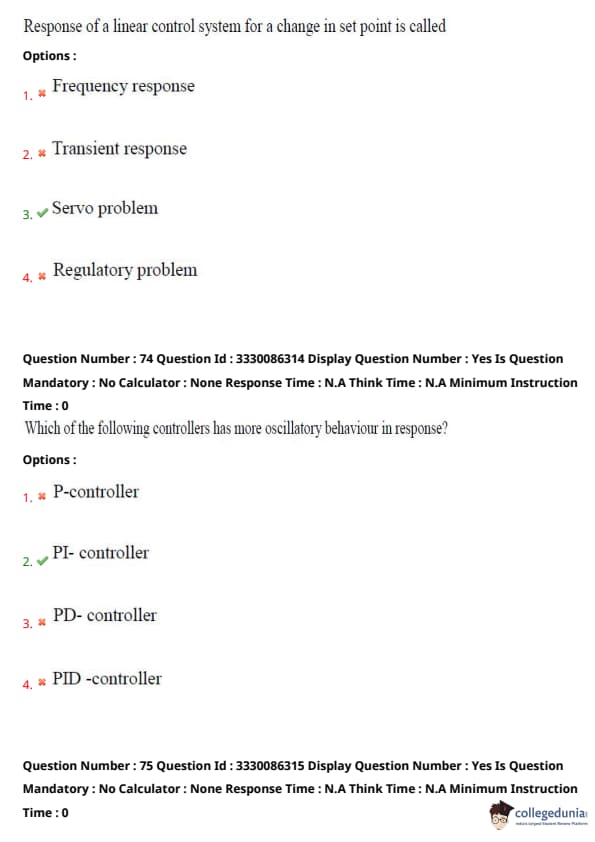
Response of a linear control system for a change in set point is called
- (1) Frequency response
- (2) Transient response
- (3) Servo problem
- (4) Regulatory problem
Question 74:
Which of the following controllers has more oscillatory behaviour in response?
- (1) P-controller
- (2) PI-controller
- (3) PD-controller
- (4) PID-controller
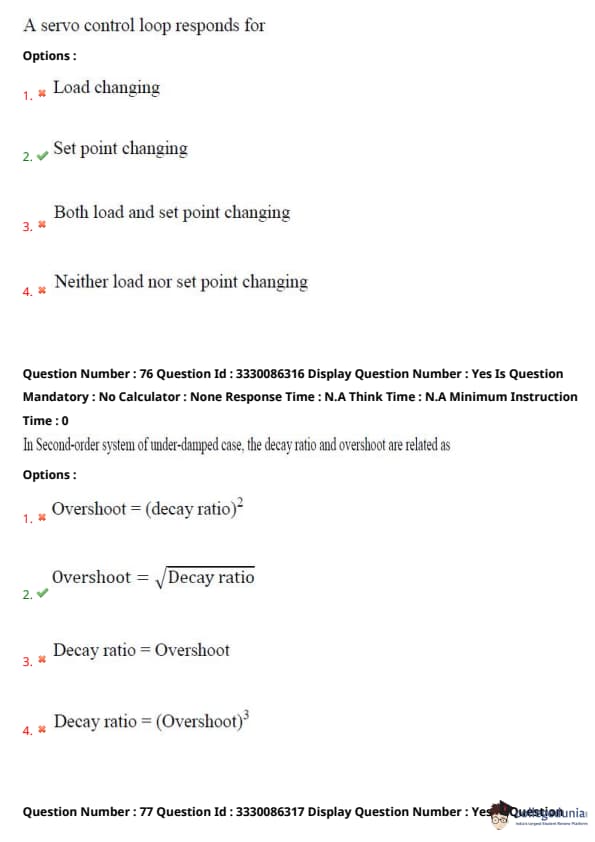
Question 75:
A servo control loop responds for
- (1) Load changing
- (2) Set point changing
- (3) Both load and set point changing
- (4) Neither load nor set point changing
Question 76:
In a Second-order system of under-damped case, the decay ratio and overshoot are related as:
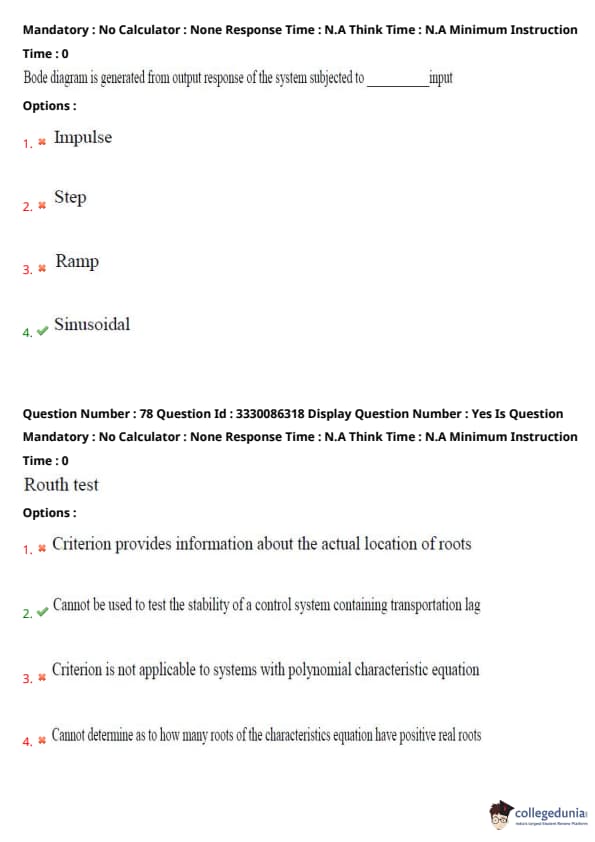
Question 77:
Bode diagram is generated from output response of the system subjected to _____________________ input
- (1) Impulse
- (2) Step
- (3) Ramp
- (4) Sinusoidal
Question 78:
Routh test
- (1) Criterion provides information about the actual location of roots
- (2) Cannot be used to test the stability of a control system containing transportation lag
- (3) Criterion is not applicable to systems with polynomial characteristic equation
- (4) Cannot determine as to how many roots of the characteristic equation have positive real roots
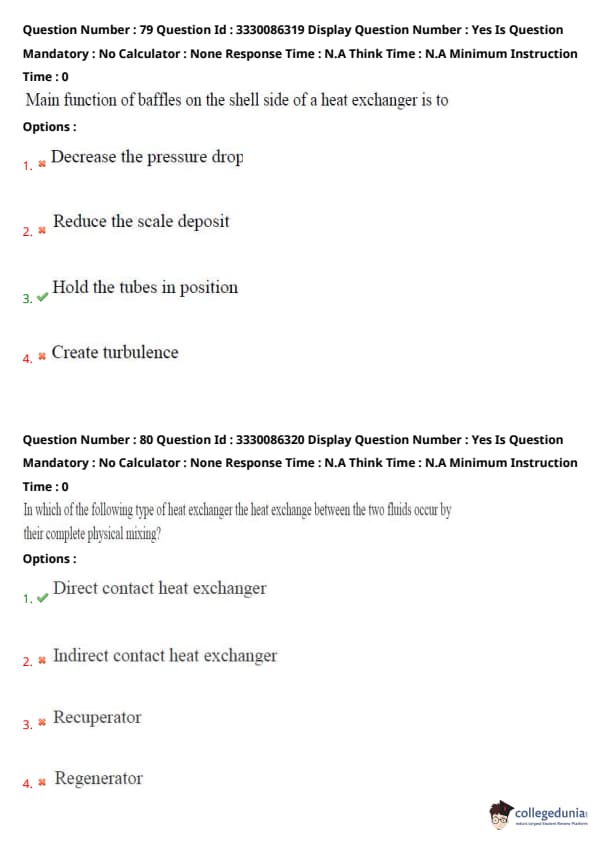
Question 79:
Main function of baffles on the shell side of a heat exchanger is to
- (1) Decrease the pressure drop
- (2) Reduce the scale deposit
- (3) Hold the tubes in position
- (4) Create turbulence
Question 80:
In which of the following type of heat exchanger the heat exchange between the two fluids occur by their complete physical mixing?
- (1) Direct contact heat exchanger
- (2) Indirect heat exchanger
- (3) Recuperator
- (4) Regenerator
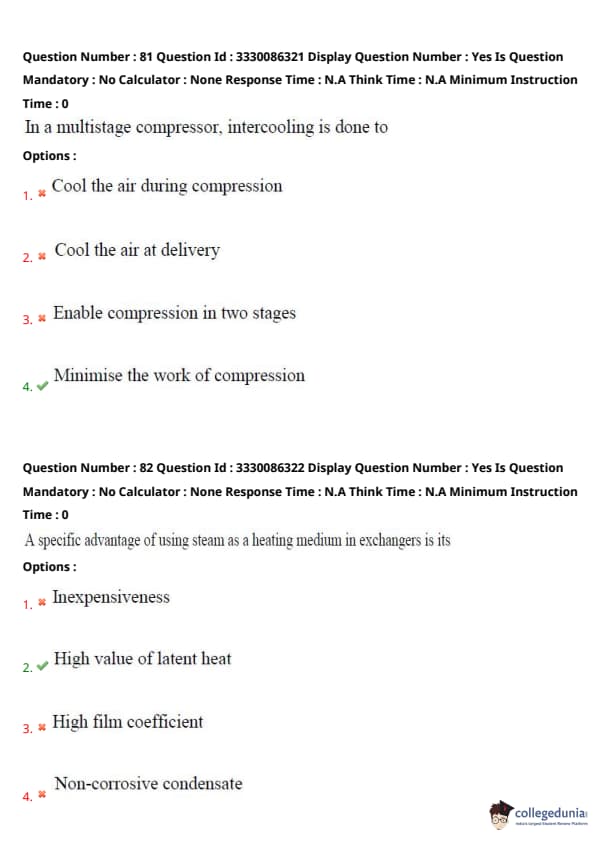
Question 81:
In a multistage compressor, intercooling is done to:
Question 82:
A specific advantage of using steam as a heating medium in exchangers is its
- (1) Inexpensiveness
- (2) High value of latent heat
- (3) High film coefficient
- (4) Non-corrosive condensate
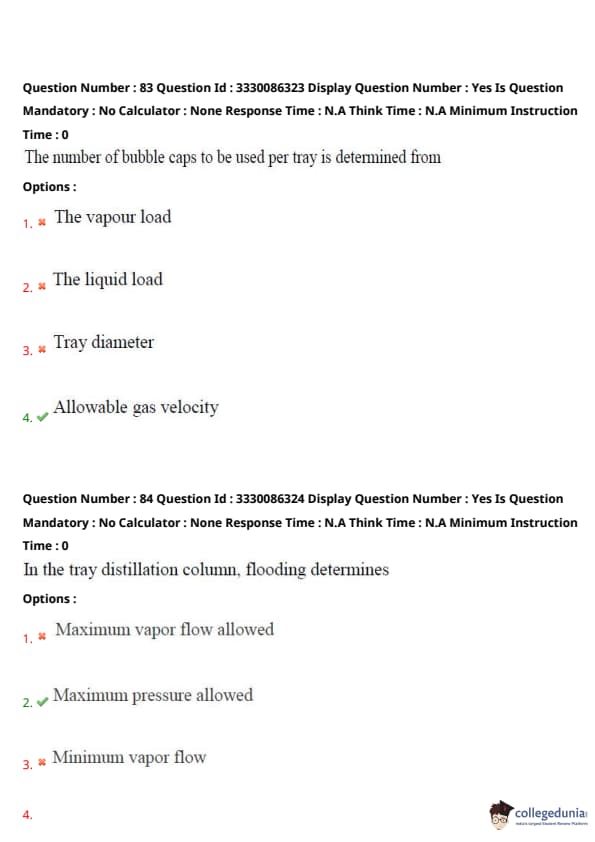
Question 83:
The number of bubble caps to be used per tray is determined from
- (1) The vapour load
- (2) The liquid load
- (3) Tray diameter
- (4) Allowable gas velocity
Question 84:
In the tray distillation column, flooding determines
- (1) Maximum vapor flow allowed
- (2) Maximum pressure allowed
- (3) Minimum vapor flow
- (4) Minimum pressure allowed
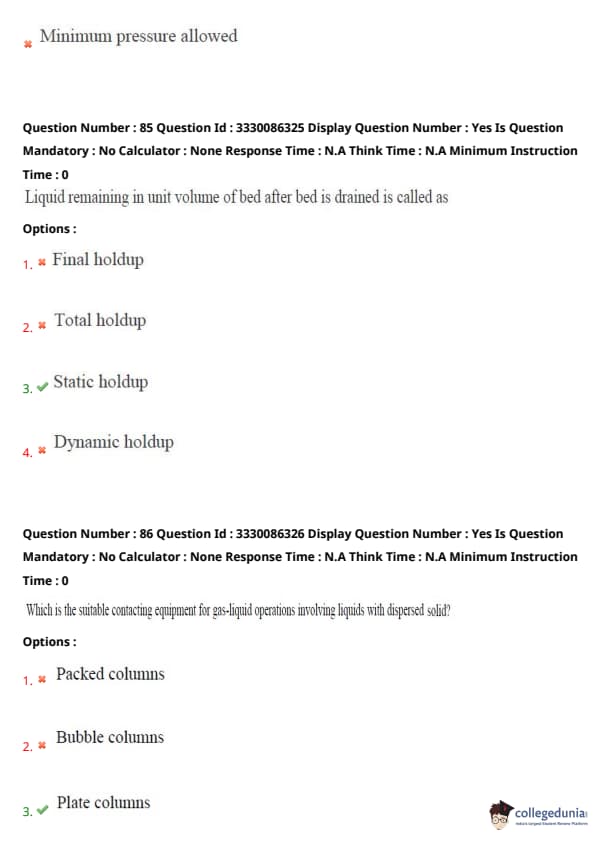
Question 85:
Liquid remaining in unit volume of bed after bed is drained is called as
- (1) Final holdup
- (2) Total holdup
- (3) Static holdup
- (4) Dynamic holdup
Question 86:
Which is the suitable contacting equipment for gas-liquid operations involving liquids with dispersed solids?
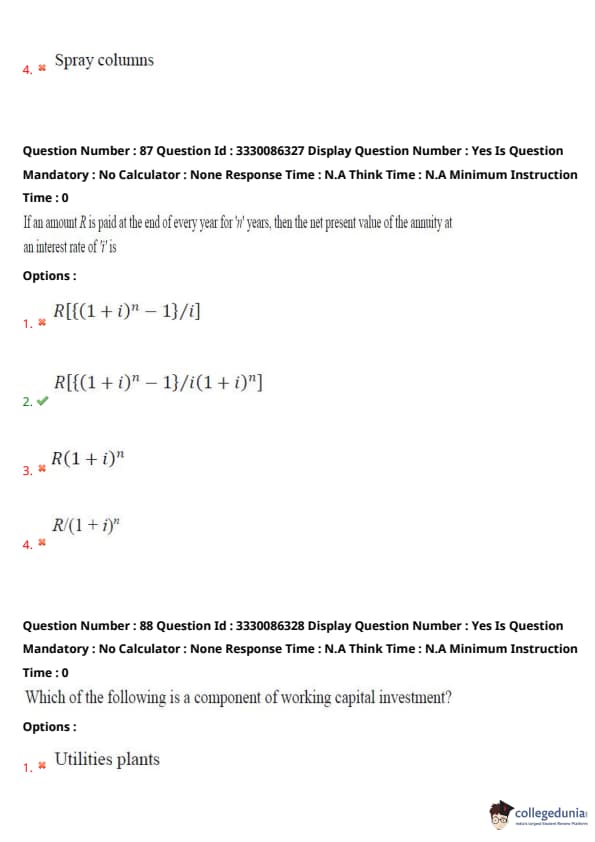
Question 87:
If an amount \(R\) is paid at the end of every year for '\(n\)' years, then the net present value of the annuity at an interest rate of '\(i\)' is
- (1) \(R[\{(1 + i)^n - 1\}/i]\)
- (2) \(R[\{(1 + i)^n - 1\}/\{i(1 + i)^n\}]\)
- (3) \(R(1 + i)^n\)
- (4) \(R/(1 + i)^n\)
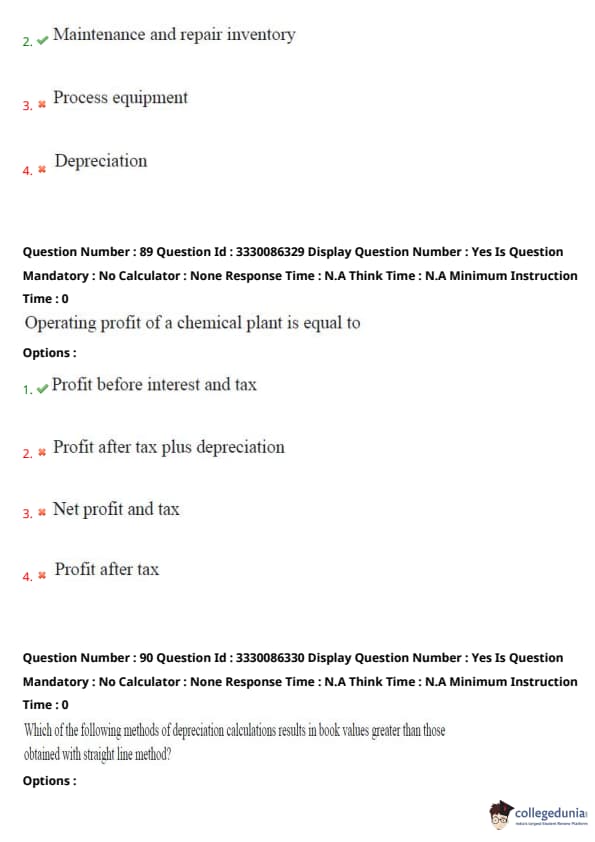
Question 88:
Which of the following is a component of working capital investment?
- (1) Utilities plant
- (2) Maintenance and repair inventory
- (3) Process equipment
- (4) Depreciation
Question 89:
Operating profit of a chemical plant is equal to
- (1) Profit before interest and tax
- (2) Profit after tax plus depreciation
- (3) Net profit and tax
- (4) Profit after tax
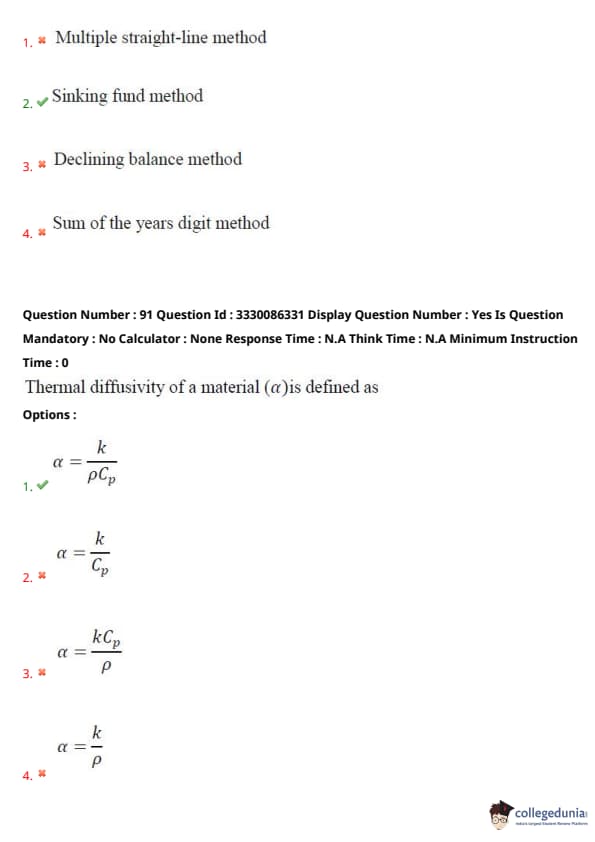
Question 90:
Which of the following methods of depreciation calculations results in book values greater than those obtained with straight line method?
- (1) Multiple straight-line method
- (2) Sinking fund method
- (3) Declining balance method
- (4) Sum of the years digit method
Question 91:
Thermal diffusivity of a material (\( \alpha \)) is defined as:
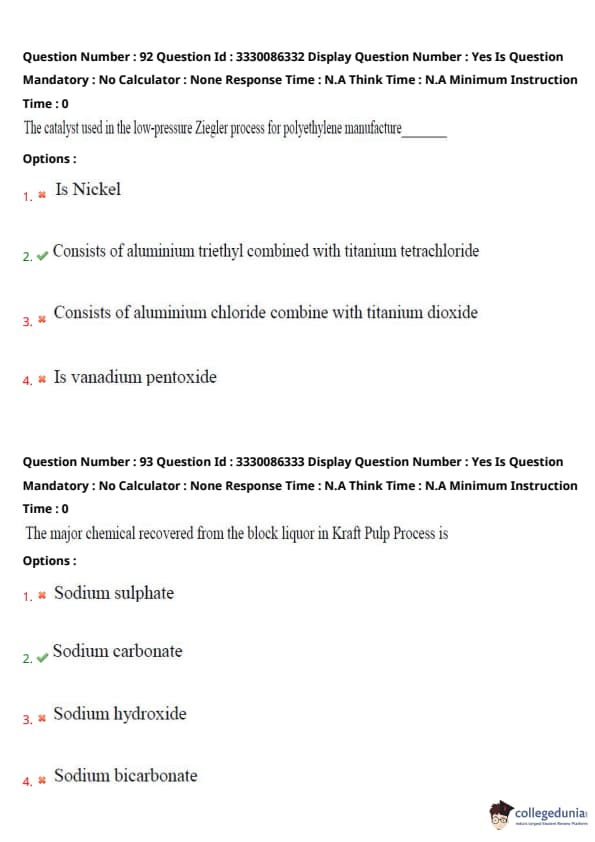
Question 92:
The catalyst used in the low-pressure Ziegler process for polyethylene manufacture _____________________
- (1) Is Nickel
- (2) Consists of aluminium triethyl combined with titanium tetrachloride
- (3) Consists of aluminium chloride combine with titanium dioxide
- (4) Is vanadium pentoxide
Question 93:
The major chemical recovered from the black liquor in Kraft Pulp Process is
- (1) Sodium sulphate
- (2) Sodium carbonate
- (3) Sodium hydroxide
- (4) Sodium bicarbonate
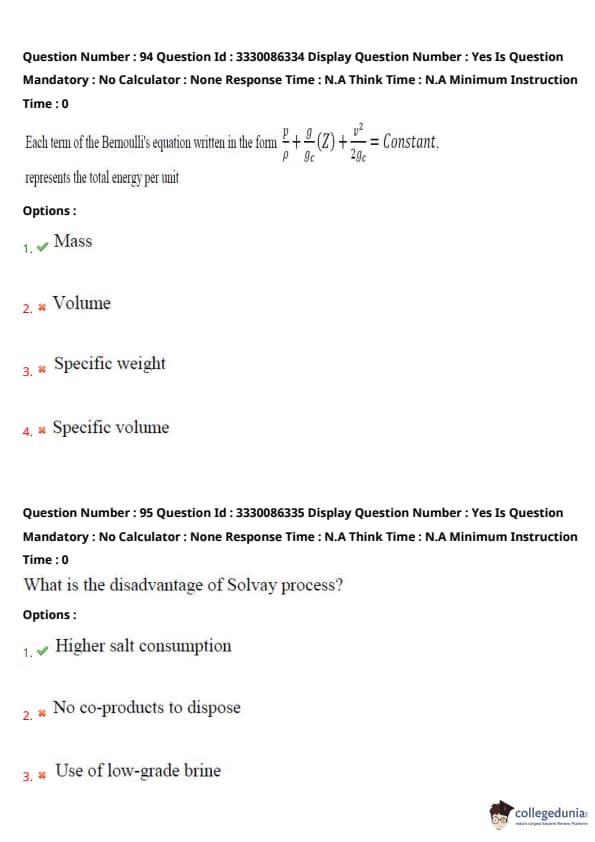
Question 94:
Each term of the Bernoulli's equation written in the form \(\frac{p}{\rho} + \frac{g}{g_c}(Z) + \frac{v^2}{2g_c} = Constant\), represents the total energy per unit
- (1) Mass
- (2) Volume
- (3) Specific weight
- (4) Specific volume
Question 95:
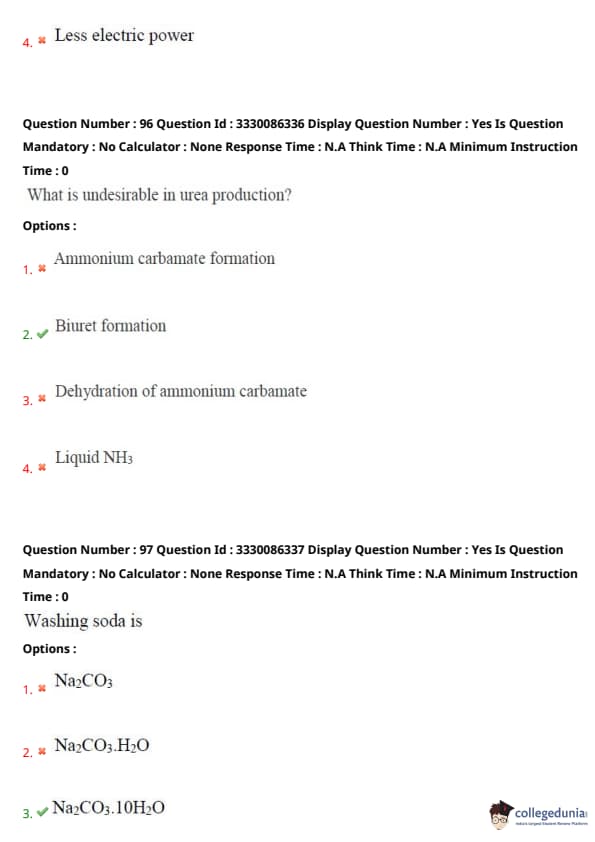
What is the disadvantage of Solvay process?
- (1) Higher salt consumption
- (2) No co-products to dispose
- (3) Use of low-grade brine
- (4) Less electric power
Question 96:
What is undesirable in urea production?
Question 97:
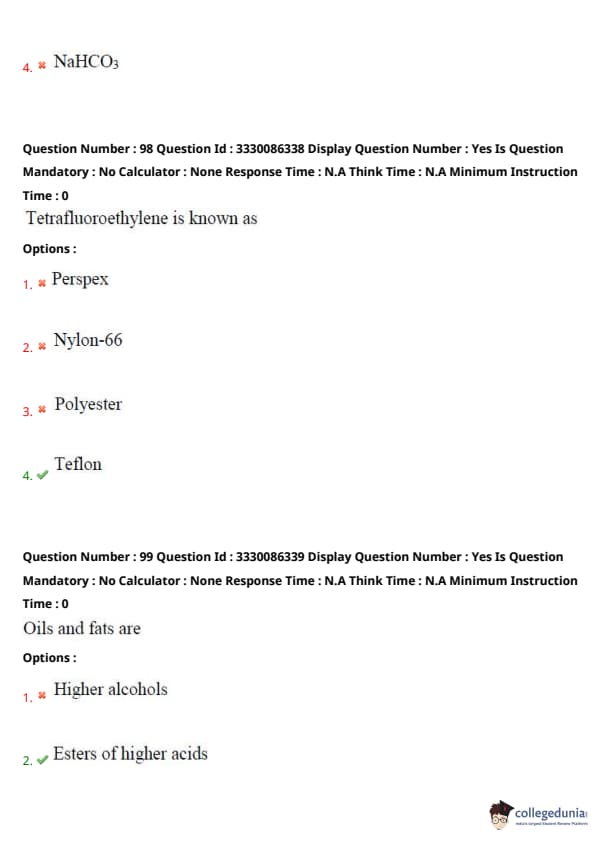
Washing soda is
- (1) \(Na_2CO_3\)
- (2) \(Na_2CO_3.H_2O\)
- (3) \(Na_2CO_3.10H_2O\)
- (4) \(NaHCO_3\)
Question 98:
Tetrafluoroethylene is known as
- (1) Perspex
- (2) Nylon-66
- (3) Polyester
- (4) Teflon
Question 99:
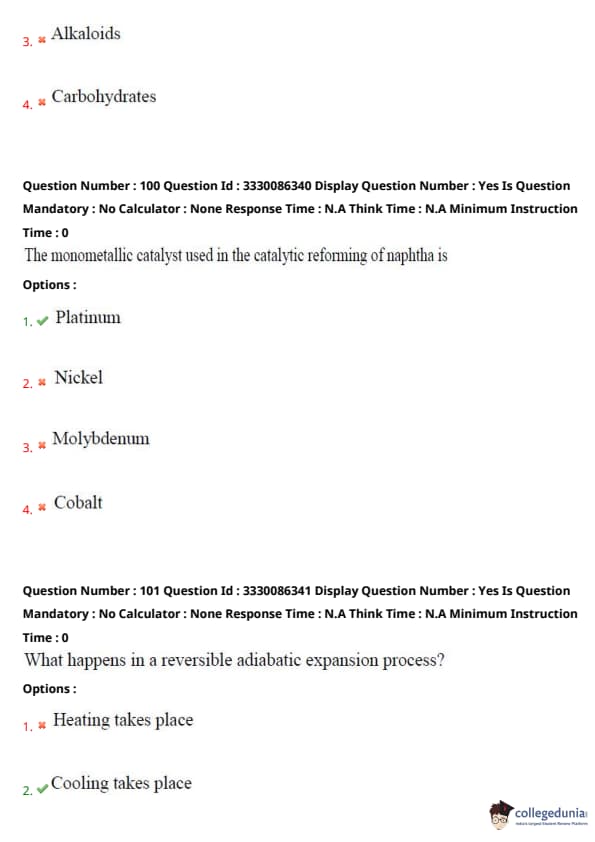
Oils and fats are
- (1) Higher alcohols
- (2) Esters of higher acids
- (3) Alkaloids
- (4) Carbohydrates
Question 100:
The monometallic catalyst used in the catalytic reforming of naphtha is
- (1) Platinum
- (2) Nickel
- (3) Molybdenum
- (4) Cobalt
Question 101:
What happens in a reversible adiabatic expansion process?
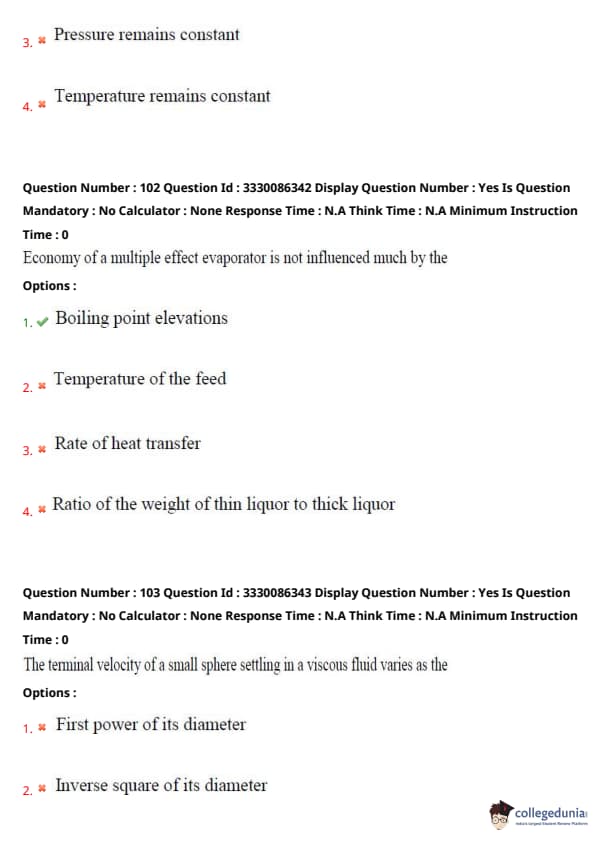
Question 102:
Economy of a multiple effect evaporator is not influenced much by the
- (1) Boiling point elevations
- (2) Temperature of the feed
- (3) Rate of heat transfer
- (4) Ratio of the weight of thin liquor to thick liquor
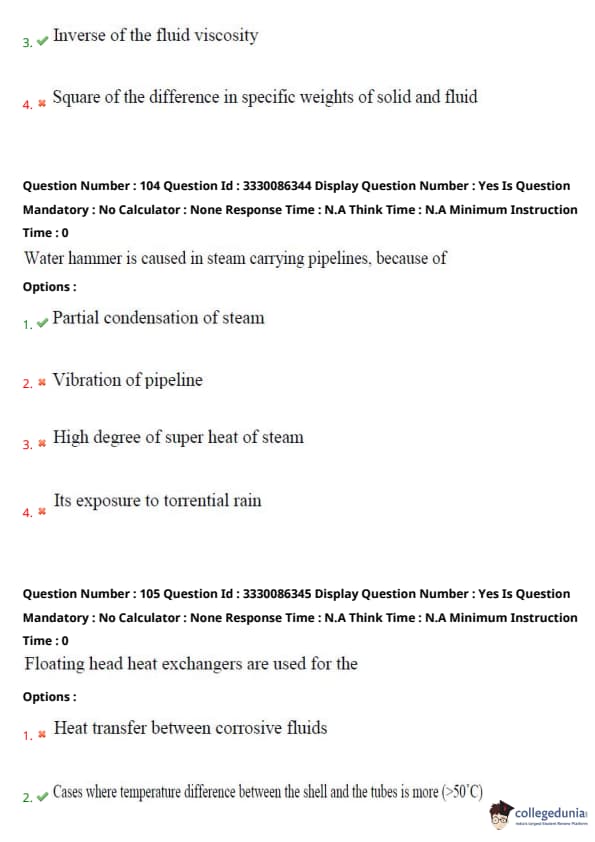
Question 103:
The terminal velocity of a small sphere settling in a viscous fluid varies as the
- (1) First power of its diameter
- (2) Inverse square of its diameter
- (3) Inverse of the fluid viscosity
- (4) Square of the difference in specific weight of solid and fluid
Question 104:
Water hammer is caused in steam carrying pipelines, because of
- (1) Partial condensation of steam
- (2) Vibration of pipeline
- (3) High degree of super heat of steam
- (4) Its exposure to torrential rain
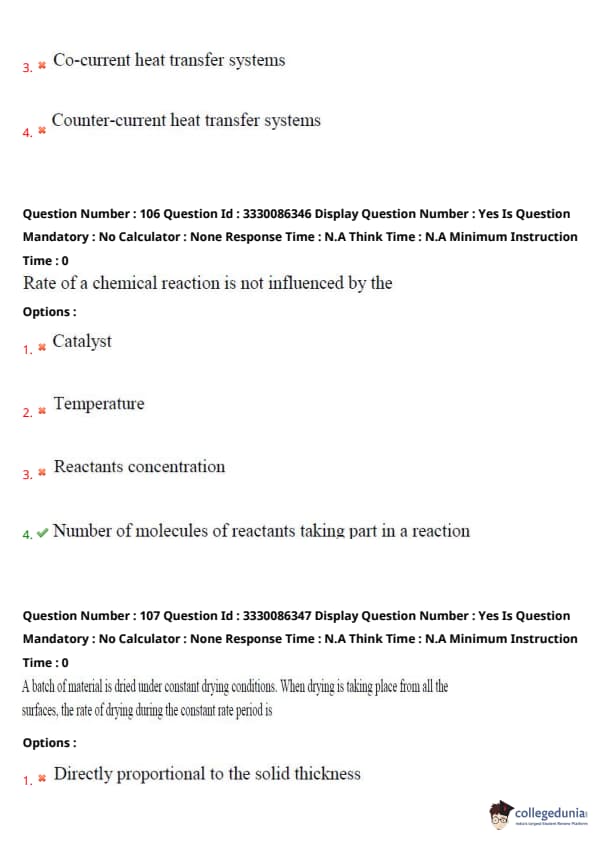
Question 105:
Floating head heat exchangers are used for the
- (1) Heat transfer between corrosive fluids
- (2) Cases where temperature difference between the shell and the tubes is more (>50°C)
- (3) Co-current heat transfer systems
- (4) Counter-current heat transfer systems
Question 106:
Rate of a chemical reaction is not influenced by the:
Question 107:
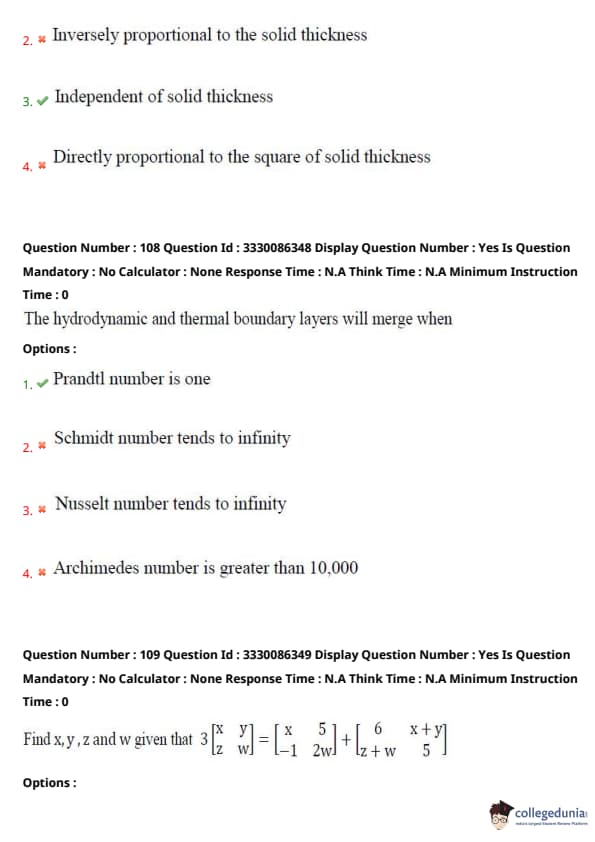
A batch of material is dried under constant drying conditions. When drying is taking place from all the surfaces, the rate of drying during the constant rate period is
- (1) Directly proportional to the solid thickness
- (2) Inversely proportional to the solid thickness
- (3) Independent of solid thickness
- (4) Directly proportional to the square of solid thickness
Question 108:
The hydrodynamic and thermal boundary layers will merge when
- (1) Prandtl number is one
- (2) Schmidt number tends to infinity
- (3) Nusselt number tends to infinity
- (4) Archimedes number is greater than 10,000
Question 109:
Find \(x, y, z\) and \(w\) given that \(3 \begin{bmatrix} x & y
z & w \end{bmatrix} = \begin{bmatrix} x & 5
-1 & 2w \end{bmatrix} + \begin{bmatrix} 6 & x+y
z+w & 5 \end{bmatrix}\)
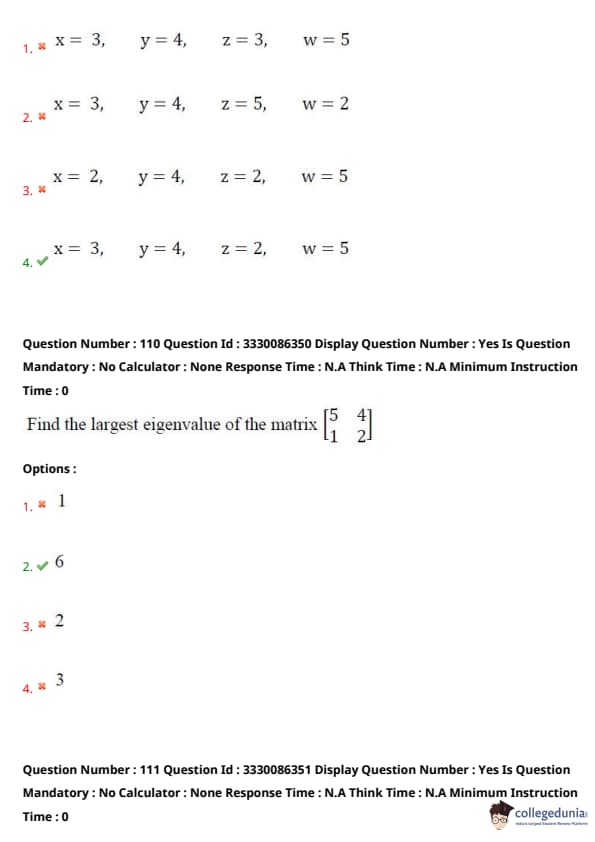
- (1) \(x = 3,\ y = 4,\ z = 3,\ w = 5\)
- (2) \(x = 3,\ y = 4,\ z = 5,\ w = 2\)
- (3) \(x = 2,\ y = 4,\ z = 2,\ w = 5\)
- (4) \(x = 3,\ y = 4,\ z = 2,\ w = 5\)
Question 110:
Find the largest eigenvalue of the matrix \(\begin{bmatrix} 5 & 4
1 & 2 \end{bmatrix}\)
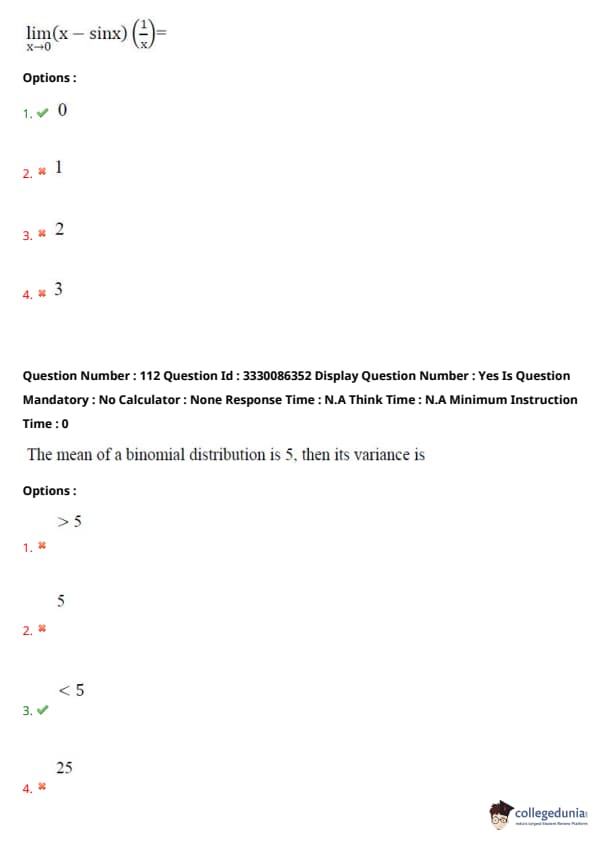
Question 111:
Evaluate the limit: \[ \lim_{x \to 0} \left( x - \sin x \right) \left( \frac{1}{x} \right) \]
Question 112:
The mean of a binomial distribution is 5, then its variance is
- (1) \(>\) 5
- (2) 5
- (3) \(<\) 5
- (4) 25
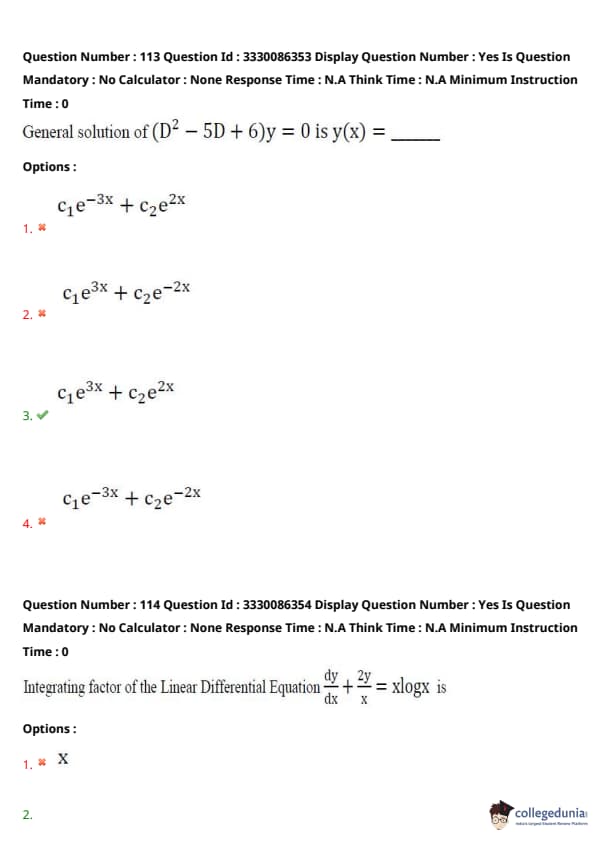
Question 113:
General solution of \((D^2 - 5D + 6)y = 0\) is \(y(x) =\)
- (1) \(c_1 e^{-3x} + c_2 e^{2x}\)
- (2) \(c_1 e^{3x} + c_2 e^{-2x}\)
- (3) \(c_1 e^{3x} + c_2 e^{2x}\)
- (4) \(c_1 e^{-3x} + c_2 e^{-2x}\)
Question 114:
Integrating factor of the linear differential equation \(\frac{dy}{dx} + \frac{2y}{x} = x \log x\) is
- (1) \(x\)
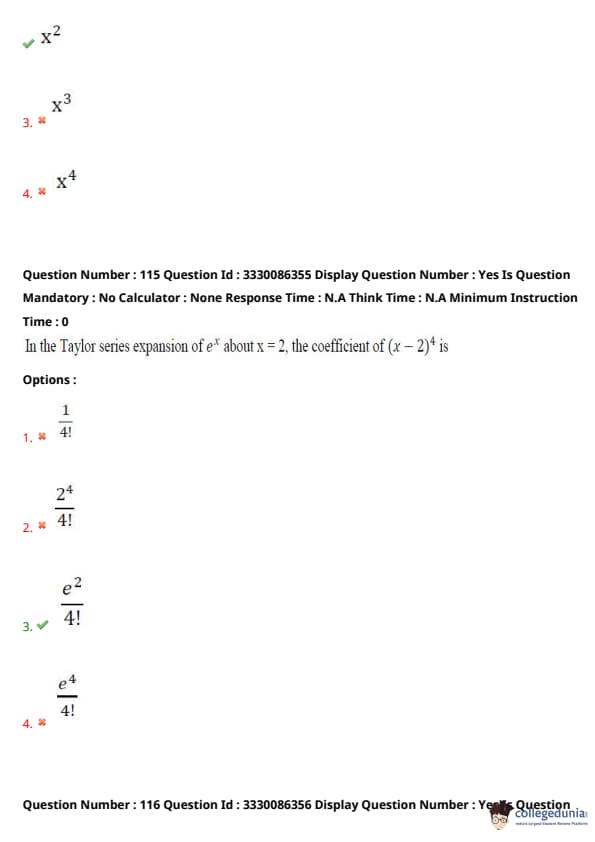
- (2) \(x^2\)
- (3) \(x^3\)
- (4) \(x^4\)
Question 115:
In the Taylor series expansion of \(e^x\) about \(x = 2\), the coefficient of \((x - 2)^4\) is
- (1) \(\frac{1}{4!}\)
- (2) \(\frac{2^4}{4!}\)
- (3) \(\frac{e^2}{4!}\)
- (4) \(\frac{e^4}{4!}\)
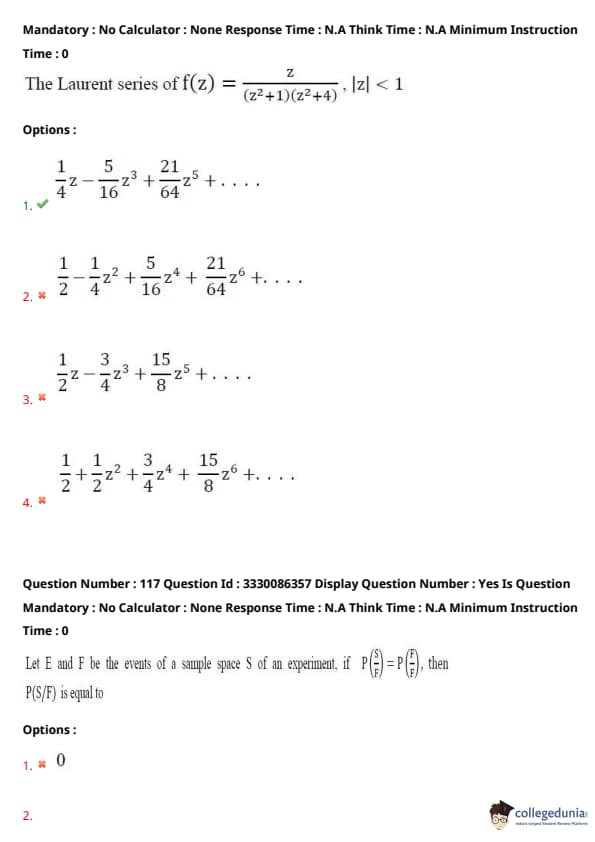
Question 116:
The Laurent series of \( f(z) = \frac{z}{(z^2+1)(z^2+4)} \) for \( |z| < 1 \) is:
Question 117:
Let E and F be the events of a sample space S of an experiment, if \( P(S/F) = P(F/F) \), then \( P(S/F) \) is equal to:
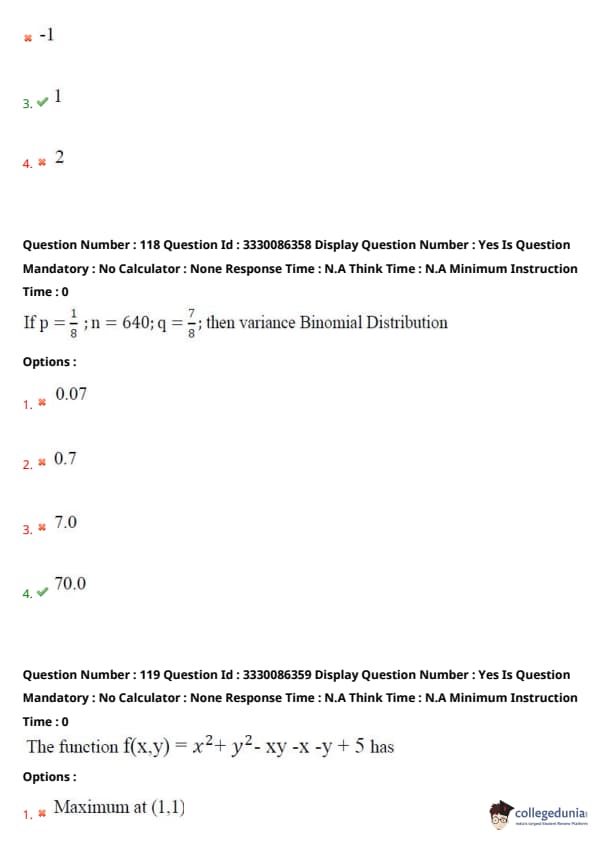
Question 118:
If \(p = \frac{1}{8}; n = 640; q = \frac{7}{8}\), then variance Binomial Distribution
- (1) 0.07
- (2) 0.7
- (3) 7.0
- (4) 70.0
Question 119:
The function \(f(x,y) = x^2 + y^2 - xy - x - y + 5\) has
- (1) Maximum at (1,1)
- (2) Saddle point at (1,1)
- (3) Minimum at (1,1)
- (4) Minimum at (1,2)
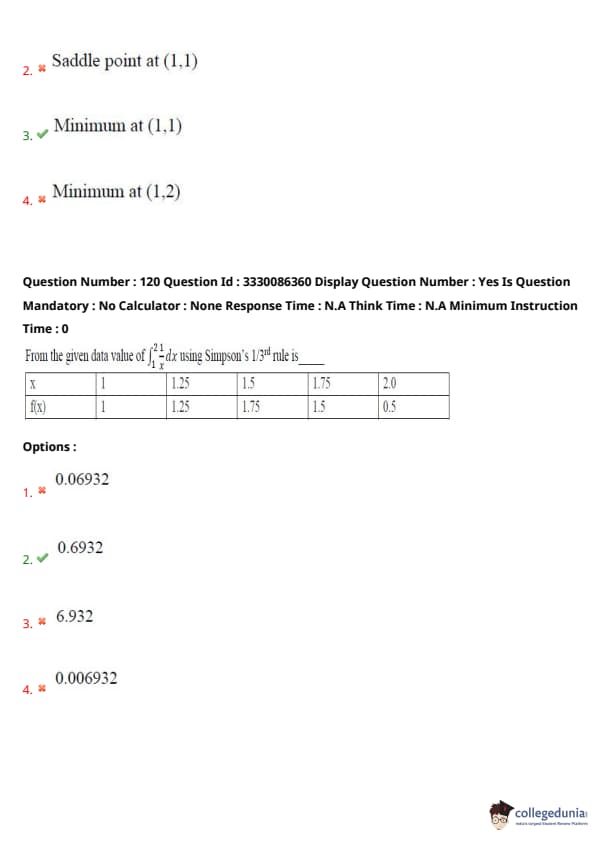
Question 120:
From the given data value of \(\int_{1}^{2} \frac{1}{x} dx\) using Simpson’s 1/3rd rule is
![]()
- (1) 0.06932
- (2) 0.6932
- (3) 6.932
- (4) 0.006932





 Download




Comments