AP PGECET 2024 Electronics and Communication Engineering Question Paper is available for download here. Sri Venkateswara University, Tirupati on behalf of APSCHE conducted AP PGECET 2024 Electronics And Communication Engineering on May 30 in Shift 1 from 9 AM to 11 AM. AP PGECET Question Paper 2024 consists of 120 MCQ-based questions in total carrying 1 mark each to be attempted in the duration of 2 hours.
AP PGECET 2024 Electronics and Communication Engineering Question Paper with Answer Key PDF
Question 2:
The mesh current method
- (I) Works with both planar and non-planar circuits
- (1) I and II
- (2) II only
- (3) I only
- (4) Neither I nor II
Question 3:
If there are 5 branches and 4 nodes in the graph, then the number of mesh equations that can be formed are?
Question 4:
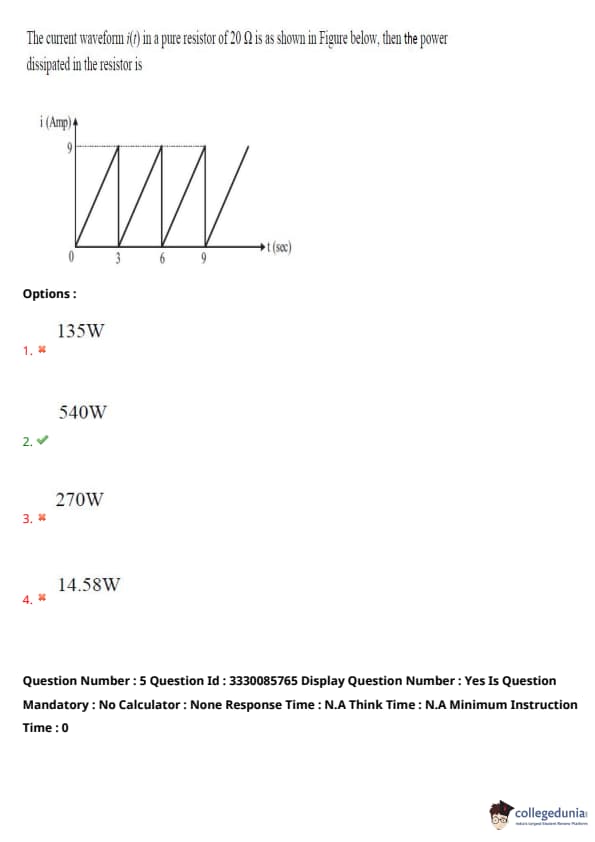
The current waveform \(i(t)\) in a pure resistor of 20 \( \Omega \) is as shown in the figure below, then the power dissipated in the resistor is
![]()
- (1) 135W
- (2) 540W
- (3) 270W
- (4) 14.58W
Question 5:
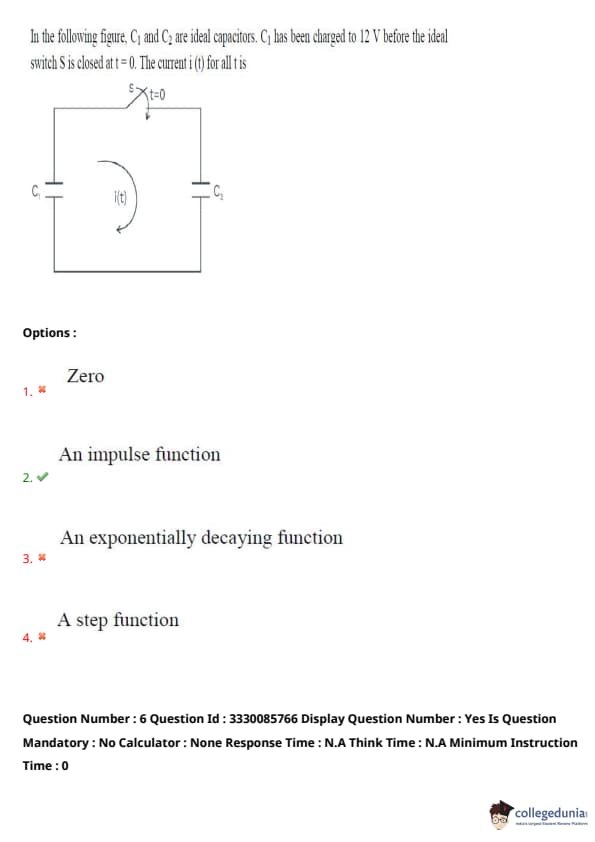
In the following figure, \(C_1\) and \(C_2\) are ideal capacitors. \(C_1\) has been charged to 12V before the ideal switch \(S\) is closed at \(t = 0\). The current \(i(t)\) for all \(t\) is
![]()
- (1) Zero
- (2) An impulse function
- (3) An exponentially decaying function
- (4) A step function
Question 6:
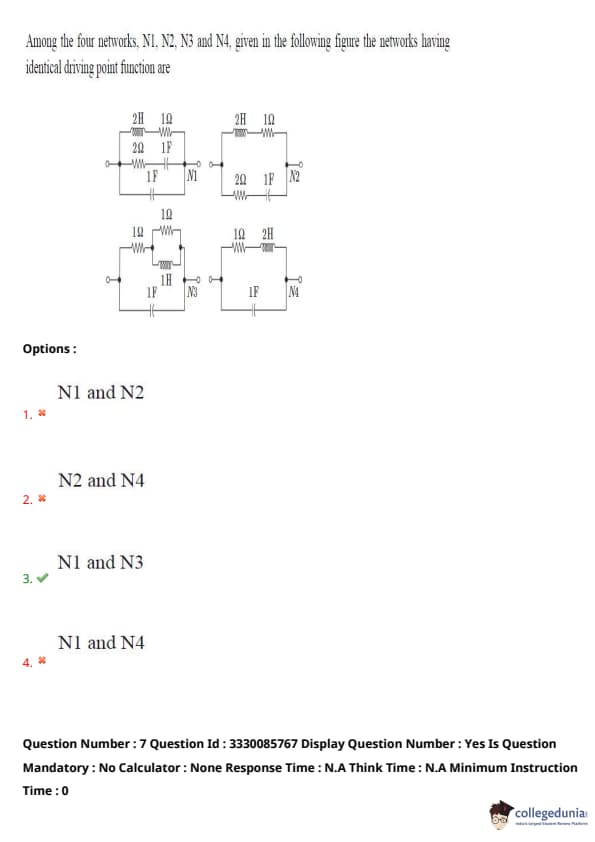
Among the four networks, N1, N2, N3, and N4, given in the following figure, the networks having identical driving point function are
![]()
- (1) N1 and N2
- (2) N2 and N4
- (3) N1 and N3
- (4) N1 and N4
Question 7:
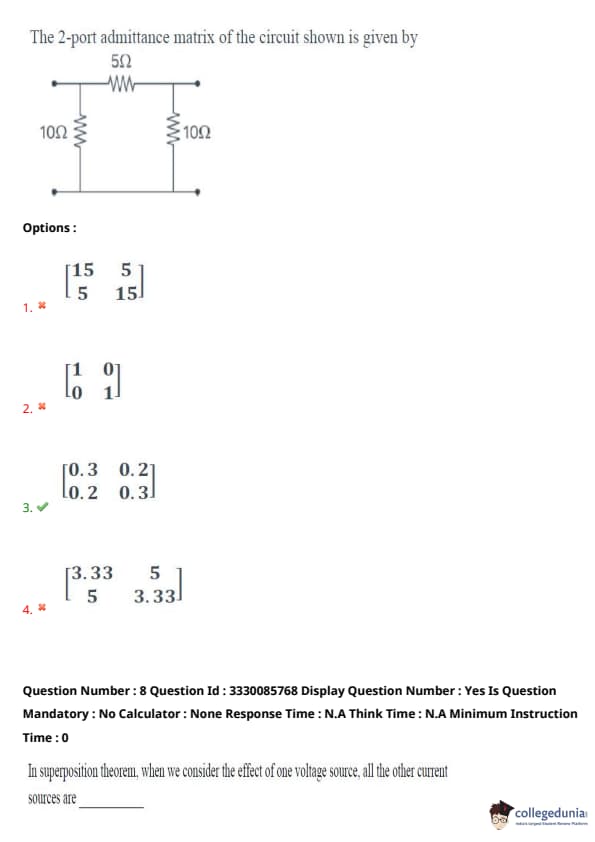
The 2-port admittance matrix of the circuit shown is given by
![]()
- (1) \(\begin{bmatrix} 15 & 5
5 & 15 \end{bmatrix}\)
- (2) \(\begin{bmatrix} 1 & 0
0 & 1 \end{bmatrix}\)
- (3) \(\begin{bmatrix} 0.3 & 0.2
0.2 & 0.3 \end{bmatrix}\)
- (4) \(\begin{bmatrix} 3.33 & 5
5 & 3.33 \end{bmatrix}\)
Question 8:
In superposition theorem, when we consider the effect of one voltage source, all the other current sources are
- (1) Shorted
- (2) Opened
- (3) Removed
- (4) Undisturbed
Question 9:
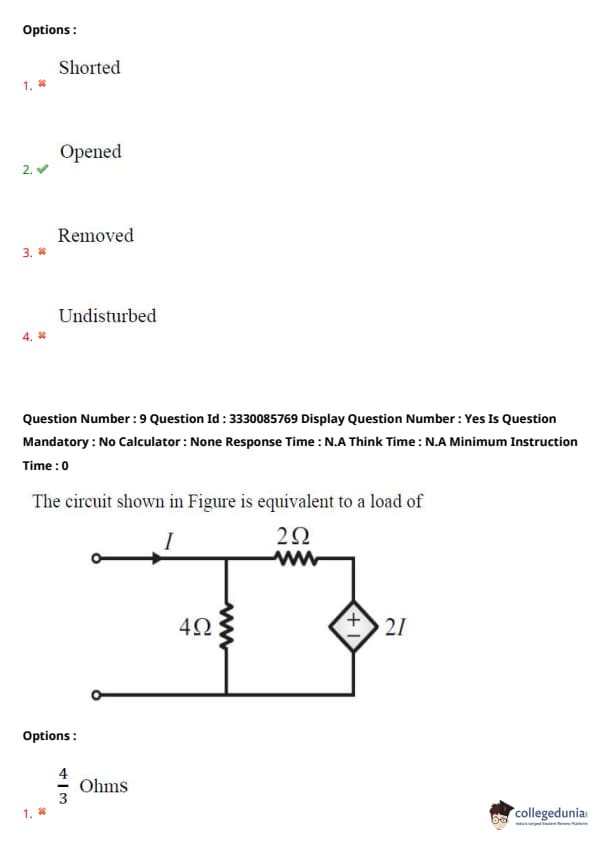
The circuit shown in Figure is equivalent to a load of
![]()
- (1) \(\frac{4}{3}\) Ohms
- (2) 4 Ohms
- (3) \(\frac{8}{3}\) Ohms
- (4) 2 Ohms
Question 10:
The current through a series RL circuit is \( \frac{1}{4} e^{-\frac{3}{4} t} \) when excited by a unit impulse voltage. The values of R and L are respectively
- (1) 8, 4
- (2) 4, 2
- (3) 2, 4
- (4) 1, 4
Question 11:
If \( E_p \) (Fermi energy level) \( > E_f \) (intrinsic Fermi energy level), then the type of semiconductor is
- (1) n-type
- (2) Elementary
- (3) p-type
- (4) Compound
Question 12:
In the circuit shown below, the Zener diode is ideal and Zener voltage is 6V. The output voltage \( V_o \) (in volts) is
![]()
- (1) 2.5V
- (2) 5V
- (3) 6V
- (4) 3V
Question 13:
Which process of the Electron-hole pair is responsible for emitting of light?
- (1) Gradient
- (2) Drift
- (3) Recombination
- (4) Diffusion
Question 14:
In MOSFET fabrication, the channel length is defined during the process of
- (1) Isolation oxide growth
- (2) Channel stop implantation
- (3) Poly-silicon gate patterning
- (4) Lithography step leading to the contact pads
Question 15:
How does a FET behave when the V-I characteristics are to the left of pinch off for an n-channel FET?
- (1) Voltage controlled resistor
- (2) Amplifier
- (3) Switch
- (4) Diode
Question 16:
The direction of the diffusion current depends on
- (1) Applied field
- (2) Mobility of charge carrier
- (3) Charge carrier concentration
- (4) Permittivity
Question 17:
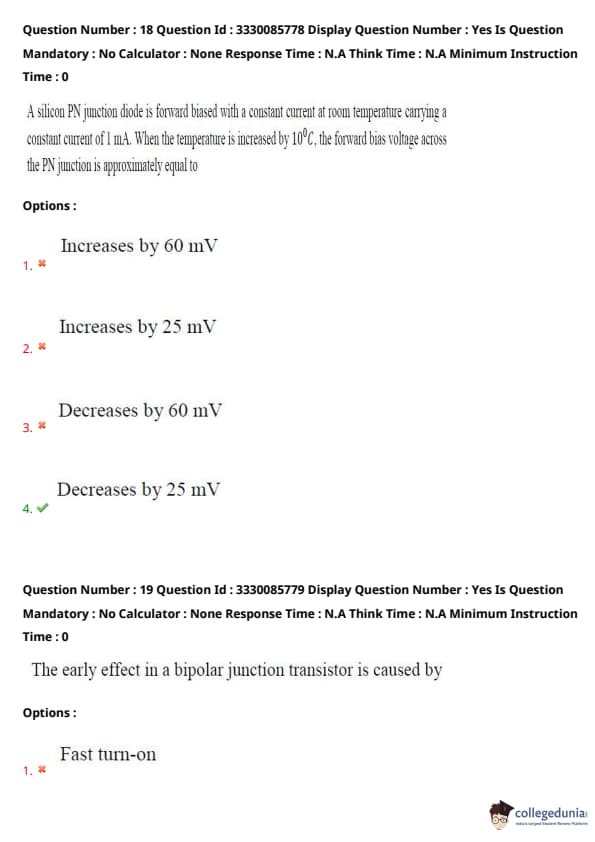
Match items in Group-I with items in Group-II, most suitably.
![]()
- (1) P - 1, Q - 2, R - 4, S - 3
- (2) P - 2, Q - 3, R - 1, S - 4
- (3) P - 3, Q - 4, R - 1, S - 2
- (4) P - 2, Q - 1, R - 4, S - 3
Question 18:
A silicon PN junction diode is forward biased with a constant current at room temperature carrying a constant current of 1 mA. When the temperature is increased by 10°C, the forward bias voltage across the PN junction is approximately equal to
- (1) Increases by 60 mV
- (2) Increases by 25 mV
- (3) Decreases by 60 mV
- (4) Decreases by 25 mV
Question 19:
The early effect in a bipolar junction transistor is caused by
- (1) Fast turn-on
- (2) Large collector-base reverse bias
- (3) Fast turn-off
- (4) Large emitter-base forward bias
Question 20:
In IC technology, dry oxidation (using dry oxygen) as compared to wet oxidation (using steam or water vapor) produces
- (1) Superior quality oxide with a higher growth rate
- (2) Inferior quality oxide with a higher growth rate
- (3) Inferior quality oxide with a lower growth rate
- (4) Superior quality oxide with a lower growth rate
Question 21:
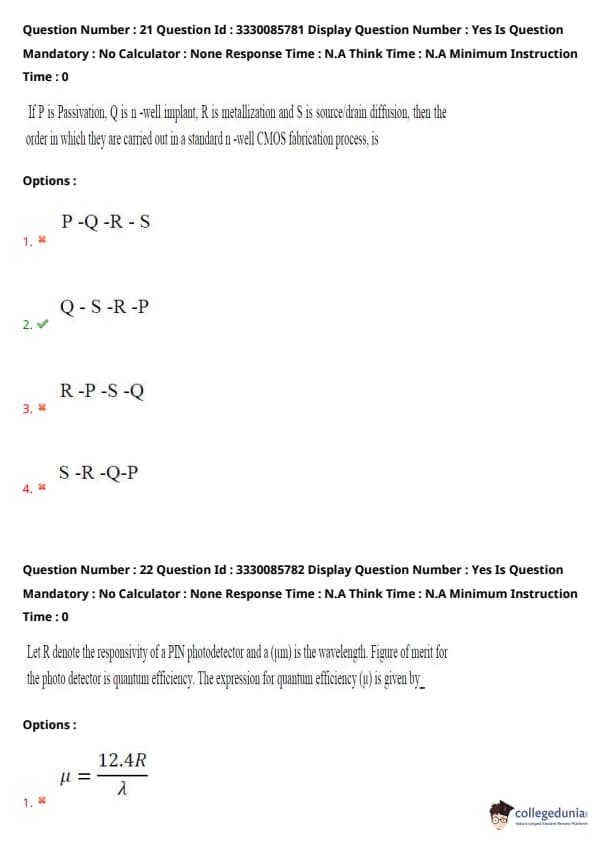
If P is Passivation, Q is n-well implant, R is metallization and S is source/drain diffusion, then the order in which they are carried out in a standard n-well CMOS fabrication process, is
- (1) P - Q - R - S
- (2) Q - S - R - P
- (3) R - P - S - Q
- (4) S - R - Q - P
Question 22:
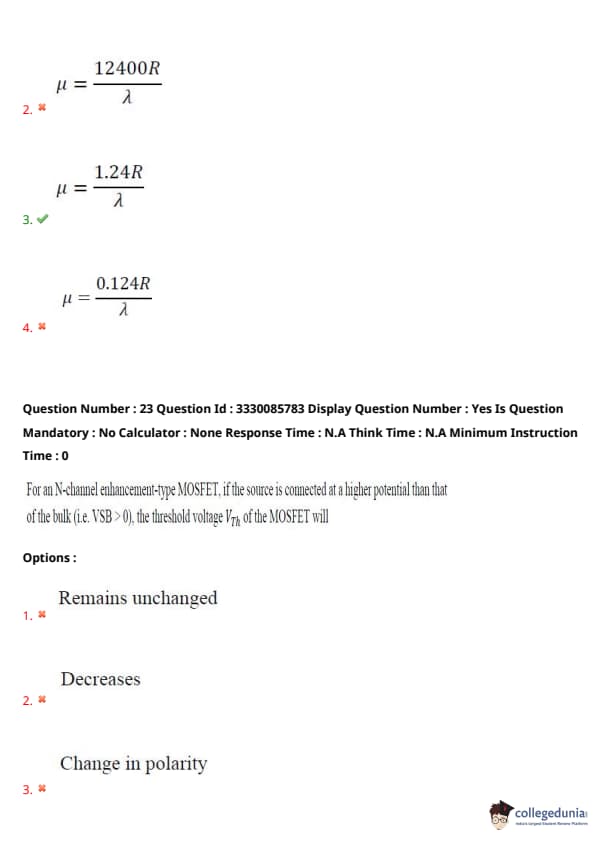
Let R denote the responsivity of a PIN photodetector and \(\lambda\) is the wavelength. Figure of merit for the photo detector is quantum efficiency. The expression for quantum efficiency \(\mu\) is given by
- (1) \(\mu = \frac{12.4R}{\lambda}\)
- (2) \(\mu = \frac{12400R}{\lambda}\)
- (3) \(\mu = \frac{1.24R}{\lambda}\)
- (4) \(\mu = \frac{0.124R}{\lambda}\)
Question 23:
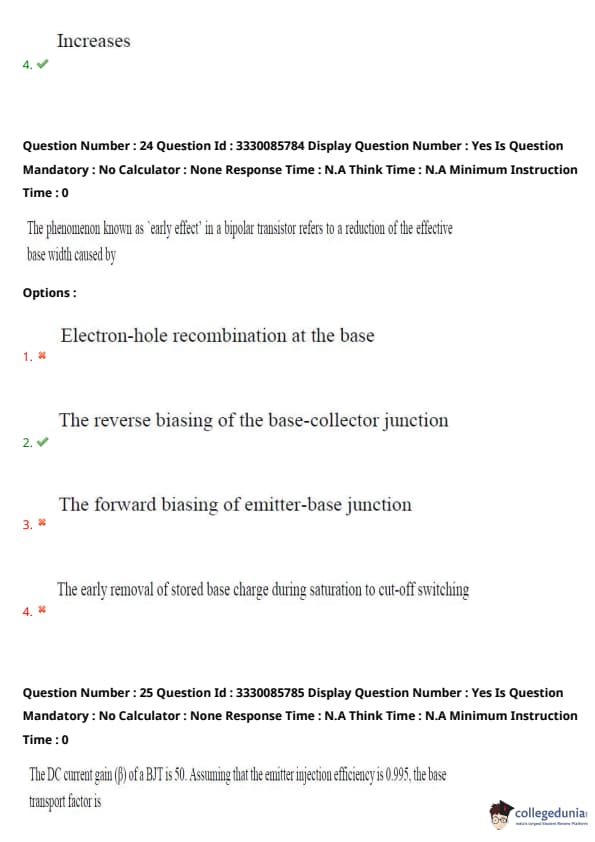
For an N-channel enhancement-type MOSFET, if the source is connected at a higher potential than that of the bulk (i.e., VSB > 0), the threshold voltage \( V_{th} \) of the MOSFET will
- (1) Remains unchanged
- (2) Decreases
- (3) Change in polarity
- (4) Increases
Question 24:
The phenomenon known as "early effect" in a bipolar transistor refers to a reduction of the effective base width caused by
- (1) Electron-hole recombination at the base
- (2) The reverse biasing of the base-collector junction
- (3) The forward biasing of emitter-base junction
- (4) The early removal of stored base charge during saturation to cut-off switching
Question 25:
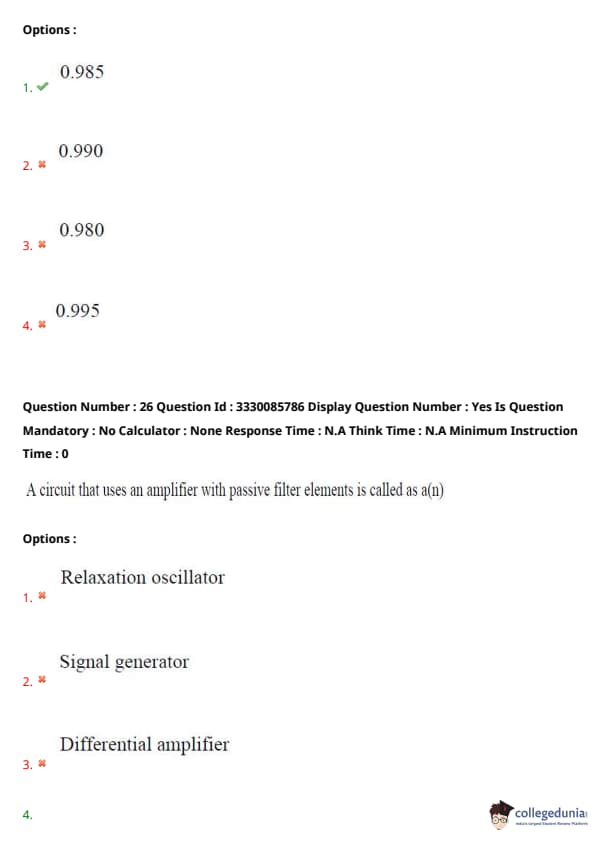
The DC current gain (\( \beta \)) of a BJT is 50. Assuming that the emitter injection efficiency is 0.995, the base transport factor is
- (1) 0.985
- (2) 0.990
- (3) 0.980
- (4) 0.995
Question 26:
A circuit that uses an amplifier with passive filter elements is called as a(n)
- (1) Relaxation oscillator
- (2) Signal generator
- (3) Differential amplifier
- (4) Active filter
Question 27:
If the input to a comparator is a sine wave, the output is
- (1) Ramp voltage
- (2) Sine wave
- (3) Rectangular wave
- (4) Sawtooth wave
Question 28:
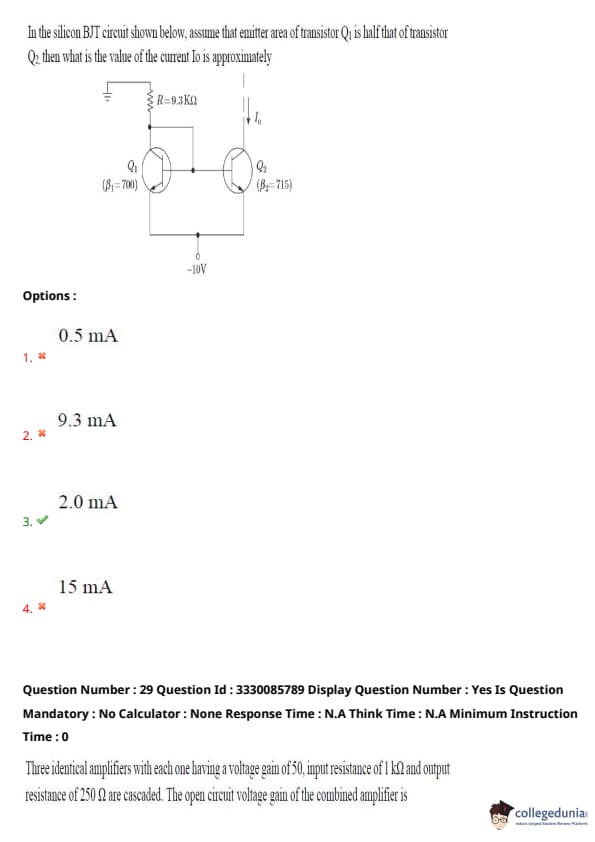
In the silicon BJT circuit shown below, assume that emitter area of transistor Q1 is half that of transistor Q2, then what is the value of the current \( I_o \) is approximately
![]()
- (1) 0.5 mA
- (2) 9.3 mA
- (3) 2.0 mA
- (4) 15 mA
Question 29:
Three identical amplifiers with each one having a voltage gain of 50, input resistance of 1 kΩ and output resistance of 250 Ω are cascaded. The open circuit voltage gain of the combined amplifier is
- (1) 49 dB
- (2) 102 dB
- (3) 98 dB
- (4) 51 dB
Question 30:
Which of the following statements are true?
P: JFET is biased to operate it in active region
Q: MOSFET is biased to operate it in saturation region
- (1) Both P and Q are correct
- (2) P is correct and Q is incorrect
- (3) P is incorrect and Q is correct
- (4) Both P and Q are incorrect
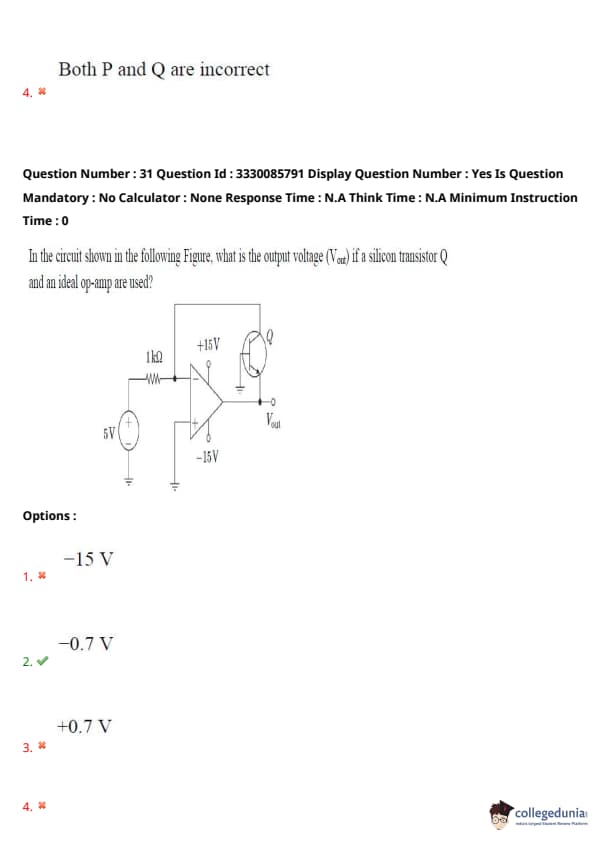
Question 31:
In the circuit shown in the following Figure, what is the output voltage (\( V_{out} \)) if a silicon transistor Q and an ideal op-amp are used?
![]()
- (1) -15 V
- (2) -0.7 V
- (3) +0.7 V
- (4) +15 V
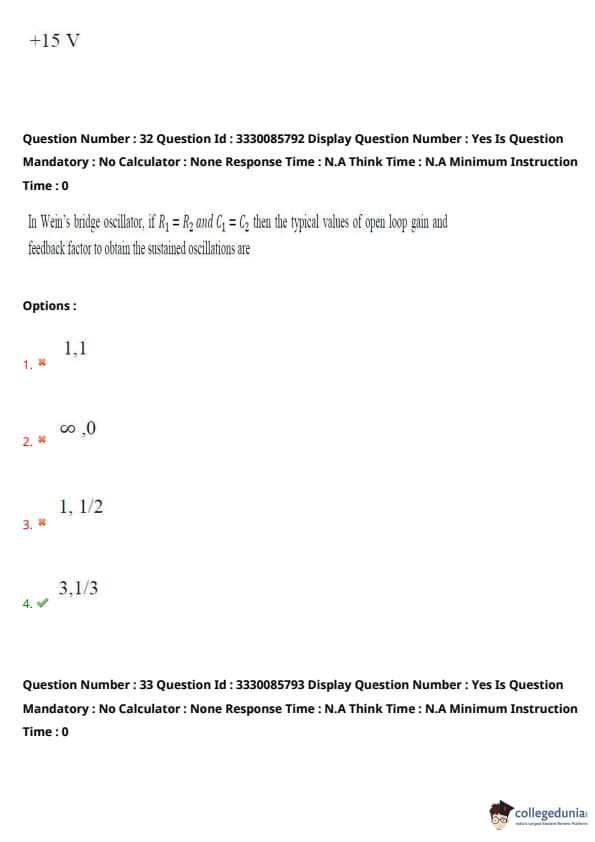
Question 32:
In Wien's bridge oscillator, if \( R_1 = R_2 \) and \( C_1 = C_2 \), then the typical values of open loop gain and feedback factor to obtain the sustained oscillations are
- (1) 1, 1
- (2) \( \infty, 0 \)
- (3) 1, \( \frac{1}{2} \)
- (4) \( \frac{3}{2}, \frac{1}{3} \)
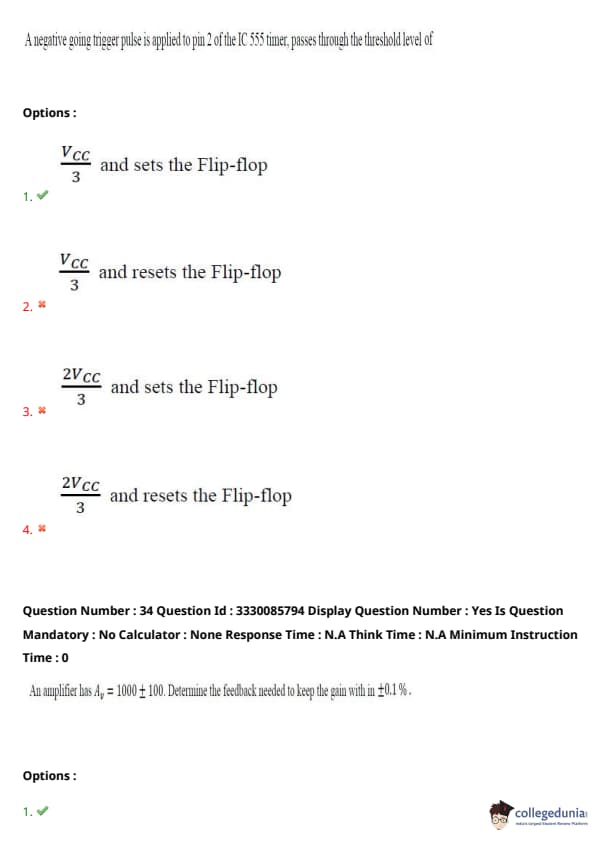
Question 33:
A negative going trigger pulse is applied to pin 2 of the IC 555 timer, passes through the threshold level of
- (1) \( \frac{V_{CC}}{3} \) and sets the Flip-flop
- (2) \( \frac{V_{CC}}{3} \) and resets the Flip-flop
- (3) \( \frac{2V_{CC}}{3} \) and sets the Flip-flop
- (4) \( \frac{2V_{CC}}{3} \) and resets the Flip-flop
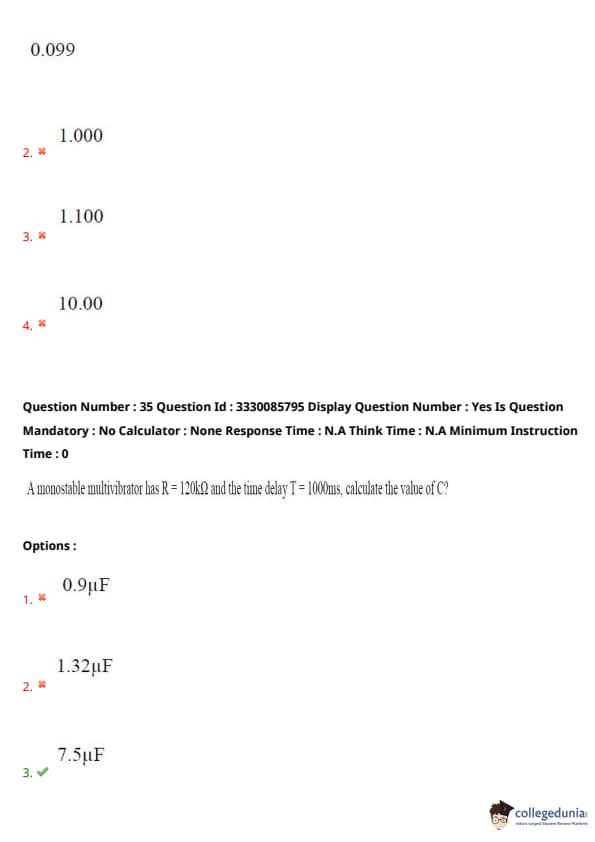
Question 34:
An amplifier has \( A_v = 1000 \pm 100 \). Determine the feedback needed to keep the gain within \( \pm 10% \).
- (1) 0.099
- (2) 1.000
- (3) 1.100
- (4) 10.00
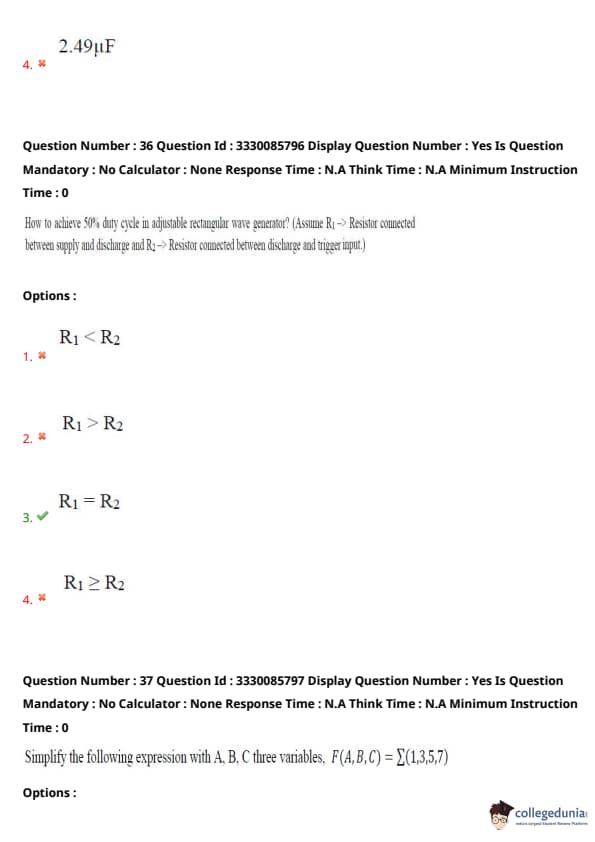
Question 35:
How to achieve 50% duty cycle in adjustable rectangular wave generator? (Assume \( R_1 \) is Resistor connected between supply and discharge and \( R_2 \) is Resistor connected between discharge and trigger input.)
- (1) \( R_1 < R_2 \)
- (2) \( R_1 > R_2 \)
- (3) \( R_1 = R_2 \)
- (4) \( R_1 \geq R_2 \)
Question 36:
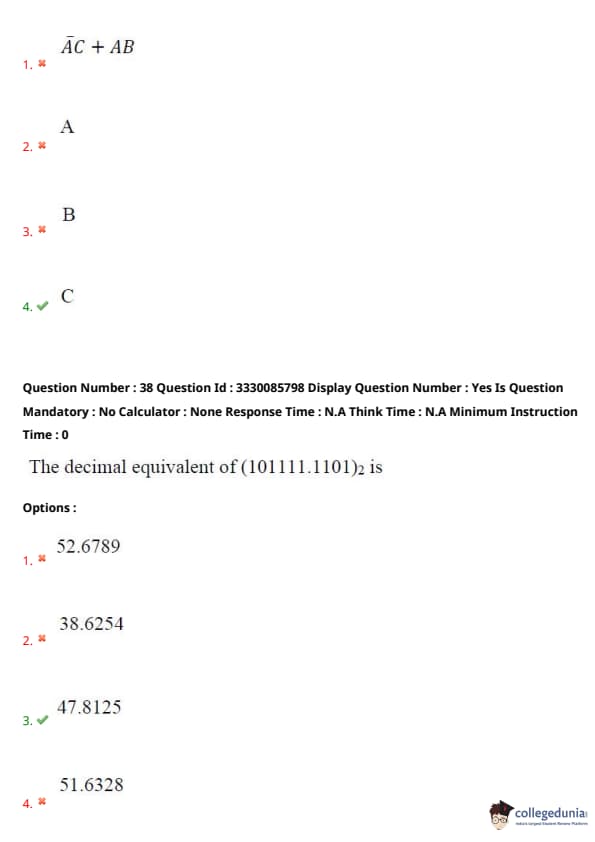
Simplify the following expression with A, B, C three variables, \( F(A, B, C) = \Sigma(1, 3, 5, 7) \)
- (1) \( \overline{A}C + AB \)
- (2) A
- (3) B
- (4) C
Question 37:
The decimal equivalent of \( (101111.1101)_2 \) is
- (1) 52.6789
- (2) 38.6254
- (3) 47.8125
- (4) 51.6328
Question 38:
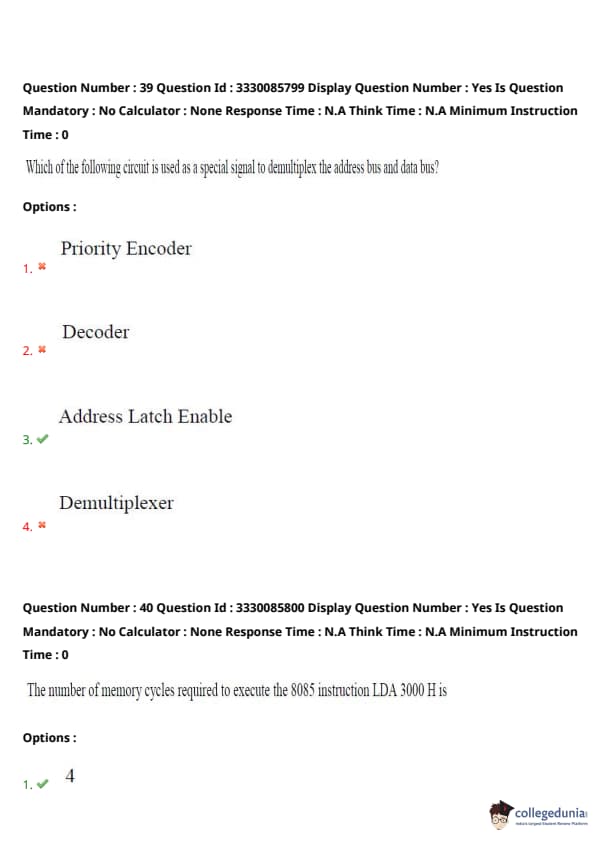
Which of the following circuit is used as a special signal to demultiplex the address bus and data bus?
- (1) Priority Encoder
- (2) Decoder
- (3) Address Latch Enable
- (4) Demultiplexer
Question 39:
The number of memory cycles required to execute the 8085 instruction LDA 3000 H is
Question 40:
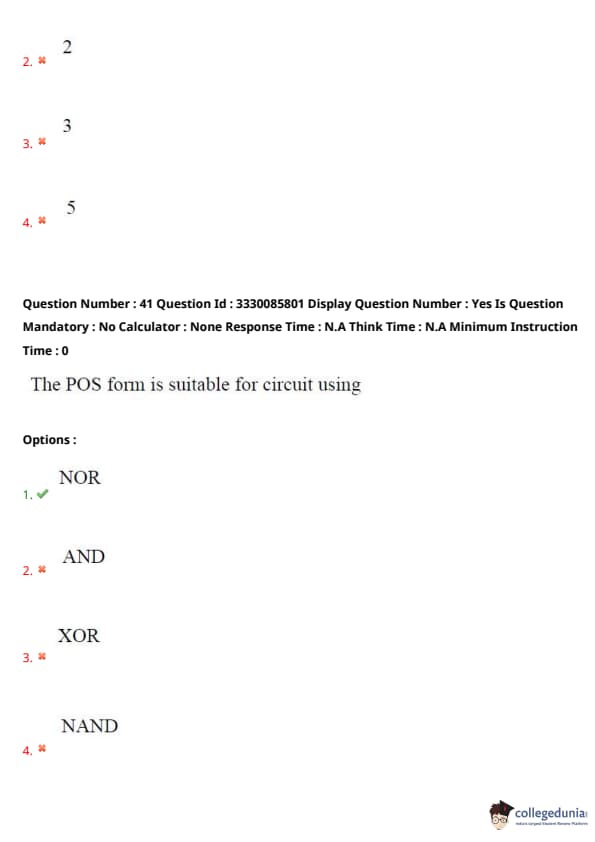
The POS form is suitable for circuits using
- (1) NOR
- (2) AND
- (3) XOR
- (4) NAND
Question 41:
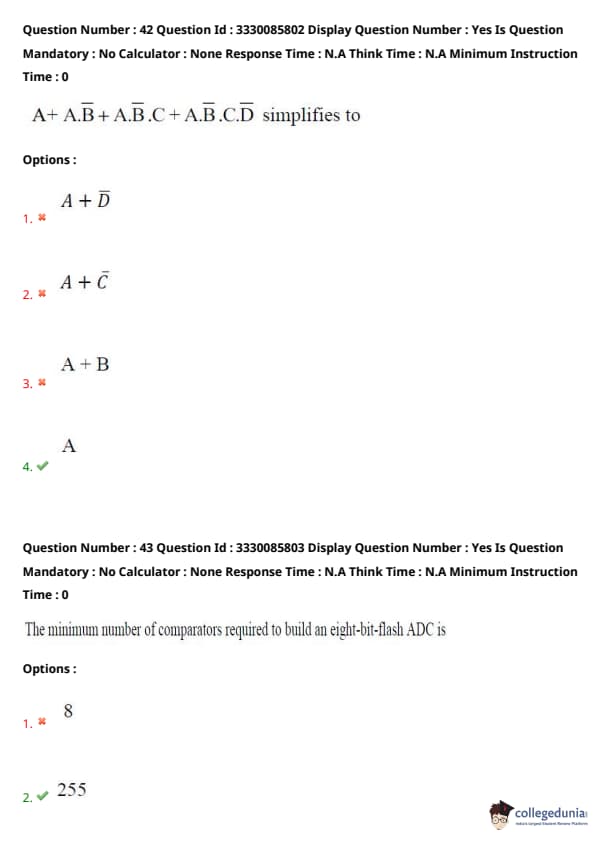
\( A + A.B + A.B.C + A.B.C.D \) simplifies to
- (1) \( A + D \)
- (2) \( A + C' \)
- (3) \( A + B \)
- (4) \( A \)
Question 42:
The minimum number of comparators required to build an eight-bit flash ADC is
- (1) 8
- (2) 255
- (3) 256
- (4) 64
Question 43:
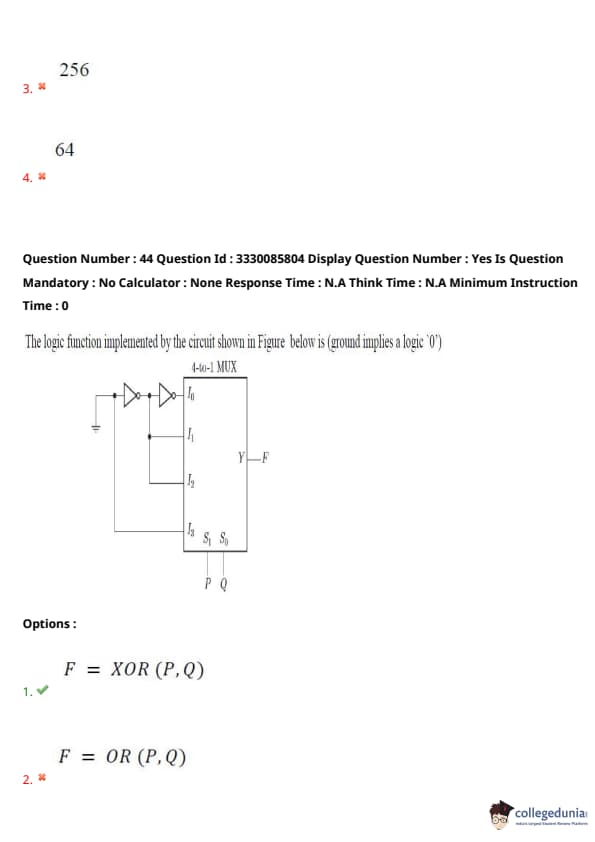
The logic function implemented by the circuit shown in the Figure below is (ground implies a logic '0')
![]()
- (1) \( F = XOR(P, Q) \)
- (2) \( F = OR(P, Q) \)
- (3) \( F = XNOR(P, Q) \)
- (4) \( F = AND(P, Q) \)
Question 44:
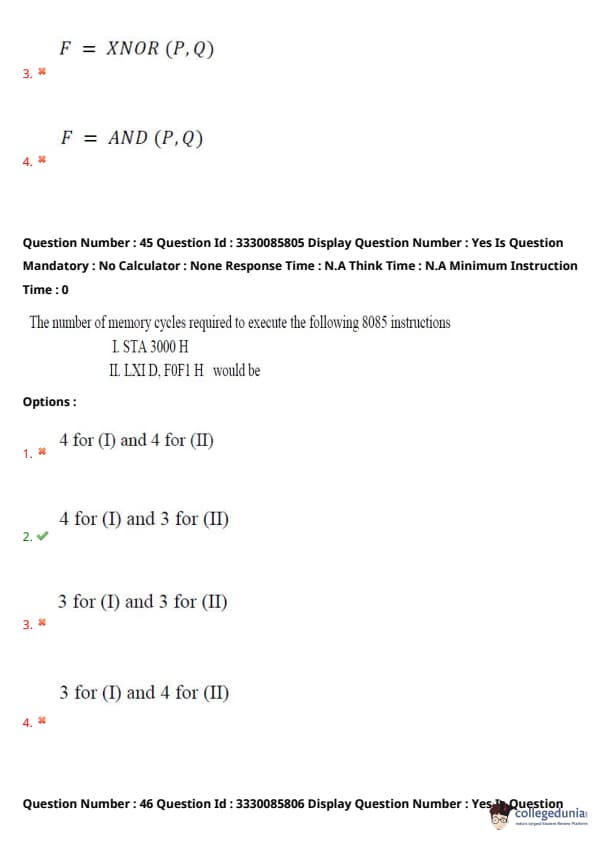
The number of memory cycles required to execute the following 8085 instructions
I. STA 3000 H
II. LXI D, 3000 H
- (1) 4 for (I) and 4 for (II)
- (2) 4 for (I) and 3 for (II)
- (3) 3 for (I) and 3 for (II)
- (4) 3 for (I) and 4 for (II)
Question 45:
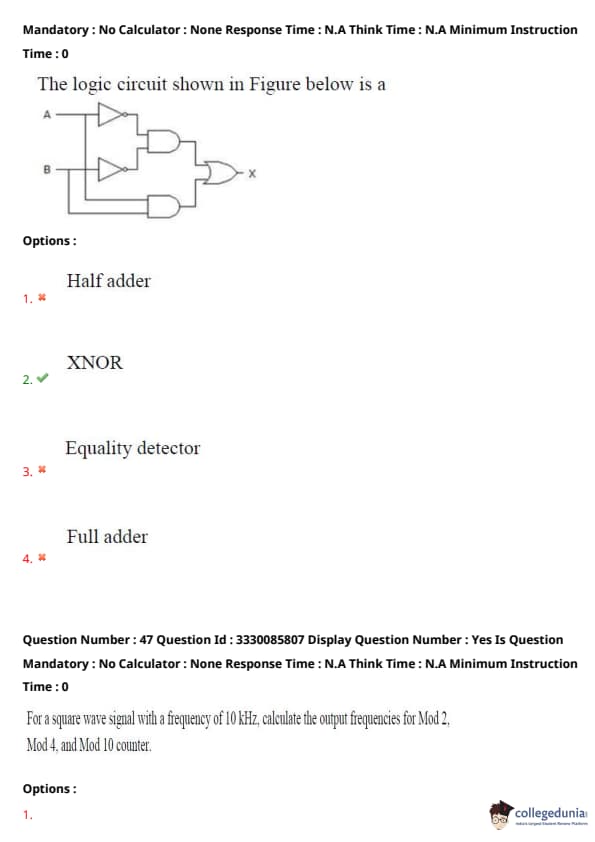
The logic circuit shown in Figure below is a
![]()
- (1) Half adder
- (2) XOR
- (3) Equality detector
- (4) Full adder
Question 46:
For a square wave signal with a frequency of 10 KHz, calculate the output frequencies for Mod 2, Mod 4, and Mod 10 counters.
- (1) 20 KHz, 40 KHz, 100 KHz
- (2) 50 Hz, 25 Hz, 0.1 Hz
- (3) 50 KHz, 25 KHz, 10 KHz
- (4) 5 KHz, 2.5 KHz, 1 KHz
Question 47:
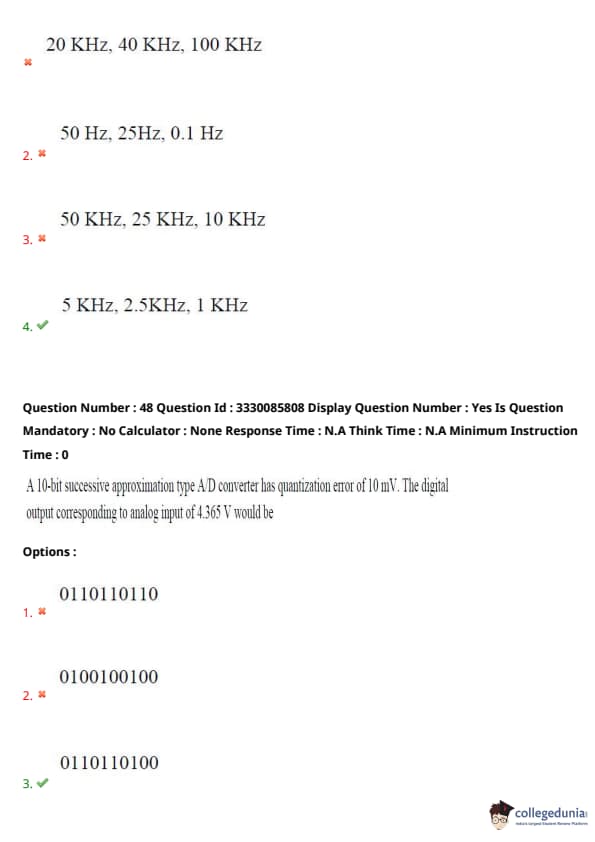
A 10-bit successive approximation type A/D converter has quantization error of 10 mV. The digital output corresponding to an analog input of 4.365 V would be
- (1) 0110110110
- (2) 0100100100
- (3) 0110110100
- (4) 1101011100
Question 48:
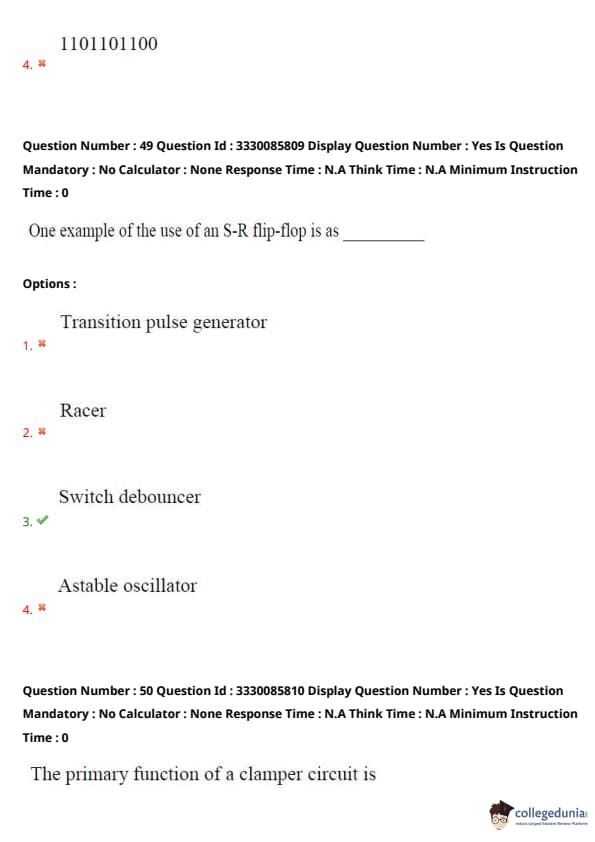
One example of the use of an S-R flip-flop is
- (1) Transition pulse generator
- (2) Racer
- (3) Switch debouncer
- (4) Astable oscillator
Question 49:
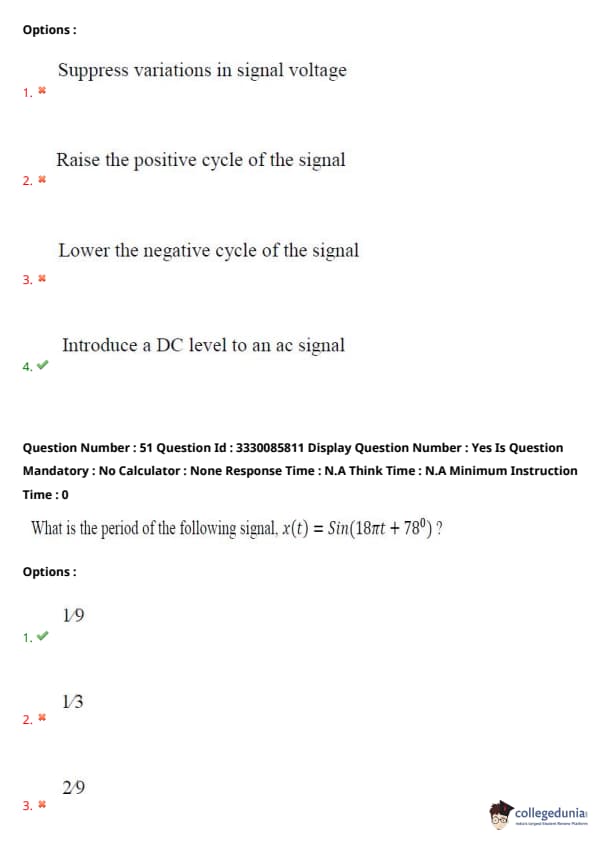
The primary function of a clamper circuit is
- (1) Suppress variations in signal voltage
- (2) Raise the positive cycle of the signal
- (3) Lower the negative cycle of the signal
- (4) Introduce a DC level to an AC signal
Question 50:
What is the period of the following signal, \( x(t) = \sin(18\pi t + 78^\circ) \)?
- (1) \( \frac{1}{9} \)
- (2) \( \frac{1}{3} \)
- (3) \( \frac{2}{9} \)
- (4) \( \frac{4}{9} \)
Question 51:
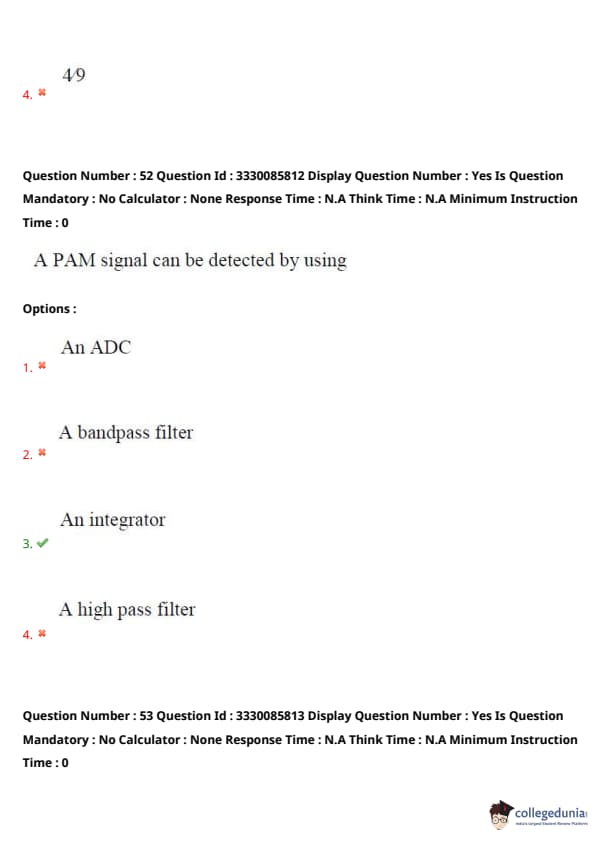
A PAM signal can be detected by using
- (1) An ADC
- (2) A bandpass filter
- (3) An integrator
- (4) A high pass filter
Question 52:
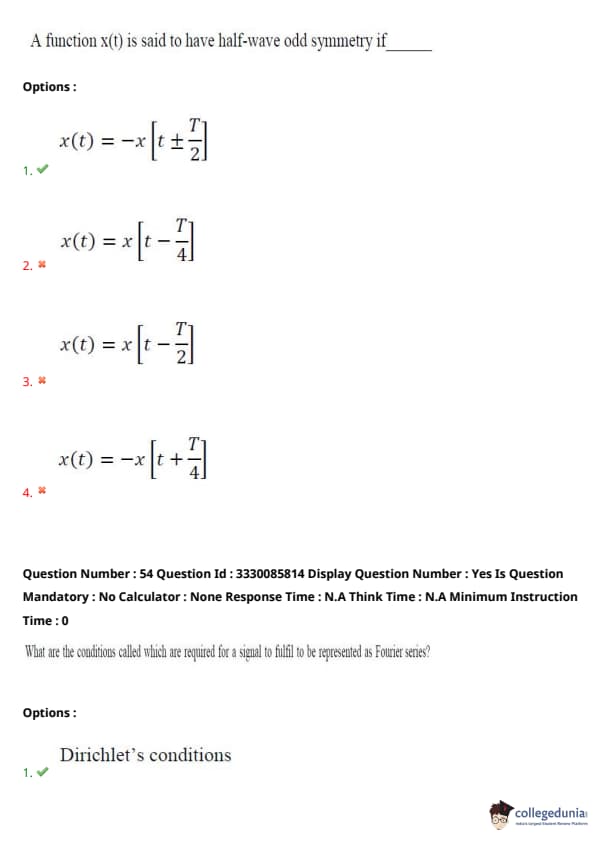
A function \( x(t) \) is said to have half-wave odd symmetry if
- (1) \( x(t) = -x\left[t \pm \frac{T}{2}\right] \)
- (2) \( x(t) = x\left[t - \frac{T}{4}\right] \)
- (3) \( x(t) = x\left[t - \frac{T}{2}\right] \)
- (4) \( x(t) = -x\left[t + \frac{T}{4}\right] \)
Question 53:
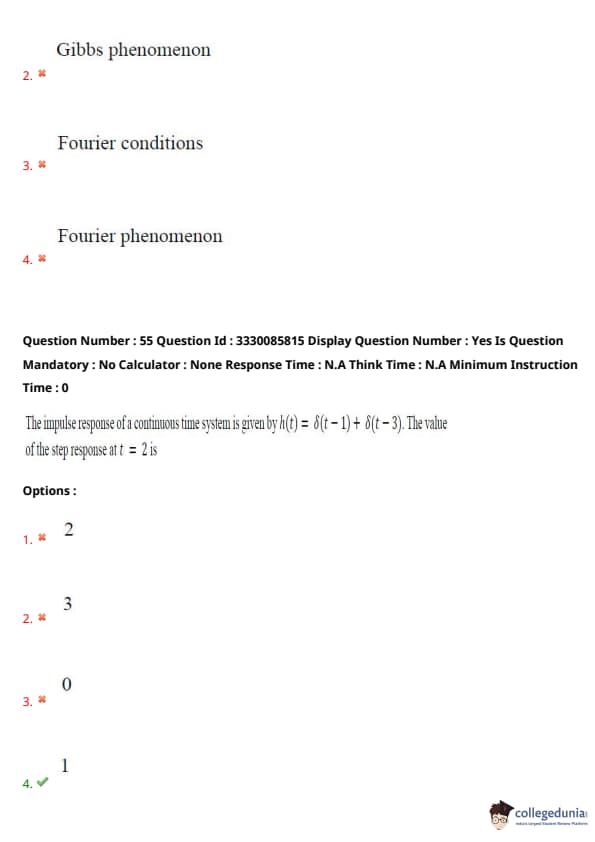
What are the conditions called which are required for a signal to fulfill to be represented as Fourier series?
- (1) Dirichlet's conditions
- (2) Gibbs phenomenon
- (3) Fourier conditions
- (4) Fourier phenomenon
Question 54:
The impulse response of a continuous time system is given by \( h(t) = \delta(t - 1) + \delta(t - 3) \). The value of the step response at \( t = 2 \) is
Question 55:
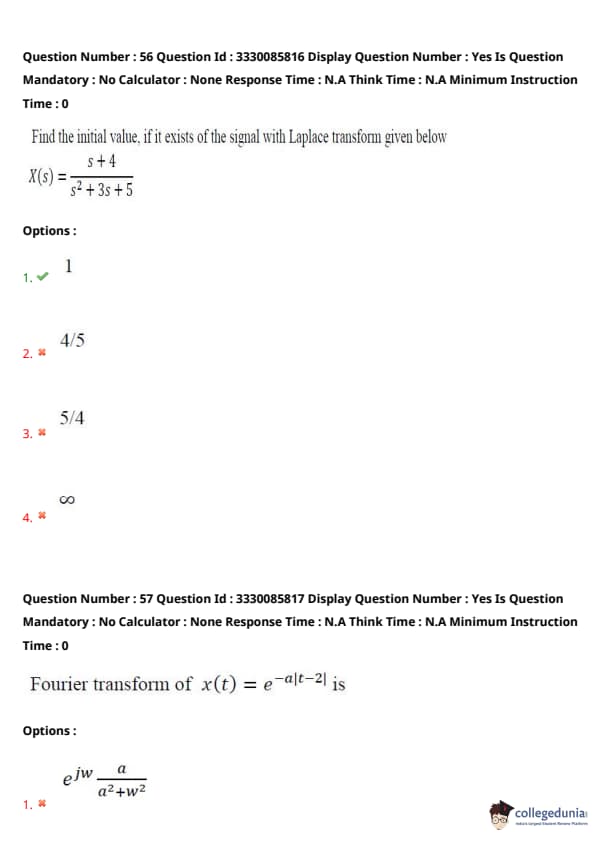
Find the initial value, if it exists of the signal with Laplace transform given below:
\[ X(s) = \frac{s + 4}{s^2 + 3s + 5} \]
- (1) 1
- (2) 4/5
- (3) 5/4
- (4) \infty
Question 56:
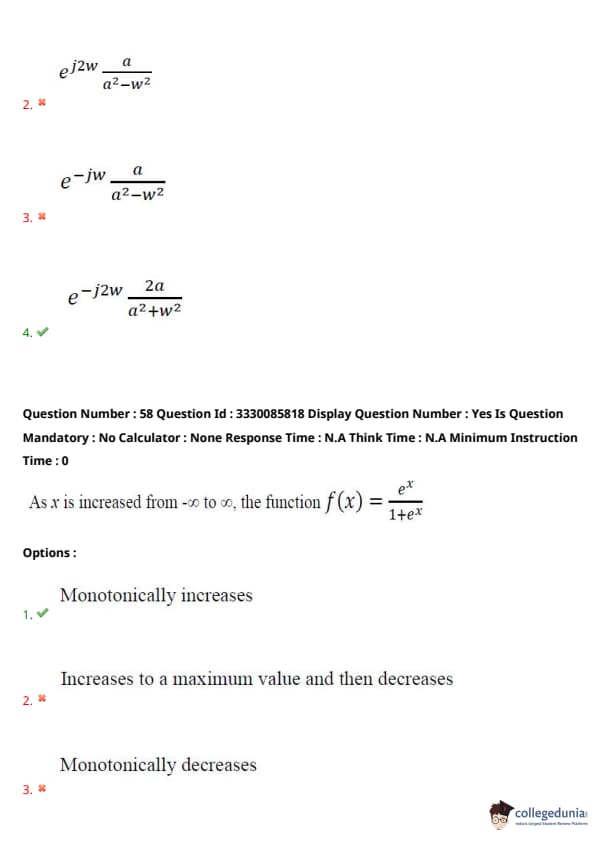
Fourier transform of \( x(t) = e^{-at}u(t - 2) \) is
- (1) \( \frac{e^{jw}}{a^2 + w^2} \)
- (2) \( \frac{e^{jw}}{a^2 - w^2} \)
- (3) \( \frac{e^{-jw}}{a^2 + w^2} \)
- (4) \( \frac{e^{-jw}}{2a + w^2} \)
Question 57:
As \( x \) is increased from \( -\infty \) to \( \infty \), the function \( f(x) = \frac{e^x}{1+e^x} \) behaves as
- (1) Monotonically increases
- (2) Increases to a maximum value and then decreases
- (3) Monotonically decreases
- (4) Decreases to a minimum value and then increases
Question 58:
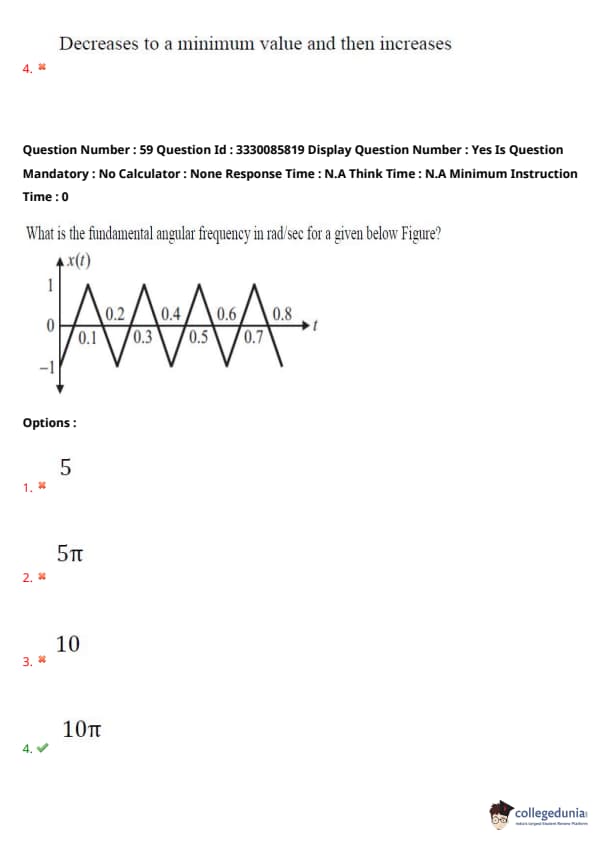
What is the fundamental angular frequency in rad/sec for the given waveform?
![]()
- (1) 5
- (2) \( 5\pi \)
- (3) 10
- (4) \( 10\pi \)
Question 59:
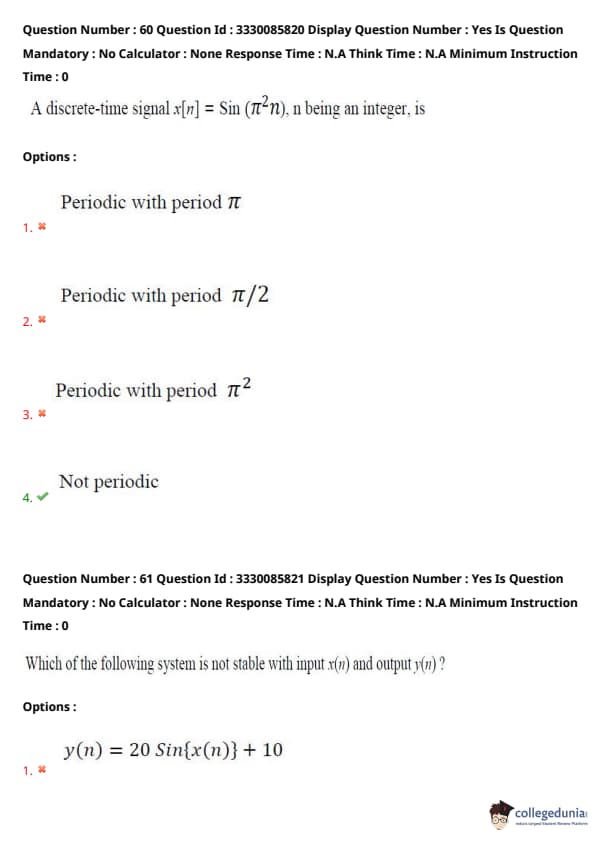
A discrete-time signal \( x[n] = \sin(\pi n^2) \), where \( n \) is an integer, is
- (1) Periodic with period \( \pi \)
- (2) Periodic with period \( \pi/2 \)
- (3) Periodic with period \( \pi^2 \)
- (4) Not periodic
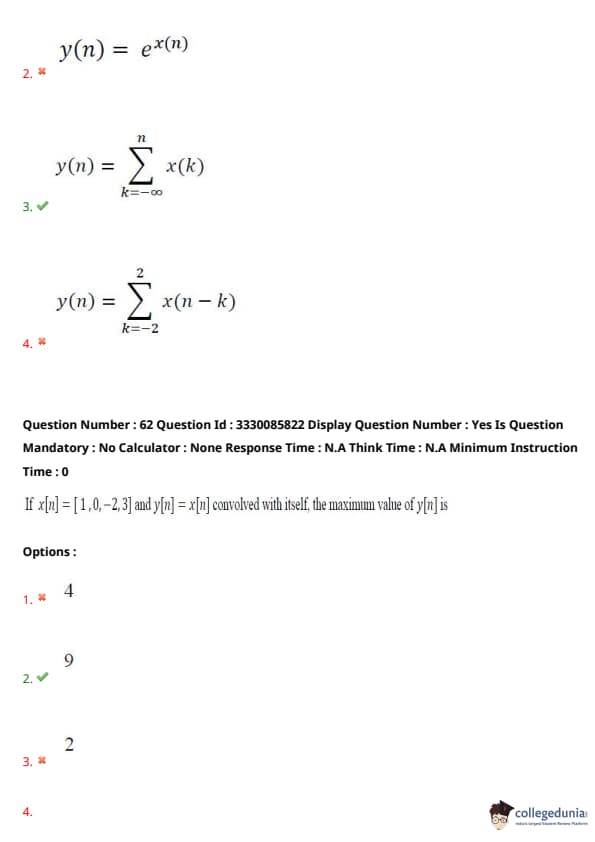
Question 60:
Which of the following system is not stable with input \( x(n) \) and output \( y(n) \)?
- (1) \( y(n) = 20 \sin(x(n)) + 10 \)
- (2) \( y(n) = e^{x(n)} \)
- (3) \( y(n) = \sum_{k=-\infty}^{n} x(k) \)
- (4) \( y(n) = \sum_{k=-2}^{2} x(n - k) \)
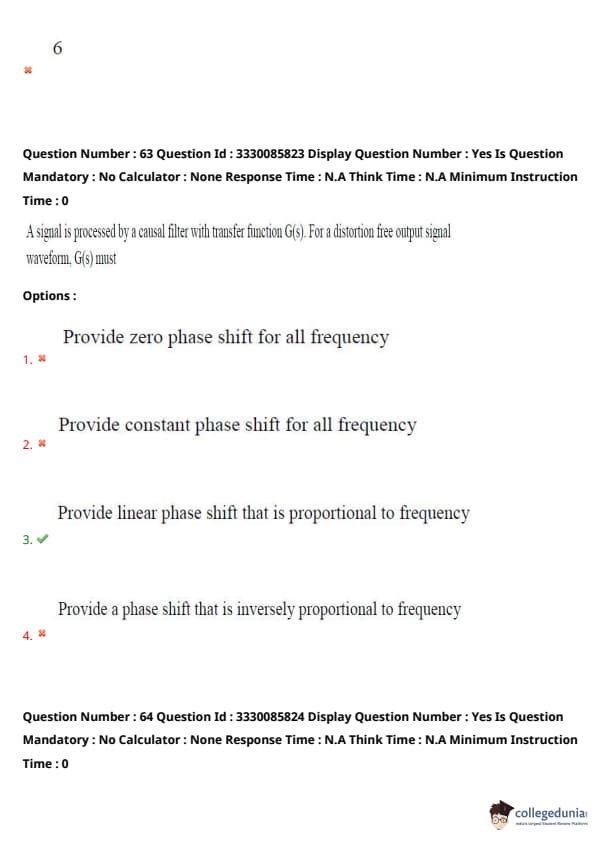
Question 61:
If \( x[n] = \{1, 0, -2, 3\} \) and \( y[n] = x[n] \ast x[n] \), the maximum value of \( y[n] \) is
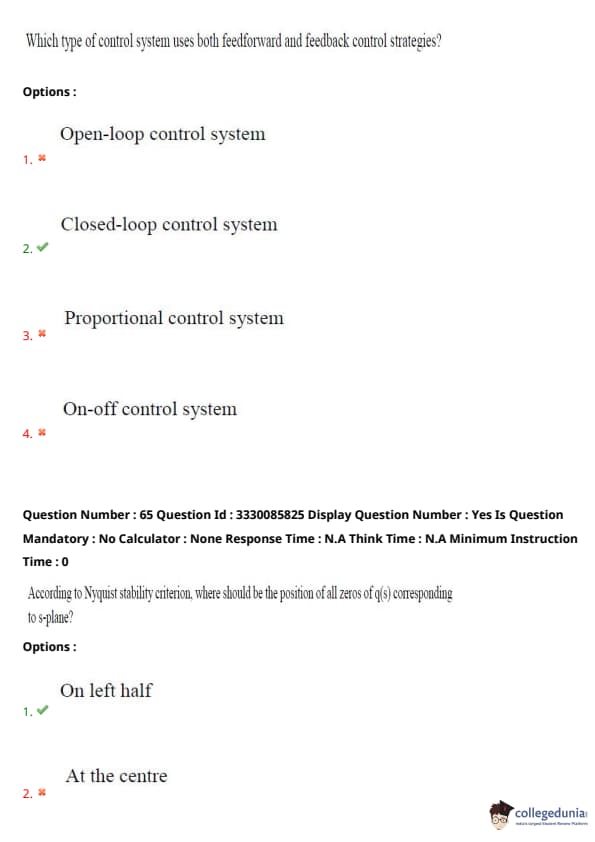
Question 62:
A signal is processed by a causal filter with transfer function \( G(s) \). For a distortion-free output signal waveform, \( G(s) \) must
- (1) Provide zero phase shift for all frequencies
- (2) Provide constant phase shift for all frequencies
- (3) Provide linear phase shift that is proportional to frequency
- (4) Provide a phase shift that is inversely proportional to frequency
Question 63:
Which type of control system uses both feedforward and feedback control strategies?
- (1) Open-loop control system
- (2) Closed-loop control system
- (3) Proportional control system
- (4) On-off control system
Question 64:
According to Nyquist stability criterion, where should be the position of all zeros of \(G(s)\) corresponding to \(s-plane\)?
- (1) On left half
- (2) At the centre
- (3) On right half
- (4) Random
Question 65:
According to Nyquist stability criterion, where should be the position of all zeros of \( G(s) \) corresponding to \( s \)-plane?
- (1) On left half
- (2) At the centre
- (3) On right half
- (4) Random
Question 66:
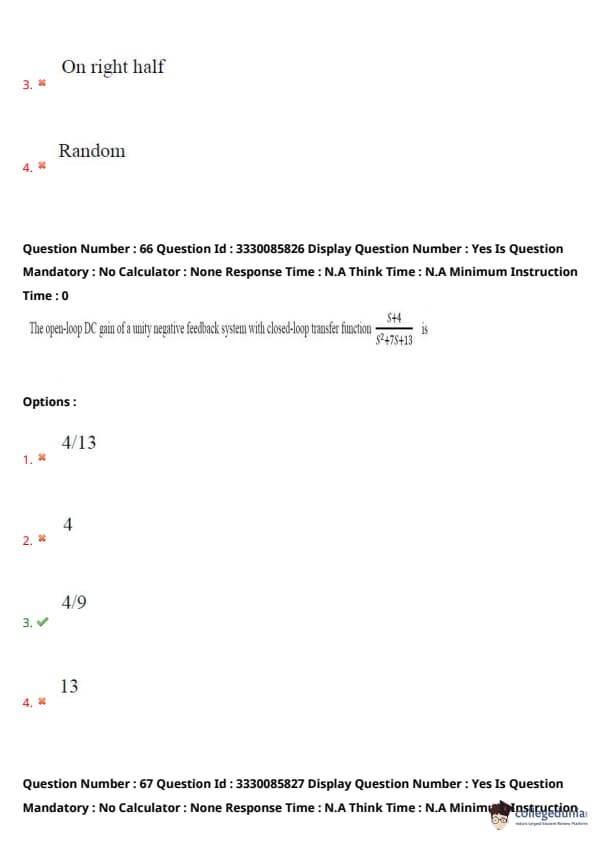
The open-loop DC gain of a unity negative feedback system with closed-loop transfer function is given by \( \frac{5}{4 + 5s + 13s^2} \), what is the open-loop DC gain?
- (1) \( \frac{4}{13} \)
- (2) 4
- (3) \( \frac{4}{9} \)
- (4) 13
Question 67:
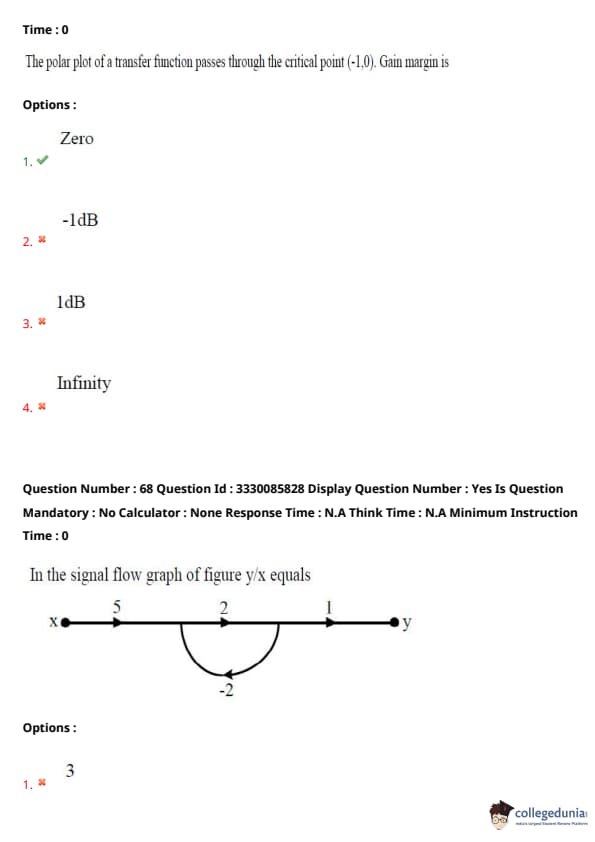
The polar plot of a transfer function passes through the critical point (+1,0). Gain margin is
- (1) Zero
- (2) \(-1dB\)
- (3) \( 1dB \)
- (4) Infinity
Question 68:
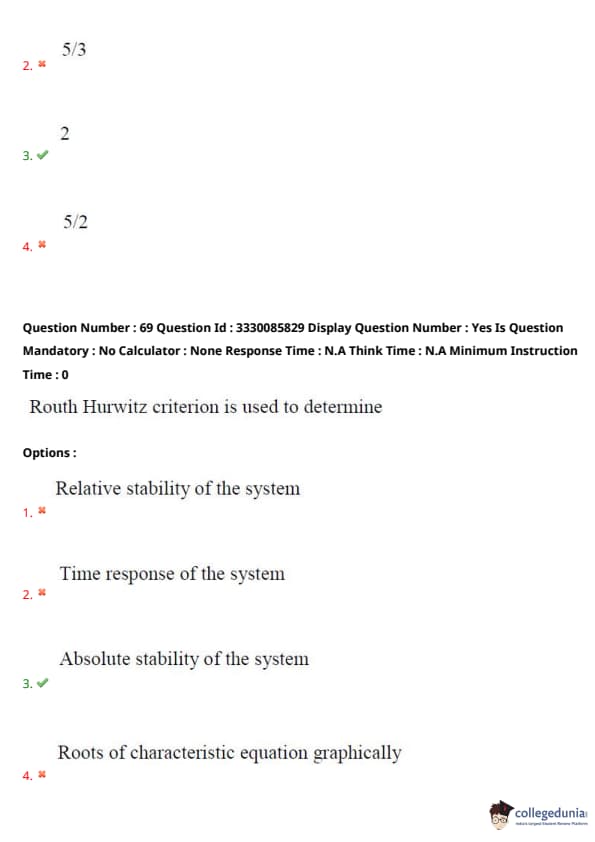
In the signal flow graph of figure \( \frac{y}{x} \) equals
![]()
- (1) 3
- (2) \( \frac{5}{3} \)
- (3) 2
- (4) \( \frac{5}{2} \)
Question 69:
%Question text
Routh Hurwitz criterion is used to determine
- (1) Relative stability of the system.
- (2) Time response of the system.
- (3) Absolute stability of the system.
- (4) Roots of characteristic equation graphically.
Question 70:
%Question text
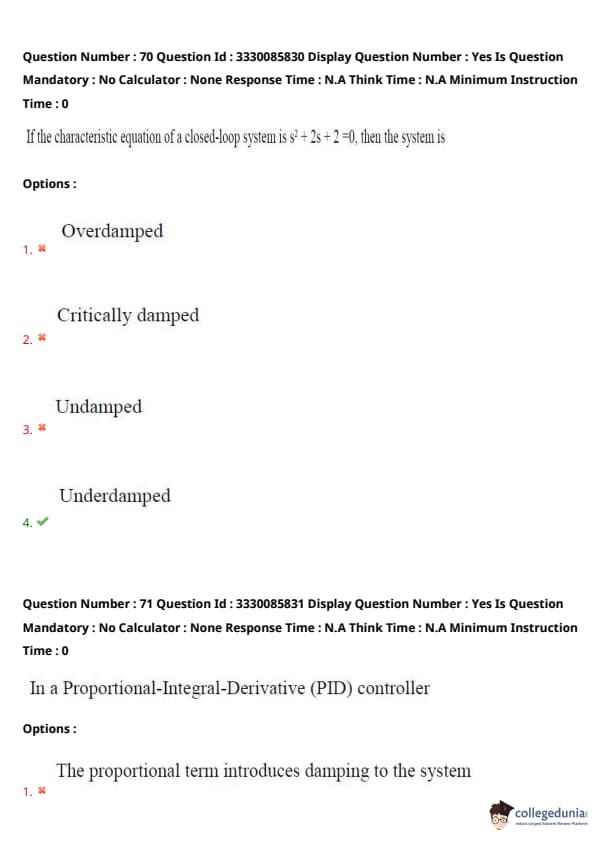
If the characteristic equation of a closed-loop system is \( s^2 + 2s + 2 = 0 \), then the system is
- (1) Overdamped.
- (2) Critically damped.
- (3) Undamped.
- (4) Underdamped.
Question 71:
In a Proportional-Integral-Derivative (PID) controller
- (1) The proportional term introduces damping to the system.
- (2) The derivative term eliminates steady-state error.
- (3) The integral term improves transient response.
- (4) The proportional term contributes to steady-state accuracy.
Question 72:
Consider a stable linear time-invariant (LTI) system with a transfer function G(s). Which of the following statements regarding Bode and Nyquist plots is true?
- (1) Bode plots provide information about the system's stability, while Nyquist plots provide information about its frequency response.
- (2) Bode plots are used to analyze the system's transient response, while Nyquist plots are used for steady-state analysis.
- (3) Nyquist plots are applicable only for stable systems, while Bode plots can be used for both stable and unstable systems.
- (4) Bode plots display the magnitude and phase response of the system, while Nyquist plots show the system's gain and phase margin.
Question 73:
The roots of the characteristic equation \(2S^3 + 3S^2 + 4S + 6 = 0\) are
- (1) \(S = -1.5, S = \pm \sqrt{2}\)
- (2) \(S = -1, S = \pm \sqrt{2}\)
- (3) \(S = -1, S = -4, S = -6\)
- (4) \(S = -1, S = -2, S = -3\)
Question 74:
Which one of the following is not the property of root loci?
- (1) The root locus is symmetrical about imaginary axis.
- (2) They start from the open loop poles and terminate at the open loop zeroes.
- (3) The breakaway points are determined from dK/ds = 0.
- (4) Segments of the real axis are the part of the root locus if and only if the total number of real poles and zeroes to their right is odd.
Question 75:
A transfer function of control system does not have pole-zero cancellation. Which one of the following statements is true?
- (1) System is neither controllable nor observable.
- (2) System is completely controllable and observable.
- (3) System is observable but uncontrollable.
- (4) System is controllable but unobservable.
Question 76:
If the highest modulation frequency is 5 kHz, find out bandwidth.
- (1) 5 kHz
- (2) 10 kHz
- (3) 2.5 kHz
- (4) 705 kHz
Question 77:
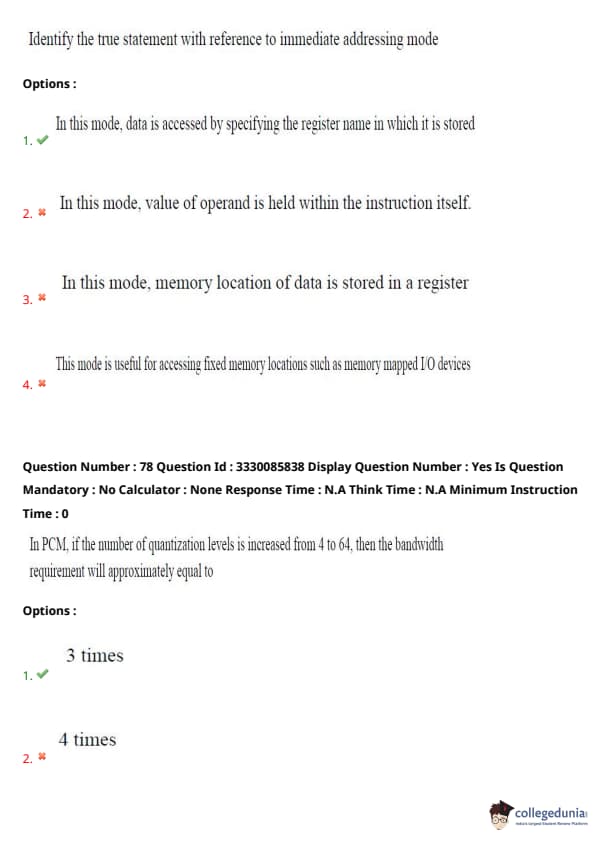
Identify the true statement with reference to immediate addressing mode
- (1) In this mode, data is accessed by specifying the register name in which it is stored.
- (2) In this mode, value of operand is held within the instruction itself.
- (3) In this mode, memory location of data is stored in a register.
- (4) This mode is useful for accessing fixed memory locations such as memory mapped I/O devices.
Question 78:
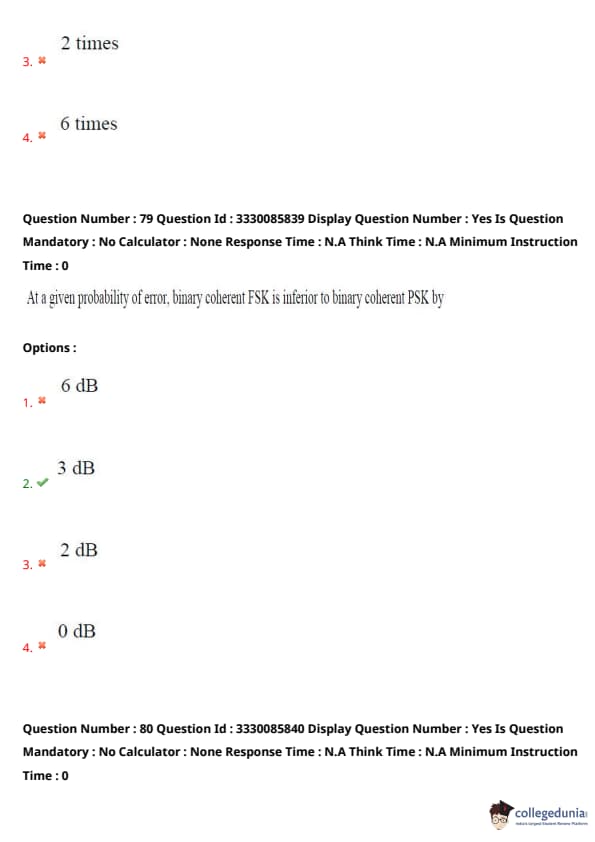
In PCM, if the number of quantization levels is increased from 4 to 64, then the bandwidth requirement will approximately equal to
- (1) 3 times
- (2) 4 times
- (3) 2 times
- (4) 6 times
Question 79:
At a given probability of error, binary coherent FSK is inferior to binary coherent PSK by
- (1) 6 dB
- (2) 3 dB
- (3) 2 dB
- (4) 0 dB
Question 80:
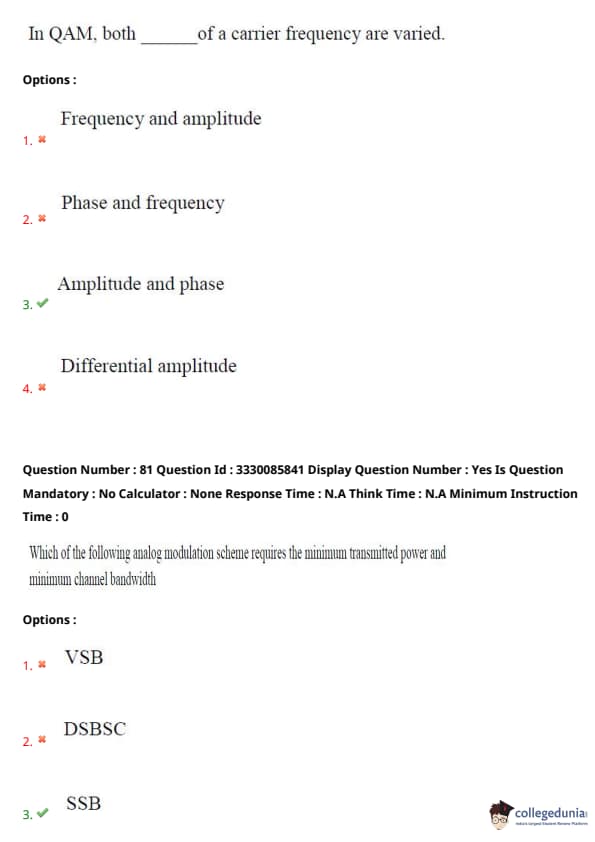
In QAM, both ____ of a carrier frequency are varied.
- (1) Frequency and amplitude
- (2) Phase and frequency
- (3) Amplitude and phase
- (4) Differential amplitude
Question 81:
Which of the following analog modulation schemes requires the minimum transmitted power and minimum channel bandwidth?
- (1) VSB
- (2) DSBCS
- (3) SSB
- (4) AM
Question 82:
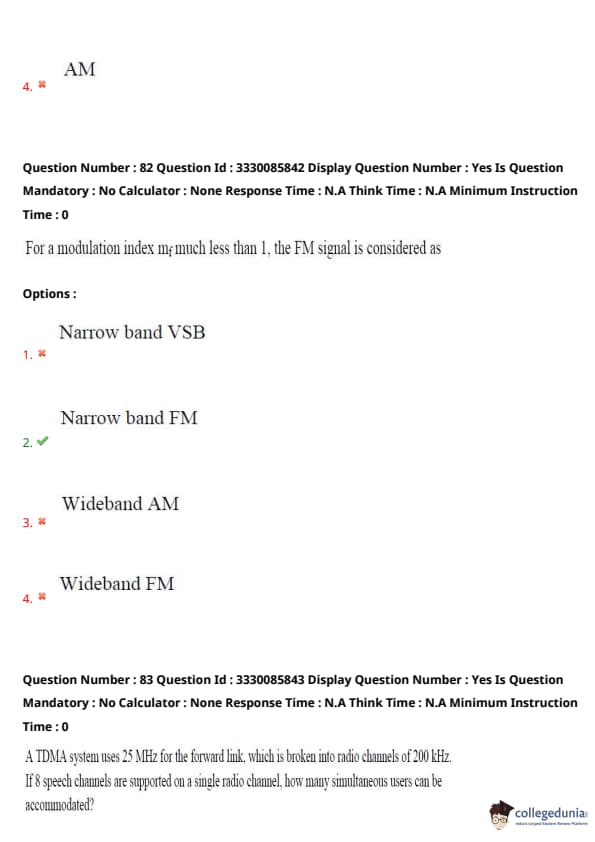
For a modulation index much less than 1, the FM signal is considered as
- (1) Narrow band VSB
- (2) Narrow band FM
- (3) Wideband AM
- (4) Wideband FM
Question 83:
A TDMA system uses 25 MHz for the forward link, which is broken into radio channels of 200 kHz. If 8 speech channels are supported on a single radio channel, how many simultaneous users can be accommodated?
- (1) 25
- (2) 200
- (3) 1600
- (4) 1000
Question 84:
Coherent demodulation of FSK signal can be detected using
- (1) Bandpass filters
- (2) Bandpass filters and envelope detectors
- (3) Matched filter
- (4) Discriminator
Question 85:
The use of non-uniform quantization leads to
- (1) Reduction in transmission bandwidth
- (2) Increase in maximum SNR
- (3) Increase in SNR for low-level signals
- (4) Simplification of quantization process
Question 86:
How many users or voice channels are supported for each 200 KHz channel in GSM?
- (1) 8
- (2) 3
- (3) 64
- (4) 12
Question 87:
The midband gain of an amplifier is 100 and the lower cutoff frequency is 1kHz. The gain of the amplifier at a frequency of 20Hz is approximately
- (1) 2
- (2) 20
- (3) 50
- (4) 100
Question 88:
Match the following:
![]()
- (1) (i) - (a), (ii) - (d), (iii) - (c), (iv) - (b)
- (2) (i) - (b), (ii) - (a), (iii) - (c), (iv) - (d)
- (3) (i) - (c), (ii) - (e), (iii) - (b), (iv) - (d)
- (4) (i) - (a), (ii) - (c), (iii) - (b), (iv) - (d)
- (i) A filter is used to convert alternating current into pulsating current.
Question 89:
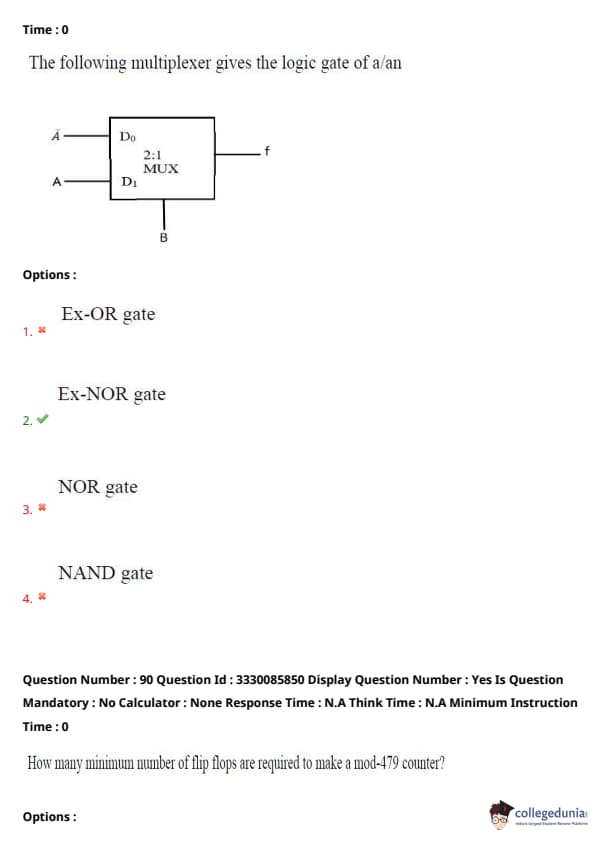
The following multiplexer gives the logic gate of a/an ___\
![]()
- (1) Ex-OR gate
- (2) Ex-NOR gate
- (3) NOR gate
- (4) NAND gate
Question 90:
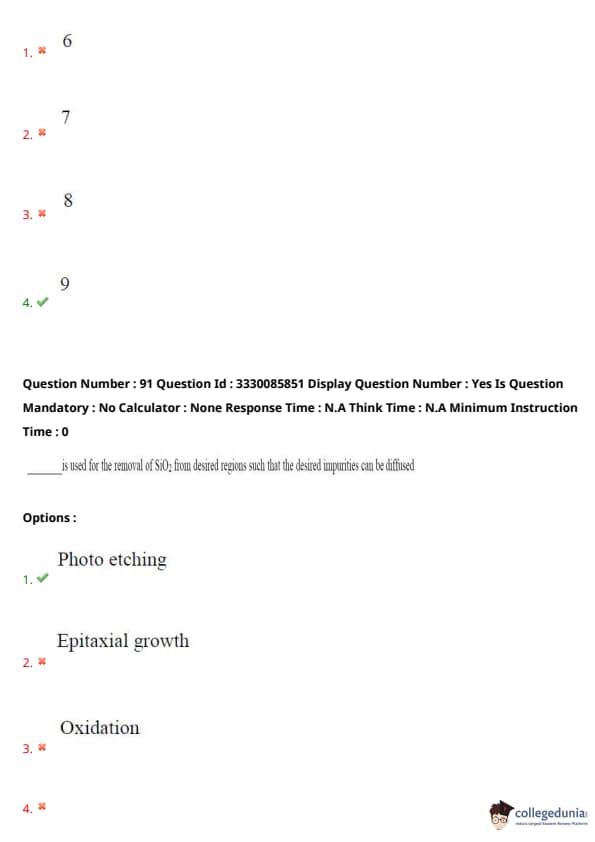
How many minimum number of flip-flops are required to make a mod-479 counter? ___\
Question 91:
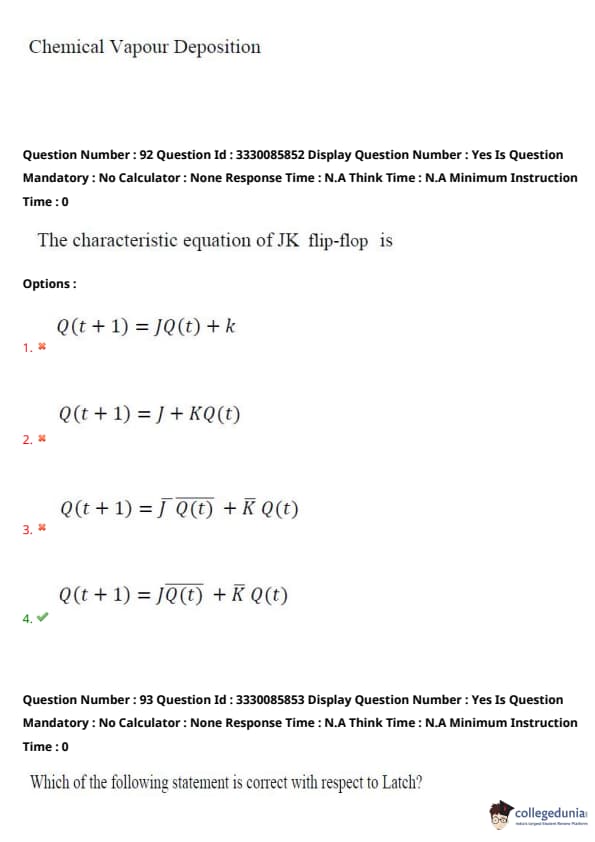
___ is used for the removal of SiO2 from desired regions such that the desired impurities can be diffused.
- (1) Photo etching
- (2) Epitaxial growth
- (3) Oxidation
- (4) Chemical Vapour Deposition
Question 92:
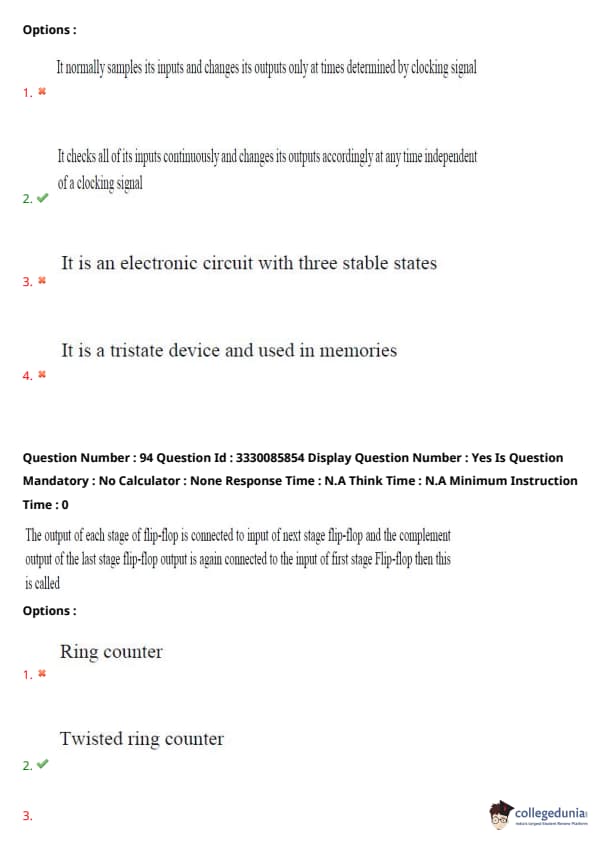
The characteristic equation of JK flip-flop is ___\
- (1) \( Q(t + 1) = JQ(t) + k \)
- (2) \( Q(t + 1) = J + KQ(t) \)
- (3) \( Q(t + 1) = JQ(t) + KQ(t) \)
- (4) \( Q(t + 1) = JQ(t) + \overline{K} Q(t) \)
Question 93:
Which of the following statement is correct with respect to Latch?
- (1) It normally samples its inputs and changes its outputs only at times determined by the clocking signal
- (2) It checks all of its inputs continuously and changes its outputs accordingly at any time independent of a clocking signal
- (3) It is an electronic circuit with three stable states
- (4) It is a tristate device and used in memories
Question 94:
The output of each stage of flip-flop is connected to input of next stage flip-flop and the complement output of the last stage flip-flop is again connected to the input of first stage flip-flop then this is called
- (1) Ring counter
- (2) Twisted ring counter
- (3) Ripple counter
- (4) Decade counter
Question 95:
The number of flip-flops used in a decade counter is ___\
Question 96:
Add the two numbers 87H and 79H in the 8085 microprocessors, then
- (1) Carry flag = 0 and zero flag = 0
- (2) Carry flag = 0 and zero flag = 1
- (3) Carry flag = 1 and zero flag = 0
- (4) Carry flag = 1 and zero flag = 1
Question 97:
Which theorem relates the line integral of a vector field over a closed curve to the surface integral of the curl of the field over the surface bounded by the curve?
- (1) Stokes's theorem
- (2) Gauss's theorem
- (3) Green's theorem
- (4) Divergence theorem
Question 98:
The curl of a vector field \( F \) is zero throughout a region of space. What does this imply about the behavior of \( F \)?
- (1) The field \( F \) is solenoidal.
- (2) The field \( F \) is irrotational.
- (3) The field \( F \) is conservative.
- (4) The field \( F \) is neither solenoidal nor irrotational.
Question 99:
Which of the following assertions accurately describes Gauss's theorem?
- (1) It connects a line integral of a vector field with a surface integral of the field's curl.
- (2) It links a surface integral of a vector field with a line integral of the field's curl.
- (3) It correlates a line integral of a vector field with a volume integral of the field's curl.
- (4) It associates a surface integral of a vector field with a volume integral of the field's divergence.
Question 100:
Which of the following is not a source of magnetostatic fields?
- (1) A dc current in a wire
- (2) A permanent magnet
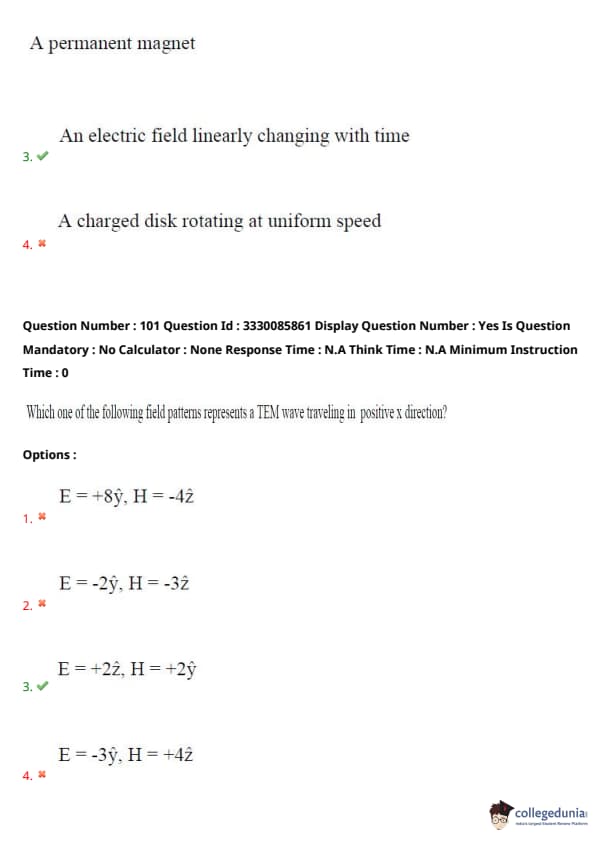
- (3) An electric field linearly changing with time
- (4) A charged disk rotating at uniform speed
Question 101:
Which one of the following field patterns represents a TEM wave traveling in the positive \( z \)-direction?
- (1) \( E = +3\hat{y}, H = -4\hat{z} \)
- (2) \( E = -2\hat{y}, H = -3\hat{z} \)
- (3) \( E = +2\hat{z}, H = +2\hat{y} \)
- (4) \( E = -3\hat{y}, H = +4\hat{z} \)
Question 102:
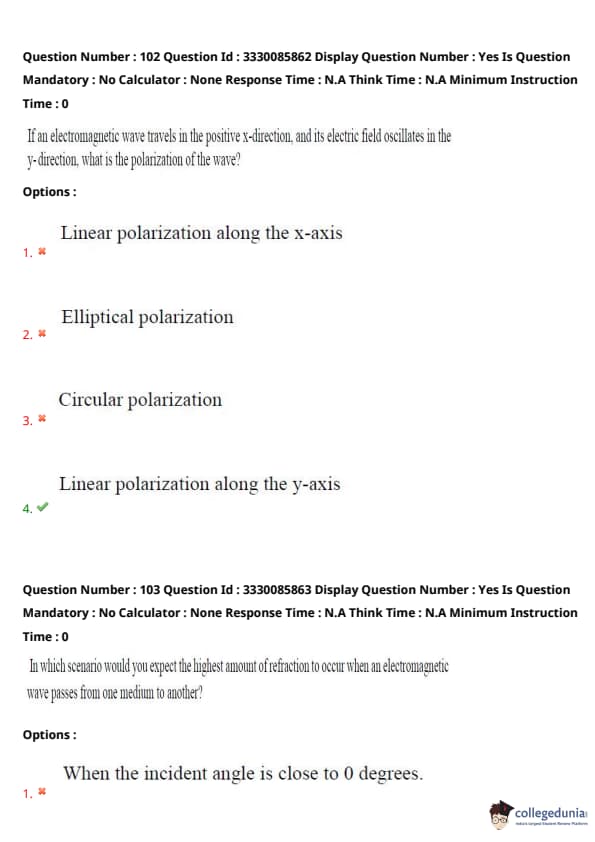
If an electromagnetic wave travels in the positive \( x \)-direction, and its electric field oscillates in the \( y \)-direction, what is the polarization of the wave?
- (1) Linear polarization along the \( x \)-axis
- (2) Elliptical polarization
- (3) Circular polarization
- (4) Linear polarization along the \( y \)-axis
Question 103:
In which scenario would you expect the highest amount of refraction to occur when an electromagnetic wave passes from one medium to another?
- (1) When the incident angle is close to 0 degrees.
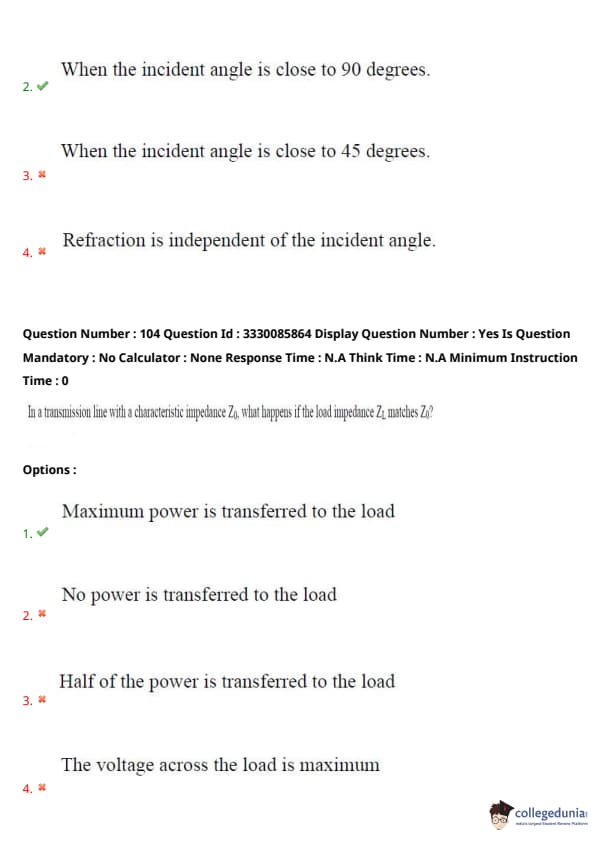
- (2) When the incident angle is close to 90 degrees.
- (3) When the incident angle is close to 45 degrees.
- (4) Refraction is independent of the incident angle.
Question 104:
In a transmission line with a characteristic impedance \( Z_0 \), what happens if the load impedance \( Z_L \) matches \( Z_0 \)?
- (1) Maximum power is transferred to the load
- (2) No power is transferred to the load
- (3) Half of the power is transferred to the load
- (4) The voltage across the load is maximum
Question 105:
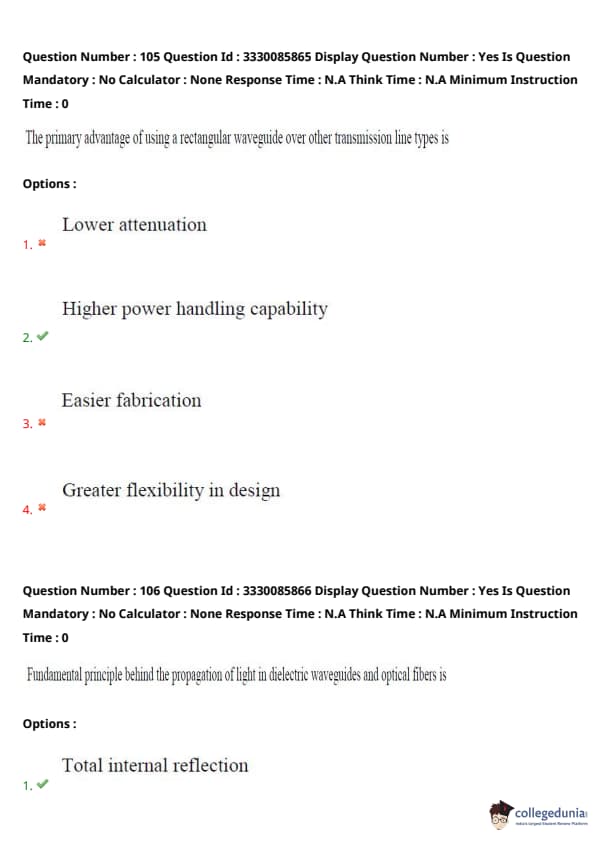
The primary advantage of using a rectangular waveguide over other transmission line types is
- (1) Lower attenuation
- (2) Higher power handling capability
- (3) Easier fabrication
- (4) Greater flexibility in design
Question 106:
Fundamental principle behind the propagation of light in dielectric waveguides and optical fibers is
- (1) Total internal reflection
- (2) Diffraction
- (3) Absorption
- (4) Refraction
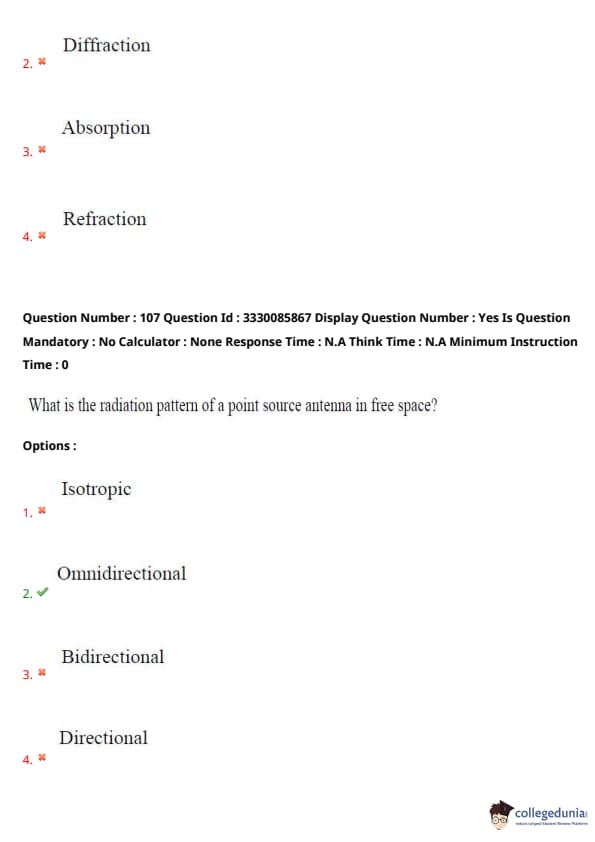
Question 107:
What is the radiation pattern of a point source antenna in free space?
- (1) Isotropic
- (2) Omnidirectional
- (3) Bidirectional
- (4) Directional
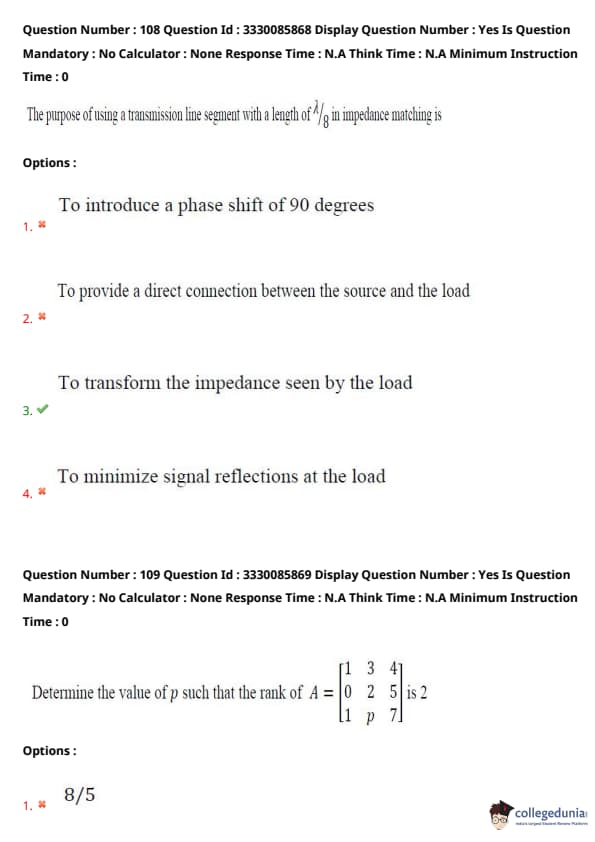
Question 108:
The purpose of using a transmission line segment with a length of \( \lambda/4 \) in impedance matching is
- (1) To introduce a phase shift of 90 degrees
- (2) To provide a direct connection between the source and the load
- (3) To transform the impedance seen by the load
- (4) To minimize signal reflections at the load
Question 109:
Determine the value of \( p \) such that the rank of matrix \( A \) is 2:
\[ A = \begin{bmatrix} 1 & 2 & 3 & 4
0 & 0 & 2 & p
1 & 0 & p & 7 \end{bmatrix} \]
- (1) \( \frac{8}{5} \)
- (2) \( \frac{21}{5} \)
- (3) \( \frac{20}{7} \)
- (4) \( \frac{3}{4} \)
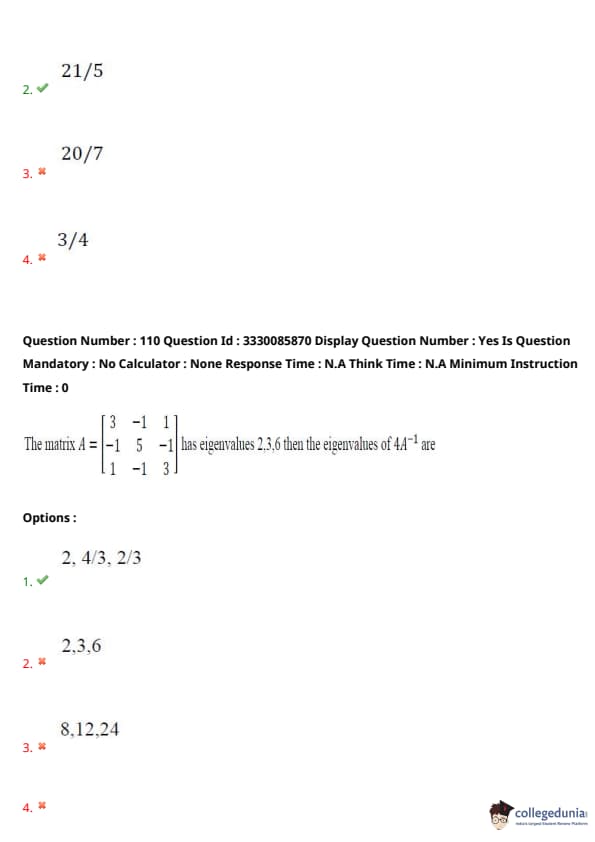
Question 110:
The matrix \( A = \begin{bmatrix} 3 & -1 & 1
1 & -5 & 1
1 & -1 & 3 \end{bmatrix} \) has eigenvalues 2, 3, 6 then the eigenvalues of \( A^4 \) are
- (1) \( 2, \frac{4}{3}, \frac{2}{3} \)
- (2) \( 2, 3, 6 \)
- (3) \( 8, 12, 24 \)
- (4) \( \frac{1}{2}, \frac{1}{3}, \frac{1}{6} \)
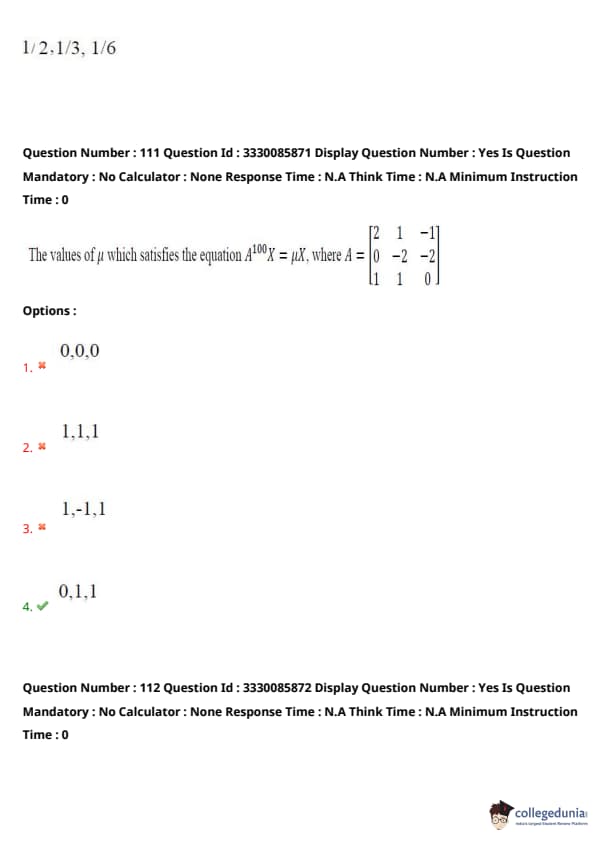
Question 111:
The values of \( \mu \) which satisfy the equation \( A^{100} \vec{x} = \mu \vec{x} \), where \( A = \begin{bmatrix} 2 & -1
0 & -2
1 & 1 \end{bmatrix} \) are
- (1) \( 0, 0, 0 \)
- (2) \( 1, 1, 1 \)
- (3) \( -1, -1, 1 \)
- (4) \( 0, 1, 1 \)
Question 112:
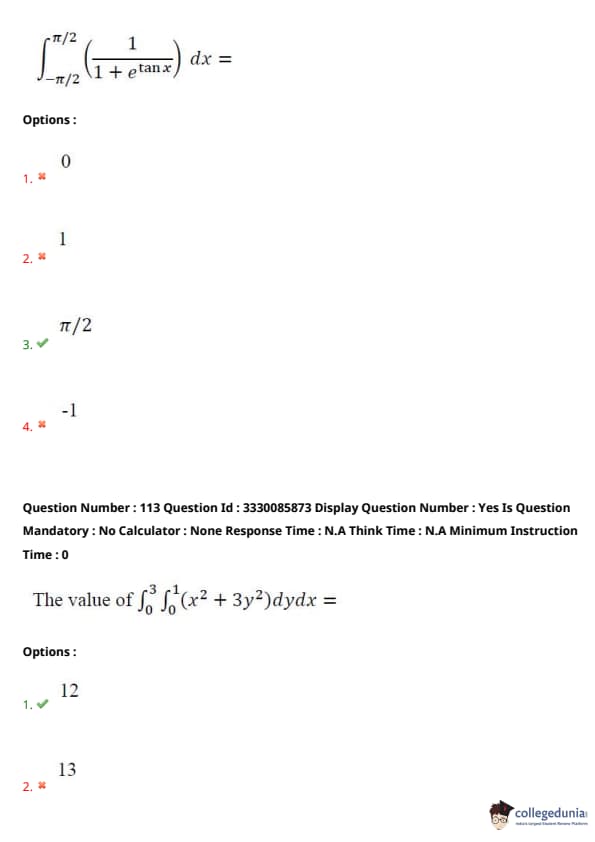
The value of \( \int_0^3 \int_0^0 (x^2 + 3y^2) \, dy \, dx \) is
- (1) 12
- (2) 13
- (3) 11
- (4) 14
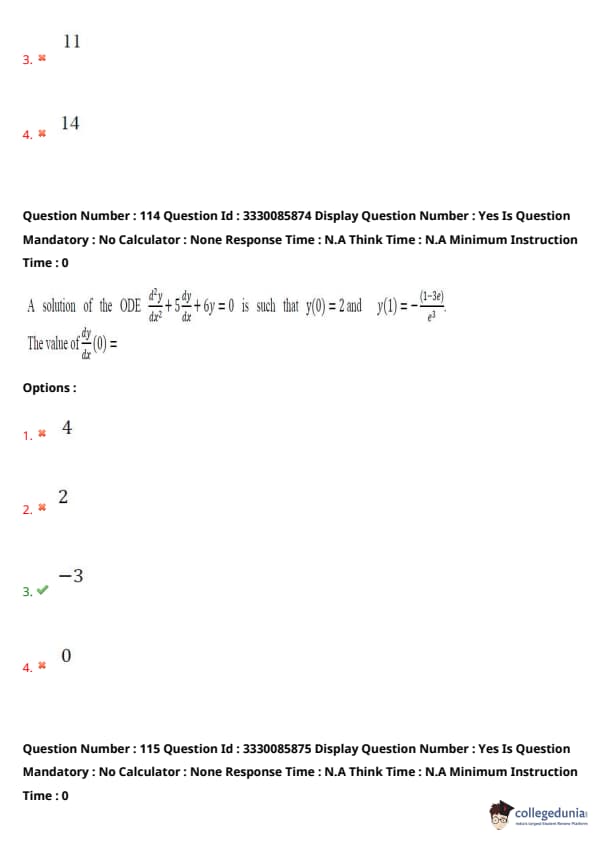
Question 113:
A solution of the ODE \( \frac{d^2y}{dx^2} + \frac{dy}{dx} = 0 \) is such that \( y(0) = 2 \) and \( y'(0) = 3 \). The value of \( y''(0) \) is
Question 114:
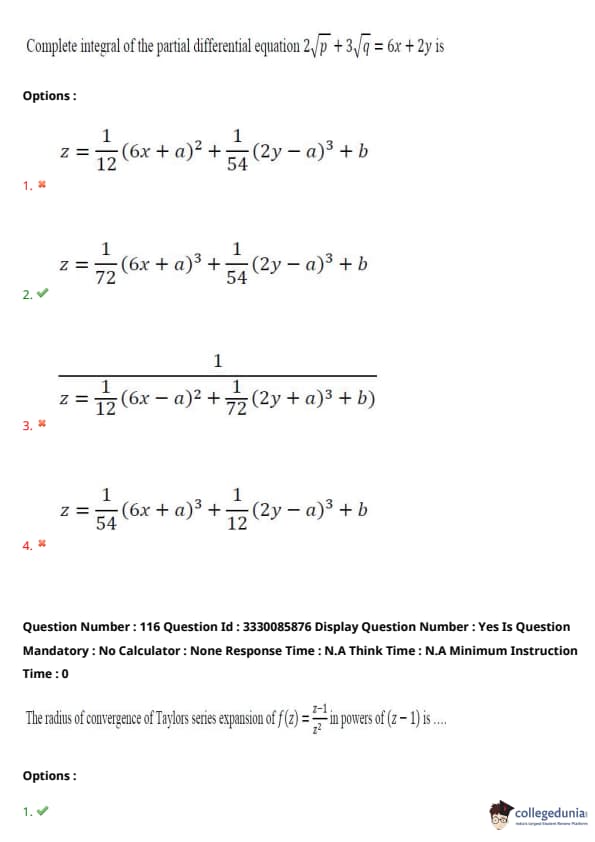
Complete integral of the partial differential equation \( 2\frac{\partial^2 f}{\partial q^2} + 3\frac{\partial f}{\partial q} = 6x + 2y \) is
- (1) \( z = \frac{1}{12}(6x + a)^2 + \frac{1}{54}(2y - a)^3 + b \)
- (2) \( z = \frac{1}{72}(6x - a)^3 + \frac{1}{54}(2y - a)^3 + b \)
- (3) \( z = \frac{1}{12}(6x - a)^2 + \frac{1}{72}(2y - a)^3 + b \)
- (4) \( z = \frac{1}{54}(6x - a)^3 + \frac{1}{12}(2y - a)^3 + b \)
Question 115:
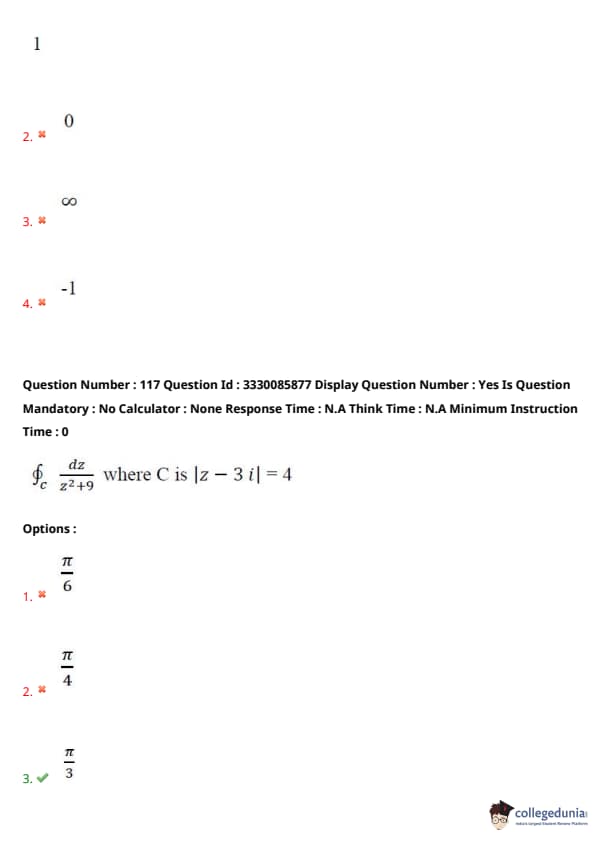
The radius of convergence of Taylor's series expansion of \( f(z) = \frac{1}{(z - 1)^2} \) in powers of \( (z - 1) \) is ...
- (1) 1
- (2) 0
- (3) \( \infty \)
- (4) -1
Question 116:
Evaluate \( \int_C \frac{dz}{z^2 + 9} \), where \( C \) is \( |z - 3| = 4 \)
- (1) \( \frac{\pi}{6} \)
- (2) \( \frac{\pi}{4} \)
- (3) \( \frac{\pi}{3} \)
- (4) \( \frac{\pi}{2} \)
Question 117:
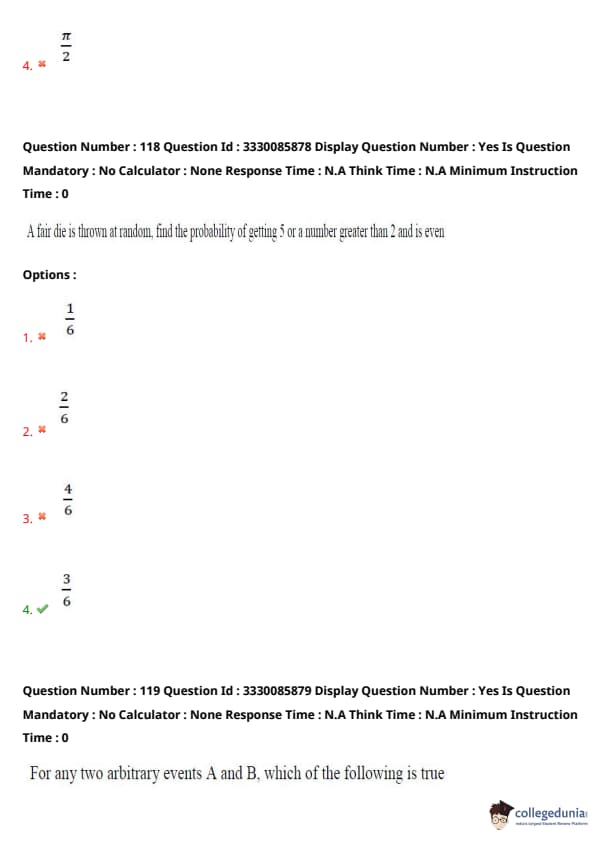
A die is thrown at random, find the probability of getting 5 or a number greater than 2 and is even
- (1) \( \frac{1}{6} \)
- (2) \( \frac{2}{6} \)
- (3) \( \frac{4}{6} \)
- (4) \( \frac{3}{6} \)
Question 118:
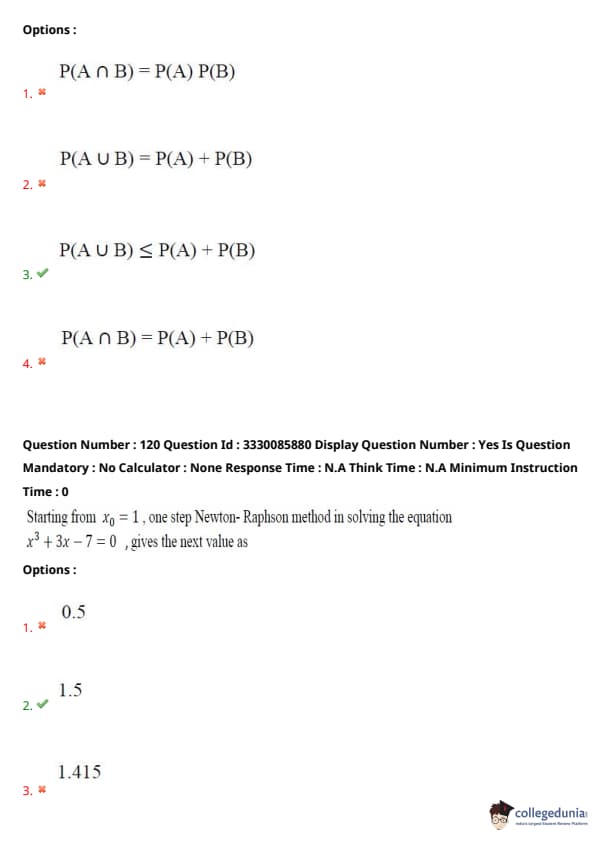
For any two arbitrary events \( A \) and \( B \), which of the following is true?
- (1) \( P(A \cap B) = P(A) P(B) \)
- (2) \( P(A \cup B) = P(A) + P(B) \)
- (3) \( P(A \cup B) \leq P(A) + P(B) \)
- (4) \( P(A \cap B) = P(A) + P(B) \)
Question 119:
Starting from \( x_0 = 1 \), one step Newton-Raphson method in solving the equation \( x^3 + 3x - 7 = 0 \) gives the next value as
- (1) 0.5
- (2) 1.5
- (3) 1.415
- (4) 1.9





 Download








Comments