




AP PGECET 2024 Instrumentation Engineering Question Paper is available for download here. Sri Venkateswara University, Tirupati on behalf of APSCHE conducted AP PGECET 2024 Instrumentation Engineering on May 31 in Shift 1 from 9 AM to 11 AM. AP PGECET Question Paper 2024 consists of 120 MCQ-based questions in total carrying 1 mark each to be attempted in the duration of 2 hours.
AP PGECET 2024 Instrumentation Engineering Question Paper with Answer Key PDF
| AP PGECET 2024 Instrumentation Engineering Question Paper with Answer Key |  Download Download |
Check Solution |

Question 1:
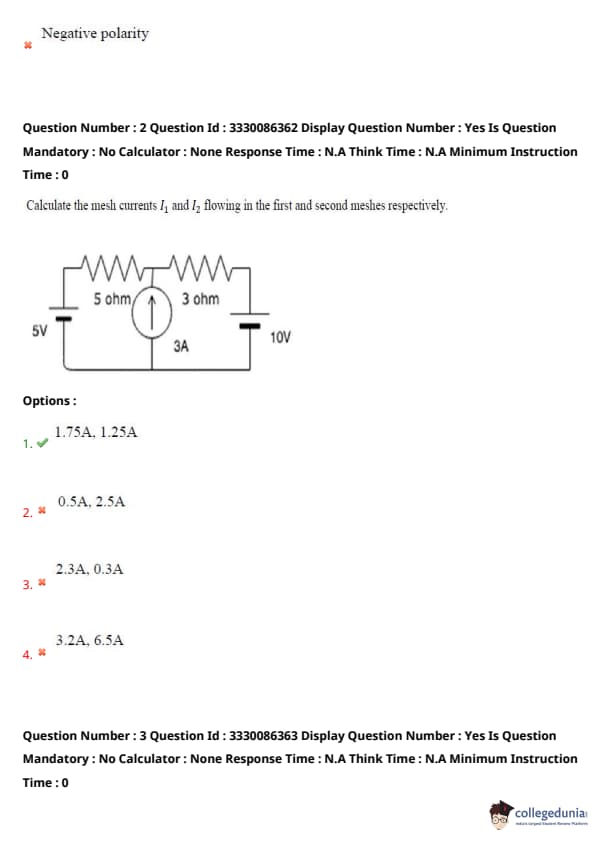
The algebraic sum of voltages around any closed path in a network is equal to \hspace{2cm}.Question 2: Calculate the mesh currents \(I_1\) and \(I_2\) flowing in the first and second meshes respectively.
![]()
Circuit Description: Left mesh (Mesh 1): 5V source (+ up), 5 ohm resistor, 3A current source (up). Right mesh (Mesh 2): 3A current source (up), 3 ohm resistor, 10V source (+ up). I1 assumed CW, I2 assumed CW.

Circuit Description: Left mesh (Mesh 1): 5V source (+ up), 5 ohm resistor, 3A current source (up). Right mesh (Mesh 2): 3A current source (up), 3 ohm resistor, 10V source (+ up). I1 assumed CW, I2 assumed CW.
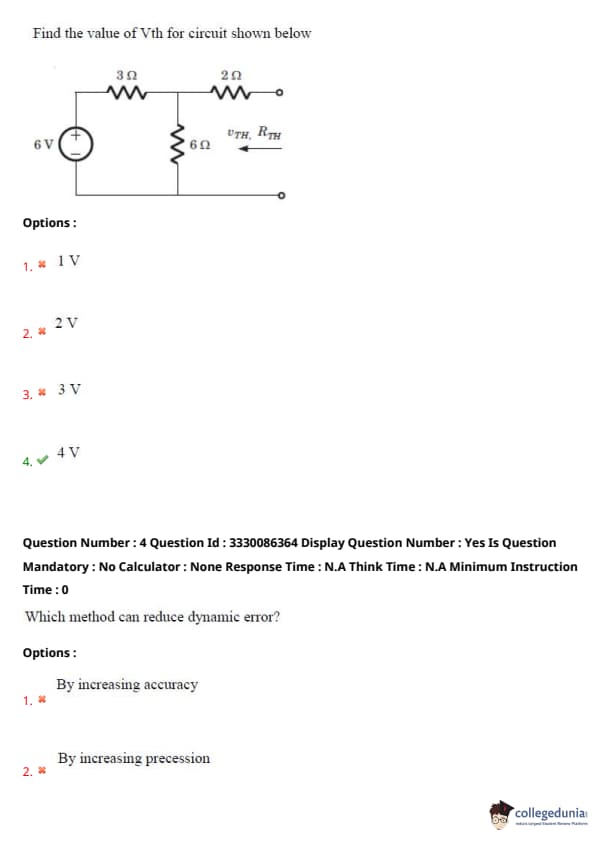
Question 3: Find the value of Vth for circuit shown below
![image]()
Circuit Description: 6V source series 3 Ohm, parallel 6 Ohm. Output node taken after the parallel combo, then series 2 Ohm to terminals.
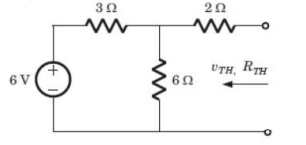
Circuit Description: 6V source series 3 Ohm, parallel 6 Ohm. Output node taken after the parallel combo, then series 2 Ohm to terminals.
Question 4: Which method can reduce dynamic error?
Question 5: What is the relative error percentage of an observation taken by an ultrasonic sensor which predicts the distance of an object to be 2.12 cm but the actual value is 2 cm?
Question 6: Which among the following is not a dynamic characteristic?
Question 7: Which of the following error is not a systematic error?
Question 8:
The ratio of the current transform at one port to current transform at other port is called \hspace{2cm}.
Question 9: If there are 10 nodes in a circuit, how many equations do we get?
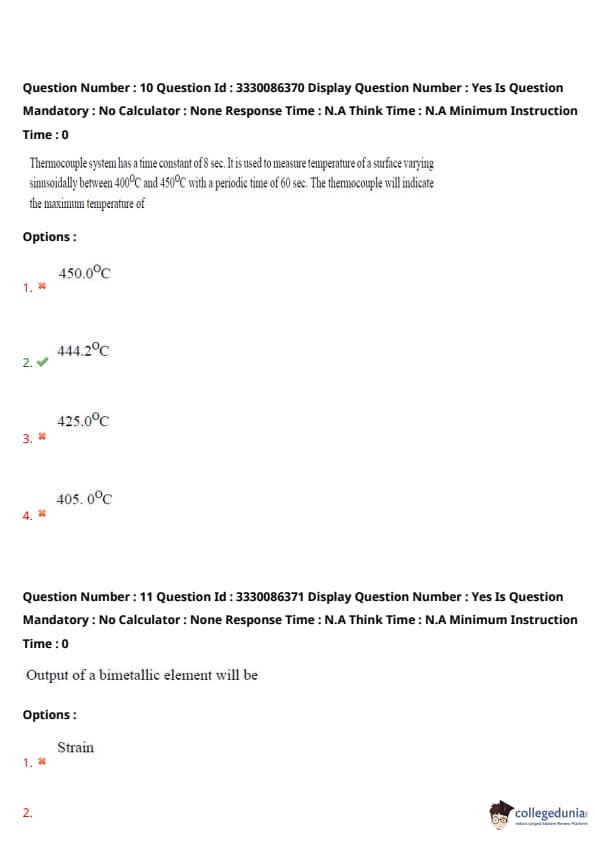
Question 10: Thermocouple system has a time constant of 8 sec. It is used to measure temperature of a surface varying sinusoidally between 400\(^\circ\)C and 450\(^\circ\)C with a periodic time of 60 sec. The thermocouple will indicate the maximum temperature of
Question 11:
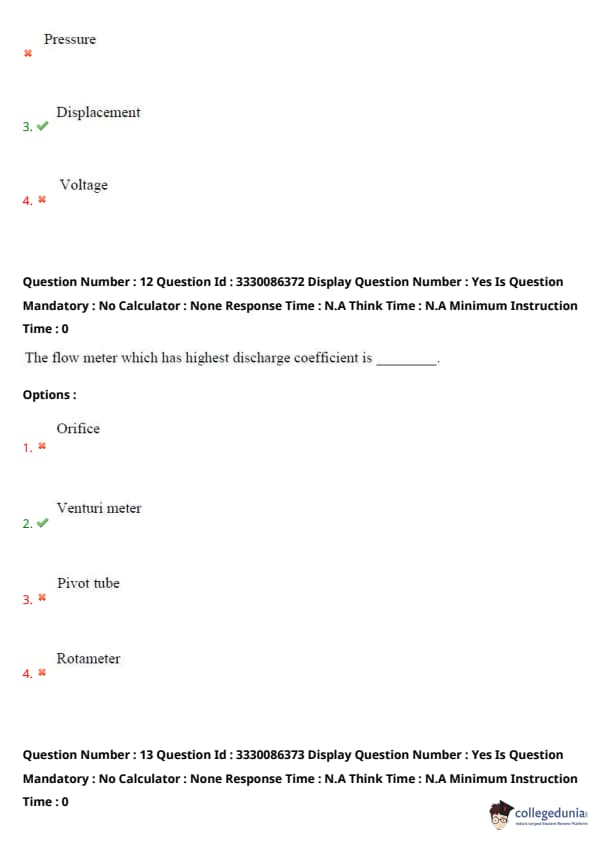
Output of a bimetallic element will be
Question 12: The flow meter which has highest discharge coefficient is \hspace{2cm}.
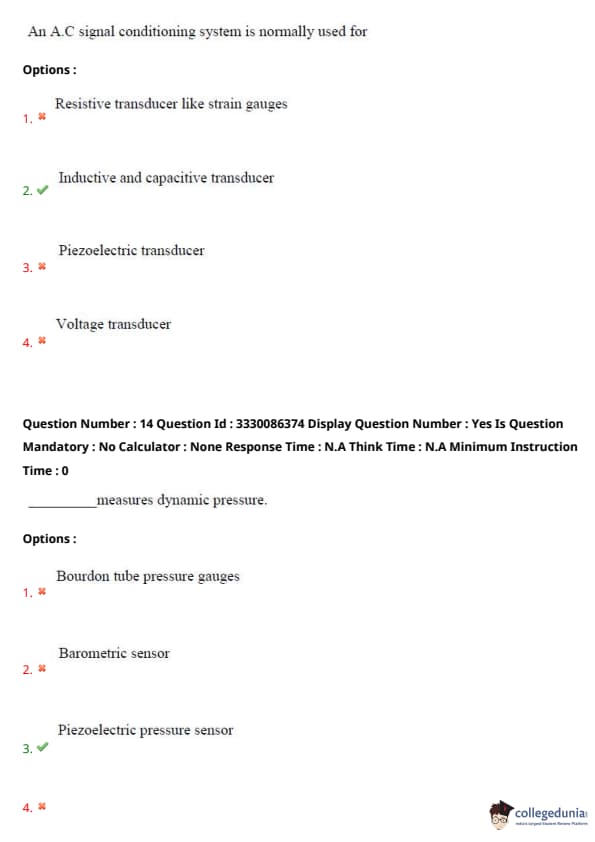
Question 13: An A.C signal conditioning system is normally used for
Question 14: \hspace{2cm} measures dynamic pressure.
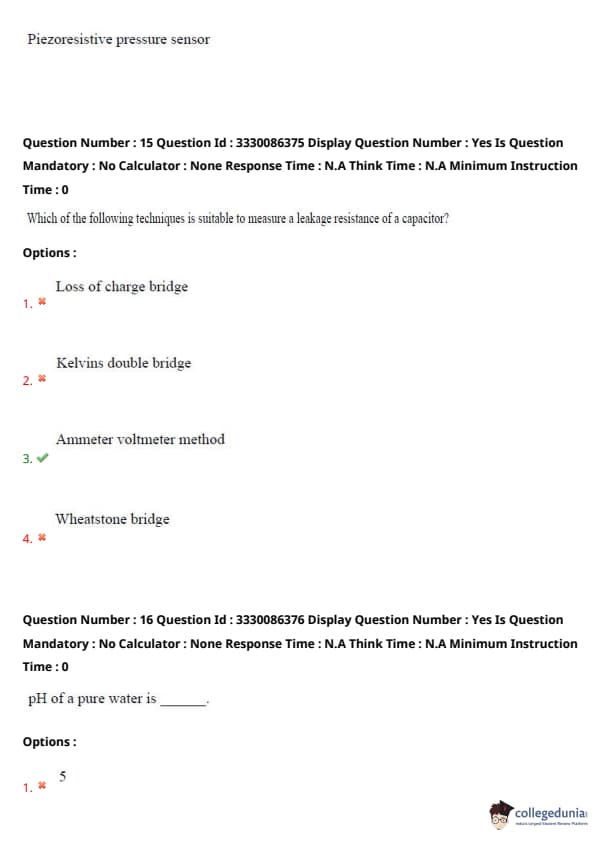
Question 15: Which of the following techniques is suitable to measure a leakage resistance of a capacitor?
Question 16: pH of a pure water is \hspace{2cm}.
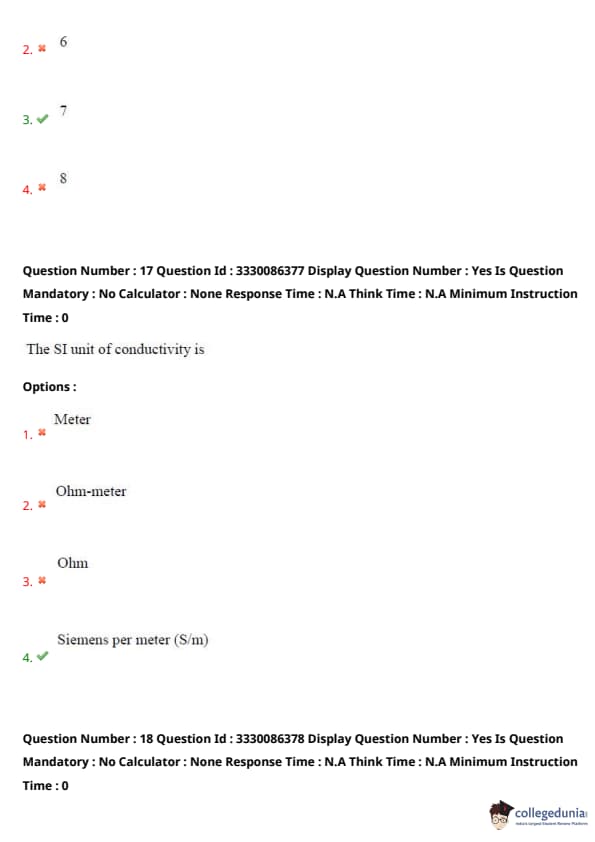
Question 17: The SI unit of conductivity is
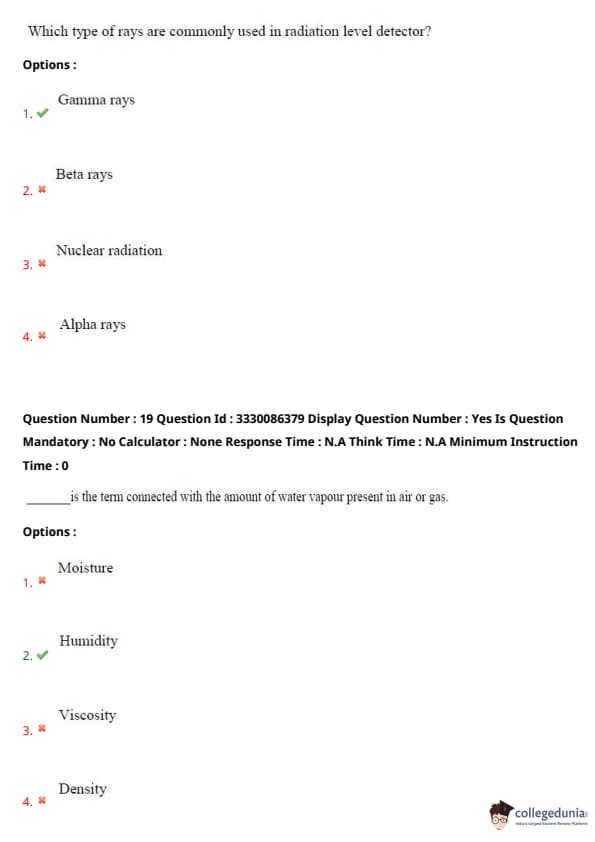
Question 18: Which type of rays are commonly used in radiation level detector?
Question 19: \hspace{2cm} is the term connected with the amount of water vapour present in air or gas.
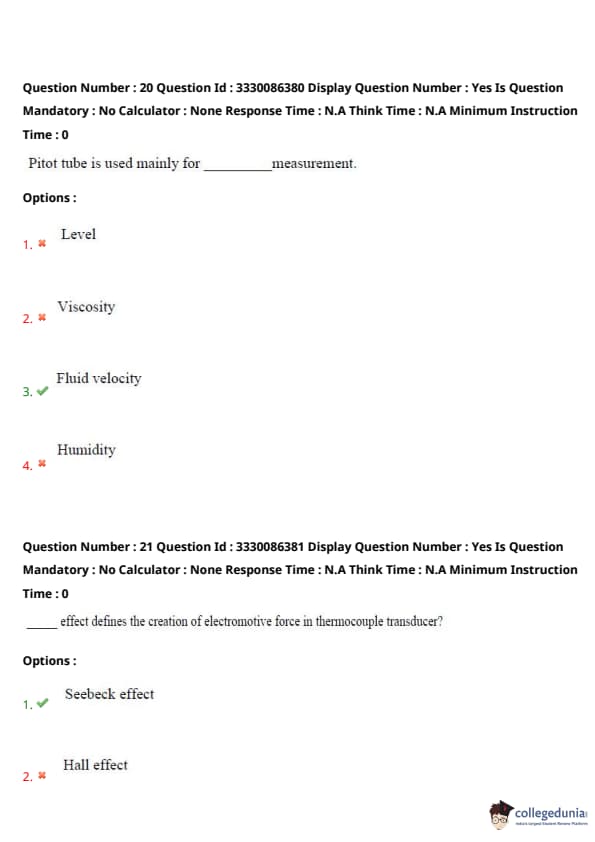
Question 20: Pitot tube is used mainly for \hspace{2cm} measurement.
Question 21: \hspace{2cm} effect defines the creation of electromotive force in thermocouple transducer?
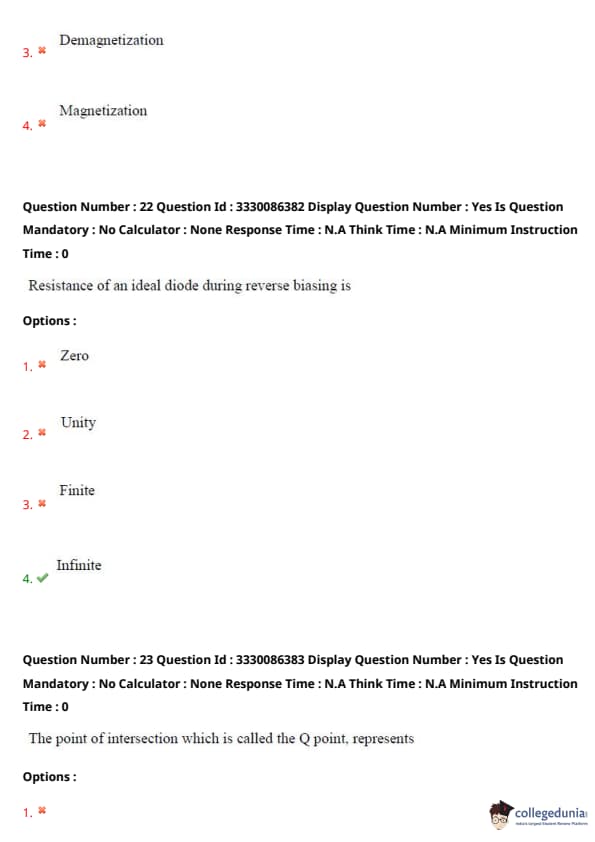
Question 22: Resistance of an ideal diode during reverse biasing is
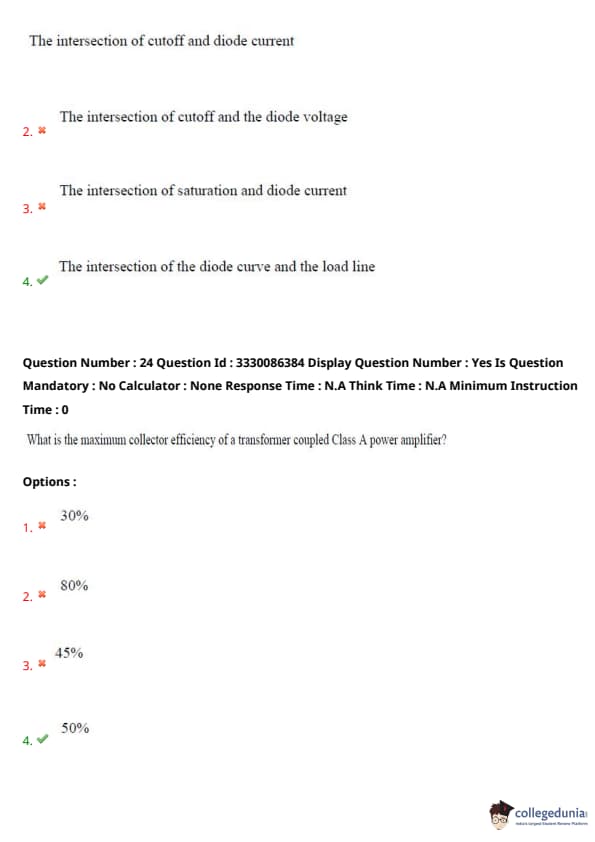
Question 23: The point of intersection which is called the Q point, represents
Question 24: What is the maximum collector efficiency of a transformer coupled Class A power amplifier?
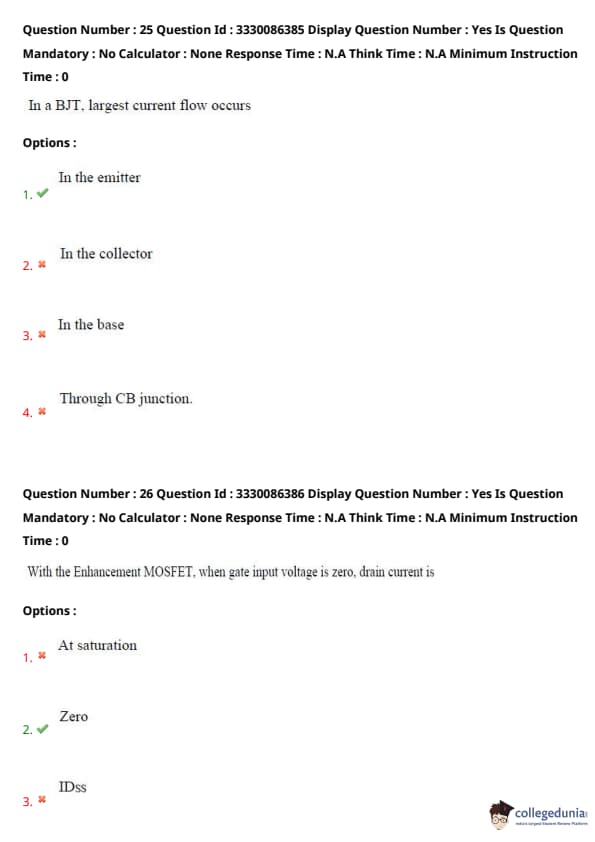
Question 25: In a BJT, largest current flow occurs
Question 26: With the Enhancement MOSFET, when gate input voltage is zero, drain current is
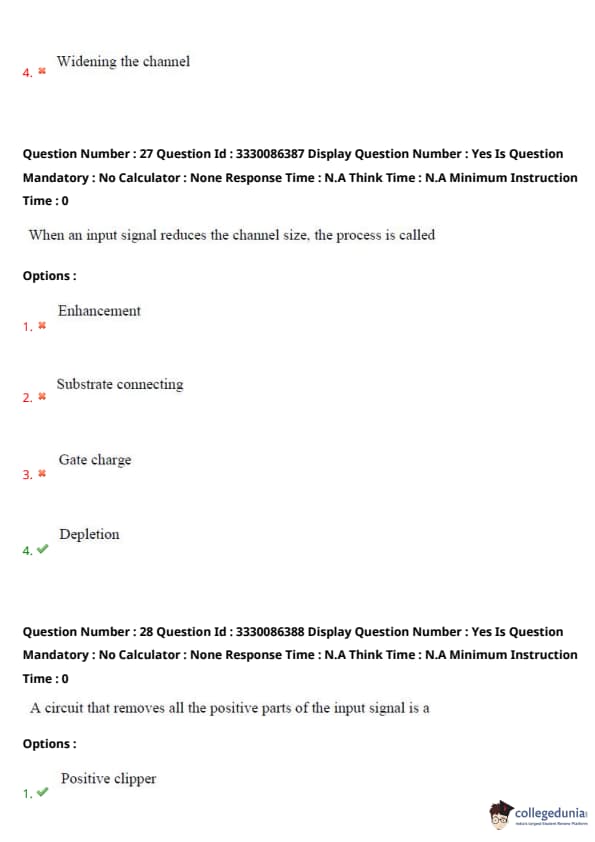
Question 27: When an input signal reduces the channel size, the process is called
Question 28: A circuit that removes all the positive parts of the input signal is a
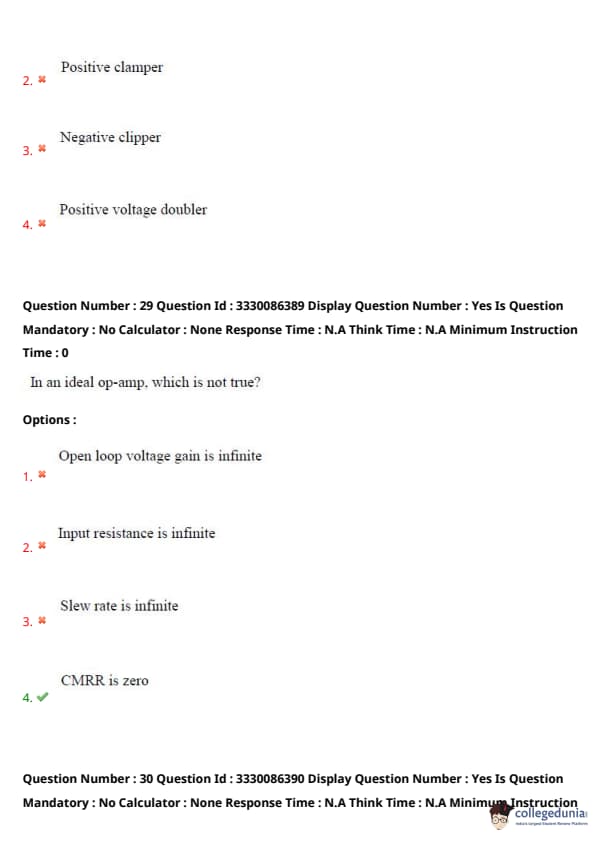
Question 29: In an ideal op-amp, which is not true?
Question 30: What is the use of the compensation capacitor in op-amp?
Question 31: What instrument is used to amplify output signal of transducer
Question 32: \hspace{2cm} and Current series are series type feedback connections.
Question 33: The value of feedback resistor and resistor connected in series with the input signal source are equal to 10k\(\Omega\) and 3.3k\(\Omega\). Calculate the closed loop voltage gain?
Question 34: The current to voltage converter photosensitive device can be used as
Question 35: Which of the oscillators doesn't come under the category of low frequency oscillators?
Question 36: In RC phase shift oscillator, one R-C bridge provides \hspace{2cm} phase shift
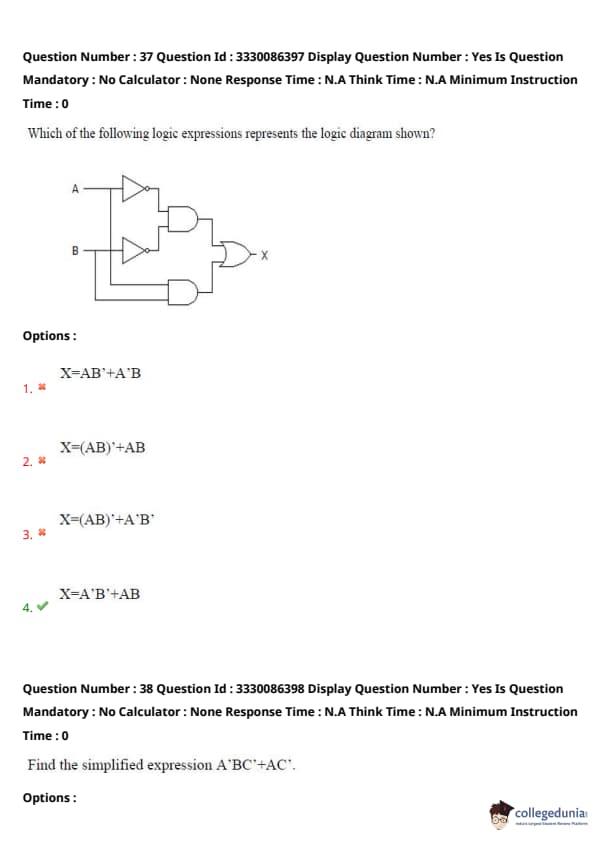
Question 37: Which of the following logic expressions represents the logic diagram shown?
![]()
(1) X=AB'+A'B
(2) X=(AB)'+AB
(3) X=(AB)'+A'B'
(4) X=A'B'+AB

(1) X=AB'+A'B
(2) X=(AB)'+AB
(3) X=(AB)'+A'B'
(4) X=A'B'+AB
Question 38: Find the simplified expression A'BC' + AC'.
Question 39: Which gate is called the anticoincidence and coincidence gate respectively?
Question 40: The parity check detection is done using
Question 41: The code where all successive numbers differ from their preceding number by a single bit is \hspace{2cm}
Question 42: How many inputs are required for a digital comparator?
Question 43: How many 3-line-to-8-line decoders are required for a 1-of-32 decoder?
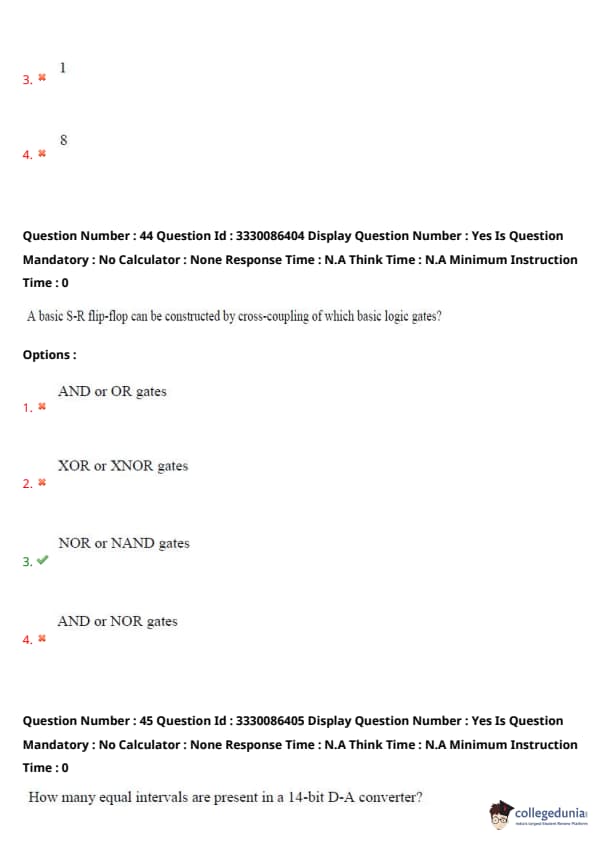
Question 44: A basic S-R flip-flop can be constructed by cross-coupling of which basic logic gates?
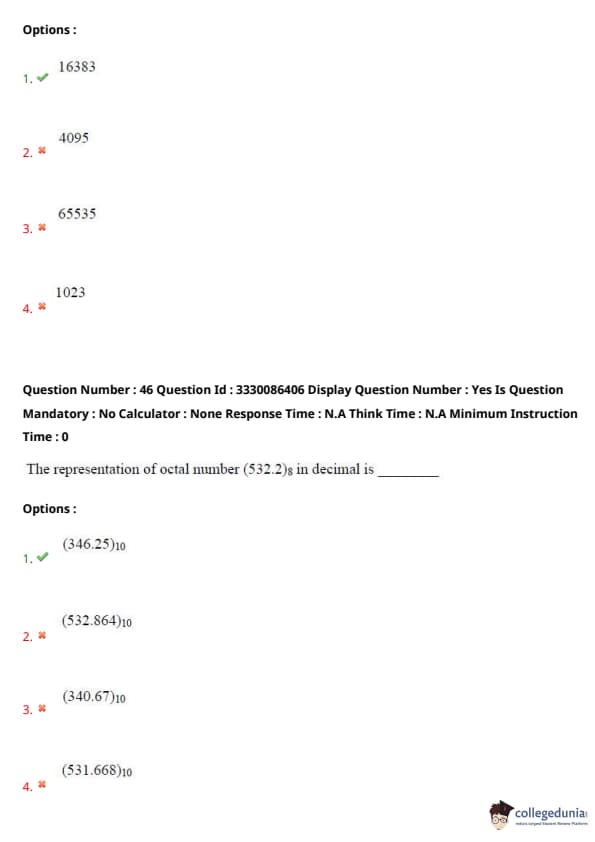
Question 45: How many equal intervals are present in a 14-bit D-A converter?
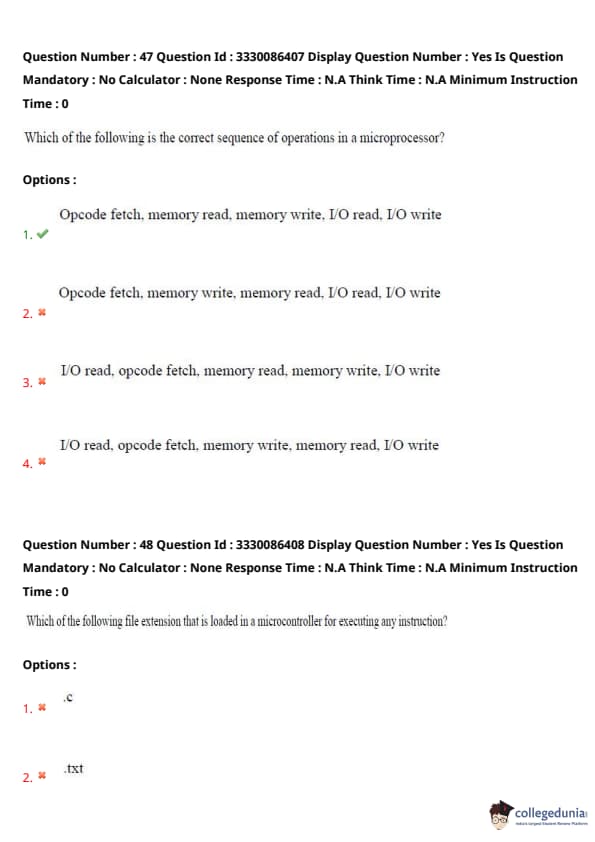
Question 46: The representation of octal number (532.2)\(_8\) in decimal is \underline{\hspace{2cm
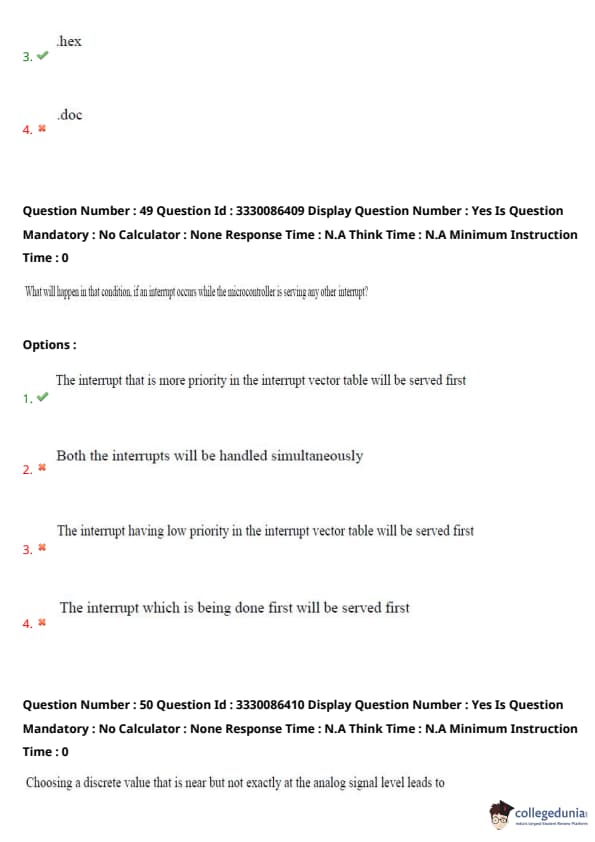
Question 47: Which of the following is the correct sequence of operations in a microprocessor?
Question 48: Which of the following file extension that is loaded in a microcontroller for executing any instruction?
Question 49: What will happen in that condition, if an interrupt occurs while the microcontroller is serving any other interrupt?
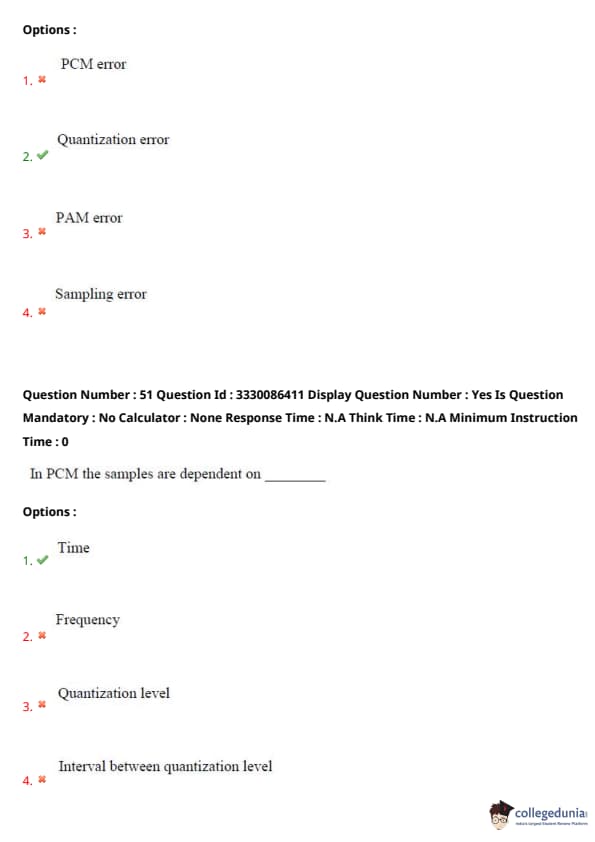
Question 50: Choosing a discrete value that is near but not exactly at the analog signal level leads to
Question 51: In PCM the samples are dependent on \hspace{2cm}
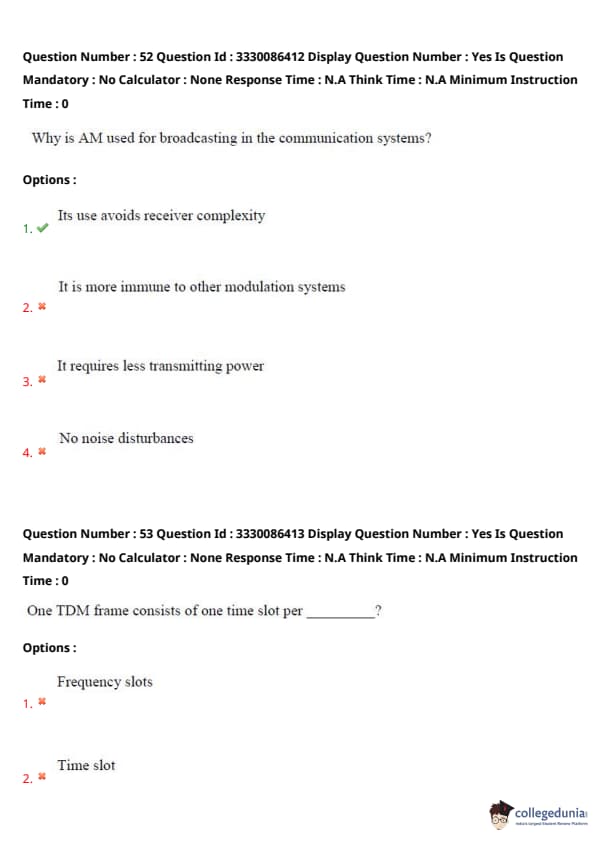
Question 52: Why is AM used for broadcasting in the communication systems?
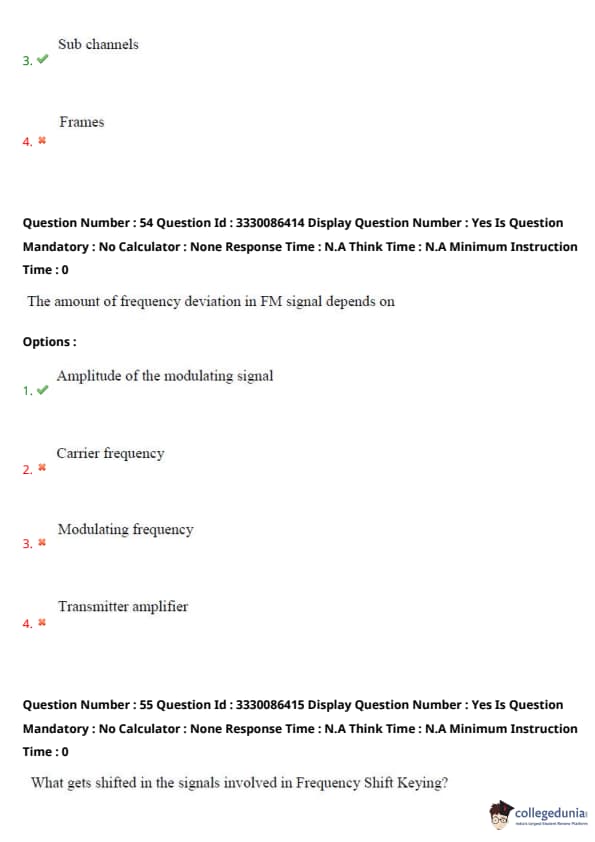
Question 53: One TDM frame consists of one time slot per \hspace{2cm} ?
Question 54: The amount of frequency deviation in FM signal depends on
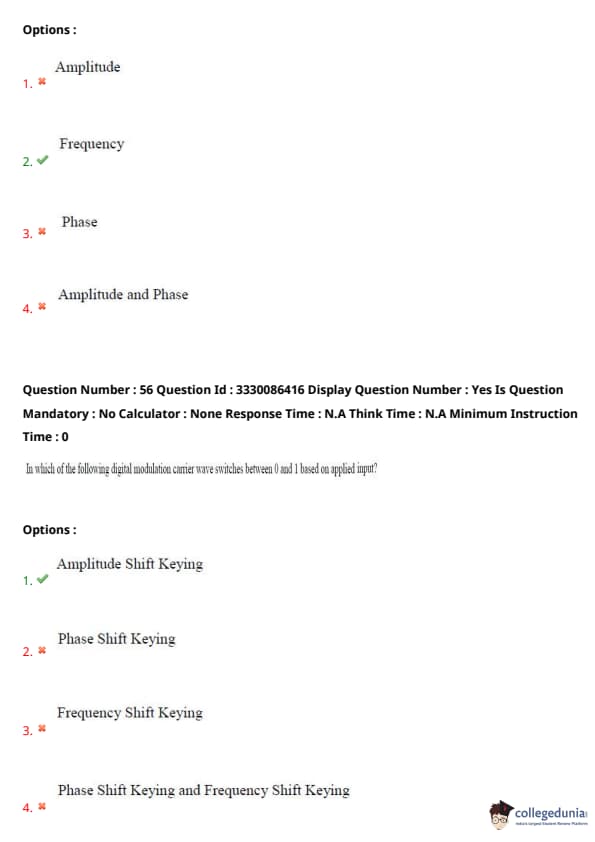
Question 55: What gets shifted in the signals involved in Frequency Shift Keying?
Question 56: In which of the following digital modulation carrier wave switches between 0 and 1 based on applied input?
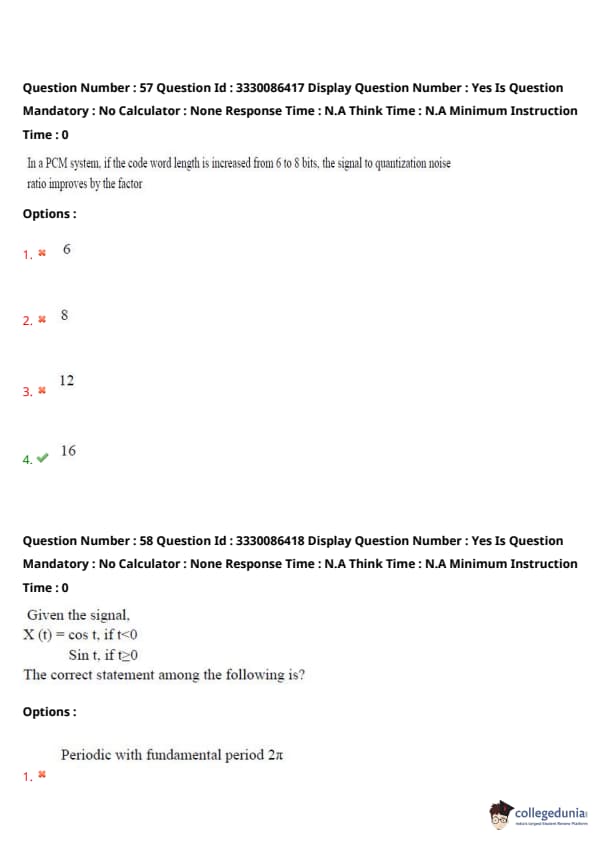
Question 57: In a PCM system, if the code word length is increased from 6 to 8 bits, the signal to quantization noise ratio improves by the factor
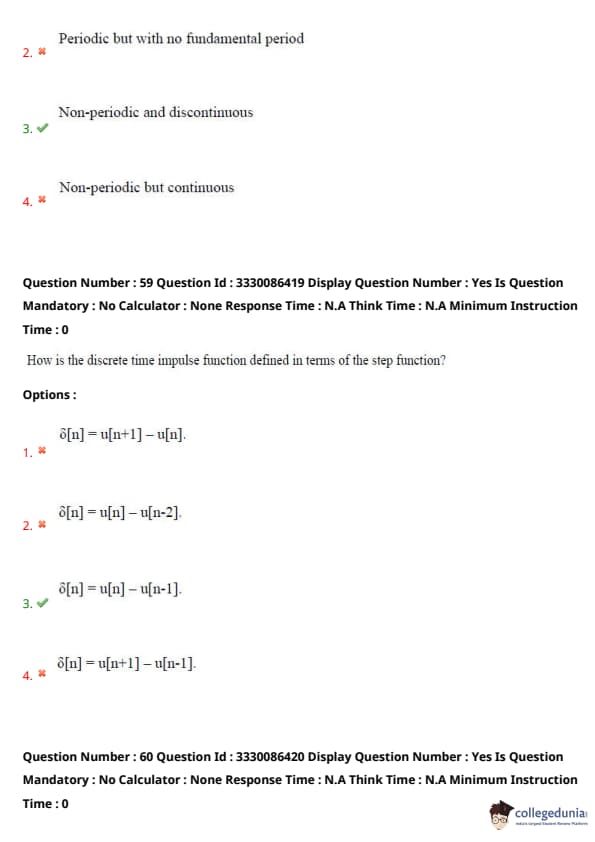
Question 58: Given the signal,
X(t) = cos t, if t\textless0
Sin t, if t\(\ge\)0
The correct statement among the following is?
X(t) = cos t, if t\textless0
Sin t, if t\(\ge\)0
The correct statement among the following is?
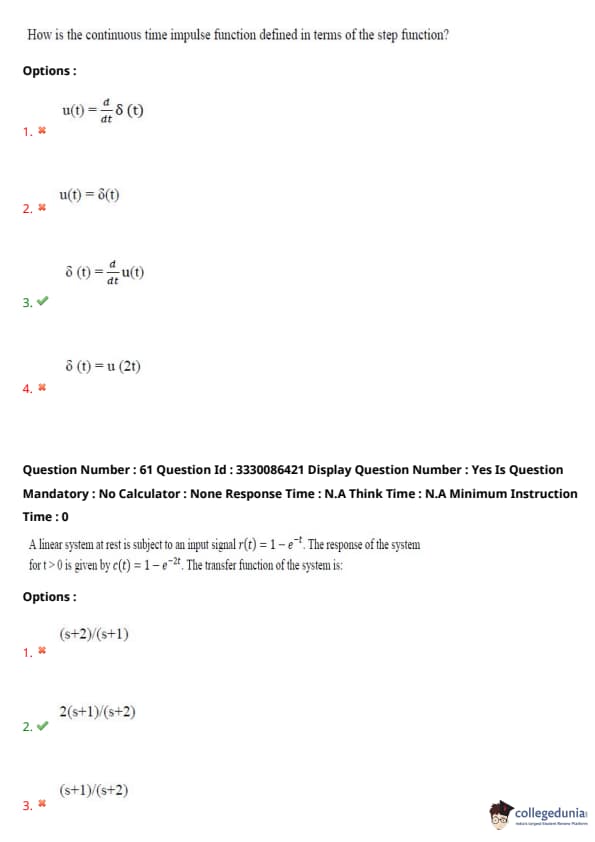
Question 59: How is the discrete time impulse function defined in terms of the step function?
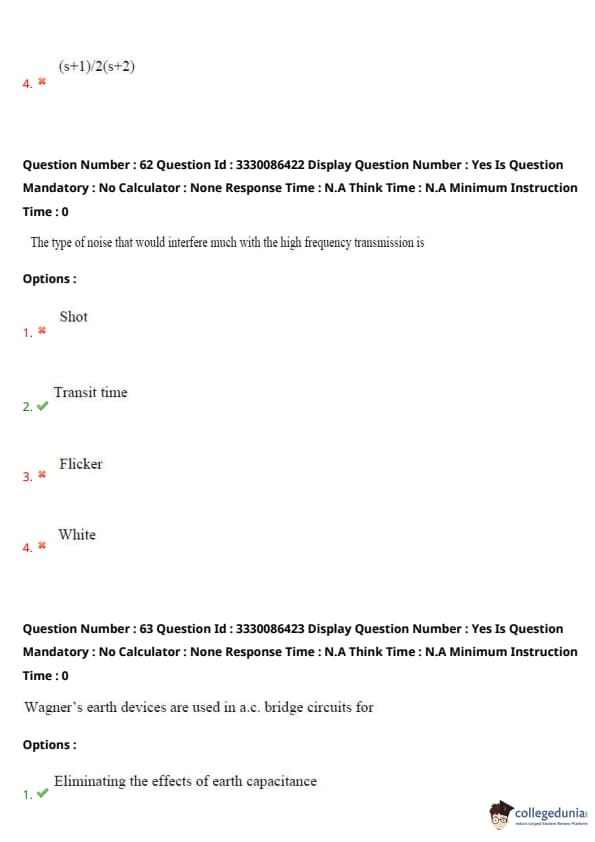
Question 60: How is the continuous time impulse function defined in terms of the step function?
Question 61: A linear system at rest is subject to an input signal \(r(t) = 1 - e^{-t}\). The response of the system for t>0 is given by \(c(t) = 1 - e^{-2t}\). The transfer function of the system is:
Question 62: The type of noise that would interfere much with the high frequency transmission is
Question 63: Wagner's earth devices are used in a.c. bridge circuits for
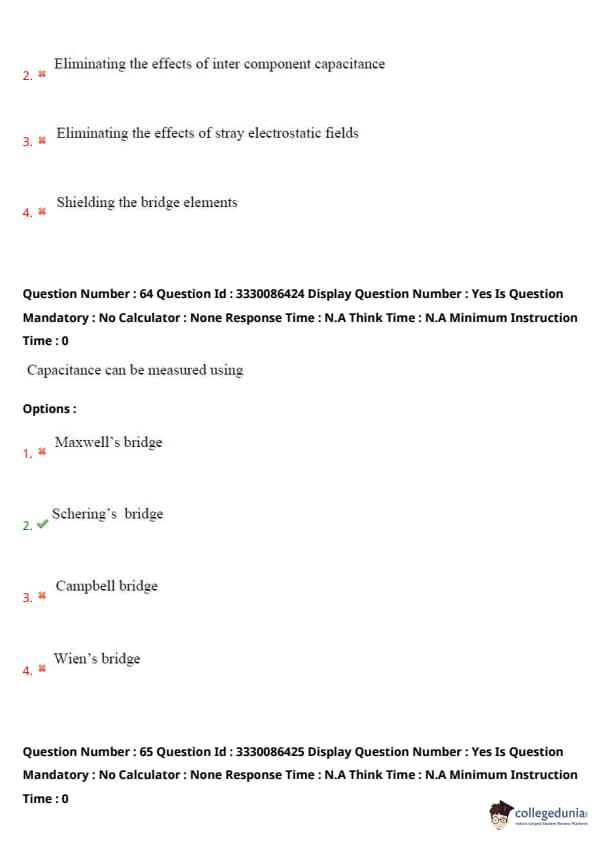
Question 64: Capacitance can be measured using
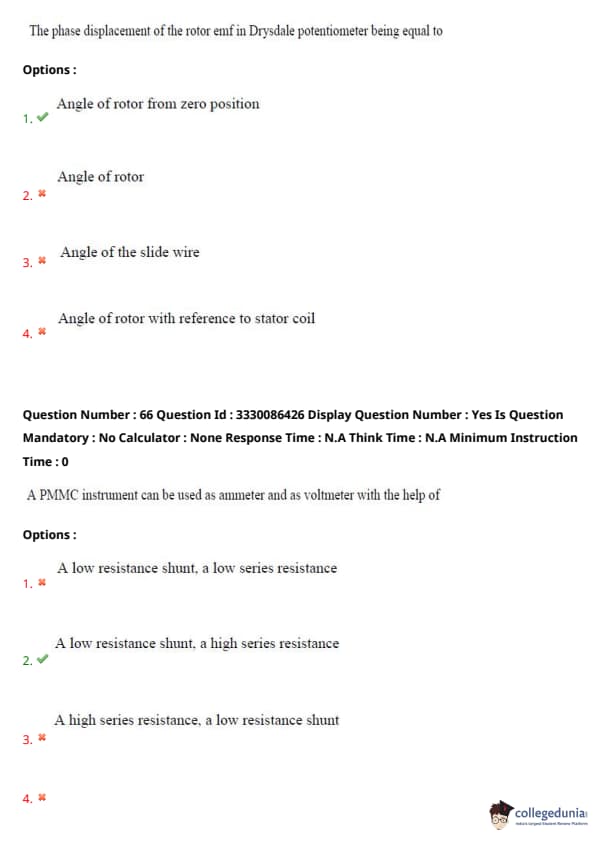
Question 65: The phase displacement of the rotor emf in Drysdale potentiometer being equal to
Question 66: A PMMC instrument can be used as ammeter and as voltmeter with the help of
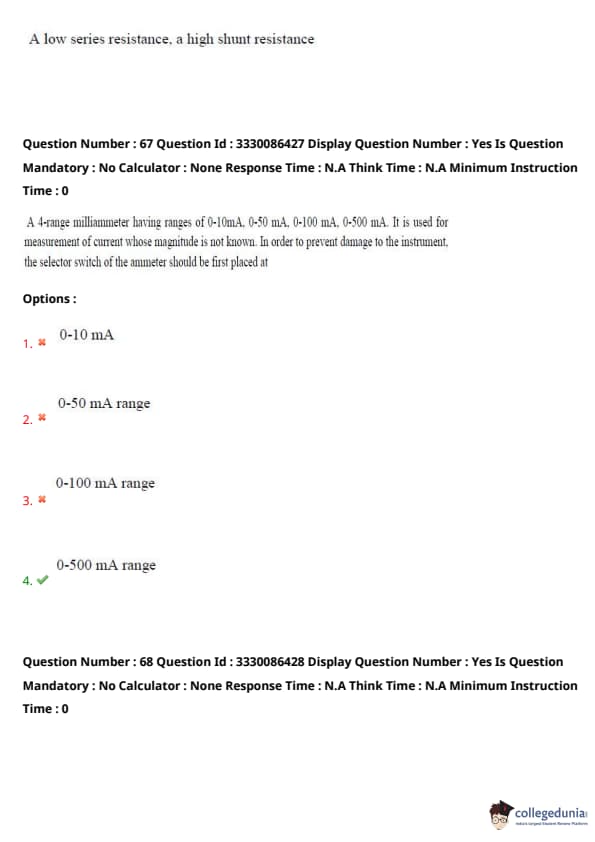
Question 67: A 4-range milliammeter having ranges of 0-10mA, 0-50 mA, 0-100 mA, 0-500 mA. It is used for measurement of current whose magnitude is not known. In order to prevent damage to the instrument, the selector switch of the ammeter should be first placed at

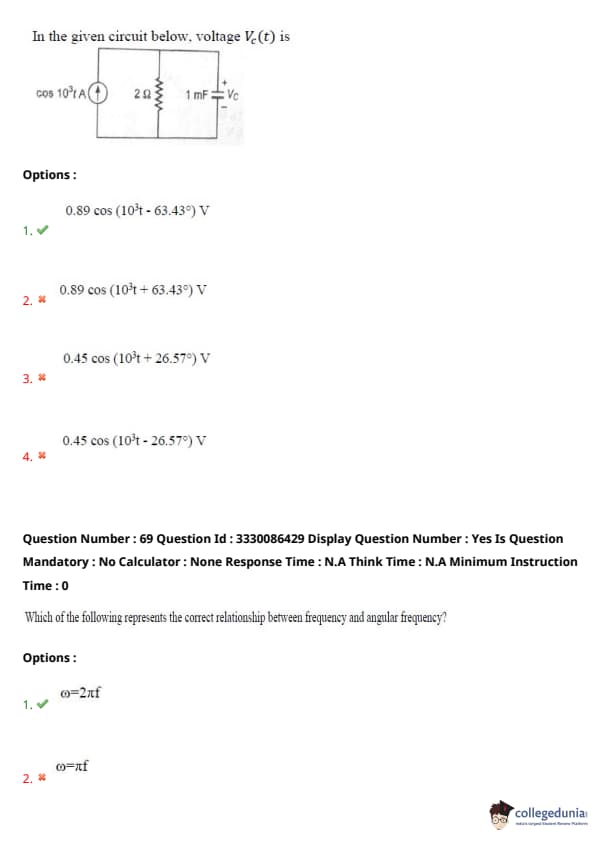
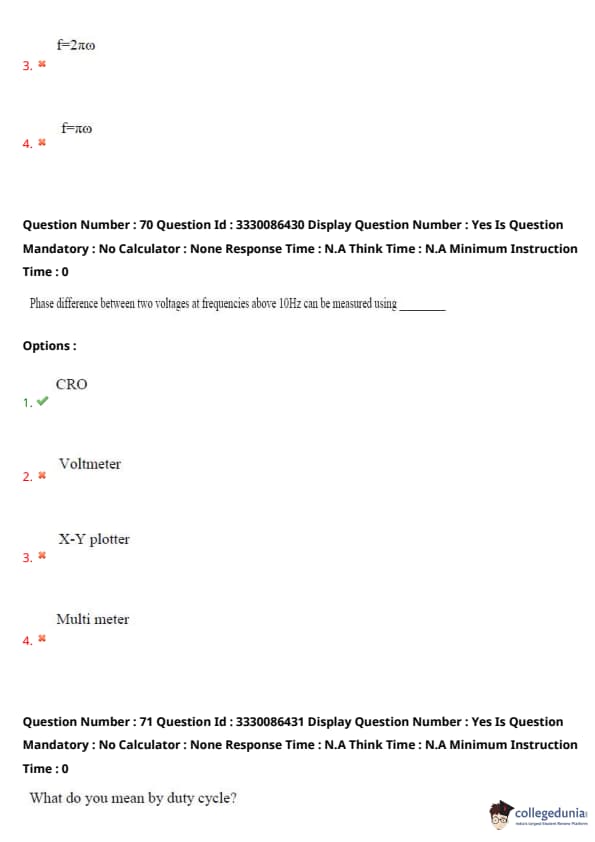
Question 69: Which of the following represents the correct relationship between frequency and angular frequency?
Question 70: Phase difference between two voltages at frequencies above 10Hz can be measured using \hspace{2cm}
Question 71: What do you mean by duty cycle?
Question 72: Typically oscilloscope represents \hspace{2cm}
Question 73: Stray capacitance effects can be minimized by \hspace{2cm}
Question 74: In serial communication, if the time interval to transmit one bit is 10 \(\mu\) sec. What is the time to transmit an 8-bit word?
Question 75: A node having only outgoing branches is called as \hspace{2cm}
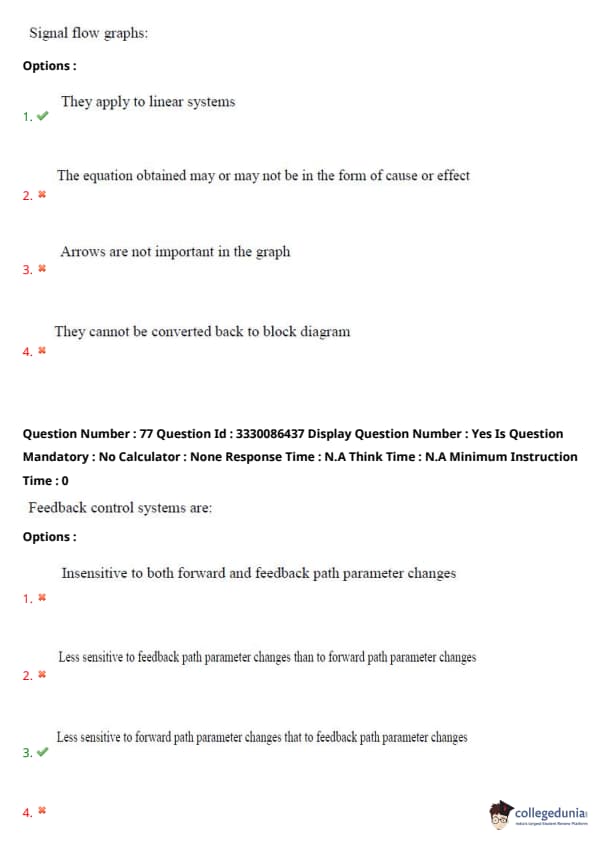
Question 76: Signal flow graphs:
Question 77:
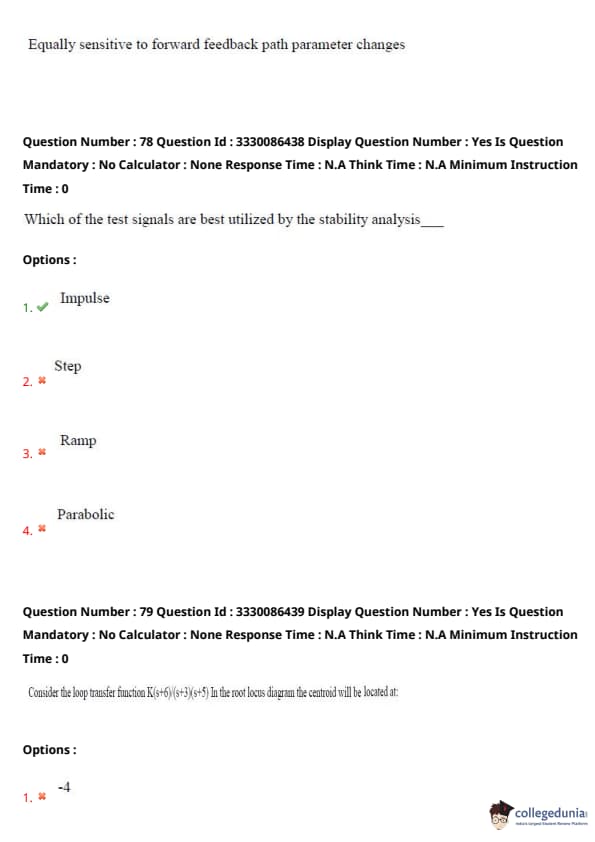
Feedback control systems are:
Question 78: Which of the test signals are best utilized by the stability analysis \hspace{2cm}
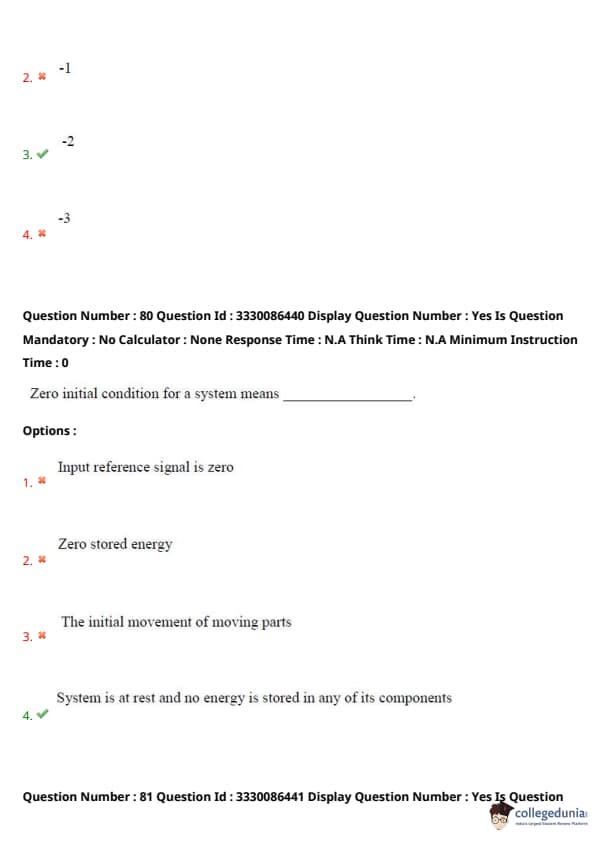
Question 79: Consider the loop transfer function K(s+6)/(s+3)(s+5). In the root locus diagram the centroid will be located at:
Question 80: Zero initial condition for a system means \hspace{2cm}
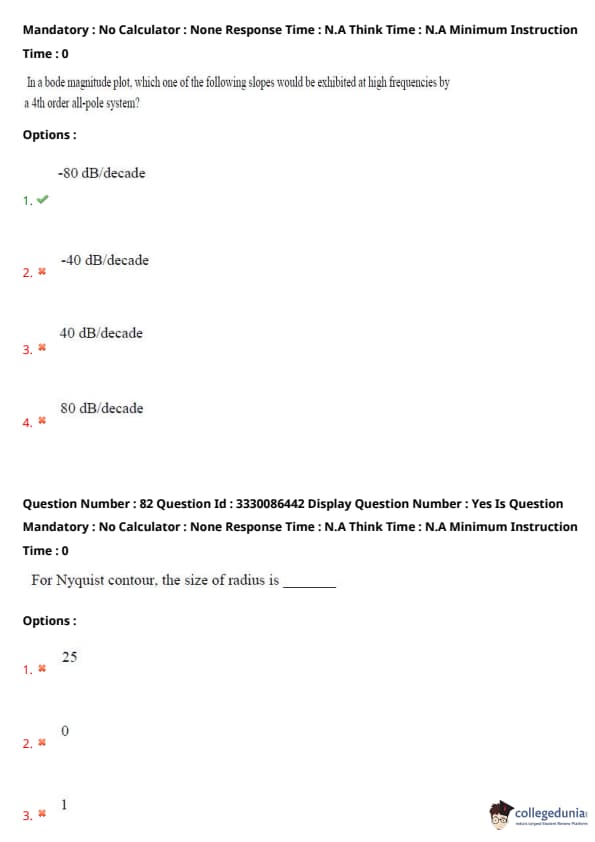
Question 81: In a bode magnitude plot, which one of the following slopes would be exhibited at high frequencies by a 4th order all-pole system?
Question 82: For Nyquist contour, the size of radius is \hspace{2cm}
Question 83: Derivative error compensation:
Question 84: Which one of the following controllers produces the output in three terms?
Question 85: Which component of a servo motor is responsible for providing feedback?

Question 87: In which type of system does power transmission takes place through compressed air?
Question 88: What pumps hydraulic oil to the hydraulic circuit?
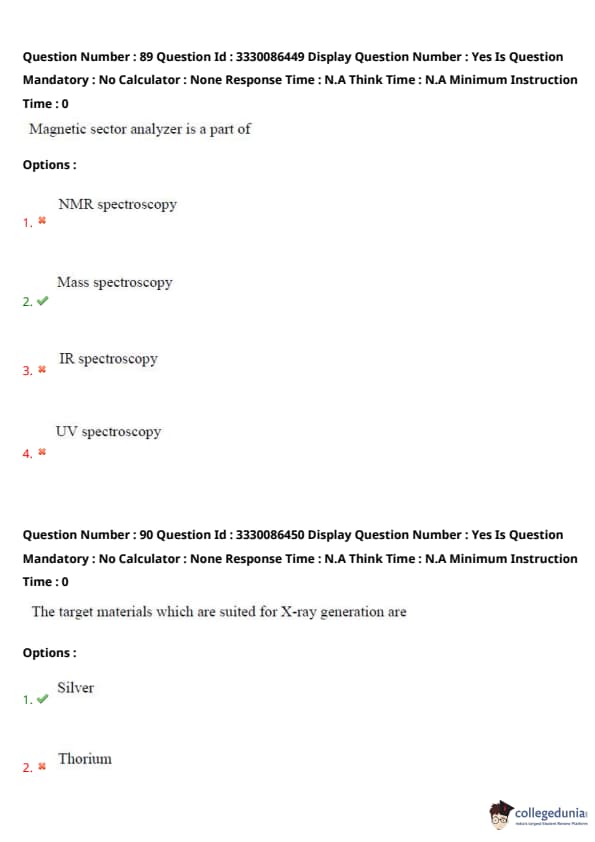
Question 89: Magnetic sector analyzer is a part of
Question 90: The target materials which are suited for X-ray generation are
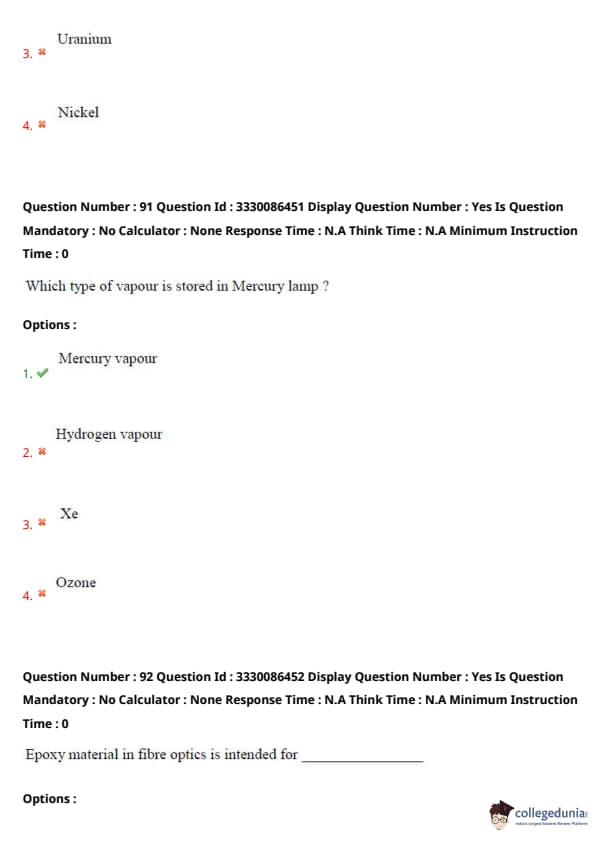
Question 91: Which type of vapour is stored in Mercury lamp ?
Question 92: Epoxy material in fibre optics is intended for \hspace{2cm}
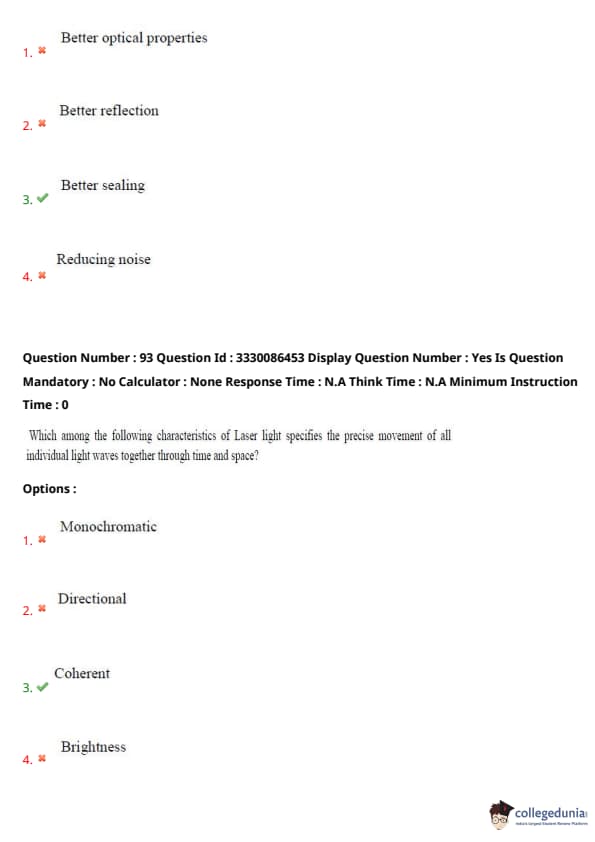
Question 93: Which among the following characteristics of Laser light specifies the precise movement of all individual light waves together through time and space?
Question 94: A device which converts electrical energy in the form of a current into optical energy is called as \hspace{2cm}.
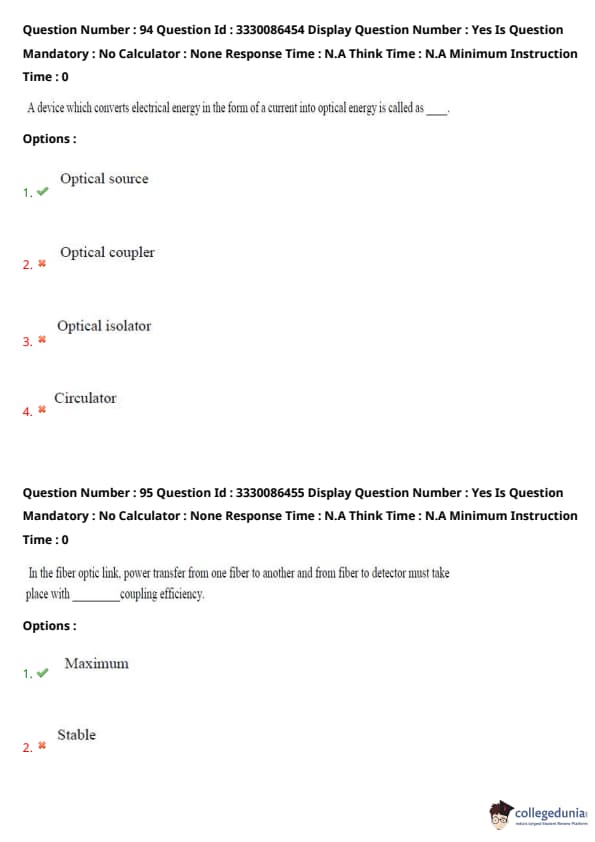
Question 95: In the fiber optic link, power transfer from one fiber to another and from fiber to detector must take place with \hspace{2cm} coupling efficiency.
Question 96: Recombination of electron-hole produces \hspace{2cm} in LEDs.
Question 97: Beer Lambert's law gives the relation between which of the following?
Question 98: Normal EEG frequency range is \hspace{2cm}
Question 99: Electroencephalogram is obtained from bioelectrical signals from the?
Question 100: Which of the following is the frequency range of ultrasonic detection?
Question 101: \hspace{2cm} is a part of the human temperature control system
Question 102: When nuclear radiations pass through, gas ionization is produced. This is the principle of which of the following detectors?
Question 103: Which among the following transducer is an example of active transducer?
Question 104: The ac series circuit is composed of a resistance of 20 \(\Omega\), inductive reactance of 40 \(\Omega\) and capacitive reactance of 15 \(\Omega\). If a current of 1 Ampere is flowing, then what is the applied voltage value?
Question 105: An ammeter is inserted in \hspace{2cm}
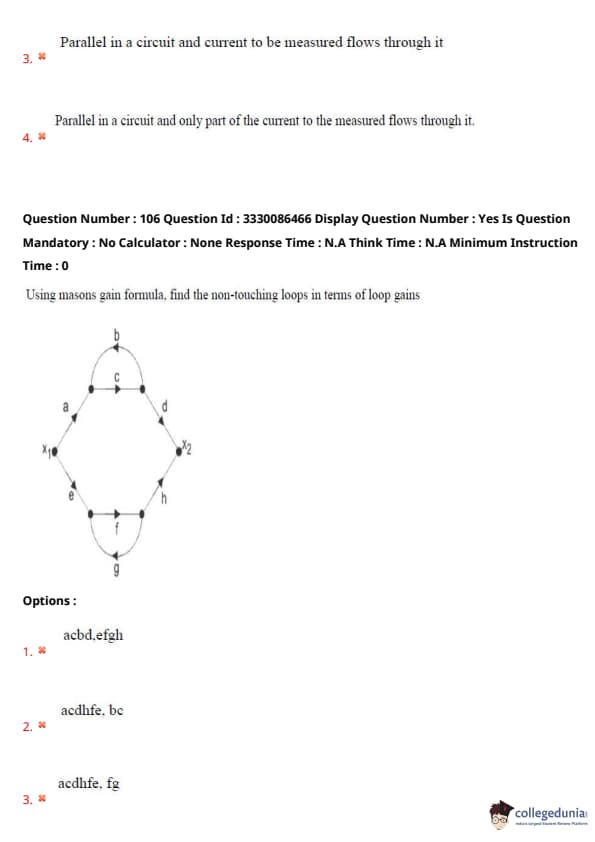
Question 106: Using masons gain formula, find the non-touching loops in terms of loop gains
![]()
Signal Flow Graph description: Nodes X1, intermediate nodes, X2. Path X1->e->f->h->X2. Path X1->a->b->c->d->X2. Loop b->c->b (gain bc). Loop f->g->f (gain fg).

Signal Flow Graph description: Nodes X1, intermediate nodes, X2. Path X1->e->f->h->X2. Path X1->a->b->c->d->X2. Loop b->c->b (gain bc). Loop f->g->f (gain fg).
Correct Answer: (4) bc, fg
- Loop 1: Starts at node after 'a', goes b \(\rightarrow\) c \(\rightarrow\) back to node after 'a'. The gain is \(L_1 = bc\).
- Loop 2: Starts at node after 'e', goes f \(\rightarrow\) g \(\rightarrow\) back to node after 'e'. The gain is \(L_2 = fg\).
Next, determine if these loops are non-touching. Two loops are non-touching if they do not share any common nodes.
- Loop 1 (bc) involves the nodes between a/b, b/c, and c/d.
- Loop 2 (fg) involves the nodes between e/f, f/g, and g/h.
Observing the diagram, these two sets of nodes are distinct; the loops do not share any nodes. Therefore, loops \(L_1\) (with gain bc) and \(L_2\) (with gain fg) are non-touching loops.
Mason's Gain Formula often requires identifying pairs (or higher orders) of non-touching loops. The pair of non-touching loops has gains bc and fg. Option 4 lists these two loop gains. The other options list paths or combinations that aren't pairs of non-touching loop gains.
Quick Tip: \textbf{Signal Flow Graph Loops.} A loop starts and ends at the same node, following branch directions. Two loops are non-touching if they share no common nodes. Mason's Gain Formula uses sums of individual loop gains, sums of products of pairs of non-touching loop gains, etc.
View Solution
First, identify the individual loops in the signal flow graph and their gains (assuming forward path gains are represented by the letters):- Loop 1: Starts at node after 'a', goes b \(\rightarrow\) c \(\rightarrow\) back to node after 'a'. The gain is \(L_1 = bc\).
- Loop 2: Starts at node after 'e', goes f \(\rightarrow\) g \(\rightarrow\) back to node after 'e'. The gain is \(L_2 = fg\).
Next, determine if these loops are non-touching. Two loops are non-touching if they do not share any common nodes.
- Loop 1 (bc) involves the nodes between a/b, b/c, and c/d.
- Loop 2 (fg) involves the nodes between e/f, f/g, and g/h.
Observing the diagram, these two sets of nodes are distinct; the loops do not share any nodes. Therefore, loops \(L_1\) (with gain bc) and \(L_2\) (with gain fg) are non-touching loops.
Mason's Gain Formula often requires identifying pairs (or higher orders) of non-touching loops. The pair of non-touching loops has gains bc and fg. Option 4 lists these two loop gains. The other options list paths or combinations that aren't pairs of non-touching loop gains.
Quick Tip: \textbf{Signal Flow Graph Loops.} A loop starts and ends at the same node, following branch directions. Two loops are non-touching if they share no common nodes. Mason's Gain Formula uses sums of individual loop gains, sums of products of pairs of non-touching loop gains, etc.
Question 107: A force sensor has a sensitivity of 0.01 mV/N. If the sensor outputs a voltage of 2 mV, what is the corresponding force (in Newtons)?

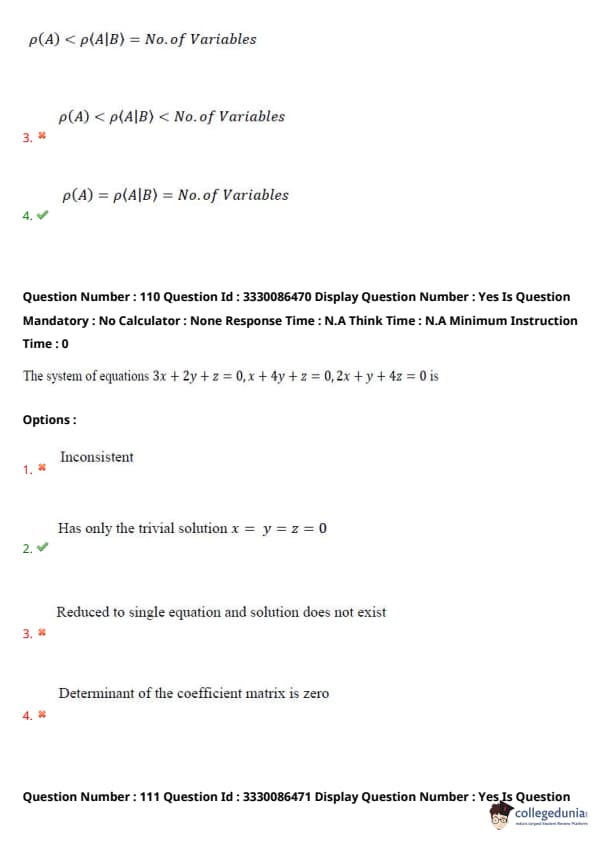
Question 109: The system AX=B has a unique solution if
Question 110: The system of equations \(3x + 2y + z = 0, x + 4y + z = 0, 2x + y + 4z = 0\) is
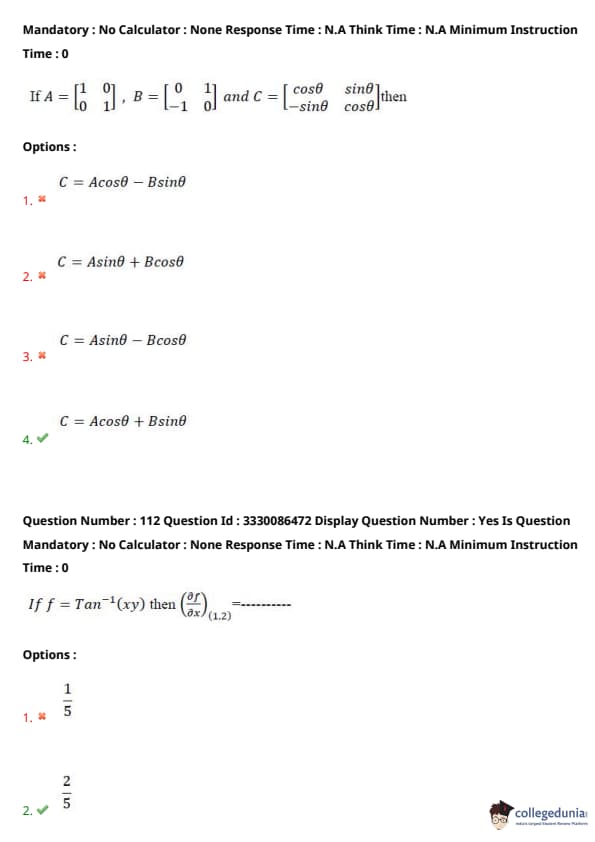
Question 111: If \( A = \begin{bmatrix} 1 & 0
0 & 1 \end{bmatrix} \), \( B = \begin{bmatrix} 0 & 1
-1 & 0 \end{bmatrix} \) and \( C = \begin{bmatrix} \cos\theta & \sin\theta
-\sin\theta & \cos\theta \end{bmatrix} \) then
0 & 1 \end{bmatrix} \), \( B = \begin{bmatrix} 0 & 1
-1 & 0 \end{bmatrix} \) and \( C = \begin{bmatrix} \cos\theta & \sin\theta
-\sin\theta & \cos\theta \end{bmatrix} \) then
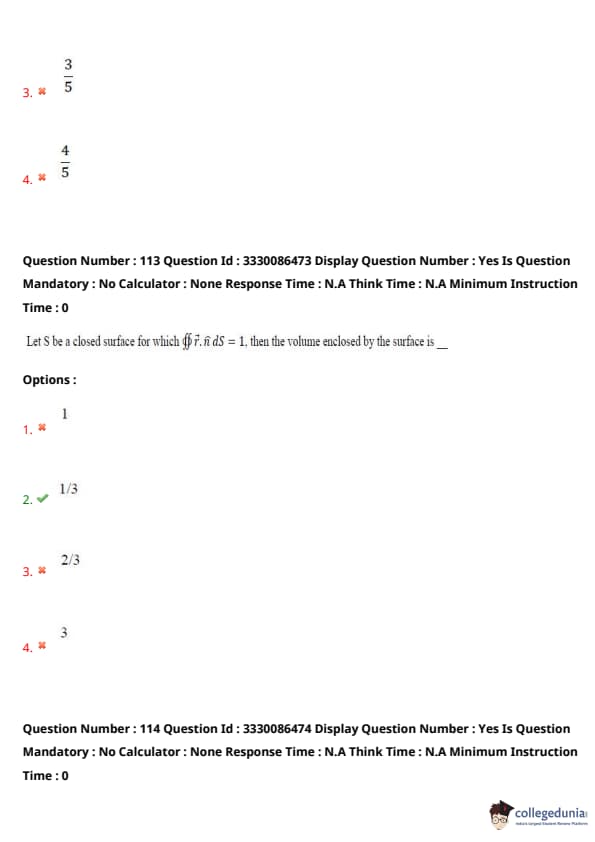
Question 112: If \( f = Tan^{-1}(xy) \) then \( \left(\frac{\partial f}{\partial x}\right)_{(1,2)} = ----------- \)
Question 113: Let S be a closed surface for which \( \oiint_S \vec{r} \cdot \hat{n} \, dS = 1 \), then the volume enclosed by the surface is __________________.
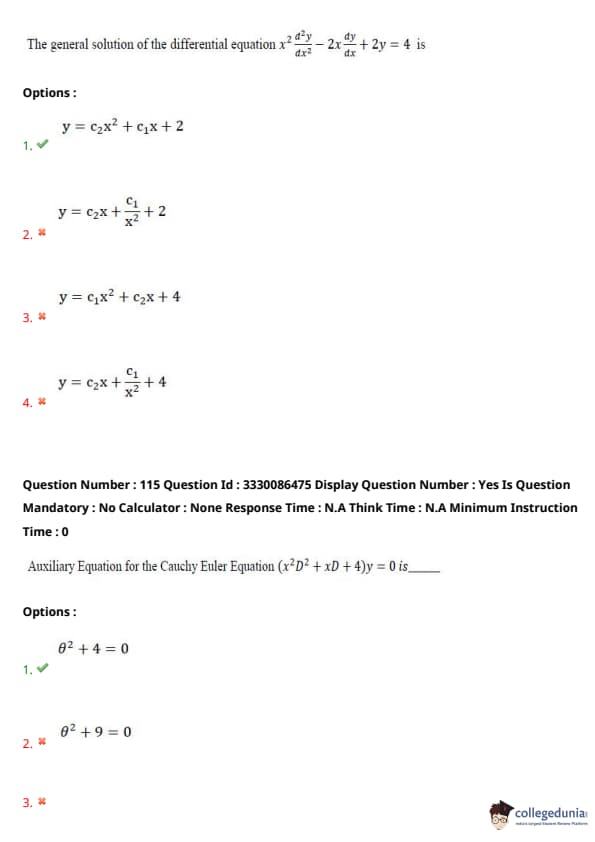
Question 114: The general solution of the differential equation \( x^2 \frac{d^2y}{dx^2} - 2x \frac{dy}{dx} + 2y = 4 \) is
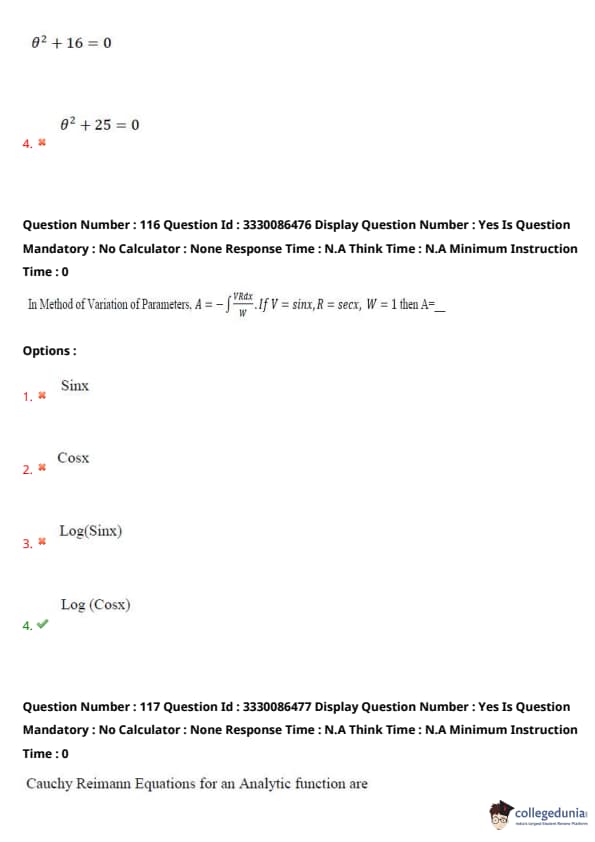
Question 115: Auxiliary Equation for the Cauchy Euler Equation \( (x^2 D^2 + xD + 4)y = 0 \) is \underline{\hspace{2cm
Question 116: In Method of Variation of Parameters, \( A = -\int \frac{y_2 R dx}{W} \). If \( V = \sin x, R = \sec x, W = 1 \) then A= \underline{\hspace{2cm
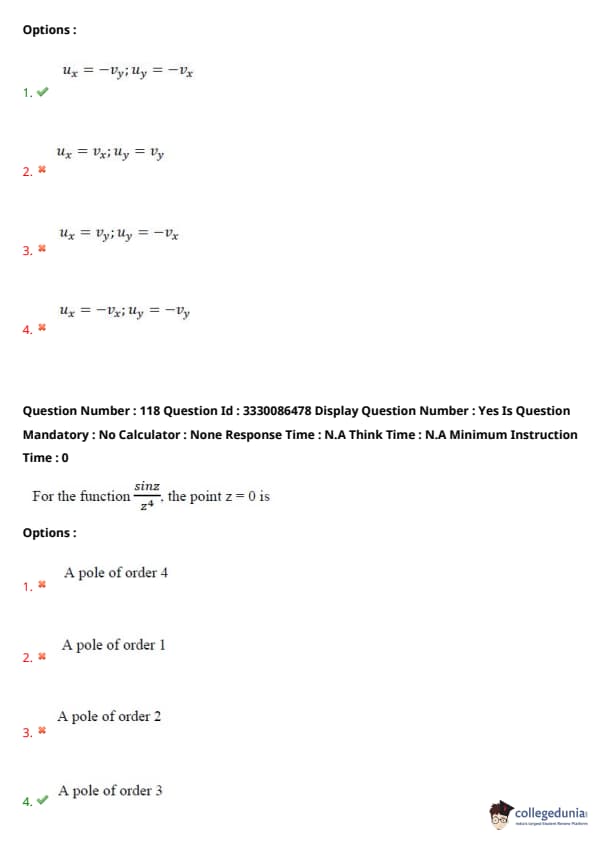
Question 117: Cauchy Riemann Equations for an Analytic function are
Question 118: For the function \( \frac{\sin z}{z^4} \), the point z = 0 is
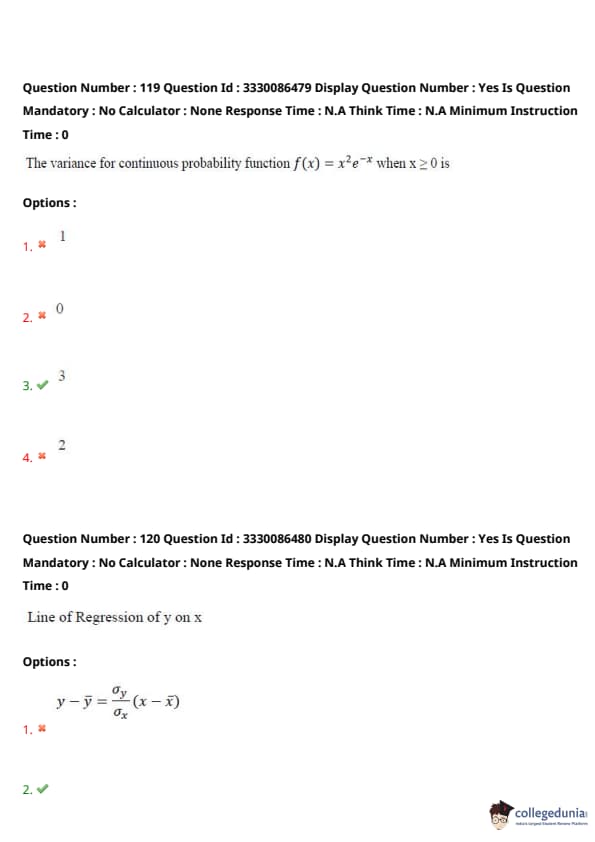
Question 119: The variance for continuous probability function \( f(x) = x^2 e^{-x} \) when \( x \ge 0 \) is
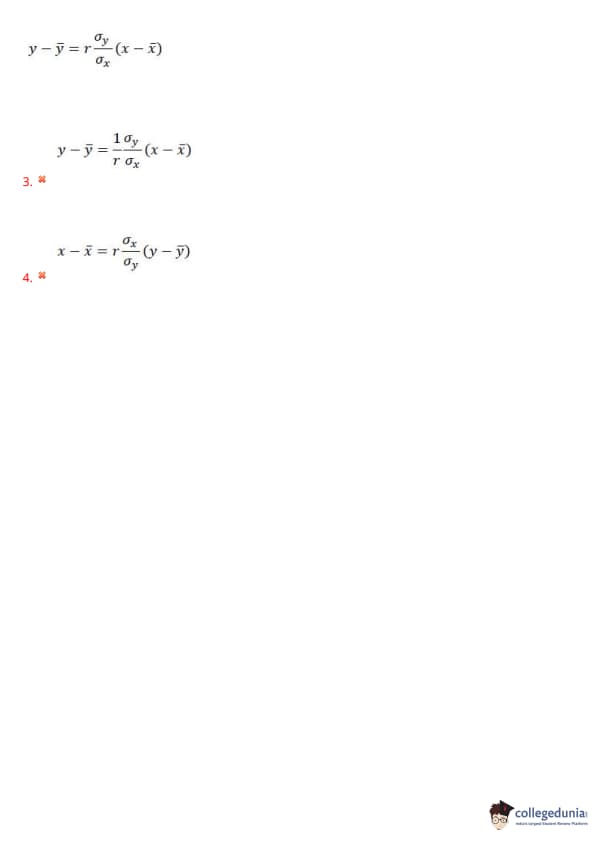
Question 120: Line of Regression of y on x





Comments