




AP PGECET 2024 Mechanical Engineering Question Paper is available for download here. Sri Venkateswara University, Tirupati on behalf of APSCHE conducted AP PGECET 2024 Mechanical Engineering on May 30 in Shift 2 from 2.30 PM to 4.30 PM. AP PGECET Question Paper 2024 consists of 120 MCQ-based questions in total carrying 1 mark each to be attempted in the duration of 2 hours.
AP PGECET 2024 Mechanical Engineering Question Paper with Answer Key PDF
| AP PGECET 2024 Mechanical Engineering Question Paper with Answer Key |  Download Download |
Check Solution |

Question 1:
"The moment of resultant of all the forces in a plane about any point is equal to the algebraic sum of moment of all the forces about the same point". This statement is known as
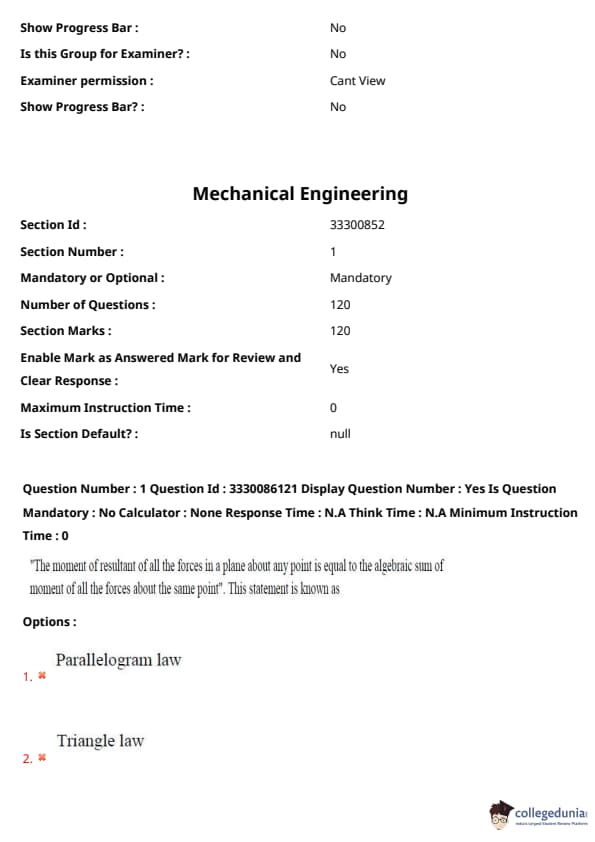
The force acting at a point \( A \) is shown in the figure. The equivalent force system acting at point \( B \) is:

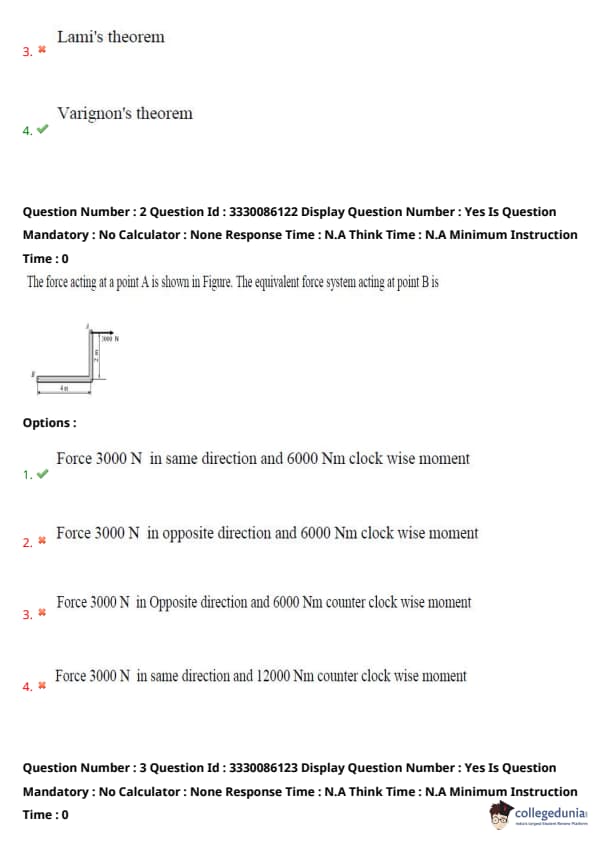
A uniform rod AB is in equilibrium when resting on a smooth groove, the walls of which are at right angles to each other as shown in the figure. What is the relation between \( \theta \) and \( \phi \) in degrees?

A plane truss has four members and four joints. The truss is
Which of the following forces are considered in the equations of virtual work?
If the acceleration-time diagram is represented by a horizontal straight line, then the displacement is:
In the system of pulleys shown in Figure, the pulleys are massless and the strings are inextensible. What is the relation between the accelerations of blocks \( A \) and \( B \)?

Options:
A 160 g cricket ball is moving with a speed of 20 m/s. What force is required to stop the ball in 0.2 seconds?
A solid cylinder of weight \( W = 100 \, N \) and radius \( r = 0.5 \, m \) is pulled along a horizontal plane by a horizontal force \( P = 90 \, N \) applied to the end of the string wound around the cylinder. What is the angular acceleration of the disc? Assume \( g = 10 \, m/s^2 \).

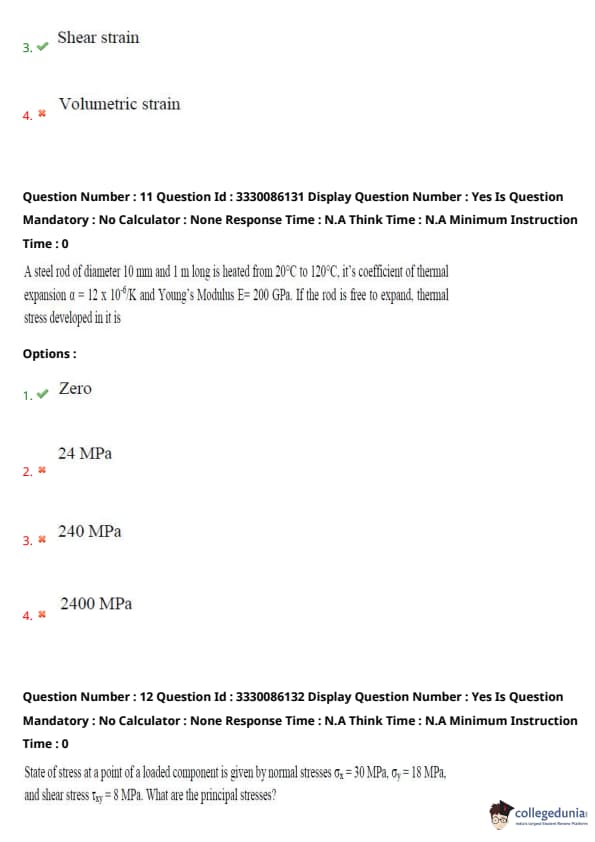
Which of the following strain mainly represents the change of shape?
A steel rod of diameter 10 mm and 1 m long is heated from 20°C to 120°C, its coefficient of thermal expansion \( \alpha = 12 \times 10^{-6} / K \) and Young’s Modulus \( E = 200 \, GPa \). If the rod is free to expand, the thermal stress developed in it is
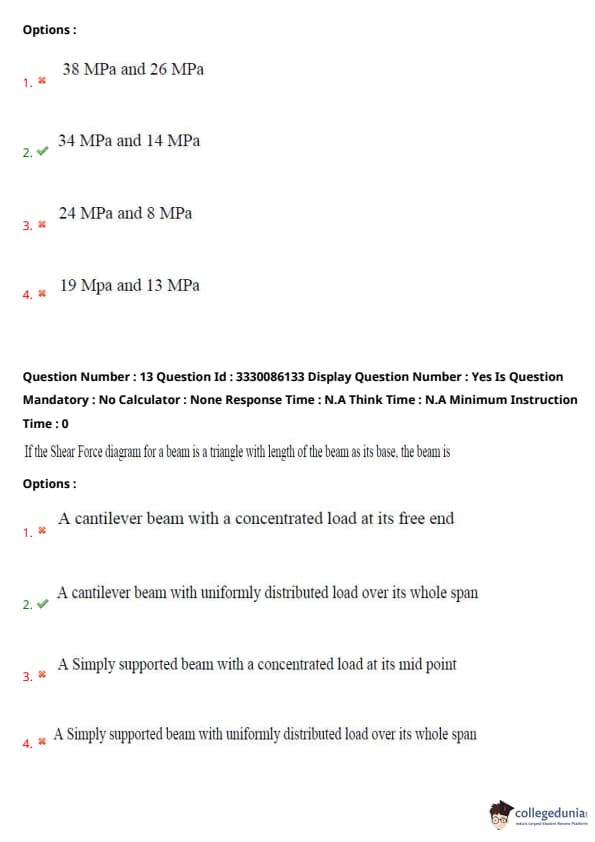
State of stress at a point of a loaded component is given by normal stresses \( \sigma_x = 30 \, MPa \), \( \sigma_y = 18 \, MPa \), and shear stress \( \tau_{xy} = 8 \, MPa \). What are the principal stresses?
If the shear force diagram for a beam is a triangle with the length of the beam as its base, the beam is
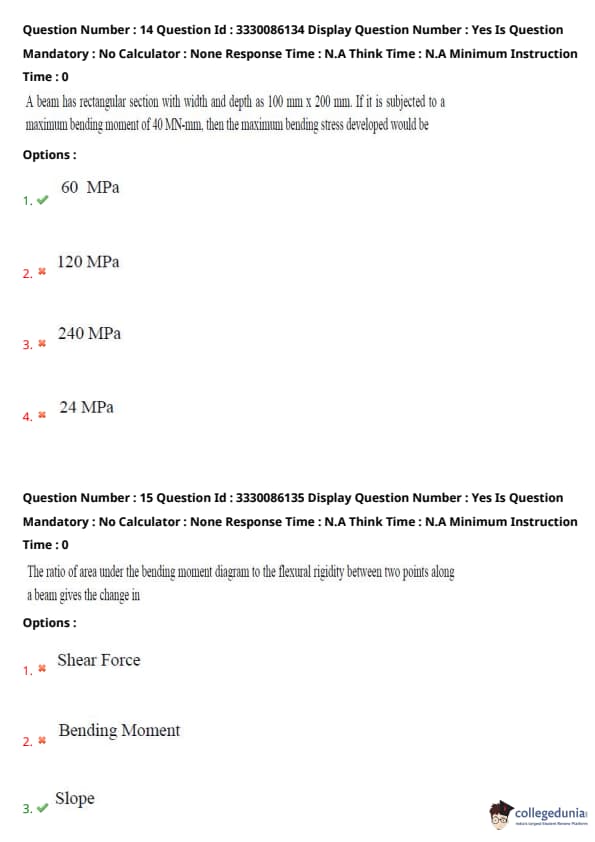
A beam has rectangular section with width and depth as 100 mm \( \times \) 200 mm. If it is subjected to maximum bending moment of 40 kN-mm, then the minimum bending stress developed would be
The ratio of area under the bending moment diagram to the flexural rigidity between two points of a beam gives the change in
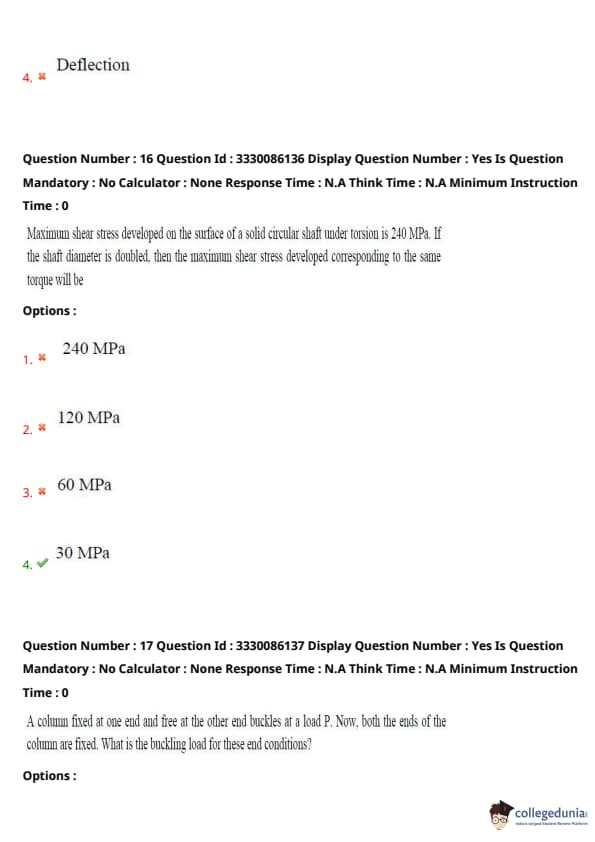
Maximum shear stress developed on the surface of a solid circular shaft under torsion is 240 MPa. If the shaft diameter is doubled, then the maximum shear stress developed corresponding to the same torque will be:
View Solution
A column fixed at one end and free at the other end buckles at a load P. Now, both the ends of the column are fixed. What is the buckling load for these end conditions?
View Solution
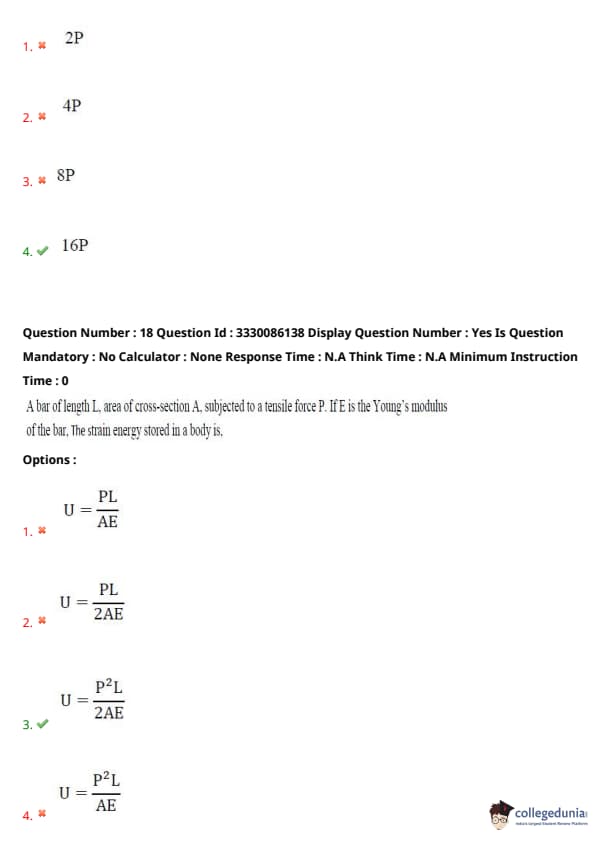
A bar of length \( L \), area of cross-section \( A \), is subjected to a tensile force \( P \). If \( E \) is the Young's modulus of the bar, the strain energy \( U \) stored in the body is:
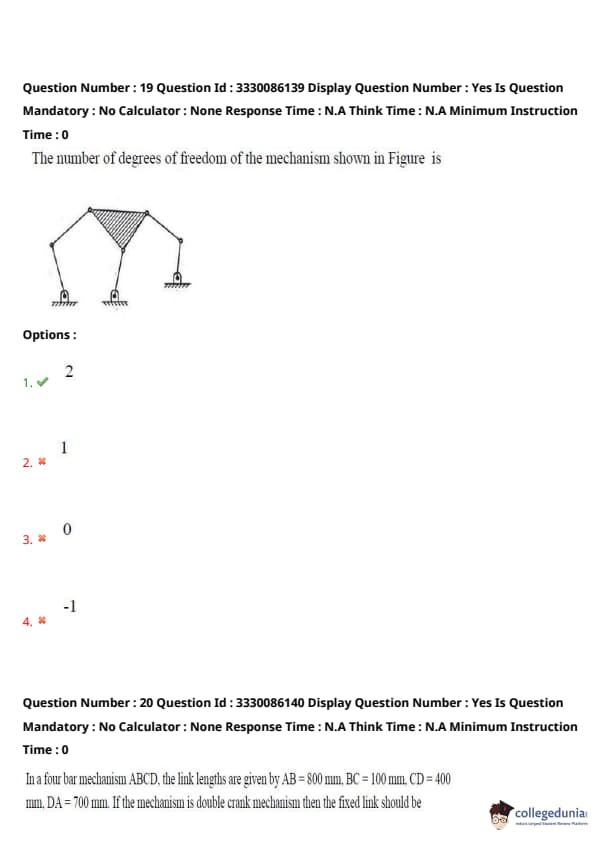
The number of degrees of freedom of the mechanism shown in Figure is

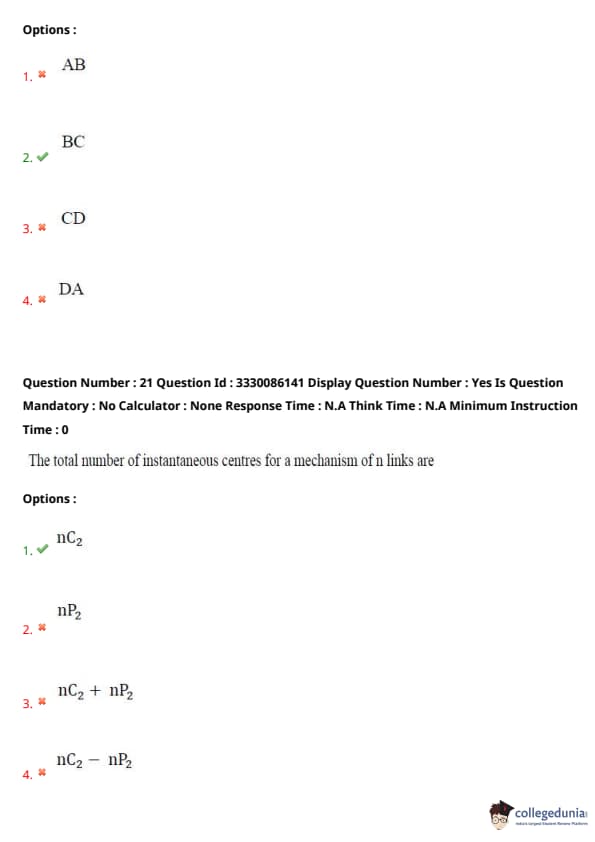
In a four-bar mechanism ABCD, the link lengths are given: AB = 800 mm, BC = 100 mm, CD = 400 mm, DA = 700 mm. If the mechanism is a double crank mechanism then the fixed link should be
The total number of instantaneous centres for a mechanism of \( n \) links are:
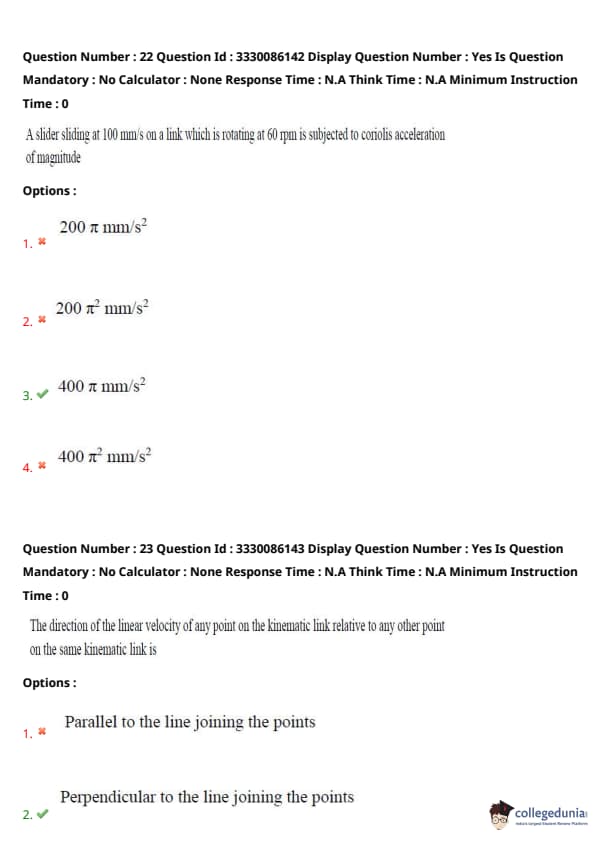
A slider sliding at 100 mm/s on a link which is rotating at 60 rpm is subjected to Coriolis acceleration of magnitude:
View Solution
The direction of the linear velocity of any point on the kinematic link relative to any other point on the same kinematic link is
The area under the turning moment diagram represents
In a simple gear train, if the number of idler gears is odd, then the direction of motion of the driven gear will be:
View Solution
A 10 kg mass is supported on a spring of stiffness 4 kN/m and has a dashpot which produces a resistance of 20 N at a velocity of 0.25 m/s. The damping ratio of the system is:
Whirling speed of a shaft coincides with the natural frequency of its:
View Solution
The natural frequency of a spring-mass system is 2 Hz. When an additional mass of 1 kg is added to the original mass \( m \), the natural frequency is reduced to 1 Hz. The original mass \( m \) is
An element is subjected to a tensile stress of 60 MPa and a shear stress of 40 MPa. If the material has the yield strength obtained in a simple tensile test is 320 MPa, the factor of safety based on maximum principal stress theory is
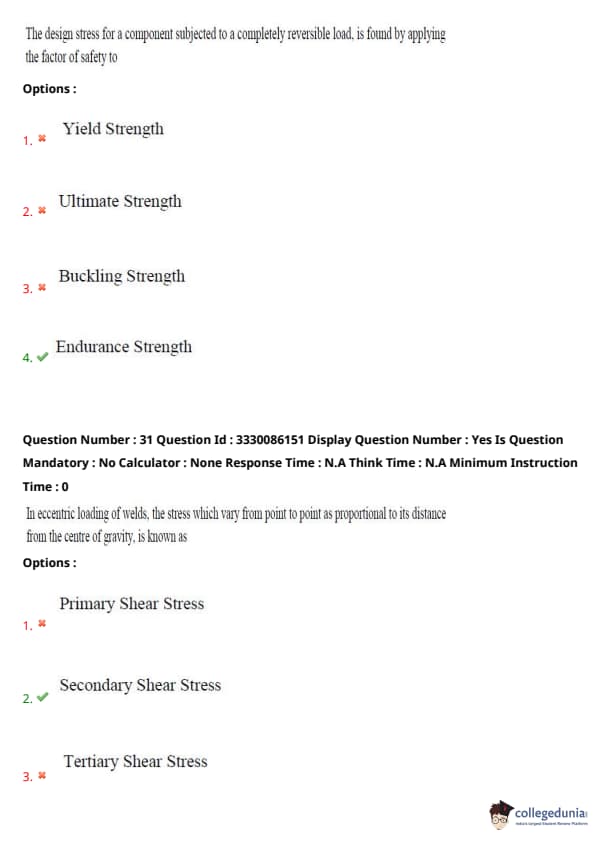
The design stress for a component subjected to a completely reversible load, is found by applying the factor of safety to:
In eccentric loading of welds, the stress which vary from point to point as proportional to its distance from the centre of gravity, is known as:
View Solution
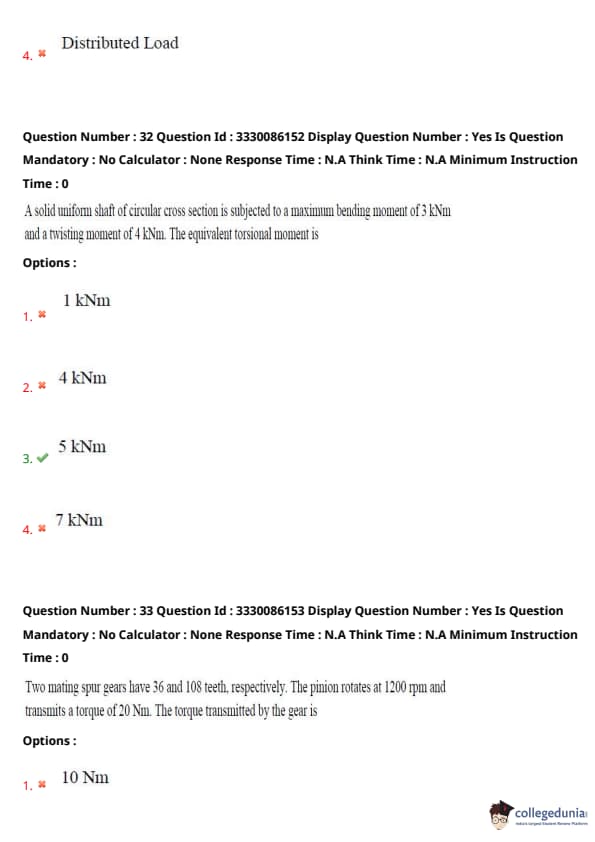
A solid uniform shaft of circular cross section is subjected to a maximum bending moment of 3 kNm and a twisting moment of 4 kNm. The equivalent torsional moment is
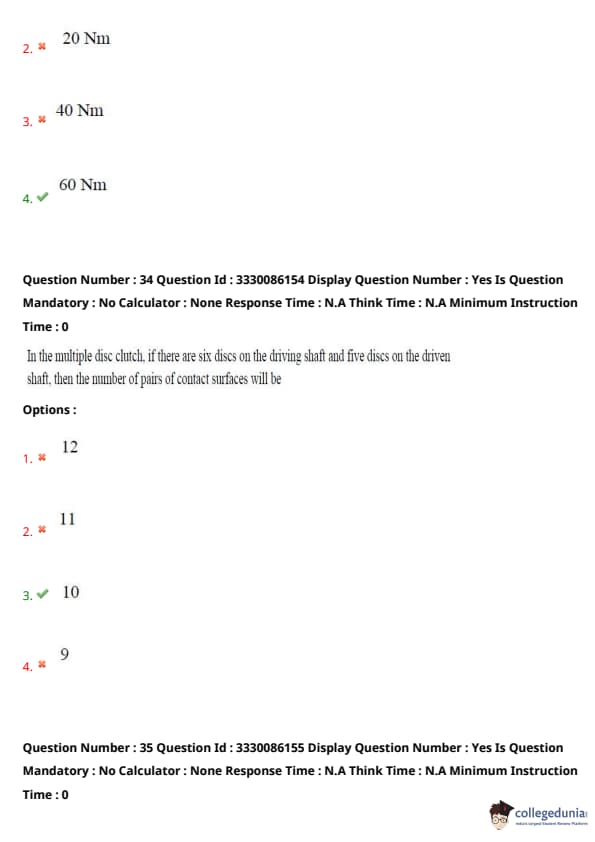
Two mating spur gears have 36 and 108 teeth, respectively. The pinion rotates at 1200 rpm and transmits a torque of 20 Nm. The torque transmitted by the gear is
In the multiple disc clutch, if there are six discs on the driving shaft and five discs on the driven shaft, then the number of pairs of contact surfaces will be
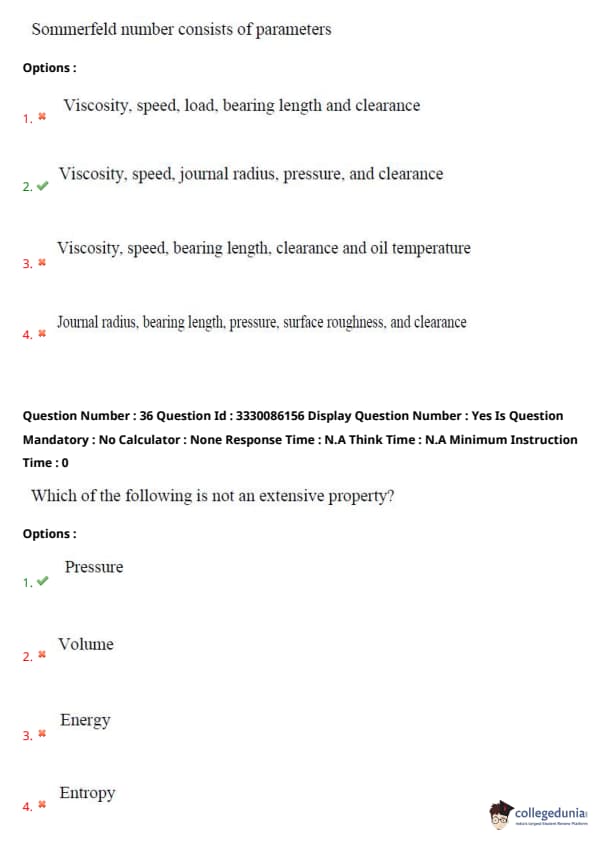
Sommerfeld number consists of parameters
Which of the following is not an extensive property?
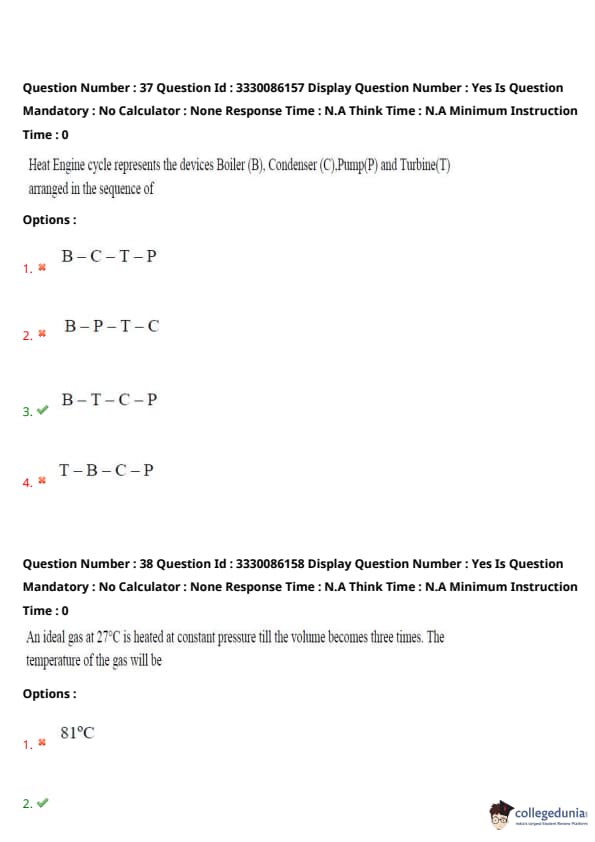
Heat Engine cycle represents the devices Boiler (B), Condenser (C), Pump (P) and Turbine (T) arranged in the sequence of:
View Solution
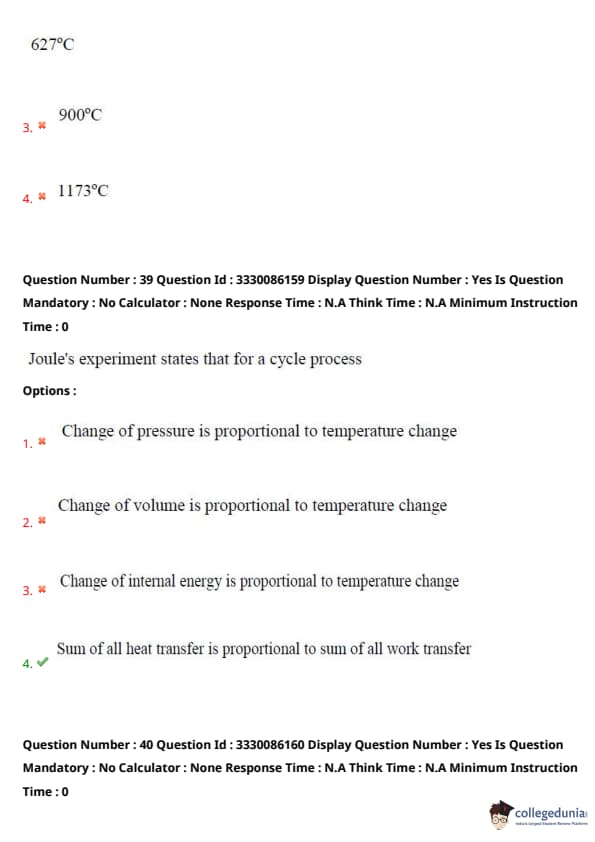
An ideal gas at \( 27^\circ C \) is heated at constant pressure till the volume becomes three times. The temperature of the gas will be
Joule’s experiment states that for a cyclic process
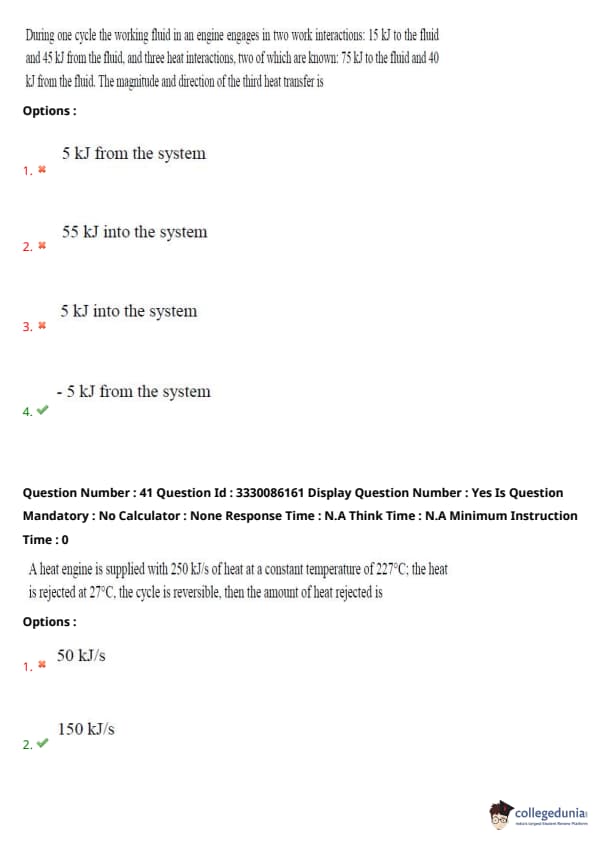
During one cycle the working fluid in an engine engages in two work interactions: 15 kJ to the fluid and 45 kJ from the fluid, and three heat interactions, two of which are known: 75 kJ to the fluid and 40 kJ from the fluid. The magnitude and direction of the third heat transfer is
A heat engine is supplied with 250 kJ/s of heat at a constant temperature of 227°C; the heat is rejected at 27°C. If the cycle is reversible, then the amount of heat rejected is:
View Solution
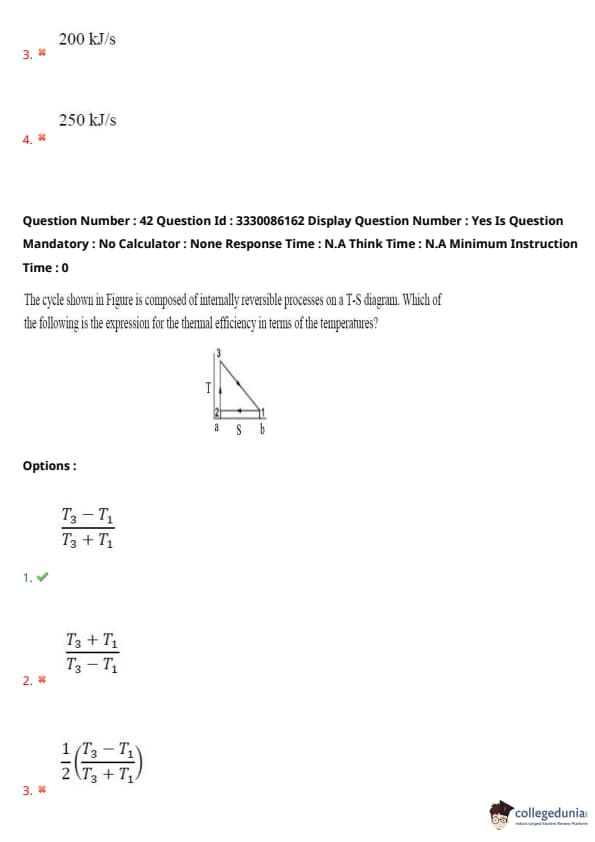
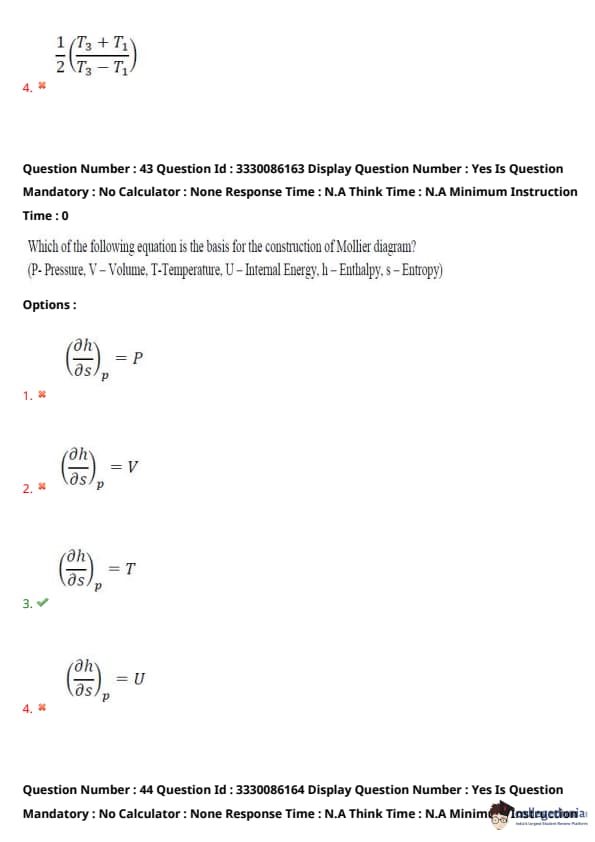
The cycle shown in Figure is composed of internally reversible processes on a T-S diagram. Which of the following is the expression for thermal efficiency in terms of the temperatures?

Options:
Which of the following equation is the basis for the construction of Mollier diagram? (P- Pressure, V- Volume, T- Temperature, U- Internal Energy, h - Enthalpy, s - Entropy)
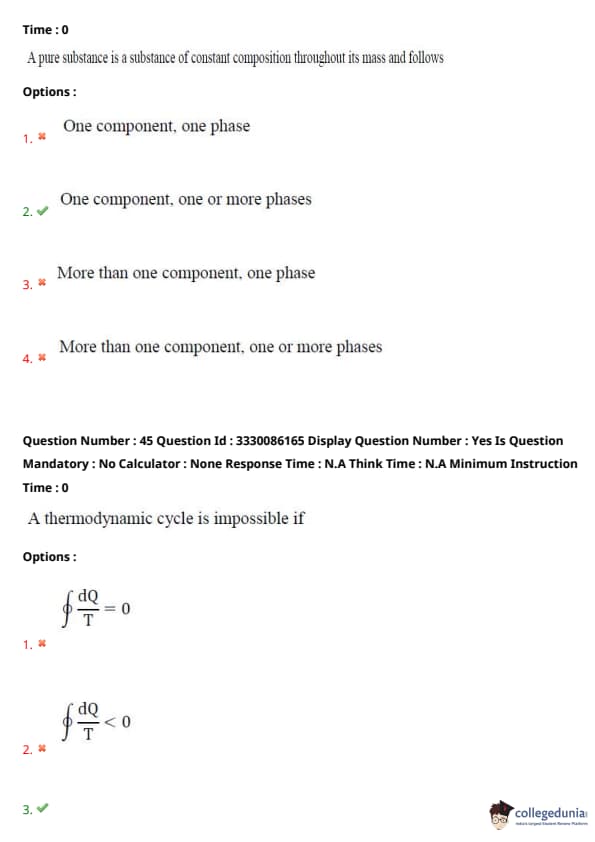
A pure substance is a substance of constant composition throughout its mass and follows
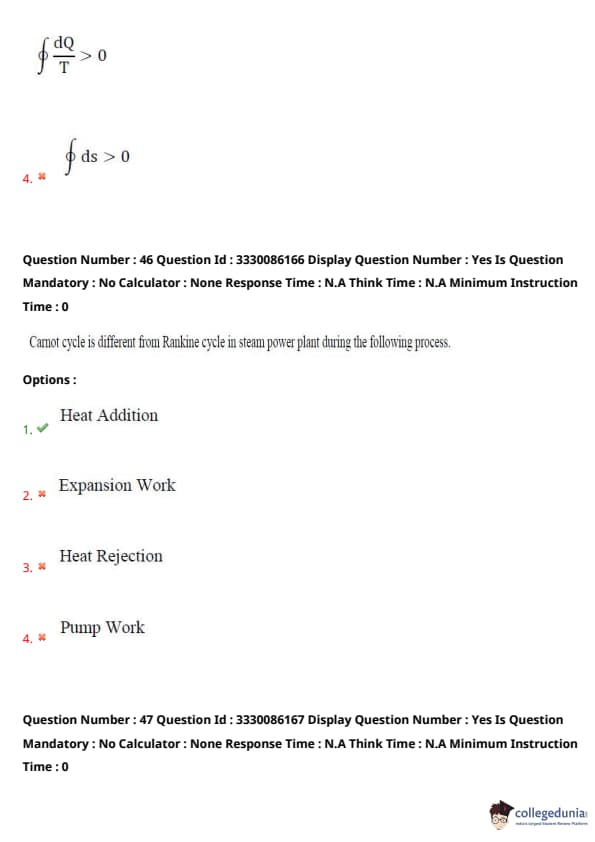
A thermodynamic cycle is impossible if
Carnot cycle is different from Rankine cycle in steam power plant during the following process.
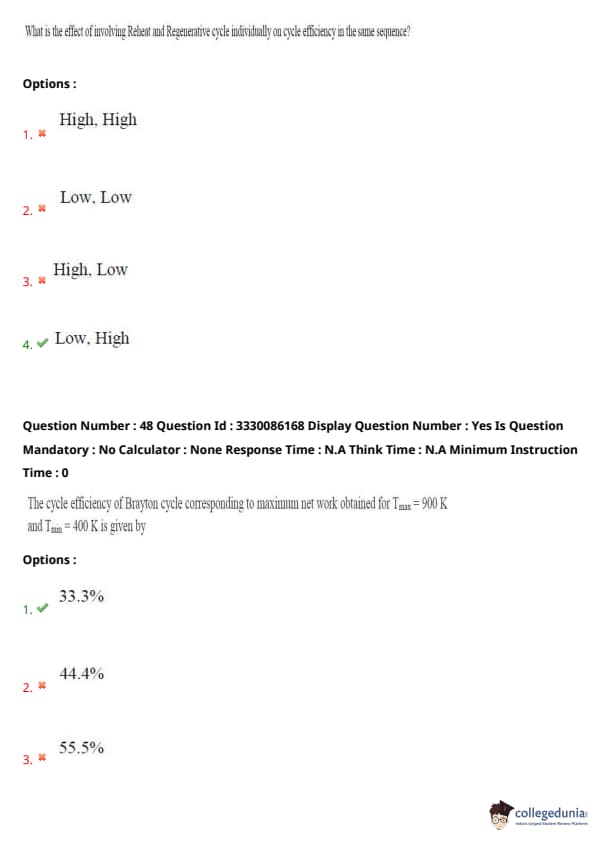
What is the effect of involving Reheat and Regenerative cycle individually on cycle efficiency in the same sequence?
View Solution
The efficiency of Brayton cycle corresponding to maximum net work obtained for \( T_{max} = 900 \, K \) and \( T_{min} = 400 \, K \) is given by
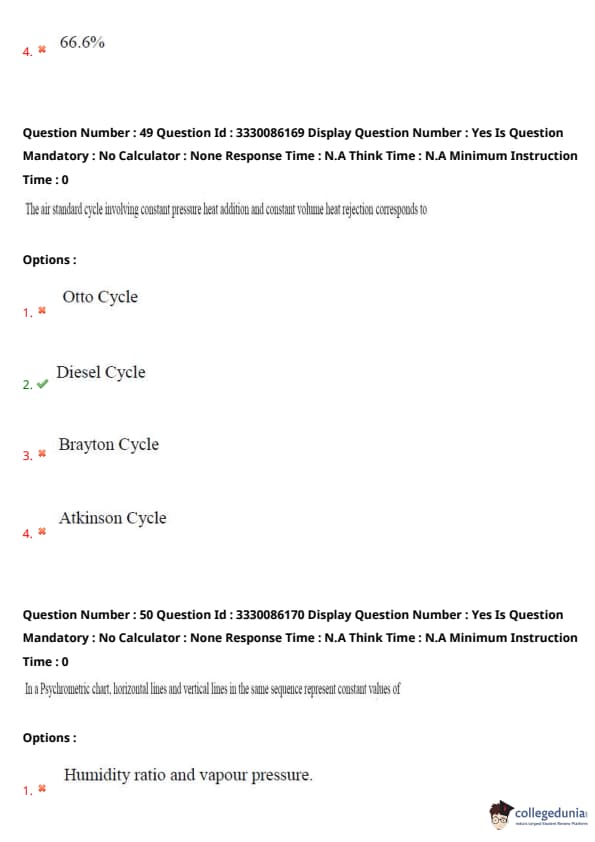
The air standard cycle involving constant pressure heat addition and constant volume heat rejection corresponds to
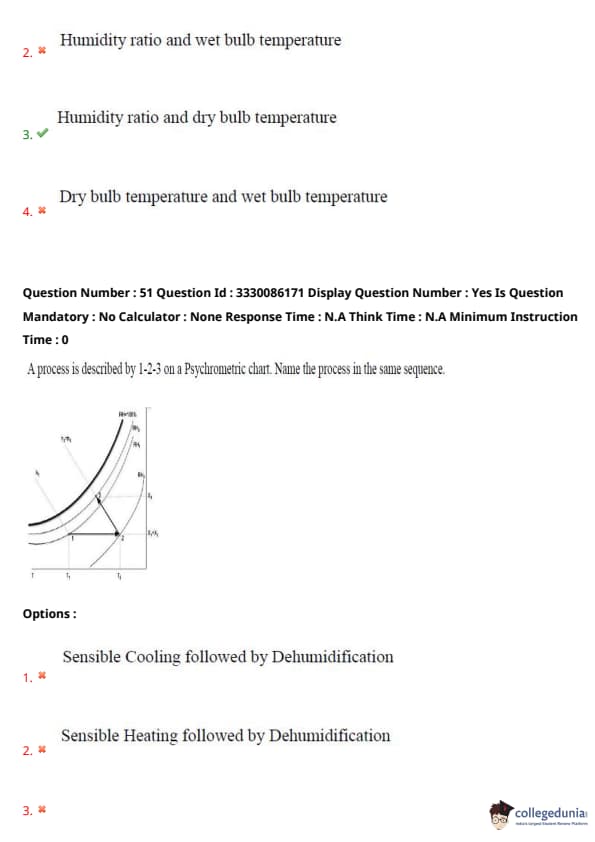
Which two properties are sufficient to define the state point of moist air?
View Solution
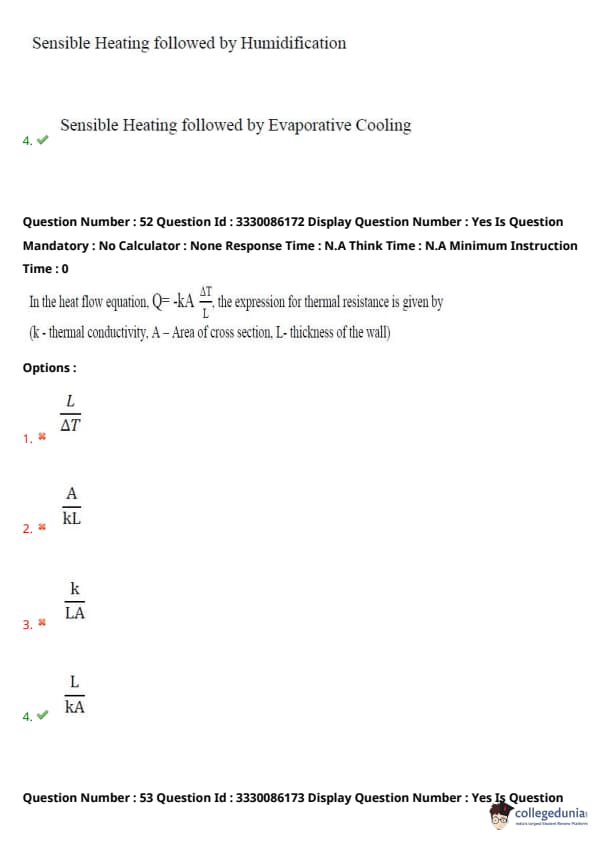
A process is described by 1-2-3 on a Psychrometric chart. Name the process in the same sequence.

In the heat flow equation, \( Q = -kA \frac{\Delta T}{L} \), the expression for thermal resistance is given by (k - thermal conductivity, A - Area of cross section, L - thickness of the wall)
If the radius of a current carrying wire is less than the critical radius, then the addition of electrical insulation will enable the wire to carry a higher current because:
View Solution
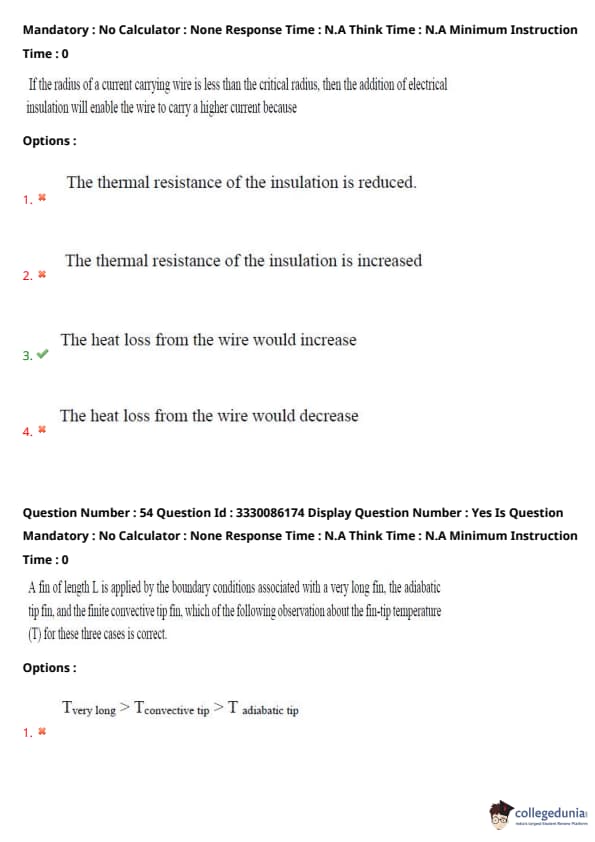
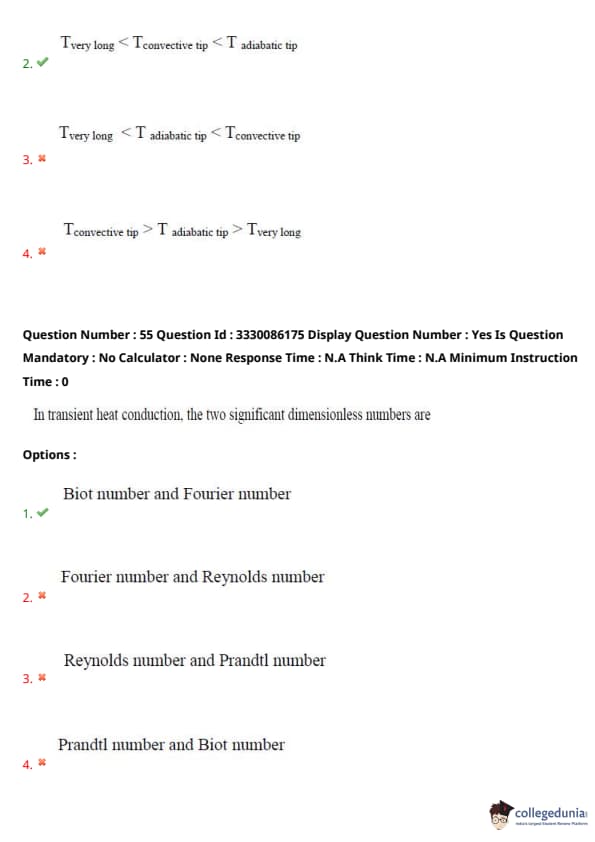
A fin of length \( L \) is applied the boundary conditions associated with a very long fin, the adiabatic tip fin, and the finite convective tip fin, which of the following observation about the fin-tip temperature (\( T \)) for these three cases is correct.
In transient heat conduction, the two significant dimensionless numbers are
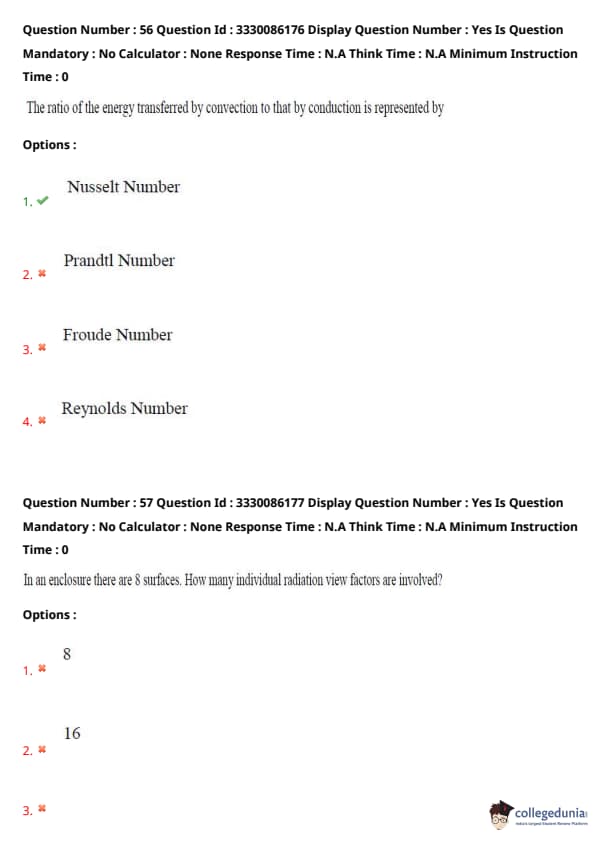
The ratio of the energy transferred by convection to that by conduction is represented by
In an enclosure there are 8 surfaces. How many individual radiation view factors are involved?
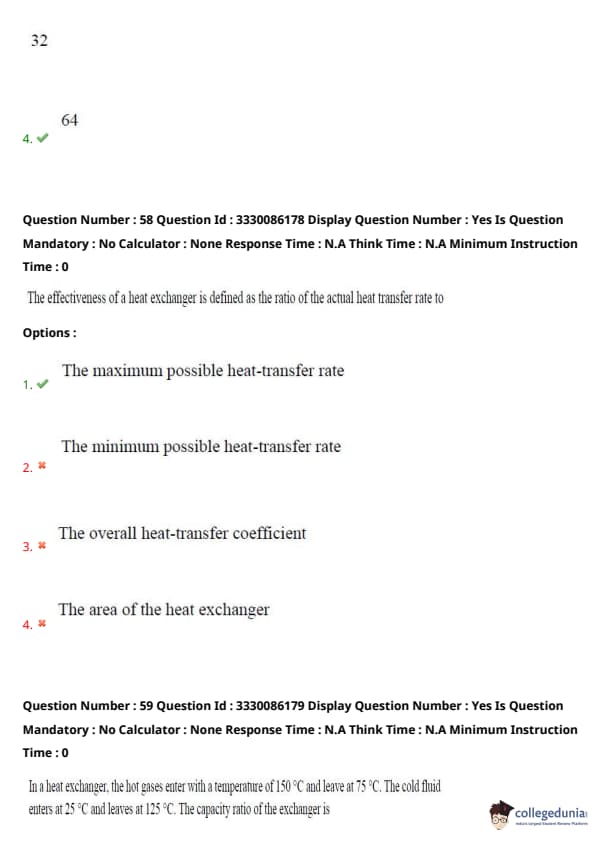
The effectiveness of a heat exchanger is defined as the ratio of the actual heat transfer rate to
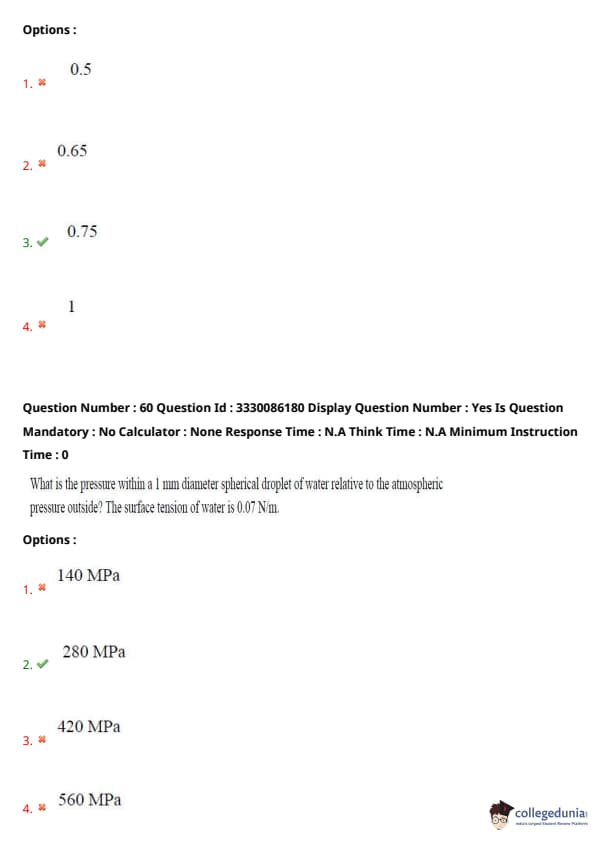
In a heat exchanger, the hot gases enter with a temperature of 150 °C and leave at 75 °C. The cold fluid enters at 25 °C and leaves at 125 °C. The capacity ratio of the exchanger is:
View Solution
What is the pressure within a 1 mm diameter spherical droplet of water relative to the atmospheric pressure outside? The surface tension of water is 0.07 N/m.
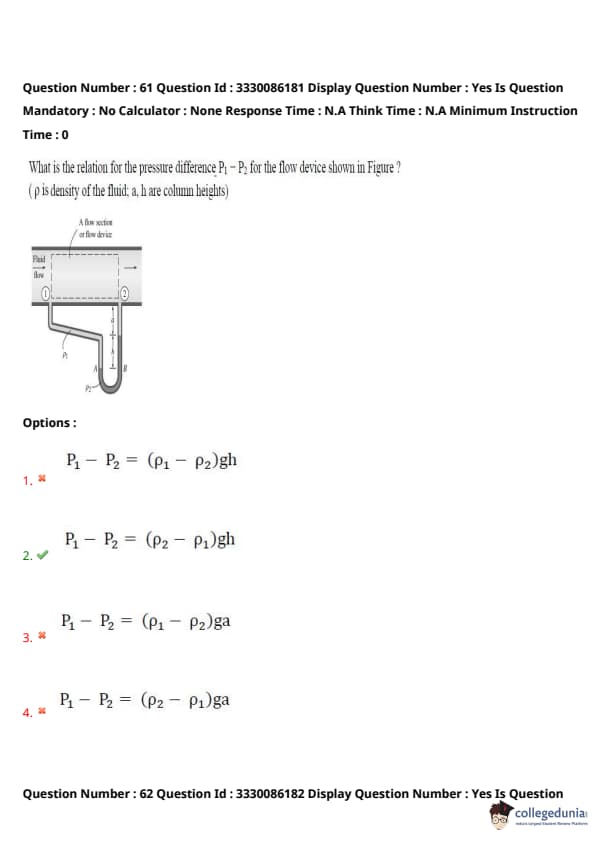
What is the relation for the pressure difference \( P_1 - P_2 \) for the flow device shown in Figure? (\( \rho \) is density of the fluid; \( a, h \) are column heights)

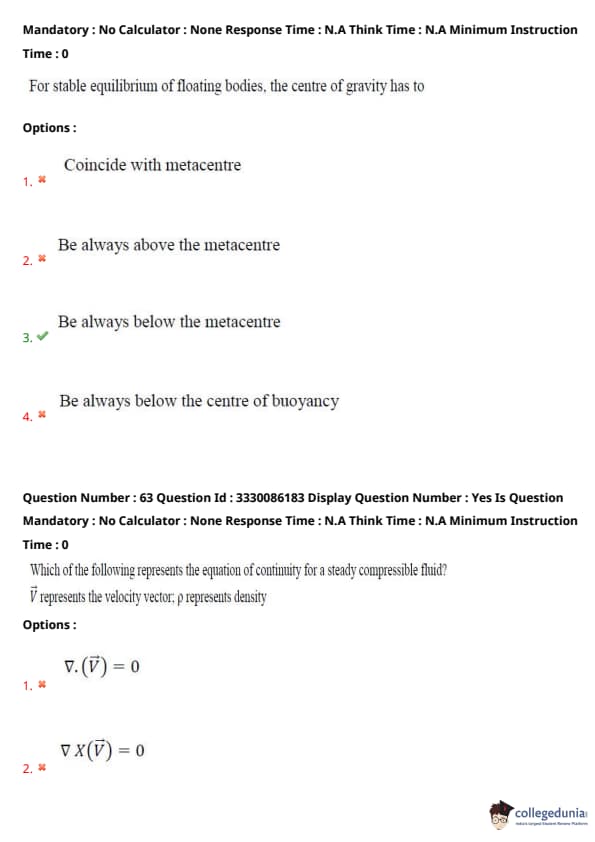
For stable equilibrium of floating bodies, the centre of gravity has to:
View Solution
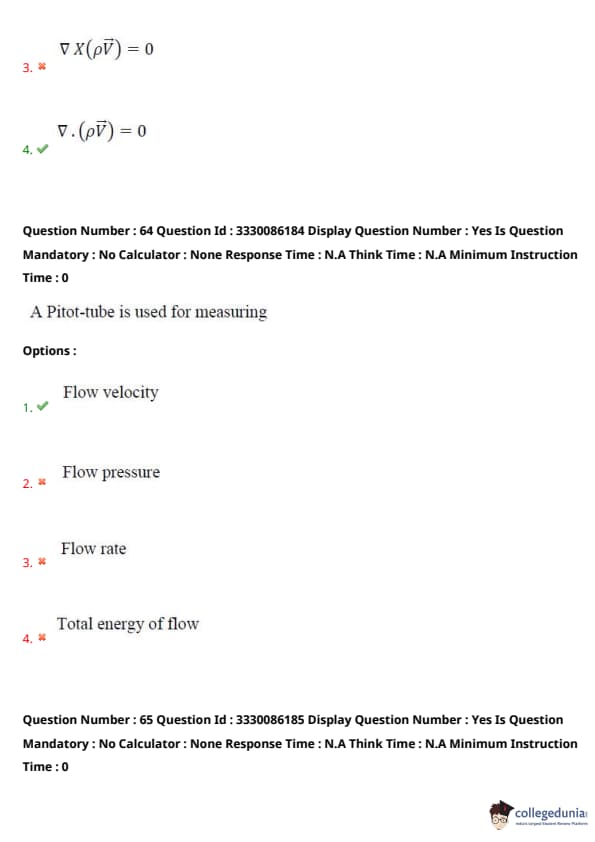
Which of the following represents the equation of continuity for a steady compressible fluid? \( \vec{V} \) represents the velocity vector; \( \rho \) represents density
A Pitot-tube is used for measuring
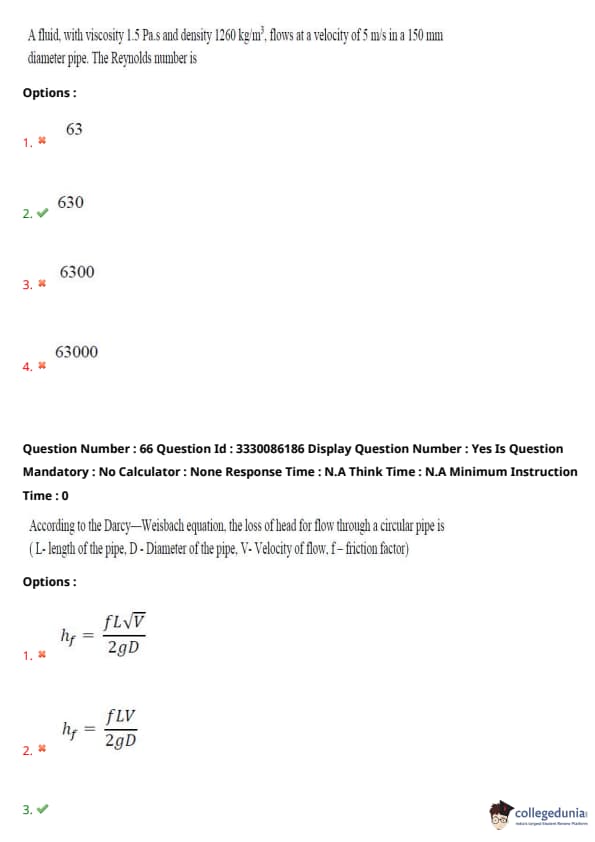
A fluid, with viscosity 1.5 Pa.s and density 1260 kg/m³, flows at a velocity of 5 m/s in a 150 mm diameter pipe. The Reynolds number is:
View Solution
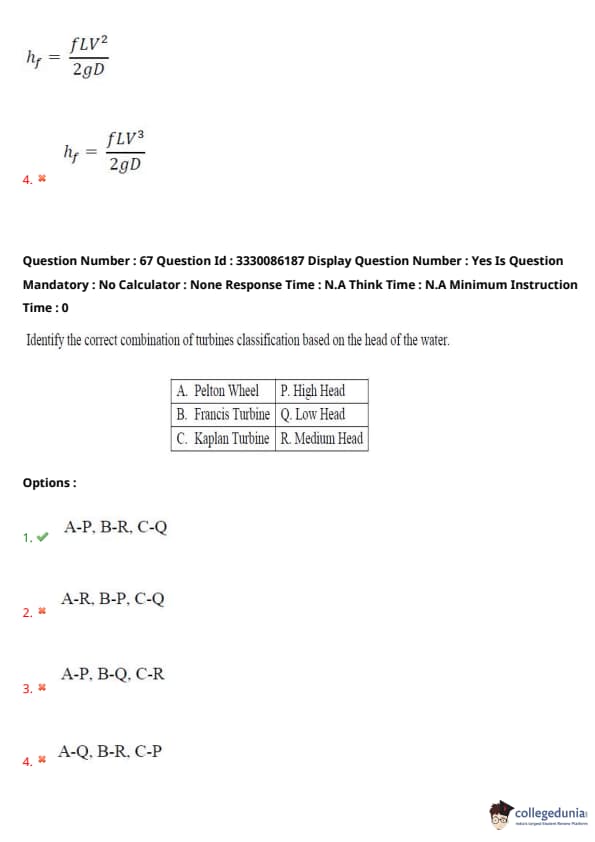
According to the Darcy--Weisbach equation, the loss of head for flow through a circular pipe is (\( L \)-length of the pipe, \( D \)-diameter of the pipe, \( V \)-velocity of flow, \( f \)-friction factor)
Identify the correct combination of turbines classification based on the head of the water.

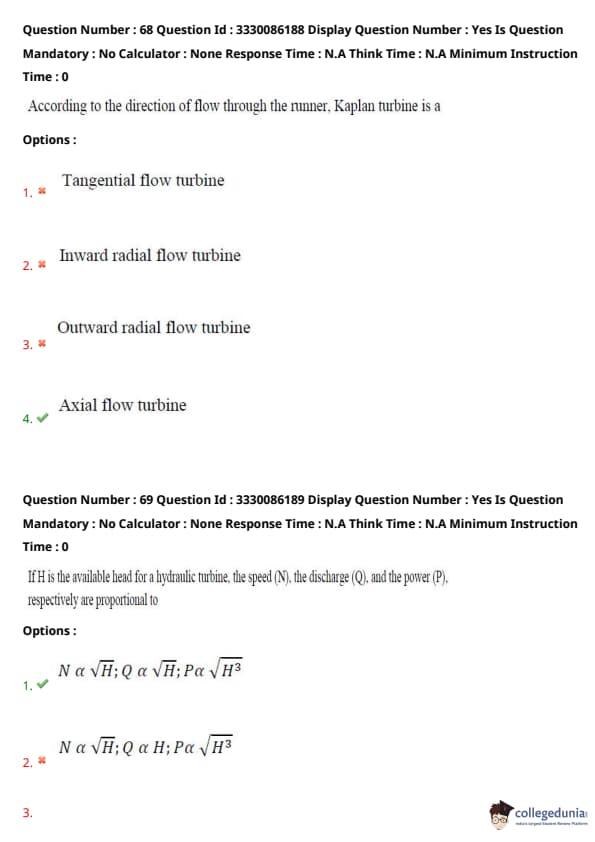
According to the direction of flow through the runner, Kaplan turbine is a:
View Solution
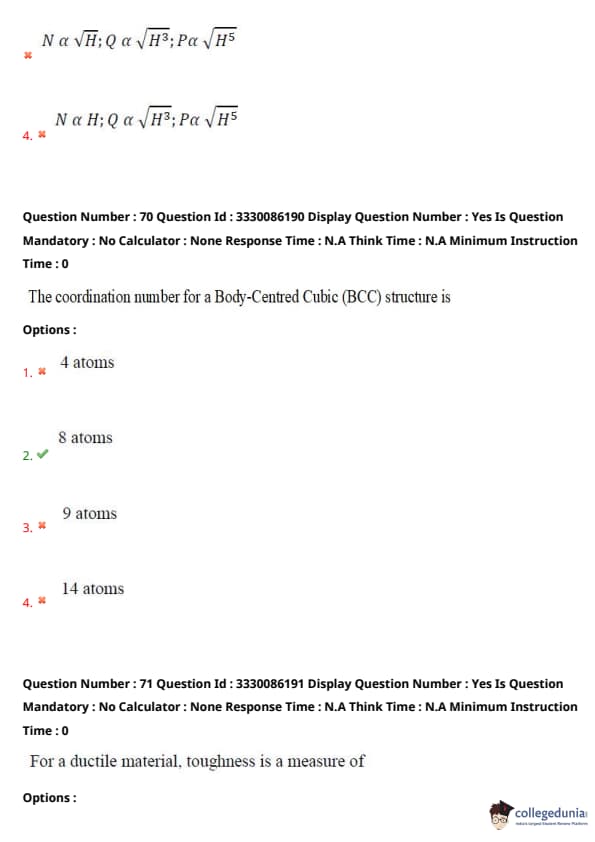
If H is the available head for a hydraulic turbine, the speed (N), the discharge (Q), and the power (P), respectively are proportional to
The coordination number for a Body-Centred Cubic (BCC) structure is
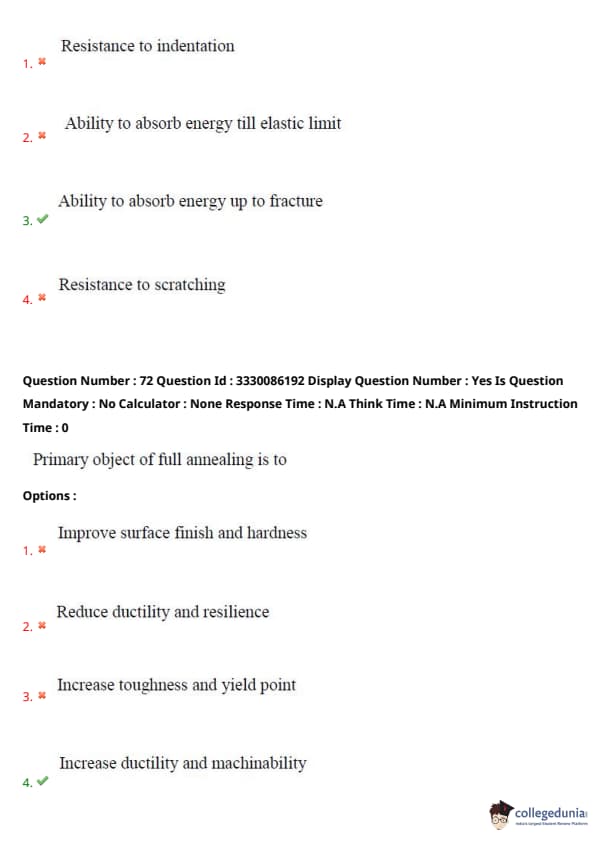
For a ductile material, toughness is a measure of
Primary object of full annealing is to
A spherical drop of molten metal of radius 5 mm was found to solidify in 12 s. In how much time will a similar drop of radius 10 mm solidify?
Select the correct statement for the riser design
In a gating system, the ratio of 1:2:4 represents:
View Solution
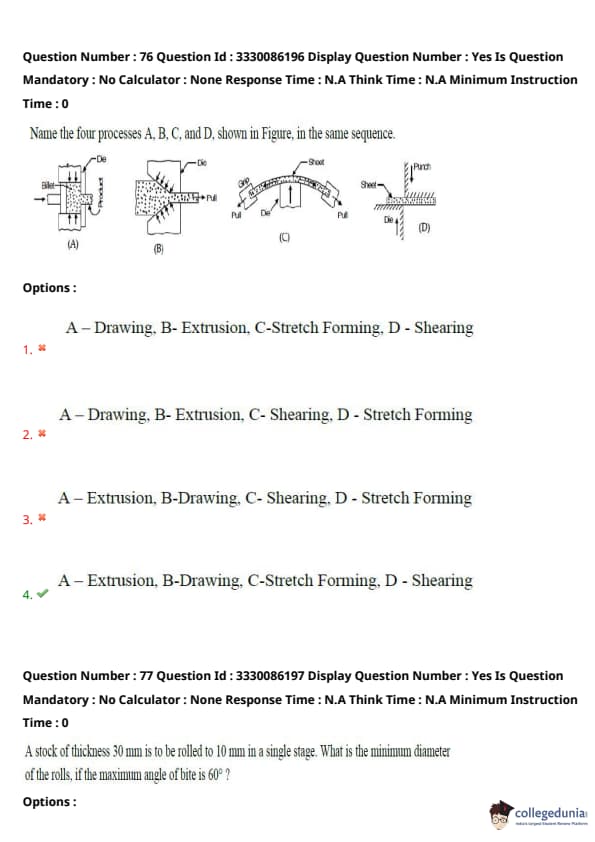
Name the four processes A, B, C, and D, shown in Figure, in the same sequence.
View Solution
A stock of thickness 30 mm is to be rolled to 10 mm in a single stage. What is the minimum diameter of the rolls, if the maximum angle of bite is 60°?
In cold working of metals, the working temperature is
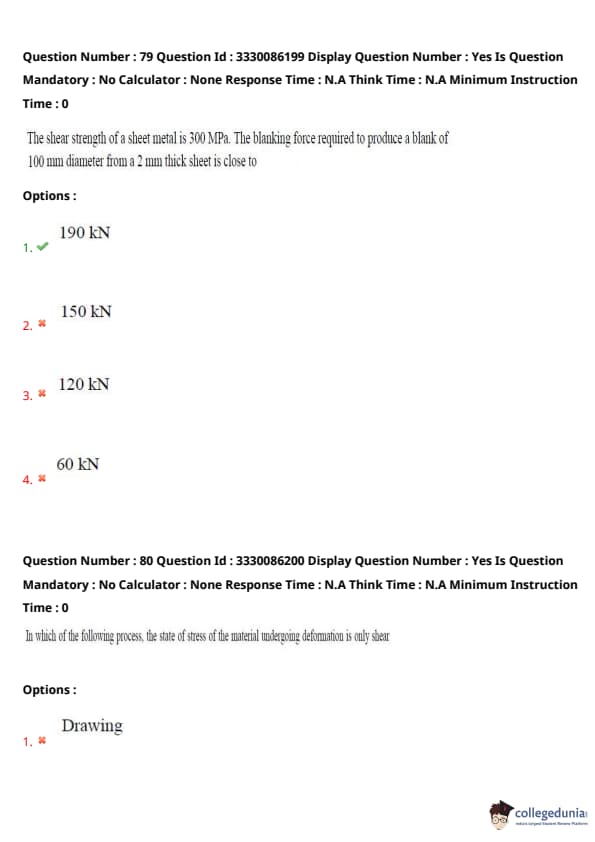
The shear strength of a sheet metal is 300 MPa. The blanking force required to produce a blank of 100 mm diameter from a 2 mm thick sheet is close to
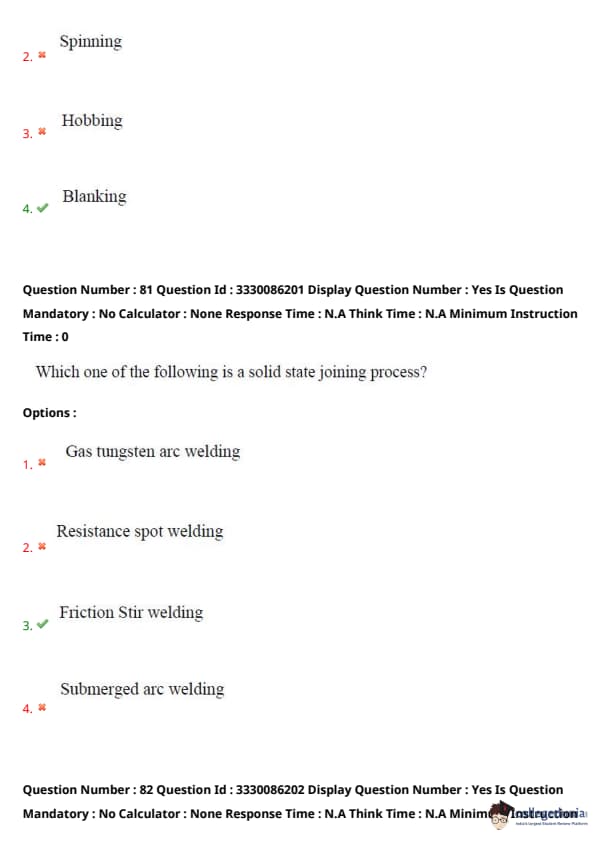
In which of the following process, the state of stress of the material undergoing deformation is only shear?
View Solution
Which one of the following is a solid state joining process?
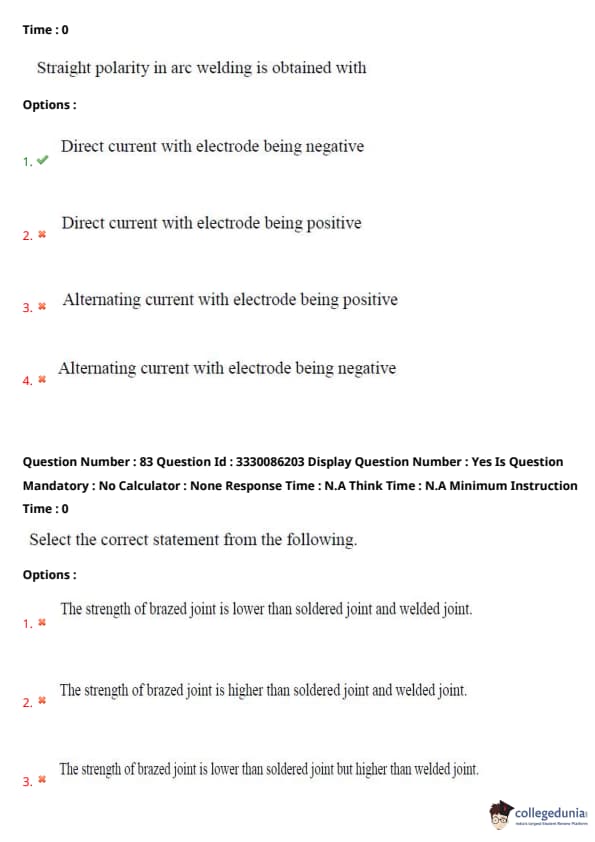
Straight polarity in arc welding is obtained with
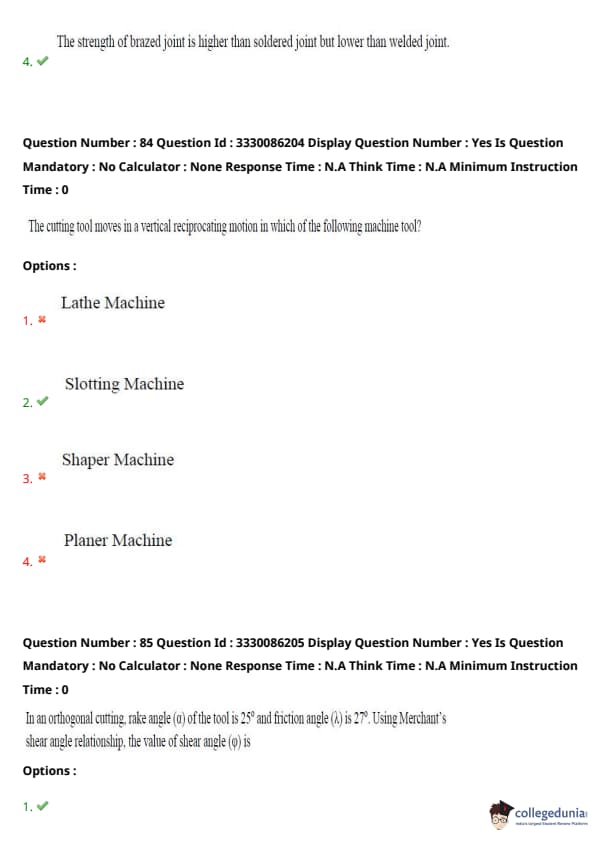
Select the correct statement from the following.
The cutting tool moves in a vertical reciprocating motion in which of the following machine tool?
In an orthogonal cutting, rake angle (\( \alpha \)) of the tool is 25° and friction angle (\( \lambda \)) is 27°. Using Merchant's shear angle relationship, the value of shear angle (\( \phi \)) is:
View Solution
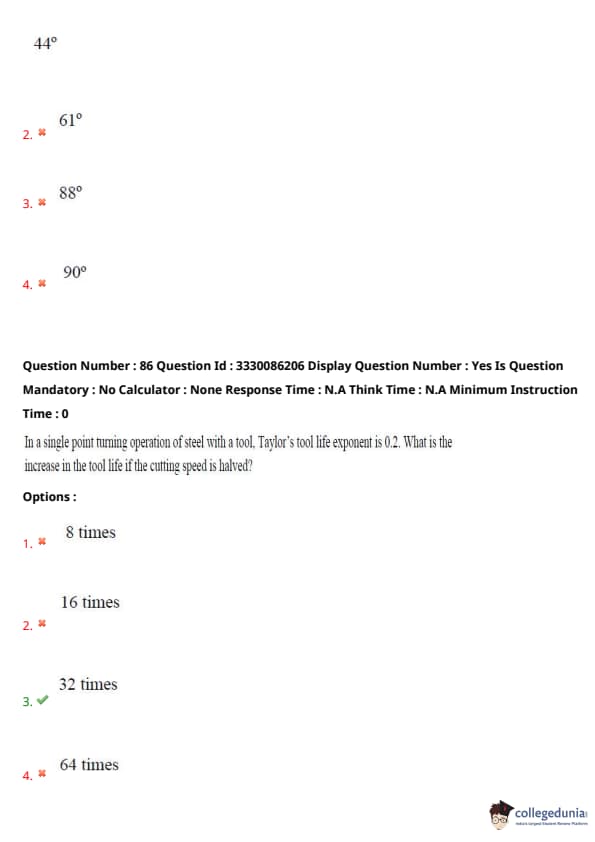
In a single point turning operation of steel with a tool, Taylor’s tool life exponent is 0.2. What is the increase in the tool life if the cutting speed is halved?
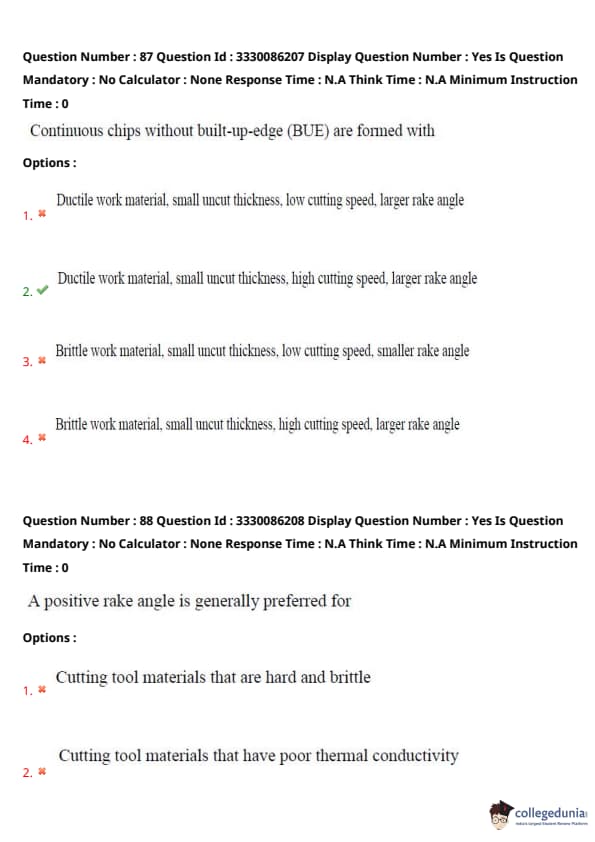
Continuous chips with built-up edge (BUE) are formed with
A positive rake angle is generally preferred for:
View Solution
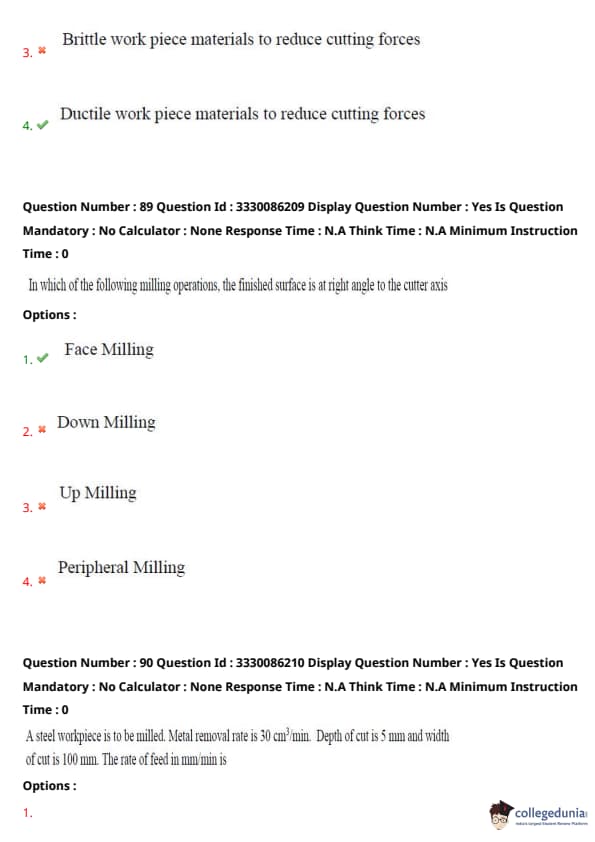
In which of the following milling operations, the finished surface is at right angle to the cutter axis?
A steel workpiece is to be milled. Metal removal rate is 30 cm\textsuperscript{3}/min. Depth of cut is 5 mm and width of cut is 100 mm. The rate of feed in mm/min is
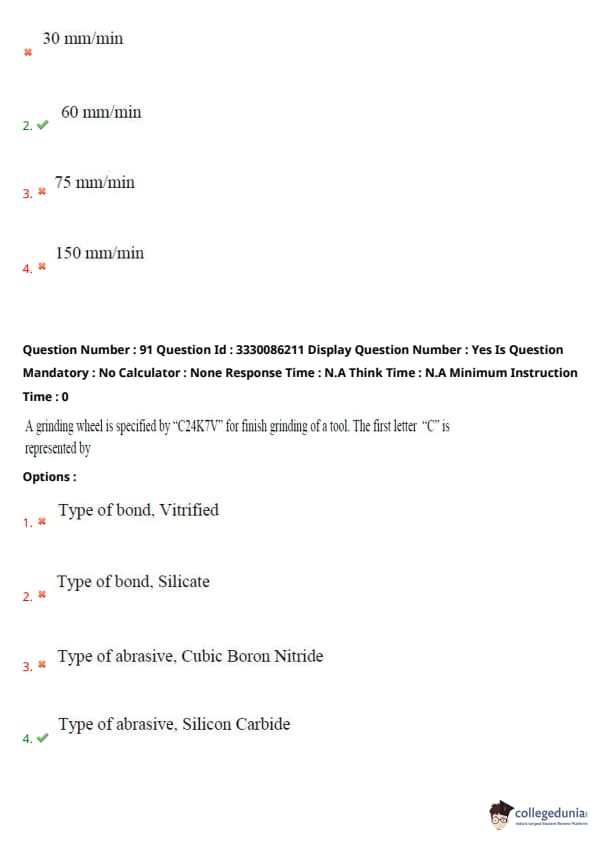
A grinding wheel is specified by ``C24K7V'' for finish grinding of a tool. The first letter ``C'' is represented by
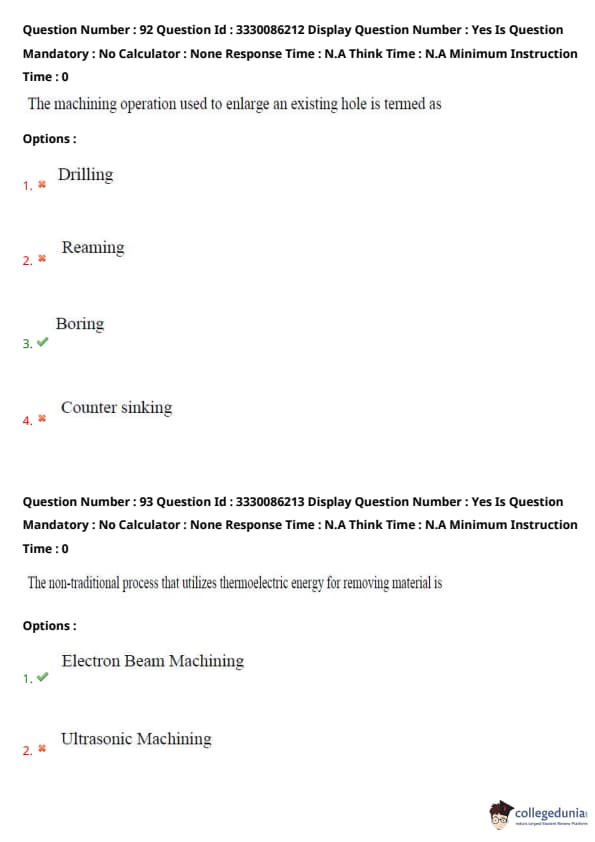
The machining operation used to enlarge an existing hole is termed as:
View Solution
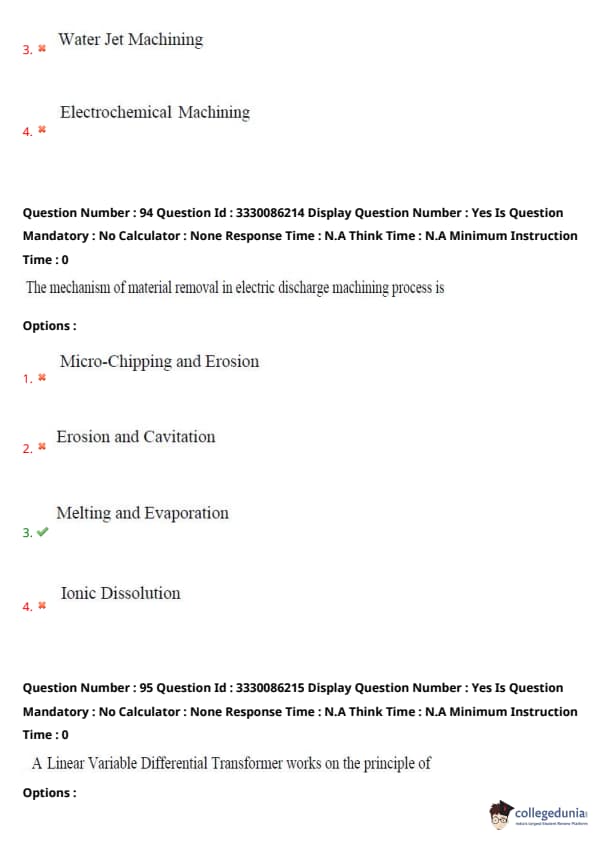
The non-traditional process that utilizes thermoelectric energy for removing material is
The mechanism of material removal in electric discharge machining process is
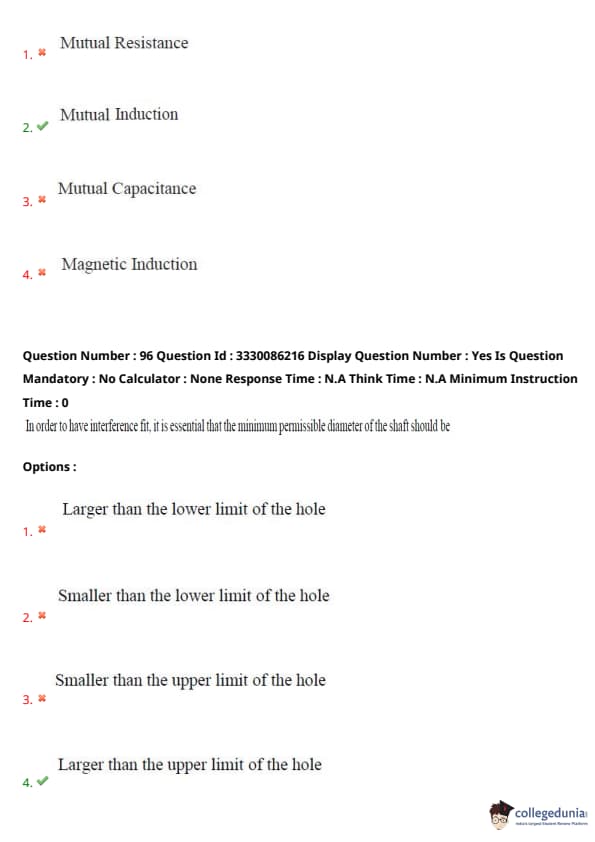
A Linear Variable Differential Transformer works on the principle of
In order to have interference fit, it is essential that the minimum permissible diameter of the shaft should be
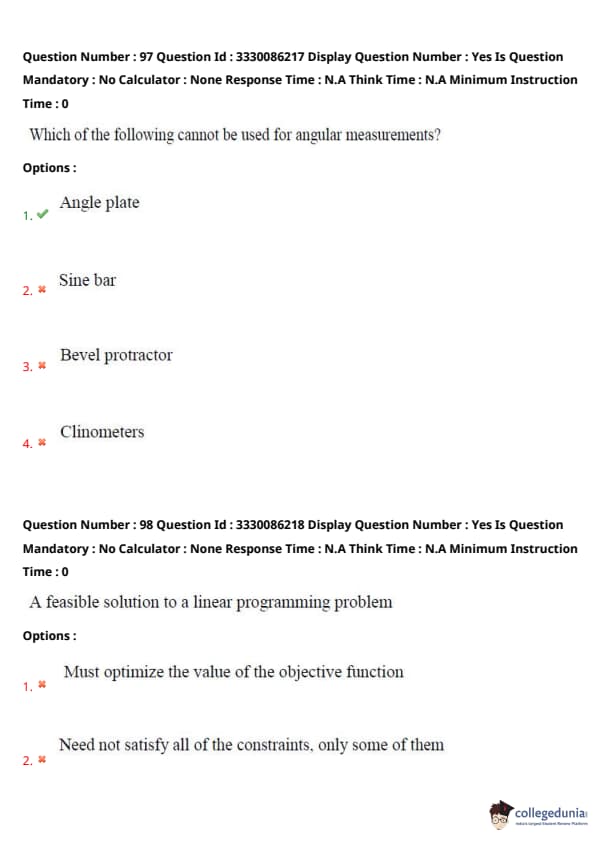
Which of the following cannot be used for angular measurements?
View Solution
A feasible solution to a linear programming problem
View Solution
Step 1: Understand the concept of a feasible solution in linear programming.
In linear programming (LP), a problem consists of an objective function to be optimized (maximized or minimized) subject to a set of linear constraints (inequalities or equalities) and non-negativity conditions. A feasible solution is any solution that satisfies all the constraints of the problem.
Step 2: Define a feasible solution.
A feasible solution must satisfy:
All the linear constraints (e.g., inequalities like \( 2x + y \leq 10 \)).
Any non-negativity constraints (e.g., \( x \geq 0, y \geq 0 \)).
The set of all feasible solutions forms the feasible region, which is a convex polytope in the solution space.
A feasible solution does not necessarily optimize the objective function; that is the role of the optimal solution, which is a subset of feasible solutions.
Step 3: Evaluate the options.
(1) Must optimize the value of the objective function: Incorrect, as a feasible solution only needs to satisfy the constraints, not optimize the objective function. Optimization is a requirement for the optimal solution, not any feasible solution. Incorrect.
(2) Need not satisfy all the constraints, only some of them: Incorrect, as a feasible solution must satisfy all constraints simultaneously. If any constraint is violated, the solution is not feasible. Incorrect.
(3) Must be a corner point of the feasible region: Incorrect, as a feasible solution can be any point within the feasible region, not just a corner point (vertex). Corner points are significant in the Simplex Method because the optimal solution, if it exists, will be at a vertex, but feasible solutions include all points in the region. Incorrect.
(4) Must satisfy all the problem's constraints simultaneously: Correct, as this is the definition of a feasible solution in linear programming. Correct.
Step 4: Select the correct answer.
A feasible solution to a linear programming problem must satisfy all the problem's constraints simultaneously, matching option (4). Quick Tip: A feasible solution in linear programming satisfies all constraints, forming the feasible region. The optimal solution, which maximizes or minimizes the objective, is a subset of feasible solutions.
The solution to a transportation problem with \( m \)-rows (supplies) and \( n \)-columns (destinations) is feasible if number of positive allocations are
View Solution
Step 1: Understand the transportation problem.
A transportation problem is a type of linear programming problem where the goal is to minimize the cost of transporting goods from \( m \) sources (supplies) to \( n \) destinations (demands). The problem is represented as a table with \( m \) rows and \( n \) columns, where each cell represents the amount transported from a source to a destination (an allocation).
Step 2: Define a feasible solution in a transportation problem.
A feasible solution must satisfy:
The supply constraints: The total amount shipped from each source must equal its supply.
The demand constraints: The total amount received at each destination must equal its demand.
Non-negativity: All allocations must be non-negative.
For the solution to be feasible and non-degenerate, the allocations must form a basic feasible solution.
Step 3: Determine the number of positive allocations for a basic feasible solution.
In a transportation problem with \( m \) sources and \( n \) destinations, there are:
\( m \) supply constraints,
\( n \) demand constraints.
However, these constraints are not all independent: The sum of supplies equals the sum of demands (a balanced transportation problem), so one constraint is redundant.
The total number of independent constraints is \( m + n - 1 \).
In linear programming, a basic feasible solution has the number of positive variables (allocations) equal to the number of independent constraints.
Therefore, a basic feasible solution to a transportation problem has exactly \( m + n - 1 \) positive allocations (non-zero entries in the transportation table).
If the number of positive allocations is less than \( m + n - 1 \), the solution is degenerate. If it is more, the solution is not a basic feasible solution.
Step 4: Evaluate the options.
(1) \( m + n \): Incorrect, as this overestimates the number of independent constraints by 1 (it does not account for the redundancy). Incorrect.
(2) \( m \times n \): Incorrect, as this is the total number of cells in the table, not the number of positive allocations needed for a basic feasible solution. Incorrect.
(3) \( m + n - 1 \): Correct, as this matches the number of independent constraints, which determines the number of positive allocations in a basic feasible solution. Correct.
(4) \( m + n + 1 \): Incorrect, as this exceeds the number of independent constraints. Incorrect.
Step 5: Select the correct answer.
The solution to a transportation problem is a basic feasible solution if the number of positive allocations is \( m + n - 1 \), matching option (3). Quick Tip: In a transportation problem, a basic feasible solution has \( m + n - 1 \) positive allocations, corresponding to the number of independent constraints (supply and demand equations minus one redundancy).
Fixed investments for manufacturing a product in a particular year is Rs. 80,000. The estimated sales for this period is 2,00,000. The variable cost per unit for this product is Rs. 4. If each unit sold is at Rs. 20, then the break-even point would be:
View Solution
The quantity versus costs plot is shown in the figure below. The costs marked as A, B, and C, respectively, are

A bill of materials is:
View Solution
Consider the network diagram shown in Figure. The time estimates in days along the arrows represents the activities. The project completion time in days based on critical path is

In a CNC program block, N130 G02 X65.0 Y60.0 R40.0 F250, G02 refers to
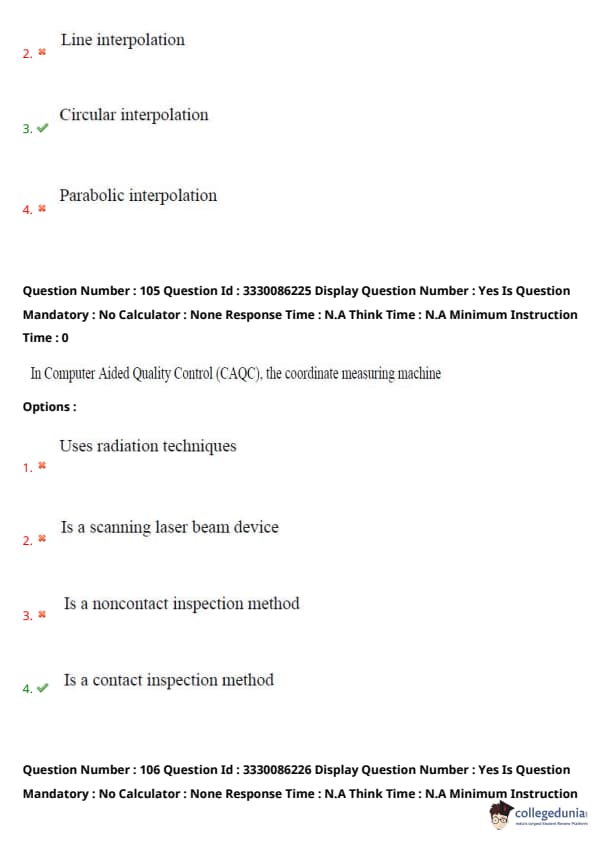
In Computer Aided Quality Control (CAQC), the coordinate measuring machine
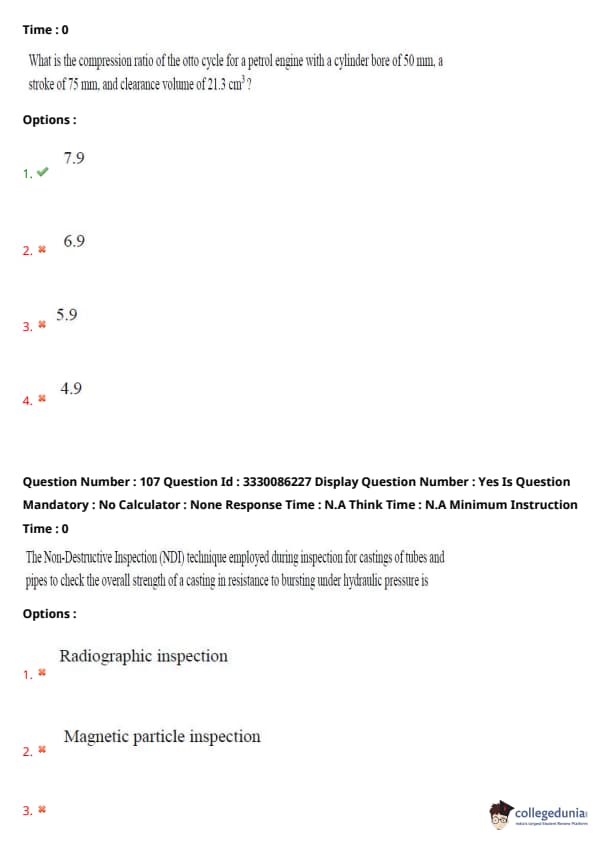
What is the compression ratio of the Otto cycle for a petrol engine with a cylinder bore of 50 mm, a stroke of 75 mm, and clearance volume of 21.3 cm\(^3\)?
The Non-Destructive Inspection (NDI) technique employed during inspection for castings of tubes and pipes to check the overall strength of a casting in resistance to bursting under hydraulic pressure is:
View Solution
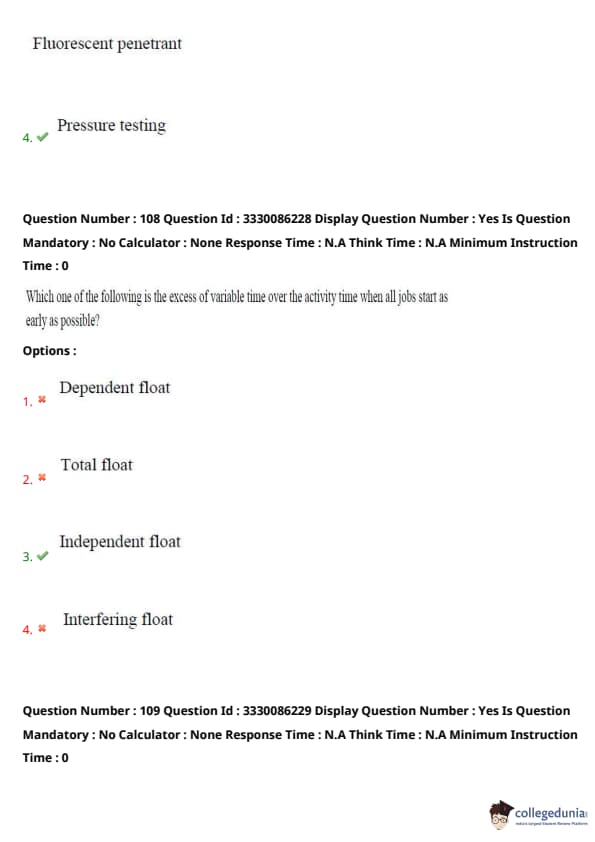
Which one of the following is the excess of variable time over the activity time when all jobs start as early as possible?
View Solution
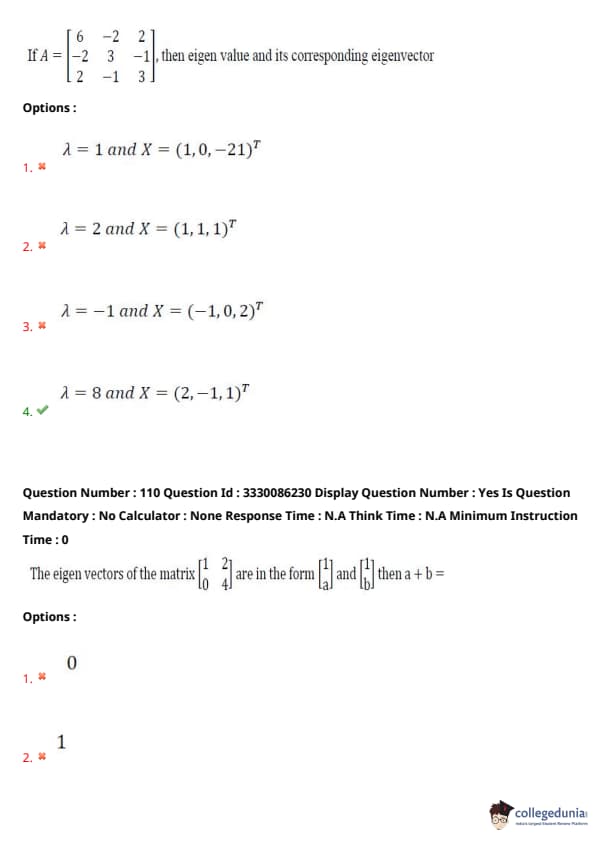
If \( A = \begin{bmatrix} 6 & -2 & 2
-2 & 3 & -1
2 & -1 & 3 \end{bmatrix} \), then eigen value and its corresponding eigen vector
The eigen vectors of the matrix \(\begin{bmatrix} 1 & 2
0 & 4 \end{bmatrix}\) are in the form \(\begin{bmatrix} 1
a \end{bmatrix}\) and \(\begin{bmatrix} 1
b \end{bmatrix}\), then \( a + b =\)
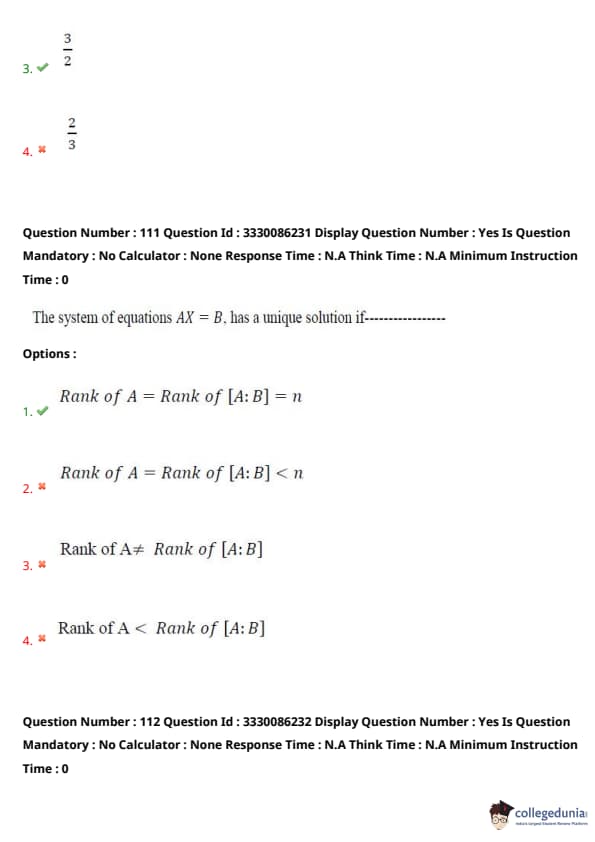
The system of equations \( AX = B \), has a unique solution if----------
View Solution
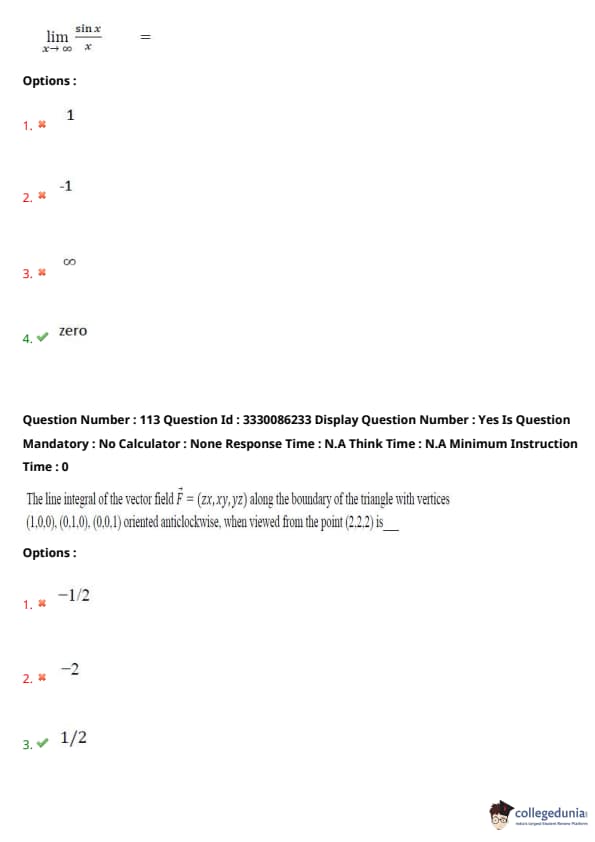
\(\lim_{x \to \infty} \frac{\sin x}{x} =\)
The line integral of the vector field \( \vec{F} = (zx, xy, yz) \) along the boundary of the triangle with vertices (1,0,0), (0,1,0), (0,0,1) anticlockwise, when viewed from the point (2,2,2) is
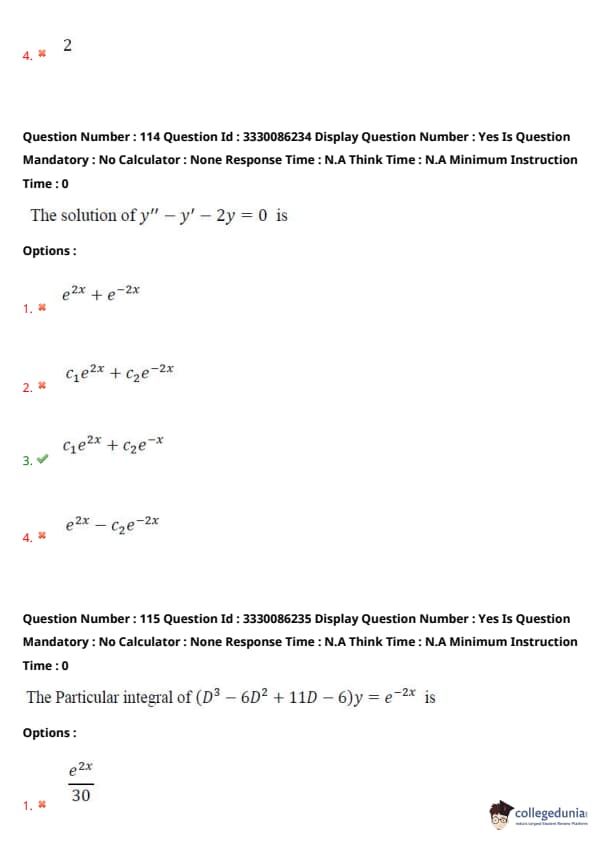
The solution of \( y'' - y' - 2y = 0 \) is
The Particular integral of \( (D^3 - 6D^2 + 11D - 6)y = e^{-2x} \) is:
View Solution
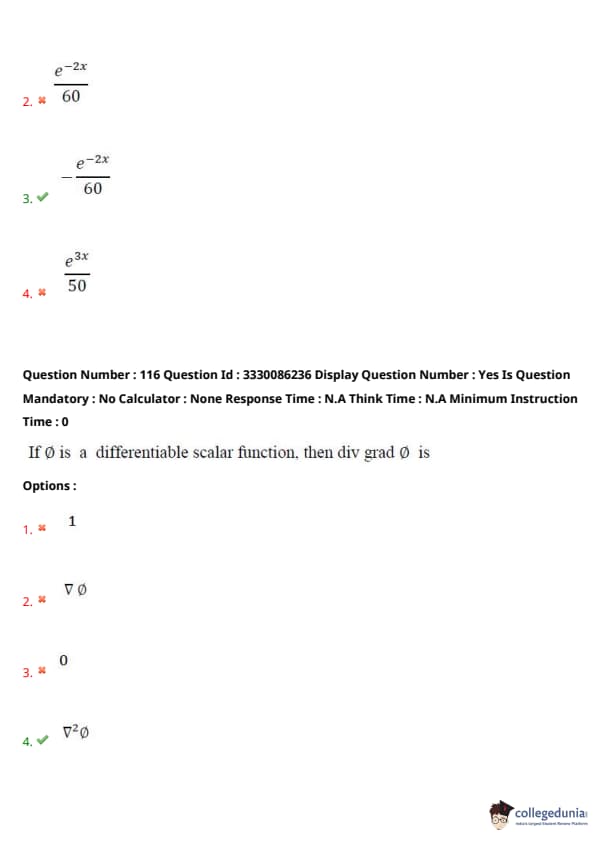
If \(\phi\) is a differentiable scalar function, then div grad \(\phi\) is
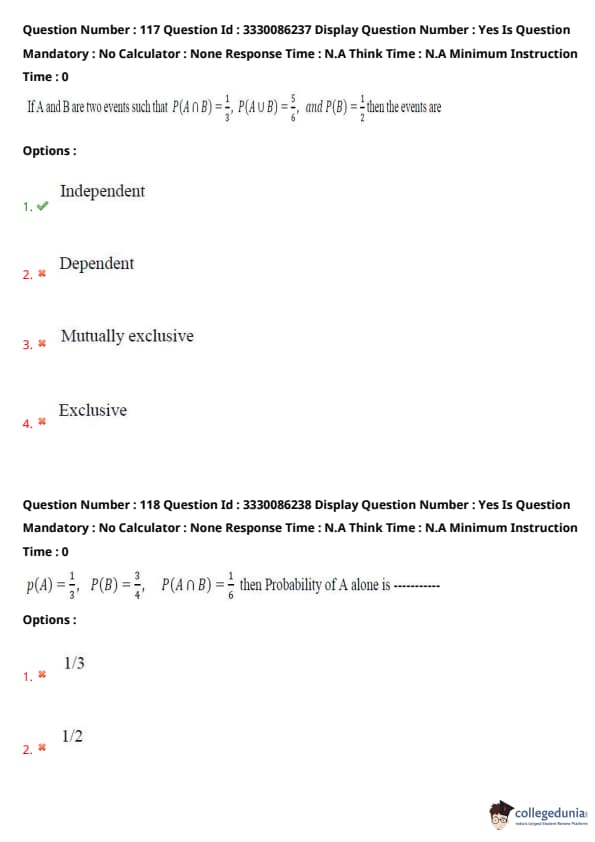
If \( A \) and \( B \) are two events such that \( P(A \cap B) = \frac{1}{3}, P(A \cup B) = \frac{5}{6}, \) and \( P(B) = \frac{1}{2} \), then the events are
\( P(A) = \frac{1}{3}, P(B) = \frac{3}{4}, P(A \cap B) = \frac{1}{6} \), then probability of \( A \) alone is
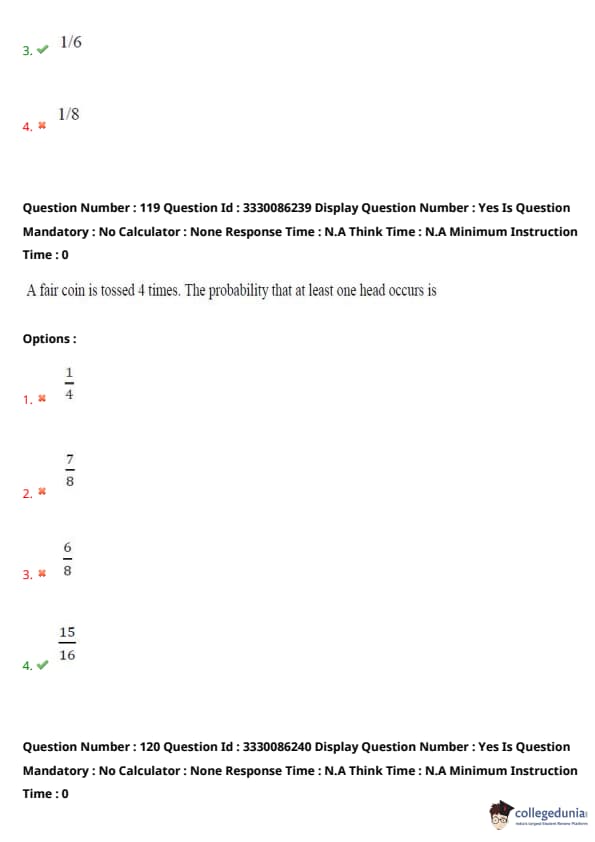
A fair coin is tossed 4 times. The probability that at least one head occurs is
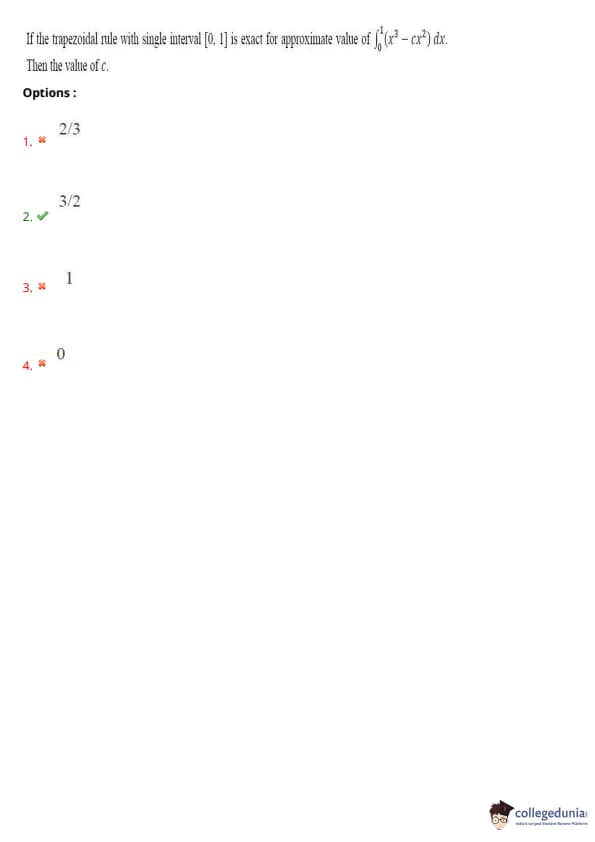
If the trapezoidal rule with a single interval [0, 1] is exact for the approximate value of \( \int_0^1 (x^3 - cx^2) \, dx \). Then the value of \( c \).
View Solution



Comments