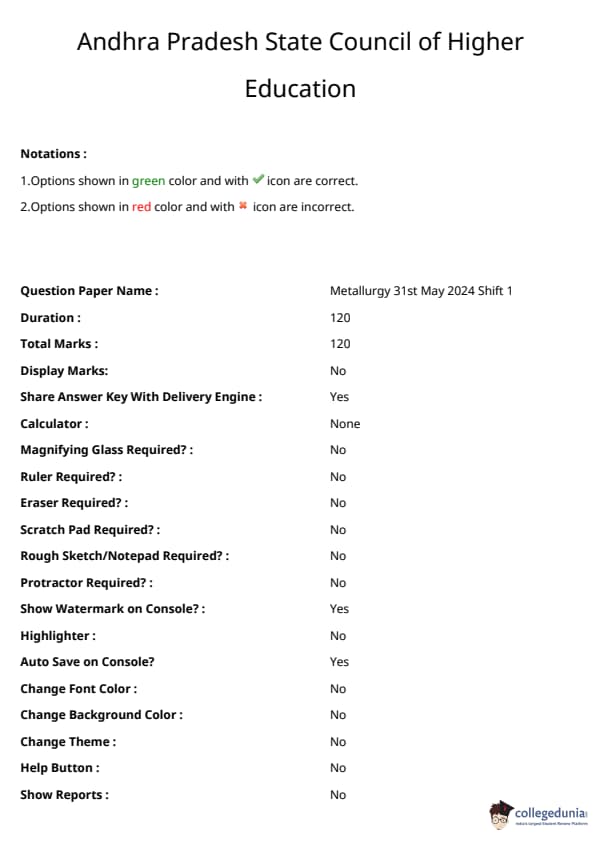
AP PGECET 2024 Metallurgy Question Paper is available for download here. Sri Venkateswara University, Tirupati on behalf of APSCHE conducted AP PGECET 2024 Metallurgy on May 31 in Shift 1 from 9 AM to 11 AM. AP PGECET Question Paper 2024 consists of 120 MCQ-based questions in total carrying 1 mark each to be attempted in the duration of 2 hours.
AP PGECET 2024 Metallurgy Question Paper with Answer Key PDF
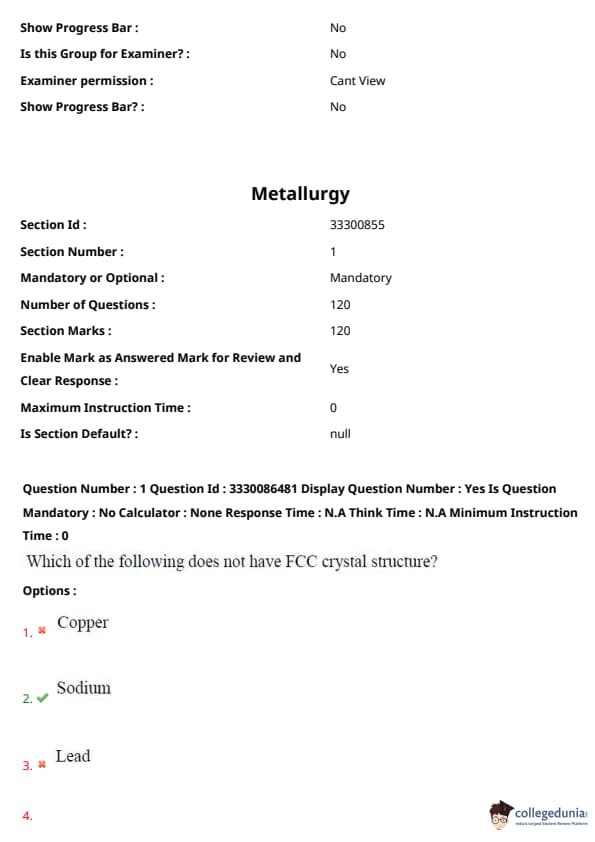
Question 1:
Which of the following does not have FCC crystal structure?
- (1) Copper
- (2) Sodium
- (3) Lead
- (4) Aluminium
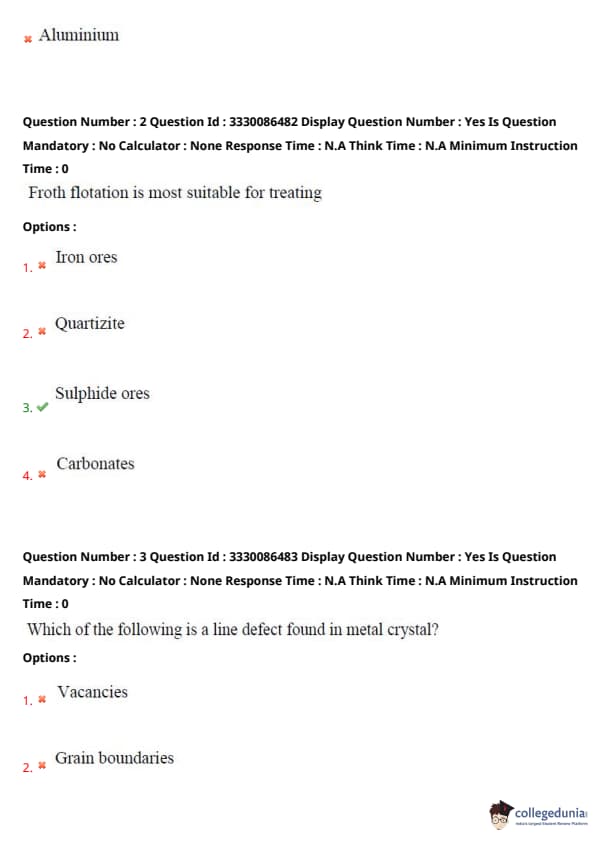
Question 2:
Froth flotation is most suitable for treating
- (1) Iron ores
- (2) Quartzite
- (3) Sulphide ores
- (4) Carbonates
Question 3:
Which of the following is a line defect found in metal crystal?
- (1) Vacancies
- (2) Grain boundaries
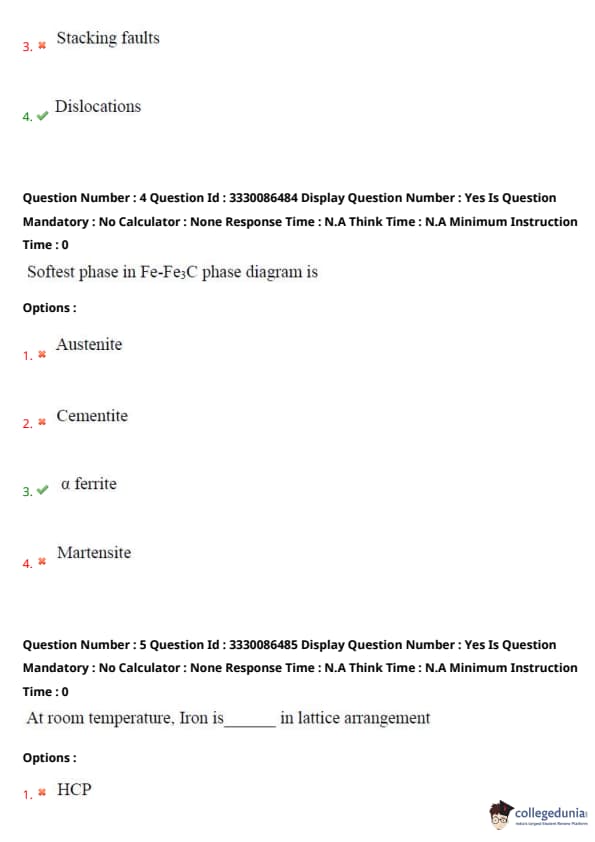
- (3) Stacking faults
- (4) Dislocations
Question 4:
Softest phase in Fe-Fe\(_3\)C phase diagram is
- (1) Austenite
- (2) Cementite
- (3) \(\alpha\) ferrite
- (4) Martensite
Question 5:
At room temperature, Iron is ........ in lattice arrangement
- (1) HCP
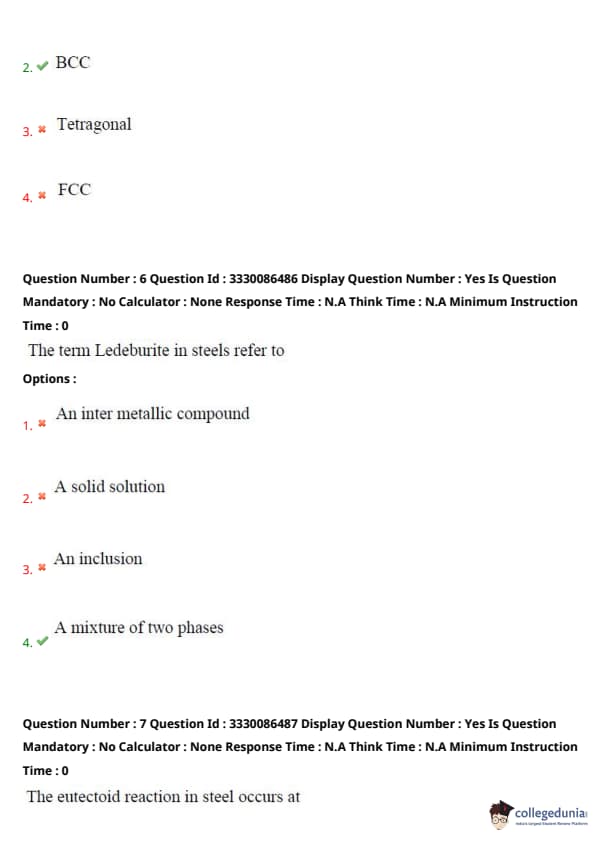
- (2) BCC
- (3) Tetragonal
- (4) FCC
Question 6:
The term Ledeburite in steels refers to
- (1) An intermetallic compound
- (2) A solid solution
- (3) An inclusion
- (4) A mixture of two phases
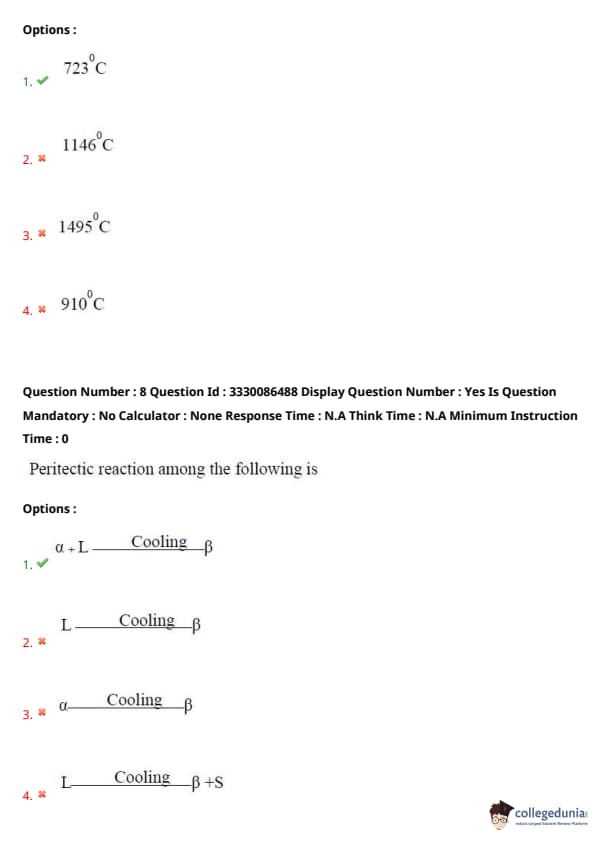
Question 7:
The eutectoid reaction in steel occurs at
- (1) 723°C
- (2) 1146°C
- (3) 1495°C
- (4) 910°C
Question 8:
Peritectic reaction among the following is
- (1) \(\alpha\) + L \(\xrightarrow{Cooling}\) \( \beta \)
- (2) L \(\xrightarrow{Cooling}\) \(\beta\)
- (3) \(\alpha\) \(\xrightarrow{Cooling}\) \(\beta\)
- (4) L \(\xrightarrow{Cooling}\) \(\beta\) + S
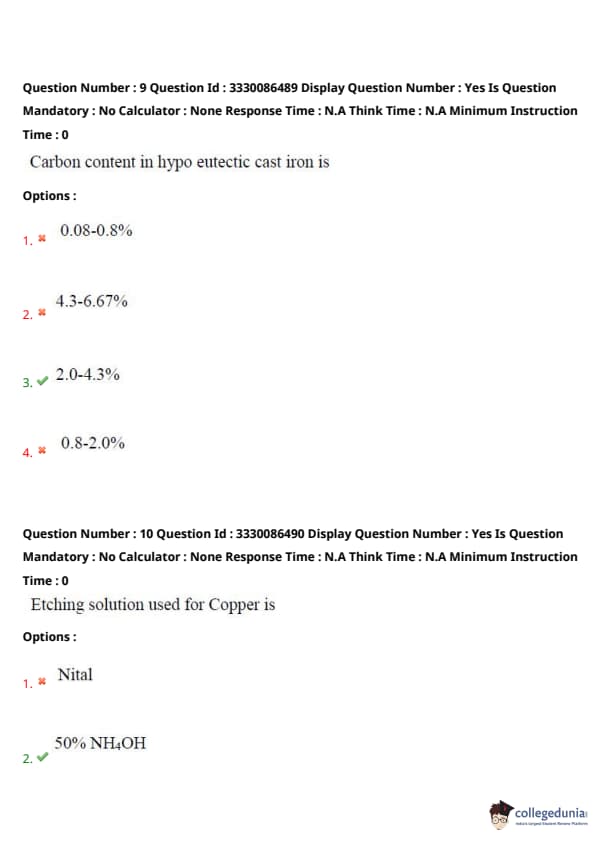
Question 9:
Carbon content in hypo eutectic cast iron is
- (1) 0.08-0.8%
- (2) 4.3-6.67%
- (3) 2.0-4.3%
- (4) 0.8-2.0%
Question 10:
Etching solution used for Copper is
- (1) Nital
- (2) 50% NH\(_4\)OH
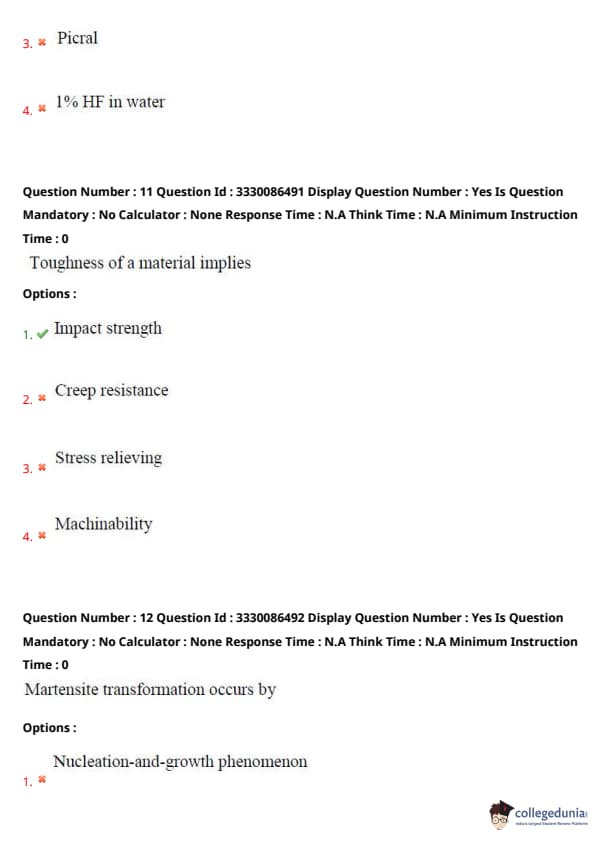
- (3) Picral
- (4) 1% HF in water
Question 11:
Toughness of a material implies
- (1) Impact strength
- (2) Creep resistance
- (3) Stress relieving
- (4) Machinability
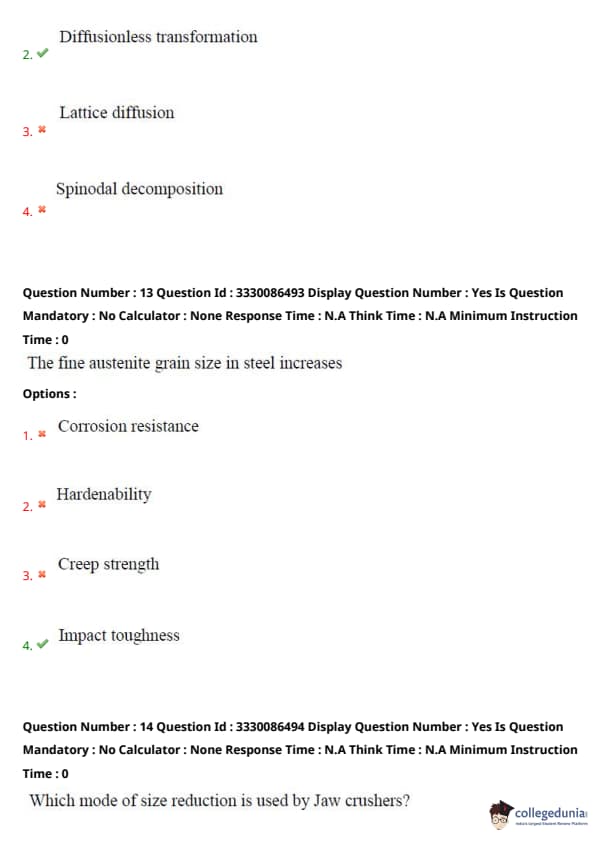
Question 12:
Martensite transformation occurs by
- (1) Nucleation-and-growth phenomenon
- (2) Diffusionless transformation
- (3) Lattice diffusion
- (4) Spinodal decomposition
Question 13:
The fine austenite grain size in steel increases
- (1) Corrosion resistance
- (2) Hardenability
- (3) Creep strength
- (4) Impact toughness
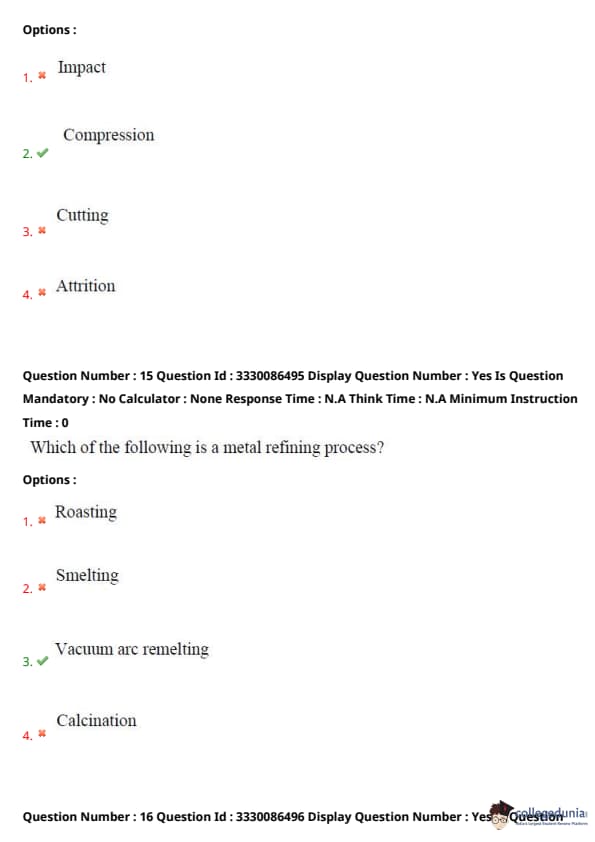
Question 14:
Which mode of size reduction is used by Jaw crushers?
- (1) Impact
- (2) Compression
- (3) Cutting
- (4) Attrition
Question 15:
Which of the following is a metal refining process?
- (1) Roasting
- (2) Smelting
- (3) Vacuum arc remelting
- (4) Calcination
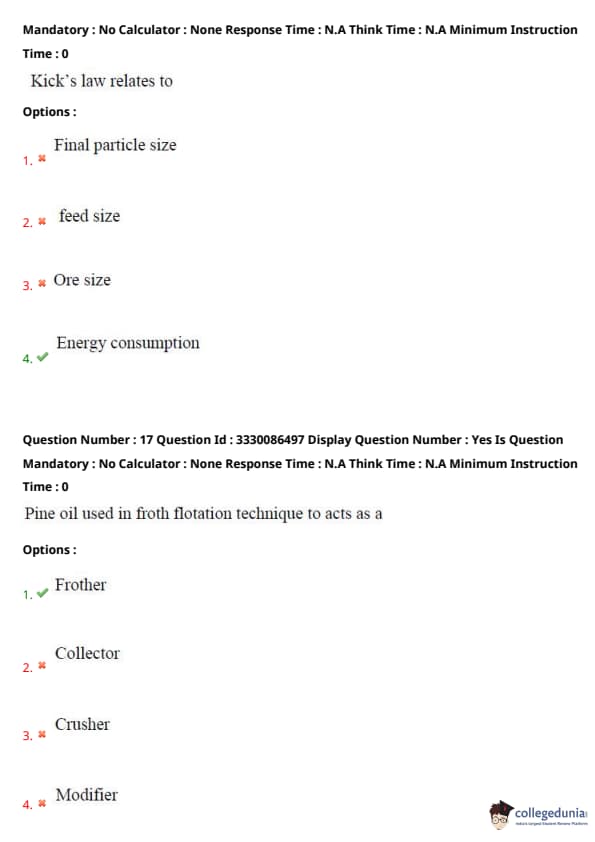
Question 16:
Kick's law relates to
- (1) Final particle size
- (2) Feed size
- (3) Ore size
- (4) Energy consumption
Question 17:
Pine oil used in froth flotation technique acts as a
- (1) Frother
- (2) Collector
- (3) Crusher
- (4) Modifier
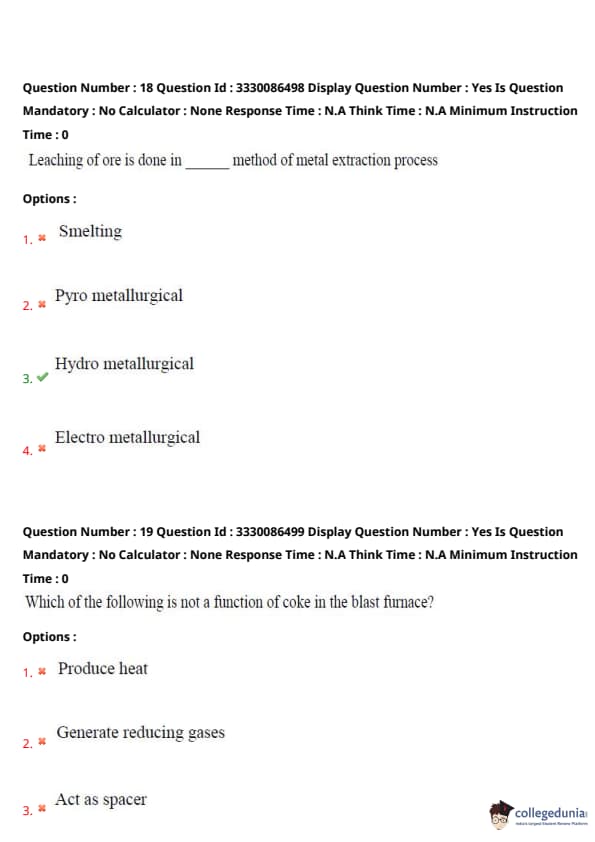
Question 18:
Leaching of ore is done in ...... method of metal extraction process
- (1) Smelting
- (2) Pyro metallurgical
- (3) Hydro metallurgical
- (4) Electro metallurgical
Question 19:
Which of the following is not a function of coke in the blast furnace?
- (1) Produce heat
- (2) Generate reducing gases
- (3) Act as spacer
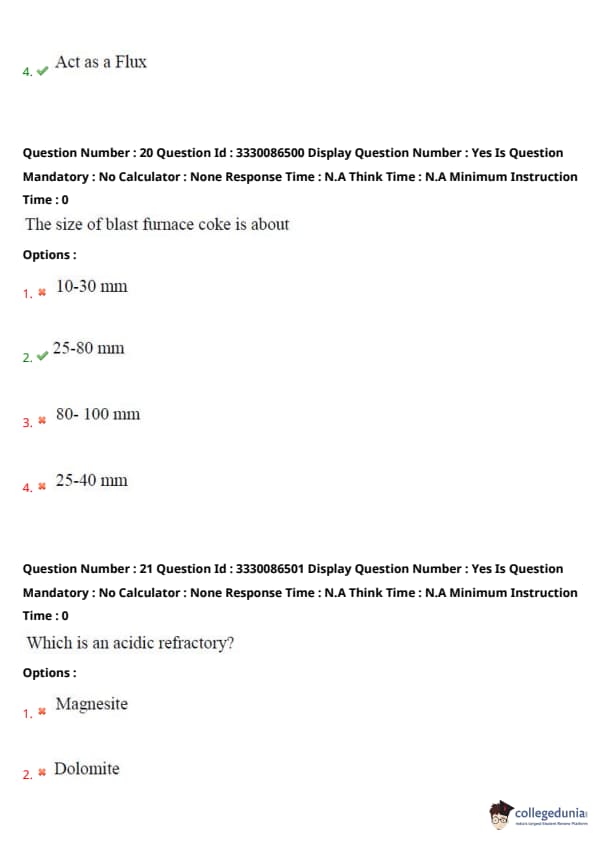
- (4) Act as a flux
Question 20:
The size of blast furnace coke is about
- (1) 10-30 mm
- (2) 25-80 mm
- (3) 80-100 mm
- (4) 25-40 mm
Question 21:
Which is an acidic refractory?
- (1) Magnesite
- (2) Dolomite
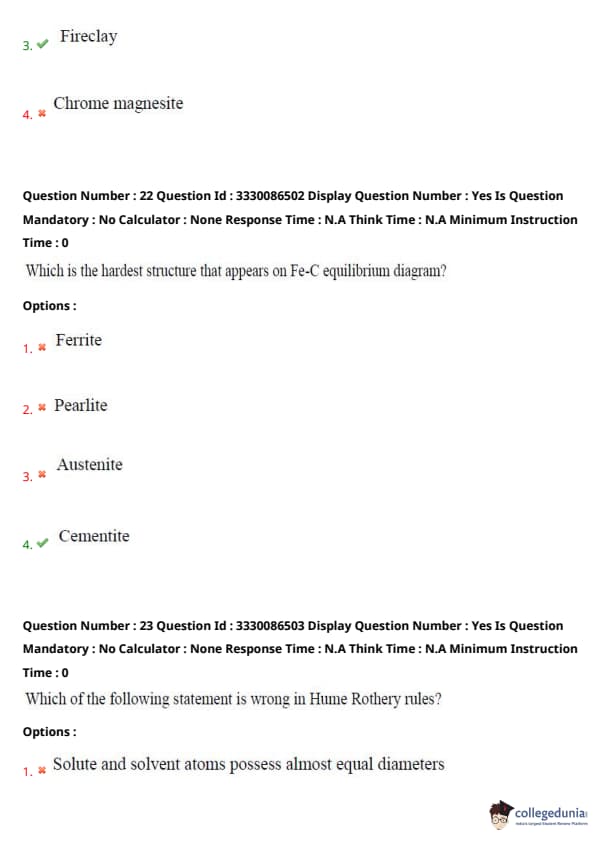
- (3) Fireclay
- (4) Chrome magnesite
Question 22:
Which is the hardest structure that appears on the Fe-C equilibrium diagram?
- (1) Ferrite
- (2) Pearlite
- (3) Austenite
- (4) Cementite
Question 23:
Which of the following statement is wrong in Hume Rothery rules?
- (1) Solute and solvent atoms possess almost equal diameters
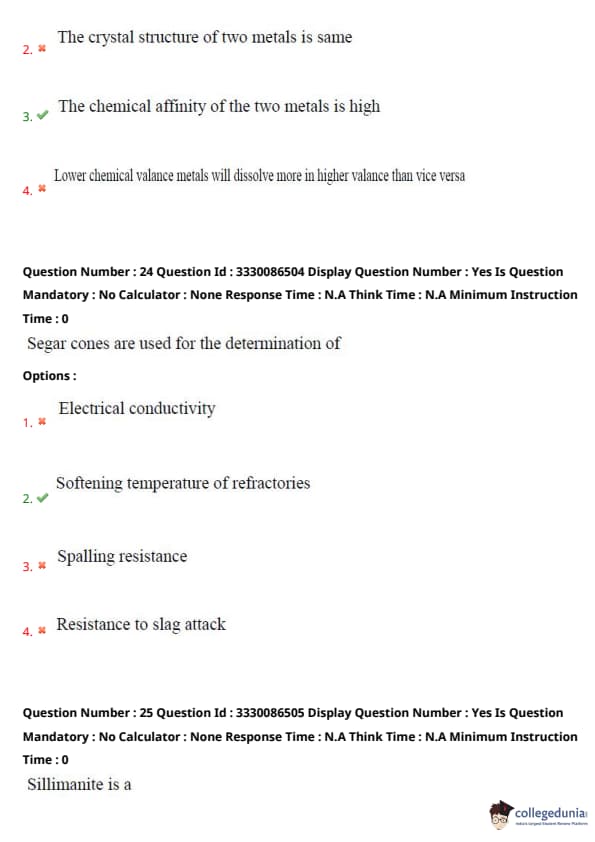
- (2) The crystal structure of two metals is the same
- (3) The chemical affinity of the two metals is high
- (4) Lower chemical valence metals will dissolve more in higher valence than vice versa
Question 24:
Segar cones are used for the determination of
- (1) Electrical conductivity
- (2) Softening temperature of refractories
- (3) Spalling resistance
- (4) Resistance to slag attack
Question 25:
Sillimanite is a
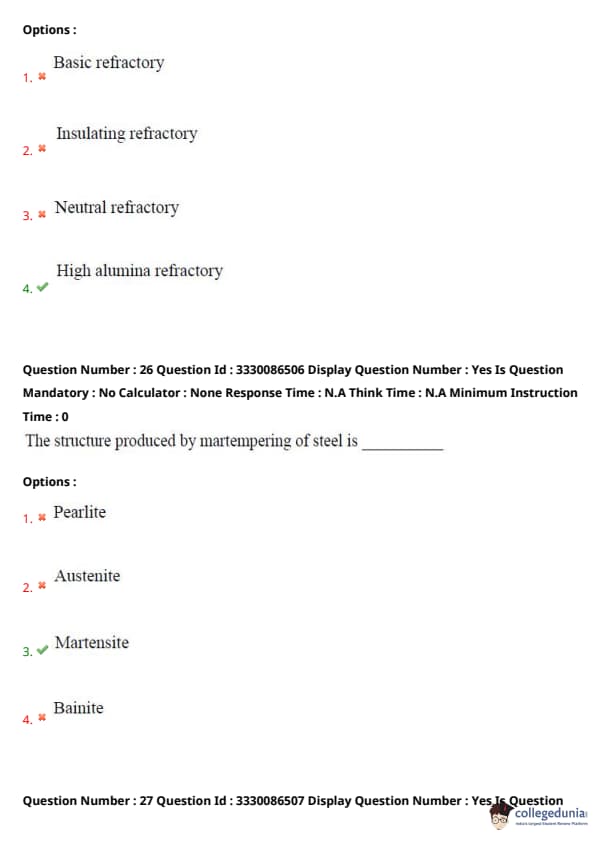
- (1) Basic refractory
- (2) Insulating refractory
- (3) Neutral refractory
- (4) High alumina refractory
Question 26:
The structure produced by martempering of steel is
- (1) Pearlite
- (2) Austenite
- (3) Martensite
- (4) Bainite
Question 27:
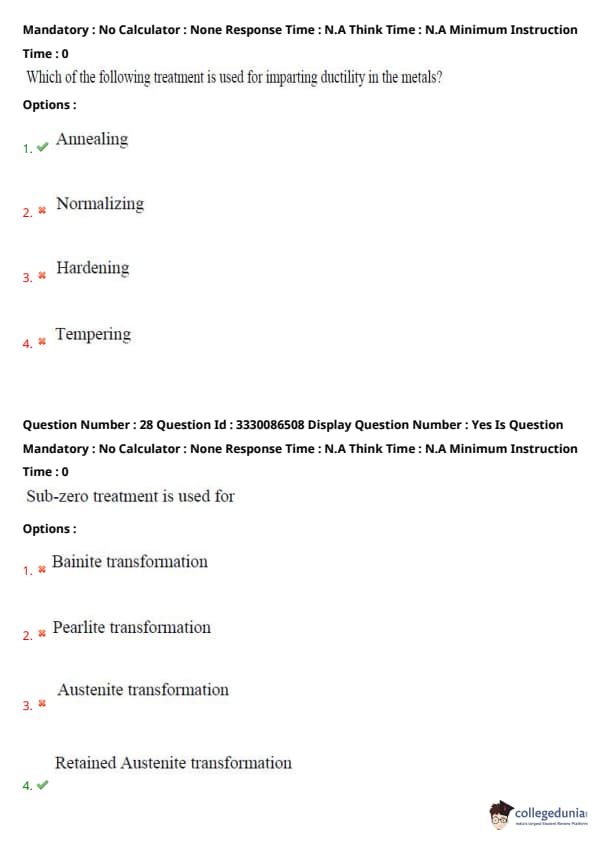
Which of the following treatments is used for imparting ductility in the metals?
- (1) Annealing
- (2) Normalizing
- (3) Hardening
- (4) Tempering
Question 28:
Sub-zero treatment is used for
- (1) Bainite transformation
- (2) Pearlite transformation
- (3) Austenite transformation
- (4) Retained Austenite transformation
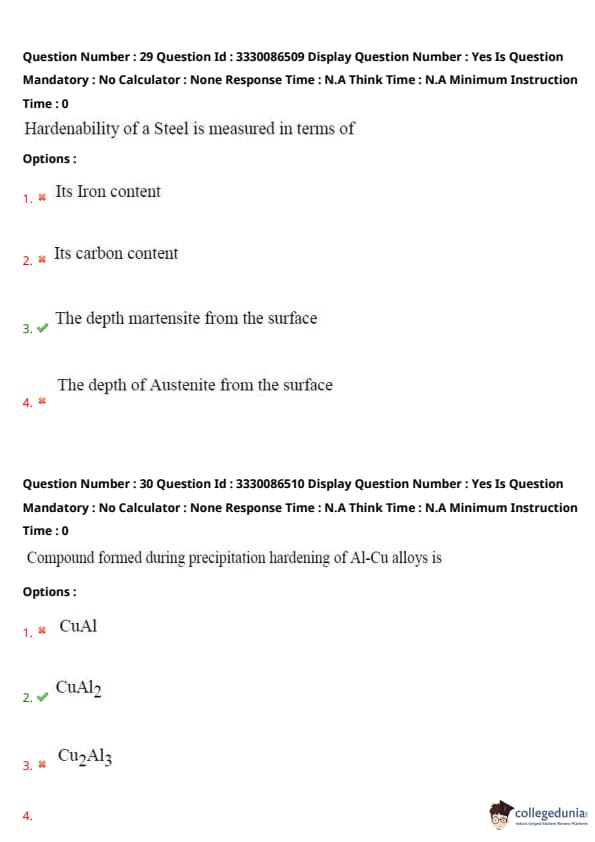
Question 29:
Hardenability of a steel is measured in terms of
- (1) Its iron content
- (2) Its carbon content
- (3) The depth martensite from the surface
- (4) The depth of Austenite from the surface
Question 30:
Compound formed during precipitation hardening of Al-Cu alloys is
- (1) CuAl
- (2) CuAl₂
- (3) Cu₂Al₃
- (4) Cu₃Al₂
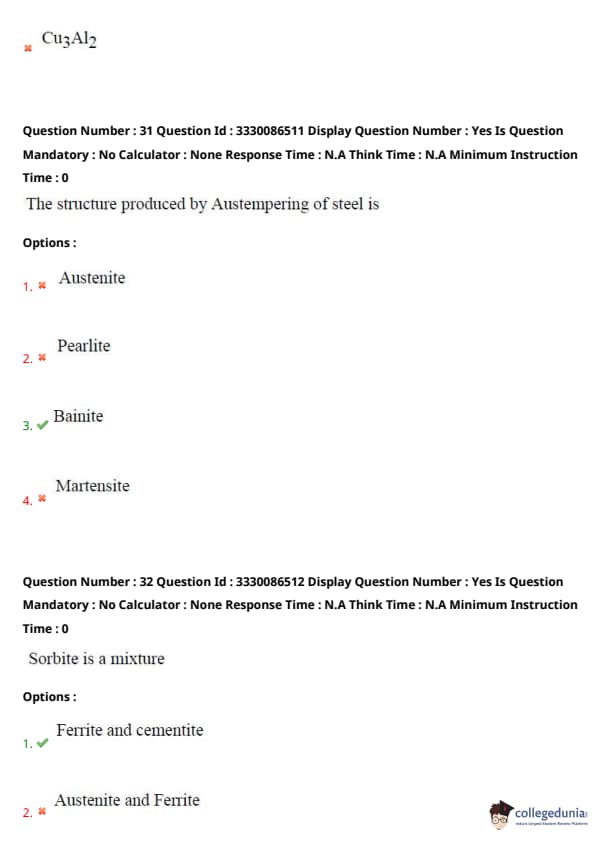
Question 31:
The structure produced by Austempering of steel is
- (1) Austenite
- (2) Pearlite
- (3) Bainite
- (4) Martensite
Question 32:
Sorbite is a mixture
- (1) Ferrite and cementite
- (2) Austenite and Ferrite
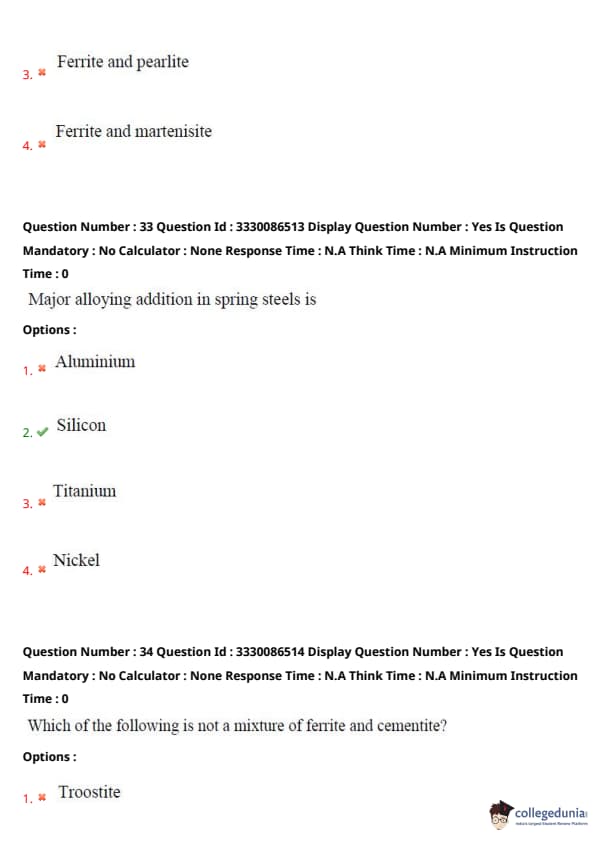
- (3) Ferrite and pearlite
- (4) Ferrite and martensite
Question 33:
Major alloying addition in spring steels is
- (1) Aluminium
- (2) Silicon
- (3) Titanium
- (4) Nickel
Question 34:
Which of the following is not a mixture of ferrite and cementite?
- (1) Troostite
- (2) Pearlite
- (3) Ledeburite
- (4) Martensite
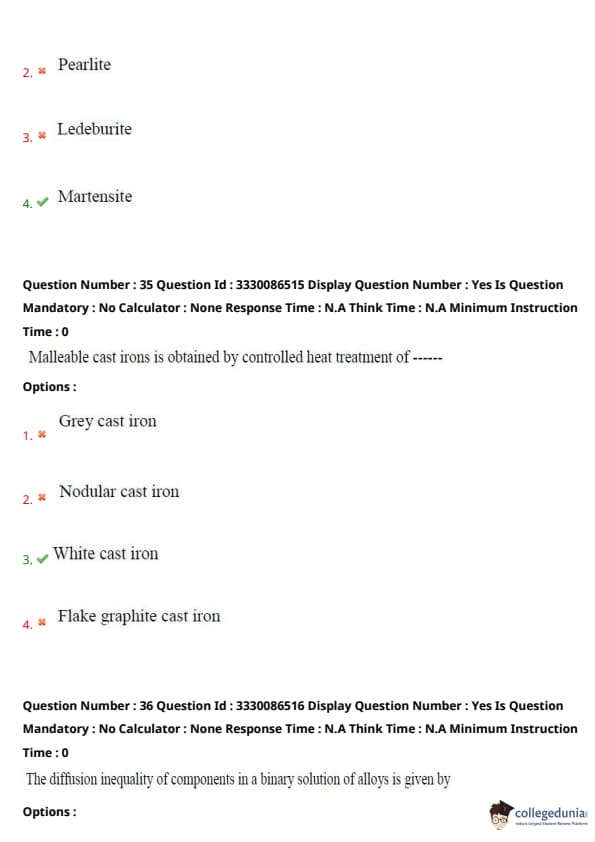
Question 35:
Malleable cast iron is obtained by controlled heat treatment of
- (1) Grey cast iron
- (2) Nodular cast iron
- (3) White cast iron
- (4) Flake graphite cast iron
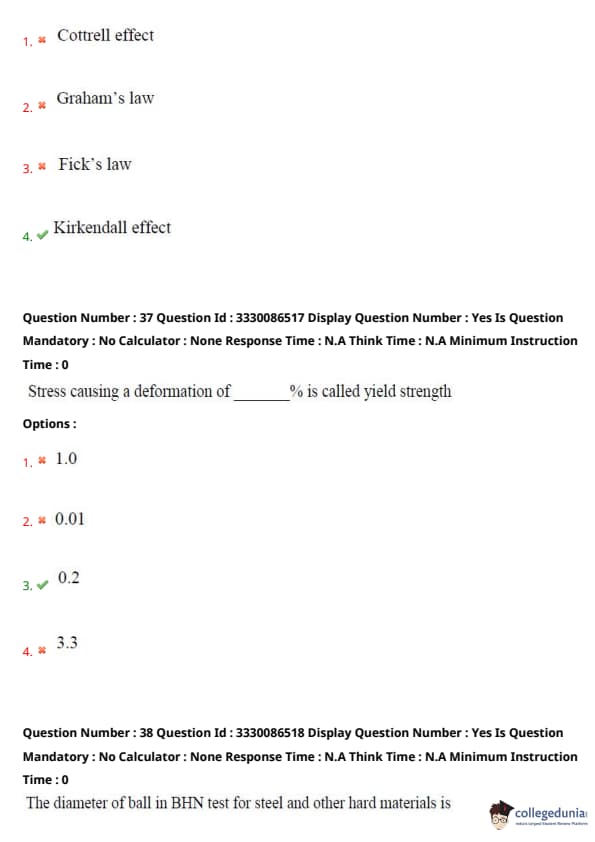
Question 36:
The diffusion inequality of components in a binary solution of alloys is given by
- (1) Cottrell effect
- (2) Graham’s law
- (3) Fick’s law
- (4) Kirkendall effect
Question 37:
Stress causing a deformation of ........ % is called yield strength
- (1) 1.0
- (2) 0.01
- (3) 0.2
- (4) 3.3
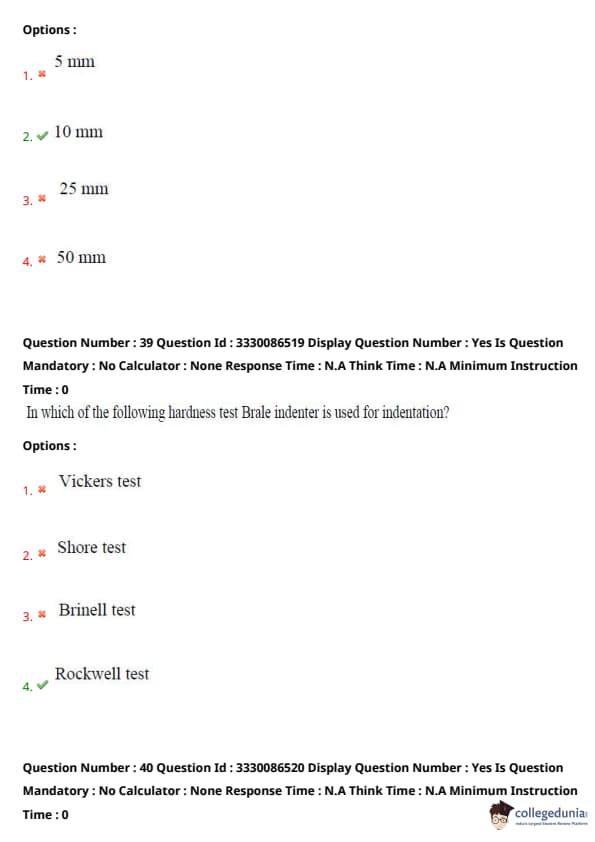
Question 38:
The diameter of the ball in BHN test for steel and other hard materials is
- (1) 5 mm
- (2) 10 mm
- (3) 25 mm
- (4) 50 mm
Question 39:
In which of the following hardness tests is the Brale indenter used for indentation?
- (1) Vickers test
- (2) Shore test
- (3) Brinell test
- (4) Rockwell test
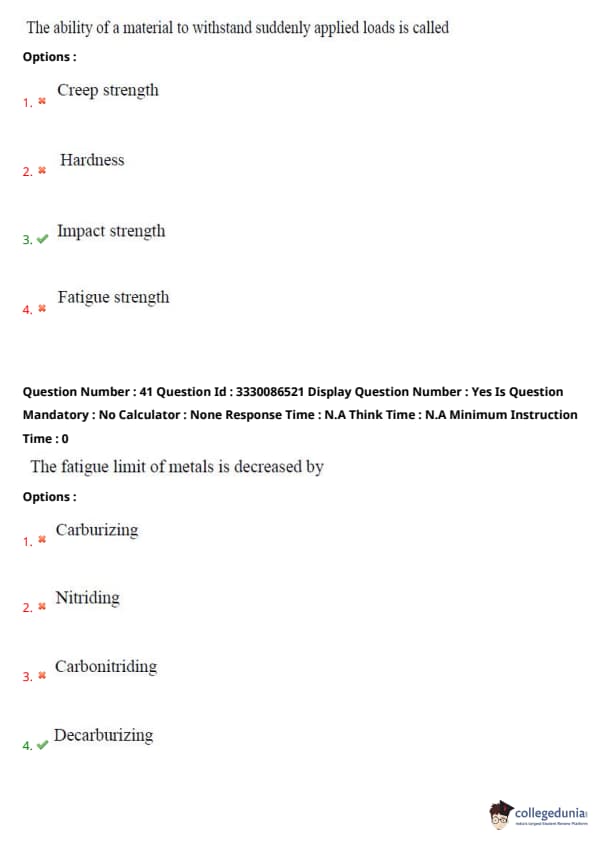
Question 40:
The ability of a material to withstand suddenly applied loads is called
- (1) Creep strength
- (2) Hardness
- (3) Impact strength
- (4) Fatigue strength
Question 41:
The fatigue limit of metals is decreased by
- (1) Carburizing
- (2) Nitriding
- (3) Carbonitriding
- (4) Decarburizing
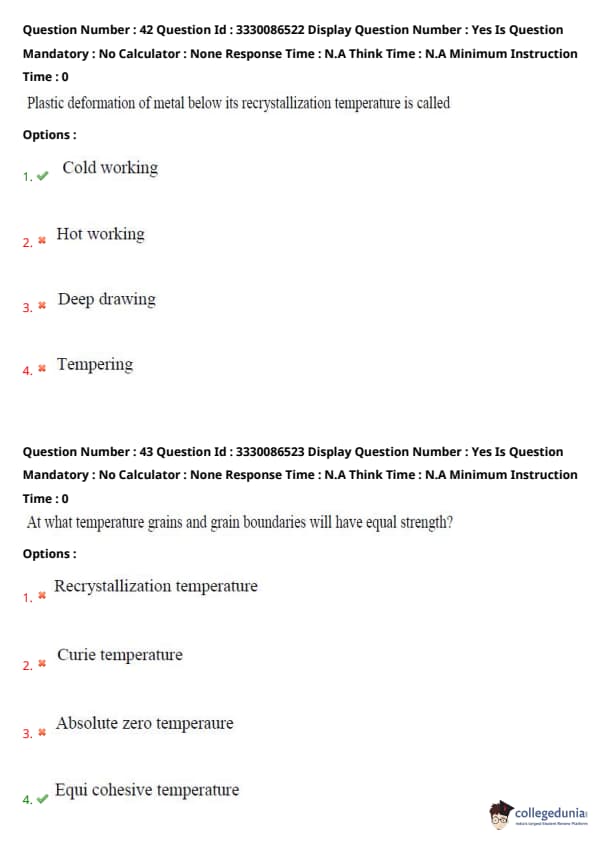
Question 42:
Plastic deformation of metal below its recrystallization temperature is called
- (1) Cold working
- (2) Hot working
- (3) Deep drawing
- (4) Tempering
Question 43:
At what temperature grains and grain boundaries will have equal strength?
- (1) Recrystallization temperature
- (2) Curie temperature
- (3) Absolute zero temperature
- (4) Equi cohesive temperature
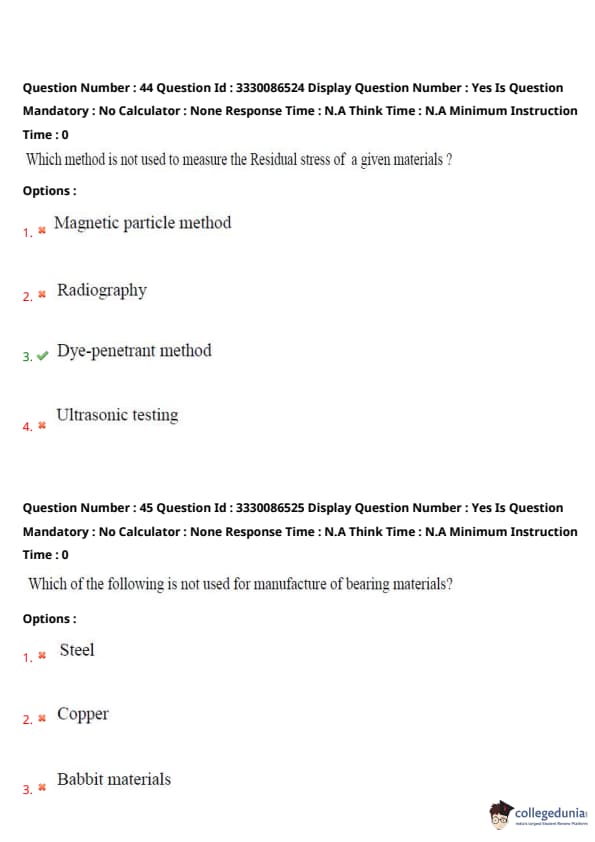
Question 44:
Which method is not used to measure the residual stress of a given material?
- (1) Magnetic particle method
- (2) Radiography
- (3) Dye-penetrant method
- (4) Ultrasonic testing
Question 45:
Which of the following is not used for the manufacture of bearing materials?
- (1) Steel
- (2) Copper
- (3) Babbit materials
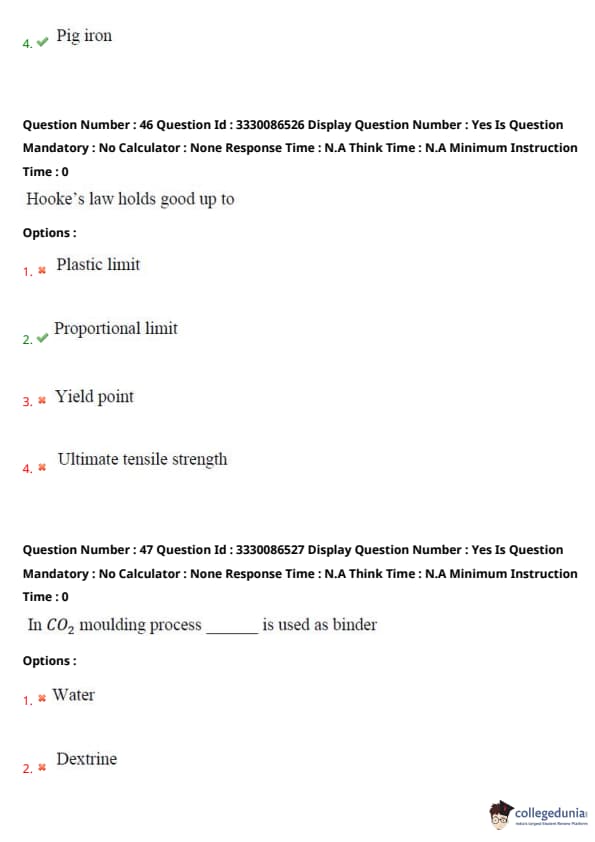
- (4) Pig iron
Question 46:
Hooke’s law holds good up to
- (1) Plastic limit
- (2) Proportional limit
- (3) Yield point
- (4) Ultimate tensile strength
Question 47:
In CO₂ moulding process ...... is used as binder
- (1) Water
- (2) Dextrine
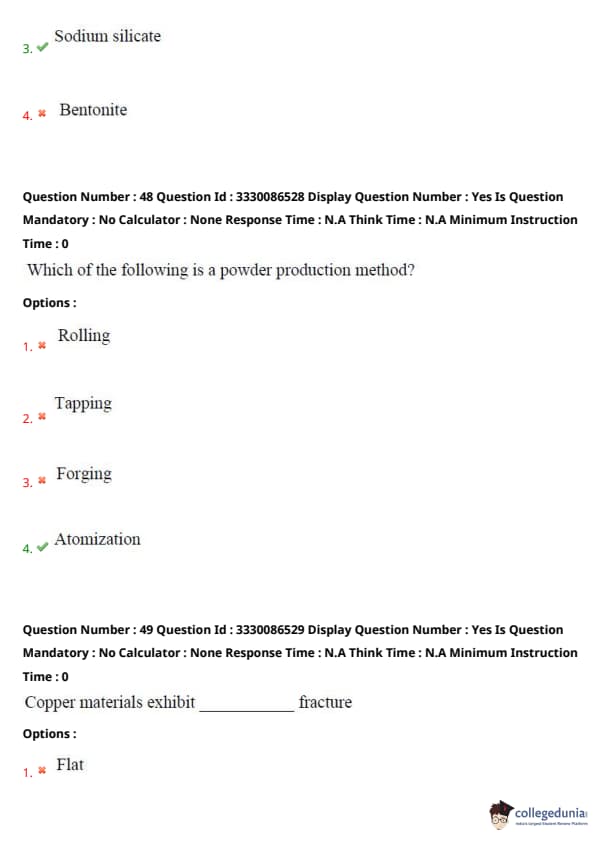
- (3) Sodium silicate
- (4) Bentonite
Question 48:
Which of the following is a powder production method?
- (1) Rolling
- (2) Tapping
- (3) Forging
- (4) Atomization
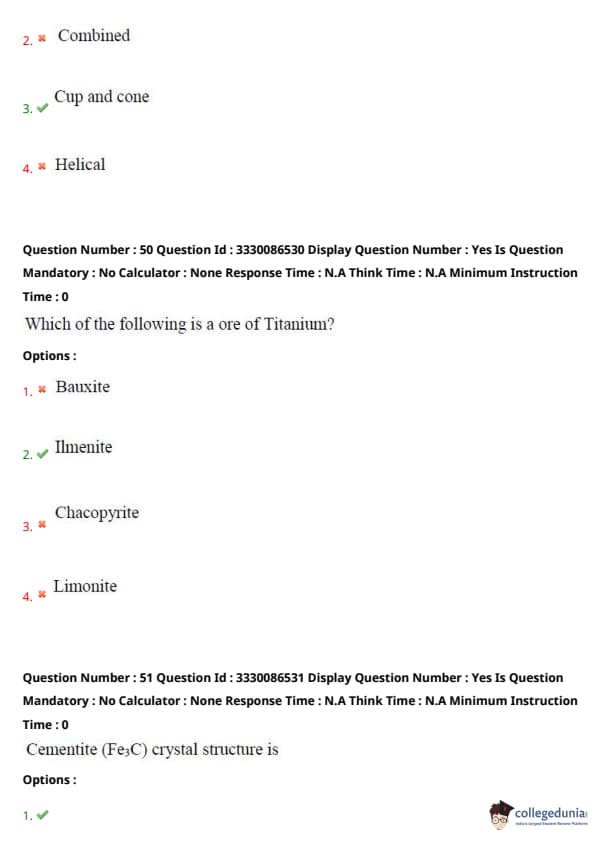
Question 49:
Copper materials exhibit ........ fracture
- (1) Flat
- (2) Combined
- (3) Cup and cone
- (4) Helical
Question 50:
Which of the following is an ore of Titanium?
- (1) Bauxite
- (2) Ilmenite
- (3) Chacopyrite
- (4) Limonite
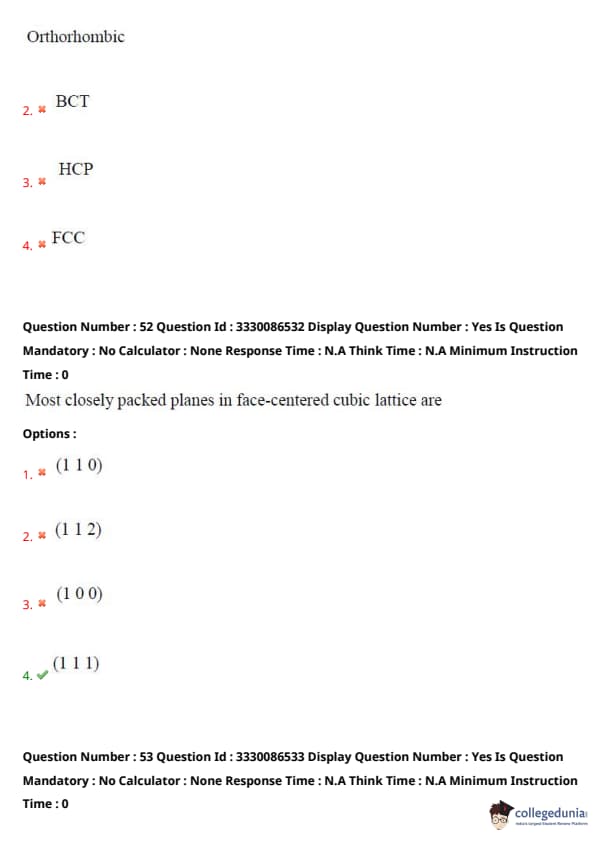
Question 51:
Cementite (Fe\(_3\)C) crystal structure is
- (1) Orthorhombic
- (2) BCT
- (3) HCP
- (4) FCC
Question 52:
Most closely packed planes in face-centered cubic lattice are
- (1) (110)
- (2) (112)
- (3) (100)
- (4) (111)
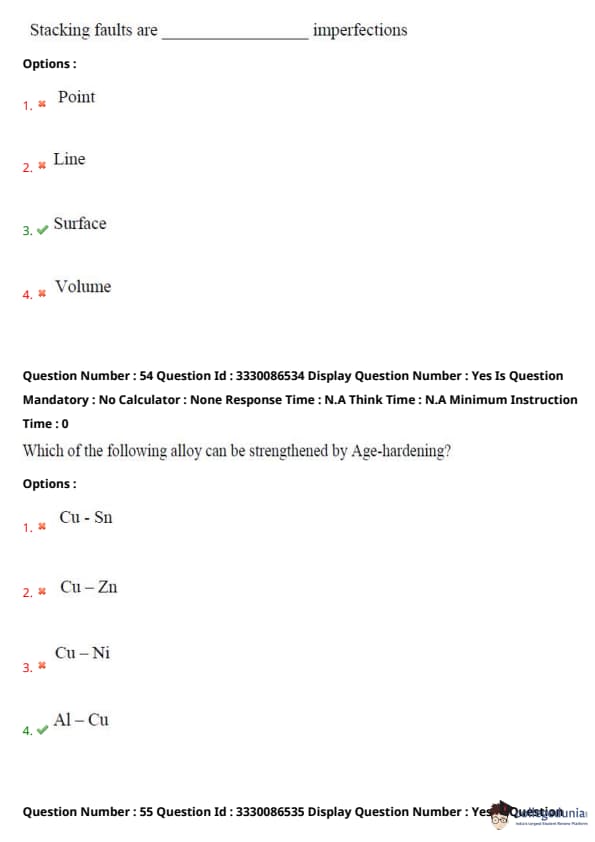
Question 53:
Stacking faults are ....... imperfections
- (1) Point
- (2) Line
- (3) Surface
- (4) Volume
Question 54:
Which of the following alloys can be strengthened by Age-hardening?
- (1) Cu - Sn
- (2) Cu - Zn
- (3) Cu - Ni
- (4) Al - Cu
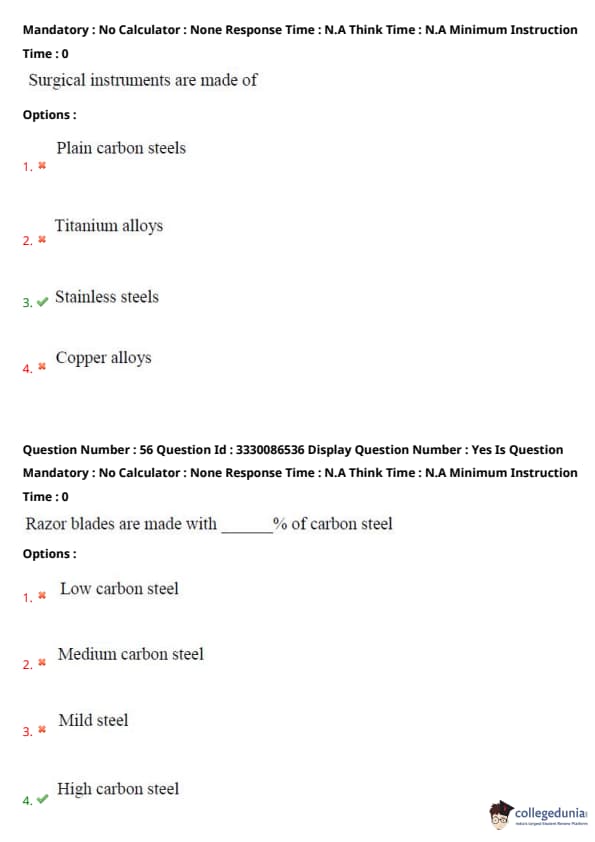
Question 55:
Surgical instruments are made of
- (1) Plain carbon steels
- (2) Titanium alloys
- (3) Stainless steels
- (4) Copper alloys
Question 56:
Razor blades are made with ....... % of carbon steel
- (1) Low carbon steel
- (2) Medium carbon steel
- (3) Mild steel
- (4) High carbon steel
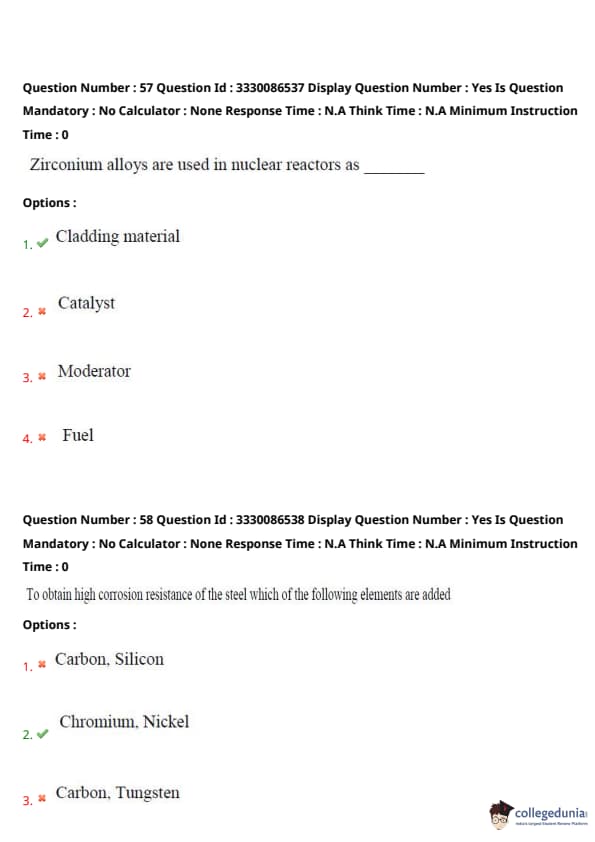
Question 57:
Zirconium alloys are used in nuclear reactors as
- (1) Cladding material
- (2) Catalyst
- (3) Moderator
- (4) Fuel
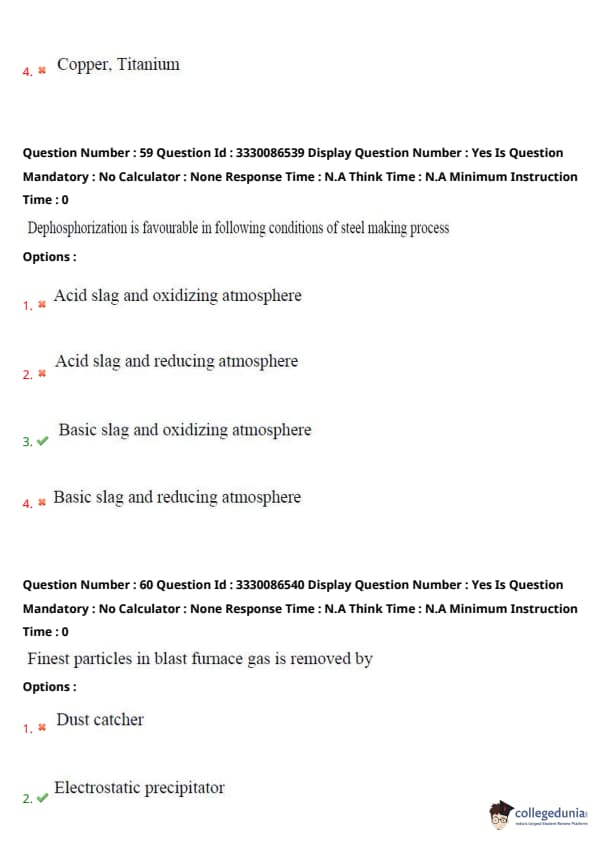
Question 58:
To obtain high corrosion resistance of the steel, which of the following elements are added?
- (1) Carbon, Silicon
- (2) Chromium, Nickel
- (3) Carbon, Tungsten
- (4) Copper, Titanium
Question 59:
Dephosphorization is favorable in the following conditions of the steel-making process
- (1) Acid slag and oxidizing atmosphere
- (2) Acid slag and reducing atmosphere
- (3) Basic slag and oxidizing atmosphere
- (4) Basic slag and reducing atmosphere
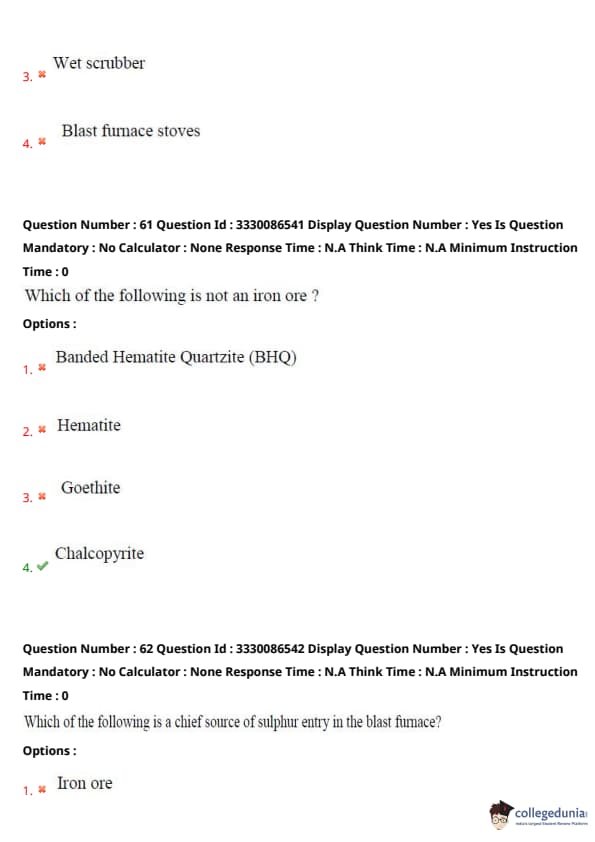
Question 60:
Finest particles in blast furnace gas are removed by
- (1) Dust catcher
- (2) Electrostatic precipitator
- (3) Wet scrubber
- (4) Blast furnace stoves
Question 61:
Which of the following is not an iron ore?
- (1) Banded Hematite Quartzite (BHQ)
- (2) Hematite
- (3) Goethite
- (4) Chalcopyrite
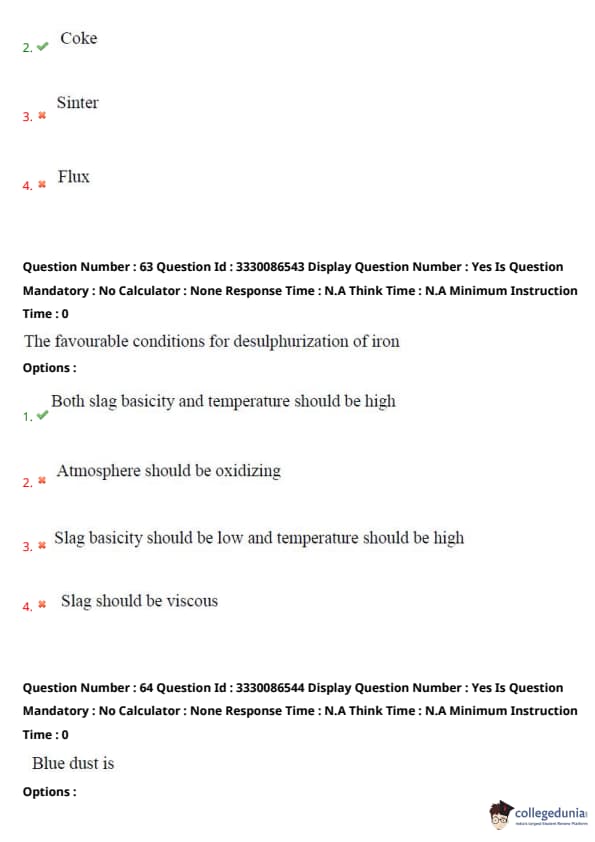
Question 62:
Which of the following is a chief source of sulfur entry in the blast furnace?
- (1) Iron ore
- (2) Coke
- (3) Sinter
- (4) Flux
Question 63:
The favorable conditions for desulphurization of iron are
- (1) Both slag basicity and temperature should be high
- (2) Atmosphere should be oxidizing
- (3) Slag basicity should be low and temperature should be high
- (4) Slag should be viscous
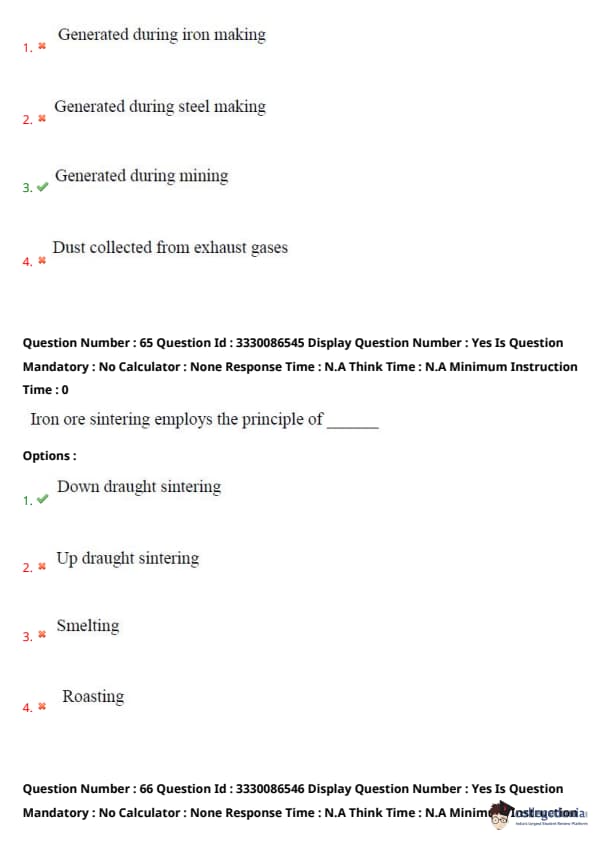
Question 64:
Blue dust is
- (1) Generated during iron making
- (2) Generated during steel making
- (3) Generated during mining
- (4) Dust collected from exhaust gases
Question 65:
Iron ore sintering employs the principle of ........
- (1) Down draught sintering
- (2) Up draught sintering
- (3) Smelting
- (4) Roasting
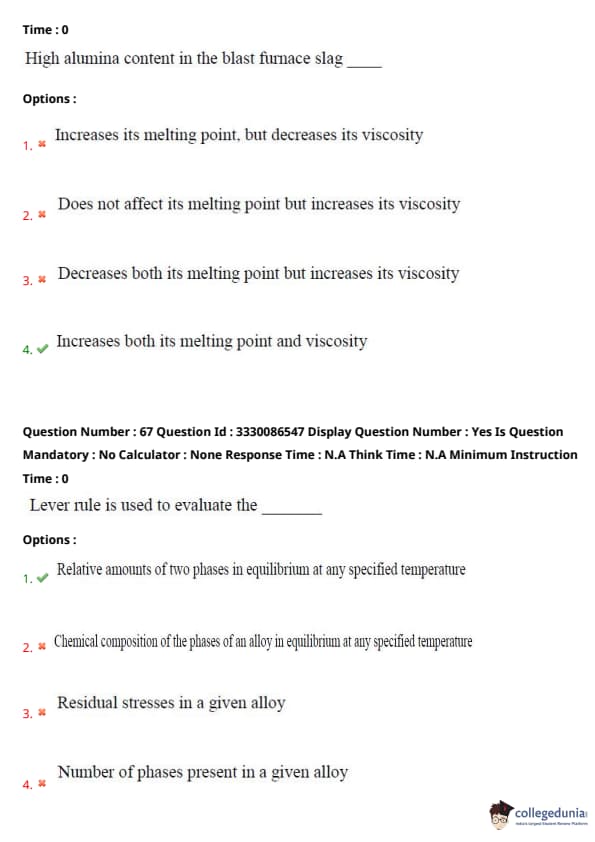
Question 66:
High alumina content in the blast furnace slag .......
- (1) Increases its melting point, but decreases its viscosity
- (2) Does not affect its melting point but increases its viscosity
- (3) Decreases both its melting point but increases its viscosity
- (4) Increases both its melting point and viscosity
Question 67:
Lever rule is used to evaluate the .......
- (1) Relative amounts of two phases in equilibrium at any specified temperature
- (2) Chemical composition of the phases of an alloy in equilibrium at any specified temperature
- (3) Residual stresses in a given alloy
- (4) Number of phases present in a given alloy
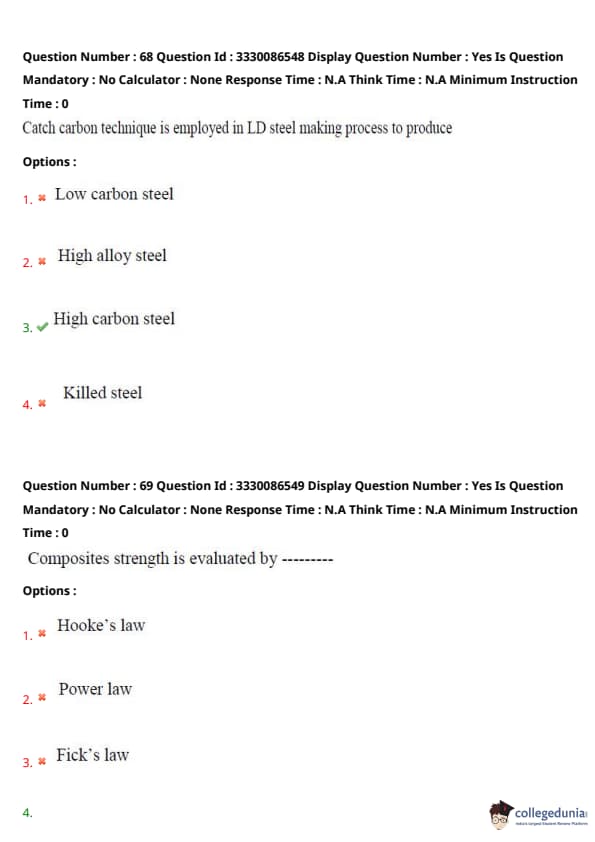
Question 68:
Catch carbon technique is employed in LD steel making process to produce
- (1) Low carbon steel
- (2) High alloy steel
- (3) High carbon steel
- (4) Killed steel
Question 69:
Composites strength is evaluated by .......
- (1) Hooke's law
- (2) Power law
- (3) Fick's law
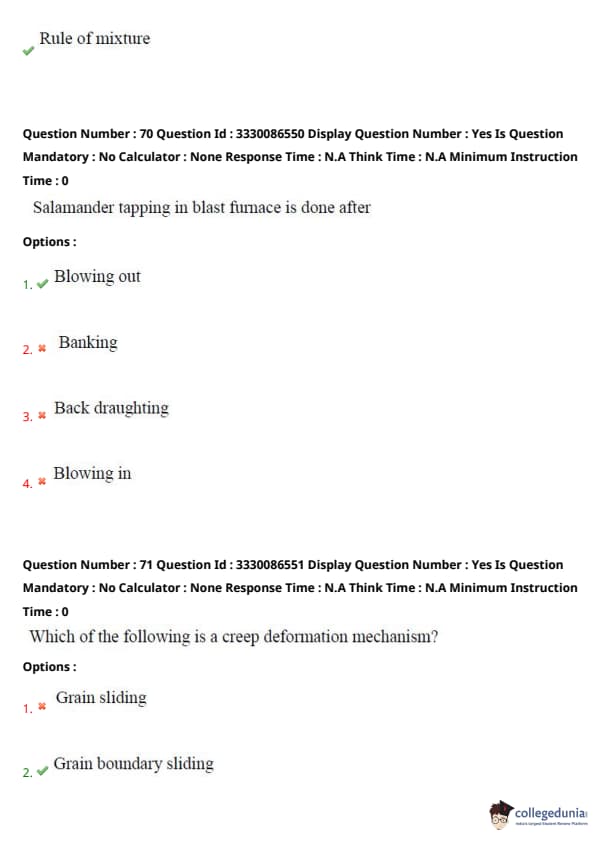
- (4) Rule of mixture
Question 70:
Salamander tapping in blast furnace is done after
- (1) Blowing out
- (2) Banking
- (3) Back draughting
- (4) Blowing in
Question 71:
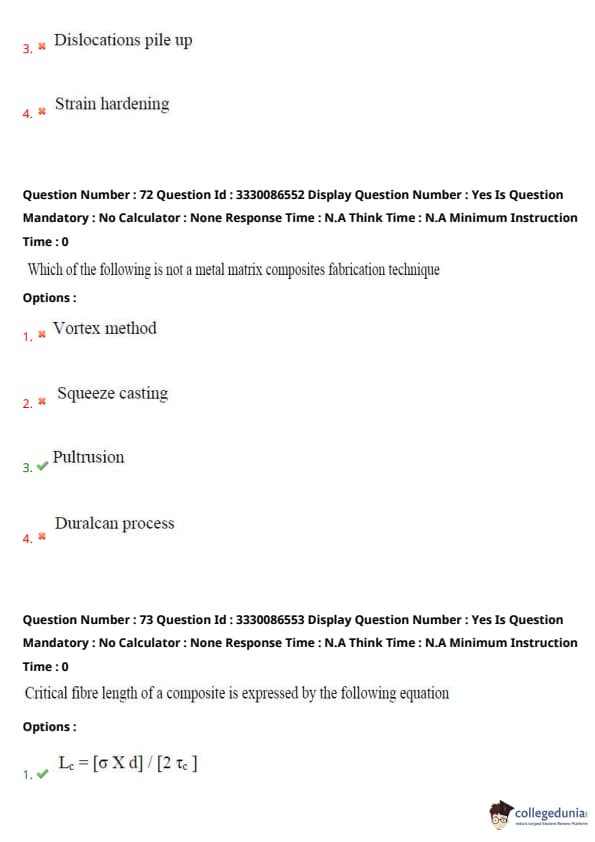
Which of the following is a creep deformation mechanism?
- (1) Grain sliding
- (2) Grain boundary sliding
- (3) Dislocations pile up
- (4) Strain hardening
Question 72:
Which of the following is not a metal matrix composites fabrication technique?
- (1) Vortex method
- (2) Squeeze casting
- (3) Pultrusion
- (4) Duralcan process
Question 73:
Critical fibre length of a composite is expressed by the following equation
- (1) L\(_c\) = [\sigma × d] / [2\tau\(_C\)]
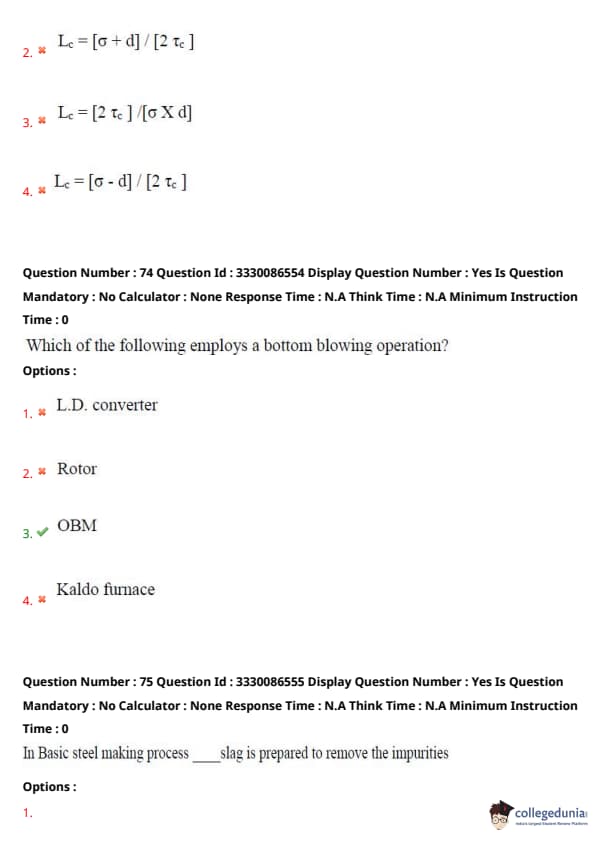
- (2) L\(_c\) = [\sigma + d] / [2\tau\(_C\)]
- (3) L\(_c\) = [2\tau\(_C\)] / [\sigma × d] /
- (4) L\(_c\) = [\sigma - d] / [2\tau\(_C\)]
Question 74:
Which of the following employs a bottom blowing operation?
- (1) L.D. converter
- (2) Rotor
- (3) OBM
- (4) Kaldo furnace
Question 75:
In Basic steel making process, ....... slag is prepared to remove the impurities
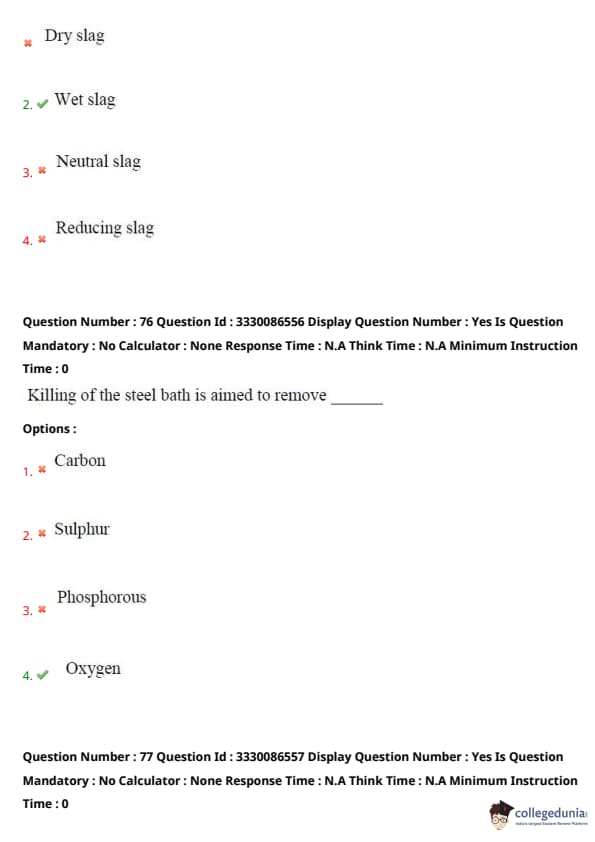
- (1) Dry slag
- (2) Wet slag
- (3) Neutral slag
- (4) Reducing slag
Question 76:
Killing of the steel bath is aimed to remove .......
- (1) Carbon
- (2) Sulphur
- (3) Phosphorous
- (4) Oxygen
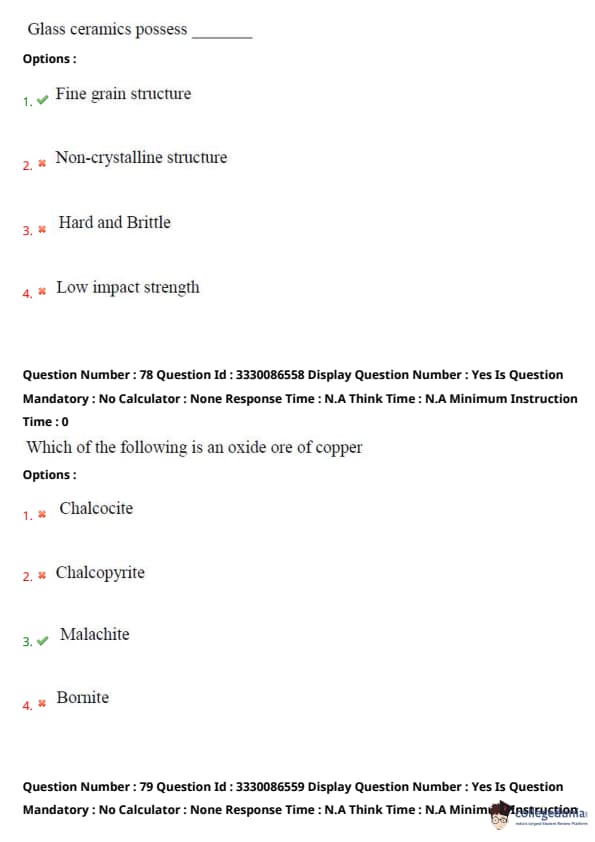
Question 77:
Glass ceramics possess ......
- (1) Fine grain structure
- (2) Non-crystalline structure
- (3) Hard and brittle
- (4) Low impact strength
Question 78:
Which of the following is an oxide ore of copper?
- (1) Chalcocite
- (2) Chalcopyrite
- (3) Malachite
- (4) Bornite
Question 79:
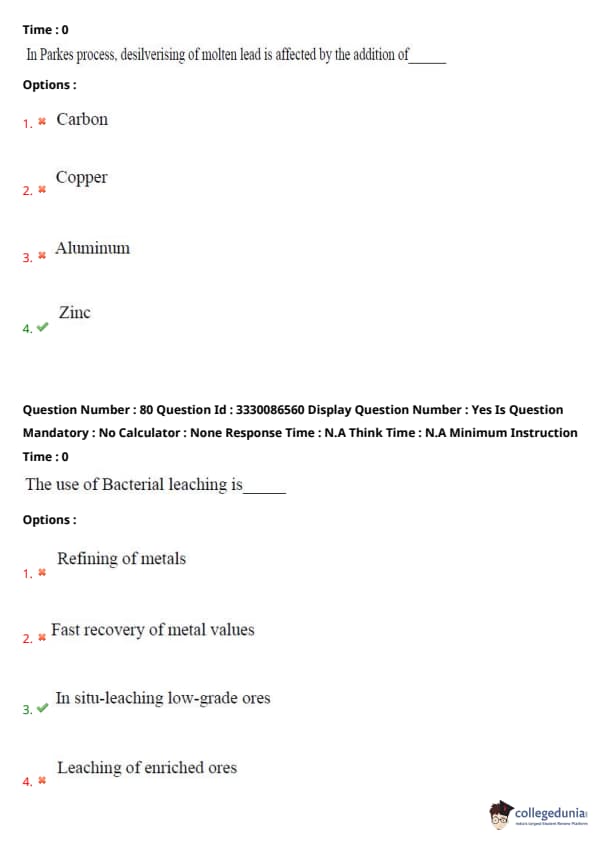
In Parkes process, desilvering of molten lead is affected by the addition of
- (1) Carbon
- (2) Copper
- (3) Aluminum
- (4) Zinc
Question 80:
The use of bacterial leaching is
- (1) Refining of metals
- (2) Fast recovery of metal values
- (3) In situ-leaching of low-grade ores
- (4) Leaching of enriched ores
Question 81:
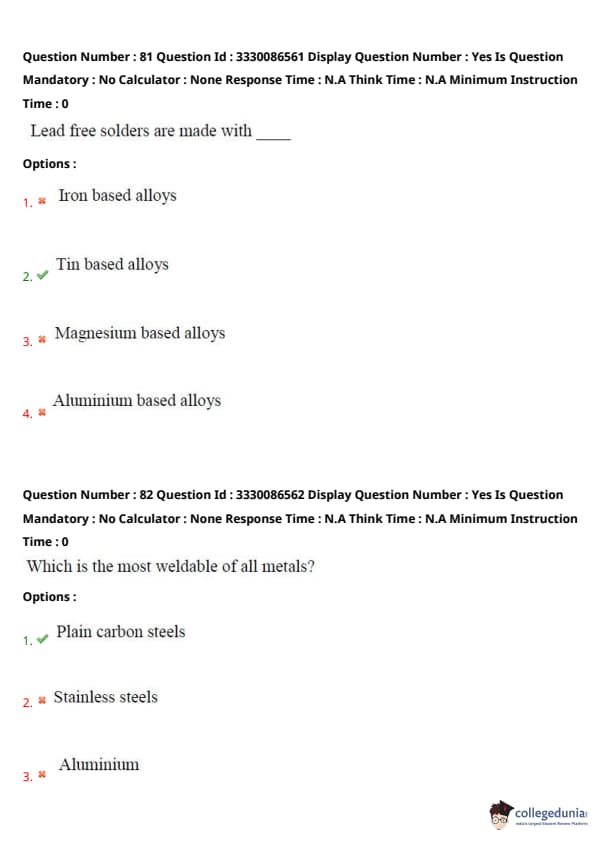
Lead-free solders are made with
- (1) Iron based alloys
- (2) Tin based alloys
- (3) Magnesium based alloys
- (4) Aluminium based alloys
Question 82:
Which is the most weldable of all metals?
- (1) Plain carbon steels
- (2) Stainless steels
- (3) Aluminium
- (4) Brass
Question 83:
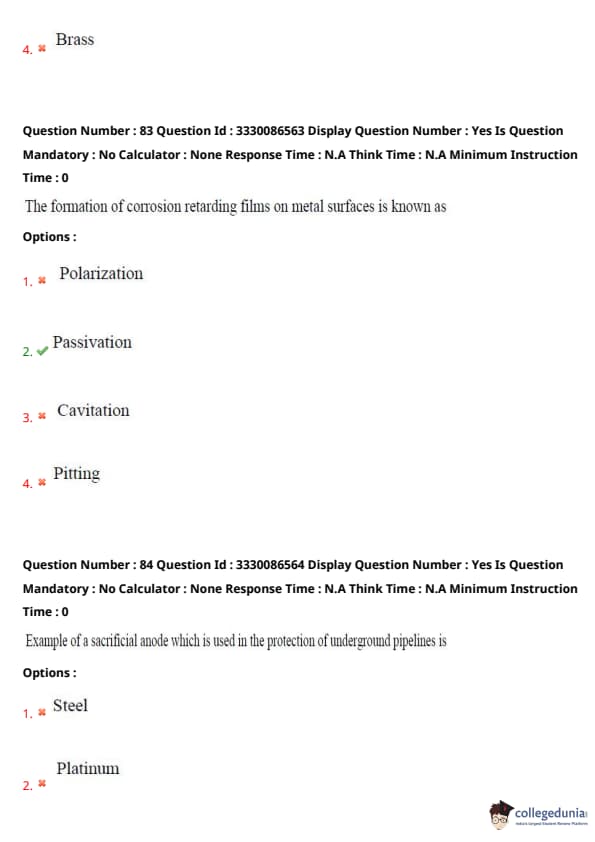
The formation of corrosion retarding films on metal surfaces is known as
- (1) Polarization
- (2) Passivation
- (3) Cavitation
- (4) Pitting
Question 84:
Example of a sacrificial anode which is used in the protection of underground pipelines is
- (1) Steel
- (2) Platinum
- (3) Graphite
- (4) Magnesium
Question 85:
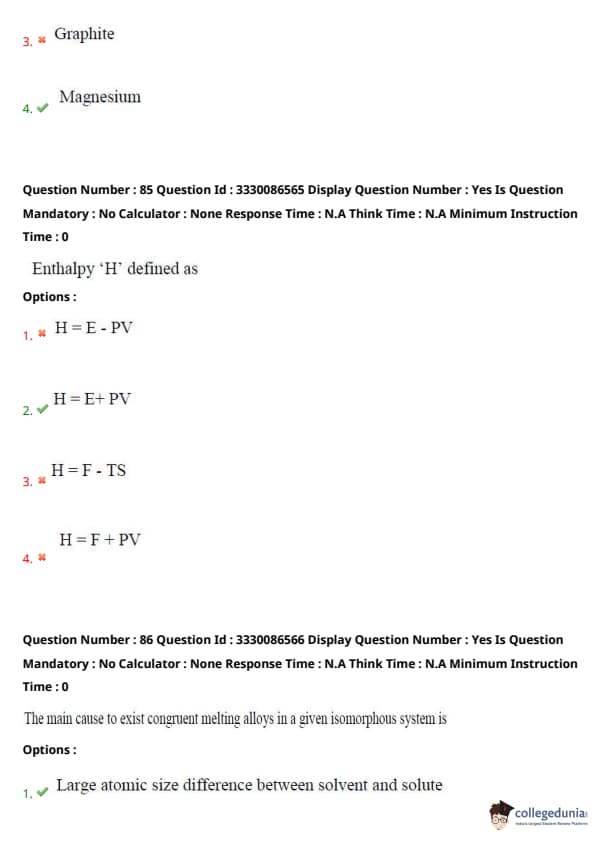
Enthalpy "H" is defined as
- (1) H = E - PV
- (2) H = E + PV
- (3) H = F - TS
- (4) H = F + PV
Question 86:
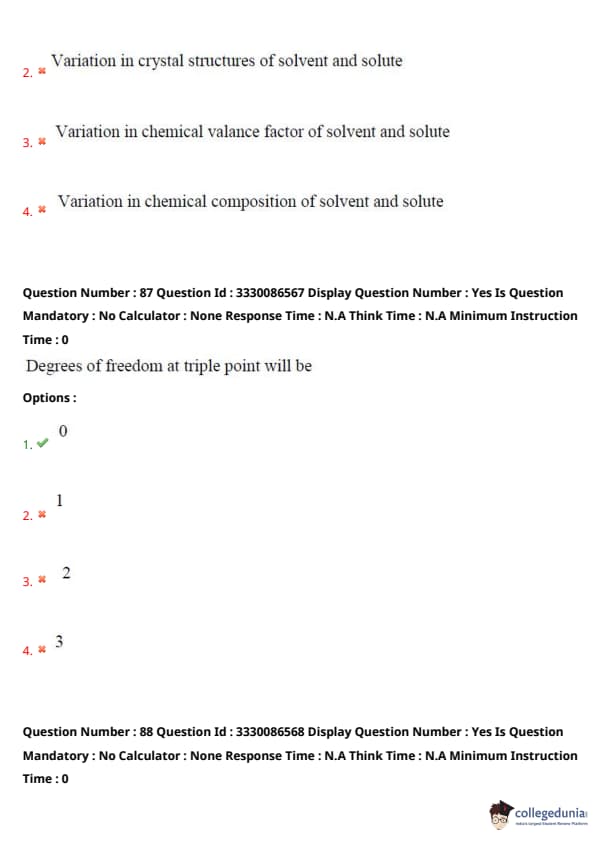
The main cause to exist congruent melting alloys in a given isomorphous system is
- (1) Large atomic size difference between solvent and solute
- (2) Variation in crystal structures of solvent and solute
- (3) Variation in chemical valance factor of solvent and solute
- (4) Variation in chemical composition of solvent and solute
Question 87:
Degrees of freedom at triple point will be
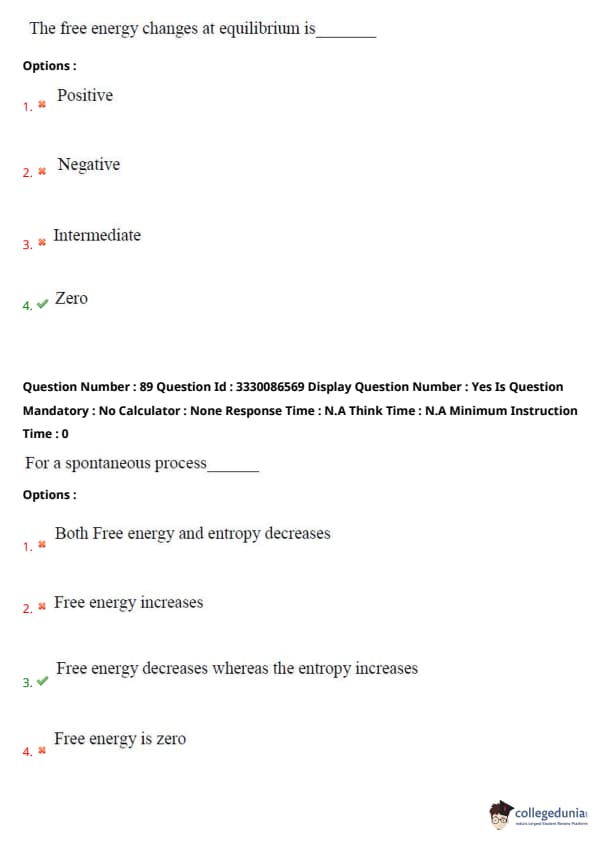
Question 88:
The free energy changes at equilibrium is
- (1) Positive
- (2) Negative
- (3) Intermediate
- (4) Zero
Question 89:
For a spontaneous process
- (1) Both Free energy and entropy decrease
- (2) Free energy increases
- (3) Free energy decreases whereas the entropy increases
- (4) Free energy is zero
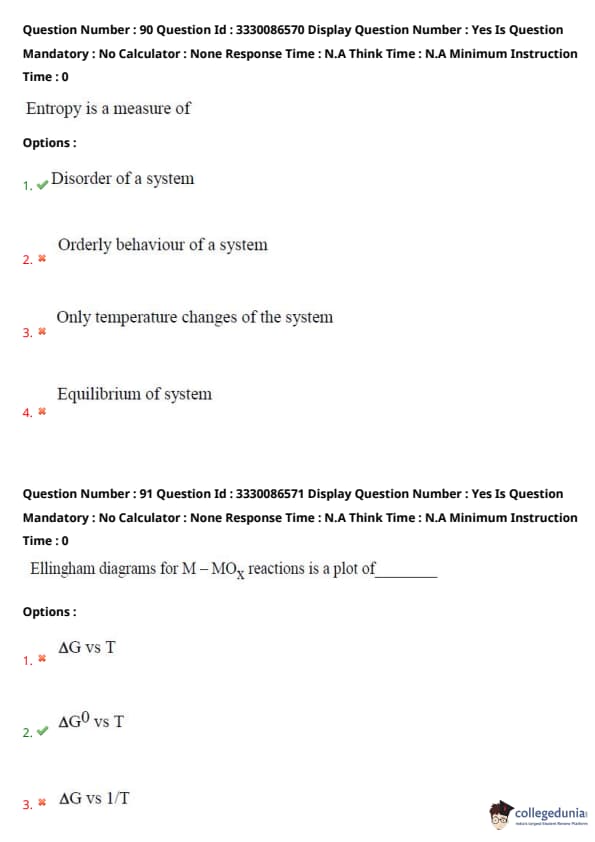
Question 90:
Entropy is a measure of
- (1) Disorder of a system
- (2) Orderly behavior of a system
- (3) Only temperature changes of the system
- (4) Equilibrium of system
Question 91:
Ellingham diagrams for M ~MOx reactions is a plot of
- (1) \(\Delta G\) vs T
- (2) \(\Delta G^{\circ}\) vs T
- (3) \(\Delta G^{\circ}\) vs 1/T
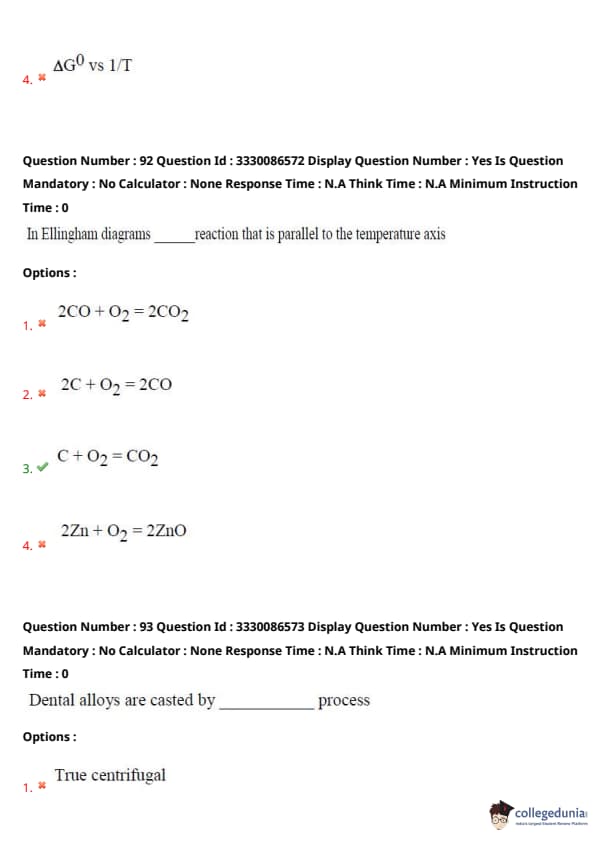
- (4) \(\Delta G^{\circ}\) vs 1/T
Question 92:
In Ellingham diagrams, the reaction that is parallel to the temperature axis is
- (1) \(2CO + O_2 = 2CO_2\)
- (2) \(2C + O_2 = 2CO_2\)
- (3) \(C + O_2 = CO_2\)
- (4) \(2Zn + O_2 = 2ZnO\)
Question 93:
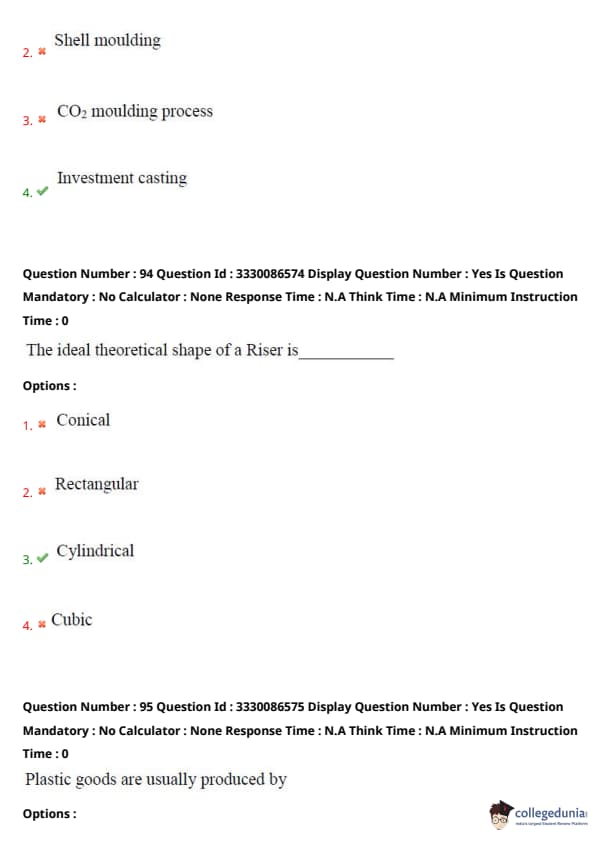
Dental alloys are casted by ...... process
- (1) True centrifugal
- (2) Shell moulding
- (3) CO2 moulding process
- (4) Investment casting
Question 94:
The ideal theoretical shape of a Riser is
- (1) Conical
- (2) Rectangular
- (3) Cylindrical
- (4) Cubic
Question 95:
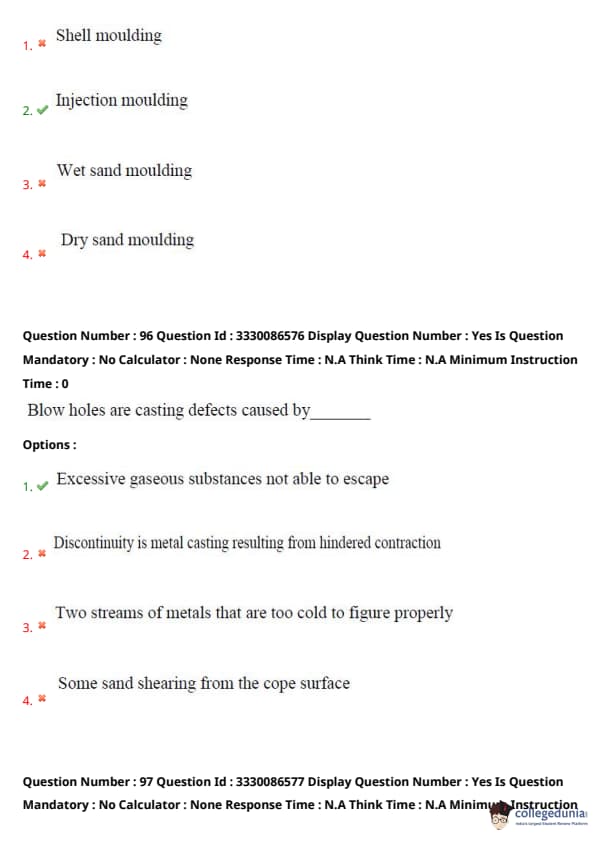
Plastic goods are usually produced by
- (1) Shell moulding
- (2) Injection moulding
- (3) Wet sand moulding
- (4) Dry sand moulding
Question 96:
Blow holes are casting defects caused by
- (1) Excessive gaseous substances not able to escape
- (2) Discontinuity in metal casting resulting from hindered contraction
- (3) Two streams of metals that are too cold to figure properly
- (4) Some sand shearing from the cope surface
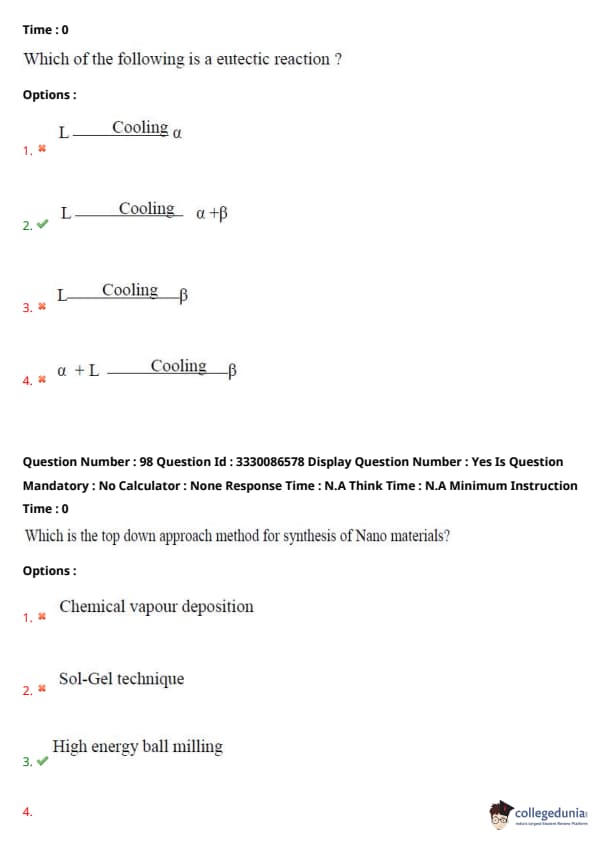
Question 97:
Which of the following is a eutectic reaction?
- (1) \( L \to Cooling \alpha \)
- (2) \( L \to Cooling \alpha + \beta \)
- (3) \( L \to Cooling \beta \)
- (4) \( \alpha + L \to Cooling \beta \)
Question 98:
Which is the top-down approach method for the synthesis of Nano materials?
- (1) Chemical vapour deposition
- (2) Sol-Gel technique
- (3) High energy ball milling
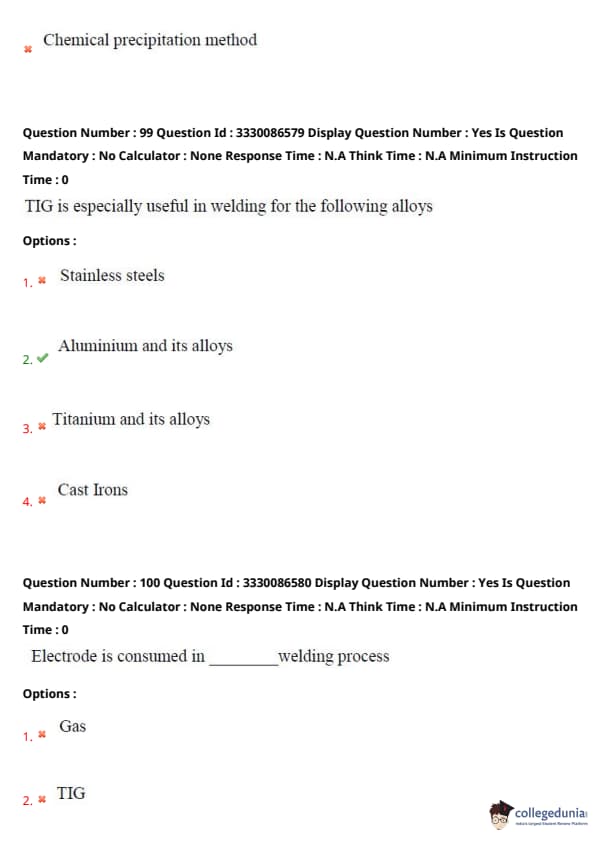
- (4) Chemical precipitation method
Question 99:
TIG is especially useful in welding for the following alloys
- (1) Stainless steels
- (2) Aluminium and its alloys
- (3) Titanium and its alloys
- (4) Cast Irons
Question 100:
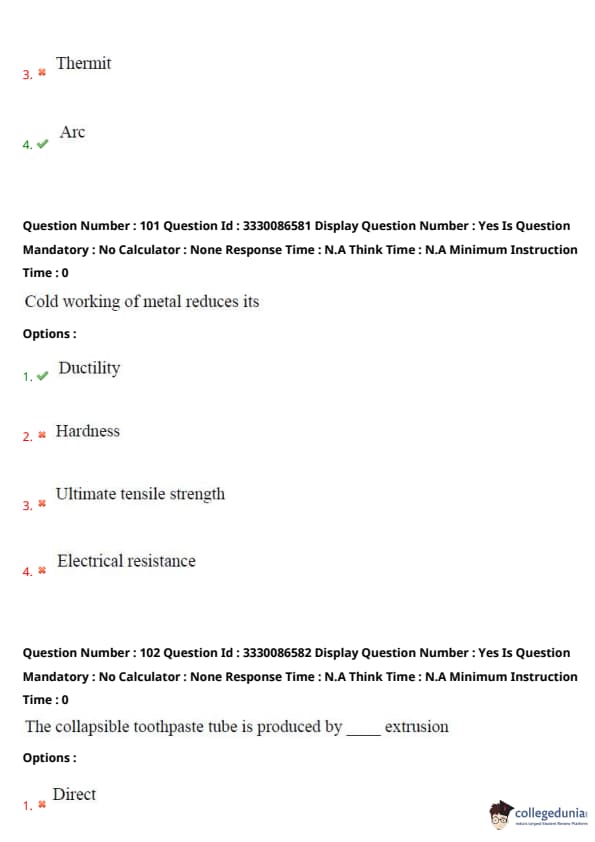
Electrode is consumed in ........ welding process
- (1) Gas
- (2) TIG
- (3) Thermit
- (4) Arc
Question 101:
Cold working of metal reduces its
- (1) Ductility
- (2) Hardness
- (3) Ultimate tensile strength
- (4) Electrical resistance
Question 102:
The collapsible toothpaste tube is produced by ....... extrusion
- (1) Direct
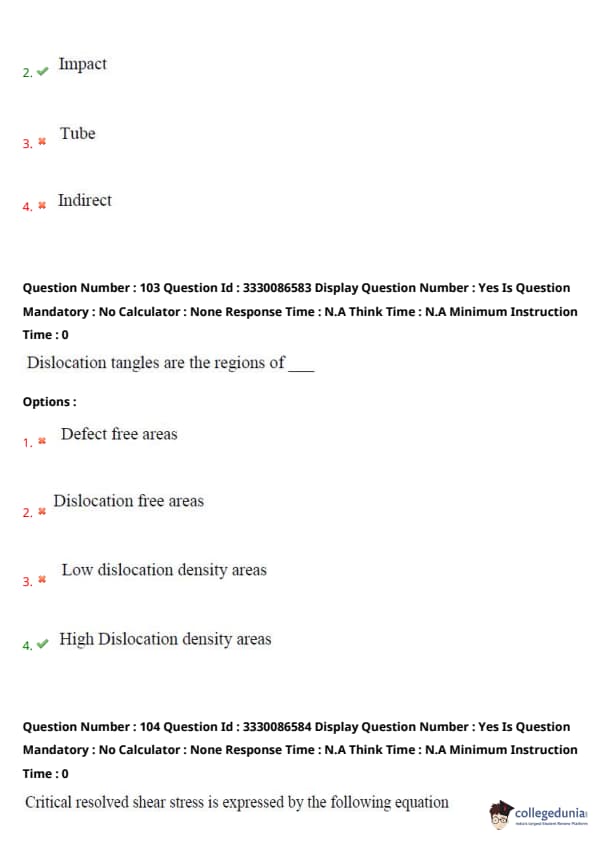
- (2) Impact
- (3) Tube
- (4) Indirect
Question 103:
Dislocation tangles are the regions of
- (1) Defect free areas
- (2) Dislocation free areas
- (3) Low dislocation density areas
- (4) High dislocation density areas
Question 104:
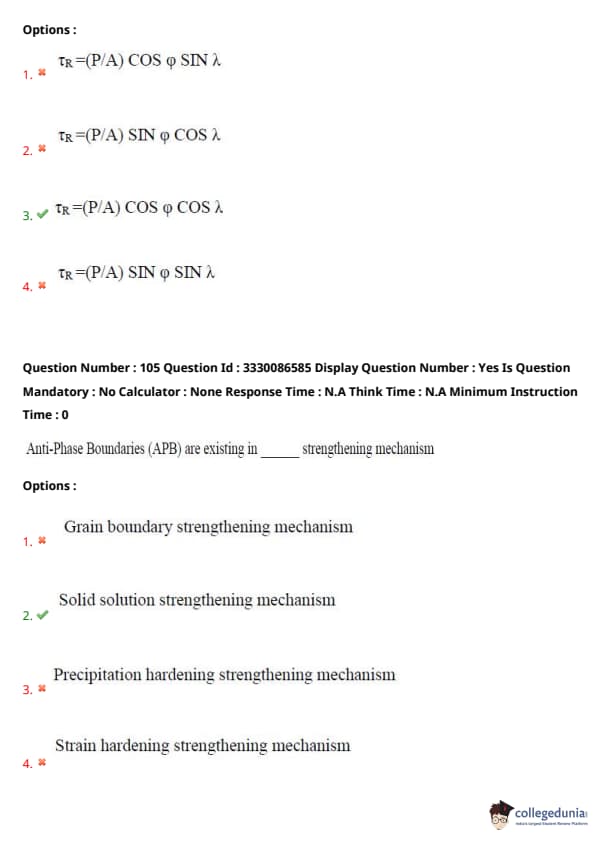
Critical resolved shear stress is expressed by the following equation
- (1) \(\tau_R = \frac{P}{A} \cos \phi \sin \lambda\)
- (2) \(\tau_R = \frac{P}{A} \sin \phi \cos \lambda\)
- (3) \(\tau_R = \frac{P}{A} \cos \phi \cos \lambda\)
- (4) \(\tau_R = \frac{P}{A} \sin \phi \sin \lambda\)
Question 105:
Anti-Phase Boundaries (APB) are existing in ...... strengthening mechanism
- (1) Grain boundary strengthening mechanism
- (2) Solid solution strengthening mechanism
- (3) Precipitation hardening strengthening mechanism
- (4) Strain hardening strengthening mechanism
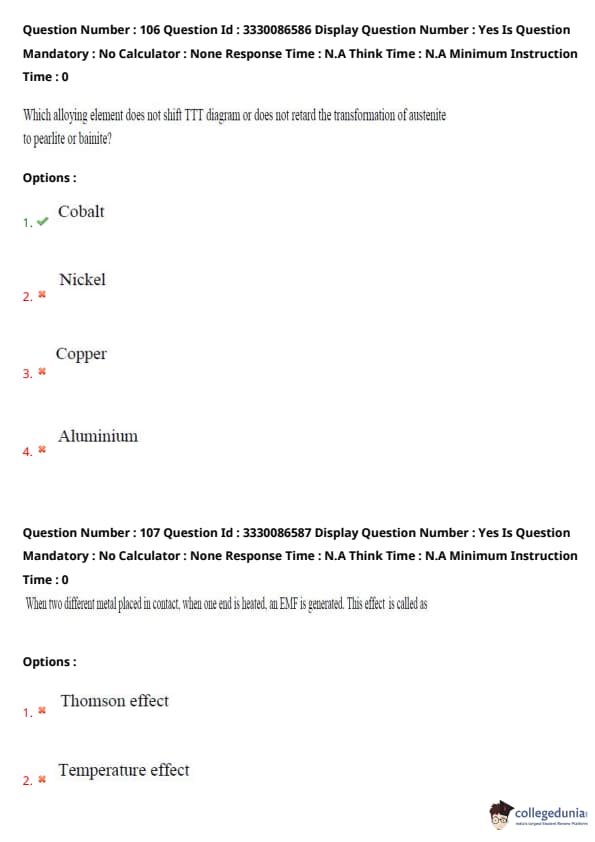
Question 106:
Which alloying element does not shift TTT diagram or does not retard the transformation of austenite to pearlite or bainite?
- (1) Cobalt
- (2) Nickel
- (3) Copper
- (4) Aluminium
Question 107:
When two different metals placed in contact, when one is heated, an EMF is generated. This effect is called as
- (1) Thomson effect
- (2) Temperature effect
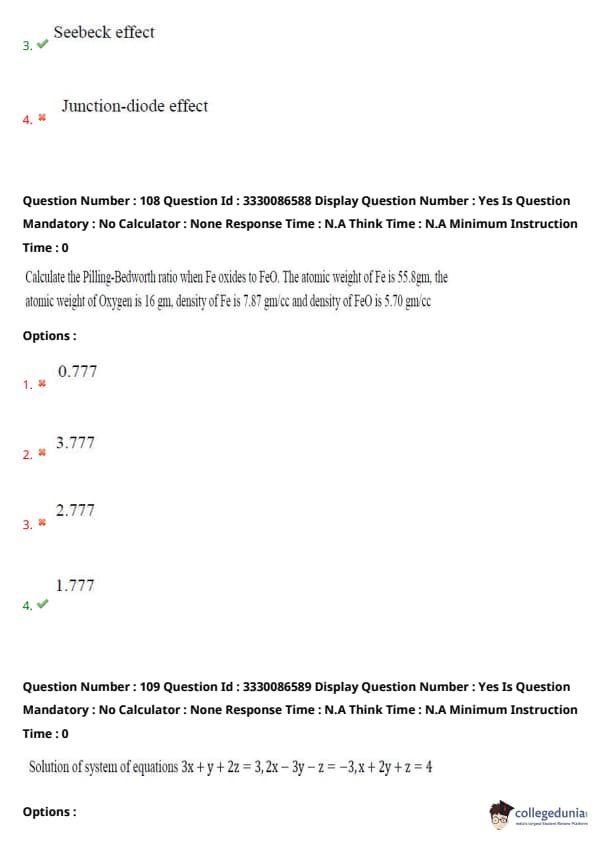
- (3) Seebeck effect
- (4) Junction-diode effect
Question 108:
Calculate the Pilling-Bedworth ratio when Fe oxides to FeO. The atomic weight of Fe is 55.8 gm, the atomic weight of Oxygen is 16 gm, density of Fe is 7.87 gm/cc and density of FeO is 5.70 gm/cc
- (1) 0.777
- (2) 3.777
- (3) 2.777
- (4) 1.777
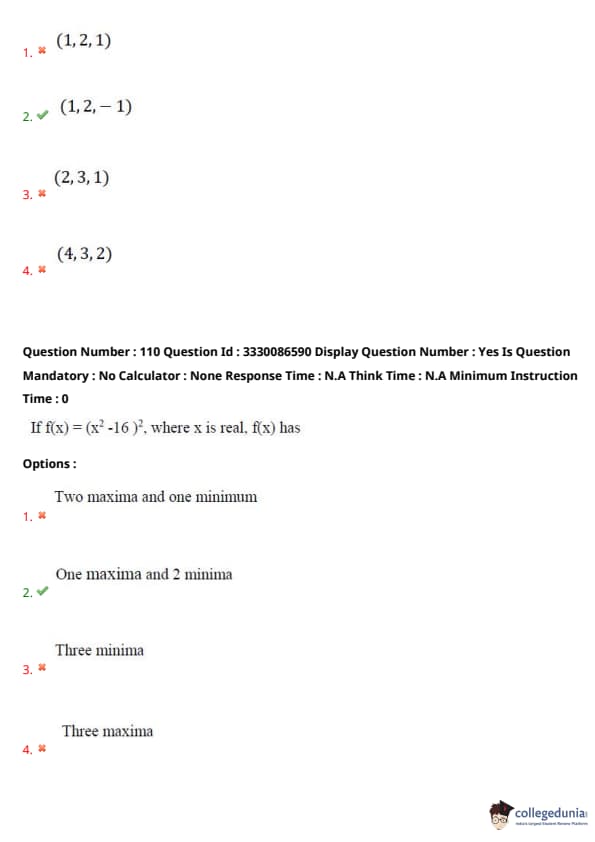
Question 109:
Solution of the system of equations \( 3x + y + 2z = 3 \), \( 2x - 3y - z = -3 \), \( x + 2y + z = 4 \)
- (1) \( (1, 2, 1)
- (2) \( (1, 2, -1)
- (3) \( (2, 3, 1)
- (4) \( (4, 3, 2)
Question 110:
If \( f(x) = (x^2 - 16)^2 \), where \( x \) is real, \( f(x) \) has
- (1) Two maxima and one minimum
- (2) One maxima and 2 minima
- (3) Three minima
- (4) Three maxima
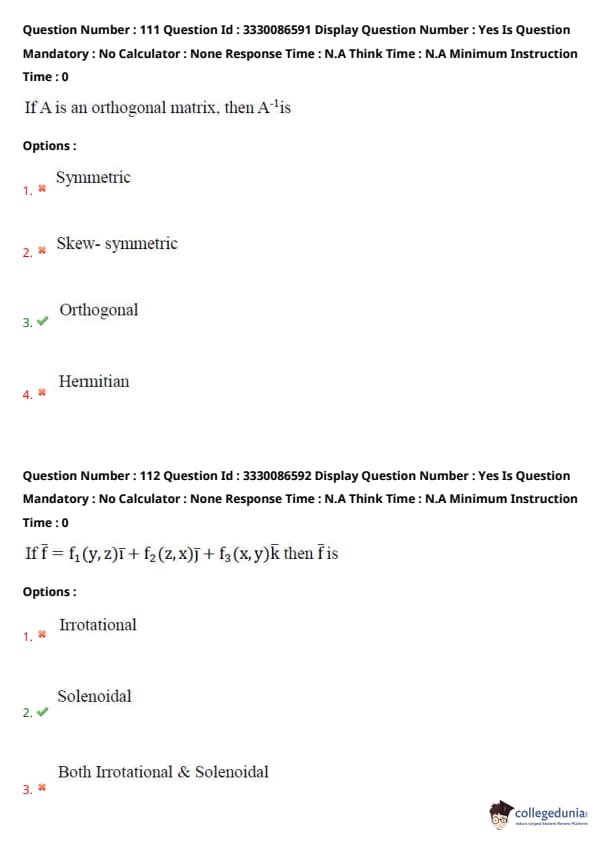
Question 111:
If \( A \) is an orthogonal matrix, then \( A^{-1} \) is
- (1) Symmetric
- (2) Skew-symmetric
- (3) Orthogonal
- (4) Hermitian
Question 112:
If \( \mathbf{f} = f_1(y, z) \hat{i} + f_2(z, x) \hat{j} + f_3(x, y) \hat{k} \), then \( \mathbf{f} \) is
- (1) Irrotational
- (2) Solenoidal
- (3) Both Irrotational \& Solenoidal
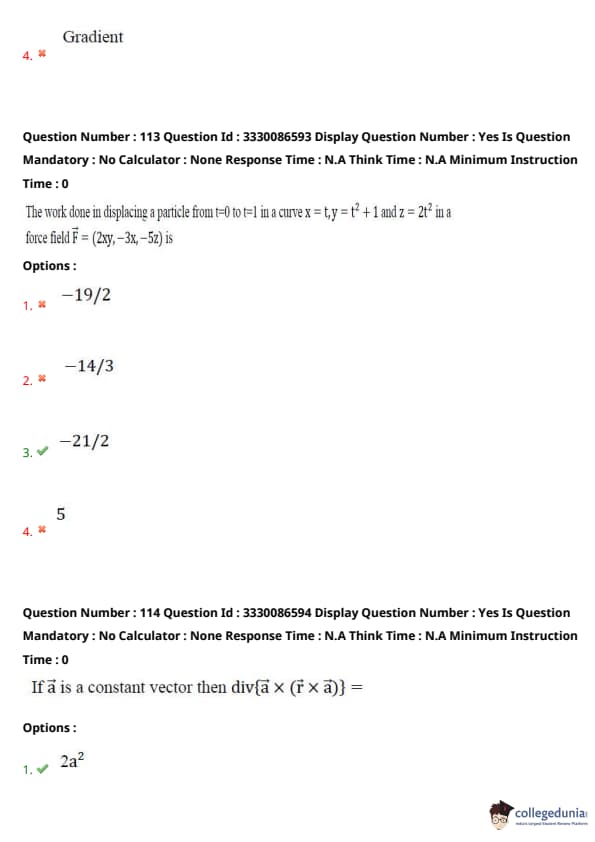
- (4) Gradient
Question 113:
The work done in displacing a particle from \( r = 0 \) to \( r = 1 \) in a curve \( x = t^2 + 1 \) and \( z = t^2 + 1 \) in a force field \( \mathbf{F} = (2xy, 3x, -5z) \) is
- (1) \(-\frac{19}{2} \)
- (2) \(-\frac{14}{3} \)
- (3) \(-\frac{21}{2} \)
- (4) \( 5 \)
Question 114:
If \( \mathbf{a} \) is a constant vector, then \( div[\mathbf{a} \times (\mathbf{r} \times \mathbf{a})] \) is
- (1) \( 2a^2 \)
- (2) \( 3a^2 \)
- (3) \( 6a^2 \)
- (4) \( 4a^2 \)
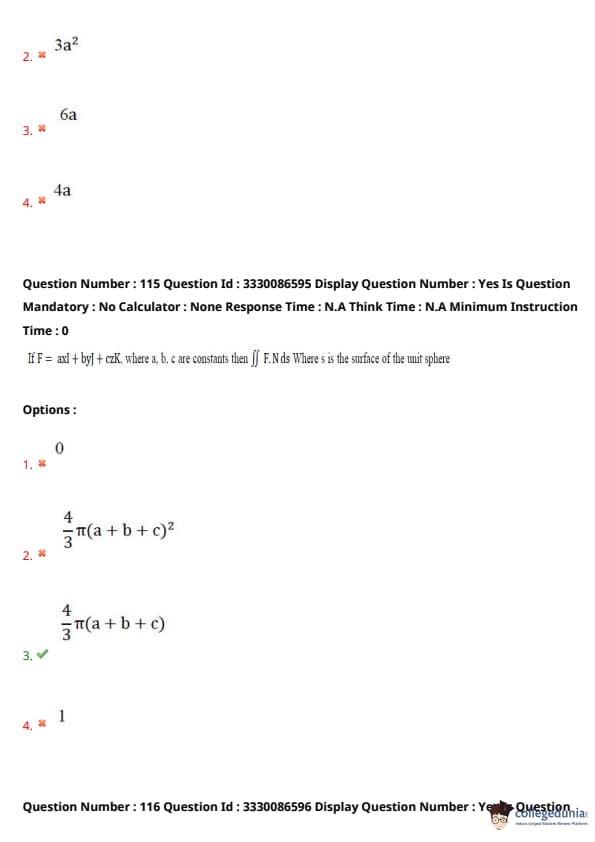
Question 115:
If \( \mathbf{F} = ax \hat{i} + by \hat{j} + cz \hat{k} \), where \( a, b, c \) are constants, then
- (1) 0
- (2) \( \frac{4}{3} \pi (a + b + c)^2 \)
- (3) \( \frac{4}{3} \pi (a + b + c) \)
- (4) 1
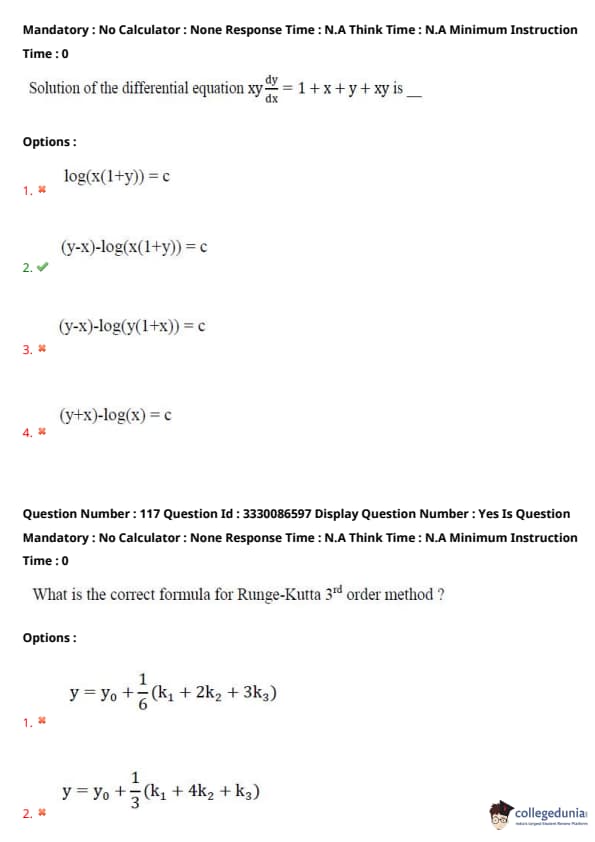
Question 116:
Solution of the differential equation \( xy \frac{dy}{dx} = 1 + x + y + xy \) is
- (1) \( \log(x(1+y)) = c \)
- (2) \( (y - x) \log(x(1 + y)) = c \)
- (3) \( (y + x) \log(x) = c \)
- (4) \( \log(x(1 + y)) = c \)
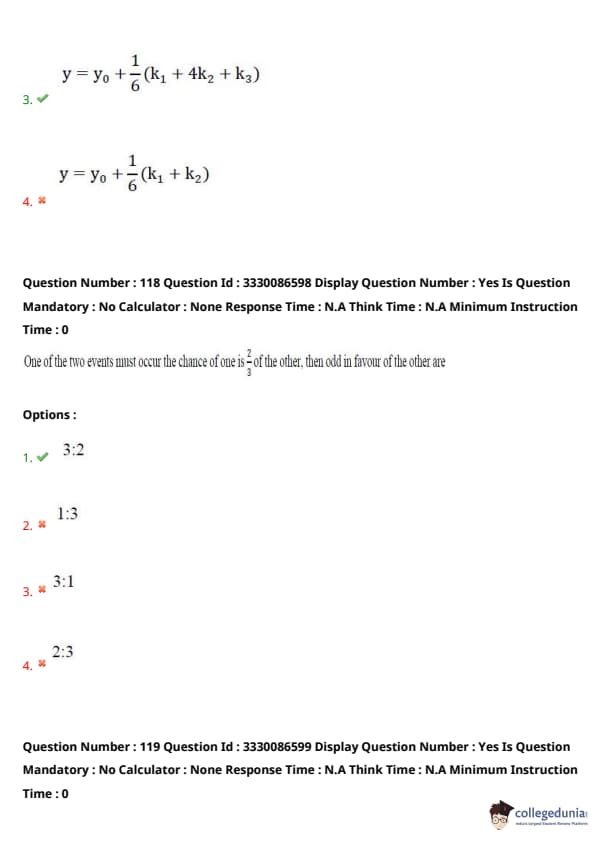
Question 117:
What is the correct formula for Runge-Kutta 3rd order method?
- (1) \( y = y_0 + \frac{1}{6}(k_1 + 2k_2 + 3k_3) \)
- (2) \( y = y_0 + \frac{1}{3}(k_1 + 4k_2 + k_3) \)
- (3) \( y = y_0 + \frac{1}{6}(k_1 + 4k_2 + k_3) \)
- (4) \( y = y_0 + \frac{1}{6}(k_1 + k_2) \)
Question 118:
One of the two events must occur. The chance of one is \( \frac{2}{3} \) of the other, then odds in favor of the other are
- (1) \( 3:2 \)
- (2) \( 1:3 \)
- (3) \( 3:1 \)
- (4) \( 2:3 \)
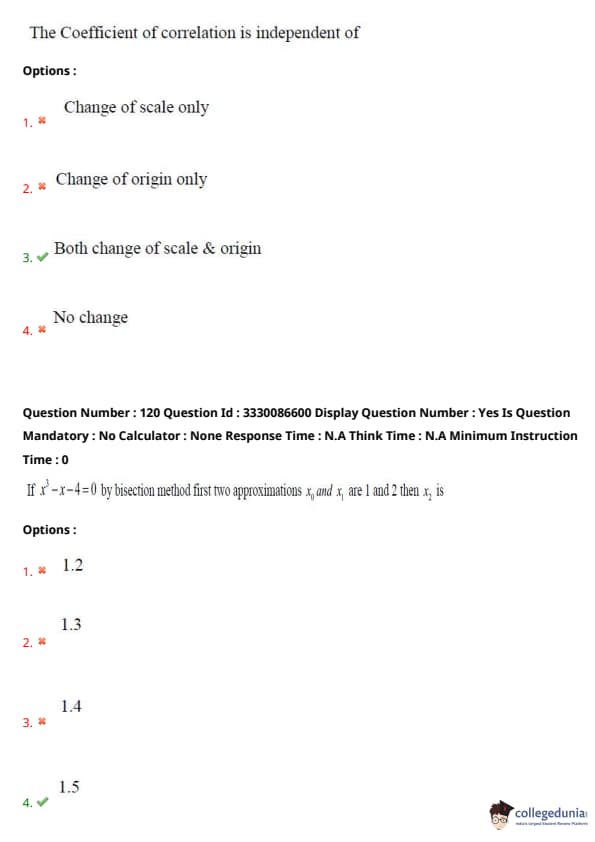
Question 119:
The coefficient of correlation is independent of
- (1) Change of scale only
- (2) Change of origin only
- (3) Both change of scale \& origin
- (4) No change
Question 120:
If \( x^2 - x - 4 = 0 \) by bisection method, first two approximations \( x_1 \) and \( x_2 \) are 1 and 2, then \( x_3 \) is
- (1) 1.2
- (2) 1.3
- (3) 1.4
- (4) 1.5





 Download





Comments