AP PGECET 2024 Pharmacy Question Paper is available for download here. Sri Venkateswara University, Tirupati on behalf of APSCHE conducted AP PGECET 2024 Pharmacy on May 29 in Shift 1 from 9 AM to 11 AM. AP PGECET Question Paper 2024 consists of 120 MCQ-based questions in total carrying 1 mark each to be attempted in the duration of 2 hours.
AP PGECET 2024 Pharmacy Question Paper with Answer Key PDF
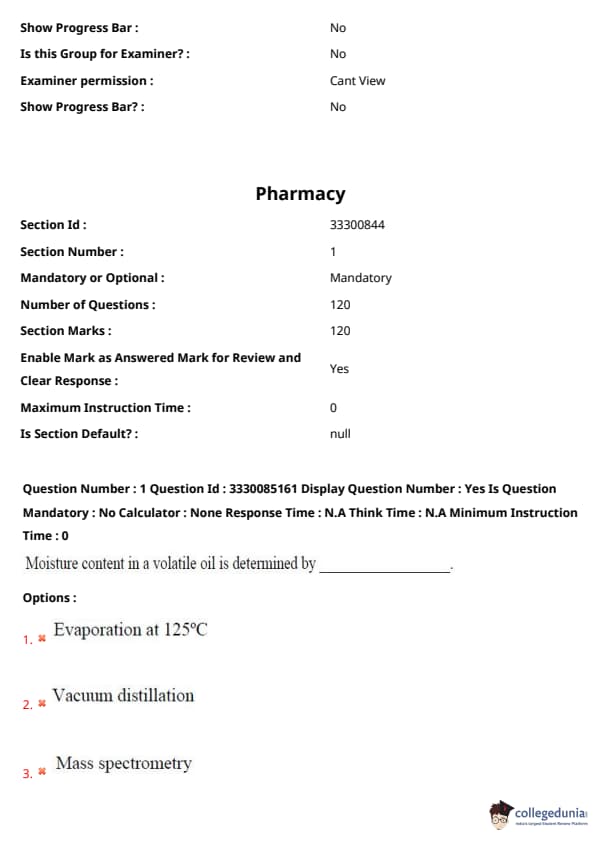
Question 1:
Moisture content in a volatile oil is determined by \hspace{2cm}.
- (A) \( Evaporation at 125^\circ C \)
- (B) \( Vacuum distillation \)
- (C) \( Mass spectrometry \)
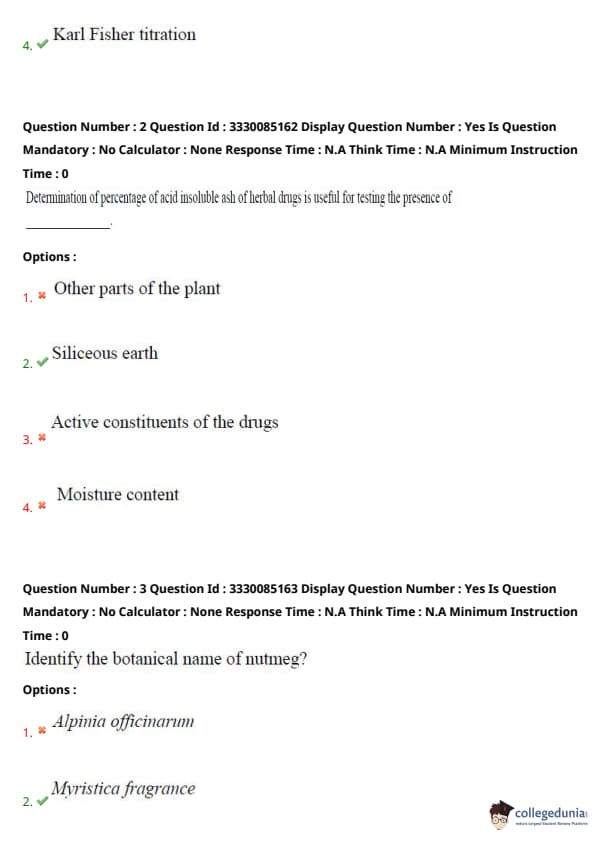
- (D) \( Karl Fisher titration \)
Question 2:
Determination of percentage of acid insoluble ash of herbal drugs is useful for testing the presence of \hspace{2cm}.
- (A) \( Other parts of the plant \)
- (B) \( Siliceous earth \)
- (C) \( Active constituents of the drugs \)
- (D) \( Moisture content \)
Question 3:
Identify the botanical name of nutmeg?
- (A) \( Alpinia officinarum \)
- (B) \( Myristica fragrans \)
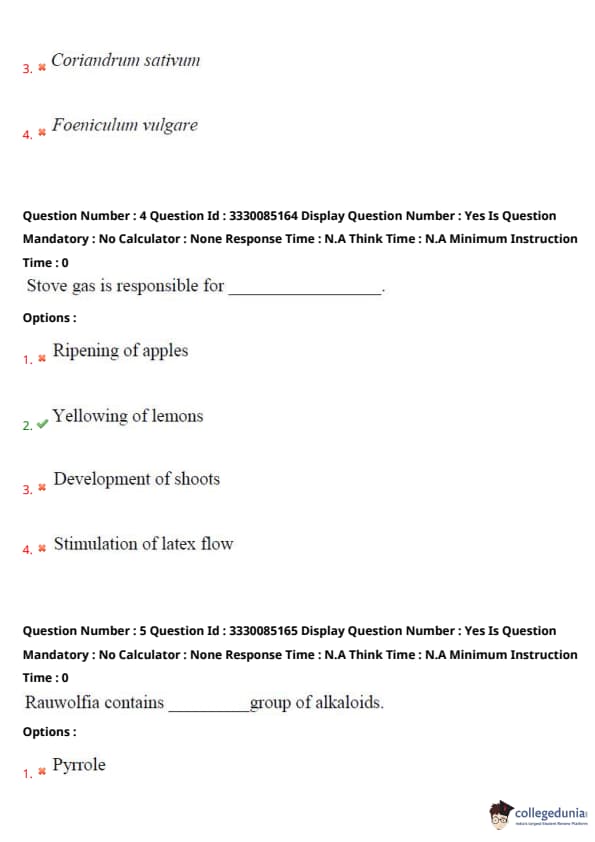
- (C) \( Coriandrum sativum \)
- (D) \( Foeniculum vulgare \)
Question 4:
Stove gas is responsible for \(\hspace{2cm}\)
- (A) \( Ripening of apples \)
- (B) \( Yellowing of lemons \)
- (C) \( Development of shoots \)
- (D) \( Stimulation of latex flow \)
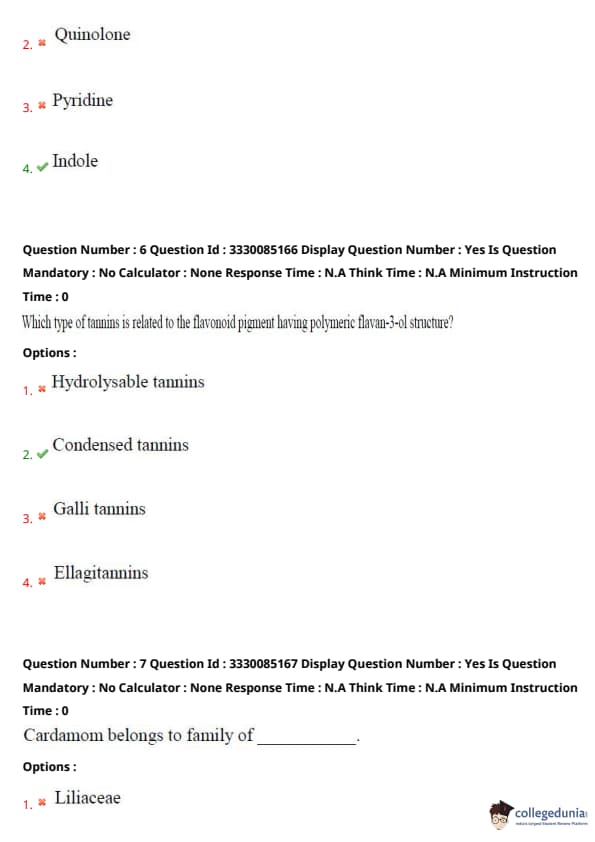
Question 5:
Rauwolfia contains \(\hspace{2cm}\) group of alkaloids.
- (A) \( Pyrrole \)
- (B) \( Quinoline \)
- (C) \( Pyridine \)
- (D) \( Indole \)
Question 6:
Which type of tannins is related to the flavonoid pigment having polymeric flavan-3-ol structure?
- (A) \( Hydrolysable tannins \)
- (B) \( Condensed tannins \)
- (C) \( Galli tannins \)
- (D) \( Ellagitannins \)
Question 7:
Cardamom belongs to family \(\hspace{2cm}\)
- (A) \( Liliaceae \)
- (B) \( Apocynaceae \)
- (C) \( Zingiberaceae \)
- (D) \( Loganiaceae \)
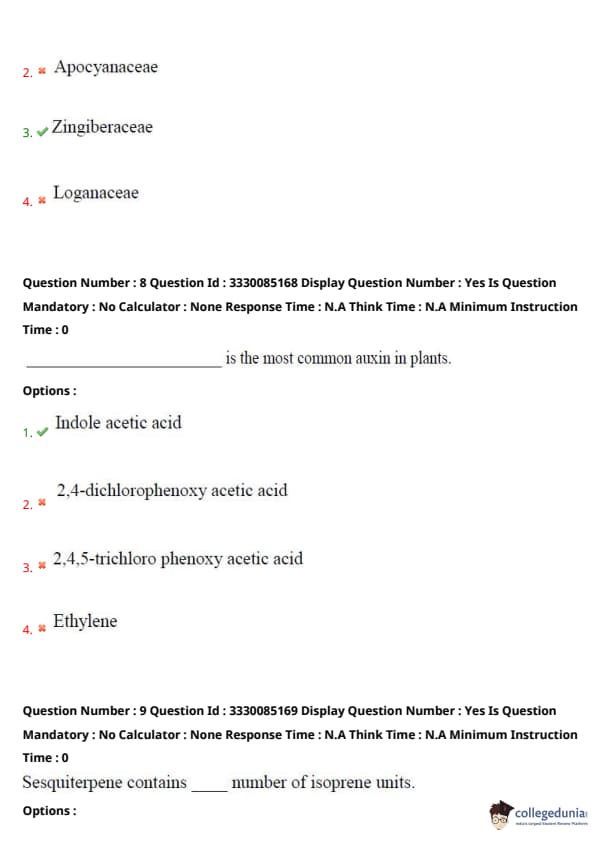
Question 8:
\(\hspace{2cm}\) is the most common auxin in plants.
- (A) \( Indole acetic acid \)
- (B) \( 2,4-dichlorophenoxy acetic acid \)
- (C) \( 2,4,5-trichloro phenoxy acetic acid \)
- (D) \( Ethylene \)
Question 9:
Sesquiterpene contains \(\hspace{2cm}\) number of isoprene units.
- (A) \( 2 \)
- (B) \( 3 \)
- (C) \( 4 \)
- (D) \( 5 \)
Question 10:
\(\hspace{2cm}\) is the main chemical constituent of chenopodium oil.
- (A) \( Citronellal \)
- (B) \( Geranial \)
- (C) \( Ascaridole \)
- (D) \( Menthol \)
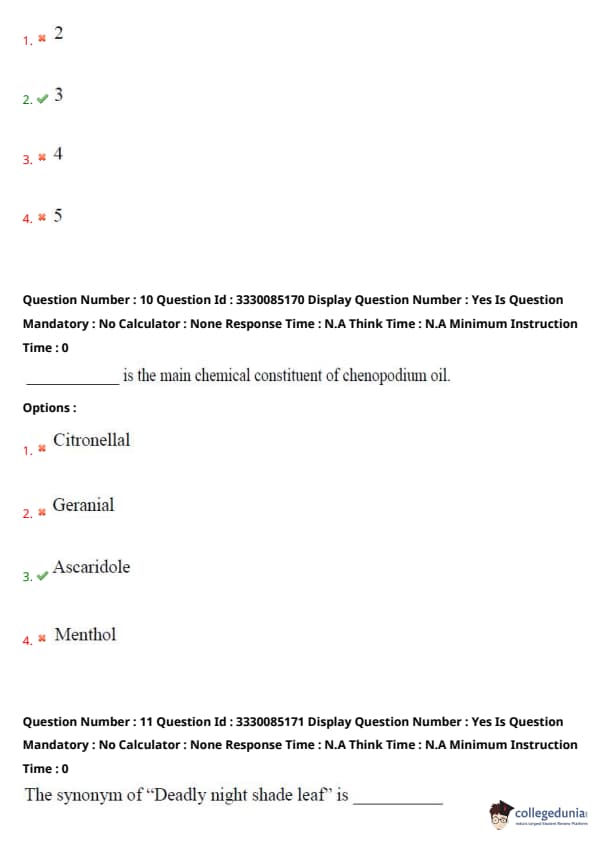
Question 11:
The synonym of "Deadly night shade leaf" is \(\hspace{2cm}\)
- (A) \( Belladonna \)
- (B) \( Hyoscine \)
- (C) \( Atropine \)
- (D) \( Datura \)
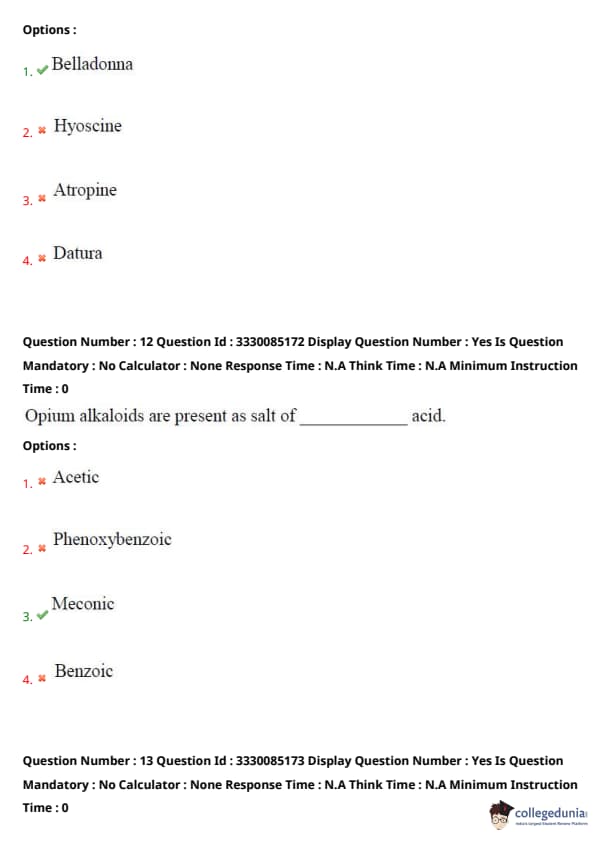
Question 12:
Opium alkaloids are present as salt of \(\hspace{2cm}\) acid.
- (A) \( Acetic \)
- (B) \( Phenoxybenzoic \)
- (C) \( Meconic \)
- (D) \( Benzoic \)
Question 13:
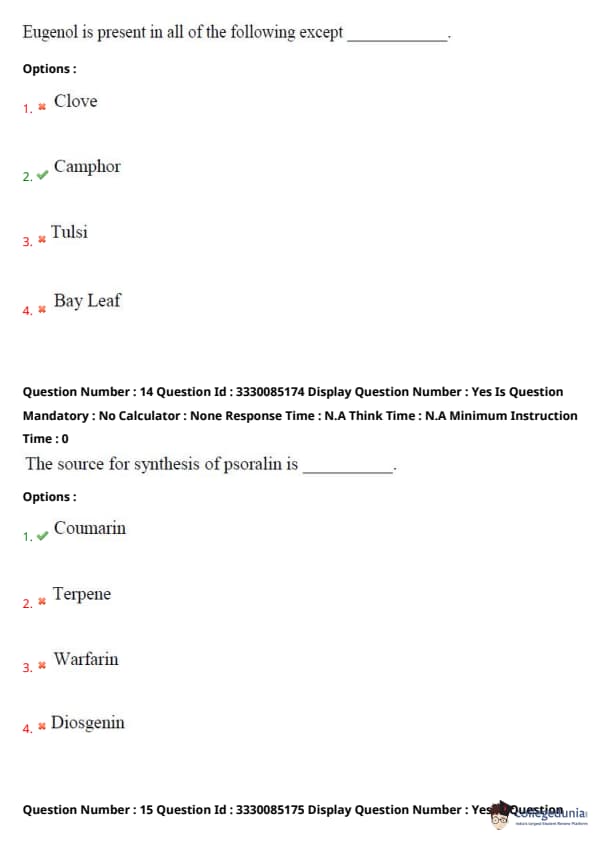
Eugenol is present in all of the following except \(\hspace{2cm}\)
- (A) \( Clove \)
- (B) \( Camphor \)
- (C) \( Tulsi \)
- (D) \( Bay Leaf \)
Question 14:
The source for synthesis of psoralen is \(\hspace{2cm}\)
- (A) \( Coumarin \)
- (B) \( Terpene \)
- (C) \( Warfarin \)
- (D) \( Diosgenin \)
Question 15:
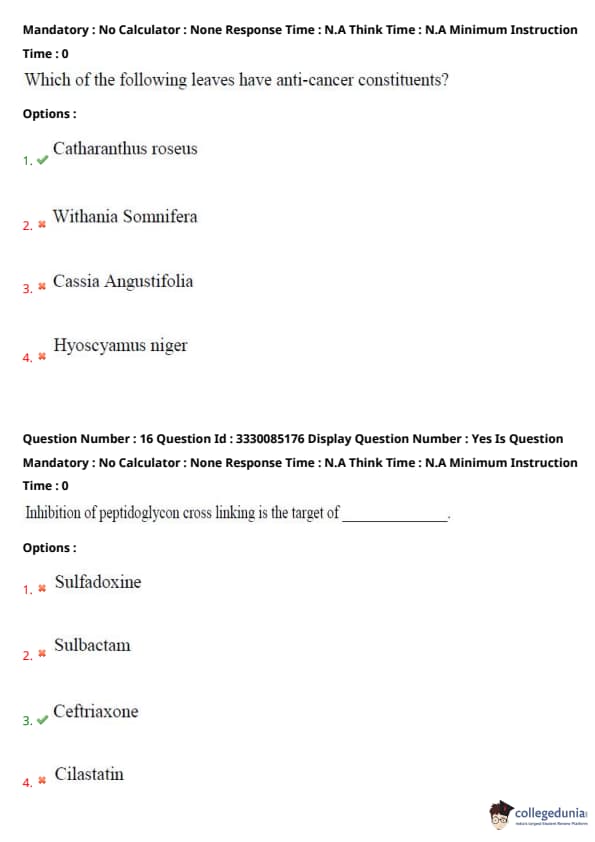
Which of the following leaves have anti-cancer constituents?
- (A) \( Catharanthus roseus \)
- (B) \( Withania Somnifera \)
- (C) \( Cassia Angustifolia \)
- (D) \( Hyoscyamus niger \)
Question 16:
Inhibition of peptidoglycan cross linking is the target of \(\hspace{2cm}\)
- (A) \( Sulfadoxine \)
- (B) \( Sulbactam \)
- (C) \( Ceftriaxone \)
- (D) \( Cilastatin \)
Question 17:
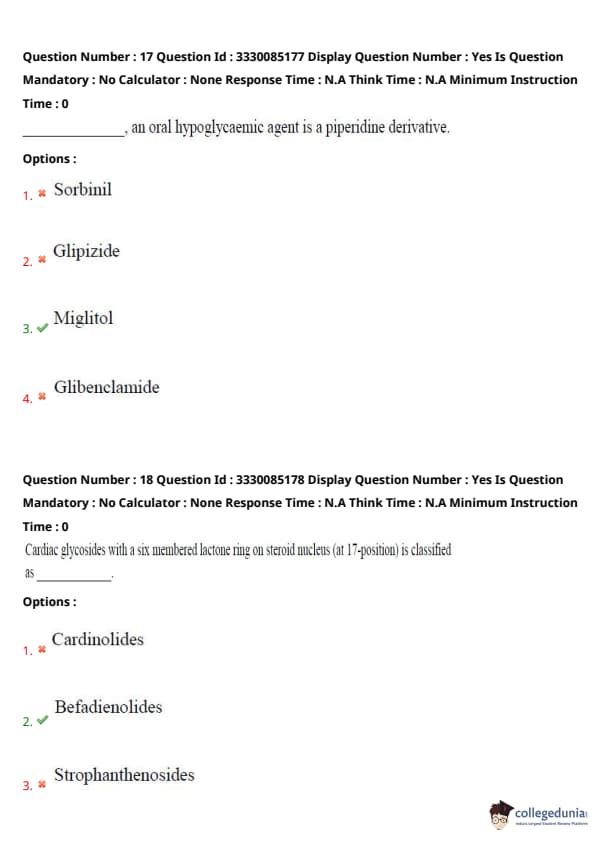
\(\hspace{2cm}\) an oral hypoglycaemic agent is a piperidine derivative.
- (A) \( Sorbinil \)
- (B) \( Glipizide \)
- (C) \( Miglitol \)
- (D) \( Glibenclamide \)
Question 18:
Cardiac glycosides with a six membered lactone ring on steroid nucleus (at 17-position) is classified as \(\hspace{2cm}\)
- (A) \( Cardinolides \)
- (B) \( Bufadienolides \)
- (C) \( Strophanthosides \)
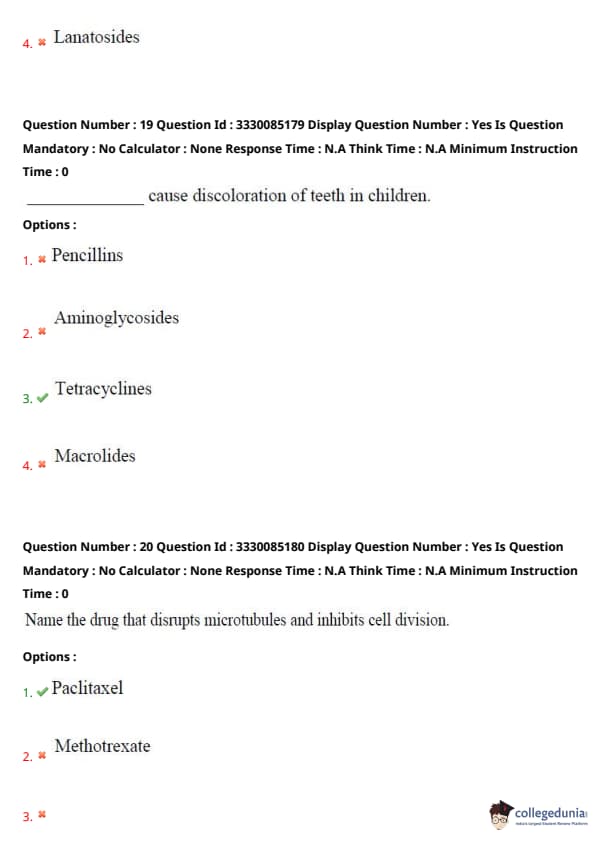
- (D) \( Lanatosides \)
Question 19:
\(\hspace{2cm}\) cause discoloration of teeth in children.
- (A) \( Penicillins \)
- (B) \( Aminoglycosides \)
- (C) \( Tetracyclines \)
- (D) \( Macrolides \)
Question 20:
Name the drug that disrupts microtubules and inhibits cell division.
- (A) \( Paclitaxel \)
- (B) \( Methotrexate \)
- (C) \( Cisplatin \)
- (D) \( Cyclophosphamide \)
Question 21:
\(\hspace{2cm}\) is classified as non-sedative anti-histamine.
- (A) \( Diphenhydramine \)
- (B) \( Promethazine \)
- (C) \( Fexofenadine \)
- (D) \( Pheniramine \)
Question 22:
\(\hspace{2cm}\) acts at both nicotinic and muscarinic receptors.
- (A) \( Acetylcholine \)
- (B) \( Atropine \)
- (C) \( Hyoscyamine \)
- (D) \( Tubocurarine \)
Question 23:
What is the class of alprazolam?
- (A) \( Barbiturate class hypnotic \)
- (B) \( Benzodiazepine class of anxiolytic agent \)
- (C) \( Opioid analgesic \)
- (D) \( Tricyclic anti-depressant \)
Question 24:
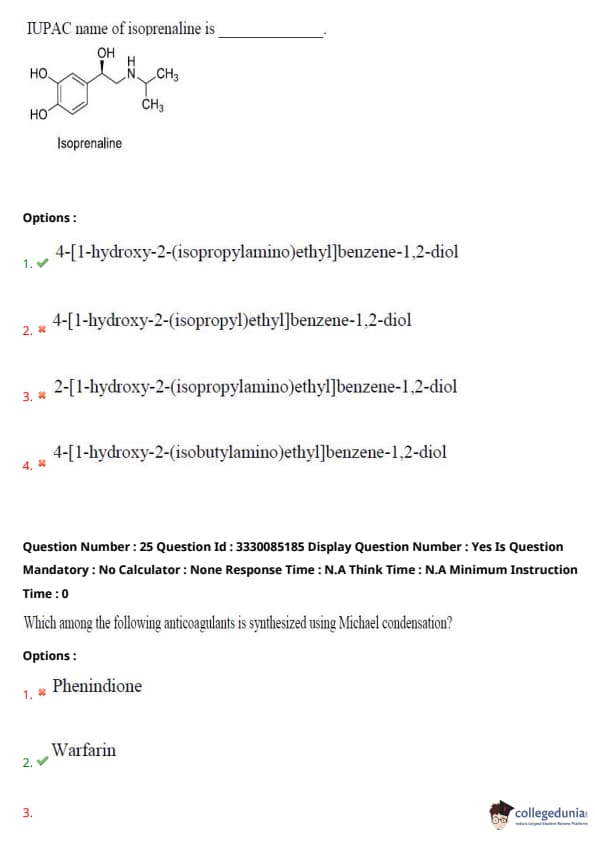
IUPAC name of isoprenaline is \(\hspace{2cm}\)
\includegraphics{24.png
- (A) \( 4-[1-hydroxy-2-(isopropylamino)ethyl]benzene-1,2-diol \)
- (B) \( 4-[1-hydroxy-2-(isopropyl)ethyl]benzene-1,2-diol \)
- (C) \( 2-[1-hydroxy-2-(isopropylamino)ethyl]benzene-1,2-diol \)
- (D) \( 4-[1-hydroxy-2-(isobutylamino)ethyl]benzene-1,2-diol \)
Correct Answer: (A) \( \text{4-[1-hydroxy-2-(isopropylamino)ethyl]benzene-1,2-diol} \)
View Solution
To determine the IUPAC name of isoprenaline, we need to analyze its structure. The benzene ring has two hydroxyl groups at positions 1 and 2, making it a benzene-1,2-diol (also known as catechol). The ethylamine substituent is attached to the benzene ring at position 4. The ethylamine group has a hydroxyl group at position 1 and an isopropylamino group at position 2. Therefore, the complete IUPAC name is 4-[1-hydroxy-2-(isopropylamino)ethyl]benzene-1,2-diol.
Let's break down the name:
- "benzene-1,2-diol" indicates the catechol ring.
- The substituent on the benzene ring is at the 4th position.
- The substituent is an ethyl group (-CH2-CH2-) with a hydroxyl group on the first carbon attached to the benzene ring (1-hydroxyethyl-) and an isopropylamino group (-NH-CH(CH3)2) on the second carbon (2-(isopropylamino)ethyl-).
Combining these, we get 4-[1-hydroxy-2-(isopropylamino)ethyl]benzene-1,2-diol. Quick Tip: When naming substituted benzenes, number the ring to give the lowest possible numbers to the substituents. Identify the principal functional groups and the longest carbon chain in the substituent.
Question 25:
Which among the following anticoagulants is synthesized using Michael condensation?
- (A) \( Phenindione \)
- (B) \( Warfarin \)
- (C) \( Dicoumarol \)
- (D) \( Bromindione \)
Question 26:
Example for amino amide local anaesthetic agent is \(\hspace{2cm}\)
- (A) \( Tetracaine \)
- (B) \( Benzocaine \)
- (C) \( Chloroprocaine \)
- (D) \( Lidocaine \)
Question 27:
\(\hspace{2cm}\) an anxiolytic is a benzodiazepine derivative.
- (A) \( Buspirone \)
- (B) \( Chlordiazepoxide \)
- (C) \( Meprobamate \)
- (D) \( Chloral hydrate \)
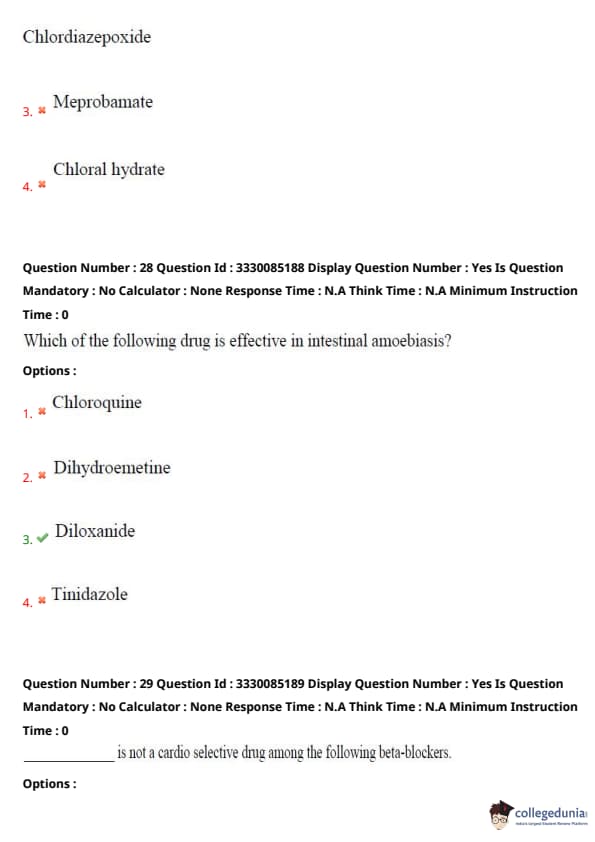
Question 28:
Which of the following drug is effective in intestinal amoebiasis?
- (A) \( Chloroquine \)
- (B) \( Dihydroemetine \)
- (C) \( Diloxanide \)
- (D) \( Tinidazole \)
Question 29:
\(\hspace{2cm}\) is not a cardio selective drug among the following beta-blockers.
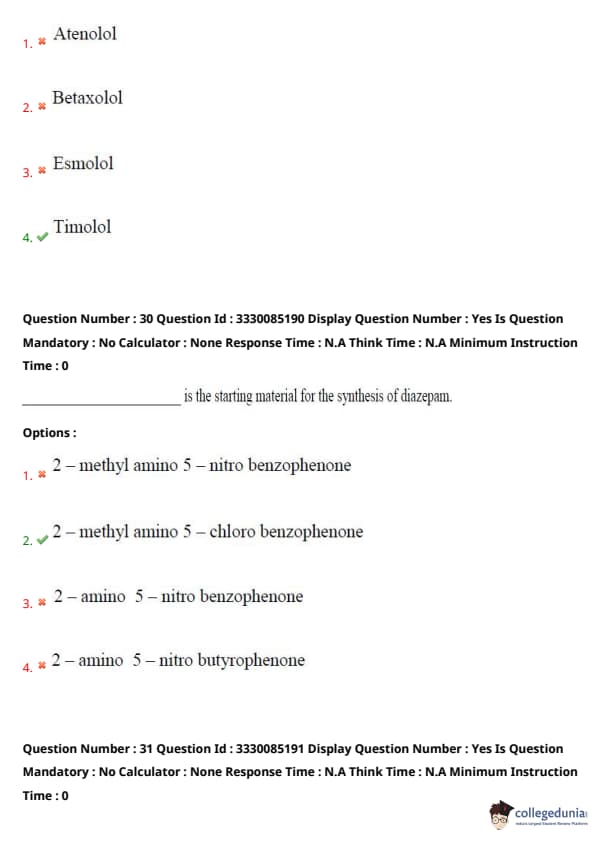
- (A) \( Atenolol \)
- (B) \( Betaxolol \)
- (C) \( Esmolol \)
- (D) \( Timolol \)
Question 30:
\(\hspace{2cm}\) is the starting material for the synthesis of diazepam.
- (A) \( 2 - methyl amino 5 - nitro benzophenone \)
- (B) \( 2 - methyl amino 5 - chloro benzophenone \)
- (C) \( 2 - amino 5 - nitro benzophenone \)
- (D) \( 2 - amino 5 - nitro butyrophenone \)
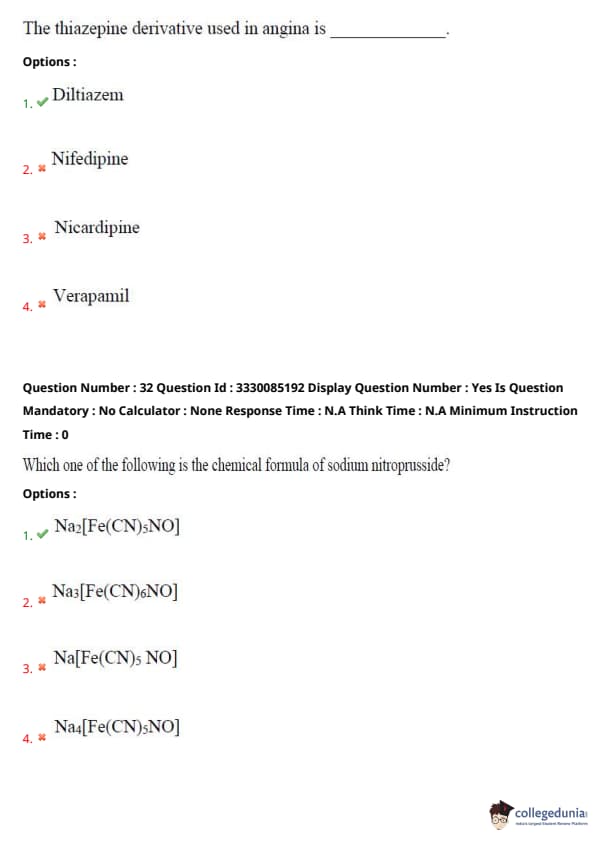
Question 31:
The thiazepine derivative used in angina is \(\hspace{2cm}\)
- (A) \( Diltiazem \)
- (B) \( Nifedipine \)
- (C) \( Nicardipine \)
- (D) \( Verapamil \)
Question 32:
Which one of the following is the chemical formula of sodium nitroprusside?
- (A) \( Na_2[Fe(CN)_5NO] \)
- (B) \( Na_3[Fe(CN)_6NO] \)
- (C) \( Na_3[Fe(CN)_5NO] \)
- (D) \( Na_4[Fe(CN)_5NO] \)
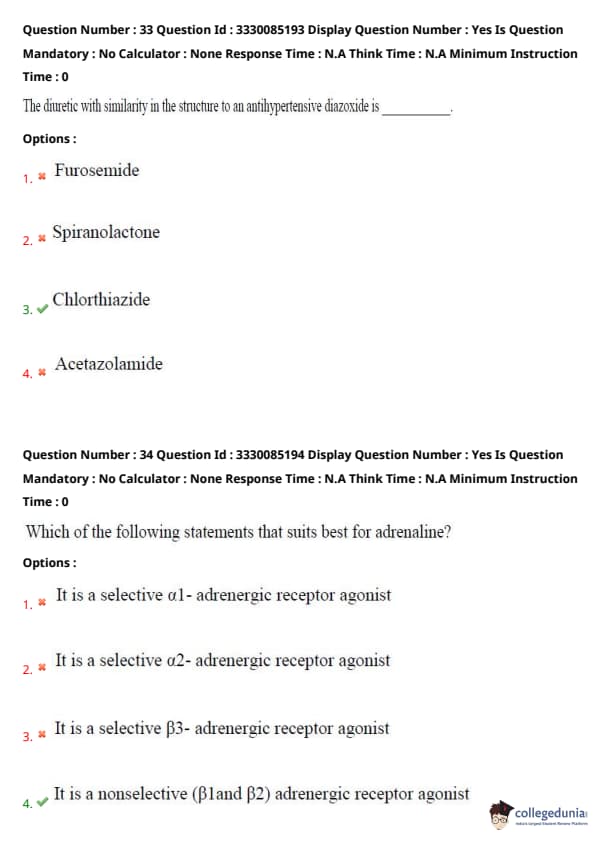
Question 33:
The diuretic with similarity in the structure to an antihypertensive diazoxide is \(\hspace{2cm}\)
- (A) \( Furosemide \)
- (B) \( Spironolactone \)
- (C) \( Chlorothiazide \)
- (D) \( Acetazolamide \)
Question 34:
Which of the following statements that suits best for adrenaline?
- (A) \( It is a selective \alpha1- adrenergic receptor agonist \)
- (B) \( It is a selective \alpha2- adrenergic receptor agonist \)
- (C) \( It is a selective \beta3- adrenergic receptor agonist \)
- (D) \( It is a nonselective (\beta1 and \beta2) adrenergic receptor agonist \)
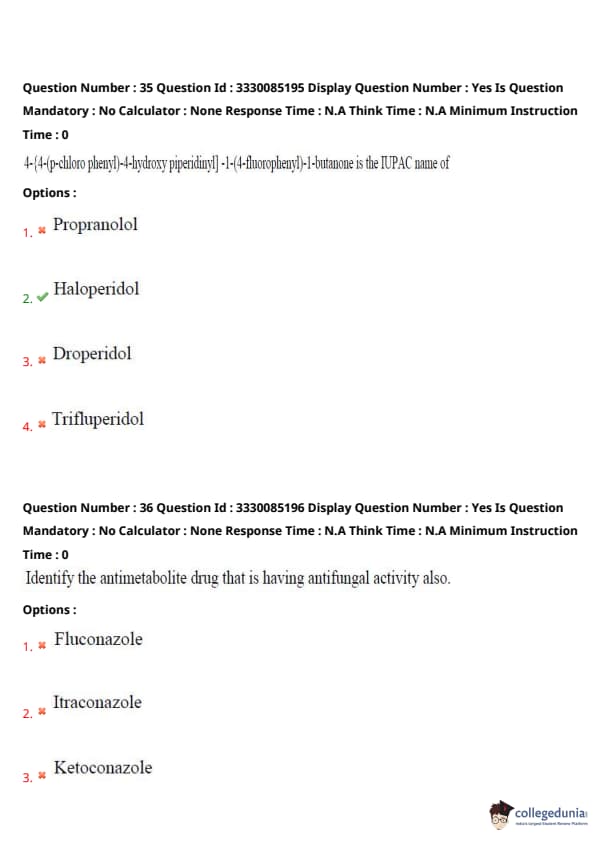
Question 35:
4-[4-(p-chloro phenyl)-4-hydroxy piperidinyl]-1-(4-fluorophenyl)-1-butanone is the IUPAC name of \(\hspace{2cm}\)
- (A) \( Propranolol \)
- (B) \( Haloperidol \)
- (C) \( Droperidol \)
- (D) \( Trifluperidol \)
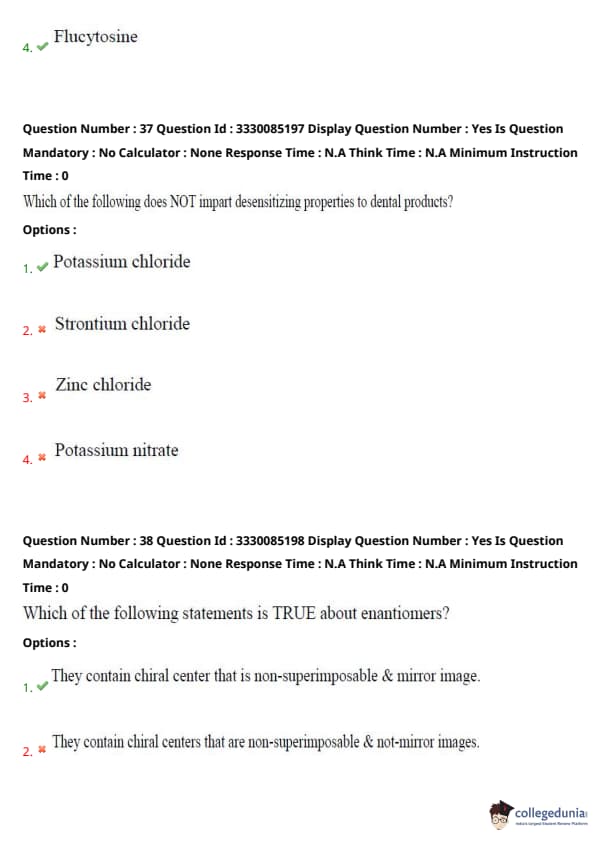
Question 36:
Identify the antimetabolite drug that is having antifungal activity also.
- (A) \( Fluconazole \)
- (B) \( Itraconazole \)
- (C) \( Ketoconazole \)
- (D) \( Flucytosine \)
Question 37:
Which of the following does NOT impart desensitizing properties to dental products?
- (A) \( Potassium chloride \)
- (B) \( Strontium chloride \)
- (C) \( Zinc chloride \)
- (D) \( Potassium nitrate \)
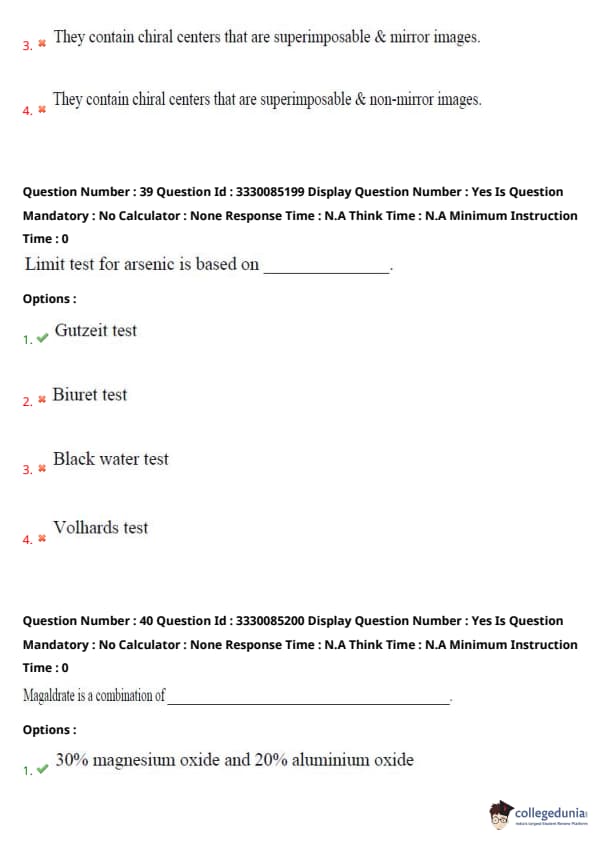
Question 38:
Which of the following statements is TRUE about enantiomers?
- (A) \( They contain chiral center that is non-superimposable \& mirror image. \)
- (B) \( They contain chiral centers that are non-superimposable \& not-mirror images. \)
- (C) \( They contain chiral centers that are superimposable \& mirror images. \)
- (D) \( They contain chiral centers that are superimposable \& non-mirror images. \)
Question 39:
Limit test for arsenic is based on \(\hspace{2cm}\)
- (A) \( Gutzeit test \)
- (B) \( Biuret test \)
- (C) \( Black water test \)
- (D) \( Volhard's test \)
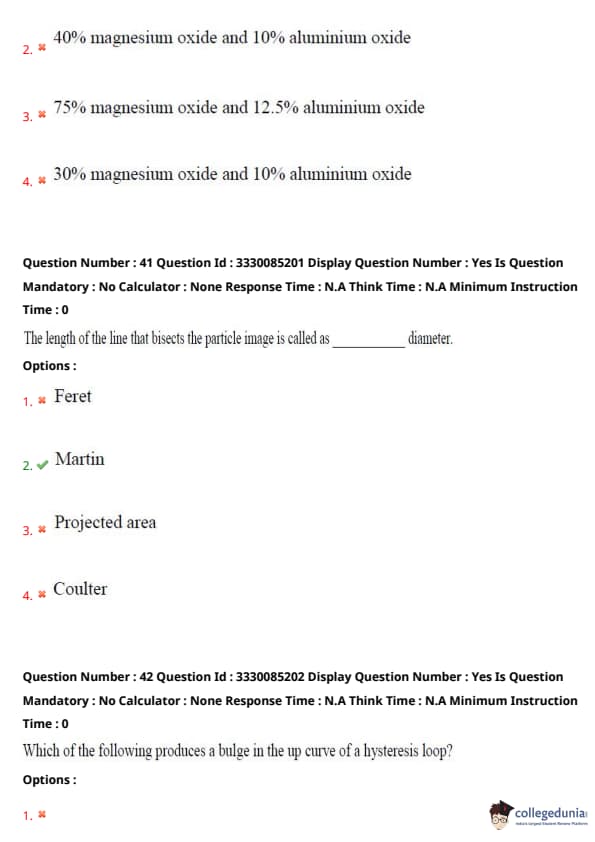
Question 40:
Magaldrate is a combination of \(\hspace{2cm}\)
- (A) \( 30% magnesium oxide and 20% aluminium oxide \)
- (B) \( 40% magnesium oxide and 10% aluminium oxide \)
- (C) \( 75% magnesium oxide and 12.5% aluminium oxide \)
- (D) \( 30% magnesium oxide and 10% aluminium oxide \)
Question 41:
The length of the line that bisects the particle image is called as \(\hspace{2cm}\) diameter.
- (A) \( Feret \)
- (B) \( Martin \)
- (C) \( Projected area \)
- (D) \( Coulter \)
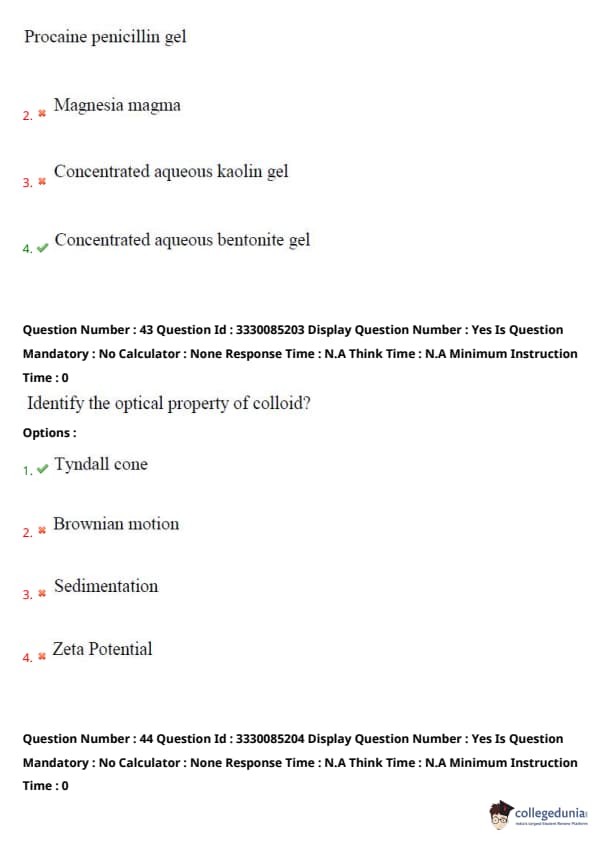
Question 42:
Which of the following produces a bulge in the up curve of a hysteresis loop?
- (A) \( Procaine penicillin gel \)
- (B) \( Magnesia magma \)
- (C) \( Concentrated aqueous kaolin gel \)
- (D) \( Concentrated aqueous bentonite gel \)
Question 43:
Identify the optical property of colloid?
- (A) \( Tyndall cone \)
- (B) \( Brownian motion \)
- (C) \( Sedimentation \)
- (D) \( Zeta Potential \)
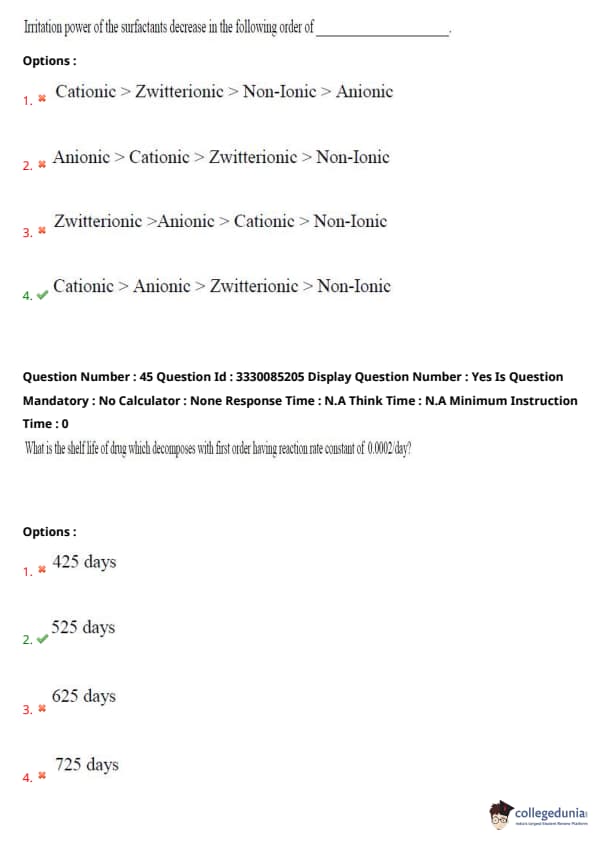
Question 44:
Irritation power of the surfactants decrease in the following order \(\hspace{2cm}\)
- (A) \( Cationic > Zwitterionic > Non-Ionic > Anionic \)
- (B) \( Anionic > Cationic > Zwitterionic > Non-Ionic \)
- (C) \( Zwitterionic > Anionic > Cationic > Non-Ionic \)
- (D) \( Cationic > Anionic > Zwitterionic > Non-Ionic \)
Question 45:
What is the shelf life of drug which decomposes with first order having reaction rate constant of 0.002 day\(^{-1}\)?
- (A) \( 425 days \)
- (B) \( 525 days \)
- (C) \( 625 days \)
- (D) \( 725 days \)
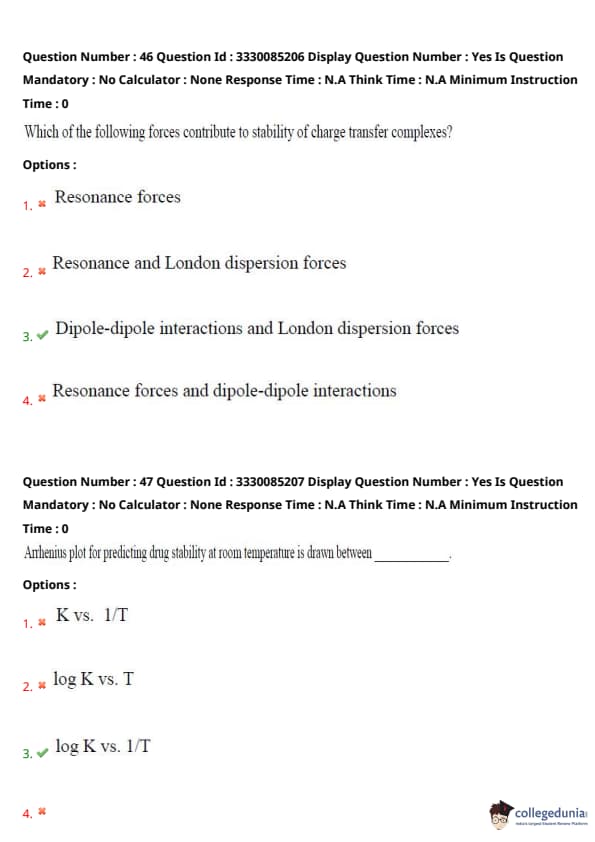
Question 46:
Which of the following forces contribute to stability of charge transfer complexes?
- (A) \( Resonance forces \)
- (B) \( Resonance and London dispersion forces \)
- (C) \( Dipole-dipole interactions and London dispersion forces \)
- (D) \( Resonance forces and dipole-dipole interactions \)
Question 47:
Arrhenius plot for predicting drug stability at room temperature is drawn between \(\hspace{2cm}\)
- (A) \( K vs. 1/T \)
- (B) \( \log K vs. T \)
- (C) \( \log K vs. 1/T \)
- (D) \( \log C vs. 1/T \)
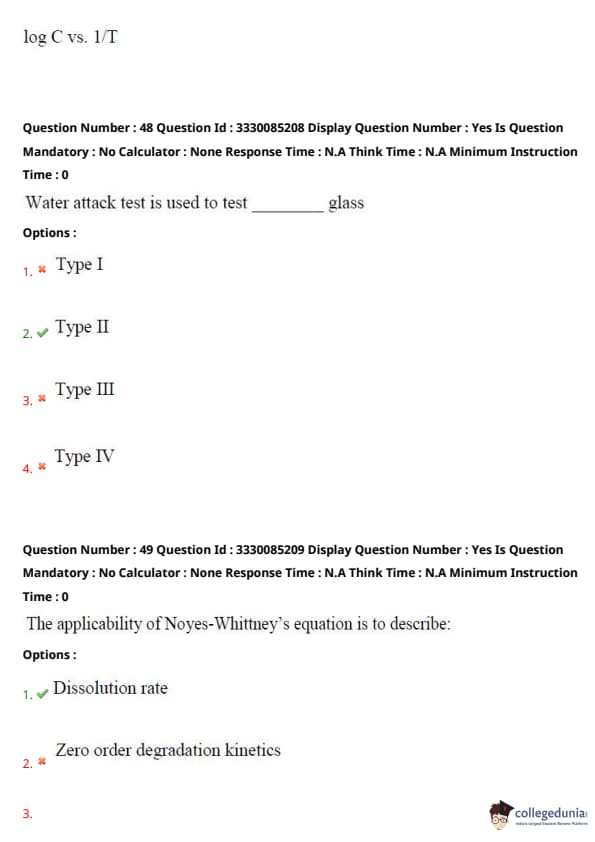
Question 48:
Water attack test is used to test \(\hspace{2cm}\) glass
- (A) \( Type I \)
- (B) \( Type II \)
- (C) \( Type III \)
- (D) \( Type IV \)
Question 49:
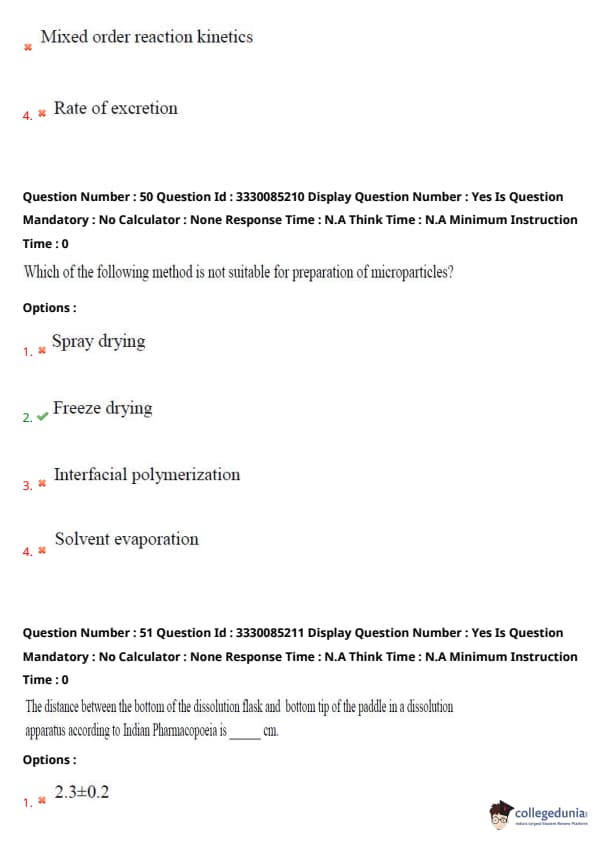
The applicability of Noyes-Whitney's equation is to describe \(\hspace{2cm}\)
- (A) \( Dissolution rate \)
- (B) \( Zero order degradation kinetics \)
- (C) \( Mixed order reaction kinetics \)
- (D) \( Rate of excretion \)
Question 50:
Which of the following method is not suitable for preparation of microparticles?
- (A) \( Spray drying \)
- (B) \( Freeze drying \)
- (C) \( Interfacial polymerization \)
- (D) \( Solvent evaporation \)
Question 51:
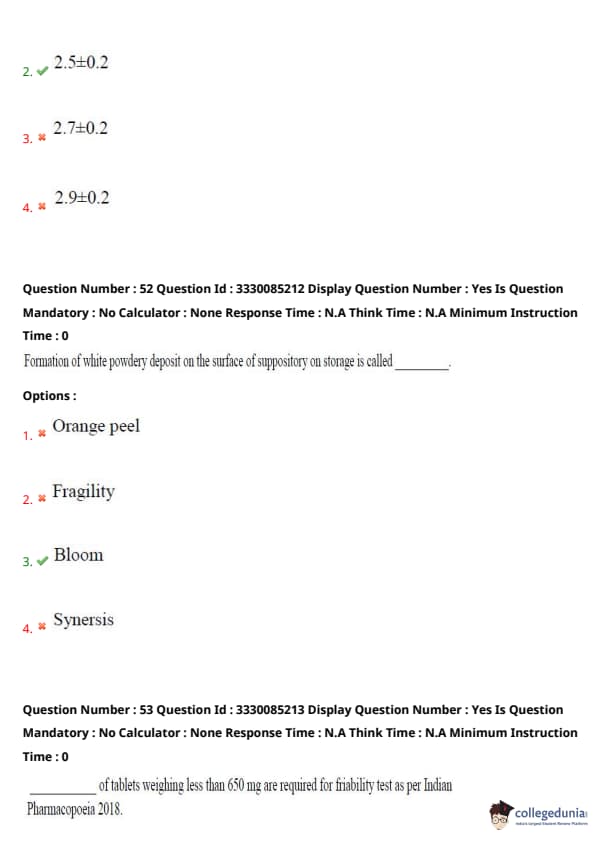
The distance between the bottom of the dissolution flask and bottom tip of the paddle in a dissolution apparatus according to Indian Pharmacopoeia is \(\hspace{2cm}\) cm.
- (A) \( 2.3 \pm 0.2 \)
- (B) \( 2.5 \pm 0.2 \)
- (C) \( 2.7 \pm 0.2 \)
- (D) \( 2.9 \pm 0.2 \)
Question 52:
Formation of white powdery deposit on the surface of suppository on storage is called \(\hspace{2cm}\)
- (A) \( Orange peel \)
- (B) \( Fragility \)
- (C) \( Bloom \)
- (D) \( Syneresis \)
Question 53:
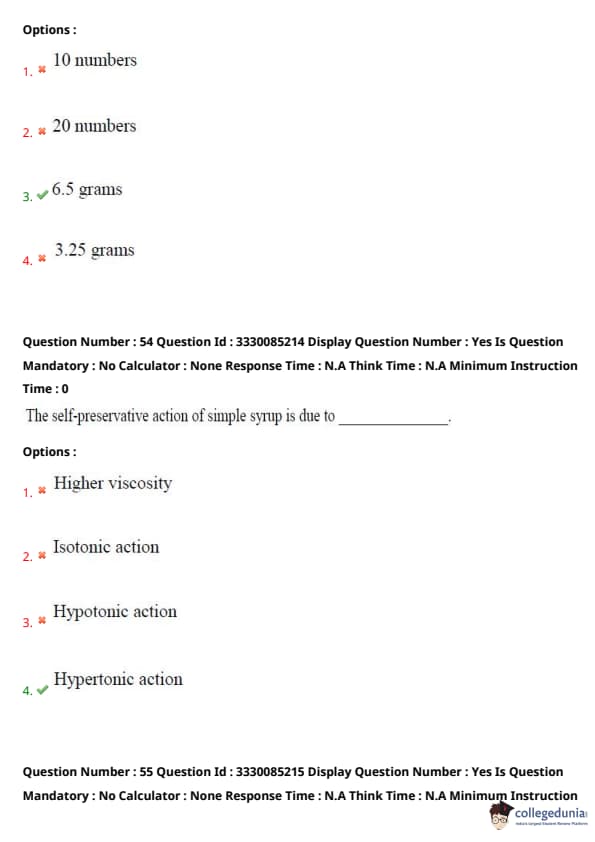
\(\hspace{2cm}\) of tablets weighing less than 650 mg are required for friability test as per Indian Pharmacopoeia 2018.
- (A) \( 10 numbers \)
- (B) \( 20 numbers \)
- (C) \( 6.5 grams \)
- (D) \( 3.25 grams \)
Question 54:
The self-preservative action of simple syrup is due to \(\hspace{2cm}\)
- (A) \( Higher viscosity \)
- (B) \( Isotonic action \)
- (C) \( Hypotonic action \)
- (D) \( Hypertonic action \)
Question 55:
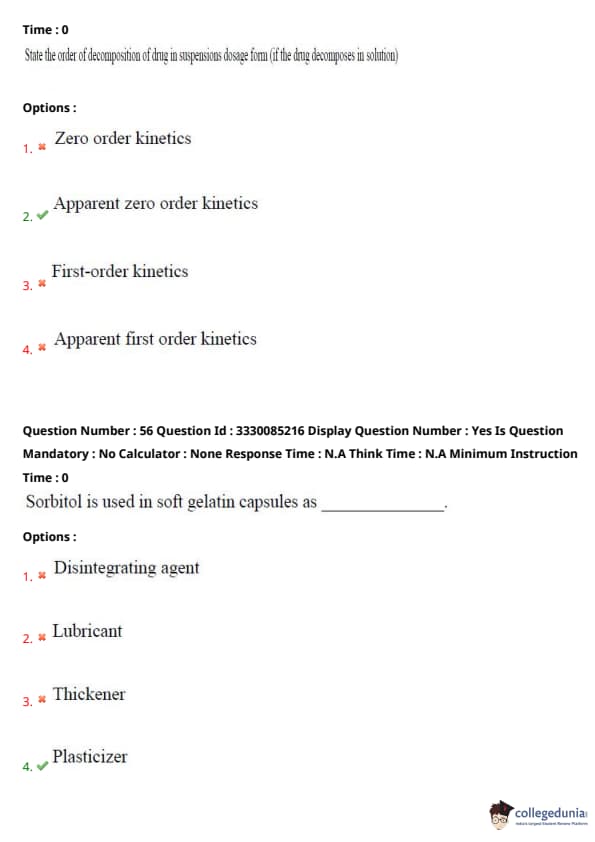
State the order of decomposition of drug in suspension dosage form (if the drug decomposes in solution)
- (A) \( Zero order kinetics \)
- (B) \( Apparent zero order kinetics \)
- (C) \( First-order kinetics \)
- (D) \( Apparent first order kinetics \)
Question 56:
Sorbitol is used in soft gelatin capsules as \(\hspace{2cm}\)
- (A) \( Disintegrating agent \)
- (B) \( Lubricant \)
- (C) \( Thickener \)
- (D) \( Plasticizer \)
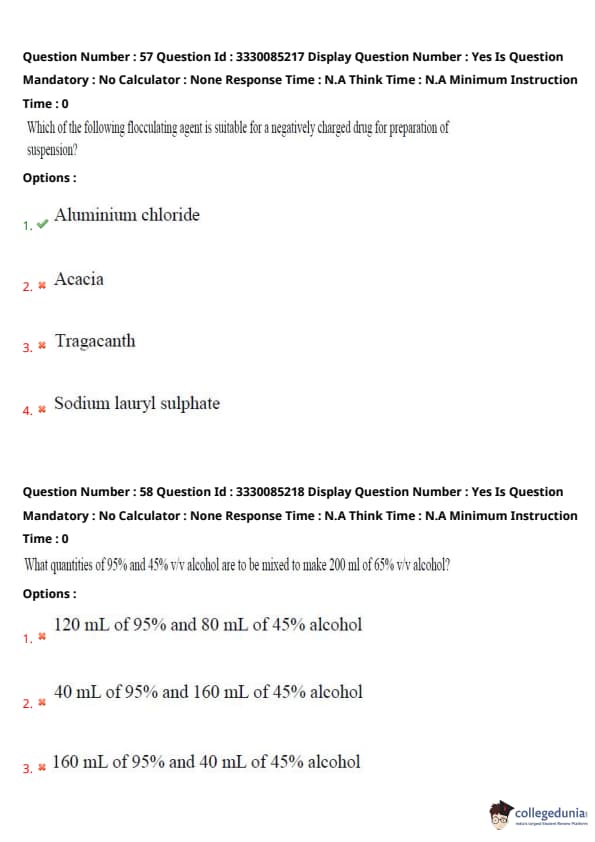
Question 57:
Which of the following flocculating agent is suitable for a negatively charged drug for preparation of suspension?
- (A) \( Aluminium chloride \)
- (B) \( Acacia \)
- (C) \( Tragacanth \)
- (D) \( Sodium lauryl sulphate \)
Question 58:
What quantities of 95% and 45% v/v alcohol are to be mixed to make 200 mL of 65% v/v alcohol?
- (A) \( 120 mL of 95% and 80 mL of 45% alcohol \)
- (B) \( 40 mL of 95% and 160 mL of 45% alcohol \)
- (C) \( 160 mL of 95% and 40 mL of 45% alcohol \)
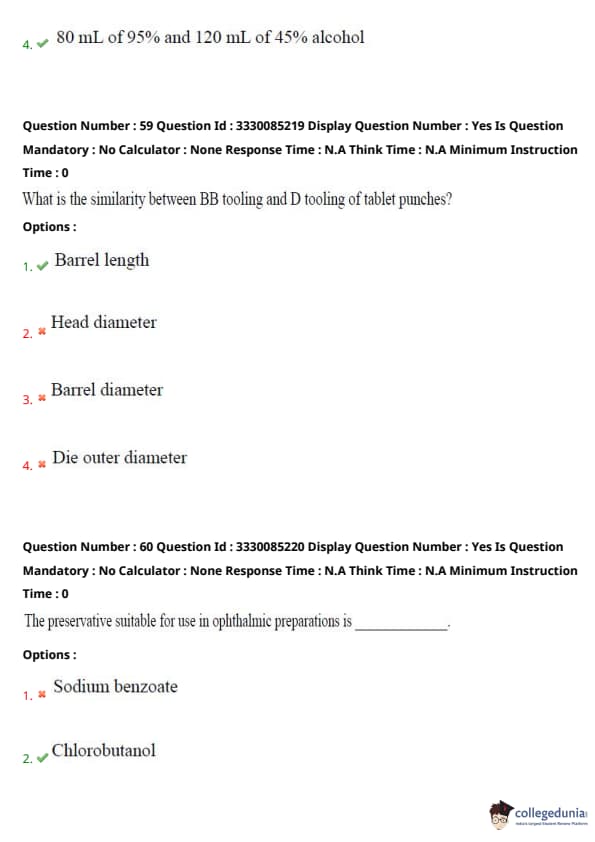
- (D) \( 80 mL of 95% and 120 mL of 45% alcohol \)
Question 59:
What is the similarity between BB tooling and D tooling of tablet punches?
- (A) \( Barrel length \)
- (B) \( Head diameter \)
- (C) \( Barrel diameter \)
- (D) \( Die outer diameter \)
Question 60:
The preservative suitable for use in ophthalmic preparations is \(\hspace{2cm}\)
- (A) \( Sodium benzoate \)
- (B) \( Chlorobutanol \)
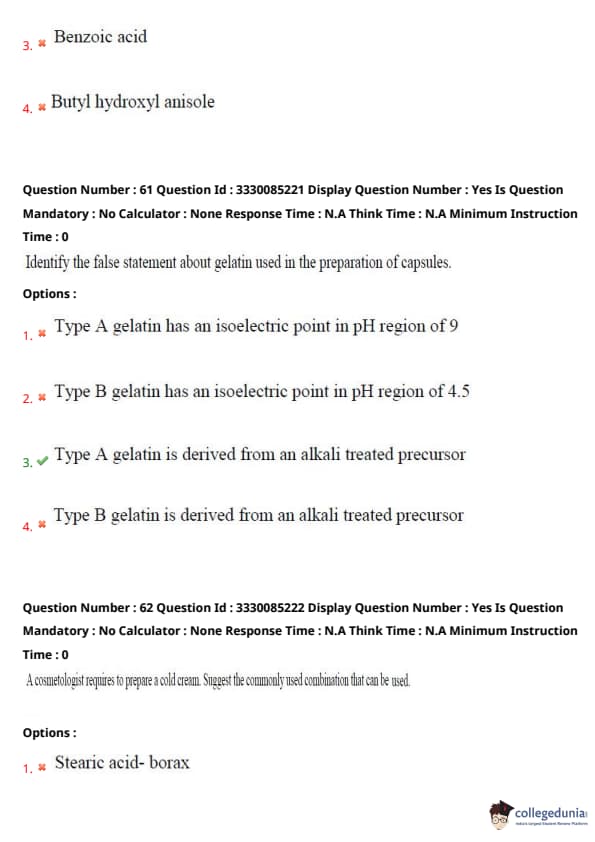
- (C) \( Benzoic acid \)
- (D) \( Butyl hydroxyl anisole \)
Question 61:
Identify the false statement about gelatin used in the preparation of capsules.
- (A) \( Type A gelatin has an isoelectric point in pH region of 9 \)
- (B) \( Type B gelatin has an isoelectric point in pH region of 4.5 \)
- (C) \( Type A gelatin is derived from an alkali treated precursor \)
- (D) \( Type B gelatin is derived from an alkali treated precursor \)
Question 62:
A cosmetologist requires to prepare a cold cream. Suggest the commonly used combination that can be used.
- (A) \( Stearic acid- borax \)
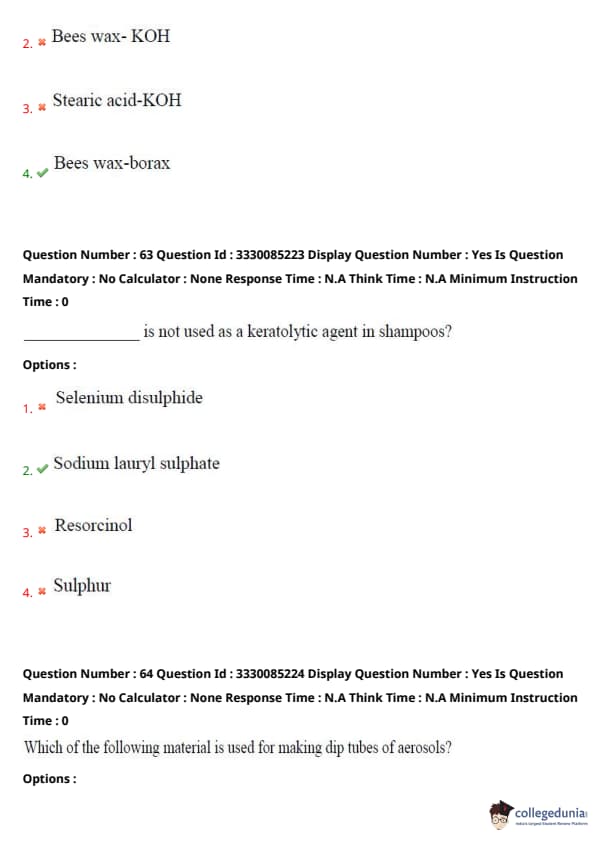
- (B) \( Bees wax- KOH \)
- (C) \( Stearic acid-KOH \)
- (D) \( Bees wax-borax \)
Question 63:
\(\hspace{2cm}\) is not used as a keratolytic agent in shampoos?
- (A) \( Selenium disulphide \)
- (B) \( Sodium lauryl sulphate \)
- (C) \( Resorcinol \)
- (D) \( Sulphur \)
Question 64:
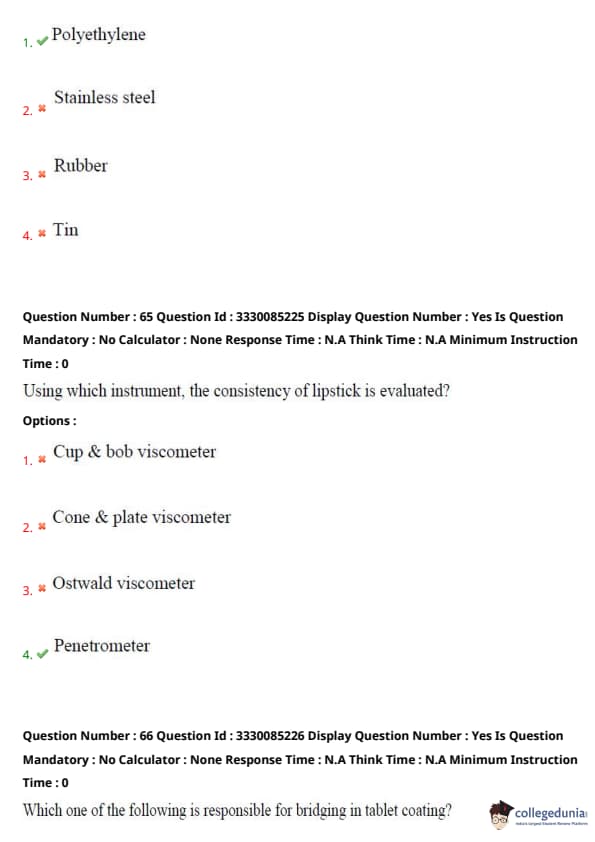
Which of the following material is used for making dip tubes of aerosols?
- (A) \( Polyethylene \)
- (B) \( Stainless steel \)
- (C) \( Rubber \)
- (D) \( Tin \)
Question 65:
Using which instrument, the consistency of lipstick is evaluated?
- (A) \( Cup \& bob viscometer \)
- (B) \( Cone \& plate viscometer \)
- (C) \( Ostwald viscometer \)
- (D) \( Penetrometer \)
Question 66:
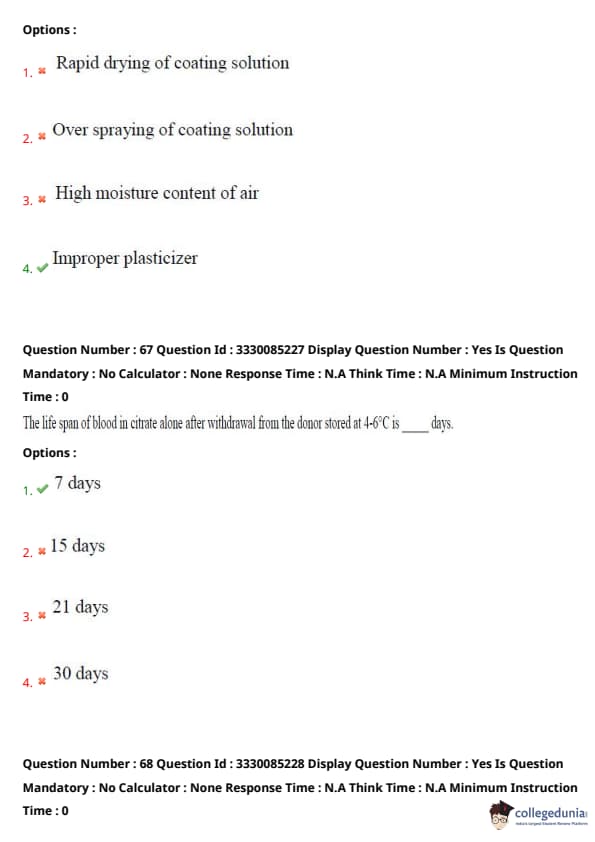
Which of the following is responsible for bridging in tablet coating?
- (A) \( Rapid drying of coating solution \)
- (B) \( Over spraying of coating solution \)
- (C) \( High moisture content of air \)
- (D) \( Improper plasticizer \)
Question 67:
The life span of blood in citrate saline after withdrawal from the donor stored at 4-6°C is \(\hspace{2cm}\) days.
- (A) \( 7 days \)
- (B) \( 15 days \)
- (C) \( 21 days \)
- (D) \( 30 days \)
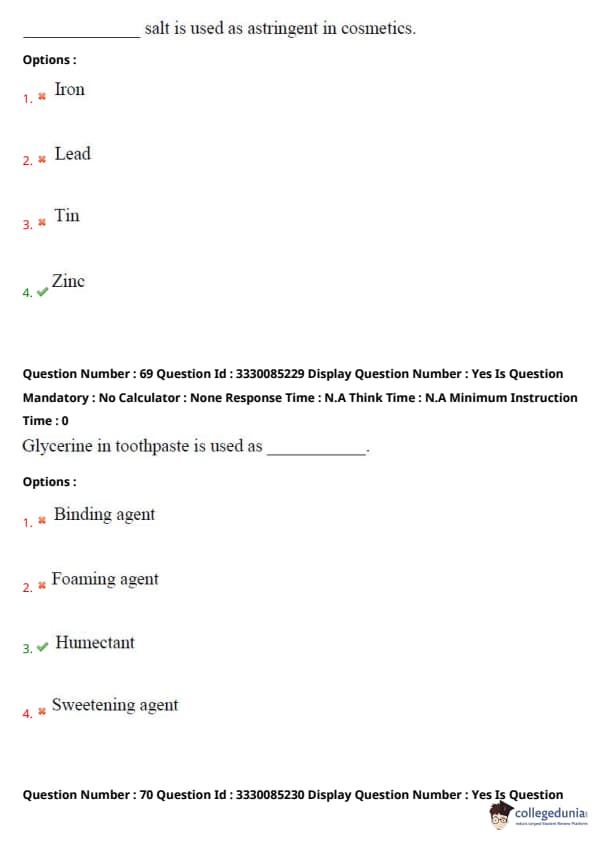
Question 68:
\(\hspace{2cm}\) salt is used as astringent in cosmetics.
- (A) \( Iron \)
- (B) \( Lead \)
- (C) \( Tin \)
- (D) \( Zinc \)
Question 69:
Glycerine in toothpaste is used as \(\hspace{2cm}\)
- (A) \( Binding agent \)
- (B) \( Foaming agent \)
- (C) \( Humectant \)
- (D) \( Sweetening agent \)
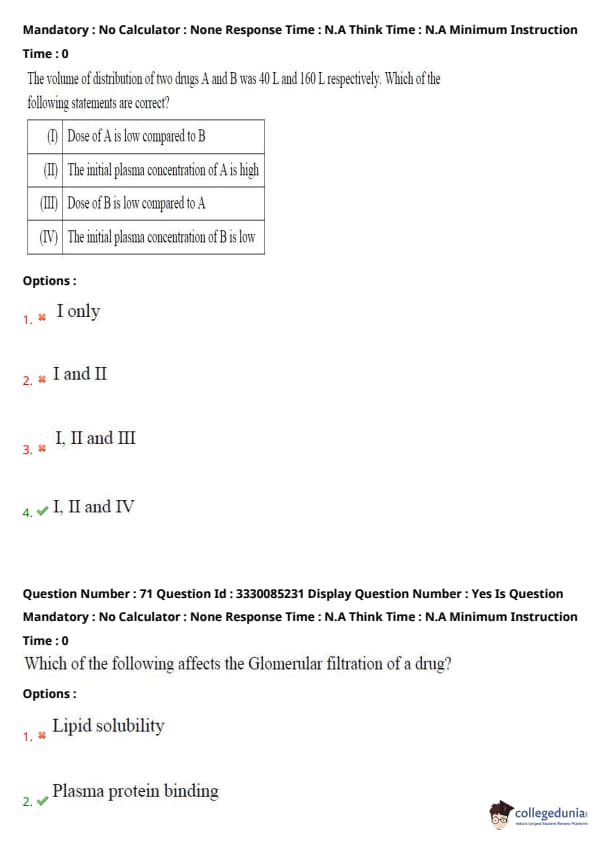
Question 70:
The volume of distribution of two drugs A and B was 40 L and 160 L respectively. Which of the following statements are correct?
Dose of A is low compared to B
The initial plasma concentration of A is high
Dose of B is low compared to A
The initial plasma concentration of B is low
- (A) \( I only \)
- (B) \( I and II \)
- (C) \( I, II and III \)
- (D) \( I, II and IV \)
Question 71:
Which of the following affects the Glomerular filtration of a drug?
- (A) \( Lipid solubility \)
- (B) \( Plasma protein binding \)
- (C) \( Degree of ionization \)
- (D) \( Rate of tubular secretion \)
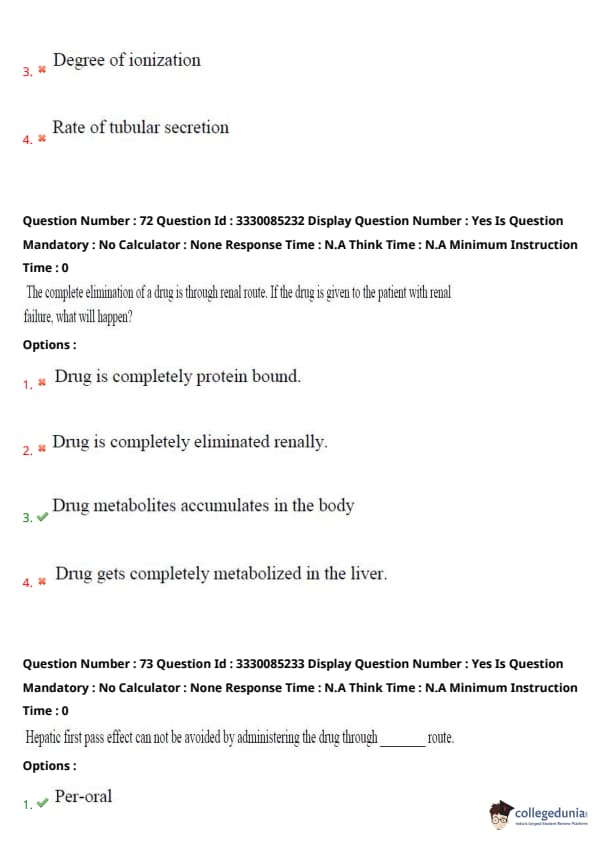
Question 72:
The complete elimination of a drug is through renal route. If the drug is given to the patient with renal failure, what will happen?
- (A) \( Drug is completely protein bound. \)
- (B) \( Drug is completely eliminated renally. \)
- (C) \( Drug metabolites accumulates in the body \)
- (D) \( Drug gets completely metabolized in the liver. \)
Question 73:
Hepatic first pass effect can not be avoided by administering the drug through \(\hspace{2cm}\) route.
- (A) \( Per-oral \)
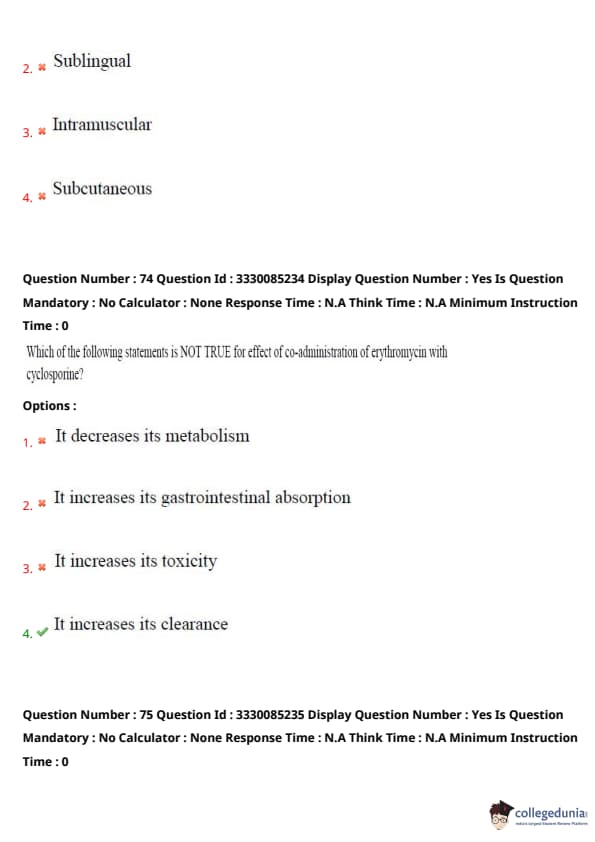
- (B) \( Sublingual \)
- (C) \( Intramuscular \)
- (D) \( Subcutaneous \)
Question 74:
Which of the following statements is NOT TRUE for effect of co-administration of erythromycin with cyclosporine?
- (A) \( It decreases its metabolism \)
- (B) \( It increases its gastrointestinal absorption \)
- (C) \( It increases its toxicity \)
- (D) \( It increases its clearance \)
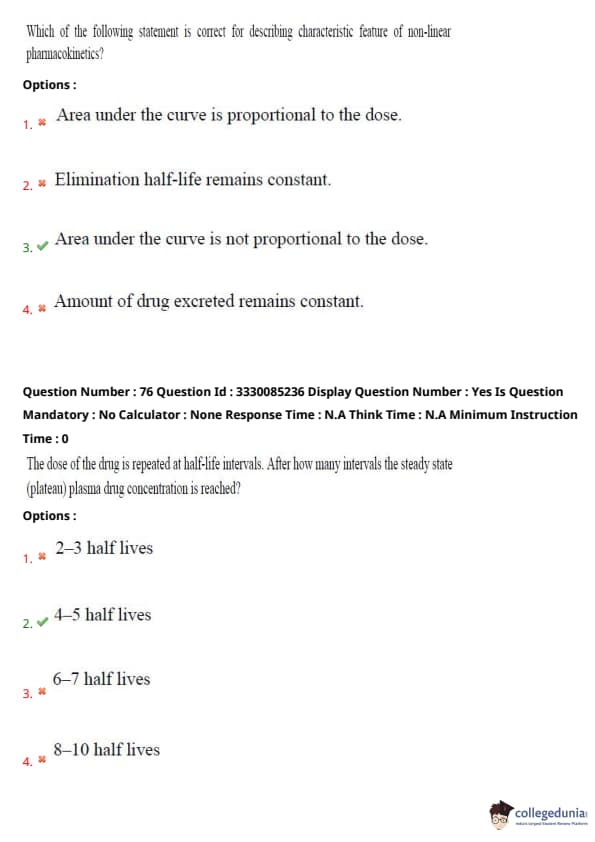
Question 75:
Which of the following statement is correct for describing characteristic feature of non-linear pharmacokinetics?
- (A) \( Area under the curve is proportional to the dose. \)
- (B) \( Elimination half-life remains constant. \)
- (C) \( Area under the curve is not proportional to the dose. \)
- (D) \( Amount of drug excreted remains constant. \)
Question 76:
The dose of the drug is repeated at half-life intervals. After how many intervals the steady state (plateau) plasma drug concentration is reached?
- (A) \( 2-3 half lives \)
- (B) \( 4-5 half lives \)
- (C) \( 6-7 half lives \)
- (D) \( 8-10 half lives \)
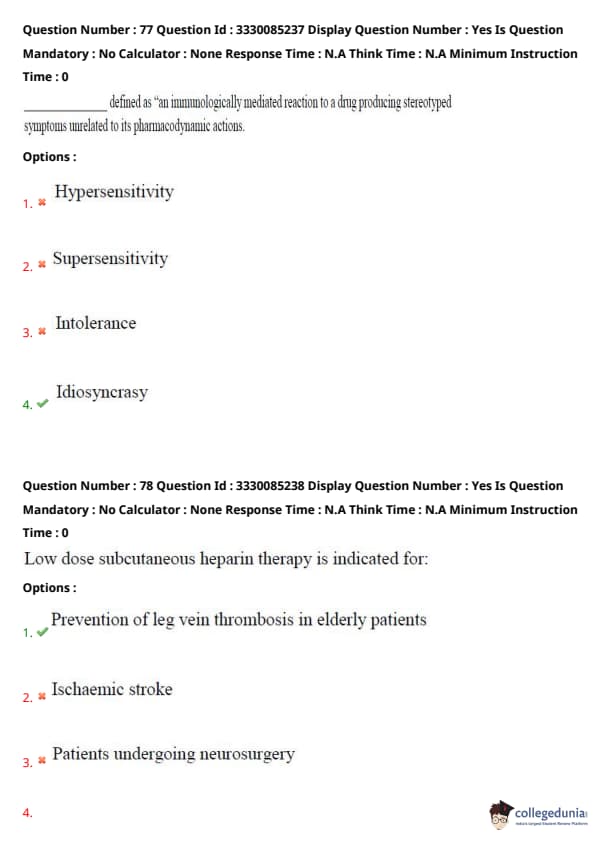
Question 77:
\(\hspace{2cm}\) defined as "an immunologically mediated reaction to a drug producing stereotyped symptoms unrelated to its pharmacodynamic actions."
- (A) \( Hypersensitivity \)
- (B) \( Supersensitivity \)
- (C) \( Intolerance \)
- (D) \( Idiosyncrasy \)
Question 78:
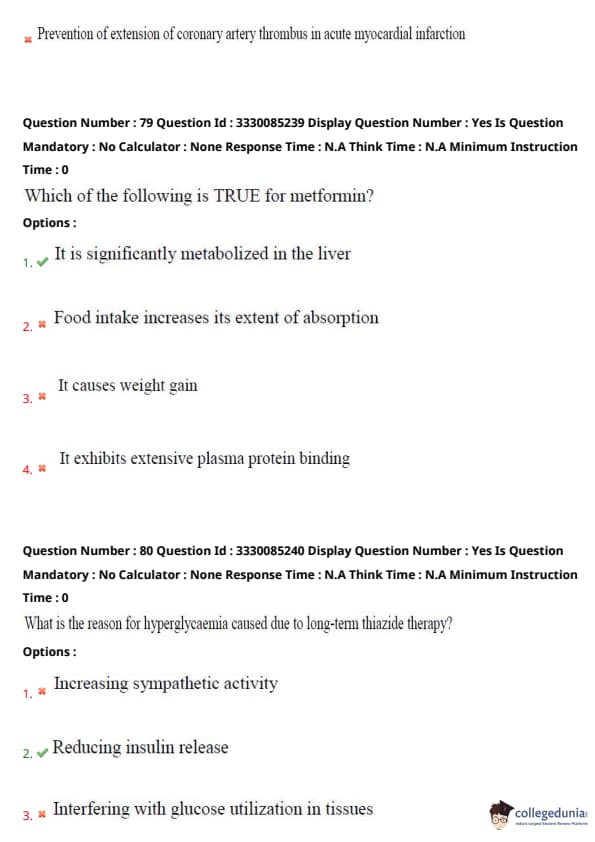
Low dose subcutaneous heparin therapy is indicated for:
- (A) \( Prevention of leg vein thrombosis in elderly patients \)
- (B) \( Ischaemic stroke \)
- (C) \( Patients undergoing neurosurgery \)
- (D) \( Prevention of extension of coronary artery thrombus in acute myocardial infarction \)
Question 79:
Which of the following is TRUE for metformin?
- (A) \( It is significantly metabolized in the liver \)
- (B) \( Food intake increases its extent of absorption \)
- (C) \( It causes weight gain \)
- (D) \( It exhibits extensive plasma protein binding \)
Question 80:
What is the reason for hyperglycaemia caused due to long-term thiazide therapy?
- (A) \( Increasing sympathetic activity \)
- (B) \( Reducing insulin release \)
- (C) \( Interfering with glucose utilization in tissues \)
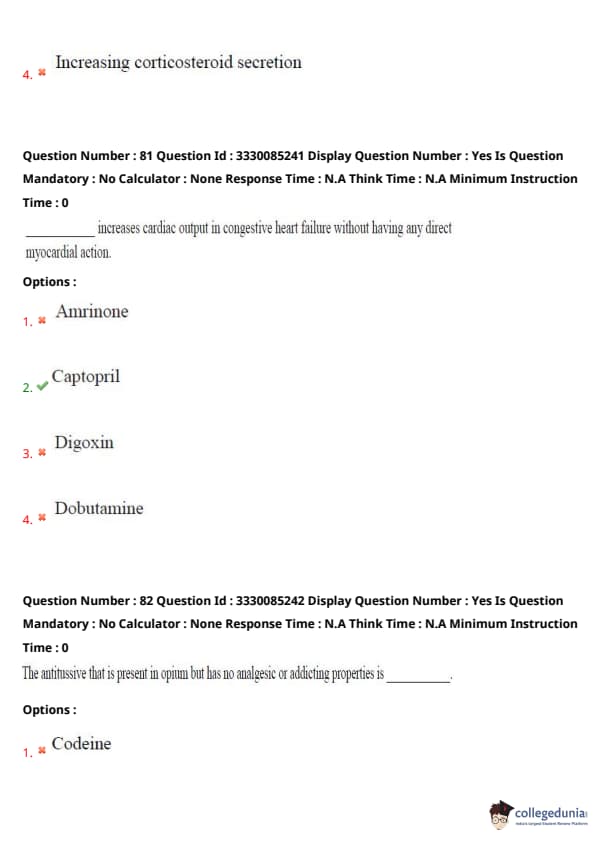
- (D) \( Increasing corticosteroid secretion \)
Question 81:
\(\hspace{2cm}\) increases cardiac output in congestive heart failure without having any direct myocardial action.
- (A) \( Amrinone \)
- (B) \( Captopril \)
- (C) \( Digoxin \)
- (D) \( Dobutamine \)
Question 82:
The antitussive that is present in opium but has no analgesic or addicting properties is \(\hspace{2cm}\)
- (A) \( Codeine \)
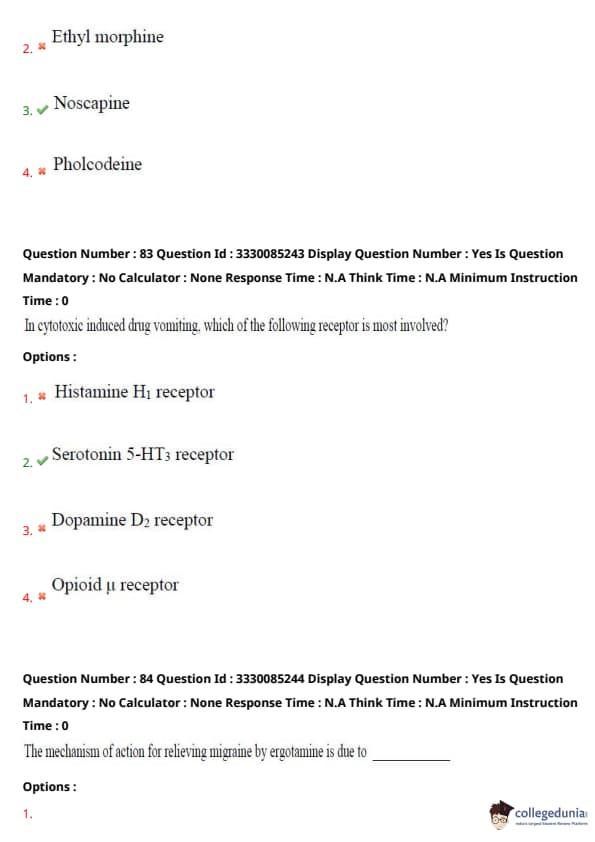
- (B) \( Ethyl morphine \)
- (C) \( Noscapine \)
- (D) \( Pholcodeine \)
Question 83:
In cytotoxic induced drug vomiting, which of the following receptor is most involved?
- (A) \( Histamine H_1 receptor \)
- (B) \( Serotonin 5-HT_3 receptor \)
- (C) \( Dopamine D_2 receptor \)
- (D) \( Opioid \mu receptor \)
Question 84:
The mechanism of action for relieving migraine by ergotamine is due to \(\hspace{2cm}\)
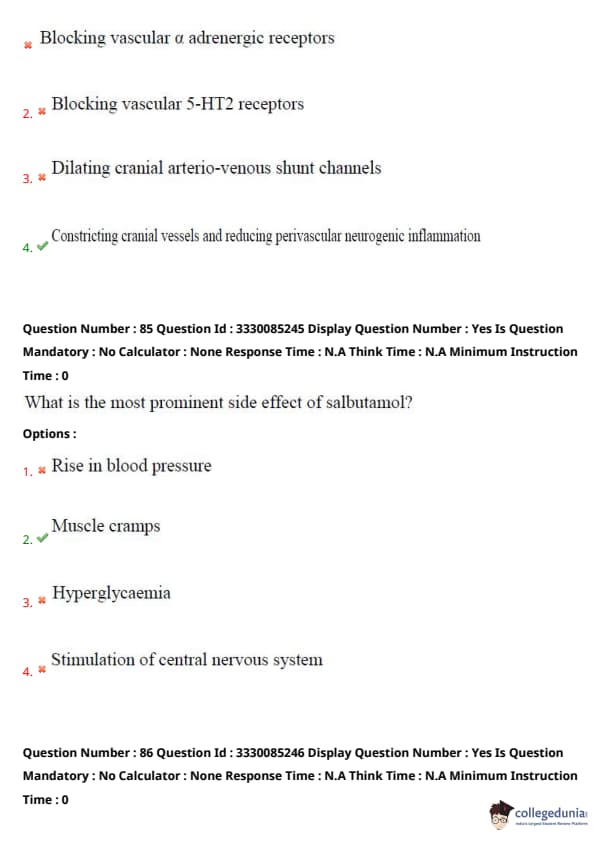
- (A) \( Blocking vascular \alpha adrenergic receptors \)
- (B) \( Blocking vascular 5-HT_2 receptors \)
- (C) \( Dilating cranial arterio-venous shunt channels \)
- (D) \( Constricting cranial vessels and reducing perivascular neurogenic inflammation \)
Question 85:
What is the most prominent side effect of salbutamol?
- (A) \( Rise in blood pressure \)
- (B) \( Muscle cramps \)
- (C) \( Hyperglycaemia \)
- (D) \( Stimulation of central nervous system \)
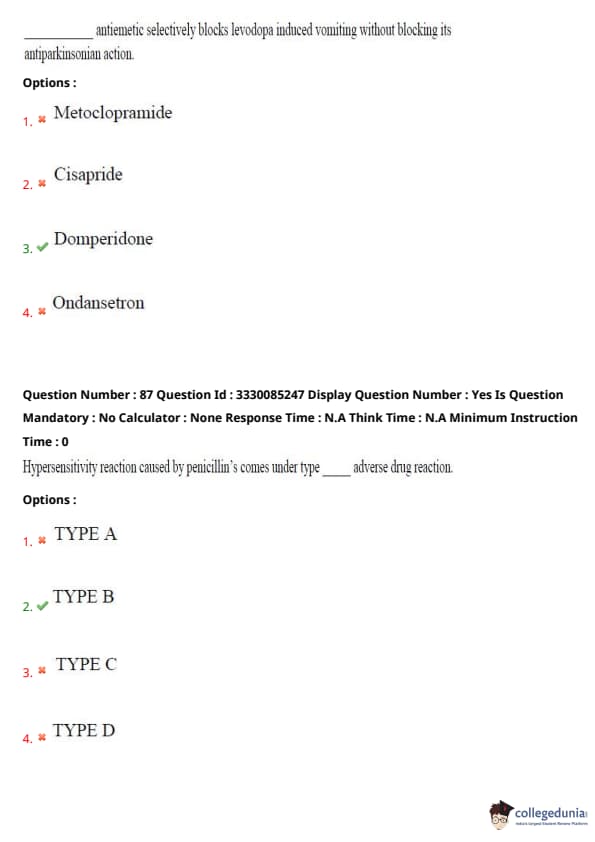
Question 86:
\(\hspace{2cm}\) antiemetic selectively blocks levodopa induced vomiting without blocking its antiparkinsonian action.
- (A) \( Metoclopramide \)
- (B) \( Cisapride \)
- (C) \( Domperidone \)
- (D) \( Ondansetron \)
Question 87:
Hypersensitivity reaction caused by penicillin's comes under type \(\hspace{2cm}\) adverse drug reaction.
- (A) \( TYPE A \)
- (B) \( TYPE B \)
- (C) \( TYPE C \)
- (D) \( TYPE D \)
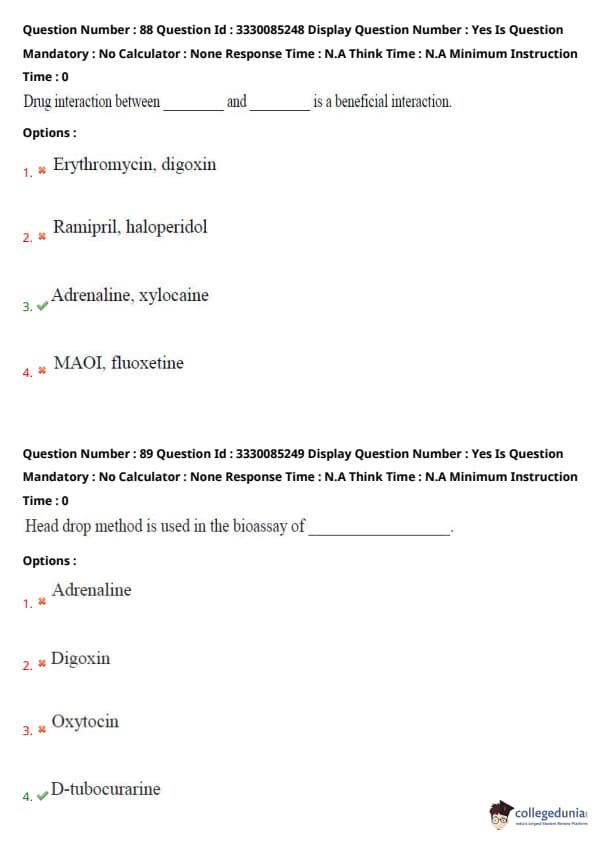
Question 88:
Drug interaction between \(\hspace{2cm}\) and \(\hspace{2cm}\) is a beneficial interaction.
- (A) \( Erythromycin, digoxin \)
- (B) \( Ramipril, haloperidol \)
- (C) \( Adrenaline, xylocaine \)
- (D) \( MAOI, fluoxetine \)
Question 89:
Head drop method is used in the bioassay of \(\hspace{2cm}\)
- (A) \( Adrenaline \)
- (B) \( Digoxin \)
- (C) \( Oxytocin \)
- (D) \( D-tubocurarine \)
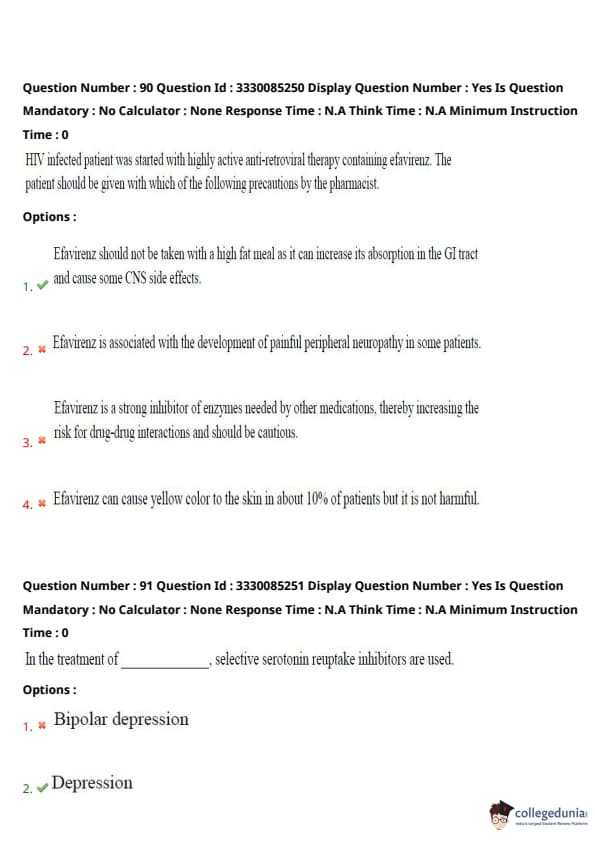
Question 90:
HIV infected patient was started with highly active anti-retroviral therapy containing efavirenz. The patient should be given with which of the following precautions by the pharmacist.
- (A) \( Efavirenz should not be taken with a high fat meal as it can increase its absorption in the GI tract and cause some CNS side effects. \)
- (B) \( Efavirenz is associated with the development of painful peripheral neuropathy in some patients. \)
- (C) \( Efavirenz is a strong inhibitor of enzymes needed by other medications, thereby increasing the risk for drug-drug interactions and should be cautious. \)
- (D) \( Efavirenz can cause yellow color to the skin in about 10% of patients but it is not harmful. \)
Question 91:
In the treatment of \(\hspace{2cm}\) selective serotonin reuptake inhibitors are used.
- (A) \( Bipolar depression \)
- (B) \( Depression \)
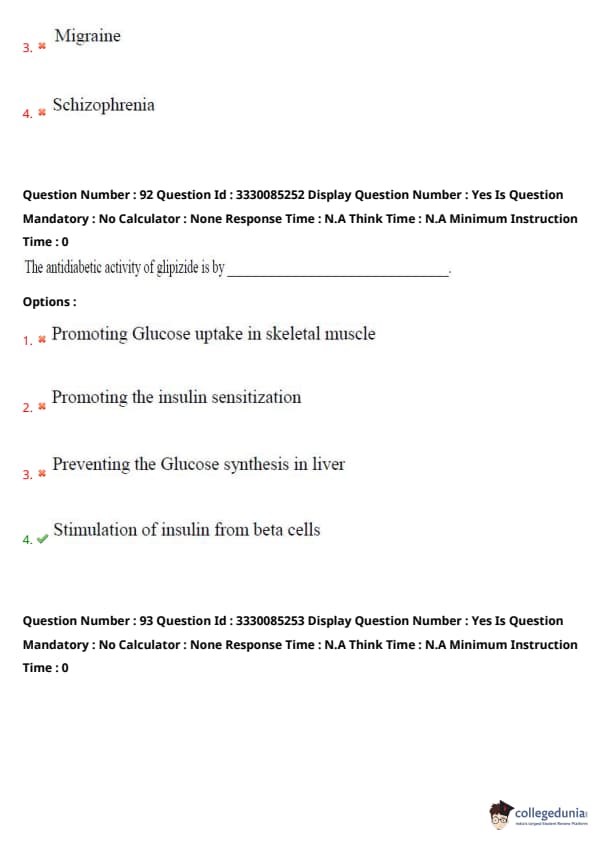
- (C) \( Migraine \)
- (D) \( Schizophrenia \)
Question 92:
The antidiabetic activity of glipizide is by \(\hspace{2cm}\)
- (A) \( Promoting Glucose uptake in skeletal muscle \)
- (B) \( Promoting the insulin sensitization \)
- (C) \( Preventing the Glucose synthesis in liver \)
- (D) \( Stimulation of insulin from beta cells \)
Question 93:
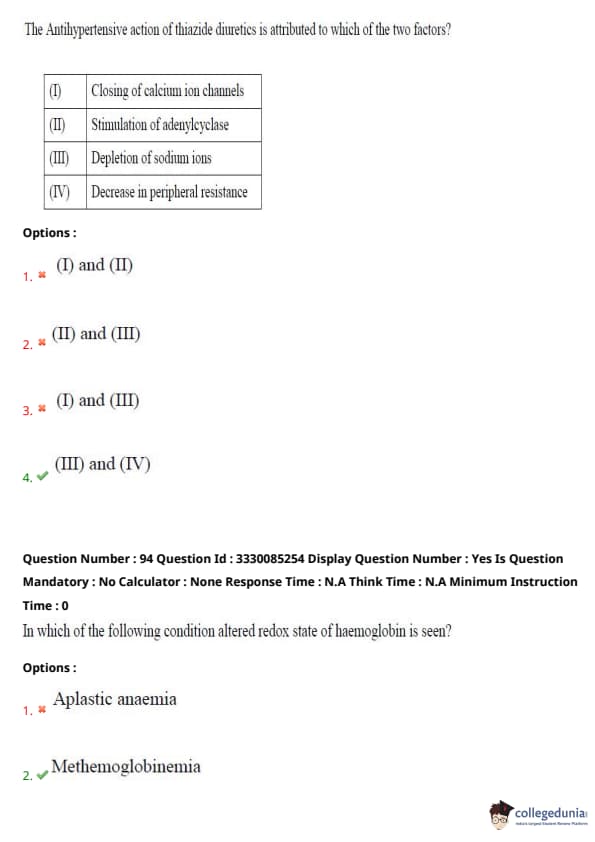
The Antihypertensive action of thiazide diuretics is attributed to which of the two factors?
Closing of calcium ion channels
Stimulation of adenylyl cyclase
Depletion of sodium ions
Decrease in peripheral resistance
- (A) \( (I) and (II) \)
- (B) \( (II) and (III) \)
- (C) \( (I) and (III) \)
- (D) \( (III) and (IV) \)
Question 94:
In which of the following condition altered redox state of haemoglobin is seen?
- (A) \( Aplastic anaemia \)
- (B) \( Methemoglobinemia \)
- (C) \( Sideroblastic anaemia \)
- (D) \( Megaloblastic anaemia \)
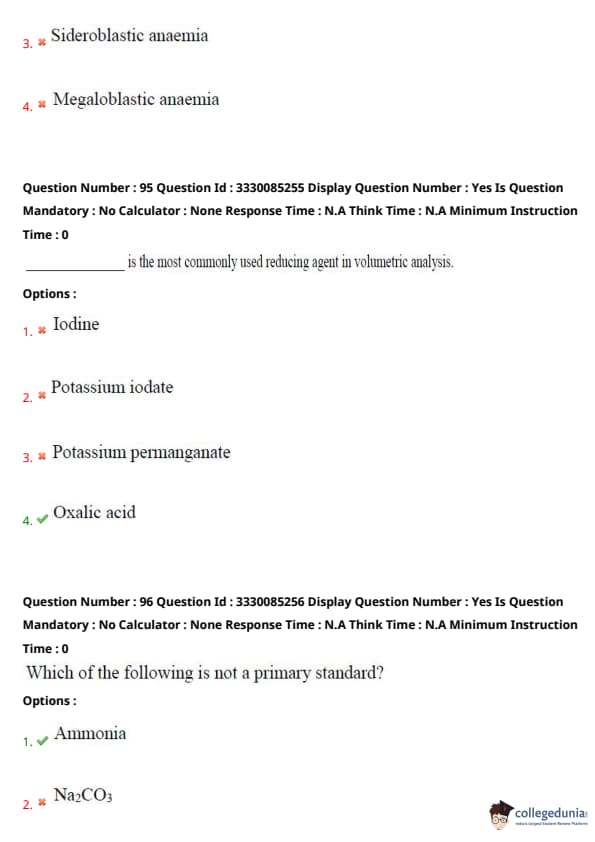
Question 95:
\(\hspace{2cm}\) is the most commonly used reducing agent in volumetric analysis.
- (A) \( Iodine \)
- (B) \( Potassium iodate \)
- (C) \( Potassium permanganate \)
- (D) \( Oxalic acid \)
Question 96:
Which of the following is not a primary standard?
- (A) \( Ammonia \)
- (B) \( Na_2CO_3 \)
- (C) \( Potassium hydrogen phthalate \)
- (D) \( Sodium oxalate \)
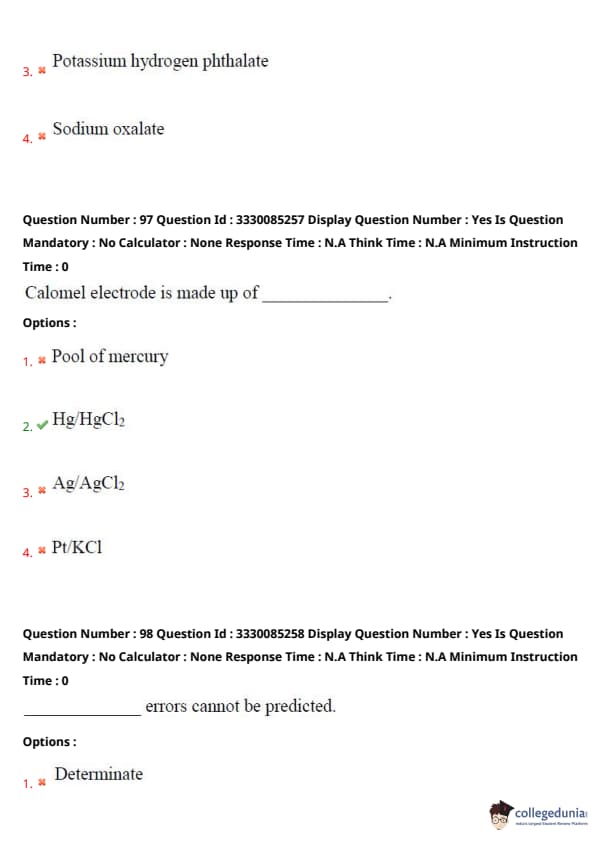
Question 97:
Calomel electrode is made up of \(\hspace{2cm}\)
- (A) \( Pool of mercury \)
- (B) \( Hg/Hg_2Cl_2 \)
- (C) \( Ag/AgCl_2 \)
- (D) \( Pt/KCl \)
Question 98:
\(\hspace{2cm}\) errors cannot be predicted.
- (A) \( Determinate \)
- (B) \( Operational \)
- (C) \( Methodological \)
- (D) \( Indeterminate \)
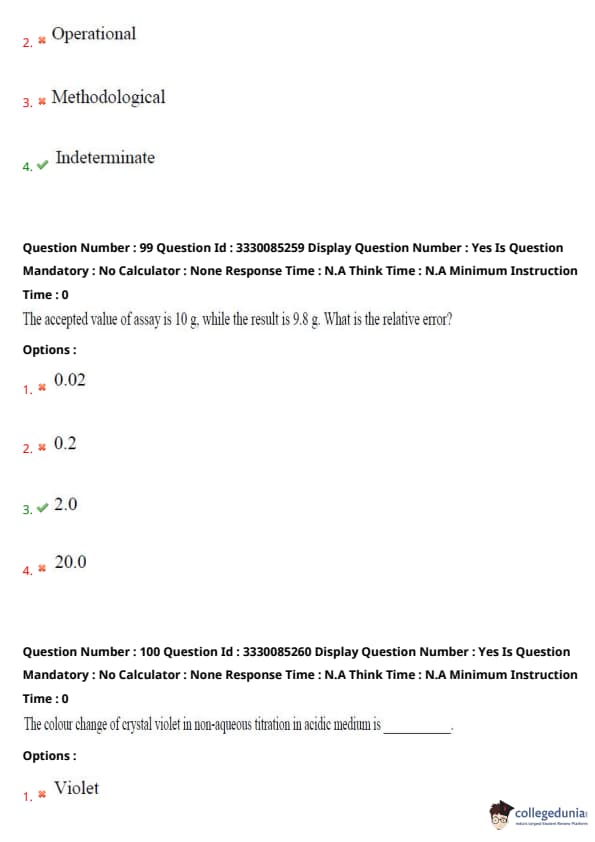
Question 99:
The accepted value of assay is 10 g, while the result is 9.8 g. What is the relative error?
- (A) \( 0.02 \)
- (B) \( 0.2 \)
- (C) \( 2.0 \)
- (D) \( 20.0 \)
Question 100:
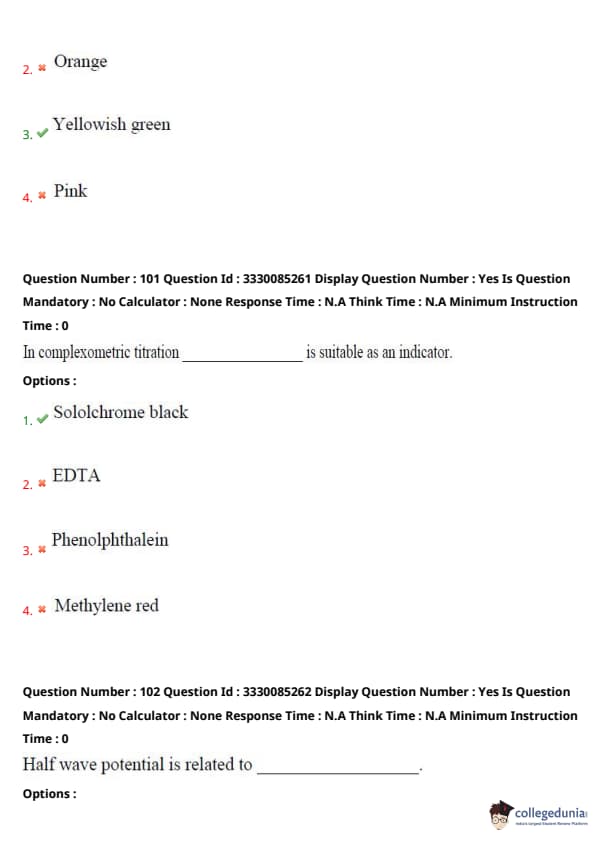
The colour change of crystal violet in non-aqueous titration in acidic medium is \(\hspace{2cm}\)
- (A) \( Violet \)
- (B) \( Orange \)
- (C) \( Yellowish green \)
- (D) \( Pink \)
Question 101:
In complexometric titration \(\hspace{2cm}\) is suitable as an indicator.
- (A) \( Solochrome black \)
- (B) \( EDTA \)
- (C) \( Phenolphthalein \)
- (D) \( Methylene red \)
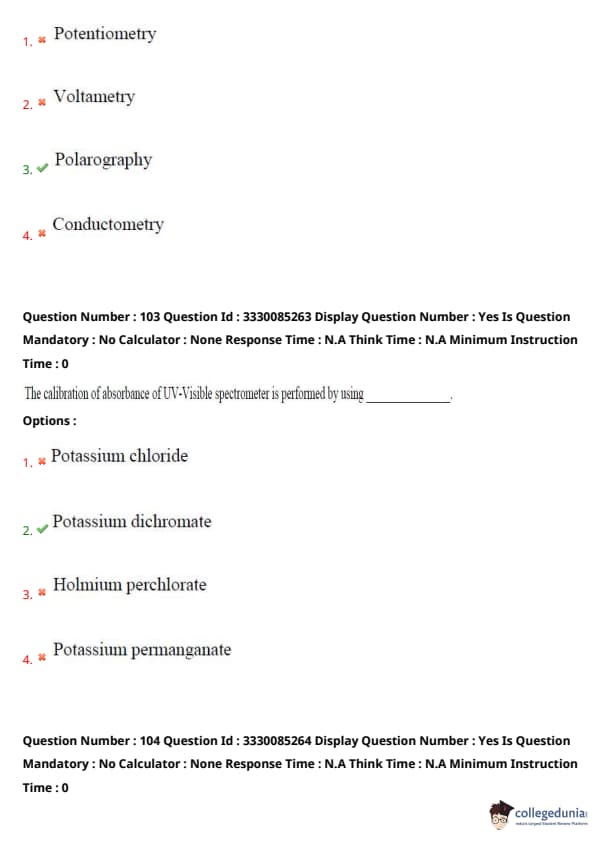
Question 102:
Half wave potential is related to \(\hspace{2cm}\)
- (A) \( Potentiometry \)
- (B) \( Voltammetry \)
- (C) \( Polarography \)
- (D) \( Conductometry \)
Question 103:
The calibration of absorbance of UV-Visible spectrometer is performed by using \(\hspace{2cm}\)
- (A) \( Potassium chloride \)
- (B) \( Potassium dichromate \)
- (C) \( Holmium perchlorate \)
- (D) \( Potassium permanganate \)
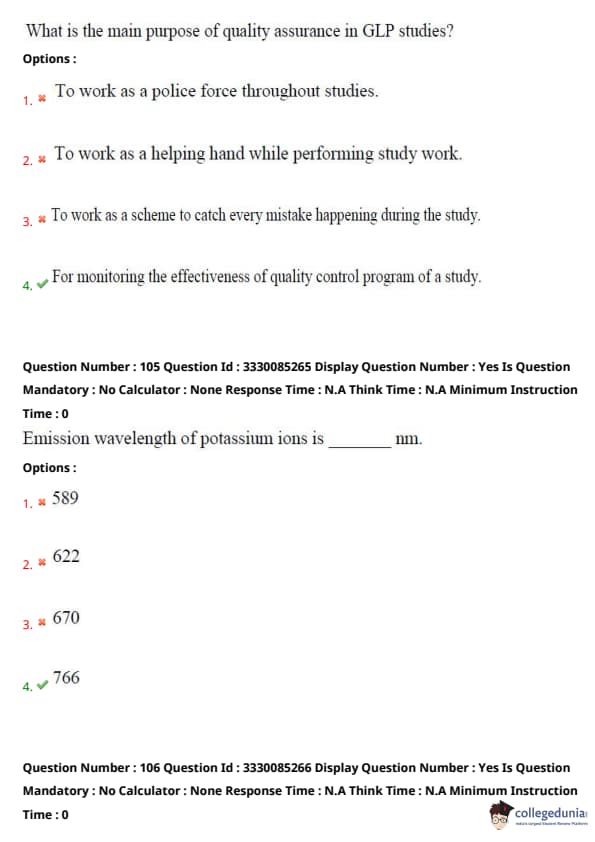
Question 104:
What is the main purpose of quality assurance in GLP studies?
- (A) \( To work as a police force throughout studies. \)
- (B) \( To work as a helping hand while performing study work. \)
- (C) \( To work as a scheme to catch every mistake happening during the study. \)
- (D) \( For monitoring the effectiveness of quality control program of a study. \)
Question 105:
Emission wavelength of potassium ions is \(\hspace{2cm}\) nm.
- (A) \( 589 \)
- (B) \( 622 \)
- (C) \( 670 \)
- (D) \( 766 \)
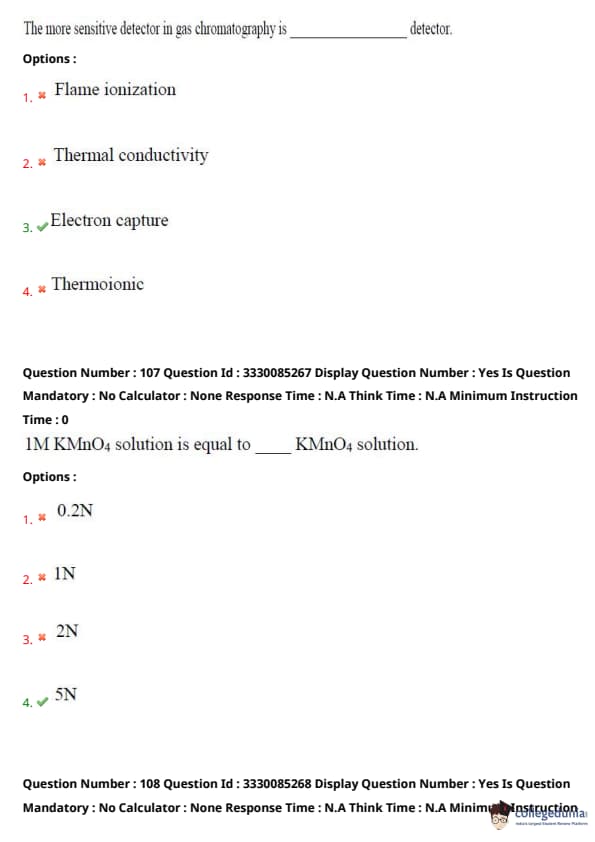
Question 106:
The more sensitive detector in gas chromatography is \(\hspace{2cm}\) detector.
- (A) \( Flame ionization \)
- (B) \( Thermal conductivity \)
- (C) \( Electron capture \)
- (D) \( Thermoionic \)
Question 107:
1M \( KMnO_4 \) solution is equal to \(\hspace{2cm}\) N \( KMnO_4 \) solution.
- (A) \( 0.2 N \)
- (B) \( 1 N \)
- (C) \( 2 N \)
- (D) \( 5 N \)
Question 108:
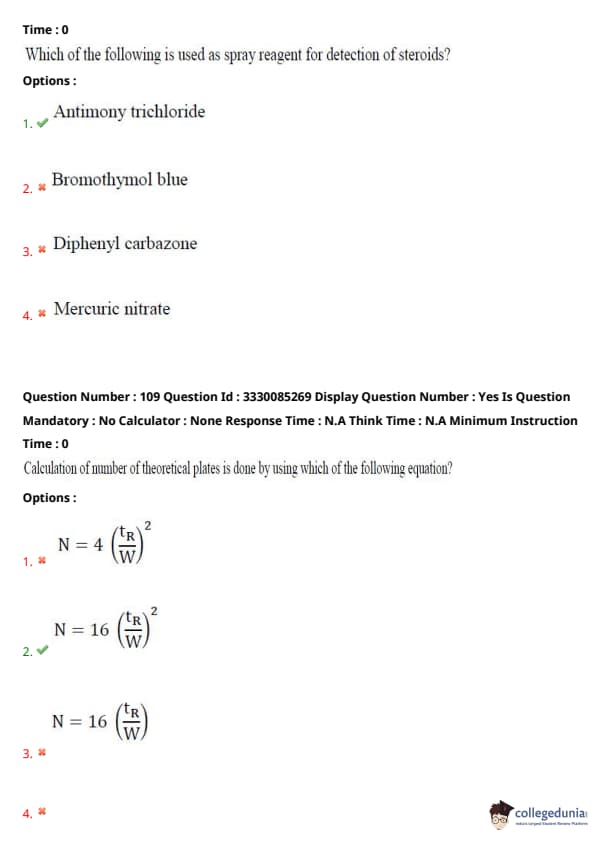
Which of the following is used as spray reagent for detection of steroids?
- (A) \( Antimony trichloride \)
- (B) \( Bromothymol blue \)
- (C) \( Diphenyl carbazone \)
- (D) \( Mercuric nitrate \)
Question 109:
Calculation of number of theoretical plates is done by using which of the following equation?
- (A) \( N = 4 \left( \frac{t_R}{W} \right)^2 \)
- (B) \( N = 16 \left( \frac{t_R}{W} \right)^2 \)
- (C) \( N = 16 \left( \frac{t_R}{W} \right) \)
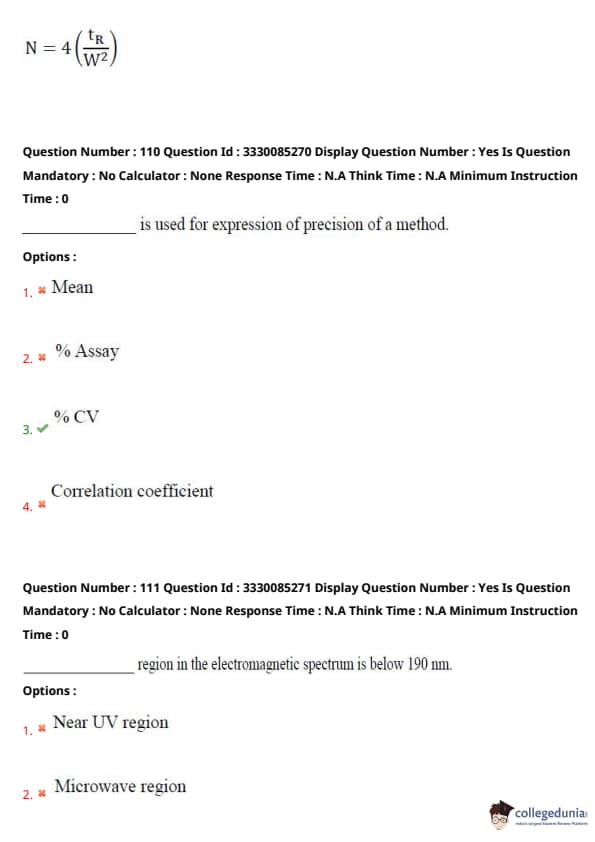
- (D) \( N = 4 \left( \frac{t_R}{W^2} \right) \)
Question 110:
\(\hspace{2cm}\) is used for expression of precision of a method.
- (A) \( Mean \)
- (B) \( % Assay \)
- (C) \( % CV \)
- (D) \( Correlation coefficient \)
Question 111:
\(\hspace{2cm}\) region in the electromagnetic spectrum is below 190 nm.
- (A) \( Near UV region \)
- (B) \( Microwave region \)
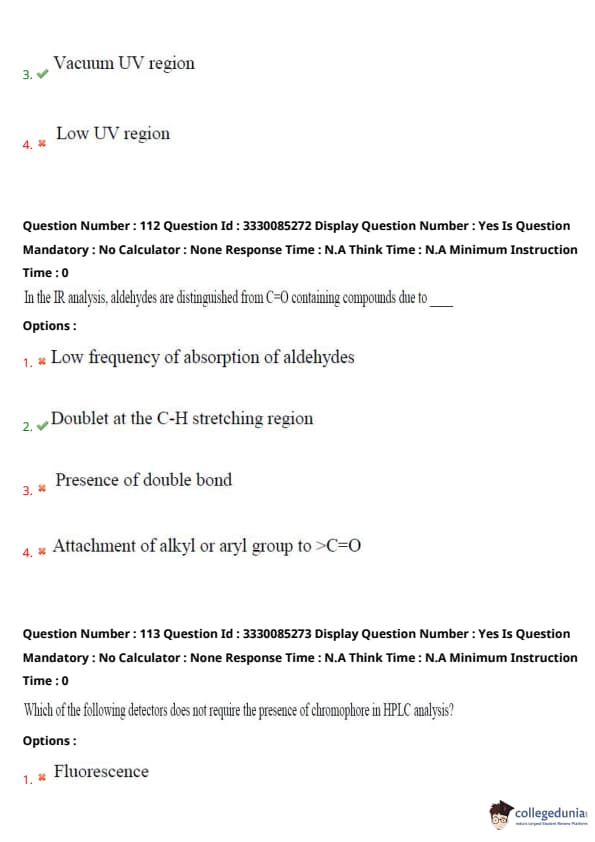
- (C) \( Vacuum UV region \)
- (D) \( Low UV region \)
Question 112:
In the IR analysis, aldehydes are distinguished from C=O containing compounds due to \(\hspace{2cm}\)
- (A) \( Low frequency of absorption of aldehydes \)
- (B) \( Doublet at the C-H stretching region \)
- (C) \( Presence of double bond \)
- (D) \( Attachment of alkyl or aryl group to >C=O \)
Question 113:
Which of the following detectors does not require the presence of chromophore in HPLC analysis?
- (A) \( Fluorescence \)
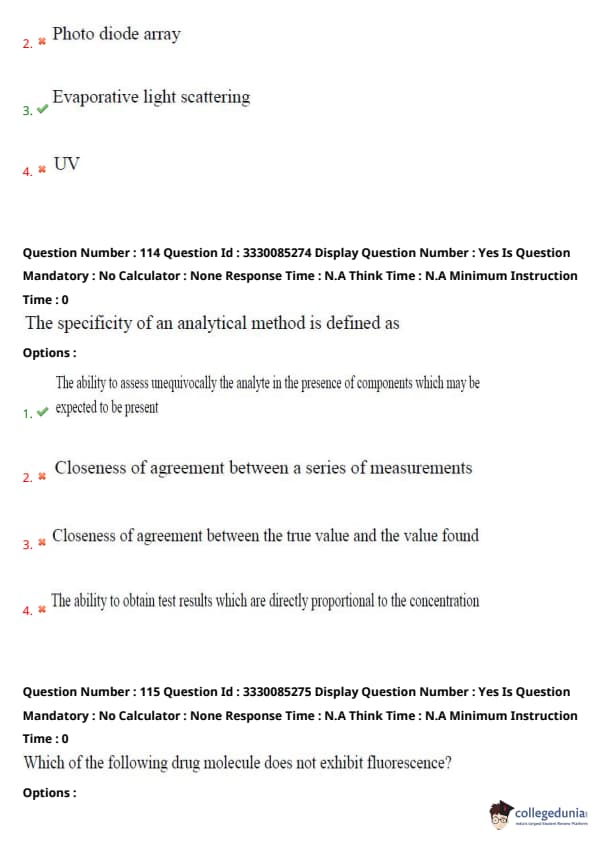
- (B) \( Photo diode array \)
- (C) \( Evaporative light scattering \)
- (D) \( UV \)
Question 114:
The specificity of an analytical method is defined as \(\hspace{2cm}\)
- (A) \( The ability to assess unequivocally the analyte in the presence of components which may be expected to be present \)
- (B) \( Closeness of agreement between a series of measurements \)
- (C) \( Closeness of agreement between the true value and the value found \)
- (D) \( The ability to obtain test results which are directly proportional to the concentration \)
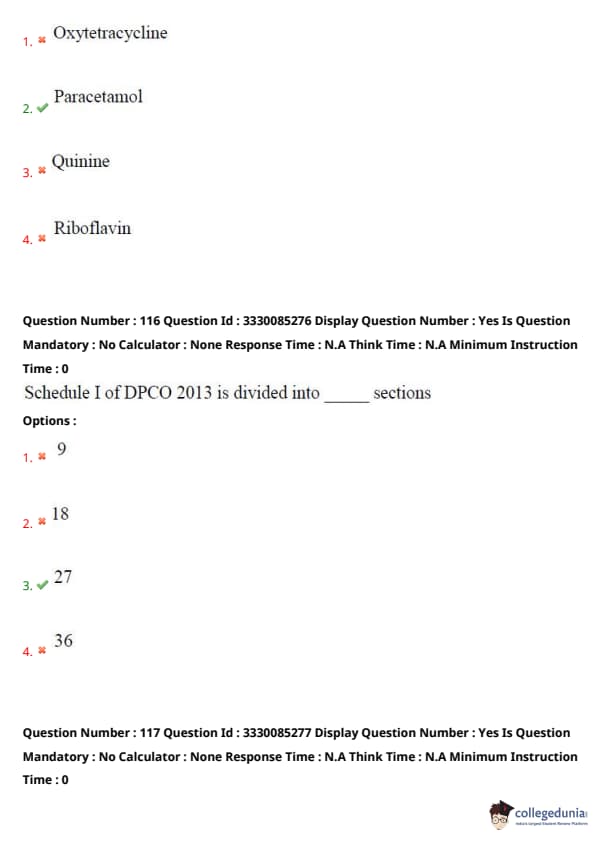
Question 115:
Which of the following drug molecule does not exhibit fluorescence?
- (A) \( Oxytetracycline \)
- (B) \( Paracetamol \)
- (C) \( Quinine \)
- (D) \( Riboflavin \)
Question 116:
Schedule I of DPCO 2013 is divided into \(\hspace{2cm}\) sections
- (A) \( 9 \)
- (B) \( 18 \)
- (C) \( 27 \)
- (D) \( 36 \)
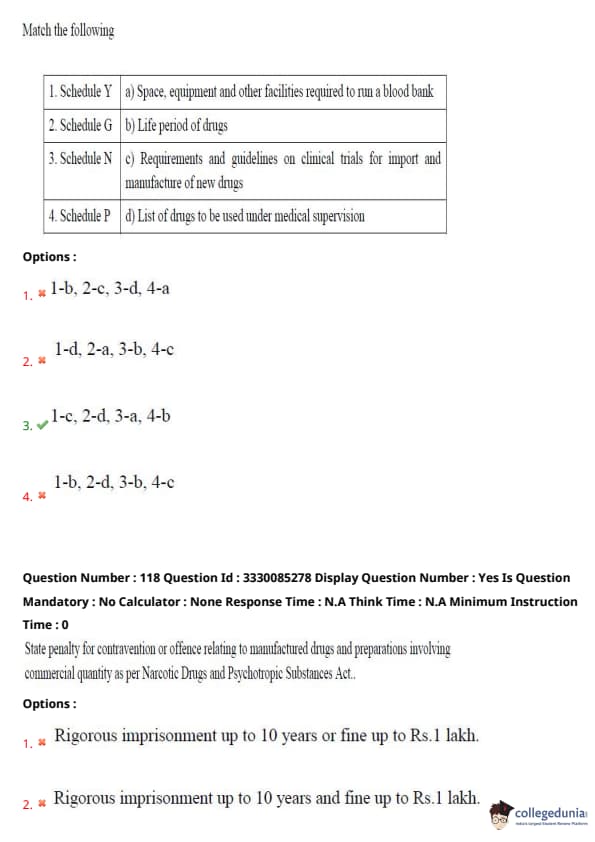
Question 117:
Match the following:
Schedule Y
Schedule G
Schedule N
Schedule P
Space, equipment and other facilities required to run a blood bank
Life period of drugs
Requirements and guidelines on clinical trials for import and manufacture of new drugs
List of drugs to be used under medical supervision
- (A) \( 1-b, 2-c, 3-d, 4-a \)
- (B) \( 1-d, 2-a, 3-b, 4-c \)
- (C) \( 1-c, 2-d, 3-a, 4-b \)
- (D) \( 1-b, 2-d, 3-b, 4-c \)
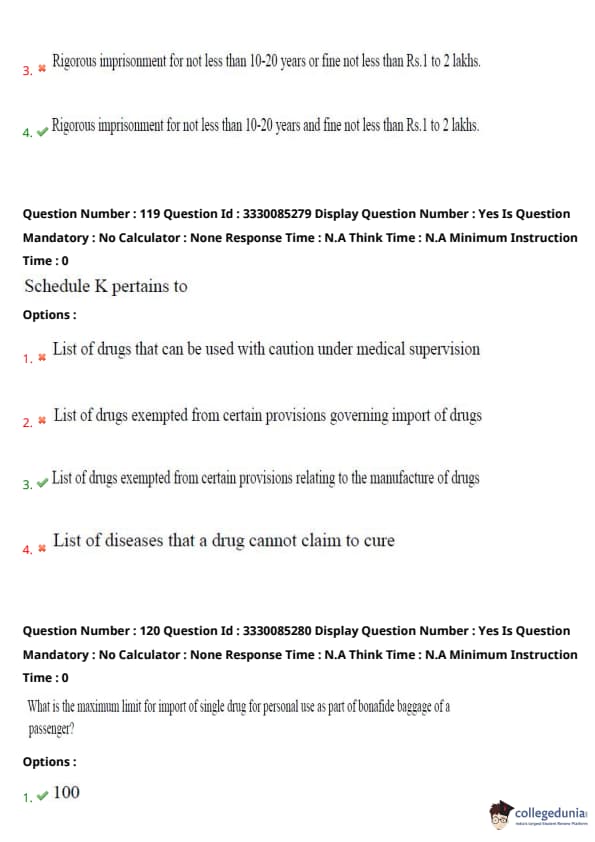
Question 118:
State penalty for contravention or offence relating to manufactured drugs and preparations involving commercial quantity as per Narcotic Drugs and Psychotropic Substances Act.
- (A) \( Rigorous imprisonment up to 10 years and fine up to Rs.1 lakh. \)
- (B) \( Rigorous imprisonment up to 10 years and fine up to Rs.1 lakh. \)
- (C) \( Rigorous imprisonment for not less than 10-20 years or fine not less than Rs.1 to 2 lakhs. \)
- (D) \( Rigorous imprisonment for not less than 10-20 years and fine not less than Rs.1 to 2 lakhs. \)
Question 119:
Schedule K pertains to \(\hspace{2cm}\)
- (A) \( List of drugs that can be used with caution under medical supervision \)
- (B) \( List of drugs exempted from certain provisions governing import of drugs \)
- (C) \( List of drugs exempted from certain provisions relating to the manufacture of drugs \)
- (D) \( List of diseases that a drug cannot claim to cure \)
Question 120:
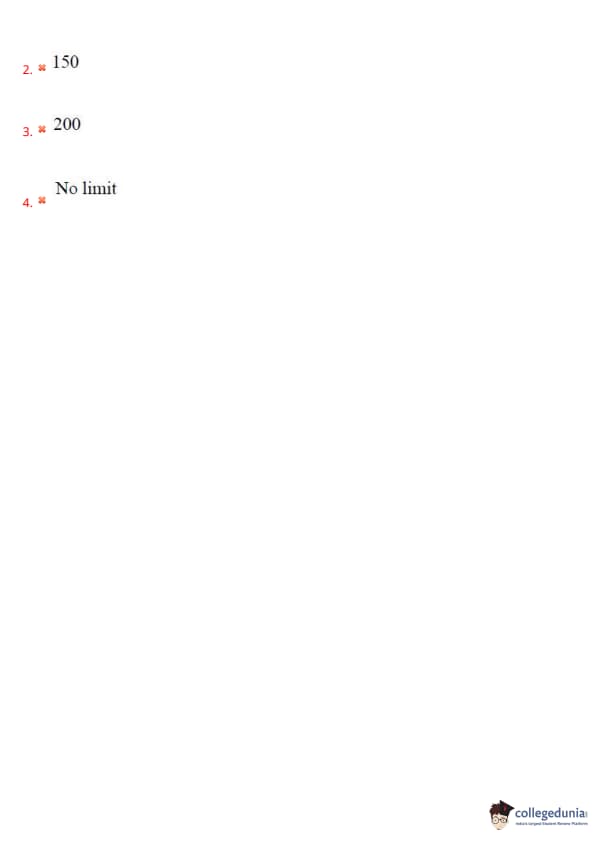
What is the maximum limit for import of single drug for personal use as part of bonafide baggage of a passenger?
- (A) \( 100 \)
- (B) \( 150 \)
- (C) \( 200 \)
- (D) \( No limit \)





 Download



Comments