AP PGECET Question Paper 2025 for Instrumentation Engineering is available for download here with answer key and solution PDF. AP PGECET 2025 was conducted from June 6 to June 8 in two shifts.
AP PGECET Question Paper 2025 consists of 120 MCQ-based questions in total carrying 1 mark each to be attempted in the duration of 2 hours.

AP PGECET Instrumentation Engineering Question Paper

AP PGECET​​ Question Paper 2025 with Solution PDF
Download PDF Check Solution
AP PGECET Instrumentation Engineering Question Paper

Question 1:

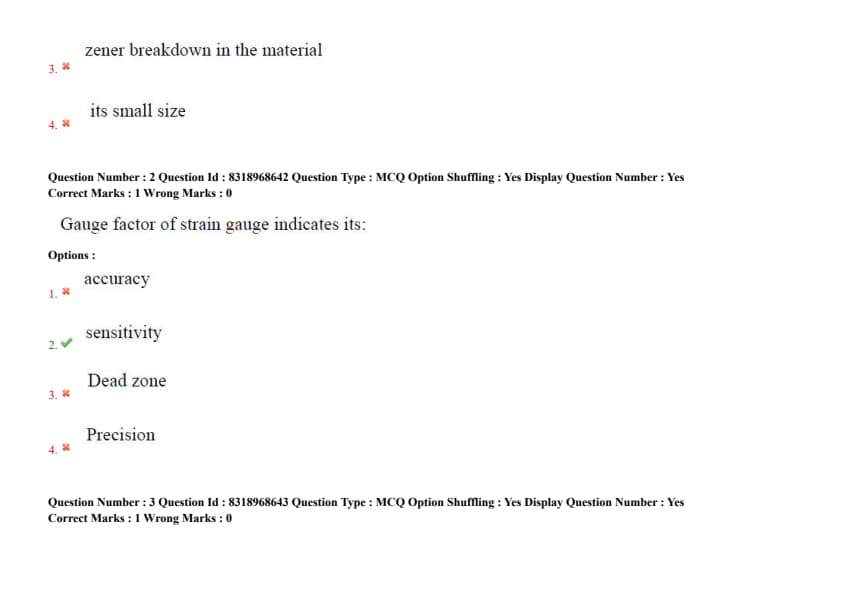
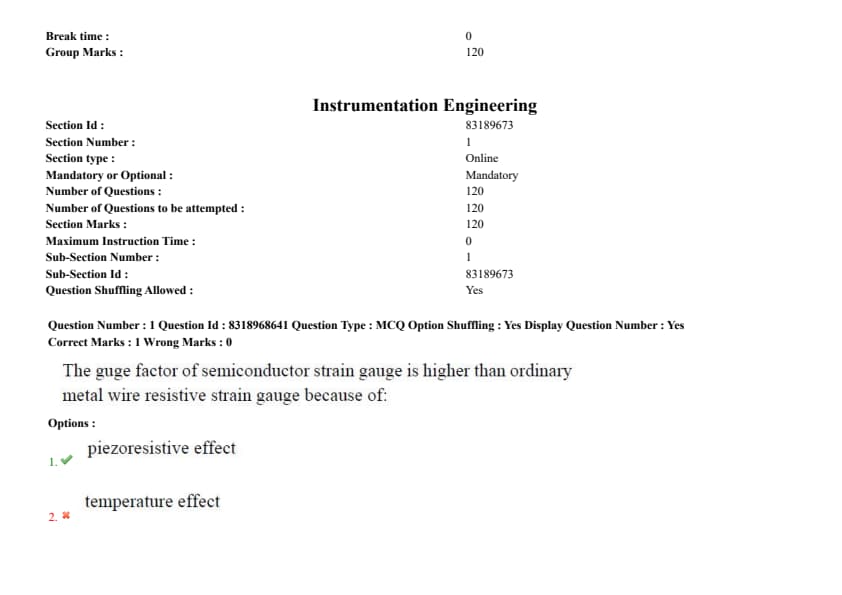
The gauge factor of semiconductor strain gauge is higher than ordinary metal wire resistive strain gauge because of:

  • (1) piezoresistive effect
  • (2) temperature effect
  • (3) zener breakdown in the material
  • (4) its small size

Question 2:

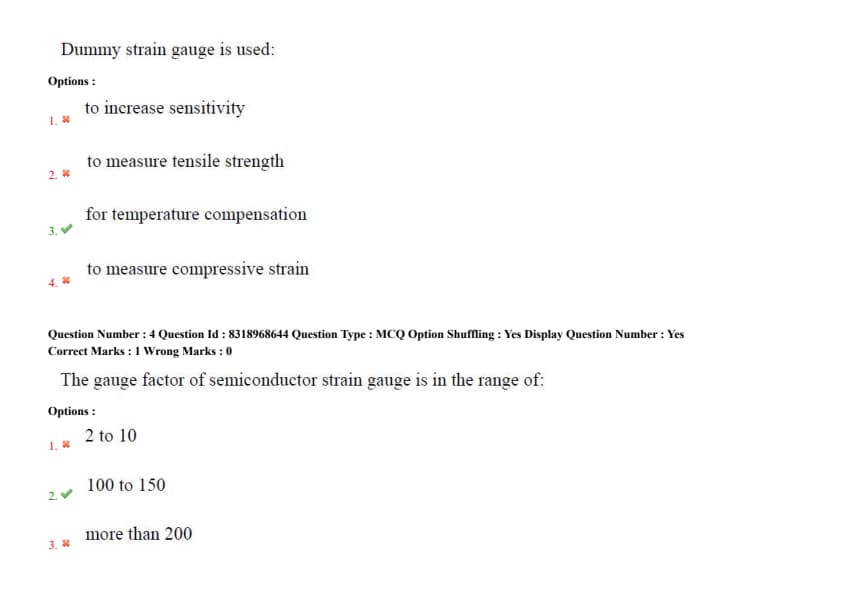
Gauge factor of strain gauge indicates its:

  • (1) accuracy
  • (2) sensitivity
  • (3) Dead zone
  • (4) Precision

Question 3:

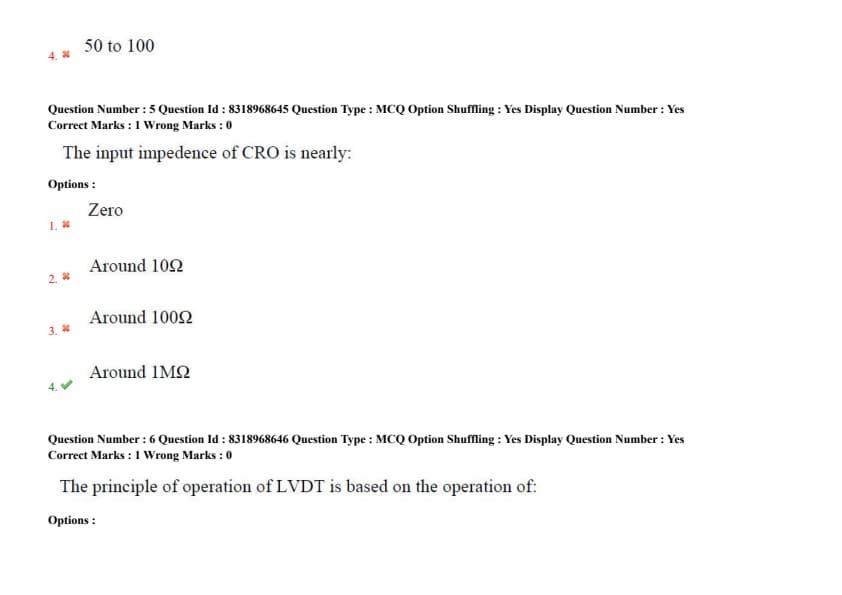
Dummy strain gauge is used:

  • (1) to increase sensitivity
  • (2) to measure tensile strength
  • (3) for temperature compensation
  • (4) to measure compressive strain

Question 4:

The gauge factor of semiconductor strain gauge is in the range of:

  • (1) 2 to 10
  • (2) 100 to 150
  • (3) more than 200
  • (4) 50 to 100

Question 5:

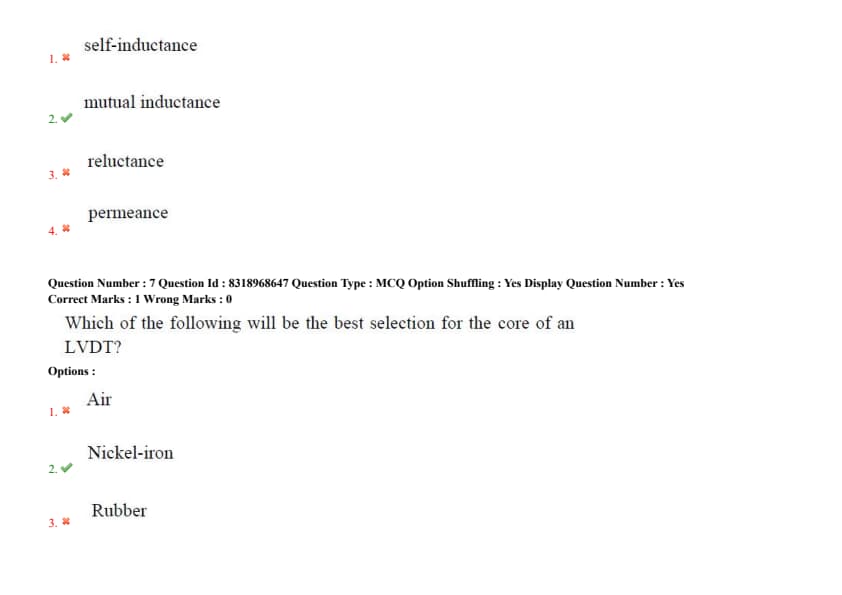
The input impedance of CRO is nearly:

  • (1) Zero
  • (2) Around 10\(\Omega\)
  • (3) Around 100\(\Omega\)
  • (4) Around 1M\(\Omega\)

Question 6:

The principle of operation of LVDT is based on the operation of:

  • (1) self-inductance
  • (2) mutual inductance
  • (3) reluctance
  • (4) permeance

Question 7:

Which of the following will be the best selection for the core of an LVDT?

  • (1) Air
  • (2) Nickel-iron
  • (3) Rubber
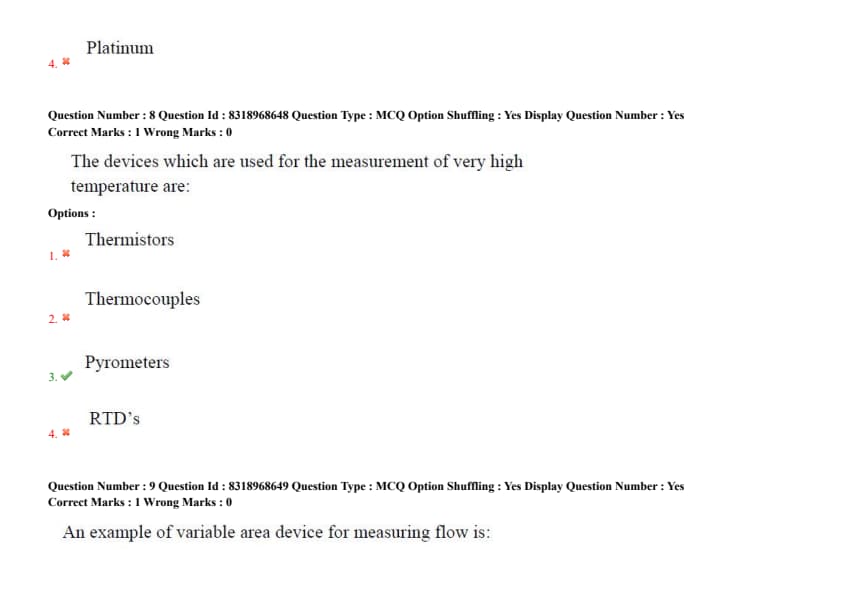
  • (4) Platinum

Question 8:

The devices which are used for the measurement of very high temperature are:

  • (1) Thermistors
  • (2) Thermocouples
  • (3) Pyrometers
  • (4) RTD's

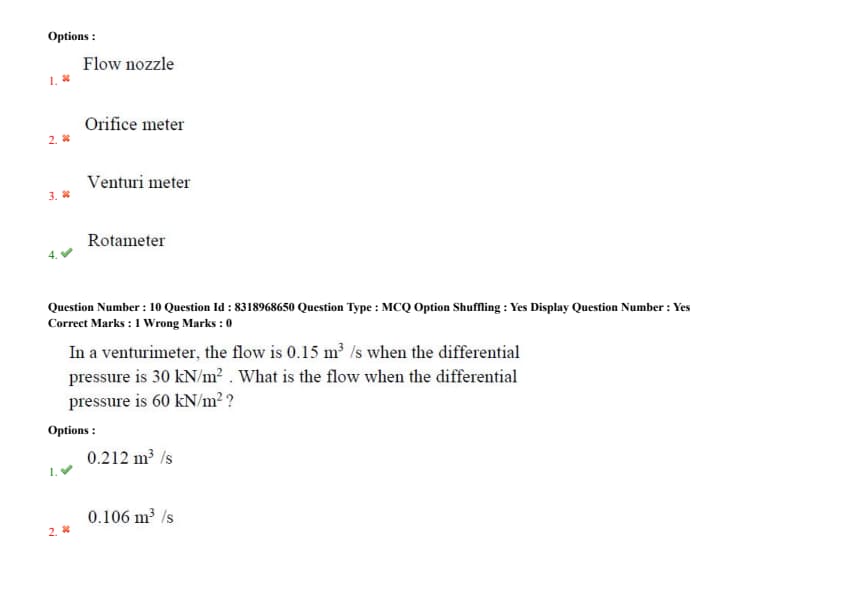
Question 9:

An example of variable area device for measuring flow is:

  • (1) Flow nozzle
  • (2) Orifice meter
  • (3) Venturi meter
  • (4) Rotameter

Question 10:

In a venturimeter, the flow is 0.15 m\(^3\)/s when the differential pressure is 30 kN/m\(^2\). What is the flow when the differential pressure is 60 kN/m\(^2\)?

  • (1) 0.212 m\(^3\)/s
  • (2) 0.106 m\(^3\)/s
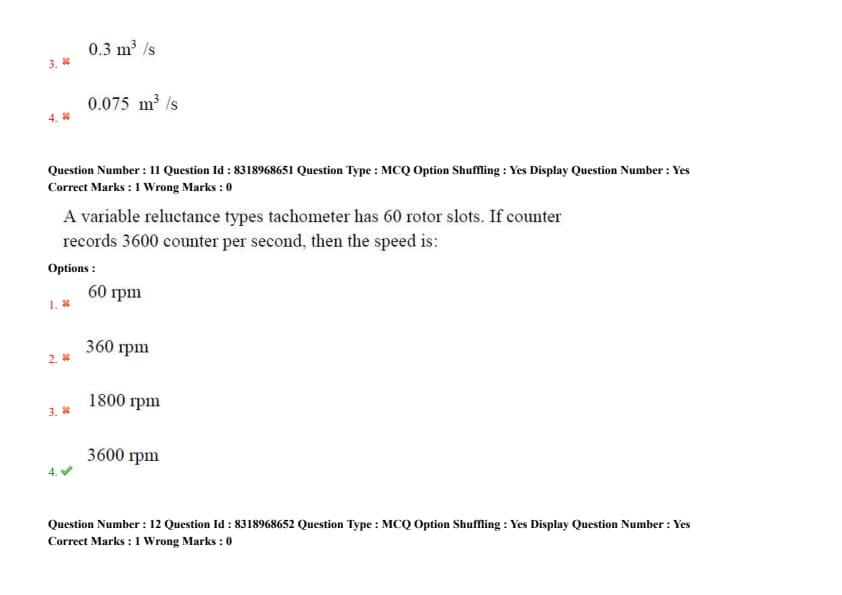
  • (3) 0.3 m\(^3\)/s
  • (4) 0.075 m\(^3\)/s

Question 11:

A variable reluctance type tachometer has 60 rotor slots. If the counter records 3600 counts per second, then the speed is:

  • (1) 60 rpm
  • (2) 360 rpm
  • (3) 1800 rpm
  • (4) 3600 rpm

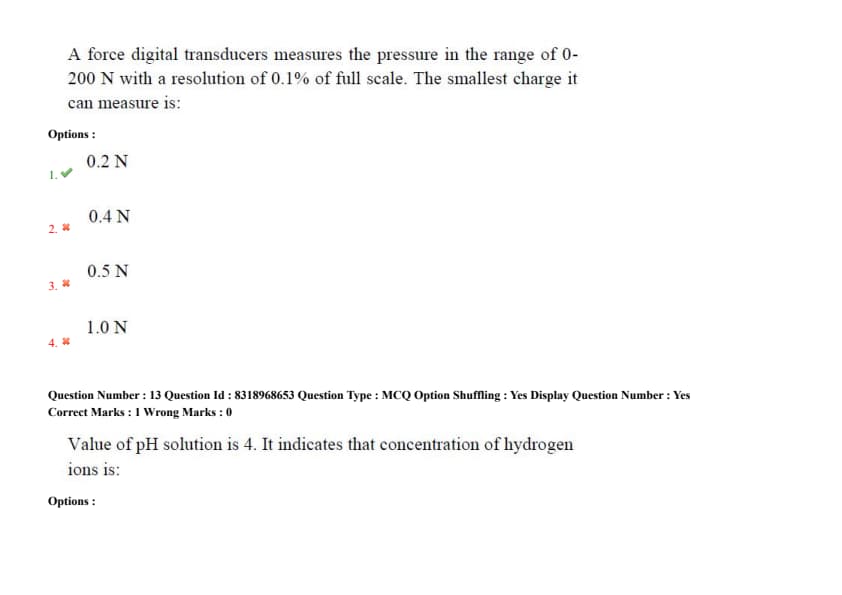
Question 12:

A force digital transducer measures the pressure in the range of 0-200 N with a resolution of 0.1% of full scale. The smallest charge it can measure is:

  • (1) 0.2 N
  • (2) 0.4 N
  • (3) 0.5 N
  • (4) 1.0 N

Question 13:

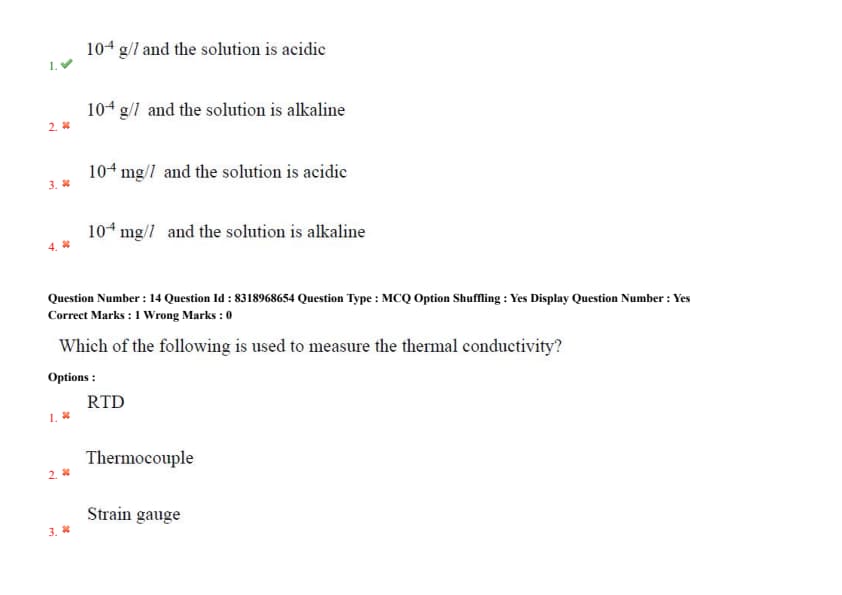
Value of pH solution is 4. It indicates that the concentration of hydrogen ions is:

  • (1) \(10^{-4}\) g/l and the solution is acidic
  • (2) \(10^{-4}\) g/l and the solution is alkaline
  • (3) \(10^{-4}\) mg/l and the solution is acidic
  • (4) \(10^{-4}\) mg/l and the solution is alkaline

Question 14:

Which of the following is used to measure the thermal conductivity?

  • (1) RTD
  • (2) Thermocouple
  • (3) Strain gauge
  • (4) Thermistor

Question 15:

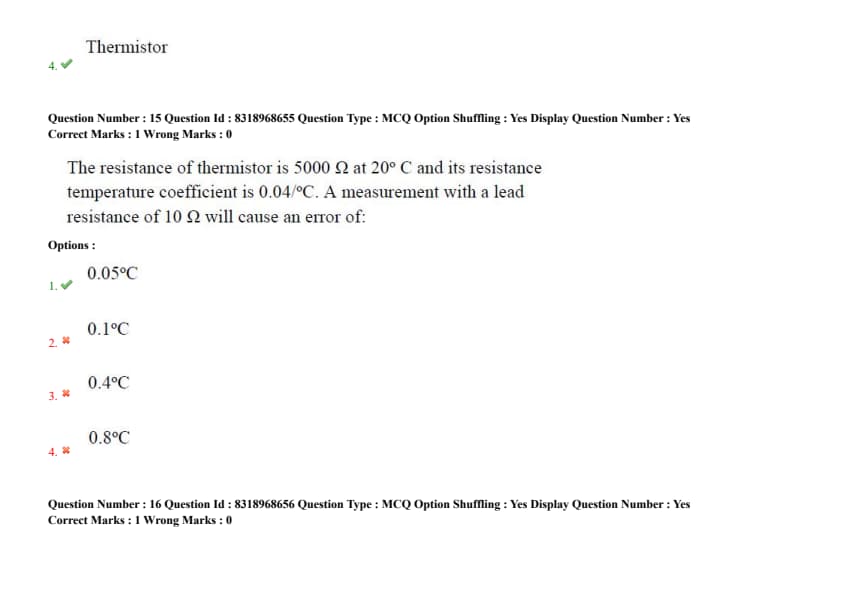
The resistance of the thermistor is 5000 \(\Omega\) at 20°C and its resistance temperature coefficient is 0.04°C. A measurement with a lead resistance of 10 \(\Omega\) will cause an error of:

  • (1) 0.05°C
  • (2) 0.1°C
  • (3) 0.4°C
  • (4) 0.8°C

Question 16:

Which of the following is an inverse transducer?

  • (1) Piezoelectric
  • (2) Thermistor
  • (3) Photovoltaic cell
  • (4) LVDT

Question 17:

Psychrometer is used for the measurement of:

  • (1) pH
  • (2) Viscosity
  • (3) Conductivity
  • (4) Humidity

Question 18:

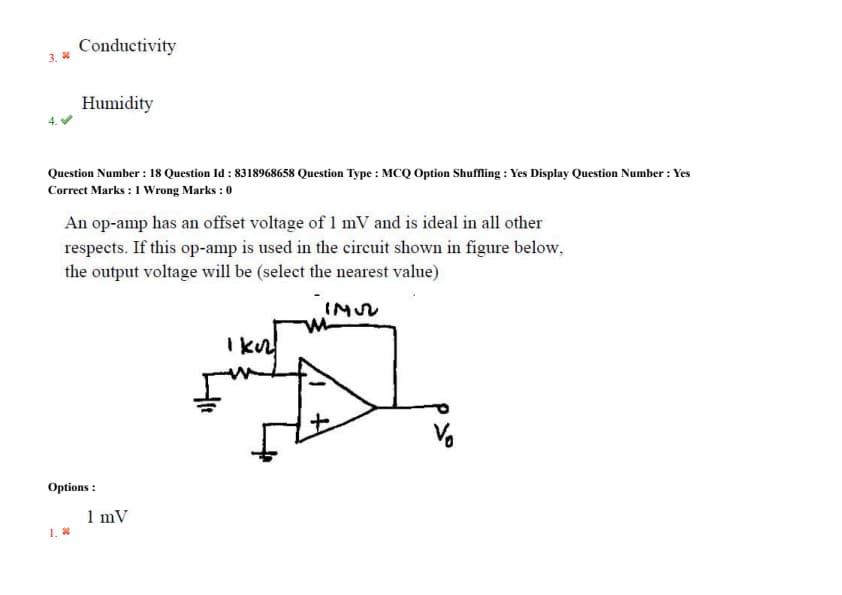
An op-amp has an offset voltage of 1 mV and is ideal in all other respects. If this op-amp is used in the circuit shown in figure below, the output voltage will be (select the nearest value):


  • (1) 1 mV
  • (2) 1 V
  • (3) \(\pm\)1 V
  • (4) \(\pm\)5 V

Question 19:

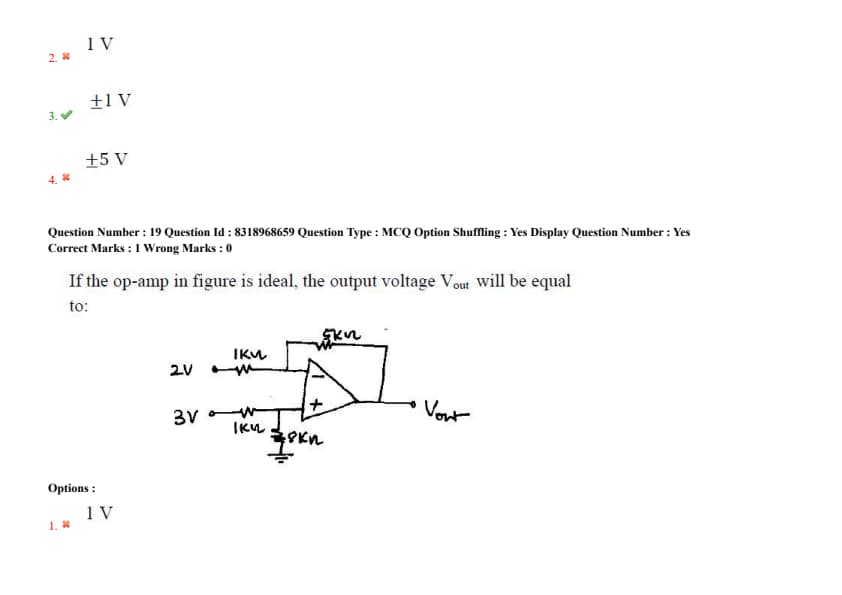
If the op-amp in figure is ideal, the output voltage \(V_{out}\) will be equal to:


  • (1) 1 V
  • (2) 6 V
  • (3) 14 V
  • (4) 17 V

Question 20:

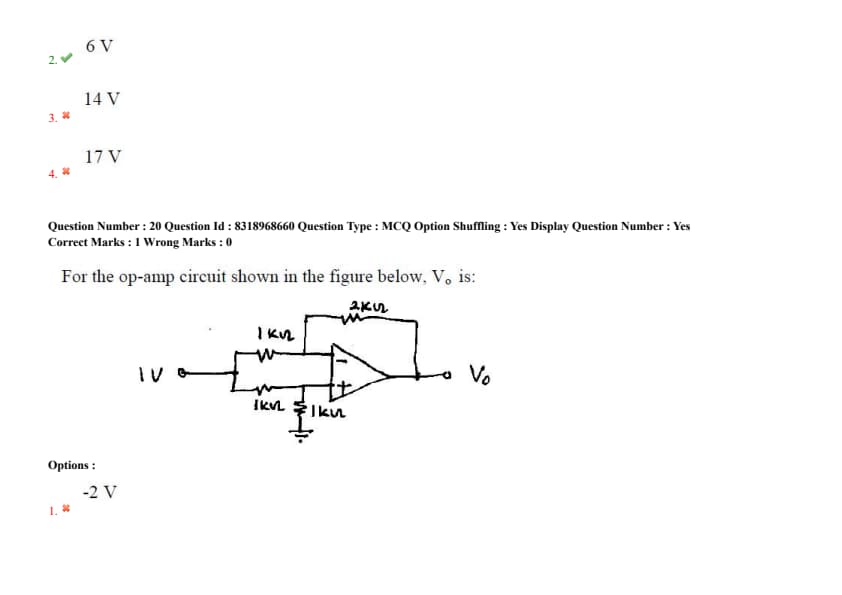
For the op-amp circuit shown in the figure below, \(V_o\) is:


  • (1) -2 V
  • (2) -1 V
  • (3) -0.5 V
  • (4) 0.5 V

Question 21:

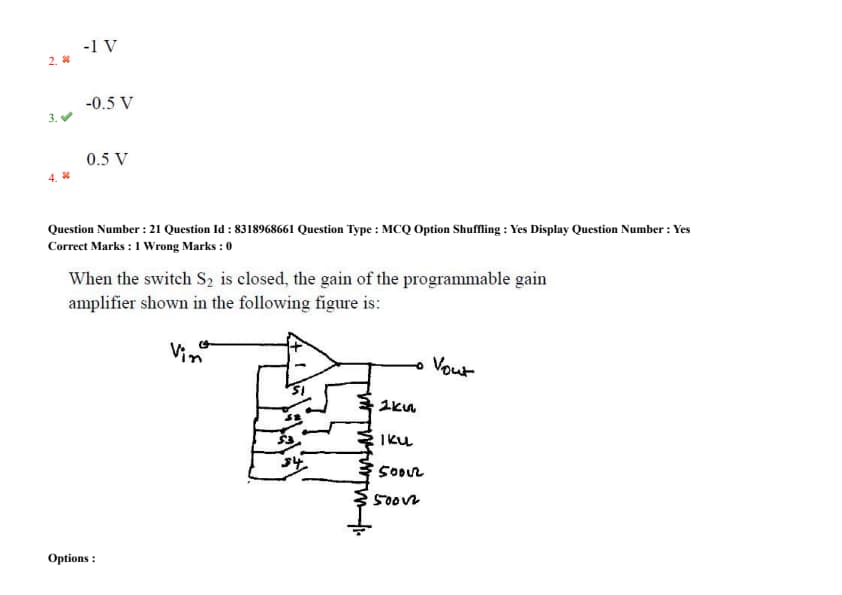
When the switch \(S_2\) is closed, the gain of the programmable gain amplifier shown in the following figure is:


  • (1) 0.5
  • (2) 2
  • (3) 4
  • (4) 8

Question 22:

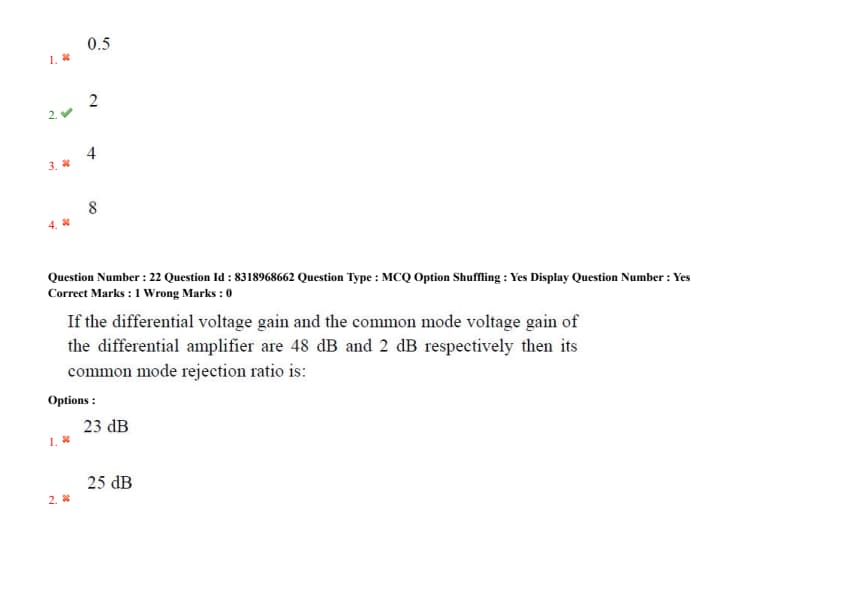
If the differential voltage gain and the common mode voltage gain of the differential amplifier are 48 dB and 2 dB respectively, then its common mode rejection ratio is:

  • (1) 23 dB
  • (2) 25 dB
  • (3) 46 dB
  • (4) 50 dB

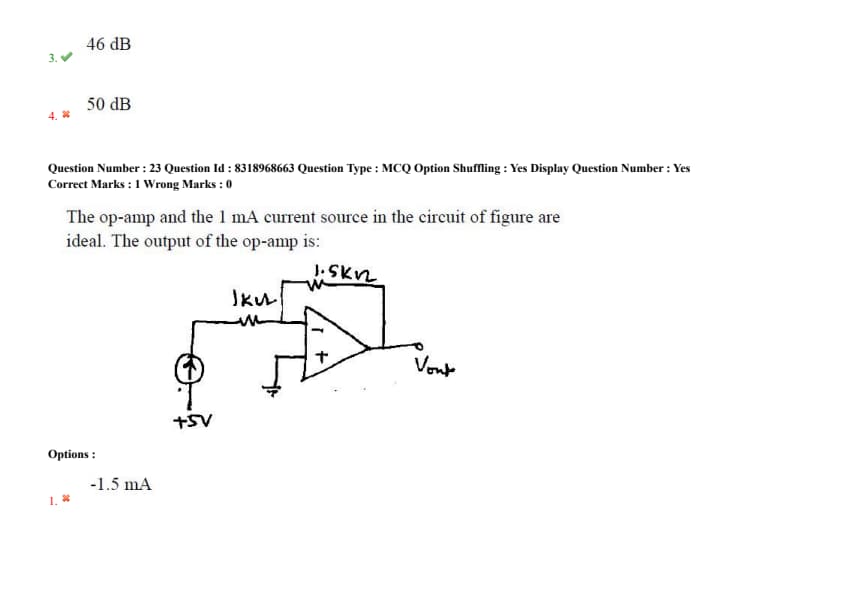
Question 23:

The op-amp and the 1 mA current source in the circuit of figure are ideal. The output of the op-amp is:


  • (1) -1.5 mA
  • (2) -1.5 V
  • (3) -7.5 V
  • (4) +1.5 V

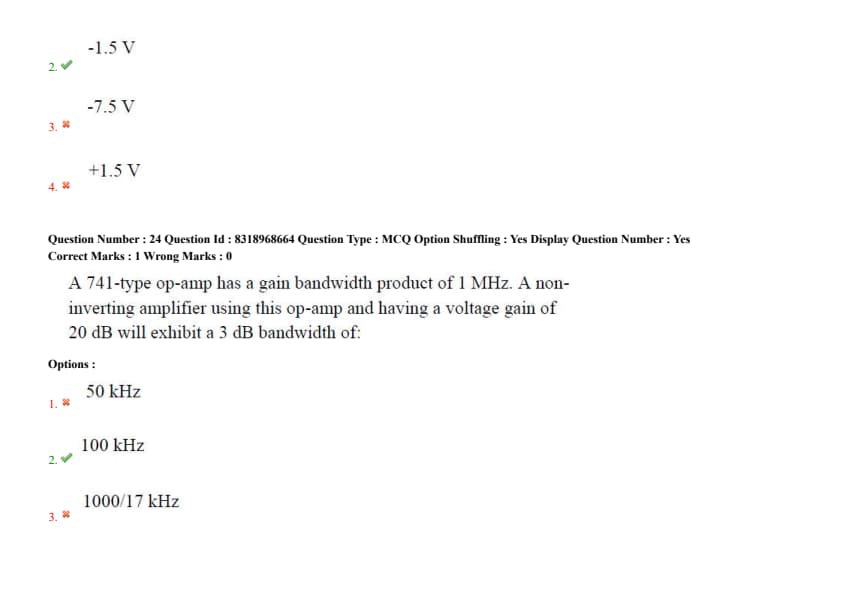
Question 24:

A 741-type op-amp has a gain bandwidth product of 1 MHz. A non-inverting amplifier using this op-amp and having a voltage gain of 20 dB will exhibit a 3 dB bandwidth of:

  • (1) 50 kHz
  • (2) 100 kHz
  • (3) \(\dfrac{1000}{17}\) kHz
  • (4) \(\dfrac{1000}{7.07}\) kHz

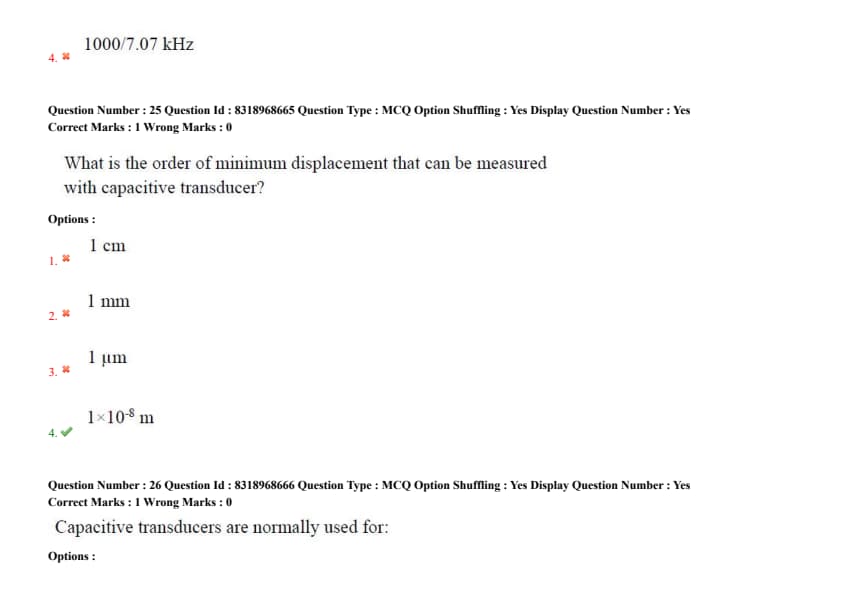
Question 25:

What is the order of minimum displacement that can be measured with a capacitive transducer?

  • (1) 1 cm
  • (2) 1 mm
  • (3) 1 \(\mu\)m
  • (4) \(1 \times 10^{-8}\) m

Question 26:

Capacitive transducers are normally used for:

  • (1) static measurement
  • (2) dynamic measurement
  • (3) both static and dynamic measurements
  • (4) transient measurement

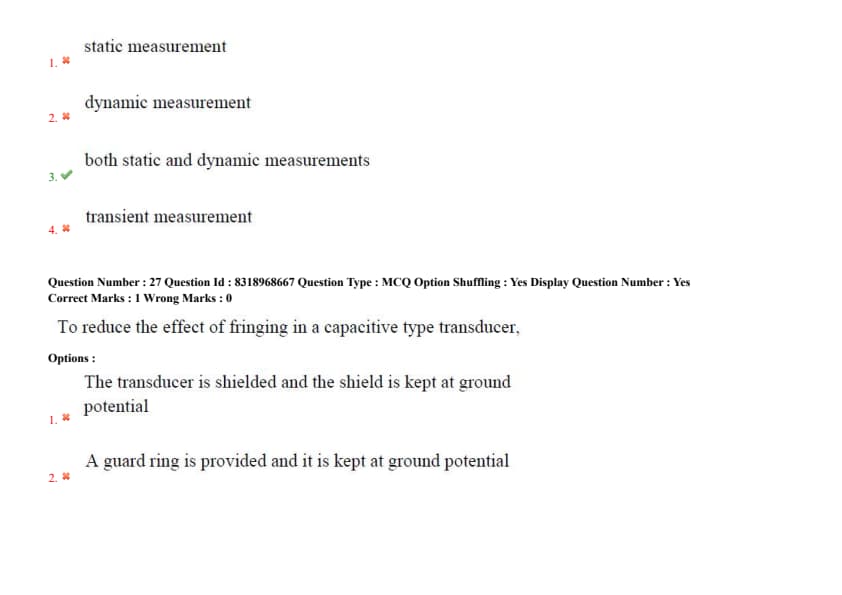
Question 27:

To reduce the effect of fringing in a capacitive type transducer,

  • (1) The transducer is shielded and the shield is kept at ground potential
  • (2) A guard ring is provided and it is kept at ground potential
  • (3) The transducer is shielded and the shield is kept at the same potential as the moving plate
  • (4) A guard ring is provided and it is kept at the same potential as the moving plate

Question 28:

Piezoelectric transducers are:

  • (1) passive transducers
  • (2) active transducers
  • (3) inverse transducers
  • (4) both active and inverse transducers

Question 29:

Piezoelectric crystals produce an EMF when:

  • (1) an external mechanical force is applied to it
  • (2) an external magnetic field is applied
  • (3) a radiant energy stimulates the crystal
  • (4) the junction of two such crystals is heated

Question 30:

The least suitable transducer for static pressure measurement is:

  • (1) semiconductor strain gauge
  • (2) variable capacitor transducer
  • (3) metal wire strain gauge
  • (4) piezoelectric transducer

Question 31:

A linear variable differential transformer (LVDT) is:

  • (1) an impedance matching transformer
  • (2) a displacement transducer
  • (3) a differential temperature sensor
  • (4) an auto transformer

Question 32:

A properly biased JFET will act as a:

  • (1) Current controlled current source
  • (2) Voltage controlled voltage source
  • (3) Voltage controlled current source
  • (4) Current controlled voltage source

Question 33:

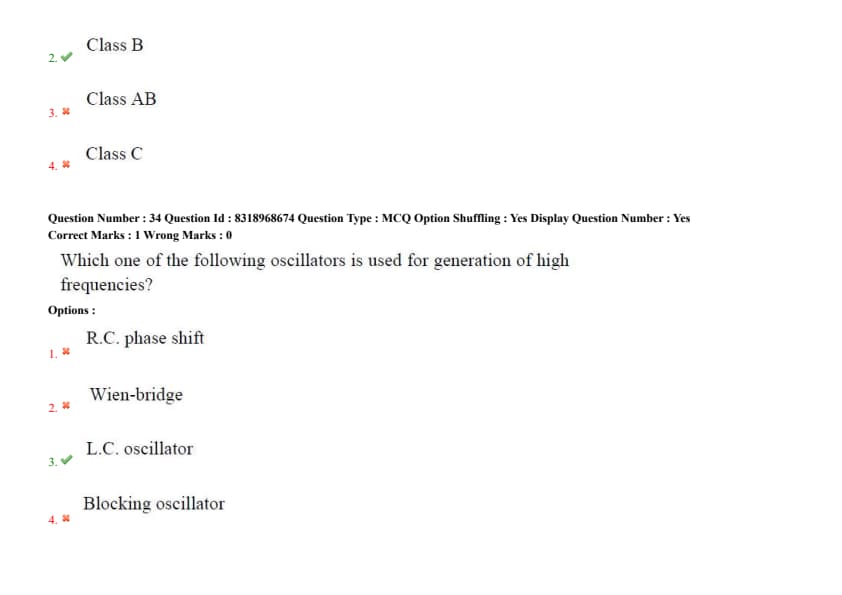
The type of power amplifier which exhibits crossover distortion in its output is:

  • (1) Class A
  • (2) Class B
  • (3) Class AB
  • (4) Class C

Question 34:

Which one of the following oscillators is used for generation of high frequencies?

  • (1) R.C. phase shift
  • (2) Wien-bridge
  • (3) L.C. oscillator
  • (4) Blocking oscillator

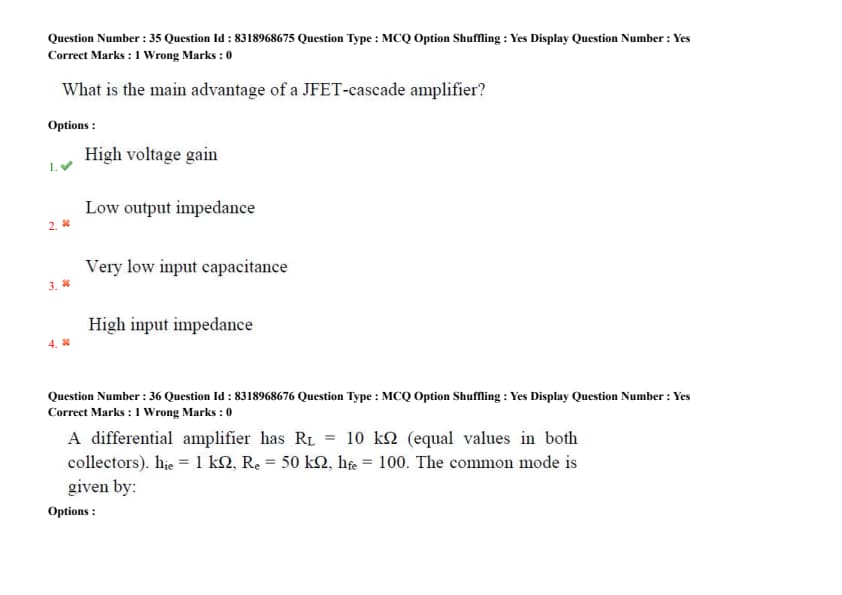
Question 35:

What is the main advantage of a JFET-cascade amplifier?

  • (1) High voltage gain
  • (2) Low output impedance
  • (3) Very low input capacitance
  • (4) High input impedance

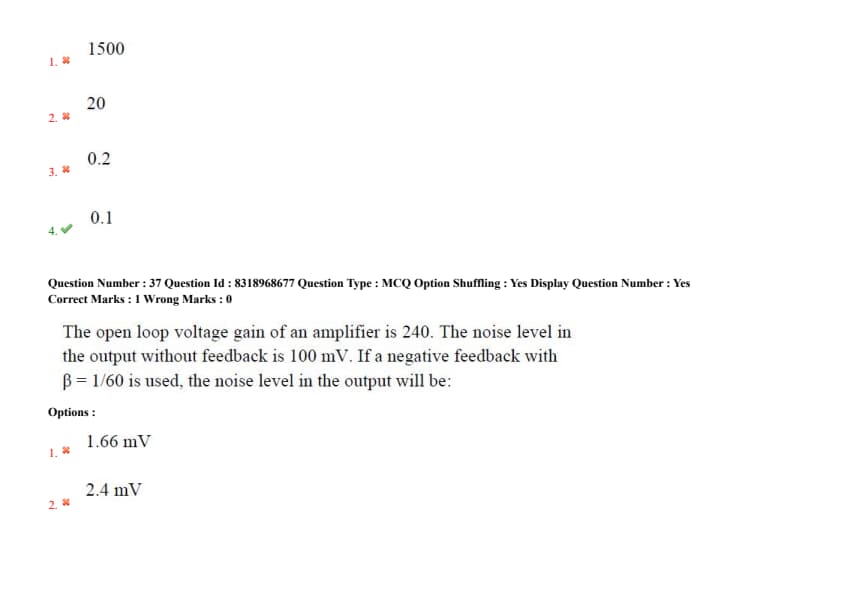
Question 36:

A differential amplifier has \(R_L = 10\,k\Omega\) (equal values in both collectors), \(h_{ie} = 1\,k\Omega\), \(R_e = 50\,k\Omega\), \(h_{fe} = 100\). The common mode is given by:

  • (1) 1500
  • (2) 20
  • (3) 0.2
  • (4) 0.1

Question 37:

The open loop voltage gain of an amplifier is 240. The noise level in the output without feedback is 100 mV. If a negative feedback with \(\beta = \dfrac{1}{60}\) is used, the noise level in the output will be:

  • (1) 1.66 mV
  • (2) 2.4 mV
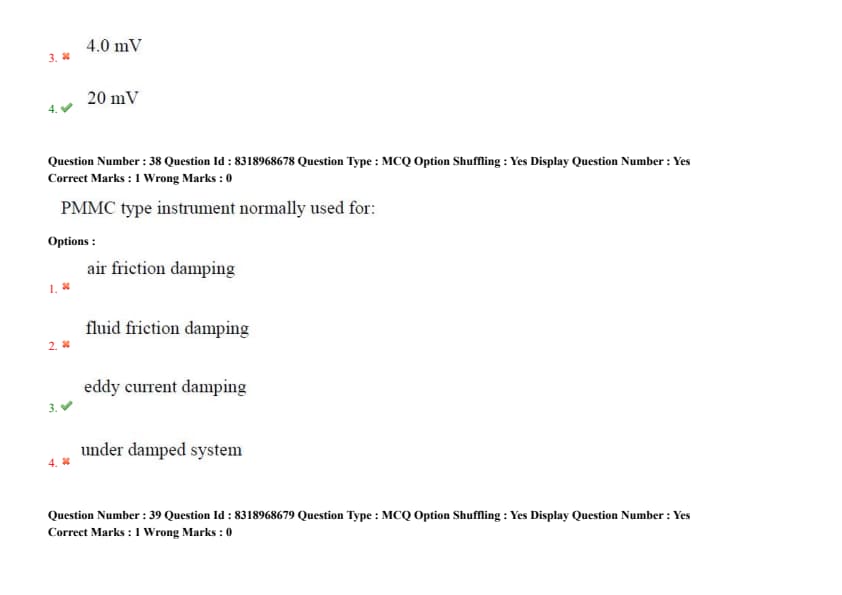
  • (3) 4.0 mV
  • (4) 20 mV

Question 38:

PMMC type instrument normally used for:

  • (1) air friction damping
  • (2) fluid friction damping
  • (3) eddy current damping
  • (4) under damped system

Question 39:

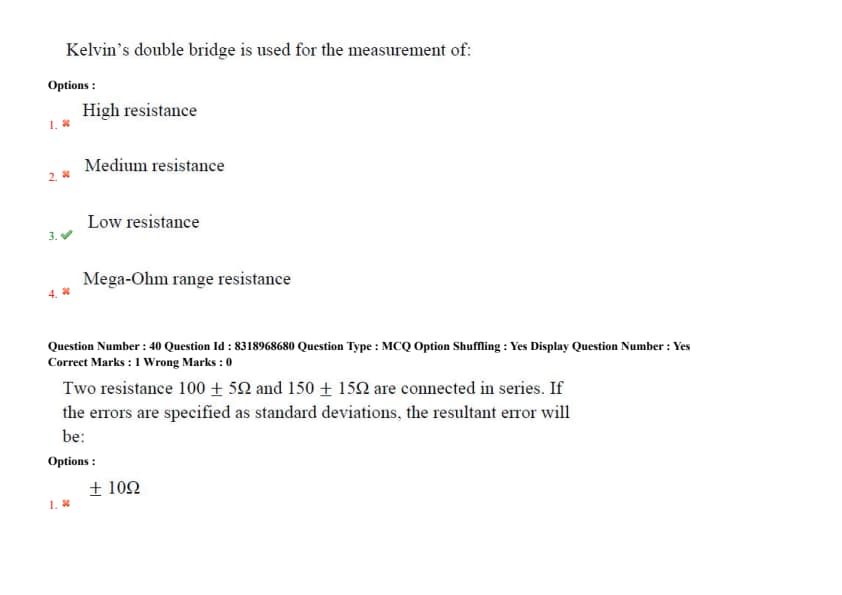
Kelvin’s double bridge is used for the measurement of:

  • (1) High resistance
  • (2) Medium resistance
  • (3) Low resistance
  • (4) Mega-Ohm range resistance

Question 40:

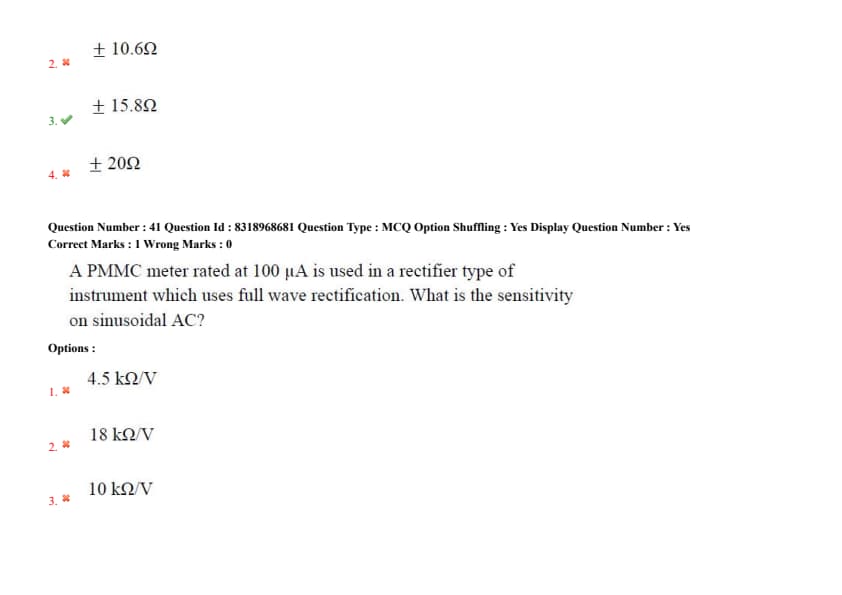
Two resistances \(100 \pm 5\,\Omega\) and \(150 \pm 15\,\Omega\) are connected in series. If the errors are specified as standard deviations, the resultant error will be:

  • (1) \(\pm 10\,\Omega\)
  • (2) \(\pm 10.6\,\Omega\)
  • (3) \(\pm 15.8\,\Omega\)
  • (4) \(\pm 20\,\Omega\)

Question 41:

A PMMC meter rated at 100 \(\mu\)A is used in a rectifier type of instrument which uses full wave rectification. What is the sensitivity on sinusoidal AC?

  • (1) 4.5 k\(\Omega\)/V
  • (2) 18 k\(\Omega\)/V
  • (3) 10 k\(\Omega\)/V
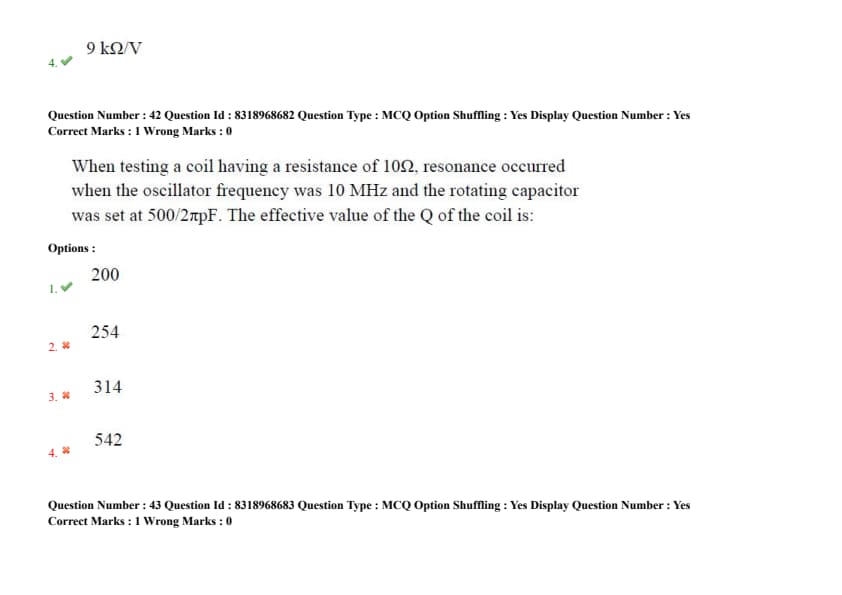
  • (4) 9 k\(\Omega\)/V

Question 42:

When testing a coil having a resistance of \(10\,\Omega\), resonance occurred when the oscillator frequency was \(10\,MHz\) and the rotating capacitor was set at \(\dfrac{500}{2\pi}\,pF\). The effective value of the Q of the coil is:

  • (1) 200
  • (2) 254
  • (3) 314
  • (4) 542

Question 43:

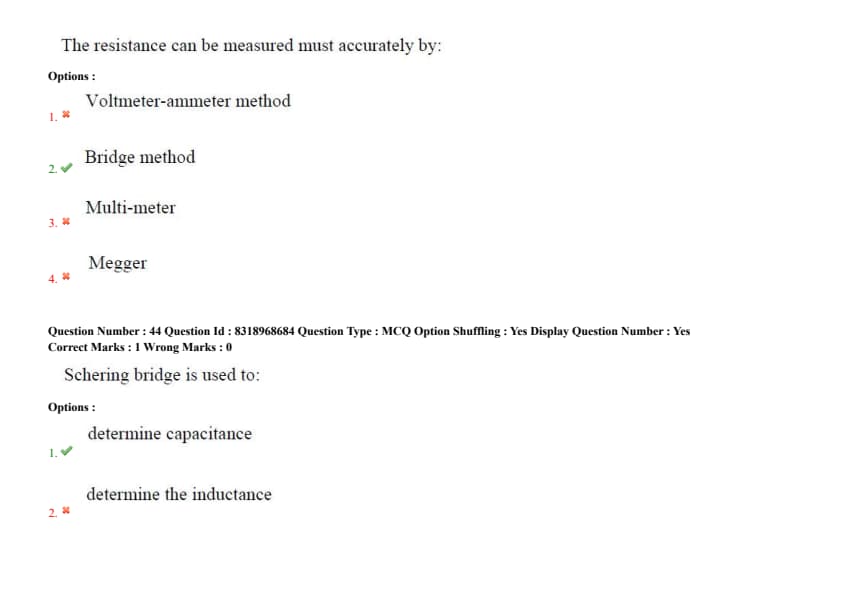
The resistance can be measured most accurately by:

  • (1) Voltmeter-ammeter method
  • (2) Bridge method
  • (3) Multi-meter
  • (4) Megger

Question 44:

Schering bridge is used to:

  • (1) determine capacitance
  • (2) determine the inductance
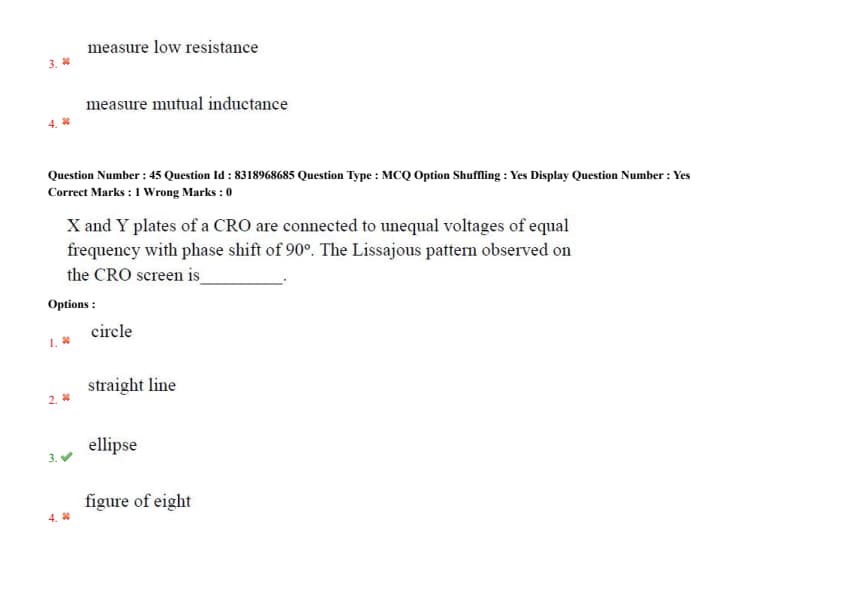
  • (3) measure low resistance
  • (4) measure mutual inductance

Question 45:

X and Y plates of a CRO are connected to unequal voltages of equal frequency with phase shift of \(90^\circ\). The Lissajous pattern observed on the CRO screen is ............

  • (1) circle
  • (2) straight line
  • (3) ellipse
  • (4) figure of eight

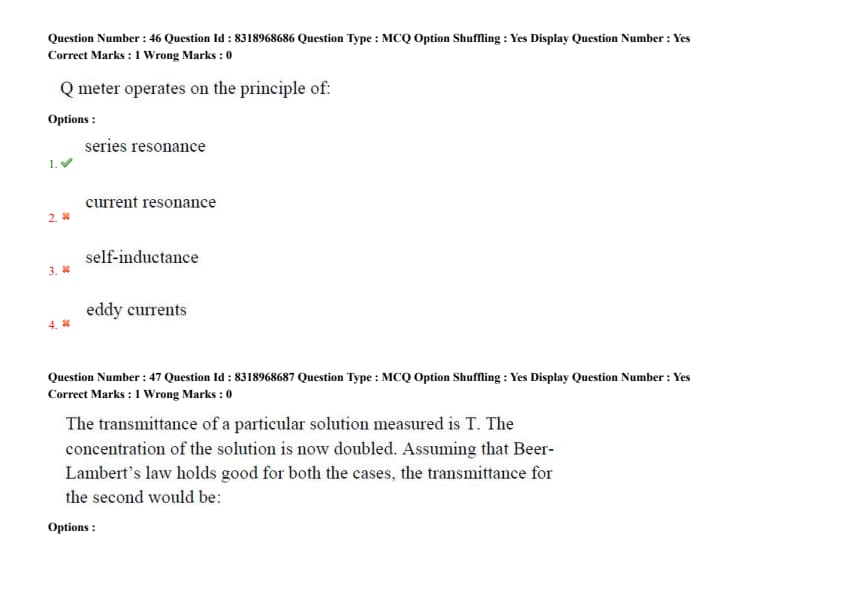
Question 46:

Q meter operates on the principle of:

  • (1) series resonance
  • (2) current resonance
  • (3) self-inductance
  • (4) eddy currents

Question 47:

The transmittance of a particular solution measured is \(T\). The concentration of the solution is now doubled. Assuming that Beer-Lambert’s law holds good for both the cases, the transmittance for the second would be:

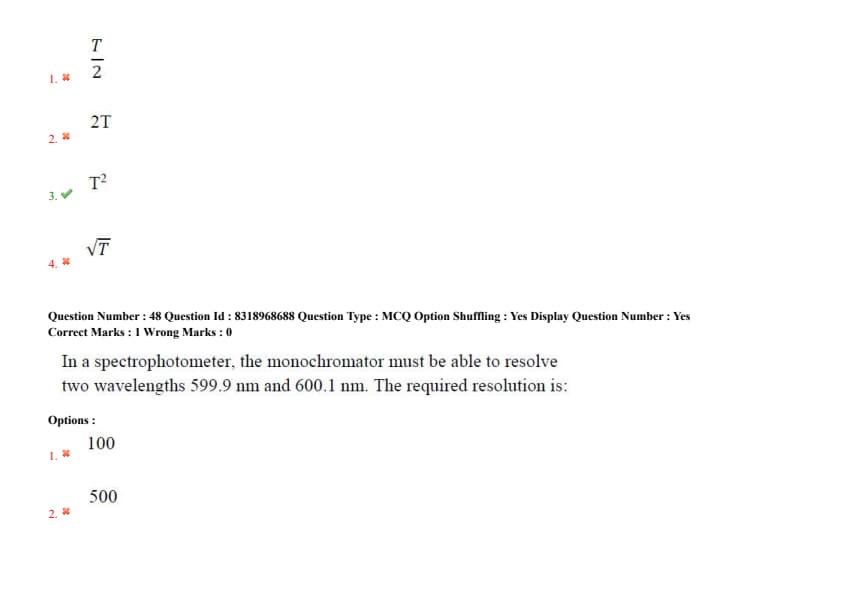
  • (1) \(\dfrac{T}{2}\)
  • (2) \(2T\)
  • (3) \(T^2\)
  • (4) \(\sqrt{T}\)

Question 48:

In a spectrophotometer, the monochromator must be able to resolve two wavelengths 599.9 nm and 600.1 nm. The required resolution is:

  • (1) 100
  • (2) 500
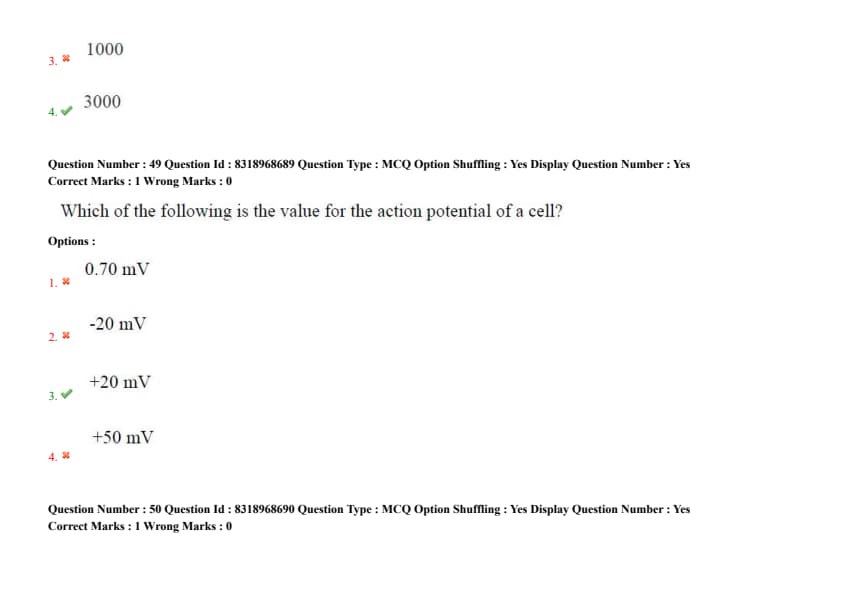
  • (3) 1000
  • (4) 3000

Question 49:

Which of the following is the value for the action potential of a cell?

  • (1) 0.70 mV
  • (2) -20 mV
  • (3) +20 mV
  • (4) +50 mV

Question 50:

The mathematical basis for Nuclear Magnetic Resonance (NMR) states that if \(\mu\) is the nuclear magnetic moment of the molecule, the gyromagnetic ratio is proportional to:

  • (1) \(\mu\)
  • (2) \(\dfrac{1}{\mu}\)
  • (3) \(\sqrt{\mu}\)
  • (4) \(\mu^2\)

Question 51:

Normal diastolic blood pressure ranges from (in mm Hg):

  • (1) 0–30
  • (2) 30–60
  • (3) 60–90
  • (4) 90–120

Question 52:

The counter method used for counting of the blood cells is based in the principle of the:

  • (1) electrical conductivity
  • (2) volume
  • (3) weight
  • (4) number of blood cells

Question 53:

On testing a blood sample it is found that it contains 15 g of Hb per decilitre of blood sample and a PVC of 0.45. Find the mean cell haemoglobin concentration for the blood sample:

  • (1) 33.3 g/dl
  • (2) 28.3 g/dl
  • (3) 33.9 g/dl
  • (4) 31.2 g/dl

Question 54:

A good indicator of cardiovascular system is:

  • (1) blood pressure
  • (2) water flow
  • (3) heart beat
  • (4) brain

Question 55:

Which of the following type of image is produced by CT scan machine?

  • (1) 1-D image
  • (2) 2-D image
  • (3) 3-D image
  • (4) 4-D image

Question 56:

Which of the following is a preferred electrode for measuring EMG?

  • (1) Surface electrodes
  • (2) Needle electrodes
  • (3) Pregelled electrodes
  • (4) Scalp electrodes

Question 57:

When intramuscular EMG is required to look into the electrical activities of deeper or overlaid muscles, ........... electrodes are used.

  • (1) plate shape electrodes
  • (2) surface electrodes
  • (3) thin thread electrodes
  • (4) fine wire electrodes

Question 58:

The contraction of the skeletal muscles results in the generation of action potential in the individual muscle fibers. Record of this action potential is called ............

  • (1) ECG
  • (2) EMG
  • (3) EEG
  • (4) EKG

Question 59:

Disturbance in the EEG pattern resulting from the external stimuli is called .............

  • (1) provoked response
  • (2) ckoored response
  • (3) evoked response
  • (4) impulse response

Question 60:

Which rhythm is the principal component of the EEG that indicates the alertness of the brain?

  • (1) Theta rhythm
  • (2) Gamma rhythm
  • (3) Beta rhythm
  • (4) Alpha rhythm

Question 61:

Normal EEG frequency range is ............

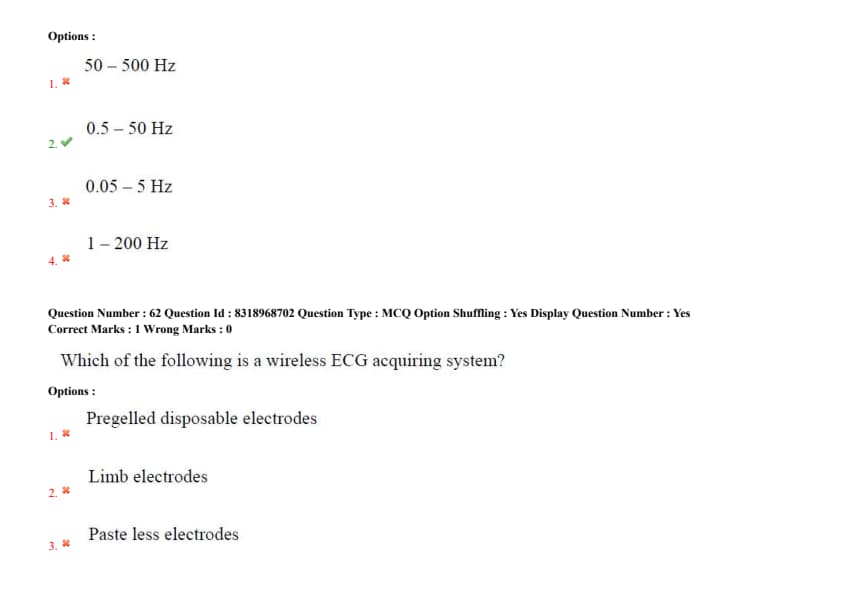
  • (1) 50 – 500 Hz
  • (2) 0.5 – 50 Hz
  • (3) 0.05 – 5 Hz
  • (4) 1 – 200 Hz

Question 62:

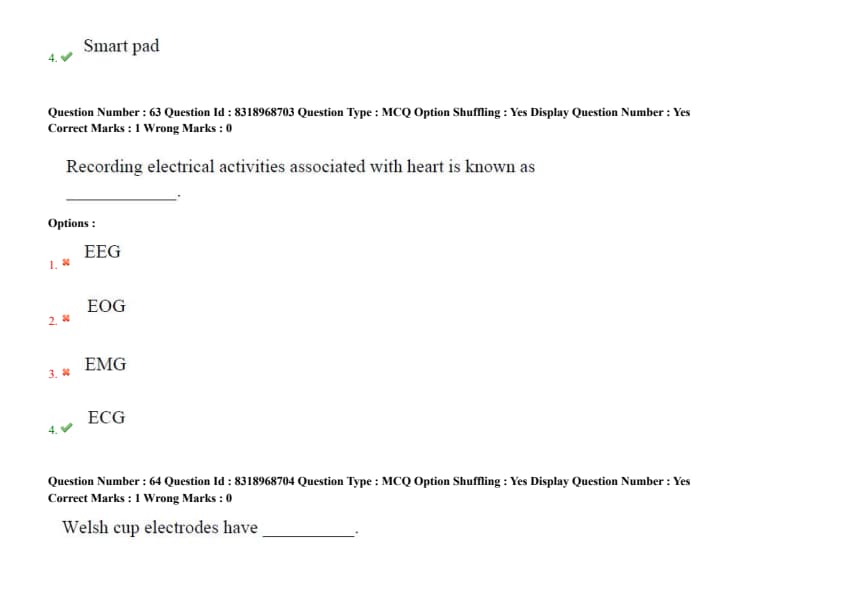
Which of the following is a wireless ECG acquiring system?

  • (1) Pregelled disposable electrodes
  • (2) Limb electrodes
  • (3) Paste less electrodes
  • (4) Smart pad

Question 63:

Recording electrical activities associated with heart is known as .............

  • (1) EEG
  • (2) EOG
  • (3) EMG
  • (4) ECG

Question 64:

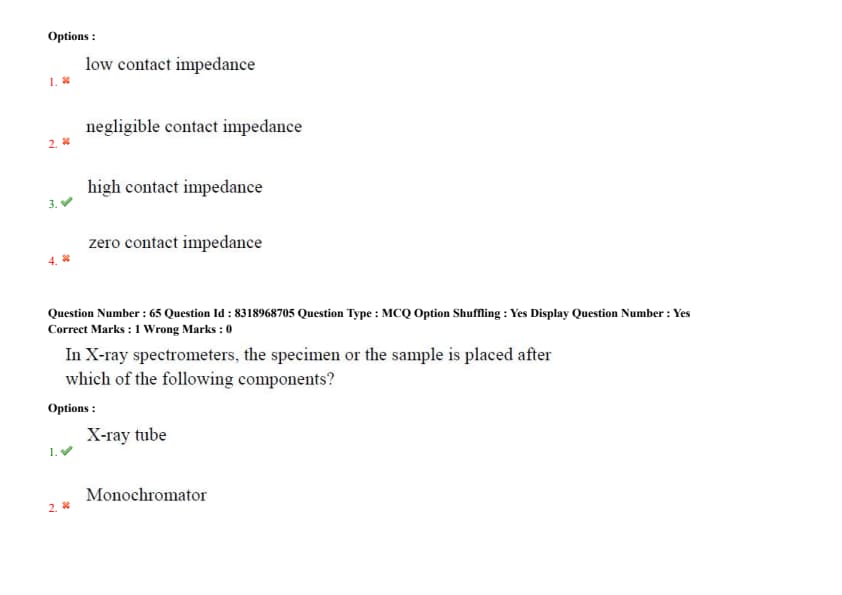
Welsh cup electrodes have .............

  • (1) low contact impedance
  • (2) negligible contact impedance
  • (3) high contact impedance
  • (4) zero contact impedance

Question 65:

In X-ray spectrometers, the specimen or the sample is placed after which of the following components?

  • (1) X-ray tube
  • (2) Monochromator
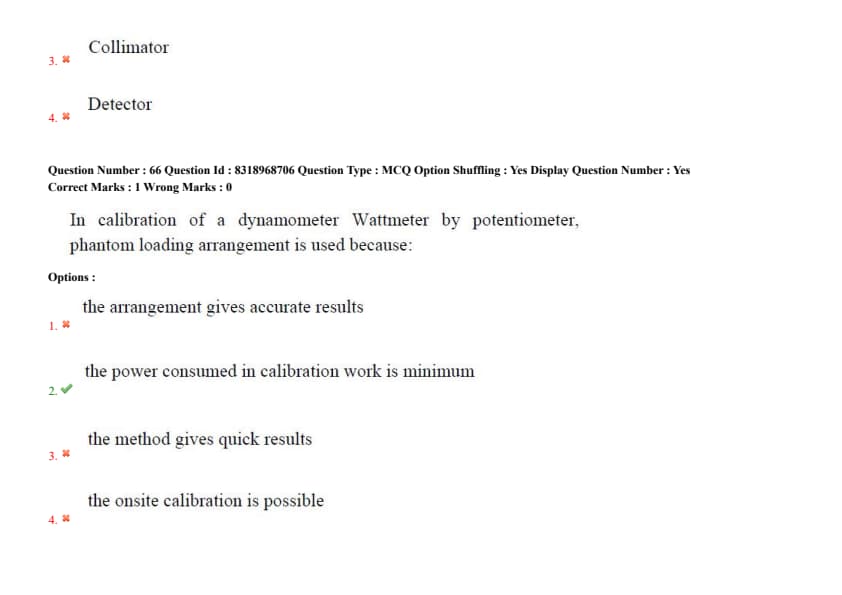
  • (3) Collimator
  • (4) Detector

Question 66:

In calibration of a dynamometer Wattmeter by potentiometer, phantom loading arrangement is used because:

  • (1) the arrangement gives accurate results
  • (2) the power consumed in calibration work is minimum
  • (3) the method gives quick results
  • (4) the onsite calibration is possible

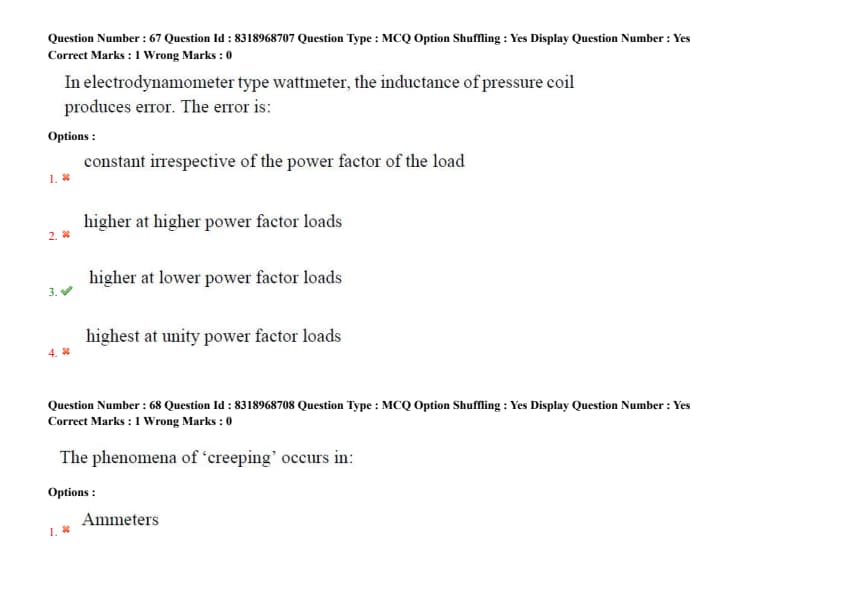
Question 67:

In electrodynamometer type wattmeter, the inductance of pressure coil produces error. The error is:

  • (1) constant irrespective of the power factor of the load
  • (2) higher at higher power factor loads
  • (3) higher at lower power factor loads
  • (4) highest at unity power factor loads

Question 68:

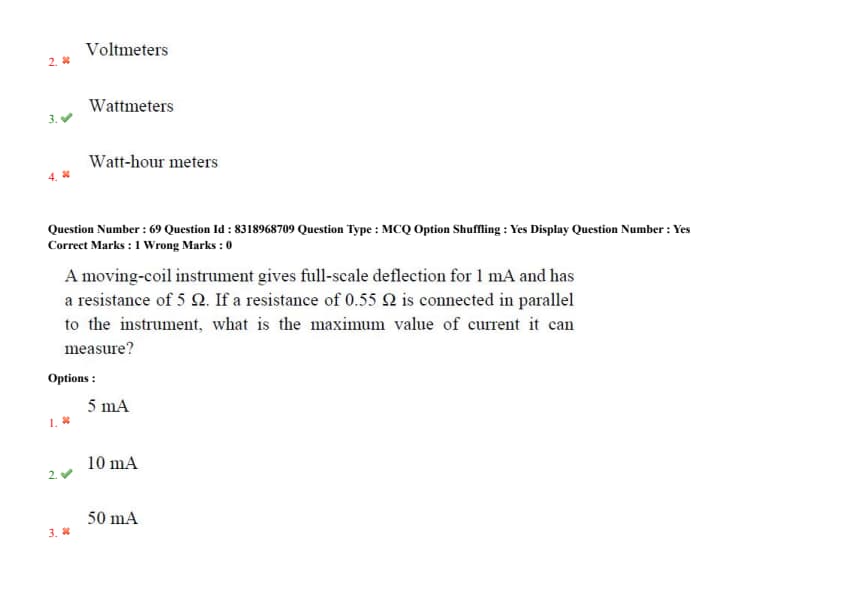
The phenomena of ‘creeping’ occurs in:

  • (1) Ammeters
  • (2) Voltmeters
  • (3) Wattmeters
  • (4) Watt-hour meters

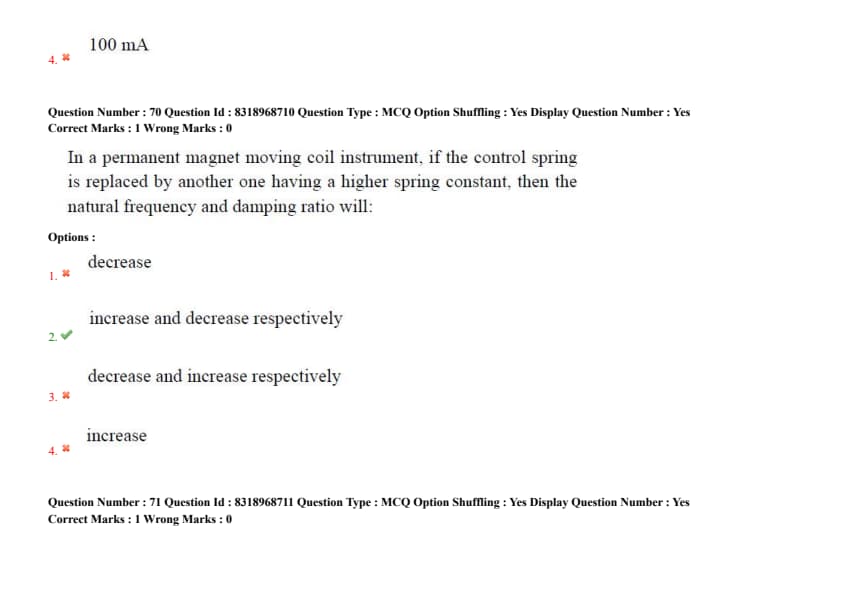
Question 69:

A moving-coil instrument gives full-scale deflection for 1 mA and has a resistance of \(5\ \Omega\). If a resistance of \(0.55\ \Omega\) is connected in parallel to the instrument, what is the maximum value of current it can measure?

  • (1) 5 mA
  • (2) 10 mA
  • (3) 50 mA
  • (4) 100 mA

Question 70:

In a permanent magnet moving coil instrument, if the control spring is replaced by another one having a higher spring constant, then the natural frequency and damping ratio will:

  • (1) decrease
  • (2) increase and decrease respectively
  • (3) decrease and increase respectively
  • (4) increase

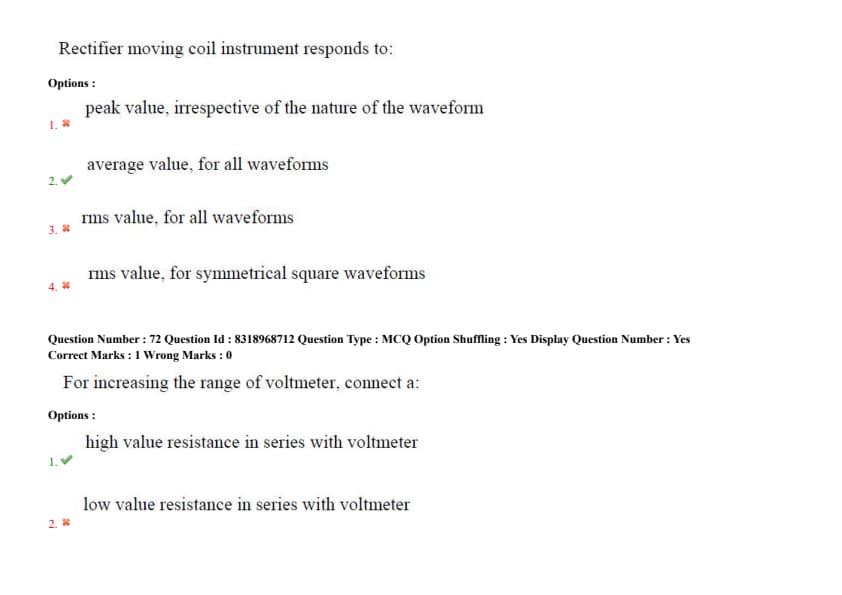
Question 71:

Rectifier moving coil instrument responds to:

  • (1) peak value, irrespective of the nature of the waveform
  • (2) average value, for all waveforms
  • (3) rms value, for all waveforms
  • (4) rms value, for symmetrical square waveforms

Question 72:

For increasing the range of voltmeter, connect a:

  • (1) high value resistance in series with voltmeter
  • (2) low value resistance in series with voltmeter
  • (3) high value resistance in parallel with voltmeter
  • (4) low value resistance in parallel with voltmeter

Question 73:

A dual-trace CRO has:

  • (1) one electron gun
  • (2) two electron guns
  • (3) one electron gun and one two pole switch
  • (4) two electron guns and one two pole switch

Question 74:

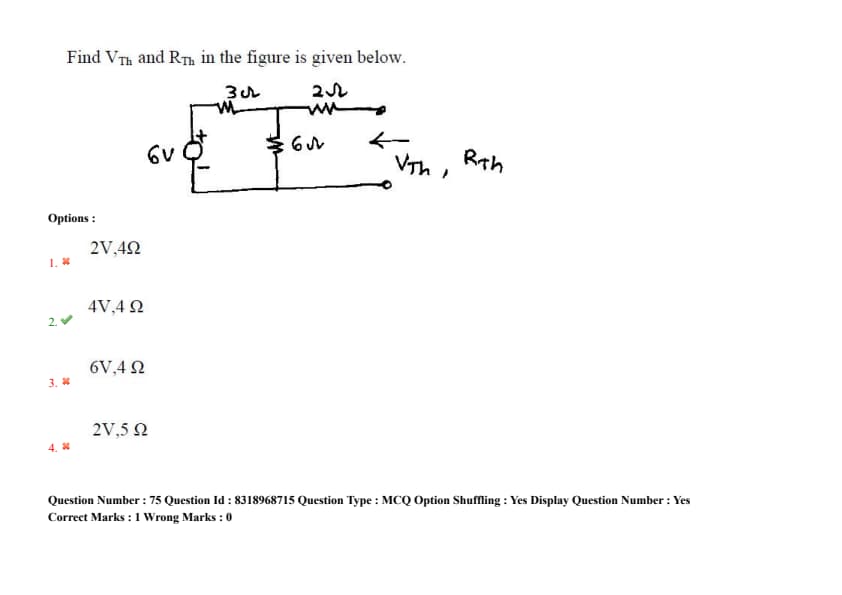
Find \(V_{Th}\) and \(R_{Th}\) in the figure shown below.


  • (1) 2V, 4\(\Omega\)
  • (2) 4V, 4\(\Omega\)
  • (3) 6V, 4\(\Omega\)
  • (4) 2V, 5\(\Omega\)

Question 75:

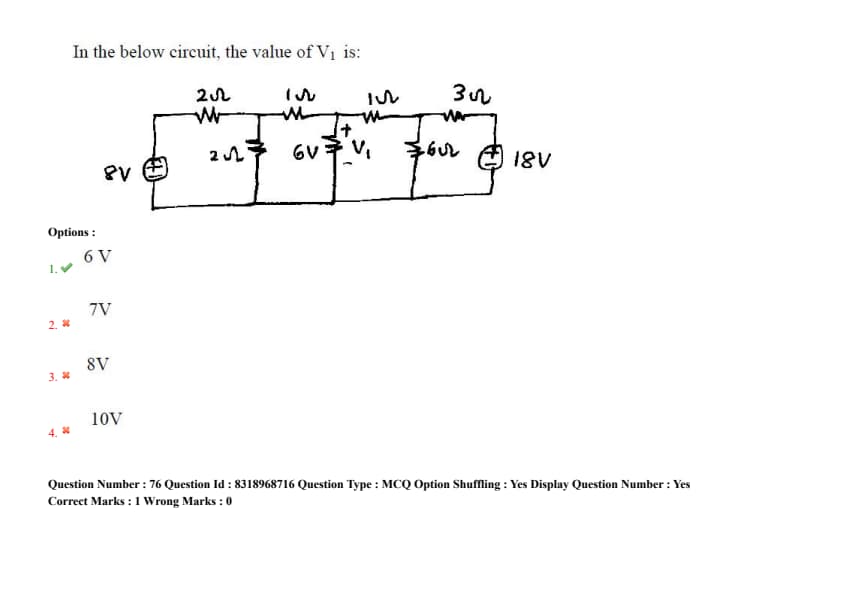
In the below circuit, the value of \(V_1\) is:


  • (1) 6 V
  • (2) 7 V
  • (3) 8 V
  • (4) 10 V

Question 76:

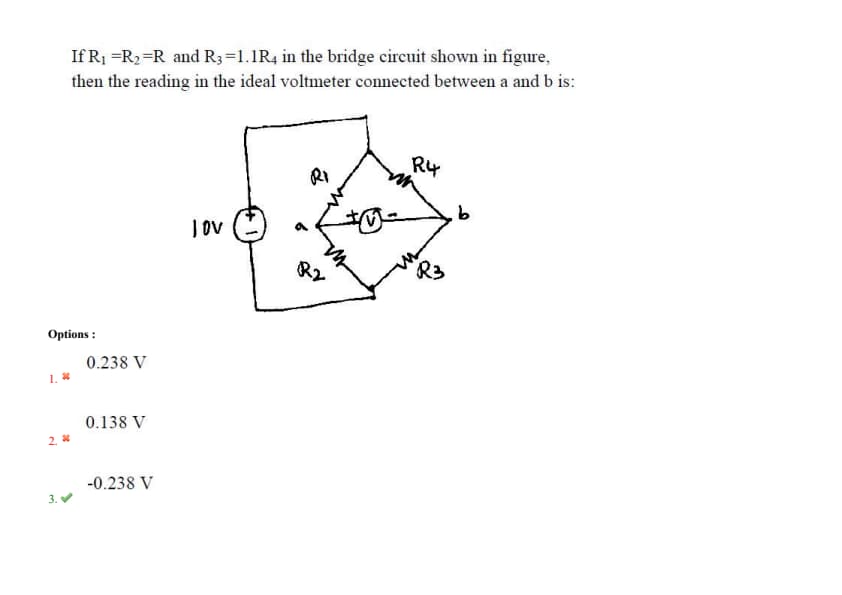
If \(R_1 = R_2 = R\) and \(R_3 = 1.1R_4\) in the bridge circuit shown in figure, then the reading in the ideal voltmeter connected between \(a\) and \(b\) is:


  • (1) 0.238 V
  • (2) 0.138 V
  • (3) -0.238 V
  • (4) 1 V

Question 77:

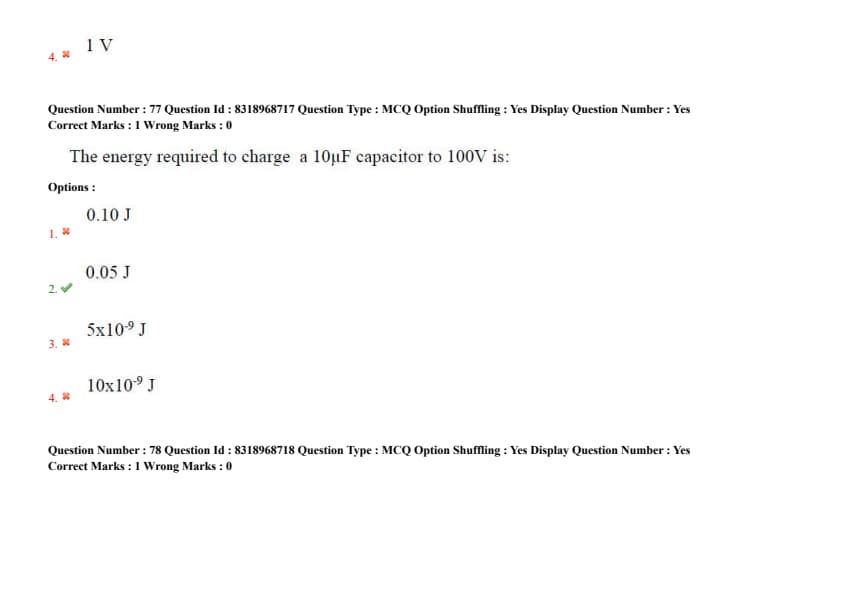
The energy required to charge a \(10\ \muF\) capacitor to \(100\ V\) is:

  • (1) 0.10 J
  • (2) 0.05 J
  • (3) \(5 \times 10^{-9}\) J
  • (4) \(10 \times 10^{-9}\) J

Question 78:

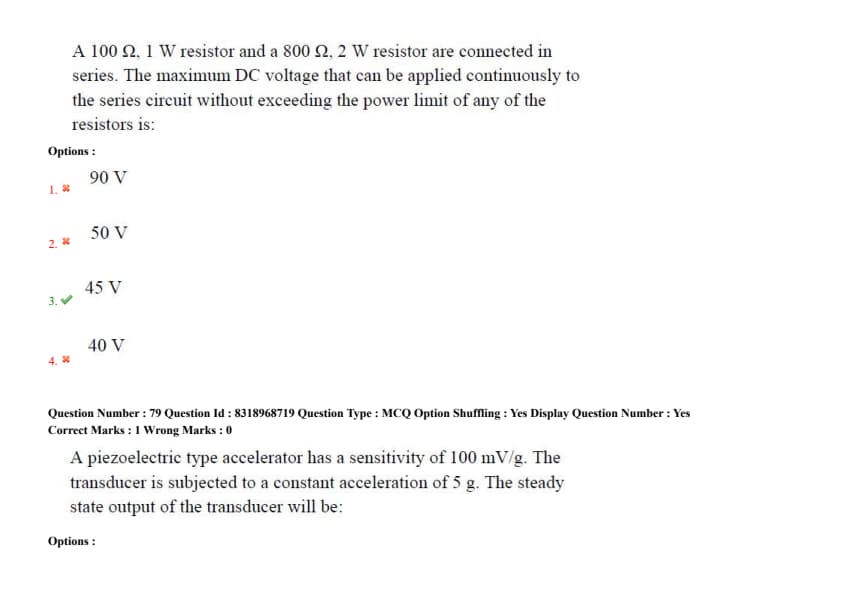
A \(100\ \Omega\), 1 W resistor and a \(800\ \Omega\), 2 W resistor are connected in series. The maximum DC voltage that can be applied continuously to the series circuit without exceeding the power limit of any of the resistors is:

  • (1) 90 V
  • (2) 50 V
  • (3) 45 V
  • (4) 40 V

Question 79:

A piezoelectric type accelerometer has a sensitivity of 100 mV/g. The transducer is subjected to a constant acceleration of 5 g. The steady-state output of the transducer will be:

  • (1) Zero
  • (2) 100 mV
  • (3) 0.5 V
  • (4) 5 V

Question 80:

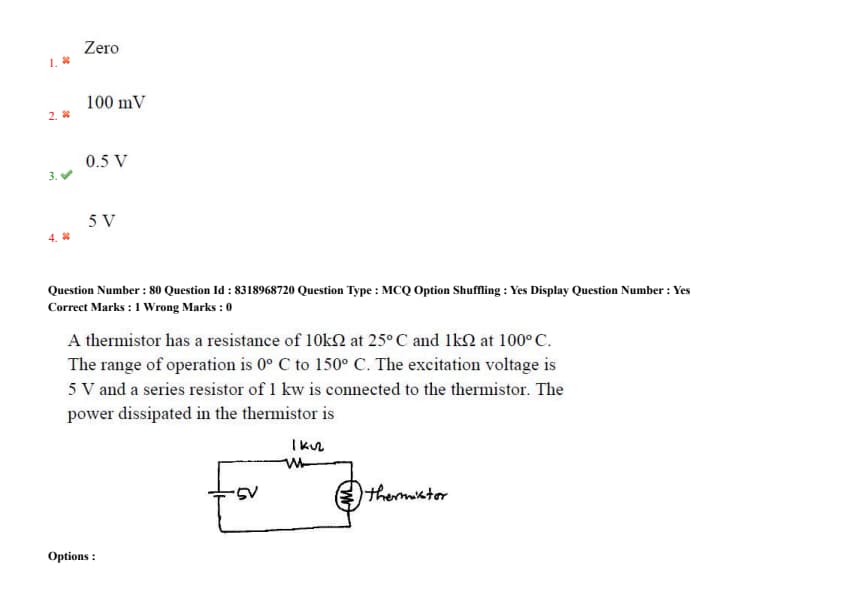
A thermistor has a resistance of \(10\ k\Omega\) at \(25^\circ\)C and \(1\ k\Omega\) at \(100^\circ\)C. The range of operation is \(0^\circ\)C to \(150^\circ\)C. The excitation voltage is 5 V and a series resistor of \(1\ k\Omega\) is connected to the thermistor. The power dissipated in the thermistor is:


  • (1) 4.0 mW
  • (2) 4.7 mW
  • (3) 5.4 mW
  • (4) 6.1 mW

Question 81:

Which of the following logics possesses highest noise immunity?

  • (1) DTL
  • (2) HTL
  • (3) ECL
  • (4) TTL

Question 82:

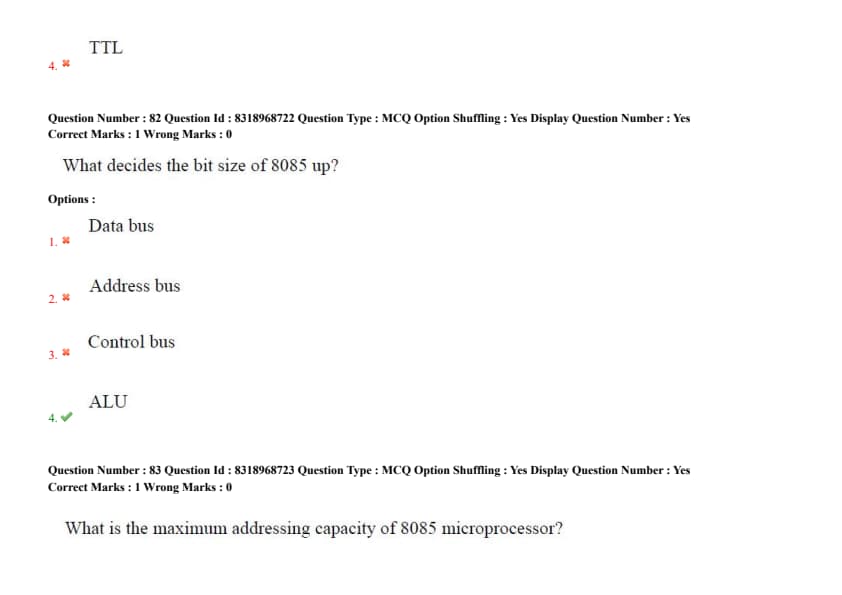
What decides the bit size of 8085 microprocessor?

  • (1) Data bus
  • (2) Address bus
  • (3) Control bus
  • (4) ALU

Question 83:

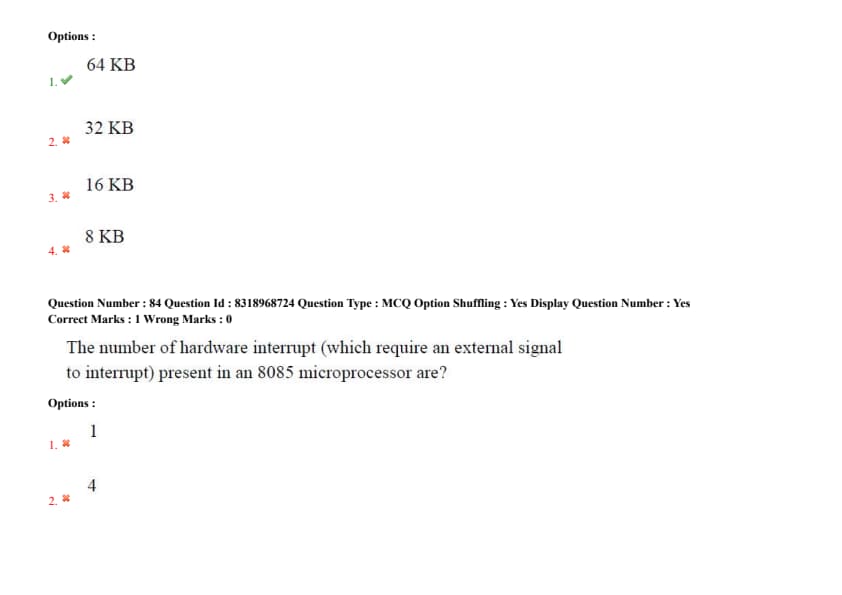
What is the maximum addressing capacity of 8085 microprocessor?

  • (1) 64 KB
  • (2) 32 KB
  • (3) 16 KB
  • (4) 8 KB

Question 84:

The number of hardware interrupts (which require an external signal to interrupt) present in an 8085 microprocessor are:

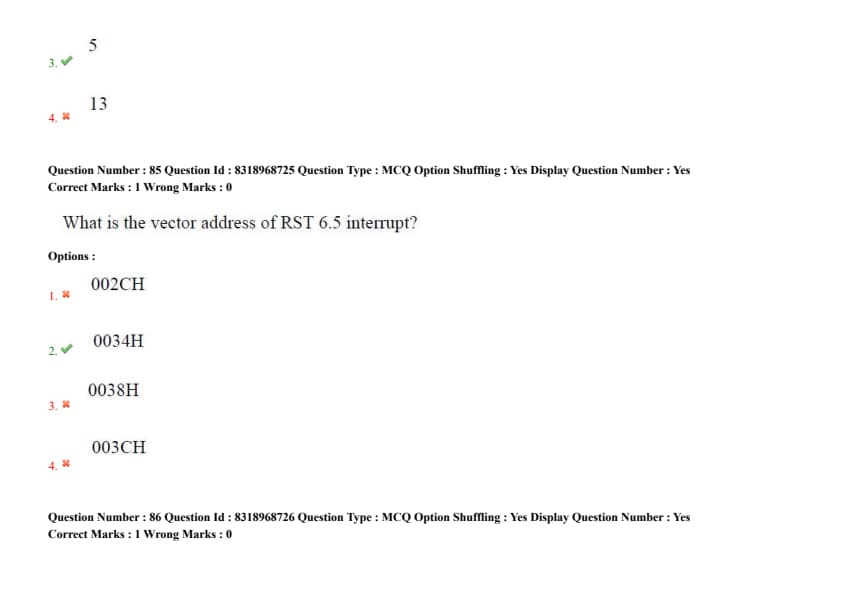
  • (1) 1
  • (2) 4
  • (3) 5
  • (4) 13

Question 85:

What is the vector address of RST 6.5 interrupt?

  • (1) 002CH
  • (2) 0034H
  • (3) 0038H
  • (4) 003CH

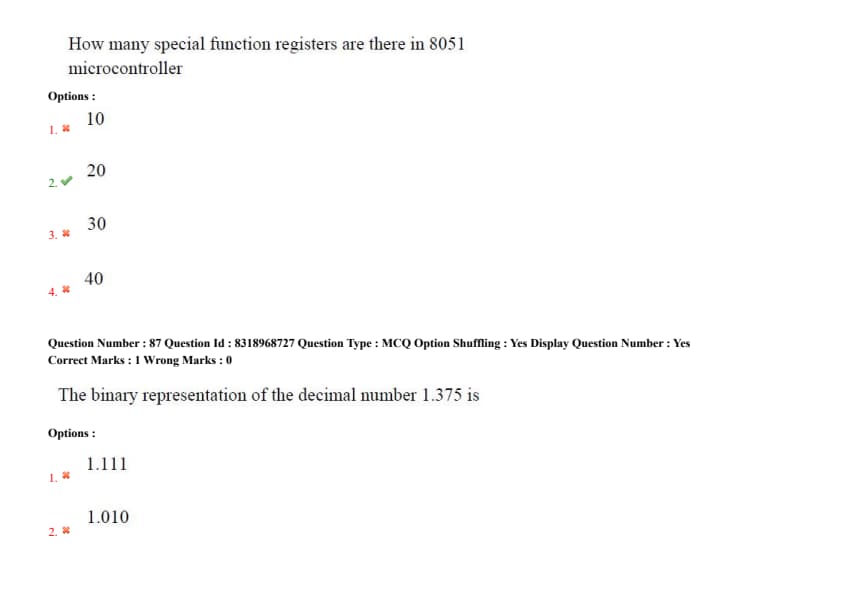
Question 86:

How many special function registers are there in 8051 microcontroller?

  • (1) 10
  • (2) 20
  • (3) 30
  • (4) 40

Question 87:

The binary representation of the decimal number 1.375 is

  • (1) 1.111
  • (2) 1.010
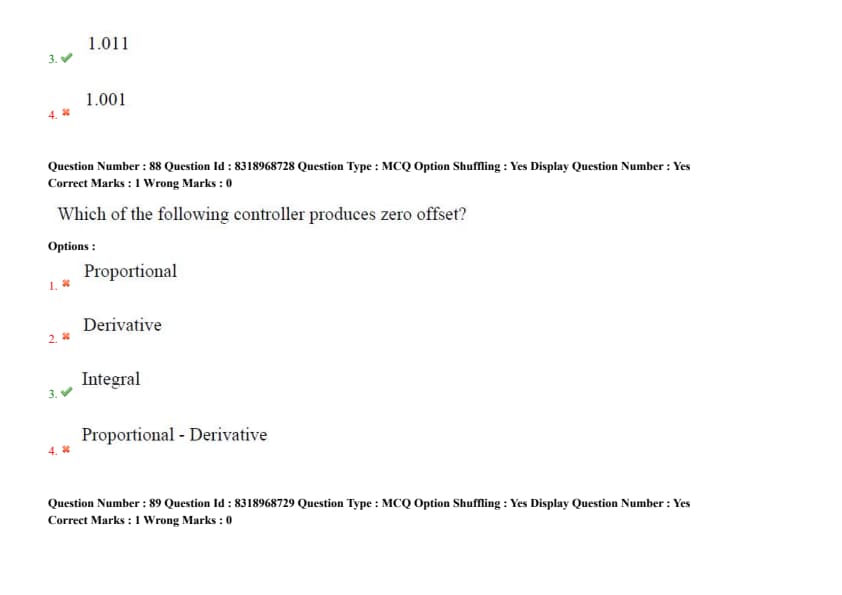
  • (3) 1.011
  • (4) 1.001

Question 88:

Which of the following controller produces zero offset?

  • (1) Proportional
  • (2) Derivative
  • (3) Integral
  • (4) Proportional - Derivative

Question 89:

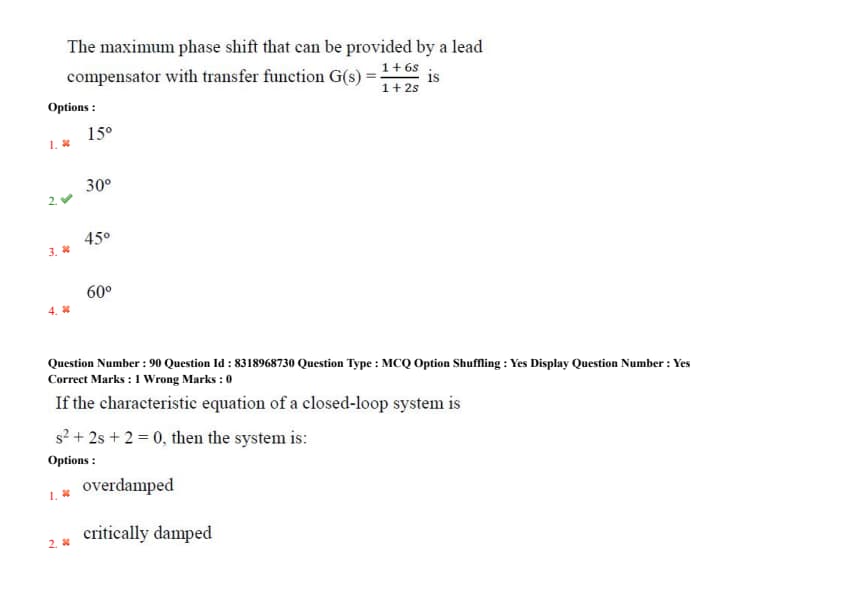
The maximum phase shift that can be provided by a lead compensator with transfer function \(G(s) = \dfrac{1 + 6s}{1 + 2s}\) is:

  • (1) \(15^\circ\)
  • (2) \(30^\circ\)
  • (3) \(45^\circ\)
  • (4) \(60^\circ\)

Question 90:

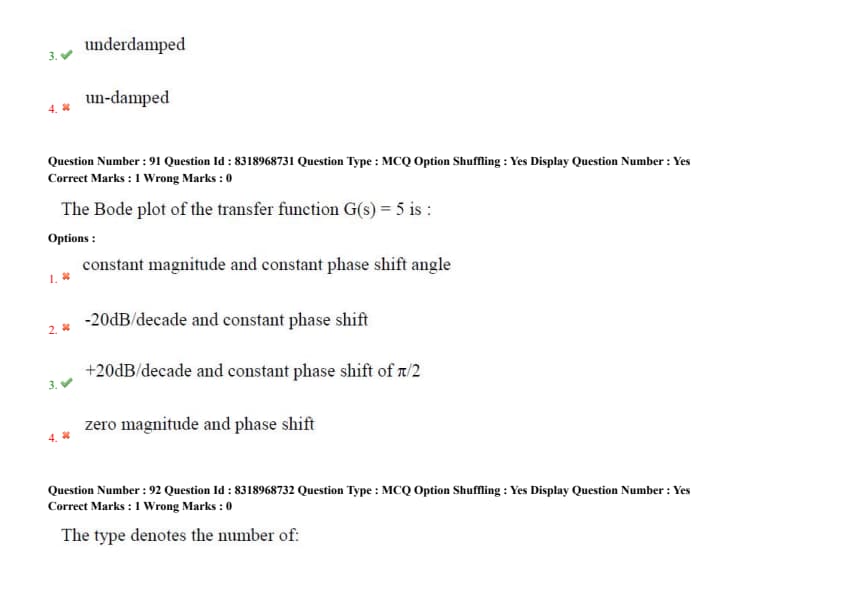
If the characteristic equation of a closed-loop system is \(s^2 + 2s + 2 = 0\), then the system is:

  • (1) overdamped
  • (2) critically damped
  • (3) underdamped
  • (4) un-damped

Question 91:

The Bode plot of the transfer function \(G(s) = 5\) is:

  • (1) constant magnitude and constant phase shift angle
  • (2) \(-20\) dB/decade and constant phase shift
  • (3) \(+20\) dB/decade and constant phase shift of \(\pi/2\)
  • (4) zero magnitude and phase shift

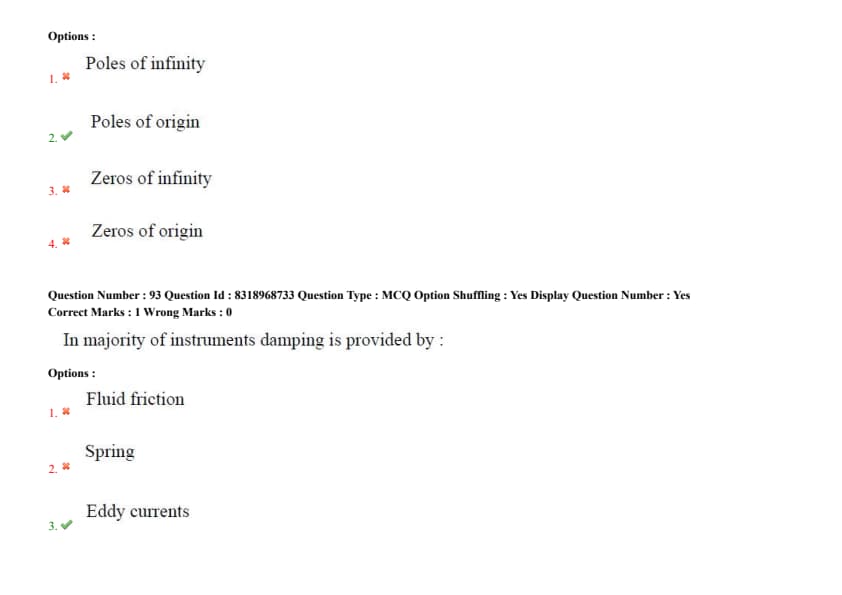
Question 92:

The type denotes the number of:

  • (1) Poles of infinity
  • (2) Poles of origin
  • (3) Zeros of infinity
  • (4) Zeros of origin

Question 93:

In majority of instruments damping is provided by:

  • (1) Fluid friction
  • (2) Spring
  • (3) Eddy currents
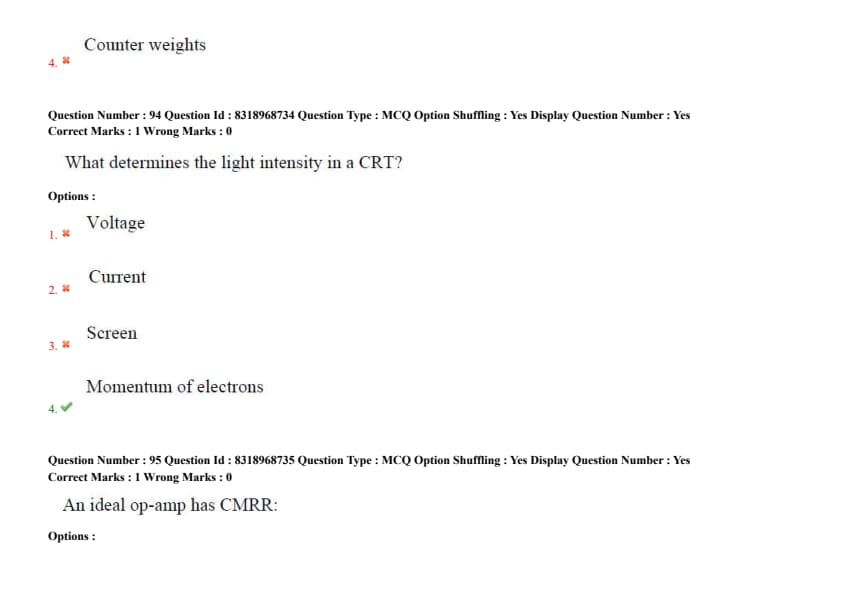
  • (4) Counter weights

Question 94:

What determines the light intensity in a CRT?

  • (1) Voltage
  • (2) Current
  • (3) Screen
  • (4) Momentum of electrons

Question 95:

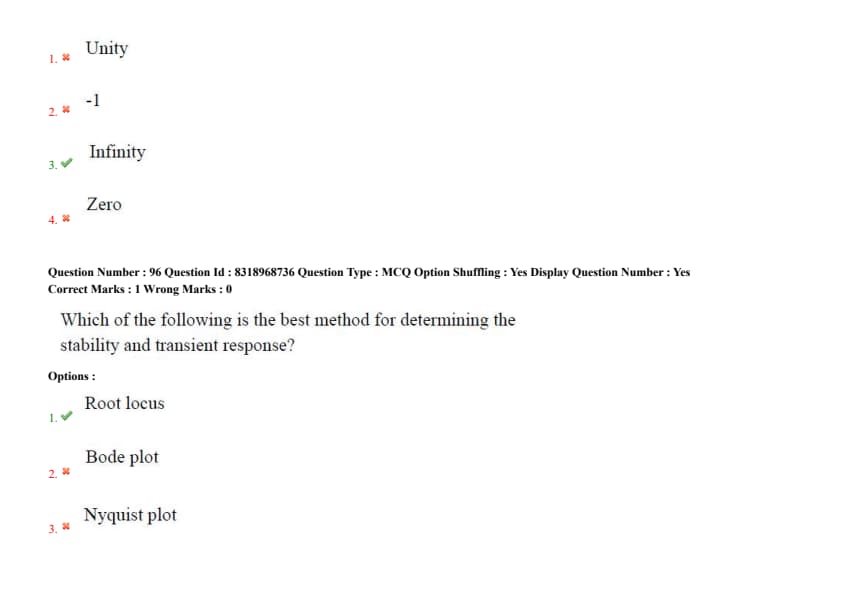
An ideal op-amp has CMRR:

  • (1) Unity
  • (2) -1
  • (3) Infinity
  • (4) Zero

Question 96:

Which of the following is the best method for determining the stability and transient response?

  • (1) Root locus
  • (2) Bode plot
  • (3) Nyquist plot
  • (4) Polar plots

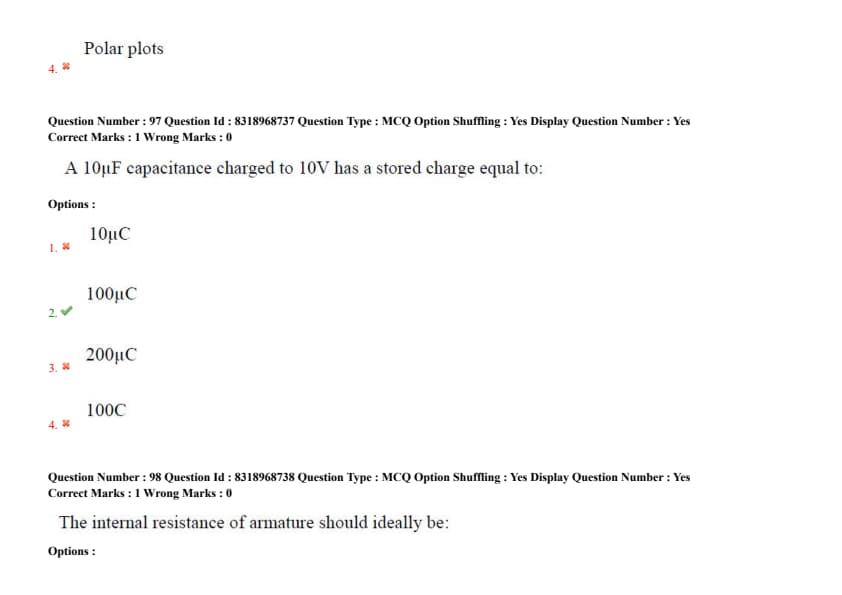
Question 97:

A \(10\ \muF\) capacitance charged to \(10\ V\) has a stored charge equal to:

  • (1) \(10\ \muC\)
  • (2) \(100\ \muC\)
  • (3) \(200\ \muC\)
  • (4) \(100\ C\)

Question 98:

The internal resistance of armature should ideally be:

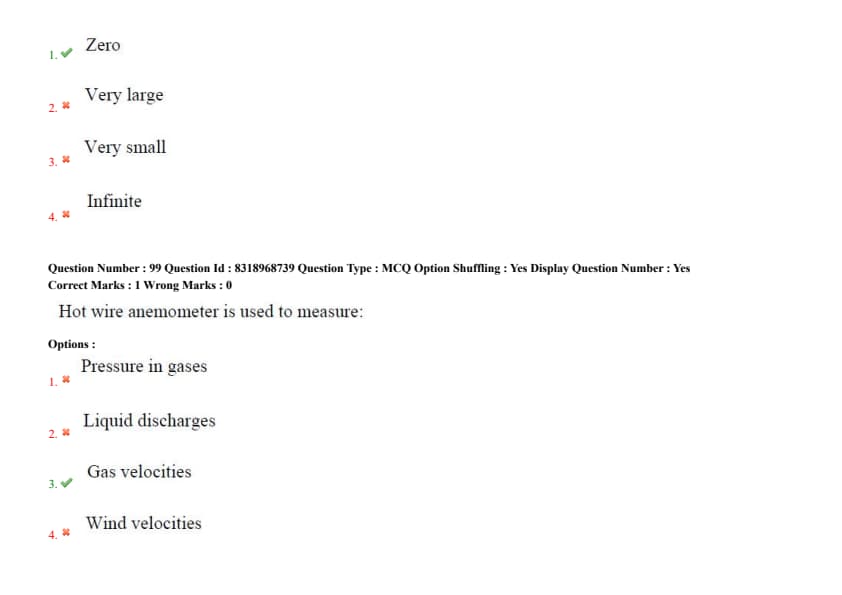
  • (1) Zero
  • (2) Very large
  • (3) Very small
  • (4) Infinite

Question 99:

Hot wire anemometer is used to measure:

  • (1) Pressure in gases
  • (2) Liquid discharges
  • (3) Gas velocities
  • (4) Wind velocities

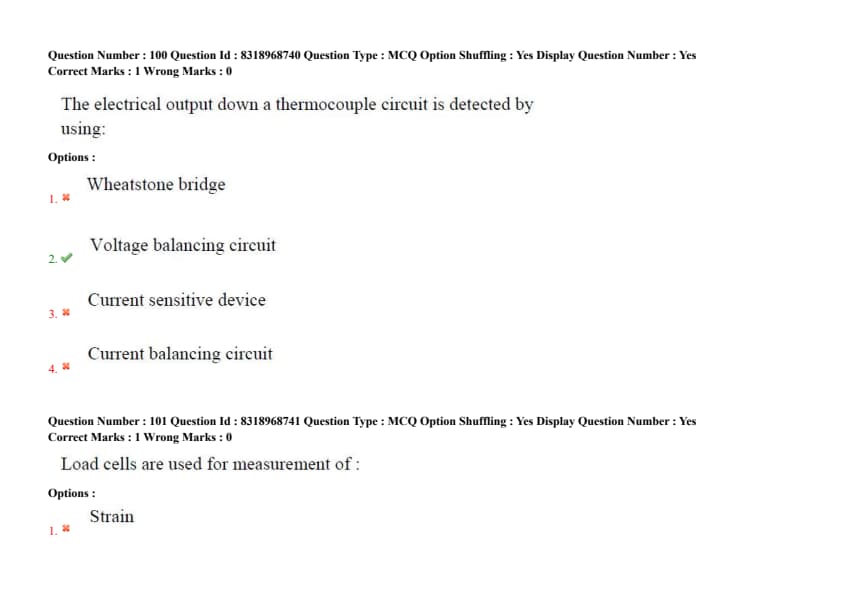
Question 100:

The electrical output down a thermocouple circuit is detected by using:

  • (1) Wheatstone bridge
  • (2) Voltage balancing circuit
  • (3) Current sensitive device
  • (4) Current balancing circuit

Question 101:

Load cells are used for measurement of:

  • (1) Strain
  • (2) Stress
  • (3) Velocity
  • (4) Weight

Question 102:

A dead weight tester is used for:

  • (1) Calibrating pressure gauges
  • (2) Testing the Magnitude of given weight
  • (3) Providing high pressures
  • (4) Measurement of Load

Question 103:

Which instrument has the manual Null balance operation?

  • (1) Optical pyrometer
  • (2) Resistance Thermometer
  • (3) Glass Thermometer
  • (4) Thermistor

Question 104:

Flapper nozzle is used in following controller?

  • (1) Hydraulic
  • (2) Electric
  • (3) Pneumatic
  • (4) Electronic

Question 105:

The most common pneumatic signal standard for industrial process instruments is:

  • (1) (0-20) psi
  • (2) (3-15) psi
  • (3) (4-20) psi
  • (4) (0-10) psi

Question 106:

Cavitation in a control valve is caused by:

  • (1) Process noise
  • (2) Vibration in pipe
  • (3) The Von Karman effect
  • (4) Pressure recovery

Question 107:

Photo conductive cells are made by:

  • (1) Lead sulphide
  • (2) Tin sulphide
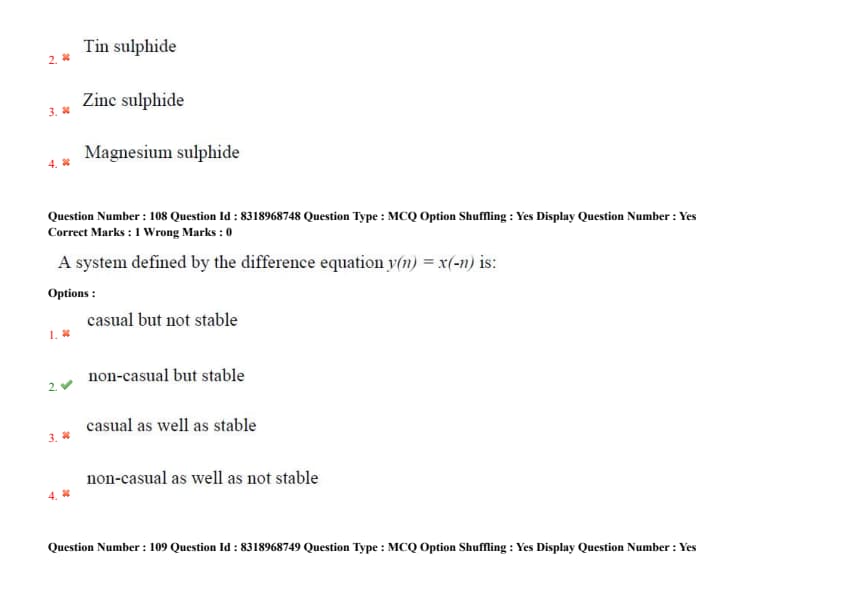
  • (3) Zinc sulphide
  • (4) Magnesium sulphide

Question 108:

A system defined by the difference equation \(y(n) = x(-n)\) is:

  • (1) Casual but not stable
  • (2) Non-casual but stable
  • (3) Casual as well as stable
  • (4) Non-casual as well as not stable

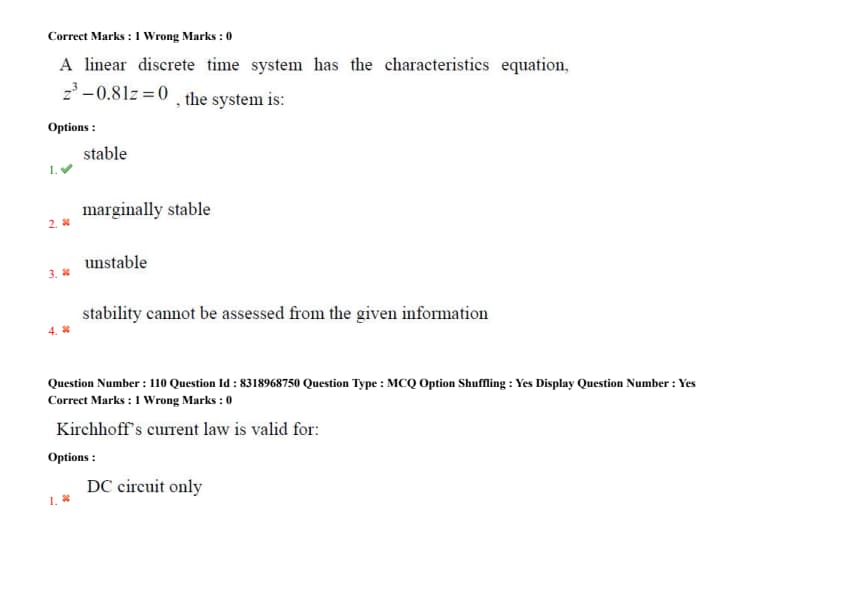
Question 109:

A linear discrete-time system has the characteristic equation, \(z^3 - 0.81z = 0\), the system is:

  • (1) stable
  • (2) marginally stable
  • (3) unstable
  • (4) stability cannot be assessed from the given information

Question 110:

Kirchhoff's current law is valid for:

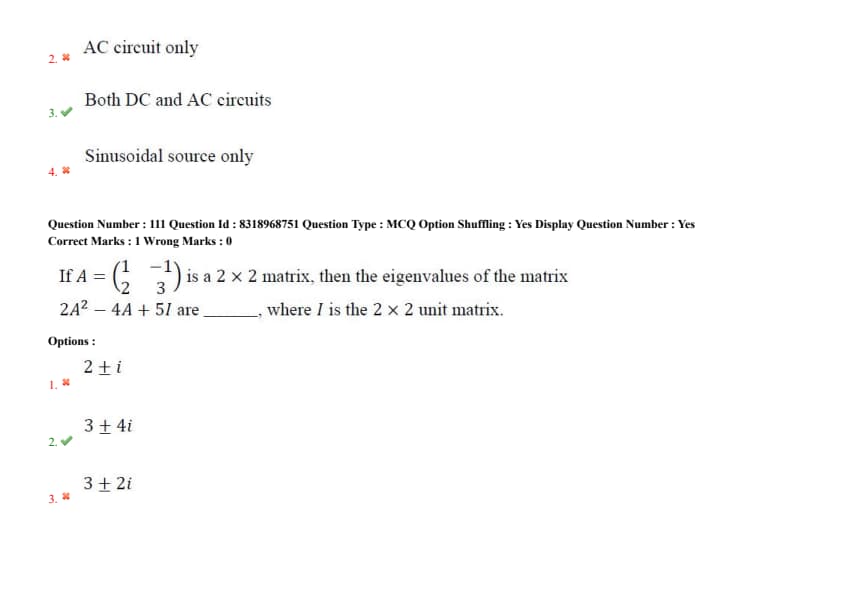
  • (1) DC circuit only
  • (2) AC circuit only
  • (3) Both DC and AC circuits
  • (4) Sinusoidal source only

Question 111:

If \(A = \begin{pmatrix} 2 & -1
3 & 2 \end{pmatrix}\) is a \(2 \times 2\) matrix, then the eigenvalues of the matrix \(2A^2 - 4A + 5I\) are ........., where \(I\) is the \(2 \times 2\) unit matrix.

  • (1) \(2 \pm i\)
  • (2) \(3 \pm 4i\)
  • (3) \(3 \pm 2i\)
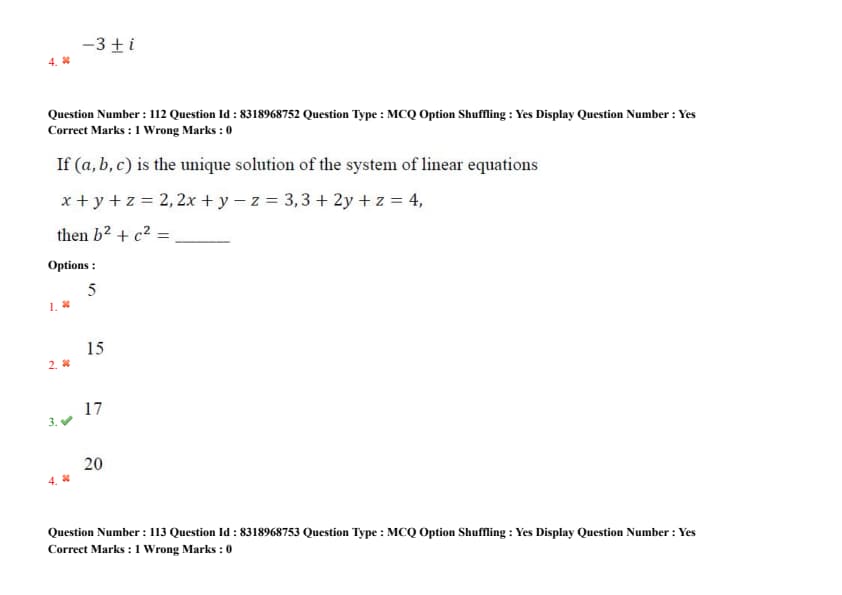
  • (4) \(-3 \pm i\)

Question 112:

If \((a, b, c)\) is the unique solution of the system of linear equations
\(x + y + z = 2, \quad 2x + y - z = 3, \quad 3x + 2y + z = 4\),

then \(b^2 + c^2 = ........\)

  • (1) 5
  • (2) 15
  • (3) 17
  • (4) 20

Question 113:

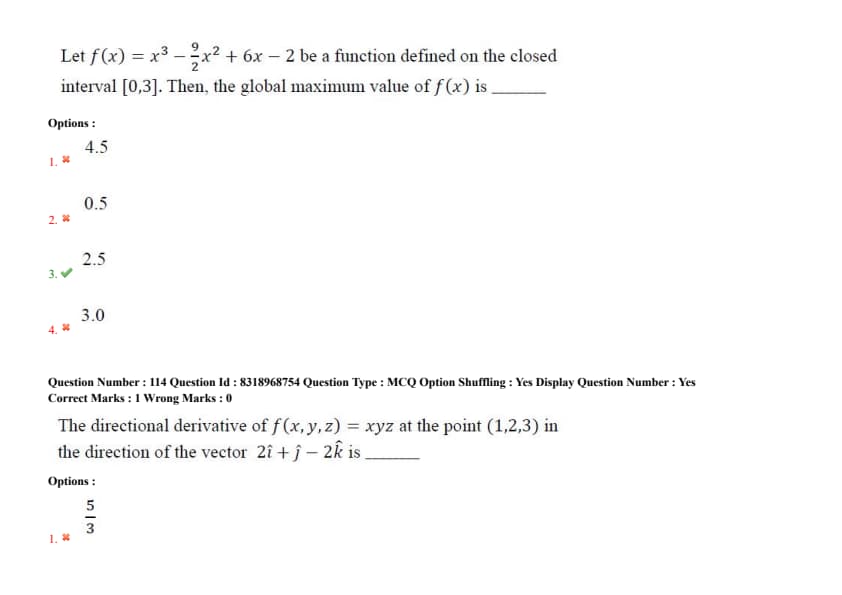
Let \(f(x) = x^3 - \dfrac{9}{2} x^2 + 6x - 2\) be a function defined on the closed interval \([0,3]\). Then, the global maximum value of \(f(x)\) is ............

  • (1) 4.5
  • (2) 0.5
  • (3) 2.5
  • (4) 3.0

Question 114:

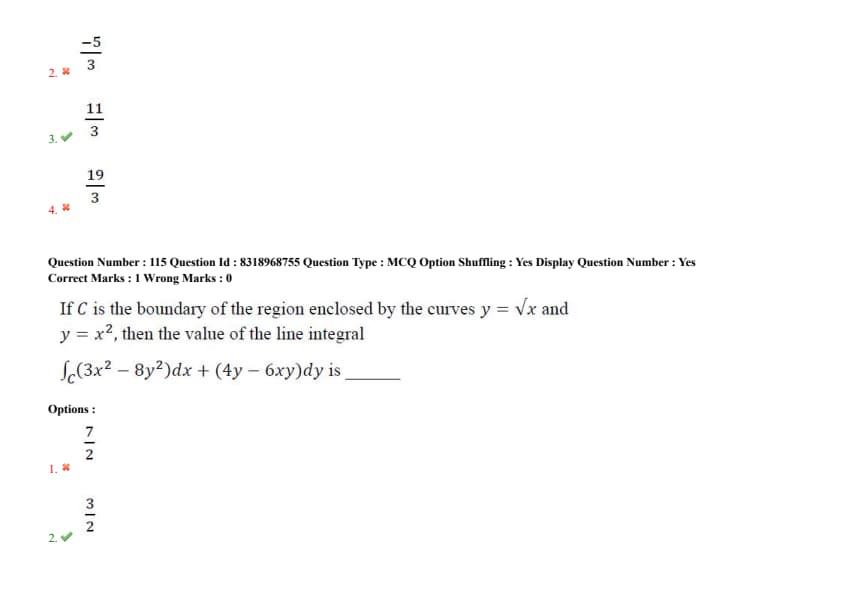
The directional derivative of \(f(x, y, z) = xyz\) at the point \((1, 2, 3)\) in the direction of the vector \(2\hat{i} + \hat{j} - 2\hat{k}\) is ............

  • (1) \(\dfrac{5}{3}\)
  • (2) \(\dfrac{-5}{3}\)
  • (3) \(\dfrac{11}{3}\)
  • (4) \(\dfrac{19}{3}\)

Question 115:

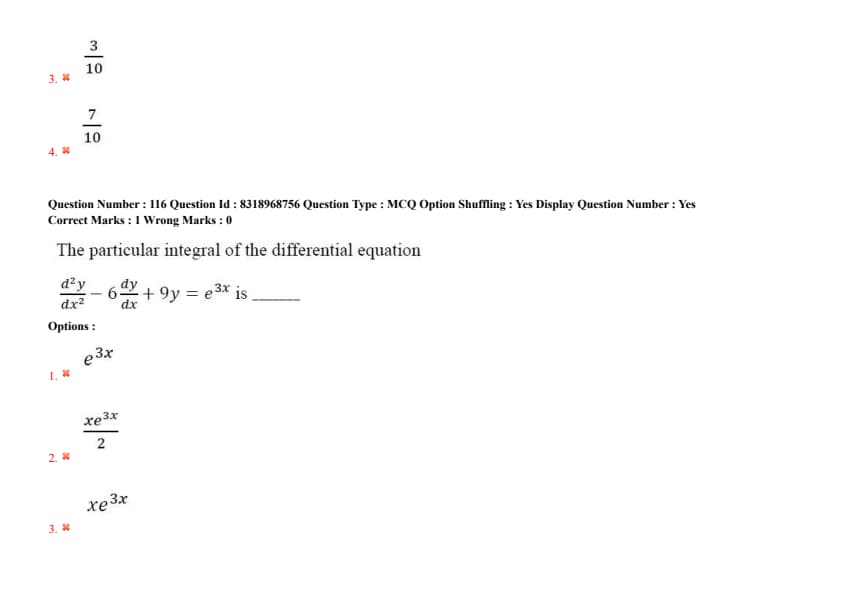
If \(C\) is the boundary of the region enclosed by the curves \(y = \sqrt{x}\) and \(y = x^2\), then the value of the line integral
\[ \int_C \left( (3x^2 - 8y^2) \, dx + (4y - 6xy) \, dy \right) = ............ \]

  • (1) \(\dfrac{7}{2}\)
  • (2) \(\dfrac{3}{2}\)
  • (3) \(\dfrac{3}{10}\)
  • (4) \(\dfrac{7}{10}\)

Question 116:

The particular integral of the differential equation
\[ \frac{d^2y}{dx^2} - 6 \frac{dy}{dx} + 9y = e^{3x} is ............ \]

  • (1) \(e^{3x}\)
  • (2) \(\dfrac{xe^{3x}}{2}\)
  • (3) \(xe^{3x}\)
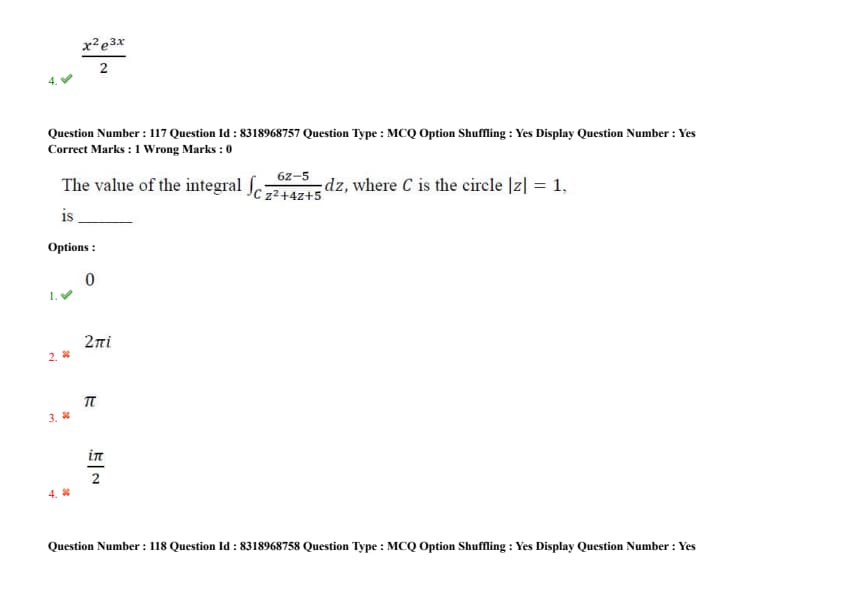
  • (4) \(\dfrac{x^2 e^{3x}}{2}\)

Question 117:

The value of the integral
\[ \int_C \frac{6z - 5}{z^2 + 4z + 5} \, dz, \quad where C is the circle |z| = 1, is ............ \]

  • (1) 0
  • (2) \(2\pi i\)
  • (3) \(\pi\)
  • (4) \(\frac{i\pi}{2}\)

Question 118:

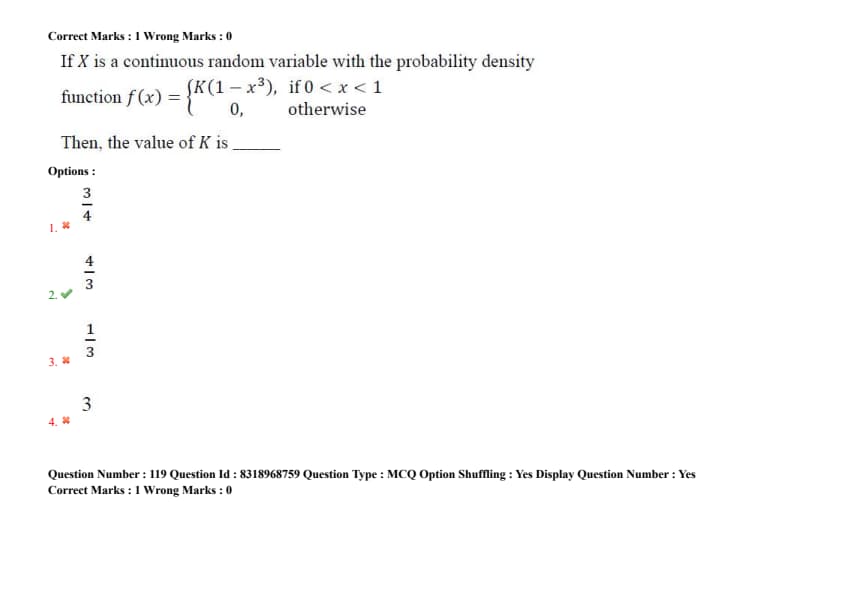
If \(X\) is a continuous random variable with the probability density
\[ f(x) = \begin{cases} K(1 - x^3), & 0 < x < 1
0, & otherwise \end{cases} \]
Then, the value of \(K\) is ............

  • (1) \(\dfrac{3}{4}\)
  • (2) \(\dfrac{4}{3}\)
  • (3) \(\dfrac{1}{3}\)
  • (4) \(3\)

Question 119:

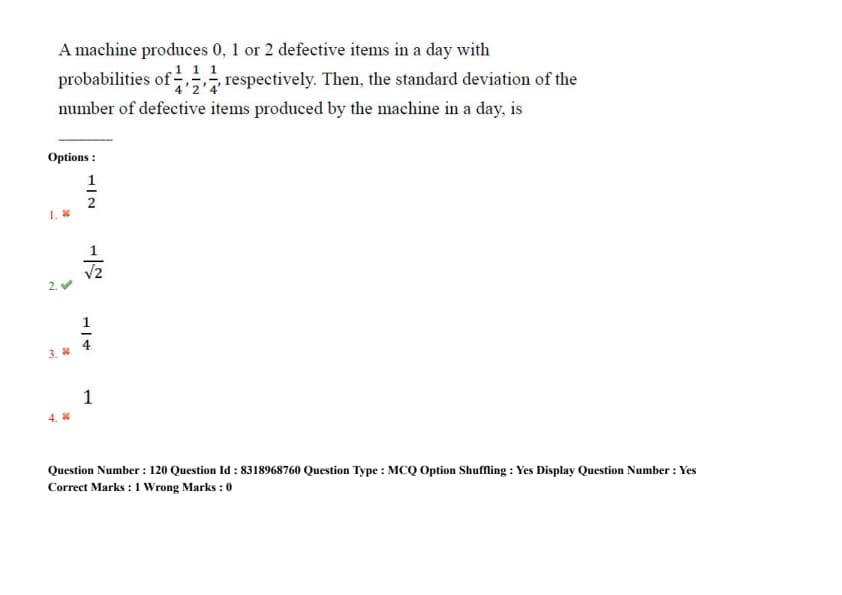
A machine produces 0, 1 or 2 defective items in a day with probabilities of \(\frac{1}{4}, \frac{1}{2}, \frac{1}{4}\) respectively. Then, the standard deviation of the number of defective items produced by the machine in a day is ............

  • (1) \(\dfrac{1}{2}\)
  • (2) \(\dfrac{1}{\sqrt{2}}\)
  • (3) \(\dfrac{1}{4}\)
  • (4) \(1\)

Question 120:

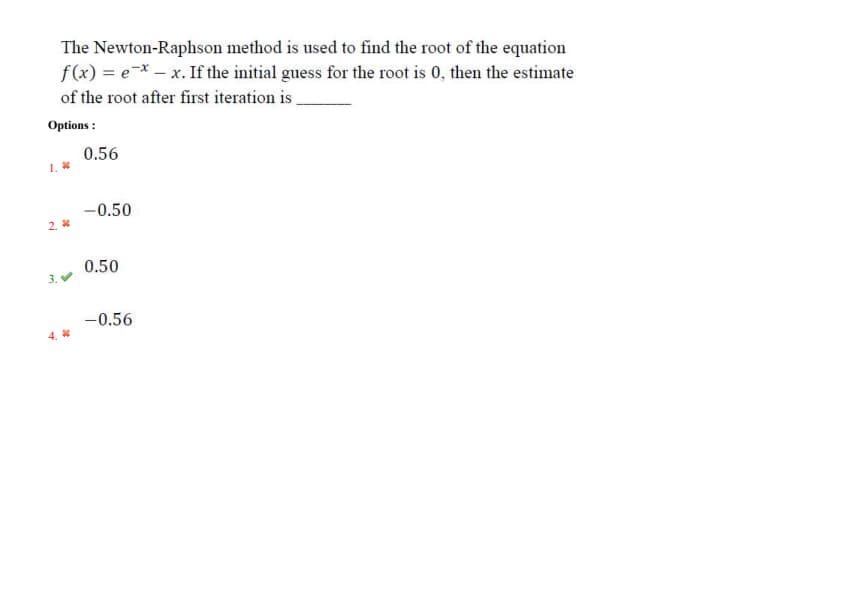
The Newton-Raphson method is used to find the root of the equation
\[ f(x) = e^{-x} - x \]
If the initial guess for the root is 0, then the estimate of the root after the first iteration is ............

  • (1) 0.56
  • (2) -0.50
  • (3) 0.50
  • (4) -0.56