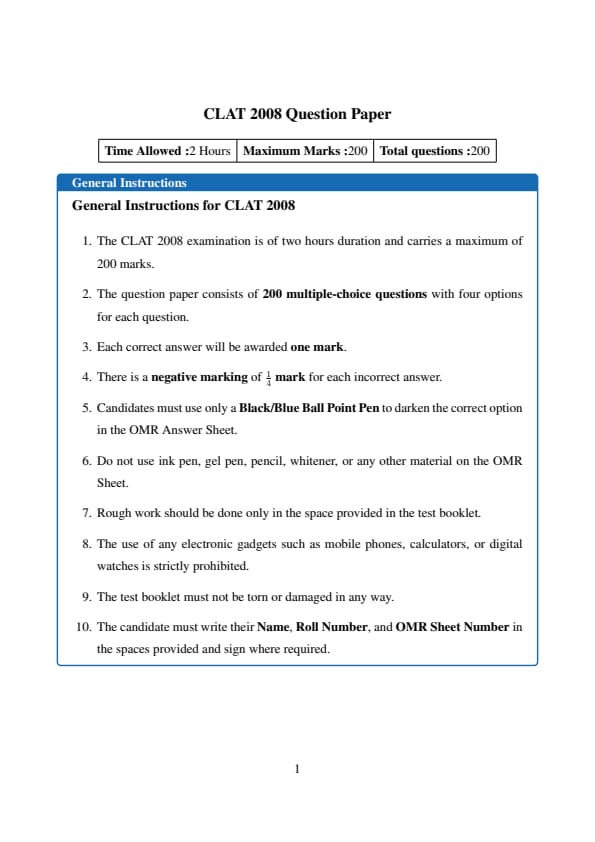
CLAT 2008 Common Question paper with answer key pdf conducted on May 11, 2008 in Afternoon Session 3:00 PM to 5:00 PM is available for download. The exam was successfully organized by Rajiv Gandhi National Law University. In terms of difficulty level, CLAT was of Easy to Moderate level. The question paper comprised a total of 200 questions divided among five sections.

Also Check:

CLAT 2008 Common Question Paper with Solution PDF

CLAT 2008 Common Question Paper with Answer Key Download PDF Check Solutions
CLAT 2008 Question Paper with solution


Question 1:

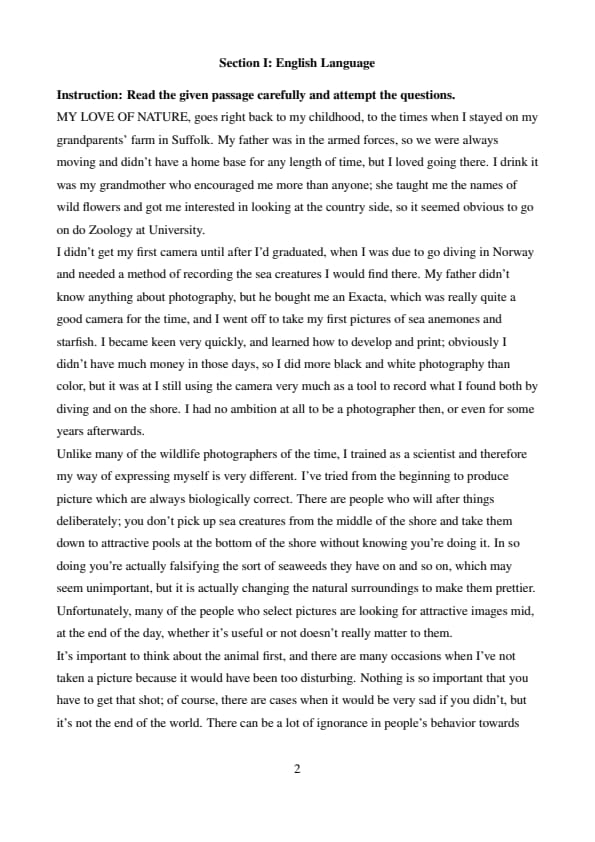
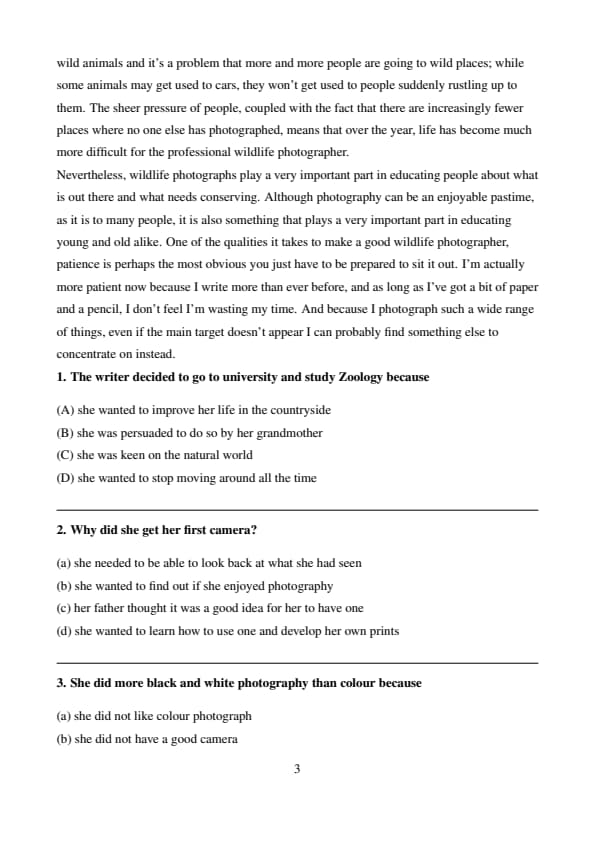
The writer decided to go to university and study Zoology because

  • (A) she wanted to improve her life in the countryside
  • (B) she was persuaded to do so by her grandmother
  • (C) she was keen on the natural world
  • (D) she wanted to stop moving around all the time
Correct Answer: (C) she was keen on the natural world
View Solution
Question 2:

Why did she get her first camera?

  • (a) she needed to be able to look back at what she had seen
  • (b) she wanted to find out if she enjoyed photography
  • (c) her father thought it was a good idea for her to have one
  • (d) she wanted to learn how to use one and develop her own prints
Correct Answer: (a) she needed to be able to look back at what she had seen
View Solution
Question 3:

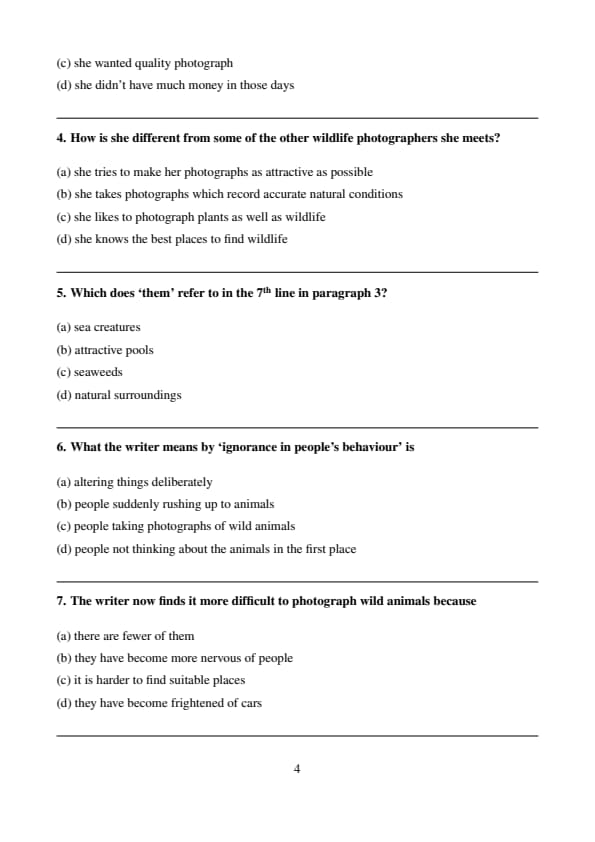
She did more black and white photography than colour because

  • (a) she did not like colour photograph
  • (b) she did not have a good camera
  • (c) she wanted quality photograph
  • (d) she didn’t have much money in those days
Correct Answer: (d) she didn’t have much money in those days
View Solution
Question 4:

How is she different from some of the other wildlife photographers she meets?

  • (a) she tries to make her photographs as attractive as possible
  • (b) she takes photographs which record accurate natural conditions
  • (c) she likes to photograph plants as well as wildlife
  • (d) she knows the best places to find wildlife
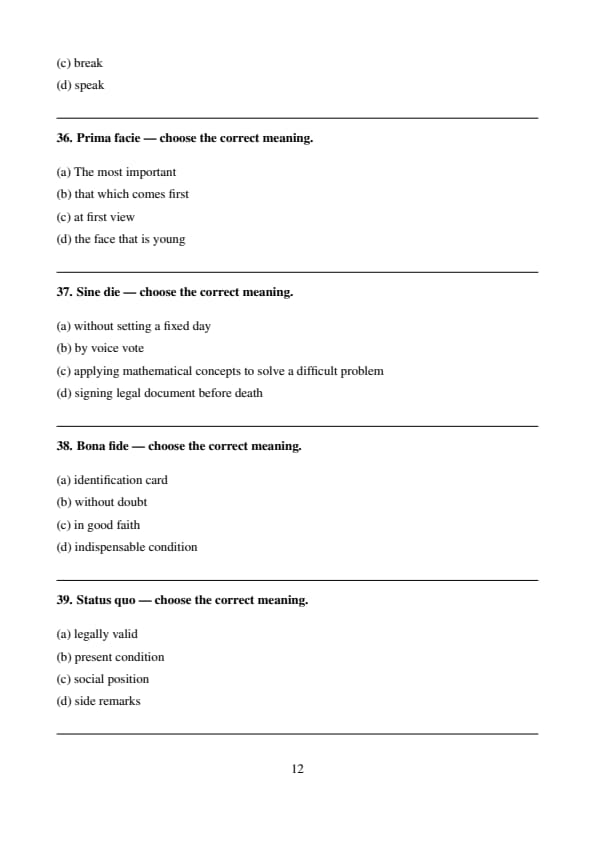
Correct Answer: (b) she takes photographs which record accurate natural conditions
View Solution
Question 5:

Which does ‘them’ refer to in the 7th line in paragraph 3?

  • (a) sea creatures
  • (b) attractive pools
  • (c) seaweeds
  • (d) natural surroundings
Correct Answer: (d) natural surroundings
View Solution
Question 6:

What the writer means by ‘ignorance in people’s behaviour’ is

  • (a) altering things deliberately
  • (b) people suddenly rushing up to animals
  • (c) people taking photographs of wild animals
  • (d) people not thinking about the animals in the first place
Correct Answer: (b) people suddenly rushing up to animals
View Solution
Question 7:

The writer now finds it more difficult to photograph wild animals because

  • (a) there are fewer of them
  • (b) they have become more nervous of people
  • (c) it is harder to find suitable places
  • (d) they have become frightened of cars
Correct Answer: (c) it is harder to find suitable places
View Solution
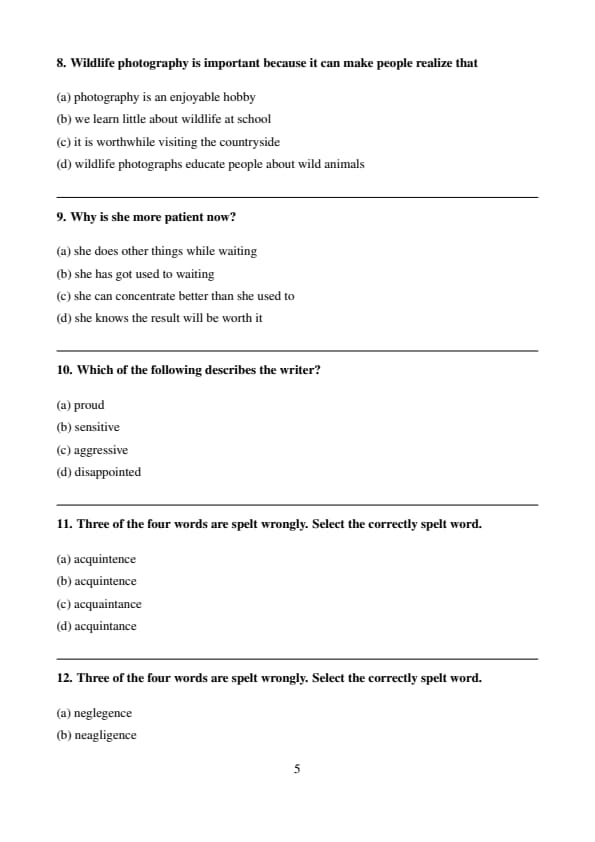
Question 8:

Wildlife photography is important because it can make people realize that

  • (a) photography is an enjoyable hobby
  • (b) we learn little about wildlife at school
  • (c) it is worthwhile visiting the countryside
  • (d) wildlife photographs educate people about wild animals
Correct Answer: (d) wildlife photographs educate people about wild animals
View Solution
Question 9:

Why is she more patient now?

  • (a) she does other things while waiting
  • (b) she has got used to waiting
  • (c) she can concentrate better than she used to
  • (d) she knows the result will be worth it
Correct Answer: (a) she does other things while waiting
View Solution
Question 10:

Which of the following describes the writer?

  • (a) proud
  • (b) sensitive
  • (c) aggressive
  • (d) disappointed
Correct Answer: (a) proud
View Solution
Question 11:
Three of the four words are spelt wrongly. Select the correctly spelt word.

  • (a) acquintence
  • (b) acquintence
  • (c) acquaintance
  • (d) acquintance
Correct Answer: (c) \textbf{acquaintance}
View Solution
Question 12:
Three of the four words are spelt wrongly. Select the correctly spelt word.

  • (a) neglegence
  • (b) neagligence
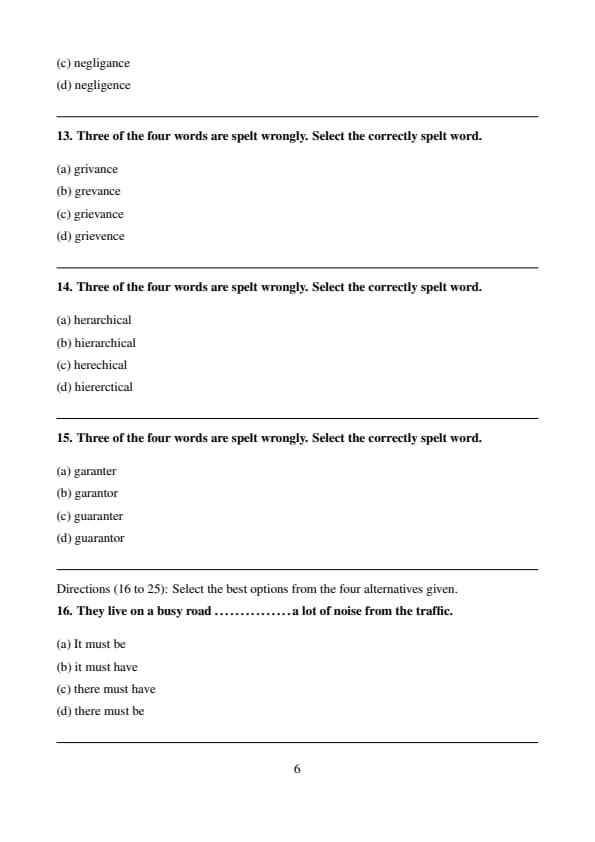
  • (c) negligance
  • (d) negligence
Correct Answer: (d) \textbf{negligence}
View Solution
Question 13:

Three of the four words are spelt wrongly. Select the correctly spelt word.

  • (a) grivance
  • (b) grevance
  • (c) grievance
  • (d) grievence
Correct Answer: (c) \textbf{grievance}
View Solution

Question 14:

Three of the four words are spelt wrongly. Select the correctly spelt word.

  • (a) herarchical
  • (b) hierarchical
  • (c) herechical
  • (d) hiererctical
Correct Answer: (b) \textbf{hierarchical}
View Solution

Question 15:

Three of the four words are spelt wrongly. Select the correctly spelt word.

  • (a) garanter
  • (b) garantor
  • (c) guaranter
  • (d) guarantor
Correct Answer: (d) \textbf{guarantor}
View Solution

Question 16:

They live on a busy road \dots\dots\dots\dots\dots a lot of noise from the traffic.

  • (a) It must be
  • (b) it must have
  • (c) there must have
  • (d) there must be
Correct Answer: (d) there must be
View Solution

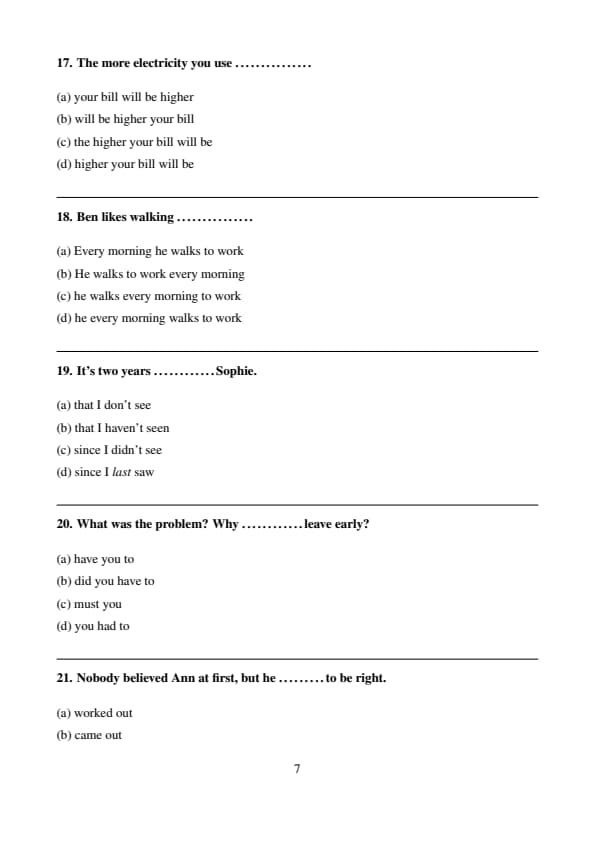
Question 17:

The more electricity you use \dots\dots\dots\dots\dots

  • (a) your bill will be higher
  • (b) will be higher your bill
  • (c) the higher your bill will be
  • (d) higher your bill will be
Correct Answer: (c) the higher your bill will be
View Solution

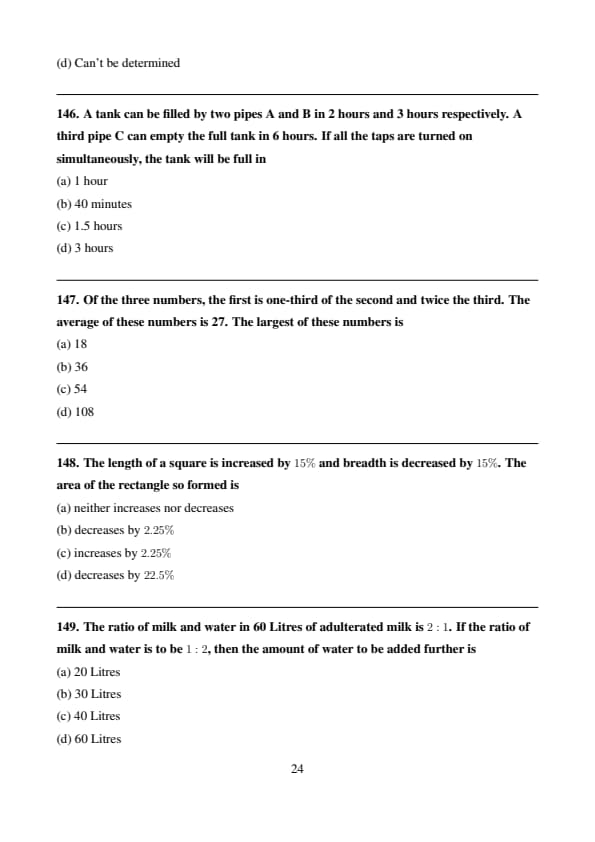
Question 18:

Ben likes walking \dots\dots\dots\dots\dots

  • (a) Every morning he walks to work
  • (b) He walks to work every morning
  • (c) he walks every morning to work
  • (d) he every morning walks to work
Correct Answer: (a) Every morning he walks to work
View Solution

Question 19:

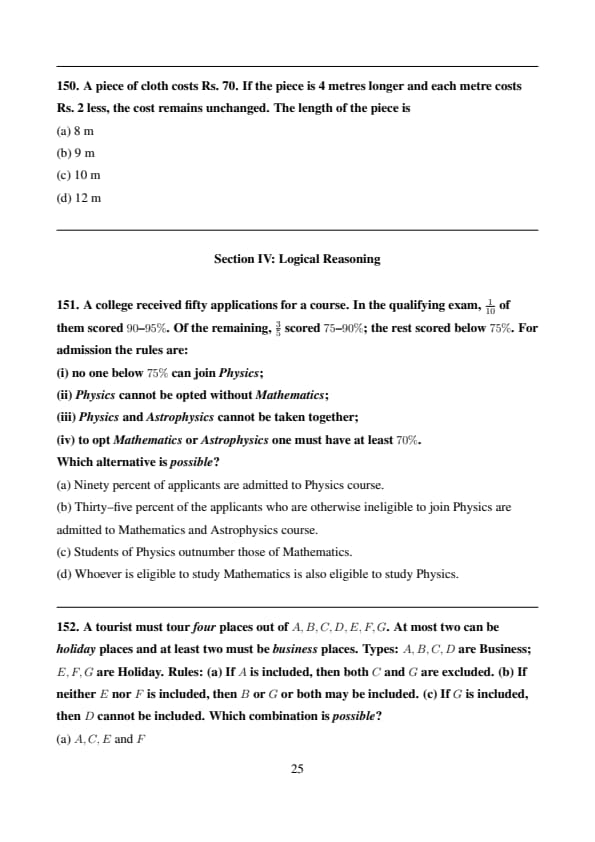
It’s two years \dots\dots\dots\dots Sophie.

  • (a) that I don’t see
  • (b) that I haven’t seen
  • (c) since I didn’t see
  • (d) since I last saw
Correct Answer: (d) since I last saw
View Solution

Question 20:

What was the problem? Why \dots\dots\dots\dots leave early?

  • (a) have you to
  • (b) did you have to
  • (c) must you
  • (d) you had to
Correct Answer: (b) did you have to
View Solution

Question 21:

Nobody believed Ann at first, but he \dots\dots\dots to be right.

  • (a) worked out
  • (b) came out
  • (c) found out
  • (d) turned out
Correct Answer: (d) turned out
View Solution

Question 22:

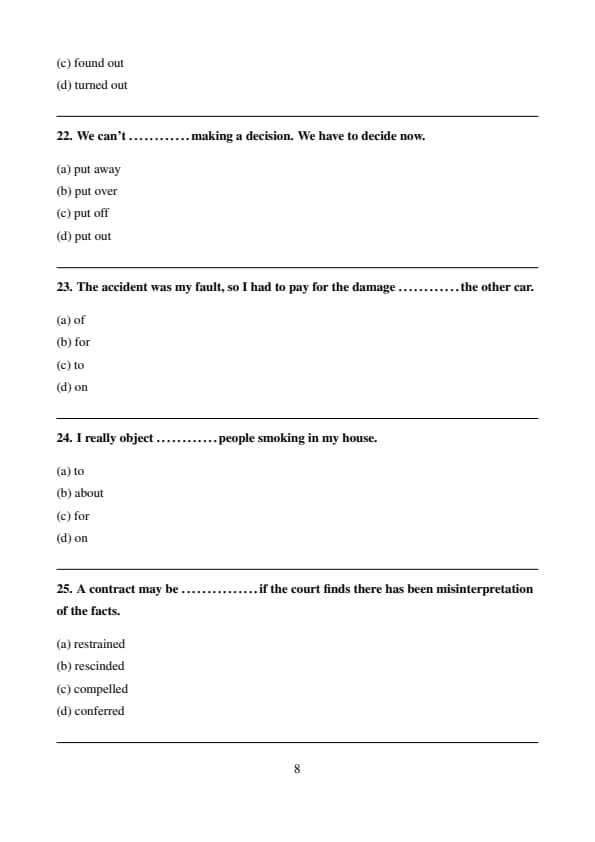
We can’t \dots\dots\dots\dots making a decision. We have to decide now.

  • (a) put away
  • (b) put over
  • (c) put off
  • (d) put out
Correct Answer: (c) put off
View Solution

Question 23:

The accident was my fault, so I had to pay for the damage \dots\dots\dots\dots the other car.

  • (a) of
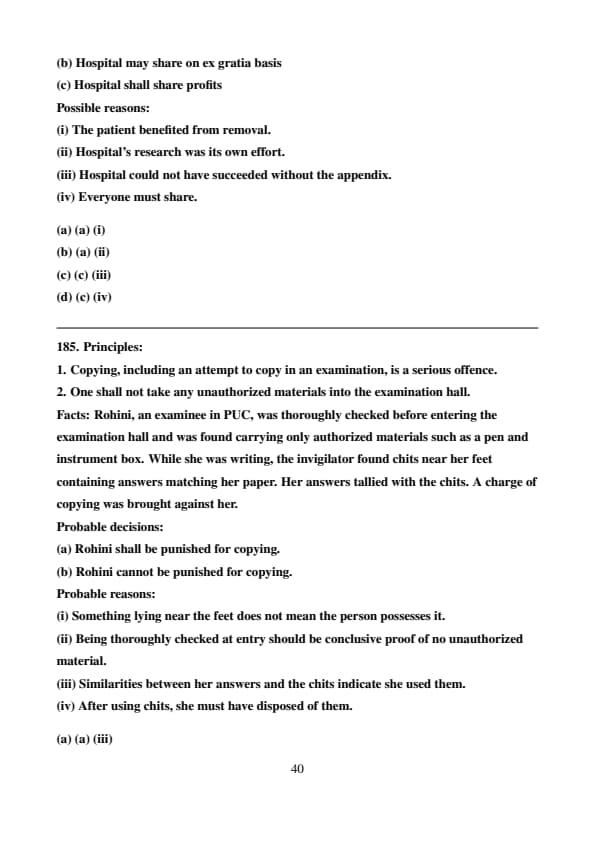
  • (b) for
  • (c) to
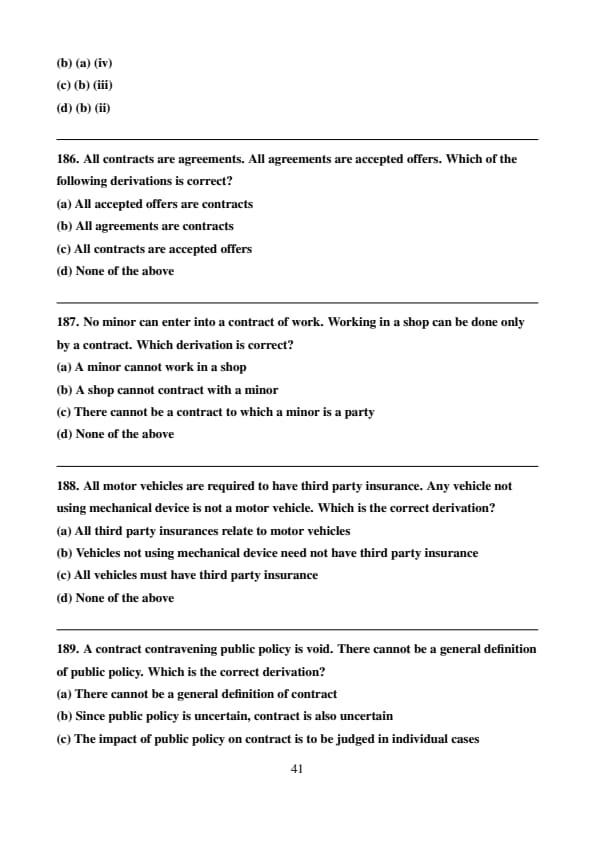
  • (d) on
Correct Answer: (c) to
View Solution

Question 24:

I really object \dots\dots\dots\dots people smoking in my house.

  • (a) to
  • (b) about
  • (c) for
  • (d) on
Correct Answer: (a) to
View Solution

Question 25:

A contract may be \dots\dots\dots\dots\dots if the court finds there has been misinterpretation of the facts.

  • (a) restrained
  • (b) rescinded
  • (c) compelled
  • (d) conferred
Correct Answer: (b) \textbf{rescinded}
View Solution

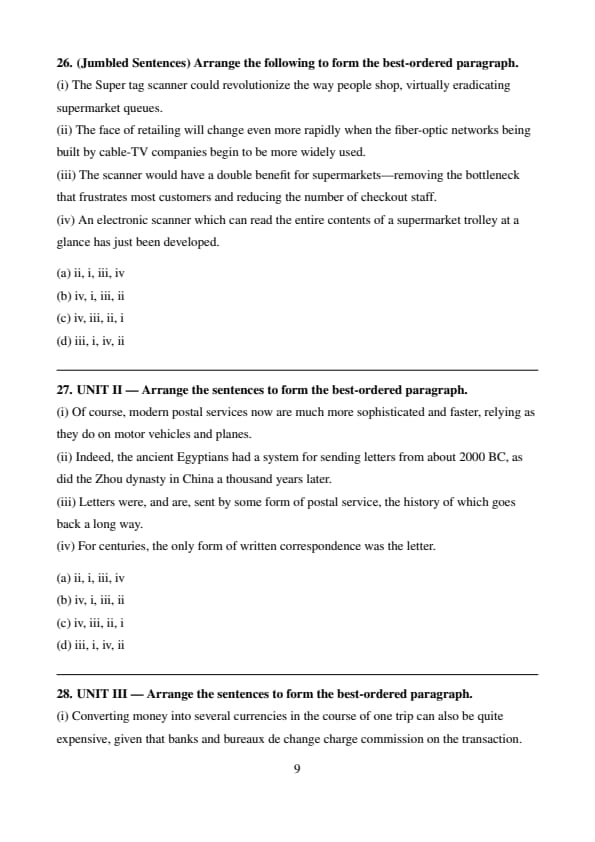
Question 26:

(Jumbled Sentences) Arrange the following to form the best-ordered paragraph.

(i) The Super tag scanner could revolutionize the way people shop, virtually eradicating supermarket queues.

(ii) The face of retailing will change even more rapidly when the fiber-optic networks being built by cable-TV companies begin to be more widely used.

(iii) The scanner would have a double benefit for supermarkets—removing the bottleneck that frustrates most customers and reducing the number of checkout staff.

(iv) An electronic scanner which can read the entire contents of a supermarket trolley at a glance has just been developed.

  • (a) ii, i, iii, iv
  • (b) iv, i, iii, ii
  • (c) iv, iii, ii, i
  • (d) iii, i, iv, ii
Correct Answer: (b) \textbf{iv, i, iii, ii}
View Solution

Question 27:

UNIT II — Arrange the sentences to form the best-ordered paragraph.

(i) Of course, modern postal services now are much more sophisticated and faster, relying as they do on motor vehicles and planes.

(ii) Indeed, the ancient Egyptians had a system for sending letters from about 2000 BC, as did the Zhou dynasty in China a thousand years later.

(iii) Letters were, and are, sent by some form of postal service, the history of which goes back a long way.

(iv) For centuries, the only form of written correspondence was the letter.

  • (a) ii, i, iii, iv
  • (b) iv, i, iii, ii
  • (c) iv, iii, ii, i
  • (d) iii, i, iv, ii
Correct Answer: (c) \textbf{iv, iii, ii, i}
View Solution

Question 28:

UNIT III — Arrange the sentences to form the best-ordered paragraph.

(i) Converting money into several currencies in the course of one trip can also be quite expensive, given that banks and bureaux de change charge commission on the transaction.

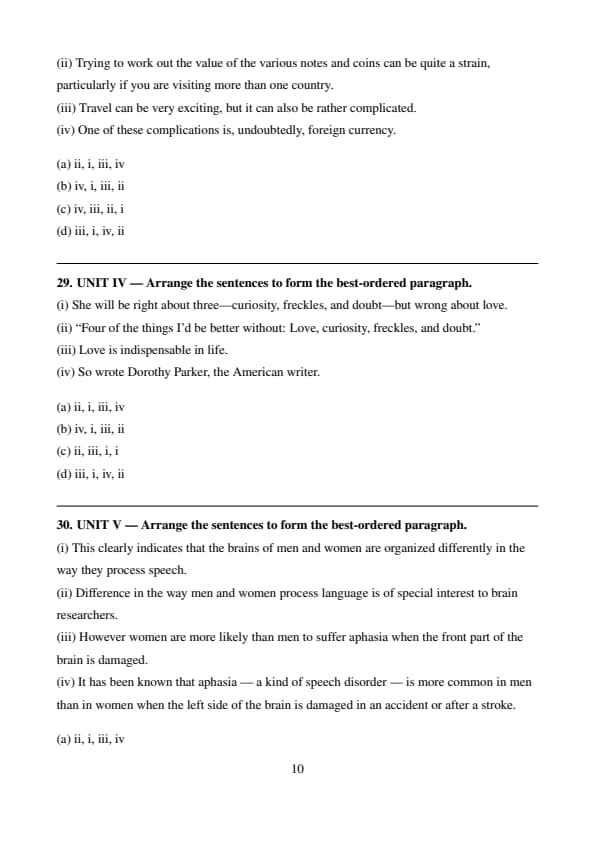
(ii) Trying to work out the value of the various notes and coins can be quite a strain, particularly if you are visiting more than one country.

(iii) Travel can be very exciting, but it can also be rather complicated.

(iv) One of these complications is, undoubtedly, foreign currency.

  • (a) ii, i, iii, iv
  • (b) iv, i, iii, ii
  • (c) iv, iii, ii, i
  • (d) iii, i, iv, ii
Correct Answer: (d) \textbf{iii, i, iv, ii}
View Solution

Question 29:

UNIT IV — Arrange the sentences to form the best-ordered paragraph.

(i) She will be right about three—curiosity, freckles, and doubt—but wrong about love.

(ii) “Four of the things I’d be better without: Love, curiosity, freckles, and doubt.”

(iii) Love is indispensable in life.

(iv) So wrote Dorothy Parker, the American writer.

  • (a) ii, i, iii, iv
  • (b) iv, i, iii, ii
  • (c) ii, iii, i, i
  • (d) iii, i, iv, ii
Correct Answer: (d) \textbf{iii, i, iv, ii}
View Solution

Question 30:

UNIT V — Arrange the sentences to form the best-ordered paragraph.

(i) This clearly indicates that the brains of men and women are organized differently in the way they process speech.

(ii) Difference in the way men and women process language is of special interest to brain researchers.

(iii) However women are more likely than men to suffer aphasia when the front part of the brain is damaged.

(iv) It has been known that aphasia — a kind of speech disorder — is more common in men than in women when the left side of the brain is damaged in an accident or after a stroke.

  • (a) ii, i, iii, iv
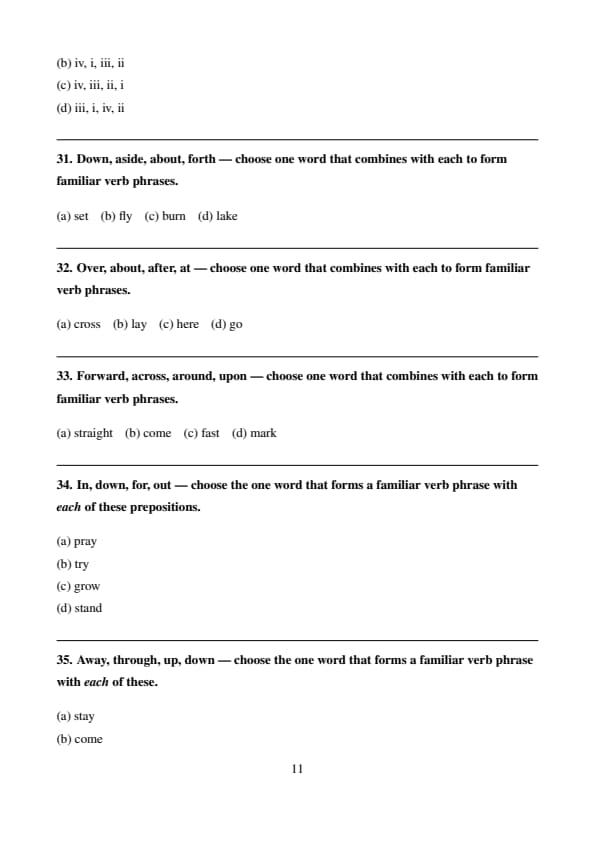
  • (b) iv, i, iii, ii
  • (c) iv, iii, ii, i
  • (d) iii, i, iv, ii
Correct Answer: (d) \textbf{iii, i, iv, ii}
View Solution

Question 31:

Down, aside, about, forth — choose one word that combines with each to form familiar verb phrases.

  • (a) set \hspace{0.2cm} (b) fly \hspace{0.2cm} (c) burn \hspace{0.2cm} (d) lake
Correct Answer: (a) \textbf{set}
View Solution

Question 32:

Over, about, after, at — choose one word that combines with each to form familiar verb phrases.

  • (a) cross \hspace{0.2cm} (b) lay \hspace{0.2cm} (c) here \hspace{0.2cm} (d) go
Correct Answer: (d) \textbf{go}
View Solution

Question 33:

Forward, across, around, upon — choose one word that combines with each to form familiar verb phrases.

  • (a) straight \hspace{0.2cm} (b) come \hspace{0.2cm} (c) fast \hspace{0.2cm} (d) mark
Correct Answer: (b) \textbf{come}
View Solution

Question 34:

In, down, for, out — choose the one word that forms a familiar verb phrase with \emph{each} of these prepositions.

  • (a) pray
  • (b) try
  • (c) grow
  • (d) stand
Correct Answer: (d) \textbf{stand}
View Solution

Question 35:

Away, through, up, down — choose the one word that forms a familiar verb phrase with \emph{each} of these.

  • (a) stay
  • (b) come
  • (c) break
  • (d) speak
Correct Answer: (c) \textbf{break}
View Solution

Question 36:

Prima facie — choose the correct meaning.

  • (a) The most important
  • (b) that which comes first
  • (c) at first view
  • (d) the face that is young
Correct Answer: (c) \textbf{at first view}
View Solution

Question 37:

Sine die — choose the correct meaning.

  • (a) without setting a fixed day
  • (b) by voice vote
  • (c) applying mathematical concepts to solve a difficult problem
  • (d) signing legal document before death
Correct Answer: (a) \textbf{without setting a fixed day}
View Solution

Question 38:

Bona fide — choose the correct meaning.

  • (a) identification card
  • (b) without doubt
  • (c) in good faith
  • (d) indispensable condition
Correct Answer: (c) \textbf{in good faith}
View Solution

Question 39:

Status quo — choose the correct meaning.

  • (a) legally valid
  • (b) present condition
  • (c) social position
  • (d) side remarks
Correct Answer: (b) \textbf{present condition}
View Solution

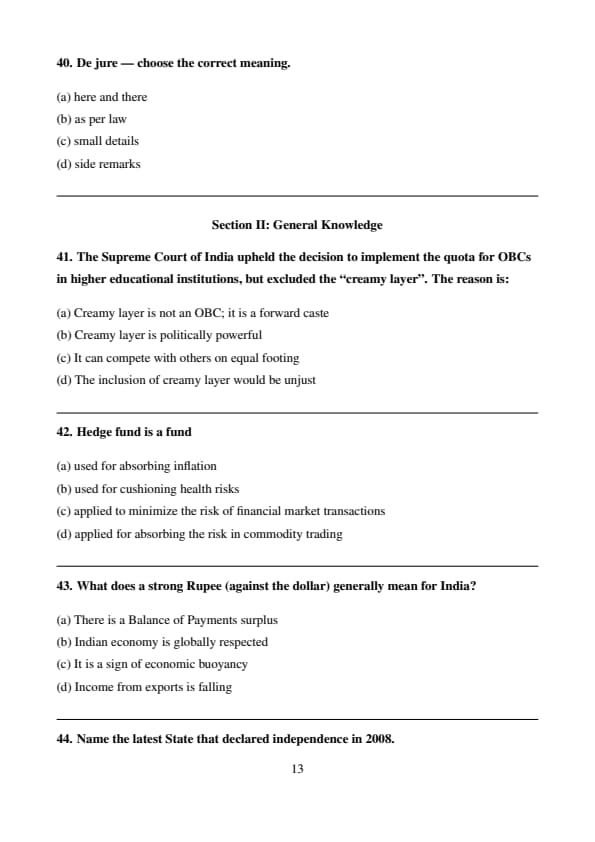
Question 40:

De jure — choose the correct meaning.

  • (a) here and there
  • (b) as per law
  • (c) small details
  • (d) side remarks
Correct Answer: (b) \textbf{as per law}
View Solution

Question 41:

The Supreme Court of India upheld the decision to implement the quota for OBCs in higher educational institutions, but excluded the “creamy layer”. The reason is:

  • (a) Creamy layer is not an OBC; it is a forward caste
  • (b) Creamy layer is politically powerful
  • (c) It can compete with others on equal footing
  • (d) The inclusion of creamy layer would be unjust
Correct Answer: (d) The inclusion of creamy layer would be unjust
View Solution

Question 42:

Hedge fund is a fund

  • (a) used for absorbing inflation
  • (b) used for cushioning health risks
  • (c) applied to minimize the risk of financial market transactions
  • (d) applied for absorbing the risk in commodity trading
Correct Answer: (c) applied to minimize the risk of financial market transactions
View Solution

Question 43:

What does a strong Rupee (against the dollar) generally mean for India?

  • (a) There is a Balance of Payments surplus
  • (b) Indian economy is globally respected
  • (c) It is a sign of economic buoyancy
  • (d) Income from exports is falling
Correct Answer: (a) There is a Balance of Payments surplus
View Solution

Question 44:

Name the latest State that declared independence in 2008.

  • (a) Serbia \hspace{0.4cm} (b) Kosovo \hspace{0.4cm} (c) Kurdistan \hspace{0.4cm} (d) Tibet
Correct Answer: (b) Kosovo
View Solution

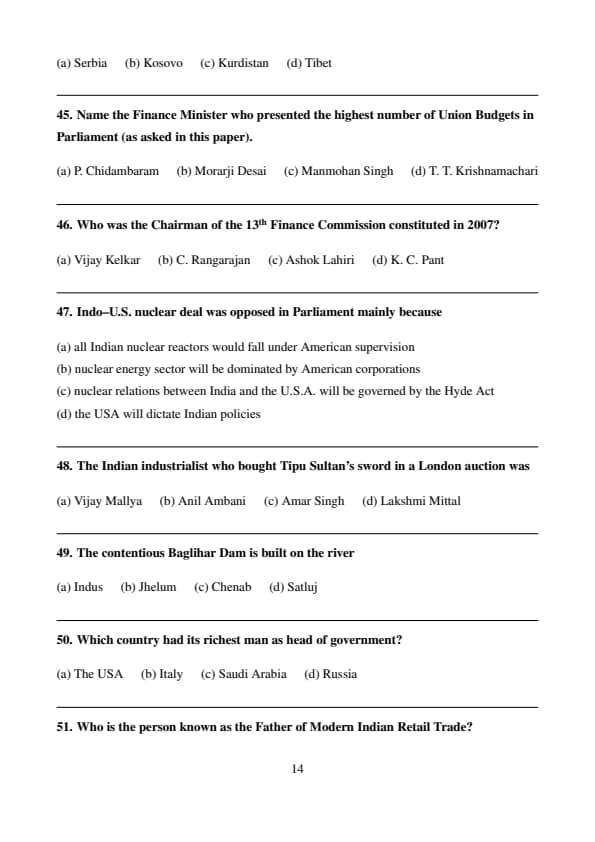
Question 45:

Name the Finance Minister who presented the highest number of Union Budgets in Parliament (as asked in this paper).

  • (a) P. Chidambaram \hspace{0.4cm} (b) Morarji Desai \hspace{0.4cm} (c) Manmohan Singh \hspace{0.4cm} (d) T. T. Krishnamachari
Correct Answer:
View Solution

Question 46:

Who was the Chairman of the 13th Finance Commission constituted in 2007?

  • (a) Vijay Kelkar \hspace{0.4cm} (b) C. Rangarajan \hspace{0.4cm} (c) Ashok Lahiri \hspace{0.4cm} (d) K. C. Pant
Correct Answer: (a) Vijay Kelkar
View Solution

Question 47:

Indo–U.S. nuclear deal was opposed in Parliament mainly because

  • (a) all Indian nuclear reactors would fall under American supervision
  • (b) nuclear energy sector will be dominated by American corporations
  • (c) nuclear relations between India and the U.S.A. will be governed by the Hyde Act
  • (d) the USA will dictate Indian policies
Correct Answer: (c) nuclear relations between India and the U.S.A. will be governed by the Hyde Act
View Solution

Question 48:

The Indian industrialist who bought Tipu Sultan’s sword in a London auction was

  • (a) Vijay Mallya \hspace{0.4cm} (b) Anil Ambani \hspace{0.4cm} (c) Amar Singh \hspace{0.4cm} (d) Lakshmi Mittal
Correct Answer: (a) Vijay Mallya
View Solution

Question 49:

The contentious Baglihar Dam is built on the river

  • (a) Indus \hspace{0.4cm} (b) Jhelum \hspace{0.4cm} (c) Chenab \hspace{0.4cm} (d) Satluj
Correct Answer: (c) Chenab
View Solution

Question 50:

Which country had its richest man as head of government?

  • (a) The USA \hspace{0.4cm} (b) Italy \hspace{0.4cm} (c) Saudi Arabia \hspace{0.4cm} (d) Russia
Correct Answer: (b) Italy
View Solution

Question 51:

Who is the person known as the Father of Modern Indian Retail Trade?

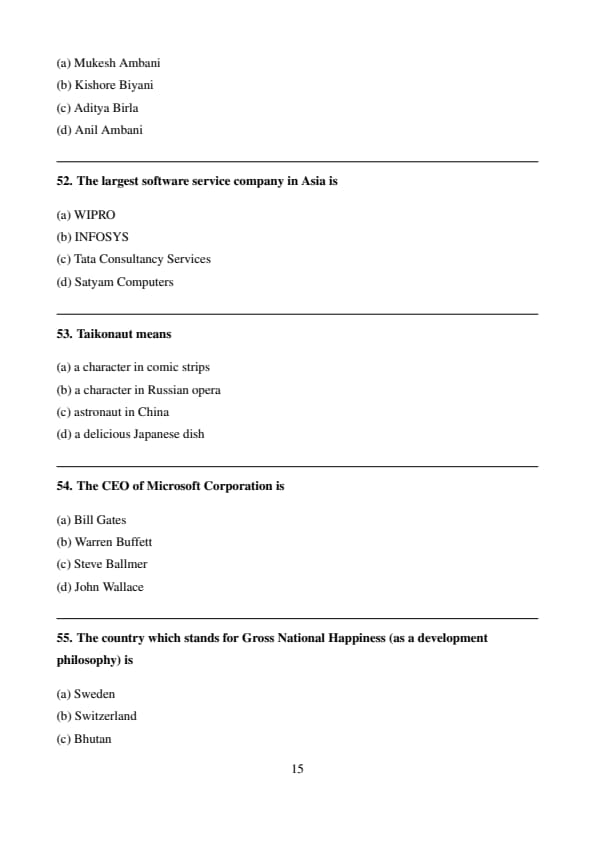
  • (a) Mukesh Ambani
  • (b) Kishore Biyani
  • (c) Aditya Birla
  • (d) Anil Ambani
Correct Answer: (b) \textbf{Kishore Biyani}
View Solution

Question 52:

The largest software service company in Asia is

  • (a) WIPRO
  • (b) INFOSYS
  • (c) Tata Consultancy Services
  • (d) Satyam Computers
Correct Answer: (c) \textbf{Tata Consultancy Services (TCS)}
View Solution

Question 53:

Taikonaut means

  • (a) a character in comic strips
  • (b) a character in Russian opera
  • (c) astronaut in China
  • (d) a delicious Japanese dish
Correct Answer: (c) \textbf{astronaut in China}
View Solution

Question 54:

The CEO of Microsoft Corporation is

  • (a) Bill Gates
  • (b) Warren Buffett
  • (c) Steve Ballmer
  • (d) John Wallace
Correct Answer: (c) \textbf{Steve Ballmer}
View Solution

Question 55:

The country which stands for Gross National Happiness (as a development philosophy) is

  • (a) Sweden
  • (b) Switzerland
  • (c) Bhutan
  • (d) Finland
Correct Answer: (c) \textbf{Bhutan}
View Solution

Question 56:

The highest paid head of government in the world (at the time of this paper) is in

  • (a) The USA
  • (b) Russian Federation
  • (c) Singapore
  • (d) Japan
Correct Answer: (c) \textbf{Singapore}
View Solution

Question 57:

The current impasse in the Doha Round of WTO Negotiations is centered around

  • (a) access to cheaper drugs
  • (b) access to market of developed countries
  • (c) agricultural subsidies provided by developed countries
  • (d) removal of non-tariff barriers
Correct Answer:
View Solution

Question 58:

The phenomenon called “Equinox” is due to the

  • (a) rotation of the Earth on its own axis
  • (b) revolution of the Earth on its inclined axis
  • (c) oblate–spheroid shape of the Earth
  • (d) gravitational pull of the planet
Correct Answer: (c) \textbf{oblate–spheroid shape of the Earth}
View Solution

Question 59:

The Director-General of the World Trade Organization is

  • (a) Renalto Ruggiero
  • (b) Pascal Lamy
  • (c) Arthur Dunkell
  • (d) Oliver Long
Correct Answer: (b) \textbf{Pascal Lamy}
View Solution

Question 60:

Capital account convertibility signifies

  • (a) guaranteeing the right to investment to foreigners
  • (b) ensuring the right of buyers to make international payments
  • (c) ensuring free international movement of capital
  • (d) ensuring the right of an individual to invest in foreign capital markets
Correct Answer: (c) \textbf{ensuring free international movement of capital}
View Solution

Question 61:

The purpose of the Kyoto Protocol is

  • (a) to promote tourism
  • (b) to contribute sustainable development
  • (c) to promote renewable sources of energy
  • (d) to put a limit on greenhouse gas emissions by states
Correct Answer: (d) \textbf{to put a limit on greenhouse-gas emissions by states}
View Solution

Question 62:

What do carbon credits signify?

  • (a) Credits given in the course of carbon products sales
  • (b) Entitlements to emit certain quantity of greenhouse gases
  • (c) Permissible amount of Carbon dioxide in the atmosphere
  • (d) The extent of carbon required to ensure sustainable development
Correct Answer: (b) Entitlements to emit certain quantity of greenhouse gases
View Solution

Question 63:

The practice of selling goods in a foreign country at a price below their domestic selling price is called

  • (a) discrimination
  • (b) dumping
  • (c) double pricing
  • (d) predatory pricing
Correct Answer: (b) dumping
View Solution

Question 64:

Which of the following is considered the bulwark of personal freedom?

  • (a) Mandamus
  • (b) Habeas Corpus
  • (c) Certiorari
  • (d) Quo Warranto
Correct Answer: (b) Habeas Corpus
View Solution

Question 65:

\emph{Vande Mataram} is composed by

  • (a) Rabindranath Tagore
  • (b) Sharatchandra Chatterji
  • (c) Bankimchandra Chatterjee
  • (d) Surendranath Banerjee
Correct Answer: (c) Bankimchandra Chatterjee
View Solution

Question 66:

How many minutes does local time vary per degree of longitude from Greenwich time?

  • (a) Four minutes
  • (b) Two minutes
  • (c) Eight minutes
  • (d) Ten minutes
Correct Answer: (a) Four minutes
View Solution

Question 67:

Article 1 of the Indian Constitution defines India as a

  • (a) Federal State
  • (b) Unitary State
  • (c) Union of States
  • (d) Quasi-Federal State
Correct Answer: (c) Union of States
View Solution

Question 68:

Which is the highest body that approves Five Year Plans in India (Planning Commission era)?

  • (a) Parliament
  • (b) Planning Commission
  • (c) National Development Council
  • (d) Council of Ministers
Correct Answer: (c) National Development Council
View Solution

Question 69:

The economist who first scientifically determined national income in India is

  • (a) Dr. D. R. Gadgil
  • (b) Dr. V. K. R. V. Rao
  • (c) Dr. Manmohan Singh
  • (d) Dr. Y. V. Alagh
Correct Answer: (b) Dr. V. K. R. V. Rao
View Solution

Question 70:

Which of the following is the largest peninsula in the world?

  • (a) Indian Peninsula
  • (b) Arabian Peninsula
  • (c) Malay Peninsula
  • (d) Chinese Peninsula
Correct Answer: (b) Arabian Peninsula
View Solution

Question 71:

The person responsible for the economic model for Indian Planning is

  • (a) Jawaharlal Nehru
  • (b) P. C. Mahalanobis
  • (c) Tarlok Singh
  • (d) V. T. Krishnamachari
Correct Answer: (a) Jawaharlal Nehru
View Solution

Question 72:

Social Forestry aims at

  • (a) Ensuring fuel and forest produce to weaker sections
  • (b) Medicinal and fruit plantation
  • (c) Large scale afforestation
  • (d) Scientific forestry
Correct Answer: (c) Large scale afforestation
View Solution

Question 73:

The Great Barrier Reef refers to

  • (a) Coral formation
  • (b) Tidal waves
  • (c) Hill range
  • (d) Man-made walls
Correct Answer: (a) Coral formation
View Solution

Question 74:

A nautical mile is equal to

  • (a) 1825 metres
  • (b) 2000 metres
  • (c) 1575 metres
  • (d) 2050 metres
Correct Answer: (a) 1825 metres
View Solution

Question 75:

Which of the following is concerned with land forms?

  • (a) Geology
  • (b) Geomorphology
  • (c) Ecology
  • (d) Geography
Correct Answer: (b) Geomorphology
View Solution

Question 76:

The country known as the \emph{Land of the Midnight Sun} is

  • (a) Sweden
  • (b) Norway
  • (c) Finland
  • (d) Denmark
Correct Answer: (b) Norway
View Solution

Question 77:

The monk who spread Buddhism in Tibet and the Far East is

  • (a) Ananda
  • (b) Nagarjuna
  • (c) Padmasambhava
  • (d) Mahendra
Correct Answer: (c) Padmasambhava
View Solution

Question 78:

TRIPS, a WTO agreement, is intended

  • (a) to provide for stronger patent protection
  • (b) to promote transnational corporate interests
  • (c) to harmonize IPR regime internationally
  • (d) to replace the World Intellectual Property Organization
Correct Answer: (c) to harmonize IPR regime internationally
View Solution

Question 79:

The carbon dating method is used to determine the age of

  • (a) Rocks
  • (b) Fossils
  • (c) Trees
  • (d) Ancient monuments
Correct Answer: (b) Fossils
View Solution

Question 80:

The Managing Director of Delhi Metro Rail Corporation (DMRC) was

  • (a) Chairman of Indian Railway Board
  • (b) Lt. Governor of Delhi
  • (c) C. Sreedharan
  • (d) Sheela Dikshit
Correct Answer: (c) C. Sreedharan
View Solution

Question 81:

18 carat gold signifies

  • (a) 18 parts of gold and 82 parts of other metal
  • (b) 18 parts of gold and 6 parts of other metal
  • (c) 82 parts of gold and 18 parts of other metal
  • (d) None of the above
Correct Answer: (c) 82 parts of gold and 18 parts of other metal
View Solution

Question 82:

The Bali Road Map adopted in December 2007 provides for

  • (a) fixation of greenhouse gas emission limits
  • (b) launching of an adaptation fund
  • (c) amendment to UN Framework Convention on Climate Change
  • (d) special and differential treatment for developing countries
Correct Answer: (c) amendment to UN Framework Convention on Climate Change
View Solution

Question 83:

Enriched uranium, used in a nuclear reactor, is

  • (a) uranium freed of all impurities
  • (b) uranium treated with radiation
  • (c) uranium mixed with isotopes
  • (d) uranium alloy with aluminium
Correct Answer: (c) uranium mixed with isotopes
View Solution

Question 84:

The scientist responsible for developing atomic energy in India is

  • (a) C. V. Raman
  • (b) H. J. Bhabha
  • (c) H. K. Sethna
  • (d) Vikram Sarabhai
Correct Answer: (b) H. J. (Homi Jehangir) Bhabha
View Solution

Question 85:

Salwa Judum, practised in certain places in India, refers to

  • (a) witchcraft
  • (b) arming civilians to fight militants
  • (c) training civilians in the use of firearms
  • (d) training civilians to be home guards
Correct Answer: (b) arming civilians to fight militants
View Solution

Question 86:

Indian who won the Ramon Magsaysay Award in 2007:

  • (a) Arun Roy
  • (b) P. Sainath
  • (c) Medha Patkar
  • (d) Ruth Manorama
Correct Answer: (b) P. Sainath
View Solution

Question 87:

The person who won the Jawaharlal Nehru Award (for International Understanding) in 2007:

  • (a) Lula da Silva
  • (b) Hugo Chávez
  • (c) Aung San Suu Kyi
  • (d) Fidel Castro
Correct Answer: (a) Lula da Silva
View Solution

Question 88:

Free Trade Area means:

  • (a) The area where anything can be bought and sold
  • (b) Countries between whom trade barriers have been substantially reduced
  • (c) Countries which have common external tariff
  • (d) Countries which have common currency
Correct Answer: (b) Countries between whom trade barriers have been substantially reduced
View Solution

Question 89:

Affirmative action in the Indian context signifies:

  • (a) providing security to weaker sections
  • (b) welfare measures to alleviate the sufferings of poor people
  • (c) providing positive opportunities to deprived sections
  • (d) giving incentives to start industries
Correct Answer: (c) providing positive opportunities to deprived sections
View Solution

Question 90:

Special Economic Zones (SEZs) are:

  • (a) the places where industries can operate without any control
  • (b) the places wherein any person can start any industry
  • (c) the places where industries get certain tax advantages
  • (d) the places wherein the national labour laws do not apply
Correct Answer: (c) the places where industries get certain tax advantages
View Solution

Question 91:

The space shuttle which successfully carried Sunita Williams to space:

  • (a) Challenger
  • (b) Atlantis
  • (c) Discovery
  • (d) Columbus
Correct Answer: (c) Discovery
View Solution

Question 92:

The leader who led the country in atoning for the past wrongs:

  • (a) John Howard
  • (b) Desmond Tutu
  • (c) Kevin Rudd
  • (d) Jimmy Carter
Correct Answer: (a) John Howard
View Solution

Question 93:

Gandhiji expounded his economic ideas in

  • (a) Hindu Swaraj
  • (b) My Experiments with Truth
  • (c) Unto the Last
  • (d) Economics of Permanence
Correct Answer: (a) Hindu Swaraj
View Solution

Question 94:

Bio-fuels have become controversial because

  • (a) they increase environmental pollution
  • (b) they slow down industrialization
  • (c) they reduce food cultivation
  • (d) they lead to degeneration of soil
Correct Answer: (a) they increase environmental pollution
View Solution

Question 95:

Ever-greening of patents means

  • (a) granting patents in perpetuity
  • (b) granting patents for 100 years
  • (c) granting protection to incremental inventions having no substantial significance
  • (d) patenting of green technology
Correct Answer: (a) granting patents in perpetuity
View Solution

Question 96:

By signing which pact with Gandhiji did Dr. Ambedkar give up his demand for separate electorates?

  • (a) Poona Pact
  • (b) Aligarh Pact
  • (c) Deccan Pact
  • (d) Delhi Pact
Correct Answer: (a) Poona Pact
View Solution

Question 97:

India earns maximum foreign exchange from the export of

  • (a) Garments
  • (b) Jute
  • (c) Gems and Jewelleries
  • (d) Light engineering goods
Correct Answer: (a) Garments
View Solution

Question 98:

Sunita Williams, renowned astronaut of Indian origin, spent a record of \dots days in space

  • (a) 195
  • (b) 185
  • (c) 200
  • (d) 160
Correct Answer: (a) 195
View Solution

Question 99:

The second biggest greenhouse–gas emitter (after the USA) in the world is

  • (a) Russia
  • (b) Germany
  • (c) China
  • (d) Japan
Correct Answer: (c) China
View Solution

Question 100:

The author of the management principle “In a hierarchy, every employee tends to rise to his level of incompetence” is

  • (a) Prof. Ducker
  • (b) Prof. J. Peter
  • (c) Prof. C. H. Prahlad
  • (d) Prof. Schmitthoff
Correct Answer: (b) Prof. J. Peter
View Solution

Question 101:

The World Trade Organization was earlier known as

  • (a) UNCTAD
  • (b) GATT
  • (c) UNIDO
  • (d) UNCITRAL
Correct Answer: (b) GATT
View Solution

Question 102:

The “Wailing Wall” is associated with

  • (a) Christians
  • (b) Bahais
  • (c) Jews
  • (d) Shias
Correct Answer: (c) Jews
View Solution

Question 103:

An Education Minister who got Bharat Ratna in India was

  • (a) G. B. Pant
  • (b) M. C. Chagla
  • (c) Abul Kalam Azad
  • (d) Humayun Kabir
Correct Answer: (c) Abul Kalam Azad
View Solution

Question 104:

Why is the Ozone Layer important?

  • (a) It absorbs greenhouse gases
  • (b) It protects Earth from ultraviolet radiation
  • (c) It maintains Earth’s temperature
  • (d) It is a buffer against extra-terrestrial hazards
Correct Answer: (b) It protects Earth from ultraviolet radiation
View Solution

Question 105:

The world’s largest river is

  • (a) Brahmaputra
  • (b) Amazon
  • (c) Nile
  • (d) Mississippi
Correct Answer: (b) Amazon
View Solution

Question 106:

Tsunami is caused by

  • (a) plate tectonics
  • (b) underwater ridges
  • (c) underwater volcanic activity
  • (d) pressure from Earth’s core
Correct Answer: (c) underwater volcanic activity
View Solution

Question 107:

The Chipko movement is associated with

  • (a) preventing the felling of trees
  • (b) afforestation
  • (c) transparency in public life
  • (d) sustainable development
Correct Answer: (a) preventing the felling of trees
View Solution

Question 108:

The first Great Indian Empire was

  • (a) Magadha Empire
  • (b) Kuru Empire
  • (c) Pandava Empire
  • (d) Gandhara Empire
Correct Answer: (a) Magadha Empire
View Solution

Question 109:

The first President of the Indian National Congress was

  • (a) A. O. Hume
  • (b) W. C. Banerji
  • (c) Dadabhai Naoroji
  • (d) Pherozeshah Mehta
Correct Answer: (b) W. C. Banerji
View Solution

Question 110:

The Mughal king who gave permission to establish the East India Company in India was

  • (a) Jahangir
  • (b) Aurangzeb
  • (c) Shahjahan
  • (d) Sher Shah
Correct Answer: (a) Jahangir
View Solution

Question 111:

The person who \emph{conceptualized} the idea of Pakistan was

  • (a) M. A. Jinnah
  • (b) Hakim Ajmal Khan
  • (c) Mohammad Iqbal
  • (d) Liaquat Ali Khan
Correct Answer: (c) Mohammad Iqbal
View Solution

Question 112:

The Khilafat Movement in India was organized

  • (a) for getting a Muslim homeland
  • (b) as a protest against British suppression of the Turks
  • (c) to preserve the Turkish Empire with the Caliph as temporal head
  • (d) as a protest against communal politics
Correct Answer: (c) to preserve the Turkish Empire with the Caliph as temporal head
View Solution

Question 113:

The pattern of Centre–State relations in India can be traced back to

  • (a) The U.S. Constitution
  • (b) The Government of India Act, 1935
  • (c) Motilal Nehru Committee Report
  • (d) Ambedkar’s vision
Correct Answer: (b) The Government of India Act, 1935
View Solution

Question 114:

The Indian who played a very important role in the world communist movement was

  • (a) Jyoti Basu
  • (b) M. N. Roy
  • (c) A. K. Gopalan
  • (d) Prakash Karat
Correct Answer: (b) M. N. Roy
View Solution

Question 115:

The first recipient of the Jnanpith Award was

  • (a) Amrita Pritam
  • (b) Dinkar
  • (c) D. V. Gundappa
  • (d) G. Sankara Kurup
Correct Answer: (d) G. Sankara Kurup
View Solution

Question 116:

Name the winner of the 2007 Nobel Prize for Literature.

  • (a) Dorris Lessing
  • (b) V. S. Naipaul
  • (c) Doras Lessing
  • (d) Salman Raushdie
Correct Answer: (a) Dorris Lessing
View Solution

Question 117:

Plea bargaining is

  • (a) permissible in India
  • (b) illegal in India
  • (c) mandatory in India
  • (d) allowed subject to the permission of the court
Correct Answer: (a) permissible in India
View Solution

Question 118:

The person appointed by two parties to settle a dispute is known as

  • (a) Judge
  • (b) Arbitrator
  • (c) Solicitor
  • (d) Conciliator
Correct Answer: (b) Arbitrator
View Solution

Question 119:

Right to travel is a fundamental right under

  • (a) Article 19 of the Constitution
  • (b) Article 21 of the Constitution
  • (c) Article 14 of the Constitution
  • (d) None of the above
Correct Answer: (a) Article 19 of the Constitution
View Solution

Question 120:

Genetically modified seeds have become controversial mainly because of

  • (a) adverse impact on human health
  • (b) adverse impact on flora around
  • (c) adverse impact on the ozone layer
  • (d) emission of greenhouse gases
Correct Answer: (a) adverse impact on human health
View Solution

Question 121:

Legal aid for an accused is

  • (a) Fundamental right
  • (b) Legal right
  • (c) Directive Principles of State Policy
  • (d) Discretion of State
Correct Answer: (a) Fundamental right
View Solution

Question 122:

The members of the Constituent Assembly who framed the Constitution were

  • (a) directly elected by the people
  • (b) indirectly elected
  • (c) nominated
  • (d) appointed by political parties
Correct Answer: (b) indirectly elected
View Solution

Question 123:

Ambedkar acted in the Constituent Assembly as

  • (a) President of the Assembly
  • (b) Chairman of the Drafting Committee
  • (c) the leading spokesman of weaker sections
  • (d) a strong defender of fundamental rights
Correct Answer: (b) Chairman of the Drafting Committee
View Solution

Question 124:

In India, international treaties are ratified by

  • (a) Parliament
  • (b) President
  • (c) Prime Minister
  • (d) The Union Cabinet
Correct Answer: (a) Parliament
View Solution

Question 125:

It is a constitutional requirement that Parliament shall meet at least

  • (a) twice in a year
  • (b) thrice in a year
  • (c) once in a year
  • (d) none of the above
Correct Answer: (a) twice in a year
View Solution

Question 126:

The Governor of a State can be removed by

  • (a) impeachment by State Legislature
  • (b) the President
  • (c) by the State Cabinet
  • (d) the Union Government at the request of the Chief Minister
Correct Answer: (b) the President
View Solution

Question 127:

Sovereignty under the Constitution belongs to

  • (a) the Parliament
  • (b) the People
  • (c) the Supreme Court
  • (d) the President along with Parliament
Correct Answer: (b) the People
View Solution

Question 128:

The Supreme Court upheld the Mandal Commission Report in

  • (a) \emph{Bommai v. Union of India}
  • (b) \emph{Indra Sawhney v. Union of India}
  • (c) \emph{Unnikrishnan v. Union of India}
  • (d) \emph{Maneka Gandhi v. Union of India}
Correct Answer: (b) \emph{Indra Sawhney v. Union of India}
View Solution

Question 129:

Under our Constitution, the right to property is

  • (a) a fundamental right
  • (b) basic structure of the Constitution
  • (c) Constitutional right
  • (d) a mere legal right
Correct Answer: (d) a mere legal right
View Solution

Question 130:

The Chairman of the Sixth Pay Commission was

  • (a) Justice B. N. Srikrishna
  • (b) Justice Ratnavel Pandian
  • (c) Justice Jagannatha Shetty
  • (d) Justice A. K. Majumdar
Correct Answer: (a) Justice B. N. Srikrishna
View Solution

Question 131:

Right to education emanates from

  • (a) right to culture and education under Articles 29 and 30
  • (b) right to equality under Article 14
  • (c) freedom of speech \& expression under Article 19
  • (d) right to life and personal liberty under Article 21
Correct Answer: (d) right to life and personal liberty under Article 21
View Solution

Question 132:

The International Court of Justice is

  • (a) an independent international institution
  • (b) a principal organ of the U.N.O.
  • (c) a subsidiary organ of the U.N.O.
  • (d) an European Institution
Correct Answer: (a) an independent international institution
View Solution

Question 133:

The Liberhan Commission, which received repeated extensions, has been inquiring into:

  • (a) Godhra riots
  • (b) Mumbai riot
  • (c) demolition of Babri Masjid
  • (d) killing of Sikhs in Delhi
Correct Answer: (c) demolition of Babri Masjid
View Solution

Question 134:

The Monopolies and Restrictive Trade Practices (MRTP) Act was repealed by:

  • (a) Competition Act
  • (b) Consumer Protection Act
  • (c) Foreign Trade (Development and Regulation) Act
  • (d) Liberalization Policy of the Government
Correct Answer: (a) Competition Act
View Solution

Question 135:

The only Judge against whom a motion of impeachment was introduced in Parliament:

  • (a) Justice Subba Rao
  • (b) Justice Ramaswami
  • (c) Justice Mahajan
  • (d) Justice Viraswami
Correct Answer: (d) Justice Viraswami
View Solution

Question 136:

The Malimath Committee Report deals with:

  • (a) judicial delays in India
  • (b) criminal justice administration
  • (c) stock market reforms
  • (d) review of Constitutional system
Correct Answer: (b) criminal justice administration
View Solution

Question 137:

The first woman Chief Justice of a High Court in India was

  • (a) Leila Mukherjee
  • (b) Leila Seth
  • (c) Fatima Bibi
  • (d) Ruma Pal
Correct Answer: (b) Leila Seth
View Solution

Question 138:

Lok Adalats have been created under

  • (a) Legal Services Authorities Act
  • (b) Arbitration and Conciliation Act
  • (c) Administration of Justice Act
  • (d) None of the above
Correct Answer: (a) Legal Services Authorities Act
View Solution

Question 139:

Recent Nepal elections were globally significant because

  • (a) Communists came to power through ballot box for the first time in the world
  • (b) Monarchy was defeated by democratic forces
  • (c) A militant movement joined the mainstream
  • (d) Secularism triumphed over theocracy
Correct Answer: (b) Monarchy was defeated by democratic forces
View Solution

Question 140:

The Third World leader who, at the time, had been openly defying the U.S.A. was

  • (a) Fidel Castro
  • (b) Hugo Chavez
  • (c) Robert Mugabe
  • (d) Hu Jintao
Correct Answer: (b) Hugo Chavez
View Solution

Question 141:

Raju earns twice as much in March as in each of the other months of the year. What part of his annual earnings does he earn in that month?

  • (a) \(\dfrac{1}{5}\)
  • (b) \(\dfrac{5}{7}\)
  • (c) \(\dfrac{2}{13}\)
  • (d) \(\dfrac{1}{10}\)
Correct Answer: (c) \(\dfrac{2}{13}\)
View Solution

Question 142:

Sanjay sold his watch for Rs.\ 1140 and thereby loses \(5%\). In order to gain \(5%\) he has to sell the watch for

  • (a) Rs.\ 1254
  • (b) Rs.\ 1260
  • (c) Rs.\ 1197
  • (d) Rs.\ 1311
Correct Answer: (b) Rs.\ 1260
View Solution

Question 143:

A mixture of 40 litres of milk and water contains \(10%\) water. How much water is to be added so that the water may be \(20%\) in the new mixture?

  • (a) 5 Litres
  • (b) 4 Litres
  • (c) 6.5 Litres
  • (d) 7.5 Litres
Correct Answer: (a) 5 Litres
View Solution

Question 144:

A train 100 meters long running at 54 km/h takes 20 seconds to pass a bridge. The length of the bridge is

  • (a) 50 m
  • (b) 150 m
  • (c) 200 m
  • (d) 620 m
Correct Answer: (c) 200 m
View Solution

Question 145:

Sameer is as much younger to Mohan as he is older to Arun. If the sum of the ages of Mohan and Arun is 48, the age of Sameer is

  • (a) 20 years
  • (b) 24 years
  • (c) 30 years
  • (d) Can't be determined
Correct Answer: (b) 24 years
View Solution

Question 146:

A tank can be filled by two pipes A and B in 2 hours and 3 hours respectively. A third pipe C can empty the full tank in 6 hours. If all the taps are turned on simultaneously, the tank will be full in

  • (a) 1 hour
  • (b) 40 minutes
  • (c) 1.5 hours
  • (d) 3 hours
Correct Answer: (c) 1.5 hours
View Solution

Question 147:

Of the three numbers, the first is one-third of the second and twice the third. The average of these numbers is 27. The largest of these numbers is

  • (a) 18
  • (b) 36
  • (c) 54
  • (d) 108
Correct Answer: (c) 54
View Solution

Question 148:

The length of a square is increased by \(15%\) and breadth is decreased by \(15%\). The area of the rectangle so formed is

  • (a) neither increases nor decreases
  • (b) decreases by \(2.25%\)
  • (c) increases by \(2.25%\)
  • (d) decreases by \(22.5%\)
Correct Answer: (b) decreases by \(2.25%\)
View Solution

Question 149:

The ratio of milk and water in 60 Litres of adulterated milk is \(2:1\). If the ratio of milk and water is to be \(1:2\), then the amount of water to be added further is

  • (a) 20 Litres
  • (b) 30 Litres
  • (c) 40 Litres
  • (d) 60 Litres
Correct Answer: (d) 60 Litres
View Solution

Question 150:

A piece of cloth costs Rs.\ 70. If the piece is 4 metres longer and each metre costs Rs.\ 2 less, the cost remains unchanged. The length of the piece is

  • (a) 8 m
  • (b) 9 m
  • (c) 10 m
  • (d) 12 m
Correct Answer: (c) 10 m
View Solution

Question 151:

A college received fifty applications for a course. In the qualifying exam, \(\tfrac{1}{10}\) of them scored \(90\)–\(95%\). Of the remaining, \(\tfrac{3}{5}\) scored \(75\)–\(90%\); the rest scored below \(75%\). For admission the rules are:
(i) no one below \(75%\) can join \emph{Physics;
(ii) \emph{Physics cannot be opted without \emph{Mathematics;
(iii) \emph{Physics and \emph{Astrophysics cannot be taken together;
(iv) to opt \emph{Mathematics or \emph{Astrophysics one must have at least \(70%\).
Which alternative is \emph{possible?

  • (a) Ninety percent of applicants are admitted to Physics course.
  • (b) Thirty–five percent of the applicants who are otherwise ineligible to join Physics are admitted to Mathematics and Astrophysics course.
  • (c) Students of Physics outnumber those of Mathematics.
  • (d) Whoever is eligible to study Mathematics is also eligible to study Physics.
Correct Answer: (b)
View Solution

Question 152:

A tourist must tour \emph{four} places out of \(A,B,C,D,E,F,G\). At most two can be \emph{holiday places and at least two must be \emph{business places. Types: \(A,B,C,D\) are Business; \(E,F,G\) are Holiday. Rules: (a) If \(A\) is included, then both \(C\) and \(G\) are excluded. (b) If neither \(E\) nor \(F\) is included, then \(B\) or \(G\) or both may be included. (c) If \(G\) is included, then \(D\) cannot be included. Which combination is \emph{possible?

  • (a) \(A, C, E\) and \(F\)
  • (b) \(B, G\) and \(E\)
  • (c) \(A, D\) and \(G\)
  • (d) \(A, B\) and \(D\)
Correct Answer: (d)
View Solution

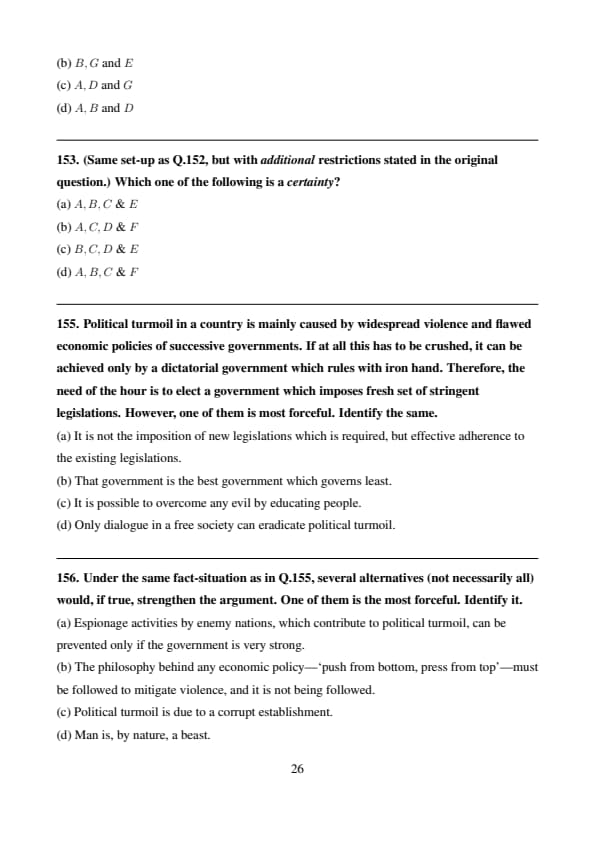
Question 153:

(Same set-up as Q.152, but with \emph{additional} restrictions stated in the original question.) Which one of the following is a \emph{certainty}?

  • (a) \(A, B, C\) \& \(E\)
  • (b) \(A, C, D\) \& \(F\)
  • (c) \(B, C, D\) \& \(E\)
  • (d) \(A, B, C\) \& \(F\)
Correct Answer: (a)
View Solution

Question 154:

Four members are to be nominated to a Committee from six candidates \(A,B,C,D,E,F\). Rules:
(A) If \(A\) is nominated, then \(D\) is excluded.
(B) If \(B\) is nominated, then exactly one of \(E\) or \(F\) must also be nominated.
(C) If \(C\) is nominated, then both \(D\) and \(B\) must be nominated. Which set of four is possible?

  • (a) \(A,B,E\)
  • (b) \(A,B,C,D\)
  • (c) \(B,C,D,E\)
  • (d) \(B,C,D,F\)
Correct Answer: (c)
View Solution

Question 155:

Political turmoil in a country is mainly caused by widespread violence and flawed economic policies of successive governments. If at all this has to be crushed, it can be achieved only by a dictatorial government which rules with iron hand. Therefore, the need of the hour is to elect a government which imposes fresh set of stringent legislations. However, one of them is most forceful. Identify the same.

  • (a) It is not the imposition of new legislations which is required, but effective adherence to the existing legislations.
  • (b) That government is the best government which governs least.
  • (c) It is possible to overcome any evil by educating people.
  • (d) Only dialogue in a free society can eradicate political turmoil.
Correct Answer: (a)
View Solution

Question 156:

Under the same fact-situation as in Q.155, several alternatives (not necessarily all) would, if true, strengthen the argument. One of them is the most forceful. Identify it.

  • (a) Espionage activities by enemy nations, which contribute to political turmoil, can be prevented only if the government is very strong.
  • (b) The philosophy behind any economic policy—‘push from bottom, press from top’—must be followed to mitigate violence, and it is not being followed.
  • (c) Political turmoil is due to a corrupt establishment.
  • (d) Man is, by nature, a beast.
Correct Answer: (b)
View Solution

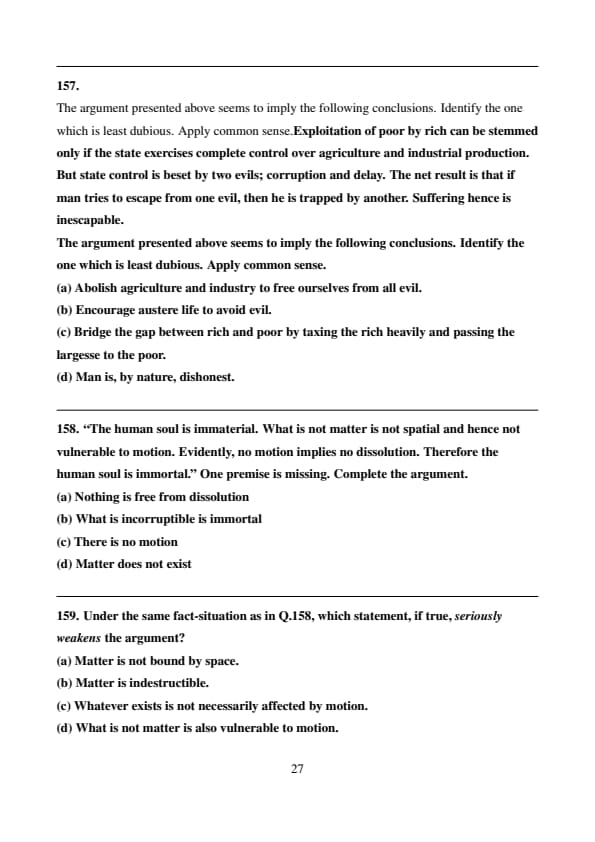
Question 157:

Exploitation of poor by rich can be stemmed only if the state exercises complete control over agriculture and industrial production. But state control is beset by two evils; corruption and delay. The net result is that if man tries to escape from one evil, then he is trapped by another. Suffering hence is inescapable.


The argument presented above seems to imply the following conclusions. Identify the one which is least dubious. Apply common sense.

  • (a) Abolish agriculture and industry to free ourselves from all evil.
  • (b) Encourage austere life to avoid evil.
  • (c) Bridge the gap between rich and poor by taxing the rich heavily and passing the largesse to the poor.
  • (d) Man is, by nature, dishonest.
Correct Answer: (c)
View Solution

Question 158:

“The human soul is immaterial. What is not matter is not spatial and hence not vulnerable to motion. Evidently, no motion implies no dissolution. Therefore the human soul is immortal.”
One premise is missing. Complete the argument.

  • (a) Nothing is free from dissolution
  • (b) What is incorruptible is immortal
  • (c) There is no motion
  • (d) Matter does not exist
Correct Answer: (b)
View Solution

Question 159:

Under the same fact-situation as in Q.158, which statement, if true, \emph{seriously weakens} the argument?

  • (a) Matter is not bound by space.
  • (b) Matter is indestructible.
  • (c) Whatever exists is not necessarily affected by motion.
  • (d) What is not matter is also vulnerable to motion.
Correct Answer: (d)
View Solution

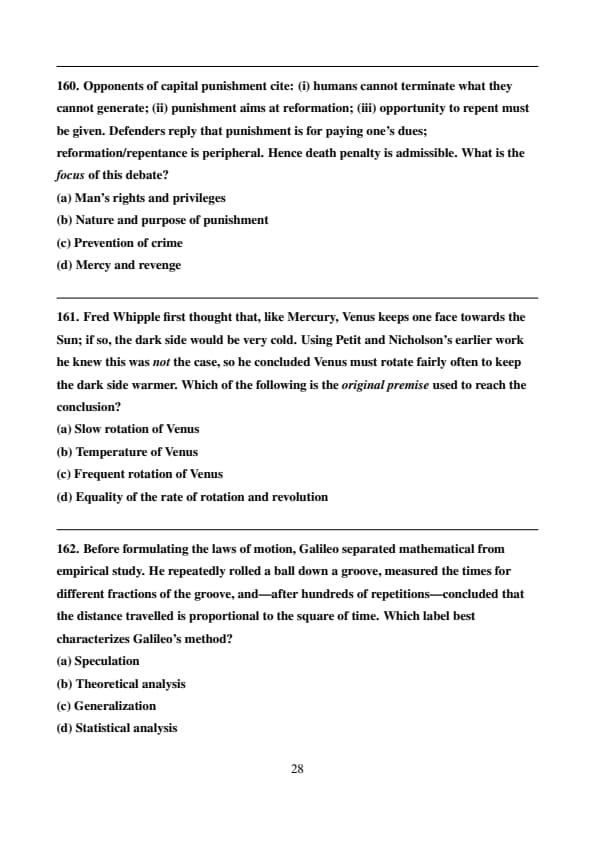
Question 160:

Opponents of capital punishment cite: (i) humans cannot terminate what they cannot generate; (ii) punishment aims at reformation; (iii) opportunity to repent must be given. Defenders reply that punishment is for paying one’s dues; reformation/repentance is peripheral. Hence death penalty is admissible. What is the \emph{focus} of this debate?

  • (a) Man’s rights and privileges
  • (b) Nature and purpose of punishment
  • (c) Prevention of crime
  • (d) Mercy and revenge
Correct Answer: (b)
View Solution

Question 161:

Fred Whipple first thought that, like Mercury, Venus keeps one face towards the Sun; if so, the dark side would be very cold. Using Petit and Nicholson’s earlier work he knew this was \emph{not} the case, so he concluded Venus must rotate fairly often to keep the dark side warmer. Which of the following is the \emph{original premise} used to reach the conclusion?

  • (a) Slow rotation of Venus
  • (b) Temperature of Venus
  • (c) Frequent rotation of Venus
  • (d) Equality of the rate of rotation and revolution
Correct Answer: (b)
View Solution

Question 162:

Before formulating the laws of motion, Galileo separated mathematical from empirical study. He repeatedly rolled a ball down a groove, measured the times for different fractions of the groove, and—after hundreds of repetitions—concluded that the distance travelled is proportional to the square of time. Which label best characterizes Galileo’s method?

  • (a) Speculation
  • (b) Theoretical analysis
  • (c) Generalization
  • (d) Statistical analysis
Correct Answer: (d) Statistical analysis
View Solution

Question 163:

Sherlock Holmes obtains two pills found at crime scenes. He dissolves one pill and gives it to a dog—nothing happens. He then dissolves the \emph{other} pill, adds milk, the dog licks and dies. Which method does the passage indicate?

  • (a) Imagination
  • (b) Experiment
  • (c) Observation
  • (d) Thought experiment
Correct Answer: (c) Observation
View Solution

Question 164:

There has been much speculation concerning the origin of lunar craters. One hypothesis is that they are the result of the impact of heavy meteors on the surface of moon while still soft. The most probable explanation is that they were produced by the gases liberated from the rocky matter. "While solidification was taking place these gases and water vapors steadily escaped through viscous surface, raising giant bubbles. The reader can easily visualize the process that took place by watching frying of pancakes. Which one of the following actually helps us to determine the origin of lunar craters?

  • (a) Analogy
  • (b) Study of foreign body
  • (c) Cause–effect relation
  • (d) Speculation
Correct Answer: (c) Cause–effect relation
View Solution

Question 165:

“Perhaps the earliest work of Archimedes that we have is that on ‘Plane Equilibrium’. In this, some fundamental principles of mechanics are set forth as rigorous geometric propositions. The work opens with furious postulate ‘Equal weights at equal distances are in equilibrium; equal weights at unequal distances are not in equilibrium, but incline towards the weight at the greater distance.’


According to this passage, which factors determine equilibrium?

  • (a) weight
  • (b) distance
  • (c) weight \& distance
  • (d) equality of weights \& distances
Correct Answer: (c) weight \& distance
View Solution

Question 166:

According to the passage, assign a truth value to: “Unequal weights at equal distances are in \emph{disequilibrium}.”

  • (a) true
  • (b) false
  • (c) uncertain
  • (d) unverifiable
Correct Answer: (a) true
View Solution

Question 167:

According to the passage, assign a truth value to: “Unequal distances are in \emph{disequilibrium}.”

  • (a) true
  • (b) false
  • (c) uncertain
  • (d) unverifiable
Correct Answer: (c) uncertain
View Solution

Question 168:

Gregor Mendal in examining tea-plants found two sharply marked races, the tall and the short. He experimentally fertilized flowers of tall plants with pollen of short. The offspring were tall plants. He next let the flowers of this first generation be fertilized with their own pollen. In the following generation, shortness reappeared. Tallness and shortness were distributed not at random but in a definite, constant, and simple ratio: three dominant talls to one recessive short. Which one of the following aptly describes the distribution of dominant and recessive characteristics?

  • (a) Systematic
  • (b) equal interval
  • (c) unpredictable
  • (d) irregular interval
Correct Answer: (a) \textit{Systematic}
View Solution

Question 169:

It is said that in his strongly worded reaction to quantum Physics, Einstein remarks ‘God does not play dice’ to which Bohr, another great physicist, reacted saying ‘Do not tell God what to system, though we can know the properties of macrocosmic objects.

  • (a) the behavior of God
  • (b) probabilistic interpretation of the behavior of quantum object
  • (c) limits of human knowledge
  • (d) irrelevance of microcosmic object
Correct Answer: (c) \textit{limits of human knowledge}
View Solution

Question 170:

An efficient and diesel-independent public transport system is essential to the economic development of nation. Suppose that the government adopts a policy to that effect then there is another favourable result. The pollution of environment is reduced to greater extent – but, then it has two-pronged backlash. The sale and consequently the production of two and four wheelers reduce to the minimum which in turn render a large number of people jobless. Cash flow to the treasury also is adversely affected. Such a step, therefore, is self-defeating unless the government evolves a counter-strategy to nullify the adverse effects. Which one of the following accurately projects the opinion of an imaginary speaker or author as the case may be of this passage?

  • (a) Abandon the idea of efficient, diesel–independent public transport.
  • (b) Ensure sustained cash flow and better jobs by inventing an alternate or more than one alternate.
  • (c) Public transport system shall be given up.
  • (d) Maintain car production and sales at the same level by incentives.
Correct Answer: (b)
View Solution

Question 171:

A moot question to be considered is whether democratic form of government is boon or bane, no matter what Lincoln might or might not have said. Rather his most (in?) famous adage, ‘by the people, for the people and of the people’ misses the most pertinent question; which attitude works behind when a person declares that he is a (or the right?) candidate to serve the people, and does not hesitate to contest and fight tooth and nail the election, an euphemism for battle with or without bullets. Admittedly, the convert attitude is different from overt attitude. Hardly anyone contests the election unwillingly. A contestant is not persuaded by any one, but driven by his own passions and dubious motives. Contrast this picture with Socrates' version; no honest man willingly takes up the job of ruler. If at all he accepts, he does so for fear of being ruled by one made up of inferior mettle. It is beyond even the wildest imagination, to expect an honest person to contest the election. Assuming that every statement is true, identify from among the given alternatives the one which strictly follows from the passage.

  • (a) No assessment of democracy is possible
  • (b) Lincoln and Socrates are talking differently
  • (c) Socrates scores over Lincoln on this issue
  • (d) Rulers can be honest
Correct Answer: (c)
View Solution

Question 172:

According to the same passage, which best differentiates Lincoln’s and Socrates’ analyses?

  • (a) the nature of democracy
  • (b) merits and demerits of politician
  • (c) qualities of election
  • (d) difference in mindset of the respective men
Correct Answer: (d)
View Solution

Question 173:

Many environmentalists are inconsistent: progress without some interference with nature is a myth, yet environment includes animal wealth too, so we must ask whether we may kill living beings (even harmful insects/stray dogs) merely for hygiene. Which one of the following runs \emph{counter} to the spirit of the passage?

  • (a) In the interest of health and cleanliness, our surroundings must be free from disease–spreading bacteria.
  • (b) Non-violence as a moral principle extends to all living creatures.
  • (c) Vegetarian food is ideal to all men.
  • (d) Man should protect his environment because he has to live.
Correct Answer: (a)
View Solution

Question 174:

On reservations in jobs, the passage argues that quality education—especially for the downtrodden—requires \emph{good-natured meritorious} teachers; if someone lacking these becomes a teacher due to reservation, generations suffer. Assuming some merit in the argument, which fallout is best described?

  • (a) Reservation is individual-centric, but not group-centric.
  • (b) Reservation, at least in one field, is self-defeating.
  • (c) The argument is biased.
  • (d) Education is not required to uplift the downtrodden.
Correct Answer: (a)
View Solution

Question 175:

Under the same fact-situation, which step best helps to \emph{circumvent} the problem?

  • (a) Replace education with money and make the poor rich.
  • (b) To achieve equality encourage inter-caste marriage.
  • (c) Only downtrodden people should form the government.
  • (d) Identify good-natured and meritorious people within the downtrodden group to make them teachers.
Correct Answer: (b)
View Solution

Question 176:

Principles:
(1) On the death of husband, the widow shall inherit the property of her deceased husband along with children equally.

(2) A widow cannot claim the property of the deceased if on the date when the question of succession opens, she has married.

(3) A female acquiring property in any way has the absolute title to the property.

Facts: When Sudhir died he had \(\frac{1}{3}\) share of the family property, which the three brothers Rudhir, Sudhir, and Yasu inherited from their father, B. Sudhir died on September 23, 2006, without having any issue. The widow of Sudhir, Ms. Win, remarried on January 1, 2007. Rudhir and Yasu refused Win the share from Sudhir’s portion when Win claimed the entire property belonging to Sudhir on January 30, 2007.

List I – Decisions:

(a) Win cannot inherit the property of Sudhir

(b) Win can inherit the property of Sudhir


List II – Reasons:

(i) Widows not belong to the family.

(ii) Win was remarried.

(iii) Her claim was on the date of Sudhir’s death.

(iv) Her claim submitted after she was remarried.

  • (a) (i)
  • (b) (ii)
  • (c) (iii)
  • (d) (iv)
Correct Answer: (d) (iv)
View Solution

Question 177:

Principles:
(1) If a person commits an act by which death is caused to another person and the act is done with the intention of causing death, the person is liable for murder.

(2) A person has a right of self-defense to the extent of causing death to another provided he apprehends death by the act of the latter.


Facts:
Shuva went to a hardware shop owned by Anup. Bargaining on some item led to an altercation between the two, and Shuva picked up a sharp object and hit Anup. When Anup started bleeding, his wife Mridula intervened and was also hit by Shuva, rendering her unconscious. Finding himself totally cornered, Anup delivered a severe blow to Shuva with a sharp object. Shuva died instantly.

Possible decisions:
(a) Anup murdered Shuva

(b) Anup killed Shuva with the intention of killing to save himself and his wife

(c) Anup killed Shuva without any intention to do so just to save himself and his wife


Probable reasons:
(i) If a person kills another instantly on the spot, the intention to kill is obvious.

(ii) Anup used force apprehending death of himself and his wife.

(iii) Anup used disproportionate force.

(iv) There was nothing to show that Shuva wanted to kill Anup or his wife.

  • (a) (a) (i)
  • (b) (a) (iii)
  • (c) (c) (ii)
  • (d) (b) (i)
Correct Answer: (c) (ii)
View Solution

Question 178:

Principles:
(1) Consumable goods which are not fit for consumption are not marketable.

(2) A consumer shall not suffer on account of unmarketable goods.

(3) A seller is liable for knowingly selling unmarketable goods.

(4) A manufacturer shall be liable for the quality of his products.


Facts:
Ram bought a Coca Cola bottle from Shama’s shop. Back at home, the server opened the bottle and poured the drink into the glasses of Ram and his friend Tom. As Tom started drinking, he felt irritation in his throat. Immediately, Ram and Tom took the sample to test and found nitric acid in the content. Ram filed a suit against Shama, Coca Cola company, and the bottler, Kishen \& Co.

Suggested Decisions:
(a) Ram cannot get compensation

(b) Tom cannot get compensation

(c) Both Ram and Tom can get compensation


Suggested Reasons:
(i) Shama did not know the contents of sealed bottles.

(ii) Ram did not actually suffer though he bought the bottle.

(iii) Tom did not buy the bottle.

(iv) Coca Cola company is responsible since it supplied the concentrate.

(v) Kishen \& Co. is responsible since it added water, sugar etc. and sealed the bottle.

(vi) Shama is responsible for selling the defective product.

  • (a) (a) (ii)
  • (b) (b) (vi)
  • (c) (c) (v)
  • (d) (c) (iv)
Correct Answer: (c) (v)
View Solution

Question 179:

Principles:
1. If A is asked to do something by B, B is responsible for the act, not A.

2. If A, while acting for B commits a wrong, A is responsible for the wrong, not B.

3. If A is authorized to do something for B, but in the name of A without disclosing B’s presence, both A and B may be held liable.


Facts: Somu contracted with Amar where Amar would buy a pump set to be used in Somu’s farm. Such a pump set was in short supply in the market. Gulab, a dealer, had such a pump set and he refused to sell it to Amar. Amar threatened Gulab of serious consequences if he failed to part with the pump set. Gulab filed a complaint against Amar.


Proposed decision:

  • (a) Amar alone is liable for the wrong though he acted for Somu.
  • (b) Amar is not liable for the wrong, though he is bound by the contract with Somu.
  • (c) Somu is bound by the contract and liable for the wrong.
  • (d) Both Somu and Amar are liable for the wrong.
    \textbf{Suggested reasons:}
    (i) Amar committed the wrong while acting for the benefit for Somu.
    (ii) Amar cannot do while acting for Somu something which he cannot do while acting for himself.
    (iii) Both Amar and Somu are liable since they are bound by the contract.
    (iv) Somu has to be responsible for the act Amar committed for Somu’s benefit.
Correct Answer: (a) (ii)
View Solution

Question 180:

Principles:

1. The owner of land has absolute interest in the property including the contents over and under the property.

2. Water flowing below your land is not yours, though you may use it.

3. Any construction on your land belongs to you.

4. All mineral resources below the land belong to the State.


Facts: There is a subterranean water flow under Suresh’s land. Suresh constructed a huge reservoir and drew all subterranean water into it. As a result, the wells of adjacent owners went dry. They demanded that Suresh either demolish the reservoir or share the water.


Proposed decisions:

(a) Suresh need not demolish the reservoir.

(b) Suresh has to demolish the reservoir.

(c) Suresh has to share the water with his neighbours.

(d) The Government can take over the reservoir.


Possible reasons:

(i) Water cannot be captured by one person for his personal use.

(ii) The government must ensure equitable distribution of water.

(iii) Whatever is under Suresh’s land may be used by him.

(iv) Suresh has to respect the rights of others regarding water.

  • (a) (a) (iii)
  • (b) (b) (i)
  • (c) (c) (iv)
  • (d) (d) (ii)
Correct Answer: (d) (ii)
View Solution

Question 181:

Principles:

1. An employer shall be liable for the wrongs committed by his employees in the course of employment.

2. Third parties must exercise reasonable care to find out whether a person is actually acting in the course of employment.


Facts: Nandan was appointed by Syndicate Bank to collect small savings from its customers daily. Nagamma, a housemaid, was one of such customers. After a couple of years, Syndicate Bank terminated Nandan’s service. Unaware of this, Nagamma continued to hand over her savings to Nandan, who misappropriated them. She realized this after three months and filed a complaint against the bank.


Possible decisions:

(a) Syndicate Bank shall be liable to compensate Nagamma

(b) Syndicate Bank shall not be liable to compensate Nagamma

(c) Nagamma has to blame herself for her negligence


Possible reasons:

(i) Nandan was not acting in the course of employment after termination.

(ii) A person cannot blame others for his own negligence.

(iii) Nagamma was entitled to be informed by the bank about Nandan.

(iv) The bank is entitled to expect customers to know the actual position.

  • (a) (b) (i)
  • (b) (c) (ii)
  • (c) (a) (iii)
  • (d) (b) (iv)
Correct Answer: (c) (a) (iii)
View Solution

Question 182:

Principles:

1. A master shall be liable for the fraudulent acts of his servants committed in the course of employment.

2. Whether an act is committed in the course of employment has to be judged in context.

3. Both master and third parties must exercise reasonable care in this regard.


Facts: Rama Bhai, a widow, opened an SB account with Syndicate Bank with the help of her nephew Keshav, who worked as a clerk in the bank. After a year, Keshav was dismissed from service. Unaware, Rama Bhai continued giving him her savings, which he misappropriated. She later sought compensation from the bank.


Possible decisions:

(a) Bank shall be liable to compensate Rama Bhai

(b) Bank shall not be liable to compensate Rama Bhai

(c) Rama Bhai cannot blame others for her negligence


Possible reasons:

(i) Keshav was not an employee when the fraud was committed.

(ii) The bank was not aware of the special arrangement between Rama Bhai and Keshav.

(iii) The bank must take care of vulnerable customers.

(iv) Rama Bhai should have checked about Keshav.

  • (a) (a) (iii)
  • (b) (c) (iv)
  • (c) (b) (ii)
  • (d) (b) (i)
Correct Answer: (c) (b) (ii)
View Solution

Question 183:

Principles:

1. A person is liable for negligence if he fails to take care of his neighbour’s interest.

2. A neighbour is anyone whose interests should have been foreseeable.


Facts: During a cricket match in a closed stadium, a fan who could not get a ticket climbed a nearby tree to watch. A ball hit him, causing injury. He sued the organizers.


Possible decisions:

(a) Organizers liable to compensate

(b) Organizers not liable

(c) Injured person should have avoided the risky spot


Possible reasons:

(i) Organizers are responsible for people inside the stadium.

(ii) Organizers could not have foreseen someone watching from a tree.

(iii) A person crazy about something must take the risk.

(iv) Organizers must be liable to all viewers.

  • (a) (a) (iv)
  • (b) (a) (iii)
  • (c) (b) (ii)
  • (d) (c) (i)
Correct Answer: (c) (b) (ii)
View Solution

Question 184:

Principles:

1. When a person unlawfully interferes with another’s chattel depriving him of its use, it is conversion.

2. Nobody shall enrich himself at another's expense.


Facts: A patient’s appendix was removed at a hospital. The hospital used unique cells from it to develop valuable drugs. The patient, learning of this later, claimed a profit share.


Possible decisions:

(a) Hospital need not share profits

(b) Hospital may share on ex gratia basis

(c) Hospital shall share profits


Possible reasons:

(i) The patient benefited from removal.

(ii) Hospital’s research was its own effort.

(iii) Hospital could not have succeeded without the appendix.

(iv) Everyone must share.

  • (a) (a) (i)
  • (b) (a) (ii)
  • (c) (c) (iii)
  • (d) (c) (iv)
Correct Answer: (a) (a) (i)
View Solution

Question 185:

Principles:

1. Copying, including an attempt to copy in an examination, is a serious offence.

2. One shall not take any unauthorized materials into the examination hall.


Facts:
Rohini, an examinee in PUC, was thoroughly checked before entering the examination hall and was found carrying only authorized materials such as a pen and instrument box. While she was writing, the invigilator found chits near her feet containing answers matching her paper. Her answers tallied with the chits. A charge of copying was brought against her.


Probable decisions:

(a) Rohini shall be punished for copying.

(b) Rohini cannot be punished for copying.


Probable reasons:

(i) Something lying near the feet does not mean the person possesses it.

(ii) Being thoroughly checked at entry should be conclusive proof of no unauthorized material.

(iii) Similarities between her answers and the chits indicate she used them.

(iv) After using chits, she must have disposed of them.

  • (a) (a) (iii)
  • (b) (a) (iv)
  • (c) (b) (iii)
  • (d) (b) (ii)
Correct Answer: (d) (b) (ii)
View Solution

Question 186:

All contracts are agreements. All agreements are accepted offers. Which of the following derivations is correct?

  • (a) All accepted offers are contracts
  • (b) All agreements are contracts
  • (c) All contracts are accepted offers
  • (d) None of the above
Correct Answer: (d) None of the above
View Solution

Question 187:

No minor can enter into a contract of work. Working in a shop can be done only by a contract. Which derivation is correct?

  • (a) A minor cannot work in a shop
  • (b) A shop cannot contract with a minor
  • (c) There cannot be a contract to which a minor is a party
  • (d) None of the above
Correct Answer: (c) There cannot be a contract to which a minor is a party
View Solution

Question 188:

All motor vehicles are required to have third party insurance. Any vehicle not using mechanical device is not a motor vehicle. Which is the correct derivation?

  • (a) All third party insurances relate to motor vehicles
  • (b) Vehicles not using mechanical device need not have third party insurance
  • (c) All vehicles must have third party insurance
  • (d) None of the above
Correct Answer: (b) Vehicles not using mechanical device need not have third party insurance
View Solution

Question 189:

A contract contravening public policy is void. There cannot be a general definition of public policy. Which is the correct derivation?

  • (a) There cannot be a general definition of contract
  • (b) Since public policy is uncertain, contract is also uncertain
  • (c) The impact of public policy on contract is to be judged in individual cases
  • (d) None of the above
Correct Answer: (c) The impact of public policy on contract is to be judged in individual cases
View Solution

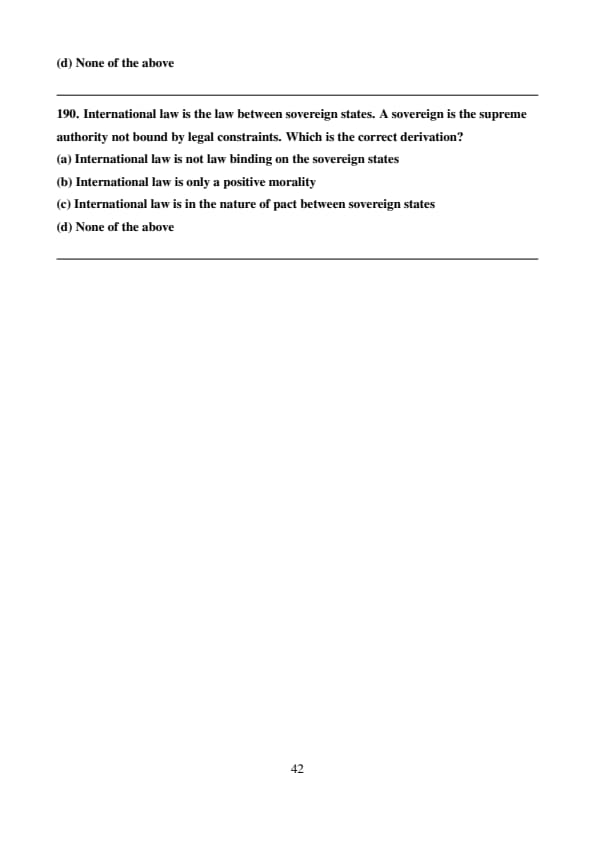
Question 190:

International law is the law between sovereign states. A sovereign is the supreme authority not bound by legal constraints. Which is the correct derivation?

  • (a) International law is not law binding on the sovereign states
  • (b) International law is only a positive morality
  • (c) International law is in the nature of pact between sovereign states
  • (d) None of the above
Correct Answer: (c) International law is in the nature of pact between sovereign states
View Solution


CLAT Previous Year Question Paper with Answer Key PDFs

Collegedunia has provided CLAT Previous Year Question paper pdf with answer key in the links given below:

Similar Law Exam Question Papers