




CLAT 2009 Common Question paper with answer key pdf conducted on May 31, 2009 in Afternoon Session 3:00 PM to 5:00 PM is available for download. The exam was successfully organized by Rajiv Gandhi National Law University. In terms of difficulty level, CLAT was of Easy to Moderate level. The question paper comprised a total of 200 questions divided among five sections.
Also Check:
CLAT 2009 Common Question Paper with Solution PDF
| CLAT 2009 Common Question Paper with Answer Key | Download PDF | Check Solutions |

Question 1:
Directions (1 to 10): Read the given passage carefully and answer file questions that follow.
There is a fairly universal sentiment that the use of nuclear weapons is clearly contrary to morality and that its production
probably so, dues not go far enough. These activities are not only opposed to morality but also to law if the legal objection can be added to the moral, the argument against the use and the manufacture of these weapons will considerably be reinforced. Now the time is ripe to evaluate the responsibility of scientists who knowingly use their expertise for the construction of such weapons, which has deleterious effect on mankind.
To this must be added the fact that more than 50 percent of the skilled scientific manpower in the world is now engaged in the armaments industry. How appropriate it is that all this valuable skill should be devoted to the manufacture of weapons of death in a world of poverty is a question that must touch the scientific conscience.
A meeting of biologists on the Long Term Worldwide Biological consequences of nuclear war added frightening dimension to those forecasts. Its report suggested that the long biological effects resulting from climatic changes may at least be as serious as the immediate ones. Sub freezing temperatures, low light levels, and high doses of ionizing and ultraviolet radiation extending for many months after a large scale nuclear war could destroy the biological support system of civilization, at least in the Northern hemisphere. Productivity in natural and agricultural ecosystem could be severely restricted for a year or more.
Post war survivors would face starvation as well as freezing conditions in the dark and be exposed to near lethal doses of radiation. If, as now seems possible, the, Southern Hemisphere were affected also, global disruption of the biosphere could ensue. In any event, there would be severe consequences, even in the areas not affected directly, because of the inter dependence of the world economy. In either case the extinction of a large fraction of the earth's animals, plants and microorganism seems possible. The population size of Homo sapiens conceivably could be reduced to prehistoric levels or below, and extinction of human species itself cannot be excluded.
1.Choose the word which is most opposite in meaning of the word, printed in bold as used in the passage Deleterious.
View Solution
The word "deleterious" in the passage describes the harmful effect of weapons on mankind.
Among the options, "harmful" is a synonym, not an opposite. "Irreparable" and "non cognizable" do not directly oppose the sense.
"Beneficial" is the direct opposite of "deleterious".
Hence the correct option is (a) Beneficial. Quick Tip: When asked for an antonym, first substitute the bold word with a simple synonym from the sentence and then pick the option that conveys the opposite of that synonym.
The author's most important objective of writing the above passage seems to………….
View Solution
Read the passage's central theme — it repeatedly emphasises moral, legal and especially biological/ecological consequences of nuclear weapons.
Options (d) and (b) are close: (d) is narrower (summarise long biological effects) while (b) captures the broader intent — to illustrate devastating effects on mankind (moral, legal, biological, societal).
The passage opens with moral/legal objections, then details biological/ecosystem impacts and societal consequences — confirming the author's aim to highlight devastation.
Hence the best choice is (b). Quick Tip: Look for the writer's main thrust across the whole passage (opening + supporting paragraphs) rather than a single paragraph when choosing author's intent.
The scientists engaged in manufacturing destructive weapons are ……………….
View Solution
The passage explicitly states that "more than 50 percent of the skilled scientific manpower in the world is now engaged in the armaments industry."
This maps directly to option (c). Other options contradict or are not supported by the passage.
Hence the correct answer is (c). Quick Tip: When a factual detail is asked, scan for exact figures or clear statements in the passage — the correct option usually mirrors the sentence closely.
According to the passage, the argument on use and manufacture of nuclear weapons
View Solution
The passage says that these activities are opposed to morality and also to law — and that "if the legal objection can be added to the moral, the argument against the use and the manufacture of these weapons will considerably be reinforced."
That sentence directly supports (d): combining legal and moral objections makes the argument stronger.
Hence the correct answer is (d). Quick Tip: Pick the option that most closely paraphrases a clear line from the passage when the question is about the author's assertion.
The author of the passage seems to be of the view that
View Solution
The passage repeatedly condemns diverting scientific skill to armaments and calls the effects "deleterious" and "lethal", raising moral concerns about such use of knowledge.
Options (a), (b), (c) support or justify weapon manufacture — contrary to the passage's critical stance. Option (d) captures the author's moral rejection that using valuable knowledge to make lethal weapons is inhumane.
Hence the correct choice is (d). Quick Tip: For attitude/stance questions, summarise the passage's tone (critical/supportive/neutral) then choose the option matching that tone.
Which of the following is one of the consequences of nuclear war?
View Solution
Locate the relevant sentence: the passage says "Productivity in natural and agricultural ecosystem could be severely restricted for a year or more."
That line indicates agricultural fertility/productivity would be affected for about a year or more after a large-scale nuclear war.
Option (a) is the only choice that refers to a one-year timescale for land/agricultural condition and therefore (despite brief awkward wording) is the statement linked to the passage's claim about the duration of post-war agricultural impact.
Step 4: Options (b) and (c) directly contradict the passage (the passage predicts starvation and low light levels, not abundant food or "cool comfortable" lights) and (d) is contradicted by the line saying the Southern Hemisphere might also be affected.
Hence the most appropriate choice is (a). Quick Tip: Match time-frames and keywords: when the passage mentions "for a year or more" or similar phrases, prefer the option that echoes that timeframe even if the option's wording is slightly awkward.
Which of the following best explains the word devoted, as used in the passage?
View Solution
Examine the sentence: "How appropriate it is that all this valuable skill should be devoted to the manufacture of weapons of death..." — here "devoted to" describes allocation of valuable skill toward weapon production.
The context is critical/negative: skills are being put to harmful ends (manufacture of "weapons of death"), so the sense is that they are being misapplied or abused for destruction.
Option (c) "Abused for destruction" best fits this negative sense. Options (a) and (b) are positive senses (dedicated/for betterment) and (d) "Underutilized" does not capture the sense of being put to harmful use.
Hence the correct choice is (c). Quick Tip: Always read the immediate context around the target word — positive/negative tone in the sentence will usually tell you which meaning is intended.
The biological consequences of nuclear war as given in the passage include all the following, except
View Solution
The passage lists specific biological consequences: "Sub freezing temperatures, low light levels, and high doses of ionizing and ultraviolet radiation extending for many months..." — this supports (a), (b) and (c).
The passage further predicts "Post war survivors would face starvation..." which contradicts the idea of abundant food.
Therefore the statement that biological consequences include "abundant food for smaller population" is not given by the passage and is the exception.
Hence the correct answer is (d). Quick Tip: For 'except' questions, first mark all items explicitly mentioned in the passage — the remaining option is the correct choice.
It appears from the passage that the use of nuclear weapons is considered against morality by
View Solution
The passage begins with: "There is a fairly universal sentiment that the use of nuclear weapons is clearly contrary to morality..." — "fairly universal" indicates a widespread (nearly global) moral objection.
Option (b) paraphrases this idea ("Almost all the nations of the world") and therefore best matches the passage.
Options (a) and (c) restrict the view to certain nations (not supported by "universal"), and (d) is a factual statement about scientists, not about who considers the weapons immoral.
Hence the correct answer is (b). Quick Tip: Words like "universal", "widely", "generally" in the passage point to answers that indicate majority or near-global views.
Which of the following statements I, II, III and IV is definitely true in the context of the passage?
View Solution
Check statement (I) — the passage warns extinction is possible and that human population "could be reduced to prehistoric levels or below, and extinction of human species itself cannot be excluded." So (I) is false.
Check (II) — the passage treats risks and harmful effects seriously (not as exaggerated), so (II) is false.
Check (III) — the passage says survivors "would face starvation ... and be exposed to near lethal doses of radiation" — not benefits of non-lethal radiation; (III) is false.
Step 4: Check (IV) — the passage explicitly says there "would be severe consequences, even in the areas not affected directly, because of the inter dependence of the world economy," so living organisms in indirectly affected areas would also suffer — (IV) is true.
Hence the only definitely true statement is (IV), so select (d). Quick Tip: For multi-statement items, check each statement against explicit lines in the passage — mark true/false and pick the option containing the definitely true statement(s).
Three of the four words given below are spelt wrong. Identify the correctly spelt one.
View Solution
The correct spelling of the word referring to the European cultural revival period is renaissance.
Options (b), (c), and (d) contain common misspellings with omitted or incorrect letters.
Hence the correct choice is (a). Quick Tip: For spelling questions, visual familiarity with commonly used foreign-derived words like \textit{renaissance helps in quickly eliminating wrong options.
Three of the four words given below are spelt wrong. Identify the correctly spelt one.
View Solution
The correct spelling of the term meaning discomfort or unease is malaise.
Options (a), (b), and (c) contain extra or misplaced vowels/letters.
Thus, (d) is the correct spelling. Quick Tip: Break tricky spellings into syllables: \textit{ma-laise helps remember the correct sequence.
Three of the four words given below are spelt wrong. Identify the correctly spelt one.
View Solution
The correct spelling meaning "not related to" is irrelevant.
All other options have incorrect doubling, missing letters, or misplaced vowels.
Hence, the answer is (b). Quick Tip: For words with common prefixes like \textit{ir- and in-, focus on preserving the base spelling after the prefix.
Three of the four words given below are spelt wrong. Identify the correctly spelt one.
View Solution
The correct spelling for monitoring or close observation is surveillance.
The double “l” after “veil” is important to note. Options (a), (c), and (d) deviate from the correct form.
Thus, the correct choice is (b). Quick Tip: Visualize the root word “veil” in \textit{surveillance to avoid misspelling.
Three of the four words given below are spelt wrong. Identify the correctly spelt one.
View Solution
The correct spelling for cheerfulness or merriment is \textit{gaiety.
All other options insert extra letters or alter vowel placement.
Therefore, the answer is (a). Quick Tip: Some words replace “-y” with “-ety” when forming nouns — memorizing such transformations prevents errors.
Mala fide
View Solution
\textit{Mala fide is a Latin term where “mala” means bad and “fide” means faith.
Together, it literally translates to “in bad faith,” often referring to dishonest or fraudulent intent.
Therefore, option (b) is correct. Quick Tip: For foreign phrases, break them into their root meanings. Latin legal terms are common in CLAT and other competitive exams.
Pro rata
View Solution
\textit{Pro rata is Latin for “according to the rate” or “in proportion.”
It is commonly used in finance, law, and employment contexts to indicate proportional allocation.
Thus, (c) correctly captures its meaning. Quick Tip: If a phrase has “pro,” think of “for” or “according to,” which can hint at proportional meaning.
Vice versa
View Solution
\textit{Vice versa is Latin meaning “the position being reversed” or “conversely.”
It is used when the two parts of a statement can be interchanged.
Option (d) gives the exact sense. Quick Tip: Link “vice” with “switch” in your mind — it helps recall the reversal idea in “vice versa.”
Ab initio
View Solution
\textit{Ab initio is Latin, where “ab” means “from” and “initio” means “beginning.”
It is often used in legal contexts to indicate something valid or invalid from the start.
Hence, (a) is correct. Quick Tip: Latin phrases often break down logically — “initio” sounds like “initiate,” meaning start.
Alibi
View Solution
\textit{Alibi is Latin for “elsewhere.”
In legal contexts, it refers to proof that a person was at another place when an alleged act occurred.
Therefore, (b) is the correct choice. Quick Tip: For memory, think: “An alibi places you elsewhere” — both literally and legally.
To give the game away
View Solution
The idiom “to give the game away” means to reveal a secret or a plan, intentionally or unintentionally.
It has nothing to do with literally losing or playing a game.
Therefore, (c) is the most accurate meaning.
Quick Tip: For idioms, focus on the figurative meaning rather than literal interpretation.
To cool one's heels
View Solution
“To cool one’s heels” refers to being kept waiting, often before being attended to.
It originates from the idea of letting your heels cool while standing or sitting idly.
Hence, (d) is correct.
Quick Tip: Visualising the idiom literally can sometimes help remember its figurative meaning.
To bury the hatchet
View Solution
“To bury the hatchet” means to end a conflict or make peace.
The phrase has Native American origins, where burying weapons signified the end of hostilities.
Thus, (b) is the correct choice.
Quick Tip: When an idiom sounds violent but involves “burying,” it often means ending hostility.
Gift of the gab
View Solution
“Gift of the gab” refers to the ability to speak easily, fluently, and persuasively.
It implies strong verbal skills rather than a literal present.
Therefore, (c) is correct.
Quick Tip: Link “gab” with “gabble” (talk) to remember its connection to speaking ability.
To smell a rat
View Solution
“To smell a rat” means to sense something suspicious or deceitful.
It does not literally involve rodents — it’s about detecting dishonesty.
Hence, (a) is correct.
Quick Tip: Associate “rat” with treachery in stories — spotting a “rat” means spotting betrayal.
Some people believe that in emotional maturity men are inferior __________ women.
View Solution
The comparative structure “inferior to” is the correct collocation in English grammar.
Other prepositions such as “than” are used with adjectives like “better” or “worse,” but “inferior” pairs with “to.”
Therefore, “to” correctly completes the sentence.
Quick Tip: Remember: “inferior,” “superior,” “junior,” and “senior” are followed by “to,” not “than.”
My father was annoyed __________ me.
View Solution
The common usage is “annoyed with a person” and “annoyed at/about a situation.”
Since “me” refers to a person, the preposition “with” is correct.
Other prepositions like “towards” or “upon” are not idiomatic in this context.
Quick Tip: Link “annoyed with” to people and “annoyed at/about” to things or situations.
Some orthodox persons are averse __________ drinking liquor.
View Solution
The adjective “averse” is always followed by “to” when expressing opposition to something.
“Averse to” means “having a strong dislike for.”
Therefore, “to” is the correct choice.
Quick Tip: Don’t confuse “averse to” (dislike) with “adverse to” (unfavourable towards).
The Cinema Hall was on fire and the Cinema owner had to send __________ the fire Brigade.
View Solution
The phrase “send for” means to request someone to come, usually for help.
In emergencies, we “send for” the doctor, police, or fire brigade.
Therefore, “for” is correct here.
Quick Tip: “Send for” = summon someone; “send to” = dispatch someone.
She was not listening __________ I was saying.
View Solution
The correct construction is “listen to” + object.
Here, “what I was saying” acts as the object, so “to what” is grammatically correct.
Therefore, “to what” fits both meaning and structure.
Quick Tip: Listening always takes “to” before the object in standard English.
Drinking country liquor in marriage is a custom __________ certain tribes.
View Solution
“Among” is used for more than two people or groups; “between” is for two.
Since “certain tribes” refers to multiple groups, “among” is correct.
Thus, option (b) fits the context.
Quick Tip: Among = more than two; Between = exactly two.
The struggle for justice brings __________ the best of moral qualities of men.
View Solution
The phrasal verb “bring out” means to reveal or highlight.
Here, the struggle reveals moral qualities, so “out” is correct.
Other options change the intended meaning.
Quick Tip: “Bring out” = reveal; “bring about” = cause something to happen.
If he __________ a horse he would fly.
View Solution
This is a subjunctive mood sentence, used for hypothetical situations.
In the subjunctive, “were” is used instead of “was” after “if” for all persons.
Therefore, “were” is correct.
Quick Tip: In unreal or hypothetical “if” clauses, always use “were” regardless of the subject.
Mohan has a bad habit of __________ at an odd hour.
View Solution
“Turning in” is an informal phrase meaning to go to bed or sleep.
“At an odd hour” fits naturally with sleeping late or unusually.
Hence, “turning in” is the correct choice.
Quick Tip: Turning in = going to bed; Turning up = arriving; Turning off = switching off.
He must refrain __________ immoral conducts.
View Solution
The verb “refrain” is always followed by “from” when meaning to abstain.
“Refrain from” + noun/verb-ing is standard usage.
Therefore, “from” is correct here.
Quick Tip: Refrain from = avoid doing something; Abstain from = deliberately not do something.
Directions (36 to 40): The constituent sentence of a passage have been jumbled up. Read jumbled sentences carefully and then choose the option which shows the best sequence of sentences of the passage.
The Collector said that the Dams should receive —
View Solution
Sentence (ii) “Water up to a particular levels” introduces the core requirement.
Follow with (i) “To ensure uninterrupted” — this gives the purpose.
Then (iv) “Supply of water for irrigation” completes the purpose.
Step 4: Finally, (iii) provides the detail — the specific use.
Hence, the logical sequence is (ii, i, iv, iii). Quick Tip: When ordering jumbled sentences, start by identifying the subject introduction, follow with the reason or action, and end with elaborations or consequences.
Arrange the sentences to form a coherent passage —
View Solution
Sentence (ii) “He wore a long, loose shirt...” sets the visual introduction.
Sentence (i) “He loved to distribute them among small kids” adds his action.
Sentence (iii) “And in doing so his eyes brightened” shows the emotional reaction.
Step 4: Sentence (iv) “The pockets of his shin bulged...” provides descriptive detail.
Hence, sequence is (ii, i, iii, iv). Quick Tip: Look for descriptive openings, then place action, emotional response, and details in that order.
Arrange the sentences to form a coherent passage —
View Solution
Sentence (i) “As we all know, a legislation” introduces the subject.
Sentence (iii) “Passed by the Houses of Parliament” continues the idea.
Sentence (ii) “Needs the assent of the President” shows the next legal requirement.
Step 4: Sentence (iv) “To become law” concludes the process.
Thus, the logical order is (i, iii, ii, iv). Quick Tip: Procedural sequences typically move from introduction, intermediate steps, and end with the final outcome.
Arrange the sentences to form a coherent passage —
View Solution
Sentence (i) “The farmers grow food for the whole country” introduces the main fact.
Sentence (iv) “Hence they are the most useful members...” logically follows.
Sentence (iii) “Yet these fellows are exploited by the rich” contrasts their value with their plight.
Step 4: Sentence (ii) “And therefore it is our duty...” concludes with a moral responsibility.
Thus, the correct sequence is (i, iv, iii, ii). Quick Tip: Contrast structures often follow: value → recognition → problem → call to action.
Arrange the sentences to form a coherent passage —
View Solution
Sentence (ii) “We went to the pond” introduces the setting.
Sentence (i) “The ripples looked enchanting...” adds visual description.
Sentence (iv) “We stood knee deep...” gives the physical action.
Step 4: Sentence (iii) “We flung stones to create ripples” concludes with the playful act.
Thus, the sequence is (ii, i, iv, iii).
% quick Tip Quick Tip: In narrative sequencing, establish place, describe, add immersive actions, and then end with a key event.
Capital market means
View Solution
The capital market refers to financial markets for buying and selling equity and debt instruments.
It is distinct from the money market, which deals with short-term funds.
Securities Market is the correct term encompassing both stock and bond markets — the main components of the capital market.
Hence, the correct choice is (c). Quick Tip: Capital markets handle long-term funds; money markets deal with short-term borrowing and lending.
From which river would the National River Project be started?
View Solution
The National River Project refers to initiatives aimed at conservation and cleaning of a designated river.
The Government of India launched the ``National River Ganga'' project as the flagship program for rejuvenation.
Hence, the correct answer is (c) Ganga. Quick Tip: Remember: Ganga is India’s only river to have been declared the National River.
``The Audacity of Hope'' is a book written by
View Solution
``The Audacity of Hope'' is a political book published in 2006 by then U.S. Senator Barack Obama.
The book outlines his political beliefs and vision for America.
The other options are well-known figures but are not connected to this title.
Hence, the correct choice is (b). Quick Tip: Link authors to their notable works for quick recall in exams.
``WPI'' is used as an acronym for
View Solution
WPI measures the average change in the price of goods at the wholesale stage.
It is a key economic indicator used to track inflation trends.
Therefore, the correct choice is (c). Quick Tip: WPI focuses on bulk transactions; CPI measures retail prices.
If the tax rate increases with the higher level of income, it shall be called
View Solution
In a progressive tax system, the tax rate increases as income increases.
This system aims to reduce income inequality.
The other options either keep the rate fixed or inversely related to income.
Hence, the correct choice is (a). Quick Tip: Progressive taxes impose a higher rate on higher income brackets.
Who is the Director of ``Chak De India''?
View Solution
``Chak De India'' is a sports drama film released in 2007.
It was directed by Shimit Amin and starred Shahrukh Khan in the lead role.
The other names are well-known filmmakers or actors, but not the director of this film.
Hence, the correct choice is (a). Quick Tip: Don’t confuse lead actors with directors — check the film credits.
What is the full form of the scanning technique CAT?
View Solution
CAT scan is an imaging procedure using computer-processed combinations of X-ray measurements.
It produces cross-sectional images of the body.
The correct expansion is Computerized Axial Tomography.
Hence, the correct choice is (c). Quick Tip: CAT scans are commonly used for detecting internal injuries and diagnosing diseases.
Who got the World Food Prize?
View Solution
The World Food Prize honors individuals who advance human development by improving food quality, quantity, or availability.
Kofi Annan, former UN Secretary-General, received the award in 2012 for his role in promoting sustainable agriculture in Africa.
The other options are notable leaders but did not receive this specific award.
Hence, the correct choice is (a). Quick Tip: Link awards with recipients’ major contributions for better retention.
ISO 9000 is a
View Solution
ISO 9000 is a set of international standards for quality management and assurance.
It helps organisations consistently meet customer and regulatory requirements.
It is not related to space projects, trade techniques, or loan security.
Hence, the correct choice is (a). Quick Tip: ISO standards are global benchmarks for quality, safety, and efficiency.
What is 'AGMARK'?
View Solution
AGMARK is a certification mark for agricultural products in India.
It ensures quality standards under the Agricultural Produce (Grading and Marking) Act, 1937.
It is not a brand name or limited to eggs supply.
Hence, the correct choice is (d). Quick Tip: AGMARK = Agricultural Marketing, mainly for farm product quality assurance.
The Headquarters of Indian Space Research Organisation is at
View Solution
ISRO’s headquarters is located in Bengaluru, Karnataka.
It is responsible for India’s space program and satellite launches.
The other options are important Indian cities but not ISRO HQ.
Hence, the correct choice is (c). Quick Tip: Remember: Bengaluru = ISRO HQ, Sriharikota = Launch Centre.
``Saras'' is the name of
View Solution
Saras is India’s first indigenous civilian aircraft.
It was developed by the National Aerospace Laboratories (NAL).
It is not related to tanks, missiles, or submarines.
Hence, the correct choice is (a). Quick Tip: Connect code names with their categories — helps in defence/tech GK.
First woman Prime-Minister in the World was from
View Solution
Sirimavo Bandaranaike from Sri Lanka became the world’s first female Prime Minister in 1960.
This was a historic milestone in global politics.
India’s first woman PM was Indira Gandhi in 1966, not the first in the world.
Hence, the correct choice is (a). Quick Tip: Chronology matters — Sri Lanka (1960) precedes India (1966) for female PMs.
Who was felicitated with 'Nishan-e-Pakistan'?
View Solution
Nishan-e-Pakistan is Pakistan’s highest civilian award.
Actor Dilip Kumar received this honour in 1998 for his contribution to cinema and cultural relations.
Other names are prominent but not recipients of this specific award.
Hence, the correct choice is (c). Quick Tip: Cross-border awards often highlight cultural diplomacy.
Which State provided separate reservation for Muslims and Christians in the State Backward Classes List in 2007?
View Solution
In 2007, Tamil Nadu included Muslims and Christians in the State Backward Classes category with separate quotas.
This was to ensure equitable representation in education and jobs.
The other states did not introduce this specific measure that year.
Hence, the correct choice is (b). Quick Tip: Year-based fact questions require precise memory — note both state and year.
Which of the following dances is not a classical dance?
View Solution
Garba is a folk dance from Gujarat, usually performed during Navratri.
Kathakali, Odissi, and Manipuri are recognised classical dance forms of India.
Hence, Garba is not considered a classical dance.
Hence, the correct choice is (b). Quick Tip: Folk vs Classical — a frequent distinction in art & culture GK.
Sulabh International is an organisation which provides
View Solution
Sulabh International is an Indian social service organisation founded by Bindeshwar Pathak.
It focuses on sanitation, hygiene, and public toilet facilities at affordable rates.
It does not primarily deal with healthcare, housing, or loans.
Hence, the correct choice is (b). Quick Tip: Link NGOs with their core mission — common in CLAT GK.
Who among the following was honoured with 'Officer of the Legion of Honour' award by French Government in July 2008?
View Solution
The Legion of Honour is France’s highest civilian award.
Filmmaker Yash Chopra received it in 2008 for his contribution to Indian cinema and strengthening Indo-French cultural ties.
Other names are prominent filmmakers but not recipients in 2008.
Hence, the correct choice is (b). Quick Tip: Match awards to recipients with year and country — helps avoid confusion.
The largest gland in the human body is
View Solution
The liver is the largest gland and performs vital functions like detoxification, protein synthesis, and bile production.
Pancreas and thyroid are smaller endocrine glands.
“Endocrine” is a system, not a gland.
Hence, the correct choice is (a). Quick Tip: Human anatomy facts are frequent — remember “Liver = largest gland”.
The Railway Budget for 2007-2008 has declared the year 2007 as the year of
View Solution
The Railway Budget 2007-08 emphasised improving passenger amenities and services.
Initiatives included better seating, improved catering, and upgraded waiting areas.
Hence, it was declared the “Year of Passenger Comfort”.
Hence, the correct choice is (b). Quick Tip: Budget themes often signal government priorities for that year.
In the world of Hindi Cinema, who was affectionately called as 'Dada Moni'?\
View Solution
Balraj Sahni was a respected actor in Hindi cinema and was affectionately called 'Dada Moni' by his colleagues and fans. He is remembered for his natural acting style and socially relevant films. The other options are also famous actors, but the nickname 'Dada Moni' is specifically associated with Balraj Sahni.\ Quick Tip: Remember famous nicknames of Hindi cinema personalities by associating their popular works and personality traits.
Outstanding Parliamentarian Award (2006) was presented in 2007 to\
View Solution
The Outstanding Parliamentarian Award is given annually to a distinguished member of the Indian Parliament who has demonstrated outstanding contribution to parliamentary proceedings. In 2007, the award for the year 2006 was given to Sharad Pawar for his exemplary parliamentary conduct and leadership. The other listed leaders have also been prominent parliamentarians but did not receive this award in 2006.\ Quick Tip: Stay updated with recent Indian political awards and their recipients as they are often asked in competitive exams.
World's longest sea bridge has taken shape in 2007 in\
View Solution
In 2007, the world's longest sea bridge project took shape in China. The Hong Kong-Zhuhai-Macao Bridge, which later became the longest sea crossing bridge, was part of China’s ambitious infrastructure development plans during this time. The other countries, though advanced in infrastructure, did not have the world's longest sea bridge in 2007.\ Quick Tip: Keep track of major world infrastructure projects by country, especially those setting world records.
Who among the following Indians became Citigroup's Investment Banking head?\
View Solution
Vikram Pandit, an Indian-American banker, rose to become the head of Citigroup’s Investment Banking division and later the CEO of Citigroup. He is recognized globally for his leadership in investment banking. L. N. Mittal is an industrialist, and the other options are less associated with this role.\ Quick Tip: Remember key Indian-origin leaders in global financial institutions for general awareness.
The Green Revolution in India has been identified with\
View Solution
The Green Revolution in India refers to the period when agriculture was transformed by the adoption of high-yield variety seeds, improved irrigation, and fertilizers. Dr. M.S. Swaminathan is known as the father of the Green Revolution in India due to his pioneering research and efforts in agricultural science. The other individuals are notable but are associated with other areas like water conservation or economic reforms.\ Quick Tip: Associate major social and scientific movements with their key personalities for easy recall.
Indian Judge in the UN Law of the Sea Tribunal is\
View Solution
Dr. P.C. Rao has served as an Indian judge at the International Tribunal for the Law of the Sea, representing India's interests in maritime law. The other names, although prominent legal personalities, are not known for holding this particular position.\ Quick Tip: Link international positions with Indian representatives to remember judiciary-related facts.
The Ozone Layer thins down as a result of a chain chemical reaction that separates from the layer
View Solution
The thinning of the ozone layer is primarily caused by chlorine atoms released from chlorofluorocarbons (CFCs). These chlorine atoms catalytically destroy ozone molecules in the stratosphere through a chain reaction, leading to ozone depletion. Oxygen and nitrogen are components of the atmosphere but do not cause this depletion. Hydrogen is not involved in this chain reaction.\ Quick Tip: Remember environmental science basics about ozone depletion focusing on CFCs and chlorine’s role.
Joint SAARC University of eight SAARC Nations has been established in
View Solution
The South Asian Association for Regional Cooperation (SAARC) established the SAARC University in Kathmandu, Nepal. It is a regional university aimed at promoting education and research cooperation among the SAARC member countries. Kathmandu, as the capital of Nepal, was chosen as the host city. Quick Tip: Remember SAARC University is headquartered in Kathmandu, Nepal, the only SAARC member capital city hosting it.
Which country recently produced the world's first cloned rabbit using a biological process that takes cells from a fetus?
View Solution
China became the first country to successfully clone a rabbit using somatic cell nuclear transfer, a process where cells are taken from a fetus and used to create a genetically identical organism. This breakthrough is a major milestone in biotechnology and cloning research. Quick Tip: Keep updated on biotechnology breakthroughs; China has made significant advances in animal cloning.
Which one of the following Vitamins is responsible for blood clotting?
View Solution
Vitamin K plays a crucial role in the synthesis of proteins required for blood clotting (coagulation). Without adequate Vitamin K, the blood cannot clot properly, leading to excessive bleeding. Vitamins A, C, and E have different physiological functions not directly involved in blood clotting. Quick Tip: Remember Vitamin K is essential for blood coagulation and wound healing processes.
What is the meaning of 'Gilt Edged Market'?
View Solution
The 'Gilt Edged Market' refers to the market for government securities, which are considered very safe investments since they are backed by the government. The term "gilt-edged" signifies high credit quality and low risk. It does not refer to smuggled goods, auctioned goods, or gold products. Quick Tip: Remember "Gilt Edged" means safe, secure government bonds or securities.
Who is the Central Chief Information Commissioner of India?
View Solution
Dr. O.P. Kejariwal is the Central Chief Information Commissioner of India, responsible for implementing the Right to Information Act and ensuring transparency in government affairs. The other options are notable officials but have not held this position at the time referred to in the question. Quick Tip: Remember the Chief Information Commissioner oversees the RTI implementation in India; Dr. O.P. Kejariwal is a key figure.
The youngest recipient of Padma Shri so far is
View Solution
Sania Mirza, an Indian professional tennis player, received the Padma Shri at a young age for her achievements in sports. She holds the distinction of being one of the youngest recipients of this prestigious civilian award. Sachin Tendulkar, Shobana Chandrakumar, and Billy Arjan Singh have also received Padma awards but were older at the time. Quick Tip: Remember Sania Mirza as one of the youngest Padma Shri awardees, noted for her tennis achievements.
Who is the Director of the film "Elizabeth: The Golden Age Cast"?
View Solution
"Elizabeth: The Golden Age" is a historical drama film directed by Shekhar Kapur. The film stars Cate Blanchett as Queen Elizabeth I and explores her reign and the challenges she faced. Shekhar Kapur is known for his works in Indian and international cinema, including the famous film "Elizabeth" (1998) and its sequel "Elizabeth: The Golden Age" (2007). Quick Tip: Remember Shekhar Kapur as the director of the "Elizabeth" series, highlighting his international directorial acclaim.
The territorial waters of India extend up to?
View Solution
According to the United Nations Convention on the Law of the Sea (UNCLOS), territorial waters of a country extend up to 12 nautical miles from its baseline (usually the coastline). Within this area, the coastal state has sovereignty and jurisdiction over the waters, airspace, seabed, and subsoil. Quick Tip: Remember the territorial sea limit for any country as 12 nautical miles, a standard under UNCLOS.
'Samjhauta Express' runs between the Railway Stations of
View Solution
The Samjhauta Express is a passenger train service between India and Pakistan. It connects Amritsar in India to Lahore in Pakistan. The train is a symbol of peace and cooperation between the two countries. Quick Tip: Remember Samjhauta Express runs between the Indian city Amritsar and Pakistani city Lahore.
Blue revolution refers to
View Solution
The Blue Revolution refers to the significant increase in fish production through aquaculture and fisheries management. It is analogous to the Green Revolution, which improved crop production. The Blue Revolution aims at increasing seafood production and improving the livelihood of fishermen. Quick Tip: Remember Blue Revolution is about fisheries and fish production, just like Green Revolution is about agriculture.
Dr. A.P.J. Abdul Kalam has been appointed as Chancellor of
View Solution
Dr. A.P.J. Abdul Kalam, former President of India and renowned scientist, was appointed as the Chancellor of the Indian Institute of Information Technology (IIIT), Thiruvananthapuram. This position allowed him to contribute to the development of technology and education. Quick Tip: Associate Dr. Kalam with IIIT Thiruvananthapuram as Chancellor, highlighting his role in technological education.
In which State "Kanya Vidyadhan Yojna" is operational?
View Solution
The "Kanya Vidyadhan Yojna" is a scholarship scheme launched by the Government of Uttar Pradesh aimed at encouraging the education of girls. It provides financial assistance to girls from economically weaker sections to pursue their studies. Quick Tip: Remember "Kanya Vidyadhan Yojna" is linked to Uttar Pradesh focusing on girls' education.
Who emerged the fastest woman of the world at Beijing Olympics?
View Solution
At the Beijing Olympics 2008, Jamaican sprinter Kerron Stewart was recognized as one of the fastest women in the world in the 100 meters sprint. She won a silver medal in the 100 meters and a bronze in the 200 meters, showcasing her speed on the global stage. Quick Tip: Remember Kerron Stewart as one of the top sprinters emerging from the Beijing 2008 Olympics.
Savannath grasslands are found in
View Solution
Savannath grasslands, commonly known as savannas, are mixed woodland-grassland ecosystems characterized by the trees being sufficiently widely spaced so that the canopy does not close. These grasslands are predominantly found in Africa, covering large parts of countries such as Kenya, Tanzania, and South Africa. The African savannas are known for their rich biodiversity, including many large herbivores and predators. Quick Tip: Savannath grasslands = African savannas, known for wildlife and open canopy.
Which State has launched the "Aarogya Sri" a health Insurance Scheme for families below poverty line?
View Solution
The "Aarogya Sri" scheme is a government health insurance initiative launched by the state of Andhra Pradesh. It aims to provide financial protection for families below the poverty line by covering the cost of medical treatments and hospitalizations, thereby reducing out-of-pocket expenditure for the poor. Quick Tip: Remember Aarogya Sri as Andhra Pradesh’s flagship health insurance for the poor.
The first nuclear reactor of India is named
View Solution
India's first nuclear reactor was named "Apsara." It became operational in 1956 and was Asia’s first nuclear reactor. Apsara was a research reactor located at the Bhabha Atomic Research Centre (BARC) in Mumbai, and it played a significant role in India’s nuclear research and development. Quick Tip: Apsara = India's first nuclear reactor (1956, BARC Mumbai).
In May 2007 Air Sahara acquired by Jet Airways is being operated as a separate airline under the name of
View Solution
In May 2007, Jet Airways acquired Air Sahara. Post acquisition, Air Sahara continued to operate as a separate airline under the new name "Jet Sahara." This helped Jet Airways to strengthen its presence in the domestic aviation sector by having a budget airline operating separately. Quick Tip: Jet Airways + Air Sahara = Jet Sahara (separate brand post-acquisition).
Suez Canal connects
View Solution
The Suez Canal is a man-made waterway in Egypt that connects the Mediterranean Sea to the Red Sea. It provides a direct shipping route between Europe and Asia without the need to navigate around Africa, significantly reducing travel time for international maritime trade. Quick Tip: Suez Canal = Mediterranean Sea ↔ Red Sea, shortcut for Europe-Asia shipping.
Government has launched E – Passport Scheme and first E – Passport was issued to
View Solution
The Government of India introduced the E-Passport scheme to enhance security features and streamline passport issuance. The first electronic passport (E-passport) was issued to then President of India, Mrs. Pratibha Patil, marking a significant milestone in India's passport services modernization. Quick Tip: Remember that the first E-passport in India was issued to the President to signify the importance of secure and advanced travel documents.
The Hindu outfit 'Hindraf' has been banned in
View Solution
Hindraf (Hindu Rights Action Force) is a coalition of Malaysian Hindu NGOs. It was banned by the Malaysian government because of its activism concerning the rights of ethnic Indians in Malaysia. The government viewed its activities as a threat to national security and public order. Quick Tip: Hindraf is associated with Malaysian Hindu activism and was banned in Malaysia due to political reasons.
Which organization is headed by Indian Environmentalist R.K. Pachauri, a Nobel Laureate?
View Solution
Dr. R.K. Pachauri was the chairman of the Intergovernmental Panel on Climate Change (IPCC), an international body assessing the science related to climate change. Under his leadership, the IPCC was awarded the Nobel Peace Prize in 2007, which he shared with Al Gore, for efforts to build up and disseminate greater knowledge about human-caused climate change. Quick Tip: Associate R.K. Pachauri with the IPCC and the Nobel Peace Prize for climate change awareness.
Kandhamal, the worst affected town by sectarian violence in September-October 2008, is situated in
View Solution
Kandhamal district in the state of Orissa (Odisha) witnessed severe communal violence in 2008, primarily targeting the Christian minority by Hindu extremist groups. The violence resulted in deaths, displacement, and destruction of property. Quick Tip: Remember Kandhamal violence took place in Orissa (now Odisha) during 2008 communal unrest.
World "No Tobacco Day" is observed on
View Solution
World No Tobacco Day is observed every year on May 31. It was created by the World Health Organization (WHO) to highlight the health risks associated with tobacco use and advocate for effective policies to reduce tobacco consumption worldwide. Quick Tip: Remember May 31 as the day dedicated globally to discourage tobacco use and raise awareness of its health hazards.
Which is the oldest Code of Law in India?
View Solution
Manusmriti, also known as the Laws of Manu, is considered the oldest and most authoritative ancient code of law in India. It lays down laws and social norms for various aspects of life including dharma, social duties, and conduct. It is dated to around 200 BCE to 200 CE, making it the oldest surviving legal text in Indian tradition. Quick Tip: Remember Manusmriti as the ancient Hindu legal text containing social, civil, and criminal laws, oldest in Indian legal history.
Private international law is also called …….
View Solution
Private international law is commonly known as the Conflict of Laws. It deals with cases where the laws of different jurisdictions might apply, determining which jurisdiction’s laws are applicable in disputes involving private parties across different countries. Quick Tip: Think of Private international law as “Conflict of Laws” which resolves jurisdictional issues in cross-border private disputes.
A nominal sum given as a token for striking a sale is called
View Solution
Earnest money is a small amount of money given by a buyer to the seller as a token of intention to complete the sale. It acts as a guarantee that the buyer will fulfill the contract and is forfeited if the buyer defaults. Quick Tip: Earnest money = Token amount showing intent to buy; differs from advance which is partial payment.
Joint heirs to a property are called
View Solution
Joint heirs, especially under Hindu law, who inherit a property together and share equal rights by birth in the ancestral property are called coparceners. Coparcenary is a unique feature of Hindu Joint Family Law. Quick Tip: Coparceners specifically refer to joint heirs in a Hindu Undivided Family having birthright shares in ancestral property.
The right of a party to initiate an action and be heard before a Court of law is called
View Solution
Locus standi means the right or capacity to bring an action or appear in a court. It allows a party to initiate a legal proceeding and be heard. Without locus standi, a person cannot file a case. Quick Tip: Locus standi = Legal standing or right to sue in a court of law.
Indian Parliament is based on the principles of
View Solution
The Indian Parliament is bicameral, meaning it consists of two houses: the Lok Sabha (House of the People) and the Rajya Sabha (Council of States). This structure is designed to ensure a balance of representation and review of legislation. Quick Tip: Remember Indian Parliament = Bicameral legislature with Lok Sabha and Rajya Sabha.
The Supreme Court held that evidence can be recorded by video-conferencing in the case …..
View Solution
In the landmark case State of Maharashtra v. Prafull B. Desai, the Supreme Court of India held that evidence could be recorded through video-conferencing. This decision modernized court procedures and enabled remote testimony, particularly useful in cases where physical presence is difficult. Quick Tip: Remember the Supreme Court ruling on video-conferencing evidence from the Maharashtra v. Prafull B. Desai case.
When the master is held liable for the wrongful act of his servant, the liability is called
View Solution
Vicarious liability is a legal principle where a master (employer) is held liable for the wrongful acts committed by his servant (employee) in the course of employment. This means the liability is imposed without the master being personally at fault. It ensures victims get compensation from the responsible party. Quick Tip: Vicarious liability connects the responsibility of an employer for acts of their employee during employment.
The act of unlawfully entering into another’s property constitutes
View Solution
Trespass refers to the unlawful entry onto someone else's property without permission. It is a wrongful act and is actionable under civil law. Trespass protects property rights by preventing unauthorized intrusion. Quick Tip: Remember, trespass specifically means unlawful entry onto property.
Which Parliamentary committee in Indian system of democracy is chaired by a member of Opposition Party?
View Solution
The Public Accounts Committee (PAC) is a key financial oversight committee in the Indian Parliament. Uniquely, the chairperson of PAC is a member of the opposition party to ensure impartial scrutiny of government spending and accountability. Quick Tip: The PAC chairmanship is always given to opposition members to maintain checks and balances.
Supreme Court held that Preamble as amended in the case of
View Solution
In Kesavananda Bharati v. State of Kerala (1973), the Supreme Court ruled that the Preamble is part of the Constitution and its basic structure cannot be altered by amendment. This case introduced the "Basic Structure Doctrine," limiting Parliament's amending power. Quick Tip: Remember Kesavananda Bharati case for the Basic Structure Doctrine and the inviolability of the Preamble.
In the year 2002 the Competition Act was enacted replacing
View Solution
The Competition Act, 2002 was enacted to replace the Monopolies and Restrictive Trade Practices (MRTP) Act, 1969. The Competition Act aims to promote competition, prevent anti-competitive practices, and protect consumer interests in the Indian market. Quick Tip: Competition Act 2002 replaced the outdated MRTP Act to regulate market competition.
A right to recover time barred debt is
View Solution
A time barred debt is a debt for which the limitation period to sue has expired. Although the debtor may owe the money, the creditor's legal right to recover is lost or becomes imperfect. Hence, it is called an imperfect right. Quick Tip: Time barred debts mean the creditor cannot legally enforce recovery; hence the right is imperfect.
The law relating to prisoners of war has been codified by
View Solution
The Geneva Convention, particularly the Third Geneva Convention of 1949, codifies the international law relating to the treatment and rights of prisoners of war. It sets humanitarian standards during armed conflicts. Quick Tip: Remember Geneva Convention for humanitarian treatment of prisoners of war.
Public holidays are declared under
View Solution
Public holidays for courts and government offices are declared under the Civil Procedure Code (CPC), which provides provisions regarding holidays for judicial and administrative purposes. Quick Tip: Public holidays for courts are governed by provisions in the Civil Procedure Code.
When a person is prosecuted for committing a criminal offence, the burden of proof is on
View Solution
In criminal law, the fundamental principle is that the burden of proof lies on the prosecution. The prosecution must prove the guilt of the accused beyond reasonable doubt. The accused is presumed innocent until proven guilty. Hence, it is the prosecution's responsibility to establish the charge with sufficient evidence. Quick Tip: Remember the maxim “Ei incumbit probatio qui dicit, non qui negat” – The burden of proof lies on the one who asserts, not on the one who denies.
Offence which can be compromised between the parties is known as
View Solution
A compoundable offence is one where the complainant can agree to withdraw the charges against the accused, often after a compromise or settlement. These offences are usually less serious in nature and allow parties to resolve the matter without a trial. Non-compoundable offences are serious crimes that cannot be settled privately and require trial by the court. Quick Tip: Compoundable offences allow settlement between parties; non-compoundable offences do not.
Husband and wife have a right to each other’s company. The right is called
View Solution
The right of husband and wife to live together and enjoy each other’s company is known as conjugal right. It is a legal right arising out of marriage, entitling spouses to cohabitation and companionship. This right is recognized and protected under personal laws. Quick Tip: Conjugal rights relate specifically to the rights and duties between husband and wife.
A person ‘dying intestate’ means he
View Solution
'Dying intestate' means a person has died without leaving a valid will. When a person dies intestate, their property is distributed according to the rules of succession under the applicable personal or succession laws. This contrasts with 'dying testate,' where a valid will exists. Quick Tip: “Intestate” = without a will; “Testate” = with a will.
If a witness makes a statement in Court, knowing it to be false, he commits the offence of
View Solution
Perjury is the offence committed when a person knowingly makes a false statement while under oath in a judicial proceeding. This undermines the administration of justice. Forgery relates to falsifying documents, falsehood is a general term but not a legal offence like perjury, and breach of trust concerns misuse of entrusted property. Quick Tip: Perjury = knowingly lying under oath in court.
A child born after father’s death is
View Solution
A posthumous child is one who is born after the death of the father. This child is entitled to inherit from the deceased father as per succession laws. 'Heir' is a general term for one who inherits, 'intestate' means dying without a will, and 'bastard' refers to a child born out of wedlock. Quick Tip: Posthumous = born after father's death.
A formal instrument by which one person empowers another to represent him is known as
View Solution
Power of attorney is a legal document where one person (the principal) authorizes another (the agent) to act on their behalf in legal or financial matters. An affidavit is a sworn statement, a will directs distribution of property after death, and a declaration is a general statement of facts. Quick Tip: Power of attorney = authority to act for someone else.
The temporary release of a prisoner is called
View Solution
Parole is the temporary, conditional release of a prisoner before the completion of their sentence, usually for good behavior. Amnesty is a general pardon for offenses, discharge ends a trial or release from legal obligations, and pardon is a full forgiveness for a crime. Quick Tip: Parole = temporary release of prisoner under conditions.
The offence of inciting disaffection, hatred or contempt against Government is
View Solution
Sedition is the offence of inciting people to rebel against the authority of the state or government, causing disaffection or hatred towards the government. Perjury is lying under oath, forgery involves falsification of documents, and revolt is an uprising or rebellion, not necessarily an offence by itself. Quick Tip: Sedition = inciting hatred or rebellion against the government.
India became the member of United Nations in the Year
View Solution
India became a founding member of the United Nations in 1945, immediately after the UN was established post-World War II. This marked India’s participation in the global forum for international cooperation. Quick Tip: India joined the UN as a founding member in 1945.
A party to the suit is called
View Solution
A litigant is a party involved in a lawsuit or legal proceeding. This term includes both plaintiffs (those who bring the suit) and defendants (those against whom the suit is brought). Accused is used in criminal cases, and complainant generally refers to the person who files a complaint. Quick Tip: Litigant = party involved in a legal case.
Who heads the four member Committee appointed to study the Centre-State relations especially the changes took place since Sarkaria Commission
View Solution
Justice Kuldip Singh headed the four-member committee appointed to study Centre-State relations, particularly focusing on developments after the Sarkaria Commission. This committee reviewed the evolving federal structure and recommended improvements. Quick Tip: Justice Kuldip Singh led the post-Sarkaria Commission committee on Centre-State relations.
No one can be convicted twice for the same offence. This doctrine is called
View Solution
The doctrine of \textit{double jeopardy protects an individual from being tried or punished more than once for the same offence. In India, this principle is enshrined in Article 20(2) of the Constitution, which states that ``no person shall be prosecuted and punished for the same offence more than once.'' This ensures fairness and prevents abuse of judicial processes. Quick Tip: Think ``jeopardy'' = ``danger'' — double jeopardy means being in legal danger twice for the same act, which is prohibited.
A participant in commission of crime is popularly known as
View Solution
An accomplice is a person who voluntarily and intentionally assists another person in committing a crime. The assistance can be before, during, or after the offence, and may include planning, aiding, or abetting the act. In law, accomplice testimony is admissible but is often treated with caution, as it comes from someone involved in the crime. Quick Tip: Accomplice = ``partner in crime'' — someone who knowingly helps commit the offence.
Which of the following is not payable to Central Government?
View Solution
Land revenue is a tax levied on land and is collected by the State Governments, as per the division of powers in the Seventh Schedule of the Constitution of India. In contrast, taxes like customs duty, income tax, and (historically) wealth tax are collected by the Central Government. Quick Tip: Land revenue = State subject; Customs/Income tax = Central subject.
Where is the National Judicial Academy located?
View Solution
The National Judicial Academy (NJA) is located in Bhopal, Madhya Pradesh. It is an institution dedicated to the training and continuing education of judges in India, aimed at improving judicial competence, efficiency, and ethics. The NJA also conducts research and publishes materials to strengthen the judicial system. Quick Tip: NJA in Bhopal — think ``B'' for both Bhopal and Bench training.
Who have constitutional right to audience in all Indian Courts?
View Solution
Article 76 of the Constitution of India grants the Attorney General the right to audience in all courts in the territory of India. This means the Attorney General can appear and be heard in any court, regardless of jurisdiction, in matters concerning the Government of India. Quick Tip: Attorney General = top legal officer of India with the right to appear in all courts.
Which of the following is not included in the Preamble to the Constitution?
View Solution
The Preamble to the Indian Constitution declares India to be a Sovereign, Socialist, Secular, Democratic Republic and secures Justice, Liberty, and Equality. The term “Morality” is not mentioned in the Preamble, though justice incorporates moral principles in a broader sense. Quick Tip: Remember: Preamble keywords = Sovereign, Socialist, Secular, Democratic, Republic, Justice, Liberty, Equality, Fraternity.
Court of Record is a Court which?
View Solution
A Court of Record not only preserves its records for evidentiary value but also has the power to punish for contempt of court. In India, the Supreme Court and High Courts are designated as Courts of Record under Articles 129 and 215, respectively. Quick Tip: Court of Record = keeps permanent records + power to punish for contempt.
A judge of the Supreme Court can be removed from office only on grounds of
View Solution
Article 124(4) of the Constitution states that a Supreme Court judge can only be removed by the President on the grounds of proven misbehavior or incapacity, after an impeachment process is carried out by Parliament. Quick Tip: Two grounds for removal: proven misbehavior or incapacity — nothing else.
Fiduciary relationship means a relationship based on
View Solution
A fiduciary relationship exists when one party places trust and confidence in another, and the latter has a duty to act in the best interest of the former. Examples include trustee-beneficiary, lawyer-client, and guardian-ward relationships. Quick Tip: Fiduciary = trust-based duty to act in another’s best interest.
The Chairman of Tehelka Enquiry commission is
View Solution
The Tehelka Enquiry Commission, set up to investigate allegations of corruption in defense procurement (Operation West End), was headed by Justice S.N. Phukan after Justice Venkataswami resigned. Quick Tip: Remember: Tehelka scam probe — Justice S.N. Phukan.
The concept of judicial review has been borrowed from the Constitution of
View Solution
Judicial review, the power of courts to examine the constitutionality of legislative acts, has been borrowed from the U.S.A. In India, this power is vested primarily in the Supreme Court and High Courts under Articles 13, 32, and 226. Quick Tip: Judicial review origin: U.S.A — landmark case: Marbury v. Madison (1803).
Every duty enforceable by law is called
View Solution
An obligation in legal terms refers to a duty enforceable by law. It may arise from a contract, statute, or legal relationship, and failure to perform such duty can result in legal consequences. Quick Tip: Legal duty = obligation; moral duty ≠ necessarily legally enforceable.
The killing of a new born child by its parents is
View Solution
Infanticide refers to the act of killing an infant, typically by the parents. In many legal systems, infanticide is treated separately from murder due to factors such as the mental condition of the mother post-childbirth. Quick Tip: Infanticide = killing of an infant; Feticide = killing of an unborn fetus.
Offence of breaking a divine idol is
View Solution
Sacrilege refers to the violation or desecration of something that is regarded as sacred, such as a divine idol, temple, or holy object. It is considered a serious offence in many legal systems and religious laws, as it directly offends the sentiments of a faith community. Quick Tip: Sacrilege = breaking or defiling something sacred; Blasphemy = speaking irreverently about God.
A person who goes under-ground or evades the jurisdiction of the court is known as
View Solution
An absconder is someone who deliberately hides or goes into concealment to evade arrest or avoid appearing before a court of law. Under criminal procedure, absconding can lead to the issuance of a proclamation and attachment of property under Sections 82–83 of the Code of Criminal Procedure (CrPC). Quick Tip: Absconder = deliberately hiding from law enforcement or court summons.
What is a caveat?
View Solution
In legal terms, a caveat is a formal notice or warning lodged with a court to prevent certain actions without notifying the person who filed it. Under Section 148A of the Civil Procedure Code (CPC), a caveat ensures that the caveator is heard before any order is passed in the relevant matter. Quick Tip: Caveat = “let him beware” — a legal warning to be heard before action is taken.
Muslim religious foundations are known as
View Solution
A Wakf in Islamic law is a permanent dedication of movable or immovable property for religious, pious, or charitable purposes as recognized by Muslim law. Once constituted, the property becomes inalienable and is managed by a Mutawalli (manager) for the benefit of the intended purpose. Quick Tip: Wakf = Islamic charitable endowment; managed by a Mutawalli.
Beyond what distance from the coast, is the sea known as ``High Sea''?
View Solution
According to international maritime law, particularly the United Nations Convention on the Law of the Sea (UNCLOS), the territorial waters of a coastal nation extend up to 12 nautical miles from its baseline (coast). Beyond this limit, the waters are considered part of the ``High Seas,'' where no single state has sovereignty, and freedom of navigation is granted to all countries. Activities here are regulated by international agreements. Quick Tip: Think of ``12 nautical miles'' as the legal swimming pool boundary for a country — beyond it, everyone can swim freely.
Instructions: (question 136-145), each question below consists of one Assertion (A) and one Reason (R). Examine them and shade the correct answers using the Code below in the OMR Answer Sheet.
Code:
View Solution
The Equator receives direct sunlight throughout the year, leading to consistently high temperatures. This makes Assertion (A) true. Reason (R) is also true — the equator experiences nearly equal day and night durations year-round due to Earth's tilt and orbit. However, equal day and night durations are not the cause of high temperatures; the direct angle of sunlight is the reason. Hence, both are true but R is not the correct explanation of A. Quick Tip: High temperatures at the equator are due to direct sunlight year-round, not equal day-night lengths.
A: Commercial fisheries have not developed in tropics.
R: The demand for marine food from low income population is low in the tropics.
View Solution
Commercial fisheries are less developed in the tropics due to several factors such as warm waters having lower nutrient content, resulting in less plankton and hence lower fish productivity. While it is true that the demand for marine food from low-income populations is low in the tropics, this is not the primary reason for the lack of development — environmental and ecological factors are more significant. Quick Tip: Warm waters = fewer fish, not just fewer buyers.
A: Lightning thunder end heavy rain accompany volcanic activity.
R: Volcanoes throw water vapour and charged particles in the atmosphere.
View Solution
Volcanic eruptions often produce lightning, thunder, and heavy rainfall. This is due to the massive release of water vapour and ash particles into the atmosphere, which create strong updrafts and charge separation, resulting in volcanic lightning. The water vapour can also condense rapidly, leading to heavy rain. Quick Tip: Volcanoes = nature’s fireworks with built-in thunderstorms.
A: Soils in some parts of Punjab, Haryana and Rajasthan are saline.
R: Evaporation exceeds precipitation.
View Solution
In arid and semi-arid areas like parts of Punjab, Haryana, and Rajasthan, high evaporation rates and low precipitation lead to the accumulation of salts in the soil. This process, called salinization, makes the soils saline and less fertile. Quick Tip: Less rain + more evaporation = salty surprise in soil.
A: The monsoons arrive suddenly in India in June.
R: The monsoonal low pressure trough is well-developed over India.
View Solution
The sudden onset of monsoons in June is due to the development of a strong low-pressure area over northwestern India, which draws in moist winds from the Indian Ocean. This marks the dramatic shift from dry summer to wet monsoon conditions. Quick Tip: Low pressure = high rain excitement in June.
A: India built dams and reservoirs to manage water resources.
R: India had enough experience in canals.
View Solution
India built dams and reservoirs primarily for irrigation, power generation, and flood control. While India indeed had experience in canals, the decision to build large-scale water storage projects was driven more by agricultural and industrial needs than canal-building expertise. Quick Tip: Canals help, but dams store the real power (and water).
A: The life expectancy in European countries is very high.
R: European countries have low mortality rate.
View Solution
Life expectancy is high in European countries largely due to low mortality rates, which are a result of advanced healthcare, high living standards, and effective public health policies. Quick Tip: Low mortality = longer birthdays to celebrate.
A: The nomadic herders their animals for meat.
R: Animals form the chief source of food and livelihood for nomadic herders.
View Solution
For nomadic herders, livestock is the primary source of both food and income. Animals provide meat, milk, hides, and trade goods, making them central to survival and economy. Quick Tip: For nomads, animals = pantry + bank account.
A: Exploitation of equatorial rain forest of Amazon basin is not easy.
R: This region is very rich in several types of deadly animals and insects.
View Solution
The Amazon rainforest is difficult to exploit mainly due to dense vegetation, challenging terrain, and environmental protection concerns. While the presence of dangerous wildlife is true, it is not the primary obstacle to exploitation. Quick Tip: Trees, not tigers, are the bigger challenge here.
A: The Sea remains free from ice from British Columbia to Bering Sea.
R: A warm air flow off the comparatively warm waters of North Pacific Drift gives the coastal areas of British Columbia a warmer climate.
View Solution
The North Pacific Drift, a warm ocean current, moderates the climate along the coast from British Columbia to the Bering Sea, preventing ice formation even in winter. This warm air flow is indeed the reason behind the phenomenon. Quick Tip: Warm currents keep the coast ice-free — nature’s ocean heater.
Instructions (questions 146-155): In each question below are given one statement and two assumptions I and II. Examine the statements and shade the correct assumption which is implicit. In the statement on the OMR Answer Sheet using the following Code.
Code:
View Solution
The statement predicts improvement "after operation", which presupposes that an operation is possible and will be performed. Therefore it implicitly assumes that the patient can be operated upon in the given condition (Assumption I). Assumption II directly contradicts I and thus cannot be implicit. Hence only Assumption I is implicit. Quick Tip: If a statement speaks of a result "after X", it usually presumes X can be done — check for feasibility assumptions.
Statement: Detergents should be used to clean cloths.
Assumptions: I. Detergent form more lather. II. Detergent helps to dislodge grease and dirt.
View Solution
The recommendation to use detergents to clean cloths rests on the functional quality of detergents — they help remove grease and dirt. That is precisely what Assumption II states, so II is implicit. Assumption I (that detergents form more lather) is a belief about a trait of some detergents but is not necessary for the statement; lather is not essential to the claim that detergents should be used. Hence only II is implicit. Quick Tip: Focus on whether an assumption is necessary to make the statement sensible — usefulness (dislodging dirt) is necessary; extra features (lather) need not be.
Statement: As there is a great demand, every person seeking ticket of the programme will be given only five tickets.
Assumptions: I. The organizers are not keen on selling the tickets. II. No one is interested in getting more than five tickets.
View Solution
The statement imposes a limit because demand is high — it aims to ensure fair distribution. Assumption I (organizers not keen on selling) is contrary to the fact that they are selling tickets; limiting sales does not mean they are not keen to sell. Assumption II (no one wants more than five tickets) is not implied by the decision to limit; in fact, the limit is likely imposed because some people might want more. Thus neither assumption is necessarily implicit. Quick Tip: A restriction due to demand suggests fairness, not unwillingness to sell or lack of desire for extra tickets.
Statement: Double your money in five months — An advertisement.
Assumptions: I. The assurance is not genuine. II. People want their money to grow.
View Solution
An advertisement promising large returns appeals to the common desire of people to increase their wealth, so Assumption II is implicit. Assumption I (that the assurance is not genuine) is a skeptical judgment but is not necessarily implied by the mere presence of an advertisement — some adverts may be genuine — therefore it is not automatically assumed. Hence only II is implicit. Quick Tip: Ads assume people want benefits; they do not necessarily assume the claim is false.
Statement: Films have become indispensable for the entertainment of people.
Assumptions: I. Films are the only media of entertainment. II. People enjoy films.
View Solution
Saying films are indispensable implies people enjoy them (Assumption II) — otherwise they would not be indispensable. Assumption I (films are the only media of entertainment) is too strong and is not implied; other media (TV, internet, theatre) may also exist. Thus only II is implicit. Quick Tip: "Indispensable" implies popularity/utility, not exclusivity.
Statement: To keep myself up-to-date, I always listen to 9.00 p.m. news on radio — a candidate tells the interview board.
Assumptions: I. The candidate does not read newspaper. II. Recent news are broadcast only on radio.
View Solution
The candidate's statement indicates a preference for a particular source (radio) to stay updated but does not imply that she/he does not read newspapers (I), nor does it imply that recent news are available only on radio (II). Both assumptions are unwarranted conclusions beyond what is stated. Hence neither assumption is implicit. Quick Tip: A personal habit does not imply the absence of other habits or exclusivity of sources.
Statement: Never before such a lucid book was available on the topic.
Assumptions: I. Some other books were available on this topic. II. You can write lucid books on very few topics.
View Solution
The claim "Never before such a lucid book was available" presupposes that earlier books on the topic did exist but were not as lucid — thus Assumption I is implicit. Assumption II (that lucid books can be written only on very few topics) is not implied by the statement; the sentence only compares this book to earlier ones on the same topic. Therefore only I is implicit. Quick Tip: "Never before" implies prior works existed; it does not generalize about all topics.
Statement: In case of any difficulty about this case, you may contact our company's lawyer.
Assumptions: I. Each company has a lawyer of its own. II. The company's lawyer is thoroughly briefed about this case.
View Solution
By offering the company's lawyer as a contact for difficulties about the case, the statement presumes that the lawyer will be able to help — which suggests that the lawyer is expected to be informed about the case (Assumption II). Assumption I (that each company has its own lawyer) is a generalization not implied by the offer; the statement refers to "our company's lawyer" only. Therefore only II is implicit. Quick Tip: An offer to contact someone's lawyer implies the lawyer can assist with that case, not that every company has a lawyer.
Statement: "Present day education is in shambles and the country is going to the dogs."
Assumptions: I. A good education system is essential for the well being of a nation. II. A good education alone is sufficient for the well being of a nation.
View Solution
The speaker's lament about education and the nation's decline presupposes the importance of education to national welfare, which aligns with Assumption I. However, Assumption II (that education alone is sufficient for national well-being) is too strong and not implied; the statement criticises education as a factor but does not claim it is the sole determinant. Hence only I is implicit. Quick Tip: Criticism of one system suggests its importance, not that it is the only factor.
Statement: Children are influenced more by their teachers nowadays.
Assumptions: I. The children consider teachers as their models. II. A large amount of children's time is spent in school.
View Solution
Saying that children are influenced more by teachers implies reasons for such influence. Both assumptions offer plausible and commonly accepted reasons: that children view teachers as role models (I) and that children spend substantial time in school (II). Either or both could underlie the asserted increase in influence, so both assumptions are implicitly reasonable. Therefore option (c) (either I or II implicit) is appropriate. Quick Tip: When a statement of influence is given, look for plausible causal factors — both modelling and exposure/time are valid.
Instructions (question 156-160): Each question below contains a Statement on relationship and a question regarding relationship hased on the Statement. Shade the correct option on relationship on the OMR Answer Shevet
Pointing to a photograph, a lady tells Ram, "I am the only daughter of this lady and her son is your maternal uncle". How is the lady related to Ram's father?
View Solution
"This lady" (in the photograph) has a son who is Ram's maternal uncle — therefore "this lady" is Ram's maternal grandmother.
The speaker is the only daughter of that grandmother — hence the speaker is Ram's mother.
The speaker (Ram's mother) is related to Ram's father as his wife.
Therefore the correct option is (b) Wife. Quick Tip: Find the referenced relative step-by-step (identify the grandmother → daughter → mother) and then link to the required person.
Introducing a man, a woman said, "He is the only son of my mother's mother." How is the woman related to the man?
View Solution
"My mother's mother" = the woman's maternal grandmother.
The "only son" of the maternal grandmother must be the woman's maternal uncle (since the woman's mother is a daughter of that grandmother; the son cannot be her father without implying incest).
Therefore the man is the woman's maternal uncle, and the woman is his niece.
Hence the correct option is (d) Niece. Quick Tip: Avoid impossible relations (like a grandmother's son being also the woman's spouse); use biological constraints to resolve ambiguity.
Shyam said, "This girl is the wife of the grandson of my mother". Who is Shyam to the girl?
View Solution
"The grandson of my mother" — for Shyam, the grandson of his mother would normally be Shyam's son (a person who is a grandson to Shyam's mother).
The girl is the wife of that grandson (i.e., wife of Shyam's son).
Therefore Shyam is the father-in-law of the girl.
Hence the correct option is (d) Father-in-law. Quick Tip: Translate phrases like "grandson of my mother" into the speaker's perspective (usually the speaker's son) before mapping the relation.
Pointing to a man on the stage, Sunita said, "He is the brother of the daughter of the wife of my husband". How is the man on the stage related to Sunita?
View Solution
"Wife of my husband" — Sunita is the wife of her husband (assuming monogamy), so this refers to Sunita herself.
"Daughter of the wife of my husband" = Sunita's daughter.
"Brother of the daughter" = the daughter’s brother, i.e., Sunita's son.
Therefore the man on the stage is Sunita's son — option (a). Quick Tip: Replace phrases like "wife of my husband" with the simplest equivalent (usually the speaker) to simplify the chain.
Introducing a man to her husband, a woman said, "His brother's father is the only son of my grandfather". How is the woman related to the man?
View Solution
"His brother's father" is simply the father of the man (both the man and his brother share the same father).
That father is "the only son of my grandfather" — the only son of the woman's grandfather is the woman's father.
So the man's father = the woman's father ⇒ the man and the woman have the same father ⇒ they are siblings.
Therefore the woman is the man's sister — option (d). Quick Tip: Simplify "brother's father" → "father" and "only son of my grandfather" → "my father" to see the sibling relation.
Legislation : Enactment :: Executive : ?
View Solution
Legislation leads to an enactment (legislation is made/converted into enactment).
The Executive branch's corresponding role is to implement or carry out laws — i.e., implementation.
Therefore the correct analogy is Implementation — option (c). Quick Tip: Match relationship types (process → result) rather than category labels.
UP : Uttranchal :: Bihar : ?
View Solution
The pair indicates a state and a region/state that was carved out / associated historically (Uttarakhand — formerly Uttaranchal — was carved out of UP regionally; similarly Jharkhand was formed from Bihar).
Bihar's corresponding bifurcated state is Jharkhand, carved out of southern Bihar.
Therefore the correct option is (a) Jharkhand. Quick Tip: In state-pair analogies, think of division/formation relationships (which modern state originated from which older state).
Gold : Silver :: Cotton : ?
View Solution
Gold and silver are both valuable, naturally occurring metallic substances (a parallel class: precious metals).
Cotton and silk are both natural, commonly valued textile fibres.
The best analogy pair is Cotton : Silk (both are natural textile fibres and often compared).
Hence the correct option is (b) Silk. Quick Tip: Prefer matching items at the same level (both are examples from the same category) rather than category-to-item mappings.
Botany : Flora :: Zoology : ?
View Solution
Botany is the science of plants, and its subject matter is termed "flora".
Zoology is the science of animals, and its subject matter is termed "fauna".
Therefore the correct option is (a) Fauna. Quick Tip: Match fields of study to their specific subject terms (Botany → Flora; Zoology → Fauna).
Cold wave : Winter :: Loo : ?
View Solution
A "cold wave" is an extreme wind/temperature phenomenon associated with winter.
"Loo" is a hot, dry wind experienced in northern India during summer.
Therefore the analogous season for "Loo" is Summer — option (c). Quick Tip: Pair climatic phenomena with the season they typically occur in (cold wave → winter; loo → summer).
King : Royal :: Saint : ?
View Solution
"Royal" is the adjectival form related to "King".
The adjective related to "Saint" is "Religious" (or "saintly" in plain English). Among the options, "Religious" is the correct adjective.
Hence the correct option is (a) Religious. Quick Tip: For word → adjective analogies, convert the noun to its descriptive adjective (king → royal; saint → religious/saintly).
Sculptor : Statue :: Poet : ?
View Solution
A sculptor produces (creates) a statue — the relationship is creator : creation.
A poet produces (creates) a poem — same creator : creation relationship.
Therefore the correct analogous item is Poem (option c). Quick Tip: In analogy questions identify whether the relation is maker→made, part→whole, cause→effect, etc., then match the same relation.
Laugh : Happy :: Cry : ?
View Solution
"Laugh" is an expression of the emotion "happy".
"Cry" is typically an expression of the emotion "sad".
Hence the correct analogy is Cry : Sad — option (a). Quick Tip: Map expressions to the emotions they commonly represent (laugh→happiness; cry→sadness).
Black : Absence :: White : ?
View Solution
In many conceptual/semantic analogies, "black" is associated with absence (e.g., absence of light).
The opposite concept to absence is presence, and "white" is often used to denote presence or full light.
Therefore the best match is Presence — option (b). Quick Tip: Look for opposites or complementary semantic pairs (black↔absence, white↔presence) in such analogy items.
Governor : President :: Chief : Minister ?
View Solution
A Governor is the constitutional head of a State, while the President is the constitutional head of the country — i.e., state-level head : national-level head.
By analogy, "Chief" (as in Chief Minister) is the head of a State government while "Prime Minister" is the head of the national government — i.e., state-level executive head : national-level executive head.
Thus the correct analogous pair is Chief (Minister) : Prime – Minister — option (d). Quick Tip: For polity analogies, align the administrative/hierarchical level (state vs national) before selecting the match.
Instructions: (question 171-175), each question below contains a Statement and two Courses of Action I and II. Assuming the statement to be true, decide which of the two suggested Course of Action logically follows and shade on the OMR Answer sheet, using the Code given below.
Code:
View Solution
The core problem is irregular supply due to producers not getting a fair price. Regulating supply to other industries (I) does not address the root cause — the low price received by producers. This is not a direct solution.
Announcing an attractive package (II) addresses both price and regular supply, tackling the real issue behind the irregularity.
Thus, only Course of Action II logically follows. Quick Tip: When evaluating courses of action, focus on measures that directly address the root cause rather than merely controlling related effects.
Statement: The Officer In-charge of a Company had a hunch that some money was missing from the safe.
Course of Action I: He should get it recounted with the help of the staff and check it with the balance sheet.
Course of Action II: He should inform the police.
View Solution
A mere hunch is not enough for police involvement; facts must be verified first.
Course I — recounting money and checking records — is a logical first step.
Course II — informing police — is premature without confirmation.
Therefore only Course I follows. Quick Tip: Always verify facts internally before escalating to external authorities like police.
Statement: If the retired Professors of the same Institutes are also invited to deliberate on restructuring of the organization, their contribution may be beneficial to the Institute.
Course of Action I: Management may seek opinion of the employees before calling retired Professors.
Course of Action II: Management should involve experienced people for the systematic restructuring of the organization.
View Solution
The statement highlights the value of retired professors’ expertise.
Course I — seeking employees’ opinion before inviting retired professors — is unnecessary and may delay the process.
Course II — involving experienced people — is directly aligned with the statement’s suggestion.
Hence only Course II follows. Quick Tip: When a statement implies a clear beneficial action, prioritize that over unrelated consultative steps.
Statement: The sale of particular products has gone down considerably causing great concern to the company.
Course of Action I: The company should make a proper study of rival products in the market.
Course of Action II: The price of the product should be reduced and quality improved.
View Solution
Falling sales can be addressed by market research (Course I) or by improving competitiveness through price and quality (Course II).
Either action independently could be a logical response to the problem.
Thus, either Course I or II follows. Quick Tip: When multiple independent remedies are viable, “either I or II” is the correct logical choice.
Statement: Mr. X, an active member of the Union, often insults his superiors in the office with his rude behavior.
Course of Action I: He should be transferred to some other department.
Course of Action II: The matter should be referred to the Union.
View Solution
The problem is an employee’s repeated rude behavior towards superiors.
Course I — transferring to another department — could reduce friction.
Course II — referring the matter to the Union — could address behavior through his association.
Step 4: Either action independently could be effective.
Thus, either Course I or II follows. Quick Tip: When two independent solutions both address the problem, “either I or II” applies.
Statement: Should a total ban be put on trapping wild animals?
Course of Action I: Yes. Trappers are making a lot of money.
Course of Action II: No. Bans on hunting and trapping are not effective.
View Solution
The core issue is conservation and animal welfare; the profit motive (Course I) is irrelevant to whether trapping should be banned.
Course II argues inefficacy without weighing ethical/ecological necessity; mere inefficacy does not negate the need for a ban or for alternate enforcement measures.
Neither Course I nor II addresses the primary policy consideration (conservation, biodiversity, legal/ethical concerns) adequately.
Therefore, neither I nor II follows. Quick Tip: Reject arguments that are irrelevant to the central policy concern (e.g., profit) or that dismiss a measure solely on assumed inefficacy without alternatives.
Statement: Should school education be made free in India?
Course of Action I: Yes. This is the only way to improve the level of literacy.
Course of Action II: No. It would add to the already heavy burden on the exchequer.
View Solution
The stated objective is improving literacy — Course I directly targets this social objective.
Course II raises a valid fiscal concern but does not negate the effectiveness of free education as a means to improve literacy; it is a contra-implementation point, not an argument against the objective.
Since the question asks which course logically follows to achieve the stated aim, only I follows.
Therefore, only Course I follows. Quick Tip: Differentiate between an argument against implementation (cost) and an argument against the objective itself (literacy); CLAT treats the objective-focused course as strong.
Statement: Should government jobs in rural areas have more incentives?
Course of Action I: Yes. Incentives are essential for attracting government servants there.
Course of Action II: No. Rural areas are already cheaper, healthier and less complex than big cities, so why offer extra incentives?
View Solution
The problem to solve is difficulty in staffing rural posts; Course I directly addresses this by proposing incentives.
Course II relies on generalisations about rural life and ignores structural drawbacks (infrastructure, career prospects, schooling, healthcare) that deter staff.
Therefore only the incentive-based course logically follows to address the stated issue.
Thus, only Course I follows. Quick Tip: When a course directly remedies the staffing/attraction problem, it is usually the correct choice; discount simplistic cost-of-living rebuttals.
Statement: Should luxury hotels be banned in India?
Course of Action I: Yes. They are places from where international criminals operate.
Course of Action II: No. Affluent foreign tourists will have no place to stay.
View Solution
Course I is an overbroad, unsupported generalisation—criminals may use many venues; banning all luxury hotels is not a justified remedy.
Course II assumes luxury hotels are the sole accommodation for affluent tourists; this is not necessarily true and does not address the concern of crime.
Neither argument reasonably supports or refutes a blanket ban based on the given statement.
Hence, neither I nor II follows. Quick Tip: Be wary of sweeping generalisations or straw-man rebuttals; CLAT treats such weak general claims as insufficient.
Statement: Should the political parties be banned?
Course of Action I: Yes. It is necessary to teach a lesson to the politicians.
Course of Action II: No. It will lead to an end of democracy.
View Solution
Course I is punitive and emotional; it does not present a reasoned policy basis for dismantling a constitutional structure.
Course II points to the fundamental constitutional implication—banning political parties would undermine democratic processes and is therefore a strong, logical objection.
Since the question asks which course logically follows, only II (which protects democratic framework) follows.
Therefore, only Course II follows. Quick Tip: Prioritise arguments grounded in constitutional or systemic consequences over emotional/punitive suggestions in CLAT reasoning items.
he average monthly income of a person in a certain family of 5 members is Rs. 1000. What will be monthly average income of one person in the same family if the income of one person increased by Rs. 12000/- per year?
View Solution
Initial total monthly income = \(5\times 1000=5000\) Rs.
Increase of Rs. 12000 per year = Rs. \(\dfrac{12000}{12}=1000\) per month.
New total monthly income = \(5000+1000=6000\) Rs.
Step 4: New average per person = \(6000\div 5=1200\) Rs.
Hence option (a). Quick Tip: Convert annual changes to monthly when averages are monthly; update total first, then divide for the new average.
A dishonest shopkeeper uses a weight of 800 gm for a kg and professes to sell his good at cost price. His profit is
View Solution
He charges for 1000 g but supplies only 800 g. So for every 800 g (his cost), he receives price of 1000 g.
Profit = \((1000-800)/800 \times 100% =200/800\times100%=25%\).
Hence option (d). Quick Tip: When faulty weights are used, treat SP as for full measure and CP as for actual measure given; profit = (extra/actual)% .
By selling 11 oranges for a rupee, a man loses 10%. How many oranges for a rupee should he sell to gain 10%?
(a) 9
(b) 10
(c) 8
(d) 5
View Solution
Selling 11 for Rs.1 means SP per orange = \(\dfrac{1}{11}\). This SP gives 10% loss, so SP = \(0.9\times CP\). Thus \(CP = \dfrac{SP}{0.9} = \dfrac{1/11}{0.9}=\dfrac{1}{9.9}\).
For 10% gain, desired SP per orange = \(1.1\times CP = 1.1\times \dfrac{1}{9.9} = \dfrac{1}{9}\).
Thus he should sell 9 oranges for Rs.1.
Hence option (a). Quick Tip: Find CP from given loss/gain relation, then compute required SP for the desired gain and invert to get quantity per unit price.
A person takes 3 hours to walk a certain distance and riding back. He could walk both ways in 5 hours. How long could it take to ride both ways.
(a) 1.5 hr
(b) 1 hr
(c) 0.5 hr
(d) 2 hr
View Solution
Let walking time one-way = \(w\), riding one-way = \(r\). Given \(w+r=3\).
Walking both ways \(2w=5\Rightarrow w=2\) hours.
Then \(r=3-w=3-2=1\) hour (one-way). Riding both ways \(=2r=2\) hours.
Hence option (d). Quick Tip: Set variables for one-way times; use given combined times to solve linear equations quickly.
Change 1/8 into percentage
View Solution
\( \dfrac{1}{8}=0.125\).
As percentage \(0.125\times100%=12.5%\).
Hence option (a). Quick Tip: Remember common fraction↔percentage conversions: \(\tfrac{1}{2}=50%\), \(\tfrac{1}{4}=25%\), \(\tfrac{1}{5}=20%\), \(\tfrac{1}{8}=12.5%\).
12.5% of 80 is equal to
View Solution
Convert 12.5% to fraction form: \( 12.5% = \frac{12.5}{100} = \frac{1}{8} \).
Multiply this fraction by 80: \( \frac{1}{8} \times 80 = 10 \).
Thus, 12.5% of 80 is 10.
Hence the correct answer is (c) 10. Quick Tip: Always convert percentages to fractions or decimals before multiplying for faster mental math.
Which number should fill the blank space to complete the series: 1,2,4,5,7,8,10,11, ___
View Solution
Observe the pattern: numbers come in pairs where within each pair the increment alternates +1, +2. Example: 1 (+1) 2 (+2) 4 (+1) 5 (+2) 7 (+1) 8 (+2) 10 (+1) 11.
After 11, following the pattern the next increment should be +2, so 11 + 2 = 13.
Hence the correct answer is (b) 13. Quick Tip: Look for small repeating difference patterns (e.g., +1, +2 cycles) when series alternate between two increments.
The smallest of the fractions given below is:
View Solution
Convert each fraction to decimal (or compare by cross-multiplication). Decimal approximations: 9/10 = 0.900, 11/12 ≈ 0.9167, 23/28 ≈ 0.8214, 32/33 ≈ 0.9697.
The smallest decimal value is 0.8214 which corresponds to 23/28.
Hence the correct answer is (c) 23/28. Quick Tip: When comparing several fractions close to 1, converting to decimals or bringing to common denominator quickly shows the smallest/largest.
Three friends shared the cost of a television. If Amit, Bharat and Dinesh each paid Rs. 3000 and Rs. 1800 respectively, then Dinesh paid what percent of the total cost?
View Solution
I could not confidently read the scanned question text for Q189 — the amounts assigned to Amit, Bharat and Dinesh appear garbled (the phrase "each paid Rs. 3000 and Rs. 1800 respectively" is inconsistent). To compute Dinesh's percentage of the total we need the three contributions (Amit, Bharat, Dinesh).
Please confirm the exact amounts paid by Amit, Bharat and Dinesh (in the order given). Example interpretations and results:
• If the contributions were Amit = 3000, Bharat = 3000, Dinesh = 1800, then Dinesh's share = 1800 / (3000+3000+1800) = 1800/7800 ≈ 23.08% (none of the listed options).
• If the contributions were Amit = 3000, Bharat = 2000, Dinesh = 1800, then Dinesh's share = 1800/(3000+2000+1800) = 1800/6800 ≈ 26.47%.
Please upload a clearer crop of Q189 or type the three amounts and I will finish the solution in the same LaTeX format. Quick Tip: Always double-check scanned numbers when transcribing — a small OCR/read error can change the whole percentage result.
The average age of 29 boys of a class is equal to 14 years. When the age of the class teacher is included, the average becomes 15 years. Find the age of the class teacher.
View Solution
Total age of 29 boys = 29 × 14 = 406 years.
With teacher included there are 30 people, average 15 ⇒ total = 30 × 15 = 450 years.
Teacher's age = 450 − 406 = 44 years.
Hence the correct answer is (a) 44 years. Quick Tip: Use total = average × number to handle average-with-an-extra-person type questions.
It takes 8 people working at equal rates to finish a work in 96 days. How long will 6 workers take for the same work?
View Solution
Total work in person-days = 8 workers × 96 days = 768 person-days.
With 6 workers, days required = 768 / 6 = 128 days.
Hence the correct answer is (b) 128 days. Quick Tip: Work = number_of_workers × days (for equal-rate workers). Use person-days to switch worker counts.
Ram's income is 20% less than Shyam's. How much is Shyam's income more than Ram's in percentage terms?
View Solution
Let Shyam's income = S. Then Ram's income = S − 20% of S = 0.8S.
Shyam's income more than Ram's = S − 0.8S = 0.2S. Percentage more relative to Ram's = (0.2S / 0.8S) × 100% = 25%.
Hence the correct answer is (c) 25%. Quick Tip: If A is x% less than B, then B is ( x / (100 − x) ) × 100% more than A. For 20% less, reverse is 25% more.
The monthly salary of A, B and C is in the ratio 2:3:5. If C's monthly salary is Rs. 1200 more than that of A, find B's annual salary.
View Solution
Let the ratio unit be k. Then A = 2k, B = 3k, C = 5k.
Given C − A = 5k − 2k = 3k = 1200 ⇒ k = 400.
Therefore B's monthly salary = 3k = 1200. B's annual salary = 1200 × 12 = 14,400.
Hence B's annual salary = Rs. 14,400. Quick Tip: Translate ratio parts to a variable unit k, use given difference to solve for k, then compute required quantity.
In a town there are 94,500 people. 2/9 of them are foreigners, 6,400 are immigrants and the rest are natives. How many are natives?
View Solution
Number of foreigners = (2/9) × 94,500 = 21,000.
Immigrants = 6,400. So natives = 94,500 − 21,000 − 6,400 = 67,100.
Hence the correct answer is (a) 67,100. Quick Tip: Subtract the known subgroups from the total; convert fraction-of-total first for accuracy.
Total salary of three persons A, B and C is Rs. 144000. They spend 80%, 85% and 75% respectively. If their savings are in the ratio 8:9:20, find C's salary.
View Solution
Let salaries be A, B, C. Their savings are: A saves 20% ⇒ 0.20A, B saves 15% ⇒ 0.15B, C saves 25% ⇒ 0.25C.
Given 0.20A : 0.15B : 0.25C = 8 : 9 : 20. Let common multiplier = k. Then:
\hspace{1em0.20A = 8k ⇒ A = 40k.
\hspace{1em0.15B = 9k ⇒ B = 60k.
\hspace{1em0.25C = 20k ⇒ C = 80k.
Sum A + B + C = 40k + 60k + 80k = 180k = 144000 ⇒ k = 800.
Step 4: C = 80k = 80 × 800 = 64,000.
Hence C's salary = Rs. 64,000. Quick Tip: Express savings in terms of salary and a common multiplier to convert a ratio into absolute salaries.
The population of a town is 155,625. For every 1000 males there are 1075 females. If 40% of the males and 24% of the females are literate, find the percentage of literacy in the town.
View Solution
Let ratio parts M:F = 1000 : 1075 ⇒ total parts = 2075.
Number of males = 155,625 × (1000/2075) = 75,000. Number of females = 155,625 − 75,000 = 80,625.
Literate males = 40% of 75,000 = 30,000. Literate females = 24% of 80,625 = 19,350.
Step 4: Total literates = 30,000 + 19,350 = 49,350. Percentage literacy = (49,350 / 155,625) × 100 ≈ 31.7108% ≈ 31.7%.
Hence the correct answer is (c) 31.7% (approximately). Quick Tip: Use ratio parts to split the population, then apply literacy percentages to each subgroup to get the overall rate.
10 sheep and 5 pigs were brought for Rs. 6000. If the average price of a sheep is Rs. 450, find the average price of pig.
View Solution
Total cost of 10 sheep = 10 \times 450 = 4,500.
Remaining cost for 5 pigs = 6,000 − 4,500 = 1,500.
Average price per pig = 1,500 / 5 = 300.
Hence the correct answer is (d) Rs. 300. Quick Tip: Find the total cost of the known group first, subtract from overall total, then divide by the number in the remaining group.
Ram weighs 25 kg more than Shyam. Their combined weight is 325 kg. How much does Shyam weigh?
View Solution
Let Shyam's weight be \( x \) kg.
Then Ram's weight will be \( x + 25 \) kg.
According to the question: \[ x + (x + 25) = 325 \] \[ 2x + 25 = 325 \] \[ 2x = 300 \] \[ x = 150 \]
Therefore, Shyam weighs \( 150 \) kg. Quick Tip: In weight problems, assign variables to unknowns and translate word statements into equations for quick solving.
Find out the wrong number in the series: 3, 8, 15, 24, 34, 48, 63
View Solution
Look at successive differences: 8−3=5, 15−8=7, 24−15=9, 34−24=10, 48−34=14, 63−48=15.
Expected pattern of differences is odd numbers increasing by 2: 5,7,9,11,13,15.
Replacing 34 by 35 would give differences 11 and 13 in the relevant places and the full pattern 5,7,9,11,13,15. Thus 34 is incorrect (should be 35).
Hence the wrong number is (b) 34. Quick Tip: When differences almost form a simple sequence (like odd numbers), check for a single term that breaks the incremental pattern.
What is the location value of 7 in the figure 9872590?
View Solution
Write the number with place values: 9,872,590 ⇒ 9 (millions), 8 (hundred-thousands), 7 (ten-thousands), 2 (thousands), 5 (hundreds), 9 (tens), 0 (units).
The digit 7 is in the ten-thousands place, so its place (location) value = 7 × 10,000 = 70,000.
Hence the correct answer is (c) 70000. Quick Tip: Count places from the right (units = 10^0) to determine the place value: tens = 10^1, hundreds = 10^2, thousands = 10^3, ten-thousands = 10^4, etc.
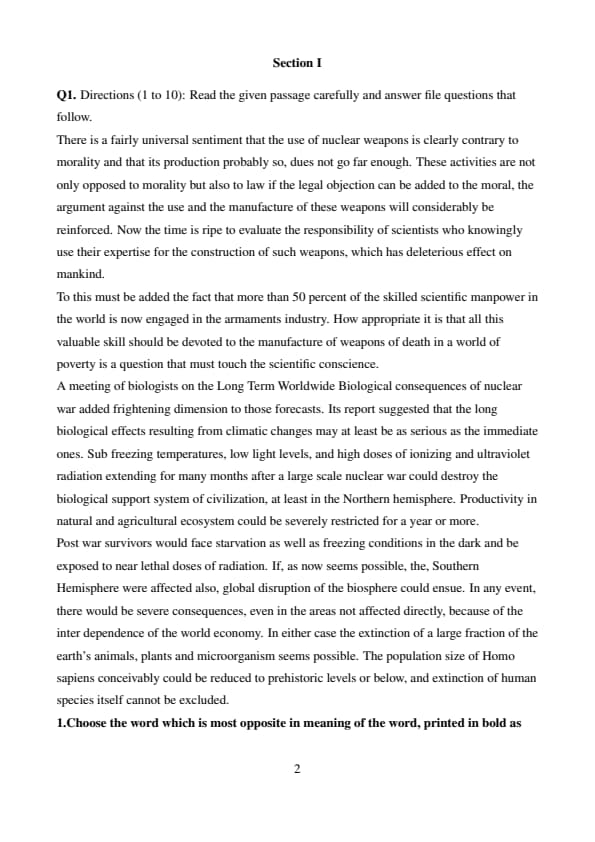
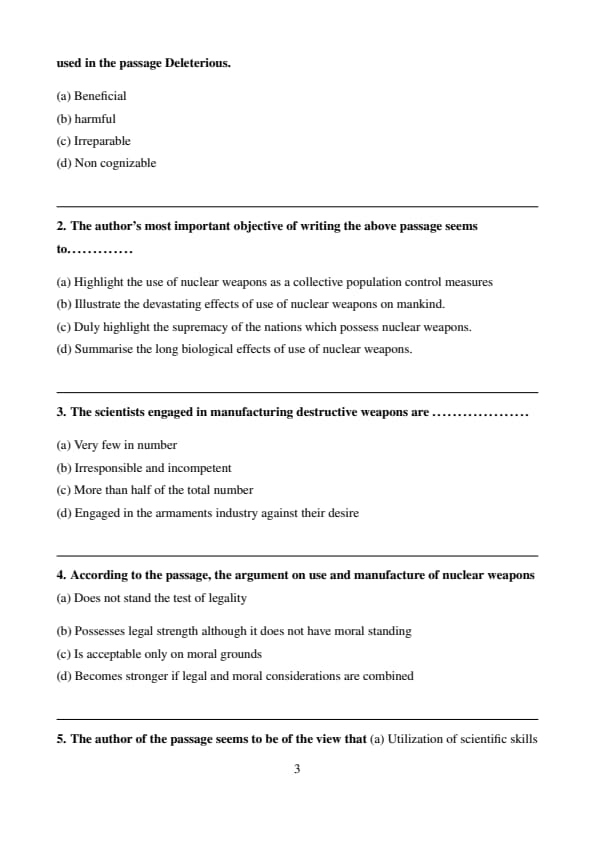
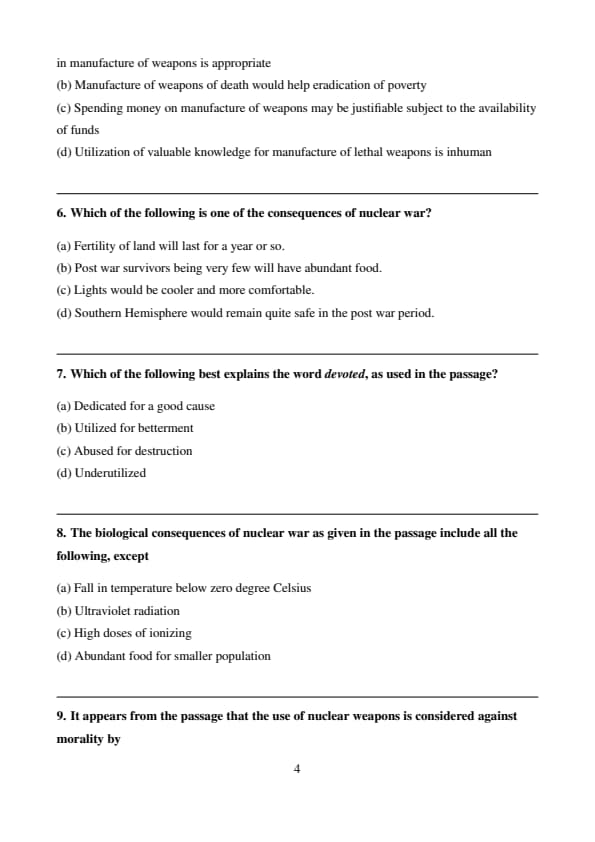
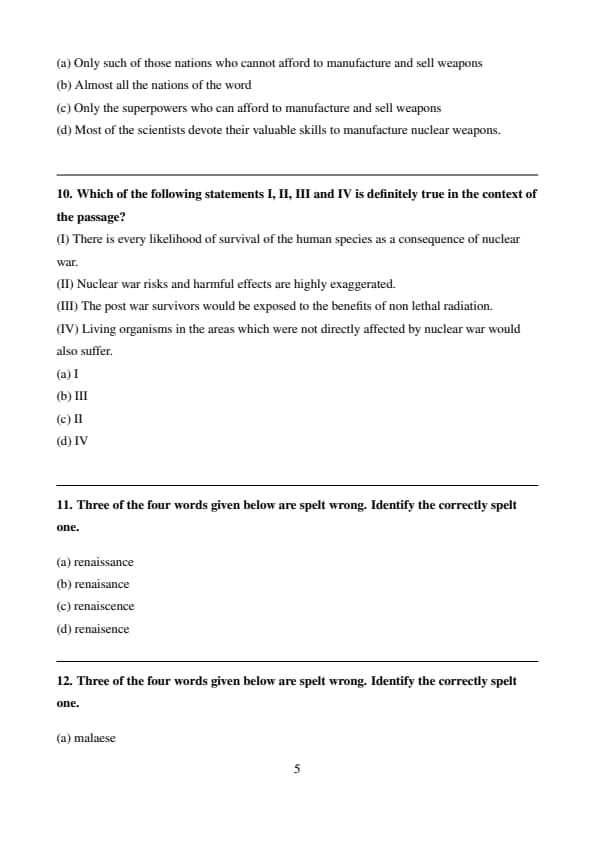
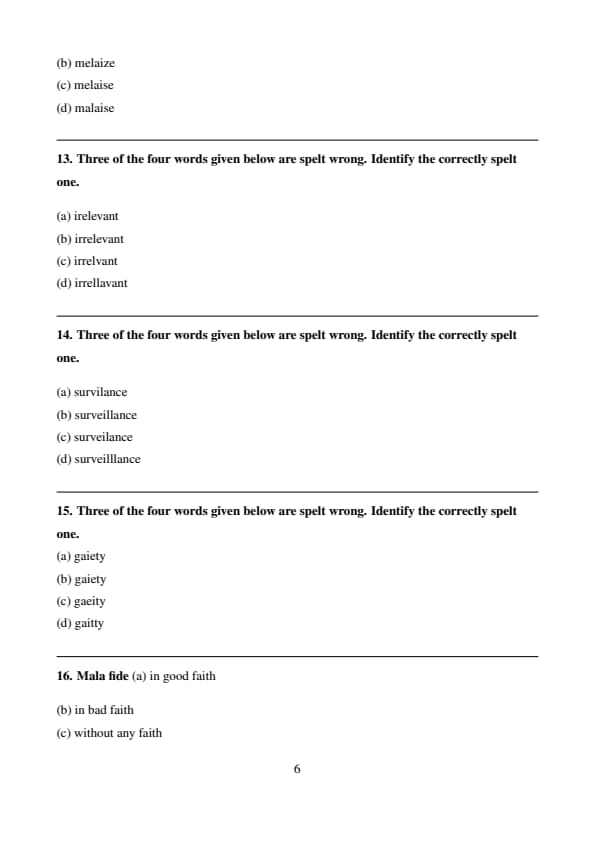
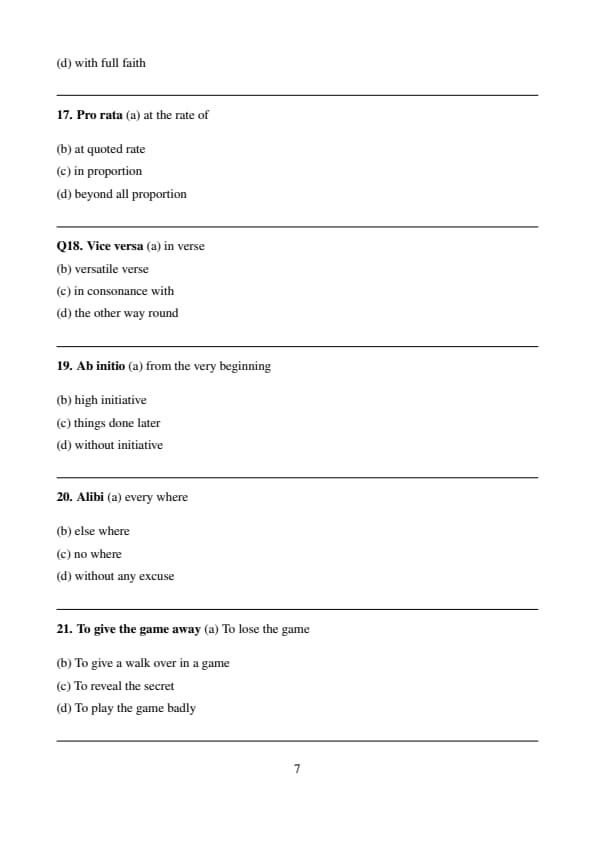
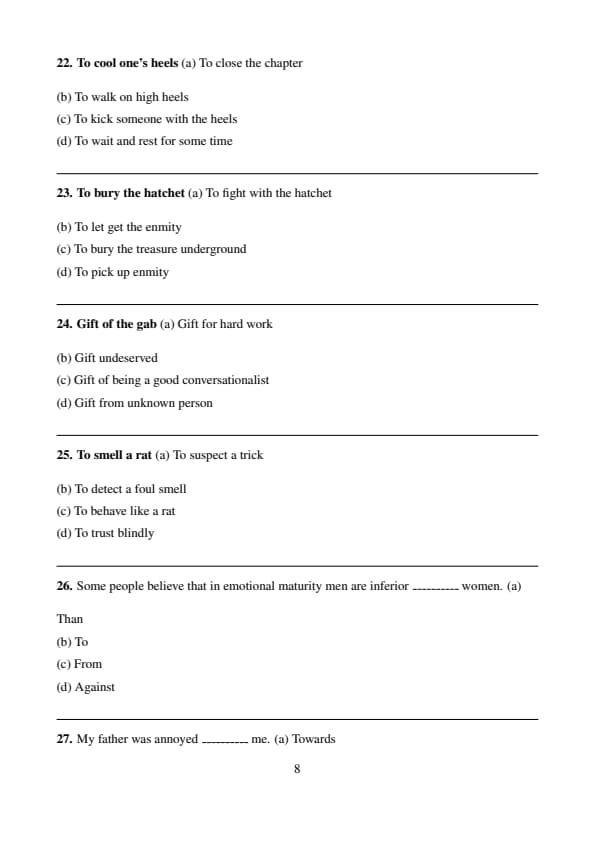
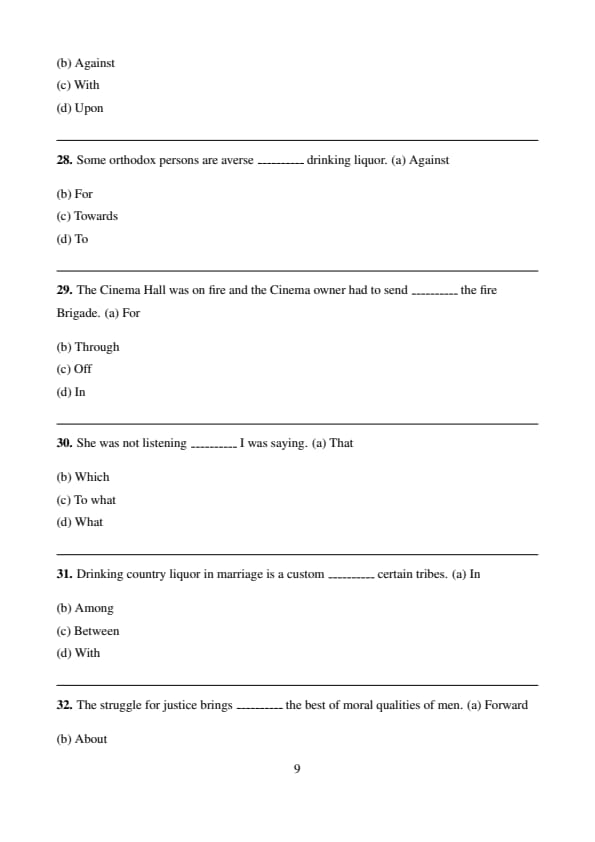
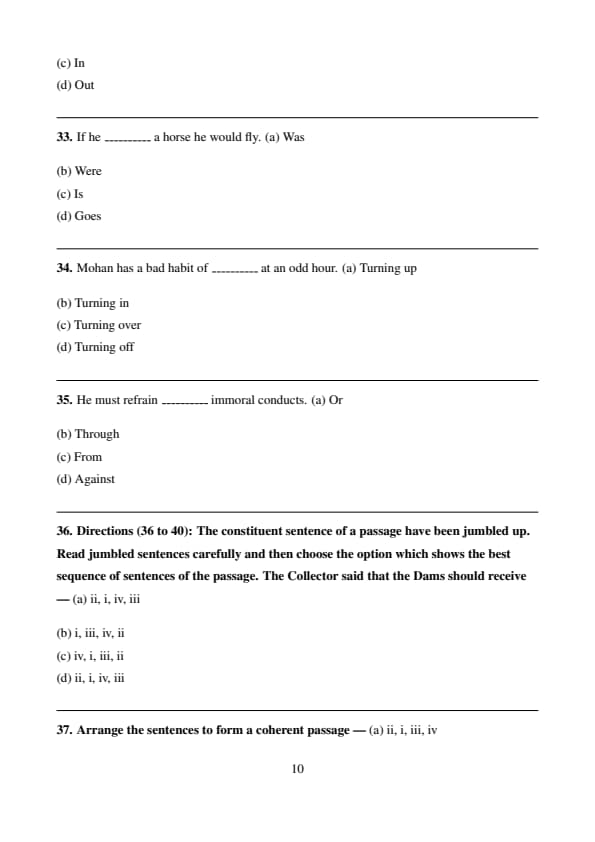
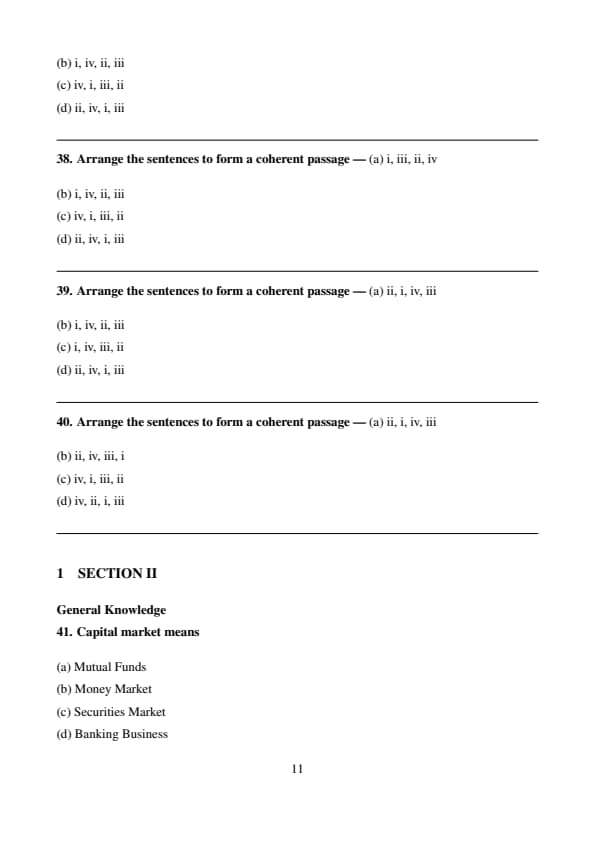
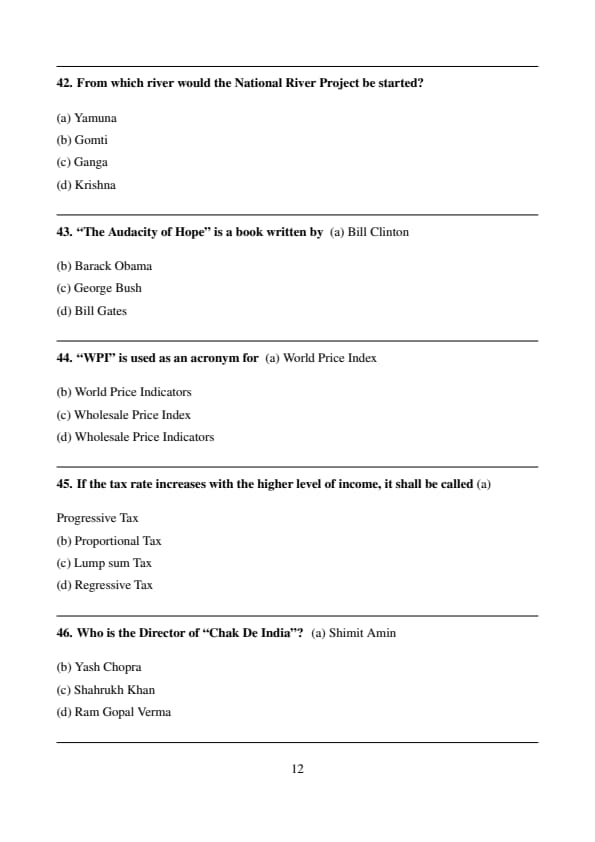
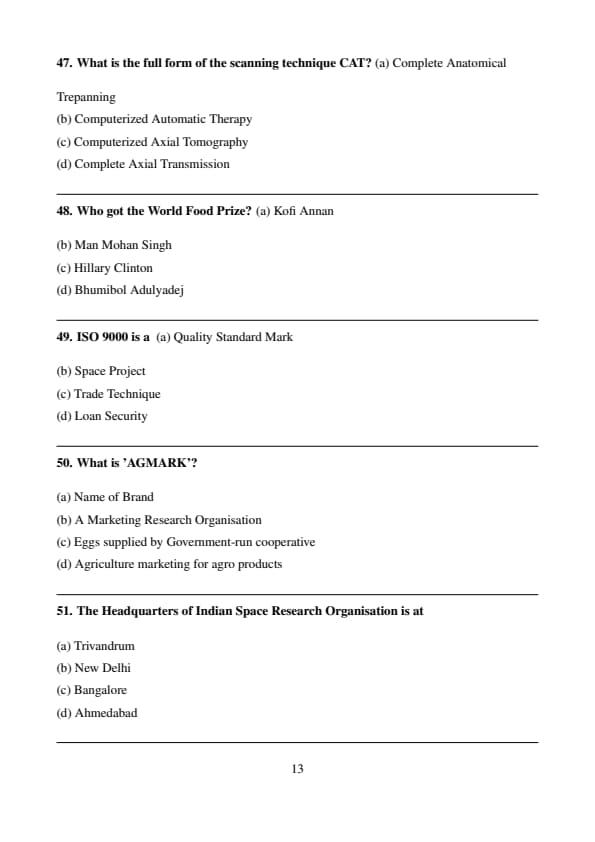
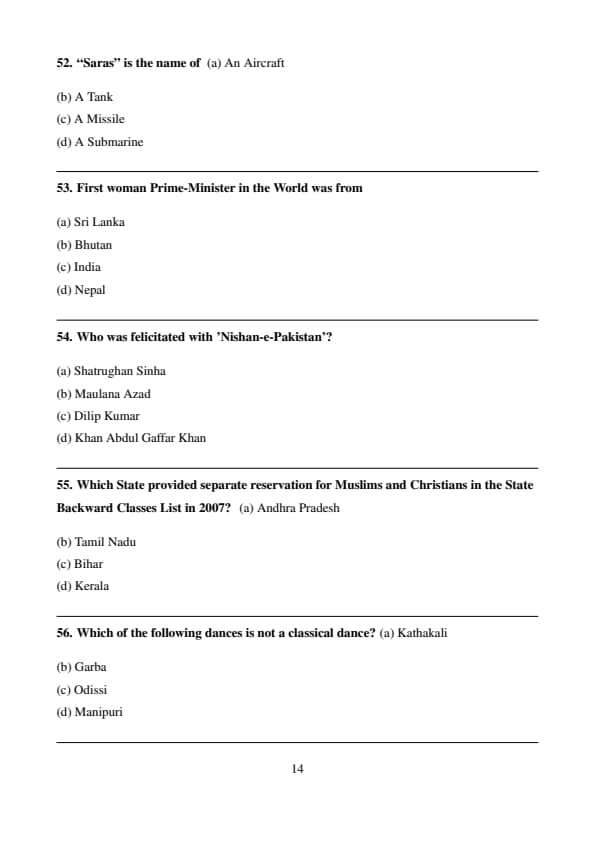
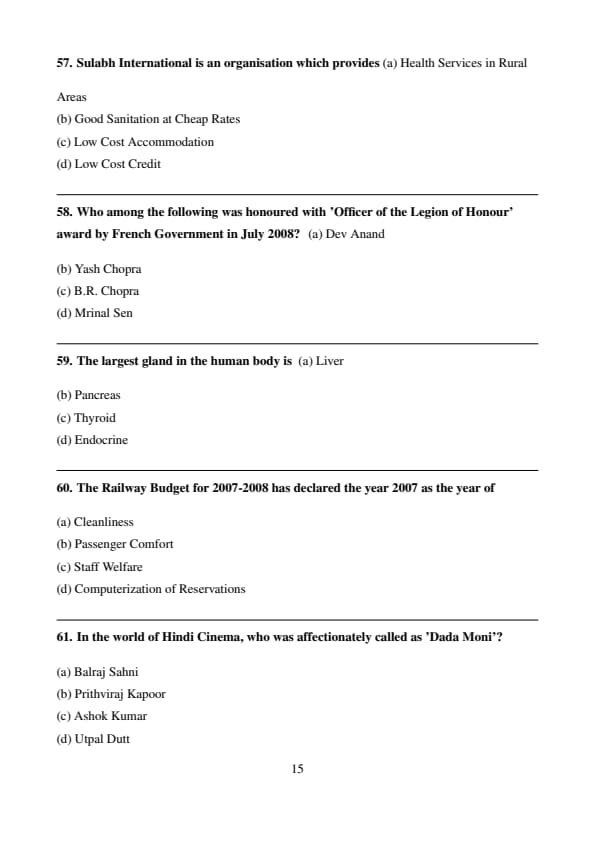
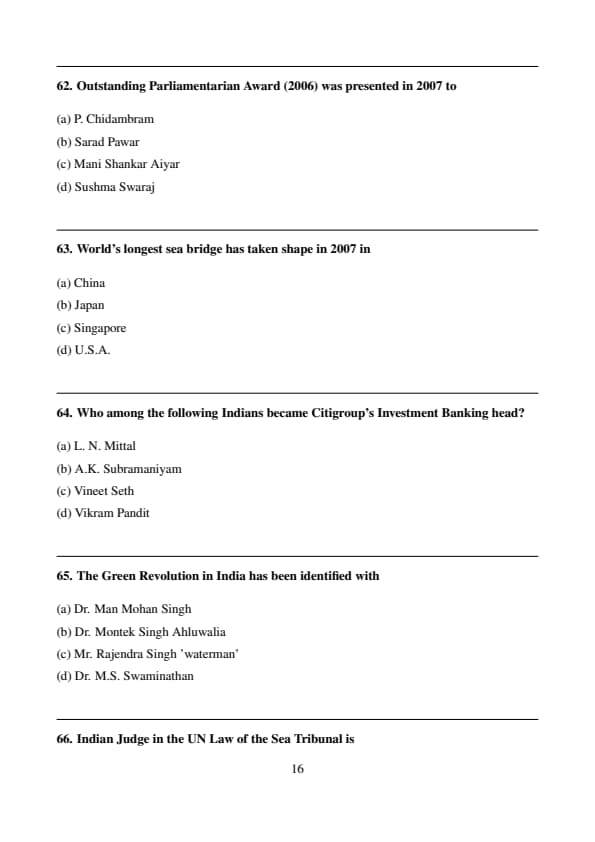
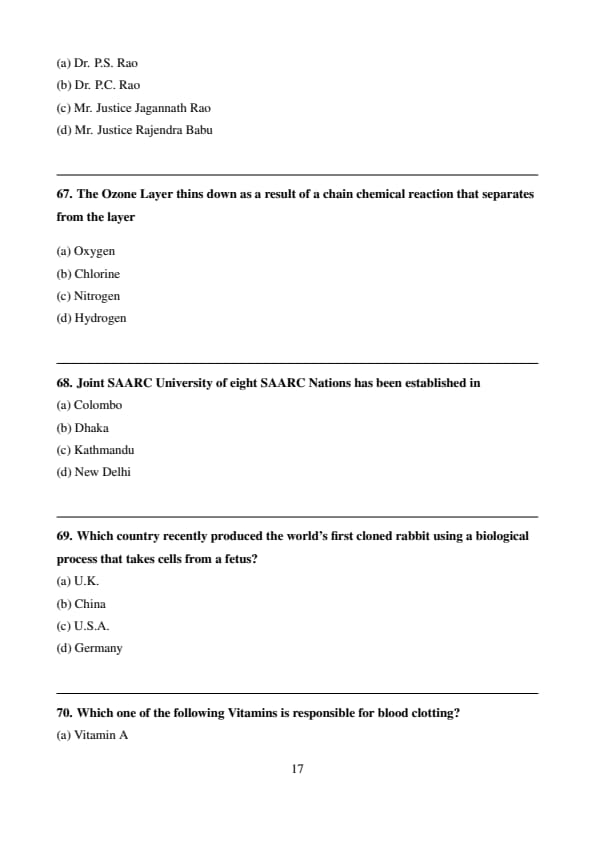
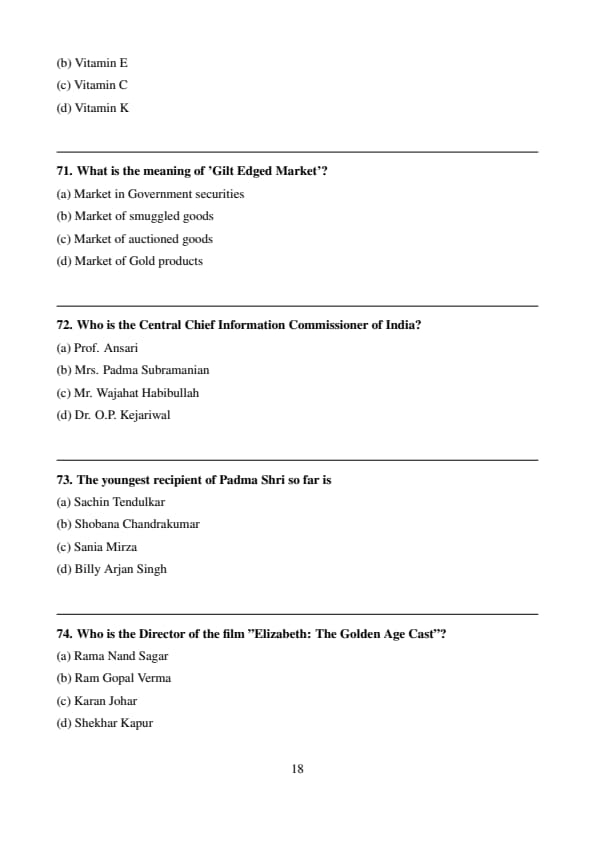
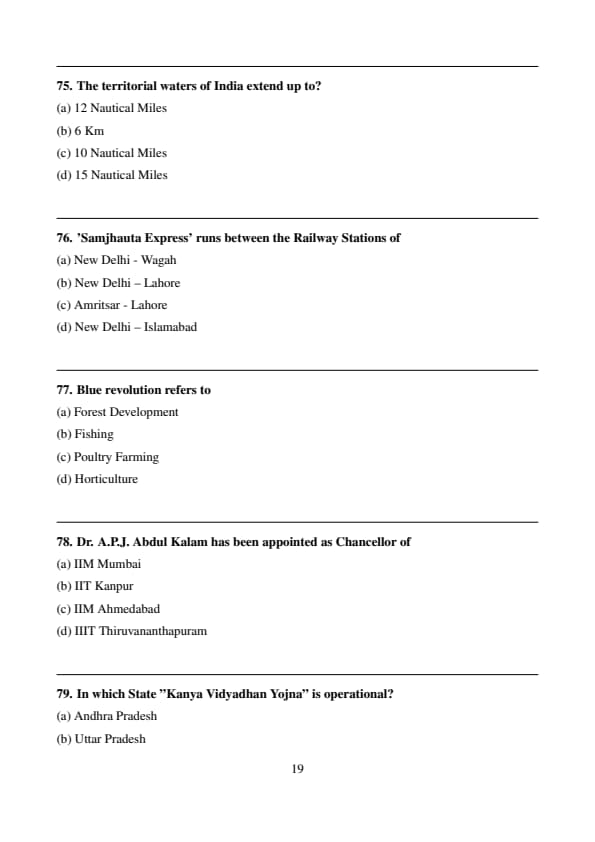
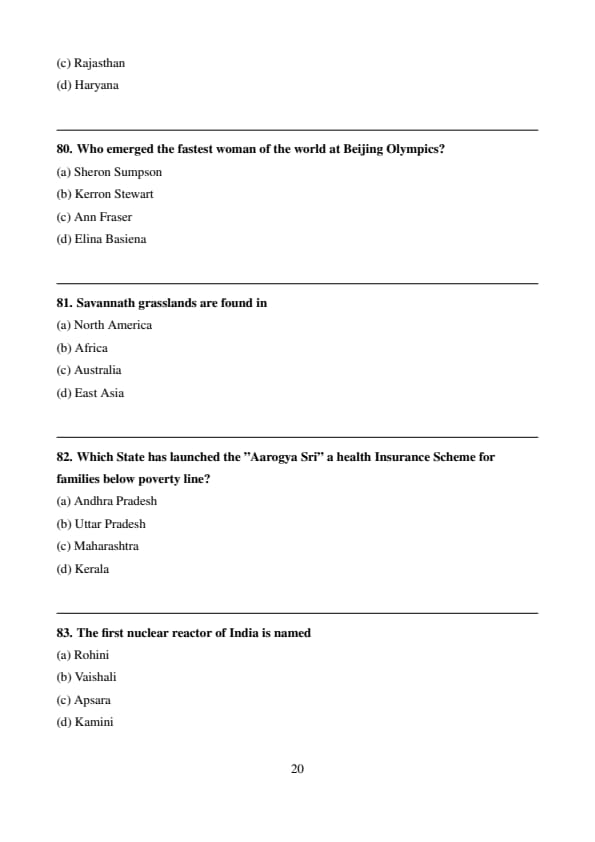
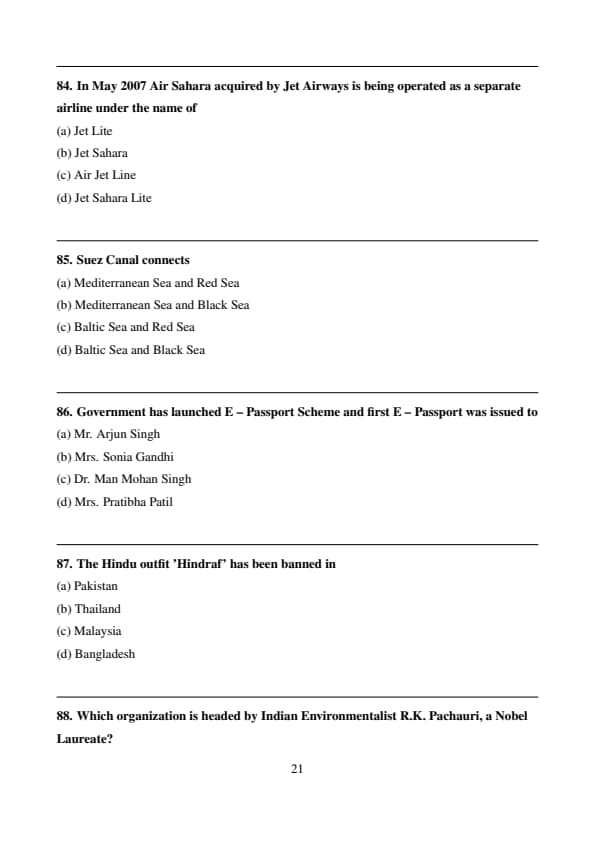
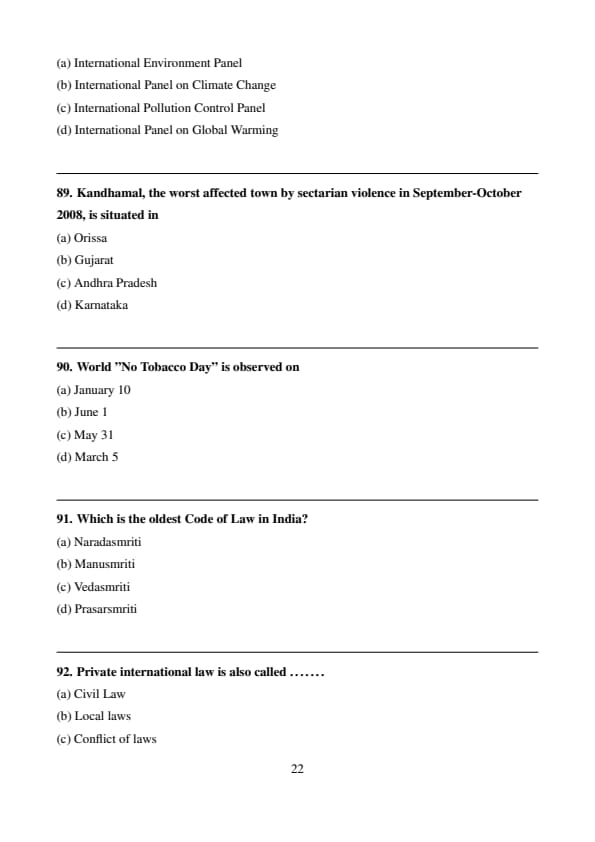
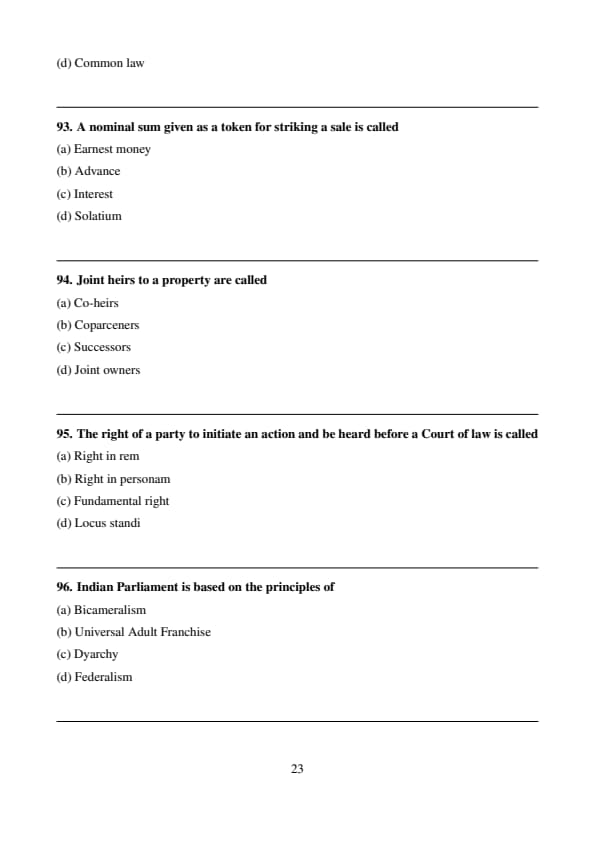
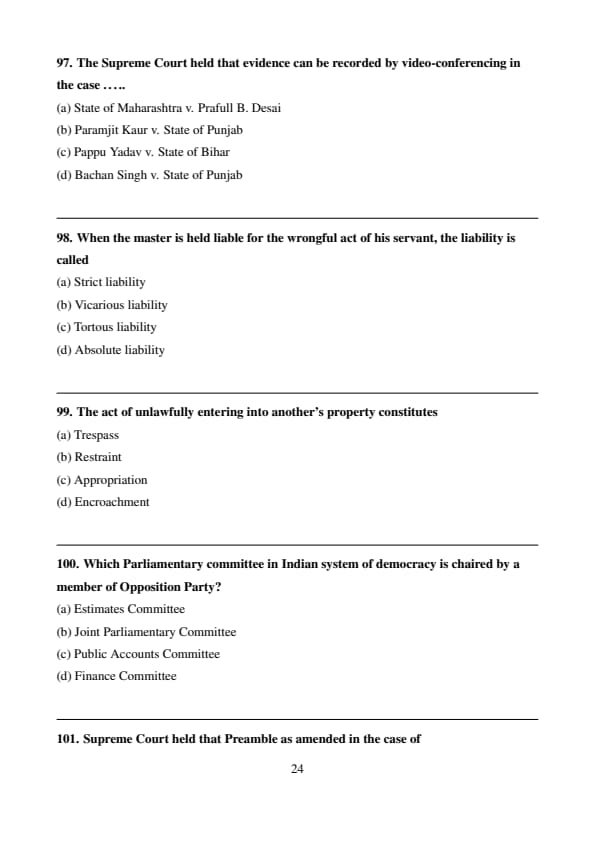
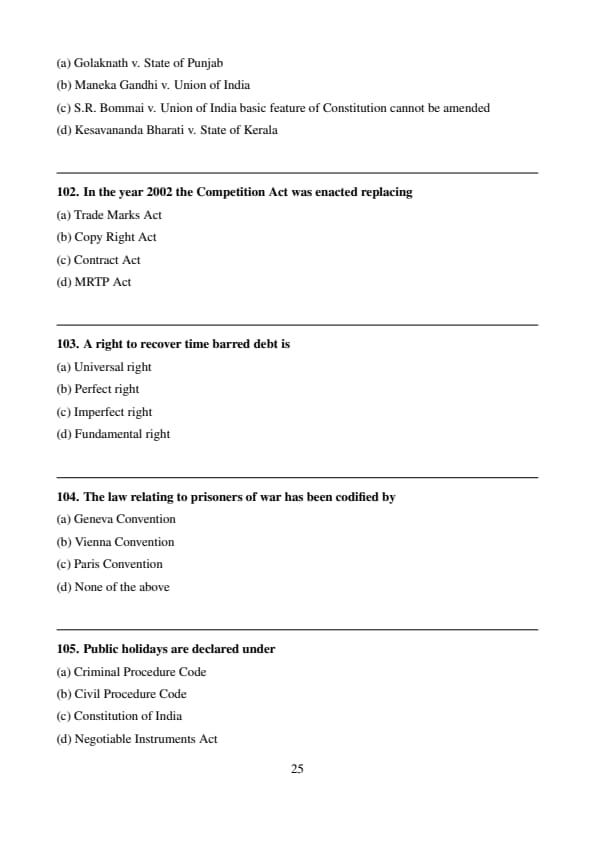
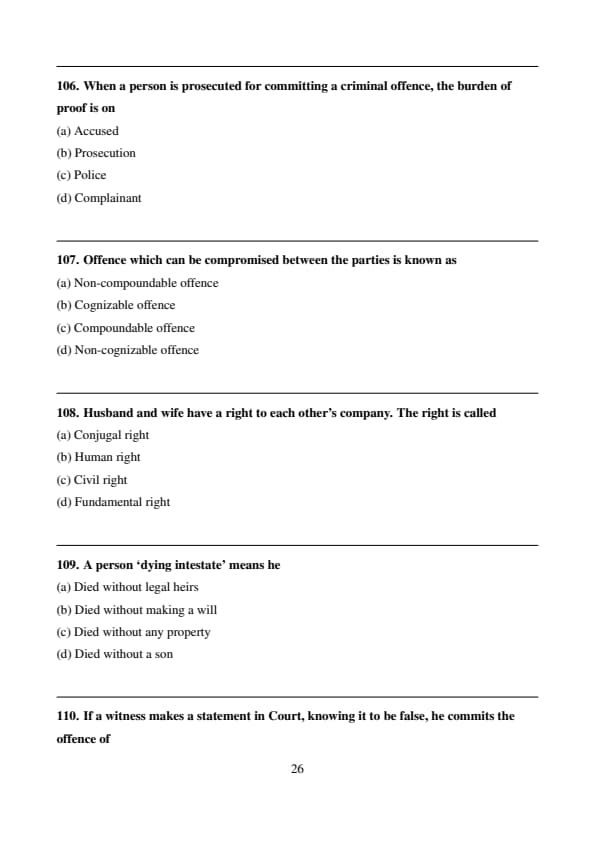
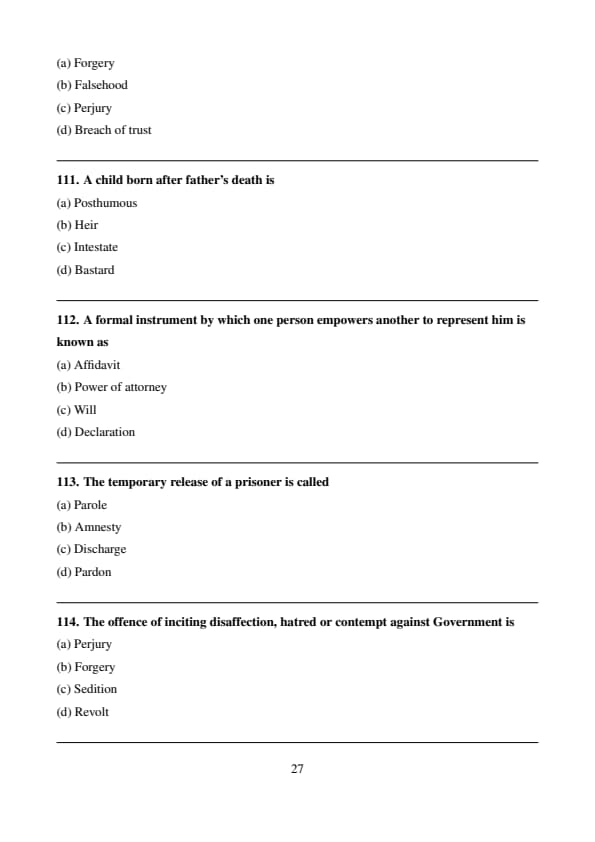
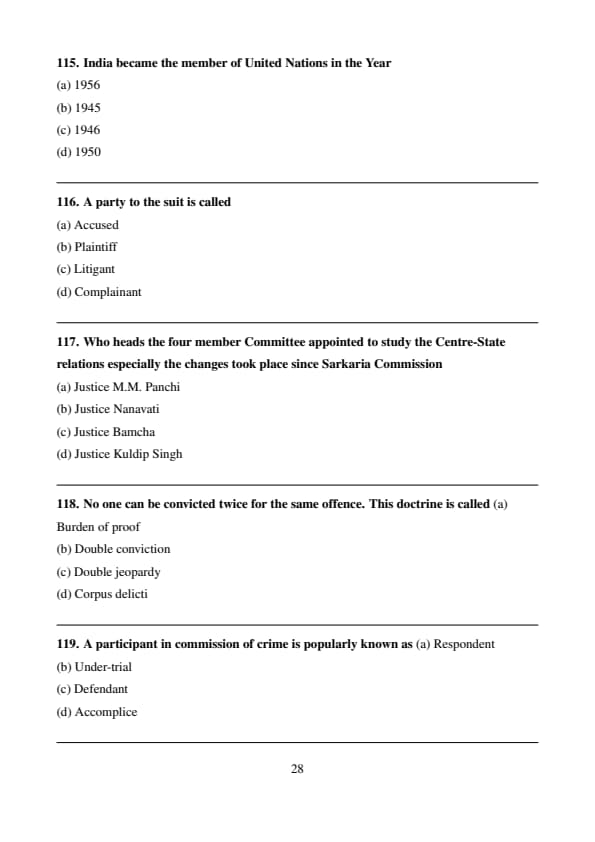
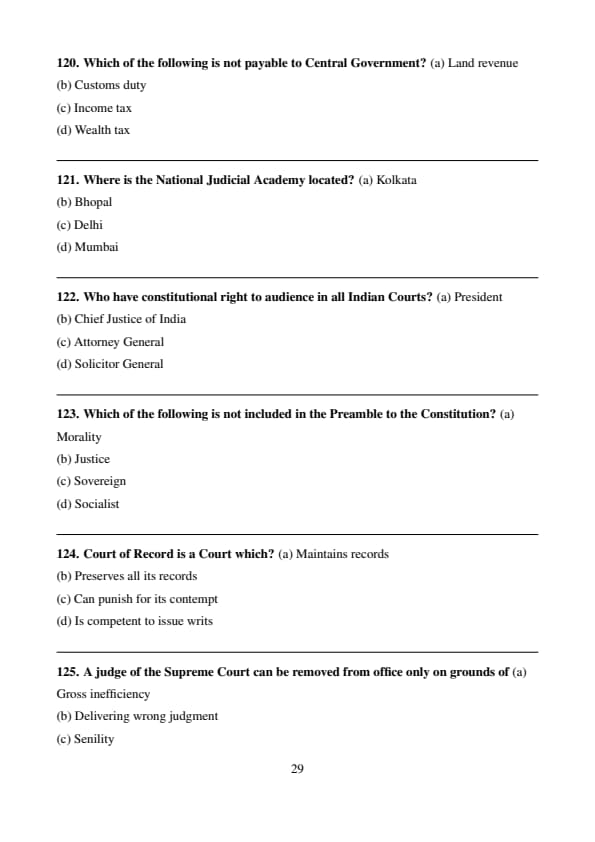
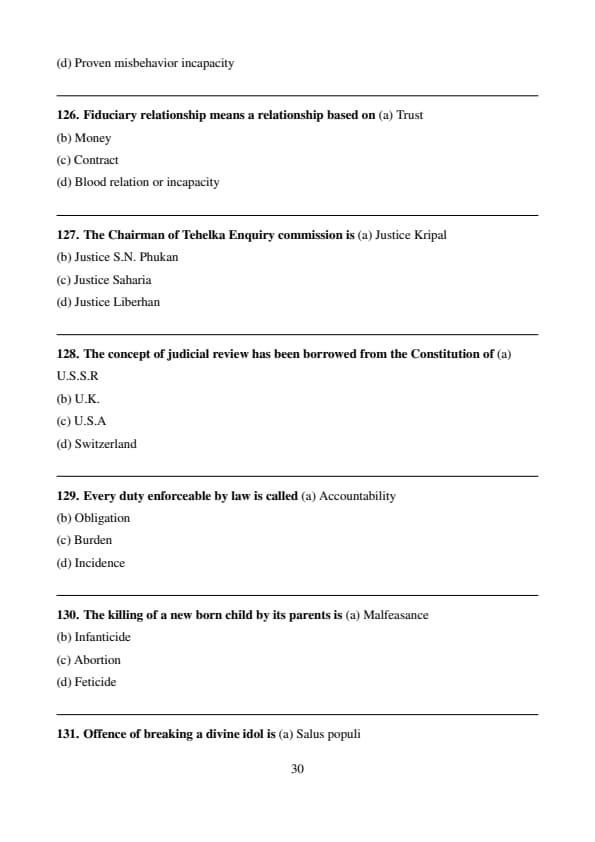
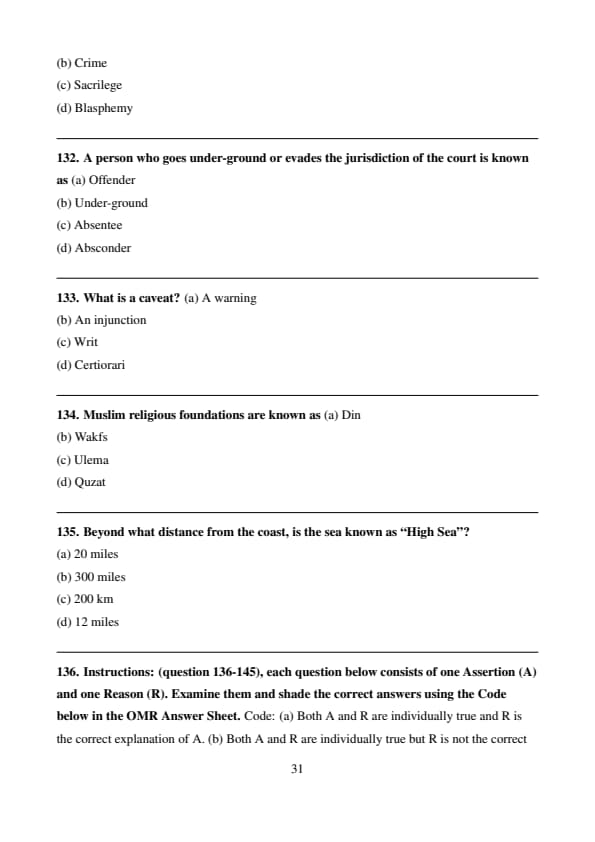
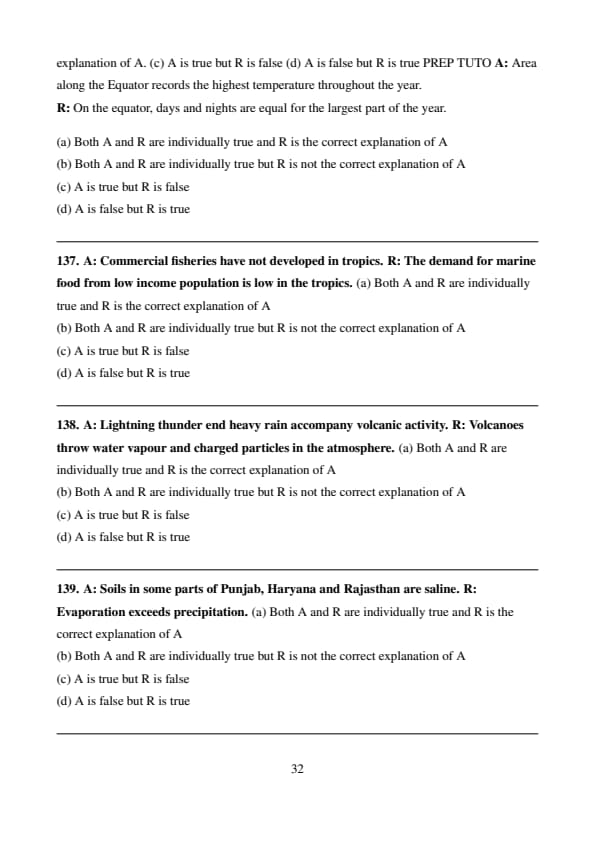
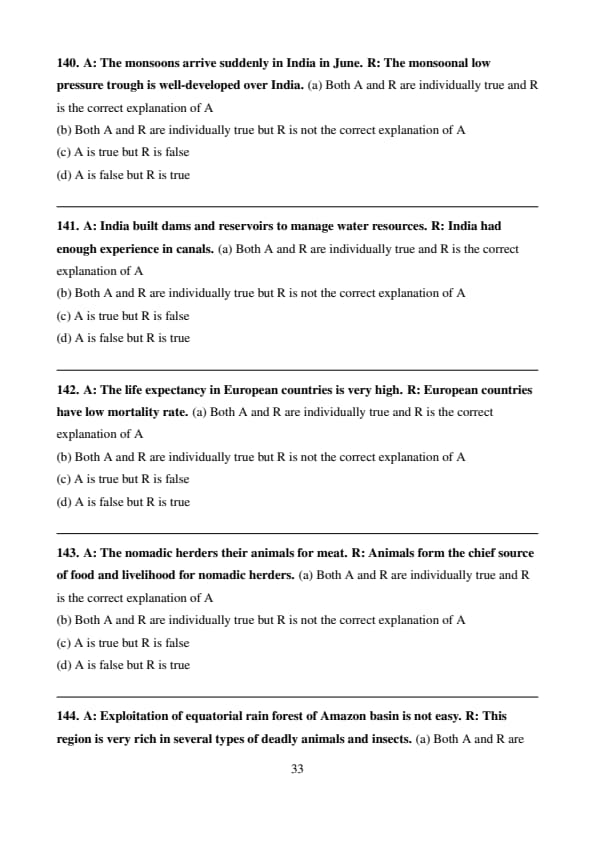
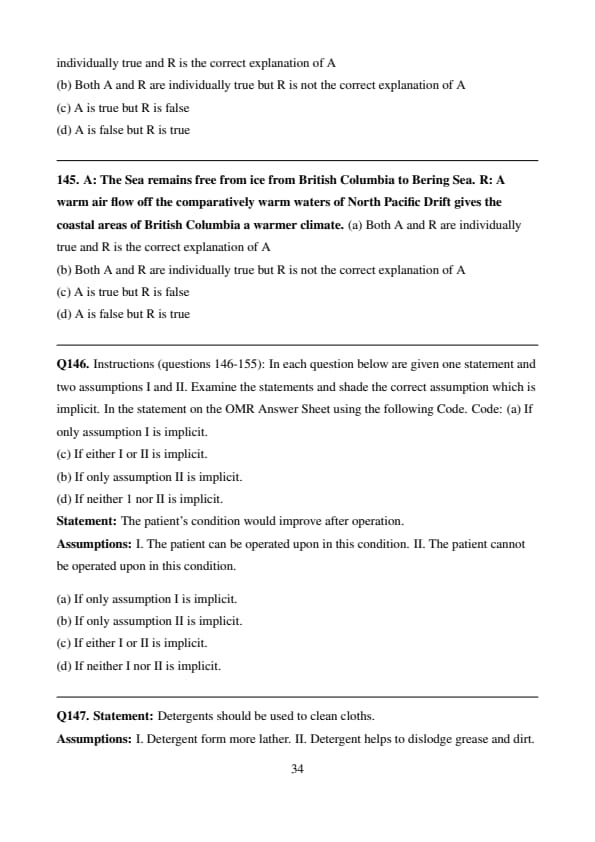
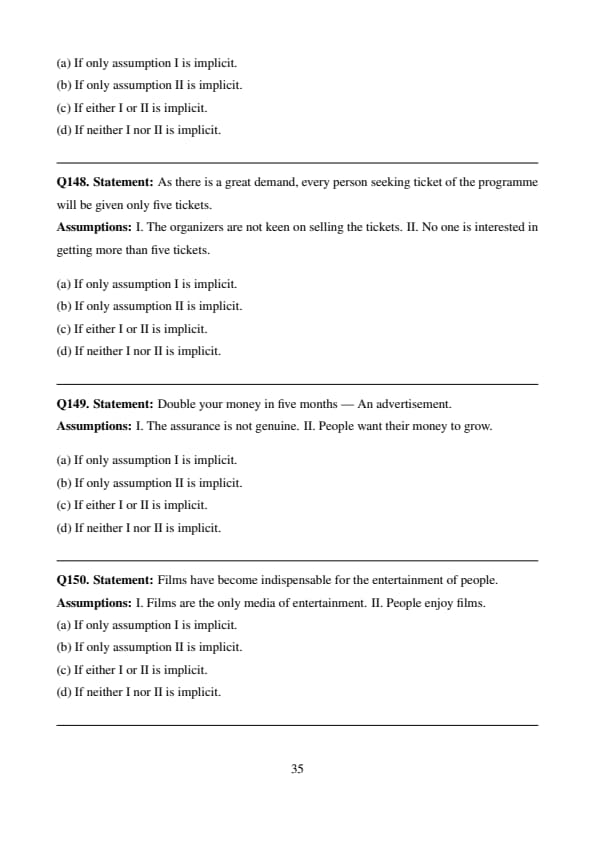
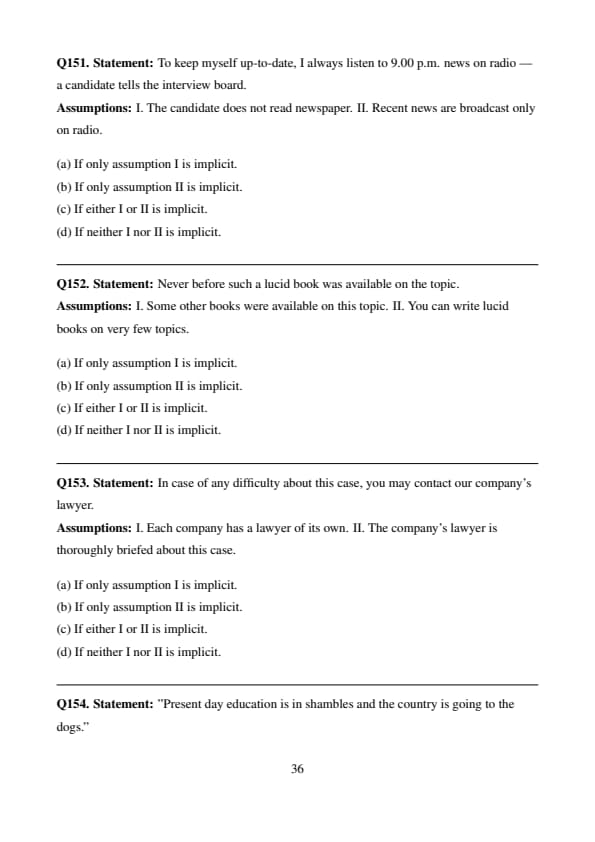
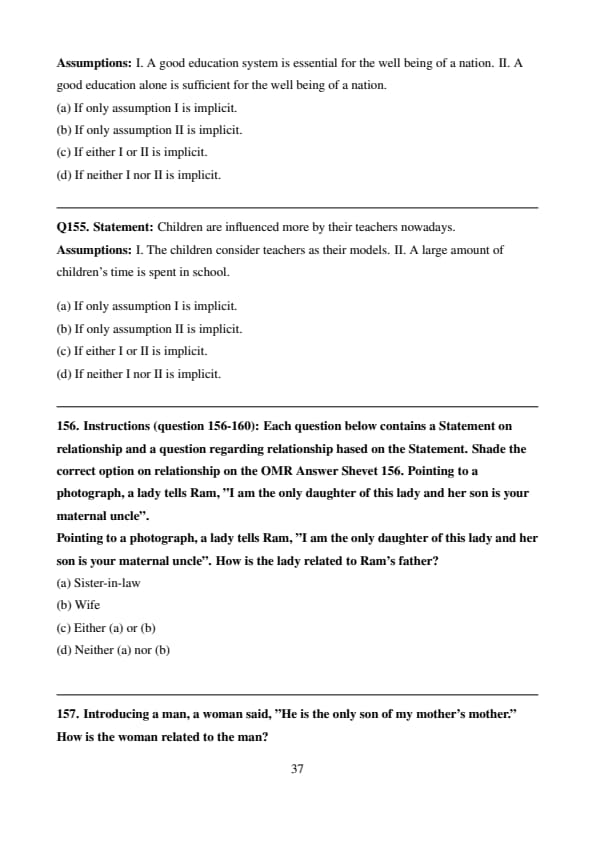
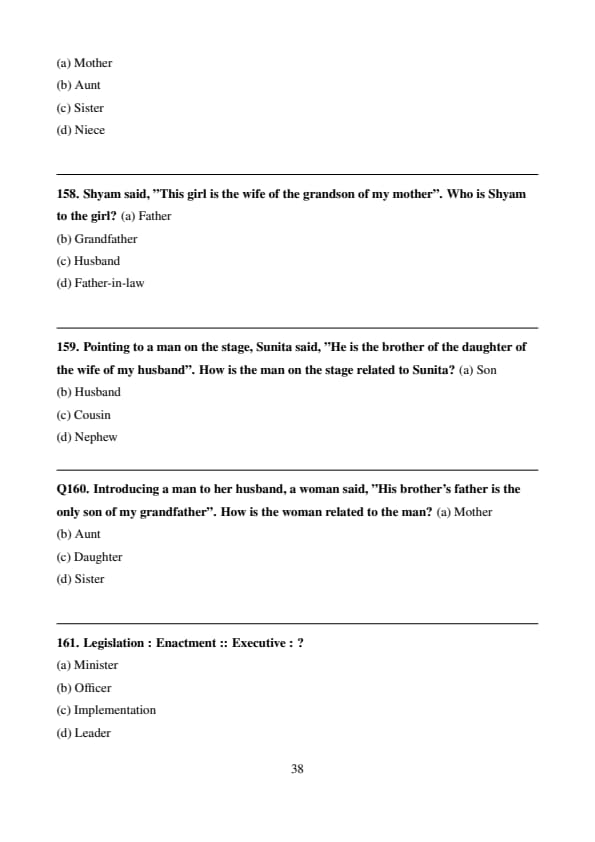
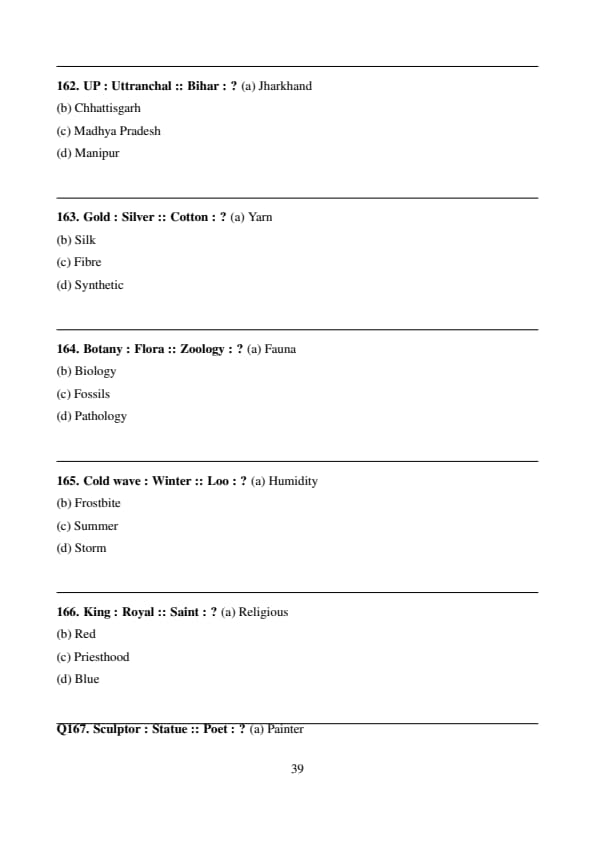
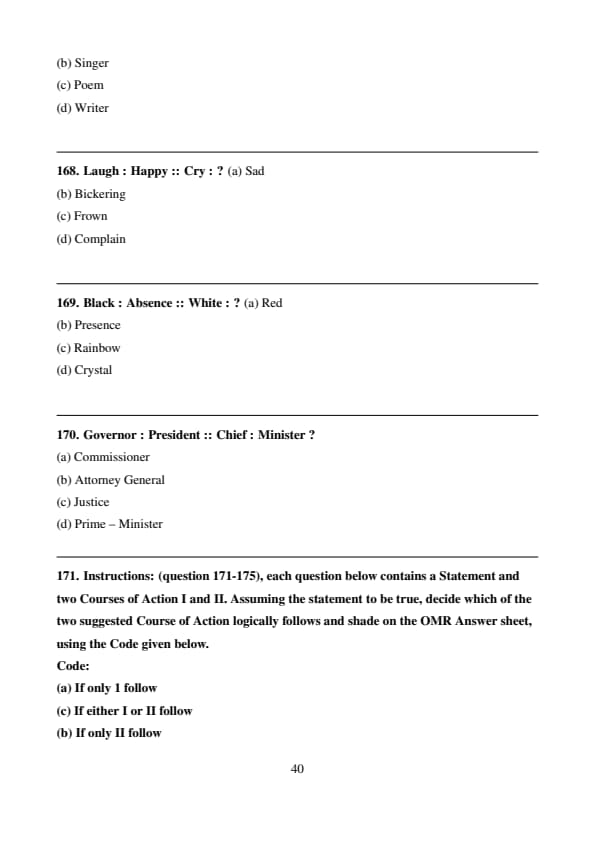
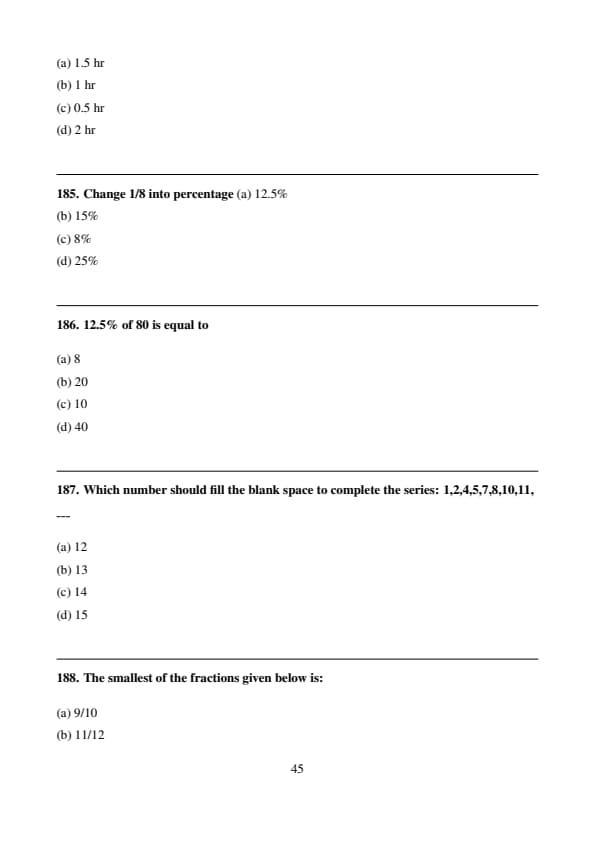
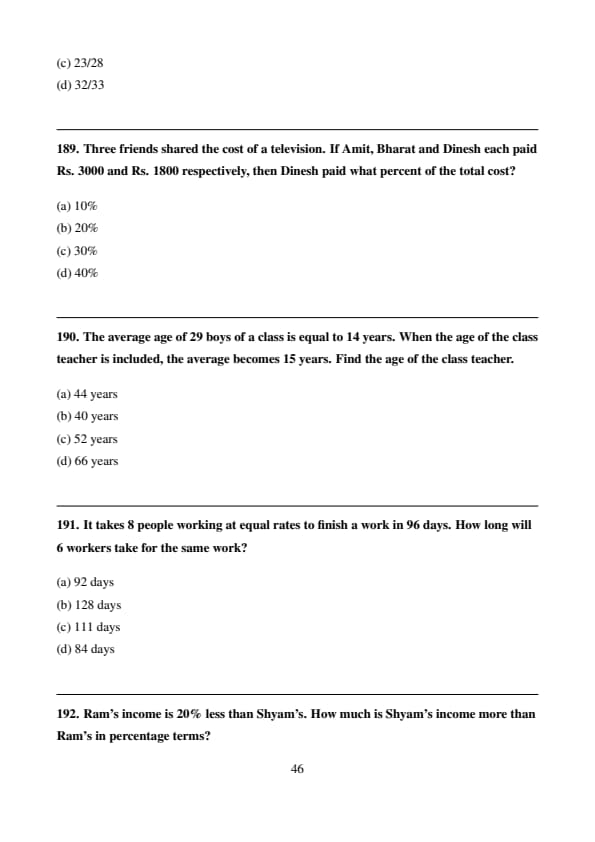
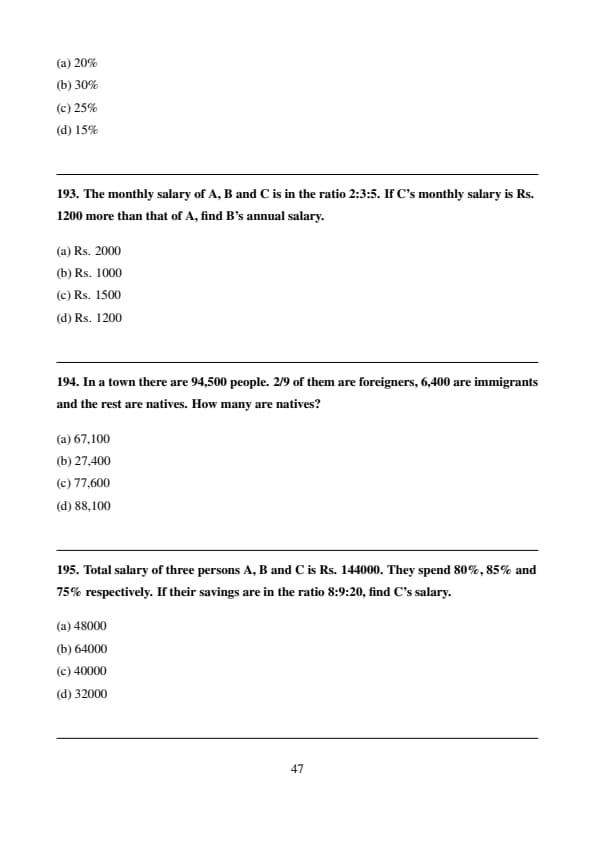
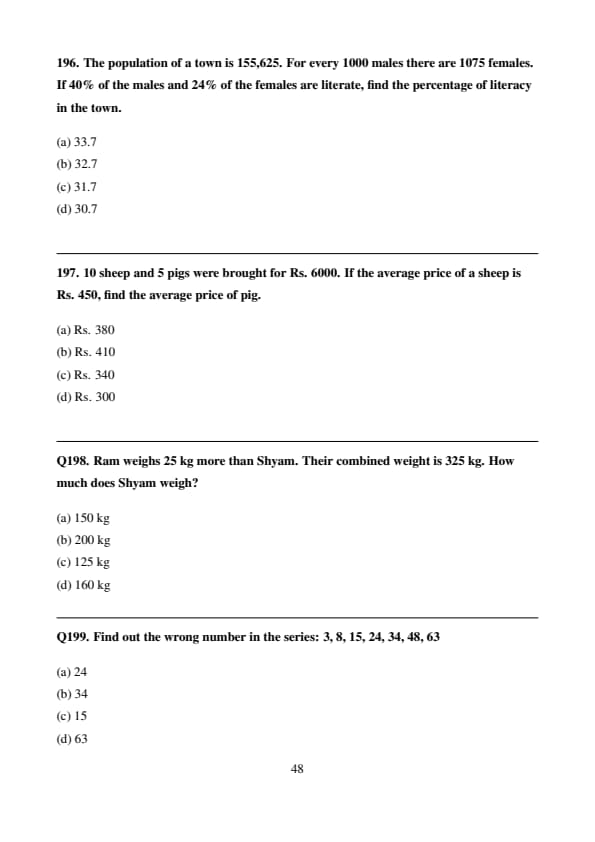
CLAT Previous Year Question Paper with Answer Key PDFs
Collegedunia has provided CLAT Previous Year Question paper pdf with answer key in the links given below:
| CLAT 2021 Question Paper | CLAT 2020 Question Paper | CLAT 2019 Question Paper |
| CLAT 2018 Question Paper | CLAT 2017 Question Paper | CLAT 2016 Question Paper |



Comments