




CLAT 2010 Common Question paper with answer key pdf conducted on May 9, 2010 in Afternoon Session 3:00 PM to 5:00 PM is available for download. The exam was successfully organized by Rajiv Gandhi National Law University. In terms of difficulty level, CLAT was of Easy to Moderate level. The question paper comprised a total of 200 questions divided among five sections.
Also Check:
CLAT 2010 Common Question Paper with Solution PDF
| CLAT 2010 Common Question Paper with Answer Key | Download PDF | Check Solutions |
Question 1:
Slavery was not done away .............. until the last century.
View Solution
The phrase "done away with" is an established idiomatic expression in English.
It means to abolish, eliminate, or get rid of something that is considered undesirable.
In this sentence, the topic is "slavery," which historically was abolished in many countries only during the last century.
Therefore, the correct and complete phrase should be "done away with," which naturally leads to selecting option (a).
Option (b) "for" is incorrect because "done away for" is not a recognised collocation in English and does not convey the intended meaning.
Option (c) "to" is also incorrect since "done away to" does not exist as an idiom or expression in this context.
Option (d) "off" is wrong because "done away off" is grammatically and idiomatically invalid.
Example: "Corporal punishment was done away with in most schools during the late 20th century."
This example shows how the idiom is used to mean "abolished" in a formal sense.
Quick Tip: Memorise fixed idiomatic expressions like "done away with" — changing the preposition will make them incorrect.
Does he not take .............. his father?
View Solution
The phrasal verb "take after" means to resemble someone, usually a family member, in looks, character, or behaviour.
In this sentence, the subject is being compared to his father, implying similarity in traits.
Option (c) "after" completes the phrasal verb correctly: "Does he not take after his father?"
Option (a) "before" is incorrect because "take before" has no idiomatic meaning related to resemblance.
Option (b) "for" does not work in this structure — "take for" usually means to consider someone to be something, e.g., "I took him for a teacher."
Option (d) "like" might seem to imply similarity, but "take like" is not a correct phrasal verb.
Example: "She really takes after her mother in her kindness and patience."
Quick Tip: Phrasal verbs like "take after" have fixed meanings — here, it is used for familial resemblance.
We will have to take .............. more staff if we're to take on more work.
View Solution
The phrasal verb "take on" means to hire or employ staff, or to accept responsibility for a task or challenge.
In this context, it refers specifically to hiring more employees.
Option (d) "on" completes the phrase to mean "hire": "We will have to take on more staff."
Option (a) "up" is incorrect — "take up" means to start a hobby, occupy space, or accept an offer, e.g., "take up painting."
Option (b) "onto" is used to describe movement towards a surface and is irrelevant here.
Option (c) "into" generally means including something or moving inside, not hiring.
Example: "The company decided to take on fifty new workers to meet increased demand."
Quick Tip: In business English, "take on" is a common phrasal verb meaning to employ or hire more staff.
Mother takes everything in her ..............
View Solution
The idiom "take something in stride" means to handle a difficult situation calmly, without letting it affect you negatively.
This phrase is often used to describe people who remain composed even under stress.
Option (c) "stride" is correct because "in her stride" completes this idiom perfectly.
Option (a) "steps" is incorrect — while steps relate to walking, the idiom is fixed as "in stride."
Option (b) "face" is wrong — "in her face" would mean directly confronting something, not handling it calmly.
Option (d) "work" is irrelevant and does not fit the idiom.
Example: "Despite the sudden criticism, she took it in her stride and continued with her presentation."
Quick Tip: Idioms like "take in stride" cannot be modified without losing their intended meaning — learn them in their original form.
Sale have really taken .............. now.
View Solution
The phrasal verb "take off" means to become successful or popular quickly, or to increase rapidly.
Here, it refers to sales increasing dramatically.
Option (d) "off" is correct: "Sales have really taken off now" means sales have grown suddenly and substantially.
Option (a) "up" would mean to start or occupy something, which doesn’t match the intended meaning.
Option (b) "on" generally means to accept responsibility or hire staff, unrelated to sales growth.
Option (c) "of" is grammatically incorrect in this construction.
Example: "Her business really took off after she introduced a new marketing strategy."
Quick Tip: "Take off" is often used to describe sudden success in business, sports, or personal projects.
The constituent phrases of a sentence are jumbled. Select the most appropriate sequence to make the sentence meaningful:
(i) built on the site of a church destroyed.
(ii) in the hilly area of the city is the famous Shandon Steeple.
(iii) the bell tower of St. Anne’s Church.
(iv) when the city was besieged by the Duke of Marlborough.
View Solution
To form a meaningful sentence, we first need to identify the subject.
The phrase (iii) "the bell tower of St. Anne’s Church" clearly functions as the main subject.
Next, (ii) "in the hilly area of the city is the famous Shandon Steeple" links the location and identification, directly following the subject.
Then, (i) "built on the site of a church destroyed" adds a descriptive clause explaining its construction.
Finally, (iv) "when the city was besieged by the Duke of Marlborough" gives the historical context for the destruction.
Combining in this order, the sentence reads naturally and maintains logical flow:
"The bell tower of St. Anne’s Church, in the hilly area of the city, is the famous Shandon Steeple, built on the site of a church destroyed when the city was besieged by the Duke of Marlborough."
This makes (d) the correct choice.
Quick Tip: When solving jumbled sentence questions, first locate the subject and then arrange descriptive and contextual clauses around it logically.
The constituent phrases of a sentence are jumbled. Select the most appropriate sequence to make the sentence meaningful:
(i) no law giving effect in the policy of the state towards securing all or any of the principles laid in part IV.
(ii) notwithstanding anything contained in Article 13.
(iii) and no law containing a declaration that it is for giving effect to such policy shall be called in question in any court on the ground that it does not give effect to such policy.
(iv) shall be deemed to be void on the ground that it is inconsistent with or takes away or abridges any of the rights conferred by Article 14 or 19.
View Solution
We begin with (ii) "notwithstanding anything contained in Article 13" because it sets a legal exception or overriding statement, which is common in constitutional provisions.
Next, (i) "no law giving effect in the policy of the state towards securing all or any of the principles laid in part IV" introduces the type of law being referred to.
Then, (iv) "shall be deemed to be void on the ground that it is inconsistent with or takes away or abridges any of the rights conferred by Article 14 or 19" specifies the constitutional reason why such a law would be invalid.
Finally, (iii) "and no law containing a declaration that it is for giving effect to such policy shall be called in question in any court on the ground that it does not give effect to such policy" clarifies an additional restriction about questioning such laws in court.
Arranging in this way gives a precise and legally coherent sentence.
This mirrors how legal articles are typically structured — starting with an overriding clause, describing the law, stating its limitations, and ending with clarifications.
Quick Tip: For legal or constitutional sentence jumbles, note that the structure usually begins with an overriding clause, then defines the law, states exceptions, and ends with procedural notes.
The constituent phrases of a sentence are jumbled. Select the most appropriate sequence to make the sentence meaningful:
(i) neither House shall proceed further with the Bill,
(ii) if he does so, the houses shall meet according.
(iii) but the President may at any time after the date of his notification summon the Houses to meet in a joint sitting for the purpose specified in the notification and,
(iv) where the President has under clause (I) notified his intention of summoning the Houses to meet in a joint sitting.
View Solution
We start with (iv) "where the President has under clause (I) notified his intention of summoning the Houses to meet in a joint sitting" because it sets up the condition for the rest of the sentence.
Next comes (i) "neither House shall proceed further with the Bill" as it states the immediate legal consequence of the situation described in (iv).
Then we follow with (iii) "but the President may at any time after the date of his notification summon the Houses to meet in a joint sitting for the purpose specified in the notification and," which provides an alternative or further action possible under the same scenario.
Finally, we end with (ii) "if he does so, the houses shall meet according," which concludes the procedural chain.
This sequence makes the sentence both grammatically correct and logically consistent with parliamentary procedure.
Quick Tip: When arranging procedural or legal sequences, place the condition first, followed by the consequence, then exceptions or options, and end with procedural outcomes.
She always praises everything I say.
View Solution
The underlined phrase "praises" means to express approval or admiration for something.
We are looking for an opposite meaning, which should convey criticism or disapproval.
Option (a) "picks holes in" is an idiomatic expression that means to find faults or criticize something.
This directly contrasts with "praises," making it the best antonym.
Option (b) "dislikes" is a general term for having a negative feeling, but it doesn’t necessarily imply active criticism.
Option (c) "rebukes" means to scold or reprimand, but it is stronger and usually for misbehavior, not general disagreement.
Option (d) "picks holes to" is grammatically incomplete and incorrect.
Therefore, option (a) is the most accurate opposite.
Example: "Instead of praising my work, he always picks holes in it to find mistakes."
Quick Tip: Idioms like "pick holes in" are perfect antonyms for praise when the context is about criticism rather than simple dislike.
He often says how wonderful his school is?
View Solution
The underlined phrase "says how wonderful" implies that he speaks positively about his school, essentially praising it.
The opposite meaning should express speaking negatively or criticizing.
Option (d) "runs down" is a phrasal verb meaning to criticize or speak poorly of something.
Option (a) "says he is unworthy" is unrelated to the school and doesn’t match the intended meaning.
Option (b) "appreciates" actually means to value or praise, so it is similar, not opposite.
Option (c) "runs up" means to accumulate (often debts or bills), unrelated to speaking about something.
Thus, "runs down" is the most accurate opposite of "says how wonderful".
Example: "He runs down his old car whenever someone asks him about it."
Quick Tip: When replacing positive speech with an opposite, phrasal verbs like "run down" often carry the sense of verbal criticism.
She said I was the best boss they’d ever had. It was obvious she was \underline{praising me sincerely.
View Solution
The underlined phrase "praising me sincerely" means giving genuine compliments or admiration.
The opposite should mean being dishonest in praise, i.e., pretending with hidden intentions.
Option (b) "befooling me" means deceiving or tricking someone, which fits perfectly as the opposite of sincere praise.
Option (a) "not appreciating me" simply means lack of praise, not necessarily dishonesty.
Option (c) "buttering me up" means flattering someone to gain favor, which still involves praise, though insincere — but it’s not exactly opposite, more like manipulative praise.
Option (d) "disliking me" is unrelated to whether praise was genuine or fake.
Thus, "befooling me" best captures the sense of opposite here because it changes the tone from genuine to deceitful.
Example: "He pretended to support me, but in reality, he was just befooling me."
Quick Tip: Opposites of sincerity often involve deception — words like "befool" indicate deliberate misleading rather than simple absence of praise.
I must \underline{perfect the operation to make the perfect robot.
View Solution
The underlined word "perfect" in this sentence is used as an action — it describes what the subject ("I") must do.
Here, "perfect" means "to make something free from faults" or "to improve it to the highest standard."
Since it expresses an action rather than a description, it functions as a verb.
Option (b) "adverb" is incorrect because it does not modify a verb, adjective, or another adverb here.
Option (c) "adjective" is incorrect — although "perfect" can be an adjective (as in "perfect robot"), in this sentence it is not describing a noun but showing an action.
Option (d) "noun" is incorrect because "perfect" is not naming anything here.
Example: "She worked hard to perfect her presentation before the meeting."
Quick Tip: Check if the word shows an action — if yes, it’s functioning as a verb, even if it can be used as other parts of speech in different contexts.
A kindly person is one who behaves \underline{kindly.
View Solution
The underlined word "kindly" here is used to describe how a person behaves.
Since it modifies the verb "behaves," it tells us the manner in which the action is done.
Words that describe "how," "when," "where," or "in what way" an action happens are adverbs.
Option (a) "noun" is incorrect because "kindly" is not naming a person, place, or thing.
Option (b) "adjective" is incorrect — although "kindly" can describe a person directly (e.g., "a kindly old man"), in this sentence it is tied to the action "behaves."
Option (d) "verb" is wrong because "kindly" itself is not an action.
Example: "She spoke kindly to the lost child to make him feel safe."
Quick Tip: If the word tells you "how" an action is performed, it is functioning as an adverb in that context.
He is not normally a \underline{very fast runner, but he runs fast in major events.
View Solution
The underlined word "very" is used here to intensify the adjective "fast."
An adverb can modify a verb, an adjective, or another adverb, and in this case, it is modifying the adjective "fast."
Option (b) "adjective" is incorrect because "very" is not describing a noun; it is modifying an adjective.
Option (c) "verb" is wrong because "very" is not an action.
Option (d) "noun" is incorrect because "very" is not naming anything.
Example: "She was very happy to see her old friends." — here, "very" intensifies the adjective "happy" in the same way it intensifies "fast" in the given sentence.
Quick Tip: Words like "very," "extremely," and "quite" are adverbs when they intensify adjectives or other adverbs.
Directions: Read the following passage carefully and answer question numbers 15 to 24.
Antigone was one of the daughters of Oedipus, that tragic figure of male power who had
been cursed by Gods for mistakenly killing his father and subsequently marrying his mother
and assuming the throne of Thebes. After the death of Oedipus, civil war broke out and a
battle was waged in front of seventh gate of Thebes — his two sons led opposing factions
and at the height of the battle fought and killed each other. Oedipus’ brother, Creon, uncle of
Antigone, was now undisputed master of the city. Creon resolved to make an example of the
brother who had fought against him, Polynices, by refusing the right of honourable burial.
The penalty of death was promulgated against any who should defy this order.
Antigone was distraught. Polynices had been left unburied, unwept, a feast of flesh for
keen-eyed carrion birds. Antigone asks her sister Ismene, for it was a challenge to her royal
blood. “Now it is time to show whether or not you are worthy of your royal blood. Is he not
my brother and yours? Whether you like it or not? I shall never desert him — never!” But
Ismene responds, “How could you dare — when Creon has expressly forbidden it? Antigone,
we are women, it is not for us to fight against men.” With a touch of bitterness, Antigone
releases her sister from the obligation to help her, but argues she cannot shrug off the burden.
“If I die for it, what happiness! Live, if you will live, and defy the holiest of laws of heaven.
What is the main theme of the story of Mitgone?
View Solution
The passage presents Antigone’s determination to give her brother a proper burial despite the decree of Creon, the ruler.
Creon’s law (the law of men) strictly forbids anyone from burying Polynices, punishing such action by death.
However, Antigone feels bound by divine duty (the heavenly law) which mandates respect for the dead and proper burial rites.
This creates a direct conflict between two sets of laws — the earthly authority of the king and the spiritual, moral authority of divine traditions.
Option (a) is incorrect because while honesty may be present in the character’s stance, it is not the central focus of the conflict.
Option (c) “being true to one’s kins” is partially true but it is more of a personal motivation, not the overarching theme of the story.
Option (d) “war is an evil” is a background element but not the main theme of Antigone’s moral struggle.
Therefore, the central theme is best described by option (b).
Example in context: In Greek tragedies, the clash between human law and divine will is a recurring motif, as seen here in Antigone’s defiance of Creon.
Quick Tip: When identifying a theme, focus on the central conflict that drives the character’s decisions, not just side elements of the plot.
Why did Antigone decide to defy the orders of Ceron?
View Solution
Antigone’s motivation for defying Creon’s decree stems from her belief in the supremacy of divine law over human law.
She views the burial of her brother not just as a familial duty but as a sacred obligation ordained by the gods.
Her speeches in the passage highlight her readiness to face death rather than betray these spiritual and moral principles.
Option (a) “She loved her brother” is true but it oversimplifies the deeper, moral reasoning behind her defiance.
Option (b) “to give an honorable burial” is accurate in action but does not fully capture the underlying reason — that this burial was a religious obligation.
Option (d) “to teach Creon a lesson” is unsupported by the passage; her aim is to uphold divine law, not personal revenge.
Thus, option (c) correctly identifies her core motivation as adherence to heavenly obligation.
Example: In the passage, Antigone says, “Defy the holiest of laws of heaven” — a direct indication that her duty to divine law is above any earthly command.
Quick Tip: Look for the character’s stated reasons in their own words; moral or religious obligations often outweigh personal feelings in classical literature.
What, in your opinion, would have been the logical end of the story?
View Solution
The passage shows Antigone as a determined character, committed to obeying the divine laws rather than the king’s decree.
Creon had made it clear that the penalty for defying his order was death.
Given Antigone’s open defiance, refusal to back down, and declaration that she would gladly die for her cause, the most logical end would be her execution.
Option (a) is inconsistent with her strong moral stance — she would never agree with her sister to abandon the burial.
Option (b) contradicts Creon’s strictness; he is portrayed as unyielding in his enforcement of the law.
Option (c) suggests mercy, which is unlikely given Creon’s resolve and the political need to uphold his authority.
Thus, option (d) is the most logical outcome, aligning with the tragic nature of Greek drama.
Quick Tip: In literature-based inference questions, base your prediction on the character’s established traits and the consequences already stated in the text.
What was the status of women in the contemporary society? They
View Solution
The passage quotes Ismene saying, “We are women, it is not for us to fight against men,” which reflects the mindset of women in that era.
This shows that women saw themselves as unable to challenge men’s authority and accepted a subordinate role in society.
Option (a) “were liberated” is the opposite of the truth; liberation implies equality and independence which were absent here.
Option (b) “could have taken their own decisions” is contradicted by Ismene’s reluctance to act without male approval.
Option (d) “claimed equality with men” is incorrect because the tone of the women’s dialogue suggests acceptance of inequality, not a demand for equal rights.
Thus, option (c) is the best answer.
Quick Tip: Pay close attention to direct quotes — they often reveal social attitudes, values, and power dynamics in comprehension passages.
Why did a civil war break out in Thebes? The war broke out because
View Solution
The passage clearly states that after the death of Oedipus, civil war broke out between his two sons, each leading opposing factions.
They fought for control over the kingdom, resulting in a battle in which both were killed.
Option (a) “curse of the Gods” is a background element in Oedipus’ life but is not the direct cause of the civil war.
Option (b) “the brothers were greedy” is an oversimplification; the text frames the dispute in terms of political power, not mere greed.
Option (d) “conflict between a son of Oedipus and Creon” is incorrect — Creon came to power only after both brothers died.
Therefore, option (c) is the correct and textually supported reason for the war.
Quick Tip: Distinguish between underlying causes (e.g., curses, fate) and immediate causes (political disputes) when answering historical or literary comprehension questions.
A carrion bird is a bird
View Solution
The term "carrion" refers to the decaying flesh of dead animals.
A carrion bird is therefore a bird that feeds on such decaying flesh, typically scavengers like vultures.
In the passage, Polynices’ body is described as “a feast of flesh for keen-eyed carrion birds,” meaning birds that consume corpses left unburied.
Option (a) “of prey” refers to birds like eagles and hawks that hunt live animals, not those that feed on dead bodies.
Option (b) “which eats human flesh” is too specific and misleading — carrion birds eat dead flesh from both animals and humans.
Option (d) “which eats only grain” is entirely incorrect because carrion birds are not herbivores.
Thus, option (c) correctly identifies the meaning.
Quick Tip: Look for contextual clues in the passage — here, “feast of flesh” immediately signals scavenging behavior, helping identify carrion birds.
Why did Creon deny decent burial to Polynices? He did so because
View Solution
The passage states that Polynices fought against Creon by leading an opposing faction in the civil war for Thebes.
Creon, after gaining power, decided to make an example of Polynices by refusing him an honourable burial.
This was a political act to punish him for his opposition and to deter others from rebelling.
Option (a) “he did not love Polynices” is not supported — the decision was political, not emotional.
Option (c) “Polynices was disobedient to Creon” is partly true but less precise than stating that he fought against Creon in war.
Option (d) “Polynices did not show bravery” is incorrect because bravery is not the issue; he fought in battle, so lack of courage is not implied.
Therefore, option (b) is the most accurate answer.
Quick Tip: When answering cause-and-effect questions, pick the reason that is most explicitly stated in the text rather than inferred.
Why did Ismene not support Antigone? Because Ismene
View Solution
Ismene’s dialogue in the passage reflects fear and resignation: she says, “We are women, it is not for us to fight against men.”
This shows she felt powerless against the authority of Creon and unwilling to risk her life by defying him.
Option (a) fits this perfectly, as it conveys both her lack of courage and acceptance of male dominance.
Option (b) “did not consider it right” is inaccurate because her decision was not about moral approval of the king’s law but fear of punishment.
Option (c) “did not think it fit to defy her uncle” is too general and does not reflect the emphasis on gender and power in her reasoning.
Option (d) “did not believe Polynices deserved better” is unsupported — she never questions Polynices’ worthiness for burial.
Thus, option (a) best captures her motivation as shown in the passage.
Quick Tip: Pay attention to tone — fear, hesitation, or deference often indicate a character’s lack of courage rather than disagreement with the cause itself.
Why did the Gods curse Oedipus? Because Oedipus
View Solution
The passage explains that Oedipus was cursed by the gods because he unknowingly killed his father and then married his mother.
This act was considered a grave violation of natural and divine law in Greek mythology, leading to the curse that plagued him and his family.
Option (b) is incomplete — while killing his father was part of the reason, the curse was triggered by the combination of patricide and incest.
Option (c) “married his mother” is also incomplete because it ignores the killing of his father, which was equally significant in the myth.
Option (d) “committed an unknown sin” is vague and not supported by the clear details given in the text.
Therefore, option (a) correctly states both acts that led to the divine curse.
Example: In Greek tragedies, the combination of patricide and incest is often portrayed as the ultimate act of hubris against divine order, as seen in the myth of Oedipus.
Quick Tip: When two connected actions together form the cause, always choose the option that includes both rather than one in isolation.
Does the story approve the principle of vicarious liability? If so how?
View Solution
Vicarious liability is the principle that one person may suffer consequences for the actions of another, often due to a relationship such as parent-child or employer-employee.
In the passage, Oedipus’s curse — resulting from his own actions — extended to his children, causing them to suffer the consequences despite their innocence.
Option (a) is incorrect because the story clearly demonstrates consequences passed from Oedipus to his children, aligning with vicarious liability.
Option (c) focuses only on the killing of his father, which is part of the cause but does not directly explain the concept of vicarious liability.
Option (d) mentions marrying his mother, which again is part of the original sin but not directly about how his children suffered for his deeds.
Thus, option (b) is the correct answer as it directly connects Oedipus’s actions to the suffering of his children, demonstrating the principle in question.
Example: Similar to legal contexts where an employer may be liable for an employee’s actions, here the children bear the curse for their father’s deeds.
Quick Tip: Look for whether the harm or penalty is transferred to another party — this is the essence of vicarious liability in both law and literature.
I have hit \underline{upon a good plan to get rid of him.
View Solution
The idiom "hit upon" means to discover, think of, or find something, often unexpectedly.
In this sentence, it refers to discovering or thinking of a good plan.
Option (a) "found" correctly captures the meaning — the speaker found (or thought of) a plan.
Option (b) "chanced upon" also means to discover by accident, but it usually applies to physical objects or situations rather than ideas or plans, so it is less precise here.
Option (c) "decided to beat him" is unrelated — the phrase "hit upon" has no connection to physical hitting in this context.
Option (d) "borrowed" is incorrect as it implies taking something from someone else, which is not the meaning of the idiom.
Example: "I hit upon the solution after hours of thinking" — here, it means "I found the solution."
Quick Tip: Many idioms have metaphorical meanings unrelated to their literal words — "hit upon" means to discover or think of, not to physically strike.
He is \underline{sticking out for better terms.
View Solution
The phrasal verb "stick out for" means to continue to demand something and not accept anything less.
In this sentence, it refers to someone refusing to settle for less than the better terms they want.
Option (d) "persists in demanding" is the correct meaning, as it captures the idea of continuing to insist.
Option (a) "threatens to take action" is different — while someone sticking out for something may take action, the phrase itself refers to persistence, not threats.
Option (b) "insists on using the force" changes the meaning to physical force, which is not implied in the idiom.
Option (c) "decides to give concessions" is the opposite of sticking out for something, as concessions mean compromising.
Example: "She stuck out for a higher salary and refused to sign the contract until her demand was met."
Quick Tip: "Stick out for" is about firm persistence in demands — think of it as ‘holding your ground’ in negotiations.
He \underline{broke off in the middle of the story.
View Solution
The phrasal verb "break off" means to stop speaking or doing something suddenly and before it is finished.
In this sentence, it refers to stopping in the middle of telling a story, likely due to an interruption or sudden change.
Option (c) "stopped suddenly" captures this meaning precisely.
Option (a) "failed" is incorrect — failure is not necessarily sudden and is broader in meaning.
Option (b) "began crying" is unrelated; "break off" does not mean to start crying.
Option (d) "felt uneasy" may be a reason why someone could break off, but it is not the meaning of the phrase itself.
Example: "She broke off in the middle of her speech when she saw him enter the room."
Quick Tip: For phrasal verbs, focus on the action described rather than possible reasons — "break off" describes the sudden stop itself.
He refused to be \underline{led by the nose.
View Solution
The idiom "led by the nose" means to be controlled or influenced completely by someone, often in a submissive or unquestioning way.
In this sentence, refusing to be led by the nose means refusing to let someone control or manipulate him.
Option (c) "to follow submissively" conveys this meaning exactly.
Option (a) "to follow like an animal" is a literal image from which the idiom is derived, but in idiomatic usage, it’s about submissive control, not actual animal following.
Option (b) "to be treated as a fool" is partially related because being submissively controlled can make someone appear foolish, but the idiom specifically focuses on control, not foolishness.
Option (d) "to be heated violently" is unrelated to the meaning of the idiom.
Example: "He was completely led by the nose by his boss, never questioning any decision."
Quick Tip: Idioms often have figurative meanings — here, "led by the nose" suggests control and submission, not literal leading.
The new cotton mill is mortgaged \underline{up to the eye.
View Solution
The idiom "up to the eye" means to be involved, committed, or burdened with something to the fullest extent possible.
In this context, saying the mill is "mortgaged up to the eye" means it is heavily or completely mortgaged.
Option (b) "completely" captures this meaning perfectly.
Option (a) "apparently" only refers to appearance, not to the degree of involvement or extent.
Option (c) "deceptively" implies dishonesty, which is unrelated to the idiom’s meaning.
Option (d) "actually" simply affirms truth and does not convey the idea of extent or totality.
Example: "He is up to the eyes in debt" means he is completely burdened with debt.
Quick Tip: Idioms describing extent often use body parts metaphorically — "up to the eyes" means deeply or fully involved.
When they embraced a new religion, it is safe to say they did it for \underline{loaves and fishes.
View Solution
The idiom "loaves and fishes" originates from a biblical reference but is used figuratively to mean personal or material gain, often at the expense of moral or spiritual values.
In the given sentence, converting to a new religion for "loaves and fishes" implies doing so for tangible rewards rather than sincere belief.
Option (c) "material benefits" is the correct meaning, as it fits this figurative sense.
Option (a) "selflessly" is the opposite of the intended meaning.
Option (b) "honest reasons" also contradicts the phrase, which implies selfish motives.
Option (d) "because of fear" is unrelated — fear could be a motive, but the idiom refers specifically to benefits or rewards.
Example: "The politician’s supporters were there only for the loaves and fishes" — meaning they supported him for the material benefits they expected to gain.
Quick Tip: Watch for idioms with moral or religious origins — their modern meanings are often figurative and relate to motives or attitudes rather than the literal event.
Choose the correct spelling:
View Solution
The word "Misogynist" refers to a person who dislikes, despises, or is prejudiced against women.
The correct spelling begins with "Miso-" (meaning hatred) and "gyn" (Greek root for woman), followed by the suffix "-ist" for a person.
Option (a) "Misogynist" is the correct spelling.
Option (b) "Mysogynists" is wrong because "Mys-" is an incorrect prefix, and it uses the plural form unnecessarily.
Option (c) "Mysoginists" has two errors: wrong prefix and incorrect "gi" instead of "gy".
Option (d) "Mysagynists" incorrectly replaces "o" with "a" and keeps the wrong prefix.
Example: "A misogynist often expresses hostility towards women in speech or behaviour."
Quick Tip: Break difficult words into roots — "miso" (hatred) + "gyn" (woman) + "ist" (person) — to remember the spelling.
Choose the correct spelling:
View Solution
"Arachnophobia" is the term for an intense fear of spiders.
It comes from the Greek "arachne" (spider) and "phobia" (fear).
Option (d) "Arachnophobia" correctly includes the "ch" after "arachn", which represents the "k" sound in Greek.
Option (a) "Aracnophobia" is missing the "h" after "c", making it incomplete.
Option (b) "Arancephophobia" is completely incorrect — it adds extra letters and changes the root entirely.
Option (c) "Arochnophobia" incorrectly places the "o" after "r" instead of after "n".
Example: "Her arachnophobia was so severe that she couldn’t even look at pictures of spiders."
Quick Tip: For scientific or medical terms, knowing the root words (like "arachn" for spider) ensures correct spelling.
Choose the correct spelling:
View Solution
"Cinnamon" refers to a spice obtained from the inner bark of several tree species from the genus Cinnamomum.
It is spelled with a double "n" in the middle and ends with "-mon".
Option (b) "Cinnamon" is the correct spelling.
Option (a) "Cinamon" is missing one "n" in the middle.
Option (c) "Cinnaman" incorrectly uses "a" instead of "o" in the last syllable.
Option (d) "Cinaman" has both errors — missing an "n" and incorrect vowel at the end.
Example: "I love adding cinnamon to my morning coffee for extra flavour."
Quick Tip: Pay attention to doubled consonants in English — "Cinnamon" has a double "n" which is easy to miss.
Choose the correct spelling:
View Solution
"Alcohol" is the correct spelling of the word referring to a colorless volatile flammable liquid found in drinks like wine, beer, and spirits.
It is derived from the Arabic word "al-kuḥl" meaning a powder, later used to refer to distilled substances.
Option (a) "Alcohol" is correct, containing the proper sequence "hol" at the end without unnecessary extra letters.
Option (b) "Alchohol" is wrong because it inserts an extra "h" after "ch".
Option (c) "Alchohal" is doubly wrong — extra "h" and wrong vowel placement.
Option (d) "Alchohel" is also incorrect due to an extra "h" and wrong ending.
Example: "Drinking too much alcohol can be harmful to your health."
Quick Tip: Remember: The correct spelling is "al" + "co" + "hol" — avoid inserting unnecessary letters like "ch" after "al".
Choose the correct spelling:
View Solution
"Bioclimatology" is the correct spelling of the scientific term for the study of the relationship between climate and living organisms.
It combines the roots "bio" (life) + "climate" + "logy" (study of).
Option (b) "Bioclimatology" is correct because it maintains the proper form of each root word.
Option (a) "Bioclymatalogy" replaces "cli" with "cly" and adds an unnecessary "a" before "tology".
Option (c) "Bioclimalology" incorrectly repeats "l" and changes the sequence of syllables.
Option (d) "Bioclimatelogy" incorrectly adds "ate" before "logy".
Example: "Bioclimatology helps scientists understand how weather patterns affect plant growth."
Quick Tip: For complex scientific terms, break them into recognizable Greek/Latin roots to help remember the correct spelling.
Lexicon
View Solution
The word "lexicon" refers to the vocabulary of a language, a person, or a subject, and it can also mean a dictionary.
It originates from the Greek word "lexis" meaning "word" or "speech".
Option (c) "dictionary" is correct as it matches the most common usage of the term in English.
Option (a) "number" is unrelated to the meaning of lexicon.
Option (b) "legal document" is incorrect as lexicon is about words, not legal paperwork.
Option (d) "captain’s dog" is irrelevant and has no connection to the actual meaning.
Example: "The scientist consulted a medical lexicon to find precise definitions of technical terms."
Quick Tip: When you see "lexi" in a word, it often relates to words, vocabulary, or language.
Hex
View Solution
The word "hex" refers to a magical spell or curse, especially one that is evil or harmful.
It is often used in folklore and witchcraft contexts, originating from the German word "hexe" meaning "witch".
Option (d) "evil spell" correctly captures this meaning.
Option (a) "crude person" is unrelated.
Option (b) "herb" is incorrect, though some herbs are associated with spells, the word "hex" itself means the curse.
Option (c) "parrot" has no connection to the meaning of hex.
Example: "The villagers believed that the farmer’s bad luck was caused by a hex placed upon his land."
Quick Tip: Words with supernatural connotations like "hex" often appear in stories involving curses or witchcraft.
Seminary
View Solution
A "seminary" is a school or college where students are trained, especially to become priests, ministers, or rabbis.
It can also refer more broadly to an institution for special training.
Option (b) "college" is correct because it matches the educational context of the word.
Option (a) "chapel" refers to a place of worship, not a place of study.
Option (c) "convocation hall" is a place for gatherings and ceremonies, not a training institution.
Option (d) "hostel" is accommodation for students or travelers, not an educational establishment.
Example: "He attended a seminary to study theology before becoming a pastor."
Quick Tip: "Seminary" usually implies specialized higher education, often in religious studies.
Liturgy
View Solution
The word "liturgy" refers to a set form of public worship, especially in Christian churches.
It includes the structured rituals, prayers, and ceremonies performed during a religious service.
Option (c) "ritual" is correct because liturgy involves a fixed order of rituals followed in worship.
Option (a) "prayer" is only one component of a liturgy, not its entire meaning.
Option (b) "priest" refers to a person who conducts the service, not the service itself.
Option (d) "church" is the place where the liturgy may occur, but it is not the meaning of the term.
Example: "The Easter liturgy in the cathedral lasted for over two hours and included hymns, prayers, and readings."
Quick Tip: Liturgy is about the structured order of worship, not just a single prayer or person.
Laity
View Solution
The term "laity" refers to all the members of a religious community who are not part of the clergy (i.e., not ordained as priests, ministers, or religious officials).
It includes baptized members who participate in the church’s life but do not have official clerical duties.
Option (d) is correct as it clearly distinguishes laity from clergy.
Option (a) "Church members not baptized" is incorrect because laity are usually baptized members.
Option (b) "church members baptized" is too broad and includes priests as well, so it does not specifically identify laity.
Option (c) "priests" is the opposite of laity, since priests are ordained clergy.
Example: "The bishop encouraged the laity to take a more active role in community service projects."
Quick Tip: In religious terminology, “laity” is the opposite of “clergy” — it’s about role, not belief or faith level.
In Malaysia, the word ‘bumiputra’ refers to
View Solution
The term "bumiputra" is derived from the Sanskrit words "bhumiputra" meaning "sons of the soil".
In Malaysia, it refers to the ethnic Malays and other indigenous peoples of the country, recognized as having special rights under Malaysian law.
Option (a) "Malays" is correct as it specifically identifies the group to which the term applies.
Option (b) "Chinese" and option (c) "Indians" are significant communities in Malaysia but are not classified as bumiputra.
Option (d) "Buddhists" refers to followers of a religion, not an ethnic classification.
Example: "Government policies in Malaysia often provide certain privileges to the bumiputra population."
Quick Tip: When dealing with cultural or political terms, understanding their literal translation can help recall their meaning.
What was the real name of Munshi Premchand?
View Solution
Munshi Premchand, one of the most celebrated Hindi-Urdu writers of the early 20th century, was born as Dhanpat Rai Srivastava.
He adopted the pen name "Munshi Premchand" under which he published his most famous novels and short stories.
Option (b) is correct as it gives his actual birth name.
Option (a) "Nabab Rai" was an earlier pen name he used before switching to Premchand.
Option (c) "Ram Chandra Srivastava" and option (d) "Hari Shankar" are unrelated names not connected to the author.
Example: "Godaan" and "Nirmala" are among Munshi Premchand’s famous works written under his chosen pen name."
Quick Tip: Many authors have pen names — learning both their real and pen names helps in competitive exams and literary studies.
Who is the author of ‘Old Man and the Sea’?
View Solution
"The Old Man and the Sea" is a short novel by American author Ernest Hemingway, published in 1952.
It tells the story of Santiago, an aging fisherman’s epic struggle with a giant marlin, symbolizing resilience and human spirit.
Option (d) is correct as Hemingway authored this Pulitzer Prize-winning work, which also contributed to his Nobel Prize in Literature in 1954.
Option (a) "Johan Ruskin" was a 19th-century art critic and writer, not associated with this novel.
Option (b) "Raja Rao" was an Indian writer known for works like "Kanthapura".
Option (c) "Gunter Grass" was a German novelist, famous for "The Tin Drum".
Example: "Hemingway’s 'The Old Man and the Sea' remains a classic of modern literature, studied for its themes of perseverance and dignity."
Quick Tip: Remember literary awards — "The Old Man and the Sea" won the Pulitzer Prize in 1953 and helped Hemingway win the Nobel Prize in Literature in 1954.
Prophet Mohammed was born in
View Solution
Historical Islamic tradition records that Prophet Mohammed was born in the year 570 A.D., known as the "Year of the Elephant" in Arab history.
This year is significant because it coincided with an attempted invasion of Mecca by the Ethiopian ruler Abraha.
Option (a) correctly identifies 570 A.D. as his birth year.
Option (b) 720 A.D. is centuries later and not historically accurate.
Option (c) 620 A.D. is during the Prophet’s adulthood, close to the time of his first revelations, not his birth.
Option (d) 510 A.D. is too early and not supported by Islamic historical records.
Example: "Prophet Mohammed was born in Mecca in 570 A.D., a time of great tribal division in Arabia."
Quick Tip: Link historical dates with notable events, like the "Year of the Elephant," to help remember them.
When was the First World War declared?
View Solution
The First World War began on 28 July 1914 following the assassination of Archduke Franz Ferdinand of Austria.
The war lasted until 11 November 1918, involving most of the world’s major powers.
Option (a) is correct as 1914 marks the official declaration and start of the conflict.
Option (b) 1915 is during the war but not its start year.
Option (c) 1918 is the year the war ended, not when it began.
Option (d) 1913 is one year before the war, with tensions building but no declarations made yet.
Example: "The First World War, starting in 1914, reshaped global politics and led to major geopolitical changes."
Quick Tip: Remember: WWI — 1914 to 1918; WWII — 1939 to 1945. These date ranges are common GK exam questions.
Deodhar trophy is given for the game of
View Solution
The Deodhar Trophy is a domestic one-day cricket competition in India, named after Prof. D. B. Deodhar, known as the Grand Old Man of Indian cricket.
It has been contested annually since the 1970s and features teams representing different zones of India.
Option (a) "Cricket" is correct as the sport for which the trophy is awarded.
Option (b) "Football", option (c) "Hockey", and option (d) "Golf" are unrelated to this specific tournament.
Example: "The Deodhar Trophy has been a platform for emerging cricket talents to showcase their skills at the national level."
Quick Tip: Link sports trophies with the sport’s legends — the Deodhar Trophy is tied to Indian cricket history.
Pariyar Wild Life sanctuary is situated in the state of
View Solution
The sanctuary referred to as “Pariyar” in many older GK booklets is the well-known Periyar Wildlife Sanctuary (now Periyar Tiger Reserve).
It lies around the Periyar River and the Periyar Lake near Thekkady in the Idukki/Pathanamthitta region of the state of Kerala.
Periyar is famous for elephants, tigers, and its evergreen forests, and is one of India’s most visited protected areas, which firmly anchors it in Kerala’s tourism identity.
Option (a) Tamil Nadu is incorrect because the sanctuary across the border on the TN side is the Meghamalai/Srivilliputhur landscape, not Periyar.
Option (b) Karnataka hosts famous reserves like Bandipur and Nagarhole, but Periyar is not in Karnataka.
Option (d) Andhra Pradesh has reserves such as Papikonda and Sri Venkateswara, none of which are Periyar.
Therefore, Kerala is the only geographically and administratively correct choice for the Periyar (Pariyar) sanctuary.
Quick Tip: If a wildlife question mentions “Periyar/Pariyar,” connect it with \textbf{Kerala} and \textbf{Thekkady} near Periyar Lake—this pairing shows up often in exams.
Napanagar in Madhya Pradesh is known for
View Solution
Napanagar (in Burhanpur district, Madhya Pradesh) grew around NEPA Ltd., one of India’s first and best-known newsprint manufacturing units.
The very name NEPA is an acronym from National Newsprint and Paper Mills, and “Nepa Nagar” became “Napanagar” in common usage because the town developed to house the mill’s workforce.
This industrial history makes the place synonymous with a newsprint factory, not with steel or sugar.
Option (a) Steel mill is incorrect—Madhya Pradesh’s major steel presence is elsewhere and Napanagar is not cited for steel.
Option (b) Sugar mills are associated with regions like Burhanpur/Khandesh belt agriculturally, but Napanagar’s fame specifically stems from newsprint, not sugar processing.
Option (c) Potteries do not define Napanagar’s identity in official or competitive-exam contexts.
Hence, the distinctive association of Napanagar is its news print factory.
Quick Tip: Link places to signature industries: \textbf{Napanagar → NEPA → Newsprint}.
Who destroyed the Somnath temple in Gujarat?
View Solution
The most famous early medieval sack of the Somnath temple occurred during Mahmud of Ghazni’s raid in 1025–26 CE, when he attacked the shrine on the Kathiawar coast.
This expedition is repeatedly cited in medieval chronicles because of the temple’s wealth and the political message of the raid.
Option (a) Muhammad Ghori (Muʿizz al-Din) fought Prithviraj and established Ghurid control in North India in the late 12th century, but he is not linked with the 1025 Somnath destruction.
Option (c) Genghis Khan, the Mongol conqueror of the early 13th century, never campaigned in peninsular Gujarat or against Somnath.
Option (d) Timur (Taimur Lang) invaded North India in 1398–99 and sacked Delhi, not Somnath.
Therefore, the historically attested destroyer in the classic exam question context is Mahmud Ghaznavi.
Quick Tip: Match names to centuries to avoid traps: \textbf{Ghazni (11th c.) → Somnath}, \textbf{Ghori (12th c.) → Delhi conquest}, \textbf{Timur (14th c.) → sack of Delhi}.
In Cape Trafalgar, the famous battle of Trafalgar was fought in 1805. Where is Cape Trafalgar situated?
View Solution
Cape Trafalgar is located on the southwestern coast of Spain, near the Strait of Gibraltar.
The Battle of Trafalgar in 1805 was a significant naval battle during the Napoleonic Wars, where the British Royal Navy, under Admiral Horatio Nelson, defeated the combined fleets of France and Spain.
The cape’s position made it strategically important for controlling naval access between the Atlantic Ocean and the Mediterranean Sea.
Option (a) Italy is incorrect because Trafalgar is not located anywhere within Italian territory.
Option (b) Greece is incorrect as it lies far to the east in the Mediterranean and has no connection to this battle site.
Option (d) Portugal is geographically close to Spain, but the cape lies within Spanish borders, not Portuguese.
Thus, the historically accurate and geographically correct answer is Spain.
Quick Tip: Remember: The Battle of Trafalgar was fought off the coast of Spain, not in Britain, despite being a major British naval victory.
Lumbini is the place where the Buddha ..............
View Solution
Lumbini, located in present-day Nepal, is recognised as the birthplace of Siddhartha Gautama, who later became known as the Buddha.
Historical records and UNESCO heritage designation confirm Lumbini as the sacred site of his birth around the 6th century BCE.
Option (a) attained nirvana refers to the Buddha’s death and final liberation, which occurred in Kushinagar, India, not Lumbini.
Option (b) attained enlightenment happened at Bodh Gaya, India, under the Bodhi tree.
Option (d) was married occurred when he was still a prince in Kapilavastu, not Lumbini.
Therefore, the correct association of Lumbini is with the Buddha’s birth.
Quick Tip: To remember Buddhist sites: Lumbini – Birth, Bodh Gaya – Enlightenment, Sarnath – First Sermon, Kushinagar – Nirvana.
Galvanometer is an instrument to measure ..............
View Solution
A galvanometer is a sensitive instrument used to detect and measure small electric currents.
It works on the principle that a current-carrying coil placed in a magnetic field experiences a torque, causing the coil to rotate and the needle to deflect on a scale.
This deflection is proportional to the current passing through the coil.
Option (a) relative density of liquids is measured using a hydrometer, not a galvanometer.
Option (c) pressure of gases is measured using a manometer or pressure gauge.
Option (d) distances are measured using tools like a ruler, measuring tape, or laser rangefinder.
Hence, the correct and specific purpose of a galvanometer is to measure electric currents.
Quick Tip: Think “Galvani – Electricity”: The galvanometer’s name comes from Luigi Galvani, a pioneer in the study of bioelectricity.
Who wrote ‘Mudra Rakshasa’?
View Solution
“Mudra Rakshasa” is a famous Sanskrit historical play authored by Vishakhadatta.
The play depicts the political intrigue and diplomacy during the rise of Chandragupta Maurya to power with the guidance of his mentor Chanakya.
It is considered a masterpiece for its portrayal of statecraft, espionage, and political strategy.
Option (b) Bana Bhatta was a court poet of Harshavardhana and authored works like “Harshacharita” and “Kadambari”, not “Mudra Rakshasa”.
Option (c) Kalidasa was a classical Sanskrit poet and dramatist known for “Shakuntala” and “Meghaduta”, but he did not write “Mudra Rakshasa”.
Option (d) Jaya Dev was a 12th-century poet famous for the “Gita Govinda”, unrelated to this play.
Thus, the historically correct author of “Mudra Rakshasa” is Vishakhadatta.
Quick Tip: Remember: “Mudra Rakshasa” is a political play, while works by Kalidasa are poetic and romantic in nature.
The venue of Asian Games in 1970 was ..............
View Solution
The 6th Asian Games were held in 1970 in Bangkok, Thailand.
Originally, South Korea was scheduled to host the games, but political tensions and security concerns led to a change in venue.
Bangkok, which had successfully hosted the 1966 Asian Games, was chosen as the alternative host.
Option (a) Beijing did not host the Asian Games until much later (1990).
Option (b) Jakarta hosted in 1962 and 2018, not in 1970.
Option (d) New Delhi hosted the games in 1951 and 1982, not in 1970.
Therefore, Bangkok is the correct answer for the 1970 Asian Games venue.
Quick Tip: Host cities for Asian Games are often shifted due to political or financial issues—Bangkok has hosted multiple times as a backup.
1929 is known for ..............
View Solution
The year 1929 is significant in Indian history because the Indian National Congress, in its Lahore Session presided over by Jawaharlal Nehru, passed the “Purna Swaraj” resolution.
This resolution declared complete independence from British rule as the ultimate goal of the freedom struggle.
January 26, 1930, was celebrated as the first “Independence Day” in accordance with this resolution.
Option (a) is incorrect because the Simon Commission visited India in 1928, not 1929.
Option (c) is misleading as the Congress leadership under Mahatma Gandhi began earlier, particularly after the Non-Cooperation Movement in 1920.
Option (d) is incorrect because Burma (Myanmar) was separated from India in 1937, not made a part of it in 1929.
Therefore, the event most historically tied to 1929 is the Congress resolution for complete independence.
Quick Tip: Remember: 1929 – Lahore Session – Purna Swaraj Declaration; January 26 later became India’s Republic Day in 1950.
L.N.S Airavat is India’s ..............
View Solution
INS Airavat is an amphibious warfare vessel of the Indian Navy, designed to carry troops, vehicles, and equipment directly onto shore without the need for port facilities.
The term “amphibious ship” means it can operate both at sea and in shallow coastal areas to support landing operations.
It belongs to the Shardul-class of tank landing ships and plays a critical role in humanitarian assistance and disaster relief missions as well.
Option (b) submarine is incorrect because INS Airavat is a surface vessel, not an underwater warship.
Option (c) destroyer is incorrect since destroyers are fast, long-endurance warships intended for escort and protection, not amphibious assaults.
Option (d) frigate is incorrect as frigates are primarily used for naval escort duties and anti-submarine warfare, not landing operations.
Thus, the correct classification of INS Airavat is an amphibious ship.
Quick Tip: Remember: Amphibious ships can land forces on beaches without docks — ideal for military operations and relief missions.
Aslra-Missile is ..............
View Solution
The ASRAAM (Advanced Short Range Air-to-Air Missile) mentioned as “Aslra-Missile” in the question seems to be a Surface to Air Missile in the context of India’s defence arsenal.
Surface to Air Missiles (SAMs) are designed to be launched from the ground to destroy enemy aircraft or incoming missiles.
They form a crucial part of a country's air defence system, providing the capability to engage aerial threats at various ranges.
Option (a) surface to surface missile is incorrect because that type is used for striking ground targets from the ground.
Option (c) air to surface missile is incorrect since those are launched from aircraft to hit ground-based targets.
Option (d) air to air missile is incorrect because those are launched from aircraft to hit other aircraft in flight.
Given the purpose of intercepting aerial targets from ground launchers, the correct classification is surface to air missile.
Quick Tip: Surface to Air Missiles are the backbone of a country’s ground-based air defence — remember the acronym SAM.
Nehru Institute of Mountaineering is situated at ..............
View Solution
The Nehru Institute of Mountaineering (NIM) is located in Uttarkashi, Uttarakhand, India.
It was established in 1965 with the objective of promoting mountaineering as an organised sport and to provide training for adventure and survival skills.
Uttarkashi’s proximity to the Garhwal Himalayas makes it an ideal location for such an institute, providing easy access to challenging terrains for training purposes.
Option (a) Nainital is a popular hill station in Uttarakhand but is not the site of NIM.
Option (b) Darjeeling is known for its Himalayan Mountaineering Institute (HMI), not the Nehru Institute.
Option (c) Shimla is the capital of Himachal Pradesh but has no connection with NIM.
Thus, the correct location for the Nehru Institute of Mountaineering is Uttarkashi.
Quick Tip: NIM = Nehru Institute of Mountaineering = Uttarkashi; HMI = Himalayan Mountaineering Institute = Darjeeling. Don’t confuse the two!
The chief guest on the 60th Republic Day of India was the President of ..............
View Solution
The 60th Republic Day of India was celebrated on January 26, 2009.
The chief guest for the parade was Nursultan Nazarbayev, the then President of Kazakhstan.
India invites a foreign head of state or government each year as the chief guest for Republic Day celebrations to strengthen diplomatic and bilateral relations.
Option (a) Uzbekistan and option (b) Tajikistan are incorrect as their leaders were not invited in that year.
Option (d) South Africa is also incorrect; its leaders have been invited in other years, but not in 2009.
Therefore, the correct answer is Kazakhstan, represented by President Nazarbayev.
Quick Tip: Republic Day chief guests are chosen to reflect India’s foreign policy priorities — knowing them can help in GK sections.
Which of the following was not the base of L.T.T.E. before being captured by Sri Lankan Forces?
View Solution
The Liberation Tigers of Tamil Eelam (L.T.T.E.) was a separatist militant organisation based in northern and eastern Sri Lanka.
Key strongholds before their defeat included Elephant Pass, Kilinochchi, and Mullaitivu, all of which were strategically important military and administrative bases.
Elephant Pass connected the Jaffna Peninsula with the mainland, Kilinochchi served as their de facto capital, and Mullaitivu was a coastal base for operations.
Option (d) Murid Ke is not located in Sri Lanka; it is actually in Pakistan and has no connection to the LTTE’s operations.
This makes Murid Ke the correct answer as it was never an LTTE base.
Quick Tip: Always cross-check the geography — if a location is not even in the country concerned, it is likely the odd one out.
Who was given Col. C.K. Nayudu Life Time Achievement Award for 2007-2008 for exemplary contribution to cricket?
View Solution
The Col. C.K. Nayudu Lifetime Achievement Award is presented by the BCCI to honour outstanding contributions to Indian cricket.
For the year 2007-08, this award was given to Gundappa Vishwanath, one of India’s most stylish and technically sound batsmen.
He represented India from 1969 to 1983, scoring over 6000 runs in Test cricket and known for his elegant wrist play.
Option (a) Kapil Dev received the award in another year, but not in 2007-08.
Option (c) Sunil Gavaskar was a recipient earlier, but not in this award year.
Option (d) Vijay Hazare was a legendary cricketer from an earlier era and had passed away before 2007.
Thus, the correct answer for 2007-08 is Gundappa Vishwanath.
Quick Tip: Link awards with the players’ eras — this helps in eliminating options when unsure.
Who is the foreign minister of European Union?
View Solution
Baroness Catherine Ashton served as the High Representative of the Union for Foreign Affairs and Security Policy for the European Union from 2009 to 2014.
In common reference, she was considered the EU’s “foreign minister” because her position involved representing the EU internationally, managing diplomatic relations, and coordinating foreign policy among member states.
Option (b) Massimo D’Alema was an Italian politician and former Prime Minister, not the EU foreign minister.
Option (c) David Miliband was the UK’s Foreign Secretary during that period, not an EU-level diplomat.
Option (d) Carl Bildt was Sweden’s Foreign Minister at the time, not holding an EU-wide position.
Thus, the correct answer is Baroness Ashlon, the formal head of EU external relations in that era.
Quick Tip: The EU’s High Representative acts like a foreign minister for the union, but the title is different for political and legal reasons.
Who is the author of ‘Godan’?
View Solution
“Godan” is one of the most celebrated Hindi novels, authored by Munshi Premchand.
Published in 1936, it portrays the socio-economic struggles of rural India, focusing on themes like poverty, exploitation, and the challenges faced by farmers.
The protagonist, Hori, embodies the plight of peasants under oppressive social and economic systems.
Option (a) Bhishma Sahani is known for works like “Tamas” but not “Godan”.
Option (c) Manohar Shyam Joshi was a novelist and journalist famous for modern Hindi literature, not associated with “Godan”.
Option (d) Sharad Chandra Chattopadhyay was a Bengali novelist known for “Devdas” and “Parineeta”, but not this Hindi classic.
Therefore, the correct author of “Godan” is Premchand.
Quick Tip: Premchand’s works often focus on social realism — “Godan” is considered his masterpiece in Hindi literature.
Which political party does Raj Babbar belong to?
View Solution
Raj Babbar, an Indian actor turned politician, has been associated with multiple political parties over his career.
He initially joined the Samajwadi Party, later moved to the Indian National Congress, and became a prominent Congress leader, representing the party in various parliamentary constituencies.
Option (a) Samajwadi was his earlier affiliation but not his party during his major Congress tenure.
Option (b) Bharatiya Janata Party has never been his political home.
Option (d) Bahujan Samaj Party is unrelated to his political career.
Thus, his main political association in later years has been with the Congress party.
Quick Tip: Many politicians in India change parties over time — always check the time frame when the question refers to their affiliation.
In which year Bastille fell on 14th of July?
View Solution
The fall of the Bastille occurred on 14th July 1789 in Paris, France, and is considered one of the most significant events of the French Revolution.
The Bastille was a medieval fortress-prison that symbolised royal authority and the absolute monarchy’s power over the people.
Its capture by revolutionaries marked the beginning of the French Revolution, which aimed to overthrow the monarchy and establish a republic.
The storming was driven by anger over political repression, economic hardship, and food shortages, as well as resentment toward King Louis XVI’s regime.
Option (a) 1879 is incorrect because it is almost a century after the event and holds no relation to the French Revolution.
Option (c) 1787 is incorrect as it was two years before the actual incident.
Option (d) None of these is wrong because 1789 is indeed the correct answer.
This date is now celebrated annually in France as Bastille Day, symbolising liberty, equality, and fraternity.
Quick Tip: Think “1789 = Revolution in France” — one of the most famous years in world history.
Alberto Fujimari is the former president of ..............
View Solution
Alberto Fujimori served as the President of Peru from 1990 to 2000.
Although of Japanese descent, he was born in Lima, Peru, and entered politics during a time of severe economic crisis and internal insurgency.
His presidency is remembered for implementing aggressive economic reforms, defeating the Shining Path insurgency, and modernising parts of the country’s infrastructure.
However, his tenure also became controversial due to allegations of corruption and human rights violations, leading to his resignation while abroad in 2000.
Option (a) Japan is incorrect — Fujimori was never a Japanese political leader despite his heritage.
Option (c) South Korea and option (d) Vietnam are entirely unrelated to his political career.
Thus, the correct answer is Peru.
Quick Tip: Don’t confuse nationality with ethnicity — Fujimori was Peruvian by nationality, Japanese by descent.
Which of the following is the national river of India?
View Solution
The Ganga (Ganges) River is recognised as the national river of India.
It originates from the Gangotri Glacier in the Himalayas and flows through the states of Uttarakhand, Uttar Pradesh, Bihar, Jharkhand, and West Bengal before emptying into the Bay of Bengal.
The river holds immense cultural, religious, and economic significance in India, being considered sacred by Hindus and supporting the livelihoods of millions.
Its basin is one of the most fertile regions in the world, contributing substantially to India’s agriculture.
Option (a) Brahmaputra is a major river in Northeast India but is not designated as the national river.
Option (b) Narmada is a west-flowing river known for its dams and hydroelectric projects but does not hold the same national status.
Option (d) Kaveri is vital for South Indian states but is not the national river.
Therefore, Ganga’s historical, cultural, and environmental importance makes it the national river of India.
Quick Tip: National River of India = Ganga; National Aquatic Animal = Ganges River Dolphin — both are linked in conservation efforts.
The highest number of telephone users is in ..............
View Solution
China has the largest population in the world, which directly contributes to it having the highest number of telephone users globally.
This includes both landline and mobile phone users, with the majority being mobile subscribers due to rapid growth in smartphone adoption.
China’s technological expansion, widespread 4G and 5G networks, and affordable mobile services have driven this massive user base.
Option (b) USA has a high number of telephone users but significantly fewer than China due to its smaller population.
Option (c) Canada has a much smaller population and cannot match the user base of larger countries.
Option (d) India, while having one of the largest mobile user bases and rapidly growing connectivity, is still slightly behind China in total telephone users.
Thus, China remains the leader in total telephone subscriptions.
Quick Tip: Population size and affordable technology are the two main factors influencing total telephone user numbers.
The president of Maldives is ..............
View Solution
Mohammed Nasheed served as the President of the Maldives from 2008 to 2012, becoming the first democratically elected president of the country.
His presidency followed decades of rule under Maumoon Abdul Gayoom.
Nasheed was known internationally for his environmental activism, especially raising awareness about climate change and its impact on low-lying island nations like the Maldives.
Option (a) Maumoon Abdul Gayoom was the long-time president before Nasheed’s tenure.
Option (b) Mohammad Ashraf and option (c) Mahmood Alam are not linked to Maldivian presidential history.
Thus, the correct answer is Mohammed Nasheed.
Quick Tip: Remember Maldives’ political shift in 2008 — it marked the transition from decades-long autocracy to democratic governance.
Arabinda Rajkhowa is a member of ..............
View Solution
Arabinda Rajkhowa is a founding member and chairman of ULFA (United Liberation Front of Asom), a separatist organisation in Assam, India.
ULFA has been involved in an armed struggle seeking to establish an independent Assam, separate from India.
Rajkhowa has been a prominent figure in Assam’s insurgency movement since the late 1970s and 1980s.
Option (a) BJP and option (b) Assam Gana Parishad are legitimate political parties, not insurgent groups.
Option (c) Maoist Centre is associated with Nepalese Maoist politics, not with Assam.
Therefore, the correct answer is ULFA, reflecting Rajkhowa’s role in insurgency movements in the Northeast.
Quick Tip: ULFA = United Liberation Front of Asom — a militant group demanding Assam’s independence.
The breakthrough in the ideas of Darwin on the evolution of species came after his visit to a cluster of islands where he saw that each island supported its own form of finch. Name the islands?
View Solution
Charles Darwin visited the Galapagos Islands in 1835 during his voyage on HMS Beagle.
While studying the flora and fauna, he noticed that each island had its own unique species of finches, with beak shapes adapted to the specific food sources available.
This observation led him to formulate the concept of natural selection, a key component of his theory of evolution.
The finches became one of the most famous examples of adaptive radiation in biology.
Option (a) Ice land and option (b) Greenland are in the far north and were not visited by Darwin during his voyage.
Option (d) Christian Islands is not related to Darwin’s studies.
Therefore, the correct answer is the Galapagos Islands, located in the Pacific Ocean and part of Ecuador.
Quick Tip: Remember: Darwin + Galapagos + Finches = Foundation of the theory of natural selection.
Mahatma Gandhi never became a Nobel Laureate, but he was nominated five times. In which of the following years was he not nominated?
View Solution
Mahatma Gandhi was nominated for the Nobel Peace Prize in the years 1937, 1938, 1939, 1947, and 1948.
However, he was not nominated in 1939.
Gandhi’s philosophy of non-violence and leadership in India’s struggle for independence attracted global attention and inspired many leaders worldwide.
Despite multiple nominations, he never received the award, a decision that has been widely debated and even acknowledged by the Nobel Committee as a significant omission.
Option (a) 1937, option (c) 1948, and option (d) 1940 are years in which he did receive nominations.
Thus, the only year listed here when he was not nominated is 1939.
Quick Tip: Gandhi was nominated five times but never won the Nobel Peace Prize — 1939 is the notable gap year.
Which of the following countries has not, till the end of 2009, decoded the entire genome of a human being?
View Solution
By the end of 2009, several countries had completed decoding the entire human genome, including the USA, UK, China, Canada, and India.
This achievement was part of the Human Genome Project and subsequent national genome initiatives.
Russia, however, had not yet completed a full sequencing of the human genome by that date.
Option (a) India achieved this milestone through efforts by the Institute of Genomics and Integrative Biology (IGIB) and other research institutions.
Option (c) China had successfully completed sequencing through its major genomics research centers.
Option (d) Canada contributed significantly to the international effort in genome mapping.
Therefore, the correct answer is Russia.
Quick Tip: Genome sequencing milestones are often linked to scientific infrastructure and funding — Russia joined later in this field.
When was the University of Bombay established?
View Solution
The University of Bombay, now officially known as the University of Mumbai, was established in the year 1857.
It was one of the first three universities in India, along with the University of Calcutta and the University of Madras, all founded in the same year.
The establishment of these universities was inspired by the recommendations of Lord Macaulay and the Wood’s Dispatch of 1854, which aimed to promote higher education in India.
Initially, the University functioned as an affiliating and examining body, without teaching departments of its own.
Over time, it expanded to include faculties in various disciplines such as arts, science, law, and engineering.
Option (a) 1861, option (c) 1909, and option (d) 1890 are all historically inaccurate for this foundation date.
Thus, the correct answer is 1857.
Quick Tip: Remember: 1857 was not just the year of the First War of Independence in India, but also the year three major universities were founded.
Harare is the capital of ..............
View Solution
Harare is the largest city and the capital of Zimbabwe, located in the northeastern part of the country.
It serves as Zimbabwe’s administrative, commercial, and communications hub.
Formerly known as Salisbury until 1982, the city was renamed Harare in honour of Chief Neharawa, a Shona chief who resisted British colonial rule.
Option (a) Zambia’s capital is Lusaka.
Option (b) Zaire Republic is the former name of the Democratic Republic of Congo, whose capital is Kinshasa.
Option (d) Yemen’s capital is Sana’a.
Thus, Harare being the capital of Zimbabwe is the correct answer.
Quick Tip: Link countries to their capitals with mnemonic devices — for example, Harare sounds like “Hurry” to Zimbabwe.
Before the Indian team left for the Conference on Climate Change at Copenhagen, Jairam Ramesh announced that India would work for voluntary reduction of ..............
View Solution
In 2009, ahead of the Copenhagen Climate Change Conference (COP15), India’s then Environment Minister Jairam Ramesh announced that India would aim for a voluntary reduction in the emissions intensity of its GDP by 20 to 25 percent by 2020 from 2005 levels.
Emissions intensity refers to the amount of greenhouse gases emitted per unit of GDP, so this target focused on improving energy efficiency and adopting cleaner technologies without capping total emissions.
The pledge was part of India’s strategy to balance sustainable development with climate change mitigation, especially as a developing country.
Option (a) 40 to 45 percent and option (c) 30 to 35 percent were never official targets for that period.
Option (d) 10 to 15 percent would have been considered too low for meaningful impact.
Thus, the announced voluntary reduction target was 20 to 25 percent.
Quick Tip: Emission intensity reduction means lowering emissions relative to economic growth, not cutting absolute emissions.
Which is the largest island in the world (if Australia is not considered an island)?
View Solution
Greenland is the world’s largest island that is not considered a continent.
It covers an area of approximately 2.16 million square kilometres, making it significantly larger than other islands such as New Guinea, Borneo, and Madagascar.
Australia, despite being larger, is classified as a continent rather than an island.
Option (a) Iceland is far smaller, covering only about 103,000 square kilometres.
Option (b) Borneo is the third-largest island in the world, shared by Indonesia, Malaysia, and Brunei, but still much smaller than Greenland.
Option (c) Sumatra is the sixth-largest island in the world, also much smaller in area.
Thus, Greenland holds the title of the largest island in the world when excluding Australia.
Quick Tip: Remember: Australia = Continent, Greenland = Largest island.
Indo-Pak summit between Pervez Musharraf and Atal Bihari Vajpayee was held in 2001 at ..............
View Solution
The Indo-Pak summit of 2001 between Pakistan’s President Pervez Musharraf and India’s Prime Minister Atal Bihari Vajpayee was held in Agra.
The aim of the summit was to improve bilateral relations, reduce tensions, and address the long-standing Kashmir issue.
Despite high expectations and extensive discussions, the summit ended without a formal agreement due to differences over the Kashmir conflict and terrorism-related issues.
Option (a) Delhi and option (d) Mumbai have hosted other high-level talks but not this particular summit.
Option (b) Shimla hosted the historic 1972 Shimla Agreement, not the 2001 summit.
Thus, the correct location for the 2001 Musharraf–Vajpayee meeting was Agra.
Quick Tip: Agra Summit 2001 = Vajpayee + Musharraf; ended without a signed agreement despite high expectations.
In May 2009, in the final of Sultan Azlan Shah Championship, Indian men’s Hockey team was defeated by ..............
View Solution
In the 2009 Sultan Azlan Shah Cup final held in Malaysia, the Indian men’s hockey team was defeated by New Zealand.
The final score was 2–1 in favour of New Zealand, marking their first-ever victory in this prestigious tournament.
India had performed strongly in the league stages but fell short in the crucial final match.
Option (a) Pakistan, although a strong hockey nation, did not face India in the final that year.
Option (b) Argentina and option (d) Canada also participated in various editions of the tournament but were not the finalists in 2009.
Thus, the correct answer is New Zealand.
Quick Tip: Sultan Azlan Shah Cup is an annual invitational hockey tournament held in Malaysia — keep track of winners by year.
Which of the following is not a union territory?
View Solution
Tripura is a full-fledged state in the northeastern region of India, not a union territory.
It became a state on 21 January 1972 after previously being a Union Territory from 1956 to 1972.
Union Territories are directly governed by the Central Government of India, while states have their own elected governments.
Option (b) Daman and Diu was a Union Territory before being merged into the Union Territory of Dadra and Nagar Haveli and Daman and Diu in 2020.
Option (c) Lakshadweep is a Union Territory consisting of islands in the Arabian Sea.
Option (d) Pondicherry (now Puducherry) is a Union Territory in southern India with former French colonies.
Thus, the correct answer is Tripura, which is a state, not a Union Territory.
Quick Tip: Remember: States have their own governments; Union Territories are administered by the Central Government.
Who was the founder editor of ‘Kesari’?
View Solution
Bal Gangadhar Tilak, a prominent leader of the Indian freedom movement, founded and edited the Marathi newspaper “Kesari” in 1881.
The newspaper was used as a platform to criticise British rule and to promote the idea of self-rule (Swaraj) among Indians.
Tilak’s bold writings in Kesari inspired nationalist sentiments and awakened political consciousness among common people.
Option (a) Lal Lajpat Rai was associated with the newspaper “The People” and other publications but not Kesari.
Option (c) Gopal Krishna Gokhale was a moderate leader and founder of the Servants of India Society, but he was not the founder editor of Kesari.
Option (d) Dadabhai Naoroji was the editor of “The Voice of India” but not Kesari.
Thus, the correct answer is Bal Gangadhar Tilak.
Quick Tip: Kesari (Marathi) and Mahratta (English) were two influential newspapers founded by Tilak to spread nationalist ideas.
With whose permission did the English set up their first factory at Surat?
View Solution
The English established their first factory at Surat in 1613 with the permission of Mughal Emperor Jahangir.
This permission came after the English defeated the Portuguese in the Battle of Swally (near Surat) in 1612, which earned them favour with the Mughals.
Surat was a major port city during the Mughal period and an important hub for trade with the Middle East and Europe.
Option (a) Akbar died in 1605, so he was not in power at the time of this event.
Option (b) Shahjahan ruled after Jahangir, from 1628 to 1658, and thus was not the ruler when the English first set up the factory.
Option (d) Aurangzeb came to power later in 1658 and also had no role in this permission.
Therefore, Jahangir is the correct answer.
Quick Tip: The Battle of Swally (1612) was a turning point for the English East India Company in gaining a foothold in India.
The group of nations known as G-8 started as G-7. Which among the following was not one of them?
View Solution
The Group of Seven (G7) originally included Canada, France, Germany, Italy, Japan, the United Kingdom, and the United States.
It was formed in the 1970s as an informal forum for the world's major industrialised democracies to discuss economic policy and global issues.
Russia was not a founding member; it joined later in 1997, transforming the G7 into the G8.
However, in 2014, Russia’s membership was suspended following its annexation of Crimea, and the group reverted to G7.
Option (a) Canada, option (b) Italy, and option (d) Japan were all original members of G7.
Thus, Russia is the correct answer as it was not one of the original members.
Quick Tip: Remember: G7 = Canada, France, Germany, Italy, Japan, UK, USA; Russia joined later to make it G8.
Emperor Akbar the Great died in the year ..............
View Solution
Emperor Akbar, one of the greatest Mughal rulers, died on October 27, 1605.
He had ruled the Mughal Empire from 1556 to 1605, expanding it to cover most of the Indian subcontinent.
His reign is known for administrative reforms, religious tolerance, and cultural advancements.
The cause of his death is believed to have been dysentery.
Option (a) 1505 is far too early, predating even Akbar’s birth in 1542.
Option (c) 1606 and option (d) 1590 are incorrect as they do not match historical records of his death.
Therefore, the correct answer is 1605.
Quick Tip: Akbar’s death in 1605 marked the succession of his son Jahangir to the Mughal throne.
What was the name of Emperor Shahjahan before he became Emperor?
View Solution
Before ascending the Mughal throne, Shah Jahan was known as Prince Khurram.
He was the son of Emperor Jahangir and Empress Jagat Gosain, and his birth name was chosen to reflect his Persian heritage.
Prince Khurram was groomed from an early age for leadership and military command, showing exceptional skills in administration and warfare.
Upon becoming emperor in 1628, he took the regal title “Shah Jahan,” meaning “King of the World” in Persian.
Option (a) Kusrau was another son of Jahangir and a rival claimant to the throne.
Option (c) Parvez was also a Mughal prince but not the future Shah Jahan.
Option (d) Shaheryar was another Mughal prince who briefly ruled after Jahangir’s death but was defeated.
Thus, Khurram is the correct answer.
Quick Tip: Shah Jahan is most famous for commissioning the Taj Mahal, but his early identity as Prince Khurram reflects his strong Mughal lineage.
Which of the following trees has medicinal value?
View Solution
Neem (Azadirachta indica) is a tree well-known for its wide range of medicinal properties and has been used in traditional medicine for centuries.
Its leaves, bark, seeds, and oil have antibacterial, antifungal, antiviral, and anti-inflammatory qualities.
Neem is used to treat skin disorders, boost immunity, and promote dental health, and it is also a natural pesticide.
Option (a) pine trees have some uses such as in aromatherapy and resin production, but they are not as universally medicinal as neem.
Option (b) teak is primarily valued for its high-quality timber rather than medicinal uses.
Option (c) oak trees have tannins and some medicinal applications, but they are not as widely recognised as neem in medicinal systems like Ayurveda.
Thus, the correct answer is neem.
Quick Tip: Neem is called “the village pharmacy” in India due to its diverse medicinal uses.
Identify the main principle on which the parliamentary system operates?
View Solution
In a parliamentary system, the executive (Prime Minister and Council of Ministers) is directly accountable to the legislature (Parliament).
The government must maintain the confidence of the majority in the lower house to remain in power.
If the legislature passes a vote of no-confidence, the executive must resign, showing the executive’s responsibility to the legislature.
Option (b) Supremacy of democracy is a broader political principle, not the defining structural feature of the parliamentary system.
Option (c) Rule of law applies to all democratic systems but is not the unique operational principle of a parliamentary government.
Option (d) Supremacy of the constitution is true for countries with written constitutions, but it is a general legal principle, not specific to parliamentary governance.
Therefore, the key operational principle is the executive’s responsibility to the legislature.
Quick Tip: In parliamentary systems, the executive survives only as long as it enjoys majority support in the legislature.
Great tennis player Björn Borg belongs to which country?
View Solution
Björn Borg is a legendary Swedish tennis player who dominated the sport in the late 1970s and early 1980s.
He won 11 Grand Slam singles titles, including six French Open titles and five consecutive Wimbledon titles from 1976 to 1980.
Borg was known for his calm demeanor on court, exceptional baseline play, and physical endurance.
Option (a) Italy, option (b) Latvia, and option (c) USA are incorrect as Borg is Swedish by birth and nationality.
His success inspired a generation of tennis players in Sweden and globally.
Quick Tip: Remember: Borg = Sweden; Federer = Switzerland; Nadal = Spain; Djokovic = Serbia.
Which of the following is the national song of India?
View Solution
The national song of India is “Vande Mataram,” written by Bankim Chandra Chattopadhyay.
It was first included in his 1882 novel *Anandamath* and later set to music by Rabindranath Tagore and other composers.
The song played a crucial role in inspiring freedom fighters during India’s struggle for independence, often sung at gatherings and protests.
Option (b) “Jana Gana Mana” is the national anthem of India, not the national song.
Option (c) “Ye mera chaman, ye mera chaman” is a patriotic song but not officially recognised as a national song or anthem.
Option (d) “Sare jahan se acchha” is another famous patriotic song written by Muhammad Iqbal, but it is not the national song.
Therefore, the correct answer is “Vande Mataram.”
Quick Tip: National Anthem = Jana Gana Mana; National Song = Vande Mataram.
Which country was known as the “sick man of Europe”?
View Solution
The term “Sick man of Europe” was used in the mid-19th century to refer to the Ottoman Empire (present-day Turkey) as it was facing political instability, military defeats, and economic decline.
The phrase is believed to have been coined by Tsar Nicholas I of Russia in the 1850s when discussing the weakening Ottoman Empire with other European powers.
The empire had been losing territories, suffering from internal corruption, and facing uprisings among its subjects.
Option (a) Greece, option (b) Latvia, and option (d) Austria were never widely known by this nickname in historical discourse.
Thus, the correct answer is Turkey, referring to its status as the declining Ottoman Empire during that period.
Quick Tip: The “Sick man of Europe” label symbolised a declining power in need of reform or facing collapse.
Which of the following judges had never been the chairman of the Law Commission of India?
View Solution
The Law Commission of India is a specialized body that periodically reviews and recommends reforms to Indian laws, and it is typically headed by a retired Supreme Court judge.
To answer this question, we must recall specific chairpersonships rather than general fame or seniority, because many Chief Justices did not necessarily serve as Law Commission chairmen.
Justice A.R. Lakshmanan served as the Chairman of the Law Commission and is well known for leading significant studies on legal reforms, thereby confirming option (b) as someone who has been Chairman.
Justice B.P. Jeevan Reddy (often referred to as Justice Jeevan Reddy) also served as Chairman and guided influential reports, so option (c) is again someone who has held the post.
Justice M. Jagannadha Rao likewise served as Chairman and is associated with multiple comprehensive recommendations, so option (d) has clearly held the position.
Justice R.C. Lahoti, although a distinguished Chief Justice of India, did not serve as the Chairman of the Law Commission, which makes option (a) the only name on the list who never held that role.
The trap in this question is to equate the prestige of being Chief Justice with having been Law Commission Chairman; however, these are distinct appointments with separate selection processes and tenures.
Thus, by positive identification of chairmen for options (b), (c), and (d), and the absence of such tenure for option (a), we conclude that Justice R.C. Lahoti never chaired the Commission.
Quick Tip: When facts about offices overlap with famous names, use \textbf{positive identification} for the ones you know and \textbf{process of elimination} for the rest; never assume that being CJI implies heading allied institutions like the Law Commission.
Who among the following was the first Chief Information Commissioner of India?
View Solution
The Central Information Commission (CIC) was constituted under the Right to Information Act, 2005 to enforce citizens’ access to information from public authorities.
The very first Chief Information Commissioner set the tone for implementation, appeals, and orders under the RTI framework, making this a frequently tested fact.
Wajahat Habibullah, a senior IAS officer with a notable administrative career, was appointed as the first Chief Information Commissioner soon after the RTI Act came into force.
Option (b), Irfan Habib, is a renowned historian and not associated with the CIC post, which helps us eliminate this distractor quickly.
Option (c), Tahir Mahmood, is a distinguished legal scholar known for work in personal laws and minority rights, but he did not serve as CIC, so this is another distractor.
Option (d), Najma Heptullah, is a prominent politician and former Governor, also not linked to the CIC position, allowing a clean elimination.
With three distractors correctly identified by profession and contribution, option (a) remains as the historically accurate first CIC.
Quick Tip: Map landmark legislation to their \textbf{first office-holders}—it creates strong memory anchors for static GK; e.g., RTI Act \(\rightarrow\) first CIC = Wajahat Habibullah.
R.T.I. stand for
View Solution
“RTI” is an acronym that appears across multiple subjects, but in Indian governance and law it specifically denotes the Right to Information under the RTI Act, 2005.
The Act empowers citizens to seek information from public authorities, thereby fostering transparency, accountability, and participatory democracy.
Option (a), “Revenue Transactions in India,” sounds official but is a fabricated expansion with no statutory backing in this context, so it must be eliminated.
Option (b), “Research and Technology Institute,” is generic terminology and not a recognized expansion in Indian public law, hence incorrect here.
Option (c), “Rural and Transparency Infrastructure,” cleverly includes the word “Transparency,” but it is still a contrived phrase and not the legal name of the Act.
Therefore, the only accurate and legally grounded expansion is option (d), “Right to Information.”
Quick Tip: When acronyms appear in a public law context, crosscheck with the \textbf{exact statutory title}; near-sounding choices often include plausible words but lack legal identity.
Fiduciary relationship is relationship based on
View Solution
A fiduciary relationship exists where one party places confidence in another who is bound to act in the former’s best interests with utmost good faith and loyalty.
Core examples include trustee–beneficiary, lawyer–client, director–company, agent–principal, and guardian–ward, all of which hinge on trust and confidence rather than mere commercial exchange.
While a fiduciary duty can arise from a contract, the essence of fiduciary obligation surpasses contractual terms and rests on duties of loyalty, care, and avoidance of conflict of interest.
Option (a), “Contract,” is incomplete because contracts can be purely commercial without imposing fiduciary standards; thus contract alone does not define fiduciary nature.
Option (c), “blood relationship,” may produce moral duties but does not automatically create legal fiduciary obligations unless roles like guardianship are formally recognized.
Option (d), “money,” refers to consideration or finance but says nothing about loyalty or best-interest duties, so it cannot be the legal foundation of fiduciary status.
Therefore, the defining basis is option (b), “trust,” capturing the legal expectation of utmost good faith and loyalty owed by the fiduciary to the beneficiary.
Quick Tip: Think of “fiduciary” as \textbf{loyalty plus confidence}: contracts may set terms, but fiduciary law adds the higher duties of trust, loyalty, and conflict-avoidance.
Human Rights Day is observed on
View Solution
Human Rights Day is celebrated annually on 10 December to mark the anniversary of the adoption of the Universal Declaration of Human Rights (UDHR) by the United Nations General Assembly in 1948.
The UDHR is a landmark document that outlines fundamental human rights to be universally protected, regardless of nationality, ethnicity, religion, or political status.
This day is significant because it commemorates a global commitment to dignity, freedom, and equality for all individuals.
Option (a) 14 February is associated with Valentine’s Day and has no connection with human rights observance.
Option (b) 26 November is Constitution Day in India, marking the adoption of the Indian Constitution.
Option (c) 2 October is Gandhi Jayanti, celebrating the birth anniversary of Mahatma Gandhi.
Therefore, only option (d) 10 December directly corresponds to Human Rights Day as recognised internationally.
Quick Tip: Always link Human Rights Day to the UDHR adoption date—10 December 1948—to remember it easily.
‘No-fault liability’ means
View Solution
The concept of “no-fault liability” means that compensation must be paid to the victim regardless of whether negligence or fault can be proven against the person responsible.
It is often applied in cases such as motor vehicle accidents (under Motor Vehicles Act provisions) and in hazardous industries where proving fault could delay justice.
Option (a) implies negligence-based liability, where fault must be established, which is not the case in no-fault systems.
Option (b) is similar—liability based on fault requires proof, making it incompatible with no-fault principles.
Option (d), freedom from liability, is the opposite of what “no-fault liability” entails; here, liability exists even without proving fault.
Thus, option (c) is correct because “absolute liability” under no-fault systems bypasses the need to prove negligence, ensuring speedy relief to victims.
Quick Tip: Remember: No-fault liability = pay compensation without proving negligence, ensuring quick justice in certain accident cases.
An ‘encumbrance’ in legal parlance is a
View Solution
In legal terms, an encumbrance is any claim, lien, charge, or liability attached to a property that may diminish its value or restrict its use.
This can include mortgages, unpaid property taxes, or easements—essentially anything that affects the owner's full rights over the property until it is resolved.
Option (b) “grant of property” refers to transferring rights, not restricting them.
Option (c) “gift of property” is a voluntary transfer without consideration, unrelated to encumbrance.
Option (d) “restriction on property” is a broader phrase that may describe encumbrances, but in strict legal terminology, encumbrance specifically denotes liabilities such as debts or legal claims tied to the property.
Therefore, the correct choice is option (a) liability on property, as it captures the legal definition precisely.
Quick Tip: Encumbrance = property liability; always check “Encumbrance Certificates” before purchasing land to verify clear title.
A husband and wife have a right to each other’s company. This right is called
View Solution
The term “conjugal right” refers to the mutual rights of spouses to each other’s company, comfort, and marital relationship.
In legal terms, this right includes cohabitation, companionship, and the fulfilment of marital obligations.
Indian law even recognises the “Restitution of Conjugal Rights” under Section 9 of the Hindu Marriage Act, 1955, allowing a spouse to seek court intervention if the other withdraws from the society of the petitioner without reasonable cause.
Option (a) “matrimonial right” is a general term that may refer to all rights arising from marriage but is not the precise legal phrase used for this specific right.
Option (b) “consortium right” in tort law refers to the right of a spouse to claim compensation for loss of companionship due to injury to the other spouse, which is narrower in scope.
Option (c) “marital right” is again a generic phrase, but legal statutes and case law use “conjugal right” for this particular context.
Therefore, option (d) “conjugal right” is the accurate legal term.
Quick Tip: Conjugal rights are enforceable in law—remember Section 9 HMA as the statutory reference.
Release of prisoner before completion of his sentence is called
View Solution
Parole refers to the conditional release of a prisoner before the completion of their sentence, subject to certain terms and supervision.
It is granted as a privilege based on good conduct, rehabilitation progress, or humanitarian grounds, rather than as a matter of right.
Option (a) “release” is a generic term that could apply to any ending of detention, but parole is a specific legal term.
Option (c) “acquittal” occurs when the court finds the accused not guilty, meaning the person was never convicted, so it is unrelated to early release after conviction.
Option (d) “lease” is a property law term and irrelevant in the criminal justice context.
Thus, the precise term for early supervised release is parole.
Quick Tip: Parole ≠ Pardon: Parole continues the sentence under conditional freedom, while pardon ends the sentence entirely.
Result of successful prosecution is
View Solution
A successful prosecution means that the prosecution has proved the guilt of the accused beyond reasonable doubt in a court of law.
When this happens, the court records a conviction, declaring the accused guilty of the charges.
Option (a) “acquittal” is the result of an unsuccessful prosecution, where the accused is found not guilty.
Option (b) “discharge” occurs when charges are dropped before a full trial, often due to insufficient evidence.
Option (d) “charge sheeting” is the filing of formal charges by the police, which happens at the start of proceedings, not the result.
Therefore, the legal outcome of a successful prosecution is a conviction.
Quick Tip: Conviction = guilt proved; Acquittal = guilt not proved. Remember the outcome depends entirely on the court’s finding after trial.
The manager of waqf is known as
View Solution
A waqf is an endowment of property for religious or charitable purposes under Islamic law.
The person responsible for managing and administering the waqf property is called a Mutawalli.
The Mutawalli ensures that the property is used according to the donor’s intentions and legal requirements, managing finances, maintenance, and beneficiary needs.
Option (a) “Sajjadanashin” refers to the hereditary custodian of a Sufi shrine, which is a different role.
Option (b) “Khadim” means attendant or caretaker, often in a mosque or shrine, but not the legal manager of a waqf.
Option (d) “Mujawar” is also a shrine caretaker but lacks the legal administrative powers of a Mutawalli.
Thus, the correct legal term for the waqf manager is Mutawalli.
Quick Tip: Mutawalli = legal manager of waqf; Sajjadanashin, Khadim, Mujawar = religious or custodial roles without full administrative control.
“Ipso facto” means
View Solution
“Ipso facto” is a Latin phrase used in law to indicate that something is the case by the very fact itself, without needing further proof.
For example, if a contract states that failure to make payment results in termination, then non-payment ipso facto ends the contract.
Option (a) “in place of” is closer to “in lieu of” and is unrelated to the Latin term’s meaning.
Option (c) “by the same source” does not convey the legal causation implied in ipso facto.
Option (d) “by the way” is a conversational phrase, not a legal principle.
Therefore, the correct translation and meaning is “by reason of that fact.”
Quick Tip: Latin legal terms are concise—ipso facto links cause and effect directly, without extra reasoning steps.
‘Requisition’ means
View Solution
Requisition refers to the official or legal demand to take control of property for a temporary period, usually by the government or an authorised body.
It is often done in times of emergency, war, or public need, such as requisitioning buildings for relief operations or housing troops.
The ownership of the property does not change hands; instead, possession and use are temporarily taken over for a specific purpose.
Option (a) “permanent transfer of title” refers to sale or transfer of ownership, which is not the meaning of requisition.
Option (b) “supervision of property” implies overseeing or managing without taking possession, which is different.
Option (d) “taking possession permanently” is more like acquisition, not requisition.
Thus, the correct meaning is temporary taking of control, making option (c) correct.
Quick Tip: Requisition = temporary possession, Acquisition = permanent ownership transfer.
‘Corroborative evidence’ means
View Solution
Corroborative evidence is supplementary evidence that confirms, strengthens, or supports the main evidence presented in a case.
It is not the primary proof but plays a crucial role in increasing the credibility of a witness’s testimony or other main evidence.
For example, if a witness testifies about a crime, CCTV footage or another witness statement that matches the first one would be corroborative.
Option (a) “main evidence” refers to primary evidence, not corroborative evidence.
Option (c) “evidence that proves guilt” can be any evidence but does not specifically define corroborative evidence.
Option (d) “evidence of a person who supports the accused” is misleading—corroborative evidence can support either the prosecution or the defence, depending on the case.
Therefore, option (b) is the correct definition.
Quick Tip: Corroborative = supporting; think of it as a “backup” that validates the main proof.
Ex parte decision means a decision given
View Solution
An ex parte decision is a judicial ruling made in the absence of one of the parties to the case, usually because that party did not appear despite being given notice.
Such decisions are often made when urgency is required or when one party fails to attend court, and the court proceeds based on the evidence of the appearing party.
Option (a) is incorrect because hearing both parties makes it a regular decision, not ex parte.
Option (b) is incorrect because ex parte can still follow proper procedure; the absence of one party does not necessarily mean improper procedure.
Option (c) is incorrect because although proper procedure may be followed, the definition specifically involves absence of the opponent.
Thus, the correct meaning is a decision without hearing the absent party, making option (d) correct.
Quick Tip: Ex parte = one-sided hearing due to absence of the other party; still legal if due notice was given.
Which of the following constitutions is a unitary constitution?
View Solution
A unitary constitution is one in which all legal powers are concentrated in the central government, with subnational units (if any) operating only with powers delegated by the centre.
In the British constitutional system, Parliament is supreme, and local governments exist but have no constitutionally guaranteed powers—they operate under authority delegated by Parliament.
Option (a) U.S. has a federal constitution, with powers divided between central and state governments.
Option (c) Indian constitution is federal with a strong centre, but not unitary in nature—it has division of powers between Union and States.
Option (d) Australia also has a federal constitution.
Therefore, the British constitution is the correct example of a unitary system.
Quick Tip: Unitary = all powers centralised; Federal = constitutionally divided powers between centre and states.
Which of the following is not a fundamental right in India?
View Solution
Originally, the right to property was a fundamental right under Article 31 of the Indian Constitution.
However, the 44th Constitutional Amendment Act of 1978 removed it from the list of fundamental rights and made it a legal right under Article 300A.
Fundamental rights in India include rights such as the right to equality, freedom of speech, freedom of religion, cultural and educational rights, and the right to constitutional remedies.
Option (a) right to form association is protected under Article 19(1)(c).
Option (b) freedom of religion is guaranteed under Articles 25–28.
Option (d) right to move freely throughout the territory of India is protected under Article 19(1)(d).
Thus, after the 44th Amendment, only option (c) is no longer a fundamental right.
Quick Tip: Remember: Right to property is now a constitutional/legal right, not a fundamental right, after 1978.
Which of the following marriages is approved by Islamic law? Between a Muslim
View Solution
Under Islamic law, a Muslim male is permitted to marry a woman from the "People of the Book"—this includes Christians and Jews.
This is based on interpretations of Islamic jurisprudence that recognise these communities as followers of earlier divine revelations.
However, a Muslim female is generally not permitted to marry a non-Muslim male unless he converts to Islam.
Option (b) female and a Hindu male is not recognised under Islamic law without conversion.
Option (c) female and a Christian male is similarly not recognised unless the male converts.
Option (d) female and a Jew male follows the same restriction as above.
Thus, option (a) is the only marriage approved without conversion.
Quick Tip: In Islamic law, marriage rules differ for males and females when it comes to interfaith unions.
Which of the following constitutions when framed did not provide for judicial review?
View Solution
Judicial review refers to the power of courts to examine the constitutionality of legislative acts and executive orders.
The Indian Constitution, the U.S. Constitution, and the Australian Constitution all contained provisions or were interpreted to allow judicial review from the beginning.
The original Pakistani Constitution, however, did not provide for judicial review in the same manner and scope.
This meant that the judiciary had a more limited role in striking down unconstitutional laws initially.
Subsequent legal developments in Pakistan altered this framework, but at the time of framing, judicial review was not fully incorporated.
Quick Tip: Judicial review = courts as guardians of the constitution; always check original constitutional provisions vs. later amendments.
Ratio decidendi means
View Solution
Ratio decidendi is a Latin term in legal reasoning that means "the reason for the decision."
It refers to the legal principle or rule on which a court’s decision is founded and which is binding in future cases with similar facts.
It is distinct from obiter dicta, which are remarks or observations made by the judge that are not essential to the decision and are not binding precedent.
Option (a) “a judicial decision” is too broad—ratio decidendi is part of the reasoning, not the entire decision.
Option (c) describes obiter dicta, not ratio decidendi.
Option (d) is vague and could include non-binding comments.
Therefore, option (b) captures the precise meaning: the authoritative part of the judgment that forms binding precedent.
Quick Tip: Ratio decidendi = binding principle; Obiter dicta = persuasive comments.
‘Dyarchy’ under the Government of India Act 1919 meant
View Solution
Dyarchy, introduced by the Government of India Act 1919, was a system of dual government at the provincial level.
Under this system, provincial subjects were divided into two categories—“transferred” and “reserved.”
Transferred subjects such as education, health, and agriculture were administered by ministers responsible to the legislative councils.
Reserved subjects such as finance, law and order, and irrigation remained under the direct control of the governor and his executive council.
This created a division of executive responsibilities between elected Indian ministers and appointed British officials.
Option (a) is incorrect because dyarchy did not mean division between central and provincial governments—that is federalism.
Option (b) is incorrect as separation of judiciary from executive is a different constitutional principle.
Option (d) is incorrect because separation between legislature and executive is a parliamentary or presidential feature, not dyarchy.
Quick Tip: Dyarchy = dual government at provincial level under 1919 Act; split into transferred and reserved subjects.
Fringe benefit tax is a tax
View Solution
Fringe Benefit Tax (FBT) was a tax levied on the value of fringe benefits that employers provide to their employees.
Examples of such benefits include company cars, subsidised meals, entertainment expenses, employee travel, and accommodation.
The tax was paid by the employer, not the employee, and was calculated on the taxable value of these benefits.
Option (b) is incorrect because it suggests the employer is paying for benefits he himself enjoys, which is not the concept of FBT.
Option (c) is incorrect because the employee does not directly pay FBT—it is the employer’s responsibility.
Option (d) is unrelated to FBT and instead refers to welfare benefits for specific communities.
FBT was introduced in India in 2005 but abolished in 2009.
Quick Tip: FBT = employer’s tax on non-cash perks to employees; abolished in India after 2009.
Which of the following is not true about a criminal proceeding?
View Solution
In a criminal proceeding, the primary purpose is to determine guilt and impose punishments such as imprisonment, fines, or both.
Option (a) is true because courts can impose fines as a part of sentencing.
Option (c) is true since prosecution is an essential part of any criminal proceeding, led by the state against the accused.
Option (d) is also true as the court may discharge an accused if there is insufficient evidence to proceed.
Option (b), however, is generally associated with civil proceedings, where disputes over ownership or transfer of property are adjudicated.
In criminal cases, the court may order confiscation or forfeiture of property related to the offence, but outright transfer of ownership as a resolution of dispute is not the aim.
Thus, (b) is not true about criminal proceedings.
Quick Tip: Criminal = punishment and prosecution; Civil = disputes, ownership, and compensation.
In Ram v/s Shyam, Ram cannot be a
View Solution
The case title “Ram v/s Shyam” indicates a civil proceeding because it is framed as one party versus another private party.
In civil cases, the person who initiates the case is called the plaintiff, and the person against whom it is filed is called the defendant.
If an appeal is filed, the person appealing is called the appellant.
In criminal cases, the case is usually titled “State v/s Accused” and the party conducting the prosecution on behalf of the state is the prosecutor.
Therefore, in a civil case like “Ram v/s Shyam,” Ram cannot be the prosecutor because that role exists in criminal proceedings, not civil disputes.
Quick Tip: Civil case = plaintiff/defendant; Criminal case = prosecution/accused.
Cr. P.C. stands for
View Solution
Cr. P.C. is the abbreviation for the Criminal Procedure Code, which is a procedural law in India that outlines the steps for conducting criminal trials.
It governs the investigation, inquiry, trial, and appeal processes in criminal cases, ensuring that justice is carried out fairly and systematically.
It is applicable throughout India except in the state of Jammu and Kashmir where local laws may differ.
Option (a) “Criminal Proceedings Code” is incorrect as no such official title exists.
Option (b) “Criminal Proceedings Court” refers to a court type, not the procedural law.
Option (c) “Criminal Prevention Code” does not correspond to any recognised legislation in India.
Therefore, the correct answer is option (d) Criminal Procedure Code.
Quick Tip: Cr. P.C. = procedural framework for all criminal cases in India; distinct from IPC, which defines offences.
Medical Science used for investigating crimes is known as
View Solution
Forensic science is the application of scientific techniques and methods to investigate crimes and assist the legal process.
It covers areas such as DNA analysis, fingerprint examination, toxicology, ballistics, and autopsy reports.
This science plays a crucial role in connecting suspects to crimes and establishing facts in court.
Option (a) “Criminal Medicine” is not a standard term in the legal context.
Option (b) “Epistemological Science” relates to the theory of knowledge, not crime investigation.
Option (d) “Ontological Science” deals with the study of being and existence, which is unrelated to criminal investigations.
Hence, option (c) Forensic science is the correct choice.
Quick Tip: Forensic science bridges law and science—its evidence can be decisive in criminal trials.
A puisne judge of a High Court is
View Solution
The term “puisne” comes from French, meaning junior or subordinate in rank.
In the High Court context, a puisne judge is any judge other than the Chief Justice, regardless of seniority among other judges.
They have the same judicial powers as the Chief Justice when hearing cases, but administratively, they rank below the Chief Justice.
Option (b) is incorrect because the Chief Justice is the head of the court, not a puisne judge.
Option (c) is incorrect since puisne judges are permanent judges, not temporary appointees.
Option (d) is incorrect because a retired judge is no longer a sitting member of the court.
Therefore, the correct answer is option (a).
Quick Tip: Puisne judge = any judge except the Chief Justice in the same court.
Intra vires means
View Solution
“Intra vires” is a Latin legal term meaning “within the powers.”
It refers to acts done within the scope of authority granted by law or the constitution to a body or individual.
For example, if a municipal corporation passes a by-law within its statutory authority, the act is intra vires.
Option (b) “outside the powers” is the opposite concept, known as “ultra vires.”
Option (c) is incorrect because fundamental rights are a separate constitutional concept.
Option (d) “regular” is too vague and does not capture the legal precision of intra vires.
Thus, option (a) is the correct legal interpretation.
Quick Tip: Intra vires = valid act within legal authority; Ultra vires = invalid act beyond legal authority.
X, the servant of Y, takes a hundred rupee note from Y’s pocket and hides it under the carpet in the house of Y. X tells Z, another servant of Y, about the currency note and both agree to share the money when the currency note is taken by X from the hiding place. Before X could recover the note, it was found by Y. Decide if an offence was committed and if so who committed the offence:
View Solution
X committed theft by taking the currency note from Y’s pocket with the dishonest intention of permanently depriving Y of it.
The hiding of the currency under the carpet was an act to conceal the stolen property.
When X informed Z and they agreed to share the money, Z became part of the conspiracy to retain the stolen property.
Even though X was prevented from actually spending the money because Y found it, the offence was already complete when the dishonest taking occurred.
Under criminal law, Z’s agreement to share the stolen amount makes him guilty of abetment or conspiracy to commit theft.
Thus, both X (principal offender) and Z (abettor) committed the offence.
Quick Tip: In theft, the offence is complete upon dishonest taking, even if the property is later recovered. Abettors share liability.
Moots, in law schools, are
View Solution
A moot court is an academic simulation of a court proceeding, often involving drafting memorials and presenting oral arguments.
Students act as advocates, presenting cases before a mock bench, which may consist of professors or practicing lawyers.
The cases are fictional but modelled on real legal principles to give students practical exposure to court procedures.
Option (a) is too broad; while moots are a form of law teaching, their defining feature is advocacy in a simulated court.
Option (c) describes a role-play class, not a moot court.
Option (d) is incorrect because a debate is usually a general argumentative exercise, not tied to legal procedure or judicial format.
Thus, option (b) accurately defines moots.
Quick Tip: Mooting = practical training for budding advocates; involves written and oral advocacy.
Scheduled Tribe status is
View Solution
Scheduled Tribe (ST) status in India is determined by the Presidential Order under Article 342 of the Constitution.
It is based on criteria such as geographical isolation, backwardness, and distinctive culture—not religion.
Unlike Scheduled Caste status (which is linked to certain religious restrictions), ST status is religion-neutral and can apply to members of any faith.
Option (a) is incorrect because it wrongly restricts ST status to Hindus.
Options (c) and (d) are similarly incorrect as they impose unwarranted religious limitations.
Therefore, option (b) is the accurate statement.
Quick Tip: ST recognition is based on community and cultural factors, not religion.
Which of the following has not been a woman judge of the Supreme Court of India, till 2009?
View Solution
Justice Gyan Sudha Mishra was elevated to the Supreme Court of India in 2010, making her tenure begin after the 2009 cut-off mentioned in the question.
Justice Sujata Manohar served from 1994 to 1999, Justice Ruma Pal served from 2000 to 2006, and Justice Fathima Beevi was the first woman judge of the Supreme Court (appointed in 1989).
Thus, all others except Justice Gyan Sudha Mishra had served in the Supreme Court before 2009.
Hence, option (a) is correct.
Quick Tip: For timeline-based questions, match tenure dates with the year given—here, 2009 was the reference point.
What is the meaning of chattel?
View Solution
In legal terminology, “chattel” refers to any movable property that can be owned, excluding real estate or immovable property.
Examples include furniture, vehicles, jewelry, and other personal possessions.
Historically, the term has been used in property law to differentiate personal property from land and fixtures attached to land.
Option (a) “any property” is too broad because chattel specifically excludes immovable property.
Option (b) “immovable property” is the opposite of chattel, making it incorrect.
Option (d) “cattle” can be an example of chattel but is not the definition itself.
Hence, option (c) movable property is correct.
Quick Tip: Chattel = movable personal property, distinct from immovable property like land.
In a civil suit, the person who files suit and the person against whom the suit is filed are called
View Solution
In civil law, the person who initiates a lawsuit is known as the plaintiff.
The person against whom the lawsuit is filed is called the defendant.
This terminology applies to civil cases, which involve disputes over rights, property, contracts, etc., rather than crimes.
Option (a) “accused, prosecutor” is used in criminal cases, not civil suits.
Option (b) “accuser” is an informal term and not the formal legal term “plaintiff.”
Option (c) “appellant, respondent” is used in appeals, where the appellant challenges a decision and the respondent defends it.
Thus, the correct pair for a civil suit is plaintiff and defendant.
Quick Tip: Civil cases = plaintiff v/s defendant; Criminal cases = prosecution v/s accused.
In a criminal case, an accused person, who in consideration of his non-prosecution offers to give evidence against other accused, is called
View Solution
An “approver” is an accused person in a criminal case who is granted a pardon on condition that they testify against their co-accused.
This is usually done under Section 306 of the Code of Criminal Procedure (CrPC) in India.
The evidence of an approver must be corroborated by other evidence because of the inherent risk of bias or self-interest.
Option (a) “accomplice” refers to someone who assists in committing the crime but does not imply cooperation with the prosecution.
Option (b) “hostile witness” is a witness who resiles from their earlier statement, not an accused turned witness.
Option (d) “hostile accomplice” is not a standard legal term.
Thus, the correct term is approver.
Quick Tip: Approver = accused turned witness for the prosecution, often in exchange for pardon.
The President of India is elected by an electoral college consisting of
View Solution
According to Article 54 of the Indian Constitution, the President is elected by an electoral college consisting of:
1. The elected members of both the Lok Sabha and Rajya Sabha.
2. The elected members of the Legislative Assemblies of the states and Union territories with legislatures.
Nominated members of Parliament and Legislative Assemblies are excluded from this process.
Option (a) and (b) are incorrect because they include nominated members.
Option (c) incorrectly includes nominated members of Parliament.
Thus, option (d) accurately represents the composition of the electoral college.
Quick Tip: Only elected members participate in the Presidential election; nominated members do not have voting rights in it.
Which of the following is not a fundamental right?
View Solution
The Constitution of India guarantees six fundamental rights: Right to Equality, Right to Freedom, Right against Exploitation, Right to Freedom of Religion, Cultural and Educational Rights, and Right to Constitutional Remedies.
The right to work is not a fundamental right but is mentioned in the Directive Principles of State Policy (Article 41) as a guiding principle for the state.
Option (a) freedom of speech is part of Article 19(1)(a), a fundamental right.
Option (b) right to life is under Article 21, a fundamental right.
Option (c) right to equality is under Articles 14–18, a fundamental right.
Thus, option (d) is not a fundamental right.
Quick Tip: Directive Principles guide the state but are not enforceable in courts, unlike fundamental rights.
International Labour Organization has its headquarters at
View Solution
The International Labour Organization (ILO) is a United Nations agency that deals with labour issues, particularly international labour standards, social protection, and work opportunities for all.
It was founded in 1919 and its headquarters is located in Geneva, Switzerland.
Option (a) The Hague is known for the International Court of Justice.
Option (c) New York houses the UN Headquarters.
Option (d) London is home to various other international bodies but not the ILO.
Thus, option (b) is correct.
Quick Tip: Remember: ILO = labour rights, Geneva = headquarters for many global organisations.
The Child Marriage Restraint Act 2006 is applicable to
View Solution
The Prohibition of Child Marriage Act, 2006 applies to all citizens of India, irrespective of religion.
It overrides any personal laws that might allow child marriage, setting the minimum marriage age as 18 for females and 21 for males.
Option (a) is incorrect because it is not restricted to Hindus.
Option (b) and (d) are incorrect because the Act applies uniformly without religious exemptions.
Thus, option (c) is the correct statement.
Quick Tip: The 2006 Act is secular in application and supersedes personal laws permitting child marriage.
X, a shopkeeper, leaves a sealed 5 kilogram bag of a branded wheat flour at the door of Y with a note “you will like this quality wheat flour and pay Rupees 100 for this bag” without being asked to do so. Y on coming back, collects the bag from his door, opens the seal of the bag, and uses a quarter of kilogram for making chapattis (unleavened bread). But next day returns the bag. Is he bound to pay for the bag? He is
View Solution
Under the law relating to unsolicited goods, if a person uses or consumes part of such goods, it implies acceptance of the goods and creates an obligation to pay for them.
In this case, Y opened the bag and consumed part of its contents, which shows acceptance of the goods.
Option (a) is incorrect because while Y did not request the delivery, his subsequent action of using the goods changes the obligation.
Option (c) is incorrect because acceptance of part implies acceptance of the whole in such contexts.
Option (d) is incorrect because one cannot keep or use unsolicited goods without liability.
Thus, option (b) is correct.
Quick Tip: Using unsolicited goods creates legal obligation to pay—partial use counts as acceptance.
Within the jurisdiction of which High Court does Lakshadweep fall
View Solution
Lakshadweep, being a Union Territory of India, comes under the jurisdiction of the Kerala High Court.
This is because of its geographical proximity to Kerala and administrative convenience.
The High Court of Kerala exercises jurisdiction over cases originating from the islands.
Option (a) Bombay High Court has jurisdiction over Maharashtra, Goa, and some Union Territories like Daman and Diu.
Option (c) Madras High Court covers Tamil Nadu and Puducherry.
Option (d) Delhi High Court has jurisdiction over the NCT of Delhi.
Thus, option (b) is correct.
Quick Tip: Union Territories may be linked to nearby High Courts for jurisdiction based on location and governance ease.
Which of the following is not the function of the International Court of Justice? It
View Solution
The International Court of Justice (ICJ) is the principal judicial organ of the United Nations.
Its functions include settling legal disputes between states and giving advisory opinions on legal questions referred by the UN General Assembly or Security Council.
It also interprets treaties and applies international law in disputes brought before it.
However, the ICJ does not try individuals for international crimes; that is the role of bodies like the International Criminal Court (ICC).
Thus, deciding international crimes is outside the ICJ’s mandate, making option (d) correct.
Quick Tip: ICJ = disputes between states; ICC = trials for individuals accused of crimes like genocide and war crimes.
Bank nationalization case relates to the nationalization of
View Solution
The bank nationalization case refers to the 1969 decision by the Government of India under Prime Minister Indira Gandhi to nationalize 14 major commercial banks.
This move was done through an ordinance, later replaced by an Act of Parliament, with the aim of extending banking facilities to rural areas and supporting economic development.
Option (a) is incorrect because 1991 was the year of economic liberalization, which encouraged privatization rather than nationalization.
Option (c) and (d) are incorrect as not all private banks were nationalized—only selected large banks were targeted.
Therefore, option (b) is correct.
Quick Tip: 1969 = first major bank nationalization; 1980 saw another round covering more banks.
Which of the following is not included within the meaning of intellectual property?
View Solution
Intellectual property (IP) refers to creations of the mind, such as inventions, literary and artistic works, and symbols, names, and images used in commerce.
It includes categories like patents, copyrights, and trademarks, all of which are legally protected rights.
Option (a) patents protect new inventions.
Option (b) copyrights protect literary, artistic, and musical works.
Option (c) trademarks protect brand names, logos, and symbols.
Option (d) “property of an intellectual” is a literal phrase without legal recognition in IP law, making it incorrect.
Quick Tip: IP = legal rights for creative and innovative works; it’s not about ownership of a person’s physical property.
The main aim of the Competition Act, 2002 is to protect the interests of
View Solution
The stated objectives of the Competition Act, 2002 include preventing practices having an adverse effect on competition, promoting and sustaining competition, protecting the interests of consumers, and ensuring freedom of trade carried on by other market participants.
Among these, consumer welfare is the central guiding value—competition policy treats robust competition as the means, while consumer interest is the end; lower prices, better quality, wider choice, and innovation ultimately accrue to consumers when anti-competitive conduct is curbed.
The Competition Commission of India (CCI) therefore investigates and remedies cartels, bid-rigging, abuse of dominant position, and anti-competitive combinations, because such conduct harms consumers through higher prices, reduced output, inferior quality, or stifled innovation.
Option (a) “the multinational corporation” is incorrect because the Act does not privilege any ownership form or nationality; if an MNC engages in anti-competitive conduct, it is penalised, and if it competes fairly, it is allowed—so protection is not targeted at MNCs.
Option (b) “the Indian companies” is also incorrect because the Act is not an industrial policy instrument designed to shield domestic firms; it is a competition statute that disciplines firms—domestic or foreign—based on conduct, with consumer interest as the benchmark.
Option (d) “the market” is close but imprecise; the Act aims to keep markets competitive as a means to the end of consumer welfare, hence “market” alone does not capture the ultimate protected interest.
Therefore, the best and legally accurate choice is option (c) “the consumers,” reflecting the Act’s consumer-welfare orientation and remedial focus.
Quick Tip: Remember the hierarchy: \textbf{competition (means)} \(\rightarrow\) \textbf{consumer welfare (end)}; the CCI polices conduct to secure benefits like lower prices, better quality, and greater choice for consumers.
Principles:
(i) Neighbour principle — A person is liable if he harms his neighbour; a neighbour is one whose actions are foreseeably affected by the person.
(ii) One is liable only for contractual relations.
Facts:
X manufactures a food item and sells it to Y, a wholesaler. Y appoints Z, a retailer, to sell the items. Z sells the food to a consumer who, after eating it, falls ill. X is liable to the consumer because:
View Solution
The neighbour principle creates a duty of care in tort where harm to a foreseeable person is likely from one’s acts or omissions, even without a contract.
A manufacturer who places goods in the stream of commerce can foresee that the ultimate consumer may be harmed by negligent manufacture, so the consumer falls within the class of “neighbours.”
The second principle about liability only for contractual relations would negate tort duties, but the question asks why X is liable “because” of which ground among the options; only the neighbour principle matches the provided framework.
There is no direct contract between X and the consumer, so option (a) cannot justify liability.
Options (b) and (d) invoke statutes that are not part of the stated principles for this problem; we must decide strictly on the principles given, not external laws.
Therefore, liability flows from the neighbour principle: the consumer is X’s neighbour in law, making option (c) correct.
Quick Tip: When principles are given, answer strictly within those principles; tort duty of care does not require contractual privity.
Principles:
(i) Freedom consists in making choices out of two or more alternatives.
(ii) Everyone has freedom to speak.
Facts:
X says his freedom to speech includes freedom not to speak. X’s assertion is:
View Solution
Principle (i) defines freedom as the power to choose among alternatives; silence is one alternative to speaking.
Principle (ii) confers the freedom to speak, and read with principle (i) it necessarily entails the choice to refrain from speech.
Thus, the essence of the right is choice, and the negative aspect (non-exercise) is protected alongside the positive aspect (exercise).
Option (a) ignores the definitional element of choice embedded in freedom.
Option (b) is incomplete because it states “right” without reasoning; option (d) provides the correct justification grounded in the principles.
Option (c) contradicts principle (i) by denying that freedom encompasses alternatives.
Therefore, X’s assertion is right because he may opt to speak or to remain silent, making option (d) correct.
Quick Tip: Whenever freedom is defined through \textbf{choices}, protect both the positive act and the choice to abstain from the act.
Principles:
(i) A master is liable for the wrongful acts of his servant.
(ii) A person can be called a servant only if there is a relationship of employment and he acts under the order and on behalf of his master.
Facts:
X Bank launched a saving scheme for poor sections of society allowing deposits of Rs.\ 10 per day. Y, an unemployed youth, collected money from several customers and, on their behalf, deposited the money at the Bank every day. The Bank gave Y a small commission. After some time, Y disappeared without depositing the customers’ money. The customers sue, alleging the Bank is liable. Decide:
View Solution
For vicarious liability, there must be a master–servant relationship in which the servant acts under the master’s control and on the master’s behalf.
Here, Y collected funds from customers and then on their behalf deposited them in the Bank; Y’s primary agency was for the customers, not for the Bank.
Receiving a small commission from the Bank for deposits does not by itself establish employment or control; it is an incentive/fee, not evidence of orders, supervision, or integration into the Bank’s service.
There is no indication that the Bank directed Y’s collection routes, times, methods, or maintained disciplinary control—classic indicia of employment are absent.
Therefore, Y cannot be characterised as the Bank’s servant within principle (ii); without a servant, principle (i) cannot attach vicarious liability to the Bank.
Option (a) mistakes commission for control; payment alone does not create a master–servant nexus.
Option (b) assumes the very point in issue and is unsupported by the facts or principle (ii).
Option (d) is untenable because someone is liable—Y misappropriated the funds and is personally liable to the customers.
Thus, the correct conclusion is that the Bank is not vicariously liable since Y was not its servant, making option (c) correct.
Quick Tip: Vicarious liability tracks \textbf{control plus representation}; commission or benefit without control does not equal a master–servant relationship.
Principles: X propounds the principle that everyone in this world always speaks lies.
Facts: X wants to know whether this principle is logically true or false.
View Solution
Let us analyse the statement made by X step-by-step.
X claims that \emph{"everyone in the world always speaks lies". This statement includes all human beings without exception.
If we apply this statement to X himself, then X is also a part of "everyone" in the world. Therefore, according to his own principle, he must also always speak lies.
Now, if X always speaks lies, then his present statement — that everyone always lies — must itself be a lie.
If the statement is a lie, that means not everyone always speaks lies; at least some people sometimes tell the truth.
This creates a contradiction known as the "liar paradox" in logic, where a statement refers to itself in a way that makes it logically impossible to be consistently true.
Therefore, the only consistent conclusion we can draw from the principle and facts is that logically X is also speaking lies when he makes this universal claim. Quick Tip: Absolute universal statements like "everyone" and "always" often fail under logical scrutiny because they include the speaker and create self-referential contradictions.
Principle: Whosoever enters into or upon the property in the possession of another, with intent to commit an offence or to intimidate or annoy any person in possession of the property, and remains there with such intent, is guilty of criminal trespass.
Facts: The accused entered at night into a house to carry on intimate relations with an unmarried major girl on her invitation and information that her family members were absent. However, he was caught by her uncle before he could get away.
View Solution
The law on criminal trespass focuses on the presence of intent at the time of entry or while remaining in another's property.
Here, the property in question is the house in which the girl lives under the guardianship of her family. The family members — including the uncle — are in legal possession of the property.
Although the accused entered the house with the girl’s invitation, the girl herself was not the sole lawful possessor of the property in the legal sense; her guardians (family members) had that possession.
The principle covers three key intents: intent to commit an offence, intent to intimidate, or intent to annoy the possessor.
When the accused was discovered by the uncle, the uncle was annoyed by his presence. This annoyance was a direct result of the accused’s unlawful entry into the premises without the permission of the lawful possessor.
Even if the accused did not initially intend to annoy the uncle specifically, the law treats annoyance to a lawful possessor caused by the presence as fulfilling the offence requirement.
Therefore, the act satisfies the legal definition of criminal trespass under the given principle, making him guilty. Quick Tip: In criminal trespass, it is not necessary to show physical harm — the presence with intent that causes annoyance to a lawful possessor is enough for the offence to be complete.
Constituent : Assembly :: Constitution : ..............
View Solution
First, we observe the relationship between "Constituent" and "Assembly".
The phrase "Constituent Assembly" refers to a formal body created with the specific role of drafting and enacting a nation's constitution.
In this pairing, the first term (Constituent) modifies the second (Assembly) to specify its purpose and authority.
This Assembly produces something — the Constitution — which serves as the supreme legal framework for the country.
Now, we need to find the relationship for "Constitution" to the correct answer.
A Constitution is the supreme law from which all other laws, regulations, and governance structures derive their legitimacy.
The direct legal product of the Constitution is the "Statute", which is a formally written and enacted law under the authority of the Constitution.
Statutes operationalize the principles, rights, and structures laid out in the Constitution.
"Legislative bills" are only proposals for laws and have no legal effect until passed and enacted; they are not guaranteed products of the Constitution.
"Speaker" refers to a position within the legislature and does not represent the product of the Constitution itself.
"Prime Minister" is a political office defined by the Constitution but is not the main legal output in the same way statutes are.
Therefore, the relationship here is: Constituent Assembly creates Constitution, Constitution creates Statute.
Hence, the correct answer is option (a) Statute.
Quick Tip: When solving analogy questions, identify whether the relationship is creator-to-product, category-to-member, cause-to-effect, or other types, then apply the same logic to the second pair.
Right : duty :: Power : ..............
View Solution
We start by examining the first pair: "Right" and "duty".
In legal and moral philosophy, a right is something an individual is entitled to, and a duty is an obligation that corresponds to that right.
For example, if someone has the right to free speech, others have the duty not to suppress that speech.
This is a "corresponding obligation" relationship.
Now, applying this pattern to the second pair, "Power" also has a corresponding obligation or consequence.
Having power implies responsibility and accountability for how that power is exercised.
The term that captures this is "Liability", which refers to the responsibility and potential consequences arising from the misuse or use of power.
Option (a) "Wrong" is simply the opposite of "right" and does not match the type of relationship.
Option (b) "Weak" is the opposite of "power" and again does not match the structure.
Option (c) "Powerless" is also an antonym, not a related responsibility.
Thus, "Liability" is the only choice that mirrors the "corresponding obligation" relationship from the first pair.
Quick Tip: When rights are mentioned, think of duties; when power is mentioned, think of responsibilities or liabilities that come with it.
Elephant : Calf :: Tiger : ..............
View Solution
First, let's identify the relationship between "Elephant" and "Calf".
A "Calf" is the young offspring of certain large mammals, including elephants, whales, and cattle.
Therefore, the first term is an adult animal, and the second term is the name of its young.
Now applying this to the second pair, we have "Tiger" as the adult animal.
The correct term for the young of a tiger is "Cub".
Option (a) "Pup" is used for young dogs, seals, and some other animals, not tigers.
Option (b) "Tigress" refers to an adult female tiger, not the young.
Option (d) "Baby Tiger" is a descriptive phrase, not the standard zoological term.
Therefore, the precise match is "Cub", making option (c) correct.
Quick Tip: Animal analogy questions often test knowledge of correct zoological terms rather than descriptive phrases.
Patient : Doctor :: Litigant : ..............
View Solution
We begin with the first pair: "Patient" and "Doctor".
A patient is a person who seeks medical help from a trained medical professional — the doctor.
This is a "client-to-professional" service relationship where one party seeks specialized expertise from the other.
Now in the second pair, "Litigant" refers to a person engaged in a lawsuit.
In legal proceedings, a litigant seeks the help of a trained legal professional — the "Lawyer".
Option (a) "Advisor" is too general and not specific to legal disputes.
Option (b) "Help" is not a profession but a generic form of assistance.
Option (c) "Legal aid" refers to a service that provides legal assistance, sometimes free, but it is not the title of the professional person themselves.
Therefore, the only precise parallel to the patient-doctor relationship is litigant-lawyer.
Quick Tip: For professional service analogies, identify the client in the first term and match it to the specific professional title in the second.
Prosecutor : Accused :: plaintiff : ..............
View Solution
We start with the first pair: "Prosecutor" and "Accused".
In criminal law, the prosecutor is the party who brings a criminal case against another party, and the accused is the person who is charged with committing the crime.
This creates an oppositional relationship: one party initiates legal action, and the other party is the target of that action.
Now we look at the second pair: "plaintiff" is the party in a civil case who initiates the lawsuit.
The party against whom the civil case is filed is known as the "Defendant".
Option (a) "Appellant" refers to someone who appeals a decision, which is a later stage in legal proceedings, not the original opposing party.
Option (c) "Plaint" is the formal written statement filed by the plaintiff, not the opposing person.
Option (d) "Suit" refers to the case itself, not to a party involved.
Thus, matching the role of accused in the first pair, the correct answer here is "Defendant".
Quick Tip: In legal analogies, match the parties in equivalent roles across criminal and civil cases — prosecutor ↔ accused, plaintiff ↔ defendant.
Lok Sabha : Meera Kumar :: Rajya Sabha : ..............
View Solution
First, identify the connection in the first pair: "Lok Sabha" and "Meera Kumar".
Meera Kumar served as the Speaker of the Lok Sabha, which is the presiding officer and head of that legislative house.
Therefore, the relationship is between a legislative body and a person who served as its presiding officer.
Now we apply the same relationship to the second pair: "Rajya Sabha" is the Upper House of the Indian Parliament.
The equivalent presiding officer in the Rajya Sabha is called the Chairman, but the Deputy Chairman also holds an important presiding role.
Najma Heptullah served as the Deputy Chairperson of the Rajya Sabha for a significant period, making her the correct match here.
Option (a) Hameed Ansati is not directly linked to this presiding role.
Option (c) Sushma Swaraj was a political leader and former Minister but not the presiding officer of Rajya Sabha.
Option (d) Arum Jaitely was a prominent leader but not in the presiding officer role for Rajya Sabha.
Hence, Najma Heptullah is the correct answer.
Quick Tip: In such analogy questions, find the role/position in the first pair and match it with the same role in the second institution.
President of India : 35 :: Member of Parliament (Rajya Sabha) : ..............
View Solution
The first pair connects the post of President of India with the minimum age requirement to hold that office, which is 35 years.
Now for the second pair, we need to find the minimum age requirement to become a Member of Parliament in the Rajya Sabha.
According to Article 84(b) of the Indian Constitution, the minimum age to be a member of the Rajya Sabha is 30 years.
Option (a) 18 is the minimum age for voting, not for holding parliamentary office.
Option (b) 21 is the minimum age for becoming a Member of Legislative Assembly or Legislative Council in a state.
Option (c) 25 is the minimum age for becoming a Member of Parliament in the Lok Sabha.
Thus, the correct answer for a Rajya Sabha MP is 30, making option (d) correct.
Quick Tip: Always recall the constitutional age limits: 18 to vote, 25 for Lok Sabha, 30 for Rajya Sabha, and 35 for President/Vice-President.
India : Parliamentary System :: U.S.A. : ..............
View Solution
The first pair is "India : Parliamentary System".
India has a parliamentary form of government, where the executive (Prime Minister and Council of Ministers) is drawn from and accountable to the legislature (Parliament).
In this system, the head of state (President) is different from the head of government (Prime Minister), and the legislature has the power to remove the executive through a no-confidence motion.
Now we look for the system that applies to the U.S.A.
The United States follows a Presidential System, where the President is both the head of state and head of government.
In this system, the executive branch is independent of the legislature, and the President is elected separately for a fixed term.
Option (a) "Democratic System" is too broad — both India and the U.S.A. are democracies, so it does not show the contrast.
Option (c) "Federal System" also applies to both countries and therefore does not create the distinct relationship seen in the first pair.
Option (d) "Republican System" is correct for both countries, so it fails to differentiate like the first pair.
Hence, the correct analogy is Parliamentary System for India and Presidential System for the U.S.A.
Quick Tip: When comparing political systems, look for the most distinctive difference in governance structures rather than common features.
Executive : President :: Judiciary : ..............
View Solution
The "Executive" refers to the branch of government responsible for implementing and enforcing laws.
In India, the President is the constitutional head of the Executive.
The "Judiciary" refers to the branch responsible for interpreting laws and administering justice.
The head of the Judiciary in India is the Chief Justice of India.
Option (a) "Supreme Court" refers to the highest judicial body, but it is the institution rather than the individual head.
Option (c) "Constitution" is the source of authority for all branches, not the head of the Judiciary.
Option (d) "Government of India" refers to the Executive branch as a whole, not the Judiciary.
Therefore, the equivalent of "President" for the Judiciary is "Chief Justice".
Quick Tip: In analogy questions about branches of government, match the head of one branch with the head of another.
World War II : United Nations :: World War I : ..............
View Solution
The United Nations was formed after World War II in 1945 to promote international peace, security, and cooperation, replacing the earlier League of Nations.
After World War I, in 1919, the League of Nations was established with the same goal — to prevent future wars through diplomacy and collective security.
The analogy compares the major international organization formed after each world war.
Option (a) "Treaty of Versailles" was a peace treaty ending World War I but not an international organization.
Option (b) "International Commission of Jurists" is a non-governmental organization focused on legal matters, unrelated to post-war world governance.
Option (d) "International Court of Justice" is part of the UN system, not the organization created after World War I.
Therefore, the correct answer is "League of Nations", which matches the role the UN played after the next world war.
Quick Tip: For historical analogy questions, match events with the direct institutional or organizational outcomes they led to.
Statement I: School education has been made free for children of poor families
Statement II: Literacy rate among the poor is steadily growing.
View Solution
Step 1: Understand Statement I — Free school education for children from poor families means that economic barriers to education have been removed for this group.
Step 2: Understand Statement II — Literacy rate among the poor is steadily growing, which indicates a positive educational outcome over time.
Step 3: Check direct cause-effect — If education is made free, more poor children can attend school, leading to higher literacy rates.
Step 4: Reverse check — A rise in literacy rate would not cause education to be made free; policy changes precede social outcomes, not vice versa.
Step 5: Consider independent causes/effects — The strong logical link shows that these are not unrelated events; they are directly connected.
Step 6: Conclusion — Statement I is the cause (policy decision) and Statement II is the effect (improved literacy), so option (a) is correct.
Quick Tip: In cause-effect questions involving policies, the policy almost always acts as the cause, and social indicators act as the effect.
Statement I: Hallmarking of gold jewellery has been made compulsory
Statement II: Many persons do not prefer to buy Hallmarked jewellery
View Solution
Step 1: Understand Statement I — A regulatory decision has been made to make hallmarking compulsory for gold jewellery to ensure purity and standardisation.
Step 2: Understand Statement II — Consumer preference data shows that some people avoid hallmarked jewellery, possibly due to cost or mistrust.
Step 3: Check direct cause-effect — Making hallmarking compulsory does not automatically cause people to dislike hallmarked jewellery; dislike could exist for unrelated reasons.
Step 4: Reverse check — People’s reluctance to buy hallmarked jewellery would not directly lead to a government mandate to make hallmarking compulsory — in fact, it’s usually consumer demand or fraud prevention that drives such laws.
Step 5: Independent cause check — Both are independent situations affecting the jewellery market: the first from a legal perspective, the second from a consumer behaviour perspective.
Step 6: Conclusion — Since neither statement is the cause or effect of the other, they are best classified as independent causes.
Quick Tip: When the two statements occur in the same sector but stem from different sources (policy vs. behaviour), they are often independent causes.
Statement I: Many vegetarians are suffering from stomach ailments.
Statement II: Many dead fish were found near the lake shore.
View Solution
Step 1: Understand Statement I — A group of vegetarians has health issues (stomach ailments), which could be due to contaminated vegetables or water.
Step 2: Understand Statement II — Dead fish at a lake shore indicate severe water pollution or oxygen depletion in the lake.
Step 3: Check direct cause-effect — Vegetarians suffering stomach issues does not cause fish to die; these events are unrelated on a direct level.
Step 4: Reverse check — Fish dying in a lake cannot directly cause vegetarians to fall ill unless both are linked to a common water contamination source.
Step 5: Common cause analysis — Both problems could be effects of the same root cause: contaminated water being used both for irrigation (affecting vegetables eaten by vegetarians) and present in the lake (killing fish).
Step 6: Conclusion — Since both are effects of a possible common cause, they are independent effects, making option (d) correct.
Quick Tip: If both events could stem from an unseen common cause but not from each other, classify them as independent effects.
Statement I: Ahmed is a healthy boy
Statement II: His mother is very particular about the food he eats.
View Solution
Step 1: Understand Statement I — Ahmed’s health status is positive, indicating that he is fit and free from major illnesses.
Step 2: Understand Statement II — His mother pays close attention to the food he eats, ensuring it is nutritious, clean, and suitable.
Step 3: Check direct cause-effect — Careful dietary supervision directly leads to better health in children by providing balanced nutrition and preventing harmful food consumption.
Step 4: Reverse check — Ahmed being healthy does not necessarily cause his mother to be careful; the care is proactive, not reactive.
Step 5: Independent causes/effects check — There is a clear dependency here, not independence, so those options are wrong.
Step 6: Conclusion — Statement II is the cause (careful diet monitoring) and Statement I is the effect (good health), so option (b) is correct.
Quick Tip: When one statement describes a habit or care routine and the other describes health, the habit is almost always the cause.
Statement I: Rate of crime is very low in this city
Statement II: The police is efficient in this city.
View Solution
Step 1: Understand Statement I — The crime rate is low, indicating safety and order in the city.
Step 2: Understand Statement II — The police force works efficiently, with quick responses, effective patrols, and strong enforcement of law.
Step 3: Check direct cause-effect — Efficient policing deters crime, catches offenders, and creates an environment where criminal activity is risky, leading to a lower crime rate.
Step 4: Reverse check — A low crime rate does not inherently make the police efficient; police efficiency is an input, not an output of crime statistics.
Step 5: Independent causes/effects check — The link is too strong for independence; the efficiency is directly responsible for the low crime rate.
Step 6: Conclusion — Statement II is the cause (police efficiency) and Statement I is the effect (low crime), so option (b) is correct.
Quick Tip: For social condition questions, efficient governance mechanisms usually act as causes, and positive societal metrics act as effects.
Statement: If Ram has finished reading the instructions, let him begin activities accordingly
Assumption I: Ram has understood the instructions
Assumption II: Ram would be able to act accordingly
View Solution
Step 1: Understanding the statement — The instruction says that if Ram has finished reading, he should begin the activities.
Step 2: Implication about understanding — If he is expected to perform the activities after reading, it is assumed he has understood them; otherwise, starting would make no sense.
Step 3: Implication about capability — It is also assumed that Ram has the ability to act on those instructions; otherwise, reading them would be useless.
Step 4: Assumption I check — True, because the statement only works if Ram has understood what he read.
Step 5: Assumption II check — True, because without the ability to act, the instruction to start activities is meaningless.
Step 6: Conclusion — Both assumptions are implicit.
Quick Tip: When a statement expects action after reading, it assumes both understanding and ability to act.
Statement: Children below the age of seven should not be prosecuted for crimes.
Assumption I: Generally children below seven cannot distinguish between right and wrong
Assumption II: Children below the age of seven are generally mentally unsound
View Solution
Step 1: Understanding the statement — It proposes a legal exemption for children under 7 from criminal prosecution.
Step 2: Core reasoning — In law, criminal responsibility requires understanding the difference between right and wrong.
Step 3: Assumption I check — True; the exemption is based on the belief that such young children cannot reliably tell right from wrong.
Step 4: Assumption II check — Not necessarily true; being unable to distinguish right from wrong does not mean a child is mentally unsound — it could simply be due to developmental stage.
Step 5: Conclusion — Only assumption I is implicit.
Quick Tip: In legal age-based exemptions, the assumption is usually about moral understanding, not mental illness.
Statement: The employer has a right to reject the application of any candidate without assigning any reason while shortlisting for interview.
Assumption I: The employer is impartial and believes in transparency
Assumption II: The employer wants to call only those candidates for interview, who in his opinion are eligible
View Solution
Step 1: Understanding the statement — It asserts the employer’s right to reject without explanation.
Step 2: Assumption I check — If anything, not giving reasons suggests less transparency, so impartiality and transparency are not assumed here.
Step 3: Assumption II check — Yes, because the act of shortlisting assumes the employer wants to call only those they personally consider eligible.
Step 4: Conclusion — Only assumption II is implicit.
Quick Tip: When discretion is explicitly allowed, the assumption is about selection preference, not necessarily fairness or transparency.
Statement: The government has decided to reduce custom duty on computers.
Assumption I: The government wants to make computers accessible to a larger number of people
Assumption II: Prices in the domestic market may go up in near future
View Solution
Step 1: Understanding the statement — Lowering custom duty reduces the cost of imported computers.
Step 2: Assumption I check — Yes, making computers cheaper is aimed at increasing accessibility for more people.
Step 3: Assumption II check — No, reducing custom duty would likely lower prices, not raise them.
Step 4: Conclusion — Only assumption I is implicit.
Quick Tip: Tax/duty reductions are usually assumed to make products cheaper and accessible, not to raise prices.
Statement: You can win over new friends by your warm smile.
Assumption I: It is necessary to win over new friends
Assumption II: It is always better to smile warmly to new persons
View Solution
Step 1: Understanding the statement — It suggests that a warm smile can help in making new friends.
Step 2: Assumption I check — The statement does not imply it is necessary to win friends; it simply suggests a method if one chooses to.
Step 3: Assumption II check — Yes, because the statement works only if smiling warmly to new people is generally beneficial.
Step 4: Conclusion — Only assumption II is implicit.
Quick Tip: If a statement offers a method, the assumption is about the method’s usefulness, not the necessity of the goal.
Six students A, B, C, D, E and F are sitting. A and B are from Mumbai, rest are from Delhi. D and F are tall but others are short. A, C, and D are girls, others are boys. Which is the tall girl from Delhi?
View Solution
Step 1: Identify origin (Mumbai/Delhi) — A and B are from Mumbai. Therefore C, D, E, and F are from Delhi.
Step 2: Identify height — D and F are tall. Therefore C and E must be short.
Step 3: Identify gender — A, C, and D are girls. Therefore B, E, and F are boys.
Step 4: Combine origin + height + gender — We need a tall girl from Delhi.
From Step 1 and Step 2: Only D and F are tall from Delhi.
From Step 3: D is a girl, F is a boy.
Thus, the only tall girl from Delhi is D.
Step 5: Eliminate incorrect options — (a) F is tall and from Delhi but is a boy. (c) E is a boy and short. (d) C is a girl from Delhi but short.
Step 6: Conclusion — Correct answer is D.
Quick Tip: In such puzzles, always filter step-by-step: location → physical attribute → gender → final match.
P is the brother of Q. R is the sister of Q. S is the sister of R. How is Q related to S?
View Solution
Step 1: Understand the family links — P is the brother of Q, meaning P and Q are siblings.
Step 2: Link Q to R — R is the sister of Q, so R and Q are also siblings. This still does not confirm Q’s gender — Q could be male or female.
Step 3: Link R to S — S is the sister of R, meaning S and R are siblings.
Step 4: Common family group — Since R and Q are siblings, and R and S are siblings, it follows that Q and S are also siblings.
Step 5: Gender ambiguity — Q could be male (brother of S) or female (sister of S). The given information does not fix Q’s gender.
Step 6: Conclusion — Q is either the brother or sister of S, making option (c) correct.
Quick Tip: When a person’s gender is not explicitly given, the safest answer is “Brother or Sister” in sibling relationship questions.
Cat : Kitten ; Goat : Kid ; Sheep : ..............
View Solution
Step 1: Identify the relationship in the first pair — A cat’s young one is called a kitten.
Step 2: Identify the relationship in the second pair — A goat’s young one is called a kid.
Step 3: Apply the same relationship to sheep — The young one of a sheep is called a lamb.
Step 4: Eliminate incorrect options — (a) Colt is the young of a horse, not a sheep. (b) Filly is a young female horse. (d) Wool is a product obtained from sheep, not its young.
Step 5: Conclusion — The correct answer is lamb.
Quick Tip: Animal analogy questions often test knowledge of correct names for young ones, not products or features.
Cataract : eye ; jaundice : liver ; pyorrhea : ..............
View Solution
Step 1: Identify the first relationship — Cataract is a disease affecting the eye.
Step 2: Identify the second relationship — Jaundice is a disease affecting the liver.
Step 3: Apply to the third — Pyorrhea is a disease affecting the gums and teeth.
Step 4: Eliminate incorrect options — (a) Breath is a function, not the part affected by pyorrhea. (b) Tongue is part of the mouth but not primarily affected in pyorrhea. (c) Cars is unrelated.
Step 5: Conclusion — The correct match is teeth.
Quick Tip: In medical analogies, identify the specific body part primarily affected by the disease.
Blue : moon ; blue : black ; black : ..............
View Solution
Step 1: Understand the pattern — “Blue moon” is a known phrase; “blue-black” is a common colour combination.
Step 2: Find the phrase for “black” — “Black sheep” is a common idiom meaning an outcast or undesirable member of a group.
Step 3: Eliminate incorrect options — (b) Goal has no fixed idiomatic link with black. (c) Sky is usually linked with blue, not black. (d) Star is often linked with white or shining, not black.
Step 4: Conclusion — The idiomatic phrase match is black sheep.
Quick Tip: Look for fixed phrases or idioms when given two-word combinations in analogy questions.
In a code every letter of the alphabet is replaced by some other letter. The code for the name Ram Kumar is ..............
View Solution
Step 1: Understand the rule — The question says each letter is replaced by some other letter consistently.
Step 2: Match name structure — “Ram Kumar” has 3 letters, space, 5 letters. The code “Ten Ronet” has the same structure: 3 letters, space, 5 letters.
Step 3: Reverse-check options — (b) Len Final has 3 letters and 5 letters but does not align with the consistent pattern from “Ram Kumar”. (c) Pen Sinel has 3 and 6 letters, breaking the structure. (d) Elephant has no space and different length.
Step 4: Logical selection — Without a provided code table, the only clear match by length and structure is Ten Ronet.
Step 5: Conclusion — Correct answer is option (a).
Quick Tip: When exact letter mapping is unknown, use length and word structure to identify the most likely coded option.
(I) 217 \quad (II) 143 \quad (III) 214 \quad (IV) 157 \quad (V) 131
Four of the above numbers are alike in a certain way and form a group. Which is the one that does not belong to the group?
View Solution
Step 1: Look for common property in most numbers — 217, 143, 157, and 131 are all prime numbers (cannot be divided by any number other than 1 and itself).
Step 2: Check 214 — 214 is not a prime number because it is divisible by 2 (even number).
Step 3: Conclusion on grouping — Since all others are prime numbers and 214 is composite, 214 is the odd one out.
Step 4: Eliminate incorrect options — (a) I = 217 is prime, so it belongs to the group. (b) V = 131 is prime, so it belongs. (c) I (duplicate option) is prime. Only (d) III = 214 does not fit.
Step 5: Final Answer — Option (d) III.
Quick Tip: In number odd-one-out questions, always check for primality, divisibility, or special mathematical properties.
(1) gourd \quad (2) radish \quad (3) spinach \quad (4) cucumber \quad (5) beetroot
Four of the above items are alike in a certain way and form a group. Which one does not belong to the group?
View Solution
Step 1: Identify type of vegetable for each — Gourd, radish, cucumber, and beetroot are vegetables typically eaten for their fruit or root parts.
Step 2: Special property check — Gourd and cucumber are fruit vegetables (develop from flowers), radish and beetroot are root vegetables.
Step 3: Identify spinach category — Spinach is a leafy vegetable grown for its leaves, not for its fruit or root.
Step 4: Grouping logic — All except spinach are either root or fruit vegetables, while spinach is leafy.
Step 5: Eliminate incorrect options — (a) Radish is a root vegetable (fits group). (b) Beetroot is a root vegetable (fits group). (c) Potatoes is not listed among the five in question, so not relevant here. Only (d) Spinach is different.
Step 6: Conclusion — Option (d) Spinach is the odd one out.
Quick Tip: Odd-one-out in vegetables often depends on edible plant part — leaf, root, fruit, or stem.
Point Out the entry which does not form a class with the other entries in questions.
View Solution
Step 1: Understand the grouping logic — House, mortgage, and immovable property are all directly related to real estate.
Step 2: Category check — A house is a type of immovable property; mortgage is a loan secured on immovable property; immovable property is the legal category for assets that cannot be moved.
Step 3: Check hypothecation — Hypothecation refers to pledging movable assets (like vehicles) as security for a loan without transferring possession — this is unrelated to immovable property.
Step 4: Group determination — The other three belong to the real estate/immovable property category, while hypothecation is for movable property.
Step 5: Conclusion — Hypothecation is the odd one out.
Quick Tip: When spotting odd terms in legal/financial contexts, check whether they apply to movable or immovable assets.
Point Out the entry which does not form a class with the other entries in questions.
View Solution
Step 1: Identify the common theme — Law, court, and judge are all directly part of the legal system.
Step 2: Check morality — Morality is about social and ethical norms, not enforceable through the formal legal system (unless codified into law).
Step 3: Group logic — Three terms are institutions or structures of law enforcement, one is about social values.
Step 4: Eliminate incorrect options — (a) Law is part of the legal framework, (b) Court is the place where legal disputes are resolved, (d) Judge is a legal authority.
Step 5: Conclusion — Morality is the odd one out.
Quick Tip: Odd-one-out in social/legal sets often distinguishes between legal enforceability and ethical guidance.
Point Out the entry which does not form a class with the other entries in questions.
View Solution
Step 1: Categorize the rights — Freedom of speech, right to equality, and freedom of religion are all fundamental rights under Part III of the Indian Constitution.
Step 2: Check the right to make contract — This is a legal right under the Indian Contract Act, not a fundamental right.
Step 3: Grouping logic — Three are constitutional fundamental rights, one is a statutory/legal right.
Step 4: Eliminate incorrect options — (a), (b), and (c) all come from the Constitution and are enforceable by writs under Article 32.
Step 5: Conclusion — Right to make contract is the odd one out.
Quick Tip: When comparing rights, check whether they are fundamental (constitutional) or ordinary (statutory).
Should there be complete ban on manufacture of Fire crackers in India?
View Solution
Step 1: Understanding Argument I
Argument I states — "No, this will render thousands of workers jobless."
If a complete ban is imposed, the immediate socio-economic impact will be the closure of firecracker manufacturing units.
These units employ a large number of skilled and semi-skilled workers, many of whom have no alternative source of livelihood.
This will directly lead to mass unemployment in certain towns (e.g., Sivakasi in Tamil Nadu) where the economy is heavily dependent on this industry.
Loss of income will not only affect individual workers but also their families and the local market economy.
Therefore, the social cost of a complete ban is extremely high and must be considered a strong point against the ban.
Step 2: Understanding Argument II
Argument II states — "Yes, the firecracker manufacturers use child labour."
This addresses a serious ethical and legal concern — child labour is prohibited under Indian law and is a violation of human rights.
If the industry is found to be systematically employing children in hazardous working conditions, it raises a compelling reason for stricter regulation or even a complete ban.
Beyond the legal aspect, there are moral and humanitarian grounds — children lose education opportunities, are exposed to dangerous chemicals, and suffer health problems.
Thus, this argument is strong from a moral and policy-making perspective.
Step 3: Balancing both arguments
Both arguments address different but valid dimensions: one focuses on the adverse socio-economic consequences (Argument I) and the other on ethical/legal violations (Argument II).
Since policy decisions must balance economic realities with human rights, both arguments are logically strong in their own right.
Hence, both I and II are strong.
m,,,,,,,,,,,,,,,,,,,,,,,,yhhfg
\[ \boxed{Correct Option: (c) Both I and II are strong} \] Quick Tip: In cause-effect and argument-based questions, an argument is considered strong if it is directly relevant, factually plausible, and has significant social, economic, or moral weight.
Should private operators be allowed to operate passenger train service in India?
View Solution
Step 1: Understanding Argument I
Argument I states — "No, private operators do not agree to operate on non-profitable sectors."
While this is a practical concern, it focuses only on the reluctance of private operators and does not evaluate the overall benefits or disadvantages for the public.
Also, such reluctance can be addressed by government policy, subsidies, or cross-subsidization.
Therefore, although factually possible, it is not strong enough as a sole reason to reject the idea.
Step 2: Understanding Argument II
Argument II states — "Yes, it will improve the quality of Indian Railway Service."
This is a strong argument because competition generally drives better service quality, efficiency, and customer satisfaction.
Private participation can bring modern technology, better maintenance, improved cleanliness, and faster complaint redressal.
It can also reduce the financial burden on the government by sharing infrastructure costs.
Thus, the improvement in quality is a relevant and strong reason in favour of allowing private operators.
Step 3: Conclusion
Since Argument I is weak (limited scope and not conclusive) and Argument II is strong (direct, relevant, and supported by economic logic), the correct choice is option (b).
\[ \boxed{Correct Option: (b) Argument II is strong} \] Quick Tip: When judging argument strength, focus on how directly the reason supports or opposes the main decision, and whether it addresses broader impacts rather than narrow or temporary issues.
Should the system of reservation of posts for scheduled castes be introduced in the private sector?
View Solution
Step 1: Understanding Argument I
Argument I — "Yes, this would give more opportunity of development to these groups."
This is strong because social justice and equal opportunity are constitutional goals.
Extending reservations to the private sector could help historically disadvantaged communities access higher-paying jobs, thereby reducing socio-economic inequality.
It also aligns with affirmative action policies to level the playing field.
Step 2: Understanding Argument II
Argument II — "No, this would affect merit."
This is also strong, as it addresses a genuine concern regarding productivity and competitiveness in private enterprises.
Merit-based selection is essential for maintaining performance standards, and compulsory quotas might reduce flexibility in hiring the most skilled candidates.
Step 3: Conclusion
Both arguments are valid from different perspectives — one from a social equity standpoint and the other from an efficiency/merit standpoint.
Since both carry significant weight in policymaking, the correct choice is (c).
\[ \boxed{Correct Option: (c) Both I and II are strong} \] Quick Tip: In argument-based questions, both opposing views can be strong if they are logical, relevant, and backed by social, legal, or economic principles.
Would the problem of old parents be solved if children are made legally responsible to take care of their parents in old age?
View Solution
Step 1: Argument I
Argument I — "Yes, such problems can be solved only through law."
This is strong because a legal obligation creates enforceability and deters neglect.
In countries where such laws exist, elderly welfare has shown improvement as children face legal consequences for non-compliance.
Step 2: Argument II
Argument II — "Yes, this will bring relief to old parents."
This is also strong because having a guarantee of care provides emotional and financial security to elderly parents.
It ensures they receive basic necessities, medical attention, and social support.
Step 3: Conclusion
Since both arguments are valid and mutually supportive, the correct choice is (c).
\[ \boxed{Correct Option: (c) Both I and II are strong} \] Quick Tip: If both arguments address different positive aspects of the same decision and are logically relevant, choose the "Both strong" option.
Should right to primary education be made a fundamental right?
View Solution
Step 1: Argument I
Argument I — "We should first complete other development projects, education of children may wait."
This is weak because delaying education for children has long-term negative consequences on literacy, skill development, and socio-economic growth.
It also contradicts the idea of inclusive development, which requires simultaneous focus on education and other sectors.
Step 2: Argument II
Argument II — "Yes, without primary education for all there cannot be inclusive development."
This is strong because education is the foundation for skilled manpower, informed citizenship, and socio-economic equality.
If primary education is not guaranteed, the cycle of poverty continues, and other development measures will not reach their full potential.
Step 3: Conclusion
Only Argument II directly supports the need to make primary education a fundamental right.
\[ \boxed{Correct Option: (b) Argument II is strong} \] Quick Tip: When judging strong arguments, always check if they align with fundamental constitutional or developmental goals.
Pramesh is heavier than Jairam but lighter than Gulab. Anand is heavier than Gulab. Mohan is lighter than Javam. Who among them is the heaviest?
View Solution
Step 1: Analyse the chain from the first statement — "Pramesh is heavier than Jairam but lighter than Gulab." This directly gives the order: Jairam (lightest) < Pramesh < Gulab.
Step 2: Second statement — "Anand is heavier than Gulab." This places Anand above Gulab, so the order now becomes: Jairam < Pramesh < Gulab < Anand.
Step 3: Third statement — "Mohan is lighter than Javam." This gives a separate comparison that does not connect to our chain above, so Mohan and Javam cannot affect who is the heaviest in our known sequence.
Step 4: Based on the connected comparisons, Anand is clearly heavier than Gulab, Pramesh, and Jairam, making Anand the heaviest in the group.
Step 5: Elimination of wrong options:
- Option (a) Jairam — clearly wrong, as Jairam is the lightest in the chain.
- Option (c) Gulab — heavier than Pramesh and Jairam, but lighter than Anand, so not the heaviest.
- Option (d) Pramesh — heavier than Jairam, but lighter than Gulab and Anand, so not the heaviest.
Quick Tip: Always build a clear comparison chain and ignore any unrelated pairs when determining extremes. Eliminate each option systematically for certainty.
Ravi is the brother of Amit’s son. How is Amit related to Ravi?
View Solution
Step 1: If Ravi is the brother of Amit’s son, it means Amit has a son.
Step 2: Brothers share the same parent(s). Since Amit is the parent of one of them, Amit must also be the parent of Ravi.
Step 3: In standard reasoning conventions, if the parent is not specified as female, "Father" is the assumed correct role.
Step 4: Elimination of wrong options:
- Option (a) Cousin — would mean Ravi is the child of Amit’s sibling, but here Ravi is sibling to Amit’s son, so this is wrong.
- Option (c) Son — this would mean Amit is Ravi’s child, which is illogical in the given context.
- Option (d) Grandfather — would require two generational gaps, which is not present here.
Quick Tip: In blood relation questions, draw a mini family tree and link the relationships logically to avoid confusion with cousin/grandparent relationships.
If CABLE is coded ZCDAY, then STABLE will be coded as:
View Solution
Step 1: Compare each letter in CABLE → ZCDAY. The change pattern is not a uniform shift; it appears to be position-based.
Step 2: Notice that the last three letters BLE become DAY in both cases. This means for STABLE, the BLE part will again change to DAY.
Step 3: For the first two letters: C becomes Z, A becomes C — when applied to STABLE, S becomes T, T becomes P.
Step 4: The middle letter A in CABLE became C in the code; in STABLE, the middle letter A becomes C as well.
Step 5: Combining these: S→T, T→P, A→C, BLE→DAY gives TPCDAY.
Step 6: Elimination of wrong options:
- Option (a) TPADAY — wrong because the A in position 3 should have been coded to C.
- Option (b) TPCDCY — wrong because the transformation of BLE is fixed as DAY, not DCY.
- Option (d) TPCYAY — wrong because the BLE portion does not code to YAY.
Quick Tip: Always check whether the code changes are fixed for certain positions or letters. Once you identify fixed patterns, apply them consistently to new words.
If CHARTER is coded UMOEPYE then PARTNER will be coded as:
View Solution
Step 1: Compare CHARTER with UMOEPYE. This is not a simple shift; it’s a rearrangement plus substitution.
Step 2: Identify the rearrangement — letters from certain positions in the original word move to different places in the code.
Step 3: Apply the same rearrangement pattern to the word PARTNER.
Step 4: After rearranging, apply the same letter substitutions as were used for the corresponding positions in CHARTER.
Step 5: The final output after applying both steps is AOEPCYE.
Step 6: Elimination of wrong options:
- Option (a) AONPCYE — wrong because the second letter should be O, but the third mapping is incorrect.
- Option (b) AEEPCYE — wrong because the double E sequence does not match the correct substitution mapping.
- Option (c) AOEEACYE — wrong because the position mapping is not consistent with the original code pattern.
Quick Tip: In hybrid coding patterns, separate the rearrangement step from the substitution step. Verify both before finalising the code to avoid mismatches.
2, 3, 4, 6, 7, 8, 9, 11, 12, 13, 14, 15, 17, 18, 19, 20, 21, ?
View Solution
Step 1: First, observe the sequence. It contains most numbers starting from 2, but clearly some are skipped.
Step 2: Look closely — numbers missing are 5, 10, and 16. These missing numbers are those that are multiples of 5 or of the form \( n^2 + 1 \) (e.g., 16).
Step 3: The given sequence is almost consecutive natural numbers except the ones which are composite multiples of 5 or certain squares are omitted.
Step 4: After 21, the next number in counting order is 22, which is present in natural order, but here the sequence logic removes no number between 21 and 23.
Step 5: Check: 22 is even and has no exclusion in the logic, so next number is 23, which is also prime.
Step 6: Since we’re to find the very next term after 21 in this sequence, it is 23.
Step 7: Elimination:
- Option (a) 22 — would fit natural counting but is excluded by the pattern here.
- Option (c) 24 — comes after 23, so too far.
- Option (d) 25 — excluded since it's a multiple of 5.
Quick Tip: When working with sequences, check for missing terms and identify the exclusion pattern before guessing the next term.
117, 104, 91, 78, ?
View Solution
Step 1: Check the difference between consecutive terms:
117 − 104 = 13
104 − 91 = 13
91 − 78 = 13
Step 2: Since the difference is consistently −13, the next term will be: 78 − 13 = 65.
Step 3: Elimination:
- Option (a) 39 — would occur after several steps, not immediately next.
- Option (b) 60 — difference from 78 is 18, which breaks the pattern.
- Option (d) 36 — much smaller, so pattern breaks.
Quick Tip: Always check for constant differences first before trying multiplication or alternating patterns in arithmetic sequences.
88, 96, 104, ?
View Solution
Step 1: Differences: 96 − 88 = 8, 104 − 96 = 8.
Step 2: This is a constant difference series with +8 each time.
Step 3: Next term = 104 + 8 = 112.
Step 4: Elimination:
- Option (a) 100 — too small, breaks the +8 pattern.
- Option (b) 110 — difference would be +6, incorrect.
- Option (c) 120 — difference would be +16, incorrect.
Quick Tip: In simple number series, constant addition or subtraction patterns are the most common. Verify before checking for complex patterns.
Ram borrows Rupees 520 from Govind at a simple interest of 13% per annum. What amount of money should Ram pay to Govind after six months to be absolved of the debt?
View Solution
Step 1: Formula for simple interest: \( SI = \frac{P \times R \times T}{100} \).
Step 2: Here, \( P = 520 \), \( R = 13% \), \( T = \frac{6}{12} = 0.5 \) years.
Step 3: Calculate interest: \( SI = \frac{520 \times 13 \times 0.5}{100} = \frac{520 \times 6.5}{100} = 33.80 \).
Step 4: Total amount = Principal + Interest = 520 + 33.80 = 552.80.
Step 5: Elimination:
- Option (b) 553.80 — off by Re.1, calculation error.
- Option (c) 453.80 — smaller than principal, impossible in a loan repayment.
- Option (d) 353.80 — much less than principal, not possible.
Quick Tip: Always convert months into years when using the simple interest formula. Half a year = 0.5 in time units.
Which of the following is a prime number?
View Solution
Step 1: Definition — A prime number is a number greater than 1 that has no positive divisors other than 1 and itself.
Step 2: Check each option:
- 19: Divisible only by 1 and 19 → Prime.
- 20: Divisible by 1, 2, 4, 5, 10, and 20 → Composite.
- 21: Divisible by 1, 3, 7, and 21 → Composite.
- 22: Divisible by 1, 2, 11, and 22 → Composite.
Step 3: Therefore, the only prime number in the list is 19.
Quick Tip: When checking for primes, test divisibility only up to the square root of the number. This speeds up the process.
The square root of 289 is:
View Solution
Step 1: Square root means the number which when multiplied by itself gives the given number.
Step 2: \( 17 \times 17 = 289 \).
Step 3: Elimination:
- Option (a) 13 → \( 13 \times 13 = 169 \), not 289.
- Option (c) 27 → \( 27 \times 27 = 729 \), too large.
- Option (d) 23 → \( 23 \times 23 = 529 \), not matching.
Step 4: Thus, the correct square root of 289 is 17.
Quick Tip: Memorising squares of numbers up to at least 30 helps quickly solve square root questions in exams.
Find the factor of 330:
View Solution
Step 1: Prime factorisation of 330:
330 ÷ 2 = 165 → divisible by 2.
165 ÷ 3 = 55 → divisible by 3.
55 ÷ 5 = 11 → divisible by 5.
11 is prime.
Step 2: So, \( 330 = 2 \times 3 \times 5 \times 11 \).
Step 3: Elimination:
- Option (a) includes 4, which is not prime and not part of prime factorisation.
- Option (b) has 7 and 13, which are not factors of 330.
- Option (c) includes 13, which is not a factor.
Quick Tip: Break the number into smallest prime factors step-by-step, dividing until only 1 is left.
Find the factor of 1122:
View Solution
Step 1: Start dividing 1122 by smallest prime factors:
1122 ÷ 2 = 561 → divisible by 2.
561 ÷ 3 = 187 → divisible by 3.
187 ÷ 11 = 17 → divisible by 11.
17 is prime.
Step 2: So \( 1122 = 2 \times 3 \times 11 \times 17 \).
Step 3: Elimination:
- Option (a) includes 9, which is not prime and not part of factorisation.
- Option (c) includes 9 twice, incorrect.
- Option (d) repeats 3 twice, making product too large.
Quick Tip: Always factorise by starting with the smallest prime number and work upward. Stop when the quotient is prime.
Which of the following is not a prime number?
View Solution
Step 1: Definition — A prime number is a number greater than 1 which has only two factors: 1 and itself.
Step 2: Check each option one-by-one:
- 23: Divisibility test — not divisible by 2, 3, 5, or 7 (primes ≤ √23), hence prime.
- 29: Divisibility test — not divisible by 2, 3, or 5 (primes ≤ √29), hence prime.
- 43: Divisibility test — not divisible by 2, 3, 5, or 7 (primes ≤ √43), hence prime.
- 21: Divisibility test — divisible by 3 (21 ÷ 3 = 7), hence composite.
Step 3: Since 21 has more than two factors (1, 3, 7, 21), it is not prime.
Step 4: Elimination reasoning:
- Option (a) 23 — prime, so not correct.
- Option (b) 29 — prime, so not correct.
- Option (c) 43 — prime, so not correct.
- Option (d) 21 — composite, correct answer.
Quick Tip: For prime check, only test divisibility by prime numbers up to the square root of the given number. This saves time in exams.
If the numbers from 1 to 24, which are divisible by 2, are arranged in descending order, which number will be at the 8th place from the bottom?
View Solution
Step 1: First, list all numbers from 1 to 24 divisible by 2: 2, 4, 6, 8, 10, 12, 14, 16, 18, 20, 22, 24.
Step 2: Arrange them in descending order: 24, 22, 20, 18, 16, 14, 12, 10, 8, 6, 4, 2.
Step 3: “8th from the bottom” means counting from smallest to largest. From the bottom (smallest): 2 (1st), 4 (2nd), 6 (3rd), 8 (4th), 10 (5th), 12 (6th), 14 (7th), 16 (8th).
Step 4: Therefore, the number in the 8th place from the bottom is 16.
Step 5: Elimination:
- Option (a) 10 — 5th from the bottom, not 8th.
- Option (b) 12 — 6th from the bottom, not 8th.
- Option (d) 18 — 4th from the top, not 8th from the bottom.
Quick Tip: When positions are given “from the bottom” or “from the top,” always write the list clearly in order before counting to avoid mistakes.
Average age of ten persons learning yoga is 32 years. When the age of their instructor is added, the average age becomes 34 years. The age of their instructor is:
View Solution
Step 1: Total age of 10 persons = \( 10 \times 32 = 320 \) years.
Step 2: With instructor added, there are 11 persons. New total age = \( 11 \times 34 = 374 \) years.
Step 3: Instructor’s age = New total age − Original total age = \( 374 - 320 = 54 \) years.
Step 4: Elimination:
- Option (b) 52 — too low, would make total 372, average not matching.
- Option (c) 46 — far lower, average would drop.
- Option (d) 50 — slightly lower than required, average would be less than 34.
Quick Tip: When adding a new person to an average, multiply the new average by total number of people and subtract the old total to find the new person’s value.
Find 12% of 5000:
View Solution
Step 1: Formula — \( x% \) of \( y \) = \( \frac{x}{100} \times y \).
Step 2: 12% of 5000 = \( \frac{12}{100} \times 5000 \).
Step 3: Simplify: \( 0.12 \times 5000 = 600 \).
Step 4: Elimination:
- Option (a) 620 — incorrect, 12.4% of 5000.
- Option (c) 680 — incorrect, 13.6% of 5000.
- Option (d) 720 — incorrect, 14.4% of 5000.
Quick Tip: Always convert percentages to decimal form before multiplying for faster calculations.
Square root of 400 is:
View Solution
Step 1: Square root means a number that, when multiplied by itself, gives the given number.
Step 2: \( 20 \times 20 = 400 \), so the square root of 400 is 20.
Step 3: Elimination:
- Option (a) 40 → \( 40 \times 40 = 1600 \), too large.
- Option (b) 25 → \( 25 \times 25 = 625 \), too large.
- Option (d) 100 → \( 100 \times 100 = 10000 \), far too large.
Quick Tip: Knowing perfect squares up to at least 30 × 30 helps in quickly finding square roots without calculation.
What is the place (location) value of 5 in 3254710?
View Solution
Step 1: Place value is the value a digit has depending on its position in the number.
Step 2: The given number is 3 2 5 4 7 1 0. Reading from left to right:
- 3 is in the lakh place (300000),
- 2 is in the ten-thousand place (20000),
- 5 is in the thousand place’s tens multiple — actually the 5 here is in the ten-thousand place → 50000.
Step 3: This means the digit 5 represents \( 5 \times 10000 = 50000 \).
Step 4: Elimination:
- Option (a) 10000 — this is the place value for a digit 1 in that position, not 5.
- Option (b) 5 — this is face value, not place value.
- Option (c) 54710 — this is a partial number, not a place value.
Step 5: Correct place value = 50000.
Quick Tip: Place value = digit × value of the place (ones, tens, hundreds, thousands, etc.). Face value is just the digit itself.
\( 6 \times 3 \, (3 - 1) \) is equal to:
View Solution
Step 1: Apply BODMAS/BIDMAS rule — Brackets, Orders, Division/Multiplication, Addition, Subtraction.
Step 2: Inside the bracket: \( 3 - 1 = 2 \).
Step 3: Now we have \( 6 \times 3 \times 2 \).
Step 4: Multiply left to right: \( 6 \times 3 = 18 \), then \( 18 \times 2 = 36 \).
Step 5: Elimination:
- Option (a) 53 — unrelated, possibly from adding incorrectly.
- Option (c) 20 — might come from wrong order of operations.
- Option (d) 19 — unrelated to correct calculation.
Quick Tip: Always solve expressions following BODMAS: brackets first, then multiplication/division, then addition/subtraction.
Y travels 15 kilometers due South, then 5 km due West, then 18 km due North, then 3 km due South, then 5 km due East. How far is he from the starting point?
View Solution
Step 1: Start at the origin (0, 0). First movement is 15 km due South → new position = (0, −15).
Step 2: Move 5 km due West → new position = (−5, −15).
Step 3: Move 18 km due North → y-coordinate changes: (−5, −15 + 18) = (−5, 3).
Step 4: Move 3 km due South → y-coordinate changes: (−5, 3 − 3) = (−5, 0).
Step 5: Move 5 km due East → x-coordinate changes: (−5 + 5, 0) = (0, 0).
Step 6: Final position = (0, 0), which is exactly the starting point.
Step 7: Therefore, distance from the starting point = \( \sqrt{(0 - 0)^2 + (0 - 0)^2} = 0 \) km.
Step 8: Elimination:
- Option (a) 6 km — would be correct if there was a diagonal offset, but here we end at origin.
- Option (b) 3 km — incorrect, partial y-offset only.
- Option (d) 9 km — incorrect, no such offset here.
Quick Tip: In direction problems, track movements along x (East–West) and y (North–South) axes separately. The net displacement is the vector sum of these components.
3, 9, .............., 6561
View Solution
Step 1: Look for a simple multiplicative pattern between consecutive terms. From 3 to 9, we multiply by 3: \(3 \times 3 = 9\).
Step 2: If the sequence is geometric with common ratio 3, the next term should be \(9 \times 3 = 27\).
Step 3: Check compatibility with the far term 6561 to validate the ratio. Continue multiplying by 3: \(27 \to 81 \to 243 \to 729 \to 2187 \to 6561\). This chain shows that repeatedly multiplying by 3 indeed lands exactly at 6561, confirming ratio \(r=3\).
Step 4: Therefore the missing third term is 27.
Step 5: Elimination of wrong options:
- (a) 18 — arises from multiplying 9 by 2, which breaks the constant ratio and will never reach 6561 via repeated doubling.
- (c) 81 — this is the fourth term (\(27 \times 3\)), not the third; it skips one multiplication step.
- (d) 61 — not a power of 3 and does not fit any consistent multiplicative pattern to reach 6561.
Quick Tip: For number series with clean jumps, test a constant multiplier (geometric ratio). Validate by checking several steps, especially against a distant term.
100, 50, 33.33, .............., 20
View Solution
Step 1: Express the given numbers as \( \frac{100}{n} \): \(100 = \frac{100}{1}\), \(50 = \frac{100}{2}\), \(33.33 \approx \frac{100}{3}\).
Step 2: The pattern clearly follows \( \frac{100}{1}, \frac{100}{2}, \frac{100}{3}, \frac{100}{4}, \frac{100}{5} \ldots \), i.e., dividing 100 by consecutive natural numbers.
Step 3: Therefore the fourth term should be \( \frac{100}{4} = 25 \).
Step 4: Confirm the end value “20”: the fifth term is \( \frac{100}{5} = 20 \), matching the tail given in the question, so the pattern is validated.
Step 5: Elimination of wrong options:
- (b) 30 — equals \( \frac{100}{3.\overline{3}} \), disrupts the clean consecutive denominator pattern.
- (c) 22 — would correspond to a non-integer denominator \( \frac{100}{4.545\ldots} \), not consistent.
- (d) 21 — would correspond to \( \frac{100}{4.761\ldots} \), also inconsistent with consecutive integers.
Quick Tip: When decimals like 33.33 appear in a series with 100 nearby, test the form \( \frac{100}{n} \) (or percentages of 100). It often reveals a neat harmonic-type pattern.
Which of the following fractions has the highest value: \( \frac{3}{5}, \frac{4}{3}, \frac{2}{5}, \frac{1}{2} \)
View Solution
Step 1: Convert each fraction to a decimal for easy comparison:
\( \frac{3}{5} = 0.6 \),
\( \frac{4}{3} \approx 1.333 \),
\( \frac{2}{5} = 0.4 \),
\( \frac{1}{2} = 0.5 \).
Step 2: Compare decimal values — the largest decimal here is \( 1.333\ldots \), which comes from \( \frac{4}{3} \).
Step 3: Elimination reasoning:
- Option (a) \( \frac{3}{5} \) = 0.6, smaller than 1.333.
- Option (c) \( \frac{2}{5} \) = 0.4, smallest value here.
- Option (d) \( \frac{1}{2} \) = 0.5, still smaller than 1.333.
Quick Tip: When comparing fractions with different denominators, converting them to decimals or finding a common denominator can quickly reveal the largest.
Four gardeners with four grass mowers mow 400 square meters of ground in four hours. How long would it take for eight gardeners with eight grass mowers to mow 800 square meters of ground?
View Solution
Step 1: Work done is directly proportional to the number of gardeners (with their mowers) and the time spent, and directly proportional to the area mowed.
Step 2: Four gardeners mow 400 m\(^2\) in 4 hours → rate of work = \(\frac{400}{4 \times 4} = 25\) m\(^2\) per gardener per hour.
Step 3: With eight gardeners (and eight mowers), the rate doubles: \( 8 \times 25 = 200\) m\(^2\) per hour.
Step 4: Time required to mow 800 m\(^2\) at 200 m\(^2\)/hour = \(\frac{800}{200} = 4\) hours.
Step 5: Elimination:
- Option (a) 8 hrs — double the needed time, would be correct only if workforce stayed the same.
- Option (b) 6 hrs — more than needed, underestimates effect of doubled workforce.
- Option (c) 12 hrs — much too long.
Quick Tip: For combined work problems, remember: Work rate × Time = Work done. Doubling the number of identical workers halves the required time for the same work.
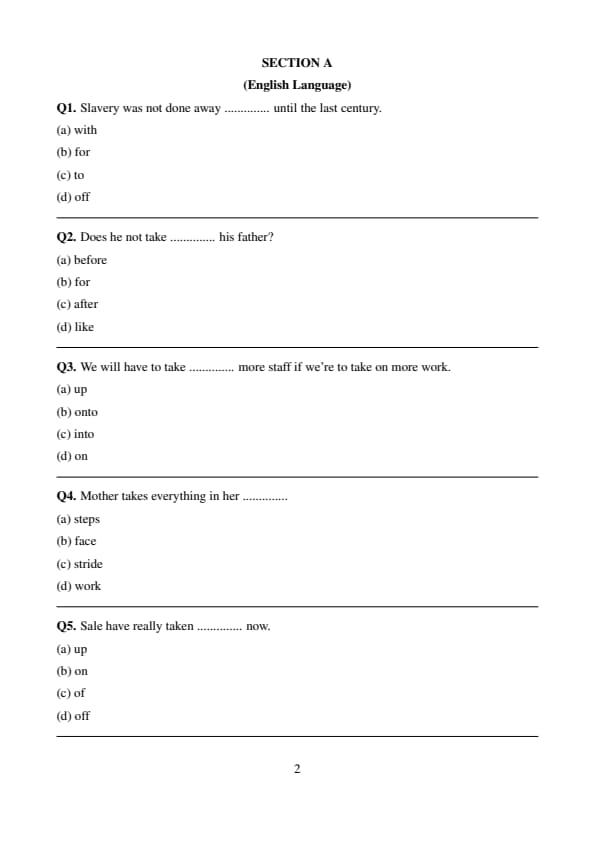
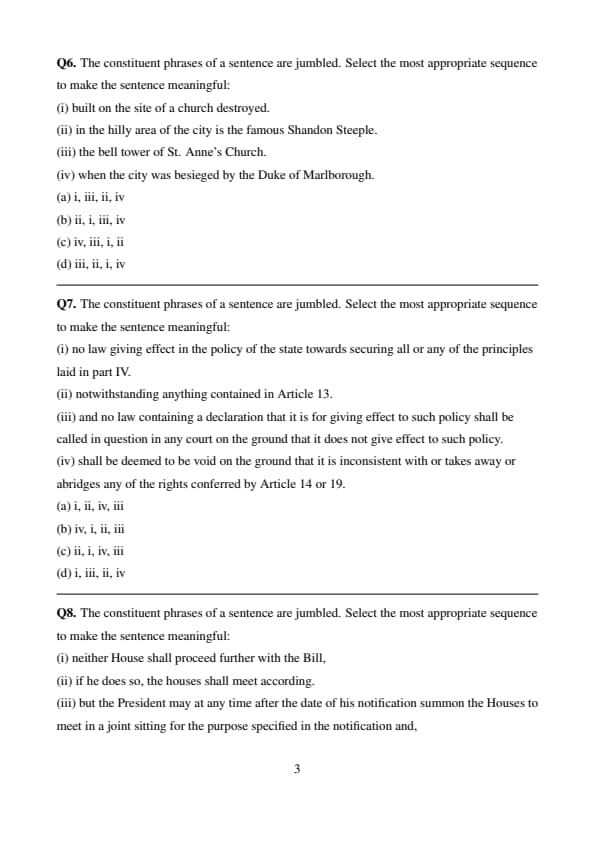
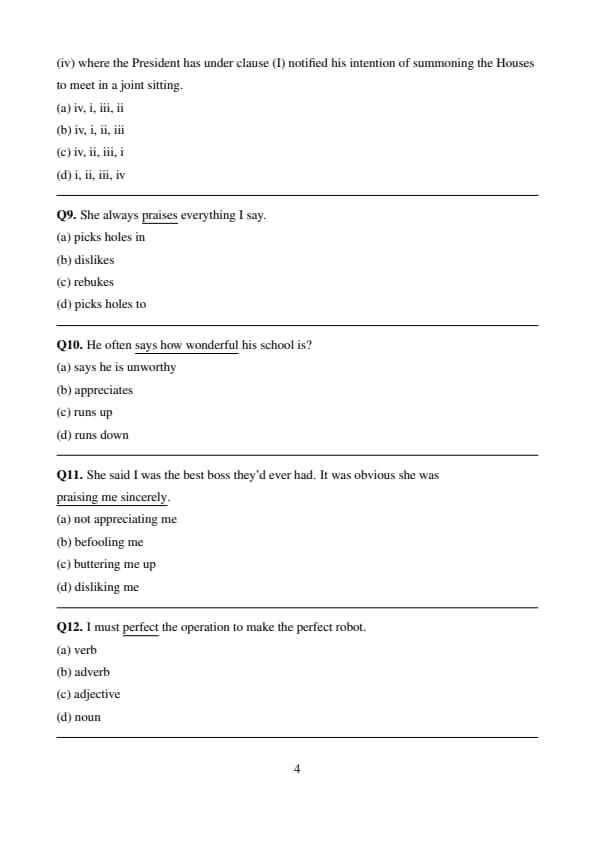
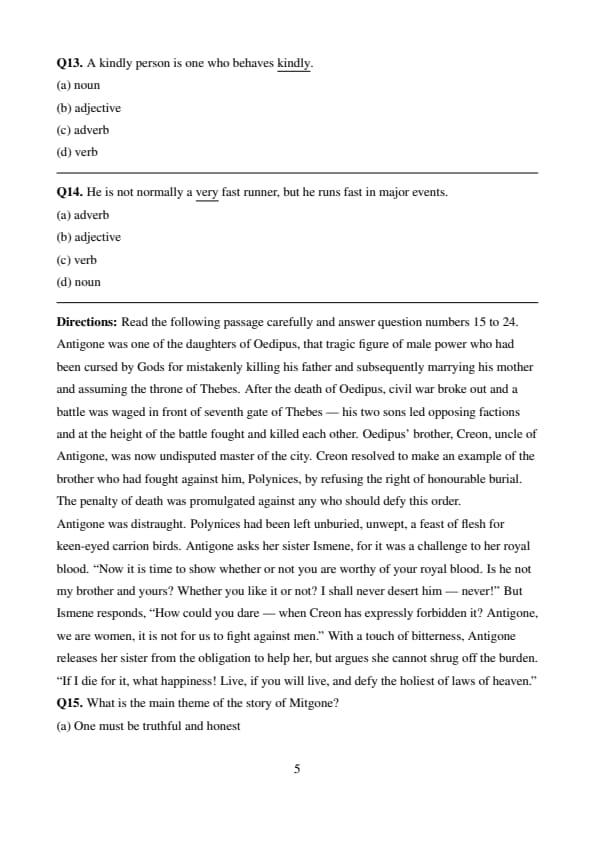
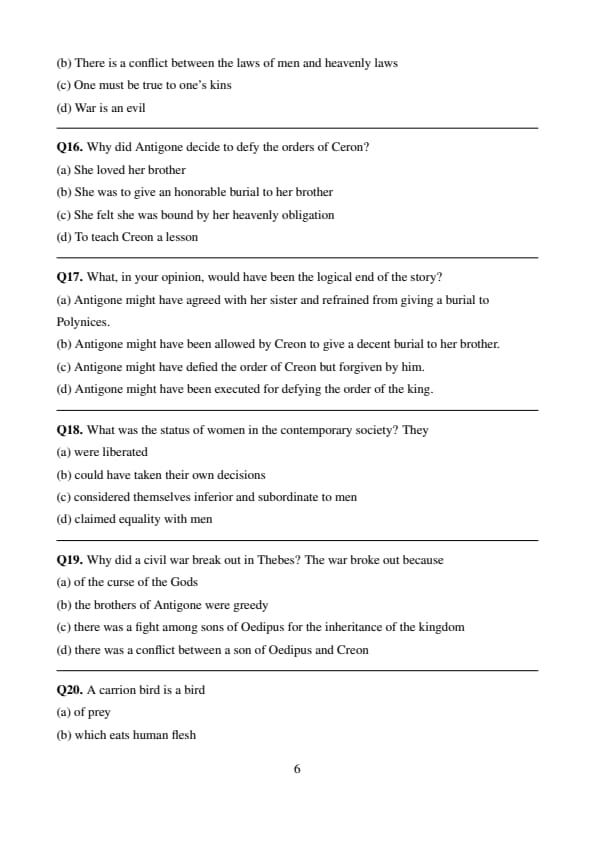
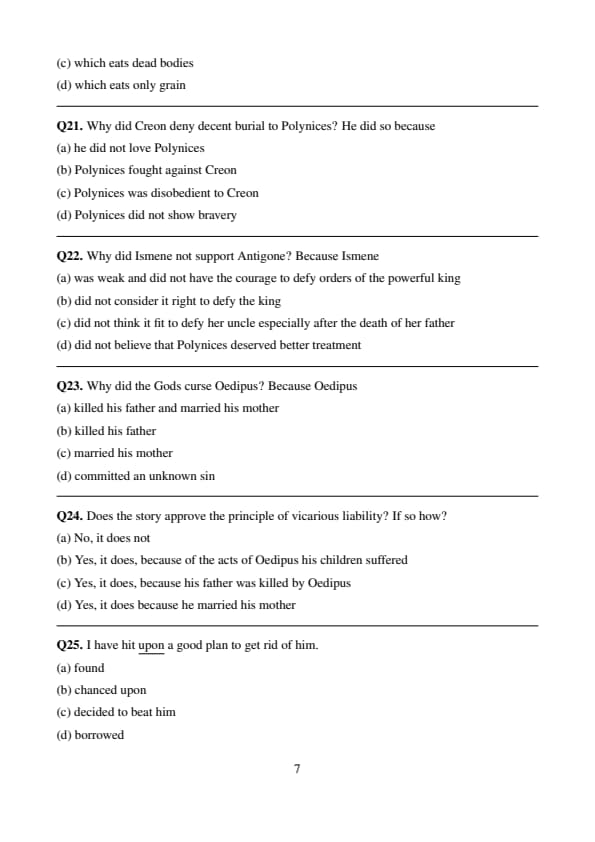
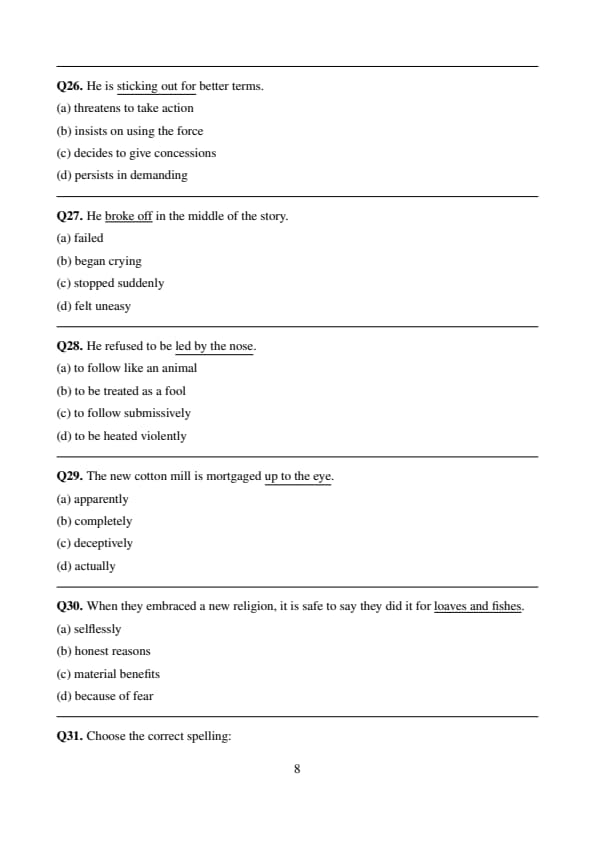
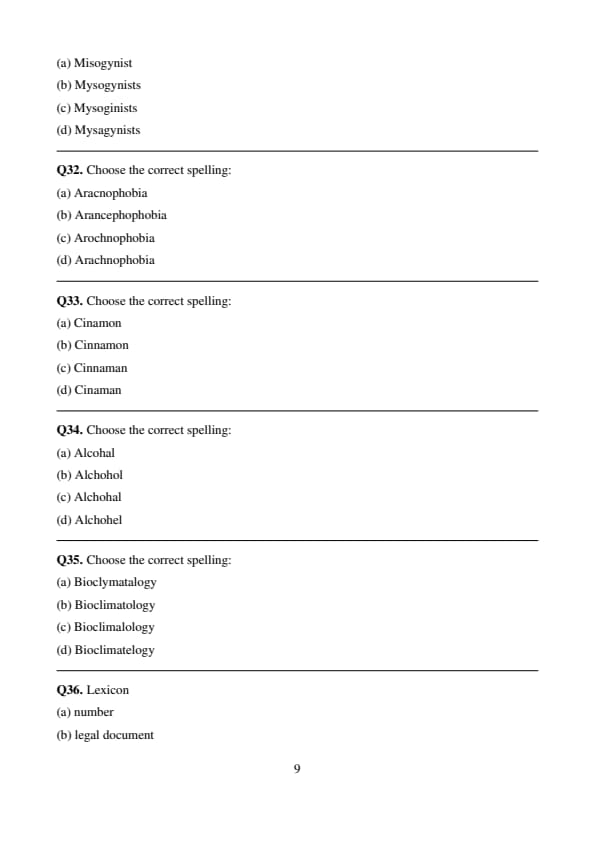
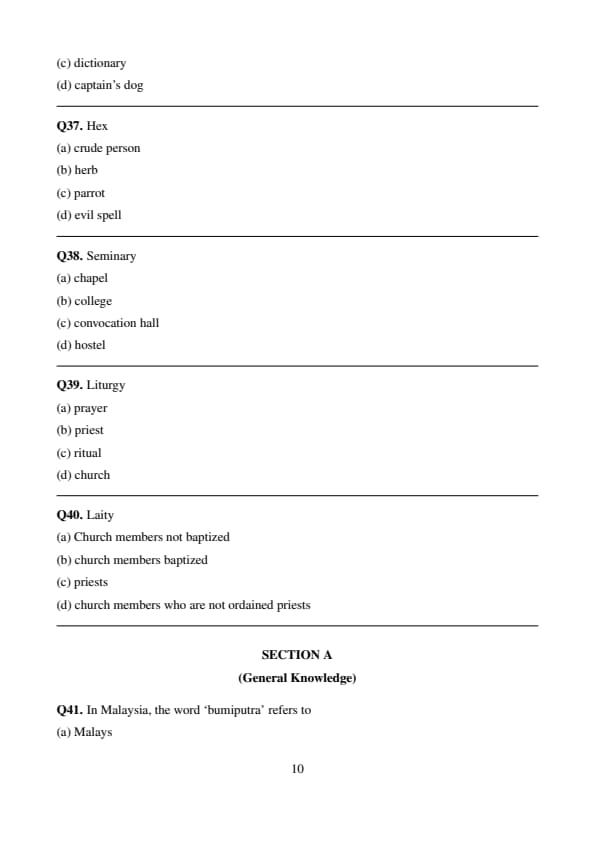
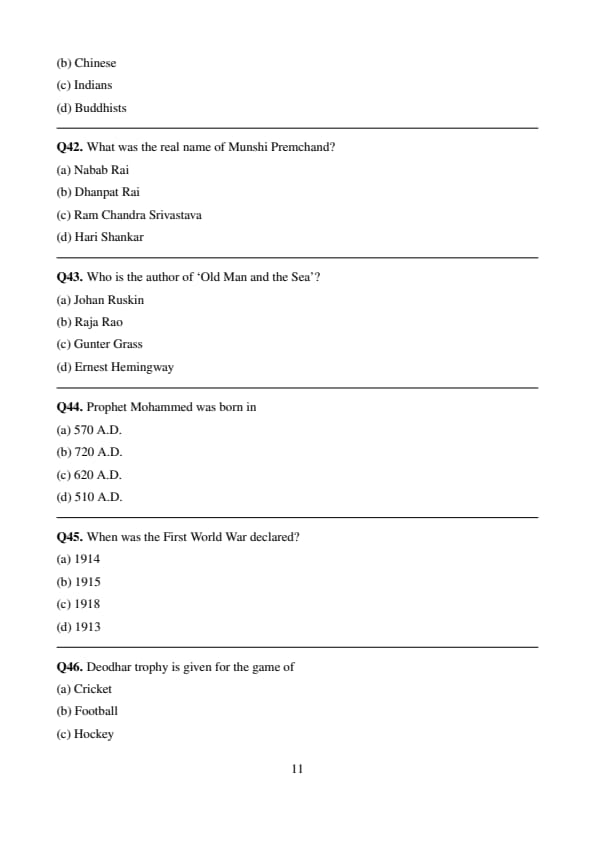
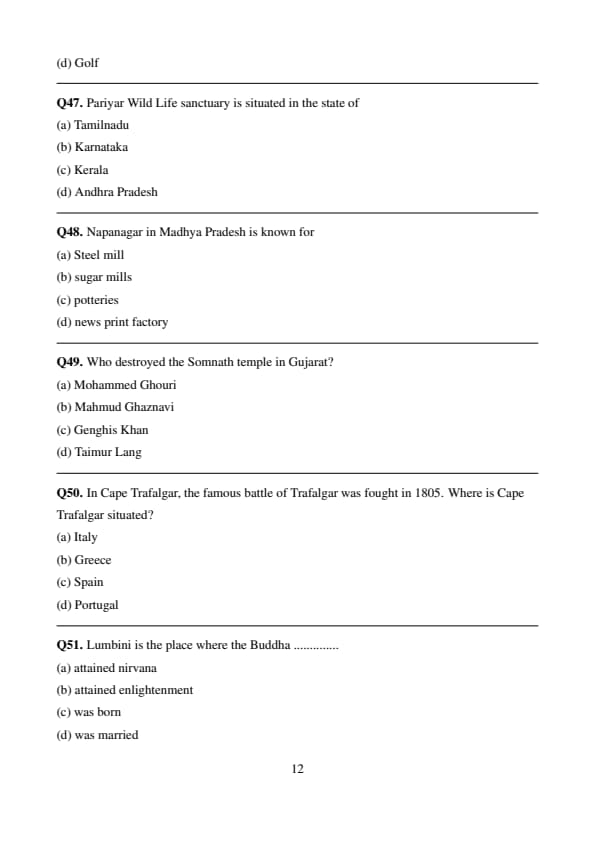
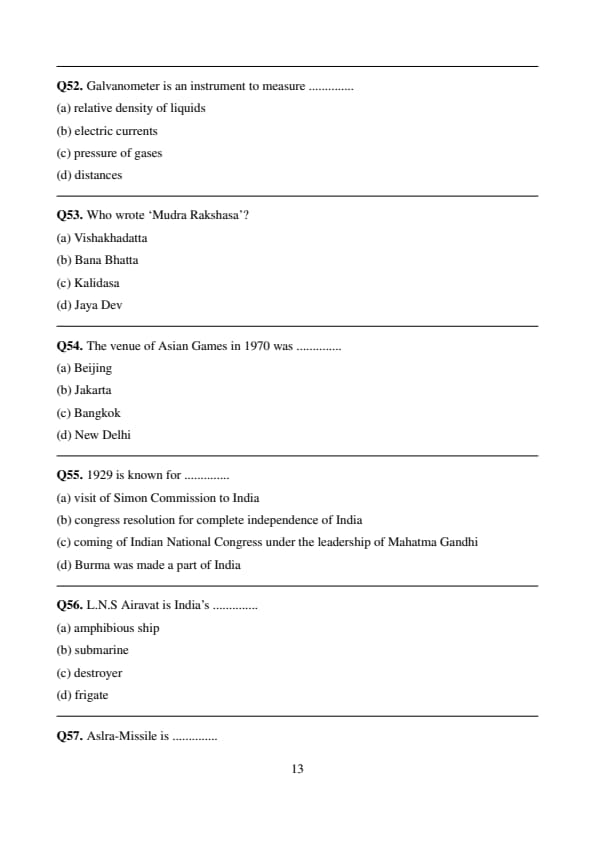
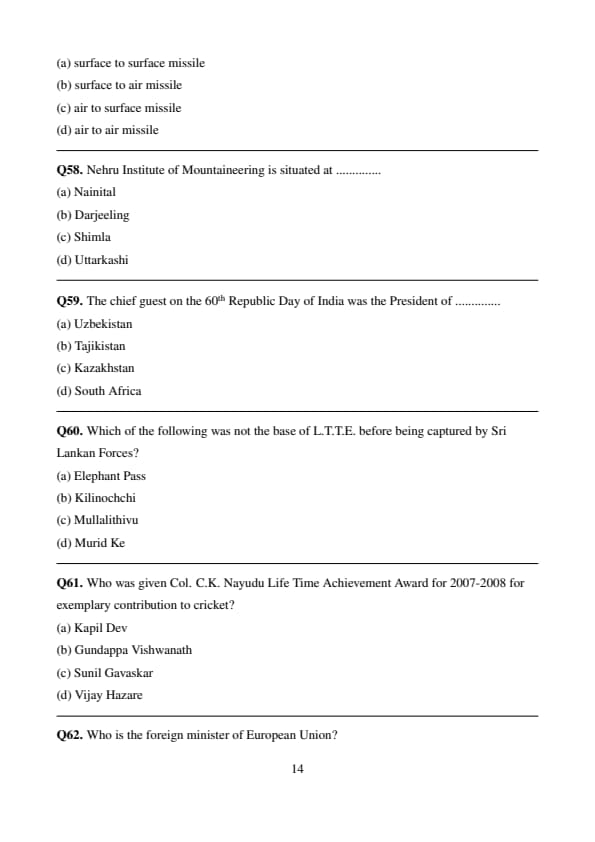
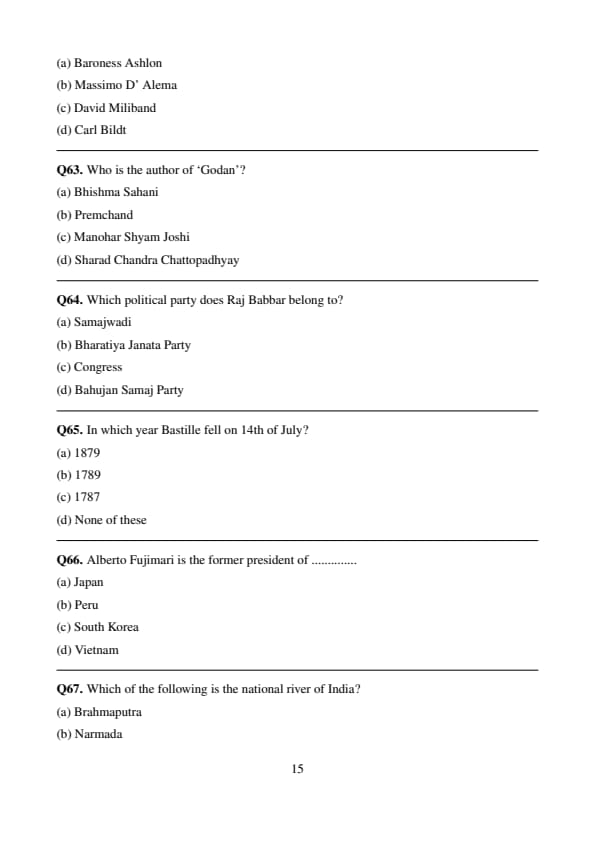
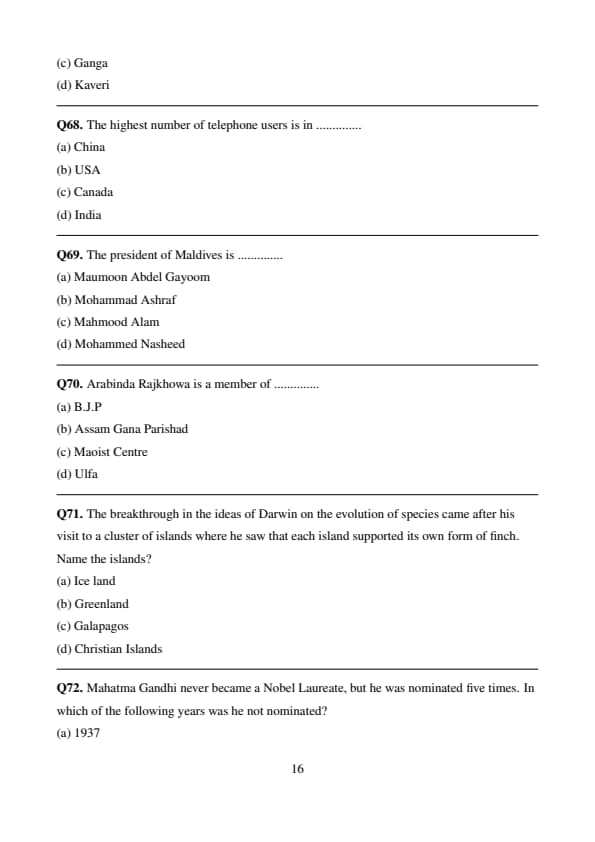
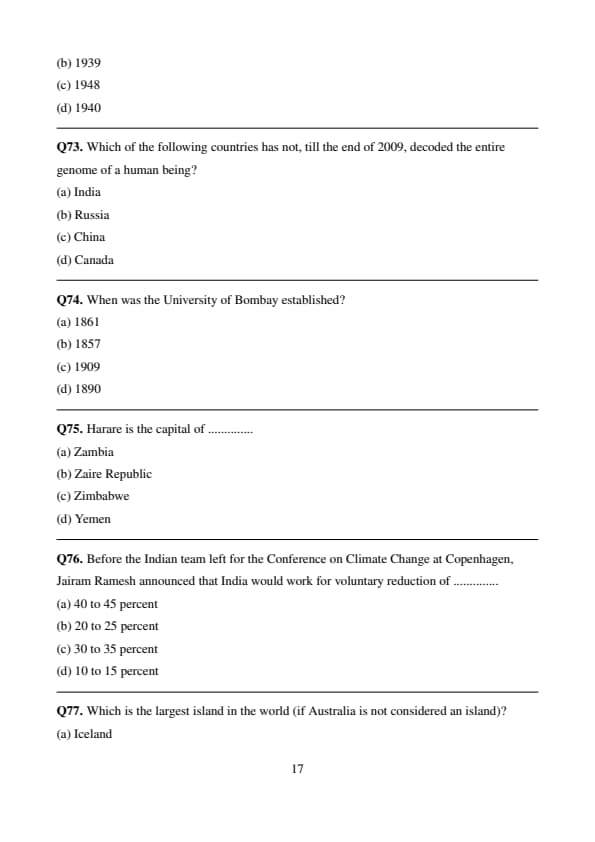
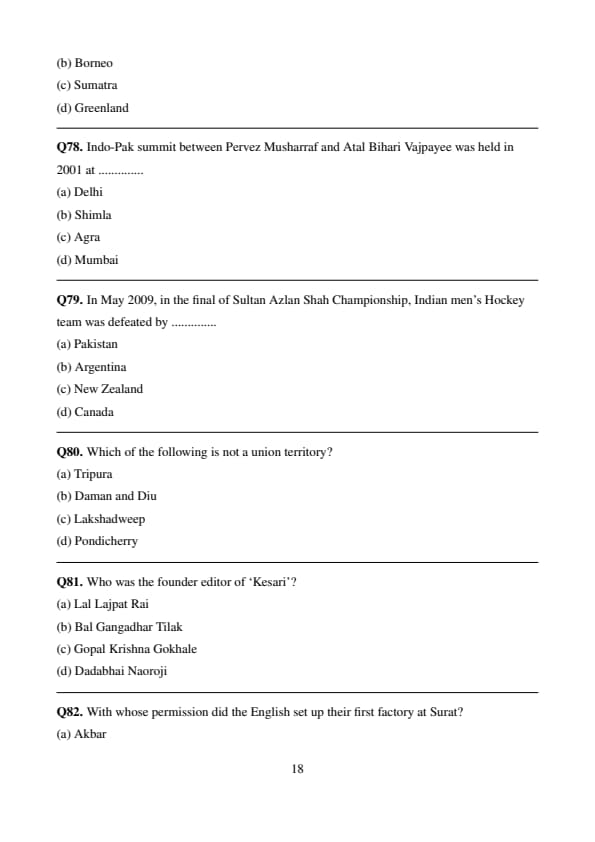
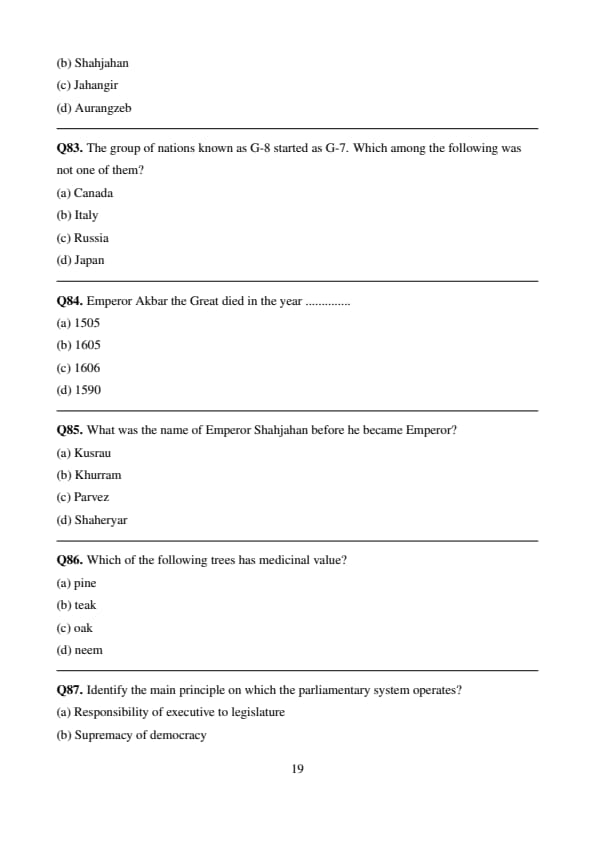
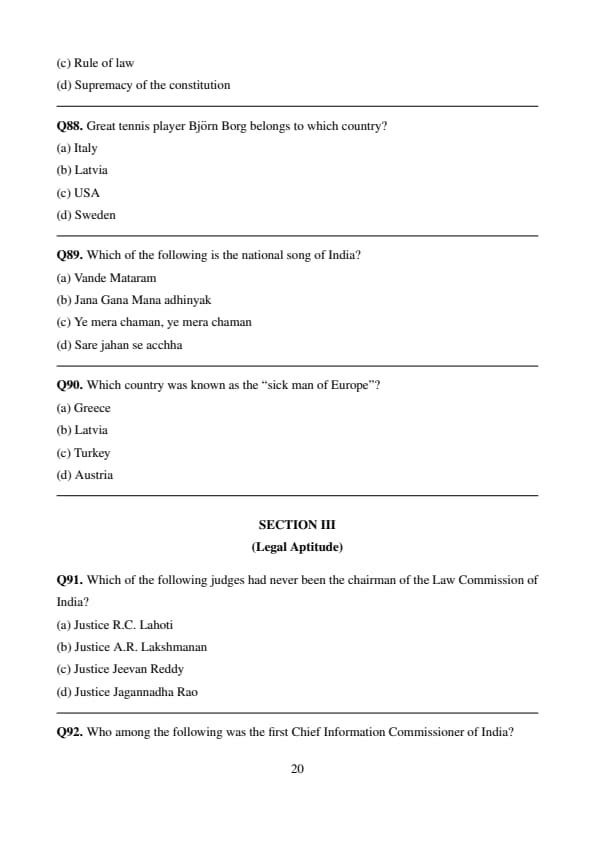
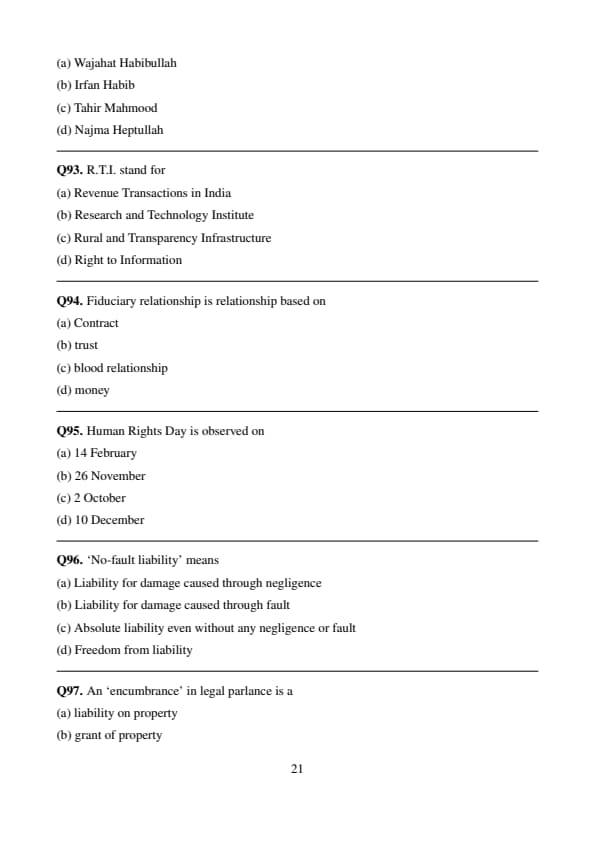
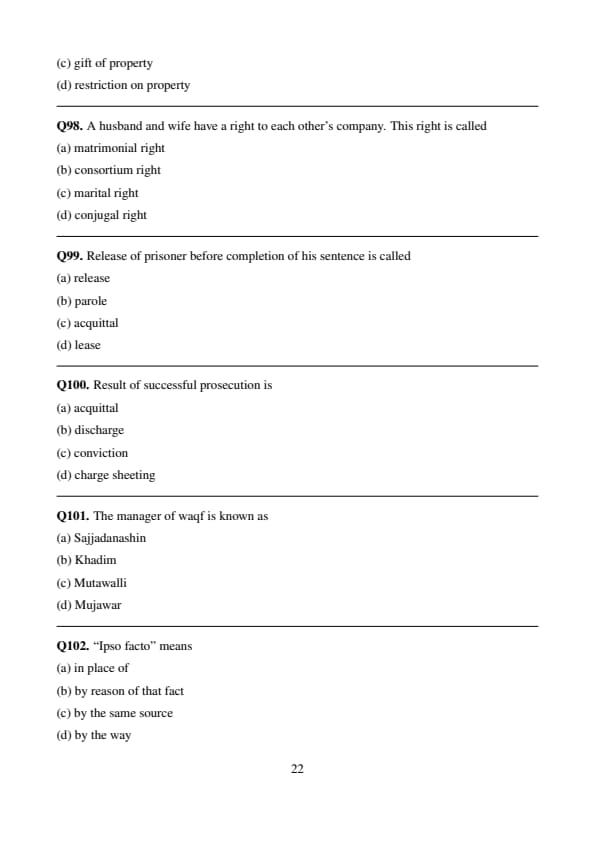
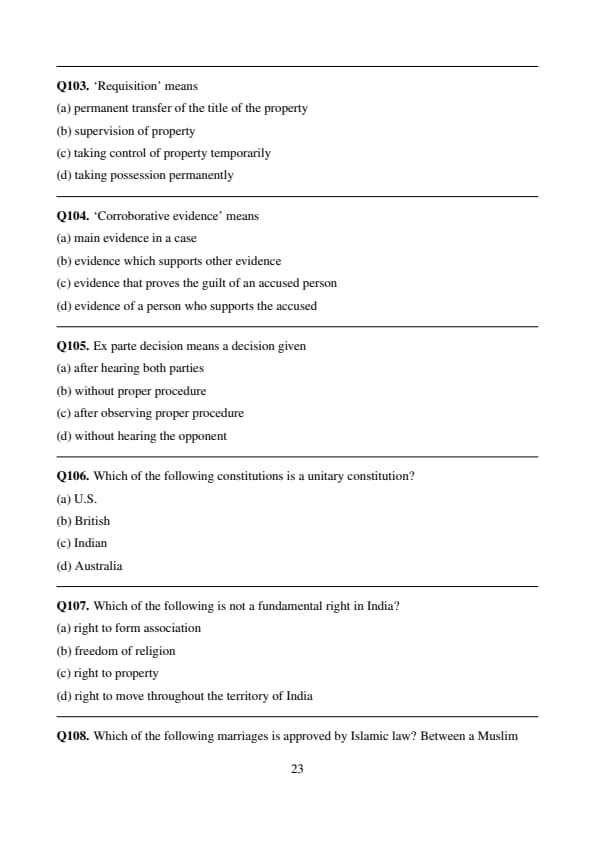
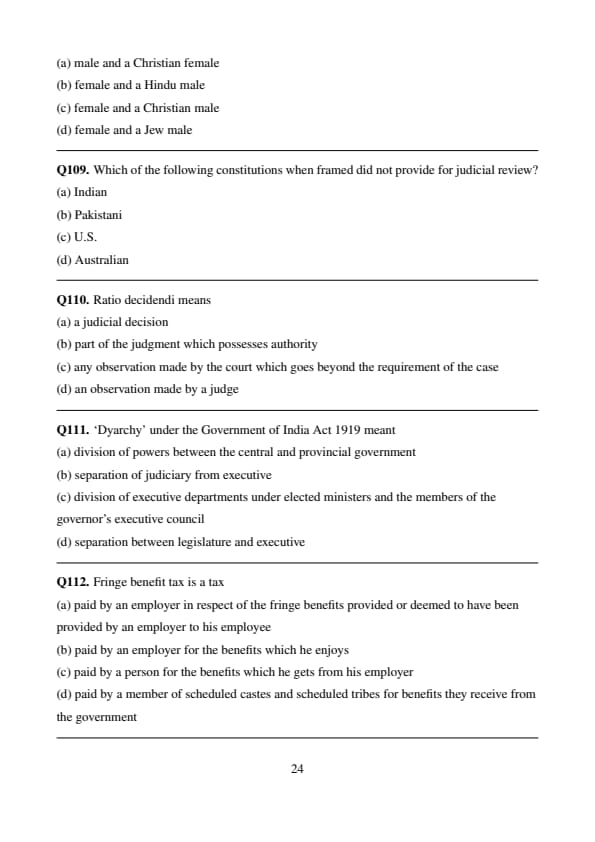
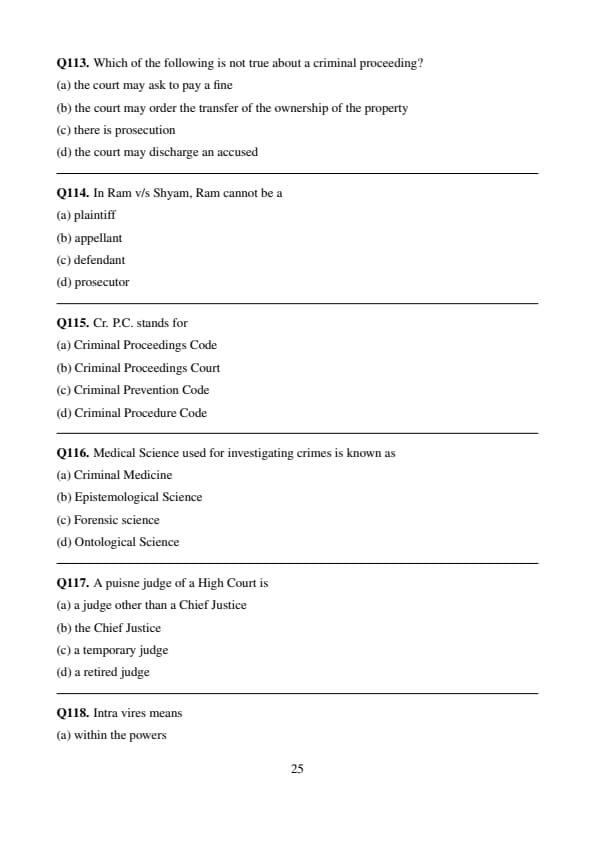
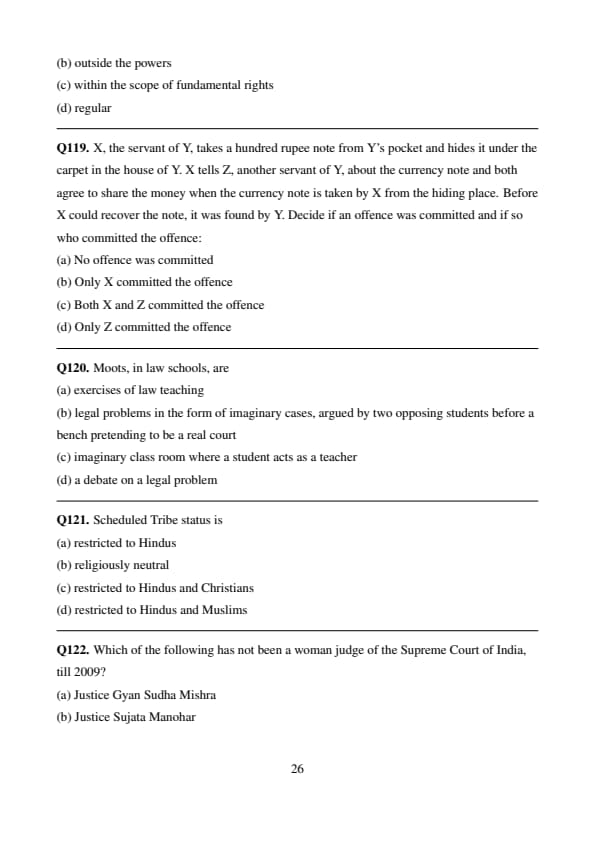
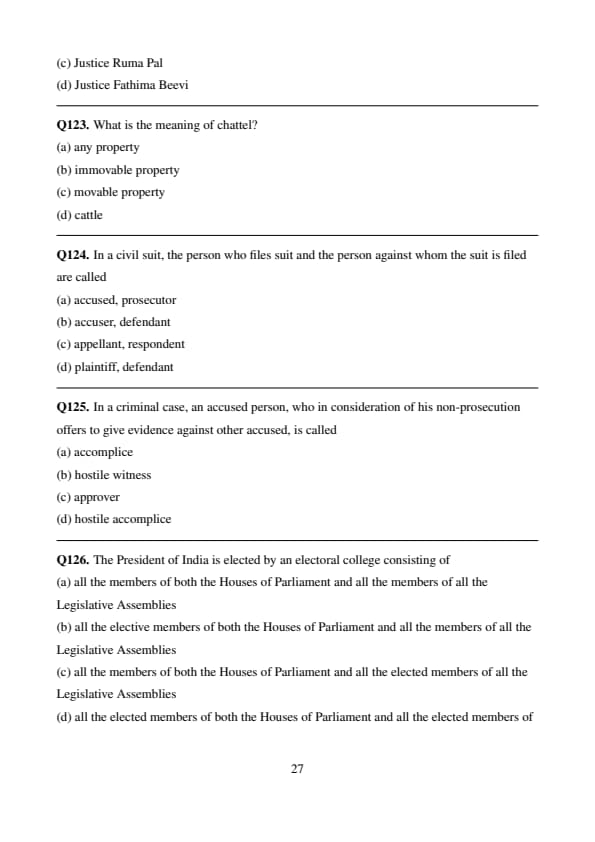
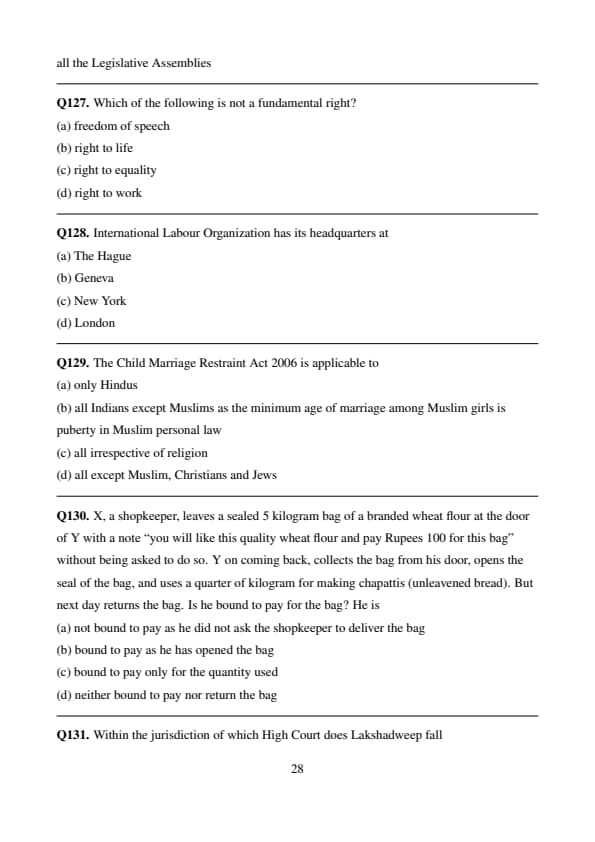
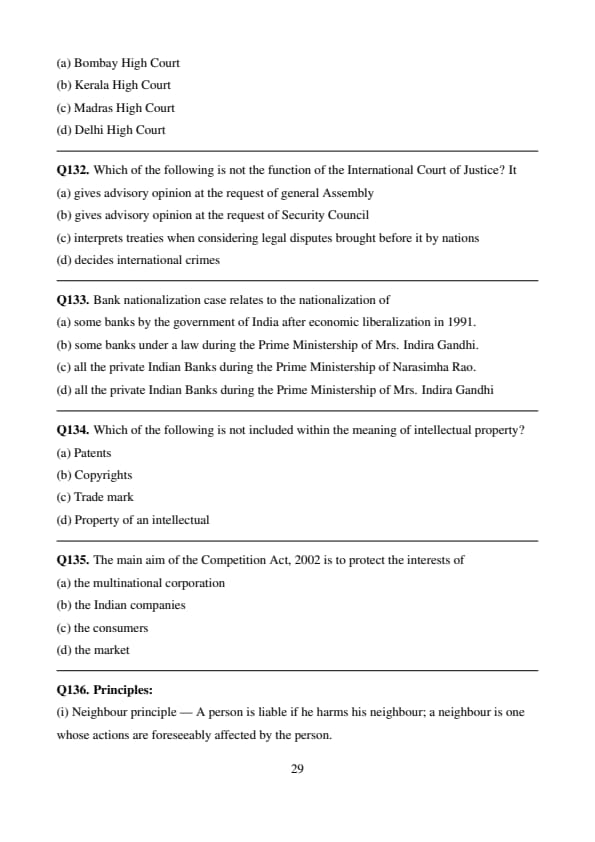
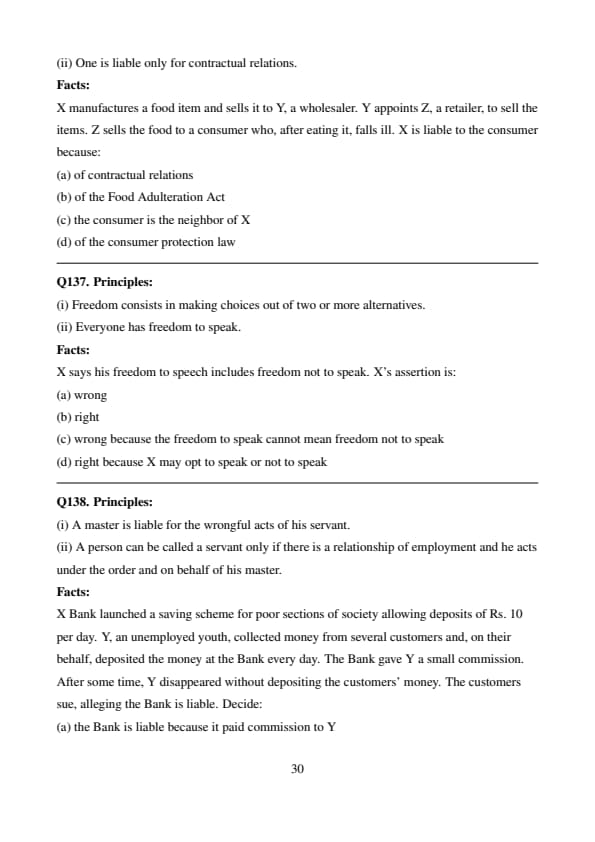
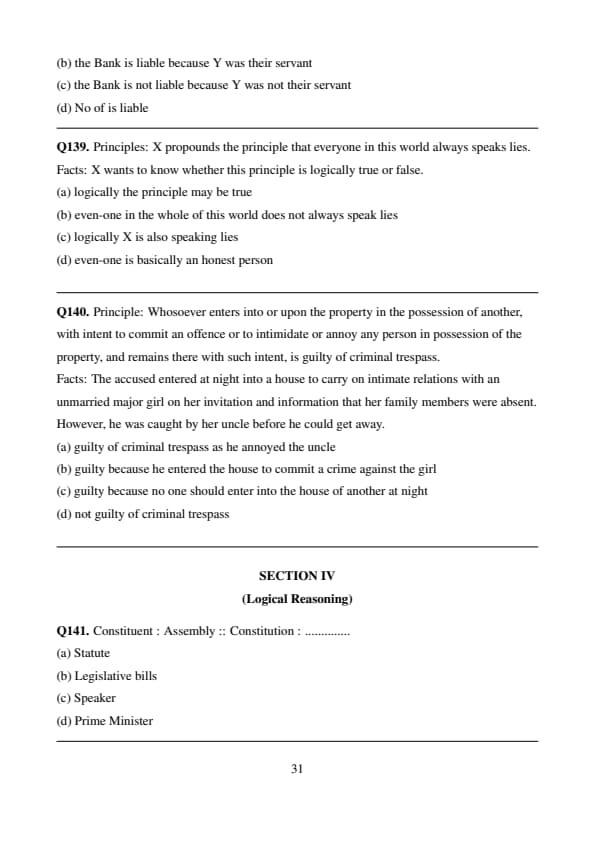
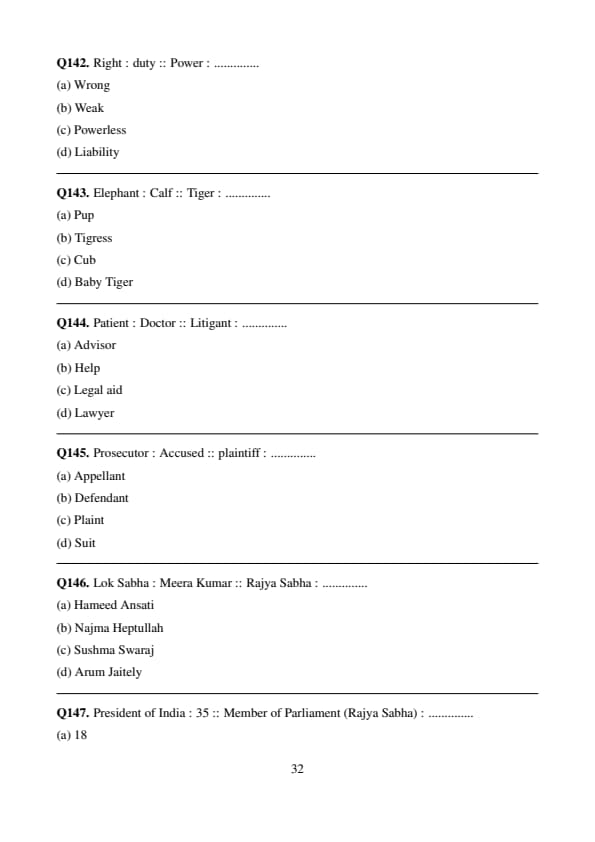
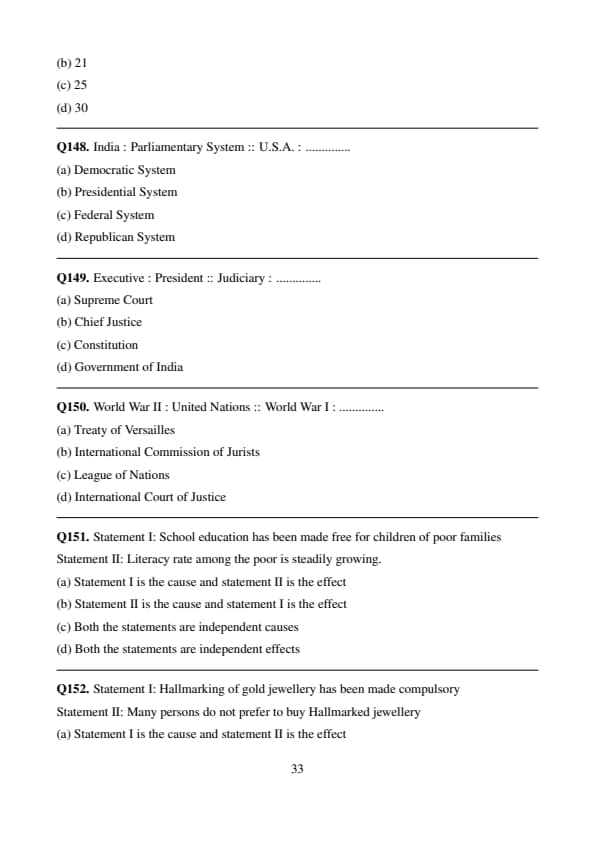
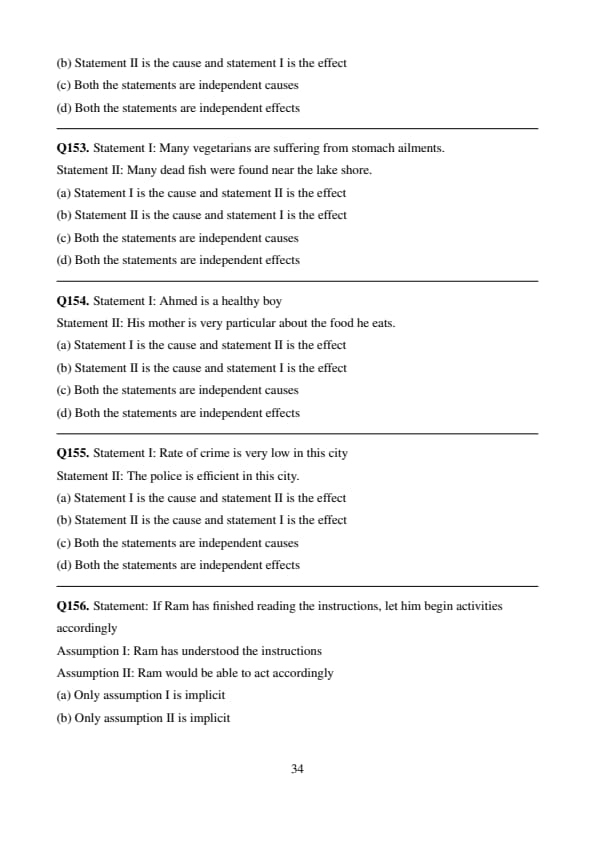
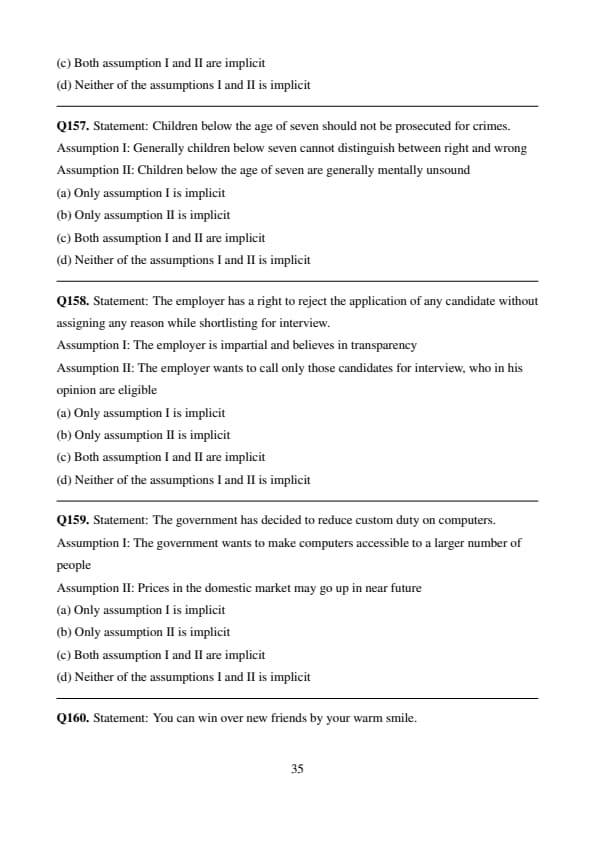
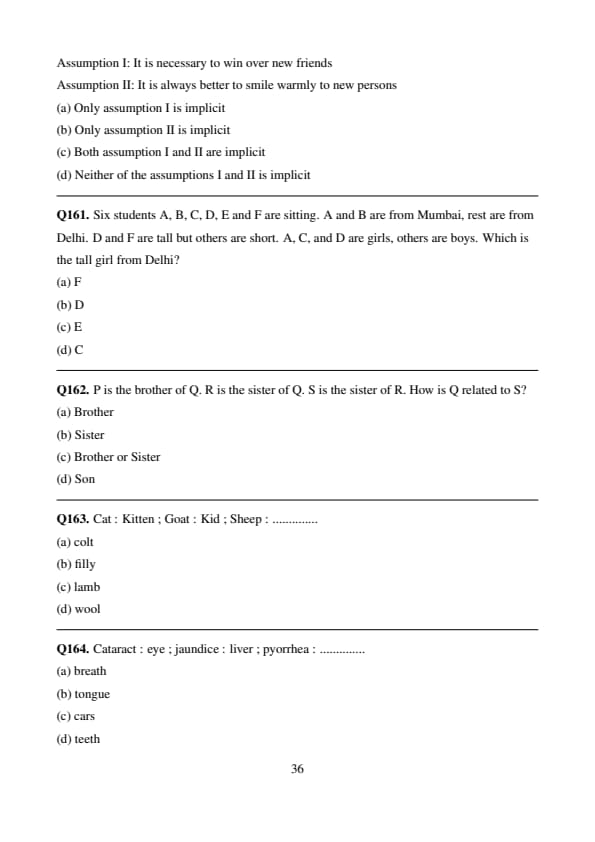
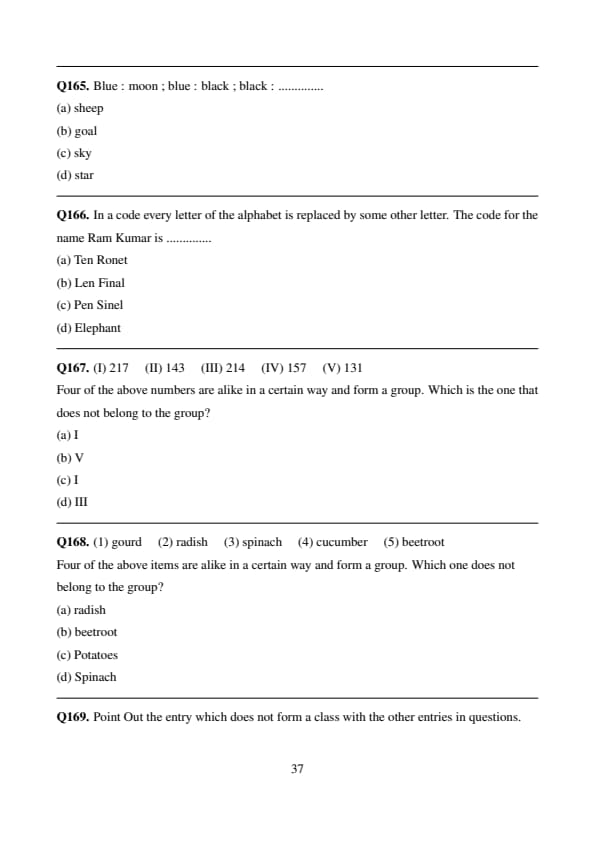
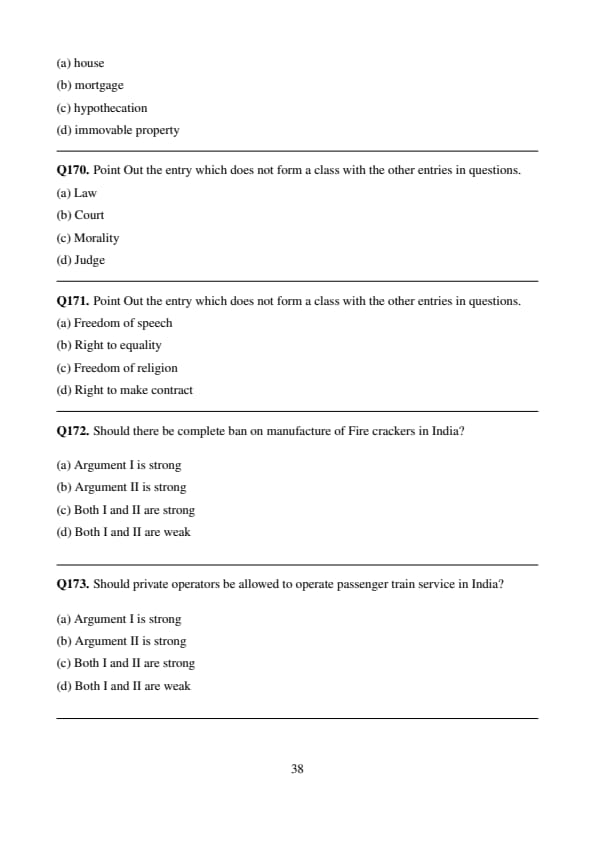
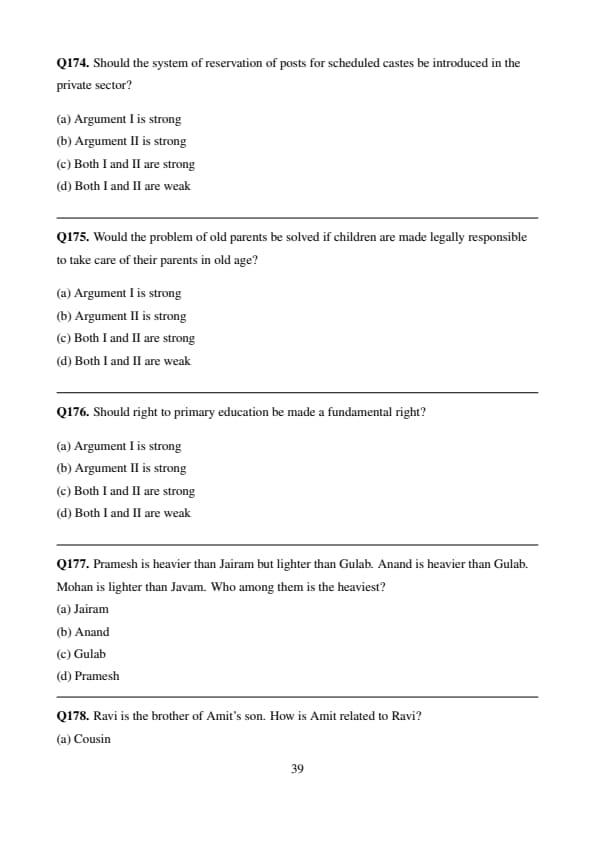
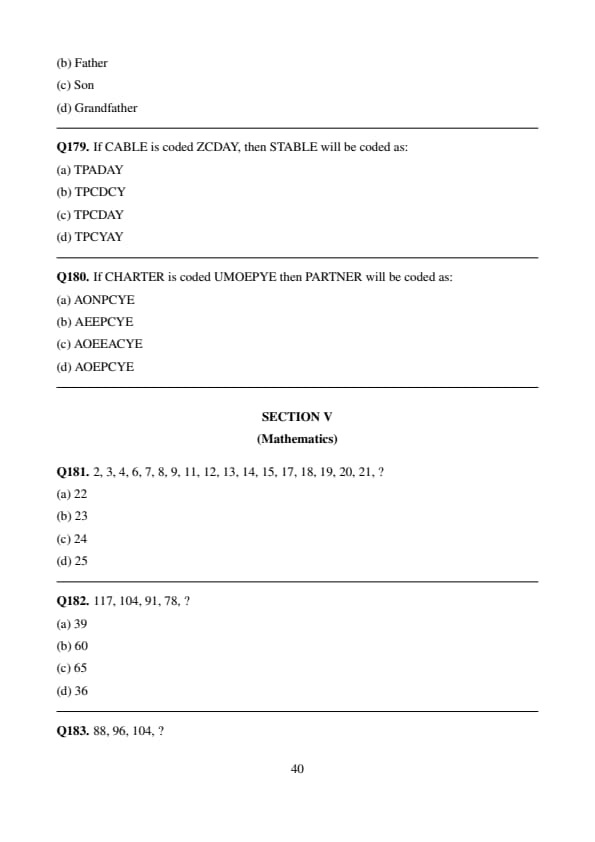
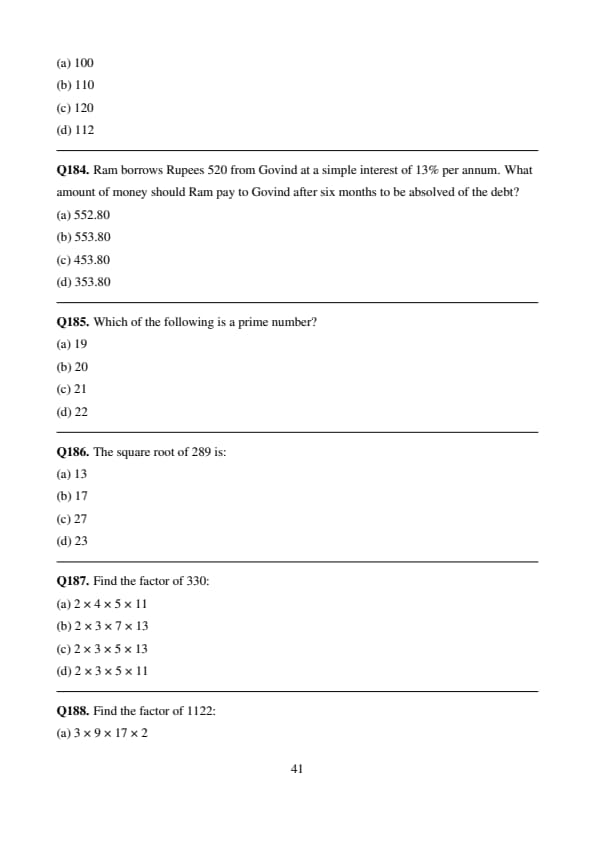
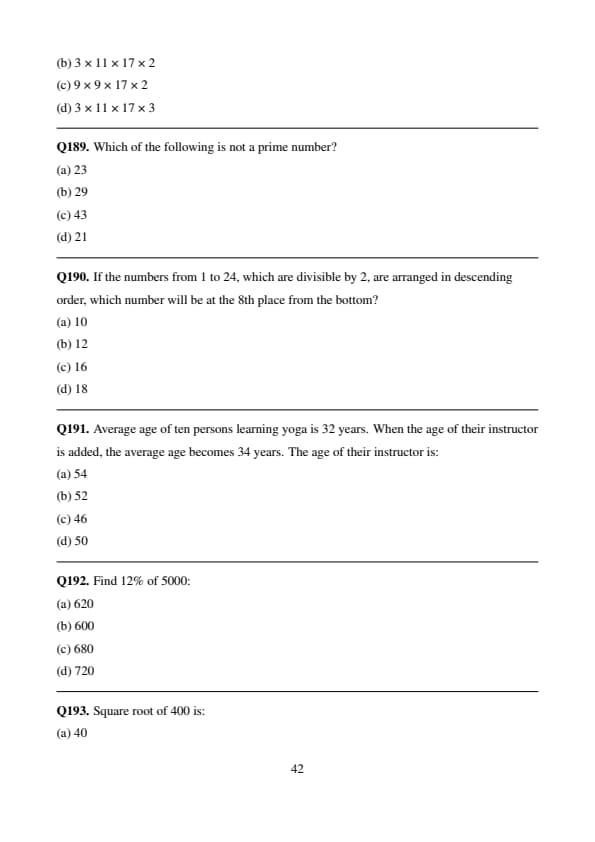
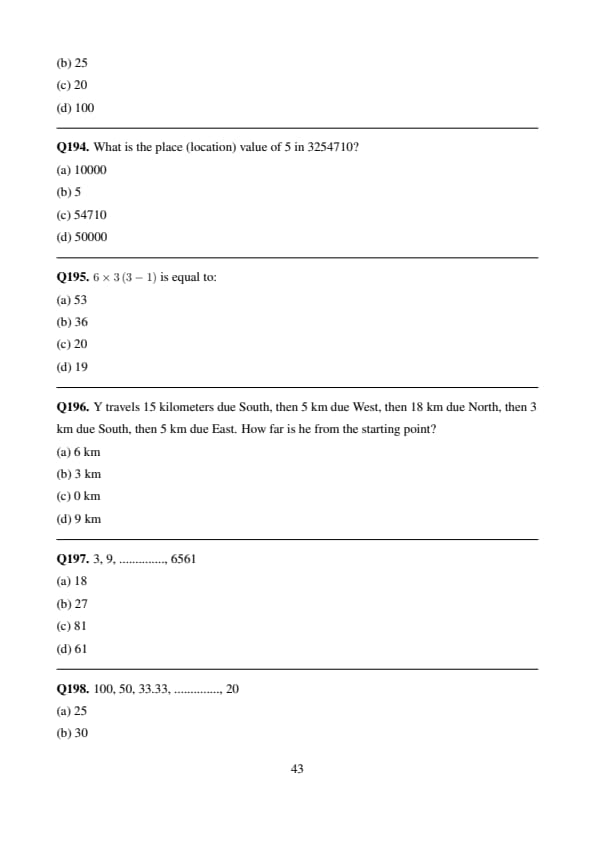
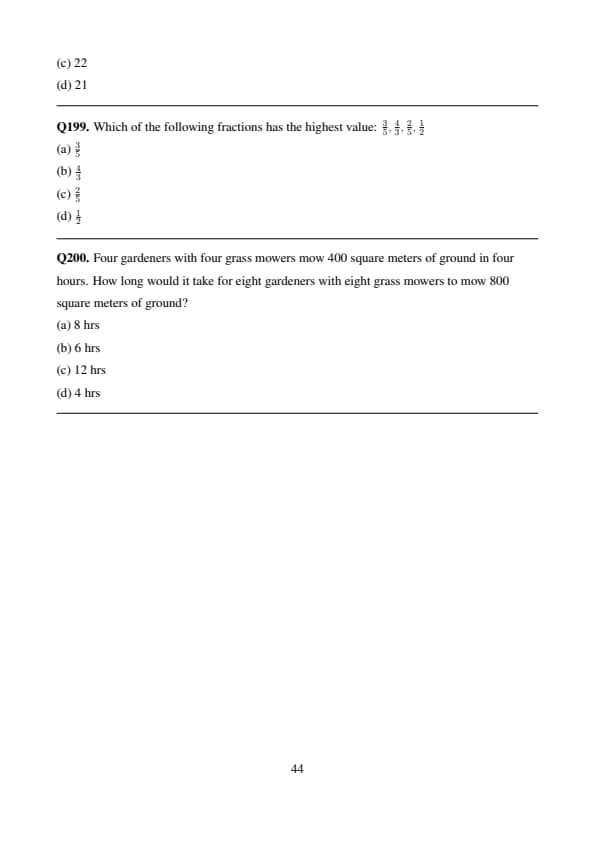
CLAT Previous Year Question Paper with Answer Key PDFs
Collegedunia has provided CLAT Previous Year Question paper pdf with answer key in the links given below:
| CLAT 2021 Question Paper | CLAT 2020 Question Paper | CLAT 2019 Question Paper |
| CLAT 2018 Question Paper | CLAT 2017 Question Paper | CLAT 2016 Question Paper |



Comments