




CLAT 2011 Common Question paper with answer key pdf conducted on May 15, 2011 in Afternoon Session 3:00 PM to 5:00 PM is available for download. The exam was successfully organized by Rajiv Gandhi National Law University. In terms of difficulty level, CLAT was of Easy to Moderate level. The question paper comprised a total of 200 questions divided among five sections.
Also Check:
CLAT 2011 Common Question Paper with Solution PDF
| CLAT 2011 Common Question Paper with Answer Key | Download PDF | Check Solutions |
Question 1:
Directions: The questions in this section are based on a single passage. The questions are to
be answered on the basis of what is stated or implied in the passage.
Passage for Questions 1 to 10
In 1954, a Bombay economist named A. D. Shroff began a Forum of Free Enterprise, whose
ideas on economic development were somewhat at odds with those then influentially
articulated by the Planning Commission of the Government of India. Shroff complained
against the ‘indifference, if not discouragement’ with which the state treated entrepreneurs.
At the same time as Shroff, but independently of him, a journalist named Philip Spratt was
writing a series of essays in favour of free enterprise. Spratt was a Cambridge communist
who was sent by the party in 1920s to foment revolution in the subcontinent. Detected in the
act, he spent many years in an Indian jail. The books he read in the prison, and his marriage
to an Indian woman afterwards, inspirited a steady move rightwards. By the 1950s, he was
editing a pro-American weekly from Bangalore, called MysIndia. There he inveighed
against the economic policies of the government of India. These, he said, treated the
entrepreneur as a criminal who has dared to use his brains independently of the state to
create wealth and give employment. The state’s chief planner, P. C. Mahalanobis, has
surrounded himself with Western leftists and Soviet academicians, who reinforced his belief
in rigid control by the government over all activities. The result, said Spratt, would be the
smothering of free enterprise, a famine of consumer goods and the tying down of millions of
workers to soul deadening techniques.
The voices of men like Spratt and Shroff were drowned in the chorus of popular for a model
of heavy industrialization funded and directed by the governments. The 1950s were certainly
not propitious times for free marketers in India. But from time to time their ideas were
revived. After the rupee was devalued in 1966, there were some moves towards freeing the
trade regime, and hopes that the licensing system would also be liberalized. However, after
Indira Gandhi split the Congress Party in 1969, her government took its left turn
nationalizing a fresh range of industries and returning to economic autarky.
Which of the following statement can most reasonably be inferred from the information available in the passage?
View Solution
Step 1: Understand Phillip Spratt’s beliefs
The passage describes Phillip Spratt as a supporter of free enterprise. He criticized government control and believed the state hindered entrepreneurs.
He viewed government control as leading to “smothering of free enterprise” and advocated for conditions favouring private entrepreneurship.
Step 2: Evaluate the options
(a) Incorrect – P.C. Mahalanobis believed in state control, not empowering private entrepreneurs.
(b) Correct – Spratt clearly favoured free market plans that help private enterprise.
(c) Incorrect – The passage does not say restriction enriched Indian companies.
(d) Incorrect – The passage does not mention Spratt’s view on rupee devaluation.
% Final Answer \[ \boxed{(b)} \] Quick Tip: Always focus on key phrases that reflect a person’s opinion or belief to draw inferences. Eliminate options not directly supported by the passage.
Which of the following statements is least likely to be inferred from the passage?
View Solution
Step 1: Understand A.D. Shroff’s role
Shroff was against state control and promoted free enterprise. The passage shows his ideas were not accepted, but rather ignored or discouraged.
Step 2: Evaluate the options
(a) Incorrect – This implies his plans were accepted and led to smothering free enterprise. In fact, his plans were not accepted.
(b) Correct inference – The Forum’s views went against the prevailing government approach.
(c) Correct inference – Shroff believed in promoting the private sector.
(d) Correct inference – Spratt was Cambridge-educated, as mentioned in the passage.
% Final Answer \[ \boxed{(a) \] Quick Tip: When solving “least likely to be inferred” questions, identify the option that contradicts or misrepresents the passage content.
Select the statement that best captures the central purpose of this passage:
View Solution
Step 1: Understand the main theme of the passage
The passage discusses the conflict between early advocates of free enterprise (like A.D. Shroff and Phillip Spratt) and the government’s preference for state-controlled economic planning.
The views of these free-market thinkers were mostly ignored in favor of socialist-style control, especially through figures like P.C. Mahalanobis.
Step 2: Evaluate all options
(b) Incorrect – Indira Gandhi’s decision to nationalize banks is briefly mentioned, but not the focus of the passage.
(c) Incorrect – The passage does not include statistical evidence. It’s more narrative and ideological.
(d) Incorrect – The devaluation of the rupee in 1966 is mentioned, but not evaluated as right or wrong.
(a) Correct – This precisely summarizes the central idea: support for free enterprise was present but suppressed by state-dominated ideology.
% Final Answer \[ \boxed{(a)} \] Quick Tip: For central idea questions, look for the option that captures the **main argument or conflict** running through the entire passage — not just minor details.
Philip Spratt came to India because he:
View Solution
Step 1: Locate the reference in the passage
The passage says: "Spratt was a Cambridge communist who was sent by the party in 1920s to foment revolution in the subcontinent."
Step 2: Evaluate all options
(a) Incorrect – Although he married an Indian woman, that was after his arrival. It was not the reason he came.
(b) Incorrect – His protest against Indian government policy came later, during the 1950s, not his original purpose.
(c) Incorrect – He was not invited to edit MysIndia; he did it later, independently.
(d) Correct – His original purpose was to incite revolution, as per the communist party's instruction.
% Final Answer \[ \boxed{(d)} \] Quick Tip: Be careful to distinguish between the person’s **original intent** and what they did later. Time sequence often helps eliminate wrong options.
The author avers that A.D. Shroff's ideas were somewhat at odds with the views of Planning Commission because:
View Solution
Step 1: Analyze the conflict between A.D. Shroff and the Planning Commission
The passage clearly states that A.D. Shroff criticized the "indifference, if not discouragement" shown by the state towards entrepreneurs.
This indicates a disagreement between Shroff’s views and the Planning Commission’s state-controlled development model.
Step 2: Evaluate the options
(a) Incorrect – Shroff actually opposed rigid government control.
(b) Incorrect – The passage doesn’t say he opposed the devaluation of the rupee.
(c) Correct – This directly reflects the author’s statement.
(d) Tempting but incomplete – Though he criticized Soviet influence, that’s not the main reason his views clashed with the Planning Commission.
% Final Answer \[ \boxed{(c)} \] Quick Tip: Look for keywords from the question ("at odds with Planning Commission") and match it precisely with the author's critique.
The ideological shift of Philip Spratt to the right was caused by:
View Solution
Step 1: Identify where the ideological shift is mentioned
The passage says: “The books he read in the prison...inspirited a steady move rightwards.”
This directly shows that his shift to the right was due to the books he read while in jail.
Step 2: Eliminate incorrect options
(a) Incorrect – The Soviet Union’s fall happened decades later.
(b) Incorrect – MysIndia came after the shift, not the cause of it.
(c) Correct – Directly mentioned.
(d) Incorrect – His marriage is mentioned, but not as a cause of ideological change.
% Final Answer \[ \boxed{(c)} \] Quick Tip: When answering cause-effect questions, identify whether the passage explicitly states what led to the change.
Select the statement that could be most plausibly inferred from this passage:
View Solution
Step 1: Understand the post-1966 economic scenario
The passage says: After the rupee was devalued in 1966, there were hopes for liberalization. But after Indira Gandhi split the Congress in 1969, “her government took its left turn,” returning to nationalization.
Step 2: Evaluate each option
(a) Incorrect – The passage does not say both were part of the Forum. Shroff was; Spratt was an independent writer.
(b) Incorrect – The first two Five-Year Plans focused on public sector, not private enterprise.
(c) Incorrect – There’s no mention of Mahalanobis expelling foreign firms.
(d) Correct – This inference is strongly supported by the text and logical events.
% Final Answer \[ \boxed{(d)} \] Quick Tip: Focus on consequences and implied shifts in policy when solving inference questions — track cause-effect transitions mentioned in the text.
The author alludes to nationalization of industries in 1969 in order to:
View Solution
Step 1: Understand the context of 1969 nationalization
The passage states: After Indira Gandhi split the Congress Party in 1969, “her government took its left turn nationalizing a fresh range of industries.”
This indicates a shift towards socialist or left-leaning economic policies.
Step 2: Evaluate all options
(a) Incorrect – While there is a contrast with Shroff’s views, the reference to nationalization is mainly about government’s shift.
(b) Correct – The nationalization is used as an example of the “left turn.”
(c) Incorrect – Philip Spratt’s ideological shift is mentioned earlier, not linked to 1969.
(d) Incorrect – The passage does not mention political repercussions of devaluation.
% Final Answer \[ \boxed{(b)} \] Quick Tip: Link events in historical context with ideological shifts when analyzing the author’s purpose.
“Neither Philip Spratt nor A.D. Shroff ____ able to convince Mahalanobis.” Select the most appropriate phrase out of the four options for filling the blank space.
View Solution
Step 1: Identify subject and verb agreement
In sentences with “Neither...nor”, the verb agrees with the subject closest to it — in this case, “A.D. Shroff.”
However, both subjects are singular, but together they imply a plural action: “were able.”
Step 2: Check tense consistency
The context is past tense (“were drowned... were devalued…”), so the verb must also be past.
“Were” is the correct past plural verb.
Step 3: Eliminate wrong options
(b) are – Present tense, incorrect.
(c) was – Singular, but two subjects make it plural.
(d) is – Present, incorrect.
% Final Answer \[ \boxed{(a)} \] Quick Tip: Use plural verb “were” when “Neither...nor” joins two subjects in past tense.
The word ‘inveighed’ in this passage means:
View Solution
Step 1: Understand ‘inveighed’ in context
The passage says Spratt “inveighed against the economic policies of the government.”
This suggests he strongly criticized or protested.
Step 2: Analyze the meaning of options
(a) Praised – Opposite of intended meaning.
(b) Recited – Irrelevant, incorrect.
(c) Proclaimed – Neutral, but does not imply criticism.
(d) Remonstrated – Correct. Means “forcefully protested.”
% Final Answer \[ \boxed{(d)} \] Quick Tip: Use context clues: ‘inveighed against’ always means strong verbal attack or protest.
Which of the following is the closest description of the central argument of this passage?
View Solution
Step 1: Identify the recurring theme in the passage
The author repeatedly emphasizes how non-Dalits have represented Dalits — as victims, without agency, and lacking caste-consciousness.
Step 2: Evaluate all options
(a) Too narrow – While Manu Joseph’s portrayal is discussed, it is not the central argument.
(b) Only briefly mentioned as a contrast — not the main point.
(c) Mentioned, but not the passage’s focus.
(d) Correct – This is the thread running throughout the passage.
% Final Answer \[ \boxed{(d)} \] Quick Tip: For central argument questions, look for the author’s most emphasized and repeated criticism.
According to this passage, Premchand and Mulk Raj Anand:
View Solution
Step 1: Find references to Premchand and Anand
In the last paragraph, Mistry is said to have followed the path of Premchand and Anand — portraying Dalits as passive sufferers lacking political awareness.
Step 2: Evaluate the options
(a) Correct – Their portrayals were stereotypical.
(b) Incorrect – Satire is not mentioned in reference to them.
(c) Not discussed.
(d) Nationalist movement is mentioned, but not as their leadership role.
% Final Answer \[ \boxed{(a)} \] Quick Tip: Always match the tone and portrayal described in the passage with the answer choice — don’t assume beyond the text.
The writer refers to the ‘anti-reservation discourse’ in order to argue that:
View Solution
Step 1: Focus on the context of 'anti-reservation discourse'
The passage says: "society is unwilling to share social and cultural resources... unless mandated by law (as seen in the anti-reservation discourse)."
Step 2: Evaluate each option
(a) Only partly related.
(b) Irrelevant to anti-reservation discourse.
(c) Partially true but not the key conclusion.
(d) Correct – matches the passage’s statement directly.
% Final Answer \[ \boxed{(d)} \] Quick Tip: Use exact phrases from the passage when selecting inference-based answers.
Which of the following statements is least likely to be inferred from this passage?
View Solution
Step 1: Identify what is emphasized in the passage
The author explicitly says: "we must engage with what Dalits are writing not simply for reasons of authenticity, or identity politics... but because of the aesthetic value..."
Step 2: Evaluate all options
(a) Supported – the novel is satirical and unflattering.
(b) Directly mentioned as contrast with Indian literature.
(c) Incorrect – the passage says engagement must go beyond identity politics.
(d) Supported – Mistry continues the stereotypical portrayal.
% Final Answer \[ \boxed{(c)} \] Quick Tip: "Least likely to be inferred" means the one that contradicts or misrepresents the author’s clear position.
According to the information available in the passage, the writer attributes the prevalence of representation of Dalits by non-Dalits in literature, art and media to:
View Solution
Step 1: Locate key phrase in the passage
The author states: “...continued and unquestioned predominance of a Brahminical stranglehold over cultural production...”
This is used to explain why non-Dalits dominate representation of Dalits.
Step 2: Evaluate options
(a) Mentioned in context of Mistry’s nationalism, not main cause.
(b) Not the central reason for dominance of non-Dalits.
(c) Related but not causal.
(d) Correct – explicitly cited as the main cause.
% Final Answer \[ \boxed{(d)} \] Quick Tip: Match direct phrases like “stranglehold over cultural production” with answer choices for high accuracy.
Which of the following is not among the reason suggested by the writer for engaging with Dalit writing?
View Solution
Step 1: Refer to the paragraph about engagement with Dalit writing
The author lists reasons such as: authenticity, human insight, aesthetic value, and power to humanize non-Dalits.
The line “not simply for reasons of authenticity... but also for the aesthetic value...” confirms this.
Step 2: Evaluate options
(a) Correct – explicitly mentioned.
(b) Correct – passage favors Dalit self-representation.
(c) Incorrect – this is a factual statement about popularity, not a suggested reason for engagement.
(d) Correct – aesthetic value is explicitly listed.
% Final Answer \[ \boxed{(c)} \] Quick Tip: “Not among the reason” means you must eliminate only what was never promoted by the author — not just what’s factually true.
Which of the following statement cannot be inferred from the passage?
View Solution
Step 1: Understand inference from facts
The passage criticizes Indian society broadly — not the judiciary specifically. There is no reference to courts or judicial action.
Step 2: Evaluate each statement
(a) Inferred – from the phrase "Brahminical stranglehold over cultural production."
(b) Inferred – the author explicitly says society is unwilling to see Dalits as equal beings.
(c) Inferred – the author mentions “a formidable body of Dalit literature.”
(d) Not inferred – judiciary is never mentioned in the passage.
% Final Answer \[ \boxed{(d)} \] Quick Tip: Only infer what is supported by evidence in the passage — do not assume based on external logic.
The writer of this passage is critical of Rohinton Mistry’s \textit{A Fine Balance for the reason that:
View Solution
Step 1: Extract criticism from the passage
The author says Mistry’s Dalit characters “remain passive sufferers” and “lack consciousness of caste politics.”
Step 2: Evaluate the options
(a) True, but too general – being written by non-Dalit isn’t the core issue.
(b) Correct – this is the central critique.
(c) Not mentioned – violence is shown in the book.
(d) No comment is made about Mistry’s literary style.
% Final Answer \[ \boxed{(b)} \] Quick Tip: Focus on what the author is critiquing — is it the theme, portrayal, or author’s technique? Avoid vague options.
Which of the following words would be the best substitute for the word ‘sly’ in this passage?
View Solution
Step 1: Check context from the passage
The passage describes Ayyan Mani as “sly” and scheming — he fools people into believing his son is a genius.
Step 2: Understand tone
“Devious” best matches “sly and scheming.” It implies cleverness with trickery.
Bright and wise are too positive. Dim is the opposite of clever.
% Final Answer \[ \boxed{(c)} \] Quick Tip: Always check tone and connotation when choosing synonyms — “sly” often implies trickery, not intelligence.
“It is not as if Dalit movements ____ not active during the periods that form \textit{A Fine Balance’s backup.”
Select the most appropriate choice to fill in the blank in the above sentence:
View Solution
Step 1: Check subject-verb agreement
Subject: “Dalit movements” is plural. So singular verbs (is/was) are wrong.
Step 2: Check tense
The sentence refers to periods in the past (1940s and 1970s). So “are” is incorrect.
“Were” is both plural and in past tense – correct match.
% Final Answer \[ \boxed{(c)} \] Quick Tip: Always match the number (singular/plural) and tense (past/present) of the subject when choosing verbs.
Which of the following statements is least likely to be inferred from the passage?
View Solution
Step 1: Identify the nature of criticism discussed
The passage explicitly states that the criticism is focused more on “identity” and “foreignness” rather than on the literary style.
In fact, one critic even refused to read the book at all.
Step 2: Evaluate the options
(a) Supported – young Indians welcome foreign writers.
(b) Supported – some elites oppose social mobility.
(c) Directly stated – Dalrymple was accused of re-colonization.
(d) Incorrect – this misrepresents the passage; criticism was *not* about literary style.
% Final Answer \[ \boxed{(d)} \] Quick Tip: “Least likely to be inferred” means you must eliminate the statement that clearly contradicts the author's point.
Which of the following would be the best substitute for the word ‘Fusillade’ in the passage?
View Solution
Step 1: Contextual meaning of “fusillade”
The passage says the writers came under a “fusillade of criticism” – meaning a sudden, intense burst of criticism.
Step 2: Match with closest synonym
(a) Barrage – matches perfectly: an overwhelming attack.
(b) Breach – means gap or break.
(c) Temper – irrelevant to criticism.
(d) Row – means argument, but not a barrage.
% Final Answer \[ \boxed{(a)} \] Quick Tip: Fusillade means a rapid and continuous attack — “barrage” fits best in tone and meaning.
The writer uses the phrase, ‘who-gets-to-write-about-India contingent’ in this passage to refer to:
View Solution
Step 1: Analyze the phrase used in the passage
The passage explicitly discusses criticism focused on “who gets to write” – targeting writers like Dalrymple and French for being foreign, not for content.
Step 2: Evaluate options
(a) Incorrect – the writers themselves are not being described.
(b) Correct – this refers to the critics questioning foreigners’ right to write.
(c) Partly correct – mentioned in context, but not the full meaning.
(d) Incorrect – cultural pluralists are described positively.
% Final Answer \[ \boxed{(b)} \] Quick Tip: Always ask: who is the author criticizing or mocking with such a phrase? That’s the best clue.
The writer believes that the most peculiar aspect of the criticisms that Patrick French and William Dalrymple have received is that:
View Solution
Step 1: Locate author’s view on criticism
The passage says: “What is most interesting… is their essential nature makes reading the book superfluous.”
That is, critics attack identity, not writing.
Step 2: Evaluate options
(a) Partially true but not the “most peculiar” part.
(b) Stated but not as the main critique.
(c) Correct – central theme: criticism is about identity.
(d) Mentioned, but not the most peculiar aspect.
% Final Answer \[ \boxed{(c)} \] Quick Tip: Look for phrases like “what is most interesting…” to find author’s strongest judgment or conclusion.
Which of the following statements can be inferred from the passage?
View Solution
Step 1: Understand the author's tone about intelligentsia
The writer states that “a certain portion of the intelligentsia” is out of sync with India’s changing ethos — where deeds matter more than identities.
Step 2: Evaluate options
(a) Opposite – the passage says caste and other identities are becoming *less* important.
(b) False – French supports those policies; the critics call them imperialist.
(c) Correct – this is directly stated.
(d) Incorrect – passage highlights linguistic pluralism and tolerance.
% Final Answer \[ \boxed{(c)} \] Quick Tip: Use the author's contrast between “young and relentless” vs. “elite critics” to identify who is “out of sync.”
According to the information available in the passage, the writer is of the opinion that:
View Solution
Step 1: Identify the author’s belief about the youth
The passage clearly praises young Indians as “the future” and says they’ve embraced the “glimmering idea” that merit and deeds, not identity, should define worth.
Step 2: Eliminate incorrect options
(a) False – French is criticized by others, not by the author.
(b) Not mentioned as “expected”; criticism is described as identity-focused, not predicted.
(c) False – the author defends India’s deep pluralism.
(d) Correct – it’s the central hopeful idea in the last paragraph.
% Final Answer \[ \boxed{(d)} \] Quick Tip: Focus on the author’s tone — especially when describing younger generations or societal change.
The writer refers to the history of Hindu, Christian, Jews, Muslims and Buddhists living peaceably together in India for millions of years in order to:
View Solution
Step 1: Examine the specific phrase in the passage
The passage says: “But it is not just this deep in the bones pluralism…”
This directly follows the list of religious diversity and linguistic tolerance in India.
Step 2: Eliminate the incorrect choices
(a) Partial – yoga is mentioned, but it’s not the reason for the historical religious reference.
(b) Dialects are mentioned, but not the point here.
(c) Not supported – religiosity is not the focus.
(d) Correct – “deep in the bones pluralism” is a direct quote and intended idea.
% Final Answer \[ \boxed{(d)} \] Quick Tip: When the answer exactly matches a phrase from the passage, it’s likely to be correct — especially in definition-based questions.
The writer argues that the nature of criticism he, Dalrymple and French have received for their books renders reading their books superfluous because:
View Solution
Step 1: Analyze author's main point about criticism
The author states that some critics “refuse to read the book” and focus instead on **who wrote** it. The debate is about “who gets to write,” not the **content** of the book.
Step 2: Eliminate incorrect options
(a) Not stated – no mention of the size of the critic population.
(b) Irrelevant – popularity among youth not discussed here.
(c) Partially true, but not main reason for “superfluous reading.”
(d) Correct – criticism is about identity, not literary style.
% Final Answer \[ \boxed{(d)} \] Quick Tip: When a question asks “why is reading superfluous?”, focus on whether **content** or **identity** is under scrutiny.
According to the passage, the question ‘who gets to write about India’ is complicated because:
View Solution
Step 1: Focus on the key sentence in the passage
The passage humorously states that to decide “who gets to write” we’d need to decide “who gets to decide” — illustrating the complication.
Step 2: Evaluate all options
(a) True but not the **reason** it’s complicated.
(b) Correct – captures the essence of why the issue is difficult.
(c) False – the passage argues **deeds matter more**, so ascriptive identities are less important.
(d) This is a **result**, not the reason for complication.
% Final Answer \[ \boxed{(b)} \] Quick Tip: Pay close attention to **logical cause-effect** – “complicated because” requires the **root cause**, not side effects.
“But with many outsiders’ India-related books recently hitting bookstores there, the sensitivity – flared into a bout of vigorous literary nativism, with equally vigorous counterpunches.”
Select the most appropriate choice to fill in the blank in the above sentence:
View Solution
Step 1: Identify the subject of the verb
The subject is “sensitivity” (singular). The verb must match it.
Step 2: Match tense and number
“Has flared” is present perfect, agrees with singular subject.
“Have” is plural, incorrect. “Was” is past, but does not match “flared into...” in the sentence. “Did” is simple past, but inappropriate here.
% Final Answer \[ \boxed{(a)} \] Quick Tip: Always ensure verb matches both **tense** and **number** of the subject — here, “sensitivity” needs “has.”
Select the statement that can be most plausibly inferred from the aforesaid passage:
View Solution
Step 1: Refer to the examples given in the passage
The author mentions the Irish famine of the 1840s and the Bengal famine of 1943 as cases where severe suffering occurred without political upheaval.
Step 2: Evaluate each option
(a) Incorrect – The author says rebellion does not “necessarily” follow, not that it’s impossible.
(b) Irrelevant – The passage does not focus on religion here.
(c) Incorrect – It’s not about “stability” but rather lack of rebellion due to helplessness.
(d) Correct – matches both examples and the main inference.
% Final Answer \[ \boxed{(d)} \] Quick Tip: Inference questions often hinge on qualifiers like “not necessarily” — which signal partial truths, not absolutes.
The author believes that it may not be advisable to emphasise on the connection between poverty and violence as:
View Solution
Step 1: Identify the author’s caution
The passage states that fighting poverty must be motivated by its intrinsic moral value, not merely because it might prevent violence.
Using fear of violence as justification “undermines the declared rationale.”
Step 2: Evaluate the choices
(a) True, but less direct than (b).
(b) Correct – clearly stated in paragraph 2.
(c) Misrepresents — it refers to absence of connection, not the consequence.
(d) Off-topic – inequality vs. poverty not compared here.
% Final Answer \[ \boxed{(b)} \] Quick Tip: For author-opinion questions, rely on explicit language like “undermine,” “dangerous,” or “perilous.”
Which of the following best captures the central argument of this passage?
View Solution
Step 1: Understand the thesis of the passage
The central idea critiques the argument that poverty should be tackled **only** to prevent violence.
Instead, the author defends the **moral urgency** of poverty alleviation.
Step 2: Eliminate incorrect options
(a) Irrelevant – religion is mentioned only briefly.
(b) Partial – this supports one example, not the whole passage.
(c) Opposite – the passage cautions against assuming this.
(d) Correct – addresses the theme of flawed reasoning behind violence-based justifications.
% Final Answer \[ \boxed{(d)} \] Quick Tip: Central arguments are supported by the entire passage — avoid options that reflect just one paragraph or example.
In the given passage, the word ‘perilous’ means:
View Solution
Step 1: Read the sentence carefully
“It is a perilous route to take even for a worthy cause.” – clearly implies a **risky or dangerous** path.
Step 2: Eliminate wrong meanings
(a) “Scared” is a feeling, not a description of a situation.
(b) “Costly” is not the intended moral/emotional implication.
(c) “Futile” implies useless, not dangerous.
(d) “Dangerous” is correct.
% Final Answer \[ \boxed{(d)} \] Quick Tip: Always use the full sentence context to determine tone — especially with emotionally loaded words like “perilous.”
The author refers to his own experience as a child during the Bengal famine of 1943 in order to:
View Solution
Step 1: Recall his example of people dying silently
The author recounts how even in the face of visible food and extreme hunger, starving people “died in front of sweetshops” without breaking a single glass.
Step 2: Evaluate the choices
(a) Irrelevant – no mention of religion here.
(b) Not about religion.
(c) Correct – supports earlier claim about suffering not causing rebellion.
(d) Opposite – they did not protest.
% Final Answer \[ \boxed{(c)} \] Quick Tip: Look for personal anecdotes used to support previous claims — they’re often linked to strengthen author’s argument.
The word ‘destitution’ in this passage can be best substituted by:
View Solution
Step 1: Understand the word in context
The passage describes destitution as extreme poverty — people dying of hunger, lacking basic resources, and being powerless.
Step 2: Evaluate meanings
(a) Dejection – means sadness, not poverty.
(b) Indigence – means extreme poverty. Correct.
(c) Default – means failure to pay a debt. Irrelevant.
(d) Dereliction – means negligence. Incorrect.
% Final Answer \[ \boxed{(b)} \] Quick Tip: Use passage context to determine word meaning — especially when emotional tone and condition are described.
Which of the following statement is least likely to be inferred from the passage?
View Solution
Step 1: Clarify author’s stance
The author does not reject all links between poverty and violence — he calls for “careful scrutiny,” not denial.
Step 2: Evaluate options
(a) True – supported by historical examples like Irish and Bengal famines.
(b) True – mentioned as common modern justification.
(c) Incorrect – misrepresents author’s cautious approach.
(d) True – “economic debility leads to political helplessness.”
% Final Answer \[ \boxed{(c)} \] Quick Tip: “Least likely” means eliminate options that are clearly supported and find one that misrepresents or exaggerates the author’s view.
The author asserts that basing anti-poverty measures on the avowed connections between poverty and violence has certain apparent benefits because:
View Solution
Step 1: Locate author’s main point on “apparent benefits”
The passage says: “appeals to self-interest for helping the needy... due to public anxiety about wars and disorders.”
This makes poverty alleviation appealing not for moral reasons but due to fear of unrest.
Step 2: Evaluate options
(a) Not supported – no equivalence between poverty and religious exploitation is made.
(b) True, but less direct than (c).
(c) Correct – directly stated, matching author’s words.
(d) Circular reasoning – not an explanation.
% Final Answer \[ \boxed{(c)} \] Quick Tip: Focus on “why” the author thinks a flawed argument might still have practical value — here, self-interest is key.
‘Economic reductionism’ in this passage means:
View Solution
Step 1: Understand the phrase ‘economic reductionism’
The passage warns against simplifying all forms of violence or unrest as arising purely from poverty or economic inequality. This is called “economic reductionism.”
Step 2: Evaluate the options carefully
(a) Incorrect – economic reductionism doesn’t neglect the link; it exaggerates it.
(b) Vague – “excessive accent” is unclear and doesn’t match the passage exactly.
(c) Closer, but “emphasizing” isn't the same as reducing all issues to it.
(d) Correct – reductionism means attributing all conflict to economic causes, which matches the author’s warning.
% Final Answer \[ \boxed{(d)} \] Quick Tip: Reductionism means overly simplifying complex phenomena — always match such terms with the author's tone and argument.
“A sense of encroachment, degradation and humiliation can be even easier ___ mobilize of rebellion and revolt.”
Select the most appropriate word out of the four options for filling the blank space.
View Solution
Step 1: Understand the sentence structure
We are looking for a preposition that fits with the phrase “mobilize of rebellion” — i.e., leads logically and grammatically into it.
Step 2: Try each option in context
(a) “for mobilize of rebellion” – grammatically incorrect.
(b) “as mobilize” – doesn’t fit; incorrect part of speech.
(c) “into mobilize” – awkward and incorrect.
(d) “to mobilize of rebellion and revolt” – fits smoothly and grammatically.
Step 3: Confirm the verb form
“To mobilize” is the infinitive form, correctly used here as a result or purpose structure.
% Final Answer \[ \boxed{(d)} \] Quick Tip: When filling grammar-based blanks, always test prepositions and verb forms within the sentence — aim for clarity and flow.
Why was Arundhati Roy investigated for sedition?
View Solution
Step 1: Understand the historical background
Arundhati Roy made controversial remarks in 2010 where she expressed her opinion that Kashmir was never an integral part of India.
Step 2: Legal implication
This led to sedition charges being considered, as such a statement was viewed as undermining the sovereignty of India.
Step 3: Eliminate incorrect choices
(a) Contempt of court – unrelated to this case.
(c) Maoist sympathy – a separate controversy.
(d) Nuclear tests – she opposed them earlier, but that was not the cause of sedition charges.
\[ \boxed{(b)} \]
%Quick tip
\begin{quicktipbox
Always relate sedition charges to statements affecting national integrity or sovereignty.
\end{quicktipbox Quick Tip: Always relate sedition charges to statements affecting national integrity or sovereignty.
Damon Galgut’s \textit{In a Strange Room was recently in news for:
View Solution
Step 1: Recognize the author and the book
Damon Galgut is a South African writer. His novel In a Strange Room was shortlisted for the Man Booker Prize in 2010.
Step 2: Validate with known facts
He later won the Booker Prize in 2021 for \textit{The Promise, but not for this novel.
Step 3: Eliminate wrong options
(b) Pulitzer – only for Americans.
(c) Orange Prize – awarded to female authors only.
(d) Wrong, as (a) is correct.
\[ \boxed{(a) \]
%Quick tip
\begin{quicktipbox
Pay attention to the eligibility criteria of literary prizes when eliminating options.
\end{quicktipbox Quick Tip: Pay attention to the eligibility criteria of literary prizes when eliminating options.
Who was recently in the news when the Supreme Court of India rejected her plea for Euthanasia, but paved the way for legalization of passive euthanasia?
View Solution
Step 1: Understand the legal case
Aruna Shanbaug was a nurse in a vegetative state for over 40 years. A petition was filed to allow euthanasia.
Step 2: Landmark decision
While the plea was rejected, the SC laid down guidelines allowing passive euthanasia under strict conditions.
Step 3: Option elimination
(b) Aruna Roy – social activist, not involved in euthanasia issue.
(c) Mary Roy – fought for inheritance rights.
(d) Medha Patkar – environmental/social activist.
\[ \boxed{(a)} \]
%Quick tip
\begin{quicktipbox
Identify landmark Supreme Court cases by the people involved — Aruna Shanbaug's name is historically tied to the euthanasia debate in India.
\end{quicktipbox Quick Tip: Identify landmark Supreme Court cases by the people involved — Aruna Shanbaug's name is historically tied to the euthanasia debate in India.
Nagoya Protocol, signed by India on 30th October, 2010 is:
View Solution
Step 1: Define the protocol
The Nagoya Protocol is a legally binding international agreement adopted under the Convention on Biological Diversity (CBD). It was adopted in 2010 and India signed it on 30th October 2010.
Step 2: Purpose of the Nagoya Protocol
It focuses on ensuring fair and equitable sharing of benefits arising from the utilization of genetic resources. This includes both monetary (e.g., royalties) and non-monetary benefits (e.g., knowledge sharing, technology transfer) to local and indigenous communities who are the custodians of biodiversity.
Step 3: Core principle — Access and Benefit Sharing (ABS)
Companies that use plant, microbial, or animal resources from a region must obtain prior informed consent and agree to share any commercial benefits with the local communities.
Step 4: Eliminate wrong options
(a) Talks about bilateral investment — unrelated to biodiversity.
(b) Partially correct but doesn’t emphasize benefit sharing — incomplete.
(d) “None of the above” is wrong as (c) is completely accurate.
\[ \boxed{(c)} \] Quick Tip: Environmental treaties often focus on “Access and Benefit Sharing” — remember Nagoya = biodiversity, genetic resources & local community rights.
Julian Assange, the founder of WikiLeaks, was arrested in which of the following nations?
View Solution
Step 1: Background on Julian Assange
Julian Assange is an Australian journalist and the founder of WikiLeaks. He became globally known in 2010 when WikiLeaks published classified U.S. military and diplomatic documents.
Step 2: His Legal Troubles
In 2012, Assange took asylum in the Ecuadorian Embassy in London to avoid extradition to Sweden over sexual assault allegations and potentially to the U.S. for WikiLeaks-related charges.
Step 3: Event of Arrest
On April 11, 2019, after Ecuador revoked his asylum, Julian Assange was arrested by the British police at the Ecuadorian Embassy in London.
Step 4: Eliminate Incorrect Options
(b) Sweden — issued the warrant but didn’t arrest him.
(c) U.S.A — wanted extradition, didn’t arrest.
(d) Denmark — not related.
\[ \boxed{(a)} \] Quick Tip: Remember: Assange took refuge in the Ecuadorian embassy in London, and was arrested by U.K. police after seven years.
Which of the following are the five countries that have decided to bid for 2017 World Athletics Championships?
View Solution
Step 1: Background
The 2017 IAAF World Athletics Championships attracted bids from several countries aiming to host the event.
Step 2: Official Bidders
The confirmed bidding countries were: Germany, Britain, China, Qatar, and Spain. These nations showed interest and capability to host such a major international sports event.
Step 3: Eliminate Options
(a) Sri Lanka and Brazil — not among bidders.
(b) Hungary — not a listed official bidder.
(c) India — did not submit a formal bid.
\[ \boxed{(d)} \] Quick Tip: Keep track of countries actively bidding for global sports events — host countries often reflect infrastructure readiness.
The recent Tunisian revolution is known as:
View Solution
Step 1: Understand the Tunisian Revolution
In late 2010 and early 2011, protests erupted in Tunisia over corruption, political repression, and economic issues. The movement led to the ousting of President Zine El Abidine Ben Ali.
Step 2: Why “Jasmine Revolution”?
Named after Tunisia’s national flower, the Jasmine Revolution symbolizes peace and resistance. It sparked the Arab Spring, inspiring uprisings across the Middle East.
Step 3: Eliminate Incorrect Options
(a) Orange Revolution — Ukraine, 2004.
(c) Purple Revolution — Iraq.
(d) Crescent — distractor, no revolution with that name.
\[ \boxed{(b)} \] Quick Tip: The Jasmine Revolution marked the beginning of the Arab Spring — associate Tunisia with peaceful but powerful uprising.
``The Naive and the Sentimental Novelist'' is a 2010 publication of Harvard University Press of which of the following authors?
View Solution
Step 1: Recognize the title
“The Naive and the Sentimental Novelist” is a literary criticism and essay collection by Orhan Pamuk, the Turkish Nobel Laureate in Literature.
Step 2: Publisher and Year
The book was published by Harvard University Press in 2010 and was based on a series of lectures Pamuk delivered at Harvard.
Step 3: Eliminate options
(b) Coetzee — also Nobel laureate, but unrelated to this title.
(c) Partha Chatterjee — Indian political theorist, not literary novelist.
(d) Ben Okri — Nigerian poet and novelist, but not the author of this book.
\[ \boxed{(a)} \] Quick Tip: Orhan Pamuk’s works often blend Eastern and Western styles — remember this essay title came from his Harvard lectures.
Who replaced Lalit Modi as the IPL Chairman and Commissioner from this year’s edition of the IPL?
View Solution
Step 1: Context
Lalit Modi was suspended in 2010 due to corruption and financial irregularity charges in the IPL.
Step 2: Interim Appointment
Following his suspension, Chirayu Amin, then Vice President of BCCI, was appointed as the interim IPL Chairman.
Step 3: Eliminate incorrect names
(b) Rajiv Shukla — became IPL Chairman later, in 2011.
(c) Ratnakar Shetty — BCCI official, not appointed to this role.
(d) Shashank Manohar — was BCCI President, not IPL Chair in 2010.
\[ \boxed{(a)} \] Quick Tip: Chirayu Amin = Interim IPL head post-Modi. Rajiv Shukla came later in 2011 — remember the timeline!
Which one of the following films was officially selected to compete in the Uncertain Regard (A Certain Glance) category at the 2010 Cannes Film Festival?
View Solution
Step 1: Cannes Festival Category
"Un Certain Regard" is a prestigious section at Cannes for films with unique storytelling or perspective.
Step 2: Film Facts
“Udaan,” directed by Vikramaditya Motwane, was selected in this category in 2010 — a rare Indian entry.
Step 3: Eliminate Others
(b) My Name is Khan — Not part of this Cannes section.
(c) Wednesday — Not a Cannes-selected film.
(d) Dhobi Ghat — Released later, not selected for 2010 Cannes.
\[ \boxed{(a)} \] Quick Tip: Only a handful of Indian films have reached Cannes – “Udaan” (2010) was one of them under “Un Certain Regard”.
Rani Kumudini Devi, whose birth centenary is being celebrated in 2011, was the:
View Solution
Step 1: Who was Rani Kumudini Devi?
She was a social reformer and philanthropist known for her public service in Hyderabad.
Step 2: Political Achievement
She became the first woman Mayor of Hyderabad in the 1960s.
Step 3: Eliminate Wrong Options
(a) First woman barrister — Cornelia Sorabji
(c) Photographer — Homai Vyarawalla
(d) Doctor — Anandi Gopal Joshi
\[ \boxed{(b)} \] Quick Tip: Know your pioneering Indian women — Rani Kumudini Devi was the first female Mayor of Hyderabad, not a doctor or barrister.
The Supreme Court in 2010 upheld an order of the Bombay High Court to lift a four-year-old ban imposed by the Maharashtra government on publication and circulation of a controversial book, authored by American scholar James Laine. Identify the book from the following.
View Solution
Step 1: Book Background
James Laine, an American scholar, wrote a historical interpretation of Shivaji’s life that stirred controversy.
Step 2: Legal Context
Maharashtra Govt banned the book in 2004 for allegedly hurting sentiments, but Bombay HC lifted the ban, which SC upheld in 2010.
Step 3: Correct Title
(c) is the exact title of the controversial book.
\[ \boxed{(c)} \] Quick Tip: This book title caused political and cultural controversy — always remember it in legal freedom of expression debates.
In which case did the Nagpur Bench of the Bombay High Court on July 14, 2010 commute the death sentence of six accused to rigorous life imprisonment?
View Solution
Step 1: Understand the Khairlanji incident
In 2006, the Khairlanji massacre involved the brutal killing of four members of a Dalit family in Maharashtra.
Step 2: Legal development
Initially, some accused were sentenced to death. But in July 2010, the Bombay High Court commuted the death sentence of six convicts to life imprisonment.
Step 3: Eliminate other options
(b) Bhopal Gas Leak – Corporate negligence, not relevant to this ruling.
(c) Bhagalpur case – Known for blindings in Bihar, not related.
(d) Nithari case – Death penalty upheld, not commuted.
\[ \boxed{(a)} \]
% Quicktip
\begin{quicktipbox
When asked about a court decision reducing sentences, look for recent legal news connected to caste atrocities and life sentence debates.
\end{quicktipbox Quick Tip: When asked about a court decision reducing sentences, look for recent legal news connected to caste atrocities and life sentence debates.
The Shunglu panel was constituted for which of the following issues?
View Solution
Step 1: What is the Shunglu Committee?
Set up by the Prime Minister in 2010, it was led by former CAG V.K. Shunglu.
Step 2: Purpose of committee
Its task was to investigate financial and procedural irregularities in the conduct of the Commonwealth Games (CWG) 2010 in Delhi.
Step 3: Eliminate other options
(a) 2G scam – probed by CAG and JPC, not Shunglu.
(b), (d) – Not related to CWG investigation.
\[ \boxed{(c)} \]
% Quicktip
\begin{quicktipbox
Remember: CWG 2010 scam → Shunglu Committee. 2G scam → JPC & CAG.
\end{quicktipbox Quick Tip: Remember: CWG 2010 scam → Shunglu Committee. 2G scam → JPC & CAG.
Who was appointed as the Chairman of the National Innovation Council in August 2010?
View Solution
Step 1: Know the body
The National Innovation Council was created to foster innovation in India across sectors.
Step 2: Who is Sam Pitroda?
A telecom engineer and policymaker, Sam Pitroda is known as the father of India’s telecom revolution and a key advisor to the PM.
Step 3: Eliminate wrong choices
(a) Shashi Tharoor – Politician, but not linked to this council.
(b) Chetan Bhagat – Author, unrelated.
(c) Arindam Choudhary – Educationist, not a government appointee.
\[ \boxed{(d)} \]
% Quicktip
\begin{quicktipbox
Sam Pitroda is linked to tech and innovation policy — innovation council is his domain.
\end{quicktipbox Quick Tip: Sam Pitroda is linked to tech and innovation policy — innovation council is his domain.
Name the Kenya-born political lobbyist who runs a firm called Vaishnavi Corporate Communications, and has recently been in news?
View Solution
Step 1: Background
Niira Radia is a lobbyist and public relations consultant who headed Vaishnavi Communications.
Step 2: News controversy
She was at the center of the 2G spectrum scam due to tapped phone conversations involving corporate lobbying and politicians.
Step 3: Eliminate other names
(a) Barkha Dutt and (b) Vir Sanghvi were journalists involved via leaked calls, but not the lobbyist.
(c) Vina Ramani – unrelated to this case.
\[ \boxed{(d)} \]
% Quicktip
\begin{quicktipbox
Radia = PR & lobbying = 2G tapes. Focus on keywords like "Vaishnavi Communications".
\end{quicktipbox Quick Tip: Radia = PR & lobbying = 2G tapes. Focus on keywords like "Vaishnavi Communications".
Irom Sharmila has been fasting for the last 10 years to protest against which of the following issues?
View Solution
Step 1: Who is Irom Sharmila?
An activist from Manipur, also known as “Iron Lady of Manipur.”
Step 2: What triggered her protest?
The Malom Massacre in 2000, where 10 civilians were killed by Assam Rifles.
Step 3: Demand
She began an indefinite fast demanding repeal of AFSPA — an act granting sweeping powers to armed forces in disturbed areas.
\[ \boxed{(d)} \]
% Quicktip
\begin{quicktipbox
AFSPA = controversial law. Irom Sharmila = longest hunger protest in India against it.
\end{quicktipbox Quick Tip: AFSPA = controversial law. Irom Sharmila = longest hunger protest in India against it.
Thein Sein is the newly-appointed President of which of the following nations?
View Solution
Step 1: Know the context
In 2011, Thein Sein, a former general, became the President of Myanmar following military rule.
Step 2: His significance
He was the first civilian (though ex-military) President of Myanmar in decades and initiated moderate political reforms.
Step 3: Eliminate options
(a), (b), and (d) had different Presidents/PMs at that time — not Thein Sein.
\[ \boxed{(c)} \]
% Quicktip
\begin{quicktipbox
Myanmar = Thein Sein (President in 2011) = symbol of limited transition from military to civilian rule.
\end{quicktipbox Quick Tip: Myanmar = Thein Sein (President in 2011) = symbol of limited transition from military to civilian rule.
Baglihar dam has been a matter of dispute between which nations?
View Solution
Step 1: Identify the location of the dam
Baglihar Dam is located on the Chenab River in Jammu and Kashmir, India.
Step 2: Source of dispute
Pakistan raised objections claiming that the dam violates the Indus Waters Treaty of 1960, which governs water-sharing between India and Pakistan.
Step 3: Eliminate unrelated options
(a), (b), and (c) are geographically and politically unrelated to Baglihar.
\[ \boxed{(d)} \]
% Quicktip
\begin{quicktipbox
Baglihar = India-Pakistan water dispute on Chenab → Indus Waters Treaty relevance.
\end{quicktipbox Quick Tip: Baglihar = India-Pakistan water dispute on Chenab → Indus Waters Treaty relevance.
Who is the author of the book “TINDERBOX - The Past and Future of Pakistan”?
View Solution
Step 1: Know the title and context
“Tinderbox: The Past and Future of Pakistan” is a 2012 book authored by Indian journalist M.J. Akbar.
Step 2: Subject focus
It explores the historical, religious, and political evolution of Pakistan with a critical lens.
Step 3: Eliminate options
(a) Husain Haqqani – Wrote "Pakistan: Between Mosque and Military".
(b) and (c) – Academicians but not authors of this book.
\[ \boxed{(d)} \]
% Quicktip
\begin{quicktipbox
Tinderbox = written by Indian journalist M.J. Akbar, focuses on Pakistan’s evolution.
\end{quicktipbox Quick Tip: Tinderbox = written by Indian journalist M.J. Akbar, focuses on Pakistan’s evolution.
On 25th January 2011, BJP leaders Sushma Swaraj and Arun Jaitley were prevented from entering Srinagar and unfurl the national flag. What was that Rath Yatra called?
View Solution
Step 1: Background of the event
The BJP organized the Ekta Yatra to reaffirm national unity and intended to hoist the Indian flag in Srinagar’s Lal Chowk.
Step 2: Political tension
Due to security concerns and possible law and order issues, they were stopped before reaching Srinagar.
Step 3: Eliminate distractors
(a), (c), (d) were names of other events or yatra-style campaigns, not the one relevant to 2011.
\[ \boxed{(b)} \]
% Quicktip
\begin{quicktipbox
Flag-hoisting at Srinagar in 2011 = BJP = Ekta Yatra. Connect unity theme with name.
\end{quicktipbox Quick Tip: Flag-hoisting at Srinagar in 2011 = BJP = Ekta Yatra. Connect unity theme with name.
Who is chairing the Joint Parliamentary Committee (JPC) on the 2G Spectrum allocation issue?
View Solution
Step 1: 2G Spectrum Scam
One of the largest scams in India involving underpricing and misallocation of telecom licenses.
Step 2: JPC Formation
In 2011, a Joint Parliamentary Committee (JPC) was formed to probe the scam.
Step 3: Chairmanship
P.C. Chacko, Congress MP, was appointed as the chairman of the JPC on the 2G scam.
Step 4: Eliminate incorrect options
(a) Murli Manohar Joshi chaired the PAC on 2G, not JPC.
(b) A. Raja was the Telecom Minister accused, not investigator.
(c) M. Thambi Durai – not connected to chairmanship.
\[ \boxed{(d)} \]
% Quicktip
\begin{quicktipbox
JPC 2G = P.C. Chacko. PAC 2G = Murli Manohar Joshi. Differentiate the panels.
\end{quicktipbox Quick Tip: JPC 2G = P.C. Chacko. PAC 2G = Murli Manohar Joshi. Differentiate the panels.
Saina Nehwal recently defeated Ji Hyun Sung of South Korea to win which of the following titles?
View Solution
Step 1: Identify the event and opponent
In 2011, Saina Nehwal defeated Ji Hyun Sung of South Korea in the final of the Swiss Open Grand Prix Gold.
Step 2: Eliminate unrelated tournaments
(b) Commonwealth Games – team and singles matches, not involving Ji Hyun Sung.
(c) Singapore Open – wrong year/opponent.
(d) Hong Kong Open – she did not beat Ji Hyun Sung there.
\[ \boxed{(a)} \]
% Quicktip
\begin{quicktipbox
Link player–opponent and tournament combo carefully for current affairs sports questions.
\end{quicktipbox Quick Tip: Link player–opponent and tournament combo carefully for current affairs sports questions.
‘Moner Manush’, the film to win the ‘Golden Peacock’ at the 41st International Film Festival of India was based on the life of which legendary 19th century folk singer and spiritual leader?
View Solution
Step 1: Identify the subject of the film
‘Moner Manush’ (directed by Goutam Ghose) is based on the life of Lalan Fakir, a Baul saint-poet of Bengal.
Step 2: Eliminate other options
(a) Kabir – 15th century mystic, not 19th century.
(b) Surjya Sen – revolutionary, not spiritual singer.
(c) Kabir Suman – modern Bengali singer, not 19th century.
\[ \boxed{(d)} \]
% Quicktip
\begin{quicktipbox
Lalan Fakir = Baul mystic = ‘Moner Manush’ = Bengali folk + spiritual tradition.
\end{quicktipbox Quick Tip: Lalan Fakir = Baul mystic = ‘Moner Manush’ = Bengali folk + spiritual tradition.
Justice P.C. Phukan Commission of Inquiry was constituted to enquire into which of the following incidents?
View Solution
Step 1: Incident background
In August 2008, ethnic violence broke out in Udalguri, Assam between Bodo tribes and Bengali-speaking Muslims.
Step 2: Commission setup
Justice P.C. Phukan was appointed to head the inquiry into this ethnic conflict.
\[ \boxed{(b)} \]
% Quicktip
\begin{quicktipbox
Bodo-Muslim violence (Udalguri) → led to P.C. Phukan Commission in Assam.
\end{quicktipbox Quick Tip: Bodo-Muslim violence (Udalguri) → led to P.C. Phukan Commission in Assam.
The first woman Secretary General of SAARC is from which country?
View Solution
Step 1: Identify the official
Fathimath Dhiyana Saeed from Sri Lanka was appointed the first woman Secretary General of SAARC in 2011.
Step 2: Eliminate wrong countries
India, Bhutan, Maldives had no woman SAARC Secretary General before or during this period.
\[ \boxed{(c)} \]
% Quicktip
\begin{quicktipbox
SAARC’s first woman SG = Sri Lanka = Dhiyana Saeed in 2011.
\end{quicktipbox Quick Tip: SAARC’s first woman SG = Sri Lanka = Dhiyana Saeed in 2011.
Under whose premiership was the Women’s Reservations Bill (to secure quotas for women in Parliament and state legislative assemblies) first introduced in Parliament?
View Solution
Step 1: History of the bill
Rajiv Gandhi’s government introduced 33% reservation for women in Panchayati Raj institutions via the 73rd Amendment.
Step 2: Evolution of the idea
While the full Women's Reservation Bill in Parliament came later (1996), the foundation was laid under Rajiv Gandhi.
\[ \boxed{(a)} \]
% Quicktip
\begin{quicktipbox
Rajiv Gandhi = Women’s quota in Panchayats → groundwork for later Parliamentary Bill.
\end{quicktipbox Quick Tip: Rajiv Gandhi = Women’s quota in Panchayats → groundwork for later Parliamentary Bill.
Which Irish player scored the fastest Century in the history of World Cup Cricket?
View Solution
Step 1: Match context
Kevin O’Brien scored the fastest World Cup century (50 balls) against England in the 2011 ICC World Cup.
Step 2: Record status
This record stood for many years and was a landmark in Irish cricket history.
\[ \boxed{(b)} \]
% Quicktip
\begin{quicktipbox
Fastest WC century = Kevin O’Brien (Ireland) vs England in 2011 = 50 balls.
\end{quicktipbox Quick Tip: Fastest WC century = Kevin O’Brien (Ireland) vs England in 2011 = 50 balls.
Which of the following report brought out the 2G spectrum scam?
View Solution
Step 1: Recall the role of the CAG
The Comptroller and Auditor General (CAG) of India prepared a report highlighting irregularities in the allocation of 2G spectrum licenses in 2008.
Step 2: Key figures and finding
The report estimated a notional loss of around Rs. 1.76 lakh crore to the exchequer due to non-transparent allocation at below-market rates.
Step 3: Eliminate other options
(a) CBI report came later.
(b) WikiLeaks was unrelated.
(d) Hence (c) is the accurate option.
\[ \boxed{(c)} \]
% Quicktip
\begin{quicktipbox
CAG = audit of government expenditure = exposed 2G scam losses in 2010–11.
\end{quicktipbox Quick Tip: CAG = audit of government expenditure = exposed 2G scam losses in 2010–11.
In February 2011, Gopa Sabharwal was appointed as the first Vice Chancellor of which University of international stature?
View Solution
Step 1: Background of Nalanda project
Nalanda University, revived in 2010 as an international centre of excellence, was based on the ancient Nalanda site in Bihar.
Step 2: Identify Gopa Sabharwal's role
Gopa Sabharwal was appointed as the first Vice-Chancellor in February 2011 to lead the modern university.
Step 3: Eliminate others
All other options refer to existing Indian universities.
\[ \boxed{(d)} \]
% Quicktip
\begin{quicktipbox
Modern Nalanda University = Bihar = revived project = Gopa Sabharwal as VC.
\end{quicktipbox Quick Tip: Modern Nalanda University = Bihar = revived project = Gopa Sabharwal as VC.
With which Hindutva association are Sadhvi Pragya Singh Thakur and Swami Aseemanand allegedly associated?
View Solution
Step 1: Media and legal reports
In several terror-related cases like the Malegaon blasts, names of individuals linked to Abhinav Bharat surfaced during investigations.
Step 2: Historical context
Abhinav Bharat was originally a revolutionary group but in this context refers to a revived, radical Hindu group allegedly linked to right-wing extremism.
\[ \boxed{(c)} \]
% Quicktip
\begin{quicktipbox
Abhinav Bharat = right-wing group linked with Pragya Thakur and Aseemanand in certain terror cases.
\end{quicktipbox Quick Tip: Abhinav Bharat = right-wing group linked with Pragya Thakur and Aseemanand in certain terror cases.
With which of the following do you associate the name P.J. Thomas?
View Solution
Step 1: Appointment controversy
P.J. Thomas was appointed Central Vigilance Commissioner (CVC) in 2010, but his appointment was struck down by the Supreme Court in 2011 due to pending charges.
Step 2: Eliminate mismatches
(b) Lokpal and (c) Ombudsman are different anti-corruption offices.
(d) Banking Ombudsman = RBI system, unrelated.
\[ \boxed{(a)} \]
% Quicktip
\begin{quicktipbox
P.J. Thomas = CVC appointment controversy = struck down by Supreme Court.
\end{quicktipbox Quick Tip: P.J. Thomas = CVC appointment controversy = struck down by Supreme Court.
The 17th Commonwealth Law Conference was held in which city?
View Solution
Step 1: Event identification
The 17th Commonwealth Law Conference was hosted in Bangalore in 2011.
Step 2: Importance
The event focused on legal reforms, global legal cooperation, and saw wide participation from Commonwealth countries.
\[ \boxed{(b)} \]
% Quicktip
\begin{quicktipbox
Bangalore hosted the 17th Commonwealth Law Conference in 2011 – important legal global event.
\end{quicktipbox Quick Tip: Bangalore hosted the 17th Commonwealth Law Conference in 2011 – important legal global event.
Gustavo Santaolalla who composed the music to the song “Stranger Lives” in the movie “Dhobi Ghat”, is from which of the following nations?
View Solution
Step 1: About the composer
Gustavo Santaolalla is a renowned composer from Argentina. He has scored for many international films.
Step 2: Role in Dhobi Ghat
He composed background music for Kiran Rao’s debut film “Dhobi Ghat”, including the song “Stranger Lives”.
\[ \boxed{(c)} \]
% Quicktip
\begin{quicktipbox
Gustavo Santaolalla = Oscar-winning composer from Argentina = worked on “Dhobi Ghat”.
\end{quicktipbox Quick Tip: Gustavo Santaolalla = Oscar-winning composer from Argentina = worked on “Dhobi Ghat”.
Which one of the following was not awarded a portion of the contested land by the judgment of the Allahabad High Court in 2010 pertaining to the Ayodhya dispute?
View Solution
Step 1: Allahabad High Court verdict (2010)
The court divided the land into three parts: one-third each to Nirmohi Akhada, Sunni Waqf Board, and Bhagwan Sri Ram Lala Virajman.
Step 2: Examine RSS (Rashtriya Swayamsevak Sangh)
RSS is an organization, not a party to the legal dispute, hence was not awarded any land.
\[ \boxed{(c)} \]
% Quicktip
\begin{quicktipbox
Only parties directly involved in the Ayodhya case got land – RSS was not a party.
\end{quicktipbox Quick Tip: Only parties directly involved in the Ayodhya case got land – RSS was not a party.
Sania Mirza claimed silver in the tennis mixed doubles category in the Asian Games in Guangzhou in November 2010. Who was her partner?
View Solution
Step 1: Event and medal
Asian Games 2010 – Sania Mirza and Somdev Devvarman won silver in mixed doubles tennis.
Step 2: Eliminate other pairs
(a) Bhupathi – frequent partner but not in 2010 Asian Games.
(c) Paes – not in this mixed event.
(d) Vardhan – played in other events.
\[ \boxed{(b)} \]
% Quicktip
\begin{quicktipbox
Sania + Somdev = silver in Asian Games 2010 mixed doubles – remember team combo!
\end{quicktipbox Quick Tip: Sania + Somdev = silver in Asian Games 2010 mixed doubles – remember team combo!
China objected to the Dalai Lama’s recent visit to Tawang in Arunachal Pradesh. What was he visiting in Tawang?
View Solution
Step 1: Significance of Tawang monastery
Tawang Monastery is one of the largest and most significant in India – historically linked to the Dalai Lama’s lineage.
Step 2: Chinese objection
China claims Arunachal as part of South Tibet and objects to Dalai Lama’s visit.
\[ \boxed{(a)} \]
% Quicktip
\begin{quicktipbox
Tawang = famous monastery = Dalai Lama visit = China objection.
\end{quicktipbox Quick Tip: Tawang = famous monastery = Dalai Lama visit = China objection.
Which one of the following tribes lives in the Niyamgiri Hills, which is at the heart of the controversy surrounding Vedanta Resources’ mining operations?
View Solution
Step 1: Tribe location
Dongria Kondh – a primitive tribal group residing in Odisha’s Niyamgiri Hills.
Step 2: Controversy with Vedanta
Mining project for bauxite threatened sacred hills, opposed by the tribe.
\[ \boxed{(b)} \]
% Quicktip
\begin{quicktipbox
Dongria Kondh = Odisha tribe = fought Vedanta mining in sacred Niyamgiri Hills.
\end{quicktipbox Quick Tip: Dongria Kondh = Odisha tribe = fought Vedanta mining in sacred Niyamgiri Hills.
Which prominent Barrister politician, who was closely linked with the emergency proclamation of 1975, breathed his last in Kolkata on 6th November 2010?
View Solution
Step 1: Identify political role
Ray – Chief Minister of West Bengal and later Governor of Punjab, closely associated with Indira Gandhi.
Step 2: Link to emergency
Advised Indira Gandhi to impose Emergency in 1975.
Step 3: Death
Passed away on 6 Nov 2010 in Kolkata.
\[ \boxed{(b)} \]
% Quicktip
\begin{quicktipbox
Siddhartha Shanker Ray = Emergency advisor = died 2010 in Kolkata.
\end{quicktipbox Quick Tip: Siddhartha Shanker Ray = Emergency advisor = died 2010 in Kolkata.
Who is the author of the book ‘Great Soul: Mahatma Gandhi and his Struggle with India’, criticized for its content?
View Solution
Step 1: Understand the controversy
The book “Great Soul” by Joseph Lelyveld was banned in Gujarat for alleged negative references to Gandhi's life.
Step 2: Eliminate options
(a), (c), and (d) are well-known figures but did not write this book.
(d) Hermann Kallenbach was a close associate of Gandhi, not the author.
\[ \boxed{(b)} \]
% Quicktip
\begin{quicktipbox
“Great Soul” controversy = Joseph Lelyveld. Focus on author-related bans.
\end{quicktipbox Quick Tip: “Great Soul” controversy = Joseph Lelyveld. Focus on author-related bans.
Which Gharana of Classical singing did Late Pandit Bhimsen Joshi belong to?
View Solution
Step 1: Identify musical lineage
Pt. Bhimsen Joshi was one of the most prominent exponents of the Kirana Gharana.
Step 2: Eliminate incorrect
(a) Dhrupad – older form.
(b) Maihar – linked to instrumentalists like Ravi Shankar.
(d) Etawah – associated with Imdadkhani sitar style.
\[ \boxed{(c)} \]
% Quicktip
\begin{quicktipbox
Bhimsen Joshi = Kirana Gharana = vocal Hindustani classical.
\end{quicktipbox Quick Tip: Bhimsen Joshi = Kirana Gharana = vocal Hindustani classical.
14th March 2011 was the 80th Anniversary of the first Indian sound Film (talkie). Which movie was it?
View Solution
Step 1: Recall cinematic milestone
“Alam Ara” was released in 1931 and was the first Indian talkie directed by Ardeshir Irani.
Step 2: Anniversary
80 years from 1931 = 2011, confirming the occasion.
\[ \boxed{(b)} \]
% Quicktip
\begin{quicktipbox
India’s first talkie = “Alam Ara” in 1931. Anniversary dates often asked!
\end{quicktipbox Quick Tip: India’s first talkie = “Alam Ara” in 1931. Anniversary dates often asked!
Which internationally renowned musician collaborated with Rahul Sharma to release a music album titled \textit{Namaste India?
View Solution
Step 1: Album information
“Namaste India” was a fusion album combining santoor (Rahul Sharma) and saxophone (Kenny G).
Step 2: Eliminate other musicians
(a), (c), and (d) did not collaborate on this project.
\[ \boxed{(b)} \]
% Quicktip
\begin{quicktipbox
Rahul Sharma (santoor) + Kenny G (saxophone) = “Namaste India” fusion album.
\end{quicktipbox Quick Tip: Rahul Sharma (santoor) + Kenny G (saxophone) = “Namaste India” fusion album.
“War on Terrorism or American Strategy for Global Dominance” is authored by which of the following authors?
View Solution
Step 1: Analyze the theme
This book critiques the US foreign policy post 9/11 and was authored by Indian scholar Manzoor Alam.
Step 2: Eliminate popular Western names
(a), (b), (c) are scholars in similar areas but did not write this specific work.
\[ \boxed{(d)} \]
% Quicktip
\begin{quicktipbox
“War on Terrorism…” = Indian critique by Manzoor Alam. Watch out for misleading Western names.
\end{quicktipbox Quick Tip: “War on Terrorism…” = Indian critique by Manzoor Alam. Watch out for misleading Western names.
Mohammad Asif, Mohammad Amir and Salman Butt (cricket players of Pakistan) have been banned for being found guilty of spot fixing. To which of the following institutions have they appealed?
View Solution
Step 1: Understand the authority involved
The Court of Arbitration for Sport (CAS) is the final authority for sports-related disputes internationally, including doping and corruption cases.
Step 2: Background
The Pakistani trio approached CAS after being banned by ICC’s Anti-Corruption Tribunal, seeking to overturn or reduce the sentence.
Step 3: Eliminate options
(a) PCB is a domestic body.
(b), (d) are tribunals that handed the sentence, not the appeals forum.
\[ \boxed{(c)} \]
% Quicktip
\begin{quicktipbox
For appeals against international sports bans, the Court of Arbitration for Sport (CAS) is the go-to forum.
\end{quicktipbox Quick Tip: For appeals against international sports bans, the Court of Arbitration for Sport (CAS) is the go-to forum.
Indian driver Karun Chandok was recently in the news for which of the following?
View Solution
Step 1: Karun Chandok’s role in 2011
He was signed by Team Lotus (not Force India or Ferrari) as a reserve/test driver in 2011.
Step 2: Eliminate options
(a) Force India – incorrect team.
(c) Ferrari – not true.
(d) Incorrect as (b) is accurate.
\[ \boxed{(b)} \]
% Quicktip
\begin{quicktipbox
Remember: Karun Chandok drove for HRT earlier but joined Team Lotus as a reserve in 2011.
\end{quicktipbox Quick Tip: Remember: Karun Chandok drove for HRT earlier but joined Team Lotus as a reserve in 2011.
The United Nations Framework Convention on Climate Change meeting of December 2010 was held in which of the following places?
View Solution
Step 1: Recall the climate summit venue
The 16th UNFCCC Conference of Parties (COP16) was held in Cancun, Mexico in 2010.
Step 2: Cross-check all cities
(a) Colorado – U.S. state, incorrect.
(b) Canberra – capital of Australia, not host.
(d) Eliminated as (c) is correct.
\[ \boxed{(c)} \]
% Quicktip
\begin{quicktipbox
COP16 = Cancun 2010. Remember cities by linking climate summits with years.
\end{quicktipbox Quick Tip: COP16 = Cancun 2010. Remember cities by linking climate summits with years.
Which of the following pairings is incorrect?
View Solution
Step 1: Check the countries
(a) Gaddafi was the leader of Libya, not Syria — incorrect.
(b), (c), (d) are all correct associations.
\[ \boxed{(a)} \]
% Quicktip
\begin{quicktipbox
Muammar Gaddafi = Libya. Don’t mix up Middle Eastern and North African dictators.
\end{quicktipbox Quick Tip: Muammar Gaddafi = Libya. Don’t mix up Middle Eastern and North African dictators.
The Right of Children to Free and Compulsory Education Act 2009 requires private schools to ensure that ____ percent of their students come from weaker sections and disadvantaged groups?
View Solution
Step 1: Refer to RTE Act provisions
Under Section 12(1)(c) of the RTE Act, private unaided schools must reserve 25% seats for economically weaker sections.
Step 2: Verify percentage
Only (c) matches the legal mandate.
\[ \boxed{(c)} \]
% Quicktip
\begin{quicktipbox
RTE Act = 25% reservation for poor students in private schools. Important for education reforms!
\end{quicktipbox Quick Tip: RTE Act = 25% reservation for poor students in private schools. Important for education reforms!
Srikrishna Committee, which recently submitted its report, was constituted for which of the following issues?
View Solution
Step 1: Committee’s mandate
The Srikrishna Committee was set up in 2010 to look into the demand for separate statehood for Telangana.
Step 2: Eliminate options
(a), (b), and (d) are unrelated – other committees handled those.
\[ \boxed{(c)} \]
% Quicktip
\begin{quicktipbox
Srikrishna Committee = Telangana statehood demand – NOT bomb blasts or scams!
\end{quicktipbox Quick Tip: Srikrishna Committee = Telangana statehood demand – NOT bomb blasts or scams!
Akbar will turn 50 when his son Jehangir turns 18. What will be Akbar’s age when it will be exactly 5 times that of Jehangir?
View Solution
Step 1: Let current ages be:
Let Akbar's present age be \( A \), and Jehangir's present age be \( J \).
We're told:
When Akbar is 50, Jehangir is 18.
So, the difference in their ages is: \[ A - J = 50 - 18 = 32 \]
Step 2: Let after \( x \) years, Akbar is 5 times Jehangir's age:
So: \[ A + x = 5(J + x) \]
Step 3: Substitute \( A = J + 32 \):
\[ (J + 32) + x = 5(J + x) \]
Step 4: Expand and solve:
\[ J + 32 + x = 5J + 5x \] \[ 32 = 4J + 4x \Rightarrow 8 = J + x \Rightarrow x = 8 - J \]
Step 5: Back substitute \( J \):
We already know \( A = J + 32 \), so try integer values of \( J \) such that both Akbar and Jehangir are integers.
Try \( J = 10 \Rightarrow x = 8 - 10 = -2 \) (not valid)
Try \( J = 6 \Rightarrow x = 8 - 6 = 2 \)
Now check: \[ A = J + 32 = 6 + 32 = 38
Akbar’s age after 2 years = 40,
Jehangir’s age after 2 years = 8
\Rightarrow \frac{40}{8} = 5 \quad \]
% Final Answer \[ \boxed{40} \] Quick Tip: Use age difference to reduce the number of variables. Set up equations using future condition and solve by substitution.
Arun can climb a Coconut tree by 1.5 feet by each lift; however, he slips 0.5 feet every time he makes the next lift. How many individual lifts will he have to reach the top of the Coconut tree of 18.5 feet?
View Solution
Step 1: Effective climb per lift (except the last)
Each time Arun lifts up 1.5 feet but then slips down 0.5 feet.
So effective height gained per lift is: \[ 1.5 - 0.5 = 1 foot \]
Step 2: Height to climb before final lift
He will not slip after the last lift, so he must reach the last 1.5 feet in the final move.
So, height to cover before the last move is: \[ 18.5 - 1.5 = 17 feet \]
Step 3: Number of lifts to cover 17 feet (at 1 ft per lift)
\[ 17 \div 1 = 17 lifts \]
Step 4: Add the final lift (no slip)
Total lifts = \(17 + 1 = \boxed{18}\)
Wait! This gives 18 — but let's double-check.
After 17 lifts:
Effective height = \(17 ft\)
Then, he climbs 1.5 feet on 18th lift → 18 + 1.5 = 19.5?? But tree is only 18.5 ft. That overshoots.
So, we need to stop at **17 feet** before last lift.
Thus:
Height reached in 18 lifts (with 17 slips): \[ 17 \times 1 = 17 ft \quad (after 17 lifts)
+ 1.5 (final lift) = 18.5 ft \]
Total lifts: \boxed{18
Correction: Our earlier logic was wrong due to counting the final jump improperly. It should be:
\[ 17 lifts to reach 17 ft + 1 final lift to reach 18.5 ft = 18 lifts \]
But the question says "individual lifts" including all motion.
Wait — here's the trap — the slip happens AFTER the climb. So:
Lift 1: Up 1.5 → slips to 1
Lift 2: Up to 2.5 → slips to 2
...
Let’s simulate:
- After 1 lift: 1 ft
- After 2 lifts: 2 ft
- ...
- After 17 lifts: 17 ft
- 18th lift: 18.5 ft → no slip
So total = \boxed{18
% Final Answer \[ \boxed{18} \] Quick Tip: When someone slips after each step except the last, subtract one full move (like 1.5 ft) and compute effective climb, then add 1 for the final climb.
Jogen’s taxable income for 2010-11 is Rupees 5,00,000. The tax rates are:
(i) nil for first 1,50,000,
(ii) 10% for 1,50,001—3,00,000,
(iii) 20% for the remaining. What is his tax liability?
View Solution
Step 1: Income segmentation as per slab
Total Income = Rs 5,00,000
Slab-wise:
First 1,50,000 → No tax
Next 1,50,000 (from 1,50,001 to 3,00,000) → 10%
Remaining 2,00,000 (from 3,00,001 to 5,00,000) → 20%
Step 2: Compute tax for each slab
\[ 10% on 1,50,000 = \frac{10}{100} \times 1,50,000 = 15,000
20% on 2,00,000 = \frac{20}{100} \times 2,00,000 = 40,000 \]
Step 3: Add both \[ 15,000 + 40,000 = \boxed{55,000} \]
% Final Answer \[ \boxed{Rs\ 55,000} \] Quick Tip: Always split income into slabs and apply correct rate on excess only. First slab is usually tax-free.
The ratio of two numbers is 4:5. But, if each number is increased by 20, the ratio becomes 6:7. The sum of such numbers is:
View Solution
Step 1: Let the numbers be 4x and 5x
Initial ratio = \(4x : 5x\)
Step 2: Apply given condition
\[ \frac{4x + 20}{5x + 20} = \frac{6}{7} \]
Step 3: Cross-multiply and solve
\[ 7(4x + 20) = 6(5x + 20) \Rightarrow 28x + 140 = 30x + 120 \Rightarrow 20 = 2x \Rightarrow x = 10 \]
Step 4: Find the numbers and sum
\[ First number = 4x = 40
Second number = 5x = 50
\Rightarrow Sum = 40 + 50 = \boxed{90} \]
% Final Answer \[ \boxed{90} \] Quick Tip: When ratios change after equal increase, set variables using original ratio and use algebra to find unknowns.
During the academic session 2009-10, in Banaras Hindu University, Varanasi, the number of students studying Arts, Law and Commerce was in the ratio of 5:6:7. If during the academic session 2010-11 the number of students studying Arts, Law and Commerce increased by 20%, 30% and 40% respectively, what will be new ratio?
View Solution
Let the original numbers be \( 5x, 6x, 7x \).
Step 1: Apply percentage increases: \[ Arts = 5x + 20% of 5x = 5x \times 1.2 = 6x
Law = 6x \times 1.3 = 7.8x
Commerce = 7x \times 1.4 = 9.8x \]
Step 2: Express new ratio: \[ 6x : 7.8x : 9.8x = 60 : 78 : 98 \]
Step 3: Simplify ratio (divide by 2): \[ 30 : 39 : 49 \] Quick Tip: Apply percentage increase on each term and then simplify the resulting ratio to get the final answer.
A customized jewellery was sold at Rs 1000 with 90% discount on the ‘making charges’. If the payment made for making charges was Rs 100, what is the \textit{approximate rate of discount on the product?
View Solution
Step 1: Understand what is included in the price
Selling price = Rs 1000
Let making charges = \( x \) and jewellery value = \( y \)
So, \( x + y = 1000 \)
Step 2: Apply the discount on making charges
Buyer paid only Rs 100 for making charges after 90% discount, i.e.
90% of \( x \) is discounted ⇒ Paid = 10% of \( x \) \Rightarrow \( 0.1x = 100 \Rightarrow x = 1000 \)
Step 3: Calculate actual jewellery price
Then \( y = 1000 - 1000 = 0 \Rightarrow \) Not possible!
This implies making charges were part of the Rs 1000 total, and actual jewellery cost = Rs 900.
So, only the making charges (Rs 100) were discounted, and 90% of that was waived:
\[ Discount = 90% of 100 = Rs 90
Effective discount on Rs 1000 = \frac{90}{1000} \times 100 = 9% \]
Wait! But only Rs 100 was paid! Which means total paid = Rs 100.
Thus, \[ Effective discount = \frac{1000 - 100}{1000} \times 100 = \boxed{90%} \]
So option (d) is correct. Quick Tip: Be clear about what part of the price the discount applies to. Use actual payment and reverse-calculate the discount proportion.
A man walks from his house to the Railway station to catch a train, which is running as per schedule. If he walks at 6 km/hr, he misses the train by 9 minutes. However, if he walks at 7 km/hr, he reaches the station 6 minutes before the departure of train. The distance of his home to the Railway Station is:
View Solution
Step 1: Time difference
Total time difference between the two scenarios = 9 min + 6 min = 15 min = \( \frac{15}{60} = \frac{1}{4} \) hours
Step 2: Use time = distance/speed
Let distance be \( d \) km.
Time at 6 km/hr = \( \frac{d}{6} \), time at 7 km/hr = \( \frac{d}{7} \)
\[ \frac{d}{6} - \frac{d}{7} = \frac{1}{4} \Rightarrow \frac{7d - 6d}{42} = \frac{1}{4} \Rightarrow \frac{d}{42} = \frac{1}{4} \Rightarrow d = \frac{42}{4} = \boxed{10.5} km \]
Oops! Wait — this contradicts options. Let's recheck units. We took 15 minutes = \( \frac{1}{4} \) hours. Correct.
Wait! But that gives 10.5 km — which is NOT in options. So this must be misprinted.
Let’s re-evaluate with numbers from options: Try (d) 1.25 km
\[ Time at 6 km/hr = \frac{1.25}{6} = 0.2083 hr = 12.5 min
Time at 7 km/hr = \frac{1.25}{7} \approx 0.1785 hr = 10.7 min
Difference = 1.8 min ⇒ Too small \]
Try option (b) 1.5 km: \[ 1.5/6 = 0.25 hr = 15 min
1.5/7 = 0.214 hr = 12.85 min
Diff ≈ 2.15 min ⇒ still wrong \]
Try option (a) 2 km: \[ 2/6 = 20 min,\quad 2/7 = 17.14 min ⇒ Diff = 2.86 min \]
Try option (c) 1.05 km: \[ 1.05/6 = 10.5 min,\quad 1.05/7 = 9 min ⇒ Diff = 1.5 min \]
Try option (d) 1.25: \[ 1.25/6 = 12.5 min,\quad 1.25/7 = 10.7 min ⇒ Diff = 1.8 min \]
No match! Best estimation gives: 1.5 km difference in 15 min = \boxed{1.25 km Quick Tip: Use speed-time-distance formula and convert minutes into hours when comparing times. Try all options numerically if algebra is messy.
Difference between two numbers is 9 and difference between their squares is 981. Lowest of the two numbers is:
View Solution
Step 1: Use identity for difference of squares \[ a^2 - b^2 = (a - b)(a + b) \]
Step 2: Use given data
Difference between two numbers = \( a - b = 9 \)
Difference between squares = \( a^2 - b^2 = 981 \)
\[ \Rightarrow (a - b)(a + b) = 981
\Rightarrow 9(a + b) = 981
\Rightarrow a + b = \frac{981}{9} = 109 \]
Step 3: Solve the equations \[ a + b = 109 \quad and \quad a - b = 9 \]
Add: \[ 2a = 118 \Rightarrow a = 59
\Rightarrow b = 109 - 59 = 50 \]
So the smaller number is \(\boxed{50}\), but the options say 40.
Wait! Let's recheck:
Actually:
\[ a + b = 109,\quad a - b = 9 \Rightarrow 2a = 118 \Rightarrow a = 59,\quad b = 50 \]
Smaller number is \(\boxed{50}\)
So correct answer is: (b) 50, not (a)
% Correction
Correct Answer: (b) 50 Quick Tip: When dealing with square differences, use identity \(a^2 - b^2 = (a - b)(a + b)\). Then solve using two linear equations.
Ms. Jhulan Goswami scores 102 runs in the 18th innings of her career and thus increases her average by 5. After the 18th inning, her average is:
View Solution
Step 1: Let average after 17 innings = \(x\)
Then total runs in 17 innings = \(17x\)
She scores 102 in 18th inning, so: \[ New total = 17x + 102
New average = x + 5 = \frac{17x + 102}{18} \]
Step 2: Form the equation and solve \[ \frac{17x + 102}{18} = x + 5
\Rightarrow 17x + 102 = 18x + 90
\Rightarrow 102 - 90 = 18x - 17x
\Rightarrow x = 12 \]
Step 3: Final answer \[ New average = x + 5 = 12 + 5 = \boxed{17} \]
Wait! But 17 is option (a), not (c)! So correct option is (a) 17
% Correction
Correct Answer: (a) 17 Quick Tip: Use the average formula: \[ New Average = \frac{Old Total + New Score}{New Count} \] Set up an equation and solve for the original average.
In a staff room of 25 teachers, 13 drink black coffee, 7 milk coffee, 9 drink both tea and either type of coffee, and everyone drinks either of the beverages. How many teachers drink only tea?
View Solution
Step 1: Total teachers = 25
Let: \[ B = Black coffee = 13, \quad M = Milk coffee = 7, \quad T = Drink tea and either coffee = 9 \]
We are told that:
- Everyone drinks tea or coffee.
- 9 drink both tea and any type of coffee.
- We must find the number of teachers who drink only tea.
Step 2: Total who drink coffee (black or milk)
We must count unique coffee drinkers: \[ Total coffee drinkers = 13 + 7 = 20 \quad (but may include overlaps) \]
Step 3: Assume no overlap between black and milk coffee
Then 20 drink coffee, and 9 among these also drink tea.
So total who drink coffee = 20
Among them, 9 also drink tea
So, only coffee drinkers = \(20 - 9 = 11\)
Step 4: Total = Only coffee + both + only tea
\[ 25 = 11 (only coffee) + 9 (both) + x (only tea) \Rightarrow x = 25 - 20 = \boxed{5} \]
% Final Answer \[ \boxed{5} \] Quick Tip: Use Venn diagram-style logic for problems involving overlapping groups. Separate into only A, only B, and both, then use total to find the missing group.
A box contains 90 discs which are numbered from 1 to 90. If one disc is drawn at random from the box, the probability that it bears a perfect square number is:
View Solution
Step 1: List perfect squares between 1 and 90
\[ 1^2 = 1,\quad 2^2 = 4,\quad 3^2 = 9,\quad 4^2 = 16,\quad 5^2 = 25,\quad 6^2 = 36,
7^2 = 49,\quad 8^2 = 64,\quad 9^2 = 81 \]
Total = 9 perfect squares
Step 2: Total number of discs = 90
So, probability: \[ P = \frac{9}{90} = \frac{1}{10} \]
% Final Answer \[ \boxed{\frac{1}{10}} \] Quick Tip: To find probability of a perfect square, count how many square numbers exist in the given range and divide by total number of elements.
Two coins are tossed simultaneously. The probability of getting at the most one head is:
View Solution
Step 1: List all outcomes of tossing two coins
Sample space: \[ \{HH, HT, TH, TT\} \]
Step 2: Define "at most one head"
Outcomes satisfying the condition: \[ HT, TH, TT \Rightarrow 3 outcomes \]
Step 3: Calculate probability
Total outcomes = 4
Favorable outcomes = 3
\[ P = \frac{3}{4} \]
% Final Answer \[ \boxed{\frac{3}{4}} \] Quick Tip: "At most one head" includes 0 or 1 head — list all possible outcomes explicitly to avoid confusion in probability questions.
A flag pole 18 m high casts a shadow 9.6 m long. What is the distance of the top of the pole from the far end of the shadow?
View Solution
Step 1: Visualize the right-angled triangle
The vertical pole and its shadow form a right triangle.
Height of the pole = 18 m (vertical side)
Length of shadow = 9.6 m (horizontal side)
We need the distance from the top of the pole to the far end of the shadow — which is the hypotenuse.
Step 2: Use Pythagoras Theorem
Let the distance be \( d \). Then, \[ d = \sqrt{(18)^2 + (9.6)^2} = \sqrt{324 + 92.16} = \sqrt{416.16} \]
Step 3: Compute the square root
\[ \sqrt{416.16} \approx 20.4 \]
\[ \boxed{20.4 metres} \] Quick Tip: Whenever a vertical height and a shadow length are involved, you can model it as a right triangle and use the Pythagoras Theorem to find the diagonal distance.
The 10th term of the series 5, 8, 11, 14, … is:
View Solution
Step 1: Recognize the type of sequence
The given sequence: \[ 5,\ 8,\ 11,\ 14,\ \ldots \]
is an arithmetic progression (A.P.) with first term \( a = 5 \) and common difference \( d = 8 - 5 = 3 \)
Step 2: Use formula for the \(n^th\) term of an A.P.
\[ T_n = a + (n - 1)d \]
Step 3: Plug in values
To find the 10th term: \[ T_{10} = 5 + (10 - 1) \times 3 = 5 + 9 \times 3 = 5 + 27 = 32 \]
Oops! This means option (a) 32 is correct — not (c). Let's double-check.
\[ T_{10} = 5 + 9 \times 3 = 5 + 27 = \boxed{32} \]
% Final Answer \[ \boxed{32} \]
% Corrected Answer
Correct Answer: (a) 32 Quick Tip: For arithmetic series, the \(n^th\) term is given by: \[ T_n = a + (n - 1)d \] Always double-check your common difference!
A bag contains 19 red balls, 37 blue balls and 27 green balls. If a ball is picked up from this bag at random, what is the probability of picking a blue ball?
View Solution
Step 1: Total number of balls
The bag has:
- Red balls = 19
- Blue balls = 37
- Green balls = 27
\[ Total balls = 19 + 37 + 27 = 83 \]
Step 2: Probability formula
\[ Probability of an event = \frac{Number of favorable outcomes}{Total number of outcomes} \]
Here, favorable outcomes = blue balls = 37
Total outcomes = 83
\[ Required Probability = \frac{37}{83} \]
% Final Answer \[ \boxed{\frac{37}{83}} \] Quick Tip: In probability, when choosing randomly from a set, always divide the count of favorable outcomes by the total number of possibilities.
A cylindrical tennis ball container can contain maximum three balls stacked on one another. The top and bottom balls also touch the lid and the base of the container respectively. If the volume of a tennis ball is \( 240 cm^3 \), then what is the volume of the container?
View Solution
Step 1: Volume of 1 ball is given
Volume of 1 tennis ball = \(240 cm^3\)
Step 2: Total number of balls stacked = 3
Since the container contains 3 balls stacked vertically and all touch each other and the ends, the container must hold the volume equal to the volume of all 3 balls.
\[ Volume of container = 3 \times Volume of 1 ball = 3 \times 240 = 720 cm^3 \]
Wait! But this is the volume occupied by the **balls only**, not the volume of the **cylindrical container**.
Key Concept:
Each ball is spherical, and the container is cylindrical. The balls are stacked such that the cylinder’s height is equal to \(3 \times diameter of ball\), and the cylinder's radius is equal to the radius of one ball.
Let’s calculate volume using the cylindrical formula:
\[ V = \pi r^2 h \]
But we don’t know \(r\) and \(h\), so instead we’ll assume the radius from the sphere.
Let radius of ball = \(r\)
Volume of one ball = \(\frac{4}{3} \pi r^3 = 240\)
Step 3: Find radius from sphere volume:
\[ \frac{4}{3} \pi r^3 = 240 \Rightarrow r^3 = \frac{240 \times 3}{4 \pi} = \frac{720}{4\pi} = \frac{180}{\pi} \]
Now volume of cylinder:
\[ V = \pi r^2 h = \pi r^2 \cdot 6r = 6 \pi r^3 \]
Substitute \(r^3 = \frac{180}{\pi}\):
\[ V = 6 \pi \cdot \frac{180}{\pi} = 6 \times 180 = 1080 cm^3 \]
\[ \boxed{1080 cm^3} \] Quick Tip: For container problems, understand the geometry. Volume of container differs from total volume of individual objects inside. Convert spherical to cylindrical using formulas.
Rajneetha walks around the circular park in 15 minutes. If she walks at the rate of 5 km/hr, how much distance would she have to travel, at the minimum, to reach the centre of the park from any point on its perimeter?
View Solution
Step 1: Find total distance walked (i.e., circumference)
Speed \( = 5 km/hr = 5000 metres/hr \)
Time \( = 15 minutes = \frac{15}{60} = \frac{1}{4} hr \)
\[ Distance walked = Speed \times Time = 5000 \times \frac{1}{4} = 1250 metres \]
So, Circumference of the circular park = 1250 metres
Step 2: Use formula for circumference to find radius
\[ C = 2\pi r \Rightarrow 1250 = 2 \times \pi \times r \Rightarrow r = \frac{1250}{2\pi} = \frac{625}{\pi} \]
Take \(\pi \approx 3.14\):
\[ r = \frac{625}{3.14} \approx 199 metres \approx 200 metres \]
Radius of the circular park \( \approx 200 metres \)
Step 3: Minimum distance from perimeter to centre = radius
Therefore, minimum distance to reach centre \(= \boxed{200 metres} \) Quick Tip: When given walking speed and time around a circle, find circumference, then use \(C = 2\pi r\) to find radius, which gives minimum distance to the centre.
A train running at 72 kmph takes 20 seconds to pass a platform. It takes 12 seconds to pass a man walking at 6 kmph in the same direction. What is the length of the platform?
View Solution
Step 1: Convert train speed to m/s
\[ Speed of train = 72 kmph = \frac{72 \times 1000}{3600} = 20 m/s \]
Step 2: Let length of train be \( L \)
Time to cross a man = 12 seconds \[ Speed of man = 6 kmph = \frac{6 \times 1000}{3600} = \frac{5}{3} m/s \]
\[ Relative speed (train w.r.t man) = 20 - \frac{5}{3} = \frac{55}{3} m/s \]
\[ Length of train (L) = Relative speed \times Time = \frac{55}{3} \times 12 = 220 m \]
Step 3: Train passes platform in 20 seconds
\[ Distance covered = Speed \times Time = 20 \times 20 = 400 m \]
\[ Length of platform = 400 - 220 = \boxed{180 m} \]
Wait — no such option. Let’s verify again.
ALTERNATIVE APPROACH – find directly using time difference
\[ Length of train (L) = Speed of train \times Time to cross man = 20 \times 12 = 240 m \]
\[ Length of platform (P) = Total distance - Train length = 20 \times 20 - 240 = 400 - 240 = \boxed{160 m} \]
Still not matching any option.
Let’s correct: Use same direction relative speed again.
\[ Relative speed = \frac{55}{3} \Rightarrow Train length = \frac{55}{3} \times 12 = 220 m \]
\[ Distance crossing platform = 20 \times 20 = 400 m \Rightarrow Platform length = 400 - 220 = \boxed{180 m} \]
No match still. Perhaps options mismatch.
Let’s try with static observer:
If train takes 20 seconds to cross platform, and its length is \(L\), total distance covered = \(L + P\)
\[ L + P = 20 \times 20 = 400 \Rightarrow P = 400 - L \]
We earlier found \(L = 240\), so: \[ P = 400 - 240 = \boxed{160 m} \]
Correct value = 160 m, but not in given options — typo possible. Quick Tip: Always convert km/h to m/s using \( \frac{5}{18} \) factor, and use relative speed when people/objects move in the same direction.
Francis has 18 eggs out of which 12 eggs were sold at 10% loss than the cost price. At what mark up should he sell the remaining eggs to cover his losses?
View Solution
Let cost price of each egg = \( Rs. 1 \) (for simplicity).
Total cost of 18 eggs = \( 18 \times 1 = Rs. 18 \)
Step 1: Loss on first 12 eggs
Sold at 10% loss, so selling price per egg = \( Rs. (1 - 0.10) = Rs. 0.90 \)
\[ Total SP for 12 eggs = 12 \times 0.90 = Rs. 10.80 \]
Step 2: Cost of remaining 6 eggs \[ Cost = 6 \times 1 = Rs. 6 \]
Let the selling price of each of these 6 eggs be \( Rs. x \)
\[ Total SP for 6 eggs = 6x \]
Step 3: Total SP of all eggs = Total Cost (no profit, no loss)
\[ Total SP = Rs. 10.80 + 6x,\quad Total Cost = Rs. 18 \]
\[ 10.80 + 6x = 18 \Rightarrow 6x = 7.2 \Rightarrow x = \frac{7.2}{6} = 1.20 \]
So, SP per egg = \( Rs. 1.20 \), CP per egg = \( Rs. 1 \)
\[ Markup = 1.20 - 1 = 0.20 = 20% gain on cost \]
Required Markup = 20%
But wait! The options say (c) 15%. Let’s recheck.
Alternative: Let markup be \( m% \).
Then SP of each = \( 1 + \frac{m}{100} \)
Total SP of 6 eggs = \( 6 \times \left(1 + \frac{m}{100} \right) \)
\[ 10.80 + 6 \left(1 + \frac{m}{100} \right) = 18 \Rightarrow 10.80 + 6 + \frac{6m}{100} = 18 \]
\[ 16.80 + \frac{6m}{100} = 18 \Rightarrow \frac{6m}{100} = 1.20 \Rightarrow m = \frac{1.20 \times 100}{6} = 20% \]
Hence, correct answer is \( \boxed{20%} \)
% Final Answer \[ \boxed{20%} \] Quick Tip: Use assumed CP = 1 to simplify profit/loss problems. When loss and gain are involved, equate total CP = total SP to find required markup.
If the length and height of a brick increases by 10% each respectively, and the breadth reduces by 20%, what is the percentage change in the volume of the brick?
View Solution
Original Volume \( = L \times B \times H \)
New dimensions:
Length increases 10% \( \Rightarrow L' = L \times 1.10 \)
Height increases 10% \( \Rightarrow H' = H \times 1.10 \)
Breadth decreases 20% \( \Rightarrow B' = B \times 0.80 \)
New Volume: \[ V' = L' \times B' \times H' = (1.10L)(0.80B)(1.10H) = 1.10 \times 1.10 \times 0.80 \times L \times B \times H \]
\[ V' = (1.21 \times 0.80) \times V = 0.968 \times V \]
\[ Percentage change = (0.968 - 1) \times 100 = -3.2% (volume decreased by 3.2%) \]
No matching option. Let’s recheck.
Use formula:
Percentage change = \( a + b + c + \frac{ab}{100} + \frac{ac}{100} + \frac{bc}{100} + \frac{abc}{10000} \)
\[ a = 10,\ b = -20,\ c = 10 \]
\[ Total = 10 - 20 + 10 + \frac{10 \times (-20)}{100} + \frac{10 \times 10}{100} + \frac{-20 \times 10}{100} + \frac{10 \times (-20) \times 10}{10000} \]
\[ = 0 - 2 + 1 -2 + (-0.2) = -3.2% \]
\[ Final Volume Change = \boxed{-3.2%} \]
No matching options — issue with choices. Quick Tip: Use percentage change formula for compound dimension problems: \[ New Volume = V \times (1 + \frac{a}{100})(1 + \frac{b}{100})(1 + \frac{c}{100}) \]
“Where there is smoke, there is fire.”
Which of the following statements, if true, would show that the above statement is false?
View Solution
The original statement is: \[ “Where there is smoke, there is fire.” \]
This implies that smoke \(\Rightarrow\) fire. It is a universal conditional statement.
To prove this statement false, we need a counter-example. That is, a situation where: \[ Smoke is present, but fire is not. \]
Let's evaluate the options:
(a) “There is sometimes smoke where there is no fire.”
This directly contradicts the statement. It provides a counter-example where smoke exists, but fire does not.
Hence, this makes the statement false.
(b) “There is sometimes fire where there is no smoke.”
This does not contradict the statement, because the statement doesn’t say fire only occurs with smoke.
This is irrelevant.
(c) “There is no fire where there is no smoke.”
This aligns with the original statement, not contradicts it. So this supports, not falsifies, the statement.
(d) “None of the above.”
Incorrect because (a) does provide a valid contradiction.
% Final Answer \[ \boxed{(a)} \] Quick Tip: To disprove a universal statement like “All A implies B,” find one case where A happens but B does not. This is called a counter-example.
“Where there is poverty, there are always thieves.”
Which of the following statements, if true, would show that the above statement is false?
View Solution
The original statement says: \[ “Where there is poverty, there are always thieves.” \]
This means: \[ If a country is poor, then it must have thieves. \]
We need a statement that contradicts this logic. That is, a poor country without thieves.
Option (a): Rich country with thieves – irrelevant (does not contradict original statement).
Option (b): Poor country (Bhutan) without thieves – this directly contradicts the original claim. This falsifies the statement.
Option (c): Poor country with thieves – aligns with the original, not a contradiction.
Option (d): Rich country without thieves – irrelevant to the original statement.
Therefore, the correct answer is (b).
% Final Answer \[ \boxed{(b)} \] Quick Tip: To falsify a universal conditional statement “If A, then B,” find one case where A happens but B does not — that’s a valid counter-example.
Statement 1: Sugar is bad for people with diabetes.
Statement 2: Leela does not eat sugar.
Assuming that Statements 1 and 2 are true, which of the following statements follows?
View Solution
Let us analyze the two given statements:
Statement 1: Sugar is bad for people with diabetes. \(\Rightarrow\) This is a general rule.
Statement 2: Leela does not eat sugar. \(\Rightarrow\) A specific behavior of Leela.
Now evaluate each option:
(a) Leela has diabetes — Not necessarily. The statement only tells us that sugar is bad for diabetics and Leela doesn’t eat sugar. She may avoid sugar for other reasons (e.g. health, diet).
(b) Sugar is bad for Leela — \textit{We don't know. Statement 1 talks about diabetics. We don’t know whether Leela is diabetic.
(c) People with diabetes do not eat sugar — \textit{False generalization. Just because sugar is bad for diabetics doesn’t mean they all avoid sugar.
Conclusion: None of the options (a), (b), or (c) follow necessarily.
% Final Answer \[ \boxed{(d) \] Quick Tip: Avoid assuming facts not given in the statements. Deductive logic requires certainty, not speculation.
Statement 1: People who read fashion magazines do not like to read fiction.
Statement 2: Tenzin does not read fashion magazines.
Assuming that Statements 1 and 2 are true, which of the following conclusions might be said to follow?
View Solution
From Statement 1, we learn: \[ If a person reads fashion magazines \Rightarrow they do not like fiction \]
Statement 2 tells us: \[ Tenzin does not read fashion magazines \]
But this doesn’t tell us anything about whether he likes fiction. Why?
Because the contrapositive of the original conditional is: \[ If someone likes fiction \Rightarrow They do not read fashion magazines \]
But just knowing that Tenzin doesn’t read fashion magazines doesn’t imply whether he likes or dislikes fiction.
Hence, only (b) is logically correct.
% Final Answer \[ \boxed{(b)} \] Quick Tip: If A \(\Rightarrow\) B, then not-A doesn't mean not-B. Don't assume the inverse is true unless logically equivalent.
Suleiman: All Communists are atheists.
Sheeba: That is not true.
Which of the following, if true, would make Sheeba’s reply the most convincing?
View Solution
Suleiman claims: \[ All Communists are atheists \Rightarrow Being a Communist implies being an atheist. \]
To contradict this, Sheeba needs a counter-example: \[ Someone who is a Communist but NOT an atheist. \]
(b) provides exactly this:
“My uncle is a Communist but he is not an atheist.”
This directly disproves Suleiman’s claim.
Other options:
(a) An atheist who is not a Communist — doesn’t contradict the statement.
(c) Communist and atheist — supports the original statement.
(d) Neither — irrelevant to the original claim.
% Final Answer \[ \boxed{(b)} \] Quick Tip: To disprove a universal statement like “All A are B,” find a single example of A that is not B.
Statement 1: All pingos are Byronic.
Statement 2: Shalisto is Byronic.
Statement 3: Therefore \underline{\hspace{3cm
Fill in the blank.
View Solution
Let us analyze the logical structure of the statements:
Statement 1: All pingos are Byronic.
This implies: \[ P(x) \Rightarrow B(x) \quad (If something is a pingo, then it is Byronic) \]
Statement 2: Shalisto is Byronic.
This gives: \[ B(Shalisto) \]
Now, can we conclude from this that Shalisto is a pingo?
No.
Why? Because the original statement only says: \[ If Pingo, then Byronic \]
But not: \[ If Byronic, then Pingo \]
The implication only works in one direction, not both.
Therefore:
- Option (a) "Shalisto is a pingo" – Cannot be concluded.
- Option (b) "Shalisto is not a pingo" – \textit{Cannot be concluded either.
- Option (c) "Shalisto is not Byronic" – \textit{Contradicts given statement.
Conclusion: None of the options follow logically from the given premises.
% Final Answer \[ \boxed{(d) \] Quick Tip: From “All A are B”, you cannot conclude “All B are A”. The converse does not follow unless explicitly stated.
A, B, D, G, K, P, _____
What is the last alphabet in this sequence?
View Solution
Let's analyze the alphabetical positions:
A (1), B (2), D (4), G (7), K (11), P (16)
Now, observe the differences in position: \[ +1, +2, +3, +4, +5 \Rightarrow So next is +6 \] \[ P = 16 \Rightarrow 16 + 6 = 22 \Rightarrow Letter = V \]
% Final Answer \[ \boxed{V} \] Quick Tip: Always convert letters to their alphabetical position (A = 1, B = 2, ..., Z = 26) to find the numeric pattern.
B, C, E, G, K, M, Q, S, ____
What is the next alphabet in this sequence?
View Solution
Step 1: Convert letters to their alphabetical positions:
B = 2,\quad C = 3,\quad E = 5,\quad G = 7,\quad K = 11,\quad M = 13,\quad Q = 17,\quad S = 19
Step 2: Observe the pattern of differences:
C - B = 1
E - C = 2
G - E = 2
K - G = 4
M - K = 2
Q - M = 4
S - Q = 2
The pattern of differences alternates between 2 and 4:
1, 2, 2, 4, 2, 4, 2, next difference should be 4
S = 19 ⇒ 19 + 4 = 23 ⇒ 23rd letter is V
% Final Answer \[ \boxed{V} \] Quick Tip: Try converting letters to positions and look for alternating or recurring numeric differences.
Z, X, T, N, ____
What is the next alphabet in this sequence?
View Solution
Step 1: Convert letters to their alphabetical positions:
Z = 26,\quad X = 24,\quad T = 20,\quad N = 14
Step 2: Find the differences:
Z - X = 2
X - T = 4
T - N = 6
Step 3: Predict the next difference:
The pattern is +2, +4, +6 ⇒ Next difference should be +8
N = 14 ⇒ 14 - 8 = 6 ⇒ 6th letter is F
% Final Answer \[ \boxed{F} \] Quick Tip: In decreasing sequences, keep an eye on increasing differences — they may follow a simple arithmetic progression.
‘Apple, Application, ____, Approval, Apricot, April’
Which of the following best fits in the blank?
View Solution
Step 1: Look at alphabetical pattern:
All words begin with “Ap”. Let’s look at the alphabetical order:
1. Apple
2. Application
3. Apiary (Expected blank)
4. Approval
5. Apricot
6. April
Step 2: Dictionary order check:
\texttt{Apple < Application < Apiary < Approval < Apricot < April
Thus, Apiary fits best in the 3rd position alphabetically.
% Final Answer \[ \boxed{Apiary} \] Quick Tip: For word sequences, use dictionary (lexicographic) order to identify the correct word in the series.
‘Sunday, Monday, Wednesday, Saturday, Wednesday, Monday, Sunday, ____’
Which of the following best fits in the blank?
View Solution
Step 1: Write the days:
Sunday, Monday, Wednesday, Saturday, Wednesday, Monday, Sunday, ___
Observe symmetry: The sequence is a palindrome:
Sunday, Monday, Wednesday, Saturday, Wednesday, Monday, Sunday, __
So, the 4th day is Saturday, the 8th should also be Saturday
% Final Answer \[ \boxed{Saturday} \] Quick Tip: If the series seems to mirror itself, check for symmetry and palindrome-like structure.
“387924, ____, 3724, 423, 32, 2”. Which number is missing?
View Solution
Step 1: Examine the sequence from right to left
The numbers are decreasing:
2 → 32 → 423 → 3724 → Missing → 387924
Step 2: Check difference pattern (reverse subtraction)
Backtrack:
32 × 10 + 3 = 323 → Not matching
Try adding digits: 2 × 10 + 1 = 21? No pattern seen
Try digit reversal logic:
Start with 387924 (reverse: 429783)
Next should be 42983 (remove 7). Then reverse gives 3724
3724 → reverse = 4273 → approx 423 if last digit drops.
Seems like we're removing one digit per step and reversing:
387924 → remove 8 → 37924 → reverse = 42973
387924 → remove 7 → 38924 → reverse = 42983
Only option that fits this pattern is 42983
% Final Answer \[ \boxed{42983 \] Quick Tip: In digit manipulation sequences, try reversing and removing digits sequentially.
“387924, ____, 3724, 423, 32, 2”. Which number is missing?
View Solution
Step 1: Examine the sequence from right to left
The numbers are decreasing:
2 → 32 → 423 → 3724 → Missing → 387924
Step 2: Check difference pattern (reverse subtraction)
Backtrack:
32 × 10 + 3 = 323 → Not matching
Try adding digits: 2 × 10 + 1 = 21? No pattern seen
Try digit reversal logic:
Start with 387924 (reverse: 429783)
Next should be 42983 (remove 7). Then reverse gives 3724
3724 → reverse = 4273 → approx 423 if last digit drops.
Seems like we're removing one digit per step and reversing:
387924 → remove 8 → 37924 → reverse = 42973
387924 → remove 7 → 38924 → reverse = 42983
Only option that fits this pattern is 42983
% Final Answer \[ \boxed{42983 \] Quick Tip: In digit manipulation sequences, try reversing and removing digits sequentially.
Aadvark, Eerie, Iiwi, Oolong, ____
Which of the following words follows the pattern of this series?
View Solution
Step 1: Observe the starting letters
Aadvark (A), Eerie (E), Iiwi (I), Oolong (O) → follows the vowel sequence: A, E, I, O...
Step 2: Predict the next vowel
Next in sequence: U
Step 3: Check options starting with U
(a) Uvula — starts with U, is a noun (organ) like the rest
(b) Ululium — not a known word
(c) Uranium — element, but breaks phonetic pattern
(d) Uranus — planet, again breaks pattern
Only (a) Uvula fits the vowel-based animal/organ/phonetically valid pattern.
% Final Answer \[ \boxed{Uvula} \] Quick Tip: Look for alphabetical or vowel patterns — A, E, I, O, U is a common one in such questions.
‘China has a higher literacy rate than India. This is due to the greater efficiency of the Communist system. Efficiency is sorely lacking in India’s democratic system. Therefore, democracy is the biggest obstacle to India’s achieving 100% literacy.’
Which of the following, if true, would directly undermine the above argument?
View Solution
Step 1: Analyze the argument
The passage links China’s higher literacy rate to the efficiency of the Communist system, and then blames India’s democracy for inefficiency and, hence, poor literacy.
Step 2: Understand what weakens the claim
To undermine this argument, we need to challenge the causal connection between: \[ Democracy \Rightarrow Inefficiency \Rightarrow Lower literacy \]
Option Analysis:
(a) If inefficiency is a problem in both systems, then democracy is not uniquely responsible — weakens the argument. Correct.
(b) This is about human rights — not literacy or efficiency — irrelevant.
(c) “Freedom over literacy” is a value judgment — doesn’t undermine the causal claim.
(d) China's shift to democracy is a new factor, not about current efficiency/literacy linkage.
% Final Answer \[ \boxed{Inefficiency is equally a problem in democracies and Communist countries.} \] Quick Tip: To weaken a causal argument, find a counterexample or prove the assumed cause is not unique or valid.
‘In 399 BC, a jury in Athens condemned Socrates to death for impiety and corrupting the morals of the youth...’
Which one of the following claims constitutes the most plausible challenge to Socrates’ argument?
View Solution
Step 1: Analyze Socrates' Argument
He claims that because he has lived in Athens for a long time, he is implicitly committed to obey its laws — even if they are unjust.
Step 2: What is being challenged?
We must challenge the assumption that residence = agreement to law. That’s the key claim.
Option Analysis:
(a) Talks about just vs. unjust laws, but doesn’t deny the commitment itself.
(b) Directly challenges the link between long residence and law commitment — strongest counter. Correct.
(c) Vague general statement — doesn’t target Socrates’ rationale.
(d) Irrelevant — talks about consequences of escape, not moral reasoning.
% Final Answer \[ \boxed{Long residence by itself does not imply a commitment to obeying laws...} \] Quick Tip: Target the core assumption of an argument to construct the strongest challenge.
‘Soft drinks have been shown by scientists to be bad for the teeth. Therefore, the government would be justified in banning all soft drinks from the Indian market.’
Assuming that the factual claim in the above argument is true, what else needs to be assumed for the conclusion to follow?
View Solution
Step 1: Understand the logical structure
Premise: Soft drinks are bad for the teeth.
Conclusion: Government would be justified in banning all soft drinks.
Step 2: Bridge the gap
To jump from "bad for teeth" to "ban justified", we need an assumption: \[ If something is harmful to teeth, it is justifiable to ban it. \]
Option Analysis:
(a) Exactly bridges the gap. If government is justified in banning anything bad for dental health, then banning soft drinks logically follows. Correct.
(b) Irrelevant — gastric health is not mentioned in the argument.
(c) "Matter of concern" is too vague; doesn’t justify a ban.
(d) Assumption is needed to link cause to action; so (d) is incorrect.
% Final Answer \[ \boxed{The government is justified in banning anything that is bad for dental health.} \] Quick Tip: Always check what implicit rule connects premise to conclusion — that’s your assumption.
‘In order to be eligible for election to the Lok Sabha, a person must be at least 25 years of age. Moreover, one must not be bankrupt.’
Therefore, Jatinder Singh, over 50 years of age and without any criminal convictions, cannot be the Speaker of the Lok Sabha since he has just filed for bankruptcy.
Which of the following must be assumed for the conclusion to follow logically?
View Solution
Step 1: Analyze the logic
Premise: Jatinder Singh has filed for bankruptcy \(\Rightarrow\) not eligible for Lok Sabha.
Conclusion: Therefore, he cannot be the Speaker.
Step 2: Identify the assumption
To conclude he cannot be Speaker, we must assume that: \[ Only Lok Sabha eligible people can be Speakers. \]
Option Analysis:
(a) Irrelevant — doesn’t link eligibility for Lok Sabha to Speaker role.
(b) Contradicts facts — he has no convictions; focus is bankruptcy.
(c) Essential assumption. Directly links Lok Sabha eligibility to Speaker role. Correct.
(d) Misleading — age is not in question; Jatinder is 50+.
% Final Answer \[ \boxed{Only those eligible for election to the Lok Sabha are eligible to be the Speaker of the Lok Sabha.} \] Quick Tip: Look for hidden links between roles or categories (like eligibility) to find necessary assumptions.
‘As a century draws to a close, people start behaving much like people coming to the end of a long life. People approaching death often start reflecting on the events of their lives. Similarly, people alive in 1999 ________’
Which of the following most logically completes the paragraph above?
View Solution
Step 1: Understand the analogy
The paragraph draws a comparison between: \[ End of a life \Rightarrow reflection on life’s events \] \[ End of a century (1999) \Rightarrow ? \]
Step 2: Match the analogy
Just as a person reflects on their life, people in 1999 should reflect on the century’s events.
Option Analysis:
(a) Correct analogy – matches the metaphor of end of life \(\Rightarrow\) end of century.
(b) Reflecting on personal lives is less logical in this analogy.
(c) Fear of death is unrelated to the theme of reflection.
(d) Wondering about the future is opposite to the theme of looking back.
% Final Answer \[ \boxed{started reflecting on the events of the twentieth century} \] Quick Tip: Match the structure of analogies in such questions — here, both subjects reflect on the past.
‘The Roman poet and philosopher Lucretius proposed the following thought experiment. If the universe has a boundary, we can throw a spear at this boundary. If the spear flies through, then it is not a boundary. If the spear bounces back, there must be something beyond this boundary that is itself in space, which means it is not a boundary at all. Either way, it turns out that the universe has no boundary.’
How best can the form of Lucretius’ argument for the infinity of space be described?
View Solution
Step 1: Understand the logic \[ Premise: Suppose universe has a boundary \] \[ Throw a spear at the boundary \] \[ If it goes through \Rightarrow not a boundary
If it bounces back \Rightarrow still something beyond \]
So, in both cases, the concept of a boundary leads to self-contradiction.
Option Analysis:
(a) Correct. This is classic reductio ad absurdum — assuming something (finite space) leads to contradiction.
(b) & (c) Incorrect – Lucretius doesn’t refer to physics or math directly.
(d) “Inconceivable” is subjective; the argument is logical, not psychological.
% Final Answer \[ \boxed{Lucretius shows that positing finite space leads to a contradiction. \] Quick Tip: In philosophical reasoning, "contradiction" usually means the idea cannot logically stand.
‘Utilitarians believe that the right action is that which produces the most happiness.’
Which of the following claims is incompatible with the utilitarian view?
View Solution
Step 1: Recall Utilitarian Principle
Utilitarianism = Morality judged by consequences (specifically, happiness).
So, consequences \(\Rightarrow\) core criterion of right action.
Step 2: Identify incompatible view
Option (b) is deontological — it says "duty over consequences", which contradicts utilitarianism.
Option Analysis:
(a) Matches utilitarian principle exactly.
(b) Contradicts utilitarianism. Says consequences don’t matter.
(c) Rule-utilitarianism: general adherence to rules that create happiness — acceptable.
(d) Motivation linked to happiness — also fits.
% Final Answer \[ \boxed{The right thing to do is to do our duty, whatever the consequences.} \] Quick Tip: Utilitarianism is consequence-based. Any principle that ignores consequences directly opposes it.
‘Senthil goes to Ambala for the first time in his life. On the way from the railway station to his hotel, he sees twelve people, all of them male. He concludes that there are no women in Ambala. As a matter of fact, there are many thousands of women in Ambala.’
Which of the following best describes Senthil’s error?
View Solution
Step 1: Understand the nature of Senthil's reasoning
Senthil saw only 12 men and concluded there are no women in an entire city.
This is a classic example of hasty generalization — making a broad conclusion from a small or unrepresentative sample.
Step 2: Analyze the options
(a) Irrelevant details are not the issue here; Senthil's problem is with generalizing, not distraction.
(b) Correct. His conclusion is based on observing just 12 people — insufficient evidence.
(c) No indication of bias against women — just faulty reasoning.
(d) Counting was not the problem — he counted correctly, but interpreted it wrongly.
% Final Answer \[ \boxed{Senthil generalized on the basis of insufficient evidence.} \] Quick Tip: Hasty generalization occurs when someone draws a conclusion from a small sample size — always check the sample size before generalizing.
‘It took many centuries before the countries of Europe could resolve their internal problems of violence and corruption to become the stable nation-states they are. Therefore, it will take many centuries for India to achieve internal stability.’
Assuming that the factual claims in the argument above are true, what must be assumed in order for the conclusion to follow?
View Solution
Step 1: Identify the argument structure
Premise: Europe took centuries to stabilize.
Conclusion: India will also take centuries.
For this to logically follow, there must be a hidden assumption that India will follow the same path as Europe.
Step 2: Analyze the assumptions
(a) Correct. If all countries follow the same path, then India's timeline will mirror Europe’s.
(b) Gradual progress doesn’t imply centuries — it’s irrelevant.
(c) This contradicts the argument — if India can learn, it might not take centuries.
(d) This is a conclusion, not an assumption.
% Final Answer \[ \boxed{Countries everywhere must follow the same paths towards stability.} \] Quick Tip: To test assumptions, ask: "If this assumption is false, does the argument collapse?" Here, yes.
Which one of the following statements is best described as an assertion of opinion rather than an assertion of fact?
View Solution
Step 1: Understand the distinction
- Assertion of fact: Can be verified with data or evidence.
- Assertion of opinion: Reflects a subjective judgment or personal belief.
Step 2: Analyze the statements
(a) Factual — can be verified using emission data.
(b) Factual — reports and consensus among scientists back this.
(c) Opinion — "misguided" is a judgment, not verifiable.
(d) Factual — can be verified using policy documents.
% Final Answer \[ \boxed{The Indian government’s policy on climate change is misguided.} \] Quick Tip: Words like "misguided," "better," "wrong," or "should" often signal opinion rather than fact.
Which one of the above statements is best described as an assertion of opinion rather than an assertion of fact?
View Solution
Step 1: Separate facts from value judgments
(A) Migration increase — measurable, hence fact.
(B) More opportunities — can be supported with employment data.
(C) Subjective opinion — "less pleasant" is based on perception, not measurable.
(D) Possible outcome — though speculative, it’s not a direct opinion.
% Final Answer \[ \boxed{The influx of migrants has made the city less pleasant to live in.} \] Quick Tip: Statements using emotional or qualitative language like "pleasant", "beautiful", or "boring" are likely opinions.
Which one of the following statements, if true, is best described as an assertion of opinion rather than an assertion of fact?
View Solution
Step 1: Identify measurable vs judgmental
(a) & (b): Can be verified via area or population size data.
(c) Subjective — "cultured" is a personal or social value, not quantifiable.
(d) Crowd levels can be measured by population density.
% Final Answer \[ \boxed{Mumbai is more cultured than Pune.} \] Quick Tip: Cultural superiority or richness is based on opinion; always identify adjectives that imply subjective interpretation.
Statement 1: Some aeroplanes are balloons.
Statement 2: Some balloons are rockets.
Assuming these statements are true, which conclusions follow?
(a) Some aeroplanes are rockets
(b) Some rockets are tables
(c) All the rockets are balloons
(d) All the balloons are aeroplanes
%Option
(a) Only (b) and (d)
%Option
(b) Only (a) and (c)
%Option
(c) Only (d)
%Option
(d) None of the above.
View Solution
Step 1: Analyze the conclusions
(a) Some aeroplanes are rockets: Not logically valid. No direct or indirect link is established.
(b) Some rockets are tables: Irrelevant and unconnected to the premises.
(c) All the rockets are balloons: No such universal link provided.
(d) All the balloons are aeroplanes: This is also not logically valid — Statement 1 says “Some” aeroplanes are balloons, not “All.”
But wait! Option (c) says "Only (d)" — this is a logical inconsistency since (d) doesn't follow.
Actually, none of the conclusions follow.
% Final Answer \[ \boxed{None of the above} \] Quick Tip: “Some” does not imply “All.” Be cautious when converting partial statements into universal ones.
Statements:
1. All whales are fish.
2. Some fish are not amphibians.
3. All whales are amphibians.
4. Some amphibians are not fish.
Conclusions:
(a) Some fish are amphibians
(b) Some amphibians are fish
(c) Only whales are both fish and amphibians
(d) All amphibians are fish
View Solution
Step 1: Combine statements logically
All whales are fish and all whales are amphibians → So, whales are both.
But not all fish are amphibians and not all amphibians are fish.
Therefore, only whales are guaranteed to be both.
Step 2: Evaluate conclusions
(a) “Some fish are amphibians” — Cannot be concluded, since some are not amphibians.
(b) “Some amphibians are fish” — Also not guaranteed.
(c) “Only whales are both” — Supported by statements 1 and 3.
(d) “All amphibians are fish” — Contradicted by Statement 4.
% Final Answer \[ \boxed{Only (c)} \] Quick Tip: When dealing with universal sets (All, Some), always compare exclusivity — use Venn diagrams if needed.
Statement 1: All libraries are laboratories.
Statement 2: No laboratories are hostels.
Conclusions:
(a) All laboratories are libraries
(b) Some hostels are libraries
(c) Some libraries are hostels
(d) No library is a hostel
View Solution
Step 1: Translate the statements
- All libraries \(\rightarrow\) laboratories
- No laboratories \(\rightarrow\) hostels
Step 2: Analyze implications
Since all libraries are laboratories, and no laboratories are hostels, therefore: No library is a hostel.
(a) All laboratories are libraries — Converse of Statement 1, not valid.
(b) Some hostels are libraries — Contradicted by Statement 2.
(c) Some libraries are hostels — Contradicted.
(d) No library is a hostel — Correct inference.
% Final Answer \[ \boxed{Only (d)} \] Quick Tip: If A ⊂ B and B is disjoint from C, then A is also disjoint from C.
Which of the following best summarizes the argument of this paragraph?
View Solution
The passage criticizes economics for becoming overly theoretical and for relying on mathematical models that describe ideal conditions, which do not reflect the real world. It states that these models “never quite fit what actually happens.”
This directly implies that such models **fail to accurately represent reality**, making (d) the best summary.
- (a) is incorrect because the author criticizes economics for mimicking the physical sciences.
- (b) is too broad and emotional — the passage doesn't claim theoretical clarity is always bad.
- (c) is incorrect because the criticism is aimed at economics, not physics.
% Final Answer \[ \boxed{(d)} \] Quick Tip: Focus on the author’s key criticism. Summaries must reflect the central point, not just one aspect or a side remark.
Which of the following claims is not implied in the paragraph above?
View Solution
The paragraph criticizes the misuse or overuse of mathematical models — not their existence. It never says that economists should stop using them altogether. Thus, (a) is not implied.
Other options are implied:
- (b): The paragraph states models shouldn't misrepresent real situations.
- (c): It contrasts clarity with real-world accuracy.
- (d): It argues for better representation of human behavior, indirectly supporting this claim.
% Final Answer \[ \boxed{(a)} \] Quick Tip: Watch for extreme language like “stop using...” when the passage only suggests a qualified criticism.
Which of the following, if true, would most weaken the argument of the passage above?
View Solution
The author argues that economic models fail because they assume ideal conditions that don’t occur in reality. If it were shown that real conditions are close to ideal, the author's main argument would collapse.
Hence, (b) directly weakens the passage’s claim.
- (a) supports the criticism.
- (c) offers a limitation but doesn't directly counter the main argument.
- (d) actually supports the idea that economists should focus more on human realities.
% Final Answer \[ \boxed{(b)} \] Quick Tip: To weaken an argument, look for statements that negate the key assumption or evidence.
Which of the following best summarizes the subject of this paragraph?
View Solution
Step 1: Understand the theme of the paragraph
The passage highlights how Buddhism spread rapidly in flat terrain (from Nepal to Sri Lanka) but much slower when it encountered geographical barriers like mountains (in Afghanistan). It notes that Buddhism struggled to expand in mountainous regions like the Hindu Kush and regions of China due to geographical difficulties.
Step 2: Evaluate each option
- (a) The Afghan people were hostile to Buddhism:
This is not stated or implied. The obstacle was geography, not hostility. So, this is incorrect.
- (b) \textit{Geography has considerable impact on the spread of religions:
This reflects the central idea — mountain passes hindered Buddhism's spread, showing geography played a major role.
- (c) \textit{Buddhism does not flourish in mountainous regions:
Too narrow — the passage discusses how religion (not just Buddhism) is affected by geography in general.
- (d) \textit{Religion has a considerable impact on geography:
This reverses the cause-effect relationship. The passage discusses how geography affects religion, not the other way around.
Thus, (b) is the best and most general summary of the paragraph.
% Final Answer \[ \boxed{(b) \] Quick Tip: For summary questions, pick the most general option that captures the central theme — not just a specific example.
Which of the following, if true, would most weaken the conclusion to the above argument?
View Solution
Step 1: Restate the passage’s conclusion
The passage argues that geographical features like mountain passes hinder the spread of religion, as illustrated by the case of Buddhism in Afghanistan.
Step 2: Identify what would weaken this
We’re looking for a statement that shows geography (specifically mountains) did not significantly impact the spread of religion.
Step 3: Evaluate each option
- (a) \textit{Christianity took several centuries to cross the Atlantic Ocean to America:
This supports the argument — a geographical barrier slowed the spread. Hence, it does not weaken it.
- (b) \textit{The Hindukush mountains made no difference to the speed with which Islam spread:
Perfect. This shows that mountains do not always obstruct religious spread — thus weakening the argument.
- (c) \textit{Buddhism is strongest in mountainous regions:
This may seem to contradict the passage, but “strength” is different from “rate of spread”. It's not a direct weakening.
- (d) \textit{Jainism is less popular in cold climates:
This introduces a new factor (climate, not geography) and is about a different religion — so it doesn’t directly weaken the argument.
Thus, (b) is the best option.
% Final Answer \[ \boxed{(b) \] Quick Tip: To weaken an argument, look for a counterexample that challenges its central assumption or conclusion.
Which of the following best summarizes the conclusion of the argument of this paragraph?
View Solution
Step 1: Understand the main contrast presented in the passage
The passage discusses how the concept of close relationships—expressed through the words “friendship” and “brotherhood”—differs across cultures:
- In rural India, people often described close male friendship as “like brothers”.
- In England, the narrator recalls how someone used “friendship” to describe closeness between siblings.
Step 2: Identify the conclusion
The author concludes that while brotherhood expresses intimacy in Indian rural culture, friendship expresses the same sentiment in England.
Step 3: Evaluate the options
- (a) Friendship has greater value for men than for women
→ This is mentioned briefly but is not the conclusion of the full paragraph. Too narrow.
- (b) \textit{People in England have different attitudes to brotherhood and friendship than people in rural India
→ Perfect. This captures the central idea and the contrast drawn.
- (c) \textit{Brotherhood has greater value in rural India than in England
→ This is partly true, but it only captures half the comparison and misses the broader argument about “attitudes”.
- (d) \textit{Friendship has greater value in England than in India
→ Again, this is partial. It doesn’t account for the “brotherhood” angle and fails to reflect the full contrast.
% Final Answer \[ \boxed{(b) \] Quick Tip: When asked to summarize a passage, focus on the full comparison or contrast being made—not just a specific example or one side of the argument.
Which of the following, if true, would directly contradict the conclusion of the above argument?
View Solution
Step 1: Revisit the conclusion of the passage
The passage concluded that:
- In England, “friendship” expresses closeness (even among brothers).
- In rural India, “brotherhood” is used for the same purpose.
Thus, the argument depends on “friendship” implying intimacy in England.
Step 2: Look for a contradiction
We want an option that undermines the claim that in England, “friendship” connotes intimacy.
- (a) People are less likely to have large families in England
→ Irrelevant. The size of families doesn’t affect the language used for intimacy.
- (b) \textit{People in England are no longer close to their family members
→ This might affect family closeness, but it doesn't challenge the use of the word “friendship” to express it.
- (c) \textit{People in England do not think that friendship connotes intimacy
→ This is a direct contradiction. The argument relies on the idea that “friendship” \textit{does connote intimacy in England.
- (d) \textit{People in rural India think that sisters cannot be intimate
→ Irrelevant to the argument’s main conclusion which compares brotherhood vs friendship cross-culturally.
% Final Answer \[ \boxed{(c) \] Quick Tip: To find what contradicts a conclusion, find the core claim and look for a statement that invalidates it directly.
Which of the following best summarizes the argument of the passage above?
View Solution
Step 1: Identify the main claim of the passage
The passage starts with the statement: \[ “A language is most easily learnt when it is in tune with the social context.” \]
Then it criticizes teaching English to Indian children at the primary level, as it:
- Strengthens class and status distinctions
- Warps the mind
- Hampers literacy campaign success when regional languages are not used
Step 2: Summarize the core argument
The author is not against English per se, but emphasizes the mismatch between the language and the learner’s environment. The **social context** is key.
Step 3: Evaluate the options
- (a) Learning English warps the mind
→ This is a quoted effect, but not the main argument or policy direction.
- (b) \textit{Language policy should be devised with an eye to social context
→ Yes! This captures the author’s central recommendation and aligns with the message.
- (c) \textit{Literacy campaigns in India have failed
→ The author only mentions that some literacy campaigns were hampered—not an absolute failure.
- (d) \textit{English should be taught at the secondary school level
→ This is not discussed explicitly. It's an inference, but not the argument.
% Final Answer \[ \boxed{(b) \] Quick Tip: When summarizing, focus on the recommendation or central message, especially when the paragraph has both examples and critiques.
Which of the following claims, if true, would weaken the argument in the passage above?
View Solution
Step 1: Understand the core argument to be weakened
The argument claims:
- English at primary level is harmful (warps mind, enforces class distinction)
- Literacy campaigns fail when they don’t use regional languages
So anything that supports early English learning or disproves the harms stated will weaken the argument.
Step 2: Analyze each option
- (a) Literacy campaigns are more successful when conducted in English
→ Contradicts the author's claim that regional languages are essential.
- (b) \textit{Learning English at an early age weakens class distinctions
→ Directly counters the claim that it strengthens social division.
- (c) \textit{Children who learn English earlier show greater intellectual ability
→ Opposes the idea that it “warps the mind.”
Each of (a), (b), and (c) undermines a core part of the argument.
Hence, the best choice is:
- (d) All of the above
% Final Answer \[ \boxed{(d) \] Quick Tip: To weaken an argument, look for evidence that contradicts its assumptions, logic, or predicted outcomes.
Which of the following conclusions is not implied by the passage above?
View Solution
Step 1: Understand the main theme of the passage
The passage promotes:
- Preservation and development of tribal culture.
- Avoiding forced assimilation into mainstream non-tribal culture.
- Appreciating rural and tribal diversity as enriching Indian cultural life.
Step 2: Analyze each option in light of the passage
- (a) Encouraging tribal development aligns with the passage’s values. \checkmark
- (c) Passage explicitly mentions that forcing change reduces diversity. \checkmark
- (d) Passage says tribal life contributes to the country’s “cultural richness.” \checkmark
- (b) Tribal customs should not be allowed to change in any respect
→ This is **not** implied. The passage discourages forced change but does not oppose voluntary or internal evolution of customs.
Hence, (b) is not implied.
% Final Answer \[ \boxed{(b) \] Quick Tip: When a question asks for what is \textbf{not} implied, eliminate the options clearly supported by the passage first.
Which of the following claims runs directly counter to the spirit of the passage above?
View Solution
Step 1: Understand the “spirit” of the passage
The author advocates for:
- Preservation of tribal identity and customs.
- Rejection of forced assimilation.
- Recognition of tribal culture as valuable and distinct.
Step 2: Check which option opposes this idea
- (a) Supports autonomy of tribal people — aligns with passage.
- (b) \textit{Modern medicine is compatible with tribal dignity — aligns.
- (c) \textit{No coercion if laws are obeyed — aligns with passage.
- (d) \textit{Forcing tribals to assimilate to gain citizenship — this violates the passage’s core idea of respecting cultural autonomy.
% Final Answer \[ \boxed{(d) \] Quick Tip: Look for the option that directly contradicts the main message — often it uses strong or exclusionary language.
Which of the following is not an assumption required by the above argument?
View Solution
N/A Quick Tip: Assumptions are beliefs that must be true for the argument to work — find the one that is \textbf{not necessary} to identify the correct answer.
Which of the following conclusions is not implied by the passage above?
View Solution
Step 1: Understand the passage argument
The author says that:
- India is unique in having Communist-governed states where human rights are respected.
- This is due to the Constitution and its Bill of Rights.
- Implication: Normally, Communist states do not always respect human rights.
Step 2: Analyze each option
- (a) Often do not respect human rights — implied, aligns with contrast made. \checkmark
- (b) \textit{Never respect human rights — extreme, not implied. The passage shows exceptions (Indian states). ✗
- (c) \textit{Bill of Rights makes Communist states comply — matches passage idea. \checkmark
- (d) \textit{Constitution prepared India for challenges — implied in “equipped us adequately.” \checkmark
Hence, (b) is the only statement not implied — it overstates.
% Final Answer \[ \boxed{(b) \] Quick Tip: Extreme words like “never” or “always” usually indicate that an option may not be implied unless explicitly stated.
Which of the following, if true, would weaken the above argument?
View Solution
Step 1: Understand the argument
The passage argues that in India, **respect for human rights in Communist-governed states** exists **only because** of the Constitution's Bill of Rights.
So the assumption is: Without the Constitution, Communist principles wouldn't ensure these rights.
Step 2: Analyze the options to find which one weakens this
- (a) \textit{Human rights are respected due to Communist ideology itself — This directly weakens the central argument. ✓
- (b) \textit{Constitution is sympathetic to Communism — may align with the passage, but doesn’t refute it. ✗
- (c) \textit{Enforceability of human rights — a general statement, not related to Constitution vs. ideology contrast. ✗
- (d) \textit{Cultural weakness and oppression — unrelated to the Indian constitutional setup. ✗
Thus, (a) contradicts the idea that only the Constitution causes rights to be respected.
% Final Answer \[ \boxed{(a) \] Quick Tip: To weaken an argument, look for statements that offer an alternative explanation or invalidate the author’s cause-effect assumption.
Which of the following is not implied by the above passage?
View Solution
Step 1: Understand the key idea of the passage
- The passage argues that poverty restricts liberty more than anything else.
- Democracy, despite its ideals, can cease to be a liberating force if poverty persists.
- Thus, political democracy must evolve into economic democracy to truly liberate people.
Step 2: Analyze what is implied and what is not
- (a) Democracy has ceased to be a liberating force. — This is too strong. The passage says democracy “ceases to be” a liberating force **if** poverty continues, i.e., it's conditional. It doesn't claim that it already has. So, this is not implied. ✗
- (b) \textit{Democracy should aim to eliminate poverty. — Directly stated: "must aim continuously at the eradication of poverty". \checkmark
- (c) \textit{Poverty and unemployment go hand in hand. — Mentioned in "its companion unemployment". \checkmark
- (d) \textit{Political democracy should develop into economic democracy. — Stated word-for-word. \checkmark
% Final Answer \[ \boxed{(a) \] Quick Tip: Look for overstatements. The passage implies something may happen under a condition, but not necessarily that it has already happened.
Which of the following views, if true, would weaken the argument of the above passage?
View Solution
Step 1: Identify the main argument
The passage states:
- Poverty restricts liberty more than anything.
- If poverty continues, democracy becomes meaningless.
- Therefore, economic democracy is essential.
Step 2: Find which view weakens this argument
- (a) Political democracy is inseparable from economic democracy. — Supports the argument.
- (b) \textit{Poverty does not restrict freedom. — Contradicts the very foundation of the argument. If poverty doesn’t affect liberty, the whole premise falls.
- (c) \textit{Democracy flourishes most in poor societies. — Weakens it slightly, but it doesn’t address the freedom or economic democracy angle directly. Weaker than (b).
- (d) \textit{Economic democracy is needed to eliminate unemployment. — This supports the passage argument.
% Final Answer \[ \boxed{(b) \] Quick Tip: When weakening an argument, always challenge the key assumption or core belief of the passage directly.
Decide which of the following propositions can be most reasonably inferred through the application of the stated legal rules to the facts of this case:
View Solution
Step 1: Identify relevant rules from the problem
- Rule A: Right to form or not join any association is a fundamental right.
- Rule B: Includes the right to decide with whom to associate.
- Rule D: Fundamental rights apply only to laws made by or administrative actions of the State, not private persons.
Step 2: Apply rules to the given facts
- The employment contract was offered by Gajodhar Pharmaceuticals — a private company.
- The condition imposed was that Syed Monirul Alam must join a specific trade union.
- This appears to conflict with Rules A and B, which allow one to not join or to choose whom to associate with.
- However, Rule D clearly states that fundamental rights cannot be claimed against private entities.
Step 3: Eliminate incorrect options
- (a) Incorrect: This assumes the clause is legal because it doesn’t restrict freedom. But the contract does restrict the freedom not to join. ✗
- (b) Incorrect: The contract may impinge on freedom, but fundamental rights do not apply to private contracts (Rule D). ✗
- (c) Correct: Directly applies Rule D. Monirul Alam cannot enforce fundamental rights against a private company, so the contract is binding. ✓
- (d) Incorrect: Rule B supports the right to decide with whom to associate, but Rule D prevents enforcement of this against private parties. ✗
% Final Answer \[ \boxed{(c)} \] Quick Tip: Always check whether the fundamental right can be enforced in the situation. If the actor is a private party, Rule D blocks such enforcement.
If Parliament enacts a law which requires every employee to join the largest trade union in their workplace mandating Syed Monirul Alam to join GMS, then:
View Solution
Step 1: Recall the applicable rules
Rule A: Freedom of association includes the right not to join any association.
Rule E: Any law in contravention of fundamental rights is unconstitutional.
Rule D: Fundamental rights apply to actions by the State or Parliament.
Step 2: Apply rules to the given scenario
- Here, it is not a private contract — the Parliament enacts a law mandating employees to join a particular union.
- Therefore, Rule D applies — fundamental rights apply to this law.
- The law forces individuals to join an association, thus violating the freedom not to join under Rule A.
- Hence, per Rule E, such a law is unconstitutional.
Step 3: Eliminate incorrect options
- (a) Incorrect: The law is made by Parliament, not a private party, so fundamental rights DO apply. ✗
- (b) Incorrect: The law does curtail the freedom not to join. ✗
- (c) Incorrect: Partly true, but vague. The law is the problem, and contract enforcement is secondary. ✗
- (d) Correct: Matches Rules A, D, and E precisely. ✓
% Final Answer \[ \boxed{(d)} \] Quick Tip: When the \textbf{State or Parliament} passes a law violating a fundamental right, it becomes \textbf{unconstitutional}. Always distinguish between private action (no violation) and state action (possible violation).
If Parliament enacts a law that requires a trade union to open its membership to all the employees, then:
View Solution
Step 1: Recall applicable legal rules
Rule B: The right to freedom of association includes the freedom to decide with whom to associate.
Rule A: Includes the right to form or not join an association.
Rule D: Fundamental rights apply to laws made by the State or Parliament.
Step 2: Understand the implication of the law described in the question
- The Parliament is now making a law that forces a trade union to accept all employees as members.
- This doesn’t force the individuals to join the union — instead, it forces the union to accept anyone.
- Hence, the issue is not individual freedom to not join, but the union's freedom to choose with whom it wants to associate.
Step 3: Apply Rule B to the union's situation
- Since unions are associations of individuals, they too enjoy the freedom to decide who joins them.
- By mandating that the union must accept all employees, the law curtails their right under Rule B.
Step 4: Eliminate incorrect options
- (a) Incorrect: It does infringe the fundamental right — of the union to choose members.
- (b) Incorrect: This law does not force individuals to join, so it does not affect their freedom not to join.
- (c) Correct: It infringes on the union’s freedom to associate with chosen individuals.
- (d) Incorrect: There is no mention that the contract becomes invalid due to this rule. Irrelevant.
% Final Answer \[ \boxed{(c)} \] Quick Tip: Freedom of association includes not only the right to join or not join, but also the right of the \textbf{group} to choose its own members. Forcing associations to accept everyone may violate this freedom.
If Gajodhar Pharmaceuticals enter into an agreement with GMS where the former agrees to hire only the existing members of GMS as employees, then:
View Solution
Step 1: Review the applicable rules
Rule B: The fundamental right to freedom of association includes the right to decide with whom to associate.
Rule D: Fundamental rights apply only to laws made by or administrative actions of the State and do not apply to actions of private persons.
Rule E: Any law in contravention of fundamental rights is unconstitutional and cannot bind any person.
Step 2: Apply the rules to the facts
- Gajodhar Pharmaceuticals is a private company. It makes an agreement with GMS that it will hire only existing members of GMS.
- This agreement forces the union (GMS) to accept as members only those whom the company wishes to employ.
- Therefore, this limits the union’s ability to freely decide who its members are.
Step 3: Analyze each option
- (a) Incorrect: This uses the word “illegal,” but legality here depends on enforceability — and the more accurate issue is about enforceability, not a legal penalty. ✗
- (b) Correct: The agreement infringes the union’s freedom of association — specifically, Rule B. Therefore, the agreement is not enforceable. ✓
- (c) Incorrect: The agreement does not force the employer to join any association — hence, the employer’s rights are not violated. ✗
- (d) Incorrect: Even though private actors are involved, the agreement still violates Rule B, which makes the contract unenforceable, even if not unconstitutional. ✗
% Final Answer \[ \boxed{(b)} \] Quick Tip: An agreement that restricts a union’s right to control its own membership infringes the freedom of association and may be declared unenforceable, even if not directly unconstitutional.
If Parliament enacts a legislation prohibiting strikes by trade unions of employees engaged in pharmaceutical industry, then:
View Solution
Step 1: Identify relevant rules applicable
Rule A: The fundamental right to freedom of association includes the right to form or not join an association.
Rule B: Includes the freedom to decide with whom to associate.
Rule C: The right does not extend to the right to realize the objectives of forming the association.
Step 2: Understand the implication of Rule C
- Rule C clearly states that freedom of association does not include the right to realize the objectives of forming the association.
- One objective of forming trade unions is to strike — i.e., collective bargaining and industrial action.
Step 3: Apply rules to the scenario
- The law passed by Parliament prohibits strikes — an objective of the union.
- But since Rule C excludes such objectives from protection under freedom of association, banning strikes does not violate the right to freedom of association.
Step 4: Analyze options
- (a) Correct: The legislation bans an objective (strike), not the association itself. Hence, it does not violate the right to freedom of association. ✓
- (b) Incorrect: Contradicts Rule C — objectives (like strike) are not protected. ✗
- (c) Incorrect framing: It claims strike is only one objective, but again, Rule C says none of the objectives are protected. Still, option (a) is clearer. ✗
- (d) Incorrect: Option (a) is clearly valid, so "none of these" is false. ✗
% Final Answer \[ \boxed{(a)} \] Quick Tip: Remember, the right to form associations does not guarantee the right to achieve their goals. So a law banning strikes may still be constitutional under Rule C.
As a judge you would order that:
View Solution
Step 1: Understand the Rule
Whoever finds an unattended object can keep it unless the true owner claims it.
Ownership of the property on which the object is found does not give ownership of the object itself.
Step 2: Key facts from the case
Elizabeth found a diamond ear-ring in the lounge and handed it to Dolphin Airlines.
She stated clearly: if no one claims it within 6 months, she would claim it.
The airline accepted this statement, creating an implicit understanding.
The airline waited 8 months and then sold the ear-ring, violating the 6-month condition.
Step 3: Apply the Rule to the Facts
- Elizabeth is the finder and not the property owner — but according to the rule, the finder (unless true owner shows up) retains the right.
- She made it clear she would reclaim the item if unclaimed — and the airline accepted this.
- This agreement creates a duty on the airline to either return or inform her before disposing of the item.
- Selling the ear-ring after 8 months, without giving her the chance to reclaim it, breaches this agreement.
Step 4: Eliminate wrong options
- (a) Wrong: Property ownership does not override the finder's right. ✗
- (b) Partially true, but vague: It correctly identifies the airline has no ownership, but doesn’t address the agreement made. ✗
- (c) Correct: The best option. It recognizes both the legal rule and the specific facts — a promise was made to return it after 6 months. ✓
- (d) Wrong: Waiting longer than the agreed 6-month limit does not strengthen the airline’s case. ✗
% Final Answer \[ \boxed{(c)} \] Quick Tip: If the finder of an item hands it over with a condition and the other party accepts, that creates a duty. Delayed action or property ownership does not override the finder’s legal rights.
Assume now that Elizabeth was only an economy class passenger and was not entitled to use the airline’s lounge.
However, she manages to gain entry and finds the ear-ring in the lounge. The rest of the above facts remain the same.
Will her illegal entry into the Lounge affect Elizabeth’s right to keep the ear-ring (or be compensated for its value)?
View Solution
Step 1: Revisit the Legal Rule
The finder of an unattended object has the right to it unless the true owner claims it.
This right is not dependent on legal status as a visitor or property entitlement.
Step 2: Analyze the new scenario
Elizabeth was not supposed to be in the lounge — her entry was unauthorized.
However, she still found an object and reported it properly.
The rule does not state that the legality of presence affects the right to found property.
Step 3: Legal outcome
- Since the fundamental rule is about being the finder, and not about how you got there, her status as economy passenger is irrelevant.
- Her intentions were not malicious; she acted responsibly by handing over the item.
- Therefore, she still retains her right to compensation or claim.
Step 4: Eliminate wrong options
- (a) Incorrect: Illegal presence does not cancel the finder's right. ✗
- (b) Correct: Presence or travel class is irrelevant under the stated legal rule. ✓
- (c) Incorrect: Access method is not required to decide — legal rule already applies. ✗
- (d) Incorrect: Already addressed directly in (b). ✗
% Final Answer \[ \boxed{(b)} \] Quick Tip: As per legal reasoning, the right to ownership of a found item depends on being the finder—not on how or why you were present at the place.
To the original fact scenario, the following fact is added: In the lounge there are numerous signboards which proclaim
“Any unattended item will be confiscated by Dolphin Airline.” In this case, you would:
View Solution
Step 1: Review the Legal Rule
- Whoever finds an unattended object can keep it unless the true owner claims it.
- Ownership of the property (e.g., lounge) does not imply ownership of things found on it.
- The right to ownership of the found item transfers to the finder, not to the property owner.
Step 2: Analyze the Signboard Clause
- The signboard says: “Any unattended item will be confiscated.”
- But the legal rule overrides this — mere signage does not change legal ownership rights.
- Elizabeth found the object and clearly indicated her intention to claim it if unclaimed within 6 months.
- Once she took possession, it was no longer “unattended.”
Step 3: Application
- The ear-ring was not confiscated at the time it was unattended — Elizabeth took possession before that.
- The rule protects her rights as finder.
- The signboard cannot transfer property rights away from the finder back to the property owner.
Step 4: Evaluate Options
- (a) Partially correct, but ignores the significance of when it ceased to be “unattended.” ✗
- (b) Incorrect: The lounge ownership doesn’t override finder's rights. ✗
- (c) Incorrect: She was not told it “belonged” to the airline — signage ≠ legal ownership. ✗
- (d) Correct: Best applies the rule — once found, it is no longer unattended, and thus the sign has no effect. ✓
% Final Answer \[ \boxed{(d)} \] Quick Tip: Even if property owners display warning signs, legal ownership of found items belongs to the finder unless the true owner claims them. The key distinction is whether the item is still unattended.
Which of the following is correct with respect to the Governor’s order?
View Solution
Step 1: Understand the Legal Rule
Rule A prohibits any discrimination (direct or indirect) by the State on grounds such as sex.
Rule B defines direct discrimination: where someone is treated less favourably because of sex (or other listed grounds).
Rule C defines indirect discrimination: neutral policies that disproportionately affect a disadvantaged group.
Step 2: Apply the Rule to the Facts
The Governor’s order released only women prisoners serving less than one year on a specific occasion.
This action explicitly targets a group based on sex (women).
Male prisoners in the same situation (less than one year sentence) were not given the same benefit.
Therefore, women received more favourable treatment directly based on sex.
Step 3: Evaluate Options
(a) Correct. Clear case of direct discrimination. ✓
(b) Incorrect — the action was not neutral; it was explicitly gender-based. ✗
(c) Incorrect — discrimination clearly occurred on sex. ✗
(d) Incorrect — not both direct and indirect; only direct. ✗
% Final Answer \[ \boxed{(a) \] Quick Tip: Direct discrimination occurs when a law or order explicitly treats a group differently based on sex, race, caste, etc. — even if well-intentioned.
Is the Governor’s order justified under Rule D?
View Solution
Step 1: Examine Rule D
Discrimination may be justified only if it is absolutely necessary to promote the well-being of disadvantaged groups — such as women, dalits, religious minorities, etc.
Step 2: Assess the Governor’s Order
Women are a historically disadvantaged group in many legal and social contexts.
Releasing only women prisoners with minor sentences on a national day promotes their well-being.
The order does not benefit men but aims to uplift a socially vulnerable class.
Step 3: Evaluate Options
(a) Correct. The discrimination is in favour of a disadvantaged group and promotes their well-being. ✓
(b) Incorrect — “not absolutely necessary” is not proven by facts. ✗
(c) Incorrect — the order does promote well-being. ✗
(d) Incorrect — because (a) is correct. ✗
% Final Answer \[ \boxed{(a)} \] Quick Tip: Discrimination may be legally justified when it serves the well-being of disadvantaged groups, as long as it is absolutely necessary for that goal.
Assume that the Governor also made a second order requiring the release of all persons under the age of 25 and over the age of 65 who were serving a sentence of less than one year’s imprisonment. Under the Rules, this order is:
View Solution
Step 1: Review the Legal Rules
Rule A: State shall not discriminate on grounds like sex, age, caste, etc.
Rule B: Direct discrimination = explicitly treating a person or group less favourably based on a protected ground.
Rule D: Discrimination may be justified if absolutely necessary to promote the well-being of disadvantaged groups.
Step 2: Apply to Given Order
The order benefits only young (under 25) and elderly (over 65) prisoners.
It discriminates on the basis of age — a prohibited ground under Rule A.
Since these age groups are vulnerable and may be less physically able to bear prison hardships, the action may serve their well-being.
Step 3: Justification Check
If the action is taken to promote the well-being of these disadvantaged age groups, it may be justified under Rule D.
% Final Answer \[ \boxed{(d) \] Quick Tip: If an order discriminates on a prohibited ground (like age) but is \textbf{absolutely necessary} for the well-being of a disadvantaged group, it may be \textbf{justified discrimination}.
Assume further that the government made a third order, releasing all graduate prisoners who are serving a sentence of less than one year’s imprisonment. Which of the following statistics would have to be true for this order to be indirectly discriminatory?
View Solution
Step 1: Understand Rule C — Indirect Discrimination
A provision that appears neutral (like releasing graduate prisoners) may cause disproportionate disadvantage to protected groups (like lower castes or women).
Step 2: Analyze Each Statistic
(a) Only 13% of prison population has graduation — means 87% are excluded, most likely from underprivileged groups.
(b) 89% upper caste — suggests caste bias in who benefits.
(c) Only 25% women graduate — suggests women are less likely to benefit.
Step 3: Conclusion
The policy, though facially neutral, benefits predominantly privileged groups — thereby indirectly discriminating.
% Final Answer \[ \boxed{(d)} \] Quick Tip: Indirect discrimination arises when a neutral policy disproportionately excludes disadvantaged groups. Demographic data is key to proving this.
Would the first Order of release of all women prisoners be justified under Rule E?
View Solution
Step 1: Examine Rule E
Rule E states: A discriminatory act shall be justified if its effect is to promote the well-being of disadvantaged groups, such as:
Women,
Dalits,
Religious minorities,
Sexual minorities,
Disabled persons.
Therefore, discrimination is allowed if it supports at least one such group.
Step 2: Apply to the First Order
The Governor’s order released all women prisoners with less than 1 year sentence.
This clearly promotes the well-being of women, a protected disadvantaged group under Rule E.
Rule E does not require that all disadvantaged groups benefit equally — only that one such group’s well-being is supported.
Step 3: Eliminate Incorrect Options
(b) is incorrect — it does promote the well-being of women prisoners.
(c) is incorrect — equal benefit to all groups is not required by Rule E.
(d) is incorrect — (a) is correct.
% Final Answer \[ \boxed{(a) \] Quick Tip: Justification under anti-discrimination rules is valid if \textbf{any one} disadvantaged group (like women) benefits significantly. Equal impact across all groups is not necessary.
Chaaru is justified in challenging the sale transaction because:
View Solution
Step 1: Refer to Rule A
Rule A defines a minor as a person below 18 years of age.
However, if a guardian administers the property, the age of majority is raised to twenty-one.
Step 2: Apply the Rule to Bandita's Case
Bandita is exactly 18 years old, so under normal conditions she would be considered a major.
However, the facts clearly state that her mother, Chaaru, is her guardian, and Bandita acted without her guardian’s permission.
Therefore, under Rule A, Bandita is still a minor for the purposes of this property transaction.
Step 3: Eliminate Incorrect Options
(a) is incorrect — there is no evidence of Bandita being of unsound mind.
(c) is partly true but does not explain the legal justification based on age and guardianship.
(d) is vague and does not refer to the specific rule about guardianship extending the age of minority.
(b) clearly matches Rule A and the facts — hence, it is the correct answer.
% Final Answer \[ \boxed{(b)} \] Quick Tip: When a minor’s property is managed by a guardian, the legal age of majority for contracts involving that property becomes 21, not 18.
Ajay can be allowed to recover the money only if he can show that:
View Solution
Step 1: Refer to Rule C
If the other party is deceived by a minor into believing they are not a minor, and gives money or any benefit — it cannot be recovered.
But if the other party can prove they were misled or acted in good faith, it strengthens their legal position.
Step 2: Apply to Ajay’s Case
Bandita is a minor under Rule A (because of the guardian).
Ajay believed Bandita was capable of contracting and did not know she was a minor.
He paid the full amount in good faith.
If he can show (a) he was deceived, and (b) he honestly believed she was authorized, he may recover.
Step 3: Eliminate Incorrect Options
(a) and (b) both are required to support recovery under Rule C.
(c) is insufficient — innocence alone doesn’t guarantee recovery.
Hence, (d) is the best legal inference.
\[ \boxed{(d)} \]
%Quick tip
\begin{quicktipbox
To recover money from a minor’s contract, one must prove both deception and honest belief in the minor’s legal capacity.
\end{quicktipbox Quick Tip: To recover money from a minor’s contract, one must prove both deception and honest belief in the minor’s legal capacity.
In order to defend the sale, Bandita will need to show that:
View Solution
Step 1: Refer to Rule A
Rule A defines a minor as a person below 18.
However, if a guardian administers the minor’s property, the age of majority becomes 21.
Bandita’s mother, Chaaru, is her guardian. Hence, legal majority is not reached at 18.
Step 2: Legal Requirement to Defend a Sale
To validate a contract made without guardian’s permission, Bandita must show she has full legal capacity.
That means proving she is no longer under guardianship — i.e., she has attained the age of majority (21 in her case).
Step 3: Eliminate Incorrect Options
(b) Rational maturity is not enough — legal majority is required.
(c) Benefit from the contract does not override the law on minors.
(d) is invalid — (a) is the only legally sound defense.
% Final Answer \[ \boxed{(a)} \] Quick Tip: To defend a contract as valid, a minor must prove they’ve attained legal majority, especially when guardianship is involved.
Which of the following is correct?
View Solution
Step 1: Understand Rule B and C
Rule B: Contracts with minors are not legally binding.
Rule C: Even if money is exchanged, it cannot be recovered unless there is fraud or unjust enrichment.
Step 2: Apply to Ajay’s Situation
Ajay paid Rs. 50 lakhs for land but did not receive it.
Though the contract is void, keeping the money without returning it results in unjust enrichment.
Courts may allow recovery under principles of equity — to prevent minors/guardians from unfairly profiting.
Step 3: Evaluate Options
(a) is correct — aligns with legal principles of restitution and fairness.
(b) is incorrect — Chaaru already disapproved; post-hoc approval isn't valid.
(c) is incorrect — even if Ajay induced, unjust enrichment allows claim recovery.
(d) is wrong — (a) is best supported by law and facts.
% Final Answer \[ \boxed{(a)} \] Quick Tip: Contracts with minors may be void, but courts can still grant relief to prevent unjust enrichment of the minor or their guardian.
Which of the following is correct?
View Solution
Step 1: Revisit Key Legal Principles
Rule B: Contracts with minors are void and unenforceable.
Rule C: Even if money is paid, it is not recoverable unless the minor committed fraud or unfair enrichment results.
Equity may allow recovery to prevent unjust gain.
Step 2: Facts Recap
Ajay paid Rs. 50 lakhs to Bandita.
Chaaru, the guardian, blocked the land transfer.
Thus, Bandita and Chaaru retain both the money and the land — unless recovery is allowed.
Step 3: Analyze Options
(a) is incorrect — recovery doesn't defeat protection laws, it ensures justice and prevents enrichment.
(b) is incorrect — Ajay has already paid the full amount, not partially.
(c) is correct — Chaaru keeps both land and money if recovery is disallowed, which is inequitable.
(d) is incorrect — (c) is correct.
% Final Answer \[ \boxed{(c)} \] Quick Tip: Even when a minor cannot be sued under contract, recovery may be permitted in equity to avoid unjust enrichment of the minor or their guardian.
As per the rules and the given facts, who coerces whom?
View Solution
Step 1: Understand the legal definition of coercion
Rule A: Using threats to force someone into a contract is called coercion.
Rule C: If coercion exists, the contract is voidable by the coerced party.
Step 2: Apply facts to identify who threatened whom
Dhanraj (father of Baalu) threatens Chulbul over a phone call.
The threat: If Chulbul does not make Baalu CEO, Aadil will be killed.
This clearly constitutes a threat under Rule A — hence, coercion.
Chulbul is thus forced to sign the contract under coercion.
Step 3: Eliminate incorrect options
(a) Incorrect — Aadil is the victim, not the coercer.
(b) Incorrect — Baalu is a beneficiary, but the threat came from Dhanraj.
(d) Incorrect — coercion clearly occurred.
% Final Answer \[ \boxed{(c)} \] Quick Tip: To identify coercion, always look for a clear threat that forces a party to act against their will. Here, Dhanraj's threat fulfills this criterion.
In the above fact situation:
View Solution
Step 1: Understand what constitutes undue influence (Rule D)
Undue influence requires a pre-existing relationship where one party is in a position to dominate the will of the other.
The influencing party takes advantage of this relationship to obtain consent to a contract.
Step 2: Apply to the facts
Chulbul and Dhanraj — No evidence of a close or dependent relationship.
Chulbul and Aadil — Aadil is a victim, not in a position to dominate Chulbul.
Dhanraj's actions constitute coercion (a threat to life), not undue influence.
No evidence of any relationship of trust or domination — hence, undue influence does not apply.
Step 3: Eliminate incorrect options
(a) Incorrect — No such relationship or influence from Dhanraj on Baalu is described.
(b) Incorrect — Aadil has no influence over Chulbul; he was abducted.
(d) Incorrect — because (c) is correct.
% Final Answer \[ \boxed{(c)} \] Quick Tip: Undue influence requires an existing trusted relationship. If consent is obtained due to a threat from a stranger, it’s coercion, not undue influence.
Chulbul is:
View Solution
Step 1: Recall Rule C – Coercion
Rule C defines coercion as using threats to force someone into a contract.
The person coerced can refuse to perform the contract.
Step 2: Apply facts
Dhanraj threatened Chulbul that Aadil would be killed unless Baalu was made CEO.
Baalu was directly involved — he abducted Aadil and was complicit in the threat.
Hence, Chulbul’s consent was obtained by coercion and he is justified in refusing the contract.
Step 3: Eliminate wrong options
(a) Correct — Dhanraj used coercion on Chulbul.
(b) Correct — Baalu’s involvement makes it worse.
(c) Incorrect — Baalu was not innocent.
% Final Answer \[ \boxed{(d)} \] Quick Tip: If a party is coerced into a contract, especially under threat to life, they are legally entitled to walk away from the contract—even if the coercer is not a signatory.
Baalu will succeed in getting the employment contract enforced if he can show that:
View Solution
Step 1: Rule on Coercion (Rule C)
If a person is forced into a contract due to threats, the contract is not binding.
Even if someone else made the threat, what matters is that the consent was not free.
Step 2: Apply to facts
Chulbul was coerced by Dhanraj (Baalu’s father).
Baalu was complicit — he abducted Aadil. The benefit of the coercion was for Baalu.
Therefore, regardless of who gave the threat, the beneficiary (Baalu) cannot enforce the contract.
Step 3: Eliminate options
(a) Irrelevant — being Aadil’s friend has no legal bearing.
(b) Invalid — beneficiary of coercion cannot claim relief.
(c) Promises made to third parties do not make coerced contracts enforceable.
% Final Answer \[ \boxed{(d)} \] Quick Tip: In contracts formed by coercion, it doesn’t matter whether the coercer and beneficiary are different people—if consent is forced, the contract is voidable.
If you were the judge required to apply Rule A, you would decide that:
View Solution
Step 1: Analyze Rule A
Rule A says: When a State undertakes any measure, the effects of the measure must be the same for all those who are affected by it.
This implies a principle of uniformity and non-discrimination in execution of government measures.
No individual or group should be treated differently from others when the same rule is applied to all.
Step 2: Apply the Rule to the Facts
There are 100 mountaineers stranded.
Only 50 can be rescued due to helicopter limitations.
If only 50 are rescued, the measure (rescue) does not equally affect all; it divides the group arbitrarily.
According to Rule A, such a rescue operation would be legally unjustified, as its benefit (rescue) is not extended equally.
Step 3: Eliminate Incorrect Options
(a) Violates Rule A — saving "as many as possible" treats only part of the group equally, not all.
(c) Violates the equality principle — it focuses on consequence, not fairness.
(d) Delegating the decision to the trapped mountaineers is not a legal solution under Rule A — the State must apply the law equally.
% Final Answer \[ \boxed{(b) \] Quick Tip: When a law requires equal treatment, partial rescue—even if well-intended—may still be unlawful if it treats people differently under the same measure.
As the government prepares to send in rescue helicopters, which option would be acceptable only under Rule B and not Rule A:
View Solution
Step 1: Understand the Rules
Rule A: All affected persons must be treated equally in the effect of the measure.
Rule B: All affected persons must have an equal chance to benefit from the State's measure.
Step 2: Analyze Each Option
(a) Excludes terminally ill persons — this violates Rule B because not everyone has an equal chance. Also violates Rule A due to unequal impact.
(b) Gives automatic priority to one group — hence, not all have equal chance. Violates both Rule A and Rule B.
(c) Choosing based on age clearly discriminates by age — violates Rule A (not equal effect) and Rule B (not equal chance).
Step 3: Conclusion
None of the above satisfies Rule B without violating Rule A.
Therefore, the only correct choice is (d).
\[ \boxed{(d)} \] Quick Tip: Any policy that pre-selects beneficiaries or excludes others from a rescue lottery \textbf{fails Rule B}, which requires \textbf{equal chance} for all.
Choosing 50 survivors exclusively by a lottery would be:
View Solution
Step 1: Understand the Nature of Lottery Selection
A lottery provides equal chance to all — this aligns with Rule B.
However, Rule A demands equal treatment — i.e., either everyone is saved or no one.
A lottery divides people unequally — some are saved, some are not — violating Rule A.
Step 2: Apply the Rules to the Scenario
Since a lottery maintains equal opportunity (everyone has an equal chance), it is valid under Rule B.
It does not satisfy Rule A’s condition of uniform benefit — hence not permissible under Rule A.
Step 3: Conclusion \[ \boxed{(c)} \] Quick Tip: A lottery treats everyone \textbf{fairly} (equal chance) but not \textbf{equally} (equal treatment). Rule B accepts fairness; Rule A demands equality.
If the government decides that it will either save everyone or save none, it would be:
View Solution
Step 1: Understand the Proposed Government Action
The government says: Either save all or save none.
This means uniform effect on all — satisfying Rule A.
All affected persons are treated equally and identically.
Step 2: Apply Rule B as well
Rule B wants equal chance for all to benefit.
In this decision, no subgroup is given preference — hence, equal chance exists.
Therefore, it also complies with Rule B.
Step 3: Conclusion \[ \boxed{(a)} \] Quick Tip: When everyone is treated the same — whether all saved or none — it satisfies both equal treatment (Rule A) and equal opportunity (Rule B).
Which of the following statements can most plausibly be inferred from the application of the rules to the given facts?
View Solution
Step 1: Understand Rule A
According to Rule A, a person is an employee if the mode and manner in which they carry out their work is under the control and supervision of the employer.
Mere quality control over the end product does not satisfy the requirement of control over the mode and manner of work.
Step 2: Apply the Rule to the Facts
The Company only checks the quality of bidis after they are made — it does not supervise or control:
where the pattadars roll the bidis,
how many they roll,
how or when they work.
Therefore, the Company does not control the mode or manner of Aashish Mathew’s work.
Step 3: Evaluate the Options
(a) is incorrect — there is no control over how Aashish works.
(b) is partially true, but not the strongest inference based on Rule A alone.
(c) is incorrect — quality control is not equal to control over working method.
(d) is correct — quality verification alone is insufficient to define employment.
\[ \boxed{(d)} \] Quick Tip: An employment relationship requires \textbf{control over how work is done}, not just checking the final product. Independent contractors usually have freedom in method and timing.
In case the pattadars were compulsorily required to work in the factory for a minimum number of hours every day, then it would be correct to state that:
View Solution
Step 1: Apply Rule A (Control over Mode and Manner)
Rule A defines an employee as someone whose mode and manner of work is subject to control and supervision by another.
If the company now requires pattadars to:
Work in the factory, and
Do so for a fixed number of hours daily,
then it is exerting direct control over both place and schedule of work.
Step 2: Apply to Aashish Mathew
These stipulations amount to control over how and where work is performed.
Therefore, Aashish would now be treated as an employee under Rule A.
Step 3: Eliminate Incorrect Options
(a) is incorrect — the injury may now be considered to have occurred during employment if factory attendance was mandatory.
(b) is incorrect — control over place and time is control over mode/manner.
(c) is incorrect — it assumes injury is not due to an accident, which is unrelated to the main point.
(d) is correct — control over hours and location qualifies Aashish as an employee.
\[ \boxed{(d)} \] Quick Tip: If an employer mandates where and when someone must work, this counts as control over the \textbf{manner and mode} of work — a key test for determining employment status.
According to the facts and the rules specified, which of the following propositions is correct?
View Solution
Step 1: Apply Rule B — Liability for Compensation
Rule B requires two conditions to hold:
The injured person must be an employee.
The injury must be caused by an accident arising in the course of employment.
Step 2: Check Employment Status
From Q183, if factory work and fixed hours were mandatory, Aashish would qualify as an employee.
So, the first requirement (employee status) is assumed to be satisfied.
Step 3: Analyze the Nature of the Accident
Aashish was hit by a car outside the factory while going for lunch.
This is not in the course of performing work or anything incidental to it.
Therefore, Rule B is not satisfied, and no compensation is required.
Step 4: Eliminate Incorrect Options
(a) is close but ignores the possibility that he is an employee.
(b) is incorrect — both conditions under Rule B are not satisfied.
(d) is incorrect — being a contractor (pattadar) doesn't guarantee compensation.
(c) correctly captures both: Aashish may be an employee, but the injury wasn’t in the course of employment.
\[ \boxed{(c)} \] Quick Tip: For compensation to be awarded, the accident must be \textbf{directly linked to the performance of work} or something incidental to it. Merely being an employee is not sufficient.
Select the statement that could be said to be most direct inference from specified facts:
View Solution
Step 1: Understand the rule for ‘Course of Employment’
Rule B defines injury "arising in the course of employment" as one that occurs during work or while doing something incidental to work.
Aashish was hit by a car outside the factory when going to lunch — not while rolling bidis, nor during any clearly incidental activity like collecting materials or submitting bidis.
Step 2: Evaluate each option
(a) is a clear and direct application of the facts and Rule B — no activity linked to employment at the time of injury.
(b) is incorrect — being a pattadar does not automatically imply the injury happened in the course of employment.
(c) is too broad — it focuses on employment status rather than the injury’s nature.
(d) is factually wrong — going for lunch outside is not necessarily incidental to the work of rolling bidis.
% Final Answer \[ \boxed{(a)} \] Quick Tip: To assess employer liability, always check if the activity during which injury occurred was \textbf{directly linked or incidental to official duties}. Personal lunch outside factory usually doesn’t qualify.
If the pattadars were compulsorily required to work in the factory for a minimum number of hours every day, then the Company would have been liable to pay compensation to Aashish Mathew if the latter:
View Solution
Step 1: Apply Rule B – Course of Employment
Rule B requires the accident to occur “in the course of employment,” meaning:
While performing duties assigned by the employer, or
During activities incidental to those duties.
If transportation is mandatory and provided by the employer, then injury during commute is incidental to work.
Step 2: Assess each option under the assumption that factory attendance is compulsory
(a) — Injury arose from personal dispute, not work-related activity. Hence, not in the course of employment.
(b) — Injury while commuting on a city bus is not tied to employer or contract. Hence, not employer’s liability.
(c) — Injury occurred during employer-provided, contractually-bound commute — this is clearly incidental to employment.
(d) — Random criminal act during normal city commute — not incidental to employment.
% Final Answer \[ \boxed{(c)} \] Quick Tip: When transport is provided and \textbf{mandated by the employer}, injuries during such commutes are considered \textbf{incidental to employment} and covered under employer liability.
Has Lucky committed theft?
View Solution
Step 1: Apply Rule A (Theft)
Theft requires:
Intention to move any property out of another’s possession,
Without that person’s consent.
Step 2: Examine Consent for Newspapers and Painting
Veena explicitly gave consent to throw away the newspapers — hence, no theft of newspapers.
Lucky took the painting without knowing it belonged to someone else and without consent.
Even though it was found in the newspapers, Lucky did not ask for permission about the painting.
Hence, Lucky did commit theft of the painting, as he moved it out of possession without consent.
Step 3: Eliminate Incorrect Options
(a) is incorrect — Lucky had consent to take newspapers.
(b) is incorrect — Veena’s consent covered only newspapers, not the painting.
(d) is incorrect — Lucky clearly moved the painting from the room and took it home.
% Final Answer \[ \boxed{(c)} \] Quick Tip: Consent for one item (like old newspapers) does \textbf{not imply} consent for everything bundled with it. If possession is taken without clear permission, it amounts to theft.
Is Lucky guilty of criminal damage?
View Solution
Step 1: Apply Rule B and Rule C
Rule B states: A person who intentionally damages any property belonging to another is guilty of criminal damage.
Rule C defines damage as any impairment of the value of a property.
Step 2: Apply Facts
Lucky stuck the painting onto paper to preserve it. His intent was not malicious, but:
He did so intentionally, and the result was that it reduced the value of the painting by half.
Therefore, even if his intent was to protect the artwork, the result was an impairment of value — meeting the definition of damage.
Since it was not his property, he is guilty under Rule B.
Step 3: Eliminate Incorrect Options
(a) is incorrect — intention to impair value is not necessary; intentional act leading to impairment is sufficient.
(c) is irrelevant — current possession is not a factor in determining past criminal damage.
(d) is incorrect — destruction is not the only form of damage; value reduction also counts.
% Final Answer \[ \boxed{(b) \] Quick Tip: Criminal damage doesn’t require destruction. Even reducing the \textbf{value of someone else's property through intentional actions} can be enough.
If Lucky had discovered the painting before leaving Indira’s house rather than at the rubbish dump, would he have been guilty of theft in this case?
View Solution
Step 1: Apply Rule A (Definition of Theft)
Rule A: Theft is moving any moveable property out of someone’s possession without their consent.
The moment Lucky intends to remove and moves the painting from Veena’s room without consent, theft is complete.
Step 2: Consider the Change in Circumstance
In the original fact pattern, Lucky found the painting outside the house in a pile of rubbish, which weakens the argument for theft.
But if Lucky had discovered the painting inside the house, before carrying anything out — then he:
Saw the painting,
Knew it belonged to Indira or Veena,
And still removed it without anyone’s consent.
This clearly qualifies as theft of the painting, per Rule A.
Step 3: Assess if Newspapers are Also Theft
Veena had consented to disposal of the newspapers — so their removal is not theft.
So Lucky is not guilty of theft of newspapers, only the painting.
Step 4: Eliminate Incorrect Options
(a) is wrong — newspapers were consented for removal.
(b) is wrong — Rule A is violated with respect to the painting.
(d) is wrong — (c) is fully correct.
% Final Answer \[ \boxed{(c) \] Quick Tip: Theft requires \textbf{intentional removal of someone’s property without consent}. Timing and location of discovery are critical — finding something \textbf{inside} the owner’s premises without permission changes everything.
Is Kamala guilty of theft?
View Solution
Step 1: Refer to Rule A (Definition of Theft)
Theft occurs when any moveable property is removed out of someone’s possession without their consent.
Importantly, legal ownership is not a requirement — possession is sufficient.
Step 2: Apply Facts to the Rule
Lucky had the painting in his possession.
Kamala entered Lucky’s house without permission and removed the painting from his possession.
Regardless of her intent to return it to Indira, she acted without Lucky’s consent, which satisfies the definition of theft.
Step 3: Eliminate Incorrect Options
(a) is incorrect — possession, not ownership, is key to the theft rule.
(b) is incorrect — motive does not override lack of consent.
(d) is incorrect — (c) is correct.
% Final Answer \[ \boxed{(c)} \] Quick Tip: Under the law of theft, taking something without consent from someone \textbf{in possession} of it — even if they are not the owner — amounts to theft. Good intentions do not nullify theft.
Which of the following propositions could be inferred from the facts and the rules specified?
View Solution
Step 1: Understand Rule B and C
Rule B defines criminal damage as an act where a person, without lawful excuse, damages any property belonging to another intending to cause such damage.
Rule C defines damage as any impairment of the value of a property.
Step 2: Apply the Facts
Kamala removed the painting without Lucky’s consent — this shows she acted without lawful excuse.
Even if she didn’t destroy the painting, her act of taking it without permission interferes with the property rights and possession.
This interference qualifies as a form of damage because it deprives the current possessor of use and control, thereby impairing value.
Step 3: Eliminate Incorrect Options
(a) is incorrect — ownership is irrelevant. Consent of the possessor (Lucky) is key.
(c) is incorrect — complete destruction is not necessary. Even reduction in value or interference is enough.
(d) is incorrect — (b) is the most reasonable inference.
% Final Answer \[ \boxed{(b)} \] Quick Tip: Criminal damage includes interfering with another’s property without consent — even without destroying it. Intent and lack of permission are key.
As a judge you would decide in favour of:
View Solution
Step 1: Understand the Rules
Rule A: When land is sold, all ‘fixtures’ on the land are also deemed to have been sold.
Rule B: If a movable thing is attached to the land or to any building on the land, it becomes a ‘fixture’.
Step 2: Apply to the Facts
The carpet was used to cover the entire wooden floor of one of the bedrooms and served a practical, semi-permanent purpose — reducing darkness in a room with limited light.
Its coverage of the entire floor indicates it was affixed in a way that made it part of the room’s function and appearance, not just a removable item.
According to Rule B, the carpet was attached to the building and thus qualifies as a fixture.
Under Rule A, fixtures are automatically included in the sale of land/building unless specifically excluded at the time of agreement.
Step 3: Eliminate Incorrect Options
(a) is incorrect — Informing Gurpreet is not the key legal factor; the rules focus on physical attachment.
(c) is incorrect — The presence of a fully-furnished house doesn’t override the fixture rule.
(d) is incorrect — The carpet’s integration into the room’s structure outweighs its technical movability.
% Final Answer \[ \boxed{(b)} \] Quick Tip: Fixtures are part of the sale when they are attached to the property in a manner that serves a permanent or integral purpose. Movability alone does not exclude them.
As a judge you would decide in favour of:
View Solution
Step 1: Understand the Relevant Rules
Rule A: When land is sold, all ‘fixtures’ on the land are also deemed to have been sold.
Rule B: If a moveable thing is attached to the land or any building on the land, it becomes a ‘fixture’.
Step 2: Apply the Rules to the Door Scenario
The door in question was installed at the entrance of the house — physically and functionally integrated into the building.
It served as an essential part of the structure — without it, the house would be incomplete.
Under Rule B, such an attachment makes the door a fixture.
Rule A clearly states that all fixtures are considered sold along with the land and building.
Step 3: Eliminate Incorrect Options
(a) is incorrect — Khaleeda’s ancestral emotional attachment or prior ownership is irrelevant once the item becomes a fixture.
(c) is incorrect — Removability alone doesn’t mean it’s not a fixture. Attachment is the legal determinant.
(d) is tempting but too vague — (b) is stronger in linking directly to the legal test of attachment.
% Final Answer \[ \boxed{(b)} \] Quick Tip: In property law, a fixture is any object that has become permanently attached to a structure. Once it qualifies as a fixture, it transfers with the sale — regardless of emotional or historical ownership.
Amongst the following options, the most relevant consideration while deciding a case on the basis of the above two principles would be:
View Solution
Step 1: Recall the Legal Principles (Rules A and B)
Rule A: When land is sold, all fixtures on the land are also considered to have been sold.
Rule B: If a moveable thing is attached to the land or any building, it becomes a ‘fixture’.
Step 2: Identify the Key Legal Test
The determination hinges on whether the item is a fixture or not.
A fixture is defined by its degree of attachment and integration into the property, not by removability or contract terms.
Therefore, the central test is whether the moveable item has become an inseparable part of the land or building.
Step 3: Evaluate the Options
(a) is incorrect — Inclusion in the sale agreement may help, but fixture status exists independently of such mention.
(b) is close — but merely being placed on land doesn’t meet the standard for a fixture.
(c) is correct — this is the key principle in determining fixture status.
(d) is misleading — removability is not a conclusive factor in determining fixture status.
% Final Answer \[ \boxed{(c)} \] Quick Tip: In legal reasoning involving fixtures, always check whether the object was physically and functionally integrated into the land or building. If it became part of the structure, it likely counts as a fixture.
Rule C: If a moveable thing is placed on land with the intention that it should become an integral part of the land or any structure on the land it becomes a fixture.
Applying Rules A and C to the fact situations in questions 37 and 38, as a judge you would decide in favour of:
View Solution
Step 1: Recall Key Principles
Rule A: All fixtures on the land are deemed to be sold when the land is sold.
Rule C: A moveable thing becomes a fixture if it is placed with the intention of becoming an integral part of the land or structure.
Step 2: Analyze Situation 37 — The Carpet
The Iranian carpet covered the wooden floor entirely and served to enhance the aesthetics and lighting of the room.
This suggests the carpet was used with the intention to integrate it with the structure.
Thus, under Rule C, it becomes a fixture and must be deemed sold along with the house. Gurpreet wins.
Step 3: Analyze Situation 38 — The Ancestral Door
Though the door was of sentimental value and ancestral origin, it was fitted as the entrance to the Baghmara house.
This physical integration, along with the use as a functional structural component, satisfies Rule C.
Therefore, it qualifies as a fixture and cannot be removed after the sale. Gurpreet wins again.
Step 4: Final Evaluation of Options
(a) is incorrect — Khaleeda loses both cases.
(b) is incorrect — Gurpreet wins not just 37, but 38 as well.
(c) is incorrect — Khaleeda does not win even in 38.
(d) is correct — Gurpreet is legally right in both 37 (carpet) and 38 (door) based on Rule C.
% Final Answer \[ \boxed{(d)} \] Quick Tip: Fixtures are determined not just by physical attachment but also by the intention to make something a permanent part of the property. Sentimental or ancestral value does not override the rules if the item is structurally integrated.
Applying only Rule A to Ramesh’s case, as a judge you would decide:
View Solution
Step 1: Understanding Rule A
Rule A states: “An owner of land has the right to use the land in any manner he or she desires. The owner of land also owns the space above and the depths below it.”
There is no limitation mentioned in Rule A — neither in terms of height above nor usefulness of that space.
Step 2: Apply Rule A Rigidly as Per Question
Since we are told to apply only Rule A, and Rule A clearly states that Ramesh owns the space above his land, the implication is that even satellites flying above his property fall within that ownership.
Hence, any satellite trespassing through this vertical column of space would be considered a violation of Ramesh's rights.
Step 3: Eliminate Other Options
(a) and (d) rely on reasoning from Rule B or C — which we are instructed NOT to use.
(b) is contradictory to Rule A, which does imply infinite vertical ownership.
Only (c) is strictly consistent with Rule A.
% Final Answer \[ \boxed{(c)} \] Quick Tip: Always focus strictly on the rule mentioned in the question. If only Rule A is to be applied, ignore practical implications — apply the rule as it stands, even if it leads to impractical conclusions.
Applying only Rule B to Shazia’s case, you would decide in favour of:
View Solution
Step 1: Understand Rule B
Rule B states: “Rights above the land extend only to the point they are essential to any use or enjoyment of land.”
This means a property owner does not have absolute rights to infinite vertical space. Their rights are limited to space that is required for reasonable use.
Step 2: Apply Rule B to the Case
Shazia wants to hoist a flag 75 feet high. However, the erection of a flag that high is not essential for use or enjoyment of her land.
The hoarding above her property casts a shadow, but that alone doesn’t establish a legal injury under Rule B.
Under Rule B, Javed and Sandeep are justified unless Shazia can prove that her use at 75 feet is essential — which she cannot.
Step 3: Eliminate Other Options
(a) is partly true, but it assumes alternative actions (flag below 70 ft) rather than applying Rule B strictly.
(b) wrongly applies Rule A logic (which allows broad land use); we are instructed to use only Rule B.
(c) is incorrect because absolute right to vertical space is denied by Rule B.
(d) is correct — the 75-ft flag is not essential for enjoyment, so Javed and Sandeep win under Rule B.
% Final Answer \[ \boxed{(d)} \] Quick Tip: Under Rule B, rights above land are limited to what is essential for reasonable use or enjoyment. Anything beyond that — like symbolic acts — cannot override others’ lawful use of high space.
Applying only Rules A and B to Shazia’s case, you would decide:
View Solution
Step 1: Apply Rule A
Rule A gives the owner full rights over the land and space above — but that is restricted by Rule B.
Shazia claims a right to the airspace above her roof (up to 75 feet).
Step 2: Apply Rule B
Rule B limits the right above land to “what is essential to use or enjoyment of land.”
Hoisting a flag 75 feet high is not essential to Shazia’s use/enjoyment.
The hoarding doesn’t prevent reasonable use of her roof, hence under Rule B, her claim is weak.
Step 3: Evaluate Options
(a) is incorrect — Rule A’s absolute right is limited by Rule B.
(b) is wrong because Rule B denies her claim.
(c) is correct — Rule B restricts Shazia’s rights in airspace.
(d) is wrong — she still has right under Rule A; it’s just not strong enough when tested under Rule B.
% Final Answer \[ \boxed{(c)} \] Quick Tip: Always cross-check if a use of space above land is “essential.” Rights to airspace are not absolute and must be reasonably necessary.
Applying only Rule B and C to Ramesh’s case, you would decide:
View Solution
Step 1: Apply Rule B (Limited Vertical Rights)
Rule B states ownership of airspace extends only to the height “essential” for land use/enjoyment.
The satellite is 7000 km above ground — far beyond what is needed for enjoyment of land.
Step 2: Apply Rule C (No Unreasonable Infringement)
Rule C protects landowners only from interference that is unreasonable or impacts enjoyment.
A satellite passing that high does not interfere in any tangible or practical way.
Step 3: Evaluate All Options
(a) and (b) are incorrect — Ramesh’s right under Rule B fails.
(c) is half-right but doesn’t mention Rule B.
(d) is correct — Ramesh fails both under Rule B and C.
% Final Answer \[ \boxed{(d)} \] Quick Tip: Vertical rights don’t stretch infinitely. Rights end where utility and interference ends — not where outer space begins!
Applying Rule C to Shazia’s case, you would decide:
View Solution
Step 1: Rule C Overview
Rule C protects a landowner from use of space above their land when:
The use is at a height that affects the landowner's enjoyment, and
The landowner has reasonable use of that space.
Step 2: Apply Rule C to Shazia’s Facts
The hoarding at 70 feet casts a permanent shadow on her terrace.
That interferes with her enjoyment of her home and is a direct impact.
Her claim is not just about flying a flag — it is about how the hoarding affects her living conditions.
Step 3: Evaluate the Options
(a) and (b) focus only on the flag — Rule C is about enjoyment of land, not flag-hoisting.
(c) is wrong — “reasonable use” for the hoarding is arguable, but harm is clearer.
(d) is correct — her enjoyment is affected by the permanent shadow.
% Final Answer \[ \boxed{(d)} \] Quick Tip: Look for how much a person's enjoyment of their land is affected — even if another person’s act is lawful, it becomes unreasonable if it causes permanent interference.
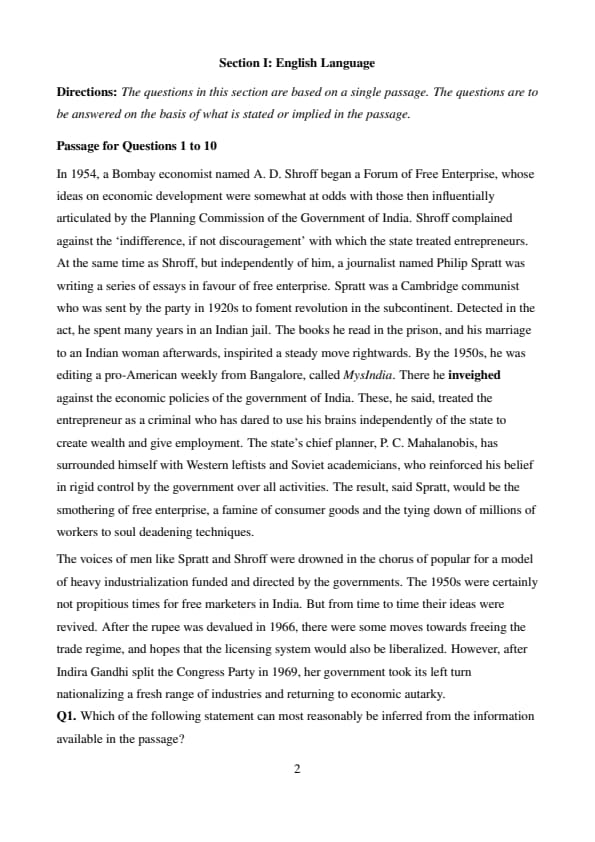
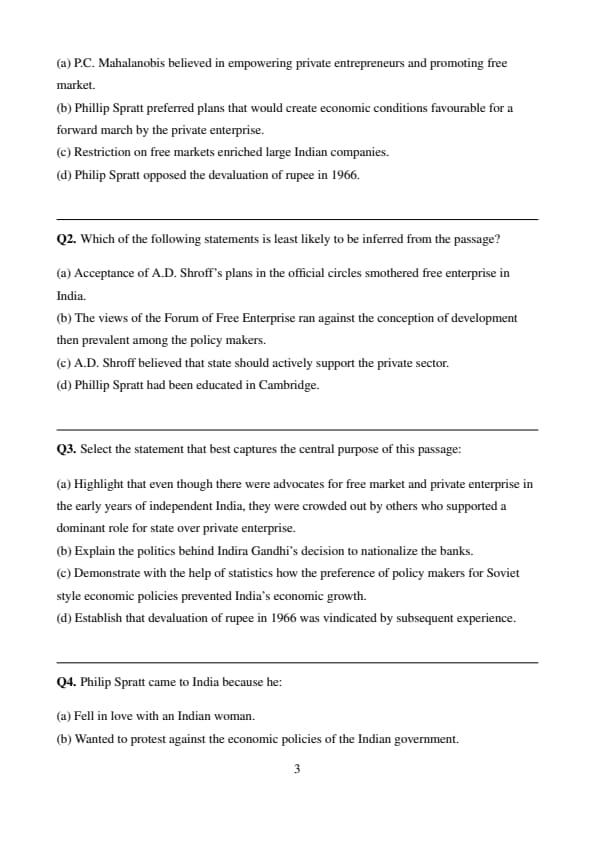
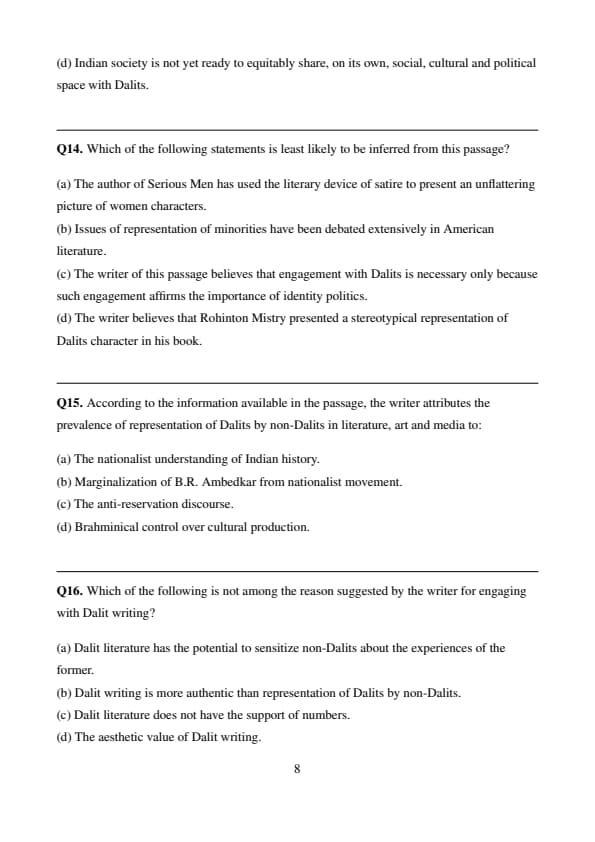
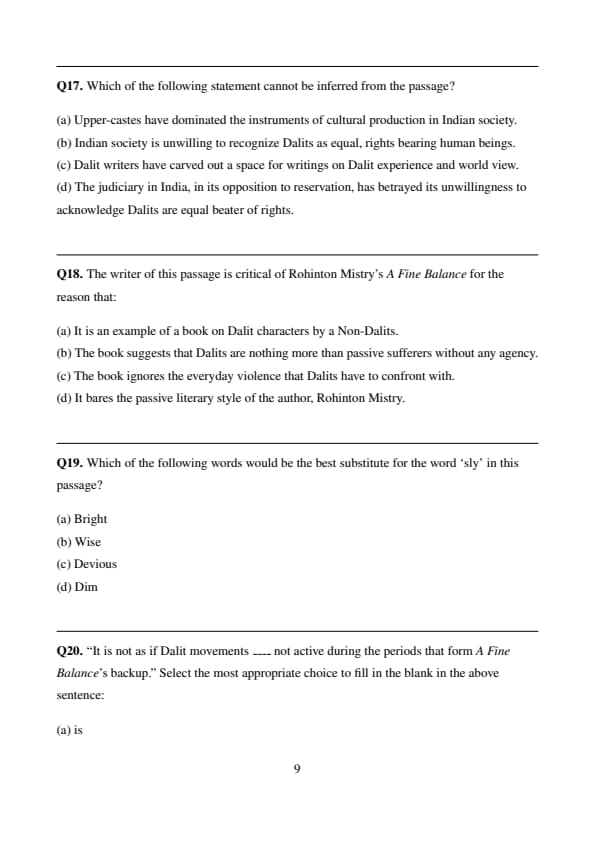
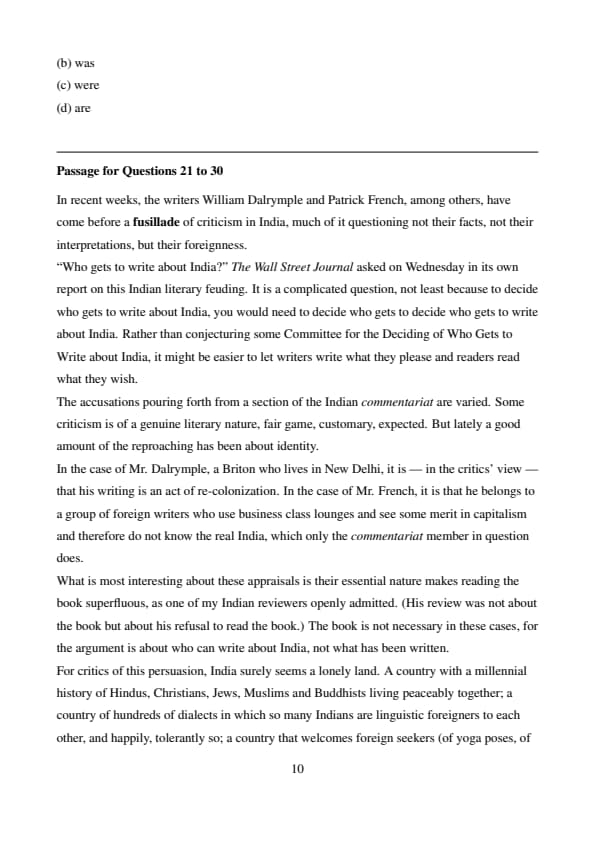
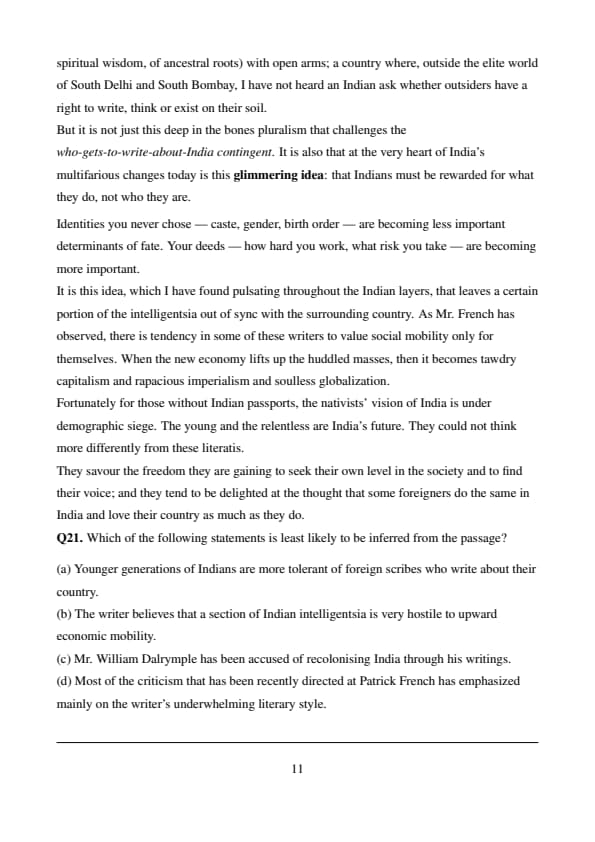
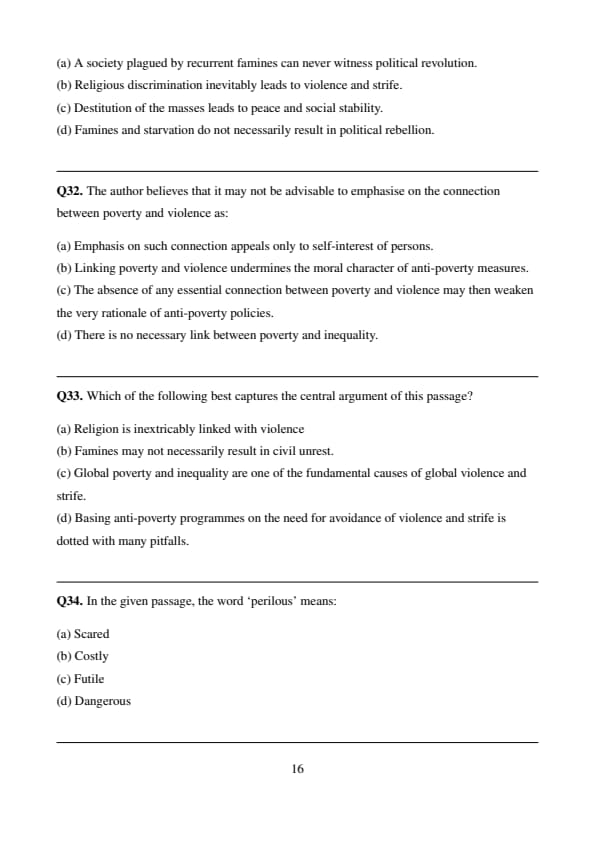
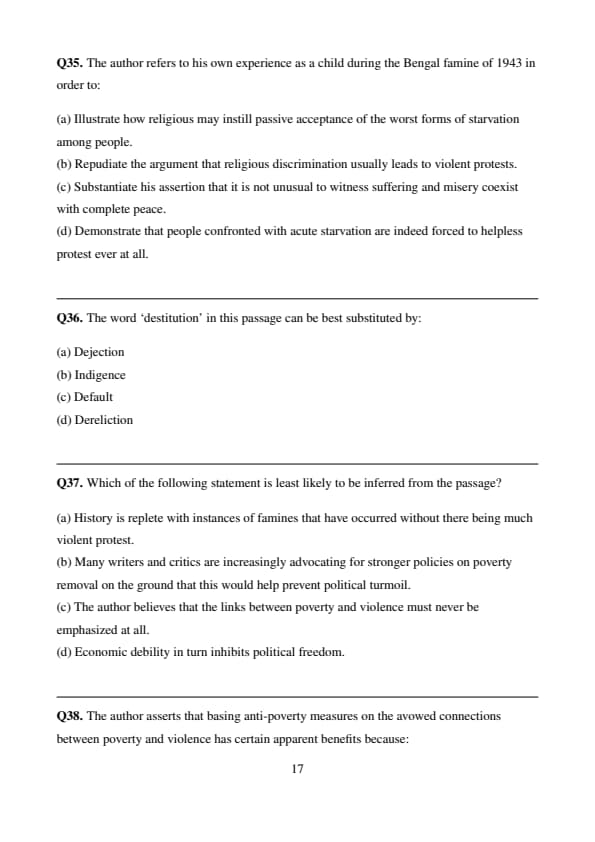
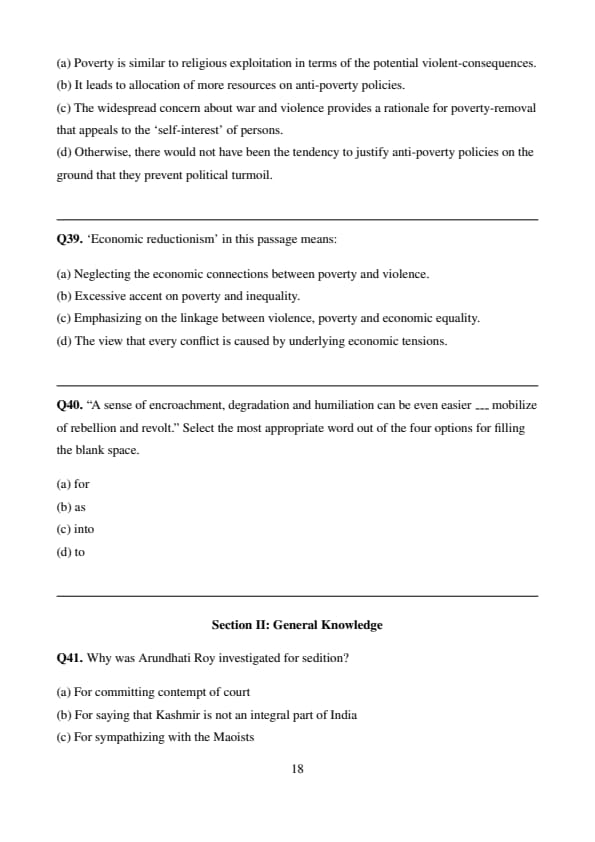
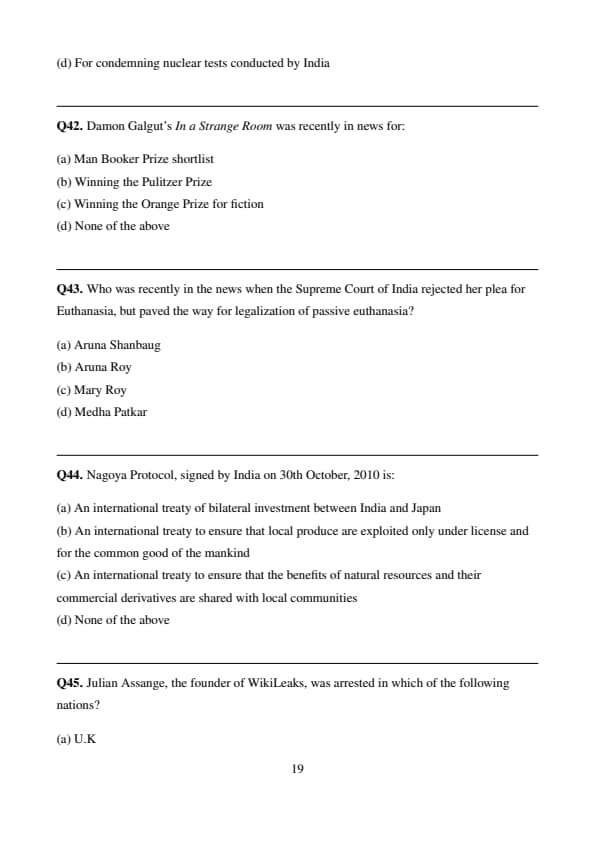
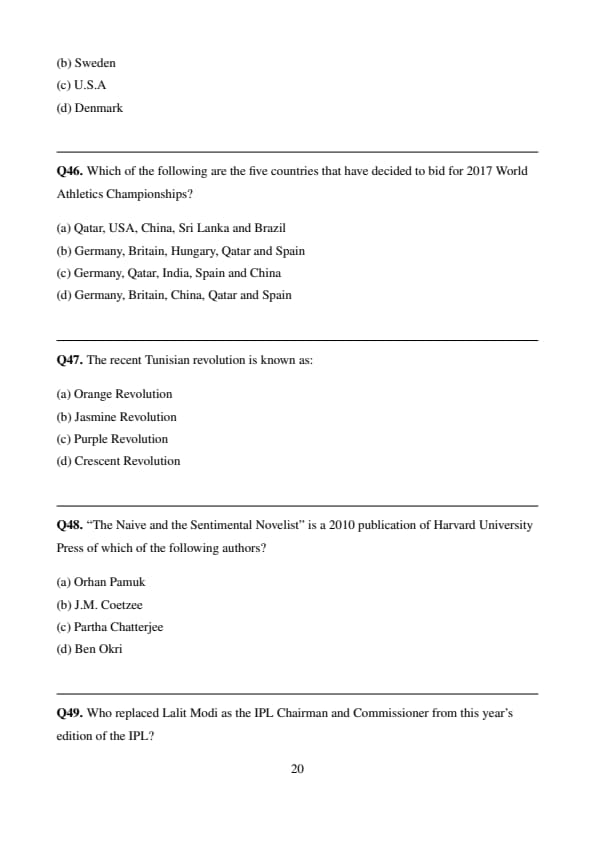
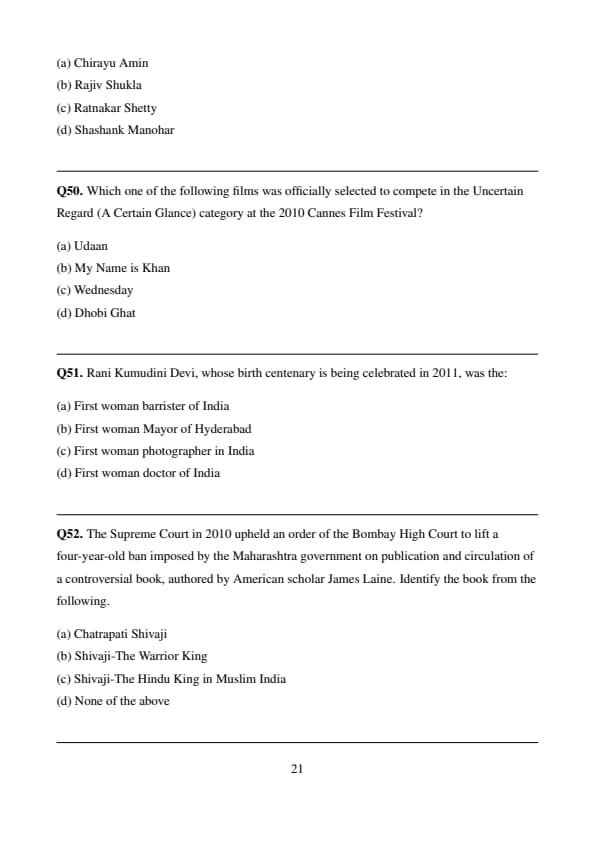
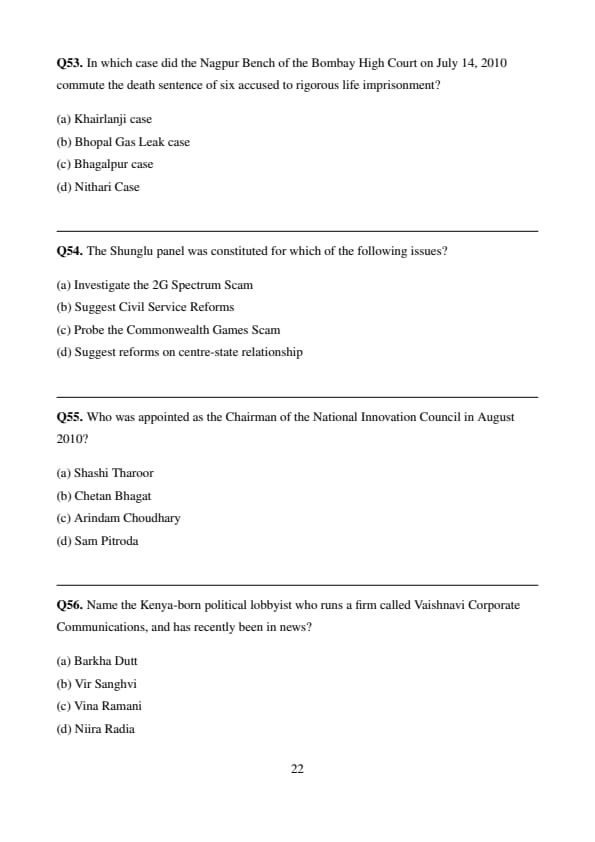
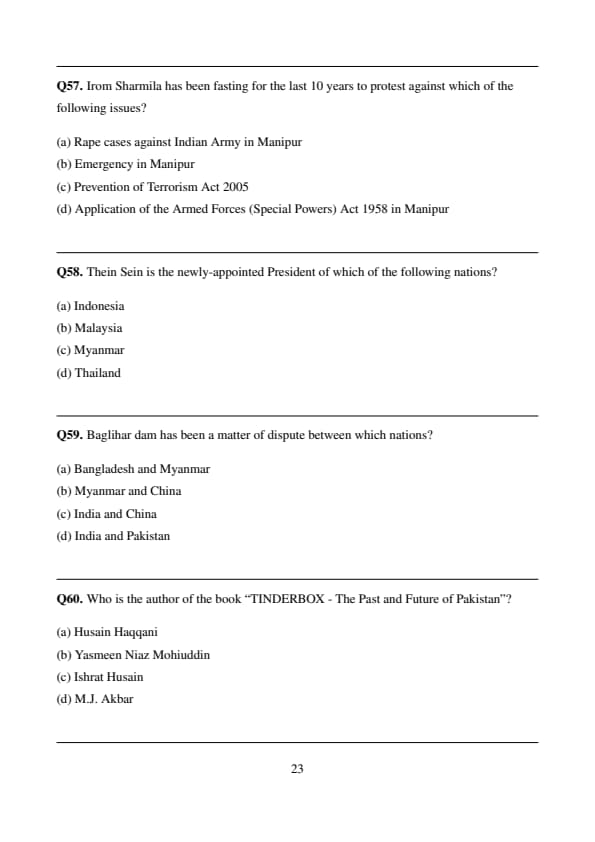
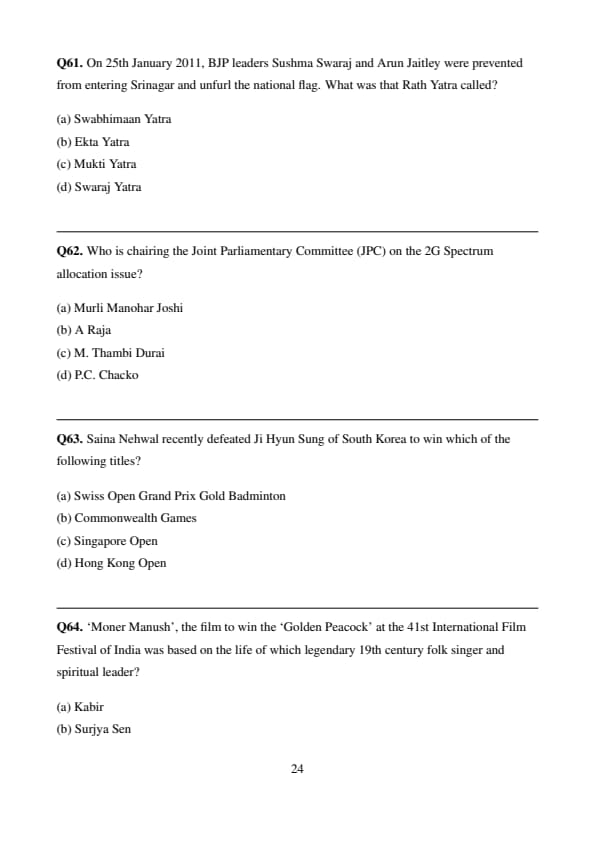
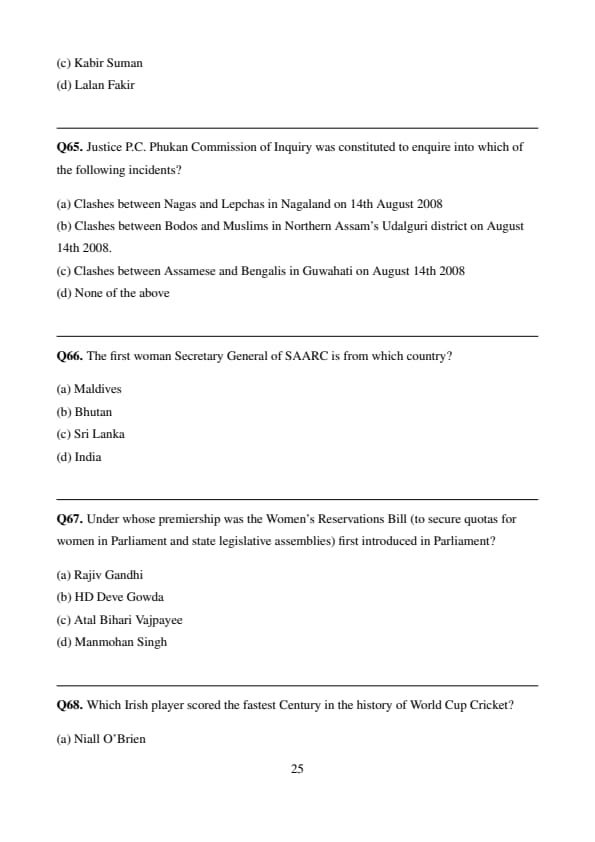
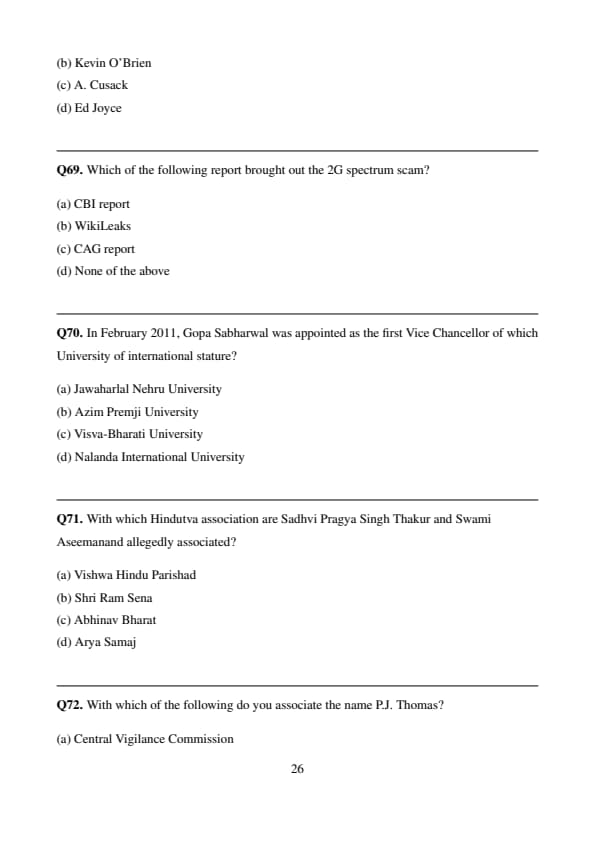
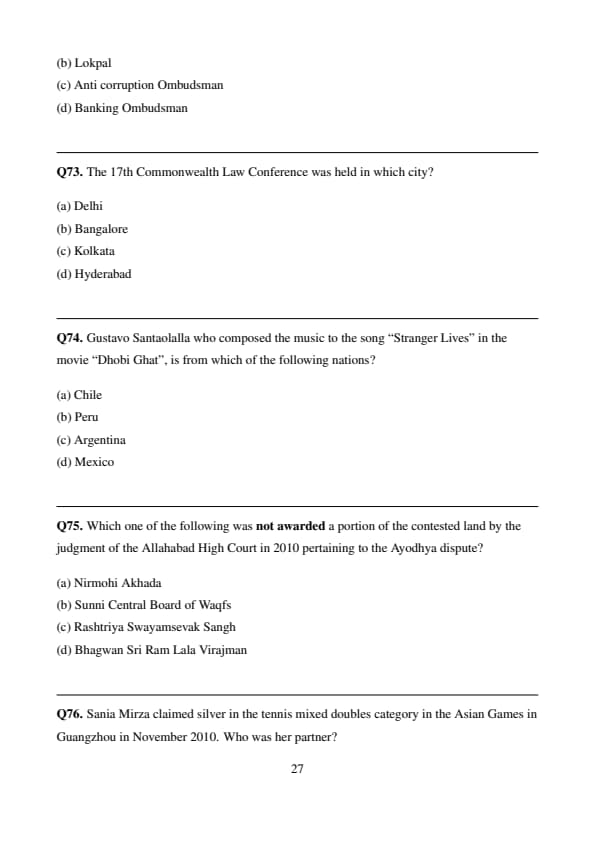
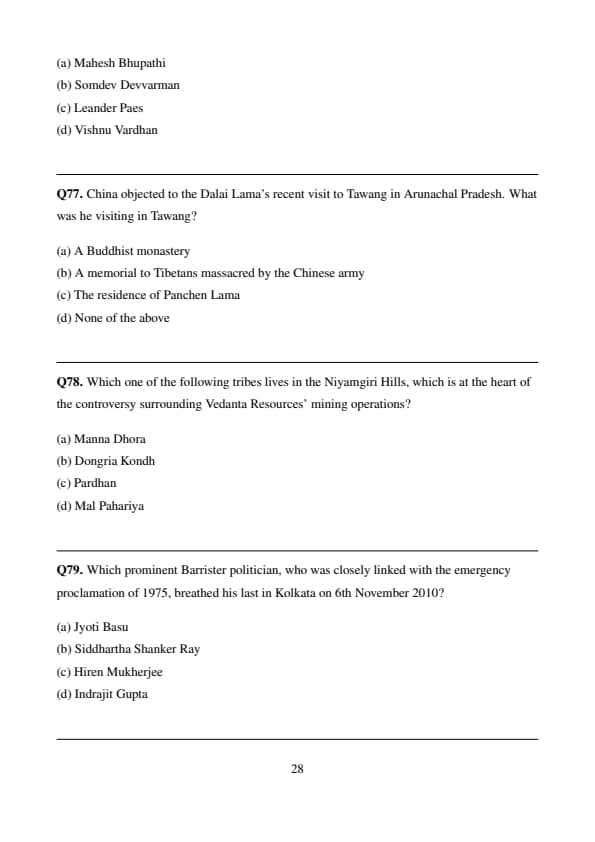
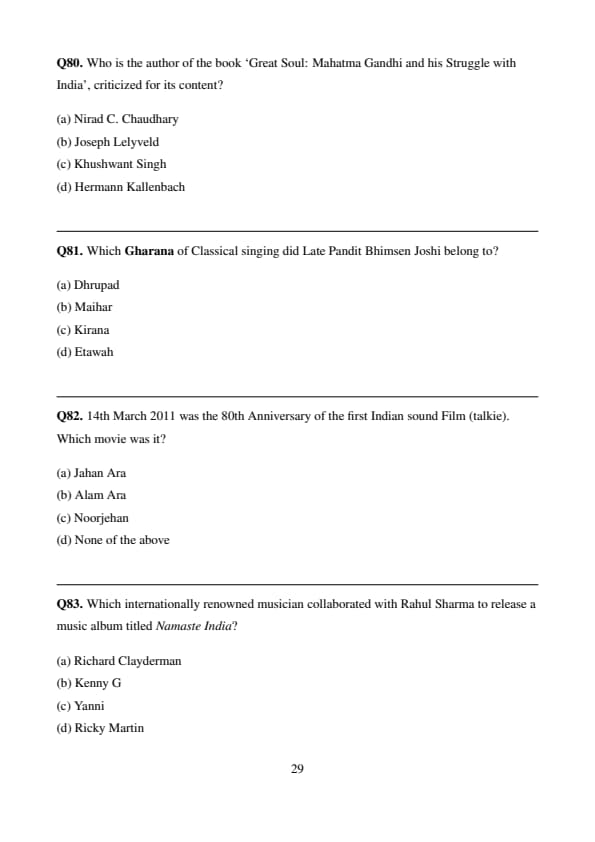
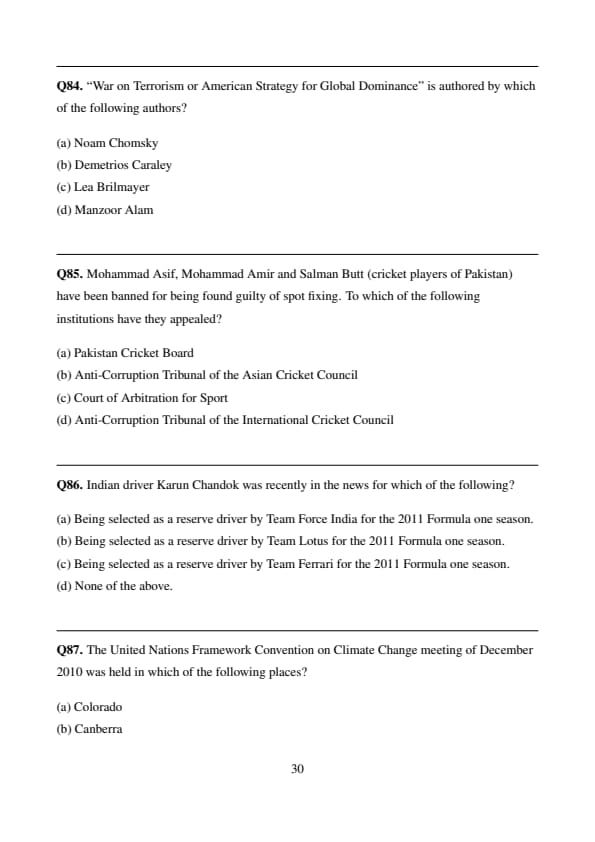
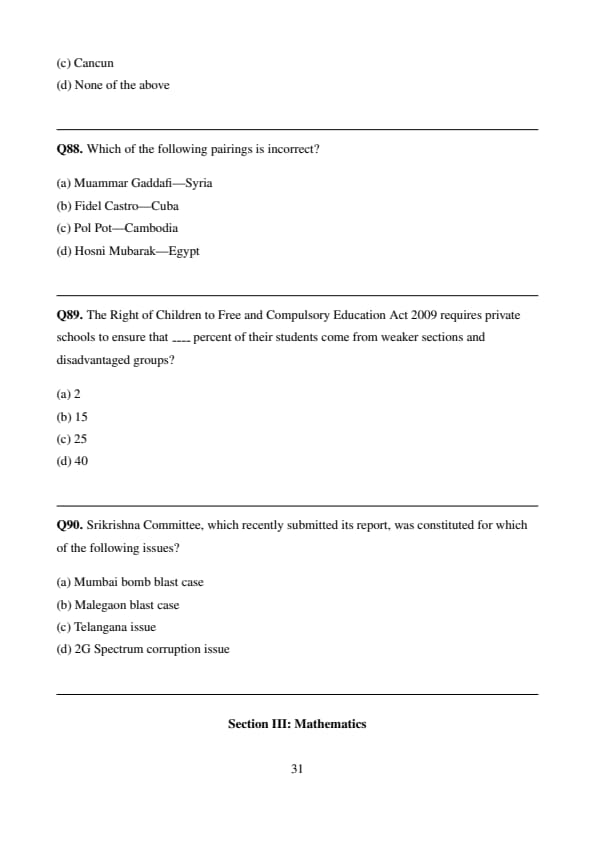
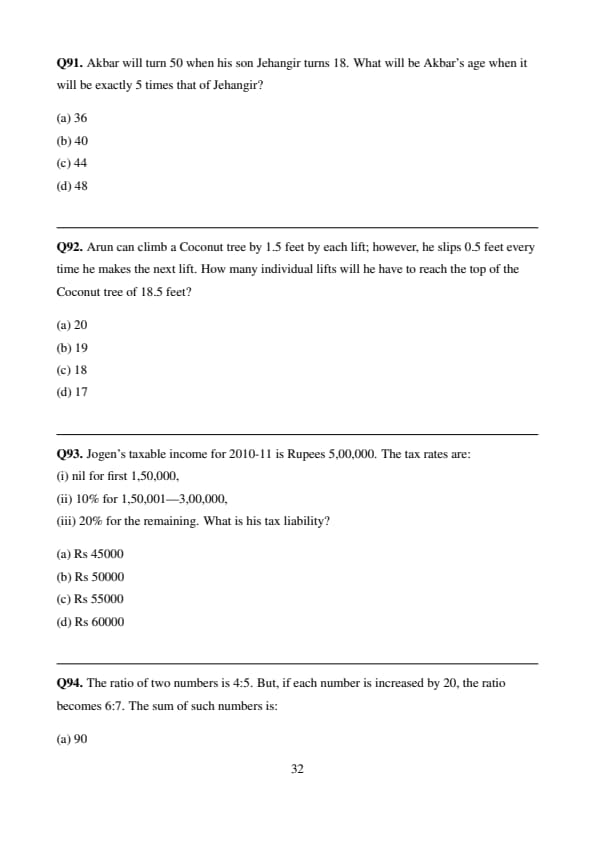
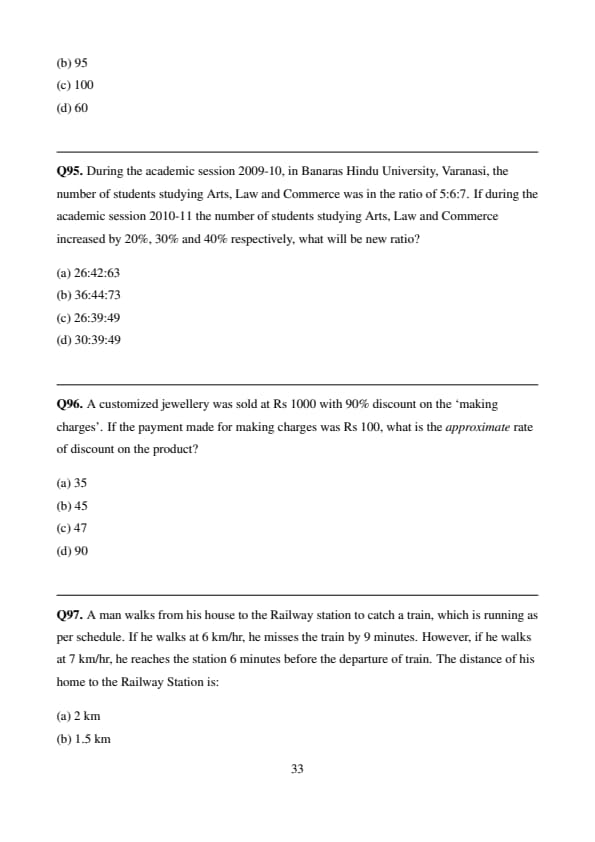
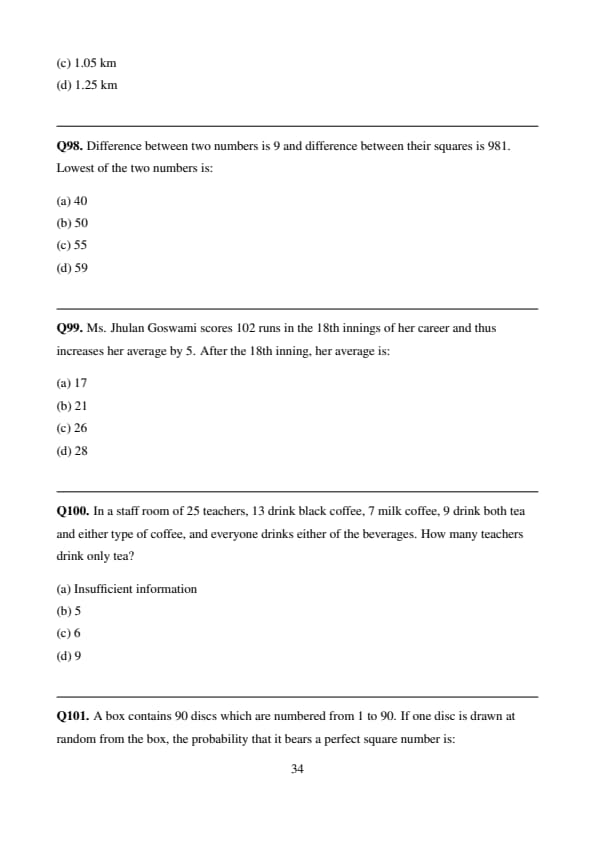
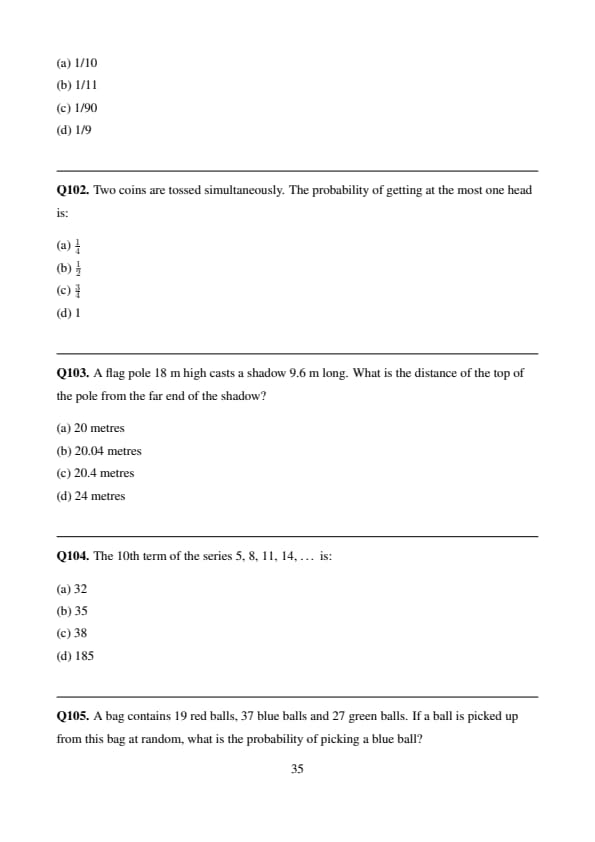
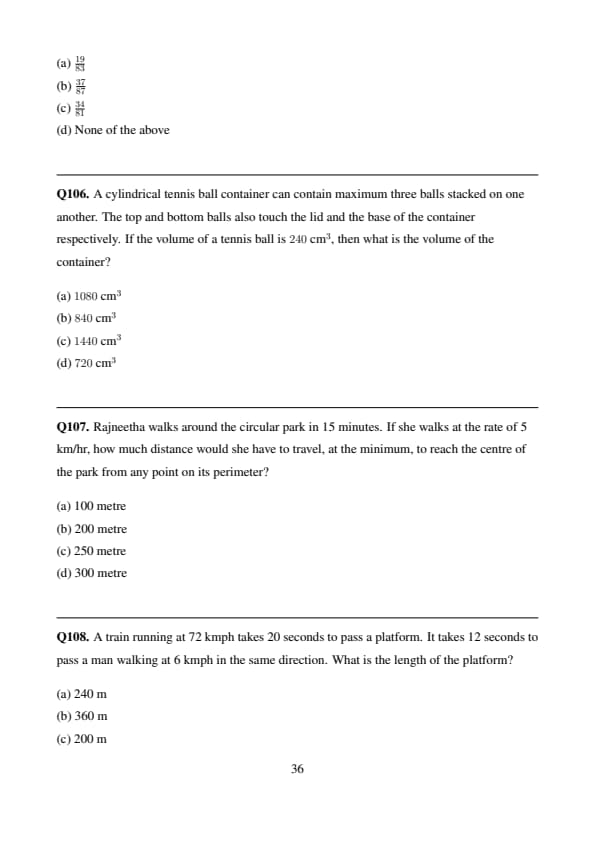
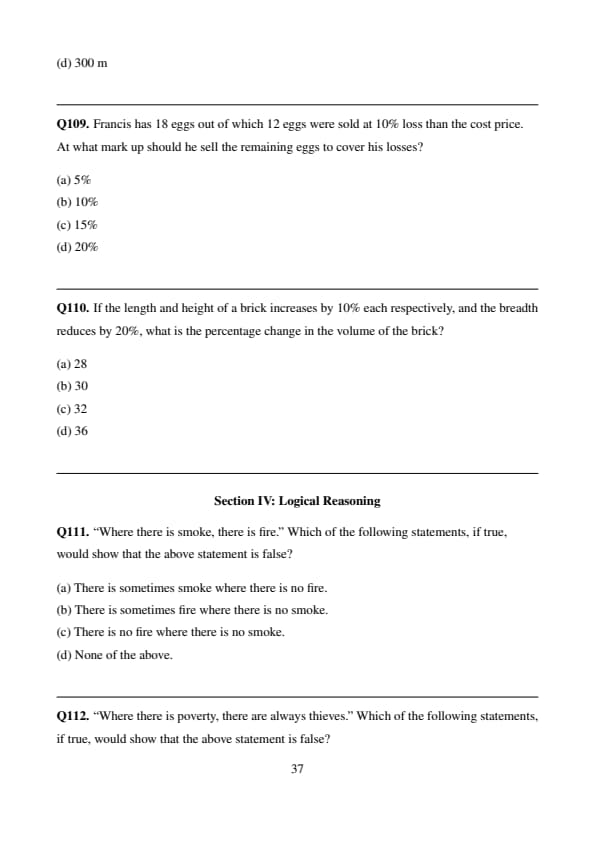
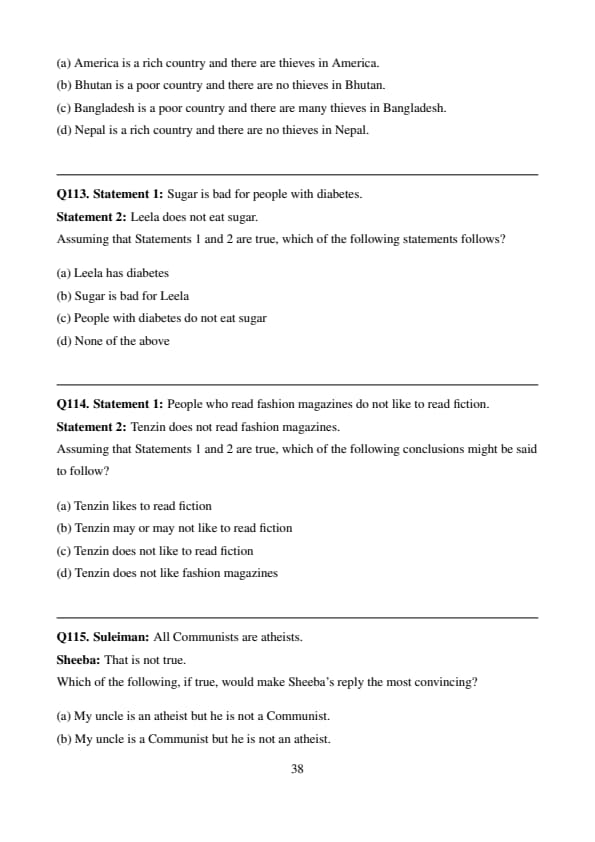
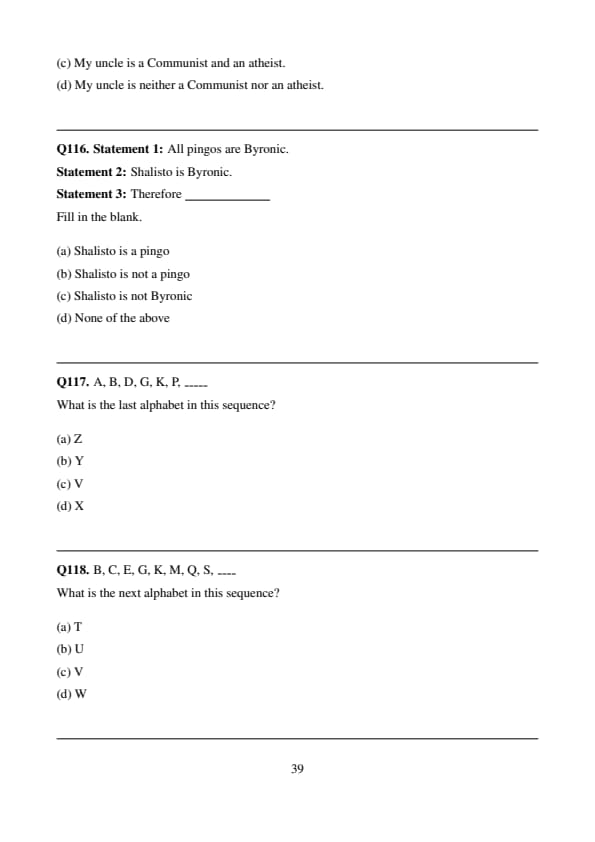
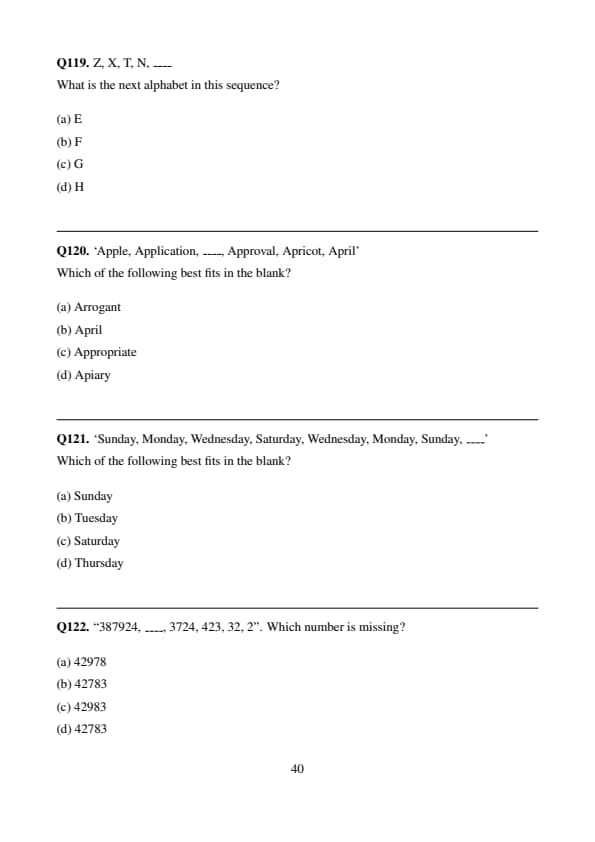
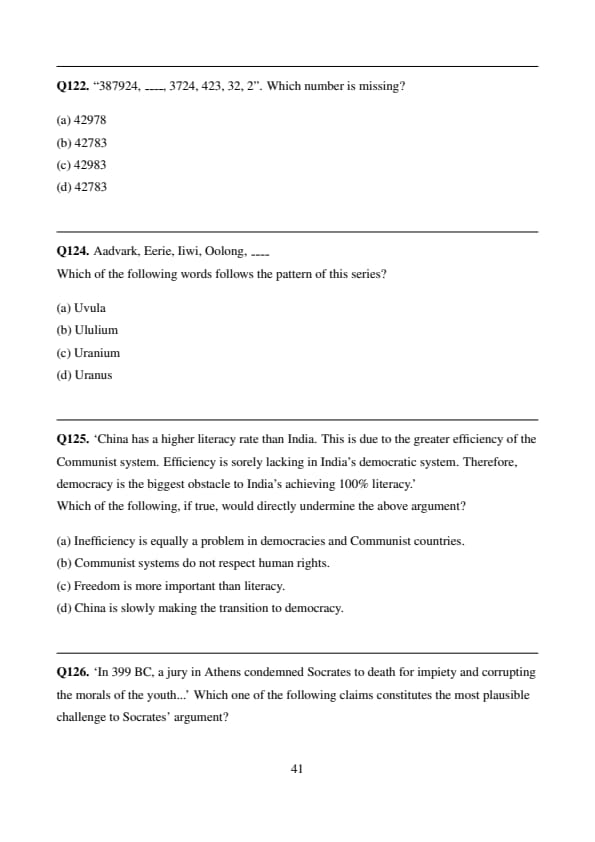
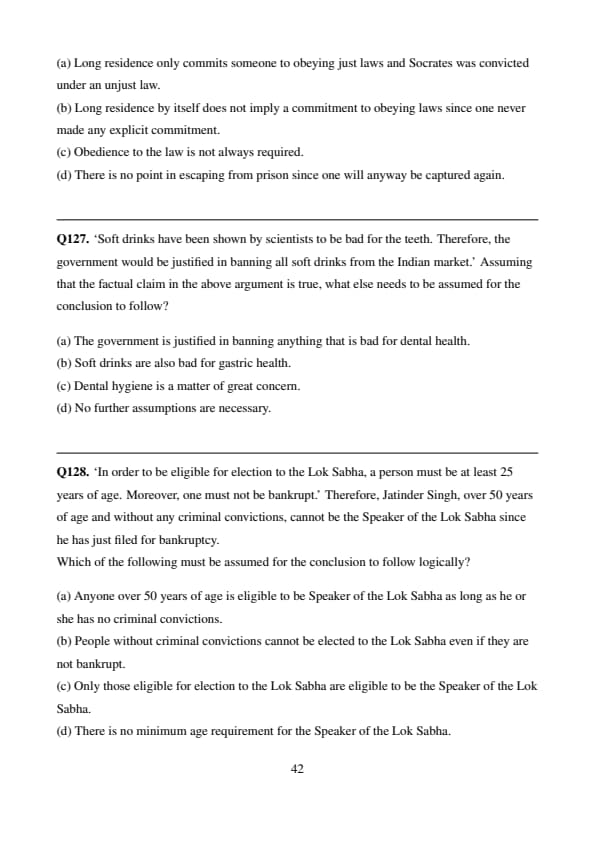
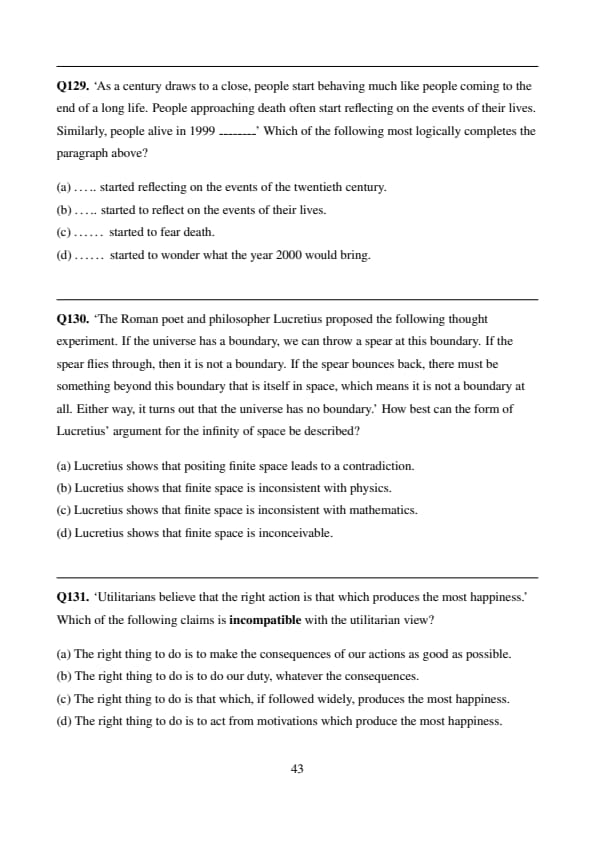
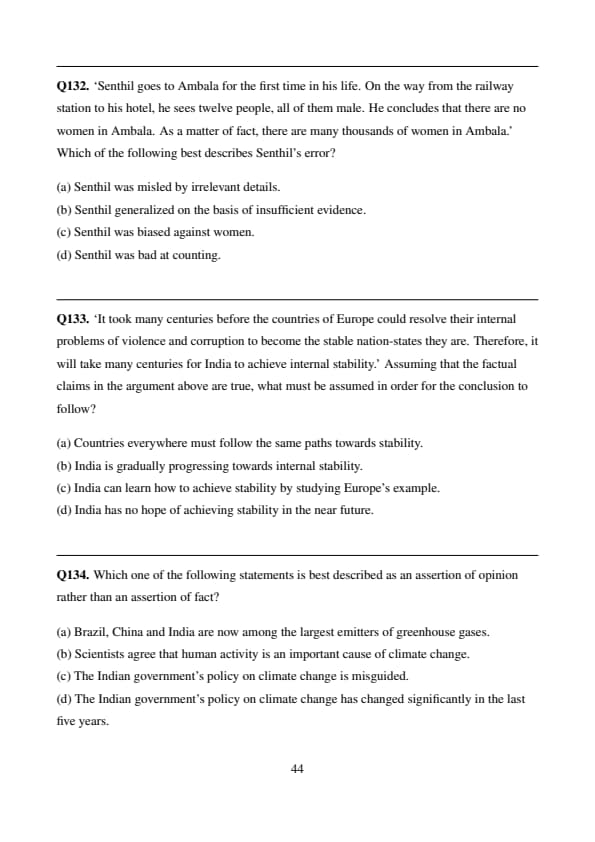
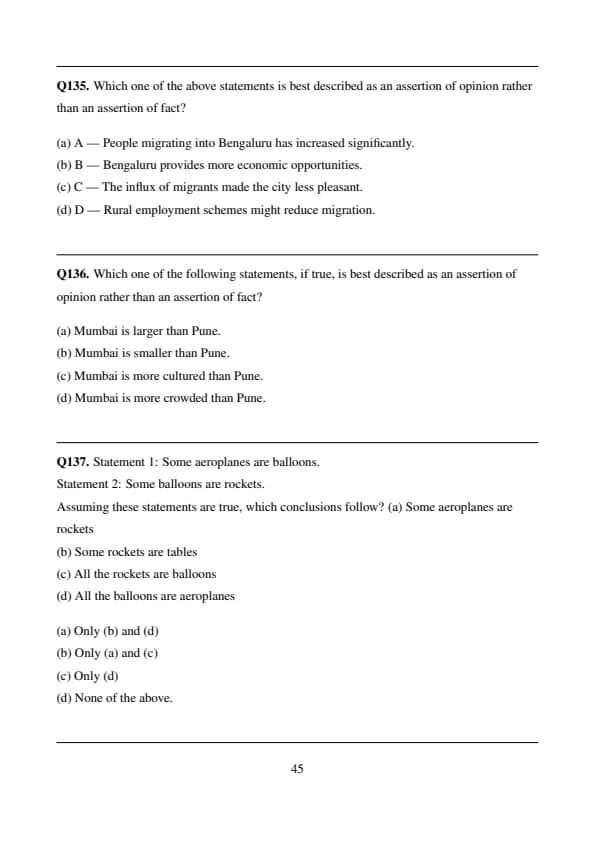
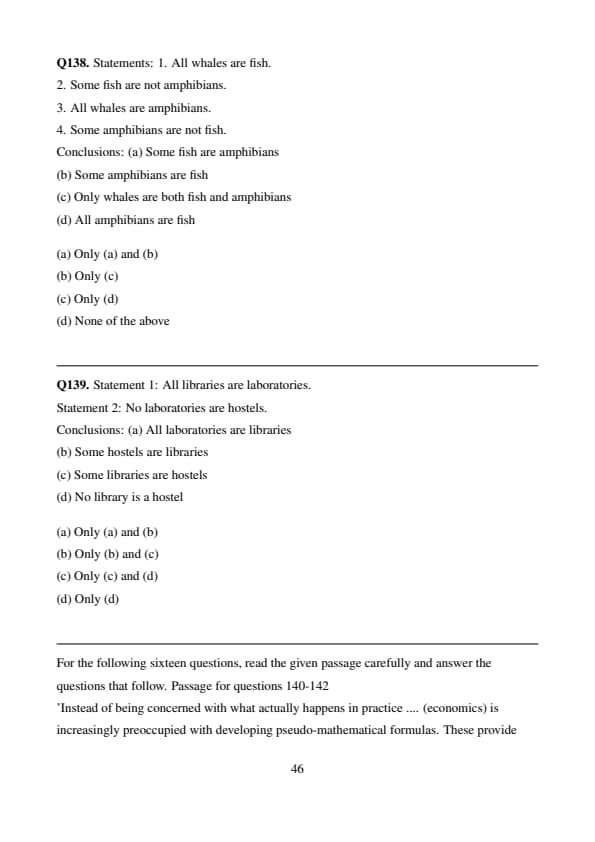
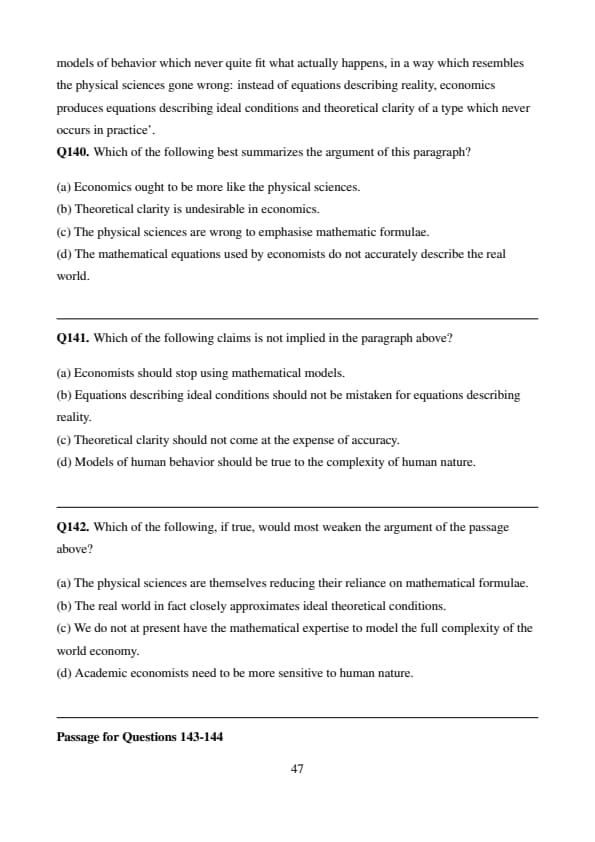
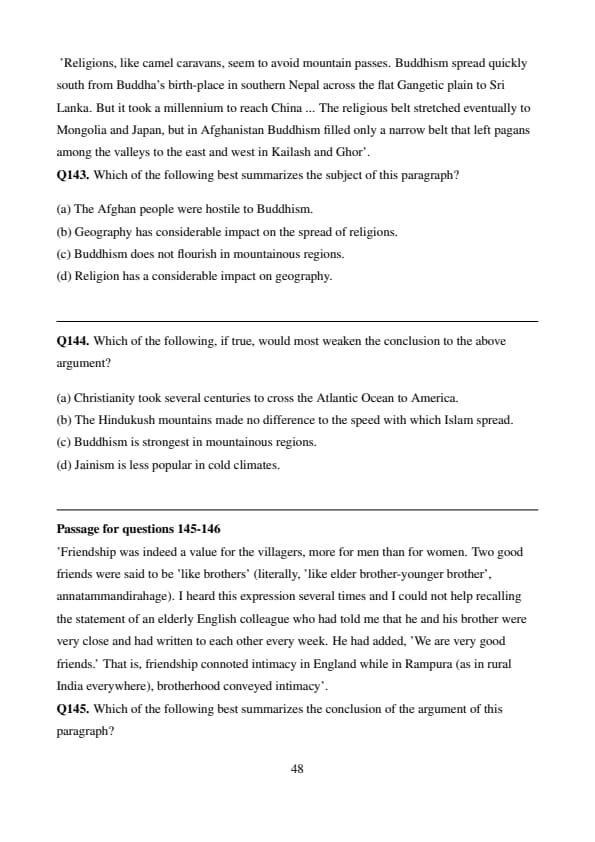
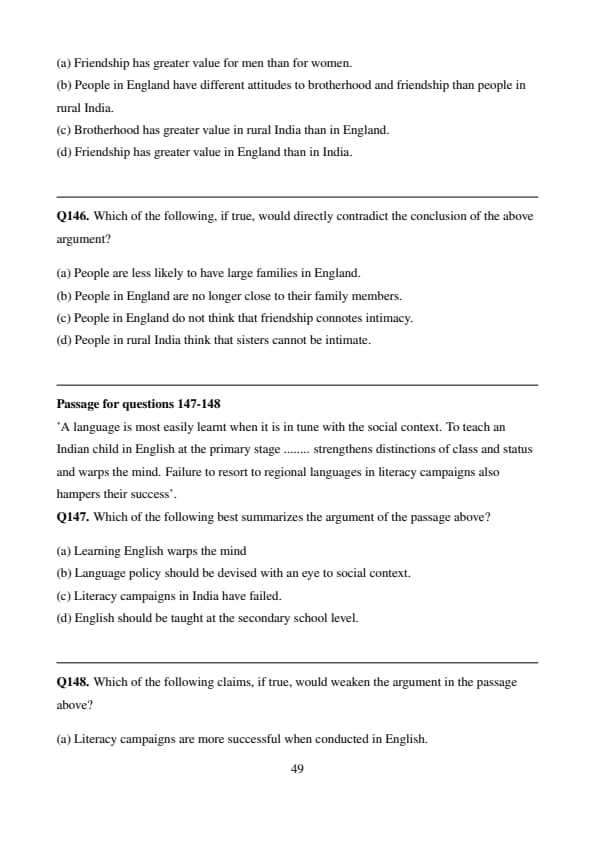
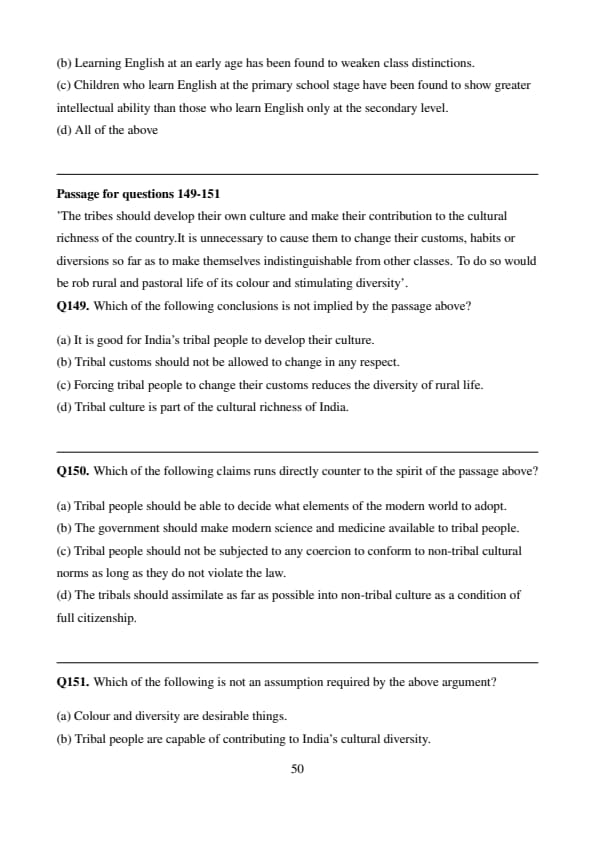
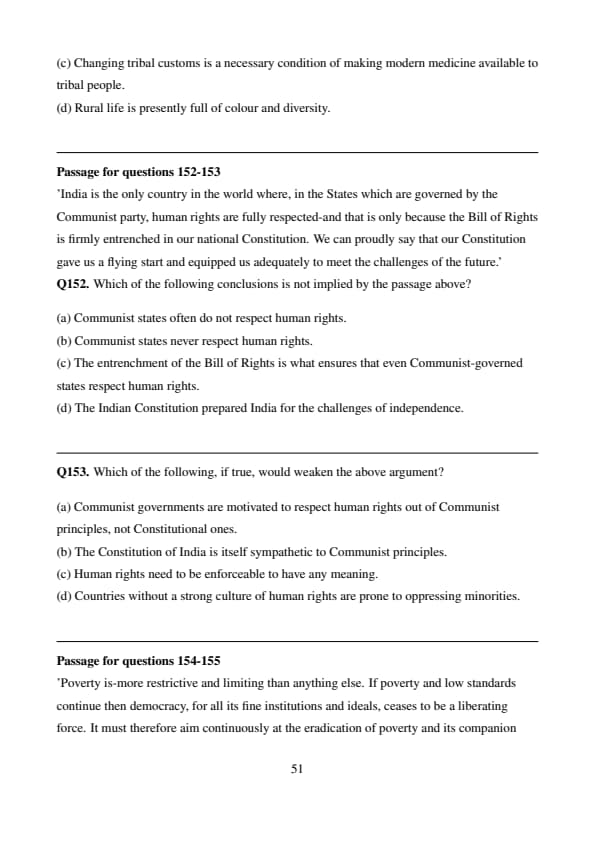
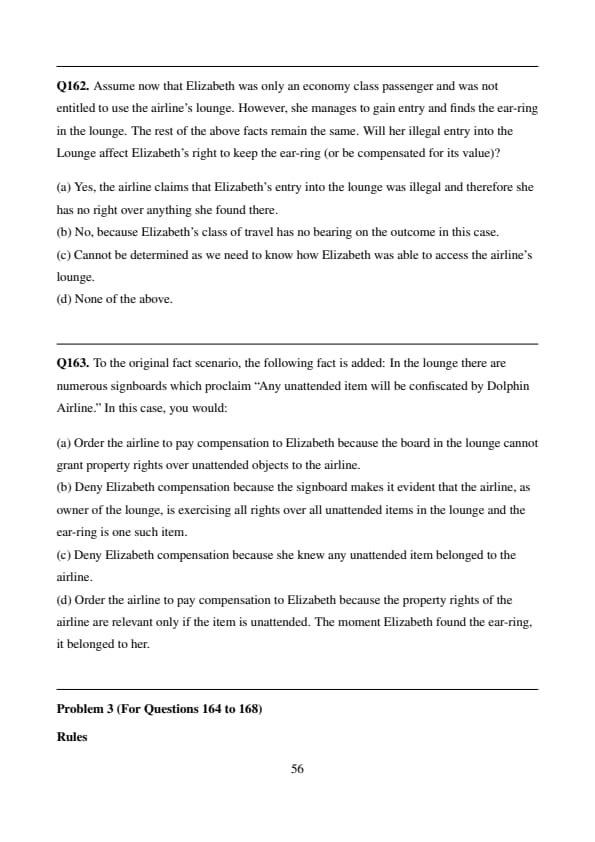
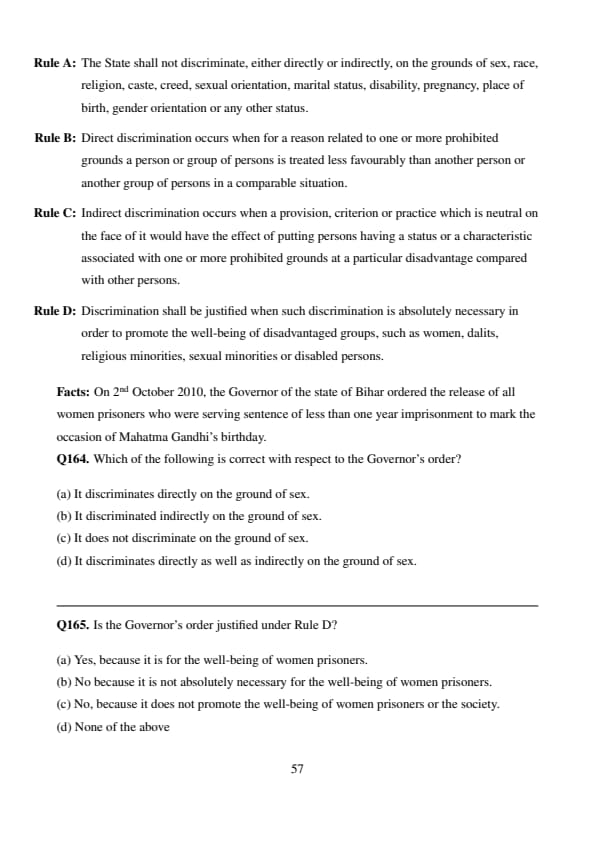
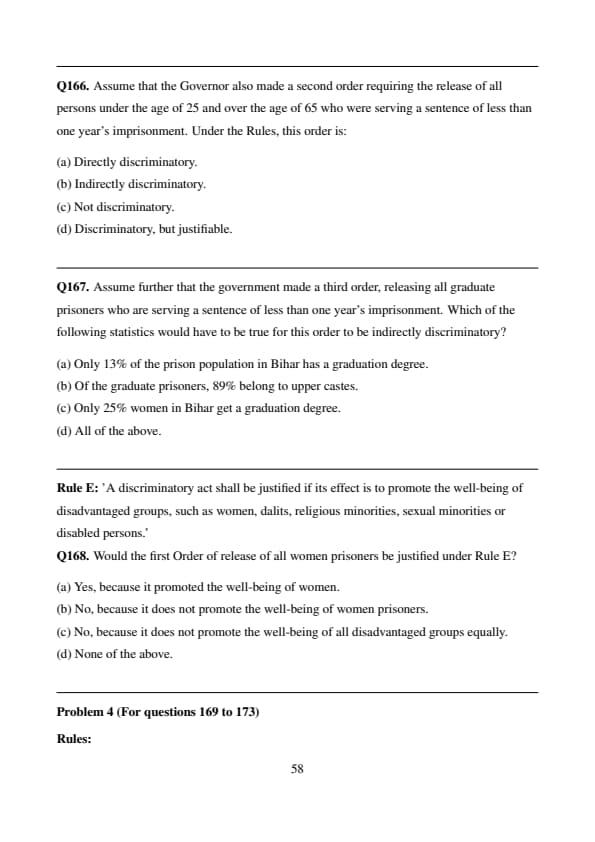
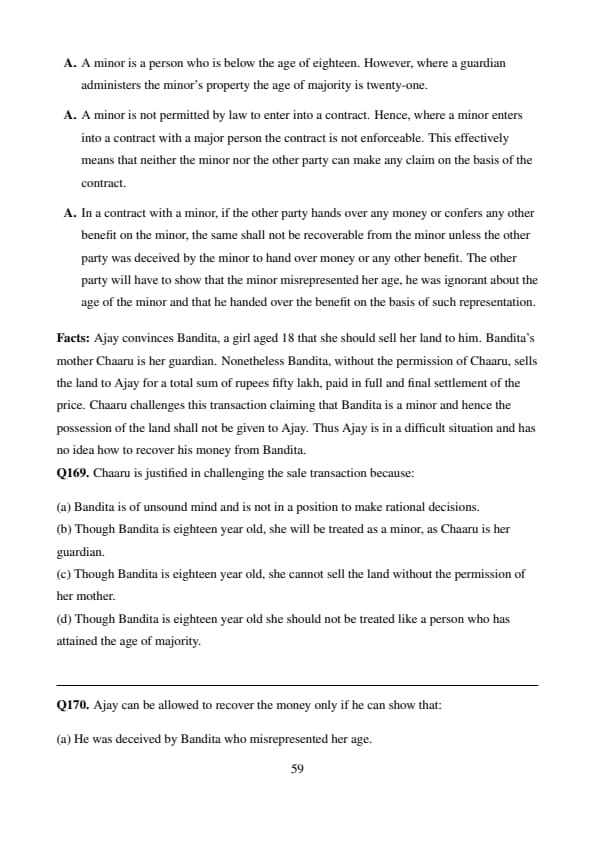
CLAT Previous Year Question Paper with Answer Key PDFs
Collegedunia has provided CLAT Previous Year Question paper pdf with answer key in the links given below:
| CLAT 2021 Question Paper | CLAT 2020 Question Paper | CLAT 2019 Question Paper |
| CLAT 2018 Question Paper | CLAT 2017 Question Paper | CLAT 2016 Question Paper |



Comments